.svg)






Beyond the Bricks
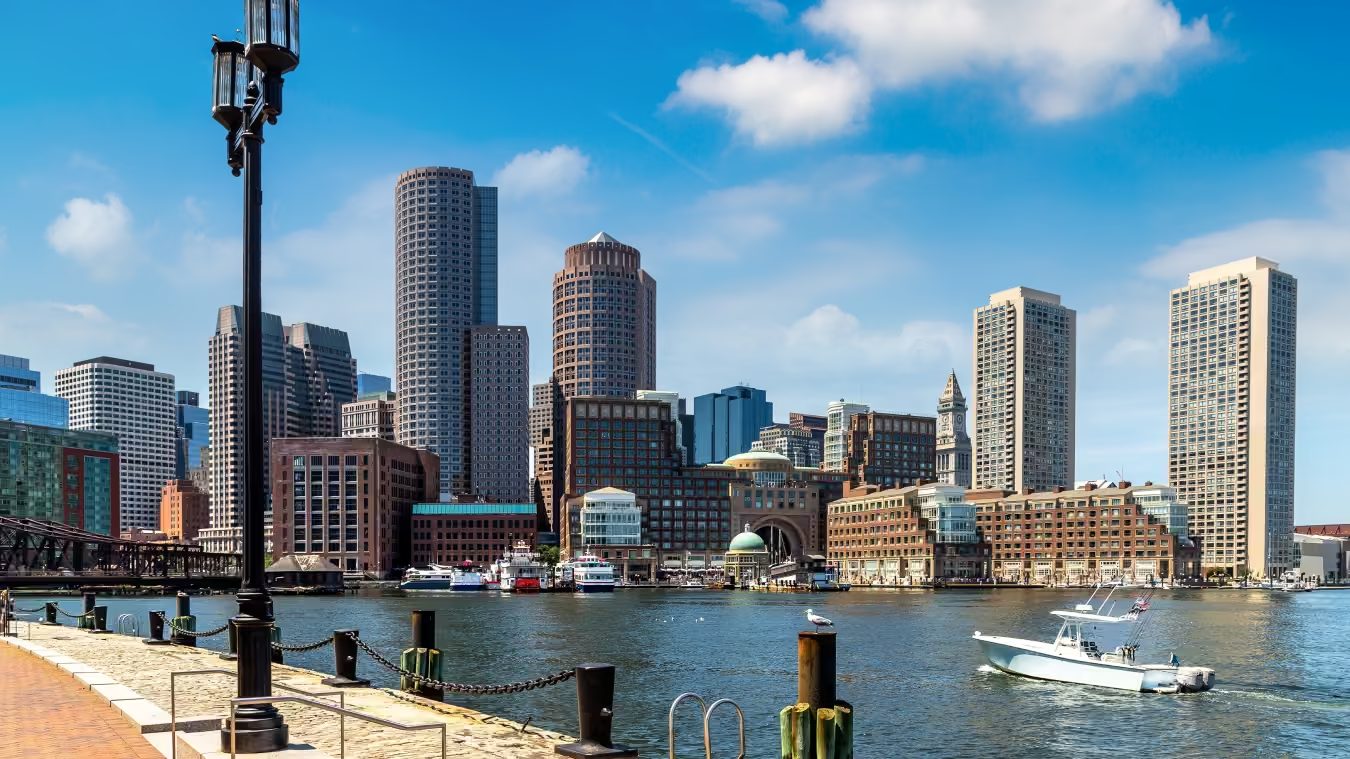
Over the past two decades, Boston's Seaport has undergone a remarkable transformation – evolving from an underutilized stretch of waterfront into one of the city's most vibrant mixed-use destinations. The story of Seaport highlights a critical lesson in real estate development: What you build matters, but creating reasons for people to visit, linger, and return matters just as much.
Using AI-powered location intelligence, we explored Seaport's recent growth and the role of community programming, experiential retail, and other placemaking initiatives in making it one of Boston's premier retail corridors.
Seaport’s Rising Tides
Experiences and community have been central to Boston Seaport’s historic revitalization. In the late 2010s, mixed-use development and entertainment anchors helped to establish Seaport as a leisure-time destination, while initiatives like Snowport, Seaport Sweat, and The Current emphasized neighborhood programming and experiential concepts. During this period, visitation consistently peaked in the summer, which remained the corridor’s primary traffic driver.
And although visits to the corridor fell sharply at the onset of the pandemic, Seaport continued to invest in public spaces. When social gatherings resumed, new mixed-use projects like Harbor Way, The Superette, and The Paseo helped to reinforce Seaport as an experience-driven destination and fuel the neighborhood’s foot traffic rebound.
Since then, expanded seasonal programming has diversified visitation beyond the summer months. The launch of The Holiday Market in 2021 complemented the already popular Snowport activation, creating a new seasonal traffic peak. Since its introduction, December has consistently generated a significant surge in visitation – a pattern that was largely absent before the pandemic.
Still, summer remains Seaport’s peak season, with the fair-weather appeal of its outdoor spaces becoming the backdrop for community and engagement. Seaport’s summer programming continues to expand, and with it, foot traffic to the corridor, which has risen nearly every year since COVID, exceeding pre-pandemic levels in the summer of 2025 and again in May and June 2026. And with new social venues, America 250 events, and World Cup action taking place in Boston and within the Seaport corridor, the stage is set for another robust summer season.
Enhanced Engagement
While some of Seaport's visitation growth can be attributed to the neighborhood's continued real estate development, a closer look at visitor dwell times provides further evidence that foot traffic is being driven by deeper engagement, not just new construction.
Extended visits consistently account for a significant share of Seaport’s overall traffic. Between January and June 2026, out-of-market visits lasting more than 150 minutes (excluding local employees) represented 39.7% of total visits to the corridor, up from 38.4% in 2025. And over the past six months, visits exceeding 150 minutes consistently outperformed overall visits year-over-year (YoY) – suggesting that visitors are becoming more engaged with the area's retail, dining, and public spaces.
Affluent Audience
Extended visits and increasing foot traffic aren't the only indicators of Seaport's upward trajectory. Audience segmentation suggests that the corridor’s experiential recreation and retail are helping to attract an affluent consumer base – a valuable cohort in today's bifurcated economic environment.
Location intelligence combined with the STI: PopStats dataset reveals that the Seaport retail corridor attracts a relatively affluent audience, with a trade area median household income (HHI) of $131.3K over the past six months, compared to $124.8K for the Boston-Cambridge-Newton, MA-NH CBSA overall. But concepts such as Ballers – a new padel and pickleball venue with social events – and The Current, a seasonal retail pop-up along Seaport's main pedestrian thoroughfare, draw even more affluent audiences. The captured market median HHIs for these venues were $143.6K and $144.1K, respectively.
Further analysis using the Spatial.ai: PersonaLive dataset suggests that Ballers and The Current attract distinct mixes of affluent consumers. The Current attracts a substantially larger share of Ultra Wealthy Families (24.5%) than either Ballers (17.5%) or the Seaport retail corridor overall (19.4%). Meanwhile, Ballers over-indexes for Educated Urbanites – affluent young professionals living in dense urban areas – relative to both The Current and the broader corridor. This suggests that Seaport's growing mix of experiential concepts is deepening the corridor's appeal across multiple affluent audience segments.
The Placemaking Playbook
For retail corridors, creating reasons to visit is just as important as creating places to shop.
Boston's Seaport illustrates how placemaking extends beyond development itself. While new retail, dining, and mixed-use projects have reshaped the neighborhood, the data suggests that ongoing investments in programming, public spaces, and experiential concepts have helped transform the corridor into a destination for community engagement.
As Seaport prepares for another busy summer, pairing physical development with curated experiences is likely to sustain the corridor's momentum.
For more insights, visit Placer.ai/anchor.



%20(2).avif)