Skip to Main Content
Thank you! Your submission has been received!
Oops! Something went wrong while submitting the form.
0
0
0
0
----------
0
0
Articles
Article
Introducing Anchored
Rebecca Bleier
Jun 25, 2026
3 minutes

We recently launched a podcast called Anchored – and if you're a frequent visitor of The Anchor, this one's for you. Anchored brings together the sharpest minds in retail, real estate, and consumer behavior for honest, in-depth conversations about where the industry is actually headed. 

Every episode is packed with ideas worth holding onto. Here are a few standout insights from our released episodes in Season 1:

Ep. 1, with Simeon Siegel from Guggenheim Partner

  • There's a structural ceiling on brand growth which most companies mistake for a temporary setback. For example, North American apparel brands tend to hit saturation at around $3 to $4 billion in revenue – so companies need to either accept that plateau and operate a profitable business at that scale, pursue international expansion, or develop a portfolio of brands to grow past a single label's ceiling.
  • The store has the best unit economics in retail, and most brands forgot that. In a store, the customer does the fulfillment themselves by picking the product off the shelf and carrying it home. In e-commerce, the brand absorbs every cost: pick, pack, ship, returns. Cutting out the physical store didn't remove the middleman so much as make brands the middleman – turning what should be a margin game into a volume game.

Watch: The $4 Billion Ceiling: Why Great Retail Brands Stop Growing

Ep. 2, with Karyln Mattson from Leadership Advisors

  • Brand consistency is the price of admission for premium apparel. If a consumer is going to pay more, there has to be a reason – and that reason has to show up the same way in every market, every store, every product. 
  • Physical retail's original purpose was discovery, and most stores have lost that. The internet commoditized browsing, which means the store has to offer a superior sense of discovery and service to justify its existence. The brands winning right now are the ones actively engineering that experience, not just maintaining shelf space.

Watch: Why Retail Needs More Art and Less Science

Ep. 3, with Andrene dos Anjos from FGF Brands

  • Internal structure is retail media's biggest obstacle. Who owns the budget, who owns the screens, and how teams are organized determines whether retail media thrives or stalls. The fragmentation in ownership, and measurement, is what keeps it from scaling as fast as it could.
  • Every retailer is its own channel. A campaign that works at Walmart won't automatically translate to Kroger. The brands that win in retail media are the ones treating each network as distinct, with its own goals, tactics, and measurement approach, rather than repurposing a national campaign across all of them.

Watch: From Hype to Hybrid: The Evolution of Retail Media

Ep. 4, with Andrew Lipsman from Media, Ads + Commerce

  • The physical store is massively undermonetized. Hundreds of millions of shoppers walk stores every week, and almost none of that audience is being monetized. Lipsman sees a path to $20B in in-store retail media over the next decade.
  • Retail media is becoming the backbone of all advertising. Retail data increasingly powers targeting and measurement across display, social, CTV, and more, making it a core layer of the advertising ecosystem. 

Watch: The In-Store Mega Channel

Ep. 5, with Stephanie McMahan from Coca Cola Company

  • Discovery is physical retail's greatest strength – and it’s often overlooked. Shoppers say the store is their #1 place to find new products, but retail professionals consistently rank it near the bottom. That gap is costing brands.
  • Personalization is the next frontier, and it starts with first-party data. The era of guessing what consumers want is coming to an end – real behavioral data tells brands what shoppers actually do. And the winners will use it without being creepy about it.

Watch: Convenience Meets Connection

Ep. 6, with Barrie Scardina, Growth-Oriented Senior Retail Executive

  • Retail spending is bifurcating. The economy is K-shaped: Roughly 10% of affluent consumers are driving about 50% of overall retail spending. And recent sales growth is coming from price and product mix, not more foot traffic.
  • The store has to evolve from transactional to experiential. The winners are turning physical spaces into experiential platforms for hospitality, events, or knowledgeable brand ambassadors – and reimagining shopping centers as mixed-use town centers curated with community data.

Watch: The New Retail Recipe

The common thread: the physical store is worth far more than most brands realize. Listen to Anchored to hear why – and explore more retail insights at Placer.ai/anchor

Article
Chipotle's World Cup BOGO Becomes Its Busiest Day of 2026
Lila Margalit
Jun 24, 2026
2 minutes

Game On!

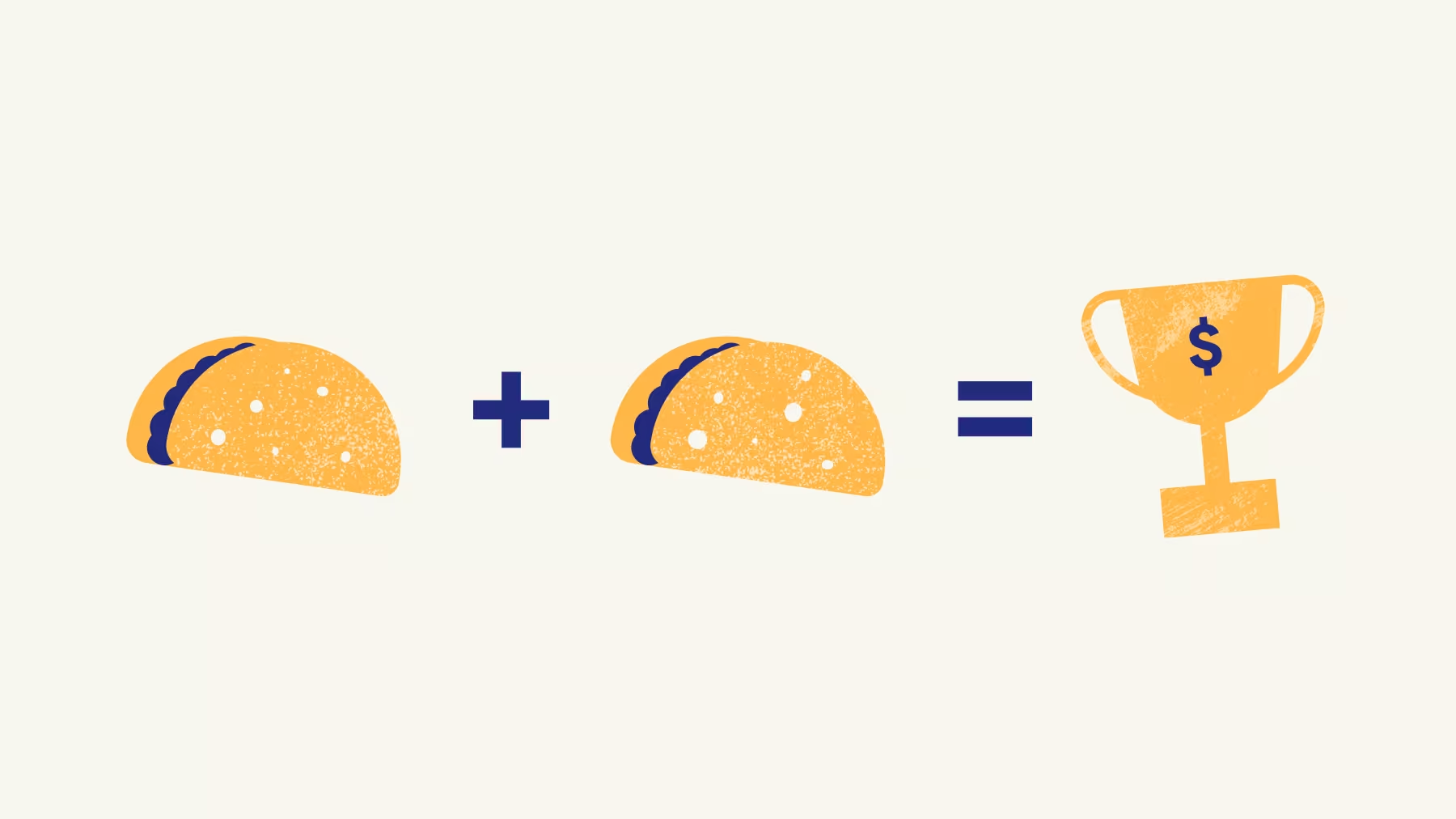
The 2026 World Cup kicked off on June 11th – and so, it turns out, did one of Chipotle's biggest traffic days of the year. To mark the occasion, the fast-casual chain offered a buy-one-get-one entrée deal to anyone who walked in wearing a soccer jersey after 3 p.m. local time.

And the promotion delivered a World-Cup-worthy visit spike. Nationwide foot traffic on June 11 ran 55.5% above Chipotle's 2026 year-to-date daily average – edging out the chain’s March tattoo BOGO, which ran 48.8% above the daily average. A jersey, it would seem, is an easier ask than a tattoo – even a fake one. And unlike the tattoo promotion, which was only available from 3 p.m. to 4 p.m., the World Cup offer ran through closing, giving customers a much larger window to participate. 

The afternoon launch also concentrated demand later in the day. Because the promotion began at 3 p.m., visits between 3 p.m. and 10 p.m. ran 88.0% above the year-to-date average for those hours, significantly outpacing the all-day lift.

Chipotle's World Cup BOGO Drove Its Busiest Day of 2026 So Far

June 11 Total Visits vs. YTD daily Avg

55.5%

June 11 Visits Between 3–10PM vs. YTD Daily Avg

88.0%

Nationwide Daily Visits Since March 1, Indexed to the Year-to-Date Daily Average

The Final Score

Chipotle's World Cup BOGO is a reminder of how much a well-timed, low-friction promotion can move foot traffic – especially one tied to a cultural moment as big as the World Cup. The jersey requirement kept the barrier to entry low, the 3 p.m. start funneled demand into the dinner daypart, and the brand's everyday regulars likely did the rest.

For more data-driven dining insights, visit Placer.ai/anchor.

Article
Why Darden is Outpacing Full-Service Dining in 2026
Lila Margalit
Jun 23, 2026
3 minutes

Darden Restaurants will report year-end results on June 25, closing the books on a fiscal year in which the Olive Garden parent raised its guidance even as much of casual dining contended with cautious consumers. What's powering the outperformance – and which of Darden's banners are doing the heavy lifting? We dove into the data to find out.

Leaving the Category Behind

Visits to Darden's brands climbed 2.4% year over year (YoY) in Q1 2026 (January through March), even as traffic to the wider full-service restaurant category fell 1.3%.

And the gap doesn't just reflect Darden's expanding fleet. Average visits per location rose 0.5% YoY across the company's brands while declining 0.5% for the category as a whole – suggesting Darden is driving incremental demand at existing restaurants, not just adding new ones. The pattern echoes the results posted by the company last quarter, when blended same-restaurant sales beat the casual dining benchmark by 540 basis points.

Darden Outpaces the Full-Service Restaurant Category in Q1 2026

Visits and Average Visits Per Location, Q1 (Jan.–Mar.) 2026 vs. Q1 2025

Darden Brands Year-over-Year, Q1 2026 vs. Q1 2025
Total Visits
2.4%
Avg. Visits per Location
0.5%
Full-Service Restaurants Year-over-Year, Q1 2026 vs. Q1 2025
Total Visits
1.3%
Avg. Visits per Location
0.5%

Steak and Breadsticks

So what is fueling Darden’s success?

Among the company’s two largest brands, LongHorn Steakhouse has been the clear pacesetter, posting YoY same-store visit growth in every month of 2026 so far. The brand is likely benefiting from America's protein obsession, with meat demand climbing as high-protein diets go mainstream. And with grocery-store beef prices elevated, a steakhouse dinner may feel like particularly good value – especially as Darden has deliberately kept LongHorn's menu pricing below inflation while continuing to invest in food quality. That pricing gap may begin to narrow, however, as management has indicated that menu price increases are expected to move closer to inflation levels this quarter.

Olive Garden's performance, by contrast, has been more volatile. Some of the brand’s YoY visit fluctuations likely reflect calendar effects – March 2026 had one fewer Saturday than March 2025, while May benefited from an extra Sunday. But the flagship is also doing plenty right. Its springtime Buy One, Take One promotion and lighter-portion menu options have helped sharpen its value message, likely contributing to May's return to growth. And the brand delivered when it mattered most: On Mother's Day – one of the biggest dining-out occasions of the year – average visits per location to Olive Garden jumped 4.1% YoY, even as full-service restaurant visits rose just 2.2%.

Momentum at the High End

Elsewhere in Darden's casual dining portfolio, Chuy’s slipped in four of the first five months of 2026, underscoring the challenges facing full-service Tex-Mex operators amid intense competition from fast-casual alternatives. Cheddar's Scratch Kitchen, meanwhile – the company's deepest value brand – generated same-store visit growth in four of the first five months of 2026, including a 3.1% increase in May. While some of that performance likely reflects easier comparisons, it also underscores the continued appeal of clearly differentiated value-oriented dining.

Darden's strongest momentum, however, is coming from the upper end of its portfolio. After entering fiscal 2026 with same-restaurant sales declining amid soft business travel, Darden’s fine-dining segment swung to 2.1% growth by last quarter on private dining gains and Ruth's Chris Steak House's three-course fixed-price menu. And visit data suggests this recovery continued into the spring, with May benefiting from a strong Mother’s Day across the segment: Average visits per location to The Capital Grille surged 16.7% YoY on the holiday, while Ruth’s Chris and Eddie V’s posted gains of 7.9% and 5.9%, respectively.

The Capital Grille and Eddie V's Lead Darden's Smaller Brands

Monthly Same-Store Traffic to Darden Chains Compared to Previous Year

Upscale casual Yard House also performed well – strength management has credited to the brand's "socially energized bar" and distinctive menu, which position it as a social gathering destination rather than just another dinner stop.

Winning at the Edges

Darden's results highlight the advantage of a diversified portfolio built around distinct consumer occasions and value propositions. Cheddar's owns everyday affordability, LongHorn serves a juicy steak at an accessible price point, Yard House anchors a night out, and the fine dining banners serve as go-to destinations for life’s celebrations. Olive Garden, meanwhile, competes in the most crowded part of the casual dining market, and its more uneven performance reflects that. But the flagship's value plays – and its standout Mother's Day – suggest it is finding its footing in the middle, too.

Can Darden's distinct brand positioning continue to drive outperformance as 2026 unfolds?

Check back with Placer.ai/anchor for the latest traffic insights.

Article
State-Level Retail in May 2026: Mapping the Impact of Gas Prices and Severe Weather
Ezra Carmel
Jun 22, 2026
3 minutes

On a national level, retail foot traffic held notably steady in May 2026. However, even relatively small fluctuations at the state level tell a story of two external pressures – a sharp run-up at the pump and a destructive mid-May storm outbreak – shaping consumer behavior.

Traffic Reflects a Cautious Consumer

The chart below shows year-over-year (YoY) visits to overall retail by state in May 2026. And while performance varied somewhat by state,all changes remained within the narrow range of ±2 percentage points. Nationwide, overall retail sat relatively flat at 0.3% YoY – stability that suggests that consumers are closely managing their budgets amid a challenging economic backdrop

Still, even modest year-over-year swings in foot traffic highlight the influence of two state-level pressures: ongoing gas price increases and adverse weather conditions.

Retail Traffic and the Path of Fuel Inflation

Gas prices continued to climb sharply in May 2026, and the map above suggests a relationship between YoY price hikes at the pump and retail visitation patterns. Regions that experienced the largest YoY increases in gas prices, such as the Midwest and Ohio – where prices climbed by over 45% and 50%, respectively – were often those that saw retail foot traffic soften. This could at least partly reflect consumers adjusting their spending to offset higher fuel costs. 

Meanwhile, the regions with the lowest average gas price, the Gulf Coast and Lower Atlantic, or the West Coast – which experienced the smallest YoY price increase of (only) about 30% – for the most part posted positive YoY retail foot traffic. This trend held even as average gas prices along the West Coast reached over $5.5 per gallon – the highest in the country – suggesting that changes in gas prices had a greater impact on consumer traffic patterns than the absolute price level itself. 

Severe Weather Weighed on Consumer Mobility

But fuel costs were only part of the retail foot traffic story in May 2026. Across the Midwest and parts of the Mid-Atlantic, a multi-day severe weather outbreak brought tornadoes, large hail, and flash flooding to the region. The same weather system also contributed to wildfire activity across southwestern Kansas and parts of Colorado, Oklahoma, and the Texas Panhandle. 

As the map above shows, the band of declining retail visits running through the Midwest, Ohio Valley, and Mid-Atlantic – closely tracking the path of these storms. This alignment suggests that severe weather amplified existing economic headwinds and gas price sensitivity, limiting consumer movement in affected markets.

May In a Nutshell

May's retail traffic patterns suggest overall consumer caution with regional nuance influenced by varying degrees of gas price pressures and local weather events.

What will retail foot traffic look like in the weeks ahead? Visit Placer.ai/anchor to find out.

Article
What To Expect From Prime Day 2026? 
Shira Petrack
Jun 18, 2026
4 minutes

Setting the Stage for Prime Day 2026

Amazon recently announced that Prime Day 2026 will take place from June 23rd to 26th, marking an earlier-than-usual start to the summer promotional season. While Prime Day itself is primarily an online event, retailers with a significant brick-and-mortar presence often join the fray with competing sales, either during Amazon's event or in the lead-up to Fourth of July promotions. So what does retail foot traffic reveal about the state of the consumer heading into this key shopping period? We dove into the data to find out.

Consumers Face Headwinds but Remain Engaged

Despite ongoing headwinds, foot traffic to major retail chains for the first five months of the year stayed in positive territory relative to 2025, a notable showing given the macroeconomic uncertainty weighing on consumer sentiment. And even though the pace of growth has cooled since March – likely due in part to the sharp increase in gas prices – the direction never turned negative.

That consistency matters heading into Prime Day. Even as growth moderated through the spring, audiences continued to choose physical retail, suggesting that in-store visits are holding up rather than ceding ground to online channels. For retailers planning competing summer promotions, the steady baseline of positive year-over-year (YoY) traffic suggests that demand is present, and the opportunity lies in converting resilient visit volume into stronger spend during the promotional window.

Longer-Distance Retail Visits Quickly Recovered After a March Pullback

Segmenting consumer traffic by driving distance shows that even the most acute headwind facing consumers right now – elevated gas prices – has done little to fundamentally alter shopping behavior. Even though longer-distance visits pulled back sharply in March with the onset of the gas price hike, the retreat proved short-lived – by April, every distance band had returned to positive growth, and the recovery held into May.

The quick rebound suggests that the March pullback in longer drives was largely temporary and did not mark a lasting shift toward online shopping. Consumers remain willing to make longer trips to stores – a healthy signal of shopping intent heading into the summer promotional season. And with gas prices now beginning to ease, the conditions look even more favorable for offline retailers as the promotional season approaches.

Traffic Trends for Major Retailers Ahead of Summer Promotional Events

Zooming in on weekly visits to major retailers, however, reveals a more volatile, retailer-specific picture beneath the steady monthly averages. 

The biggest distinction is between retailers entering the summer from a position of strength and those looking for a boost. Costco, Target, and (to a slightly lesser effect) Best Buy maintained year-over-year traffic gains throughout the spring – suggesting that, for these retailers, promotional events are more likely to amplify existing momentum than to create it. 

Meanwhile, Walmart's traffic in recent weeks remained largely in line with last year, potentially reflecting continued pressure on its more value-oriented customer base – making the upcoming promotional events an important opportunity to reignite growth.

Home Depot and Lowe's fall somewhere in between. Both have shown signs of improvement after a prolonged slowdown, making the July 4th period an important test of whether that recovery can continue. 

What to Watch This Promotional Season

Consumer sentiment remains under pressure ahead of the early summer promotional events, but foot traffic data suggests that shoppers have not materially pulled back from physical stores. The resilience of longer-distance visits, combined with easing gas prices and generally positive traffic trends, points to a consumer who is becoming more selective rather than disengaged. 

As retailers roll out competing promotions over the coming weeks, the key question will be where they choose to spend. Retailers already generating traffic momentum appear well positioned to capitalize on the season, while those facing softer visitation trends will be looking to promotions to reaccelerate growth.

For more data-driven retail insights, visit placer.ai/anchor 

Article
What Can Restaurants Expect This Father’s Day?
Lila Margalit
Jun 17, 2026
3 minutes

Perhaps the nicest gift you can give a parent is a meal they don't have to cook – complete with cloth napkins, quality family time, and no dishes to clean afterward. That's why Mother's Day and Father's Day consistently deliver some of the biggest traffic surges of the year for full-service restaurants (FSRs).

But with fuel prices still elevated and consumers continuing to watch their spending, will families still splurge on dining out this Father's Day, or will some opt for lower-cost alternatives? Which restaurant chains stand to benefit the most from the holiday – and where might diners find a quieter table if they're hoping to avoid the crowds?

A Strong Mother's Day Sets the Table for Dad

Mother's Day and Father's Day have long ranked among the restaurant industry's most important occasions – and Mother's Day this year was no exception.

On May 10th, 2026, visits to full-service restaurants surged 56.0% above the average Sunday, while rising 1.5% year over year compared to Mother's Day 2025. Diners also spent more time at restaurants, with average dwell time climbing 12.8% above a typical Sunday – suggesting longer celebrations and potentially larger checks.

Limited-service restaurants, meanwhile, saw visits dip slightly below their typical Sunday baseline – suggesting that consumers weren't trading down. Even amid economic uncertainty, families appeared willing to pay a premium for the experience of celebrating Mom with a sit-down meal. And with Mother's Day and Father's Day consistently ranking among the busiest days of the year for full-service restaurants, Mother's Day's strong performance bodes well for another successful Father's Day season.

This Year’s Strong Mother’s Day Performance Bodes Well for Father’s Day

Sunday Visits to Full-Service and Limited-Service Restaurants vs. the 12-Month Sunday Average

FSR Visits on Mother’s Day 2026 vs. Mother’s Day 2025

YoY Visits+1.5%

Mother’s Day vs. 12-Month Sunday Average (FSR)

Visits+56.0%
Avg. Dwell Time+12.8%

Father’s Day vs. 12-Month Sunday Average (FSR)

Visits+38.1%
Avg. Dwell Time+11.5%

Texas Roadhouse Steals the Father’s Day Show

On a typical Sunday, Texas Roadhouse is already the nation's most-visited full-service restaurant chain, capturing 7.9% of FSR visits. Chili's follows at 7.1%, while Olive Garden captures 6.5%.

Mother's Day reshuffles the leaderboard somewhat. Both Texas Roadhouse and Olive Garden gain meaningful share as families gather for celebratory meals, with Texas Roadhouse narrowly maintaining its lead. On Mother's Day 2026, Texas Roadhouse captured 9.2% of FSR visits, while Olive Garden followed closely at 8.8%.

Father's Day, however, is a very different story. Last year, Texas Roadhouse captured 9.4% of all full-service restaurant visits, while both Chili's (5.8%) and Olive Garden (5.7%) lagged far behind. Steak, it seems, is exceptionally dad-coded.

The flip side, of course, is that Father's Day may be one of the quieter times to enjoy a plate of unlimited breadsticks. As families flock to steakhouses to celebrate Dad, Olive Garden's share of visits falls well below its typical Sunday levels, making it a surprisingly uncrowded alternative for diners looking to avoid the holiday rush.

Texas Roadhouse Leads Both Holidays, But Really Dominates Father’s Day

Share of Full-Service Restaurant Visits by Chain — 12-Month Sunday Average, Mother’s Day 2026, and Father’s Day 2025

Visit share by chain. Texas Roadhouse: 7.9% typical Sunday, 9.2% Mother's Day, 9.4% Father's Day. Olive Garden: 6.5%, 8.8%, 5.7%. Chili's: 7.1%, 6.6%, 5.8%.

Share

Embed:

Special Occasions Still Matter

Parents, it turns out, are very good for the restaurant business. And if Mother's Day is any indication, June 21st is poised to provide another meaningful boost for the segment this year – giving operators another opportunity to capitalize on one of the category's most reliable traffic-driving occasions.

To keep on top of full-service dining trends, follow Placer.ai/anchor

Reports
INSIDER
Retail Giants in 2024: Walmart, Costco, and Target's Competitive Edge
See how retail giants Walmart, Costco, and Target fared in the first half of 2024 – and explore factors contributing to their success.
August 23, 2024
7 minutes

Strategies for Retail Giants

Walmart, Target, and Costco are three of the most popular retailers in the country, drawing millions of shoppers through their doors each day. Each of these retail giants boasts distinct strengths and strategies that cater to their unique customer bases, allowing them to thrive in a highly competitive market. 

This white paper takes a closer look at some of the factors that are helping the three chains flourish. How does Walmart’s positioning as a family-friendly retailer help it drive visits in its more competitive markets? How can Target leverage its reach to drive more loyal visits? And what does the increase in young shoppers frequenting membership warehouse clubs mean for Costco? 

We dove into the location analytics to explore these questions further. 

Year-Over-Year Visit Growth 

Examining monthly visitation patterns for the three retail giants shows Costco’s wholesale club model leading the way with consistent year-over-year (YoY) visit growth – ranging from 6.1% in stormy January 2024 to 13.3% in June. Family favorite Walmart followed closely behind, seeing YoY foot traffic growth during all but two months, when visits briefly trailed slightly behind 2023 levels before rebounding.

Target, meanwhile, had a slower start to the year, with visits trending below 2023 levels for most of January to April. Over this same period (the three months ending May 2024), Target reported a 3.7% decline in YoY comparable sales. But since then, things have begun to turn around for the chain, with YoY visits rising in May (2.5%), June (8.9%), and July (4.7%). This renewed visit growth into the second half of the year bodes well for the superstore – and the ongoing back-to-school season may well push visits up further as the summer winds down. 

For all three chains, Q2 2024’s visit success has likely been bolstered in part by summer deals and intensifying price wars – as the retailers slash prices to woo inflation-weary consumers back to the store.   

Changing Consumer Habits

Over the past few years, consumer behaviors have been changing rapidly in response to shifting economic conditions. This next section explores some of these changes at Walmart, Target, and Costco, to better understand what may be driving these shifts. 

Less Mission-Driven Shopping – Except at Costco

One way that consumers have traditionally responded to inflation and other headwinds has been through the adoption of mission-driven shopping – making fewer, but longer, trips to retailers, so that every visit counts. Superstores and wholesale clubs, which offer one-stop shopping experiences, have long been prime destinations for these extended shopping trips. And even during periods when visits have lagged, these retailers have often benefited from extended dwell times – leading to bigger basket sizes. 

A look at changes in average dwell times at Walmart and Target suggests that as YoY visits have picked up, dwell times have come down – perhaps reflecting a normalization of consumers’ shopping patterns. With inflation stabilizing and gas prices lower than they were in 2022 and 2023, customers may feel less pressure to consolidate shopping trips than they have in recent years. 

In contrast, Costco’s comparatively long dwell times have remained stable over the past several years. The warehouse club’s bulk offerings, plentiful free samples, and inexpensive food court encourage shoppers to spend more time browsing the aisles than they would at other retailers. And even if mission-driven shopping continues to subside, Costco customers will likely keep on making extra-long shopping trips. 

Increased Competition from Dollar Stores

While inflation is cooling faster than expected, prices remain high, and new players are stepping into the retail space occupied by Walmart, Target, and Costco – especially dollar stores. Though higher-income customers increasingly rely on the three retail giants for many of their purchases, customers of more modest means are often drawn to the rock-bottom prices offered at dollar stores. 

And analyzing the cross-shopping patterns of visitors to Walmart, Target, and Costco shows that growing shares of visitors to the three behemoths also visit Dollar Tree on a regular basis. In Q2 2019, the share of visitors to Walmart, Target, and Costco who frequented Dollar Tree at least three times ranged between 9.8% and 13.7%. But by Q2 2024, that share rose to 16.7%-21.6%.  

Dollar Tree is leaning into this increased interest among superstore shoppers. Over the past year, Dollar Tree added some 350 Dollar Tree locations, even as it shuttered nearly 400 Family Dollar stores. And the chain recently acquired the leases of some 170 99 Cents Only Stores – offering Dollar Tree access to a customer base accustomed to buying everything from groceries to household goods. As Dollar Tree continues to grow its footprint and expand its food offerings, the chain will be better positioned than ever to provide a real challenge to Walmart, Target, and Costco.

Still, the three retail giants each have unique offerings that distinguish them from dollar stores. This next section examines what sets Walmart, Target, and Costco apart – and how they can continue to strengthen their competitive edge. 

Inside the Giants’ Playbooks

With competition on the rise, Walmart, Target, and Costco must display agility in navigating an ever-evolving market landscape. This section dives into the data for each chain’s more successful metro areas to see what factors are helping them outperform nationwide averages – and what metrics the retailers can harness to try to replicate these results nationwide. 

Wealthier Visitors Drive Loyalty at Target

Target recently expanded its Target Circle Rewards program, rolling out three new tiers for its 100 million members. And this focus on loyalty has proven successful for the chain. Demographic and visitation data reveal a strong correlation between the median household incomes (HHIs) of Target locations’ captured markets across CBSAs (core-based statistical areas), and their share of loyal visitors in Q2 2024: CBSAs where Target locations’ captured markets had higher median HHIs also tended to draw more repeat monthly visitors.

Target’s captured markets in the Los Angeles-Long Beach-Anaheim, LA CBSA, for example, featured a median HHI of $89.8K in Q2 2024 – and 48.0% of the chain’s LA visitors frequented a Target at least twice a month during the quarter. Target stores in the Chicago-Naperville-Elgin, IL-IN-WI CBSA, where the chain’s captured markets had a median HHI of $88.7K in Q2 2024, also had a loyalty rate of 48.0%. 

Target generally attracts a more affluent audience than Walmart. And even as the superstore slashes prices to attract more price-conscious consumers, the retailer is also taking steps likely to enhance its popularity among higher-income households. In April 2024, Target debuted a paid membership tier within its loyalty program offering perks like same-day delivery for a fee. Maintaining and expanding these premium offerings will be key for Target as it seeks to attract more affluent  customers and replicate its high-performing results in CBSAs nationwide.

Costco’s Younger Audience 

The persistent inflation of the past few years, while challenging for some retailers, has also created new opportunities – particularly for wholesalers. Membership warehouse clubs, including Costco, are gaining popularity among younger shoppers, a cohort often looking for new ways to stretch their more limited budgets. An October 2023 survey revealed that nearly 15% of respondents aged 18 to 24 and 17% of those aged 25 to 30 shop at Costco.

A closer look at some of Costco’s best-performing CBSAs for YoY visit-per-location growth highlights the significance of these younger shoppers: In H1 2024, the company’s YoY visit-per-location growth was strongest in areas with higher-than-average shares of young urban singles.

For example, the San Diego-Chula Vista-Carlsbad, CA CBSA experienced visit-per-location growth of 10.4% YoY in H1 2024, while the nationwide average stood at 7.9%. And the CBSA’s share of Young Urban Singles, defined by the Spatial.ai: PersonaLive dataset as “singles starting their careers in trade and service jobs,” was 12.1%, well above Costco’s nationwide average of 7.3%. 

Walmart’s Family-Friendly Focus

Walmart is a one-stop shop for everything from affordable groceries to clothing to home furnishings, making it especially popular among families. The retailer actively courts this segment with baby offerings designed to meet the needs of both kids and parents, virtual offerings in the metaverse, and collectible toys.

And visitation data reveals a connection between the extent of different Walmart locations’ YoY visit growth and the share of households with children in their captured markets. 

In H1 2024, nationwide visits to Walmart increased by 4.1% YoY, while the share of households with children in the chain’s overall captured market hovered just under the nationwide baseline. But in some CBSAs where Walmart outpaced this nationwide growth, the retail giant also proved especially adept at attracting parental households – outpacing relevant statewide baselines. 

In Boston-Cambridge-Newton, MA, for example, Walmart experienced 5.0% YoY visit growth in H1 2024 – while the share of households with children in the chain’s local captured market stood 7% above the Massachusetts state average. And in Grand Rapids-Kentwood, MI, where Walmart’s share of parental households outpaced the Minnesota state average by an even wider 15% margin, the retailer saw impressive 7.3% YoY visit growth. This pattern repeated itself in other metro areas, suggesting that there may be a correlation between local Walmart locations’ visit growth and their relative ability to draw households with children.

Walmart can continue solidifying its market position by leaning into its family-oriented offerings and expanding its footprint in regions with growing populations of young families.

The Winning Retail Edge 

Walmart, Target, and Costco all experienced YoY visit growth in the final months of H1 2024, with Costco leading the way. And though the three chains still face considerable challenges, each one brings unique strengths to the table. By continuously innovating and responding to changing market conditions, Walmart, Target, and Costco can not only overcome obstacles but also leverage them to reinforce their market positions and drive continued growth.

INSIDER
How Local Events Promote Economic Growth: The Civic Impact of Summer Events
Dive into the data to find out how major summer events – including Lollapalooza in Chicago and Governors Ball in New York – drive community engagement and boost the local economy.
August 22, 2024
5 minutes

Lollapalooza: Energizing Chicago

The first Lollapalooza – a four-day music festival – took place in 1991. Chicago’s Grant Park became the event’s permanent home (at least in the United States) in 2005, drawing thousands of revelers and music fans to the park each year. 

This year, the festival once again demonstrated its powerful impact on the city. On August 1st, 2024, visits to Grant Park surged by 1,313.2% relative to the YTD daily average, as crowds converged on the park to see Chappell Roan’s much-anticipated performance. And during the first three days of the event, the event drew significantly more foot traffic than in 2023 – with visits up 18.9% to 35.9% compared to the first three days of last year’s festival (August 3rd to 5th, 2023).  

Change In Visitor Profile

Lollapalooza led to a dramatic spike in visits to Grant Park – and it also attracted a different type of visitor compared to the rest of the year. 

Analyzing Grant Park’s captured market with Spatial.ai’s PersonaLive dataset reveals that  Lollapalooza attendees are more likely to belong to the “Young Professionals” and “Ultra Wealthy Families” segment groups than the typical Grant Park visitor.

By contrast, the “Near-Urban Diverse Families” segment group, comprising middle-class diverse families living in or near cities, made up only 6.5% of visitors during the festival, compared to 12.0% during the rest of the year.

Additionally, visitors during Lollapalooza came from areas with higher HHIs than both the nationwide baseline of $76.1K and the average for park visitors throughout the year. Understanding the demographic profile of visitors to the park during Lollapalooza can help planners and city officials tailor future events to these segment groups – or look for ways to make the festival accessible to a wider range of music lovers.

Businesses Get Boosts

Lollapalooza’s impact on Chicago extended beyond the boundaries of Grant Park, with nearby hotels seeing remarkable surges in foot traffic. The Congress Plaza Hotel on South Michigan Avenue witnessed a staggering 249.1% rise in visits during the week of July 29, 2024, compared to the YTD visit average. And Travelodge on East Harrison Street saw an impressive 181.8% increase. These spikes reflect the festival’s draw not just for locals but for out-of-town visitors who fill hotels across the city.

The North Michigan Avenue retail corridor also enjoyed a significant increase in foot traffic during the festival, with visits on Thursday, August 1st 56.0% higher than the YTD Thursday visit average. On Friday, August 2nd, visits to the corridor were 55.7% higher than the Friday visit average. These numbers highlight Lollapalooza’s role in driving economic activity across Chicago, as festival-goers venture beyond the park to explore the city’s vibrant retail and hospitality offerings.

Queens Keeps it Cool

City parks often serve as community hubs, and Flushing Meadows Corona Park in Queens, NY, has been a major gathering point for New Yorkers. The park hosted one of New York’s most beloved summer concerts – Governors Ball – which moved from Governors Island to Flushing Meadows in 2023. 

During the festival (June 9th -11th, 2024), musicians like Post Malone and The Killers drew massive crowds to the park, with visits soaring to the highest levels seen all year. On June 9th, the opening day of the festival, foot traffic in the park was up 214.8% compared to the YTD daily average, and at its height, on June 8th, the festival drew 392.7% more visits than the YTD average. 

The park also hosted other big events this summer – a July 21st set by DMC helped boost visits to 185.1% above the YTD average. And the Hong Kong Dragon Boat Festival on August 3rd and 4th led to major visit boosts of 221.4% and 51.6%, respectively. 

These events not only draw large crowds, but also highlight the park’s role as a space where cultural and civic life can find expression, flourish, and contribute to the health of local communities.

The Reach and Resonance of Events

Analyzing changes in Flushing Meadows Corona Park’s trade area size offers insight into how far people are willing to travel for these events. During Governors Ball, for example, the park’s trade area ballooned to 254.5 square miles, showing the festival's wide appeal. On July 20th, by contrast, when the park hosted several local bands and DJs, the trade area was a much more modest 57.0 square miles.

Ready, Set, Summer

Summer events drive community engagement, economic activity, and civic pride. Cities that invest in their parks and event hubs, fostering lively and inclusive spaces, can create lasting value for both residents and visitors, enriching the cultural and social life of urban areas.

For more data-driven civic stories, visit Placer.ai

INSIDER
2024 Hotel Visit Trends
Despite inflation and other headwinds, the hotel industry presents significant growth opportunities across tiers, regions, and audience segments.
August 1, 2024


Hospitality Report Card

The pandemic and economic headwinds that marked the past few years presented the multi-billion dollar hotel industry with significant challenges. But five years later, the industry is rallying – and some hotel segments are showing significant growth.

This white paper delves into location analytics across six major hotel categories – Luxury Hotels, Upper Upscale Hotels, Upscale Hotels, Upper Midscale Hotels, Midscale Hotels, and Economy Hotels – to explore the current state of the American hospitality market. The report examines changes in guest behavior, personas, and characteristics and looks at factors driving current visitation trends. 

An Upper Midscale Sweet Spot

Overall, visits to hotels were 4.3% lower in Q2 2024 than in Q2 2019 (pre-pandemic). But this metric only tells part of the story. A deeper dive into the data shows that each hotel tier has been on a more nuanced recovery trajectory. 

Economy chains – those offering the most basic accommodations at the lowest prices – saw visits down 24.6% in Q2 2024 compared to pre-pandemic – likely due in part to hotel closures that have plagued the tier in recent years. Though these chains were initially less impacted by the pandemic, they were dealt a significant blow by inflation – and have seen visits decline over the past three years. As hotels that cater to the most price-sensitive guests, these chains are particularly vulnerable to rising costs, and the first to suffer when consumer confidence takes a hit.

Luxury Hotels, on the other hand, have seen accelerated visit growth over the past year – and have succeeded in closing their pre-pandemic visit gap. Upscale chains, too, saw Q2 2024 visits on par with Q2 2019 levels. As tiers that serve wealthier guests with more disposable income, Luxury and Upscale Hotels are continuing to thrive in the face of headwinds. 

But it is the Upper Midscale level – a tier that includes brands like Trademark Collection by Wyndham, Fairfield by Marriott, Holiday Inn Express by IHG Hotels & Resorts, and Hampton by Hilton – that has experienced the most robust visit growth compared to pre-pandemic. In Q2 2024, Upper Midscale Hotels drew 3.5% more visits than in Q2 2019. And during last year’s peak season (Q3 2023), Upper Midscale hotels saw the biggest visit boost of any analyzed tier. 

As mid-range hotels that still offer a broad range of amenities, Upper Midscale chains strike a balance between indulgence and affordability. And perhaps unsurprisingly, hotel operators have been investing in this tier: In Q4 2023, Upper Midscale Hotels had the highest project count of any tier in the U.S. hotel construction and renovation pipeline. 

Upper Midscale Hotels Gain Visit Share

The shift in favor of Upper Midscale Hotels and away from Economy chains is also evident when analyzing changes in relative visit share among the six hotel categories. 

Upper Midscale hotels have always been major players: In H1 2019 they drew 28.7% of overall hotel visits – the most of any tier. But by H1 2024, their share of visits increased to 31.2%. Upscale Hotels – the second-largest tier – also saw their visit share increase, from 24.8% to 26.1%. 

Meanwhile, Economy, Midscale, and Upper Upscale Hotels saw drops in visit share – with Economy chains, unsurprisingly, seeing the biggest decline. Luxury Hotels, for their parts, held firmly onto their piece of the pie, drawing 2.8% of visits in H1 2024.

The Guests Driving Upper Midscale Chain Growth

Who are the visitors fueling the Upper Midscale visit revival? This next section explores shifts in visitor demographics to four Upper Midscale chains that are outperforming pre-pandemic visit levels: Trademark Collection by Wyndham, Holiday Inn Express by IHG Hotels & Resorts, Fairfield by Marriott, and Hampton by Hilton

A Variety of (Rising) Income Levels

Analyzing the captured markets* of the four chains with demographics from STI: Popstats (2023) shows variance in the relative affluence of their visitor bases. 

Fairfield by Marriott drew visitors from areas with a median household income (HHI) of $84.0K in H1 2024, well above the nationwide average of $76.1K. Hampton by Hilton and Trademark Collection by Wyndham, for their parts, drew guests from areas with respective HHIs of $79.6K and $78.5K – just above the nationwide average. Meanwhile, Holiday Inn Express by IHG Hotels & Resorts drew visitors from areas below the nationwide average. 

But all four brands saw increases in the median HHIs of their captured markets over the past five years. This provides a further indication that it is wealthier consumers – those who have had to cut back less in the face of inflation – who are driving hotel recovery in 2024.

(*A chain’s captured market is obtained by weighting each Census Block Group (CBG) in its trade area according to the CBG’s share of visits to the chain – and so reflects the population that actually visits the chain in practice.) 

Identifying Regional Growth Opportunities

Much of the Upper Midscale visit growth is being driven by chain expansion. But in some areas of the country, the average number of visits to individual hotel locations is also on the rise – highlighting especially robust growth potential. 

Tourism Booms Bolster Visits Per Location

Analyzing visits to existing Upper Midscale chains in four metropolitan areas with booming tourism industries – Salt Lake City, UT, Palm Bay, FL, San Diego, CA, and Richmond, VA – shows that these markets feature robust untapped demand.

Utah, for example, has emerged as a tourist hotspot in recent years – with millions of visitors flocking each year to local destinations like Salt Lake City to see the sights and take in the great outdoors. And Upper Midscale hotels in the region are reaping the benefits. In H1 2024, the overall number of visits to Upper Midscale chains in Salt Lake City was 69.4% higher than in H1 2019. Though some of this increase can be attributed to local chain expansion, the average number of visits to each individual Upper Midscale location in the area also rose by 12.5% over the same period.  

Palm Bay, FL (the Space Coast) – another tourist favorite – is experiencing a similar trend. Between H1 2019 and H1 2024, overall visits to local Upper Midscale hotel chains grew by 36.4% – while the average number of visits per location increased a substantial 16.9%. Given this strong demand, it may come as no surprise that the area is undergoing a hotel construction boom. Upper Midscale hotels in other areas with flourishing tourism sectors, like San Diego, CA and Richmond, VA, are seeing similar trends, with increases in both overall visits and and in the average number of visits per location. 

Extended Stay: An Economy Bright Spot 

Though Economy chains have underperformed versus other categories in recent years, the tier does feature some bright spots. Some extended-stay brands in the Economy tier – hotels with perks and amenities that cater to the needs of longer-stay travelers – are succeeding despite category headwinds. 

Young Professionals Fuel Extended-Stay Success

Choice Hotels’ portfolio, for example, includes WoodSpring Suites, an Economy chain offering affordable extended-stay accommodations in 35 states. In H1 2024, the chain drew 7.7% more visits than in the first half of 2019 – even as the wider Economy sector continued to languish. InTown Suites, another Economy extended stay chain, saw visits increase by 8.9% over the same period.

And location intelligence shows that the success of these two chains is likely being driven, in part, by their growing appeal to young, well-educated professionals. In H1 2019, households belonging to Spatial.ai: PersonaLive’s “Young Professionals” segment made up 9.6% of WoodSpring Suites’ captured market. But by H1 2024, the share of this group jumped dramatically to 13.3%. At the same time, InTown Suites saw its share of Young Professionals increase from 12.0% to 13.4%.

Whether due to an affinity for prolonged “workcations” (so-called “bleisure” excursions) or an embrace of super-commuting, younger guests have emerged as key drivers of growth for the extended stay segment. And by offering low–cost accommodations that meet the needs of these travelers, Economy chains can continue to grow their share of the pie.

Market Recovery Led by Affordable, Quality Experiences

The hospitality industry recovery continues – led by Upper Midscale Hotels, which offer elevated experiences that don’t break the bank. But today’s market has room for other tiers as well. By keeping abreast of local visitation patterns and changing consumer profiles, hotels across chain scales can personalize the visitor experience and drive customer satisfaction.

Loading results...
We couldn't find anything matching your search.
Browse one of our topic pages to help find what you're looking for.
For more in-depth analyses on a variety of subjects, explore Reports.
The Anchor Logo
INSIDER
Stay Anchored: Subscribe to Insider & Unlock more Foot Traffic Insights
Gain insider insights with our in-depth analytics crafted by industry experts
— giving you the knowledge and edge to stay ahead.
Subscribe