.png)
.png)

.png)
.png)

With sales of mountain passes up and eager skiers and snowboarders ready to hit the slopes, let’s take a look at how Backcountry has been performing of late. This brand may be familiar to many, as it has been an online retailer for the past 27 years. Lately, though, the retailer has made a foray into brick-and-mortar stores in areas where they have a strong concentration of online customers, with the store count currently up to 9 nationwide.
The Palo Alto store opened in Spring 2023. Visitation trendlines show that this store at the Stanford Shopping Center has jumped to be neck-and-neck with the Seattle store in Dec 2023.
The majority of Backcountry shoppers come from very high-income households, such as Ultra Wealthy Families, Educated Urbanites, and Sunset Boomers (using PersonaLive data for select store trade areas).
Backcountry opened its first physical store downstairs from its corporate headquarters in Park City, UT in 2021. The impetus for opening a brick-and-mortar store was to “deepen connections with its customers.” In addition to the Palo Alto store, Backcountry also opened its first east coast outpost on 14th St in Washington DC during spring 2023, one of the hot retail corridors we wrote about. The newest entrant is a 23,000 square-foot flagship location open at the Grove in Los Angeles in July, which will provide gear for all sorts of popular outdoor activities, such as hiking, camping, water sports, running and climbing.

The holidays conjure up warm, cozy images of families sitting around artfully-set tables and enjoying delicious home-cooked meals. But for many people, Christmas Day is also a time to eat out. And while many restaurants are closed on December 25th, several national and regional chains keep their doors open for patrons eager to enjoy a nice, stress-free meal with loved ones – without the clean-up.
So with the holiday season in the rearview mirror, we dove into the data to explore nationwide December 25th dining trends – focusing our analysis on more than 100 chains, mostly full-service, with significant national or regional presence. Which brands are most popular on Christmas Day? And what differences can be observed in different regions of the country?
Nationwide, visits to dining chains nationwide were down 59.7% on December 25th, 2023, compared to a Q4 2023 daily average. But digging down deeper into the different areas of the country reveals significant regional differences.
The Pacific states – including California, Washington, Oregon, Alaska, and Hawaii – saw a drop of just 33.8% in dining visits on Christmas Day compared to the region’s Q4 2023 daily average. Next in line were the various regions of the South, where December 25th foot traffic dropped between 51.2% and 56.9%, followed by the Mountain states. And on the other end of the spectrum lay New England, where visits were down 83.3% compared to a Q4 baseline. Other areas of the Northeast and Midwest also experienced foot traffic dips in excess of 70.0% – indicating that residents of these areas are less likely to dine out on the holiday.
%20(1).avif)
But which chains are most popular on December 25th? Analyzing the distribution of holiday visits among 25 leading Christmas Day restaurant destinations shows that three all-day breakfast chains – Waffle House, IHOP, and Denny’s – dominated the Christmas Day dining market this year.
Together, these 24/7 eateries, which tend to experience significant holiday visit bumps, accounted for an impressive 70.4% of holiday dining foot traffic. After a leisurely morning of presents and hot cocoa, it seems, nothing quite hits the spot like waffles, pancakes, and other breakfast favorites. And with affordable prices, seasonal menus, and special holiday vibes (complete with pajama-clad customers), these restaurants offer plenty of holiday cheer.
But breakfast chains aren’t the only dining venues that draw Christmas Day crowds. Red Lobster, the popular seafood chain, cornered 4.9% of this year’s December 25th dining foot traffic. And Applebee’s, Black Bear Diner, Golden Corral, and TGI Fridays each received between 2.0% and 3.0% of Christmas Day visits.
.avif)
Drilling down deeper into the data for holiday visit trends shows that each state has its own favorite Christmas Day destination. In no fewer than 21 states nationwide – including New York, Texas, Michigan, and Florida – IHOP topped the chart. Denny’s and Waffle House, for their parts, each led the charge in 11 states, with Waffle House dominating the Christmas Day scene in much of the South.
But in some places, other chains topped the Christmas Day rankings. In Iowa, Minnesota, and North Dakota, people flocked to Perkins Restaurant & Bakery – the casual-dining chain known for its iconic pies and pancakes. In Wyoming and South Dakota, Red Lobster drew the biggest crowds. And in Oregon, Shari’s – a chain with some 80 locations in the western region of the country – attracted the most holiday visits.
.avif)
Foot traffic data also reveals, unsurprisingly, that visitors to the three Christmas Day leaders – Waffle House, IHOP, and Denny’s – spent more time in the restaurants on Christmas Day than they usually do. Some 17.3% of Christmas Day Waffle House visits lasted more than one hour – compared to 14.7% on an average day in 2023. IHOP and Denny’s also saw significant holiday increases in dwell time.
.avif)
Though many restaurants are closed on December 25th, chains that do stay open – especially all-day breakfast eateries – draw significant crowds. How will holiday winners like Waffle House, IHOP, and Denny’s continue to fare as people settle back into their post-holiday routines? And how will Christmas Day dining trends evolve nationwide in the years to come?
Follow placer.ai/blog to find out.

The Placer.ai Nationwide Office Building Index: The office building index analyzes foot traffic data from some 1,000 office buildings across the country. It only includes commercial office buildings, and commercial office buildings with retail offerings on the first floor (like an office building that might include a national coffee chain on the ground floor). It does NOT include mixed-use buildings that are both residential and commercial.
Has the remote work war run its course? For a while last year, it seemed like not a day went by without another headline proclaiming the demise of WFH. And as return-to-office mandates continued to pile up (et tu, Zoom?), the debate over offsite work productivity grew ever more rancorous.
But amidst all the noise, a new hybrid reality appears to have taken hold, offering both companies and employees the benefits of a mixed model. Yes, productivity can thrive outside the office – but there is something about the intangible spark that ignites when people interact with one another in person that has proven crucial to business success. So while recent survey data shows a precipitous drop in fully remote work over the past three years, most companies aren’t requiring people to go back to the office full time.
With these trends in mind, we dove into the data to explore the state of office foot traffic as the year drew to a close. How did December 2023 office visits compare to pre-COVID? And what impact did the holiday season have on the demographic profile of the typical office-goer?
Last month, buildings in our Nationwide Office Index received 36.5% fewer visits than they did in December 2019 – reflecting a continuation of the same general holding pattern that has seen foot traffic hovering around 40.0% of pre-COVID levels, with some minor fluctuations.
But delving further into the data for key commercial hubs nationwide highlights the persistence of important regional differences – with New York City emerging as last month’s clear office recovery winner. In December 2023, the Big Apple experienced a year-over-four-year (Yo4Y) visit gap of just 19.2% – the smallest seen by the city in some time. At the other end of the spectrum lay San Francisco, with a Yo4Y visit gap of 53.1%.
.avif)
But December is a bit of an outlier, work-wise. It’s the heart of the holiday season – kicked off by Thanksgiving at the end of November, and bookended by New Year’s Eve on the other side. And foot traffic data shows a small but distinct shift in the demographic profiles of office buildings’ captured markets – i.e. the areas their visitors come from – during the last month of the year.
Nationwide, and in major cities like New York and San Francisco, office-goers tend to come from relatively affluent areas with greater-than-average shares of one-person households. But over the final three months of 2023, both of these metrics in office buildings’ captured markets gradually declined. November office visitors were more likely to come from larger and lower-HHI households than October visitors – and December visitors were more likely to come from such households than November ones. This may reflect the greater flexibility of higher-HHI employees to work from home more often during the holiday season. It may also reflect a greater tendency on the part of singles to take extended trips to visit family during the holidays, and plug in from afar.
.avif)
Hybrid work may be here to stay, but employees and companies will likely continue to negotiate the exact terms of the new model in the months and years ahead. Are the remote work wars really over? And what will office recovery look like in the new year?
Follow placer.ai/blog to find out.

With their experiential vibes and treasured blends of well-known brands and local gems, high-street retail corridors are experiencing something of a renaissance. Iconic shopping districts like Fifth Avenue and SoHo in New York City, Rodeo Drive in Beverly Hills, and Newbury Street in Boston are seeing steady influxes of luxury and high-end apparel brands. And economic headwinds notwithstanding, consumers continue to flock to these important retail destinations to shop, grab a bite to eat, and take in all the sights and sounds they have to offer.
So with the new year upon us, we dove into the data to see how major urban shopping districts nationwide fared this holiday season. How did visits to these corridors in the final months of 2023 compare to last year? And who are the consumers driving the high-street revival?
Over the past six months, visits to major urban shopping districts have been consistently higher than they were last year. And as the holiday season kicked into gear, the year-over-year (YoY) growth trajectory trended upwards – indicating a robust turnout during this holiday period.
%20(1).avif)
To examine some of the factors behind this growth, we analyzed the demographic profiles of the captured markets of POIs (points of interest) corresponding to major high-street corridors throughout the country.
The analysis shows that throughout the U.S., high-street shopping districts hold special appeal for affluent audiences – and for consumers belonging to Spatial.ai’s PersonaLive’s “Educated Urbanite” psychographic segment. This segment encompasses well-educated young singles that live in dense urban areas and make relatively high salaries. Given the demographic profile of their visitors, it’s no wonder that high-street corridors are finding success while expanding their luxury and high-end apparel portfolios.
In Q4 2023, the captured markets of Fifth Avenue, SoHo, and Times Square all featured higher median household incomes (HHIs), and greater shares of the “Educated Urbanite” segment than New York’s statewide baselines. Each of these quintessential New York City landmarks, however, drew a somewhat different visitor base.
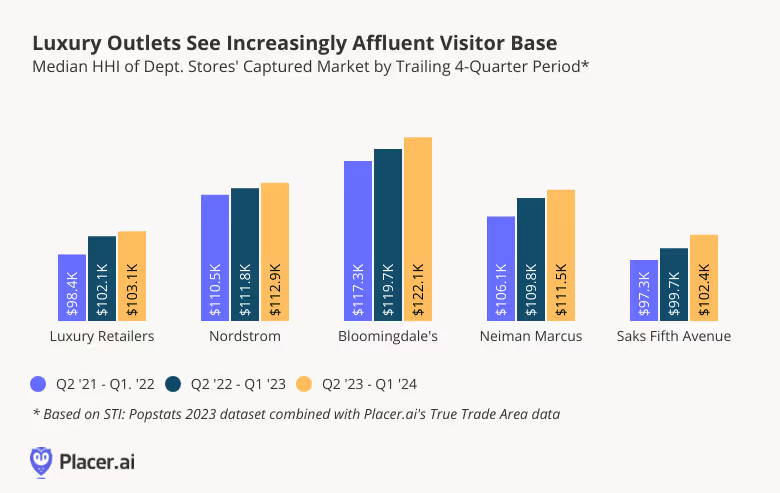
Fifth Avenue, with its array of museums, luxury high-rises, and expensive department stores, drew the most affluent crowd, with a captured market median HHI of $105.6K – some 35.7% above the statewide median. SoHo, for its part, known for designer apparel stores, trendy cafes, and whimsical tourist attractions (Museum of Ice Cream, anyone?), attracted the largest share of “Educated Urbanites.” And Times Square, a top Big Apple attraction with broad popular appeal, boasted a visitor profile closest to statewide baselines.
.avif)
A look at the visitor profiles of major California shopping districts reveals a similar trend. The captured markets of Beverly Hills’ Rodeo Drive, Santa Monica’s 3rd Street Promenade, Hayes Valley in San Francisco, and Abbot Kinney in Los Angeles all had higher median HHIs in Q4 2023 than the statewide median of $85.7K. Of these, the captured market with the highest median HHI was that of Hayes Valley in San Francisco – an unsurprising finding given the relative affluence of the Bay Area. Not far behind was Rodeo Drive, with a median HHI of $113.9K.
Hayes Valley also led the charge for “Educated Urbanites,” with no less than 61.4% of the population of its captured market – nearly two-thirds – belonging to this segment. But all four of the analyzed high-street corridors were significantly over-indexed for this demographic compared to the California baseline of 13.1%.
.avif)
Looking at urban shopping districts in other major cities nationwide – including Newbury Street in Boston, Fulton Market in Chicago, and Walnut Street in Philadelphia – shows that the unique draw of these corridors for young, affluent singles isn’t confined to New York and Chicago. In all three corridors, the median HHIs and shares of “Educated Urbanites” in the captured markets
also exceeded statewide baselines – oftentimes by a wide margin.
.avif)
Evolving work routines and post-COVID population shifts continue to present municipalities and other civic stakeholders with significant challenges. But the revival of high-street retail corridors shows that cities are up to the task. How will major urban shopping districts fare in the new year? And how will their audiences continue to evolve?
Follow Placer.ai’s data-driven retail foot traffic analyses to find out.

How did the brick-and-mortar divisions of Walmart, Target, and other leading retailers perform this holiday season? Which days drove the most visits, and how did foot traffic performance this year compare to 2022? We dove into the data to find out.
Looking at daily visits to Target, Walmart, mid-tier department stores (including Macy’s, JCPenney, Kohl’s Belk, and Dillard’s), luxury department stores (including Saks Fifth Avenue, Neiman Marcus, Bloomingdale’s, and Nordstrom) and Best Buy reveals several common trends.
In all cases, retail visits began to creep up over the days leading up to Thanksgiving (Monday through Wednesday) as consumers took advantage of early Black Friday discounts. And the visit increase on Black Friday 2023 relative to the Q4 daily average was larger than in 2022 – perhaps thanks to budget-conscious consumers holding out for the steep discounts offered the day after Thanksgiving. The Christmas Eve Eve (December 23rd) and Super Saturday spikes were also particularly pronounced in 2023, likely thanks to the combination of both retail events falling on the same day this year.
All retailers and retail segments analyzed also saw smaller surges on Boxing Day (December 26th) 2023 when compared to 2022, likely due to calendar differences. Christmas fell on a Sunday in 2022, so December 26th was declared a federal holiday in lieu of December 25th, and many private-sector employers likely gave time off as well – giving consumers the opportunity to hit the stores and enjoy after-Christmas sales. But Boxing Day still drove visit peaks across the board in 2023 (albeit not smaller peaks than in 2022) – indicating that Boxing Day is now a U.S. phenomenon as well.
December 27th, 28th, and 29th saw a greater increase relative to the daily Q4 average in 2023 compared to 2022, culminating in a larger New Years Eve Eve (December 30th) spike. The December 30th surge may be because this year’s December 30th fell on a Saturday, which is a major shopping day in its own right. But the increase in the days prior to New Years Eve Eve, when after-Christmas sales were in full force, could indicate that consumers are still particularly attune to sales events.
Still, despite the similarities across retail categories, foot traffic data also reveals some important differences between the segments.
Visits to Target began to increase in November 2023 relative to October as the retailer offered “Four Weeks of Early Black Friday Deals,” starting October 29th. And like the other categories analyzed, Target saw its first small visit peak of the season on the Wednesday before Thanksgiving (also known as Turkey Wednesday thanks to the massive Grocery visit spikes on the day). Visits on the day before Thanksgiving were up by 21.5% and 22.1%, in 2022 and 2023, respectively, despite foot traffic on an average Wednesday tends to be lower than the Q4 daily average – indicating that “Turkey Wednesday” also holds retail significance for grocery-adjacent categories.
Visits then spiked on Black Friday and returned to seasonally normal levels on Saturday. Throughout December, foot traffic continued to swell, with every week exceeding the previous week’s visit performance. The intensity of the visit growth picked up the week before Christmas, with Christmas Eve Eve/Super Saturday seeing a significant jump. Finally, Target visits on Boxing Day and the week following Christmas also exceeded the Q4 daily average as consumers took advantage of end-of-season sales and looked for festive attire for their New Year’s Eve celebrations.

The holiday season visit pattern at Walmart differs from those at Target in several instances. The superstore’s Turkey Visit spike was significantly more pronounced than Target’s, likely thanks to Walmart’s more extensive grocery offerings. Walmart also saw smaller spikes on Black Friday – perhaps due to the retailer’s famous “everyday low prices,” which may reduce the appeal of specific sales events. The Christmas Eve Eve/Super Saturday surge were also lower than for Target, but the Super Saturday increase relative to Black Friday spike was more pronounced, with some consumers probably visiting Walmart for last-minute groceries ahead of their Christmas dinners.
.avif)
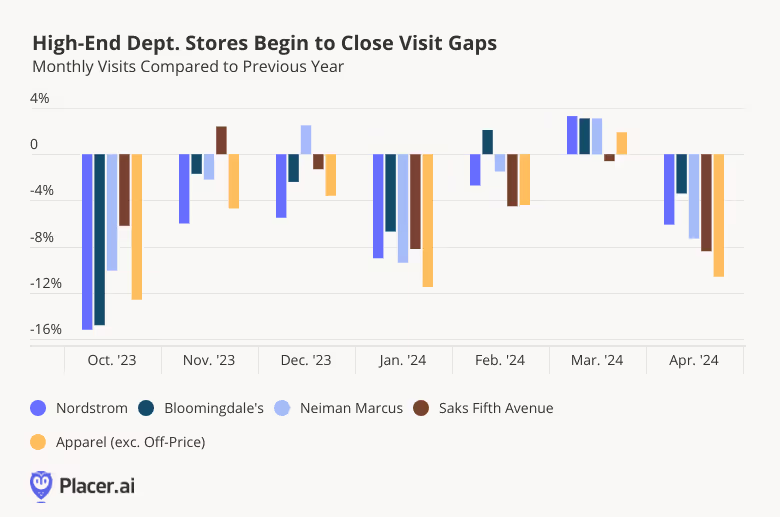
Visits to luxury department stores (Saks Fifth Avenue, Neiman Marcus, Nordstrom, and Bloomingdale’s) followed the general retail foot traffic trends, with larger peaks on Black Friday and on Christmas Eve Eve/Super Saturday in 2023 compared to 2022. Boxing Day 2023 drove a smaller visit spike relative to last year, but foot traffic was still 98.2% higher than the Q4 2023 daily average – indicating that the day is still emerging as an important retail milestone, especially for pricier segments.
.avif)
Mid-tier department stores (Macy’s, Kohl’s, JCPenney, Belk, and Dillard’s) saw more significant spikes on Black Friday and Christmas Eve Eve/Super Saturday, and smaller spikes on Boxing Day. Luxury’s department stores’ biggest post-Christmas visit peak was on Boxing Day, but mid-tier department stores experienced their largest end-of-year increase on New Year’s Eve Eve (December 30th).
.avif)
Best Buy saw the strongest Q4 visit spike on Black Friday out of all the retailers and retail segments analyzed, with foot traffic up a whopping 510.9% compared to its Q4 2023 daily average. The electronics leader also had the largest Christmas Eve Eve/Super Saturday bump – with visits up 188.1% – and Boxing Day boost, with traffic up 112.9% compared to the Q4 daily average. The visit surges over the holiday season’s retail milestones indicate that demand for electronics remains strong – even as some consumers may be putting off large purchases due to economic headwinds.
.avif)
The holiday season drove significant retail foot traffic across categories, with every segment displaying its own unique Q4 visitation pattern. How will these sectors perform in the year ahead?
Visit placer.ai/blog to find out.

2023 was a year that forced restaurant operators to stay agile. Inflation was top-of-mind for most consumers throughout the year, resulting in a trade-down to value-oriented restaurants (or trading out to value grocery chains, dollar stores, and convenience stores). That said, value wasn’t the only factor driving visits, as new menu innovations (Taco Bell was a standout) or marketing partnerships (McDonald’s Famous Orders and “adult” happy meals helping the chain to outperform from a visitation perspective). While we’ve seen visitation trends for the morning daypart improve due to a steady recovery in return to office trends, we continue to see visits during late morning and early afternoon for coffee and QSR chains due to changes in consumer routines (not to mention a resurgence in late night dining). This has also prompted several chains to refine their approach to drive-thrus and pick-up windows (Shake Shack, Chipotle, Taco Bell, among several others). On top of these trends, we’ve seen massive changes in restaurant trade areas, driving many chains to rethink their expansion plans (including an emphasis on South and Southeast, which have seen population growth due to migration).
McDonald’s new exploratory restaurant concept CosMc’s sits at the intersection of several of these trends. The smaller-format (approximately 2,800 square feet, compared to 4,000-4,500 square feet for the average McDonald’s), drive-thru only concept opened its doors last month in Bolingbrook, IL, and is part of a “limited test run”. Its menu heavily focuses on beverages, including four “Signature Galactic Boosts” (featuring Sour Cherry Energy Boost and Island Pick-Me-Up Punch drinks), iced teas and lemonades (such as a Tropical Spiceade and Blackberry Mist Green Tea), slushes and frappes (including a Chai Frappe Burst and Popping Pear Slush), and coffee-based products (highlighted by the S’Mores Cold Brew and Turmeric Spiced Latte). While beverages are the focal point, there are also a variety of breakfast and snack food options, including a Spicy Queso and Creamy Avocado Tomatillo breakfast sandwiches, McPops (filled doughnuts), Savory Hash Brown Bites, and Pretzel Bites. In addition to the experimental fare, the menu also features a host of traditional breakfast sandwiches and beverage offerings.
Given the early buzz, we decided to check out the concept for ourselves this week. It was immediately apparent how much interest CosMc’s was drawing, as the drive-thru lane spanned roughly 80 vehicles upon arrival (which required use of a separate parking lot at the Maple Park Place shopping center, which also features Burlington, Ross Dress for Less, Dollar Tree, Aldi, and Best Buy stores).

.avif)
While its unique menu has rightfully generated a significant amount of attention, it’s also clear that McDonald’s is also using CosMc’s as a test for other potential drive-thru only locations in the future. Customers order from dynamic menu boards and cashless payment devices are used to expedite the payment process. Visitors wait at the menu board until their order is ready, and then pickup windows are assigned when the order is ready.
.avif)
.avif)
Admittedly, it’s tough to make definitive conclusions about CosMc’s with the location being open for only a few weeks. Placer’s data suggests that CosMc’s saw more than double the number of visits that a typical McDonald’s saw chainwide during December 2023 (despite being open only since Dec. 7) and more than triple the number of visits per square foot (given CosMc’s smaller, roughly 2,500 square feet footprint). However, it’s also worth noting that CosMc’s visitation numbers would likely have been much higher if the location had additional capacity to satisfy the overwhelming demand.
Still, Placer offers some other ways to evaluate CosMc’s early trends. Based on 2019 Census Block Group data, CosMc’s trade area size (using a 70% of visit threshold) was just over 155 square miles during December 2023 (below). This is roughly 2.5 times the size of the trade area for the average McDonald’s location during December 2023 (62 miles) and significantly larger than the average trade area for most coffee brands (25-35 miles for more urban focused brands to 50-60 miles for more suburban/secondary market brands). In fact, the closest recent comparison we could find for CosMc’s was Raising Cane’s Post Malone and Dallas Cowboys restaurant collaboration, which had an impressive 264-mile trade area during its initial month of opening (though also helped by cross-traffic from Dallas Cowboys home game visitors from across the state of Texas). In some ways, there were also similarities between CosMc's and the Hello Kitty Cafe Trucks, which the Placer.ai Blog team wrote about last September.
Given that McDonald’s also appears to be targeting a younger demographic with CosMc’s, we thought we’d also look at the age breakdown for the potential market trade area (the population living within the trade area for the CosMc’s store). McDonald’s collective potential market trade area largely mirrors U.S. trends given its reach (the company has previously stated that 85% of the population in its top five markets–the U.S., France, the U.K., Germany and Canada–are within three miles of a McDonald’s location), it’s interesting that the potential market trade area for CosMc’s does skew to a younger audience, particularly the 22–29-year-old cohort.
By the end of 2024, McDonald’s plans to open an additional 10 CosMc’s test units, including locations in the Dallas-Fort Worth and San Antonio markets (notably some of the fastest growing markets in the U.S.). Does CosMc’s have the potential to be something more than a 10-unit test over a longer horizon? McDonald's has attempted to differentiate its coffee business in the past with its McCafe menu and standalone McCafe locations in international markets, but competition with Starbucks and others made it difficult for the company to distinguish McCafe as a standalone retail brand in the U.S. CosMc's is interesting from this perspective, as it may allow the company to build a brand more naturally and stand out with a younger audience (which appears to be working). It’s unlikely that future CosMc’s will look or operate like the pilot location in Bolingbrook. Nevertheless, the excitement around new products, an expansive trade area, and potential to connect with younger audience make it a worthwhile test (especially with 2024 shaping up to be a strong year for unit growth within the coffee category).
.avif)
Coffee’s success in 2025 offers several key lessons for dining operators across categories:
1. Strategic expansion into under-penetrated regions can supercharge growth. YoY visits to coffee chains are growing fastest in areas of the Southeast and Sunbelt where the category still accounts for a relatively low share of dining visits.
2. Pairing craveable products with genuinely human, personalized service can build durable loyalty. Aroma Joe’s proves that when standout offerings are combined with warm, consistent personal touches, brands can create habit loops that drive repeat visits even in crowded markets.
3. Prioritizing hyper-efficient convenience models can unlock meaningful growth. Scooter’s Coffee demonstrates that fast, reliable, frictionless experiences can materially increase traffic while supporting rapid expansion.
4. Building recurring limited-time rituals can create predictable demand spikes and deepen engagement. From the annual Pumpkin Spice Latte launch to Jackpot Day, coffee chains show that ritualized promotions can “own the calendar,” generating predictable traffic spikes and deepening emotional engagement.
5. Using scarce, hype-driven offerings can generate high-impact moments that shift behavior. Starbucks’ Bearista drop illustrates how limited, buzzworthy merchandise or products can not only spike visits but also shift customer behavior, driving traffic outside typical dayparts.
6. Leveraging cultural collaborations can create excitement without relying on discounts. Dunkin’s Wicked partnership shows that tapping into moments in pop culture can deliver multi-day visit lifts comparable to major promotions – often without relying on giveaways.
Coffee has become one of the most resilient and inventive corners of the U.S. food and beverage industry. Even as consumers wrestle with higher prices and trim discretionary spending, they continue to show up for cold foam, caffeinated boosts, and treat-worthy daily indulgences.
Throughout 2025, coffee chains saw consistent year-over-year (YoY) quarterly visit growth, as brands from Starbucks to 7 Brew expanded their footprints. Crucially, per-location category-wide traffic also remained close to 2024 levels throughout most of the year before trending upward heading into the holiday season – showing that this expansion has not diluted demand at existing coffee shop locations.
What’s fueling coffee’s ongoing momentum? Which strategies are helping leading chains accelerate despite this year’s headwinds? And what can operators across dining categories learn from coffee’s success?
This white paper dives into the data to reveal the strategies behind coffee’s standout performance – and how they can help dining concepts across segments succeed in 2026.
Analyzing market-level (DMA) dining traffic data reveals that coffee chains are prioritizing growth in markets with lighter competition – and this formula is paying off.
In the graphic below, the top map shows the share of dining visits commanded by coffee in each DMA, while the bottom map highlights the year-over-year (YoY) change in visits to the coffee category. Perhaps unsurprisingly, markets where coffee already commands a high share of dining visits (specifically on the West Coast and in the Northeast) are seeing the softest year-over-year performance, while DMAs with lower coffee penetration are delivering the strongest visit growth.
In other words, traditional coffee markets such as Northwestern metros– where competition is high and incremental gains are harder to capture – are no longer the primary engines of category momentum. Instead, coffee visits are growing fastest across the Southeast, Sun Belt, and Texas – regions where branded coffee still represents a relatively small share of dining visits. Operators across dining segments can learn from coffee's approach and identify markets with low category penetration to lean into those whitespace opportunities.
But geography is only part of the story. And the coffee segment shows that a strong concept that delivers on fundamentals – great products and exceptional service – can thrive even in tougher coffee markets such as the northeast.
The experience of expanding Northeastern chain Aroma Joe’s shows how pairing craveable beverages with an unusually personal service model can drive visit growth even in relatively hard-to-break-into regions.
Aroma Joe’s, a rapidly-expanding coffee chain headquartered in Maine, with over 125 locations, has become something of a local obsession: Customers rave about the chain’s addictive signature beverages – as well as the feel-good atmosphere cultivated by its warm, friendly staff. And this combination of human touch and product quality creates a powerful habit loop: In October 2025, nearly one quarter of visitors to Aroma Joe’s stopped at the chain at least four times during the month – a much higher loyalty rate than that seen by other leading coffee brands.
The takeaway: Craveable products paired with exceptional service can create a scalable loyalty engine.
Another key differentiator for the coffee sector is convenience. Drive-thrus have become ubiquitous across the category, with many of the fastest-growing upstarts embracing drive-thru only models and legacy leaders also leaning more heavily into the format.
Scooter’s Coffee – named for its core promise to help customers “scoot” in and out quickly – exemplifies this advantage. In Q3 2025, the chain posted a 3.1% YoY increase in average visits per location, even as it continued to scale its footprint. And its customers averaged a dwell time of just 7.3 minutes – significantly lower than other leading coffee chains, including other drive-thru-forward peers.
By delivering consistently quick experiences without compromising quality, Scooter’s has emerged as a traffic leader in the coffee space – demonstrating the power of efficiency to drive demand.
No category has mastered the “event-ization” of the menu quite like coffee – and few brands own the category’s calendar as effectively as Starbucks. The annual return of the Pumpkin Spice Latte has become a cultural milestone that marks the unofficial start of fall for millions, driving double-digit visit spikes and shaping seasonal traffic patterns.
And the importance of the event only continues to grow. On August 26th, 2025, PSL day drove a 19.5% spike in traffic compared to the prior ten-week average – a higher relative spike than that seen in 2024 or 2023.
But this playbook isn’t reserved for mega-brands. 7 Brew’s monthly Jackpot Day, held on the 7th of each month, shows how recurring promotions can also build anticipation and deliver repeatable traffic lifts for up-and-coming concepts.
Beginning in August 2025, Jackpot Day shifted from a limited “Jackpot Hour” to an all-day activation. That month’s offer – two medium drinks for $8 plus a Kindness wristband – generated a 47.1% lift versus an average Thursday. And in subsequent months, giveaways ranging from tote bags to footballs kept the excitement going, sustaining elevated visits each time the 7th rolled around.
These rituals create emotional consistency: Customers know when to expect something special and plan around it. Dining chains beyond the coffee space can also create dependable spikes in traffic by implementing recurring, ritualized LTOs that create an emotional calendar and keep customers engaged.
Offering recurring LTOs is one way to keep customers consistently engaged. But one-time, limited-edition merch drops can create even bigger visit surges. Starbucks’ much-hyped “Bearista” launch this November is a prime example: Customers lined up nationwide for the chance to buy – not receive – an adorable, limited-edition, bear-shaped reusable cup. And despite its hefty $30 price tag, the merch drop drove a massive nationwide visit spike, making it the chain’s biggest sales day ever and fueling additional momentum leading into Red Cup Day.
And location data shows that this kind of hype-driven, scarce merchandise can shift not just visitor volume but daypart behavior. Visits surged as early as 4:00 AM as FOMO-driven customers showed up at the crack of dawn to secure a bear. And the shift toward early morning visits (though not quite as early) continued the following day as stores quickly ran out of stock.
Starbucks' Bearista frenzy suggests that scarcity isn’t just a retail tactic – it’s a powerful behavioral trigger that restaurants can harness as well. Limited-run items, exclusive merch drops, or time-bound specials can generate excitement, pull visits forward, and reshape daypart patterns in ways traditional promotions rarely do.
Cultural tie-ins add another accelerant. In November, Dunkin’ launched its Wicked collaboration alongside its holiday menu, generating a significant multi-day traffic spike – achieved, like Bearista, without giveaways. The event leaned on playful thematic branding, seasonal flavors, and limited-run items that tapped into Wicked fandom.
Dunkin's Wicked surge shows that when executed well, cultural relevance can also significantly move the needle. Other dining segments may also lean into thoughtful collabs to create outsized excitement and traffic lift – even without deep discounts or free offers.
The coffee sector’s 2025 performance offers a blueprint for dining success: Chains are expanding smartly into underpenetrated regions, successfully implementing both hyper-efficient and hyper-personal service models, using recurring LTOs to build seasonal and monthly rituals, and leveraging merch and pop culture partnerships to reshape demand.
Together, these strategies provide a practical playbook for dining brands to increase visit frequency, deepen customer commitment, and capture new growth opportunities in 2026 and beyond.

Five metros from across the United States stand out for consumer momentum going into 2026: Salt Lake City (UT), Reno (NV), Indianapolis (IN), Tampa-St. Petersburg-Clearwater (FL), and Raleigh-Durham (NC). All five metro areas saw their populations increase by more than the average U.S. metro between 2023 and 2024, and year-over-year (YoY) retail and dining traffic trends outpaced the nationwide average.
Utah is one of the fastest-growing states in the U.S. The state’s population has grown steadily for more than two decades with unemployment remaining consistently below the nationwide average, with one of the youngest workforces in the country. According to some analysts, the median household income in Utah, when adjusted for cost of living, is the highest in the nation.
All of this positions Salt Lake City – the state’s capital – as a particularly attractive market heading into 2026. Location analytics show year-over-year increases in foot traffic across many neighborhoods, from established retail hubs like Sugar House and Downtown SLC to the more mixed-use Central City and primarily residential areas such as The Avenues and East Bench. The city also serves as a gateway to a diverse mix of audiences, attracting younger residents and commuters as well as affluent families who come into the city to shop, dine, and enjoy local attractions.
Salt Lake City’s diversity in age and household composition as well as Utah's strong homeownership culture – even among younger cohorts – creates opportunities for retail and dining chains across categories. Home-forward concepts are particularly poised to outperform, as shown by recent location analytics. Traffic to furniture & home furnishing chains increased 7.4% YoY in the Salt Lake City DMA compared to a 2.5% increase nationwide, and grocery stores and home improvement retailers outperformed in the market as well. These trends point to a solid market for retailers tied to home life – from furniture and décor to everyday grocery needs –driven not only by steady population growth and household spending, but also by a local culture that places strong emphasis on family and the home.
While Salt Lake City continues to build on its strong foundation, another Western city is quietly gaining momentum. Reno, Nevada, which is often viewed as a regional gaming-town, is increasingly emerging as a dynamic travel destination in its own right.
In 2024 Washoe County (including the city of Reno) welcomed approximately 3.8 million visitors whose spending of about $3.4 billion generated a total economic impact of $5.2 billion. This growth signals a robust visitor-economy that supports roughly 43,800 jobs and generates over $420 million in state and local tax revenue.
What makes this particularly compelling is that while Las Vegas, Nevada is facing mounting pressures from increasing costs, the Reno-Tahoe region is showing stronger resilience thanks in part to a drive-market model and diversified appeal. Analyzing the traffic data shows that visits from non-residents, and non-employees to downtown Reno have increased YoY for the past three years. And though Reno may be thought of as a vacation spot for older Gen X and Baby Boomer vacationers, the data also indicates that Singles & Starters –"young singles starting out and some starter families living a city lifestyle" – make up an increasingly large share of Reno's visitor base.
This generational diversification carries important implications for both retail and real estate investment. As younger visitors drive up spending in food, entertainment, and shopping centers, the market is poised for renewed urban energy – fueling redevelopment across downtown corridors and mixed-use projects. With strategic public–private investments and an expanding visitor economy, Reno stands out as a market to watch in 2026, combining strong fundamentals with emerging demographic momentum.
The Midwest also contains several metro areas on the rise. Large-scale manufacturing projects like Intel’s $20 billion chip plants and Honda and LG Energy Solution’s EV battery facility are spurring housing and retail expansion around Columbus, Ohio. Kansas City, Missouri, is benefiting from logistics growth and projected tourism growth linked to its role as a FIFA World Cup 2026 host city. And Madison, Wisconsin, is seeing steady consumer growth is supported by its diverse tech and biotech economy.
But Indianapolis, Indiana tops the charts in terms of YoY overall retail visit growth between May and October 2025 (+4.3%, see first chart). And much of the consumer traffic in the Indianapolis DMA consists of suburban and rural households – precisely the segments that many retailers are now trying to woo.
Family-friendly retailers and dining chains are particularly well positioned to thrive in Indiana heading into 2026. Indianapolis has some of the best job prospects and most affordable home prices in the country – and its favorable salary to cost of living ratio likely allows many families to have leftover income left over for discretionary spending.
Recent data shows that a range of family-oriented brands – from Chili’s and Marshall’s to Kroger – have outperformed in Indianapolis over the past six months. The city’s growing middle-income population and its suburban, family-focused consumer base appear to be fueling stronger in-person spending, particularly at convenient, affordable, and community-oriented retail and dining destinations.
Moving east to North Carolina brings several additional growing metros into focus, including Myrtle Beach, Wilmington, and Charlotte. But Raleigh rises above the pack with its powerful combination of job growth, steady in-migration, and a well-balanced, diversified economy.
All this is leading to YoY increases in total traffic within the Raleigh-Durham, NC DMA, driven in part by major firms – including entrants in finance and life-sciences – continuing to expand operations in the area. The city of Raleigh also has relatively low median age and relatively high median household income. This combination of robust job creation, wage gains, and a growing pool of young, high-spending residents positions Raleigh as one of the most dynamic consumer markets in the Southeast heading into 2026.
Raleigh's consumer growth potential is particularly stark when looking at performance of major mixed-use developments across the region. Foot traffic at leading projects such as Smoky Hollow, the Main District at North Hills Street, and Fenton in Cary has climbed sharply.
The data also shows that these destinations attract a disproportionately high share of wealthy singles and one-person households – a demographic with strong discretionary spending power. Together, these trends point to a deepening base of urban, high-income consumers fueling growth in dining, retail, and entertainment – making Raleigh one of the country's most dynamic and opportunity-rich metro areas heading into 2026.
In the Southeast, Tampa is one of the nation’s standout metro areas heading into 2026. Strong fundamentals – such as no state income tax and expanding employment in sectors like technology, healthcare, and logistics – have attracted a significant influx of Gen Z and millennial residents. And although in-migration is beginning to slow somewhat, the city's expanding economy and youthful talent base continue to fuel growth across housing, retail, and dining.
And as more companies require employees to spend additional days in the office, YoY commuter traffic has increased across Tampa’s major cities. Leisure visits from non-residents are also on the rise, suggesting that retailers and dining chains seeking to capture this expanding market could benefit from growing their presence throughout the Tampa metro area.
Rising traffic across Tampa’s major urban areas appears to be translating into stronger dining activity as well. Over the past six months, average YoY visits to Tampa area full-service restaurants, coffee shops, and fast-casual chains have all exceeded the national average, which may reflect a broader acceleration in both local workforce and leisure-visitor demand.

1. Retail is deeply divided. Visits to value and luxury apparel segments grew YoY in 2025 while traffic to mid-tier retailers flagged.
2. Upscale dining momentum reflects similar bifurcation. More resilient, affluent consumers are bolstering fine-dining traffic.
3. Authenticity is key. Brands successfully executing on a clear sense of purpose – from community-driven grocers to bookstores – are driving consistent visit growth.
4. Online and offline retail are converging into a seamless ecosystem. As consumers seek online value and in-person convenience, AI fulfillment, dark stores, and local pickup are accelerating.
5. Digitally native brands expanding into physical retail are redefining omnichannel. These chains provide a blueprint for merging digital efficiency with personalized in-store experiences.
6. Traditionally urban brands are shifting to suburbia to capture new audiences. With consumers rooted in hybrid lifestyles and growing suburban demand, chains that adapt their footprints drive fresh traffic.
7. Expansion into college markets and celebrity pop-ups are helping retailers and malls connect with younger consumers. Brands that grew their footprints in college towns or on campuses increased their Gen Z traffic, as did malls that hosted celebrity or influencer activations.
Retail and dining faced another complex year in 2025. Persistent economic headwinds and uncertainty surrounding tariffs intensified consumers’ focus on value, even as affluent shoppers continued to indulge in luxury brands and upscale dining experiences.
Yet the year also revealed behavioral shifts that extended beyond price sensitivity. Shoppers increasingly prioritized brands that convey authenticity and a clear sense of purpose – those that deliver value not only through price, but through omnichannel convenience, product quality, and brand ethos.
For their part, retailers and malls continued to evolve, adopting strategies to capture both the expanding suburban market and a rising generation of younger consumers emerging as a defining force in retail.
How have these trends evolved, and how will they shape the retail landscape in 2026? We dove into the data to find out.
The first three quarters of 2025 underscored a widening divide in the apparel sector, with strength at both ends of the price and income spectrums.
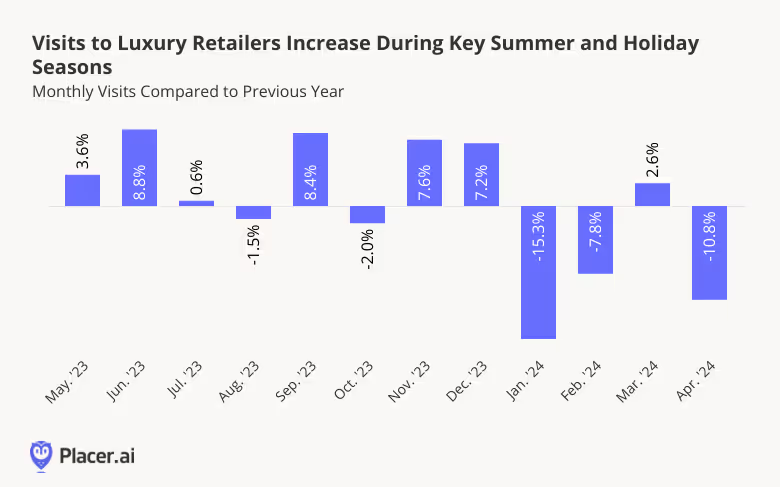
Off-price retailers and thrift stores, which draw shoppers from lower- and middle-income trade areas, gained significant ground – reflecting consumers’ ongoing search for value and treasure-hunt experiences that feel both economical and rewarding. At the same time, luxury maintained modest growth, showing that high-income shoppers remain resilient and willing to spend on premium experiences. Meanwhile, traditional apparel and mid-tier department stores continued to see visit declines, signaling further pressure on the retail middle. Retailers such as Target and Kohl’s, traditional staples of this middle segment, are contending with the challenge of defining their identity to consumers in a market increasingly split between value and luxury.
Looking ahead to 2026, mid-tier retailers will need to navigate a complex and polarized landscape. Without the clear positioning enjoyed by value and luxury players, success will require sharper differentiation and disciplined execution. But though the middle remains a tough place to compete, it still holds potential: Brands that can redefine relevance – something many of these same chains achieved just a few years ago – stand to capture consumers with spending power.
A similar bifurcation dynamic is also unfolding in the dining sector.
Upscale full-service restaurants (FSRs) are outperforming their casual dining counterparts, as higher-income consumers – and those dining out for special occasions – seek elevated experiences at fine-dining chains.
At the same time, more cost-conscious diners are trading down from casual dining FSRs to fast-casual chains, which continue to outperform the casual dining segment. Fast-casual brands are also benefiting from trading up within the limited-service segment, as consumers who choose to eat out – rather than eat at home or grab a lower-cost prepared meal at a c-store or grocery – opt for more experiences that feel more premium yet remain accessible.
Across both retail and dining, bifurcation doesn’t tell the whole story. Even as spending concentrates at the high and low ends of the market, a growing number of brands are succeeding by delivering an experience that feels intentional, distinctive, and true to their identity. These concepts share a clear raison d’être – a sense of purpose that resonates with consumers – as well as successful execution. The data shows that brands providing this kind of “on-point” experience are driving consistent visit growth in 2025, signaling that authenticity may be important retail currency in 2026.
Trader Joe’s sustained momentum reflects its ability to make shopping feel like discovery. The chain’s locally-inspired assortments, roughly 80% private-label mix, and steady rotation of seasonal products keep visits fresh and engagement high.
Sprouts, for its part, continues to benefit from a sharpened identity centered on freshness, sustainability, and health. Its smaller-format stores, curated product mix, and messaging around healthy living have helped it build a loyal base of wellness‐oriented shoppers.
Meanwhile, Barnes & Noble’s transformation offers a compelling case study in the power of experience. Its strategy of empowering local managers to curate store selections and host community events has turned stores into cultural touchpoints – driving increased visits and dwell times.
All three brands derive their strength from their clarity of purpose – illustrating how authenticity and intentionality are becoming meaningful factors shaping consumer engagement.
Authenticity isn’t limited to national names. Regional players such as H-E-B and In-N-Out Burger demonstrate how deeply ingrained local identity can translate into sustained growth.
H-E-B’s community-driven ethos, local sourcing, and operational excellence have built trust across Texas markets, helping it remain one of the country’s most beloved grocery chains, with high rates of shoppers visiting multiple times a month. And in the quick-service category, California-native In-N-Out Burger stands out for its quality, nostalgia, and mystique, as the chain continues to attract visitation trends that exceed national QSR benchmarks.
These brands demonstrate that authenticity can have a local element. Their success reflects not just product strength or efficiency, but a deeper connection to the communities they serve.
While regional and experience-driven brands continue to build deep consumer connections, the broader retail landscape is also being reshaped by operational innovation. As technology and infrastructure improve, retailers are finding new ways to merge digital efficiency with convenient physical touchpoints.
E-commerce growth and in-store activity are increasingly interconnected. Visits to ecommerce distribution centers* climbed steadily between October 2021 and September 2025, while the share of short, under-10-minute trips to big-box chains Target, Walmart, BJ’s Wholesale Club, and Sam’s Club also increased. Together, these patterns suggest that while online shopping continues to expand, consumers remain highly engaged with physical locations through buy-online-pick-up-in-store (BOPIS) and same-day fulfillment channels – combining the value of online deals with the convenience of quick, local pickup.
This trend also reflects ongoing advancements in AI-driven fulfillment and Walmart’s testing of dark stores – retail spaces converted into local fulfillment hubs that accelerate delivery and enable quick customer pickup. These innovations are shortening fulfillment windows while optimizing store networks for hybrid demand.
As retailers continue to blur the boundaries between digital and physical commerce in 2026, expect them to become increasingly complementary parts of a single, omnichannel ecosystem.
*The Placer.ai E-commerce Distribution Center Index measures foot traffic across more than 400 distribution centers nationwide, including facilities operated by leading retailers such as Amazon, Walmart, and Target. Designed as a barometer for U.S. e-commerce activity, the index captures two key audiences: employees, estimated through dwell-time patterns, and visitors, who often represent logistics partners delivering raw materials, moving in-process goods, or collecting finished products.
The resurgence of digitally native brands embracing physical retail underscores how online and offline strategies are converging into an integrated model, combining digital efficiency with the benefits of a physical presence.
Framebridge, a DTC custom framing brand, offers a clear example of this trend. As the brand has expanded its footprint, the average number of monthly visits to each of its locations rose sharply throughout 2025.
Framebridge’s success lies in its well-executed omnichannel model. Customers can place orders online or in store, with the option to ship directly to their homes or pick up in person.
But for Framebridge, physical locations aren’t just about convenience. Art and memories are often one of a kind, so having knowledgeable staff in store and the opportunity to engage with materials firsthand transforms a transaction into a personalized, consultative experience.
Framebridge exemplifies how digitally native brands are merging the ease of online shopping with physical spaces that provide a personal touch. And more digitally native brands, like Gymshark, are looking to bring their business offline with the hope of adding value for consumers.
As retailers advance their omnichannel strategies, another enduring shift is reshaping the retail map post-pandemic – the continued rise of suburban traffic. Brands that entered the pandemic with strong suburban footprints were among the first to benefit as in-person activity rebounded, while urban-focused chains that expanded outward have met migrating consumers and captured new audiences anchored in hybrid lifestyles and local shopping routines.
Large-format and drive-thru focused brands like Costco, Cava, and Dutch Bros. entered the pandemic era from a position of strength as they are traditionally situated in suburban and exurban areas. As consumers spent more time close to home and away from urban centers, these chains captured heightened local demand and saw visits rebound rapidly once in-person shopping resumed.
And as the pandemic reshaped consumer traffic patterns, brands like Shake Shack and Chipotle quickly recognized emerging opportunities in suburban markets and adjusted their strategies to capture this shifting demand. For Shake Shack – a brand once defined by its urban storefronts – the shift toward suburban drive-thrus and stand-alone locations represented a significant pivot. Chipotle followed a similar path, accelerating its suburban expansion through the rollout of “Chipotlane” drive-thru lanes.
Arriving somewhat later to the suburban landscape, sweetgreen, once synonymous with its urban footprint, opened its first drive-thru in 2022, and by 2024 had made suburban markets a core pillar of its growth strategy.
These real estate moves positioned all three brands to capture demand from remote and hybrid workers, helping sustain visit growth well above pre-pandemic baselines.
As suburban demand continues to grow, the suburbs will likely remain a critical growth frontier for many brands in the year ahead.
Investment in suburban markets underscores how changing market conditions and strategy adaptation can allow brands to meet consumers where they are. And a parallel trend is unfolding in college towns and youth-dense trade areas, where brands are channeling investment to capture rising Gen Z spending power.
Expansion in college-anchored markets, paired with celebrity and influencer-driven pop-ups, is helping retailers build cultural relevance and increase engagement with this emerging consumer base.
The graph below underscores how targeted expansion into college-anchored markets can meaningfully shift audience composition. Over the last several years, many brands have expanded their near-campus footprints – and in turn, attracted a higher share of the Spatial.ai:PersonaLive “Young Urban Singles” segment, one highly aligned with Gen Z consumers.
CAVA’s rapid unit growth, including openings near major universities and in college towns, helped the brand increase its share of “Young Urban Singles” within its captured trade areas between October 2018-September 2019 and October 2024-September 2025. Meanwhile, Panda Express and Raising Cane's, which already had relatively large shares of the segment six years ago, have also invested in college-adjacent locations, lifting their “Young Urban Singles” audience share.
Even legacy mass retailer Target benefited from small-format and large store expansions near universities – growing its captured market share of “Young Urban Singles”.
These shifts suggest that college towns will continue to be strategic growth markets, including for luxury brands like Hermès. By making inroads in college towns and with Gen Z shoppers, brands can strengthen loyalty early and build durable market share that remains as these young adults move on from campus life.
As Gen Z’s influence expands beyond campus borders, retail engagement is increasingly driven by cultural moments that resonate with this cohort. And malls are finding that temporary pop-ups including influencer collaborations and celebrity-led activations can attract these young consumers.
At The Grove, the Pandora pop-up with brand ambassador girl-group Katseye in October 2024 led to a modest but significant increase in the Gen Z-dominant “Young Professionals” and “Young Urban Singles” segments within the mall’s captured trade area during the first week of the activation – compared to the average for the last twelve months.
Similarly, at Westfield Century City, the Taylor Swift x TikTok activation from October 3rd-9th, 2025 – which allowed fans to immerse themselves in the sets from the viral “The Fate of Ophelia” music video boosted the shares of “Young Urban Singles” and Young Professionals”, underscoring the star power of everything Taylor Swift.
And at American Dream, the pattern extended beyond younger audiences. On September 5th and 6th, 2025, Ninja Kidz attended the grand opening of their Action Park while Salish Matters made an appearance at the mall on September 6th for her skincare pop-up – which drew such large crowds that it had to be shut down. During these two event days, the mall’s shares of both “Young Professionals” and “Ultra-Wealthy Families” increased substantially, highlighting that pop-up events can draw young and affluent family audiences.
Together, these examples reinforce that, in 2026, the integration of short-term pop-ups will continue to be a strategy for malls and individual brands to gain relevance for key demographic segments.
2025 reinforced that retail remains as dynamic as ever. Value continues to anchor decisions, but consumers are redefining what value means – blending price sensitivity with expectations for authenticity. And in the current retail landscape, online and physical retail are growing more interconnected as consumers demand convenience and experience.
In 2026, adaptability will be retailers’ greatest competitive edge. The next era of retail will belong to brands that can continue to refine their operating strategy – while staying true to a clear brand identity.