.png)
.png)

.png)
.png)


If there’s one sector of the retail industry that continues to innovate, evolve and perform at a high level, it’s convenience stores. Convenience chains remained in lock step with their consumers over the past few years, a difficult feat for many retailers, and benefited from suburban and rural migration patterns. 2023 was a banner year for C-Stores, with visits to large scale chains growing by 6% compared to 2022 (though some of the growth was due to chain consolidation).
C-Stores have done a fantastic job of attracting more visitors through additions like EV charging, local autonomous delivery, and expanded service offerings. However, the winning formula for many C-Store chains has been the bet on fresh, prepared and made to order foods. Chains have transformed consumer thinking around convenience driven foodservice and the concept has won over consumer’s appetites and wallets.
Chains that prioritize prepared foods have higher dwell times, more weekend visits and strong traffic growth according to our data. In a retail industry that prioritizes uniqueness in experience and product, more foodservice options clearly move the needle for visitors. Compared to the large chain C-store average dwell time of 10 minutes in Q1 2024, chains such as Buc-ee’s, Wawa, and Sheetz have higher dwell times by at least a minute, while chains associated with grab-and-go have shorter than average dwell times.
Looking a little more closely at Buc-ee’s, the darling of both the southeast and TikTok fame, the dwell time is double the average of large chain C-Stores. Buc-ee’s has the unique ability to blend entertainment, kitsch and prepared foods in a way that enchants visitors. Maybe it’s the chain’s Beaver Nuggets or the house-smoked barbeque, or its beloved mascot?
Buc-ee’s has the highest percentage of visits lasting 15 minutes or longer, and excels in visits between 15 and 45 minutes compared to other C-Store chains (below). More than half of the visits to Buc-ee’s occur between Friday-Sunday, more than any other competitor. Buc-ee’s can be seen as a destination C-Store as opposed to a daily stop due to the size and location of stores, which certainly contributes to the higher dwell time. Other C-Store chains looking to improve food offerings can use Buc-ee’s as a source of inspiration when it comes to breadth of assortment and mix of specialty packaged items and foodservice options.
The most surprising metrics come from Casey’s, a chain that has publicly committed to foodservice, but can’t seem to capture longer visits. Casey’s dwell time more closely mirrors that of grab-and-go chains like Maverik or Kwik Trip than it does Buc-ee’s or Wawa. Looking at the differences in demographic segments between Buc-ee’s, Wawa and Casey’s, Wawa and Buc-ee’s attract a visitor that is suburban, younger and more affluent than Casey’s. There may be a correlation between made to order offerings and suburban locations that’s benefitting chains focused on both.
The C-Store evolution is quickly blurring the lines between grocery, QSR and traditional convenience models, and is a bellwether of what’s to come across other sectors in retail. The bi-furcation of c-store formats is likely to accelerate throughout the remainder of 2024. Blending the right product selection, on-demand offerings and a beneficial experience for visitors is necessary in today’s retail climate.

Sprouts, the natural and organic food focused grocery chain operating in 23 states nationwide, is going through a growth spurt. We dove into the visit and audience data to see where the chain stands today and what the rest of 2024 – and beyond – may have in store.
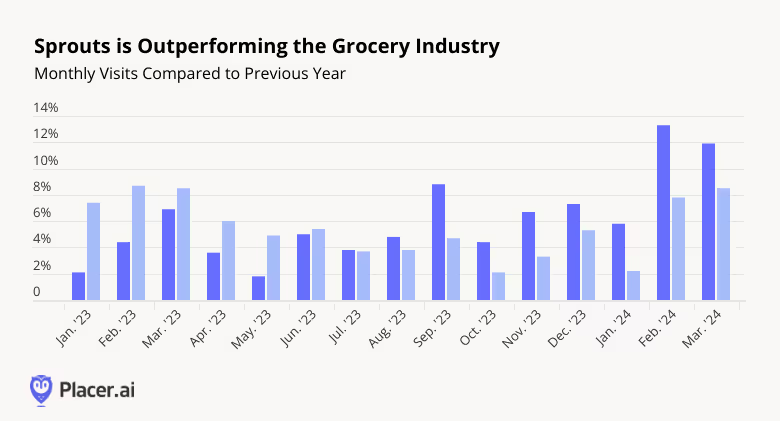
Sprouts is on the rise. Year-over-year (YoY) visits increased every month of last year and have been outperforming the nationwide Grocery average since mid-2023. And the chain continued to grow in Q1 2024, with visits up an impressive 13.3% and 11.9% in February and March 2024, respectively – an impressive feat given the comparison to an already strong Q1 2023.
Some of the growth is driven by expansion – the company opened 30 new stores in 2023 and expects to add 35 additional locations in 2024. But the increase in foot traffic is also a testament to the potential of specialty grocery stores to leverage their unique product selection to attract grocery shoppers, even in the face of growing competition in the space.

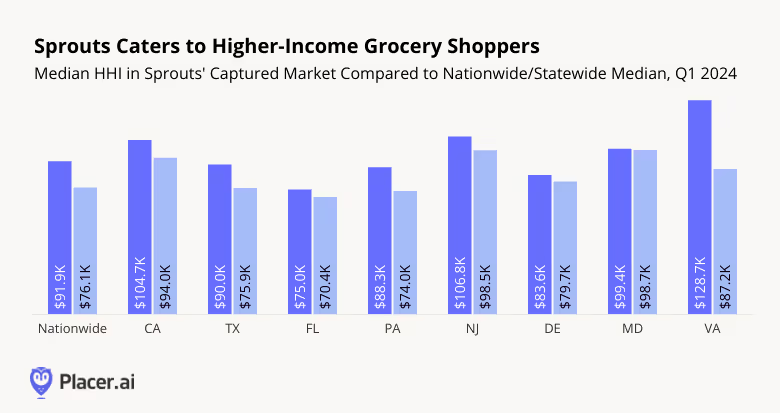
The relatively high income of Sprout’s visitor base is likely also helping the chain stay ahead of the grocery pack: Median HHI in Sprout’s trade areas nationwide is higher than the U.S. median HHI, and the data shows a similar trend in Sprout’s eight growth markets.
The relative affluence of Sprouts shoppers means that this segment may not be as impacted by high food prices as other grocery shoppers – so the retail headwinds predicted this year are not likely to slow down Sprout’s growth potential as the chain continues expanding its reach in 2024.

While Sprouts’ visitors across states seem to share a relatively high income level, diving deeper into the location intelligence data reveals some major differences in both in-store behavior and overall market composition.
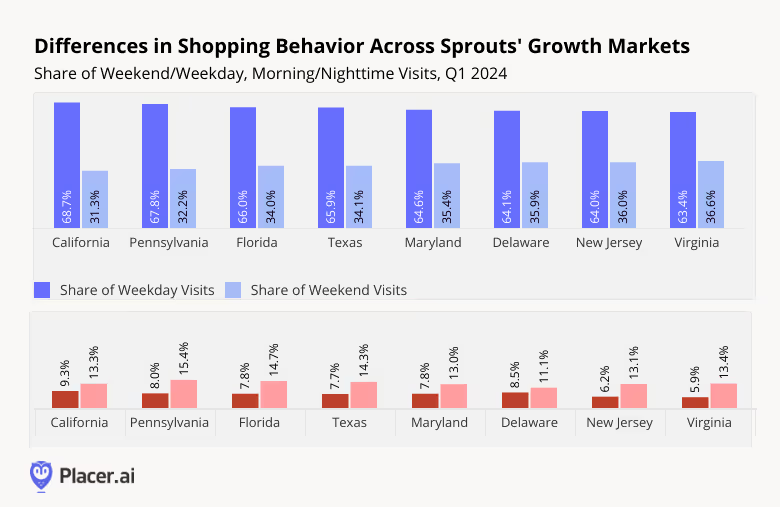
For example, the share of weekend (as opposed to weekday) visits to Sprouts in Q1 2024 varied significantly – from 31.3% in California to 36.6% in Virginia. Shoppers in the company’s various growth markets also visited stores at different hours throughout the day: Mornings (8:00 AM to 9:59 PM) were popular with California, Delaware, and Pennsylvania residents, while evenings were favored by Pennsylvanians, Floridians, and Texans.
Understanding the in-store behavior of shoppers in each state will likely help Sprouts adapt its operations and staffing schedules as the company continues expanding in these markets.

In addition to highlighting the variance between the shopping habits of Sprouts visitors across markets, diving deeper into the location intelligence data also reveals differences in the relationship between Sprouts shoppers and the wider grocery markets in each state.
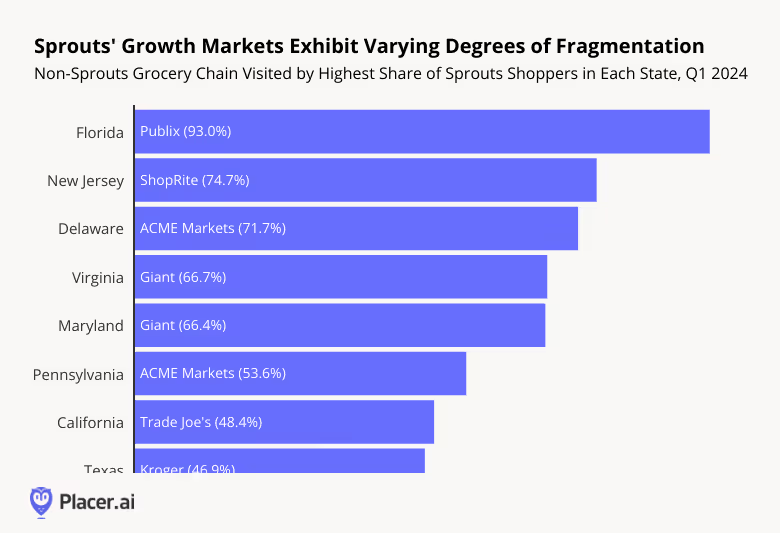
The chart below shows the most popular grocery alternative for Sprouts shoppers in each state (which other grocery chain was the most visited by Sprouts visitors) and what share of Sprouts shoppers visited that grocery chain in Q1 2024.
In Florida, over 90% of Sprouts shoppers also visited a Publix location in Q1 2024 – indicating that Sprouts in the Sunshine State is operating in a relatively consolidated grocery market and operating against an established crowd favorite. Meanwhile, only 46.9% of Texan Sprouts visitors also visited a Kroger – the other grocery chain most visited by Sprouts visitors – indicating that the Texas grocery market may be more fragmented, and so may respond to a different expansion strategy, than the Florida grocery market.

Sprouts strong visitation trends indicate that the grocery chain is expanding into willing markets, and the brand’s relatively affluent shopper base means that Sprouts is unlikely to be too impacted by whatever economic headwinds may lie ahead. As the chain continues making its presence felt in newer markets, location intelligence suggests that Sprouts has plenty of room to grow in 2024 and beyond.
For more data-driven retail insights, visit our blog at placer.ai.

Crocs’ rebrand from ugly to chic is one of retail’s most fascinating Cinderella stories (glass clog, anyone?). We dive into the latest location analytics and demographic data to explore the consumer behavior that drives Crocs’ continued success.
Embarking on a journey to become a fashionable brand, in 2017 Crocs inked a partnership with Christopher Kane who became the first designer to collaborate with the brand. A stampede of designer and celebrity-inspired styles followed in 2018 and 2019 including Balenciaga's iconic ten-inch platform Croc and Post Malone's take on the classic clog.
During the pandemic, Crocs built on its success in fashion and celebrity circles, and gained a new following from comfort-first shoe shoppers stuck at home or running errands.
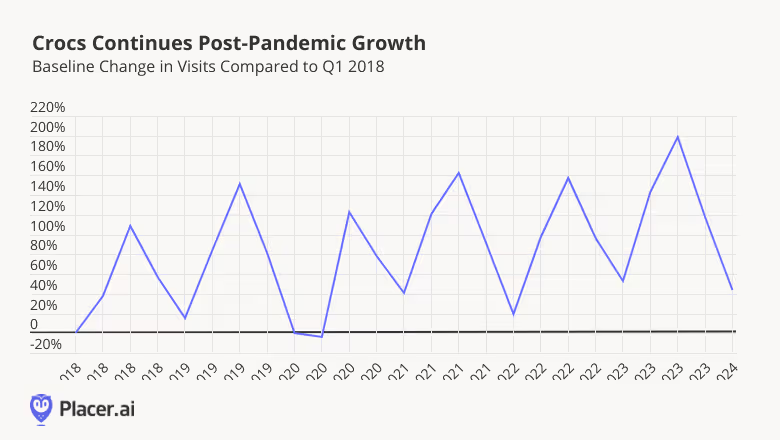
Taking a wide lens on Crocs’ foot traffic since 2018 shows how a strategy of designer partnerships as well as recognition as a functional shoe drives visits to the brand. In 2018 and 2019, as designer Crocs rolled out, visits to the brand climbed to new heights.
And since the wider retail reopening in 2021, Crocs’ foot traffic growth has accelerated as comfort reigns supreme in and out of the home.
Compared to a Q1 2018 baseline, Crocs saw its largest monthly visit peak in Q3 2023 (199.1%) – the critical summer period. And foot traffic in the most recent Q1 2024 was 43.7% above the Q1 2018 baseline. This indicates that the shoe’s acceptance within pop-culture combined with demand for comfortable footwear is elevating the brand’s traffic to new levels.

As Crocs continues to gain traction, the company appears to be pursuing a real estate strategy aimed at repositioning the brand as an affordable shoe for the whole family. Although Crocs shrank its store count in the years leading up to the pandemic, the brand has now begun opening new locations in outlet malls – five in 2023, with plans for 30 new stores in outlet malls in 2024.
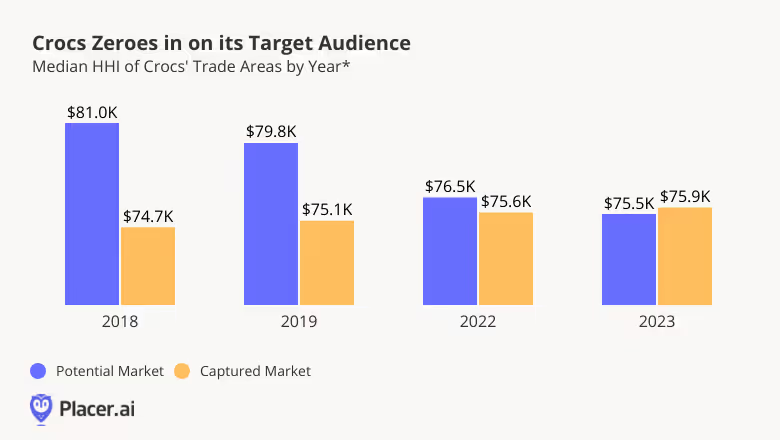
Analyzing Crocs’ trade areas between 2018 and 2023 suggests that this strategy is helping the brand reach its audience. According to the STI: Popstats 2023 dataset, in 2018, there was a gap of more than $6K between the median household income (HHI) in Crocs’ potential market ($81.0K/year) and in its captured market ($74.7K/year). But by 2023, the median HHI of the brand’s potential market ($75.5K) and captured market ($75.9K) had more closely aligned. This indicates that by opening stores in outlet malls – where consumers looking for discounts are likely to shop – Crocs’ potential market more closely reflects its actual visitors and the brand can drive additional traffic from its target audience.

From humble beginnings, Crocs have become runway-famous. And yet, the clogs are more popular than ever with the everyday consumer – at home or out on the town. How will Crocs shape the next chapter of this foam fairytale?
Visit Placer.ai to find out.
This blog includes data from Placer.ai Data Version 2.0, which implements improvements to our extrapolation capabilities, adds short visit monitoring, and enhances visit detection.

Final Four weekend capped off the NCAA “March Madness” basketball tournaments with a full schedule of fan experiences on both the men’s and women’s sides of the ball.
The Women’s Final Four took place between April 4th and 7th, 2024 in Cleveland, Ohio with on-court action at Rocket Mortgage FieldHouse. “Tourney Town” – an interactive basketball exhibition – ran concurrently at the Huntington Convention Center.
The Men’s Final Four commenced on April 5th at State Farm Stadium in Glendale, Arizona, culminating with the championship game on April 8th. The multi-day exhibition “Final Four Fan Fest” took place at the Phoenix Convention Center.
We dove into the location analytics and audience segmentation for visitors to several Final Four events to better understand the fans in attendance throughout the tournament weekend.
The men and women’s Final Four weekend attracted spectators from near and far, with each event attracting a unique mix of out of town tourists and locals.
Both men and women’s championship games attracted a relatively large share of out-of-town guests, likely due to the excitement surrounding a national title game. Analysis of visitors by home location revealed that the men and women’s championship games had the smallest share of visitors from less than 100 miles away – 29.8% and 33.3% respectively. In other words, these two events had the largest share of visitors that lived more than 100 miles from the venues.
The men’s open practice appeared to be more popular with long-distance travelers than the women’s, perhaps because all four men’s teams participated – as opposed to just two at the women’s open practice. The men’s practice was also followed by an all-star game which likely increased its appeal for visitors traveling from afar in the hopes of spotting their favorite players. The data revealed that more than half of the spectators traveled over 250 miles to watch the men’s practice, as opposed to under a quarter of spectators for the women’s practice.
Meanwhile, the women’s experiential exhibition at Huntington Convention Center drew more out-of-towners than the men’s exhibition at Phoenix Convention Center – only 23.3% of visitors to the women’s exhibition came from under 30 miles away, compared to almost half (48.3%) of the men’s exhibition visitors. The larger share of out-of-town visitors to the women’s exhibition may be because the event was close to the arena, making it a more convenient stop for non-local fans. On the other hand, the distance between the men’s exhibition in downtown Phoenix and the stadium in Glendale meant that the off-court experience was more out-of-the-way for tourists who had traveled specifically for the on-court action.

Analysis of Final Four visitors by income level provides further insight into the differences between each event’s fan base. According to the STI: Popstats dataset, the women’s events generally drew visitors from areas with a lower median household income (HHI) compared to the men’s events, although the gaps between the men and women’s visitor bases varied from event to event. Some of the difference in trade area HHI may be due to regional variance and the mix of locals and tourists at each event.
The visitor bases of the men and women’s championship games exhibited the widest disparity, with the men’s championship spectator base coming from areas with a median HHI of $99.9K, compared to $74.6K for the women’s championship’s trade area. The difference may be due to the relatively higher face value of tickets to the men’s championship game – even though the star-power of Iowa’s Caitlin Clark drove up the price of women’s tickets on the secondary market. In contrast, both the men’s and women’s practices and exhibitions were free or nearly free events and drove traffic from relatively lower-income areas – even though visitors to the men’s practice still came from more affluent areas than the trade area of the women’s championship match.
Visitors to the men and women’s convention center exhibition displayed the smallest income differences, with respective trade area median HHI of $80.0K and $76.6K. The data also reveals that visitors to the women’s exhibition came from a trade area with a median HHI that was higher than the median HHI for both the championship game and the open practice, perhaps because the exhibition drew a relatively large share of tourists who could afford to be in town for a slightly longer stay.

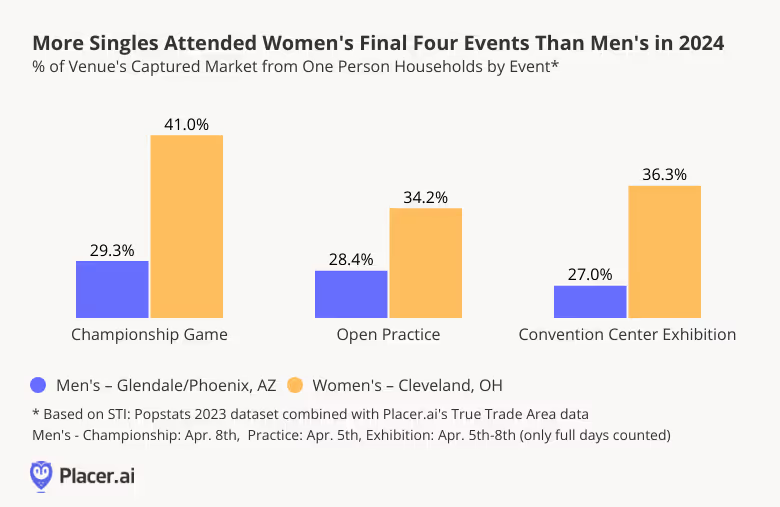
Further demographic analysis indicates that a greater share of singles – who tend to be on the younger side – attended the women’s Final Four events than the men’s. During the women’s championship, 41.0% of households in the trade area of the Rocket Mortgage FieldHouse were made up of one-person households. This segment also made up 34.2% and 36.3% of the households in the trade areas of the venues for the women’s practice and exhibition, respectively. On the men’s side, singles comprised just 29.3% of the championship’s trade area, 28.4% of the practice’s, and 27.0% of the exhibition’s.
This reflects the growing popularity of women’s college basketball players on social media which is bringing more viewership to the sport.

Want more data-driven visitor insights for sporting events? Visit Placer.ai.
This blog includes data from Placer.ai Data Version 2.0, which implements improvements to our extrapolation capabilities, adds short visit monitoring, and enhances visit detection.

During last week’s solar eclipse, people from all over the country converged on cities within the path of totality to witness the excitement first hand. And for municipalities and local businesses, the influx of tourists was expected to generate a boon.
But just how did the celestial event impact business activity on the ground? Which sectors benefited from the hype – and which geographic areas saw the biggest visit spikes?
We dove into the data to find out.
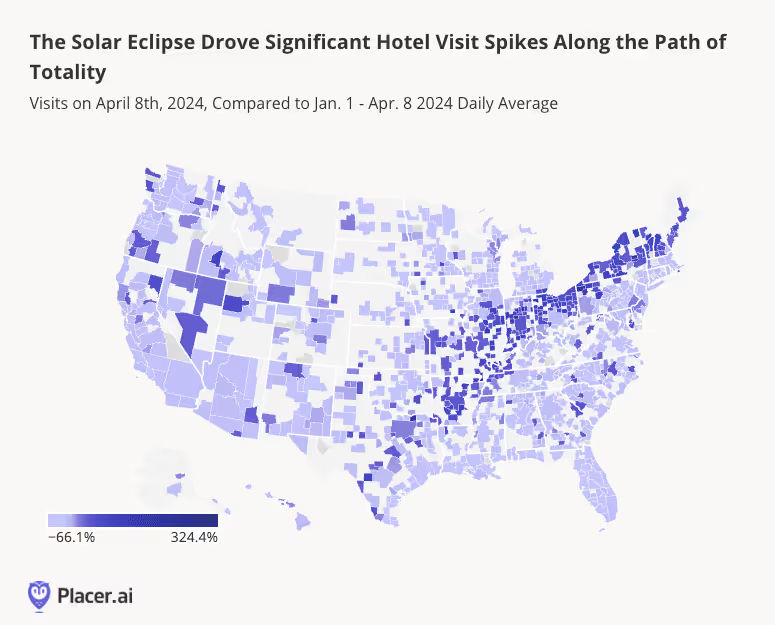
On April 8th, 2024, hotels in CBSAs where the eclipse could be viewed in all its glory (or close to it) experienced major visit boosts. And mapping hotel visits on the big day to CBSAs nationwide – compared to year-to-date daily averages – shows just how significant the cosmic alignment was for areas lucky enough to be located along or near the path of totality.

Within metropolitan CBSAs (CBSAs with at least 50,000 residents), Danville, IL – where visitors could either view a near-total eclipse or drive to a nearby location with 100% totality – experienced the biggest jump in Hotel visits, with visits to the category up 111.3%. But urban centers from north to south – including in New York, Indiana, Ohio, Arkansas, and Missouri – also experienced substantial hotel visit spikes.
.avif)
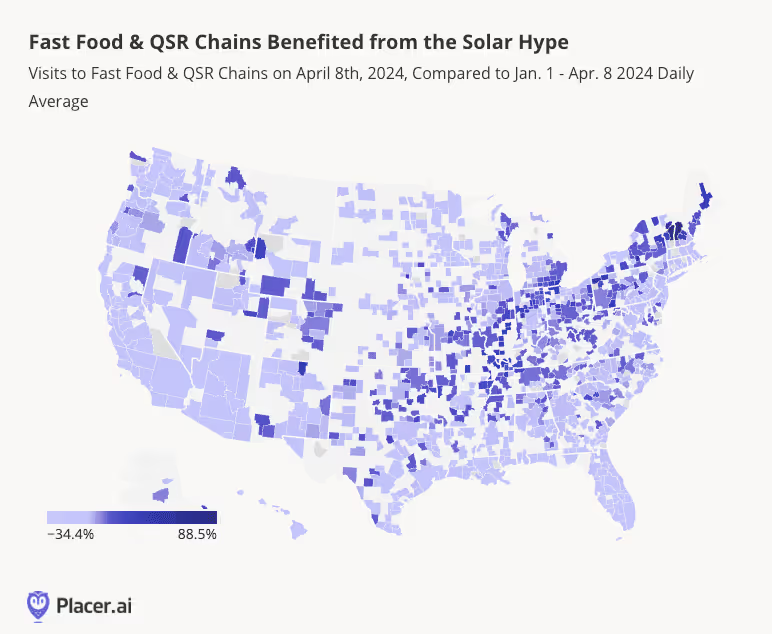
Hotels weren’t the only locations to reap the rewards of the solar eclipse. Fast Food & QSR chains in and around the path of totality enjoyed meaningful April 8th visit spikes of their own. And while the Hotel visit increases were more closely concentrated in prime viewing areas, Fast Food & QSR visits increased along a wider radius as people likely grabbed a bite to eat while making their way to a sun-gazing hotspot.

And the impact of the solar eclipse wasn’t limited to locations located in or near the path of totality. Retailers and dining chains nationwide got in on the action with special deals and limited-time offers meant to make the most of the unique interstellar opportunity.
In the week leading up to April 8th, 2024, Warby Parker drew crowds with the promise of free solar eclipse glasses. And while a burger joint may not be the first place people associate with eyewear, fast food favorite SONIC Drive In also attracted astronomy aficionados with a limited-time Blackout Slush Float that came with free eclipse viewing gear.
Krispy Kreme Doughnuts, for its part, marked the occasion with a limited-edition Total Solar Eclipse Doughnut. And though Mondays aren’t typically busy days for the chain, the special offering produced a clear visit uptick nationwide. In states along the path of totality, Krispy Kreme visits were up 55.5% on April 8th when compared to an average Monday this year, and in the rest of the country they were up 33.9%.
.avif)
For retailers across categories, landmark events from movie launches to cosmic occurrences have the potential to drive visit spikes and generate business. What other big opportunities lie in store for retailers this year?
Follow Placer.ai’s data-driven retail analyses to find out.
This blog includes data from Placer.ai Data Version 2.0, which implements improvements to our extrapolation capabilities, adds short visit monitoring, and enhances visit detection.

This year’s March Madness really lived up to its name, buoyed by the star power of Caitlin Clark, Angel Reese, Paige Bueckers, and Juju Watkins driving viewership to new heights. For the first time in history, the NCAA women’s basketball title drew more viewers than the men’s at 18.9M for the women’s and 14.8M for the men’s, per Nielsen.
Tickets to the Final Four cost $532 on average, an 82% increase over last year, and for the championship game, Rocket Mortgage Fieldhouse Stadium in Cleveland, OH was packed to the gills.
In the days leading up to the women’s final, nearby hotels saw visits increase as well.

This report leverages location intelligence data to analyze the auto dealership market in the United States. By looking at visit trends to branded showrooms, used car lots, and mixed inventory dealerships – and analyzing the types of visitors that visit each category – this white paper sheds light on the state of car dealership space in 2023.
Prior to the pandemic and throughout most of 2020, visits to both car brand and used-only dealerships followed relatively similar trends. But the two categories began to diverge in early 2021.
Visits to car brand dealerships briefly returned to pre-pandemic levels in mid-2021, but traffic fell consistently in the second half of the year as supply-chain issues drove consistent price increases. So despite the brief mid-year bump, 2021 ended with overall new car sales – as well as overall foot traffic to car brand dealerships – below 2019 levels. Visits continued falling in 2022 as low inventory and high prices hampered growth.
Meanwhile, although the price for used cars rose even more (the average price for a new and used car was up 12.1% and 27.1% YoY, respectively, in September 2021), used cars still remained, on average, more affordable than new ones. So with rising demand for alternatives to public transportation – and with new cars now beyond the reach of many consumers – the used car market took off and visits to used car dealerships skyrocketed for much of 2021 and into 2022. But in the second half of last year, as gas prices remained elevated – tacking an additional cost onto operating a vehicle – visits to used car dealerships began falling dramatically.
Now, the price of both used and new cars has finally begun falling slightly. Foot traffic data indicates that the price drops appear to be impacting the two markets differently. So far this year, sales and visits to dealerships of pre-owned vehicles have slowed, while new car sales grew – perhaps due to the more significant pent-up demand in the new car market. The ongoing inflation, which has had a stronger impact on lower-income households, may also be somewhat inhibiting used-car dealership visit growth. At the same time, foot traffic to used car dealerships did remain close to or slightly above 2019 levels for most of 2023, while visits to branded dealerships were significantly lower year-over-four-years.
The situation remains dynamic – with some reports of prices creeping back up – so the auto dealership landscape may well continue to shift going into 2024.
With car prices soaring, the demand for pre-owned vehicles has grown substantially. Analyzing the trade area composition of leading dealerships that sell used cars reveals the wide spectrum of consumers in this market.
Dealerships carrying a mixed inventory of both new and used vehicles seem to attract relatively high-income consumers. Using the STI: Popstats 2022 data set to analyze the trade areas of Penske Automotive, AutoNation, and Lithia Auto Stores – which all sell used and new cars – reveals that the HHI in the three dealerships’ trade areas is higher than the nationwide median. Differences did emerge within the trade areas of the mixed inventory car dealerships, but the range was relatively narrow – between $77.5K to $84.5K trade area median HHI.
Meanwhile, the dealerships selling exclusively used cars – DriveTime, Carvana, and CarMax – exhibited a much wider range of trade area median HHIs. CarMax, the largest used-only car dealership in the United States, had a yearly median HHI of $75.9K in its trade area – just slightly below the median HHI for mixed inventory dealerships Lithia Auto Stores and AutoNation and above the nationwide median of $69.5K. Carvana, a used car dealership that operates according to a Buy Online, Pick Up in Store (BOPIS) model, served an audience with a median HHI of $69.1K – more or less in-line with the nationwide median. And DriveTime’s trade areas have a median HHI of $57.6K – significantly below the nationwide median.
The variance in HHI among the audiences of the different used-only car dealerships may reflect the wide variety of offerings within the used-car market – from virtually new luxury vehicles to basic sedans with 150k+ miles on the odometer.
Visits to car brands nationwide between January and September 2023 dipped 0.9% YoY, although several outliers reveal the potential for success in the space even during times of economic headwinds.
Visits to Tesla’s dealerships have skyrocketed recently, perhaps thanks to the company’s frequent price cuts over the past year – between September 2022 and 2023, the average price for a new Tesla fell by 24.7%. And with the company’s network of Superchargers gearing up to serve non-Tesla Electric Vehicles (EVs), Tesla is finding room for growth beyond its already successful core EV manufacturing business and positioning itself for a strong 2024.
Japan-based Mazda used the pandemic as an opportunity to strengthen its standing among U.S. consumers, and the company is now reaping the fruits of its labor as visits rise YoY. Porsche, the winner of U.S New & World Report Best Luxury Car Brand for 2023, also outperformed the wider car dealership sector. Kia – owned in part by Hyundai – and Hyundai both saw their foot traffic increase YoY as well, thanks in part to the popularity of their SUV models.
Analyzing dealerships on a national level can help car manufacturers make macro-level decisions on marketing, product design, and brick-and-mortar fleet configurations. But diving deeper into the unique characteristics of each dealership’s trade area on a state level reveals differences that can serve brands looking to optimize their offerings for their local audience.
For example, analyzing the share of households with children in the trade areas of four car brand dealership chains in four different states reveals significant variation across the regional markets.
Nationwide, Tesla served a larger share of households with children than Kia, Ford, or Land Rover. But focusing on California shows that in the Golden State, Kia’s trade area population included the largest share of this segment than the other three brands, while Land Rover led this segment in Illinois. Meanwhile, Ford served the smallest share of households with children on a nationwide basis – but although the trend held in Illinois and Pennsylvania, California Ford dealerships served more households with children than either Tesla or Land Rover.
Leveraging location intelligence to analyze car dealerships adds a layer of consumer insights to industry provided sales numbers. Visit patterns and audience demographics reveal how foot traffic to used-car lots, mixed inventory dealerships, and manufacturers’ showrooms change over time and who visits these businesses on a national or regional level. These insights allow auto industry stakeholders to assess current demand, predict future trends, and keep a finger on the pulse of car-purchasing habits in the United States.