.png)
.png)

.png)
.png)

Family Dollar’s parent company Dollar Tree recently announced plans to dramatically rightsize the discount chain’s store fleet, with 600 stores slated for closure in 2024 and more to follow in upcoming years for a total of almost 1000 closures. We dove into the location intelligence for Family Dollar and three other leading value-forward retailers to understand which chain stands to benefit most from Family Dollar’s contraction.
Dollar Tree’s plans to close almost 1000 Family Dollar stores did not surprise retail analysts. Discount & Dollar Stores have been on the rise in recent years, driven in part by significant expansions – visits to the industry up 25.4% in Q1 2023 and up 55.8% in Q4 2023 relative to pre-pandemic Q1 2019. But this growth seems to have bypassed Family Dollar. Q1 2023 visits to the brand were up just 0.8% and traffic during the critical holiday-driven Q4 2023 was up just 9.8% since Q1 2019.
Meanwhile, the eponymous banner of Family Dollar’s parent company Dollar Tree outperformed the wider industry during the same period, with a 28.4% increase in Q1 2023 visits and a 72.1% increase in Q4 2023 visits relative to a Q1 2019 baseline.
.avif)
The Discount & Dollar Store space includes major players like Dollar General and the Dollar Tree banner that can fill the voids left by shuttering Family Dollar Venues. Walmart also may step into some of the newly created gaps. Analyzing the demographic and psychographic composition of the trade areas of these four chains – Family Dollar, Dollar General, Dollar Tree, and Walmart – may reveal the chain(s) best positioned to cater to Family Dollar’s current visitor base.
Most people have set daily shopping habits, and chains will likely have more success vying for Family Dollar’s visitor base if they can accommodate the current visitation patterns of Family Dollar shoppers.
Family Dollar and Dollar General respectively receive 37.0% and 37.9% of their daily visits between the hours of 5:00 PM and 8:59 PM. Meanwhile, only 31.2% of Dollar Tree’s visitors and 34.3% of Walmart visitors visited those chains in the late afternoon and evening. The similarities between Dollar General and Family Dollar’s visitation patterns may mean that Dollar General’s staffing and opening schedule is suited to handle the influx of former Family Dollar visitors without making these visitors modify their current shopping behavior.
.png)
Analyzing the four chains by trade area median household income (HHI) also shows that Family Dollar is closer to Dollar General than to Walmart or Dollar Tree – but the data also reveals that Family Dollar serves a distinct demographic base. The chain has a potential market median HHI of $62.1K and a captured market median HHI of $48.3K – in both cases, the lowest trade area median HHI of the four chains analyzed.
Potential market analysis weighs the Census Block Groups (CBG) making up a trade area according to the number of residents in each CBG. The low median HHI in Family Dollar’s potential market means that the chain’s venues tend to be located in lower-income areas compared to the other chains’ store fleets.
Captured market median HHI reflects the median HHI in the CBGs making up a trade area weighted according to the number of visits to the chain from each CBG. And comparing the four chains indicates that the gap between Family Dollar and the other three chains is even larger when looking at the captured market median HHI, with Family Dollar serving the lowest income households within its potential market.
Still, Dollar General’s trade area median HHI is closest to that of Family Dollar – although Family Dollar’s trade area median HHI is still significantly lower than that of Dollar General – which could mean that Dollar General will be most attractive to Family Dollar’s former visitors.
.png)
But looking at other metrics suggests differences in household composition between Family Dollar and Dollar General. Although the potential market share of households with children is similar for the two chains, Family Dollar’s captured market share is higher while Dollar General’s captured market share of households with children is lower.
Family Dollar’s popularity among lower-income households with children may explain why the chain has been struggling in recent years, as this demographic has been particularly hard-hit by the recent economic headwinds. And this distinct demographic base may also mean that Dollar General might want to make some merchandising, pricing, or marketing adjustments to best serve Family Dollar’s former visitors.
.png)
Although the demographic composition of Family Dollar’s trade areas sets the chain’s visitor base apart, diving into the psychographic segmentation of the chain’s captured and potential market highlights similarities with other value-forward retailers.
All four chains analyzed seem particularly popular with rural audiences – specifically with the Rural Average Income and Rural Low Income segments as defined by the Spatial.ai: PersonaLive dataset. (Dollar General and Walmart also see a disproportionate number of visits from the Rural High Income segment within their potential markets.) So some of Family Dollar’s rural shoppers may already be visiting Walmart or Discount & Dollar Stores – and these other retailers may choose to open in areas where Family Dollar is closing and where no other discounter currently operates.
.avif)
The massive rightsizing of Family Dollar’s store fleet creates major opportunities for other value-driven retailers to expand their reach. Who will end up benefiting most from these shifts?
Check in with placer.ai to find out.
This blog includes data from Placer.ai Data Version 2.0, which implements improvements to our extrapolation capabilities, adds short visit monitoring, and enhances visit detection.

Last year’s retail vibe was nothing if not experiential. Inflation led consumers to trade down and cut back on discretionary spending – but people still sought out fun, affordable venues to meet up with friends and let off some steam.
So with 2023 firmly in the rearview mirror, we dove into the data to check in with Dave & Buster’s Entertainment Inc., owner of eatertainment chain Dave & Buster's, and – since 2022 – Main Event Entertainment. How did the company’s two brands fare in the final months of 2023 and at the start of 2024? And what lies in store for them in the months ahead?
Dave & Buster’s, the sports bar arcade that invites harried grown-ups to cast aside their worries and “unlearn adulthood”, is thriving. With some 160 venues across 42 states, Dave and Buster’s offers the most tightly-wound consumers an inexpensive escape from real life – someplace they can unwind with friends over a beer, some mouthwatering shareables, and a bit of friendly skee-ball.
Over the past several years, Dave & Buster’s has grown its store count, and in 2022 broadened its portfolio with Main Event Entertainment – the family-oriented eatertainment concept that pairs arcade games with larger format activities such as laser tag and bowling. And since November 2023, both brands have sustained mainly positive year-over-year (YoY) visit growth, disrupted only by January 2024’s inclement weather.
.png)
Main Event Entertainment’s purchase by Dave & Buster’s appears to have been a natural move on the company’s part. Overlaying foot traffic data with demographics from STI’s PopStats reveals that the two chains’ comparable offerings attract customers with similar income profiles: In 2023, Dave & Buster’s’ and Main Event’s captured markets featured median household incomes (HHIs) of $67.3K and $67.6K, respectively – just under the nationwide baseline of $69.5K.
But the acquisition of Main Event has also allowed Dave & Buster’s Entertainment, Inc. to broaden its visitor base. Both of the company’s brands attract plenty of singles and families with children. But while Dave & Buster’s young-adult-oriented vibe holds special appeal for people living on their own, Main Event’s child-friendly activities make it a particularly attractive destination for parental households. Together, the two chains offer something for everyone – cementing the company’s role as an eatertainment leader.
.png)
Dave & Buster’s and Main Event also enjoy similar weekly visitation patterns. Unsurprisingly, the two chains are busiest on Saturdays, followed by Sundays and Fridays, and quieter during the rest of the week. But both brands have also found creative ways to boost weekday visits. On Wednesdays, Dave & Buster’s offers a 50%-off deal, letting customers play their favorite games at half the price – and fueling a significant midweek foot traffic spike. Main Event Entertainment, for its part, draws weekday crowds on Mondays with an afternoon all–you-can-play special.
.png)
Everybody needs to let their hair down sometimes – and with Spring Break right around the corner, both Dave & Buster’s and Main Event are building momentum with seasonal specials aimed at making their offerings even more affordable.
For both chains, March is an important milestone – in 2023, Dave & Buster’s and Main Event drew 41.0% and 82.9% more traffic during the week of March 13th, respectively, than they did, on average, throughout the rest of year. And if recent visit trends are any indication, the two brands appear poised to enjoy a healthy Spring Break and a strong rest of 2024.
For more data-driven retail and dining insights, follow Placer.ai.
This blog includes data from Placer.ai Data Version 2.0, which implements improvements to our extrapolation capabilities, adds short visit monitoring, and enhances visit detection.

Despite the individual restaurant success stories in 2023, last year was also a period of economic headwinds in the dining industry. But Darden Restaurants – and its largest chains Olive Garden, LongHorn Steakhouse, and Cheddar’s Scratch Kitchen – continued to drive foot traffic. We dove into the location analytics for these three Darden brands and took a closer look at the shifts in consumer behavior impacting the dining space.
Foot traffic in 2023 was largely positive for Olive Garden, LongHorn Steakhouse, and Cheddar’s Scratch Kitchen, with the strong visit trends likely helping drive Darden’s recent sales growth.
All three brands posted impressive YoY visit growth in Q1 2023, perhaps aided by the comparison to an Omicron-impacted, muted Q1 2022. LongHorn Steakhouse then pulled ahead of the pack in Q2 and Q3 with YoY foot traffic up 3.7% and 4.8%, respectively, before finishing the year off strong with a 3.8% YoY visit increase in Q4. But the real Darden star in Q4 was Olive Garden. The Italian-focused chain’s success was likely bolstered by the return of the Never Ending Pasta Bowl – offered from late September 2023 through mid-November – which appears to have attracted even more hungry diners than it did the previous year.
Meanwhile, YoY visits to Cheddar’s Scratch Kitchen increased during the first three quarters of 2023 and held relatively steady in Q4 – YoY visits during the last quarter of the year were down just 0.7% – highlighting the overall strength of Darden’s portfolio.
.avif)
Though 2023 was a particularly successful year for Darden foot traffic, Olive Garden, LongHorn, and Cheddar’s were not immune to this year’s arctic blast. The extreme weather in January 2024 impacted dining visits and put a damper on traffic to these chains. But once the weather warmed up in February 2024, YoY visits to Olive Garden, LongHorn, and Cheddar’s began to heat up as well – outpacing even the strong early 2023 traffic – indicating that Darden brands are likely in for another year of robust visits.
.avif)
Diving deeper into the analytics for Darden’s brands indicated that shifts in consumer behavior may be a factor in the restaurants’ recent foot traffic gains. Analysis of hourly visits to Olive Garden, LongHorn, and Cheddar’s since 2019 revealed that a greater share of visitors are now engaging with their favorite restaurants during non-traditional dayparts in the mid and late afternoon.
The share of daily Olive Garden, LongHorn, and Cheddar’s visitors visiting between 2 PM and 5:59 PM was higher in 2023 than in 2019 for all three brands. Olive Garden had the largest share of mid and late afternoon visits in 2022 at 32.6% and maintained its share of 2:00 PM to 5:59 PM visitation in 2023. Meanwhile, LongHorn and Cheddar’s share of visits during the 2:00 PM to 5:59 PM daypart continued increasing in 2023 relative to the previous year, which suggests that this trend of late afternoon and early dinner visits is becoming the new normal.
As eating out early is becoming more prevalent in the casual dining space – as well as in fine dining and steakhouse restaurants – Darden might capitalize on this trend by adding more happy hours and other late-afternoon specials to its restaurants’ menus.
.png)
Darden’s biggest chains succeeded in driving foot traffic growth in 2023 and early 2024. Location analytics indicated that while demand for the brands is consistent, consumer behavior is always changing. How will these restaurants navigate the rest of 2024? Visit Placer.ai to find out.
This blog includes data from Placer.ai Data Version 2.0, which implements improvements to our extrapolation capabilities, adds short visit monitoring, and enhances visit detection.

Athleisure and sportswear are a go-to for consumers looking to move seamlessly between activities – from a workout to work-from-home. That functionality has kept the category running hot in recent years even while more consumers are getting back to the office and socializing. And since athleisure and sportswear are now bonafide wardrobe staples, more consumers are investing in high-end items. We dove into the data for two of the category’s biggest upscale players – Nike and lululemon – in order to take a closer look at the consumer behavior driving visit growth.
During all four quarters of 2023, Nike and lululemon saw year-over-year (YoY) foot traffic growth that surpassed the visit increases in the wider Athleisure & Sportswear space. Part of Nike’s sizable 2023 YoY visit gains were likely due to the addition of a large number of stores relative to its somewhat modest footprint. Nike is continuing to invest in own-brand stores to boost DTC business including the first U.S. Michael Jordan "World of Flight" store coming to Philadelphia, PA. Lululemon also expanded its store count – albeit more modestly – which likely also helped the company stay ahead of the competition.
.png)
Fueled by significant store growth, Nike managed to keep YoY foot traffic positive in the first two months of 2024 despite the arctic blast that plagued overall retail visits in January.
Lululemon and the wider Athleisure & Sportswear space were less insulated from the effects of the storm, and the comparison to a strong 2023 made for mild YoY visit gaps in January 2024. But by the end of February 2024, both lululemon and the Athleisure & Sportswear space had narrowed their visit gaps and appeared to be on an upward trajectory.
.png)
Diving deeper into the demographic data for Nike’s trade area indicated that the aggressive expansion is not the only factor driving the brand’s recent foot traffic gains. Analysis using the AGS: Demographic Dimensions dataset revealed that since the 2021 retail reopening – and specifically Q3 2021 – the median household income (HHI) of Nike’s captured market has been higher than that of its potential market*. And the gap between the median HHI in the brand’s captured and potential markets seems to have widened even further in 2022-2023.
Driving traffic from affluent consumers appears to be an intentional strategy by the brand. Nike CEO John Donahoe recently noted that the brand is expanding in products across price points and now offers more expensive womenswear than ever before – and location intelligence indicates that this strategy is working. By Q4 2023, the median HHI of Nike’s captured market had climbed to $95.6K – the highest in nearly five years. This suggests that despite the adverse impact of inflation on some aspirational shoppers, Nike is succeeding in driving high-value foot traffic.
*A chain’s potential market refers to the population residing in a given trade area, where the Census Block Groups (CBGs) making up the trade area are weighted to reflect the number of households in each CBG. A chain’s captured market weighs each CBG according to the actual number of visits originating to the chain from that CBG.
.png)
Will the success of upscale athleisure and sportswear continue in 2024? Visit Placer.ai to find out.
This blog includes data from Placer.ai Data Version 2.0, which implements improvements to our extrapolation capabilities, adds short visit monitoring, and enhances visit detection.

The big news coming out of Dollar Tree’s Q4 2023 update was that the company plans to close 1,000 stores following a comprehensive portfolio review (which we first discussed in December). Management plans to close approximately 600 Family Dollar stores in the first half of fiscal 2024, with another 370 Family Dollar and 30 Dollar Tree stores expected to close over the next several years as store lease terms expire. The 970 anticipated Family Dollar store closures represent 11.6% of the banner’s 8,359 stores opened as of the end of February. Dollar stores were one of the strongest performing categories from a visitation (new stores and perspective during 2023 (below), so it may seem surprising that Dollar Tree plans to close so many Family Dollar stores during 2024.
Dollar Tree’s decision to close Family Dollar stores echoes a lot of what we’ve heard from other retailers closing stores in recent years, including Macy’s, CVS/Walgreens, and others. For the most part, retailers’ decisions to close stores comes down to a combination of factors: (1) population migration has changed the supply/demand balance in a given market; (2) consumer behavior has changed post-COVID; (3) the retailer is facing new sources of competition and eroding consumer loyalty; and (4) retailers are replacing underperforming stores with a modernized store layout.
Management cited changing demographics and market saturation as key considerations driving its consolidation efforts for Family Dollar. While the company has not announced which locations it plans to close, we’ve plotted Family Dollar’s 1,000 lowest performing locations over the trailing twelve months on a visit per square foot basis below.
If we compare this to a map of changes in Origin/Destination Household Income Ratio over the past four years (using Placer’s Migration Trends report), the changing demographics that Dollar Tree cited becomes evident. Many underperforming Family Dollar locations are in the Mid-Atlantic and Southeast markets, several of which have seen an increase in higher household income population due to migration (represented by the green dots below). As populations in these markets have shifted, it’s not surprising that the company is reevaluating its store portfolio in these markets.
The other factor at play behind these store closures is increasing competition. We’ve discussed disruption from Temu and other online marketplaces in the past, but dollar stores are also fighting for visitor share with value grocery chains, superstores, and convenience stores. And it’s not just lower-income consumers that these chains are fighting over–we’re seeing increasing evidence that dollar stores are seeing visits from middle income consumers. In fact, Dollar Tree CEO Rick Dreiling noted that Dollar Tree added 3.4 million new customers in 2023, mostly from households earning over $125,000 a year. We’ve previously noted how Walmart has been successful attracting more middle-income consumers but if we look at captured trade area demographics for the Dollar Tree banner (and not including Family Dollar) from Q3 2023 to Q4 2023, we do see an increase in the trade areas between $50-$150K in household income (below).
Admittedly, some of the increase in higher-income consumers can be explained by the aforementioned migration trends, but management also attributes the pick up in middle-income consumers to its multi-price point strategy called “More Choices” (which we’ve discussed in the past). In particular, we believe the company has seen success driving visits to Dollar Tree stores with its $3, $4, and $5 frozen and refrigerated assortment, which have been rolled out to more than 6,500 locations today (almost 80% of the banner’s store base as of February). The company has also discussed adding cooler capacity at Family Dollar stores; 17,000 cooler doors were added at Family Dollar last year, which brought the average to 26 coolers per store (versus a long-term goal of 30 coolers per store). We suspect that many of the closed Family Dollar stores will be replaced with new stores featuring expanded cooler offerings to better compete for customers across all demographic groups.
There are also more practical reasons for the store closures, including improved execution. Dreiling pointed out that underperforming stores can “take the bulk of a district manager's time”. By closing them, the company can better focus on service and execution at existing stores. Also, management believes that the closings will be accretive from a cash perspective (i.e., it’s cheaper to run these underperforming stores dark than it is to operate them at a loss).
When closing stores, there is always the risk that customers will churn to competing retail brands and categories. In fact, we’ve seen a meaningful number of visitors to CVS and Walgreens locations that closed the past two years migrate to nearby grocery and superstore chains. However, by replicating many of Dollar Tree’s successful strategies–including expanded cooler assortments–at future Family Dollar store openings, it gives the chain an opportunity to offset potential visitors lost to this round of closures.

While many retailers have embraced smaller format stores, one chain bucking this trend is Dick’s Sporting Goods through its large-format House of Sport concept. This format offers shoppers an “elevated assortment and service model, premium experiences and enhanced visual expressions”. We discussed the early success of the House of Sport last summer, and with a few months of additional data to look at, we can now better assess the longer-term potential of this concept sporting goods retail category.
Below, we’ve presented visit per location data for the 12 Dick’s House of Sport locations currently open versus Dick’s chainwide average since the beginning of 2023. The strong visits per location trends that we identified last July continued into the back half of 2023 and early 2024, with House of Sport locations now seeing 5-6 times the number of visits per location compared to the rest of the chain. For reference, the average Dick’s Sporting Goods store is roughly 50K square feet square feet compared to 100K-120K square feet for House of Sport, indicating that House of Sport is also outperforming on a visit per square foot basis.
Given the strong visitation trends, it’s not surprising that Dick’s plans to invest more in the House of Sport concept in the years ahead. In 2024, the company plans to open eight new locations, with seven being planned relocations/conversions of existing Dick’s stores and one new store at Prudential Center in Boston. The company also plans to begin construction this year on approximately 15 House of Sport locations that will open throughout 2025, bringing the total number of House of Sport locations to 35 by the end of 2025. Longer-term, management sees an opportunity for 75-100 House of Sport locations by 2027.
Interestingly, Dick’s plans to incorporate experiential elements similar to House of Sport across the rest of its store portfolio. During its Q4 2023 update this past week, management also announced plans to open 16 next-generation 50K square foot Dick’s Sporting Goods stores in 2024, including the relocation/remodeling of 12 existing stores (on top of the 11 next-generation stores already opened). These next generation stores were inspired by the House of Sport format and incorporate expanded product assortments for certain categories, emphasis on services, and improved visuals. The company also plans to open 10 Golf Galaxy Performance Center locations in 2024 (aligning well with golf’s post-COVID comeback).
In total, Dick’s Sporting Goods plans to increase square footage by approximately 2% in 2024, marking the retailer's largest annual square footage increase since 2017. Importantly, the economics behind Dick’s nascent store formats are compelling. The House of Sport formats generate approximately $35 million in omnichannel sales per store, approximately 20% EBITDA margins, and cash-on-cash returns of 35% on an initial investment of $18.5M ($11.5M capex, $3.5M inventory, and $3.5M pre-opening costs). The next-generation Dick’s stores are expected to generate $14M in omnichannel sales per store, 20% EBITDA margins, and cash-on-cash returns of 65% on an initial investment of $4.5M ($2.5M capex, $1.5M inventory, and $0.5M in pre-opening costs).

Malls have long acted as a gleaming symbol of American retail. Following the opening of the first indoor mall in 1956, and as the American middle class increasingly moved from the city to the suburbs, malls continued to open at a rapid rate. By 1960, some 4,500 shopping centers had opened nationwide, filling the growing demand for “third places” – spaces that allowed the newly suburban populations to gather, socialize, and create community. And while that role evolved over the years, it’s safe to say that malls have played a major part in shaping the American shopping culture.
But malls’ rapid expansion led to an oversaturated market – some estimates suggest that there are approximately 24 square feet of retail space per U.S. citizen, as compared to 4.6 for the U.K. and 2.8 for China. Many began to predict the demise and downfall of malls, and that narrative intensified as online shopping grew in popularity. The rise of big-box stores, a focus on “services, not things,” and COVID-19 only accelerated these trends.
A lot of the doom and gloom predictions tend to de-emphasize the mall's role as a modern incarnation of a bustling downtown shopping area.
But a lot of these doom and gloom predictions focus on malls only as a place to shop, and tend to de-emphasize their other role as the third place – a modern incarnation of a bustling downtown shopping area, replete with shops, services, and places to meet. And after two years of isolation and a new, pandemic-induced wave of suburban relocation, malls’ potential to bring people together is more prized than ever.
So although malls were hit hard during COVID-19, many of them are finding ways to reinvent themselves and stay relevant. Today, more than halfway through 2022, the challenges that malls face continue to evolve and change – but malls are evolving too. This white paper covers a few specific ways that some malls have found to thrive in the new normal. Some shopping centers are turning to entertainment to draw crowds into their doors. Others are focusing on offering a full visitor experience that extends beyond simply grabbing a new shirt or a burger at the food court. Still, more are embracing omnichannel options, offering an integrated on and offline experience to their shoppers. In the face of significant retail challenges, top-tier malls are turning to innovative solutions to stay ahead of the game.
The pandemic posed significant challenges to malls. Although foot traffic to the category rose back up in the summer of 2021, the Delta and subsequent Omicron waves brought visits down once more. And as visit gaps post-Omicron began to narrow, inflation and gas prices put the brakes on any return to normalcy. April and May 2022 saw visits beginning to trend up, though the unrelenting rise of inflation, the highest it’s been in the past 40 years, has slowed that recovery slightly.
Foot traffic data shows that malls are continuing to attract visitors, despite the challenges that seem to crop up weekly.
Still, foot traffic data shows that malls are continuing to attract visitors, despite the challenges that seem to crop up weekly. And while they may no longer play the central role they once did in Americans’ shopping routines, malls still serve as indoor community hubs where friends and family can come together for diverse food, shops, and entertainment options. This could explain why top-tier malls keep on coming back despite the seemingly constant obstacles.
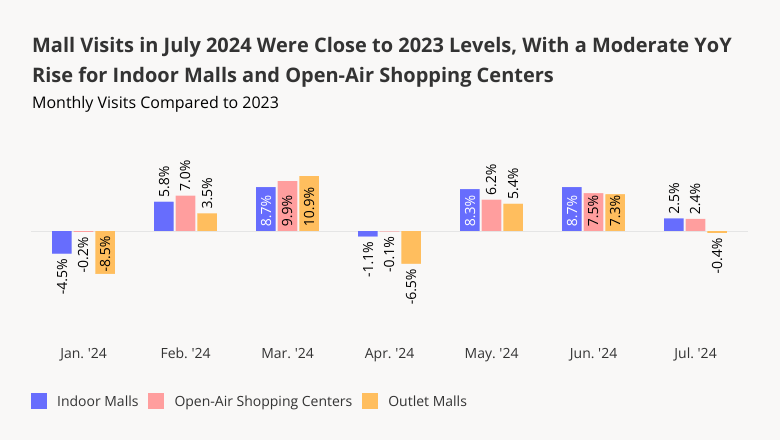
Comparing monthly visits from January 2022 through July 2022 to the same period in 2019 highlights the significant difficulties facing the sector. Indoor malls, open-air lifestyle centers, and outlet malls alike saw marked lags in foot traffic as compared to three years ago.
Monthly year-over-three-year (Yo3Y) foot traffic comparisons also highlight mall resilience.
The monthly year-over-three-year (Yo3Y) foot traffic comparisons also highlight mall resilience. Following an Omicron-plagued January, the visit gaps narrowed in February 2022 to less than 5% for all the segments. And although the increase in gas prices and inflation brought visits down in March, malls quickly bounced back in April 2022, with indoor malls seeing only 1.8% fewer visits than in 2019 and open-air shopping centers down only 4.8% Yo3Y. Foot traffic fell again in May and June as consumers tightened their budgets in the face of rising prices, but consumers appear to have quickly made peace with the new economic reality. By July 2022, visits to indoor malls and open-air lifestyle centers were only 3.5% and 2.7% lower than they had been in July 2019.
COVID didn’t just impact visit numbers – since 2020, mall visits have also gotten shorter, likely a result of pandemic restrictions and a general desire not to congregate any longer than necessary. And although 2021 and 2022 saw a slight uptick in time spent at malls and shopping centers – from 60 minutes in 2020 to 62 minutes in 2021 and 2022 – the median dwell time is still significantly lower than the 70 minutes median dwell time of pre-COVID 2018 and 2019.
Shorter visits are not necessarily a bad thing – intent-driven shoppers may simply be doing more research ahead of time and less in-mall browsing.
Shorter visits are not necessarily a bad thing in and of themselves – consumers today are highly informed, so many intent-driven shoppers may simply be doing more research ahead of time and less in-mall browsing. But shorter (and fewer) visits do mean that malls must focus on giving shoppers a reason to visit. We explore some successful strategies below.
Malls have long integrated entertainment into their overall experience in the form of arcades, movie theaters, and even coin-operated animal rides. Some malls, however, are taking their entertainment offerings to the next level.
In August 2021, CBL Properties, a Tennessee-based property developer, announced the opening of the Hollywood Casino by Penn National Gaming in the York Galleria Mall in York, Pennsylvania. The 80,000 square foot casino, which boasts 500 slots and 24 live-action table games, opened in the mall’s lower level. The space was occupied by a now-closed Sears department store, and the entertainment venue now functions as a new anchor to draw customers in.
The casino’s opening has had a dramatic impact on the mall’s foot traffic. In a year-over-three-year (Yo3Y) comparison, July 2021 saw 2.4% fewer visitors than July 2018. But when the casino opened in August 2021, visits to the location jumped to 31.4% Yo3Y. This increase is all the more impressive considering that the casino opened on August 19th, with only 12 days left in the month.
The mall, which had seen negative Yo3Y visit numbers until the casino’s opening, has sustained the positive visit trend through July 2022 – a testament to the appeal of in-mall entertainment.
Another mall betting on indoor entertainment is the Pierre Bossier Mall in Bossier City, Louisiana. In April 2022, Surge Entertainment opened a child-friendly space, which includes zip-lining, bowling, laser tag and arcade games. The Surge Entertainment chain is co-owned by Drew Brees, the former New Orleans Saints quarterback, and has 15 locations around the country. The Pierre Bossier Mall branch is filling the space vacated by Virginia College, which closed its doors in 2018.
Since Surge Entertainment opened its Bossier City location, the mall has seen a dramatic increase in average dwell time.
Since Surge Entertainment opened its Bossier City location, the mall has seen a dramatic increase in average dwell time. Between July 2021 and March 2022, median dwell time hovered between 51 and 58 minutes. But following the center’s opening, median dwell time jumped to 78 minutes. Since then, the median dwell time has remained consistently elevated: In the four months since the Surge Entertainment opening, median dwell times did not drop below 75 minutes.
Brick-and-mortar retailers once viewed online shopping as a threat – but now, mall owners and operators are increasingly turning to digital channels to complement existing approaches. COVID-19 and the surge of online shopping further fueled malls’ digital progress. Over the past two years, large malls and suburban shopping centers across the country have been rolling out various online and social shopping options and adopting omnichannel strategies.
In September 2020, Centennial, a real estate investment firm with many malls and mixed-use entertainment centers in its portfolio, launched a chain-wide omnichannel platform called Shop Now!. The app allows consumers to shop across all Centennial malls the way someone would shop on Amazon.
The first phase of the program, which launched in October 2020, allowed users to browse an AI-powered search engine connected to the inventory of all of the stores operating in their mall of interest. In February 2022, Centennial debuted phase two of the program at its Santa Ana, CA based MainPlace Mall. It allows customers to consolidate orders from several stores into a single cart, get the order fulfilled by personal shoppers, and have the orders ready for same-day delivery or on-site pickup.
The e-commerce app could have detracted shoppers from physically going to the mall – but instead, the program increased both monthly and loyal visitors.
The app allows consumers to browse and shop from the comfort of their phones. It could have detracted shoppers from physically going to the mall – but instead, the program has increased both monthly and loyal visitors. In the months following the launch of the second phase, MainPlace Mall saw its loyal visits increase by 5% (from 46.2% in February ‘22 to 51.3% in June ‘22), while overall monthly visits in April ‘22 increased by 5.5% when compared to 2019. The digital investment also helped the mall make sales that could have been lost to other e-commerce platforms. The mall’s brick-and-mortar success following the addition of a digital channel highlights how malls can rise to the top by embracing an omnichannel strategy.
Continuing its innovative streak, the MainPlace Mall recently added an experiential component with the opening the American Ninja Warrior Adventure Park in July 2022 in the place of four former retail stores. During its first month of operation, the park drove the mall’s share of loyal visits up by 13.4% compared to the previous month while boosting Yo3Y monthly visits by 18.0%.
The difference in impact between the online platform launch and the opening of the American Ninja Warrior Adventure Park indicates that malls can enjoy both gradual gains over time as well as jumps in foot traffic and loyalty, depending on the strategy they adopt.
Omnichannel strategies can also revitalize food courts hit hard by the pandemic. Arundel Mills Mall, part of the Simon Property Group, began offering online orders in February 2022 via a platform called Snackpass, allowing users to use the app at various eateries around the mall. Snackpass, launched in 2017 as a food ordering app on the Yale campus, facilitates group ordering and includes various social features. Its current iteration allows customers to pre-order food, skip lines, collect rewards, and engage with friends. It also offers discounts on group orders, in an effort to promote social dining.
Since the beginning of the Snackpass partnership, the shopping center itself is seeing more visitors – many of whom are coming from farther away.
Since the beginning of the Snackpass partnership, the shopping center itself is seeing more visitors – many of whom are coming from farther away. In the five months following the app’s launch, Arundel Mills saw an overall increase of 15 square miles to its True Trade Area (TTA), and an increase of 29.5% in visits per sq. ft. – The consistent increase in TTA and visits per sq. ft. are a testament to the power of innovative dining partnerships to draw traffic to top-tier malls.
With many retailers reducing their on-mall presence, empty brick-and-mortar stores have attracted plenty of negative attention. But now, malls are increasingly repurposing vacated spaces in new, innovative ways that resonate with local communities and can fill their evolving needs.
At the Ocean County Mall in Toms River, NJ, Simon Property Group repurposed the huge space left by a former Sears store and turned it into a lifestyle center, with stores opening throughout 2020. The space is now being used by a number of highly popular chains such as LA Fitness, Ulta Beauty, HomeSense, and P.F. Chang’s and also includes a children's play area.
This pivot seems to be working. Median dwell time to the mall has increased from 53 minutes to 56 minutes, a significant change when considering that a majority of malls have recently seen their dwell times drop.
The center has also seen the median age for its trade area decrease from 40.5 years old in the first half of 2021 to 37.2 in the first half of 2022, a dramatic shift in visitor demographics. Yo3Y visits are strong as well – July 2022 were up by 17.1%.
In a similar tale of a closed Sears turning into a lifestyle center, the Northshore Mall in Peabody, MA turned the space vacated by the department store into a mixed-use center. The most significant anchor is now the high-end Life Time Fitness Center that offers cardio, weights, and functional training rooms, and includes yoga, pilates, and cycling studios, indoor and outdoor pools, basketball and pickleball courts, saunas, and a bistro.
As soon as the health club opened its doors in July 2021, visits to the mall increased – significantly outpacing the levels seen when Sears was still open.
As soon as the health club opened its doors in July 2021, visits to the mall increased – significantly outpacing the levels seen when Sears was still open. Both Yo3Y and year-over-four-year (Yo4Y) foot traffic numbers were impressive, with July 2022 seeing 17.2% more visitors than three years prior.
As visits to malls become more focussed, selecting the right tenant has never been more important – and that may mean looking at unconventional occupants to draw in customers.
In one example of tapping into local needs, the Westfield Oakridge shopping center in San Jose, CA, opened a specialty grocery store on its premises. 99 Ranch Market, one of the largest Asian supermarket chains in the U.S., began operating its first mall location in March 2022. The location includes classic grocery store items such as produce, meat, and seafood sections, and also boasts a dining hall, tea bar, and bakery.
Its opening day saw lines snaking out the door, as excited locals queued to sample the store’s delicacies. And the crowd-drawing hype seems to be more than a flash in the pan – the months following the opening were the mall’s strongest in the past year and a half. Yo3Y visits were up by 10.1% in July 2022 , with some shoppers reporting that the addition of the grocery store had turned Westfield Oakridge into their all-in-one stop shop.
Although the area was not lacking in grocery options, retail foot traffic data indicates that the new 99 Ranch Market at Westfield Oakridge Mall still filled a void.
Although the area was not lacking in grocery options, retail foot traffic data indicates that the new 99 Ranch Market at Westfield Oakridge Mall still filled a void – the new grocery store’s trade area has only minimal overlaps with the other trade areas of the nearby 99 Ranch Markets locations. This means that most of the new 99 Ranch Market’s customers were not being well-served by the existing locations of the chain.
Westfield Oakridge is not the only San Jose mall turning to food to attract the crowds. On June 16th 2022, following much hype and a pandemic-related delay, Eataly, the all-in-one Italian market, restaurant, and cooking school opened its first Northern California location at the Westfield Valley Fair in Santa Clara, CA.
Prior to the launch, the Westfield Valley Fair mall was already one of the more successful malls in the country – but the opening of Eataly seems to be driving even more foot traffic. Yo3Y visits to malls during Eataly’s opening week exceeded 20% for the first time in months and have since remained consistently elevated, with visits for the week of July 25th up 27.7% relative to the equivalent week in 2019.
In March 2022, regional department store Von Maur opened its doors at The Village of Rochester Hills, an open-air lifestyle center in Michigan. The retailer, which has 36 locations throughout the Midwest, took over the space left vacant by Carson’s, another Midwest-based department store.
What may be the first new department store in the Detroit metropolitan area in over a decade is driving visits to the shopping center.
What may be the first new department store in the Detroit metropolitan area in over a decade is driving visits to the shopping center. Von Maur’s March 2022 opening pushed Yo3Y visits up by 16.9% compared to the mere 4.3% Yo3Y increase the month before.
Part of the secret to Von Maur’s success lies in the psychographic characteristics of residents within the mall’s trade area. Using Spatial.ai’s GeoWeb data, a tool which tracks online engagement with various trends and topics by neighborhood, we found that the TTA surrounding The Village had an index of 131 for department store shoppers. In other words, people in the mall’s trade area exhibited heightened interest in department stores – they engaged with department-store-related content at a rate that was 1.3 times higher than the national average – which helps explain why Von Maur is thriving in this specific location. And in another testament to the strength of immersive retail experiences, Von Maur, which focuses on curating a unique shopper journey and features a pianist at all of its locations, has been ranked the top department store in America.
The addition of Von Maur is not the only change that The Village is implementing – the mall has continued adding new stores and will be opening more throughout the year. These, too, will likely boost foot traffic to the lifestyle center.
The mall’s ability to select tenants that cater to, and reflect the needs and behaviors of its consumers is likely to continue driving success. By drilling down into the nitty-gritty details of who comes to shop, where they come from, and what shops they enjoy frequenting, mall management can tailor the shopping center to meet the needs of its base.
The “death of the American mall” has been predicted for years. The reality, however, is much more nuanced than that – like many other sectors, malls are undergoing a shift to help them better serve evolving customer needs and survive and thrive in an ever-shifting retail landscape.
The malls featured in this white paper have found ways to consistently attract visitors despite the various obstacles faced by the category over the past two years. By understanding that the American mall must evolve along with the consumers, mall owners can successfully revitalize their retail spaces.

This report leverages location intelligence data to analyze the auto dealership market in the United States. By looking at visit trends to branded showrooms, used car lots, and mixed inventory dealerships – and analyzing the types of visitors that visit each category – this white paper sheds light on the state of car dealership space in 2023.
Prior to the pandemic and throughout most of 2020, visits to both car brand and used-only dealerships followed relatively similar trends. But the two categories began to diverge in early 2021.
Visits to car brand dealerships briefly returned to pre-pandemic levels in mid-2021, but traffic fell consistently in the second half of the year as supply-chain issues drove consistent price increases. So despite the brief mid-year bump, 2021 ended with overall new car sales – as well as overall foot traffic to car brand dealerships – below 2019 levels. Visits continued falling in 2022 as low inventory and high prices hampered growth.
Meanwhile, although the price for used cars rose even more (the average price for a new and used car was up 12.1% and 27.1% YoY, respectively, in September 2021), used cars still remained, on average, more affordable than new ones. So with rising demand for alternatives to public transportation – and with new cars now beyond the reach of many consumers – the used car market took off and visits to used car dealerships skyrocketed for much of 2021 and into 2022. But in the second half of last year, as gas prices remained elevated – tacking an additional cost onto operating a vehicle – visits to used car dealerships began falling dramatically.
Now, the price of both used and new cars has finally begun falling slightly. Foot traffic data indicates that the price drops appear to be impacting the two markets differently. So far this year, sales and visits to dealerships of pre-owned vehicles have slowed, while new car sales grew – perhaps due to the more significant pent-up demand in the new car market. The ongoing inflation, which has had a stronger impact on lower-income households, may also be somewhat inhibiting used-car dealership visit growth. At the same time, foot traffic to used car dealerships did remain close to or slightly above 2019 levels for most of 2023, while visits to branded dealerships were significantly lower year-over-four-years.
The situation remains dynamic – with some reports of prices creeping back up – so the auto dealership landscape may well continue to shift going into 2024.
With car prices soaring, the demand for pre-owned vehicles has grown substantially. Analyzing the trade area composition of leading dealerships that sell used cars reveals the wide spectrum of consumers in this market.
Dealerships carrying a mixed inventory of both new and used vehicles seem to attract relatively high-income consumers. Using the STI: Popstats 2022 data set to analyze the trade areas of Penske Automotive, AutoNation, and Lithia Auto Stores – which all sell used and new cars – reveals that the HHI in the three dealerships’ trade areas is higher than the nationwide median. Differences did emerge within the trade areas of the mixed inventory car dealerships, but the range was relatively narrow – between $77.5K to $84.5K trade area median HHI.
Meanwhile, the dealerships selling exclusively used cars – DriveTime, Carvana, and CarMax – exhibited a much wider range of trade area median HHIs. CarMax, the largest used-only car dealership in the United States, had a yearly median HHI of $75.9K in its trade area – just slightly below the median HHI for mixed inventory dealerships Lithia Auto Stores and AutoNation and above the nationwide median of $69.5K. Carvana, a used car dealership that operates according to a Buy Online, Pick Up in Store (BOPIS) model, served an audience with a median HHI of $69.1K – more or less in-line with the nationwide median. And DriveTime’s trade areas have a median HHI of $57.6K – significantly below the nationwide median.
The variance in HHI among the audiences of the different used-only car dealerships may reflect the wide variety of offerings within the used-car market – from virtually new luxury vehicles to basic sedans with 150k+ miles on the odometer.
Visits to car brands nationwide between January and September 2023 dipped 0.9% YoY, although several outliers reveal the potential for success in the space even during times of economic headwinds.
Visits to Tesla’s dealerships have skyrocketed recently, perhaps thanks to the company’s frequent price cuts over the past year – between September 2022 and 2023, the average price for a new Tesla fell by 24.7%. And with the company’s network of Superchargers gearing up to serve non-Tesla Electric Vehicles (EVs), Tesla is finding room for growth beyond its already successful core EV manufacturing business and positioning itself for a strong 2024.
Japan-based Mazda used the pandemic as an opportunity to strengthen its standing among U.S. consumers, and the company is now reaping the fruits of its labor as visits rise YoY. Porsche, the winner of U.S New & World Report Best Luxury Car Brand for 2023, also outperformed the wider car dealership sector. Kia – owned in part by Hyundai – and Hyundai both saw their foot traffic increase YoY as well, thanks in part to the popularity of their SUV models.
Analyzing dealerships on a national level can help car manufacturers make macro-level decisions on marketing, product design, and brick-and-mortar fleet configurations. But diving deeper into the unique characteristics of each dealership’s trade area on a state level reveals differences that can serve brands looking to optimize their offerings for their local audience.
For example, analyzing the share of households with children in the trade areas of four car brand dealership chains in four different states reveals significant variation across the regional markets.
Nationwide, Tesla served a larger share of households with children than Kia, Ford, or Land Rover. But focusing on California shows that in the Golden State, Kia’s trade area population included the largest share of this segment than the other three brands, while Land Rover led this segment in Illinois. Meanwhile, Ford served the smallest share of households with children on a nationwide basis – but although the trend held in Illinois and Pennsylvania, California Ford dealerships served more households with children than either Tesla or Land Rover.
Leveraging location intelligence to analyze car dealerships adds a layer of consumer insights to industry provided sales numbers. Visit patterns and audience demographics reveal how foot traffic to used-car lots, mixed inventory dealerships, and manufacturers’ showrooms change over time and who visits these businesses on a national or regional level. These insights allow auto industry stakeholders to assess current demand, predict future trends, and keep a finger on the pulse of car-purchasing habits in the United States.