Skip to Main Content
Thank you! Your submission has been received!
Oops! Something went wrong while submitting the form.
0
0
0
0
----------
0
0
Articles
Article
Six Q1 Thoughts
Ethan Chernofsky
Apr 13, 2026
5 minutes

Q1 2026 is in the books and there were some key elements that popped when we looked at the data.

1. Inspiration in the Store 

While we’re all about location data, few things get us as excited as the glorious combination of behavioral location analytics with sentiment data. So, we ran a poll of retail industry professionals with our friends at ShopTalk, and the results were fascinating. But two answers really stood out.

First, only 30% of respondents felt that ‘inspiration’ was a key element of the store experience. This was shockingly low considering how powerful the ‘discover mode’ aspect of the shopper journey can be. It also speaks to the massive potential in better maximizing this component to drive product engagement, sales and retail media opportunities.

Second, while 44% of respondents expected Agentic AI to boost digital commerce and 22% expected to simply fragment digital’s current share, 34% felt it would be a tide that lifted all boats. This is hugely positive in that it indicates a growing recognition that the benefit  of digitally native innovations is not limited to the digital environment.

2. Hot Start for Malls

In January, all mall formats in the Placer.ai Mall Index saw a boost. A nice start for malls, but maybe just a fluke? 

The February data came in and showed that all mall formats once again saw a boost. This gives more evidence to the going hypothesis that top tier malls are in the midst of a significant and ongoing renaissance. While this clearly has huge ramifications for site selection and placemaking at these centers, it also speaks to an ongoing potential for a significant swath of lower tier malls to drive their own revolutions with a greater focus on driving complementary offerings and local audiences.

3. The Target Bounceback?

I’m hardly unbiased when it comes to Target, but since the week beginning January 26th through the week beginning March 23rd – the retailer has seen nothing but visit growth, with visits averaging a 7.8% year over year lift during that period.

Does this mean that every problem is solved? No. But it does show that while there were clearly challenges faced in recent years, there is a unique potential for Target because of their market positioning and brand. We called them out as one of the clear candidates for a major recovery in 2026 and they are showing early signs that validate that call.

4. Unstoppable Costco

In September of 2024 Costco raised the cost of membership. Did this deter potential members and limit visits? Nope. 

Instead, Costco has seen continued growth and an expansion of its audience with new groups becoming a bigger part of its overall mix. The result is the latest sign that Costco’s growth could actually have many more levels to hit with just the expansion of its audience.

5. Grocery Playbook

In a guest post for The Anchor dunnhumby’s Erich Kahner broke down the grocery segment and powerful positioning that two groups had. Savings-First grocers like Aldi or Lidl were well positioned to grab visits with a clear value offering that emphasized price, an especially powerful tool in a period of seemingly endless economic volatility. On the other hand, Quality-First grocers like Sprouts were leading with an emphasis, not on price, but on exceptional product quality. And while these two concepts may seem like obvious draws for consumers, the ability to so effectively center an offering around a core promise gives these brands a unique market position and the ability to effectively deliver on and prioritize this position.

But there is a third group – the unicorns. In this case, Kahner focused on brands like Trader Joe’s and H-E-B and their ability to leverage authenticity, ideal product mix and a powerful understanding of their audience to deliver an exceptional and targeted experience. And this is critical because it represents the latest example that the antidote to bifurcation – the push to exceptional quality and exceptional value across categories – is authenticity. The ability to create an experience and product offering that stands out and truly resonates for a core audience.

6. Rules for Office

Yes, there are continued improvements in office visitation led largely by more dramatic year over year lifts in areas that took longer to recover like San Francisco. However, there is an overall sense that the current state of affairs in office is generally stable. And this is great for office real estate.

Hybrid work has absolutely changed behavior, but it didn’t stop professionals from coming to the office – or many businesses from demanding this return. But there are clear indications of what drives more office visits. Proximity, industry, and family status all present clear signals of how often an audience will visit the office during a specific period. The positive here is that it shows a clear rationale for why people don’t visit, and it is not because they don’t value the office.

The takeaway? Expect an office-centric version of hybrid work to continue setting the overall pace.

For more data-driven retail & CRE insights, visit placer.ai/anchor 

Placer.ai leverages a panel of tens of millions of devices and utilizes machine learning to make estimations for visits to locations across the US. The data is trusted by thousands of industry leaders who leverage Placer.ai for insights into foot traffic, demographic breakdowns, retail sale predictions, migration trends, site selection, and more.

Article
How Club Pilates is Turning Scale into a Sustainable Super-Brand
Shira Petrack
Apr 10, 2026
3 minutes

Club Pilates Enters the Next Phase of Growth 

Club Pilates’ journey since its acquisition by Xponential Fitness represents a rare and large-scale success in the boutique fitness space. Since 2019, the chain has increased its monthly visits by over 200%, largely by expanding aggressively and saturating existing markets. 

But same-store data suggests that the brand, having built a dense and expansive studio footprint, may be hitting its first ceiling, and expansion alone may not be enough to sustain the momentum of the past couple of years. Instead, the chain will likely need to combine new location openings with unlocking the latent value within its existing network of 1,400+ studios – growing membership, driving more engagement, improving utilization, and deepening customer relationships.

To that end, Xponential is pursuing a multi-pronged strategy aimed at boosting unit-level economics, including improving member acquisition and investing in digital upgrades to enhance conversion and retention. The company is also testing pricing and packaging strategies alongside studio refreshes and new class formats to increase engagement and utilization with the goal of improving profitability across the existing studio base.

Why Keep Expanding? 

But even as Xponential Fitness works to improve performance at existing locations, expansion – which has been Club Pilates’ primary growth engine to date – will remain an important part of the strategy, with the company aiming to open locations in both "new and existing geographies."  

AI-powered location analytics reveal that most Club Pilates visits come from local clients, a trend which has remained remarkably consistent throughout the chain's aggressive expansion. In 2025, around 70% of visits came from patrons travelling less than five miles to reach the studio and more than 85% originated within a 10-mile radius – underscoring the highly local nature of the business. 

Because most customers come from nearby, opening additional studios allows the brand to reach new local audiences rather than relying on a single location to cover an entire market. When spaced appropriately, this can grow total demand with limited overlap, while marketing across the market helps reduce the cost of acquiring each new member. As a result, even if same-store visits begin to level off, the brand can continue to grow by expanding its footprint – capturing new pockets of local demand that existing studios do not fully serve.

From Scaling Up to Scaling Better

As Club Pilates enters its next phase, growth will depend both on opening new studios and on optimizing its existing network – improving utilization, deepening engagement, and refining pricing. With strong local density and a loyal, routine-driven customer base, the brand is well positioned to increase member lifetime value through digital enhancements and more personalized experiences. If executed well, this shift from pure expansion to expansion and optimization could elevate Club Pilates from a fast-growing chain to a true fitness super-brand.

For more data-driven consumer insights, visit placer.ai/anchor

Placer.ai leverages a panel of tens of millions of devices and utilizes machine learning to make estimations for visits to locations across the US. The data is trusted by thousands of industry leaders who leverage Placer.ai for insights into foot traffic, demographic breakdowns, retail sale predictions, migration trends, site selection, and more.

Article
Placer.ai March 2026 Mall Index: Edge Growth, Midday Risk
Shira Petrack
Apr 9, 2026
3 min

Overall Traffic to Malls Up YoY in Q1 2026

Traffic to malls increased in Q1 2026 across all three formats analyzed – indoor malls, open-air shopping centers, and outlet malls – largely thanks to strong performances in the first two months of the year. 

March Visits More Subdued 

But March 2026 visits were more subdued, with indoor malls seeing a slight year-over-year (YoY) decline of 1.1% and outlet malls experiencing a steeper drop of 4.1% compared to March 2025. Open-air shopping centers were the only format to maintain growth, though their 3.2% YoY visit increase – though solid – was still more modest than the stronger gains seen by the format in January and February.

So what happened in March? Why did open-air shopping centers fare better than their peers? And how can malls return to growth across formats going into Q2?  

Daypart Visit Analysis Sheds Light On Malls' Growth Path

Some of the dip may be due to calendar differences – March 2026 had one less Saturday than March 2025 – and since Saturdays are typically malls' busiest day, the shift likely impacted overall visits for the month.

But a closer look at daypart trends can shed additional light on both the strength earlier in the quarter and the slowdown in March. In Q1 overall, growth was concentrated at the edges of the day: traffic before 11 AM and after 8 PM saw the strongest gains, with additional support from the early evening (5 PM–8 PM). In contrast, midday traffic – the largest share of visits – was relatively flat for open-air centers and slightly negative for indoor and outlet malls. Still, robust edge growth was sufficient to offset this softness and drive overall quarterly gains. 

But in March, growth in morning and evening hours slowed – particularly for indoor and outlet malls – while midday declines became more pronounced. This meant that the off-peak gains were no longer sufficient to offset weakness in the core of the day – leading to the YoY traffic declines for indoor and outlet malls. 

How Did Open-Air Shopping Centers Maintain Growth Momentum? 

But even as traffic to indoor and outlet malls declined, open-air shopping centers maintained growth momentum due to two key advantages. First, the format maintained most of its morning and evening gains, and its midday traffic trends ease from growth to stability rather than from stability to decline like for indoor and outlet malls – so the growth at the edges was still enough to offset the flat visits midday. Second, open-air centers are less dependent on midday visits, with around 77% of visits to open-air shopping centers occurring between 11 AM and 8 PM, compared to 83% to 84% for indoor and outlet malls. This means that open-air shopping centers are more resilient to dips in midday visits than the other two formats. 

How Can Malls Cement Their Recovery? 

The softness seen in March at indoor and outlet malls does not negate the strong start to 2026, which drove overall YoY visit growth in Q1. However, it does highlight what will be required to sustain that momentum going forward.

The data points to two paths to more durable growth: reigniting demand during peak midday hours through programming, tenant mix, and convenience-driven visits or reducing reliance on that window by expanding traffic in the morning and evening. Open-air shopping centers provide a model for the latter, with a more balanced daypart mix – likely driven by their dining, entertainment, and extended-hour experiences – that has helped cushion midday softness. For indoor and outlet malls, long-term stability will likely depend on a combination of both – strengthening midday performance while also building consistent off-peak demand. 

For more data-driven retail insights, visit placer.ai/anchor

Article
Lands’ End’s Store Fleet Emerges as a Growth Engine in a New Strategic Era
Ezra Carmel
Apr 8, 2026
3 minutes

Lands’ End is entering a new chapter. The recently announced joint venture with WHP Global signals a strategic shift for the heritage apparel brand – one that could expand its reach through licensing, brand partnerships, and new distribution channels.

Under the agreement, WHP assumes control of Lands’ End’s licensing business, while the brand retains its retail operations. And while Lands’ End has long been associated with its catalog and e-commerce dominance, AI-powered location analytics suggest that its physical store fleet maintains an important role.

Lands’ End Stores Outpace the Apparel Category

As an apparel brand with a history of catalogue retail, Lands’ End continues to generate the majority of its sales online. Yet its physical stores remain a critical component of the business – and an increasingly bright spot. 

Lands’ End outpaced the broader apparel category in year-over-year visit growth in three of the past four quarters, with the only decline in Q1 2026 likely tied to store closures as part of ongoing optimization. At the same time, visits per location have remained consistently positive and above category benchmarks, highlighting the strength of the remaining fleet. This suggests that brick-and-mortar continues to be an effective driver of growth as the brand moves into its next phase.

A High-Value and Emerging Customer Base

Further evidence of the fleet’s strength – and its long-term potential – can be seen in the audience it attracts.

AI-powered audience segmentation indicates that in 2025, the brand captured an outsized share of visits from Ultra Wealthy Families, as well as from singles – the combined one-person and non-family households – segments, relative to the traditional apparel category.

The significant share of affluent families points to a customer base with both spending power and relative insulation from macroeconomic pressure. Meanwhile, strength among singles – a cohort that skews younger and includes a meaningful share of Gen Z consumers – highlights traction with a target demographic critical to long-term relevance.

The prevalence of both these audiences in Land's End's trade area suggests a dual advantage. Strong engagement from affluent households may help support near-term stability, while resonance with younger shoppers could indicate a developing pipeline for sustained growth in the years ahead.

A Foundation for Future Growth

The performance of Lands’ End’s store fleet, coupled with the composition of its audience, suggests a brand with momentum in physical retail – a notable advantage as it retains control of that side of the business. A productive fleet and a resilient, evolving customer base provide stability today, and could offer a strong foundation for broader brand expansion in the years ahead.

How will Lands’ End leverage this momentum as it enters its next phase? Visit Placer.ai/anchor to find out.

Placer.ai leverages a panel of tens of millions of devices and utilizes machine learning to make estimations for visits to locations across the US. The data is trusted by thousands of industry leaders who leverage Placer.ai for insights into foot traffic, demographic breakdowns, retail sale predictions, migration trends, site selection, and more.

Article
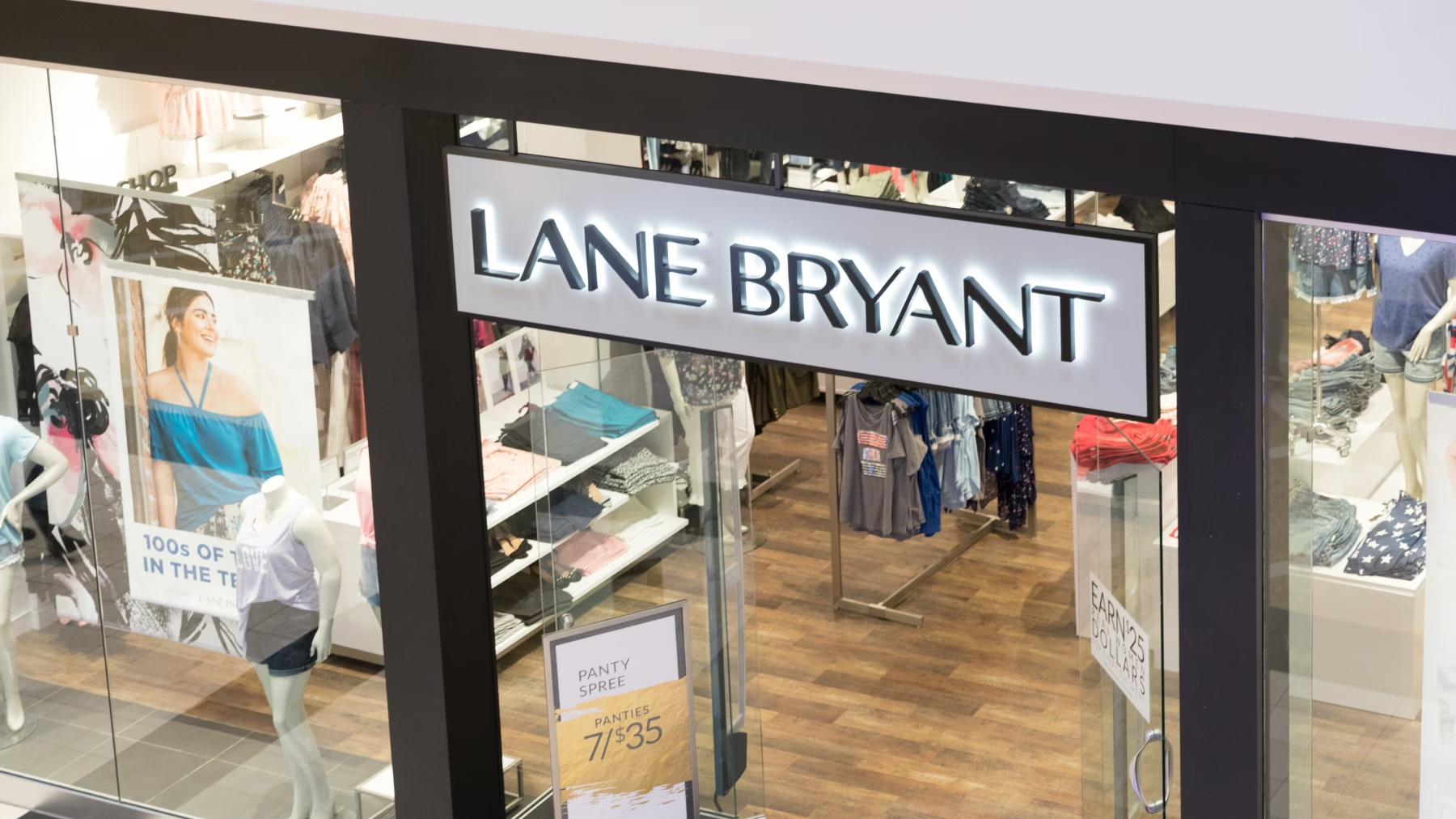
Lane Bryant’s Reset Finds Its Footing as GLP-1 Use Reshapes Apparel Demand
Lila Margalit
Apr 7, 2026
4 minutes

Lane Bryant faced significant challenges during the pandemic and has continued to gradually shrink its store fleet in the years since. And now, with nearly one in eight U.S. consumers using GLP-1 medications, plus-size apparel demand is beginning to shift in meaningful ways – introducing a new layer of complexity for the legacy retailer.

How is Lane Bryant navigating these challenges, and what does its customer base reveal about its ability to adapt?

Rightsized Fleet Finds Its Rhythm

In July 2020, Lane Bryant’s parent company filed for bankruptcy and closed more than 150 stores. But following its acquisition later that year by Sycamore Partners, the brand began to regain its footing – and recent location analytics suggest those stabilization efforts are taking hold.

While the reduced footprint has, unsurprisingly, led to lower overall traffic, average annual visits per location remain above 2019 levels, suggesting that demand has been successfully consolidated into existing locations. Average visits per location also held steady between 2024 and 2025, even as the company continued to quietly trim its unit count. The result is a smaller but more productive fleet, with steady activity supported by fewer, better-aligned stores.

Family Core Anchors Demand with Room to Expand

Still, as Lane Bryant continues to stabilize, the question becomes how it can further increase store-level productivity. And analyzing the demographic profile of its trade areas offers insight into both its core strengths and where the next phase of optimization may emerge.

One of the brand’s clearest advantages is Lane Bryant’s strong reach among family-oriented segments, which are overrepresented in its captured market – the areas within its trade area generating the highest share of visits – compared both to its overall trade area (its potential market) and to the national baseline. These segments, including parents of young children and households with teenagers at home, tend to skew younger than peak GLP-1 users, potentially offering the chain some near-term insulation from rapid GLP-1-driven disruption. Still, these cohorts are also seeing growing adoption – and as usage expands within this demographic, Lane Bryant will need to increasingly support customers through evolving size needs rather than rely on demand tied to a stable size identity.

At the same time, the data points to opportunities to expand reach across other segments. Among older households, Lane Bryant’s captured audience aligns with its trade area but falls below the nationwide average, highlighting potential whitespace that could be unlocked through footprint adjustments or more targeted engagement in markets where this segment is more concentrated.

Among younger “Contemporary Households,” by contrast – a segment that includes singles, non-family households, and married couples without children – the brand under-indexes relative to its trade area while slightly outperforming the national benchmark. This suggests Lane Bryant has geographic access to a larger pool of these consumers but has yet to fully capture their demand, pointing to an opportunity for growth through more targeted marketing and merchandising.

Challenges and Opportunities Ahead

GLP-1 adoption is disrupting traditional plus-size apparel demand, while also creating new opportunities as consumers undergoing weight loss journeys increase spend while moving through sizes. Retailers that can support customers across these transitions with more flexible assortments will be better positioned to capture this shift. And Lane Bryant’s steady operational footing and well-defined core audience provide it with a solid foundation to compete in this next phase of growth.

For more data-driven retail insights, visit placer.ai/anchor.

Placer.ai leverages a panel of tens of millions of devices and utilizes machine learning to make estimations for visits to locations across the US. The data is trusted by thousands of industry leaders who leverage Placer.ai for insights into foot traffic, demographic breakdowns, retail sale predictions, migration trends, site selection, and more.

Article
Target's Baby Push, Babylist Showroom Highlight Demand for Offline Baby Retail
Elizabeth Lafontaine
Apr 6, 2026
4 minutes

Target Steps Into Baby Category White Space 

Oh baby! The competition for ownership of the baby retail space has once again intensified. Target recently announced the debut of its new “Baby Boutique” concept, which launched online on March 15th and is expected to roll out to 200 locations this year. The updated format greatly expands Target’s assortment of brands and baby items, including the debut of beloved and upscale baby brands like Uppababy, Doona, Bugaboo and Stokke, which previously hadn’t been sold at the retailer. Target’s strategy appears to be aimed at courting and retaining new and expectant parents who are looking for a one-stop shopping experience for baby products, whether in hardlines or softlines.

The baby category, in particular, has presented a white space opportunity for retailers across the country since the closure of buybuy Baby in 2023. Since then, Kohl’s launched a shop-in-shop concept with Babies”R”Us and buybuy Baby had a small but unsuccessful relaunch after being sold. That has left consumers with fractured options, including e-commerce only, department stores, mass merchants and local boutiques. Target’s push could propel it into the national leader role for the category, and also help the brand to revitalize itself after a challenging 2025 performance.

Strong Overlap Between Target and buybuy Baby's Visitor Base

Looking at some of the insights behind this new pivot, it’s clear that Target is hoping to capture the attention of shoppers who would have normally shopped at the former buybuy Baby. According to Placer.ai’s foot traffic combined with Personalive consumer segmentation, Target’s shopper profile looks very similar to that of buybuy Baby during its operation. Specifically, the share of visits by Wealthy Suburban Families, Near Urban Diverse Families and Ultra Wealthy Families are all very closely aligned between the two chains, indicating that Target’s strategy could easily entrench itself with today’s consumer.

Traffic Continues to Increase Babylist's Physical Showroom – Especially from Affluent Audiences 

Despite the battle for national attention, there have also been innovations on a smaller scale in baby products. Babylist, a popular digitally native registry service, opened its first brick and mortar location in Beverly Hills in 2023, bringing the showroom experience to life for shoppers who want to test and learn before committing to baby gear. Baby items, particularly in hardlines like car seats and strollers, tend to be large ticket items, and many parents still want that tactile experience while shopping.

According to Placer’s foot traffic insights, the location has been successful in attracting the right customer base. The store allows shoppers to gain product knowledge and compare brands and models by category, making it easier to plan an online baby registry more effectively. Traffic has grown over the last year to the showroom, and the store's audience over-indexes for Ultra Wealthy Families, which both could drive conversion to the online marketplace.

Another group that has a high share of visits are Sunset Boomers, which would account for potential new grandparents. Grandparents are a vital shopper base for baby retailers, as they have higher levels of disposable income and are often purchasing gifts for others. Target could benefit from the buy-in of this group as it continues its journey into the world of baby-focused retail.

For more data-driven retail insights, visit placer.ai/anchor

Placer.ai leverages a panel of tens of millions of devices and utilizes machine learning to make estimations for visits to locations across the US. The data is trusted by thousands of industry leaders who leverage Placer.ai for insights into foot traffic, demographic breakdowns, retail sale predictions, migration trends, site selection, and more.

Reports
INSIDER
Migration Hotspots in a Cool 2024 Market
Discover which metro areas are still attracting new residents – and what’s drawing people to emerging hotspots.
May 23, 2024
5 minutes

Slowing Domestic Migration

Following COVID-era highs, domestic migration levels have begun to taper off – with the number of Americans moving within the U.S. hitting an all-time low, according to some sources, in 2023

To be sure, some popular COVID-era destinations – including Idaho, the Carolinas, and Utah – saw their net domestic migration continue to rise, albeit at a slower pace. But other states which had been relocation hotspots between February 2020 and February 2023, such as Wyoming and Texas, experienced negative net migration between February 2023 and February 2024. 

Hotspots in a Cool Market

Analyzing CBSA-level migration data reveals differences and similarities between last year’s migration patterns and COVID-era trends. 

Between February 2020 and February 2023, seven out of the ten CBSAs posting the largest population increases due to inbound domestic migration were located in Florida. But between February 2023 and February 2024, the top 10 CBSAs with the largest net migrated percent of the population were significantly more diverse. Only four out of the ten CBSAs were located in Florida, and several new metro areas – including Provo-Orem, UT, Kingsport-Bristol, TN-VA, and Boulder, CO – joined the list. 

This white paper leverages a variety of location intelligence tools – including Placer.ai’s Migration Report, Niche Neighborhood Grades, and ACS Census Data location intelligence – to analyze two migration hotspots. Specifically, the report focuses on Daytona Beach, FL, which already appeared on the February 2020 to February 2023 list and has continued to see steady growth, and Boulder, CO, which has emerged as a new top destination. The data highlights the potential of CBSAs with unique value propositions to continue to attract newcomers despite ongoing housing headwinds. 

High Tech's New Frontier – Boulder, CO 

The Boulder, CO CBSA has emerged as a domestic migration hotspot: The net influx of population between February 2023 and February 2024  (i.e. the total number of people that moved to Boulder from elsewhere in the U.S., minus those that left) constituted 3.1% of the CBSA’s February 2024 population.

The strong migration is partially due to the University of Colorado, Boulder’s growing popularity. But the metro area has also emerged as a flourishing tech hub, with Google, Apple, and Amazon all setting up shop in town, along with a wealth of smaller start ups.  

Moving in from Los Angeles & San Francisco – But Also Chicago, Dallas, and New York

Most domestic relocators tend to remain within state lines – so unsurprisingly, many of the recent newcomers to Boulder moved from other CBSAs in Colorado. But perhaps due to Boulder’s robust tech ecosystem, many of the new residents also came from Los Angeles, CA (6.6%) and San Francisco, CA (3.4%) – other CBSAs known for their thriving tech scenes

At the same time, looking at the other CBSAs feeding migration to the area indicates that tech is likely not the only draw attracting people to Boulder: A significant share of relocators came from the CBSAs of Chicago, IL (6.1%), Dallas , TX (4.9%), and New York, NY (3.9%). The move from these relatively urbanized CBSAs to scenic Boulder indicates that some of the domestic migration to the area is likely driven by people looking for better access to nature or a general lifestyle change. 

Boulder’s Quality of Life Attracting Migration

According to the U.S. News & World Report, Boulder ranked in second place in terms of U.S. cities with the best quality of life. Using Niche Neighborhood Grades to compare quality of life attributes in the Boulder CBSA and in the areas of origin dataset highlights some of the draw factors attracting newcomers to Boulder beyond the thriving tech scene. 

The Boulder CBSA ranked higher than the metro areas of origin for “Public Schools,” “Health & Fitness,” “Fit for Families,” and “Access to Outdoor Activities.” These migration draw factors are likely helping Boulder attract more senior executives alongside younger tech workers – and can also explain why relocators from more urban metro areas may be choosing to make Boulder their home.

Boulder’s strong inbound migration numbers over the past year – likely driven by its flourishing tech scene and beautiful natural surroundings – reveal the growth potential of certain CBSAs regardless of wider housing market headwinds. 

Sun, Sand, and Daytona Beach

Florida experienced a population boom during the pandemic, and several CBSAs in the state – including the Deltona-Daytona Beach-Ormond Beach, FL CBSA – have continued to welcome domestic relocators in high numbers. The CBSA’s anchor city, Daytona Beach – known for its Bike Week and NASCAR’s Daytona 500 – has also seen positive net migration between February 2023 and February 2024. 

An Attractive Destination for Older Americans

Americans planning for retirement or retirees operating on a fixed income are likely particularly interested in optimizing their living expenses. And given Daytona’s relative affordability, it’s no surprise that the median age in the areas of origin feeding migration to Daytona Beach tends to be on the older side. 

According to the 2021 Census ACS 5-Year Projection data, the median age in Daytona Beach was 39.0. Meanwhile, the weighted median age in the areas of migration origin was 42.6, indicating that those moving to Daytona Beach may be older than the current residents of the city. 

Zooming into the migration data on a zip code level also highlights Daytona Beach’s appeal to older Americans: The zip code welcoming the highest rates of domestic migration was 32124, home to both Jimmy Buffet’s Latitude Margaritaville’s 55+ community and the LPGA International Golf Club, host of the LPGA Tour. The median age in this zip code is also older than in Daytona Beach as a whole, and the weighted age in the zip codes of origin was even higher – suggesting that older Americans and retirees may be driving much of the migration to the area.

Daytona’s Migration Draw Factors 

Looking at the migration draw factors for Daytona Beach also suggests that the city is particularly appealing to retirees, with the city scoring an A grade for its “Fit for Retirees.” But the city of Daytona Beach is also an attractive destination for anyone looking to elevate their leisure time, with the city scoring higher than Daytona Beach’s cities of migration origin for “Weather,” “Access to Restaurants,” or “Access to Nightlife.”

Like Boulder, Daytona’s scenery – including its famous beaches – is likely attracting newcomers looking to spend more time outdoors and improve their work-life balance. And like Boulder and its tech scene, Daytona Beach also has an extra pull factor – its affordability and fit for older Americans – that is likely helping the area continue to attract new residents, even as domestic migration slows down nationwide. 

Opportunities for Growth Amidst Slowing Migration 

Although the overall pace of domestic migration has slowed, analyzing location intelligence data reveals several migration hotspots amidst the overall cooldown. Boulder and Daytona Beach each have a set of unique draw factors that seem to attract different populations – and the success of these regions highlights the many paths to migration growth in 2024.  

INSIDER
Winning Strategies for a Stabilizing Fitness Market
Gym visits are stabilizing following two years of post-pandemic growth - and staying on top of changing consumer preferences can help fitness studios continue driving visits.
May 16, 2024
6 minutes

Fitness Segment Back In Shape

The Fitness industry was a major post-pandemic winner. Visits to gyms across the country surged as stay-at-home orders ended and people returned to their in-person workout routines. And even as consumers reduced discretionary spending in the face of inflation, they kept going to the gym – finding room in their budgets for the chance to embrace wellness and get in shape while interacting with other people.

But no category can sustain such unabated growth forever – and as the segment inevitably stabilizes, gyms will need to stay nimble on their feet to maintain their competitive edge. 

This white paper takes a closer look at the state of Fitness as the category transitions into a more stable growth phase following two years of outsize post-pandemic demand. The report digs into the location analytics to reveal how the Fitness space has changed – and what strategies gyms can adopt to stay ahead of the pack. 

*This report excludes locations within Washington state due to local legislation.

Stability Is The Name Of The Game

Monthly visits to the Fitness category have grown consistently year over year (YoY) since early 2022, when COVID subsided and gyms returned to full capacity. And the segment is still doing remarkably well. Even in January and March 2024 – when visits were curtailed by an Arctic blast and by the Easter holiday weekend – YoY Fitness visits remained positive, despite the comparison to an already strong 2023.  

Still, recent months have seen smaller YoY increases than last year, indicating that the Fitness category is entering a more normalized growth phase. 

Leaning Into Evolving Consumer Preferences

By keeping a close watch on evolving consumer preferences, fitness chains can uncover new opportunities for growth and adaptation within a stabilizing market – including leaning into increasingly popular dayparts.  

Late Afternoon And Evening Visits On The Rise

Examining the evolving distribution of gym visits by daypart over the past six years shows that major shifts were brought on by the COVID-19 pandemic. 

Between Q1 2019 and Q1 2021, as remote work took hold, gyms saw their share of 2:00 PM - 5:00 PM visits increase from 15.8% to 18.6%. Though this trend partially reversed as the pandemic receded, afternoon visits remained elevated in Q1 2024 compared to pre-COVID – likely a reflection of hybrid work patterns that leave people free to take an exercise break during their workdays.

At the same time, the share of morning visits to fitness chains (between 8:00 AM and 11:00 AM) dropped from 20.5% in Q1 2019 to 17.2% in Q1 2024, while evening visits (between 8:00 PM and 11:00 PM) increased from 11.3% to 13.2%. 

Gyms that recognize this changing behavior can adapt to new workout preferences – whether by incentivizing morning visits, scheduling popular classes mid-afternoon, or offering extended evening hours.  

Evening Workouts Provide Gains

In fact, the data indicates that gyms that are leaning into the evening workout trend are already finding success: Of the top 12 most-visited gym chains in the country, those that saw bigger increases in their shares of evening visits also tended to see greater YoY visit growth. 

EōS Fitness and Crunch Fitness, for example, have seen their shares of evening visits grow by 5.5% and 3.4%, respectively, since COVID – and in Q1 2024, their YoY visits grew by 29.0% and 21.8%, respectively. Other chains, including 24 Hour Fitness and Chuze Fitness, experienced similar shifts in visit patterns. At the same time, LA Fitness saw just a minor increase in its share of evening visits between Q1 2019 and Q1 2024, and a correspondingly small increase in YoY visits. 

As the evening workout slot gains popularity, gym operators that can adapt to these new trends and encourage evening visits may see significant benefits in the years to come.

Young Gym-Goers Driving Success

Diving into demographic data for the analyzed gym chains sheds light on some factors that may be driving this heightened preference for evening workouts at top-performing gyms. 

The four fitness chains that experienced the greatest YoY visit boosts in Q1 – Crunch Fitness, EōS Fitness, 24 Hour Fitness, and Chuze Fitness all featured trade areas with significantly higher-than-average shares of Young Professionals and Non-Family Households. (STI: PopStat’s Non-Family Household segment includes households with more than one person not defined as family members. Spatial.ai: PersonaLive’s Young Professional consumer segment includes young professionals starting their careers in white collar or technical jobs.) 

In plainer terms, these consumer segments – typically young, well-educated, and without children – and therefore more likely to be flexible in their workout times – are driving visits to some of the best-performing gyms across the country. And these audiences seem to be displaying a preference for nighttime sweat sessions – a factor that gyms can take into account when planning programming and marketing efforts. 

Attracting Niche Markets

Leaning into emerging gym visitation patterns is one way for fitness chains to thrive in 2024 – but it isn’t the only marker of success for the segment. Even after years of visit growth, the market remains open to new opportunities and innovations that meet health-conscious consumers where they are. 

Striding Towards Success

STRIDE Fitness, a gym that offers treadmill-based interval training, has sparked a trend among running enthusiasts. This niche player is finding success, particularly among a specific demographic: runners and endurance training enthusiasts. 

Between January and April 2024, monthly YoY visits to STRIDE Fitness consistently outperformed the wider Fitness space. A standout month was January, when STRIDE Fitness’s visits soared by an impressive 33.6% YoY, surpassing the industry average of 5.7% for the same period.

Psychographic data from the Spatial.ai’s FollowGraph dataset – which looks at the social media activity of a given audience – suggests that STRIDE Fitness’ trade areas are well-positioned to attract those visitors most open to its offerings. Residents of STRIDE Fitness’s potential market are 24% more likely to be, or to be interested in, Endurance Athletes than the nationwide average – compared to just 3% for the Fitness industry as a whole. Similar patterns emerge for Marathon Runners and Triathlon Participants. This indicates that the chain is well-situated near consumers with a passion for endurance sports and long distance running, helping it maintain a competitive edge in the crowded gym market. 

Pickleball Craze Sends Visits Soaring

Pickleball, a game that blends elements of tennis, ping pong, and badminton, is the fastest-growing sport in the country. And recognizing its broad appeal, some fitness chains have begun incorporating pickleball courts into their facilities. 

Arizona-based EōS Fitness added a pickleball court at a Phoenix, AZ location – and early 2024 data highlights the impact of this addition. Between January and April 2024, the location drew between 9.1% and 33.3% more monthly visits than the chain’s Arizona visit-per-location average. 

And analyzing the demographic profile of the chain’s location with a pickleball court reinforces the game’s increasingly wide appeal. Young consumer segments have been embracing the game in large numbers – and the Phoenix EōS Fitness location’s potential market includes a significantly higher share of 18 to 34-year-olds than the chain’s overall Arizona potential market. Residents of the pickleball location’s trade area are also less affluent than the chain’s Arizona average. 

Pickleball has typically been associated with more affluent consumer segments, and it seems like this may be shifting. With more people than ever embracing the game, gyms that choose to add courts to their facilities may reap the foot traffic benefits. 

Something For Everyone

The Fitness industry has undergone a significant transformation since COVID-19. The category’s outsize post-pandemic visit growth has begun to stabilize, and gyms are staying ahead by adapting to changing consumer preferences. Evenings are emerging as crucial dayparts for gym operators, likely driven by younger consumer segments. And niche fitness chains are seeing visit success, proving that there are plenty of ways for the Fitness segment to succeed.

INSIDER
C-Stores: From Convenient Stops to Go-To Destinations
Discover key strategies helping C-Stores drive visits, engage customers, and cement their roles as dining, shopping, and tourism destinations in their own right.
April 25, 2024
5 minutes

This report includes data from Placer.ai Data Version 2.0, which implements improvements to our extrapolation capabilities, adds short visit monitoring, and enhances visit detection.

C-Stores: Charging Ahead

Grabbing a coffee or snack at a convenience store is a time-honored road trip tradition – but increasingly, Convenience Stores (C-Stores) have also emerged as places people go out of their way to visit. 

Convenience stores have thrived in recent years, making inroads into the discretionary dining space and growing both their audiences and their sales. Between April 2023 and March 2024, C-Stores experienced consistent year-over-year (YoY) visit growth, generally outperforming Overall Retail. Unsurprisingly, C-Stores fell behind Overall Retail in November and December 2023, when holiday shoppers flocked to malls and superstores to buy gifts for loved ones. But in January 2024, the segment regained its lead, growing YoY visits even as Overall Retail languished in the face of an Arctic blast that had many consumers hunkering down at home.

C-Stores’ current strength is partially due to the significant innovation by leading players in the space: Chains like Casey’s, Maverik, Buc-ee’s, and Rutter’s are investing in both in their product offerings and in their physical venues to transform the humble C-Store from a stop along the way into a bona fide destination. Dive into the data to explore some of the key strategies helping C-Stores drive consumer engagement and stay ahead of the pack. 

Four C-Store Brands Ahead of the Curve

While chain expansion may explain some of the C-Store segment growth, a look at visit-per-location trends shows that demand is growing at the store level as well. Over the past year (April 2023 to March 2024), average visits per location on an industry-wide basis grew by 1.8%, compared to the year prior (April 2022 to 2023). 

And within this growing segment, some brands are distinguishing themselves and outperforming category averages. Casey’s, for example, saw the average number of visits to each of its locations increase by 2.3% over the same time frame – while Maverik, Buc-ee’s and Rutter’s saw visits per location increase by 3.2%, 3.4% and 3.9%, respectively.

Chains That Are Becoming The Final C-Store Destinations

Each in its own way, Casey’s, Maverik, Buc-ee’s, and Rutter’s, are helping to transform C-Stores from pit stops where people can stretch their legs and grab a cup of coffee to destinations in and of themselves. 

Casey’s & Maverik: Leaning into Breakfast 

Midwestern gas and c-store chain Casey’s – famous for its breakfast pizza and other grab-and-go breakfast items – has emerged as a prime spot for fast food pizza lovers to grab a slice first thing in the morning. And Salt Lake City, Utah-based Maverik – which recently acquired Kum & Go and its 400-plus stores – is also establishing itself as a breakfast destination thanks to its specialty burritos and other chef-inspired creations.  

Casey’s and Maverik’s popular breakfast options are likely helping the chains receive its larger-than-average share of morning visits: In Q1 2024, 16.3% of visits to Maverik and 17.5% of visits to Casey’s took place during the 7:00 AM - 10:00 AM daypart, compared to just 14.9% of visits to the wider C-Store category.

Psychographic data from the Spatial.ai’s FollowGraph dataset – which looks at the social media activity of a given audience – also suggests that Casey’s and Maverik’s have opened stores in locations that allow them to reach their target audience. Compared to the average consumer, residents of Casey’s potential market are 7% more likely to be “Fast Food Pizza Lovers” than both the average consumer and the average C-Store trade area resident. Residents of Maverik’s potential market are 16% more likely than the average consumer to be “Mexican Food Enthusiasts,” compared to residents of the average C-Store’s trade area who are only 1% more likely to fall into that category.

With both chains expanding, Casey’s and Maverik can hope to introduce new audiences to their unique breakfast options and solidify their hold over the morning daypart within the C-Store space over the next few years. 

Buc-ee’s: Bigger Is Better

Everything is said to be bigger in the Lone Star State, and Texas-based convenience store chain Buc-ee’s – holder of the record for the worlds’ largest C-Store – is no exception. With a unique array of specialty food items and award-winning bathrooms, Buc-ee’s has emerged as a well-known tourist attraction. And the popular chain’s status as a visitor hotspot is reflected in two key metrics. 

First, Buc-ee’s attracts a much greater share of weekend visits than other convenience store chains. In Q1 2024, 39.6% of visits to Buc-ee’s took place on the weekends, compared to just 28.3% for the wider C-Store industry. And second, Buc-ee’s captured markets feature higher-than-average shares of family-centric households – including those belonging to Experian: Mosaic’s Suburban Style, Flourishing Families, and Promising Families segments.

Rather than merely a place to stop on the way to work, Buc-ee’s has emerged as a favored destination for families and for people looking for something fun to do on their days off.

Rutter’s: Expanding Upward

Buc-ee’s isn’t the only C-Store chain that believes bigger is better. Pennsylvania-based Rutter’s is increasing visits and customer dwell time by expanding its footprint – both in terms of store count and venue size. New stores will be 10,000 to 12,000 square feet – significantly larger than the industry average of around 3,100 square feet. And in more urban areas, where space is at a premium, the company is building upwards.

Rutter’s added a second floor to one of its existing locations in York, PA in December 2023. The remodel, which was met with enthusiasm by customers, provided additional seating for up to 30 diners, a beer cave, and an expanded wine selection. And in Q1 2024, the location experienced 15.6% YoY visit growth – compared to a chainwide average of 7.6%. Visitors to the newly remodeled Rutter’s also stayed significantly longer than they did pre-renovation. The share of extended visits to the store (longer than ten minutes) grew from 20.8% in Q1 2023 to 27.0% in Q1 2024 – likely from people browsing the chain’s selection of beers or grabbing a bite to eat. 

Convenience At Every Corner

Convenience stores are flourishing, transforming into some of the most exciting dining and tourist destinations in the country. Today, C-Store customers can expect to find brisket sandwiches, gourmet coffees, or craft beers, rather than the stale cups of coffee of old. And the data shows that customers are receptive to these innovations, helping drive the segment’s success. 

Loading results...
We couldn't find anything matching your search.
Browse one of our topic pages to help find what you're looking for.
For more in-depth analyses on a variety of subjects, explore Reports.
The Anchor Logo
INSIDER
Stay Anchored: Subscribe to Insider & Unlock more Foot Traffic Insights
Gain insider insights with our in-depth analytics crafted by industry experts
— giving you the knowledge and edge to stay ahead.
Subscribe