Skip to chain selection
Thank you! Your submission has been received!
Oops! Something went wrong while submitting the form.
0
0
0
0
----------
0
0
Articles
Article
Movie Theaters in Q1 2024: A Preview of Coming Attractions?
We dove into the latest foot traffic analytics for leading movie theater chains – AMC Theatres, Regal Cinemas, and Cinemark – to uncover how recent consumer behavior and visitor demographics are setting the stage for the cinema category’s next chapter. 
Ezra Carmel
May 7, 2024
3 minutes

We dove into the latest foot traffic analytics for leading movie theater chains – AMC Theatres, Regal Cinemas, and Cinemark – to uncover how recent consumer behavior and visitor demographics are setting the stage for the cinema category’s next chapter. 

Visits in 2024: An Underwhelming Sequel So Far

Cinemas have yet to reclaim their pre-COVID glory – and during the first few months of 2024, visits to AMC and Regal, and to a lesser extent Cinemark, remained substantially below 2019 levels. While some of these visit gaps can be attributed to exhibitors downsizing their real estate portfolios, the rise in at-home entertainment continues to impact pre-pandemic foot traffic comparisons.

In addition, since the pandemic, blockbuster releases have taken on even greater importance as drivers of movie theater visit spikes. And in early 2024, a relative absence of new blockbusters took its toll on theater operators’ performance. Between January and April 2024, cinema leaders saw YoY visit dips – likely attributable in part to delayed releases. And smash-hit titles that drove box-office success in early 2023 – including Avatar: The Way of Water, Ant Man, and The Super Mario Bros. Movie – helped set the stage for challenging YoY comparisons.

Monthly visits to AMC Theaters, Regal Cinemas, and Cinemark, compare to 2019 and 2023

More High-Income Theater Visitors 

Despite these visit gaps, analysis of changing visitor demographics suggests that there remain a variety of ways for theater operators to succeed. 

Analyzing cinema leaders’ captured markets with demographics from STI: PopStats shows that today’s movie-goers are more affluent than they were before COVID. After dipping in Q1 2023, the median household incomes (HHIs) of AMC, Regal Cinema, and Cinemark’s captured markets spiked in Q1 2024, surpassing the chains’ own pre-pandemic benchmarks. This shift may be due in part to discretionary spending cutbacks by less affluent consumers – who may be particularly inclined to hold off on going to the movies when there are no big releases on offer.

For exhibitors, the increase in visitors’ spending power presents an important opportunity: Affluent movie-goers are likely to spend more on revenue-boosting concessions and premium formats, a boon for theater chains at a time when visit gaps linger.

Median Houshold income of movie theaters' captured markets - audience segmentation graph

Looking Ahead

Five years after COVID sent movie theaters into a tailspin, the category is holding its own. Though routine visits remain lower than they were before the pandemic, a shifting customer base continues to provide operators with new avenues for success.

For more data-driven entertainment insights, visit Placer.ai.

This blog includes data from Placer.ai Data Version 2.0, which implements improvements to our extrapolation capabilities, adds short visit monitoring, and enhances visit detection.

Article
Let’s Get Physical: Fitness In 2024
The fitness industry has experienced steady growth in recent years, propelled by consumers’ prioritization of health and wellness – and gyms across the country are benefiting. We take a closer look at the data to see how the segment is performing relative to last year.
Bracha Arnold
May 6, 2024
3 minutes

The fitness industry has experienced steady growth in recent years, propelled by consumers’ prioritization of health and wellness – and gyms across the country are benefiting. 

So with 2024 underway, we dove into the data to examine the segment’s performance during the first months of the year. Did Fitness’ strong January showing persist beyond the season of new year’s resolutions? And how did major gym chains – including Planet Fitness, Life Time, Crunch Fitness, and EōS – perform in Q1 2024 relative to last year

Let’s Get Physical

Fitness has been a consistent success story over the past few years, and the category is showing no signs of slowing down. Year-over-year (YoY) visits to the industry were up nearly every week between January and April 2024, with the sole exception of the week of January 15th, when an Arctic blast saw many people hunkering down indoors. And visits remained slightly elevated even during the week of March 25th, when Easter celebrations likely distracted many people from their gym goals – an impressive feat given the comparison to a non-holiday week in 2023.

Weekly visits to overall fitness segment compared to 2023. Excludes locations in Washington state due to local legislation

Flexing Into 2024

Drilling down into visit trends for eight major fitness chains shows that in today’s robust fitness environment, there’s enough demand to sustain a variety of chains: Both premium and mid-range options like Life Time and LA Fitness as well as more affordable choices like Planet Fitness and Crunch Fitness saw visits increase or remain steady for most of Q1 – and all saw YoY visit bumps in April. 

Monthly visits to leading fitness chains compared to previous year. Excludes data from Washington state due to local legislation

Getting Pumped 

Some gym-goers hit the gym several times a week and spend hours working out, while others have a more relaxed get-in-shape schedule. And analyzing leading chains’ visitation patterns shows that gyms are finding success by catering to fitness buffs’ varying preferences. 

Perhaps unsurprisingly, the data reveals a strong correlation between a chain’s share of frequent visitors (i.e. those visiting the gym eight or more times in a month), and a chain’s share of visitors staying longer than 90 minutes. While some clubs, including Life Time and EōS appear to attract highly dedicated gym-goers, others, including Planet Fitness and Anytime Fitness, seem to draw more casual visitors. 

The fact that both fitness chains attracting frequent visitors for longer workouts and gyms that cater to more casual exercisers who spend less time in the gym during each session are seeing positive visitation trends indicates that there are plenty of models for fitness success in 2024.

Correlation between the share of visitors visiting gyms more than 8 times & share of visits lasting 90 or more minutes among leading fitness chains, April 2024. Excludes Washington state due to local legislation.

The Final Weigh-In

One thing seems clear – interest in gyms is not going away anytime soon. Visits continue to show YoY growth, and the industry is full of options for every kind of fitness enthusiast. Whether opting for occasional visits or adhering to a structured workout regimen – there’s something for everyone.  

To stay ahead of the latest retail and fitness developments, visit placer.ai/blog.

Article
McDonald’s and the Evolving State of Food Retail
R.J. Hottovy
May 3, 2024

Following a busy week of Q1 2024 updates several restaurant chains, the key question facing operators is whether menu price increases the past several years have forced consumers into alternative food retail channels. Several restaurant chains--most notably McDonald’s–highlighted a more “discriminating” consumer during their quarterly updates. According McDonald’s CEO Chris Kempczinski on the company’s Q1 2024 update this week: “U.S. consumers continued to be even more discriminating with every dollar that they spend as they faced elevated prices in their day-to-day spending which is putting pressure on the QSR industry.” In turn, this has resulted in flat-to-declining industry traffic in the U.S. during the quarter. Looking at year-to-date visitation trends across the different restaurant categories, we see a weak start to the year due to inclement weather, followed by a rebound to low-single-digit growth for the limited-service categories (QSR and fast casual) and low-single-digit declines for the full-service restaurant chains.

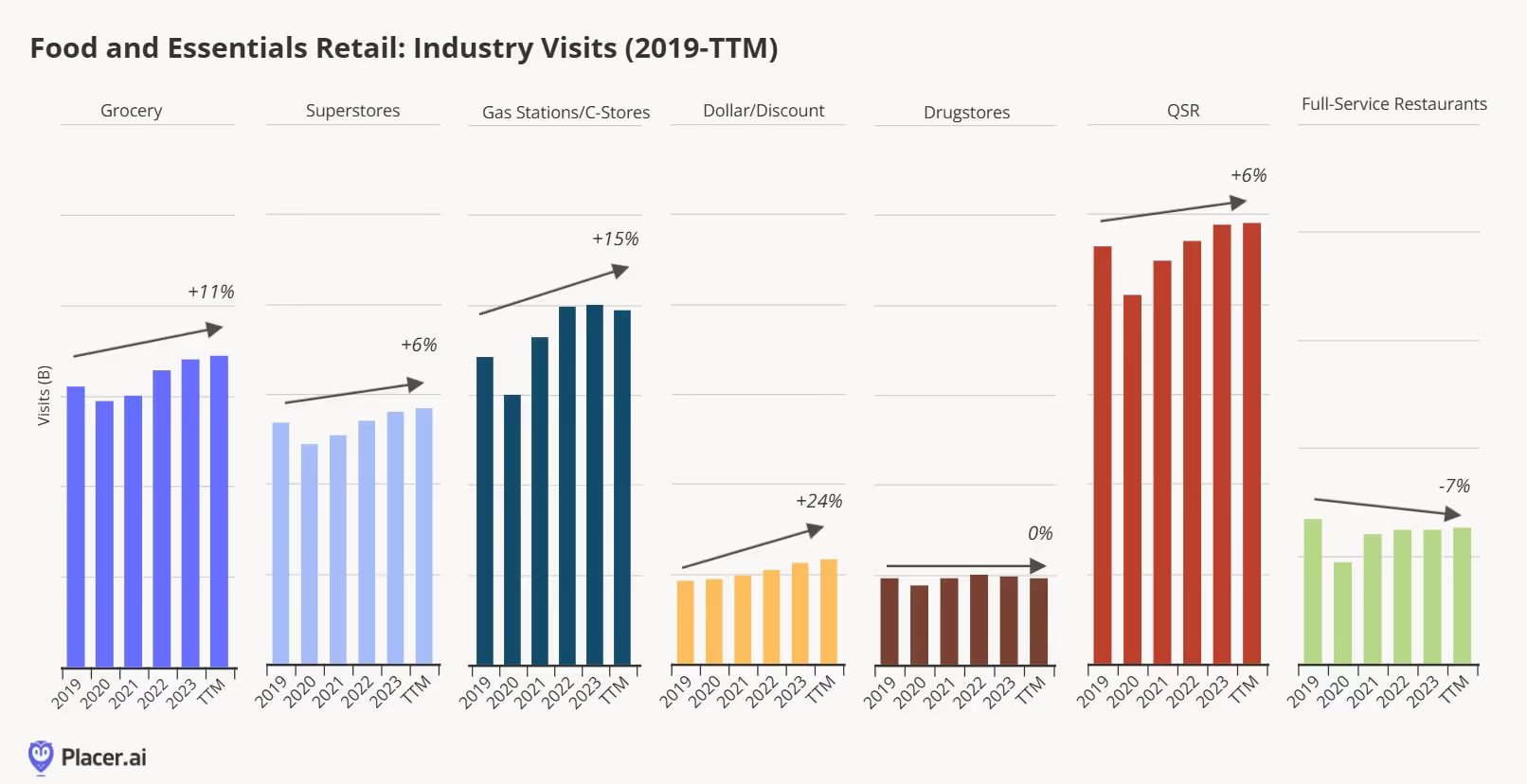
As we discuss throughout this week’s Anchor report, consumers will likely remain discriminating over the next several quarters.  As such, we expect a continuation of the channel shifts we’ve been witnessing across the broader food retail sector. According to our data, the QSR category saw a +5% increase in visits from 2019-2023, while the full-service restaurant category saw a -8% decrease in visits (partly explained by the permanent closure of many smaller, regional full-service dining chains). Conversely, the grocery, superstore, convenience store, and dollar/discount stores have all seen meaningfully higher visit growth over the same period (as our friends at Restaurant Business have also called out), indicating these channels are taking share from the restaurant industry.

Looking at McDonald’s cross-visitation trends during the quarter, we see further evidence of this shift. We’ve compared the favorite grocery chains of McDonald’s visitors in Q1 2024 to Q1 2023 below. We see a material increase in the percentage of McDonald’s visitors that visited an Aldi location year-over-year–24% versus 17% in the year ago period. We also see a decrease in percentage of visits to most conventional grocery chains.

MCD_050324

Not surprisingly, McDonald’s plans to accentuate its value offerings in the coming quarters. On its update call, management noted that 90% of its U.S. locations offer meal bundles for $4 or less and that it has been running several promotions through its digital app. The company also noted the need to align around a strong national value proposition so that the company can use its tremendous media scale to drive high consumer awareness. It will likely take time for McDonald’s to organize around its value platform, but once it does start to promote its value offerings on a nationwide basis, we would expect much of the rest of the QSR category to follow suit.

Article
Formula 1: U.S. Grand Prix Expansion Winning Key Visitor Segments
Elizabeth Lafontaine
May 3, 2024

This weekend, Formula 1 is once again ready to take the track in the United States, this time at the Miami Grand Prix on Sunday. The Miami Grand Prix is the first U.S. race in the 2024 calendar, followed by the U.S. Grand Prix in Austin, Texas and the Las Vegas Grand Prix in the fall.

America has grown into the new epicenter of the sport and is the only country besides Italy to host multiple races in a singular season. Not only does the U.S. host races, but countless American retail, tech, CPG and hospitality brands serve as team sponsors, including Marriott, Rokt, Tommy Hilfiger, Google, eBay, Coca Cola and more. For brands looking at the consumption habits of younger, more affluent consumers, the rise of Formula 1 in the U.S. can help unlock insights on this group. Credit for Formula 1’s exponential growth in popularity is largely due to the Netflix docuseries, Drive to Survive, which just released its sixth season in the first quarter of 2024. According to Netflix, over 90 million hours of the program were watched throughout the first half of last year. The immense popularity of the show and its behind the scenes access to the luxurious world of F1 generated a large demand for the sport by Americans, and the appetite for home grown F1 races where U.S. based fans can participate is palpable.

2024 is the third running of the Miami Grand Prix, held around Hard Rock Stadium, with the event debuting in 2022. According to Placer.ai data, traffic at the event, which usually runs Thursday-Sunday, in 2023 increased 3% compared to 2022. Usually during grand prix weekends, visitors have the option to purchase single or multi-day passes, and our data (as shown below) indicates that there were fewer repeat visits in 2023 compared to 2022; consumers may have chosen single day passes more often or made the event a part of a larger weekend in Miami. The highest number of visits occurred on Sunday each year, which aligns with the fact that the actual race takes place that day, with practice sessions and qualifying taking place on Friday and Saturday respectively.

Miami GP loyal

Despite slightly fewer loyal visits during the weekend, the time spent at the event increased, with an average of 179 minutes, up 4% year-over-year. With consumers spending around three hours at the venue, there is a huge opportunity for American CPG and retail companies to engage with this captive audience.

The U.S. Grand Prix, held annually in Austin, has seen similar success from the influx of American F1 fans. Traffic at the 2023 event weekend grew by 38% compared to 2019. 2022 saw peak event attendance, most likely due to a competitive and exhilarating end to the 2021 season that bled into the next year. 2023 also saw the highest percentage of three-day visits during the weekend, highlighting that most U.S. Grand Prix attendees visit the track multiple days for the various race weekend events.

While the growth of the event itself is impressive, the change in visitor demographics provides an even more striking opportunity for American retailers and brands. 2023 brought the highest percentage of visits from young professionals and young urban singles compared to all other segments in 2023. Young professionals also grew to 36% of visits in 2023 from less than 30% in 2019, showcasing the rise in younger and more affluent visitors. Both the popularity of Netflix coupled with the increase in influencer marketing brand trips to races may both have contributed to this shift over time.

It’s clear that Formula 1’s growing popularity has no doubt fueled race expansion stateside and that has been able to capture the attention of the elusive younger consumer, especially those with disposable income.  Brands, licensees and retailers have all jumped on the opportunity to collaborate with drivers, teams and race weekends to tap into this growth market. Sporting events are a highly competitive landscape, excuse the pun, but the intersection of sports and content have paved the way for Formula 1’s success in the U.S.

Article
Chipotle: Staffing Matters
R.J. Hottovy
May 3, 2024

Last week, Chipotle’s Q1 2024 update featured a number of positives, including visitation trends that outperformed the broader restaurant category and strong contribution from new store openings. More than 5% of the company’s 7% comparable sales growth during the quarter was driven by transaction growth, and year-over-year visitation trends have accelerated thus far in April. (Recall that our year-over-year visitation data includes contribution from stores opened during the past year as well as improvements in visits per location).

Impressively, there were multiple sources driving Chipotle’s transaction growth during the quarter. The company’s strong track record for menu innovation under CEO Brian Niccol continued during the most recent quarter, with the company spotlighting Barbacoa and the return of Chicken Al Pastor as a limited time offer. Management will continue to explore new menu additions, and is currently developing a new product pipeline for the next 18-24 months.

While menu innovation is important, it’s clear that throughput (the amount of customers that can be served with Chipotle’s assembly line process)  is becoming a major factor in visitation traffic outperformance. We believe this has been driven by lower employee turnover rates—the company noted that it is experiencing the lowest turnover rates since Niccol joined the company in March 2018. According to management, throughput reached the highest levels in four years because of more consistent staffing, which aligns with our visit per location data for the past five years (below).

Chipotle noted that its throughput improved by nearly 2 entrees in its peak 15 minutes compared to last year with each month showing an acceleration. According to the company, “the restaurants run more smoothly as our teams are properly trained and deployed, which allows them to keep up with demand without stress. This leads to more stability and therefore more experienced teams that execute better every day, and this can be seen in our latest turnover data which is at historically low levels.” Our data also shows that visitation trends are improving during its peak hours, but that its peak hours are also changing. Historically, the hours between 12:00 PM-2:00 PM have represented Chipotle’s most frequently visited hours, but post-pandemic, we’ve seen visits shift to the 6:00 PM-8:00 PM timeframe (below). Return-to-office trends partly explain these trends, as do Chipotle’s push into smaller, more suburban/rural markets.

When we look at visit per location trends by hour, we see that most of the improvement during the Q1 2024 compared to Q1 2023 took place during the later afternoon and evening dayparts.

Looking ahead, Chipotle sees an opportunity to improve peak hour throughput, including adjusting the cadence of digital orders to better balance the deployment of labor (thus eliminating the need to pull a crew member from the front makeline to help the digital makeline during peak periods). The company also plans to bring back a coaching tool for its associates that it had in place prior to the pandemic. With more and more retailers embracing generative AI to help educate and train their employees-–a trend we heard consistently at this week’s Analytics Unite conference–we would expect Chipotle to also adopt generative AI with its updated coaching tool, potentially unlocking greater throughput improvements in the process.

Article
Where Are Workers Returning to Office in 2024?
Hybrid work is here to stay, and many office buildings are below capacity, while others are thriving. We take a look at outperforming office buildings in New York, Chicago, San Francisco, and Dallas to find out what is driving foot traffic to these buildings. 
Ben Witten
May 2, 2024
5 minutes

The widespread adoption of hybrid work continues to be one of the most significant paradigm shifts since the COVID pandemic. As employees visit offices less frequently, or not at all, corporate users are opting for less but better space which is driving office vacancy rates to record highs.   

But even as utilization for many office buildings remains below capacity, some buildings are clearly prospering. So what sets these thriving properties apart from the pack? We looked at outperforming office buildings in four major metro areas – New York, Chicago, San Francisco, and Dallas – to find out. 

Buildings where Visits Exceed 2019 Levels 

The post-pandemic office recovery has been uneven across the country. As of February 2024, a significantly larger share of workers in the New York-Newark-Jersey City and Dallas-Fort Worth CBSAs were back in the office, while office visits in the Chicago-Naperville-Elgin and San Francisco-Oakland-Berkeley CBSAs remained subdued. 

But throughout the country, the reality is much more nuanced as some office buildings struggle to maintain occupancy,others are thriving. We identified four office buildings in four major metropolitan areas where the recovery in utilization was significantly stronger than the respective metro: 

What sets these buildings apart from the pack?

Line charts showing monthly visits to various office buildings and CBSA office indexes compared to a January 2019 baseline

Similar Visit Patterns in High-Occupancy Office Buildings 

One factor that isn’t driving the office recovery at these high-occupancy office buildings is different weekly visitation patterns. 

Location intelligence for offices nationwide indicates that hybrid workers appear to prefer coming to the office mid-week: The bulk of weekly visits occur on Tuesdays, Wednesdays, and Thursdays, with fewer visits taking place on Monday and even less visits on Fridays. And this was also the weekly visitation pattern in the four CBSAs analyzed as well as in the high-occupancy office buildings. In fact, the outperforming office buildings had even more of their visits concentrated mid-week compared to the visit patterns in the wider CBSA.

Share of visits during each workday out of total Monday-Friday visits across various office buildings and CBSAs

It seems, then, that the higher visits to these outperforming offices is not due to more employees coming in on typical WFH days. Instead, more workers are likely coming in mid-week to make up for the lull on Mondays and Fridays. 

So who are these visitors? And could they hold the key to these buildings' strong recovery numbers? 

High-Occupancy Office Buildings Draw Visitors From Areas with Higher Income & Fewer Families 

Focusing on the period between March 2023 and February 2024 reveals that in all the labor catchment areas of the analyzed Office Indexes, the share of one-person households was larger than the nationwide share of 27.5%. And during the same period, the share of one-person households in the catchment areas of the high-performing office buildings was even greater – almost 50% of households in the captured market of 2010 Flora St. in Dallas consisted of one-person households. 

On the other hand, families with children were underrepresented in the catchment areas of the office indexes relative to the nationwide average of 27.1% – and the share of households with children was even lower in the catchment areas of the high-occupancy office buildings. 

This indicates that those with young children at home were generally less likely to go into the office – and so the office buildings seeing the strongest post-COVID recovery are those that serve a large contingent of single employees. On the flip side, there is often a motivation for young singles to visit the office more frequently, whether driven by the desire for training and mentorship or the prospect of meeting a significant other in or around the workplace. 

Household segmentation across various office building indexes showing higher post-COVID occupancy among areas with higher incomes and fewer families

Much has been written on the challenging impact that return-to-office mandates can have on working parents – and especially on working mothers – so it may not come as a surprise that employees from family households are underrepresented in office buildings in 2024. 

But the fact that one-person households are even more prevalent in the labor markets of the overperforming buildings (as compared to the wider CBSA Office Index) indicates that businesses and office assets can thrive even without wooing working parents back to the office.

Outperforming Office Buildings See Larger Share of Visits from Managers & Executives

So who are these singles driving the return to the office? Some of this segment may be made up of Gen-Zers seeking the networking and mentorship opportunities provided by an in-person office setting. But it’s not just younger workers leading the return to the office – the data indicates that executives and managers also make up an outsized portion of the outperforming buildings’ catchment  areas. In all four CBSAs analyzed, the catchment area of the high-occupancy building included a significantly larger share of people in a managerial or executive role compared to the average catchment area composition of the wider CBSA Office Index. 

Many of these executives are likely choosing – rather than being forced – to work on-site. Some might be looking to encourage their staff to return to the office by leading by example, while many are likely leveraging their space to host clients, driving foot traffic to these locations higher. But whatever factors are driving the trend – it appears that office buildings looking to bounce back in the new normal need to make sure they are drawing back the managerial ranks.

Share of population in trade area in a managerial/executive role - household segmentation among various office indexes across the country

Overperforming Offices Serve More Finance & Tech Workers

Analyzing the popular industries and occupations in the catchment areas of the office buildings and industries also reveals that the overperforming buildings serve a much higher share of employees working in finance, insurance, and real estate. A larger share of the catchment area population of the high-occupancy office complexes also works in professional services – including high-tech jobs – compared to the office index in the wider CBSA.

Share of population in trade areas of various office buildings that are in finance, insurance, tech, and real estate

Many financial institutions and tech companies have asked employees to return to the office at least three days a week, which could explain why these industries are overrepresented in the catchment area of the high-occupancy buildings. This data may indicate, then, that while some of the foot traffic is coming from executives choosing to return to their pre-COVID work habits, the return-to-office mandates – whether full or part-time – are likely also helping these buildings stay ahead of the curve.  

Return to Office Story Still Being Written 

Although the proliferation of office vacancies across the country can make it seem like the return to office battle has already been lost, several buildings are bucking the trend. Location intelligence indicates that a combination of partial return-to-office mandates along with a larger-than-usual share of visitors from executives and non-parental households is helping these office complexes thrive. 

Reports
INSIDER
Brewing Success: Winning Strategies for Coffee Chains
Dive into the data to explore foot traffic trends in the coffee space – and uncover factors driving visits to Starbucks, Dunkin’, and other leading chains.
June 20, 2024

Coffee on the Rise

Everybody loves coffee. And with some 75% of American adults indulging in a cup of joe at least once a week, it’s no wonder the industry is constantly on an upswing.

In early 2024, year-over-year (YoY) visits to coffee chains increased nationwide – with every state in the continental U.S. experiencing year-over-year (YoY) coffee visit growth.

The most substantial foot traffic boosts were seen in smaller markets like Oklahoma (19.4%), Wyoming (19.3%), and Arkansas (16.9%), where expansions may have a more substantial impact on statewide industry growth. But the nation’s largest coffee markets, including Texas (10.9%), California (4.2%), Florida (4.2%), and New York (3.5%), also experienced significant YoY upticks. 

Expanding to Meet Growing Demand

The nation’s coffee visit growth is being fueled, in large part, by chain expansions: Major coffee players are leaning into growing demand by steadily increasing their footprints. And a look at per-location foot traffic trends shows that by and large, they are doing so without significantly diluting visitation to existing stores. 

On an industry-wide level, visits to coffee chains increased 5.1% YoY during the first five months of 2024. And over the same period, the average number of visits to each individual coffee location declined just slightly by 0.6% – meaning that individual stores drew just about the same amount of foot traffic as they did in 2023. 

Drilling down into chain-level data shows some variation between brands. Dutch Bros., BIGGBY COFFEE and Dunkin’ all saw significant chain-wide visit boosts, accompanied by minor increases in their average number of visits per location. 

Starbucks, for its part, which reported a YoY decline in U.S. sales for Q2 2024, maintained a small lag in visits per location. But given the coffee leader’s massive footprint – some 16,600 stores nationwide – its ability to expand while avoiding more significant dilution of individual store performance shows that Starbucks’ growth is meeting robust demand. 

What is driving the coffee industry’s remarkable category-wide growth? And who are the customers behind it? This white paper dives into the data to explore key factors driving foot traffic to leading coffee chains in early 2024. The report explores the demographic and psychographic characteristics of visitors to major players in the coffee space and examines strategies brands can use to make the most of the opportunity presented by a thriving industry.

Starbucks Visits Fueled by RTO

One factor shaping the surge in coffee visit growth is the slow-but-sure return-to-office (RTO). Hybrid work may be the post-COVID new normal – but RTO mandates and WFH fatigue have led to steady increases in office foot traffic over the past year. And in some major hubs – including New York and Miami – office visits are back to more than 80.0% of what they were pre-pandemic.

A look at shifting Starbucks visitation patterns shows that customer journeys and behavior increasingly reflect those of office-goers. In April and May 2022, for example, 18.6% of Starbucks visitors proceeded to their workplace immediately following their coffee stop – but by 2024, this share shot up to 21.0%. 

Over the same period, the percentage of early morning (7:00 to 10:00 AM) Starbucks visits lasting less than 10 minutes also increased significantly – from 64.3% in 2022 to 68.7% in 2024. More customers are picking up their coffee on the go – many of them on the way to work – rather than settling down to enjoy it on-site.

Short Visits Driving Success at Dunkin’

Dunkin’ is another chain that is benefiting from consumers on the go. Examining the coffee giant’s performance across major regional markets – those where the chain maintains a significant presence – reveals a strong correlation between the share of Dunkin’ visits in each state lasting less than five minutes and the chain’s local YoY trajectory. 

In Wisconsin, for example, 50.9% of visits to Dunkin’ between January and May 2024 lasted less than five minutes. And Wisconsin also saw the most impressive YoY visit growth (5.9%). Illinois, Ohio, Maine, and Connecticut followed similar patterns, with high shares of very short visits and strong YoY showings. 

On the other end of the spectrum lay Tennessee, Alabama, and Florida, where very short visits accounted for a low share of the chain’s statewide total – under 40.% – and where visits declined YoY. 

Dunkin’s success with very short visits may be driven in part by its popular app, which makes it easy for harried customers to place their order online and save time in-store. And this is good news indeed for the coffee leader – since customers using the app also tend to generate bigger tickets. 

Dutch Bros. Appealing to Singles

Dutch Bros.’ meteoric rise has been fueled, in part, by its appeal to younger audiences. Recently ranked as Gen Z’s favorite quick-service restaurant, the rapidly-expanding coffee chain sets itself apart with a strong brand identity built on cultivating a positive, friendly customer experience. 

And Dutch Bros.’ people-centered approach is resonating especially well with singles – including young adults living alone – who may particularly appreciate the chain’s community atmosphere.

Analyzing the relative performance of Dutch Bros.’ locations across metro areas – focusing on regions where the chain has a strong local presence – shows that it performs best in areas with plenty of singles. Indeed, the share of one-person households in Dutch Bros.’ local captured markets is very strongly correlated with the coffee brand’s CBSA-level YoY per-location visit performance. Areas with higher concentrations of one-person households saw significantly more YoY visit growth in the first part of 2024.  (A chain’s captured market is obtained by weighting each Census Block Group (CBG) in its trade area according to the CBG’s share of visits to the chain – and so reflects the population that actually visits the chain in practice). 

The share of one-person households in Dutch Bros.’ Tucson, AZ captured market, for example, stands at 33.4% – well above the nationwide baseline of 27.5%. And between January and May 2024, Tucson-area Dutch Bros. saw a 6.0% increase in the average number of visits per location. Tulsa, OK, Medford, OR, and Oklahoma City, OK – which also feature high shares of one-person households (over 30.0%) – similarly saw per-location visit increases ranging from 3.6% - 7.0%. On the flip side, Fresno, CA, Las Vegas-Henderson-Paradise, NV, and San Antonio-New Braunfels, TX, which feature lower-than-average shares of single-person households, saw YoY per-location visit declines ranging from 1.5%-9.5%. 

As Dutch Bros. forges ahead with its planned expansions, it may benefit from doubling down on this trends and focusing its development efforts on markets with higher-than-average shares of one-person households – such as university towns or urban areas with lots of young professionals.

BIGGBY COFFEE: Pressing the Suburban Advantage  

Michigan-based BIGGBY COFFEE is another java winner in expansion mode. With a growth strategy focused on emerging markets with less brand saturation, BIGGBY has been setting its sights on small towns and rural areas throughout the Midwest and South. Though the chain does have locations in bigger cities like Detroit and Cincinnati, some of its most significant markets are in smaller population centers.

And a look at the captured markets of BIGGBY’s 20 top-performing locations in early 2024 shows that they are significantly over-indexed for suburban consumers – both compared to BIGGBY as a whole and compared to nationwide baselines. (Top-performing locations are defined as those that experienced the greatest YoY visit growth between January and May 2024).

“Suburban Boomers”, for example – a Spatial.ai: PersonaLive segment encompassing middle-class empty-nesters living in suburbs – comprised 10.6% of BIGGBY’s top captured markets in early 2024, compared to just 6.6% for BIGGBY’s overall. (The nationwide baseline for Suburban Boomers is even lower – 4.4%.) And Upper Diverse Suburban Families – a segment made up of upper-middle-class suburbanites – accounted for 9.6% of the captured markets of BIGGBY’s 20 top locations, compared to just 7.2% for BIGGBY’s as a whole, and 8.3% nationwide. 

Coffee for Everyone

Coffee has long been one of America’s favorite beverages. And java chains that offer consumers an enjoyable, affordable way to splurge are expanding both their footprints and their audiences. By leaning into shifting work routines and catering to customers’ varying habits and preferences, major coffee players like Starbucks, Dunkin’, Dutch Bros., and BIGGBY COFFEE are continuing to thrive.

INSIDER
Unlocking Potential in Underserved Grocery Markets
Dive into the location analytics to uncover potential growth markets in regions with limited grocery store availability.
June 6, 2024
6 minutes

Note: This report is based on an analysis of visitation patterns for regional and nationwide grocery chains and does not include single-location stores. 

Understanding Grocery Store Chain Distribution

Grocery stores, superstores, and dollar stores all carry food products – and American consumers buy groceries at all three. But even in today’s crowded food retail environment, traditional grocery chains have a special role to play. With their primary focus on stocking a wide variety of fresh foods, these chains serve a critical function in offering consumers access to healthy options. 

But visualizing the footprints of major grocery chains across the continental U.S. – alongside those of discount & dollar stores – shows that the geographical distribution of grocery chains remains uneven.

In some areas, including parts of the Northeast, Midwest, South Atlantic, and Pacific regions, grocery chains are plentiful. But in others – some with population centers large enough to feature a robust dollar store presence – they remain in short supply.

And though many superstore locations also provide a full array of grocery offerings, they, too, are often sparsely represented in areas with low concentrations of grocery chains. 

For grocery chain operators seeking to expand, these underserved grocery markets can present a significant opportunity. And for civic stakeholders looking to broaden access to healthy food across communities, these areas highlight a policy challenge. For both groups, identifying underserved markets with significant untapped demand can be a critical first step in deciding where to focus grocery development initiatives.

This white paper dives into the location analytics to examine grocery store availability across the United States – and harnesses these insights to explore potential demand in some underserved markets. The report focuses on locations belonging to regional or nationwide grocery chains, rather than single-location stores. 

Untapped Grocery Markets

Last year, grocery chains accounted for 43.4% of nationwide visits to food retailers – including grocery chains, superstores, and discount & dollar stores. But drilling down into the data for different areas of the country reveals striking regional variation – offering a glimpse into the variability of grocery store access throughout the U.S.  In some states, grocery stores attract the majority of visit share to food retailers, while in others, dollar stores or superstores dominate the scene. 

The ten states where residents were most likely to visit grocery chains in early 2024 – Oregon, Vermont, Washington, Massachusetts, California, Maryland, New Hampshire, Connecticut, New Jersey, and Rhode Island – were all on the East or West Coasts. In these states, as well as in Nevada and New York, grocery chain visits accounted for 50.0% or more of food retail visits between January and April 2024.

Meanwhile, residents of many West North Central and South Central states were much less likely to do their food shopping at grocery chains. In North Dakota, for example, grocery chain visits accounted for just 11.7% of visits to food retailers over the analyzed period. And in Mississippi, Oklahoma, and Arkansas, too, grocery stores drew less than 20.0% of the overall food retail foot traffic. 

YoY Visit Growth Data Highlights Strong Grocery Demand In Some States

But low grocery store visit share does not necessarily indicate a lack of consumer interest or ability to support such stores. And in some of these underserved regions, existing grocery chains are seeing outsize visit growth – indicating growing demand for their offerings. 

North Dakota, the state with the smallest share of visits going to grocery chains in early 2024, experienced a 9.1% year-over-year (YoY) increase in grocery visits during the same period – nearly double the nationwide baseline of 5.7%. Other states with low grocery visit share, including Nebraska, Arkansas, Alabama, Mississippi, and New Mexico, also experienced higher-than-average YoY grocery chain visit growth. This suggests significant untapped potential for grocery stores and a market that is hungry for more. 

Alabama Bound: Identifying Grocery Markets With Increasing Demand

Alabama is one state where grocery chains accounted for a relatively small share of overall food retail foot traffic in early 2024 (just 28.9%) – but where YoY visit growth outperformed the nationwide average. And digging down even further into local grocery store visitation trends provides further evidence that at least in some places, low grocery visit share may be due to inadequate supply, rather than insufficient demand. 

In Central Alabama, for example, many residents drive at least 10 miles to reach a local grocery chain. And several parts of the state, both rural and urban, feature clusters of grocery stores that draw customers from relatively far away.

But zooming in on YoY visitation data for local grocery chain locations shows that at least some of these areas likely harbor untapped demand. Take for example the Camden, Butler, Thomasville, and Gilbertown areas (circled in the map above). The Piggly Wiggly location in Butler, AL, drew 40.1% of visits from 10 or more miles away. The same store experienced a 23.3% YoY increase in visits in early 2024 –  far above the statewide baseline of 6.6%. Meanwhile, the Super Foods location in Thomasville, AL, which drew 52.8% of visits from at least 10 miles away – experienced YoY visit growth of 12.3%. The Piggly Wiggly locations in Camden, AL and Gilbertown, AL saw similar trends. 

At the same time, trade area analysis of the four locations reveals that the grocery stores had little to no trade area overlap during the analyzed period. Each store served specific areas, with minimal cannibalization among customer bases.

These metrics appear to highlight robust demand for grocery stores in the region – grocery visits are growing at a stronger rate than those in the overall state, people are willing to make the drive to these stores, and each one has little to no competition from the others. 

Increasing Access to Fresh Food in Greenville County, SC

While significant opportunity exists across the country, many communities still face considerable challenges in supporting large grocery stores. Though South Carolina has a significant number of grocery chain locations, for example, certain areas within the state have low access to food shopping opportunities. And one local government – Greenville County – is considering offering tax breaks to grocery stores that set up shop in the area, to improve local fresh food accessibility.

Assessing Local Demand – And Preferences

Placer.ai migration and visitation data shows that Greenville County is ripe for such initiatives: the county’s population grew by 4.8% over the past four years – with much of that increase a result of positive net migration. And YoY visits to Greenville County Grocery Stores have consistently outperformed state averages: In April 2024, grocery visits in the county grew by 6.1% YoY, while overall visits to grocery stores in South Carolina grew by 4.2%. This growth – both in terms of grocery visits and population – points to rising demand for grocery stores in Greenville County. 

Analyzing the Greenville County grocery store trade areas with Spatial.ai’s FollowGraph dataset – which looks at the social media activity of a given audience – offers further insight into local grocery shoppers’ particular demand and preferences. 

Consumers in Greenville-area grocery store trade areas, for example, are more likely to be interested in “Mid-Range Grocery Stores” (including brands like Aldi, Kroger, and Lidl) than residents of grocery store trade areas in the state as a whole. This metric provides further evidence of local demand for grocery chains – and offers a glimpse into the kinds of specific grocery offerings likely to succeed in the area. 

Final Thoughts 

Grocery stores remain essential services for many consumers, providing a place to pick up fresh produce, meat, and other healthy food options. And many areas in the country are ripe for expansion, with eager customer bases and growing demand. Identifying such areas with location analytics can help both grocery store operators and municipal stakeholders provide their communities and customer bases with an enhanced grocery shopping experience that caters to local preferences. 

INSIDER
Migration Hotspots in a Cool 2024 Market
Discover which metro areas are still attracting new residents – and what’s drawing people to emerging hotspots.
May 23, 2024
5 minutes

Slowing Domestic Migration

Following COVID-era highs, domestic migration levels have begun to taper off – with the number of Americans moving within the U.S. hitting an all-time low, according to some sources, in 2023

To be sure, some popular COVID-era destinations – including Idaho, the Carolinas, and Utah – saw their net domestic migration continue to rise, albeit at a slower pace. But other states which had been relocation hotspots between February 2020 and February 2023, such as Wyoming and Texas, experienced negative net migration between February 2023 and February 2024. 

Hotspots in a Cool Market

Analyzing CBSA-level migration data reveals differences and similarities between last year’s migration patterns and COVID-era trends. 

Between February 2020 and February 2023, seven out of the ten CBSAs posting the largest population increases due to inbound domestic migration were located in Florida. But between February 2023 and February 2024, the top 10 CBSAs with the largest net migrated percent of the population were significantly more diverse. Only four out of the ten CBSAs were located in Florida, and several new metro areas – including Provo-Orem, UT, Kingsport-Bristol, TN-VA, and Boulder, CO – joined the list. 

This white paper leverages a variety of location intelligence tools – including Placer.ai’s Migration Report, Niche Neighborhood Grades, and ACS Census Data location intelligence – to analyze two migration hotspots. Specifically, the report focuses on Daytona Beach, FL, which already appeared on the February 2020 to February 2023 list and has continued to see steady growth, and Boulder, CO, which has emerged as a new top destination. The data highlights the potential of CBSAs with unique value propositions to continue to attract newcomers despite ongoing housing headwinds. 

High Tech's New Frontier – Boulder, CO 

The Boulder, CO CBSA has emerged as a domestic migration hotspot: The net influx of population between February 2023 and February 2024  (i.e. the total number of people that moved to Boulder from elsewhere in the U.S., minus those that left) constituted 3.1% of the CBSA’s February 2024 population.

The strong migration is partially due to the University of Colorado, Boulder’s growing popularity. But the metro area has also emerged as a flourishing tech hub, with Google, Apple, and Amazon all setting up shop in town, along with a wealth of smaller start ups.  

Moving in from Los Angeles & San Francisco – But Also Chicago, Dallas, and New York

Most domestic relocators tend to remain within state lines – so unsurprisingly, many of the recent newcomers to Boulder moved from other CBSAs in Colorado. But perhaps due to Boulder’s robust tech ecosystem, many of the new residents also came from Los Angeles, CA (6.6%) and San Francisco, CA (3.4%) – other CBSAs known for their thriving tech scenes

At the same time, looking at the other CBSAs feeding migration to the area indicates that tech is likely not the only draw attracting people to Boulder: A significant share of relocators came from the CBSAs of Chicago, IL (6.1%), Dallas , TX (4.9%), and New York, NY (3.9%). The move from these relatively urbanized CBSAs to scenic Boulder indicates that some of the domestic migration to the area is likely driven by people looking for better access to nature or a general lifestyle change. 

Boulder’s Quality of Life Attracting Migration

According to the U.S. News & World Report, Boulder ranked in second place in terms of U.S. cities with the best quality of life. Using Niche Neighborhood Grades to compare quality of life attributes in the Boulder CBSA and in the areas of origin dataset highlights some of the draw factors attracting newcomers to Boulder beyond the thriving tech scene. 

The Boulder CBSA ranked higher than the metro areas of origin for “Public Schools,” “Health & Fitness,” “Fit for Families,” and “Access to Outdoor Activities.” These migration draw factors are likely helping Boulder attract more senior executives alongside younger tech workers – and can also explain why relocators from more urban metro areas may be choosing to make Boulder their home.

Boulder’s strong inbound migration numbers over the past year – likely driven by its flourishing tech scene and beautiful natural surroundings – reveal the growth potential of certain CBSAs regardless of wider housing market headwinds. 

Sun, Sand, and Daytona Beach

Florida experienced a population boom during the pandemic, and several CBSAs in the state – including the Deltona-Daytona Beach-Ormond Beach, FL CBSA – have continued to welcome domestic relocators in high numbers. The CBSA’s anchor city, Daytona Beach – known for its Bike Week and NASCAR’s Daytona 500 – has also seen positive net migration between February 2023 and February 2024. 

An Attractive Destination for Older Americans

Americans planning for retirement or retirees operating on a fixed income are likely particularly interested in optimizing their living expenses. And given Daytona’s relative affordability, it’s no surprise that the median age in the areas of origin feeding migration to Daytona Beach tends to be on the older side. 

According to the 2021 Census ACS 5-Year Projection data, the median age in Daytona Beach was 39.0. Meanwhile, the weighted median age in the areas of migration origin was 42.6, indicating that those moving to Daytona Beach may be older than the current residents of the city. 

Zooming into the migration data on a zip code level also highlights Daytona Beach’s appeal to older Americans: The zip code welcoming the highest rates of domestic migration was 32124, home to both Jimmy Buffet’s Latitude Margaritaville’s 55+ community and the LPGA International Golf Club, host of the LPGA Tour. The median age in this zip code is also older than in Daytona Beach as a whole, and the weighted age in the zip codes of origin was even higher – suggesting that older Americans and retirees may be driving much of the migration to the area.

Daytona’s Migration Draw Factors 

Looking at the migration draw factors for Daytona Beach also suggests that the city is particularly appealing to retirees, with the city scoring an A grade for its “Fit for Retirees.” But the city of Daytona Beach is also an attractive destination for anyone looking to elevate their leisure time, with the city scoring higher than Daytona Beach’s cities of migration origin for “Weather,” “Access to Restaurants,” or “Access to Nightlife.”

Like Boulder, Daytona’s scenery – including its famous beaches – is likely attracting newcomers looking to spend more time outdoors and improve their work-life balance. And like Boulder and its tech scene, Daytona Beach also has an extra pull factor – its affordability and fit for older Americans – that is likely helping the area continue to attract new residents, even as domestic migration slows down nationwide. 

Opportunities for Growth Amidst Slowing Migration 

Although the overall pace of domestic migration has slowed, analyzing location intelligence data reveals several migration hotspots amidst the overall cooldown. Boulder and Daytona Beach each have a set of unique draw factors that seem to attract different populations – and the success of these regions highlights the many paths to migration growth in 2024.  

Loading results...
We couldn't find anything matching your search.
Browse one of our topic pages to help find what you're looking for.
For more in-depth analyses on a variety of subjects, explore Reports.
The Anchor Logo
INSIDER
Stay Anchored: Subscribe to Insider & Unlock more Foot Traffic Insights
Gain insider insights with our in-depth analytics crafted by industry experts
— giving you the knowledge and edge to stay ahead.
Subscribe