Thank you! Your submission has been received!
Oops! Something went wrong while submitting the form.
0
0
0
0
----------
0
0
Articles
Article
McDonald’s & Chipotle Q1 2025 Recap
McDonald's and Chipotle are staying strong despite economic uncertainty. With Q1 2025 over, we looked at their visit trends and key strategies driving customer traffic.
Bracha Arnold
Apr 21, 2025
3 minutes

McDonald's and Chipotle, two of the most significant players in the quick-service and fast-casual dining sectors, are maintaining a promising trajectory despite the current economic uncertainty. With the first quarter of 2025 concluded, we examined their recent visit patterns and explored some of the strategies these two dining giants are employing to drive visits.

The Outperforming Golden Arches 

Although the visit gap to McDonald’s widened slightly – from -1.7% year-over-year (YoY) in Q4 2024 to -2.6% in Q1 2025 – traffic to the chain still remains close to last year's levels, suggesting that its value proposition continues to resonate strongly with its customer base even during times of economic uncertainty.

Burrito Madness 

Meanwhile, Chipotle continues to see YoY visit growth, with YoY foot traffic to the chain rising by 4.5% in Q1 2025.  

Some of the company’s strength may be attributed to its strategic fleet expansions, particularly in smaller markets. Moving forward, Chipotle has set its sights on opening roughly 350 new locations throughout 2025, with a focus on drive-through – another major growth driver for the chain.

McDonald’s Minecraft Match Made in Heaven

A Minecraft Movie debuted on April 3rd, 2025, and McDonald’s, perhaps recalling the success of its Adult Happy Meal promotion, participated in the movie rollout by offering a Minecraft Movie special. The meal, which includes Minecraft-themed collectibles, is available for a limited time, creating a sense of urgency for diners – something that McDonald’s has used in the past to great success.

The impact of the special was already evident in the first week following the release. Visits to McDonald’s on Tuesday, April 1st – when the special launched – were 12.2% higher than the year-to-date (YTD) average Tuesday visit count for 2025. And the launch provides a continued boost to the chain, with visits on the following two Tuesdays elevated by 9.5% and 7.4%, respectively, relative to the YTD Tuesday visit average.

Chicken at Chipotle

Chipotle, too, has leveraged limited-time offers and specials to great success, with chicken-focused promotions like 2024’s Chicken al Pastor and, more recently, the introduction of a Honey Chicken special driving visits to the chain. 

Visits to Chipotle jumped by 6.3% above the YTD weekly visit average during the week of March 10th, 2025, when the special launched, and remained elevated through the rest of the month. While visit numbers had been trending slightly upward towards the end of February, the launch of the Honey Chicken special seems to have driven a sustained visit surge. Burrito Day provided another visit boost to the chain, with Thursday visits on April 3rd – the day of the launch – elevated by 13.0% relative to the YTD Thursday visit average.

A (Burrito) Wrap on Q1

McDonald’s and Chipotle are maintaining their position in a challenging market, driving visits through carefully considered expansion, specials, and promotions.

Will these visits continue to hold pace as Q2 gets underway?

Visit Placer.ai for the latest data-driven dining insights.

Article
Location Intelligence On Display: A Look at Los Angeles's Top Museums
Los Angeles boasts several world-class museums that educate and entertain local visitors and tourists alike. We dove into the data for several of LA’s top museums in order to examine the visitation patterns and demographics of museum goers in Los Angeles.
Ezra Carmel
Apr 18, 2025
4 minutes

Los Angeles is famous for its film and music industry, but the city also boasts several world-class museums that educate and entertain local visitors and tourists alike. We dove into the data for several of LA’s top museums in order to examine the visitation patterns and demographics of museum goers in the City of Angels. 

Year-Round Museum Visits 

Analyzing monthly visits to the top LA museums over the past 12 months reveals that although most receive a visit boost in the spring and summer, each institution has a unique seasonal visit pattern. 

The California Science Center and La Brea Tar Pits and Museum received the largest July visit surges, likely due to heavy traffic from young families on vacation. Meanwhile, The Petersen Automotive Museum received the largest December visit spike, perhaps due to a boost from private holiday events. And The Museum of Contemporary Art appears to have maintained a steady flow of visitors – experiencing a relatively muted summer uptick, but relatively robust visits in the fall.

Museum Guests From Near and Far

Diving further into the data reveals that LA museums are particularly popular with hyper-local visitors and with out-of-towners: Every museum analyzed received large shares of visitors from less than 30 and/or from more than 250 miles away, with fewer visitors coming from 30-250 miles.

The California Science Center received the greatest share of visitors residing less than 30 miles (60.7%) from the museum, perhaps due to its popularity with educational groups and its location in bustling Exposition Park

Griffith Observatory, with views of the Hollywood sign and Los Angeles's urban landscape, was highly popular with out-of-town visitors – 48.7% of guests resided at least 250 miles away. And as a unique active fossil excavation site, La Brea Tar Pits and Museum was also favored by out-of-town visitors (42.9% of guests came from 250+ miles away). 

Guest Demographics

The relatively high shares of out-of-town visitors at most LA museums analyzed highlights the role that tourists play in supporting LA’s cultural institutions. And diving into the median HHI in the museums’ captured market reveals that these out-of-towners may represent a particularly desirable audience.  

In general, the museums analyzed tend to attract a relatively wealthy audience. In 2024, the median household income (HHI) in all the analyzed museums’ captured market trade areas was higher than the median HHI nationwide ($79.6K/year) – perhaps due to California’s relatively high median HHI of $99.3K/year. Most museums also drove traffic from regions with a higher median HHI than the state benchmark – likely due to the relative affluence of the Los Angeles area. The Getty and The Museum of Contemporary Art’s captured trade areas had the highest median HHIs, at $107.2K/year and $103.7K/year, respectively.

But when analyzing only out-of-town visitors (who traveled 250 miles or more), the median HHIs of the captured trade areas increased – indicating that out-of-town museum guests were more affluent than local ones. This suggests that tickets to special exhibitions could be set at higher price points during peak seasons when more out-of-town guests are anticipated.

Final Stop

Though there are similarities between the behavior and demographics of visitors to LA’s museums, they each experience somewhat distinct seasonal visit patterns and attract diverse audiences. With the busiest museum season ramping up, cultural institutions stand to gain from understanding the changing characteristics of their guests.

For more insights, visit Placer.ai.

Article
3 Insights Into the Shopping Habits of Older Consumers 
Despite making up over 40% of American adults, Gen X and Baby Boomers are often overlooked by marketers in favor of Gen Z shoppers. We analyzed the latest data to better understand these frequently overlooked consumer segments. 
Shira Petrack
Apr 17, 2025
4 minutes

Marketers, retailers, and category managers spend a lot of time trying to analyze the retail preferences of Gen Z shoppers. Meanwhile, Gen X and Baby Boomers are seldom considered, even though almost 40% of American adults are aged 55 or older. We analyzed the latest data to better understand these frequently overlooked consumer segments. 

  1. Older Consumers Still Shop Offline 

Although the overwhelming majority of older Americans spend several hours a day online and over half of American seniors own a smartphone, the data indicates many consumers aged 55+ are still more comfortable shopping in-store. 

Comparing the age distribution among adult visitors to Walmart’s website with the age distribution in Walmart’s offline trade area shows that older consumers (aged 55+) are overrepresented in the retailer’s offline trade area relative to its online visitor base. 

Offline shopping offers a range of benefits, from personalized service to the ability to physically examine products and the convenience of walking out with the purchased items. Retailers looking to increase their penetration with older audience segments might consider investing in brick-and-mortar stores that give older consumers the shopping experience that best fits their needs.

  1. Optimizing the In-Store Experience For Older Audiences

For retailers looking to reach Gen X and Baby Boomers, merely building brick-and-mortar channels may not be enough – brands should also ensure that the in-store experience is optimized for older audiences. And the first step may be ensuring that staffing and opening hours are adapted to the shopping habits of older Americans. 

Analyzing the hourly visit distribution at L.L. Bean and Ocean State Job Lot – two chains particularly popular with a variety of older audiences – suggests that Gen X and Baby Boomer shoppers may prefer visiting stores earlier in the day: Visits between the hours of 9 AM and 2 PM accounted for a much larger share of visits to both chains when compared to visitation behavior for the wider category. So retailers seeking to attract Gen X and Baby Boomers may consider earlier opening hours and robust staffing during the late morning and early afternoon.

  1. Older Consumers Are Not a Monolith

At the same time, while many older consumers do exhibit some commonalities – such as a preference for offline shopping or for earlier-in-the-day store visits – it is important to remember that older shoppers are not a monolith. Like other age-based market segments, the label of “older consumer” lumps together a variety of customer types from various socioeconomic backgrounds representing a wide array of values and interests. Retailers looking to cater to this demographic should also consider the particular characteristics of their target audience beyond the general attributes common to many older consumers. 

The chart below shows the share of various “Boomer” segments (from the Spatial.ai: PersonaLive dataset) in the trade areas of seven apparel retailers popular with older consumers. All these segments – Sunset Boomers, Suburban Boomers, and Budget Boomers – consist of consumers aged 65-74, but their living arrangements and household income levels vary. And as the chart shows, each Boomer segment exhibits unique brand affinities. 

Sunset Boomers – the most affluent segment – were significantly overrepresented in the captured markets Talbots, Anthropologie, Vineyard Vines, and Chico’s. Suburban Boomers – middle-class older consumers – were also slightly overrepresented in Talbots, Vineyard Vines, and Chico’s captured market, but were underrepresented for Anthropologie and significantly overrepresented at Boscov’s. And Budget Boomers – older consumers with household incomes of $35K to $50K – were overrepresented in Bealls and Cato’s captured market even though these retailers did not seem particularly popular with the other two Boomer segments. 

To effectively target older consumers, retailers should assess how their products and services align with the unique tastes and spending abilities of each Boomer and Gen X sub-segment.

Older consumers make up a significant share of U.S. shoppers, even though this demographic is not always top of mind for marketers and retailers. By embracing the continued importance of physical stores and adapting to the specific shopping behaviors of Baby Boomers and Gen X consumers, retailers can cultivate stronger engagement with these segments. Ultimately, though, success with this audience will hinge on recognizing the heterogeneity of older shoppers and tailoring strategies accordingly.   

For more data-driven retail insights, visit placer.ai/anchor

Article
Placer 100 Index, March 2025 Recap – Which Chains Weathered the Storm? 
Foot traffic to the Placer 100 Index for Retail & Dining - the top-performing chains identified by the Placer.ai platform - stabilized in March 2025, with fitness and dining leading the way.
Ezra Carmel
Apr 16, 2025
3 minutes

After leap year comparison induced year-over-year (YoY) declines in February 2025, foot traffic to the Placer 100 Index for Retail & Dining stabilized in March 2025 to just -0.3% below 2024 levels – an impressive performance considering the severe weather that impacted large parts of the country. 

Mapping Visits

State-level analysis of March 2025 visits to the Placer 100 Index reveals that massive storms indeed contributed significantly to regional foot traffic declines. States that bore the brunt of inclement weather in March 2025 – particularly in the Southeastern and Central United States – appeared to experience the steepest YoY visit gaps. 

Chili’s Stays Hot

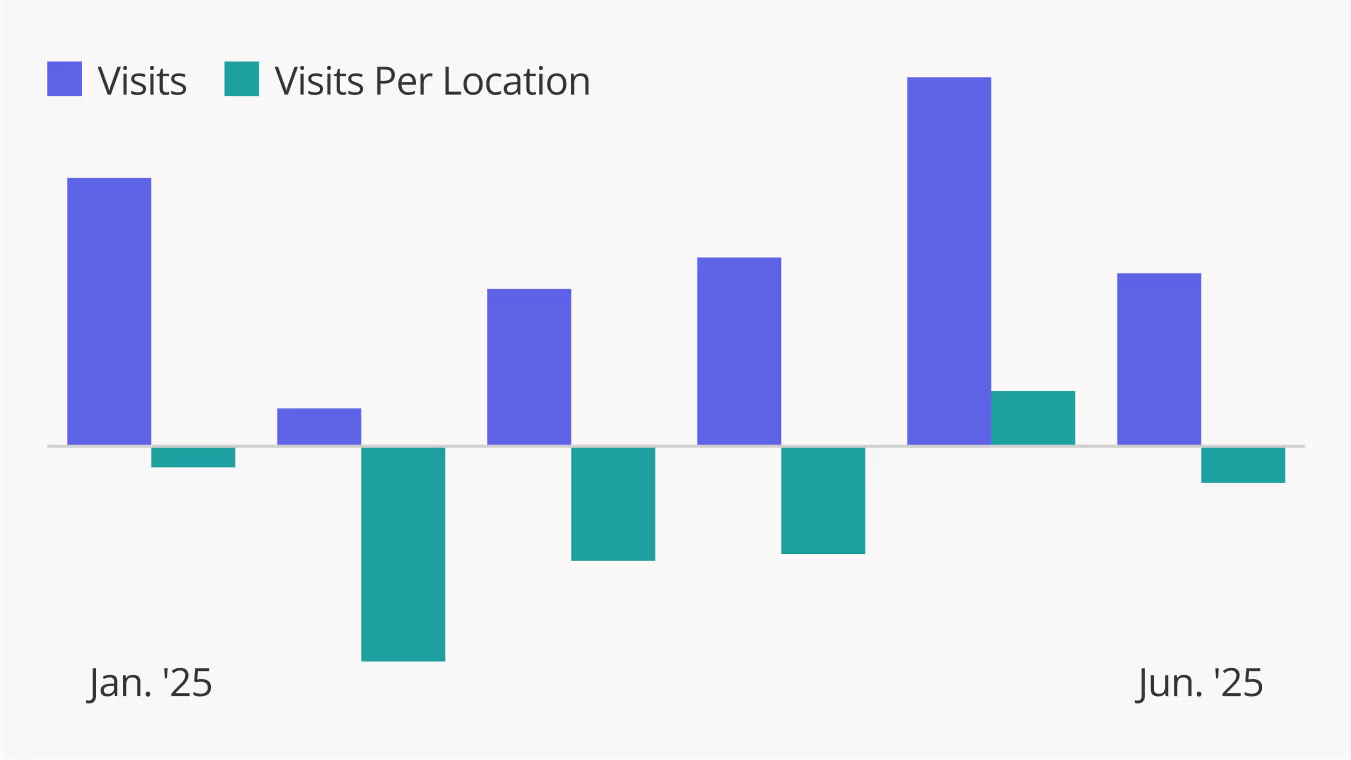
Despite the extreme climate conditions, some chains managed to plow ahead, enjoying visit growth in March 2025. Once again, Chili’s Grill & Bar held on to the top spot in the Placer 100 Index for YoY visits (22.6%) and visits per location (23.4%) growth, likely due to continued success in the areas of value and virality. Meanwhile, three fitness chains made the top 10 in YoY visits – Crunch Fitness (22.5%), LA Fitness (10.0%), and Planet Fitness (9.7%), at least in part due to continuing expansions of their respective footprints. 

Spotlight on Fitness Chains

Expansion is perhaps only one driving factor behind the success of Crunch Fitness, Planet Fitness, and LA Fitness in March 2025. The beginning of the year is generally busy for fitness chains as many consumers adopt new years’ resolutions to get in shape, even if many abandon their pursuit down the line. But the data suggests that Crunch Fitness, Planet Fitness, and LA Fitness experienced visit growth in March in part due to a sustained increase in visitor frequency. 

All three chains saw an increase in the share of visitors visiting 8 or more times in March 2025 compared to 2024, indicating that the chains are driving more traffic from fitness-invested visitors. And these fitness buffs, who attend the gym quite often, are perhaps less likely to give up on their fitness goals during the year, which bodes well for the fitness chains’ chances to sustain members and elevated traffic in the months ahead.

The Placer 100 Index for March 2025 demonstrates the effect of harsh winter conditions on retail and dining visits. Still, the strong performance of several chains highlights the consumer trends and brand strategies that can drive growth. 

For more insights anchored in location analytics, visit Placer.ai/anchor.

Article
The Post-Pandemic Retail Evolution: A look back on the last five years
Half a decade has passed since the onset of the COVID-19 pandemic, transforming the retail industry overnight. We took a look back at how some things have changed - and what's stayed the same.
Elizabeth Lafontaine
Apr 15, 2025
10 minutes

It’s hard to imagine, but we’ve eclipsed the five year anniversary of the onset of the pandemic lockdowns across the U.S., when the retail industry was transformed overnight. By April 2020, thousands of stores had closed and uncertainty loomed. At the time, it felt like the potential end of physical retail that the industry had been ruminating over for years. 

The Resilience of Physical Retail 

Five years later, the industry looks mostly like it did at the beginning of 2020. Online shopping did not kill physical retail, and although e-commerce adoption has substantially increased since pre-pandemic – fueled by the spike in new online shoppers in 2020 – the vast majority of retail transactions (over 80%) still occur in brick-and-mortar locations.

At the same time, while the retail industry looks similar to itself structurally, there have been numerous changes at the category level. Many large ticket purchases like consumer electronics and home furnishings that experienced a pull forward in demand during the pandemic waned over the past few years. Visits to apparel retailers and department stores looked, for a while, like they would never recover. And as people emerged from their homes or found their way to TikTok, beauty became the in-demand category that spread like wildfire. Grocery shopping went from a mundane chore to a form of consumer escapism in 2020; in many ways, that behavior has stuck for shoppers as they now frequent more grocery chains in their journey.

We’ve also observed some fundamental changes across U.S. consumers; more workers still work from home than before the pandemic, although return to office numbers keep rising. And many city dwellers who migrated during the peak pandemic period still remain in more suburban and rural areas.

So what have the past five years taught us about U.S. shoppers? First, we’ve learned that consumers are much more resilient than we give them credit for as they demonstrated a remarkable ability to both adapt to unprecedented circumstances and return to their former shopping habits once the situation normalized. Second, consumers are very cyclical in their behaviors and interests – five years after the pandemic’s start, many of the categories that suffered are coming back into their own. And, as consumers face different types of economic uncertainty, we should be optimistic that they can weather different types of storms. But perhaps the key lesson from the past five years has been that brick-and-mortar stores serve a distinct purpose to both retailers and shoppers – and that physical commerce is definitively here to stay.

Visits to Brick & Mortar Surpass Pre-Pandemic Levels While Dwell Time Decreases

Looking at the Placer 100 Retail and Dining Index reveals that visits to retail and dining locations not only rebounded from the pandemic, but have surpassed pre-pandemic levels. There are a few underlying causes that could have contributed to these changes: store and unit openings, a higher frequency in visits to certain categories, and increased consumer demand.

At the same time, dwell times across the macro retail industry have shifted since the pandemic as consumers are generally spending less time in stores than they did in 2019. There could be a few reasons contributing to this decrease: a higher adoption of e-commerce as a research tool before visiting a store, a higher utilization of BOPIS and curbside offerings, or more frequent visits leading to shorter individual trips but longer overall time in store. Last year (2024) also saw a higher share of weekday visits compared to the pre-pandemic period, where more consumers shopped on the weekend.

From a consumer perspective, as we wrote about recently, higher income households are more important to the retail industry than prior to the pandemic – even though they account for fewer visits overall. Meanwhile, lower income households are visiting retailers more frequently, especially in essential categories, as they look to combat inflationary pressures that exploded since the pandemic. 

Essential Retailers Cemented Their Importance

What did the pandemic reveal about essential retail categories? For many consumers, these segments got them through the peak pandemic time period as discretionary retail locations remained closed. Grocery stores, pharmacies, and superstores provided a sense of normalcy for shoppers as visiting a store became much more than a weekly errand. Today’s shoppers mirror many of those behaviors; they visit these types of retailers more frequently and don’t balk at making an extra trip for that “must-have” item from a specific chain. 

Value Retailers Came Out On Top 

Looking at the relative share of visits by category shows that dollar and discount stores gained the most visit share compared to the pre-pandemic trends. These chains have invested heavily in fresh food items and assortment expansion to become more of a destination for shoppers, especially those who are more price sensitive. So while visitation growth to dollar store chains did stagnate in 2024, even as retailers continued to expand store fleets, the leading players in this category have already entrenched themselves deeper into consumers' shopping journey compared to the pre-pandemic period.

Similarly, value based grocers and warehouse clubs have become more frequent stops in consumer daily routines, even if their share of visitation hasn’t risen dramatically. These chains have benefitted from changes in consumer behavior over the past five years: Warehouse clubs were well positioned for consumers who migrated from urban to suburban environments, and value grocery stores such as Aldi and Trader Joe’s became a safe haven for consumers trying to combat inflationary pressures as the country emerged from the pandemic.

Drugstores – a COVID-era Winner – Face Challenges

The one sector that hasn’t fared as well? The drugstore channel. The increase in visitation during the vaccine roll out period didn’t result in long term sustained traffic, and drugstores with their expansive store fleet have struggled to find their true value proposition as competition from wellness chains (such as GNC & Vitamin Shoppe), beauty retailers, and superstores grew. Drug-based retailers are still working to right size business today, as further constrained shoppers look elsewhere. 

Adapting to Evolving Consumer Needs in Essential Retail

Essential retail players have had to contend with ever-evolving consumer needs in the post-pandemic period and continue to play a key role in the return for normalcy. Some sectors have fared better than others, but those that have emerged as winners looked to stay in lock step with their consumers on their journey. Retailers realized that they didn’t have to be the best at everything – experience, convenience, value, and assortment – but they needed to lean into their speciality to be successful.

Post-Pandemic Hurdles for Discretionary Retail

On the other end of the retail spectrum, discretionary categories have faced headwinds as consumers exited the peak pandemic period. The peak pandemic years (2020 and 2021) were banner years for retail segments that cater to shoppers’ “wants”. But as the need to self-soothe with goods waned and inflationary pressures rose, consumers walked away from many of the retailers who had benefited from their behavioral changes. (The declines in foot traffic in these categories likely also reflected some of the shift to online channels, as most of these retailers were forced to shut their doors during the early days of COVID.) 

It’s been a long road to recovery for discretionary businesses, but we began to see some renewed signs of life over the past year. These retailers must remain vigilant in their quest for relevance with shoppers; high levels of uncertainty, debts, and increasing focus on value all still present headwinds for the retail industry – particularly those who focus on satisfying desires instead of needs.

Beauty Visits Normalize Following Post-Pandemic Surge 

In reviewing the visitation growth since 2022, discretionary retail could be broken into two performance categories: beauty and everything else. As we’ve written previously, the beauty industry was able to ride the wave of post-lockdown consumer behaviors, including the need to replace outdated products that hadn’t been worn while spending more time at home. At the same time, consumers also became more enamored with mass beauty brands, or those sold at drugstores or mass merchants at lower price points. The success of these brands and retailers that harnessed the power of consumer choice, like Ulta Beauty, intersected with a strong consumer desire for value. And although 2024 was a year of reckoning for the beauty industry as the consumer shifts towards other priorities, the category’s strong success during the early post-pandemic period cannot be overstated.

Post-Pandemic Adjustment for Home Goods and Apparel

The performance of other discretionary segments has been more mixed. Categories that saw meteoric growth during the pandemic lockdowns – such as home furnishings, home improvement and consumer electronics – failed to sustain momentum. Apparel trends, like the rise of athleisure, had helped drive continued demand to retail chains and department stores even without the need for traditional clothing, and as life got back to normal and these trends faded, retailers saw year-over-year declines in visitation.

But the 2024 data began the slow rebound of some of these categories, particularly in home and apparel. Home furnishings, home improvement, and consumer electronics may continue to see a rebound in 2025 as we enter a new replacement cycle and those who purchased these categories during the pandemic look to refresh their homes and upgrade their technology. Apparel’s rebound can be attributed to a resurgence of national brands as increased use of semaglutide medications and an interest in healthy living drive shoppers to revamp their wardrobes.

The one area of discretionary retail that outperformed its competitors and continues to shine? The off-price channel has had an extraordinary few years of visitation growth since the onset of the pandemic. Off-price retailers have enticed consumers with the perfect blend of value orientation, in-store experience, and immediacy that drive repeat visitation and keep shoppers engaged. The success of off-price retail also underscores the continued importance of physical retailers, despite the initial changes in behavior during the pandemic. This sector of discretionary retail is probably best positioned to handle the potential economic uncertainty of 2025 and beyond.

Overall, the discretionary side of the retail industry has begun to recover from its challenging few years of visitation, but 2025 does pose uncertainty that could impact consumers’ disposable income levels. Retailers that cater to consumers’ “wants” must work even harder to stay on their customers’ radar and entice shoppers to come into physical retail locations instead of shopping online or via social media platforms. As mentioned earlier, high income shoppers are going to become even more valuable to this sector of retail as it tries to maintain momentum. 

Consumer Resilience and Future Retail Opportunities 

The retail industry has undergone a tremendous transformation over the past five years. But while so much has evolved, there is still a lot of opportunity for the industry to be more agile in its ability to satisfy consumer demands. Despite the early days of store closures during the pandemic, physical retail not only bounced back, but has flourished. Retailers continue to focus on upgrading store fleets and opening new stores. Stores have moved away from being experiential to trying to just provide a good shopper experience. Retail’s reality is that consumers still face many challenges ahead, especially economic uncertainty. But, the pandemic highlighted the resilience of both retailers and shoppers to support one another, which will hopefully continue into the future of retail.

Article
Orlando Theme Park Wars Heat Up 
Universal’s Epic Universe opens May 22. We analyzed foot traffic and demographics at Universal and Disney parks in Orlando to see how this major addition could impact visitor trends to these tourist destinations.
Elizabeth Lafontaine
Apr 14, 2025
2 minutes

The battle for theme park dominance in Orlando is heating up this spring and summer. The highly anticipated opening of Universal Orlando Resort’s Epic Universe on May 22nd brings a third theme park gate to the resort, inching closer to the count of Walt Disney World. Universal has been slowly chipping away at Disney’s stronghold over the Orlando market with new resort hotels, water parks and now the addition of a third gate, while Disney has concentrated efforts around upgrades to existing parks and expansion of programs like the Disney Vacation Club. 

The opening of Epic Universe reveals some of the tension brewing beneath the surface when it comes to changing consumer demands. Visiting the resorts in Orlando, a rite of passage for many families, has gotten much more expensive in recent years, and theme park ticket prices are similar at both destinations, although Walt Disney World does have a higher overall Median Household Income in its captured market. According to Placer.ai’s cross-visitation analysis, 40% of visitors to Universal Orlando Resort also visit Walt Disney World, signaling that Epic Universe needs to wow in order to keep visitors on property instead of resort hopping.

Placer.ai’s foot traffic estimates show that the two resorts attract slightly different demographic profiles. Walt Disney World attracts a higher distribution of Ultra Wealthy Families and Wealthy Suburban Families, while Universal Orlando Resort captures more visits from middle-income cohorts like Blue Collar Suburbs, City Hopefuls and Near-Urban Diverse Families. There’s even a difference in the young people who visit each resort: Walt Disney World captures more Young Professionals – the potential “Disney Adults” – whereas Universal sees a higher share of visits from Young Urban Singles.

With the year-over-year price increases, even a wealthier base of visitors may not help to sustain visitation with a new theme park opening and uncertain economic headwinds. Both Orlando destinations are up against a changing consumer base and theme park loyalists who expect the highest standard of excellence and innovation. 

For more data-driven consumer insights, visit placer.ai/anchor


Reports
INSIDER
Brewing Success: Winning Strategies for Coffee Chains
Dive into the data to explore foot traffic trends in the coffee space – and uncover factors driving visits to Starbucks, Dunkin’, and other leading chains.
June 20, 2024

Coffee on the Rise

Everybody loves coffee. And with some 75% of American adults indulging in a cup of joe at least once a week, it’s no wonder the industry is constantly on an upswing.

In early 2024, year-over-year (YoY) visits to coffee chains increased nationwide – with every state in the continental U.S. experiencing year-over-year (YoY) coffee visit growth.

The most substantial foot traffic boosts were seen in smaller markets like Oklahoma (19.4%), Wyoming (19.3%), and Arkansas (16.9%), where expansions may have a more substantial impact on statewide industry growth. But the nation’s largest coffee markets, including Texas (10.9%), California (4.2%), Florida (4.2%), and New York (3.5%), also experienced significant YoY upticks. 

Expanding to Meet Growing Demand

The nation’s coffee visit growth is being fueled, in large part, by chain expansions: Major coffee players are leaning into growing demand by steadily increasing their footprints. And a look at per-location foot traffic trends shows that by and large, they are doing so without significantly diluting visitation to existing stores. 

On an industry-wide level, visits to coffee chains increased 5.1% YoY during the first five months of 2024. And over the same period, the average number of visits to each individual coffee location declined just slightly by 0.6% – meaning that individual stores drew just about the same amount of foot traffic as they did in 2023. 

Drilling down into chain-level data shows some variation between brands. Dutch Bros., BIGGBY COFFEE and Dunkin’ all saw significant chain-wide visit boosts, accompanied by minor increases in their average number of visits per location. 

Starbucks, for its part, which reported a YoY decline in U.S. sales for Q2 2024, maintained a small lag in visits per location. But given the coffee leader’s massive footprint – some 16,600 stores nationwide – its ability to expand while avoiding more significant dilution of individual store performance shows that Starbucks’ growth is meeting robust demand. 

What is driving the coffee industry’s remarkable category-wide growth? And who are the customers behind it? This white paper dives into the data to explore key factors driving foot traffic to leading coffee chains in early 2024. The report explores the demographic and psychographic characteristics of visitors to major players in the coffee space and examines strategies brands can use to make the most of the opportunity presented by a thriving industry.

Starbucks Visits Fueled by RTO

One factor shaping the surge in coffee visit growth is the slow-but-sure return-to-office (RTO). Hybrid work may be the post-COVID new normal – but RTO mandates and WFH fatigue have led to steady increases in office foot traffic over the past year. And in some major hubs – including New York and Miami – office visits are back to more than 80.0% of what they were pre-pandemic.

A look at shifting Starbucks visitation patterns shows that customer journeys and behavior increasingly reflect those of office-goers. In April and May 2022, for example, 18.6% of Starbucks visitors proceeded to their workplace immediately following their coffee stop – but by 2024, this share shot up to 21.0%. 

Over the same period, the percentage of early morning (7:00 to 10:00 AM) Starbucks visits lasting less than 10 minutes also increased significantly – from 64.3% in 2022 to 68.7% in 2024. More customers are picking up their coffee on the go – many of them on the way to work – rather than settling down to enjoy it on-site.

Short Visits Driving Success at Dunkin’

Dunkin’ is another chain that is benefiting from consumers on the go. Examining the coffee giant’s performance across major regional markets – those where the chain maintains a significant presence – reveals a strong correlation between the share of Dunkin’ visits in each state lasting less than five minutes and the chain’s local YoY trajectory. 

In Wisconsin, for example, 50.9% of visits to Dunkin’ between January and May 2024 lasted less than five minutes. And Wisconsin also saw the most impressive YoY visit growth (5.9%). Illinois, Ohio, Maine, and Connecticut followed similar patterns, with high shares of very short visits and strong YoY showings. 

On the other end of the spectrum lay Tennessee, Alabama, and Florida, where very short visits accounted for a low share of the chain’s statewide total – under 40.% – and where visits declined YoY. 

Dunkin’s success with very short visits may be driven in part by its popular app, which makes it easy for harried customers to place their order online and save time in-store. And this is good news indeed for the coffee leader – since customers using the app also tend to generate bigger tickets. 

Dutch Bros. Appealing to Singles

Dutch Bros.’ meteoric rise has been fueled, in part, by its appeal to younger audiences. Recently ranked as Gen Z’s favorite quick-service restaurant, the rapidly-expanding coffee chain sets itself apart with a strong brand identity built on cultivating a positive, friendly customer experience. 

And Dutch Bros.’ people-centered approach is resonating especially well with singles – including young adults living alone – who may particularly appreciate the chain’s community atmosphere.

Analyzing the relative performance of Dutch Bros.’ locations across metro areas – focusing on regions where the chain has a strong local presence – shows that it performs best in areas with plenty of singles. Indeed, the share of one-person households in Dutch Bros.’ local captured markets is very strongly correlated with the coffee brand’s CBSA-level YoY per-location visit performance. Areas with higher concentrations of one-person households saw significantly more YoY visit growth in the first part of 2024.  (A chain’s captured market is obtained by weighting each Census Block Group (CBG) in its trade area according to the CBG’s share of visits to the chain – and so reflects the population that actually visits the chain in practice). 

The share of one-person households in Dutch Bros.’ Tucson, AZ captured market, for example, stands at 33.4% – well above the nationwide baseline of 27.5%. And between January and May 2024, Tucson-area Dutch Bros. saw a 6.0% increase in the average number of visits per location. Tulsa, OK, Medford, OR, and Oklahoma City, OK – which also feature high shares of one-person households (over 30.0%) – similarly saw per-location visit increases ranging from 3.6% - 7.0%. On the flip side, Fresno, CA, Las Vegas-Henderson-Paradise, NV, and San Antonio-New Braunfels, TX, which feature lower-than-average shares of single-person households, saw YoY per-location visit declines ranging from 1.5%-9.5%. 

As Dutch Bros. forges ahead with its planned expansions, it may benefit from doubling down on this trends and focusing its development efforts on markets with higher-than-average shares of one-person households – such as university towns or urban areas with lots of young professionals.

BIGGBY COFFEE: Pressing the Suburban Advantage  

Michigan-based BIGGBY COFFEE is another java winner in expansion mode. With a growth strategy focused on emerging markets with less brand saturation, BIGGBY has been setting its sights on small towns and rural areas throughout the Midwest and South. Though the chain does have locations in bigger cities like Detroit and Cincinnati, some of its most significant markets are in smaller population centers.

And a look at the captured markets of BIGGBY’s 20 top-performing locations in early 2024 shows that they are significantly over-indexed for suburban consumers – both compared to BIGGBY as a whole and compared to nationwide baselines. (Top-performing locations are defined as those that experienced the greatest YoY visit growth between January and May 2024).

“Suburban Boomers”, for example – a Spatial.ai: PersonaLive segment encompassing middle-class empty-nesters living in suburbs – comprised 10.6% of BIGGBY’s top captured markets in early 2024, compared to just 6.6% for BIGGBY’s overall. (The nationwide baseline for Suburban Boomers is even lower – 4.4%.) And Upper Diverse Suburban Families – a segment made up of upper-middle-class suburbanites – accounted for 9.6% of the captured markets of BIGGBY’s 20 top locations, compared to just 7.2% for BIGGBY’s as a whole, and 8.3% nationwide. 

Coffee for Everyone

Coffee has long been one of America’s favorite beverages. And java chains that offer consumers an enjoyable, affordable way to splurge are expanding both their footprints and their audiences. By leaning into shifting work routines and catering to customers’ varying habits and preferences, major coffee players like Starbucks, Dunkin’, Dutch Bros., and BIGGBY COFFEE are continuing to thrive.

INSIDER
Unlocking Potential in Underserved Grocery Markets
Dive into the location analytics to uncover potential growth markets in regions with limited grocery store availability.
June 6, 2024
6 minutes

Note: This report is based on an analysis of visitation patterns for regional and nationwide grocery chains and does not include single-location stores. 

Understanding Grocery Store Chain Distribution

Grocery stores, superstores, and dollar stores all carry food products – and American consumers buy groceries at all three. But even in today’s crowded food retail environment, traditional grocery chains have a special role to play. With their primary focus on stocking a wide variety of fresh foods, these chains serve a critical function in offering consumers access to healthy options. 

But visualizing the footprints of major grocery chains across the continental U.S. – alongside those of discount & dollar stores – shows that the geographical distribution of grocery chains remains uneven.

In some areas, including parts of the Northeast, Midwest, South Atlantic, and Pacific regions, grocery chains are plentiful. But in others – some with population centers large enough to feature a robust dollar store presence – they remain in short supply.

And though many superstore locations also provide a full array of grocery offerings, they, too, are often sparsely represented in areas with low concentrations of grocery chains. 

For grocery chain operators seeking to expand, these underserved grocery markets can present a significant opportunity. And for civic stakeholders looking to broaden access to healthy food across communities, these areas highlight a policy challenge. For both groups, identifying underserved markets with significant untapped demand can be a critical first step in deciding where to focus grocery development initiatives.

This white paper dives into the location analytics to examine grocery store availability across the United States – and harnesses these insights to explore potential demand in some underserved markets. The report focuses on locations belonging to regional or nationwide grocery chains, rather than single-location stores. 

Untapped Grocery Markets

Last year, grocery chains accounted for 43.4% of nationwide visits to food retailers – including grocery chains, superstores, and discount & dollar stores. But drilling down into the data for different areas of the country reveals striking regional variation – offering a glimpse into the variability of grocery store access throughout the U.S.  In some states, grocery stores attract the majority of visit share to food retailers, while in others, dollar stores or superstores dominate the scene. 

The ten states where residents were most likely to visit grocery chains in early 2024 – Oregon, Vermont, Washington, Massachusetts, California, Maryland, New Hampshire, Connecticut, New Jersey, and Rhode Island – were all on the East or West Coasts. In these states, as well as in Nevada and New York, grocery chain visits accounted for 50.0% or more of food retail visits between January and April 2024.

Meanwhile, residents of many West North Central and South Central states were much less likely to do their food shopping at grocery chains. In North Dakota, for example, grocery chain visits accounted for just 11.7% of visits to food retailers over the analyzed period. And in Mississippi, Oklahoma, and Arkansas, too, grocery stores drew less than 20.0% of the overall food retail foot traffic. 

YoY Visit Growth Data Highlights Strong Grocery Demand In Some States

But low grocery store visit share does not necessarily indicate a lack of consumer interest or ability to support such stores. And in some of these underserved regions, existing grocery chains are seeing outsize visit growth – indicating growing demand for their offerings. 

North Dakota, the state with the smallest share of visits going to grocery chains in early 2024, experienced a 9.1% year-over-year (YoY) increase in grocery visits during the same period – nearly double the nationwide baseline of 5.7%. Other states with low grocery visit share, including Nebraska, Arkansas, Alabama, Mississippi, and New Mexico, also experienced higher-than-average YoY grocery chain visit growth. This suggests significant untapped potential for grocery stores and a market that is hungry for more. 

Alabama Bound: Identifying Grocery Markets With Increasing Demand

Alabama is one state where grocery chains accounted for a relatively small share of overall food retail foot traffic in early 2024 (just 28.9%) – but where YoY visit growth outperformed the nationwide average. And digging down even further into local grocery store visitation trends provides further evidence that at least in some places, low grocery visit share may be due to inadequate supply, rather than insufficient demand. 

In Central Alabama, for example, many residents drive at least 10 miles to reach a local grocery chain. And several parts of the state, both rural and urban, feature clusters of grocery stores that draw customers from relatively far away.

But zooming in on YoY visitation data for local grocery chain locations shows that at least some of these areas likely harbor untapped demand. Take for example the Camden, Butler, Thomasville, and Gilbertown areas (circled in the map above). The Piggly Wiggly location in Butler, AL, drew 40.1% of visits from 10 or more miles away. The same store experienced a 23.3% YoY increase in visits in early 2024 –  far above the statewide baseline of 6.6%. Meanwhile, the Super Foods location in Thomasville, AL, which drew 52.8% of visits from at least 10 miles away – experienced YoY visit growth of 12.3%. The Piggly Wiggly locations in Camden, AL and Gilbertown, AL saw similar trends. 

At the same time, trade area analysis of the four locations reveals that the grocery stores had little to no trade area overlap during the analyzed period. Each store served specific areas, with minimal cannibalization among customer bases.

These metrics appear to highlight robust demand for grocery stores in the region – grocery visits are growing at a stronger rate than those in the overall state, people are willing to make the drive to these stores, and each one has little to no competition from the others. 

Increasing Access to Fresh Food in Greenville County, SC

While significant opportunity exists across the country, many communities still face considerable challenges in supporting large grocery stores. Though South Carolina has a significant number of grocery chain locations, for example, certain areas within the state have low access to food shopping opportunities. And one local government – Greenville County – is considering offering tax breaks to grocery stores that set up shop in the area, to improve local fresh food accessibility.

Assessing Local Demand – And Preferences

Placer.ai migration and visitation data shows that Greenville County is ripe for such initiatives: the county’s population grew by 4.8% over the past four years – with much of that increase a result of positive net migration. And YoY visits to Greenville County Grocery Stores have consistently outperformed state averages: In April 2024, grocery visits in the county grew by 6.1% YoY, while overall visits to grocery stores in South Carolina grew by 4.2%. This growth – both in terms of grocery visits and population – points to rising demand for grocery stores in Greenville County. 

Analyzing the Greenville County grocery store trade areas with Spatial.ai’s FollowGraph dataset – which looks at the social media activity of a given audience – offers further insight into local grocery shoppers’ particular demand and preferences. 

Consumers in Greenville-area grocery store trade areas, for example, are more likely to be interested in “Mid-Range Grocery Stores” (including brands like Aldi, Kroger, and Lidl) than residents of grocery store trade areas in the state as a whole. This metric provides further evidence of local demand for grocery chains – and offers a glimpse into the kinds of specific grocery offerings likely to succeed in the area. 

Final Thoughts 

Grocery stores remain essential services for many consumers, providing a place to pick up fresh produce, meat, and other healthy food options. And many areas in the country are ripe for expansion, with eager customer bases and growing demand. Identifying such areas with location analytics can help both grocery store operators and municipal stakeholders provide their communities and customer bases with an enhanced grocery shopping experience that caters to local preferences. 

INSIDER
Migration Hotspots in a Cool 2024 Market
Discover which metro areas are still attracting new residents – and what’s drawing people to emerging hotspots.
May 23, 2024
5 minutes

Slowing Domestic Migration

Following COVID-era highs, domestic migration levels have begun to taper off – with the number of Americans moving within the U.S. hitting an all-time low, according to some sources, in 2023

To be sure, some popular COVID-era destinations – including Idaho, the Carolinas, and Utah – saw their net domestic migration continue to rise, albeit at a slower pace. But other states which had been relocation hotspots between February 2020 and February 2023, such as Wyoming and Texas, experienced negative net migration between February 2023 and February 2024. 

Hotspots in a Cool Market

Analyzing CBSA-level migration data reveals differences and similarities between last year’s migration patterns and COVID-era trends. 

Between February 2020 and February 2023, seven out of the ten CBSAs posting the largest population increases due to inbound domestic migration were located in Florida. But between February 2023 and February 2024, the top 10 CBSAs with the largest net migrated percent of the population were significantly more diverse. Only four out of the ten CBSAs were located in Florida, and several new metro areas – including Provo-Orem, UT, Kingsport-Bristol, TN-VA, and Boulder, CO – joined the list. 

This white paper leverages a variety of location intelligence tools – including Placer.ai’s Migration Report, Niche Neighborhood Grades, and ACS Census Data location intelligence – to analyze two migration hotspots. Specifically, the report focuses on Daytona Beach, FL, which already appeared on the February 2020 to February 2023 list and has continued to see steady growth, and Boulder, CO, which has emerged as a new top destination. The data highlights the potential of CBSAs with unique value propositions to continue to attract newcomers despite ongoing housing headwinds. 

High Tech's New Frontier – Boulder, CO 

The Boulder, CO CBSA has emerged as a domestic migration hotspot: The net influx of population between February 2023 and February 2024  (i.e. the total number of people that moved to Boulder from elsewhere in the U.S., minus those that left) constituted 3.1% of the CBSA’s February 2024 population.

The strong migration is partially due to the University of Colorado, Boulder’s growing popularity. But the metro area has also emerged as a flourishing tech hub, with Google, Apple, and Amazon all setting up shop in town, along with a wealth of smaller start ups.  

Moving in from Los Angeles & San Francisco – But Also Chicago, Dallas, and New York

Most domestic relocators tend to remain within state lines – so unsurprisingly, many of the recent newcomers to Boulder moved from other CBSAs in Colorado. But perhaps due to Boulder’s robust tech ecosystem, many of the new residents also came from Los Angeles, CA (6.6%) and San Francisco, CA (3.4%) – other CBSAs known for their thriving tech scenes

At the same time, looking at the other CBSAs feeding migration to the area indicates that tech is likely not the only draw attracting people to Boulder: A significant share of relocators came from the CBSAs of Chicago, IL (6.1%), Dallas , TX (4.9%), and New York, NY (3.9%). The move from these relatively urbanized CBSAs to scenic Boulder indicates that some of the domestic migration to the area is likely driven by people looking for better access to nature or a general lifestyle change. 

Boulder’s Quality of Life Attracting Migration

According to the U.S. News & World Report, Boulder ranked in second place in terms of U.S. cities with the best quality of life. Using Niche Neighborhood Grades to compare quality of life attributes in the Boulder CBSA and in the areas of origin dataset highlights some of the draw factors attracting newcomers to Boulder beyond the thriving tech scene. 

The Boulder CBSA ranked higher than the metro areas of origin for “Public Schools,” “Health & Fitness,” “Fit for Families,” and “Access to Outdoor Activities.” These migration draw factors are likely helping Boulder attract more senior executives alongside younger tech workers – and can also explain why relocators from more urban metro areas may be choosing to make Boulder their home.

Boulder’s strong inbound migration numbers over the past year – likely driven by its flourishing tech scene and beautiful natural surroundings – reveal the growth potential of certain CBSAs regardless of wider housing market headwinds. 

Sun, Sand, and Daytona Beach

Florida experienced a population boom during the pandemic, and several CBSAs in the state – including the Deltona-Daytona Beach-Ormond Beach, FL CBSA – have continued to welcome domestic relocators in high numbers. The CBSA’s anchor city, Daytona Beach – known for its Bike Week and NASCAR’s Daytona 500 – has also seen positive net migration between February 2023 and February 2024. 

An Attractive Destination for Older Americans

Americans planning for retirement or retirees operating on a fixed income are likely particularly interested in optimizing their living expenses. And given Daytona’s relative affordability, it’s no surprise that the median age in the areas of origin feeding migration to Daytona Beach tends to be on the older side. 

According to the 2021 Census ACS 5-Year Projection data, the median age in Daytona Beach was 39.0. Meanwhile, the weighted median age in the areas of migration origin was 42.6, indicating that those moving to Daytona Beach may be older than the current residents of the city. 

Zooming into the migration data on a zip code level also highlights Daytona Beach’s appeal to older Americans: The zip code welcoming the highest rates of domestic migration was 32124, home to both Jimmy Buffet’s Latitude Margaritaville’s 55+ community and the LPGA International Golf Club, host of the LPGA Tour. The median age in this zip code is also older than in Daytona Beach as a whole, and the weighted age in the zip codes of origin was even higher – suggesting that older Americans and retirees may be driving much of the migration to the area.

Daytona’s Migration Draw Factors 

Looking at the migration draw factors for Daytona Beach also suggests that the city is particularly appealing to retirees, with the city scoring an A grade for its “Fit for Retirees.” But the city of Daytona Beach is also an attractive destination for anyone looking to elevate their leisure time, with the city scoring higher than Daytona Beach’s cities of migration origin for “Weather,” “Access to Restaurants,” or “Access to Nightlife.”

Like Boulder, Daytona’s scenery – including its famous beaches – is likely attracting newcomers looking to spend more time outdoors and improve their work-life balance. And like Boulder and its tech scene, Daytona Beach also has an extra pull factor – its affordability and fit for older Americans – that is likely helping the area continue to attract new residents, even as domestic migration slows down nationwide. 

Opportunities for Growth Amidst Slowing Migration 

Although the overall pace of domestic migration has slowed, analyzing location intelligence data reveals several migration hotspots amidst the overall cooldown. Boulder and Daytona Beach each have a set of unique draw factors that seem to attract different populations – and the success of these regions highlights the many paths to migration growth in 2024.  

Loading results...
We couldn't find anything matching your search.
Browse one of our topic pages to help find what you're looking for.
For more in-depth analyses on a variety of subjects, explore Reports.
The Anchor Logo
INSIDER
Stay Anchored: Subscribe to Insider & Unlock more Foot Traffic Insights
Gain insider insights with our in-depth analytics crafted by industry experts
— giving you the knowledge and edge to stay ahead.
Subscribe