.png)
.png)

.png)
.png)


Craft retailers – one of the top destinations for purchasing holiday decor – posted impressive year-over-year (YoY) gains this holiday season: AI-powered location analytics reveals that visits to industry leaders Michaels and Hobby Lobby were up YoY by double-digits almost every week of the holiday season. And while some of these chains' success is likely due to the reduced competition – with Party City having ceased its operations earlier this year – the strong growth also suggests that, despite digital competition, the demand for physical browsing and festive inspiration remains high.
We dove into the data to analyze how the holiday decor market is evolving.
The 2025 closures of Party City and JOANN consolidated the crafting sector, leaving Michaels and Hobby Lobby with fewer competitors and driving up YoY visits. This market shift proved particularly advantageous in Q4 as shoppers seeking Halloween decorations and holiday trimmings flocked to the remaining specialty retailers.
But Michaels and Hobby Lobby's success is due to more than just a market consolidation – the two chains have cemented themselves as premier destinations for holiday home decor. And while these retailers have traditionally relied on families looking to fill suburban homes with seasonal cheer, AI-powered location analytics reveal that younger, more urban shoppers are also fueling the holiday traffic boost.
Focusing on October and November data reveals that both chains saw the share of "households with children" in their captured market dip between 2024 and 2025, while the share of Young Professionals and Young Urban Singles increased. This suggests that at least some of the holiday decorating in 2025 was fueled not just by family traditions, but also by a younger generation curating their spaces with viral, budget-friendly finds.
While the exit of competitors like Party City and JOANN cleared the playing field in 2025, Michaels and Hobby Lobby's success is due to more than just absorbing the displaced demand. By capturing a new wave of young, urban shoppers hunting for viral trends, these retailers have proven that holiday décor is no longer solely the domain of suburban families. This successful pivot from traditional utility to trend-driven destination suggests that the craft sector isn't just surviving the retail shakeout; it is effectively reshaping itself for a new generation of consumers.
For more data-driven insights, visit placer.ai/anchor.
Placer.ai leverages a panel of tens of millions of devices and utilizes machine learning to make estimations for visits to locations across the US. The data is trusted by thousands of industry leaders who leverage Placer.ai for insights into foot traffic, demographic breakdowns, retail sale predictions, migration trends, site selection, and more.

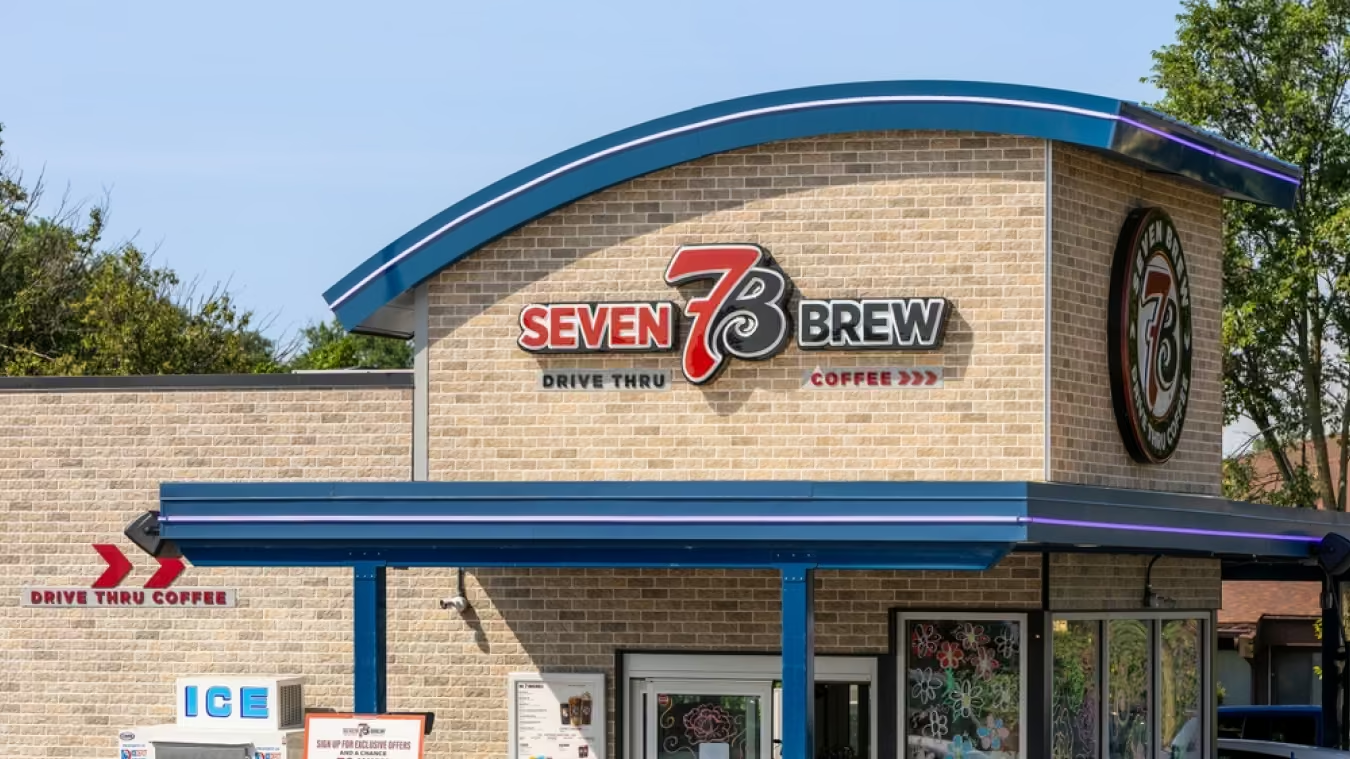
7 Brew Coffee may be the fastest-growing coffee chain in the US right now. The chain surged from just 14 locations at the start of 2022 to around 500 locations by October 2025. And average visits per location also increased significantly – indicating that despite the breakneck expansion, the drive-thru brand still has significant runway left to grow.
The chain's hypergrowth has been fueled by significant capital, including an equity investment from Blackstone in 2024 and a massive franchise agreement with the Flynn Group to develop an additional 160 stores. With a modular building model that allows for rapid deployment, 7 Brew is positioned to aggressively challenge major drive-thru competitors like Dutch Bros and Scooter's Coffee.
7 Brew's success can also be linked to a broader rise in drive-thru-centric coffee concepts. The chart below illustrates the shifting category dynamics in recent years as leading drive-thru coffee chains – with Dutch Bros in the lead – commanding a growing share of overall coffee visits since 2019.
Even amid the broader rise of drive-thru coffee chains, 7 Brew’s growth continues to stand out. While the brand still holds a relatively small share of the overall coffee market, the brand’s proportional growth outpaces its peers, reflecting both aggressive unit expansion and strong consumer adoption. The chart also underscores how 7 Brew is increasingly carving out space within a segment historically dominated by brands like Dutch Bros – suggesting meaningful long-term competitive potential.
With drive-thru coffee continuing to surge in popularity and consumers gravitating toward convenience-forward formats, 7 Brew is well positioned to continue capturing incremental market share and solidifying its status as one of the fastest-rising brands in the category.
For more data-driven retail insights, visit placer.ai/anchor.
Placer.ai leverages a panel of tens of millions of devices and utilizes machine learning to make estimations for visits to locations across the US. The data is trusted by thousands of industry leaders who leverage Placer.ai for insights into foot traffic, demographic breakdowns, retail sale predictions, migration trends, site selection, and more.

Despite the ongoing consumer headwinds, the 2025 holiday shopping season delivered year-over-year (YoY) gains for both retail and dining chains nationwide, with the majority of states registering retail and dining traffic increases during the holiday window. And while performance varied meaningfully by category and format, aggregate retail traffic numbers point to significant consumer engagement throughout the end of 2025.
Bifurcation has been a defining trend of consumer behavior in 2025 and continued to shape shopping patterns during the holiday season. Thrift stores and off-price retailers led the apparel category with traffic up 11.7% and 6.6% (November 1st to December 24th, 2025), respectively, compared to last year’s holiday period. Luxury chains and department stores also posted modest gains (+1.8%), while traditional apparel chains saw slight declines (-1.8%) and mid-tier department stores experienced more pronounced traffic drops (-6.2%).
Open-air shopping centers led mall-format performance during the 2025 holiday season, with visits up 1.7% YoY, as consumers gravitated toward environments that offered a more festive, experiential atmosphere and a wider mix of dining options. The format likely received an additional lift from warmer-than-average weather across much of the country, which encouraged shoppers to fully take advantage of the outdoor amenities and social experiences open-air centers offer during the holidays.
Indoor mall traffic was largely flat (+0.8%) – a positive signal given ongoing consumer headwinds, especially for mid-tier formats – suggesting that traditional malls were able to maintain relevance during a pressured spending environment.
Meanwhile, outlet mall visits declined slightly (-0.8%), likely reflecting reduced appetite for destination-driven, discretionary trips as shoppers prioritized convenience, everyday value, and locally accessible retail over longer, deal-oriented excursions during the holidays.
Within the superstore category, wholesale clubs and discount & dollar stores outperformed mass merchants. This performance underscores consumers’ continued shift toward value-driven retail during the holidays and highlights that “value” extends beyond low prices alone; wholesale clubs, with their compelling value propositions, are also seeing meaningful gains in the current consumer environment.
Categories most closely tied to self-gifting outperformed more traditional holiday segments during the 2025 season. Pet stores and services (+5.5% YoY) and home improvement retailers (+3.4% YoY) led the way, perhaps because purchases from these categories are typically positioned as practical investments in everyday life, ranging from caring for pets to improving and maintaining living spaces.
In contrast, home furnishings (-0.8%) lagged, as these purchases tend to be more decorative or occasion-driven and therefore more likely to be intended as gifts for others rather than immediate, utility-focused upgrades. Traffic to electronics stores also dipped slightly (-1.5%). Together, these trends underscore a consumer preference for spending that delivers direct, everyday value to themselves over more traditional, outward-facing holiday gifting.
Overall, location analytics for the 2025 holiday season suggest that consumers remained highly engaged despite ongoing economic pressure, but their spending behavior continued to fragment. Across apparel, superstores, and discretionary categories, shoppers consistently gravitated toward retailers that delivered clear value – whether through low prices, strong quality-to-price ratios, or products tied to personal utility and well-being. The outperformance of thrift, off-price, wholesale clubs, and self-gifting categories underscores a consumer mindset that is both pragmatic and selective, balancing budget consciousness with targeted willingness to spend.
Looking ahead to 2026, these patterns suggest that retailers should move beyond one-dimensional value messaging and instead sharpen their core propositions. Formats that clearly articulate why they are “worth the trip” – through pricing power, assortment differentiation, or alignment with everyday consumer priorities – will be best positioned to win share. As bifurcation persists, success will increasingly depend on understanding which consumer needs a brand serves best and doubling down on those strengths, rather than attempting to compete broadly across a squeezed and highly segmented retail landscape.
For more data-driven consumer insights, visit placer.ai/anchor.
Placer.ai leverages a panel of tens of millions of devices and utilizes machine learning to make estimations for visits to locations across the US. The data is trusted by thousands of industry leaders who leverage Placer.ai for insights into foot traffic, demographic breakdowns, retail sale predictions, migration trends, site selection, and more.

Dutch Bros has long been a powerhouse in the beverage space, building its business with rapid expansion and securing a loyal following. But to maintain its growth momentum, Dutch Bros will likely need to look beyond its beverage-first identity. By strategically expanding its breakfast offerings, the brand can attract a new segment of morning diners while driving incremental spend from its existing loyal customer base.
Dutch Bros is still on an aggressive growth trajectory, with plans to continue opening new locations at a brisk pace. The company passed the 1,000-unit mark this year and aims to reach over 2,000 locations nationwide by 2029. However, recent data suggests that while the brand's overall footprint is expanding, its established locations are facing the typical challenges of a maturing brand.
Throughout much of 2025, total visits to Dutch Bros increased rapidly year-over-year (YoY), driven largely by new store openings. And while same-store visits – which measure the performance of locations open for at least a year – were also generally positive, the growth was somewhat uneven. So although the brand’s expansion is still meeting robust demand, the gap between total growth and same-store performance may indicate that Dutch Bros is reaching a level of saturation in its initial markets.
To sustain growth, the brand is targeting the morning daypart by introducing breakfast offerings, reaching approximately 160 stores by the end of September 2025 and plans to deploy the menu across its store fleet in 2026. This strategy appears to be paying off: November saw same-store visits surge to their highest levels of the year. While this spike was likely supported by holiday menu launches and Black Friday, it also suggests the breakfast initiative is gaining traction and successfully revitalizing performance at established locations.
Why is Dutch Bros betting on breakfast? Historically, Dutch Bros has seen a lower percentage of its daily traffic occur during the morning daypart than its competitors. And when comparing the chain’s hourly visit distribution to the wider coffee category, it becomes clear why the shift toward a more robust breakfast offering is a logical move for Dutch Bros. While the coffee category as a whole sees 43.1% of its total daily visits between 5:00 and 11:00 AM, Dutch Bros captures only 32.6% during that same window, according to the chart below.
To bridge this gap, Dutch Bros is evolving its menu to include more substantial food options. Food currently accounts for only about 2% of Dutch Bros’ total sales, a figure it hopes to increase significantly with the help of hot breakfast items. As Dutch Bros continues to roll out the expanded food lineup to more locations in 2026, the brand is positioning itself to compete directly for the morning commuter who currently heads to a competitor for a meal-and-drink combo.
And to further bolster its morning performance, Dutch Bros could lean into "functional fuel" trends that complement its popular protein coffee and are likely to appeal in particular to younger consumers who prioritize health-conscious menu options.
Dutch Bros is at a pivotal point in its evolution. While new store openings continue to drive visits, the brand is now focusing on deepening its relationship with customers through the breakfast daypart. If the recent uptick in same-store visits is any indication, the shift from a "beverage-first" destination to a well-rounded morning stop could be exactly what the company needs to sustain its long-term momentum.
For more dining insights, visit Placer.ai/anchor.
Placer.ai leverages a panel of tens of millions of devices and utilizes machine learning to make estimations for visits to locations across the US. The data is trusted by thousands of industry leaders who leverage Placer.ai for insights into foot traffic, demographic breakdowns, retail sale predictions, migration trends, site selection, and more.

The last full week before Christmas (December 15th to 21st) saw massive seasonal spikes in traffic across the board, underscoring the continued importance of physical retail during the holiday season. But while visits rose broadly compared to the year-to-date (YTD) average, year-over-year comparisons tell a more nuanced story, with many traditional gifting categories experiencing modest declines relative to 2024.
Part of this softness likely reflects the calendar shift. Super Saturday fell on December 20th in 2025 but on December 21st in 2024, so 2025 holiday shoppers enjoyed an extra day between Super Saturday and Christmas to complete last-minute purchases. Yet a deeper look at the data suggests that timing alone does not tell the full story. Value-oriented retailers – including dollar stores, thrift stores, and off-price chains – saw traffic remain flat or even increase year over year (YoY) despite the same calendar shift.
So consumers are still spending, but they are trading down, actively seeking deals, and gravitating toward “treasure hunt” retail experiences rather than traditional discretionary splurges.
In a season defined by economic prudence, the most immediate winners were the retailers promising the most bang for the buck. Discount & Dollar Stores – not a traditional holiday category – saw a healthy seasonal uplift of 37.3% compared to their weekly average as well as a 3.8% traffic increase compared to 2024. In contrast, Superstores saw smaller spikes compared to the YTD average and YoY visits dips of 4.6%.
The outperformance of dollar stores suggests that shoppers were making targeted, smaller-basket trips for affordable essentials and stocking stuffers rather than relying solely on the "one-stop-shop" giants.
The "traditional" holiday categories, including apparel and electronic stores, experienced their expected massive seasonal "pop," but – like superstores – struggled to match the highs of 2024.
And while some of the decline can be explained by the calendar shift, the double-digit YoY drop in traffic to key holiday categories such as department stores suggests that timing alone does not account for the slowdown. Instead, the data indicates that consumers are still showing up to buy gifts, but are purchasing fewer items or choosing lower-priced alternatives – forcing traditional discretionary retailers to compete more aggressively for a shrinking share of wallet.
Malls showed a similar pattern, with strong seasonal traffic surges alongside YoY declines – although these YoY gaps were far smaller than in other discretionary categories. This resilience suggests that, despite headwinds facing individual retailers, the mall itself remains the central hub of the holiday shopping experience.
The off-price sector delivered one of the strongest signals this season, posting sharp seasonal traffic surges alongside modest YoY gains despite unfavorable calendar shifts. Thrift stores also stood out, recording a notable YoY increase in visits even as traffic came in slightly below the category’s YTD weekly average – likely reflecting the category’s year-round strength and its relatively recent emergence as a holiday shopping destination.
This data underscores the outsized role of value perception in shaping holiday shopping behavior and highlights the growing appeal of the “thrill of the find.” Whether hunting for a designer deal or uncovering a one-of-a-kind vintage piece, consumers increasingly favored discovery-driven experiences over the standardized assortments of traditional retail.
For retailers looking ahead to 2026, the lessons of this holiday season are stark. First, value is non-negotiable – consumers are actively migrating to formats that offer perceived savings. Second, the mall is not dead, but it is evolving. The format remains a critical seasonal traffic driver, but it must compete harder on convenience and experience. Finally, the success of the off-price and thrift sectors suggests that inventory freshness and the "treasure hunt" dynamic are powerful tools to combat consumer fatigue. As we close the books on 2025, it’s clear that while the consumer is still shopping, they are doing so with a sharper, more critical eye.
Placer.ai leverages a panel of tens of millions of devices and utilizes machine learning to make estimations for visits to locations across the US. The data is trusted by thousands of industry leaders who leverage Placer.ai for insights into foot traffic, demographic breakdowns, retail sale predictions, migration trends, site selection, and more.
.avif)
Black Friday has long served as a reliable anchor in the retail calendar. But some retailers place less weight on the post-Thanksgiving rush – or even opt out of it altogether – in favor of promotional windows that better align with their customers or brand values.
We analyzed foot traffic patterns at two such retailers, REI and IKEA, to see how alternative promotional strategies can shape visit performance throughout the year.
Mission-driven REI’s decision to close on Black Friday is a deliberate break from retail tradition. The brand’s long-running #OptOutside initiative reflects its commitment to outdoor activity and to the well-being of its employees, who get the day off to spend with friends and family.
The graph below highlights the foot traffic impact of the decision: while the traditional apparel and recreational & sporting goods categories experienced a sharp surge during the week of Black Friday, REI’s visits dropped below its 2025 YTD average.
Even so, the data indicates that REI still captures seasonal momentum. The retailer’s pre-Thanksgiving Holiday Sale delivered a modest visit lift that partially offset its voluntary pause on one of the category’s highest-traffic days. And REI’s post-Black Friday sales – Cyber Monday and last-minute gifts sale – appeared to do some heavy lifting for the brand, while the anticipated end-of-year sale is likely to provide an additional foot traffic boost as shoppers gear up for winter activities.
And beyond the holidays, REI follows a distinct promotional rhythm of its own, leaning into moments – like the start of summer – that reflect the seasonal outdoor needs of its customers. The retailer’s annual Anniversary Sale in May delivered the largest weekly visit spike of 2025, with demand for warm-weather gear sustaining elevated traffic in the weeks that followed. And unlike traditional apparel and recreational and sporting goods retailers, which saw a pronounced back-to-school visit surge in early August, the brand saw a smaller bump during its end-of-summer Labor Day sale.
REI’s alternative holiday cadence sets up an interesting comparison with other retailers – like IKEA – that hold Black Friday sales events but rely less heavily on the milestone than their wider category.
As shown in the graph below, the furniture and home furnishings segment received its largest visit boost of the year in the weeks leading up to and including Black Friday, as consumers likely took advantage of big sales events to spruce up their spaces in anticipation of hosting family and friends for the holidays. IKEA, however, saw just a modest November lift, with weekly visits remaining below the chain’s year-to-date average.
Instead, IKEA anchors its promotional calendar around several event-driven periods throughout the year – most notably its summer sale window from June through August, when the brand capitalizes on home furnishing demand during the peak moving season. Other events, such as IKEA’s winter clearance sale from December 2024 through early January 2025 helped stabilize post-holiday traffic at a moment when category visits softened.
REI and IKEA’s visit trends underscore the value of a promotional calendar built around brand alignment rather than conventional retail expectations. Neither retailer maximizes Black Friday in the way their respective categories do, yet both demonstrate how targeted seasonal events can cultivate consistent demand outside of traditional peak periods.
For more retail insights, visit Placer.ai/anchor.
Placer.ai leverages a panel of tens of millions of devices and utilizes machine learning to make estimations for visits to locations across the US. The data is trusted by thousands of industry leaders who leverage Placer.ai for insights into foot traffic, demographic breakdowns, retail sale predictions, migration trends, site selection, and more.
The pandemic and economic headwinds that marked the past few years presented the multi-billion dollar hotel industry with significant challenges. But five years later, the industry is rallying – and some hotel segments are showing significant growth.
This white paper delves into location analytics across six major hotel categories – Luxury Hotels, Upper Upscale Hotels, Upscale Hotels, Upper Midscale Hotels, Midscale Hotels, and Economy Hotels – to explore the current state of the American hospitality market. The report examines changes in guest behavior, personas, and characteristics and looks at factors driving current visitation trends.
Overall, visits to hotels were 4.3% lower in Q2 2024 than in Q2 2019 (pre-pandemic). But this metric only tells part of the story. A deeper dive into the data shows that each hotel tier has been on a more nuanced recovery trajectory.
Economy chains – those offering the most basic accommodations at the lowest prices – saw visits down 24.6% in Q2 2024 compared to pre-pandemic – likely due in part to hotel closures that have plagued the tier in recent years. Though these chains were initially less impacted by the pandemic, they were dealt a significant blow by inflation – and have seen visits decline over the past three years. As hotels that cater to the most price-sensitive guests, these chains are particularly vulnerable to rising costs, and the first to suffer when consumer confidence takes a hit.
Luxury Hotels, on the other hand, have seen accelerated visit growth over the past year – and have succeeded in closing their pre-pandemic visit gap. Upscale chains, too, saw Q2 2024 visits on par with Q2 2019 levels. As tiers that serve wealthier guests with more disposable income, Luxury and Upscale Hotels are continuing to thrive in the face of headwinds.
But it is the Upper Midscale level – a tier that includes brands like Trademark Collection by Wyndham, Fairfield by Marriott, Holiday Inn Express by IHG Hotels & Resorts, and Hampton by Hilton – that has experienced the most robust visit growth compared to pre-pandemic. In Q2 2024, Upper Midscale Hotels drew 3.5% more visits than in Q2 2019. And during last year’s peak season (Q3 2023), Upper Midscale hotels saw the biggest visit boost of any analyzed tier.
As mid-range hotels that still offer a broad range of amenities, Upper Midscale chains strike a balance between indulgence and affordability. And perhaps unsurprisingly, hotel operators have been investing in this tier: In Q4 2023, Upper Midscale Hotels had the highest project count of any tier in the U.S. hotel construction and renovation pipeline.
The shift in favor of Upper Midscale Hotels and away from Economy chains is also evident when analyzing changes in relative visit share among the six hotel categories.
Upper Midscale hotels have always been major players: In H1 2019 they drew 28.7% of overall hotel visits – the most of any tier. But by H1 2024, their share of visits increased to 31.2%. Upscale Hotels – the second-largest tier – also saw their visit share increase, from 24.8% to 26.1%.
Meanwhile, Economy, Midscale, and Upper Upscale Hotels saw drops in visit share – with Economy chains, unsurprisingly, seeing the biggest decline. Luxury Hotels, for their parts, held firmly onto their piece of the pie, drawing 2.8% of visits in H1 2024.
Who are the visitors fueling the Upper Midscale visit revival? This next section explores shifts in visitor demographics to four Upper Midscale chains that are outperforming pre-pandemic visit levels: Trademark Collection by Wyndham, Holiday Inn Express by IHG Hotels & Resorts, Fairfield by Marriott, and Hampton by Hilton.
Analyzing the captured markets* of the four chains with demographics from STI: Popstats (2023) shows variance in the relative affluence of their visitor bases.
Fairfield by Marriott drew visitors from areas with a median household income (HHI) of $84.0K in H1 2024, well above the nationwide average of $76.1K. Hampton by Hilton and Trademark Collection by Wyndham, for their parts, drew guests from areas with respective HHIs of $79.6K and $78.5K – just above the nationwide average. Meanwhile, Holiday Inn Express by IHG Hotels & Resorts drew visitors from areas below the nationwide average.
But all four brands saw increases in the median HHIs of their captured markets over the past five years. This provides a further indication that it is wealthier consumers – those who have had to cut back less in the face of inflation – who are driving hotel recovery in 2024.
(*A chain’s captured market is obtained by weighting each Census Block Group (CBG) in its trade area according to the CBG’s share of visits to the chain – and so reflects the population that actually visits the chain in practice.)
Much of the Upper Midscale visit growth is being driven by chain expansion. But in some areas of the country, the average number of visits to individual hotel locations is also on the rise – highlighting especially robust growth potential.
Analyzing visits to existing Upper Midscale chains in four metropolitan areas with booming tourism industries – Salt Lake City, UT, Palm Bay, FL, San Diego, CA, and Richmond, VA – shows that these markets feature robust untapped demand.
Utah, for example, has emerged as a tourist hotspot in recent years – with millions of visitors flocking each year to local destinations like Salt Lake City to see the sights and take in the great outdoors. And Upper Midscale hotels in the region are reaping the benefits. In H1 2024, the overall number of visits to Upper Midscale chains in Salt Lake City was 69.4% higher than in H1 2019. Though some of this increase can be attributed to local chain expansion, the average number of visits to each individual Upper Midscale location in the area also rose by 12.5% over the same period.
Palm Bay, FL (the Space Coast) – another tourist favorite – is experiencing a similar trend. Between H1 2019 and H1 2024, overall visits to local Upper Midscale hotel chains grew by 36.4% – while the average number of visits per location increased a substantial 16.9%. Given this strong demand, it may come as no surprise that the area is undergoing a hotel construction boom. Upper Midscale hotels in other areas with flourishing tourism sectors, like San Diego, CA and Richmond, VA, are seeing similar trends, with increases in both overall visits and and in the average number of visits per location.
Though Economy chains have underperformed versus other categories in recent years, the tier does feature some bright spots. Some extended-stay brands in the Economy tier – hotels with perks and amenities that cater to the needs of longer-stay travelers – are succeeding despite category headwinds.
Choice Hotels’ portfolio, for example, includes WoodSpring Suites, an Economy chain offering affordable extended-stay accommodations in 35 states. In H1 2024, the chain drew 7.7% more visits than in the first half of 2019 – even as the wider Economy sector continued to languish. InTown Suites, another Economy extended stay chain, saw visits increase by 8.9% over the same period.
And location intelligence shows that the success of these two chains is likely being driven, in part, by their growing appeal to young, well-educated professionals. In H1 2019, households belonging to Spatial.ai: PersonaLive’s “Young Professionals” segment made up 9.6% of WoodSpring Suites’ captured market. But by H1 2024, the share of this group jumped dramatically to 13.3%. At the same time, InTown Suites saw its share of Young Professionals increase from 12.0% to 13.4%.
Whether due to an affinity for prolonged “workcations” (so-called “bleisure” excursions) or an embrace of super-commuting, younger guests have emerged as key drivers of growth for the extended stay segment. And by offering low–cost accommodations that meet the needs of these travelers, Economy chains can continue to grow their share of the pie.
The hospitality industry recovery continues – led by Upper Midscale Hotels, which offer elevated experiences that don’t break the bank. But today’s market has room for other tiers as well. By keeping abreast of local visitation patterns and changing consumer profiles, hotels across chain scales can personalize the visitor experience and drive customer satisfaction.
The past few years have provided the tourism sector with a multitude of headwinds, from pandemic-induced lockdowns to persistent inflation and a rise in extreme weather events. But despite these challenges, people are more excited than ever to travel – more than half of respondents to a recent survey are planning on increasing their travel budgets in the coming months.
And while revenge travel to overseas destinations is still very much alive and well, the often high costs associated with traveling abroad are shaping the way people choose to travel. Domestic travel and tourism are seeing significant growth as more affordable alternatives.
This white paper takes a closer look at two of the most popular domestic tourism destinations in the country – New York City and Los Angeles. Over the past year, both cities have continued to be leading tourism hotspots, offering a wealth of attractions for visitors. What does tourism to these two cities look like in 2024, and what has changed since before the pandemic? How have inflation and rising airfare prices affected the demographics and psychographics of visitors to these major hubs?
Analyzing the distribution of domestic tourists across CBSAs nationwide from May 2023 to April 2024 reveals New York and Los Angeles to be two of the nation’s most popular destinations. (Tourists include overnight visitors staying in a given CBSA for up to 31 days).
The New York-Newark-Jersey City, NY-NJ-PA metro area drew the largest share of domestic tourists of any CBSA during the analyzed period (2.7%), followed closely by the Los Angeles-Long Beach-Anaheim, CA CBSA (2.5%). Other domestic tourism hotspots included Orlando-Kissimmee-Sanford, FL (tied for second place with 2.5% of visitors), Dallas-Fort Worth-Arlington, TX (1.9%), Las Vegas-Henderson-Paradise, NV (1.8%), Miami-Fort Lauderdale-Pompano Beach, FL (1.8%), and Chicago-Naperville, Elgin, IL-IN-WI (1.6%).
The Big Apple. The City That Never Sleeps. Empire City. Whatever it’s called, New York City remains one of the most well-known tourist destinations in the world. And for many Americans, New York is the perfect place for an extended weekend getaway – or for a multi-day excursion to see the sights.
But where do these NYC-bound vacationers come from? Diving into the data on the origin of visitors making medium-length trips to New York City (three to seven nights) reveals that increasingly, these domestic tourists are coming from nearby metro areas.
Between 2018-2019 and 2023-2024, for example, the number of tourists visiting New York City from the Philadelphia metro area increased by 19.2%.
The number of tourists coming from the Boston and Washington, D.C metro areas, and from the New York CBSA itself (New York-Newark-Jersey City, NY-NJ-PA) also increased over the same period.
Meanwhile, further-away CBSAs like San Francisco-Oakland-Berkeley, CA, Atlanta-Sandy Springs-Alpharetta, GA, and Miami-Fort Lauderdale-Pompano Beach, FL fed fewer tourists to NYC in 2023-2024 than they did pre-pandemic. It seems that residents of these more distant metro areas are opting for vacation destinations closer to home to avoid the high costs of air travel.
Diving even deeper into the characteristics of visitors taking medium-length trips to New York City reveals another demographic shift: Tourists staying between three and seven nights in the Big Apple are skewing younger.
Between 2018-2019 and 2023-2024, the share of visitors to New York City from areas with median ages under 30 grew from 2.1% to 4.5%. Meanwhile, the share of visitors from areas with median ages between 31 and 40 increased from 34.3% to 37.7%.
The impact of this trend is already being felt in the Big Apple, with The Broadway League reporting that the average age of audiences to its shows during the 2022- 2023 season was the youngest it had been in 20 seasons.
The shift towards younger tourists can also be seen when examining the psychographic makeup of visitors to popular attractions in New York City. Analyzing the captured markets of major NYC landmarks with data from Spatial.ai’s PersonaLive dataset reveals an increase in households belonging to the “Educated Urbanites” segment between 2018-2019 and 2023-2024.
These well-educated, young singles are increasingly visiting iconic NYC venues such as the Whitney Museum of American Art, The Metropolitan Museum of Art, The American Museum of Natural History, and the Statue of Liberty. This shift highlights the growing popularity of these attractions among young, educated singles, reflecting a broader trend of increased domestic tourism among this demographic.
New York City’s tourism sector is adapting to meet the changing needs of travelers, fueled increasingly by younger visitors who may be unable to take a costly international vacation. How have travel patterns to Los Angeles changed in response to increasing travel costs?
While New York City is the East Coast’s tourism hotspot, Los Angeles takes center stage on the West Coast. And as overseas travel has become increasingly out of reach for Americans with less discretionary income, the share of domestic tourists originating from areas with lower HHIs has risen.
Before the pandemic, 57.6% of visitors to LA came from affluent areas with median household incomes (HHIs) of over $90K/year. But by 2023-2024, this share decreased to 50.7%. Over the same period, the share of visitors from areas with median HHIs between $41K and $60K increased from 9.7% to 12.5%, while the share of visitors from areas with HHIs between $61K and $90K rose from 32.1% to 35.8%.
Diving into the psychographic makeup of visitors to popular Los Angeles attractions – Universal Studios Hollywood, Disneyland California, the Santa Monica Pier, and Griffith Observatory – also reflects the above-mentioned shift in HHI. The captured markets of these attractions had higher shares of middle-income households belonging to the “Family Union” psychographic segment in 2023-2024 than in 2018-2019.
Experian: Mosaic defines this segment as “middle income, middle-aged families living in homes supported by solid blue-collar occupations.” Pre-pandemic, 16.0% of visitors to Universal Studios Hollywood came from trade areas with high shares of “Family Union” households. This number jumped to 18.8% over the past year. A similar trend occurred at Disneyland, Santa Monica Pier, and Griffith Observatory.
And like in New York City, growing numbers of visitors to Los Angeles appear to be coming from nearby areas. Between 2018-2019 and 2023-2024, the share of in-state visitors to major Los Angeles attractions increased substantially – as people likely sought to cut costs by keeping things local.
Pre-pandemic, for example, 68.9% of visitors to Universal Studios Hollywood came from within California – a share that increased to 72.0% over the past year. Similarly, 59.7% of Griffith Observatory visitors in 2018-2019 came from within the state – and by 2023-2024, that number grew to 64.7%.
Even when times are tight, people love to travel – and New York and Los Angeles are two of their favorite destinations. With prices for airfare, hotels, and dining out increasing across the board, younger and more price-conscious households are adapting, choosing to visit nearby cities and enjoy attractions closer to home. And as the tourism industry continues its recovery, understanding emerging visitation trends can help stakeholders meet travelers where they are.
The positive retail momentum observed in Q1 2024 continued into Q2 – as stabilizing prices and a strong job market fostered cautious optimism among consumers. Year-over-year (YoY) retail foot traffic remained elevated throughout the quarter, with June in particular seeing significant weekly visit boosts ranging from 4.7% to 8.5%.
The robustness of the retail sector in Q2 was also highlighted by positive visit growth during the quarter’s special calendar occasions, including Mother’s Day (the week of May 6th) and Memorial Day (the week of May 27th). And though consumer spending may moderate as the year wears on, retail’s strong Q2 showing offers plenty of room for optimism ahead of back-to-school sales and other summer milestones.
On a quarterly basis, overall retail visits rose 4.2% in Q2. And diving into specific categories shows that value continued to reign supreme, with discount and dollar stores seeing the most robust YoY visit growth (11.2%) of any analyzed category.
Other essential goods purveyors, such as grocery store chains (7.6%) and superstores (4.6%), also outperformed the overall retail baseline. And fitness – a category deemed essential by many health-conscious consumers – outpaced overall retail with a substantial 6.0% YoY foot traffic increase.
The decidedly more discretionary home improvement industry performed less well than overall retail in Q2 – but in another sign of consumer resilience, it too experienced a YoY visit uptick. And overall restaurant foot traffic increased 2.6% YoY.
Discount and dollar stores enjoyed a strong Q2 2024, maintaining YoY visit growth above 10.0% for six out of the quarter’s 13 weeks. Only during the week of April 1st did the category see a temporary decline, likely the result of an Easter calendar shift. (The week of April 1st 2024 is being compared to the week of April 3rd, 2023, which included the run-up to Easter)
Some of this growth can be attributed to the continued expansion of segment leaders like Dollar General. But the category has also been bolstered by the emphasis consumers continue to place on value in the face of still-high prices and economic uncertainty.
Dollar General, which has been expanding both its store count and its grocery offerings, saw YoY visits increase between 9.1% and 15.9% throughout the quarter. Affordable-indulgence-oriented Five Below, which has also been adding locations at a brisk clip, saw YoY visits increase between 4.9% and 18.8%.
And though Dollar Tree has taken steps to rightsize its Family Dollar brand, the company’s eponymous banner – which caters to middle-income consumers in suburban areas – continued to grow both its store count and its visits in Q2.
Grocery store chains also performed well in Q2 2024 – experiencing strongly positive foot traffic growth throughout the quarter. Though the sector continues to face its share of challenges, stabilizing food-at-home prices and improvements in employee retention and supply chain management have helped propel the industry forward.
Diving into the performance of specific chains shows that within the grocery segment, too, price was paramount in Q2 2024 – with limited-assortment value grocery stores like Aldi and Trader Joe’s leading the way.
Traditional chains H-E-B and Food Lion (owned by Ahold Delhaize) – both of which are known for relatively low prices – outperformed the wider grocery sector with respective YoY foot traffic boosts of 11.4% and 8.7%. But ShopRite, Safeway (owned by Albertsons), Kroger, and Albertsons also drew more visits in Q2 2024 than in the equivalent period of last year.
Fitness has proven to be relatively inflation-proof in recent years – thriving even in the face of reduced discretionary spending and consumer cutbacks. Indeed, rising prices may have actually helped boost gym attendance, as people sought to squeeze the most value out of their monthly fees and replace pricy outings with already-paid-for gym excursions.
And despite lapping a remarkably strong 2023, visits to gyms nationwide remained elevated YoY in Q2 2024.
Diving into the data for some of the nation’s leading gyms shows that today’s fitness market has plenty of room at the top. Planet Fitness, 24 Hour Fitness, Life Time Fitness, Orangetheory Fitness, and LA Fitness all experienced YoY visit growth in Q2 2024 – reflecting consumers’ enduring interest in all things wellness-related.
But it was EōS Fitness and Crunch Fitness – two value gyms that have been pursuing aggressive expansion strategies – that really hit it out of the park, with respective YoY foot traffic increases of 23.4% and 21.4%.
The week of April 1st saw a decline in YoY visits to superstores – likely attributable to the Easter calendar shift noted above. But the category quickly rallied, and with back-to-school shopping and major superstore sales events coming up this July, the category appears poised to enjoy continued success throughout the summer.
Within the superstore category, wholesale clubs continued to stand out – with Costco Wholesale, Sam’s Club and BJ’s Wholesale Club enjoying YoY foot traffic growth ranging from 12.0% to 7.4%. But Target and Walmart also impressed with 4.6% and 4.0% YoY visit increases.
Inflation, elevated interest rates, and a sluggish real estate market have created a perfect storm for the home improvement industry, with spending on renovations in decline. The accelerated return to office has likely also taken its toll on the category, as people spend more time outside the home and have less availability to immerse themselves in DIY projects.
But despite these challenges, weekly YoY foot traffic to home improvement and furnishing chains remained elevated throughout much of the Q2 – with June and April seeing mostly positive YoY visit growth, and May hovering just below 2023 levels. This (modest) visit growth may be driven by consumers loading up on supplies for necessary home repairs, or by shoppers seeking materials for smaller projects. And given the importance of Q2 for the home improvement sector, this largely positive snapshot may offer some promise of good things to come.
Some chains within the home improvement category continued to perform especially well in Q2 2024 – with rapidly expanding, budget-oriented Harbor Freight Tools leading the pack. But Ace Hardware, Menards, The Home Depot, and Lowe’s also saw foot traffic increases in Q2, showcasing the category’s resilience in the face of headwinds.
Restaurants – including full-service restaurants (FSR), quick-service restaurants (QSR), fast-casual chains, and coffee chains – lagged behind grocery stores and other essential goods retailers in Q2 2024, as price-sensitive consumers prioritized needs over wants and ate at home more often.
Still, YoY restaurant foot traffic remained up throughout most of the quarter. And impressively, the sector saw a YoY visit uptick during the week of Mother’s Day (the week of May 6th, 2024, compared to the week of May 8th, 2023) – an important milestone for FSR.
The restaurant industry’s YoY visit growth was felt across segments – though fast-casual and coffee chains experienced the biggest visit boosts. Like in Q1 2024, fast-casual restaurants hit the sweet spot between indulgence and affordability, outpacing QSR in the wake of fast food price hikes. And building on the positive YoY trendline that began to emerge last quarter, full-service restaurants finished Q2 2024 with a 1.4% YoY visit uptick.
Chain expansion was the name of the restaurant game in Q2 2024, with several chains that have been growing their footprints outperforming segment averages – including CAVA, Chipotle Mexican Grill, Ziggi’s Coffee, California-based Philz Coffee, Raising Cane’s, Whataburger, and First Watch. Chili’s Grill and Bar also outpaced the full-service category average, aided by the revamping of its “3 for Me” menu.
Retailers and restaurants in Q2 2024 continued to face plenty of challenges, from inflation to rising labor costs and volatile consumer confidence. But foot traffic trends across industries – including both essential goods purveyors like grocery stores and more discretionary categories like home improvement and restaurants – suggest plenty of room for cautious optimism as 2024 wears on.