.png)
.png)

.png)
.png)

Professional sports rank among the most profitable industries for sponsorships and brand partnerships. These partnerships, such as Nike's collaboration with the NFL or Coca-Cola's long-standing relationship with the Olympics, offer immense value through enhanced brand visibility and increased consumer engagement.
Today, we took a look at two sports partnership agreements – one between DICK’s Sporting Goods and the Boston Celtics and Red Sox, and another between BIGGBY COFFEE and the Detroit Tigers – to explore the impact of these deals.
DICK’s Sporting Goods recently announced a major partnership with Boston’s beloved Celtics (NBA) and Red Sox (MLB) teams. The partnership was announced shortly after the grand opening of Boston’s new DICK’s House of Sport venue at 760 Boylston Street – which was attended by Red Sox and Celtics legends like David Ortiz and Larry Bird. In addition to signage and logo placement at TD Garden and Fenway Park, the deal grants DICK’s IP rights to be used locally, both in the House of Sport and online.
A look at cross-visitation patterns between DICK’s Sporting Goods and TD Garden and Fenway Park shows that this partnership is likely to be beneficial to both sides. The share of stadium visitors that also visited DICK’s Sporting Goods (nationwide) rose in May and June 2024, outpacing last year’s levels. And a respective 35.4% and 23.9% of visitors to DICK’s new local House of Sport in May and June 2024 also visited Fenway Park and TD Garden – more than the share that visited other major Boston landmarks like Faneuil Hall.

Comerica Park in Detroit, Michigan, which hosts the Detroit Tigers baseball team, launched a partnership with Michigan-based BIGGBY COFFEE in 2023.
Since the partnership began, there has been a noticeable rise in visits to local BIGGBY COFFEE locations. During the 2023 baseball season, visits per location to BIGGBY COFFEE in the Detroit area were 6.3% higher than during the 2022 season – while nationwide visits per location to the chain dropped slightly compared to the previous year, with 0.3% fewer visits than in 2022%.
Similarly, the share of Comerica Park visitors frequenting a BIGGY COFFEE location at least once during the baseball season increased after the sponsorship deal. In 2022, 21.7% of visitors to Comerica Park also visited a BIGGBY; by 2023, this share increased to 25.8%.

The marriage of sports and sponsorships is a long-standing one – and harnessing location analytics can help sports leagues and teams find partnerships that resonate with sports fans.
For more data-driven marketing insights, visit Placer.ai.

We’ve discussed the meteoric rise of warehouse clubs, particularly in relation to their mass merchant counterparts so far in 2024. Clubs continue to provide all three components of what makes retail successful today; unique products, value and a positive in-store experience. And as we previously highlighted, each club has its unique value proposition that drives engagement with its members.
A few weeks ago, at the Bank of America London Investor Conference, Walmart CFO John David Rainey, spoke about the growth of Sam’s Club and the relationship between that growth and Millennials and Gen Z cohorts. He mentioned that those two groups represent the highest level of growth to the Sam’s Club business, and logically, against the backdrop of changes across the retail industry, this makes sense. As this group ages into the family formation life stage, their retail needs change, and coupled with migration patterns since the pandemic, most likely more space means more bulk.
Using Placer’s foot traffic estimates and Experian Mosaic lifestyle cohorts, we compared the first six months of 2019 to the first six months of this year to determine if this trend also was reflected in consumer visits. Costco showed a 50-basis-point increase in visits from trade areas with a higher percentage of Singles and Starters and Promising Families, both groups that align with Millennial and Gen Z life stages. Those cohorts also represented the highest levels of change over the five years of any group of Costco trade area constituents.

Sam’s Club tells a similar story, if not one that is even more compelling. Singles & Starters, as of 2024, represented the highest percentage of visitors, and increased 80 basis points from 2019. Promising Families also increased by 20 basis points over the same period, while many segments of more mature consumers declined in percentage over the five year period. Both Sam’s Club and Costco have grown visits so far in 2024, and it’s likely that the growth is being fueled by younger shoppers.

Migration from urban environments to more suburban and rural areas as well as aging into larger spaces both could play a role in the growth in popularity of warehouse clubs by younger consumers. This sector of retail relies on, and greatly benefits from loyalty, and getting buy-in from elusive younger consumers can provide some more long-term stability for Sam’s Club and Costco. With Costco’s announcement this week that it will be raising prices on memberships for the first time since 2017, focusing on those newer, younger members with higher earning potential may help to alleviate some of the pressure. Younger visitors may be enticed by the food court, stocking up on essentials or impulsive items, and warehouse clubs are welcoming this next wave of consumers through their doors.

Food retail’s “Battle Royale” officially moved on to its next round with the introduction of McDonald’s $5 Meal Deal on June 25. We’ve previously discussed how value-oriented grocers have disrupted McDonald’s and the broader QSR category and how casual dining chains shot the first shots in this summer’s value wars with extreme value offerings, but given McDonald’s reach, we wanted to take a closer look at this promotion and its ripple effect across the food retail landscape.
The Placer Blog looked at the impact of several recent limited time offers across the restaurant industry this week, but we thought we’d specifically look at McDonald’s and its direct competitors. After slower year-over-year visitation trends during April and the first half of May, we saw much stronger trends across the QSR category in June, especially those with bundled meal promotions like Jack in the Box, Wendy’s, Arby’s, and Burger King. McDonald’s visits actually declined year-over-year during the first week of the $5 Meal Deal promotion, but that was more of a function of lapping last year’s viral Grimace Shake promotion (the strength of the year-over-two-year visit trends below also supports this). Last week’s visitation trends accelerated on both a one- and two-year basis, reinforcing how important value is for driving visits for QSR consumers.


While consumers have responded positively to McDonald’s and other QSR chains’ bundled value promotions, we’ve yet to see a material impact on grocery visits over the same time period (both value and conventional grocers continue to see positive year-over-year growth). To us, there are probably a few reasons for this: (1) grocery stores have also been promotional over the corresponding period, something we’ve called out a few times the past few months; (2) consumers are still shopping a wider number of total food retail locations as they seek out deals and have incorporated QSR bundled value meals into their current shopping behavior; and (3) distortion in year-over-year numbers due to last week’s 4th of July holiday (which saw strong year-over-year visit trends).


As inflation continues to squeeze household budgets, restaurants are turning to limited-time offers (LTOs) to attract cost-conscious consumers. These promotions help create buzz among patrons and drive foot traffic.
We take a closer look at several dining chains – Buffalo Wild Wings, Starbucks, Chili’s, and McDonald’s – to see how their recent LTOs were received by diners.
Buffalo Wild Wings is no stranger to limited-time offers – the chicken-centric restaurant gave away free chicken wings after this year’s Superbowl went into overtime, marked National Beer Day with $5 beers, and offered a whole slew of March Madness deals.
The chain’s recently introduced LTO – unlimited boneless wings every Monday and Wednesday for just $19.99 – launched on May 13th, and is slated to run through July 10th, 2024. And comparing visitation patterns during the seven-week period immediately following the launch (May 12th - June 29th, 2024) to those during the seven-week period preceding the launch (March 24th - May 11th, 2024), shows just how well-received this LTO has been.
Foot traffic to Buffalo Wild Wings rose 8.1% immediately after the launch, largely due to outsized Monday and Wednesday visit increases of 45.6% and 49.3%, respectively. And during the seven-week period following the introduction of the LTO, the chain’s share of Monday visits shot up from 9.1% to 12.3%, while its share of Wednesday visits increased from 10.2% to 14.1%.

Starbucks has been leaning into value offerings – and in addition to its new “pairings” menu, the coffee giant also rolled out a limited-time 50% Friday discount exclusively for app users, which began on May 10th, 2024 and lasted through the month. Analyzing Starbucks’ visitation patterns shows that the promotion led to a significant increase in Friday foot traffic at Starbucks locations nationwide.
Compared to the year-to-date average, visits to Starbucks on Fridays following the launch experienced a noticeable increase in visits. Where the visits to Starbucks on Friday May 3rd, before the promotion launched, were 1.1% lower than the year-to-date (YtD) Friday visit average, visits on May 10th – when the promotion launched – jumped by 20.0% above the YTD visit average.
This special, which excluded hot brewed coffee and tea, seems to have met people’s desires for a refreshing afternoon or pre-weekend pick-me-up.

On April 29th, 2024, Chili's Grill & Bar revamped its "3 for Me" menu, which offers customers a customizable three-course meal at a value price – and weekly YoY visits to Chili’s have been strongly elevated ever since. Even before the updated menu roll out, YoY foot traffic to Chili’s was largely positive, reaching 8.6% in the week of April 1st, 2024. But since the kickoff, YoY visits have remained consistently higher – and have yet to taper off.
In addition to Chili’s new Big Smasher Burger, another menu item that seems to be driving excitement is its chicken sandwich – an offering that tends to increase foot traffic wherever it shows up.

McDonald’s has also been a leader at boosting visits by offering limited edition sauces, drinks, and deals. And the chain’s most recent LTO leans hard on consumers’ recent affinity for value. On June 25th, 2024, the chain announced a $5 Meal Deal, which includes a McDouble or McChicken, 4-piece Chicken McNuggets, small fries, and a small soft drink.
These deeply discounted prices are likely to be particularly appealing to customers against the backdrop of McDonald’s rising menu prices, which have been significantly impacted by inflation. Indeed, foot traffic to the chain jumped following the $5 special launch, with visits to McDonald’s exceeding year-to-date daily visit averages.
The Tuesday of the launch – June 25th – was McDonald’s busiest Tuesday of the year thus far (outpaced since by July 2nd), drawing 8.0% more visits than the year-to-date Tuesday average. And similar patterns repeated across all days following the launch, signifying how well-received this special has been among McDonald’s fans.

The foot traffic boosts provided by these limited-time-offers prove that, in times of inflationary pressure, a good deal can continue to bring visitors into a fast-food spot.
How will the dining value wars continue to play out in the months ahead?
Visit Placer.ai to find out.

How did the Placer 100 Index for Retail & Dining fare in June 2024? We dove into the data to find out.
As the first half of the year comes to a close, retail and dining visits continue to demonstrate resilience. Analyzing the YoY foot traffic performance of the Placer 100 Index for Retail and Dining highlights this positive trend, with June visits increasing 6.8% relative to June 2023. This growth follows May 2024's YoY visit growth of 5.3%.
This upward visitation pattern shows that despite continued concerns, consumers are feeling cautiously optimistic about the current economic climate. With back-to-school shopping set to ramp up over the next two months, retail visits may well continue on their upward trajectory.

Drilling down deeper into the data highlights the priority shoppers continue to place on value – with bargain retailers claiming many of the top spots for YoY visit growth. Grocery stores were also major winners in June 2024, likely buoyed by consumers seeking to cut costs by making more of their food at home.
Three grocery chains ranked among June 2024’s top YoY visit performers: Aldi (28.4%), Trader Joe’s (17.4%) and H-E-B (13.3%). These chains, as well as three others – Food Lion Grocery Store, ShopRite, and Walmart Neighborhood Market – were also among the top performing chains for YoY visits per location.

Within the already-strong grocery segment, one chain – H-E-B – continues to prove its staying power. Despite being concentrated in Texas, the chain consistently ranks as one of the most popular grocery chains in the country, as evidenced by its consistently elevated foot traffic.
Since January 2024, YoY visits to H-E-B have increased substantially – outperforming the wider traditional grocery sector. Though very much a full-service supermarket, H-E-B’s foot traffic growth has been more akin to that seen by budget-oriented, limited assortment chains like Aldi and Trader Joe's.

One factor that may be contributing to H-E-B’s ongoing success is its growing role as a purveyor of takeout and inexpensive prepared food options. Many of H-E-B’s grocery stores have in-store restaurants – and the chain also offers a variety of other ready meals and snacks.
The focus on takeout and convenience food seems to be a solid move for H-E-B, as evidenced by the chain’s YoY increase in short visits – i.e., those lasting under ten minutes. In Q2 2024, short visits to H-E-B increased by 14.3% compared to Q2 2023, while over the same period, longer visits increased by a more modest 10.7%. Some of these quick-stop visitors may be dropping by to grab a snack or to-go meal.
In recognition of the growing demand for quick-stop grocery and prepared food options, H-E-B has also been making inroads into the c-store space, with a chain of twelve convenience stores recently rebranded as H-E-B Fresh Bites. And as a grocer with its finger on the pulse of what shoppers want, H-E-B appears poised for further success.

As the summer gets underway, retail and dining visitation patterns remain strong – with value chains and grocery retailers leading the way. How will these trends continue to play out throughout the summer?
Visit Placer.ai to find out.

How did indoor malls, open-air shopping centers, and outlet malls fare in June 2024? We dove into the data to find out.
Fresh on the heels of May’s strong showing, malls continued to impress in June 2024. Weekly year-over-year (YoY) visits to all three mall types (indoor malls, open-air shopping centers, and outlet malls) remained robust throughout the month, as shoppers took advantage of the warm weather to go shopping.
YoY foot traffic to malls was especially high during the week of June 17th – when a record-breaking heat wave likely drove shoppers to seek refuge in air-conditioned spaces – including both malls and individual stores. During that week, indoor malls, open-air shopping centers, and outlet malls saw YoY visit increases of 9.4%, 9.9%, and 4.5%, respectively.

Malls’ positive June performance appears to herald a strong summer shopping season for the sector – which tends to draw larger crowds in summer months.
Comparing monthly mall visits to a January 2019 baseline shows that all three mall types experience substantial summer foot traffic boosts. For indoor malls and open-air shopping centers, the summer foot traffic increases – though significant – pale in comparison to those of the holiday season. But for outlet malls, the July and August foot traffic spikes rival those seen in December.
Outlet malls’ special summertime opportunity may be driven by a variety of factors. People may have more time to travel to outlet malls during summer vacations and may be more inclined to embrace the experience of a leisurely shopping day trip when the weather is warm. College students and parents eager to find back-to-school deals may also flock to outlet malls in July and August as they gear up for the academic year.
And with such a strong June under their belts, outlet malls – as well as indoor malls and open-air shopping centers – appear poised for a successful summer indeed.

The warm summer months not only bring more shoppers to malls, but also lead to longer visits. Analyzing monthly shifts in malls’ average visit durations since May 2023 shows that like foot traffic, mall dwell time also has a seasonal element – with people staying longer during holiday shopping seasons, as well as in the summer. Visit durations peak in July, and then again in November and December – with smaller jumps seen in March, likely a result of Easter and Spring Break.
And looking more closely at dwell time trends over the past six months shows that since the beginning of 2024, mall visit length increased slightly each month for all three mall types. June 2024 average visit durations to indoor malls, open-air shopping centers, and outlet malls were 1.9, 1.3, and 3.1 minutes longer, respectively, than in January 2024. While these differences are subtle, the consistency of the shift is striking – and considering that the averages are derived from millions of visits to hundreds of malls, it reflects a significant trend.

As the temperatures warm up, shoppers are happy to hit the mall. All three mall types saw a strong June, indicating a promising summer ahead.
Will July and August meet these high expectations for shopping malls across the country?
Visit our blog at placer.ai to find out.
Return-to-office (RTO) trends have been closely watched over the past few years, with relevant stakeholders trying to puzzle out the impact remote and hybrid work have had on business operations and worker performance. And while visits to office buildings, overall, remain below pre-pandemic levels, office recovery varies from city to city – reflecting the complex and nuanced nature of regional economic trends, workforce preferences, and industry-specific needs.
This white paper harnesses location analytics to explore office recovery in the country’s second-largest economy – Los Angeles. The first part of the report is based on an analysis of foot traffic data from Placer.ai’s Los Angeles Office Index – an index comprising 100 office buildings in LA (including several in the greater metro area). The second part of the report broadens the lens to analyze visits by local employees to points of interest (POIs) corresponding to four major LA-area office districts: Century City, Downtown LA, Santa Monica, and Culver City. The white paper examines the impact that return-to-work mandates have had on visits to office buildings, discovers which demographic groups are driving the RTO, and explores the connection between commute time and return-to-office rates.
The return to office in Los Angeles has consistently lagged behind other major cities, underperforming nationwide recovery levels since the pandemic ground in-office work to a virtual halt. Still, the city’s office buildings are seeing a steady increase in visits, with foot traffic tending to spike at the beginning of each year. This indicates that even though office visits in LA are still below national averages, they are on a steady growth trajectory – a promising sign for stakeholders in the city.
A closer examination of Los Angeles office buildings also shows that despite the overall lag, some top-performing buildings in the LA metro area are defying the odds. Visits to the 20 local office buildings with the narrowest Q2 2024 post-COVID visit gaps were down just 8.7% in June 2024 compared to January 2019 – significantly outperforming the nationwide average.
So while overall office recovery in the city is still behind nationwide trends, these top-performing buildings indicate an optimistic outlook for the city’s office spaces.
Diving into the demographics of visitors to LA’s top-performing office buildings reveals an important insight: these buildings are attracting younger workers. This cohort has shown a stronger preference for in-person work compared to their older colleagues.
Analyzing the buildings’ captured markets with psychographics from AGS: Panorama reveals that these buildings are attracting visitors from areas with larger shares of "Emerging Leaders" and "Young Coastal Technocrats" than the broader metro area.
"Emerging Leaders'' – upper-middle-class professionals in early stages of their careers – make up 20.3% of households in the trade areas feeding visits to these top-performing buildings, compared to 14.9% in the broader LA CBSA. Similarly, "Young Coastal Technocrats," young and highly educated professionals in tech and professional services, account for 14.7% of households driving visits to the top-performing buildings, compared to only 12.1% in the broader area.
The trend suggests that companies in these high-performing office buildings employ many early-career professionals eager to accelerate their careers and work in-person with colleagues and mentors. This is a positive sign for the future of the office market in the LA metro area, indicating that it is attractive to key demographic groups that are likely to drive future growth and innovation.
Over the past few years, the debate regarding return-to-office mandates has been a heated one. Will employees follow return-to-office requirements? Can companies enforce the return to office after offering remote and hybrid work options? Recent location analytics data suggests that, at least in the Los Angeles metro area, some return-to-office mandates have been effective.
Three major tech companies – Activision Blizzard, TikTok, and SNAP Inc. – recently made their return-to-office policies stricter. Activision mandated a full return to the office in January 2024. TikTok has also intensified its return-to-office policy while seeking to expand its office presence in the greater Los Angeles area. And SNAP Inc. required employees to return to the office earlier this year as a condition of continued employment.
Visitation patterns at each of these companies' respective headquarters suggest that their policies have directly impacted visit frequency. Since the beginning of the year, the share of repeat office visits (defined as two or more visits per week) has increased for all three locations. Activision saw its share of repeat office visits grow from 52.1% in H1 2023 to 61.4% in the same period of 2024. TikTok’s repeat visits grew from 49.5% to 61.0%, and SNAP’s repeat visits increased from 36.6% to 42.8%.
These numbers highlight how return-to-office policies can lead to noticeable changes in office visit patterns and offer a blueprint to other businesses looking to foster a stronger in-office workforce.
Los Angeles is the second-largest metro area in the country, with several distinct business districts across its sprawling landscape. And a closer look at four major office hubs in the greater LA area – Century City, Downtown LA, Santa Monica, and Culver City – highlights how the office recovery can vary, not just by city or demographic, but on a neighborhood level.
Weekday visits by local employees to all four analyzed business districts have rebounded significantly since 2020 – though each area has followed its own particular trajectory.
Culver City, home to major businesses including Sony Pictures and Disney Digital Network, saw the least pronounced drop in employee visits during the early days of the pandemic. And in Q2 2024, weekday visits by local workers were down just 18.4% compared to Q1 2019.
Century City, on the other hand, saw the most marked drop in local employee foot traffic as the pandemic set in. But the district’s recovery trajectory has also been the most dramatic – with a Q2 2024 visit gap of just 28.5%, smaller than Downtown LA’s 29.7% visit gap. Perhaps capitalizing on this momentum, Century City is expanding its business district with the addition of a major new office building, set to be completed in 2026 and serve as the headquarters for Creative Artists Agency. Santa Monica, for its part, finished off Q2 2024 with a 23.3% visit gap.
Century City stands out within the Los Angeles metropolitan area for its dramatic decline and subsequent resurgence in local employee foot traffic. And looking at another metric of office recovery – employee commute distance – further underscores the district’s remarkable comeback.
The share of employees commuting to Century City from three to seven miles away has nearly returned to pre-COVID levels – suggesting a normalization of commuting patterns by local workers living in the area. In H1 2019, 33.5% of workers in Century City commuted between 3 and 7 miles to work; in 2022, that number had dropped to 29.8%. But by 2024, the share of visitors making that commute had grown to 32.5% – much closer to pre-COVID numbers.
Similarly, the region’s trade area size, which had contracted significantly in the wake of the pandemic, bounced back significantly in 2024. This serves as another indication of Century City’s rebound, cementing Century City’s status as a key business hub within the Los Angeles metropolitan area.
Five years after the upheaval caused by the pandemic, office spaces are still changing. Although the Los Angeles area has taken longer to recover than other major cities, analyzing local visitation data shows significant potential for the city’s business areas. With young employees leading the return-to-office charge, the city is poised to keep driving its strong economy and adjust to an evolving office environment.
Retail media networks (RMNs) have cemented their roles as the future – and present – of advertising. These networks enable advertisers to promote products and services through a retailer’s online properties and physical stores, when consumers are close to the point-of-purchase and primed to buy.
Today, we take a closer look at two newcomers to the retail media space: Costco Wholesale and Wawa. Both chains have an online presence – but both also excel at in-store experiences, offering unique opportunities for consumer engagement and exposure to new products.
This white paper dives into the data to explore some of the key advantages Costco and Wawa bring to the retail media table – and examine how the retailers’ physical reach can best be leveraged to help advertising partners find new audiences.
Wawa and Costco, the latest additions to the growing number of companies with retail media networks, exhibit significant advertising potential. Both brands boast a wide reach and diverse customer base, and both have access to troves of customer data through membership and loyalty programs.
Foot traffic data confirms the robust offline positioning of the two retailers. In Q1 2024, year-over-year (YoY) visits to Costco and Wawa increased 9.5% and 7.5% respectively – showing that their in-store engagement is on a growth trajectory.
And since consumers tend to spend a lot more time in-store than they do on retailers’ websites, Costco’s and Wawa’s strong brick-and-mortar growth positions them especially well to help advertisers reach new customers. In Q1 2024, the average visits to Costco’s and Wawa’s physical stores lasted 37.4 and 11.4 minutes respectively – compared to just 6.7 and 4.6 minutes for the chains’ websites. These longer in-store dwell times can be harnessed to maximize ad exposure and offer partners more extended opportunities for meaningful interactions with customers. Partners can also analyze the behavior and preferences of the two chains’ growing visitor bases to craft targeted online campaigns.
Costco’s retail media network will tap into the on- and offline shopping habits of its staggering 74.5 million members to inform targeted advertising by partners. And the retailer’s tremendous reach offers a significant opportunity to engage customers in-store.
But while Costco is dominant in some areas of the country, other markets are led by competitors like Sam’s Club and BJ’s Wholesale Club. And advertisers looking to choose between competing RMNs or hone in on the areas where Costco is strongest can analyze Costco's performance and visit share – on a local or national level – to determine where to focus their efforts.
An analysis of the share of visits to wholesalers across the country reveals that Costco is the dominant wholesale membership club in much of the Western United States. But Costco also captures the largest share of wholesale club visits in many other major population centers, including important markets like New York, Chicago, Phoenix, and San Antonio. Costco’s widespread brick-and-mortar dominance offers prospective advertising partners a significant opportunity to connect with regional audiences in a wide array of key markets.
Another one of Costco’s key advantages as a retail media provider lies in its highly loyal and engaged audience. In May 2024, a whopping 41.4% of Costco’s visitors frequented the club at least twice during the month – compared to 36.6% for Sam’s Club and 36.0% for BJ’s Wholesale.
Moreover, Costco led in average visit duration compared to its competitors. In May 2024, customers spent an average of 37.1 minutes at Costco – surpassing even the impressive dwell times at Sam’s Club and BJ’s Wholesale Club.
YoY visits per location to Costco, too, were the highest of the analyzed wholesalers, all three of which saw YoY increases. These metrics further establish the wholesaler’s position as an effective retail media provider.
Even when foot traffic doesn't show a brand’s clear regional dominance, location analytics can reveal other metrics that signal its unique potential. Take the Richmond-Petersburg, VA, designated market area (DMA), for example. In May 2024, BJ’s Wholesale Club led the DMA with 41.2% of wholesale club visits, while Costco was a close second with 37.3% of visits.
But despite BJ’s lead in visit share, Costco's Richmond audience was more affluent. Costco's visitors came from trade areas with a median household income (HHI) of $93.2K/year, compared to $73.1K/year for Sam’s Club and $89.5K/year for BJ’s. Additionally, Costco drew a higher share of weekday visits than its counterparts.
Analyzing shopper habits and preferences across chains on a local level can provide crucial context for strategists working on media campaigns. Advertisers can partner with the brands most likely to attract consumers interested in their offerings, and identify where – and when – to focus their advertising efforts.
Convenience stores, or c-stores, are emerging as destinations in and of themselves – and their rising popularity among a wider-than-ever swath of consumers opens up significant opportunities in the retail advertising space.
Wawa is a relative newcomer to the world of retail media, after other c-stores like 7-Eleven and Casey’s launched their networks in 2022 and 2023. But despite coming a bit late to the party, the potential for Wawa’s Goose Media Network is significant – thanks to a cadre of highly loyal visitors who enjoy the physical shopping experience the c-store chain offers.
In May 2024, Wawa’s share of loyal visitors (defined as those who visited the chain at least twice in a month) was 60.1%. In contrast, other leading c-store chains operating in Wawa’s market area – QuickTrip and 7-Eleven, for example – saw loyalty rates of 56.0% and 47.9%, respectively, for the same period.
Additionally, Wawa visitors browsed the aisles longer than those at other convenience retailers. In May 2024, 39.9% of Wawa visitors stayed in-store for 10 minutes or longer, compared to 29.6% at QuickTrip and 25.7% at 7-Eleven.
Wawa's loyal customer base and longer visit durations make it a strong contender in the retail media space. By harnessing this high level of customer engagement, Wawa can draw in advertisers and develop targeted marketing strategies that resonate with its dedicated shoppers.
Wawa has been on an expansion roll over the past few years, with plans to open at least 280 stores over the next decade in North Carolina, Tennessee, Georgia, Alabama, Ohio, Indiana, and Kentucky. The chain has also been steadily increasing its footprint in Florida – between January 2019 and April 2024, Wawa grew from 167 Sunshine State locations to 280, with more to come.
And analyzing changes in Wawa’s visit share in one of Florida’s biggest markets – the Miami-Ft. Lauderdale DMA – shows how successful the chain’s local expansion has been. Between January 2019 and April 2024, Wawa more than doubled its category-wide visit share in the Miami area (i.e. the portion of total c-store visits in the DMA going to Wawa) – from 19.0% to nearly 40.0%.
A look at changes in Wawa’s Miami-Ft. Lauderdale trade area shows that the chain’s growing visit share has been driven by an expanding market and an increasingly diverse audience.
In April 2019, there were some 55 zip code tabulation areas (ZCTAs) in the Miami-Ft. Lauderdale DMA from which Wawa drew at least 3,000 visits per month. By April 2021, this figure grew to 96 – and by April 2024, it reached 129.
Over the same period, the share of “Family Union” households in Wawa’s local captured market – defined by the Experian: Mosaic dataset as families comprised of middle-income, blue collar workers – nearly doubled, growing from 7.4% in April 2019 to 14.4% in April 2024.
Retail media networks that make it easier to introduce shoppers to products and brands that are closely aligned with their preferences and habits offer a win-win-win for retailers, advertisers, and consumers alike. And Costco and Wawa are extremely well-positioned to make the most of this opportunity.

Everybody loves coffee. And with some 75% of American adults indulging in a cup of joe at least once a week, it’s no wonder the industry is constantly on an upswing.
In early 2024, year-over-year (YoY) visits to coffee chains increased nationwide – with every state in the continental U.S. experiencing year-over-year (YoY) coffee visit growth.
The most substantial foot traffic boosts were seen in smaller markets like Oklahoma (19.4%), Wyoming (19.3%), and Arkansas (16.9%), where expansions may have a more substantial impact on statewide industry growth. But the nation’s largest coffee markets, including Texas (10.9%), California (4.2%), Florida (4.2%), and New York (3.5%), also experienced significant YoY upticks.
The nation’s coffee visit growth is being fueled, in large part, by chain expansions: Major coffee players are leaning into growing demand by steadily increasing their footprints. And a look at per-location foot traffic trends shows that by and large, they are doing so without significantly diluting visitation to existing stores.
On an industry-wide level, visits to coffee chains increased 5.1% YoY during the first five months of 2024. And over the same period, the average number of visits to each individual coffee location declined just slightly by 0.6% – meaning that individual stores drew just about the same amount of foot traffic as they did in 2023.
Drilling down into chain-level data shows some variation between brands. Dutch Bros., BIGGBY COFFEE and Dunkin’ all saw significant chain-wide visit boosts, accompanied by minor increases in their average number of visits per location.
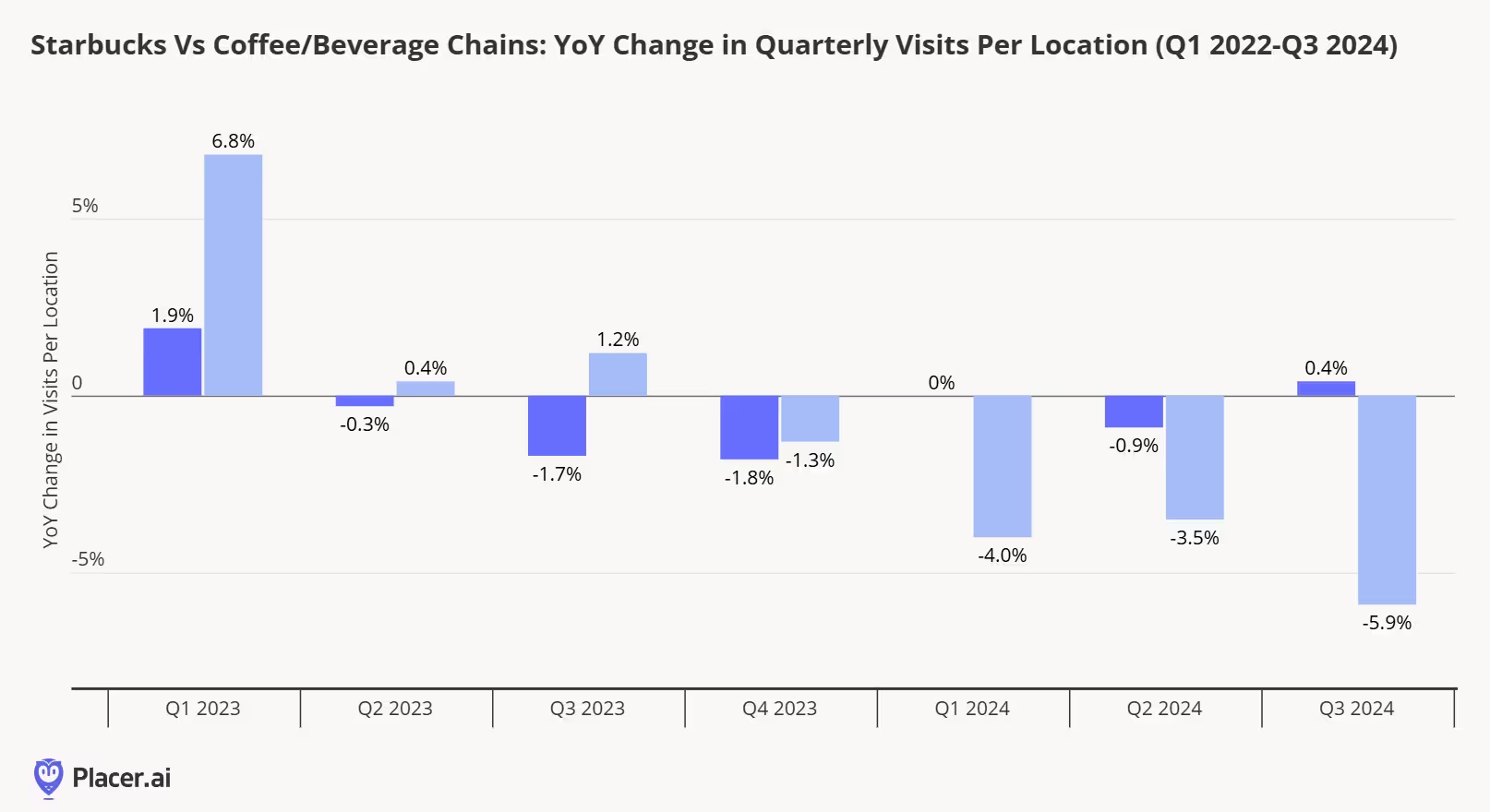
Starbucks, for its part, which reported a YoY decline in U.S. sales for Q2 2024, maintained a small lag in visits per location. But given the coffee leader’s massive footprint – some 16,600 stores nationwide – its ability to expand while avoiding more significant dilution of individual store performance shows that Starbucks’ growth is meeting robust demand.
What is driving the coffee industry’s remarkable category-wide growth? And who are the customers behind it? This white paper dives into the data to explore key factors driving foot traffic to leading coffee chains in early 2024. The report explores the demographic and psychographic characteristics of visitors to major players in the coffee space and examines strategies brands can use to make the most of the opportunity presented by a thriving industry.
One factor shaping the surge in coffee visit growth is the slow-but-sure return-to-office (RTO). Hybrid work may be the post-COVID new normal – but RTO mandates and WFH fatigue have led to steady increases in office foot traffic over the past year. And in some major hubs – including New York and Miami – office visits are back to more than 80.0% of what they were pre-pandemic.
A look at shifting Starbucks visitation patterns shows that customer journeys and behavior increasingly reflect those of office-goers. In April and May 2022, for example, 18.6% of Starbucks visitors proceeded to their workplace immediately following their coffee stop – but by 2024, this share shot up to 21.0%.
Over the same period, the percentage of early morning (7:00 to 10:00 AM) Starbucks visits lasting less than 10 minutes also increased significantly – from 64.3% in 2022 to 68.7% in 2024. More customers are picking up their coffee on the go – many of them on the way to work – rather than settling down to enjoy it on-site.
Dunkin’ is another chain that is benefiting from consumers on the go. Examining the coffee giant’s performance across major regional markets – those where the chain maintains a significant presence – reveals a strong correlation between the share of Dunkin’ visits in each state lasting less than five minutes and the chain’s local YoY trajectory.
In Wisconsin, for example, 50.9% of visits to Dunkin’ between January and May 2024 lasted less than five minutes. And Wisconsin also saw the most impressive YoY visit growth (5.9%). Illinois, Ohio, Maine, and Connecticut followed similar patterns, with high shares of very short visits and strong YoY showings.
On the other end of the spectrum lay Tennessee, Alabama, and Florida, where very short visits accounted for a low share of the chain’s statewide total – under 40.% – and where visits declined YoY.
Dunkin’s success with very short visits may be driven in part by its popular app, which makes it easy for harried customers to place their order online and save time in-store. And this is good news indeed for the coffee leader – since customers using the app also tend to generate bigger tickets.
Dutch Bros.’ meteoric rise has been fueled, in part, by its appeal to younger audiences. Recently ranked as Gen Z’s favorite quick-service restaurant, the rapidly-expanding coffee chain sets itself apart with a strong brand identity built on cultivating a positive, friendly customer experience.
And Dutch Bros.’ people-centered approach is resonating especially well with singles – including young adults living alone – who may particularly appreciate the chain’s community atmosphere.
Analyzing the relative performance of Dutch Bros.’ locations across metro areas – focusing on regions where the chain has a strong local presence – shows that it performs best in areas with plenty of singles. Indeed, the share of one-person households in Dutch Bros.’ local captured markets is very strongly correlated with the coffee brand’s CBSA-level YoY per-location visit performance. Areas with higher concentrations of one-person households saw significantly more YoY visit growth in the first part of 2024. (A chain’s captured market is obtained by weighting each Census Block Group (CBG) in its trade area according to the CBG’s share of visits to the chain – and so reflects the population that actually visits the chain in practice).
The share of one-person households in Dutch Bros.’ Tucson, AZ captured market, for example, stands at 33.4% – well above the nationwide baseline of 27.5%. And between January and May 2024, Tucson-area Dutch Bros. saw a 6.0% increase in the average number of visits per location. Tulsa, OK, Medford, OR, and Oklahoma City, OK – which also feature high shares of one-person households (over 30.0%) – similarly saw per-location visit increases ranging from 3.6% - 7.0%. On the flip side, Fresno, CA, Las Vegas-Henderson-Paradise, NV, and San Antonio-New Braunfels, TX, which feature lower-than-average shares of single-person households, saw YoY per-location visit declines ranging from 1.5%-9.5%.
As Dutch Bros. forges ahead with its planned expansions, it may benefit from doubling down on this trends and focusing its development efforts on markets with higher-than-average shares of one-person households – such as university towns or urban areas with lots of young professionals.
Michigan-based BIGGBY COFFEE is another java winner in expansion mode. With a growth strategy focused on emerging markets with less brand saturation, BIGGBY has been setting its sights on small towns and rural areas throughout the Midwest and South. Though the chain does have locations in bigger cities like Detroit and Cincinnati, some of its most significant markets are in smaller population centers.
And a look at the captured markets of BIGGBY’s 20 top-performing locations in early 2024 shows that they are significantly over-indexed for suburban consumers – both compared to BIGGBY as a whole and compared to nationwide baselines. (Top-performing locations are defined as those that experienced the greatest YoY visit growth between January and May 2024).
“Suburban Boomers”, for example – a Spatial.ai: PersonaLive segment encompassing middle-class empty-nesters living in suburbs – comprised 10.6% of BIGGBY’s top captured markets in early 2024, compared to just 6.6% for BIGGBY’s overall. (The nationwide baseline for Suburban Boomers is even lower – 4.4%.) And Upper Diverse Suburban Families – a segment made up of upper-middle-class suburbanites – accounted for 9.6% of the captured markets of BIGGBY’s 20 top locations, compared to just 7.2% for BIGGBY’s as a whole, and 8.3% nationwide.
Coffee has long been one of America’s favorite beverages. And java chains that offer consumers an enjoyable, affordable way to splurge are expanding both their footprints and their audiences. By leaning into shifting work routines and catering to customers’ varying habits and preferences, major coffee players like Starbucks, Dunkin’, Dutch Bros., and BIGGBY COFFEE are continuing to thrive.