Thank you! Your submission has been received!
Oops! Something went wrong while submitting the form.
0
0
0
0
----------
0
0
Articles
Article
Dog Park Bars: When Things Get "Ruff", it's Nice to Have your Doggy Sidekick
Caroline Wu
Apr 19, 2024

Commercial real estate is constantly coming up with new and inventive concepts, and one of the latest ideas is the dog park bar. Chains such as Bark Social and Fetch Park are two such entrants that noted the rise in pet ownership during Covid, and are capitalizing on pet owners’ love for their dogs, as well as desire for human companionship and playdates for their canines.

These dog park bars combine the joy of seeing your furry friend run around with other dogs, while the owners can enjoy a cold frosty brew.

Fetch Park has five locations in Georgia, including Buckhead and Alpharetta. Meanwhile, Bark Social has locations in Baltimore, Bethesda, Alexandria, and Philadelphia, with upcoming plans for Los Angeles and Columbia.

Fetch Park includes events such as “Ales, Tails, and Trivia”, weekly karaoke nights, stand-up comedy, and even a singles’ mingle to meet other like-minded pooch people. Bark Social styles itself as a bar for dog lovers, and includes Bark Rangers that oversee puppy activities such as holding your pet’s first birthday party. There is even doggy daycare and summer camp available.  

And in sunny LA, it’s not the San Vicente Bungalows or SoHo House that’s getting attention, it’s Dog PPL in Santa Monica, a private dog park whose $80/month membership lets your dog play in style. There are “ruffarrees” on hand to keep the calm while owners socialize and imbibe rosé or kombucha. It can even serve as a co-working location or gym substitute with its dog yoga classes.

dog yoga

Source: Dog PPL

If you’re in the Midwest, check out Barkside in Detroit. This 10,000 sq ft location in the West Village combines a dog park, bar, and beer garden all in one. There is a special focus on Detroit and Michigan brands when it comes to libations, which include beer, wine, spritzers, and a variety of coffee drinks.

And if you truly can’t part from your furry friend for even a minute, new BARK Air has partnered with a jet charter service and offers a Gulfstream V so you and your pet can travel in style. For the price of $6,000 one-way, amenities include dog champagne (aka chicken broth), special blankets and pillows, and delicious dog treats. This service is only available for NY, LA, and London jetsetters, but if this concept takes off and comes to more cities, that would truly be paw-some.

Article
C-Stores: Prepared Foods Entice and Delight Visitors
Elizabeth Lafontaine
Apr 19, 2024

If there’s one sector of the retail industry that continues to innovate, evolve and perform at a high level, it’s convenience stores. Convenience chains remained in lock step with their consumers over the past few years, a difficult feat for many retailers, and benefited from suburban and rural migration patterns. 2023 was a banner year for C-Stores, with visits to large scale chains growing by 6% compared to 2022 (though some of the growth was due to chain consolidation).

C-Stores have done a fantastic job of attracting more visitors through additions like EV charging, local autonomous delivery, and expanded service offerings. However, the winning formula for many C-Store chains has been the bet on fresh, prepared and made to order foods. Chains have transformed consumer thinking around convenience driven foodservice and the concept has won over consumer’s appetites and wallets.

Chains that prioritize prepared foods have higher dwell times, more weekend visits and strong traffic growth according to our data. In a retail industry that prioritizes uniqueness in experience and product, more foodservice options clearly move the needle for visitors. Compared to the large chain C-store average dwell time of 10 minutes in Q1 2024, chains such as Buc-ee’s, Wawa, and Sheetz have higher dwell times by at least a minute, while chains associated with grab-and-go have shorter than average dwell times.

Looking a little more closely at Buc-ee’s, the darling of both the southeast and TikTok fame, the dwell time is double the average of large chain C-Stores. Buc-ee’s has the unique ability to blend entertainment, kitsch and prepared foods in a way that enchants visitors. Maybe it’s the chain’s Beaver Nuggets or the house-smoked barbeque, or its beloved mascot?

Buc-ee’s has the highest percentage of visits lasting 15 minutes or longer, and excels in visits between 15 and 45 minutes compared to other C-Store chains (below). More than half of the visits to Buc-ee’s occur between Friday-Sunday, more than any other competitor. Buc-ee’s can be seen as a destination C-Store as opposed to a daily stop due to the size and location of stores, which certainly contributes to the higher dwell time. Other C-Store chains looking to improve food offerings can use Buc-ee’s as a source of inspiration when it comes to breadth of assortment and mix of specialty packaged items and foodservice options.

The most surprising metrics come from Casey’s, a chain that has publicly committed to foodservice, but can’t seem to capture longer visits. Casey’s dwell time more closely mirrors that of grab-and-go chains like Maverik or Kwik Trip than it does Buc-ee’s or Wawa. Looking at the differences in demographic segments between Buc-ee’s, Wawa and Casey’s, Wawa and Buc-ee’s attract a visitor that is suburban, younger and more affluent than Casey’s. There may be a correlation between made to order offerings and suburban locations that’s benefitting chains focused on both.

The C-Store evolution is quickly blurring the lines between grocery, QSR and traditional convenience models, and is a bellwether of what’s to come across other sectors in retail. The bi-furcation of c-store formats is likely to accelerate throughout the remainder of 2024. Blending the right product selection, on-demand offerings and a beneficial experience for visitors is necessary in today’s retail climate.

Article
Strong Start for Sprouts in 2024
Sprouts, the natural and organic food focused grocery chain operating in 23 states nationwide, is going through a growth spurt. We dove into the visit and audience data to see where the chain stands today and what the rest of 2024 – and beyond – may have in store. 
Shira Petrack
Apr 18, 2024
4 minutes

Sprouts, the natural and organic food focused grocery chain operating in 23 states nationwide, is going through a growth spurt. We dove into the visit and audience data to see where the chain stands today and what the rest of 2024 – and beyond – may have in store. 

Sprouts is on a Growth Spurt

Sprouts is on the rise. Year-over-year (YoY) visits increased every month of last year and have been outperforming the nationwide Grocery average since mid-2023. And the chain continued to grow in Q1 2024, with visits up an impressive 13.3% and 11.9% in February and March 2024, respectively – an impressive feat given the comparison to an already strong Q1 2023. 

Some of the growth is driven by expansion – the company opened 30 new stores in 2023 and expects to add 35 additional locations in 2024. But the increase in foot traffic is also a testament to the potential of specialty grocery stores to leverage their unique product selection to attract grocery shoppers, even in the face of growing competition in the space.

Monthly visits to Sprouts compared to previous year

Sprouts High-Income Visitor Base Likely Contributing to the Chain’s Success 

The relatively high income of Sprout’s visitor base is likely also helping the chain stay ahead of the grocery pack: Median HHI in Sprout’s trade areas nationwide is higher than the U.S. median HHI, and the data shows a similar trend in Sprout’s eight growth markets.

The relative affluence of Sprouts shoppers means that this segment may not be as impacted by high food prices as other grocery shoppers – so the retail headwinds predicted this year are not likely to slow down Sprout’s growth potential as the chain continues expanding its reach in 2024.

Median household income in Sprouts' captured market relative to nationwide/statewide median, Q1 2024

Sprouts’ Different Growth Markets Exhibit Different Characteristics

While Sprouts’ visitors across states seem to share a relatively high income level, diving deeper into the location intelligence data reveals some major differences in both in-store behavior and overall market composition. 

For example, the share of weekend (as opposed to weekday) visits to Sprouts in Q1 2024 varied significantly – from 31.3% in California to 36.6% in Virginia. Shoppers in the company’s various growth markets also visited stores at different hours throughout the day: Mornings (8:00 AM to 9:59 PM) were popular with California, Delaware, and Pennsylvania residents, while evenings were favored by Pennsylvanians, Floridians, and Texans. 

Understanding the in-store behavior of shoppers in each state will likely help Sprouts adapt its operations and staffing schedules as the company continues expanding in these markets. 

Share of weekday vs. weekend visits, and morning vs. nighttime visits, at Sprouts, Q1 2024

Differences in the Composition of the Grocery Market in Each State 

In addition to highlighting the variance between the shopping habits of Sprouts visitors across markets, diving deeper into the location intelligence data also reveals differences in the relationship between Sprouts shoppers and the wider grocery markets in each state. 

The chart below shows the most popular grocery alternative for Sprouts shoppers in each state (which other grocery chain was the most visited by Sprouts visitors) and what share of Sprouts shoppers visited that grocery chain in Q1 2024. 

In Florida, over 90% of Sprouts shoppers also visited a Publix location in Q1 2024 – indicating that Sprouts in the Sunshine State is operating in a relatively consolidated grocery market and operating against an established crowd favorite. Meanwhile, only 46.9% of Texan Sprouts visitors also visited a Kroger – the other grocery chain most visited by Sprouts visitors – indicating that the Texas grocery market may be more fragmented, and so may respond to a different expansion strategy, than the Florida grocery market.

Non-sprouts grocery chain visited by highest share of sprouts shoppers in each state, Q1 2024

Sprouts’ Room to Grow

Sprouts strong visitation trends indicate that the grocery chain is expanding into willing markets, and the brand’s relatively affluent shopper base means that Sprouts is unlikely to be too impacted by whatever economic headwinds may lie ahead. As the chain continues making its presence felt in newer markets, location intelligence suggests that Sprouts has plenty of room to grow in 2024 and beyond. 

For more data-driven retail insights, visit our blog at placer.ai

Article
Crocs’ Footwear Fairytale
Crocs’ rebrand from ugly to chic is one of retail’s most fascinating Cinderella stories (glass clog, anyone?). We dive into the latest location analytics and demographic data to explore the consumer behavior that drives Crocs’ continued success. 
Ezra Carmel
Apr 17, 2024
3 minutes

Crocs’ rebrand from ugly to chic is one of retail’s most fascinating Cinderella stories (glass clog, anyone?). We dive into the latest location analytics and demographic data to explore the consumer behavior that drives Crocs’ continued success. 

Partnerships and Pandemic Popularity 

Embarking on a journey to become a fashionable brand, in 2017 Crocs inked a partnership with Christopher Kane who became the first designer to collaborate with the brand. A stampede of designer and celebrity-inspired styles followed in 2018 and 2019 including Balenciaga's iconic ten-inch platform Croc and Post Malone's take on the classic clog. 

During the pandemic, Crocs built on its success in fashion and celebrity circles, and gained a new following from comfort-first shoe shoppers stuck at home or running errands.

Taking a wide lens on Crocs’ foot traffic since 2018 shows how a strategy of designer partnerships as well as recognition as a functional shoe drives visits to the brand. In 2018 and 2019, as designer Crocs rolled out, visits to the brand climbed to new heights. 

And since the wider retail reopening in 2021, Crocs’ foot traffic growth has accelerated as comfort reigns supreme in and out of the home.

Compared to a Q1 2018 baseline, Crocs saw its largest monthly visit peak in Q3 2023 (199.1%) – the critical summer period. And foot traffic in the most recent Q1 2024 was 43.7% above the Q1 2018 baseline. This indicates that the shoe’s acceptance within pop-culture combined with demand for comfortable footwear is elevating the brand’s traffic to new levels.

Baseline change in visits to Crocs compared to Q1 2018

Real Estate Strategy Helps ‘Democratize’ the Brand

As Crocs continues to gain traction, the company appears to be pursuing a real estate strategy aimed at repositioning the brand as an affordable shoe for the whole family. Although Crocs shrank its store count in the years leading up to the pandemic, the brand has now begun opening new locations in outlet malls – five in 2023, with plans for 30 new stores in outlet malls in 2024. 

Analyzing Crocs’ trade areas between 2018 and 2023 suggests that this strategy is helping the brand reach its audience. According to the STI: Popstats 2023 dataset, in 2018, there was a gap of more than $6K between the median household income (HHI) in Crocs’ potential market ($81.0K/year) and in its captured market ($74.7K/year). But by 2023, the median HHI of the brand’s potential market ($75.5K) and captured market ($75.9K) had more closely aligned. This indicates that by opening stores in outlet malls – where consumers looking for discounts are likely to shop – Crocs’ potential market more closely reflects its actual visitors and the brand can drive additional traffic from its target audience.

Median HHI of Crocs' Trade Areas by year

Happily Ever After

From humble beginnings, Crocs have become runway-famous. And yet, the clogs are more popular than ever with the everyday consumer – at home or out on the town. How will Crocs shape the next chapter of this foam fairytale?

Visit Placer.ai to find out.

This blog includes data from Placer.ai Data Version 2.0, which implements improvements to our extrapolation capabilities, adds short visit monitoring, and enhances visit detection.

Article
Who Attends NCAA Final Four Events?
Final Four Weekend, when the NCAA "March Madness" basketball tournaments culminate with a championship game, took place between April 4th and 7th. Who attended these events? We take a look at the location analytics and audience segmentation of visitors to find out.
Ezra Carmel
Apr 16, 2024
5 minutes

Final Four weekend capped off the NCAA “March Madness” basketball tournaments with a full schedule of fan experiences on both the men’s and women’s sides of the ball. 

The Women’s Final Four took place between April 4th and 7th, 2024 in Cleveland, Ohio with on-court action at Rocket Mortgage FieldHouse. “Tourney Town” – an interactive basketball exhibition – ran concurrently at the Huntington Convention Center.  

The Men’s Final Four commenced on April 5th at State Farm Stadium in Glendale, Arizona, culminating with the championship game on April 8th. The multi-day exhibition “Final Four Fan Fest” took place at the Phoenix Convention Center. 

We dove into the location analytics and audience segmentation for visitors to several Final Four events to better understand the fans in attendance throughout the tournament weekend.

Locals and Tourists Have Event Preferences

The men and women’s Final Four weekend attracted spectators from near and far, with each event attracting a unique mix of out of town tourists and locals. 

Both men and women’s championship games attracted a relatively large share of out-of-town guests, likely due to the excitement surrounding a national title game. Analysis of visitors by home location revealed that the men and women’s championship games had the smallest share of visitors from less than 100 miles away – 29.8% and 33.3% respectively. In other words, these two events had the largest share of visitors that lived more than 100 miles from the venues. 

The men’s open practice appeared to be more popular with long-distance travelers than the women’s, perhaps because all four men’s teams participated – as opposed to just two at the women’s open practice. The men’s practice was also followed by an all-star game which likely increased its appeal for visitors traveling from afar in the hopes of spotting their favorite players. The data revealed that more than half of the spectators traveled over 250 miles to watch the men’s practice, as opposed to under a quarter of spectators for the women’s practice. 

Meanwhile, the women’s experiential exhibition at Huntington Convention Center drew more out-of-towners than the men’s exhibition at Phoenix Convention Center – only 23.3% of visitors to the women’s exhibition came from under 30 miles away, compared to almost half (48.3%) of the men’s exhibition visitors. The larger share of out-of-town visitors to the women’s exhibition may be because the event was close to the arena, making it a more convenient stop for non-local fans. On the other hand, the distance between the men’s exhibition in downtown Phoenix and the stadium in Glendale meant that the off-court experience was more out-of-the-way for tourists who had traveled specifically for the on-court action.

2024 Final four events - cumulative percentage of visitors by home location showing a mix of locals and out-of-town visitors

Wealthy Fans Dominate the Men’s Game

Analysis of Final Four visitors by income level provides further insight into the differences between each event’s fan base. According to the STI: Popstats dataset, the women’s events generally drew visitors from areas with a lower median household income (HHI) compared to the men’s events, although the gaps between the men and women’s visitor bases varied from event to event. Some of the difference in trade area HHI may be due to regional variance and the mix of locals and tourists at each event.

The visitor bases of the men and women’s championship games exhibited the widest disparity, with the men’s championship spectator base coming from areas with a median HHI of $99.9K, compared to $74.6K for the women’s championship’s trade area. The difference may be due to the relatively higher face value of tickets to the men’s championship game – even though the star-power of Iowa’s Caitlin Clark drove up the price of women’s tickets on the secondary market. In contrast, both the men’s and women’s practices and exhibitions were free or nearly free events and drove traffic from relatively lower-income areas – even though visitors to the men’s practice still came from more affluent areas than the trade area of the women’s championship match.

Visitors to the men and women’s convention center exhibition displayed the smallest income differences, with respective trade area median HHI of $80.0K and $76.6K. The data also reveals that visitors to the women’s exhibition came from a trade area with a median HHI that was higher than the median HHI for both the championship game and the open practice, perhaps because the exhibition drew a relatively large share of tourists who could afford to be in town for a slightly longer stay.

Final four men's championship game attracted high-income visitors

Single Fans En Masse at Women’s Events

Further demographic analysis indicates that a greater share of singles – who tend to be on the younger side – attended the women’s Final Four events than the men’s. During the women’s championship, 41.0% of households in the trade area of the Rocket Mortgage FieldHouse were made up of one-person households. This segment also made up 34.2% and 36.3% of the households in the trade areas of the venues for the women’s practice and exhibition, respectively. On the men’s side, singles comprised just 29.3% of the championship’s trade area, 28.4% of the practice’s, and 27.0% of the exhibition’s.

This reflects the growing popularity of women’s college basketball players on social media which is bringing more viewership to the sport.

More singles attended women's final four events than men's in 2024

Want more data-driven visitor insights for sporting events? Visit Placer.ai.

This blog includes data from Placer.ai Data Version 2.0, which implements improvements to our extrapolation capabilities, adds short visit monitoring, and enhances visit detection.

Article
Eclipse Fever: How Did the (Retail and Hospitality) Stars Align?
Last week's solar eclipse brought people from all over the country to witness the natural phenomenon. How did the event impact business activity on the ground? Which sectors benefited from the hype – and which geographic areas saw the biggest visit spikes? We dove into the data to find out.
Lila Margalit and Noam Maman
Apr 15, 2024
3 minutes

During last week’s solar eclipse, people from all over the country converged on cities within the path of totality to witness the excitement first hand. And for municipalities and local businesses, the influx of tourists was expected to generate a boon.

But just how did the celestial event impact business activity on the ground? Which sectors benefited from the hype – and which geographic areas saw the biggest visit spikes? 

We dove into the data to find out.

Key Takeaways

  • Hotels in CBSAs located along or near the path of totality experienced significant visits increases on the day of the solar eclipse – with Danville, IL taking the lead among metropolitan areas. 
  • Fast Food & QSR chains in and around the path of totality also saw meaningful visit boosts. 
  • Brands nationwide, including Warby Parker, SONIC Drive In, and Krispy Kreme Doughnuts drove visit increases with special deals and limited-time offers. 

Lodging in the Path of Totality

On April 8th, 2024, hotels in CBSAs where the eclipse could be viewed in all its glory (or close to it) experienced major visit boosts. And mapping hotel visits on the big day to CBSAs nationwide – compared to year-to-date daily averages – shows just how significant the cosmic alignment was for areas lucky enough to be located along or near the path of totality.

map: solar eclipse drove significant hotel visit spikes along the path of totality

Within metropolitan CBSAs (CBSAs with at least 50,000 residents), Danville, IL – where visitors could either view a near-total eclipse or drive to a nearby location with 100% totality – experienced the biggest jump in Hotel visits, with visits to the category up 111.3%. But urban centers from north to south – including in New York, Indiana, Ohio, Arkansas, and Missouri – also experienced substantial hotel visit spikes. 

bar graph: CBSAs across states experienced eclipse-driven hotel visit boosts

Solar-Powered Fast Food

Hotels weren’t the only locations to reap the rewards of the solar eclipse. Fast Food & QSR chains in and around the path of totality enjoyed meaningful April 8th visit spikes of their own. And while the Hotel visit increases were more closely concentrated in prime viewing areas, Fast Food & QSR visits increased along a wider radius as people likely grabbed a bite to eat while making their way to a sun-gazing hotspot.

map: fast food & QSR chains along path of totality benefitted from the solar hype

Out-of-This-World Visit Increases

And the impact of the solar eclipse wasn’t limited to locations located in or near the path of totality. Retailers and dining chains nationwide got in on the action with special deals and limited-time offers meant to make the most of the unique interstellar opportunity. 

In the week leading up to April 8th, 2024, Warby Parker drew crowds with the promise of free solar eclipse glasses. And while a burger joint may not be the first place people associate with eyewear, fast food favorite SONIC Drive In also attracted astronomy aficionados with a limited-time Blackout Slush Float that came with free eclipse viewing gear

Krispy Kreme Doughnuts, for its part, marked the occasion with a limited-edition Total Solar Eclipse Doughnut. And though Mondays aren’t typically busy days for the chain, the special offering produced a clear visit uptick nationwide. In states along the path of totality, Krispy Kreme visits were up 55.5% on April 8th when compared to an average Monday this year, and in the rest of the country they were up 33.9%. 

bar graph: chains nationwide drove visits with eclipse-related limited time offers and special deals

Astronomical Opportunities Ahead

For retailers across categories, landmark events from movie launches to cosmic occurrences have the potential to drive visit spikes and generate business. What other big opportunities lie in store for retailers this year?

Follow Placer.ai’s data-driven retail analyses to find out. 

This blog includes data from Placer.ai Data Version 2.0, which implements improvements to our extrapolation capabilities, adds short visit monitoring, and enhances visit detection.

Reports
INSIDER
Report
Hudson Yards: The On-Site Workforce of Manhattan's New Hub
Dive into the data to explore shifting work patterns among Manhattan’s on-site employees and examine emerging trends in the fast-growing Hudson Yards neighborhood.
October 8, 2024
4 minutes

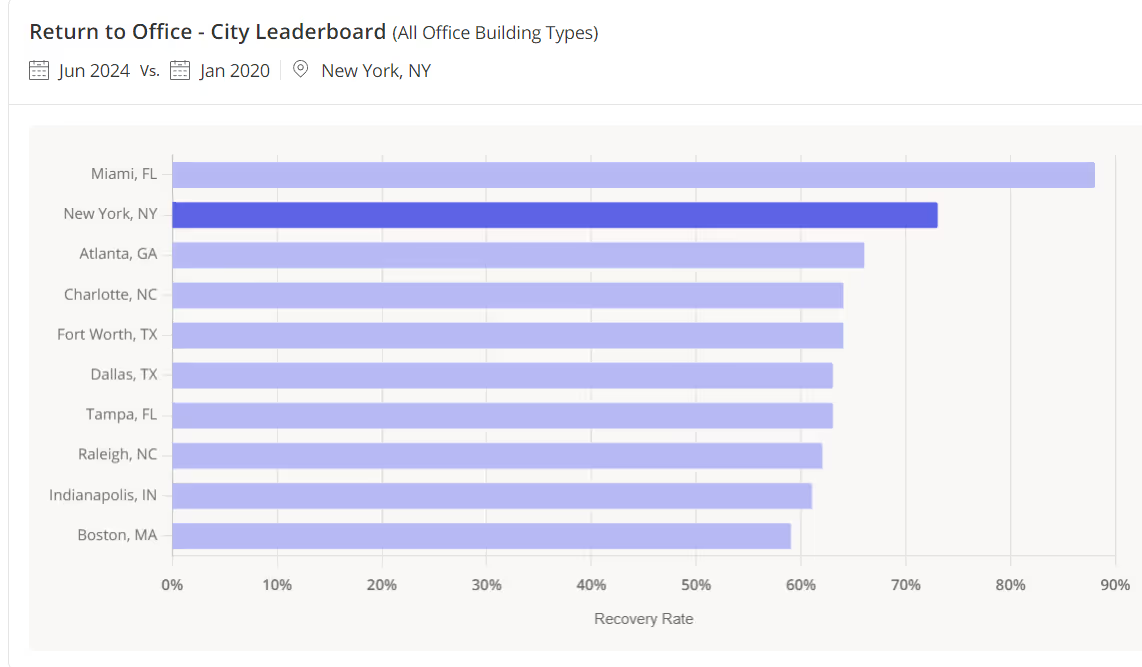
New York City is one of the world’s leading commercial centers – and Manhattan, home to some of the nation's most prominent corporations, is at its epicenter. Manhattan’s substantial in-office workforce has helped make New York a post-pandemic office recovery leader, outpacing most other major U.S. hubs. And the plethora of healthcare, service, and other on-site workers that keep the island humming along also contribute to its thriving employment landscape.

Using the latest location analytics, this report examines the shifting dynamics of the many on-site workers employed in Manhattan and the up-and-coming Hudson Yards neighborhood. Where does today’s Manhattan workforce come from? How often do on-site employees visit Hudson Yards? And how has the share of young professionals across Manhattan’s different districts shifted since the pandemic? 

Read on to find out. 

The Beat of the Borough

Return of the Commuter 

The rise in work-from-home (WFH) trends during the pandemic and the persistence of hybrid work have changed the face of commuting in Manhattan. 

In Q2 2019, nearly 60% of employee visits to Manhattan originated off the island. But in Q2 2021, that share fell to just 43.9% – likely due to many commuters avoiding public transportation and practicing social distancing during COVID.

Since Q2 2022, however, the share of employee visits to Manhattan from outside the borough has rebounded – steadily approaching, but not yet reaching, pre-pandemic levels. By Q2 2024, 54.7% of employee visits to Manhattan originated from elsewhere – likely a reflection of the Big Apple’s accelerated RTO that is drawing in-office workers back into the city. 

Unsurprisingly, some nearby boroughs – including Queens and the Bronx – have seen their share of Manhattan worker visits bounce back to what they were in 2019, while further-away areas of New York and New Jersey continue to lag behind. But Q2 2024 also saw an increase in the share of Manhattan workers commuting from other states – both compared to 2023 and compared to 2019 – perhaps reflecting the rise of super commuting

Spotlight on Hudson Yards

A Hyper-Hybrid Environment

Commuting into Manhattan is on the rise – but how often are employees making the trip? Diving into the data for employees based in Hudson Yards – Manhattan’s newest retail, office, and residential hub, which was officially opened to the public in March 2019 – reveals that the local workforce favors fewer in-person work days than in the past.

In August 2019, before the pandemic, 60.2% of Hudson Yards-based employees visited the neighborhood at least fifteen times. But by August 2021, the neighborhood’s share of near-full-time on-site workers had begun to drop – and it has declined ever since. In August 2024, only 22.6% of local workers visited the neighborhood 15+ times throughout the month. Meanwhile, the share of Hudson Yards-based employees making an appearance between five and nine times during the month emerged as the most common visit frequency by August 2022 – and has continued to increase since. In August 2024, 25.0% of employees visited the neighborhood less than five times a month, 32.5% visited between five and nine times, and 19.2% visited between 10 and 14 times.  

Like other workers throughout Manhattan, Hudson Yards employees seem to have fully embraced the new hybrid normal – coming into the office between one and four times a week. 

New Buildings Worth The Commute

But not all employment centers in the Hudson Yards neighborhood see the same patterns of on-site work. Some of the newest office buildings in the area appear to attract employees more frequently and from further away than other properties.

Of the Hudson Yards properties analyzed, Two Manhattan West, which was completed this year, attracted the largest share of frequent, long-distance commuters in August 2024 (15.3%) – defined as employees visiting 10+ times per month from at least 30 miles away. And The Spiral, which opened last year, drew the second-largest share of such on-site workers (12.3%). 

Employees in these skyscrapers may prioritize in-person work – or have been encouraged by their employers to return to the office – more than their counterparts in other Hudson Yards buildings. Employees may also choose to come in more frequently to enjoy these properties’ newer and more advanced amenities. And service and shift workers at these properties may also be coming in more frequently to support the buildings’ elevated occupancy.

Hudson Yards Young

Diving deeper into the segmentation of on-site employees in the Hudson Yards district provides further insight into this unique on-site workforce. 

Analysis of POIs corresponding to several commercial and office hubs in the borough reveals that between August 2019 and August 2024, Hudson Yards’ captured market had the fastest-growing share of employees belonging to STI: Landscape's “Apprentices” segment, which encompasses young, highly-paid professionals in urban settings.

Companies looking to attract young talent have already noticed that these young professionals are receptive to Hudson Yards’ vibrant atmosphere and collaborative spaces, and describe this as a key factor in their choice to lease local offices.

At Work In Manhattan: A Mix Of Old And New

Manhattan is a bastion of commerce, and its strong on-site workforce has helped lead the nation’s post-pandemic office recovery. But the dynamics of the many Manhattan-based workers continues to shift. And as new commercial and residential hubs emerge on the island, workplace trends and the characteristics of employees are almost certain to evolve with them.

INSIDER
Pricing Strategies Driving Restaurant Visits in 2024
Dive into the data to explore the state of the restaurant industry in 2024 and see how leading chains are navigating the challenges posed by rising prices.
September 26, 2024
7 minutes

Dining in 2024 (So Far)

The restaurant space has experienced its fair share of challenges in recent years – from pandemic-related closures to rising labor and ingredient costs. Despite these hurdles, the category is holding its own, with total 2024 spending projected to reach $1.1 trillion by the end of the year.

And an analysis of year-over-year (YoY) visitation trends to restaurants nationwide shows that consumers are frequenting dining establishments in growing numbers – despite food-away-from-home prices that remain stubbornly high.

Overall, monthly visits to restaurants were up nearly every month this year compared to the equivalent periods of 2023. Only in January, when inclement weather kept many consumers at home, did restaurants see a significant YoY drop. Throughout the rest of the analyzed period, YoY visits either held steady or grew – showing that Americans are finding room in their budgets to treat themselves to tasty, hassle-free meals.

Still, costs remain elevated and dining preferences have shifted, with consumers prioritizing value and convenience – and restaurants across segments are looking for ways to meet these changing needs. This white paper dives into the data to explore the trends impacting quick-service restaurants (QSR), full-service restaurants (FSR), and fast-casual dining venues – and strategies all three categories are using to stay ahead of the pack. 

Dollar-Driven Dining Decisions 

Overall, the dining sector has performed well in 2024, but a closer look at specific segments within the industry shows that fast-casual restaurants are outperforming both QSR and FSR chains. 

Between January and August 2024, visits to fast-casual establishments were up 3.3% YoY, while QSR visits grew by just 0.7%, and FSR visits fell by 0.3% YoY. As eating out becomes more expensive, consumers are gravitating toward dining options that offer better perceived value without compromising on quality. Fast-casual chains, which balance affordability with higher-quality ingredients and experiences, have increasingly become the go-to choice for value-conscious diners.

Fast-casual restaurants also tend to attract a higher-income demographic. Between January and August 2024, fast-casual restaurants drew visitors from Census Block Groups (CBGs) with a weighted median household income of $78.2K – higher than the nationwide median of $76.1K. (The CBGs feeding visits to these restaurants, weighted to reflect the share of visits from each CBG, are collectively referred to as their captured market). 

Perhaps unsurprisingly, quick-service restaurants drew visitors from much less affluent areas. But interestingly, despite their pricier offerings, full-service restaurants also drew visitors from CBGs with a median HHI below the nationwide baseline. While fast-casual restaurants likely attract office-goers and other routine diners that can afford to eat out on a more regular basis, FSR chains may serve as special occasion destinations for those with more moderate means. 

Who Can Afford to Raise Prices?

Though QSR, FSR, and fast-casual spots all seek to provide strong value propositions, dining chains across segments have been forced to raise prices over the past year to offset rising food and labor costs. This next section takes a look at several chains that have succeeded in raising prices without sacrificing visit growth – to explore some of the strategies that have enabled them to thrive.

Shake Shack: Drawing Affluent Audiences 

The fast-casual restaurant space attracts diners that are on the wealthier side – but some establishments cater to even higher earners. One chain of note is NYC-based burger chain Shake Shack, which features a captured market median HHI of $94.3K. In comparison, the typical fast-casual diner comes from areas with a median HHI of $78.2K. 

Shake Shack emphasizes high-quality ingredients and prices its offerings accordingly. The chain, which has been expanding its footprint, strategically places its locations in affluent, upscale, and high-traffic neighborhoods – driving foot traffic that consistently surpasses other fast-casual chains. And this elevated foot traffic has continued to impress, even as Shake Shack has raised its prices by 2.5% over the past year. 

Texas Roadhouse: Thriving Through Price Hikes

Steakhouse chain Texas Roadhouse has enjoyed a positive few years, weathering the pandemic with aplomb before moving into an expansion phase. And this year, the chain ranked in the top five for service, food quality, and overall experience by the 2024 Datassential Top 500 Restaurant Chain.

Like Shake Shack, Texas Roadhouse has raised its prices over the past year – three times – while maintaining impressive visit metrics. Between January and August 2024, foot traffic to the steakhouse grew by 9.7% YoY, outpacing visits to the overall FSR segment by wide margins. 

This foot traffic growth is fueled not only by expansion but also by the chain's ability to draw traffic during quieter dayparts like weekday afternoons, while at the same time capitalizing on high-traffic times like weekends. Some 27.7% of weekday visits to Texas Roadhouse take place between 3:00 PM and 6:00 PM – compared to just 18.9% for the broader FSR segment – thanks to the chain’s happy hour offerings early dining specials. And 43.3% of visits to the popular steakhouse take place on Saturdays and Sundays, when many diners are increasingly choosing to splurge on restaurant meals, compared to 38.4% for the wider category.

QSR Limited-Time Offers (LTOs) to the Rescue

Though rising costs have been on everybody’s minds, summer 2024 may be best remembered as the summer of value – with many quick-service restaurants seeking to counter higher prices by embracing Limited-Time Offers (LTOs). These LTOs offered diners the opportunity to save at the register and get more bang for their buck – while boosting visits at QSR chains across the country. 

Hardee’s August Combo Deal: A Recipe for Loyalty

Limited time offers such as discounted meals and combo offers can encourage frequent visits, and Hardee’s $5.99 "Original Bag" combo, launched in August 2024, did just that. The combo allowed diners to mix and match popular items like the Double Cheeseburger and Hand-Breaded Chicken Tender Wraps, offering both variety and affordability. And visits to the chain during the month of August 2024 were 4.9% higher than Hardee’s year-to-date (YTD) monthly visit average.

August’s LTO also drove up Hardee’s already-impressive loyalty rates. Between May and July 2024, 40.1% to 43.4% of visits came from customers who visited Hardee’s at least three times during the month, likely encouraged by Hardee’s top-ranking loyalty program. But in August, Hardee’s share of loyal visits jumped to 51.5%, highlighting just how receptive many diners are to eating out – as long as they feel they are getting their money’s worth. 

McDonald’s Special Meal Deal

McDonald’s launched its own limited-time offer in late June 2024, aimed at providing value to budget-conscious consumers. And the LTO – McDonald’s foray into this summer’s QSR value wars – was such a resounding success that the fast-food leader decided to extend the deal into December. 

McDonald’s LTO drove foot traffic to restaurants nationwide. But a closer look at the chain’s regional captured markets shows that the offer resonated particularly well with “Young Urban Singles” – a segment group defined by Spatial.ai's PersonaLive dataset as young singles beginning their careers in trade jobs. McDonald's locations in states where the captured market shares of this demographic surpassed statewide averages by wider margins saw bigger visit boosts in July 2024 – and the correlation was a strong one.  

For example, the share of “Young Urban Singles” in McDonald’s Massachusetts captured market was 56.0% higher than the Massachusetts statewide baseline – and the chain saw a 10.6% visit boost in July 2024, compared to the chain's statewide H1 2024 monthly average. But in Florida, where McDonald’s captured markets were over-indexed for “Young Urban Singles” by just 13% compared to the statewide average, foot traffic jumped in July 2024 by a relatively modest 7.3%. 

These young, price-conscious consumers, who are receptive to spending their discretionary income on dining out, are not the sole driver of McDonald’s LTO foot traffic success. Still, the promotion’s outsize performance in areas where McDonald’s attracts higher-than-average shares of Young Urban Singles shows that the offering was well-tailored to meet the particular needs and preferences of this key demographic. 

Michelin Star Success 

While QSR, fast-casual, and FSR chains have largely boosted foot traffic through deals and specials, reputation is another powerful way to attract diners. Restaurants that earn a coveted Michelin Star often see a surge in visits, as was the case for Causa – a Peruvian dining destination in Washington, D.C. The restaurant received its first Michelin Star in November 2023, a major milestone for Chef Carlos Delgado.

The Michelin Star elevated the restaurant's profile, drawing in affluent diners who prioritize exclusivity and are less sensitive to price increases. Since the award, Causa saw its share of the "Power Elite" segment group in its captured market increase from 24.7% to 26.6%. Diners were also more willing to travel for the opportunity to partake in the Causa experience: In the six months following the award, some 40.3% of visitors to the restaurant came from more than ten miles away, compared to just 30.3% in the six months prior.

These data points highlight the power of a Michelin Star to increase a restaurant’s draw and attract more affluent audiences – allowing it to raise prices without losing its core clientele. Wealthier diners often seek unique culinary experiences, where price is less of a concern, making these establishments more resilient to inflation than more venues that serve more price-sensitive customers.

The Final Plate

Dining preferences continue to evolve as restaurants adapt to a rapidly changing culinary landscape. From the rise in fast-casual dining to the benefits of limited-time offers, the analyzed restaurant categories are determining how to best reach their target audiences. By staying up-to-date with what people are eating, these restaurant categories can hope to continue bringing customers through the door. 

INSIDER
The Rising Stars: Six Metro Areas Welcoming Young Professionals
Find out which metro areas are seeing positive net migration and discover what might be drawing newcomers to these cities.
September 23, 2024
3 minutes

The COVID-19 pandemic – and the subsequent shift to remote work – has fundamentally redefined where and how people live and work, creating new opportunities for smaller cities to thrive. 

But where are relocators going in 2024 – and what are they looking for? This post dives into the data for several CBSAs with populations ranging from 500K to 2.5 million that have seen positive net domestic migration over the past several years – where population inflow outpaces outflow. Who is moving to these hubs, and what is drawing them? 

CBSAs on the Rise

The past few years have seen a shift in where people are moving. While major metropolitan areas like New York still attract newcomers, smaller cities, which offer a balance of affordability, livability, and career opportunities, are becoming attractive alternatives for those looking to relocate. 

Between July 2020 and July 2024, for example, the Austin-Round Rock-Georgetown, TX CBSA, saw net domestic migration of 3.6% – not surprising, given the city of Austin’s ranking among U.S. News and World Report’s top places to live in 2024-5. Raleigh-Cary, NC, which also made the list, experienced net population inflow of 2.6%. And other metro areas, including Fayetteville-Springdale-Rogers, AR (3.3%), Des Moines-West Des Moines, IA (1.4%), Oklahoma City, OK (1.1%), and Madison, WI (0.6%) have seen more domestic relocators moving in than out over the past four years.

All of these CBSAs have also continued to see positive net migration over the past 12 months – highlighting their continued appeal into 2024.

Younger and Hungrier

What is driving domestic migration to these hubs? While these metropolitan areas span various regions of the country, they share a common characteristic: They all attract residents coming, on average, from CBSAs with younger and less affluent populations. 

Between July 2020 and July 2024, for example, relocators to high-income Raleigh, NC – where the median household income (HHI) stands at $84K – tended to hail from CBSAs with a significantly lower weighted median HHI ($66.9K). Similarly, those moving to Austin, TX – where the median HHI is $85.4K – tended to come from regions with a median HHI of $69.9K. This pattern suggests that these cities offer newcomers an aspirational leap in both career and financial prospects.

Moreover, most of these CBSAs are drawing residents with a younger weighted median age than that of their existing residents, reinforcing their appeal as destinations for those still establishing and growing their careers. Des Moines and Oklahoma City, in particular, saw the largest gaps between the median age of newcomers and that of the existing population.

Housing and Jobs: Upgrading and Improving

Career opportunities and affordable housing are major drivers of migration, and data from Niche’s Neighborhood Grades suggests that these CBSAs attract newcomers due to their strong performance in both areas. All of the analyzed CBSAs had better "Jobs" and "Housing" grades compared to the regions from which people migrated. For example, Austin, Texas received the highest "Jobs" rating with an A-, while most new arrivals came from areas where the "Jobs" grade was a B. 

While the other analyzed CBSAs showed smaller improvements in job ratings, the combination of improvements in both “Jobs” and “Housing” make them appealing destinations for those seeking better economic opportunities and affordability.

Final Grades

Young professionals may be more open than ever to living in smaller metro areas, offering opportunities for cities like Austin and Raleigh to thrive. And the demographic analysis of newcomers to these CBSAs underscores their appeal to individuals seeking job opportunities and upward mobility. 

Will these CBSAs continue to attract newcomers and cement their status as vibrant, opportunity-rich hubs for young professionals? And how will this new mix of population impact these growing markets?

Visit Placer.ai to keep up with the latest data-driven civic news. 

Loading results...
We couldn't find anything matching your search.
Browse one of our topic pages to help find what you're looking for.
For more in-depth analyses on a variety of subjects, explore Reports.
The Anchor Logo
INSIDER
Stay Anchored: Subscribe to Insider & Unlock more Foot Traffic Insights
Gain insider insights with our in-depth analytics crafted by industry experts
— giving you the knowledge and edge to stay ahead.
Subscribe