.svg)






Recreational retailers – from hobby shops to arts and crafts retailers and bookstores – can play a role in fostering creativity and community.
We took a closer look at several players in the space – including Barnes & Noble, Half Price Books, Hobby Lobby, and Michaes – to see how they are faring as 2024 draws to a close.
Bookstores: A New Chapter
One of the biggest challenges traditional brick-and-mortar retailers have faced in recent decades is the rise of online shopping, especially from Amazon – ironically, a company that started as a book retailer. Yet, in 2024, brick-and-mortar bookstores are defying expectations and thriving. Nearly every month this year, chains like Barnes & Noble and Half Price Books have seen more foot traffic at their stores than in 2023.
Despite closing several locations over the past year, Half Price Books experienced significant YoY visit increases between May and August 2024 – with only July seeing a YoY lag likely reflective of the chain’s substantial July 2023 seasonal uptick. Meanwhile, Barnes & Noble – which has been expanding its fleet – saw YoY foot traffic increases ranging from 8.0% to 17.2% throughout the analyzed period. Both chains finished off the summer with impressive 14.3% (Barnes & Noble) and 10.3% (Half Price Books) YoY boosts.
Analyzing monthly fluctuations in visits to the two chains relative to a January 1, 2021 baseline shows just how important both the summer and holiday seasons are for the two bookstores. As brands that cater to both families and college students (see below), Barnes & Noble and Half Price Books see significant annual summer visit upticks in July and August – likely boosted by back-to-school shopping. But particularly for Barnes & Noble, the real magic happens during the holiday season, when people flock to the chain in search of gifts for loved ones.
Bookstores’ strong performance shows that consumers are voting with their feet – embracing the special – and irreplaceable –reading and browsing experience provided by brick-and-mortar stores. And with a strong summer under their belts, Barnes & Noble and Half Price books have every reason to expect a highly successful Q4 2024.
Reading Into The Demographics
Diving into trade area demographics shows that both Barnes & Noble and Half Price Books appeal to diverse audiences – outperforming nationwide baselines for everything from “Wealthy Suburban Families” to “Young Professionals” (a segment group that includes college students) and “Blue Collar Suburbs”. Still, there are differences between the two chains – offering opportunities for the retailers to tailor their marketing strategies to align with their respective visitors.
Barnes & Noble’s captured market trade area, for example, features a higher share of the middle-class “Near Urban Diverse Families” segment group – while that of Half Price Books features higher shares of the other analyzed segments. The chains’ different audiences can help them strategically curate their book assortments and offer a more tailored experience for their customers – a strategy that Barnes & Noble has placed at the center of its blueprint for growth.
Hobby Stores: Redesigning Their Futures
While bookstores have thrived in 2024, craft stores have faced a more mixed performance. Hobby Lobby and Michaels both experienced varying YoY foot traffic trends, with monthly visits tracking closely with 2023’s. Still, August 2024 visits were elevated by 7.9% and 6.0% at Hobby Lobby and Michaels, proving the significance of the back-to-school season.
Summer Sales Boosts
Weekly visit data further highlights the significant impact of the back-to-school season on craft retailers – which offer both classroom decor and school supplies. As the shopping season kicked in, Hobby Lobby and Michaels both experienced notable increases in foot traffic compared to their year-to-date (YTD) averages.
The week of September 2, 2024 in particular was a strong one across both chains, with visits surging to their highest levels relative to the YTD average. Hobby Lobby experienced an 18.3% surge in visits and Michaels grew by 15.9%. This data emphasizes the critical role seasonality plays in driving traffic to craft retailers, particularly during key periods like back-to-school, when customers are stocking up on supplies. And since the category usually sees its biggest monthly spike during the holiday season (December 2023 visits to Hobby Lobby were 57.7% higher than the 2023 monthly visit average and 52.1% higher at Michaels), the chains seem poised to see more visitors in the coming months. October visits will also likely rise for the two chains, as customers go on the hunt for fall decor.
Crafting Visitation Growth
Hobby and recreational stores have shown resilience and adaptability in 2024, with strong seasonal peaks and diverse customer bases fueling their visits. With the holiday season fast approaching, these companies seem set to continue experiencing foot traffic boosts for the rest of the year.
Visit Placer.ai to keep up with the latest data-driven retail news.
This blog includes data from Placer.ai Data Version 2.1, which introduces a new dynamic model that stabilizes daily fluctuations in the panel, improving accuracy and alignment with external ground truth sources.

The COVID-19 pandemic – and the subsequent shift to remote work – has fundamentally redefined where and how people live and work, creating new opportunities for smaller cities to thrive.
But where are relocators going in 2024 – and what are they looking for? This post dives into the data for several CBSAs with populations ranging from 500K to 2.5 million that have seen positive net domestic migration over the past several years – where population inflow outpaces outflow. Who is moving to these hubs, and what is drawing them?
CBSAs on the Rise
The past few years have seen a shift in where people are moving. While major metropolitan areas like New York still attract newcomers, smaller cities, which offer a balance of affordability, livability, and career opportunities, are becoming attractive alternatives for those looking to relocate.
Between July 2020 and July 2024, for example, the Austin-Round Rock-Georgetown, TX CBSA, saw net domestic migration of 3.6% – not surprising, given the city of Austin’s ranking among U.S. News and World Report’s top places to live in 2024-5. Raleigh-Cary, NC, which also made the list, experienced net population inflow of 2.6%. And other metro areas, including Fayetteville-Springdale-Rogers, AR (3.3%), Des Moines-West Des Moines, IA (1.4%), Oklahoma City, OK (1.1%), and Madison, WI (0.6%) have seen more domestic relocators moving in than out over the past four years.
All of these CBSAs have also continued to see positive net migration over the past 12 months – highlighting their continued appeal into 2024.
Younger and Hungrier
What is driving domestic migration to these hubs? While these metropolitan areas span various regions of the country, they share a common characteristic: They all attract residents coming, on average, from CBSAs with younger and less affluent populations.
Between July 2020 and July 2024, for example, relocators to high-income Raleigh, NC – where the median household income (HHI) stands at $84K – tended to hail from CBSAs with a significantly lower weighted median HHI ($66.9K). Similarly, those moving to Austin, TX – where the median HHI is $85.4K – tended to come from regions with a median HHI of $69.9K. This pattern suggests that these cities offer newcomers an aspirational leap in both career and financial prospects.
Moreover, most of these CBSAs are drawing residents with a younger weighted median age than that of their existing residents, reinforcing their appeal as destinations for those still establishing and growing their careers. Des Moines and Oklahoma City, in particular, saw the largest gaps between the median age of newcomers and that of the existing population.
Housing and Jobs: Upgrading and Improving
Career opportunities and affordable housing are major drivers of migration, and data from Niche’s Neighborhood Grades suggests that these CBSAs attract newcomers due to their strong performance in both areas. All of the analyzed CBSAs had better "Jobs" and "Housing" grades compared to the regions from which people migrated. For example, Austin, Texas received the highest "Jobs" rating with an A-, while most new arrivals came from areas where the "Jobs" grade was a B.
While the other analyzed CBSAs showed smaller improvements in job ratings, the combination of improvements in both “Jobs” and “Housing” make them appealing destinations for those seeking better economic opportunities and affordability.
Final Grades
Young professionals may be more open than ever to living in smaller metro areas, offering opportunities for cities like Austin and Raleigh to thrive. And the demographic analysis of newcomers to these CBSAs underscores their appeal to individuals seeking job opportunities and upward mobility.
Will these CBSAs continue to attract newcomers and cement their status as vibrant, opportunity-rich hubs for young professionals? And how will this new mix of population impact these growing markets?
Visit Placer.ai to keep up with the latest data-driven civic news.
Convenience stores, or c-stores, have been one of the more exciting retail categories to watch over the past few years. The segment has undergone significant shifts, embracing more diverse offerings like fresh food and expanded dining options, while also exploring new markets and adapting to changing consumer needs.
We took a closer look at how the segment is faring as Q3 2024 draws to a close.
Seasonal Stops Along The Way
Convenience stores are increasingly viewed not only as places to fuel up, but as affordable destinations for quick meals, snacks, and other necessities. And analyzing monthly visits to the category shows that it is continuing to benefit from its positioning as a stop for food, fuel, and in some cases, tourism.
Despite lapping a strong H1 2023, visits to the category either exceeded last year’s levels or held steady during all but one of the first eight months of 2024 – highlighting the segment’s ongoing strength. Only in January 2024 did C-stores see a slight YoY dip, likely reflecting a weather-induced exaggeration of the segment’s normal seasonality.
Indeed, examining monthly fluctuations in visits to c-stores (compared to a January 2021 baseline) shows that foot traffic to the category tends to peak in summer months – perhaps driven by summer road trips and vacations – and slow down significantly in winter. Given summer’s importance for convenience stores, the category’s August YoY visit bump is a particularly promising indication of c-stores’ robust positioning this year.
Regional Chains Expanding Their Reach
While some C-store chains, like 7-Eleven, have a nationwide presence, others are concentrated in specific areas of the country. But as the popularity of C-stores continues to grow, regional chains like Wawa, Buc-ee’s, and Sheetz are expanding into new territories, broadening their reach.
Wawa, a beloved brand with roots in Pennsylvania, has become synonymous with its fresh sandwiches, coffee, and a highly loyal customer base. Wawa has been a major player in the c-store space in recent years, with a revamped menu driving ever-stronger foot traffic to its Mid-Atlantic region stores. Between January and August 2024, YoY visits to the chain were mostly elevated. And the chain is now venturing into states like Florida – where its store count has grown significantly over the past few years – as well as Georgia and Alabama.
Meanwhile, Texas favorite Buc-ee’s, though known for its enormous stores and mind boggling array of dining options, has a relatively small footprint – but that might be changing. The chain, which also outpaced its already-strong 2023 performance this year, is opening locations in Arkansas and North Carolina, further building on its reputation as a destination for travelers. And Sheetz, another regional chain with a strong presence in Pennsylvania, is also expanding, with plans to open locations in Southern states like North Carolina and Tennessee.
Taking the Pulse of Statewide Dwell Times
This trend toward regional expansion offers significant opportunities for growth, not only by increasing store count, but also by reaching new consumer bases and target audiences. Customer behavior differs between markets – and by expanding into new areas, c-stores can tap into unique local visitation patterns.
One metric that highlights local differences in consumer behavior is dwell time, or the amount of time a customer spends inside a convenience store per visit. In some regions, visitors tend to move in and out quickly, while in others, customers linger for longer periods of time.
Analyzing convenience store dwell times by state highlights substantial differences in visitor behavior. During the first eight months of 2024, coastal states (with the exception of Oregon) tended to see shorter average dwell times (between 7.5 and 11.8 minutes). On the other hand, in states like Wyoming, Montana, and North Dakota, average dwell times ranged between 21.2 and 28.2 minutes.
Interestingly, the states with the longest dwell times also have some of the highest percentages of truck traffic on interstate highways – suggesting that these longer stops are perhaps made by long-haul truckers looking for a place to shower, relax, and grab a bite to eat.
Limited-Time Options
Even as regional favorites expand their reach, nationwide classic 7-Eleven is taking steps to further cement its growing role as a prime grab-and-go food and beverage destination. And like other dining destinations, the chain relies on limited-time offers (LTOs) to fuel excitement – and visits.
One of the most iconic, and beloved c-store LTOs is 7-Eleven’s Slurpee Day, which falls each year on July 11th. The event, during which all 7-Eleven locations hand out free slurpees, tends to drive significant upticks in foot traffic – and this year was no exception. Visits to the convenience store jumped by a whopping 127.3% on July 11th, 2024 relative to the YTD daily visit average – proving that good deals will bring customers in the door.
A Strong Year for Convenience Stores
The convenience store sector continues building on the impressive growth seen in 2023. As many chains double down on expanding both their regional presence and their offerings, will they continue to drive growth in the coming years?
Visit Placer.ai to keep up with the latest data-driven convenience store updates.
This blog includes data from Placer.ai Data Version 2.1, which introduces a new dynamic model that stabilizes daily fluctuations in the panel, improving accuracy and alignment with external ground truth sources.
Darden Restaurants, Inc. is a major player in the restaurant industry, operating restaurants across a wide range of dining styles and price points. Recently, Darden announced plans to acquire Tex-Mex chain Chuy’s, a move that would add some 100 new locations across 16 states to the Darden portfolio.
We took a closer look at how the dining brand has performed over the past few months, and dug deeper into what impact the Chuy’s acquisition might have on Darden.
Year-Over-Year Visit Growth
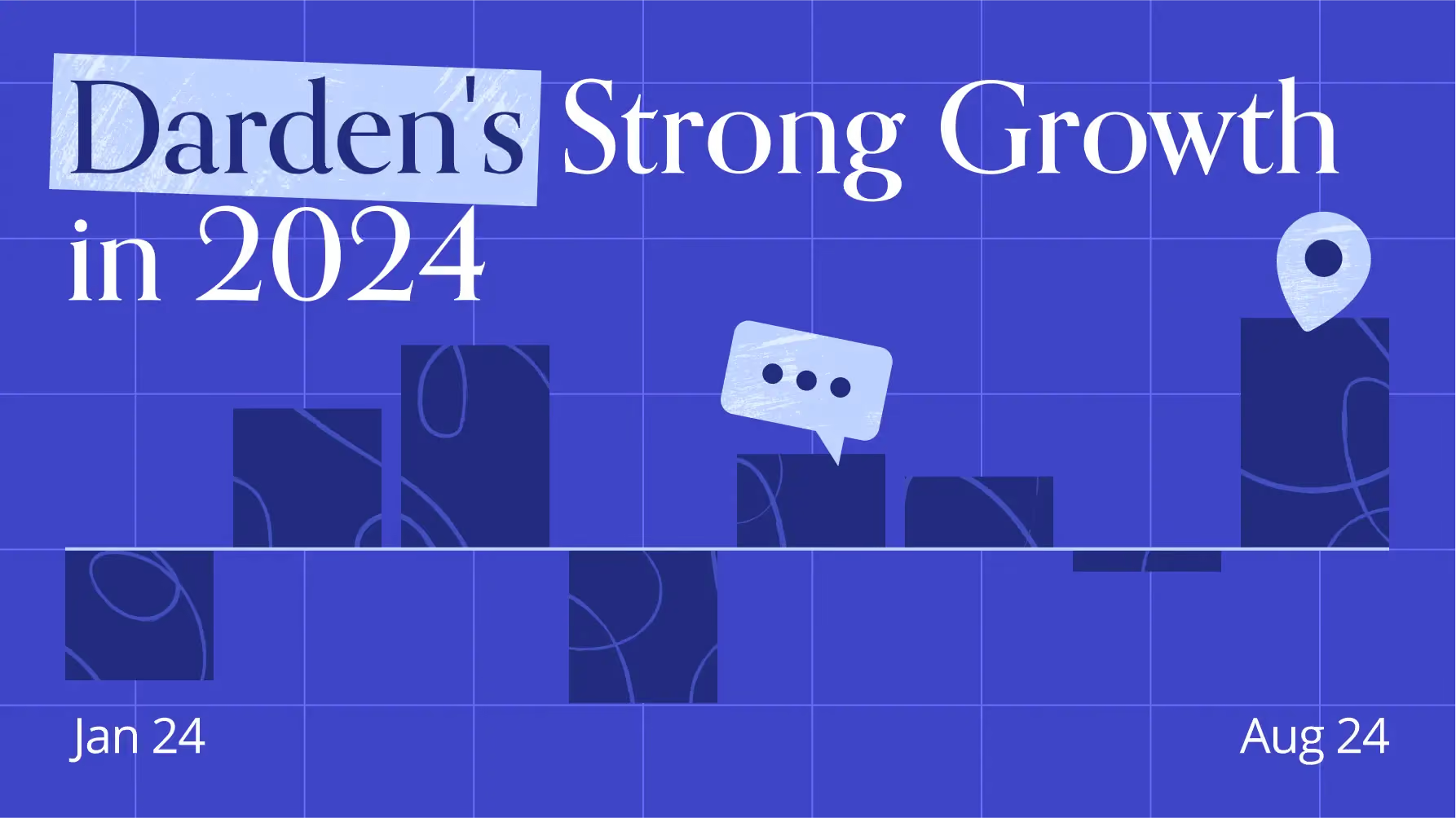
Darden's 2024 performance has been strong, with only three months – January, April, and July – showing YoY visit declines. January’s 2.9% decline was likely driven by unseasonably cold weather, while Easter weekend shifted visits across multiple retail categories in April 2024. And though July visits experienced a modest dip of 0.5% YoY, the drop was quickly offset by a 5.1% YoY increase in August.
This trend points to a recovery in consumer dining behavior, particularly in the full-service restaurant sector, where growth is being driven by consumers opting for higher-quality dining experiences over fast food options.
Monthly Visits to Darden’s Largest Brands
Darden owns and operates nearly 2,000 restaurants nationwide. Its three core brands – Olive Garden, LongHorn Steakhouse, and Cheddar’s Scratch Kitchen make up the bulk of these locations.
All three restaurant chains enjoyed overall positive momentum over the past few months, with LongHorn emerging as a standout performer. The chain saw its foot traffic increase in all months analyzed, with August 2024 visits elevated by 10.4% YoY.
Cheddar’s Scratch Kitchen and Olive Garden, too, experienced growth in all but two of the analyzed months, with August 2024 visits elevated by 3.1% and 6.9%, respectively, YoY. These trends point to consistent – and perhaps growing – consumer demand, a solid position as the holiday season approaches.
Expanding Footprint and Target Demographics
In July 2024, Darden announced its intention to acquire Chuy’s, an Austin-based Tex-Mex chain, a move that could add 101 stores to Darden’s already extensive portfolio. And while the acquisition is still pending, digging into the demographic and psychographic data offers some insight into what might make Chuy’s at home with the Darden family.
One defining factor of Darden’s restaurant portfolio might be its range – the chain offers dining options that appeal to people across a variety of income brackets. Its core brands – Cheddar’s Scratch Kitchen, Longhorn Steakhouse, and Olive Garden – cater to a customer base with household incomes similar to the nationwide median of $76.1K. But Darden’s broader portfolio includes several chains that appeal to wealthier patrons – visitors to Eddie V’s Prime Seafood, for example, came from trade areas where the median household income (HHI) was $105K.
Chuy’s visitor base, meanwhile, hails from trade areas with a median HHI of $86.2K. So the addition might help the restaurant group build on its core audience while appealing to higher-income diners who may be looking to “trade down” to a more casual, affordable meal without compromising on quality. This alignment allows Chuy’s to seamlessly fit within Darden's strategy, providing a diverse range of dining experiences while expanding its reach into higher-income markets.
Attracting Younger Diners
Darden’s acquisition of Chuy’s also appears to be a strategic play to attract younger diners, a segment that continues to drive interest in Mexican and Teex-Mex cuisine. And examining the demographics of visitors across all Darden brands reveals that Chuy’s is particularly popular among “Young Professionals”, with 9.4% of its diners coming from trade areas classified as such by the Spatial.ai: PersonaLive dataset.
As young diners continue to be a category of interest for Darden, the Chuy’s acquisition may be the ticket to Darden maintaining its visit dominance in the coming years.
Final Thoughts
Darden continues to drive foot traffic across its wide portfolio of brands, offering something for every kind of diner. With plans to expand its core audience underway, will the restaurant group continue to improve its monthly visits?
Visit Placer.ai to keep up with the latest data-driven dining news.
This blog includes data from Placer.ai Data Version 2.1, which introduces a new dynamic model that stabilizes daily fluctuations in the panel, improving accuracy and alignment with external ground truth sources.

Back-to-school shopping is a major driver of retail visits and sales – and this year, spending on the upcoming school year was set to be the second-highest on record. So with the frenzy winding down, we took a look at how several key retail categories and chains performed during this important season.
Retail's Summer Surge
Overall, retail rallied throughout July and August, with weekly visits to major back-to-school categories – including superstores, department stores, and other apparel retailers – mainly outperforming last year’s visit levels. Though department stores and apparel chains saw very slight YoY declines in late July, all the analyzed categories enjoyed YoY boosts beginning the week of August 5th. And since the back-to-school season is traditionally a high-traffic period, the ability of these categories to sustain YoY growth is particularly impressive.
Superstores and Bulk Buys
Digging deeper into individual brands reveals substantial visit boosts at superstores Target and Walmart and warehouse membership club Costco.
Target, already enjoying positive momentum from summer sales events, drove visits even higher with steep discounts on essential back-to-school items. In addition to attracting parents on the hunt for kids’ school supplies, Target has emerged as a favorite destination for college students seeking to load up on dorm decor and other collegian necessities. And between the weeks of July 9th, 2024 and August 19th, 2024, the retailer saw weekly visits jump a remarkable 9.7% to 20.8% compared to a year-to-date (YTD) weekly average. Walmart and Costco, too, saw significant visit boosts in July August, as they drew crowds with discount and bulk offerings.
The strong performance of these retailers during the back-to-school season bodes well as they head into the critical holiday shopping period. With momentum on their side, Target, Walmart, and Costco are poised to capitalize on their competitive pricing and value offerings, potentially driving another period of robust growth.
Fashion on a Budget
Back-to-school often means outfitting kids and teens with new clothing, and off-price retailers – including Burlington, Marshalls, Ross, and T.J. Maxx – are reaping the benefits. With a reputation for low prices and everything from apparel to backpacks, these chains are popular choices for the back-to-school crowd. And this year, weekly visits to these retailers got a significant boost, with August 19th foot traffic up 11.0% at Burlington, 13.9% at Marshalls, 6.0% at Ross, and 15.8% at T.J. Maxx, compared to a YTD weekly average.
Supplies in Demand
Superstores, department stores, and apparel retailers aren’t the only ones to benefit from the back-to-school craze – office supply stores, predictably, also experience major boosts. While weekly visits to Office Depot, OfficeMax (both owned by The ODP Corporation), and Staples had lagged behind the chains’ year-to-date (YTD) weekly visit averages during April and May, they began to recover in early July. By August, visits were surging, with the week of August 19th showing increases of 24.4% for Office Depot, 32.7% for OfficeMax, and 39.2% for Staples.
Kicking Off the School Year
Getting a pair of new shoes for school is another time-honored tradition – and DICK’s Sporting Goods has heeded the call with massive markdowns. The chain drew back-to-school shoe and apparel shoppers with a major 50%-off sale, and visits jumped significantly – peaking during the week of August 12th at 40.5% above a January 1st, 2024 baseline.
Hibbett, meanwhile, supercharged its back-to-school campaign with discounts and free children’s haircuts, offered between July 28th and August 25th at different locations. And the events boosted foot traffic dramatically, with the week of July 29th seeing a whopping 76.1% visit increase compared to a January 1st, 2024 baseline. Though visits to both sporting goods chains began to taper off as August wore on, they remained elevated – serving as a reminder of the power of back-to-school shopping and sales.
Back To Shopping
Back-to-school season remains one of the most important shopping periods of the year, with significant consumer demand drawing visit growth across major retail categories.
Can these retailers continue drawing on this momentum into the holiday season?
Visit Placer.ai to keep up with the latest data-driven retail news.
This blog includes data from Placer.ai Data Version 2.1, which introduces a new dynamic model that stabilizes daily fluctuations in the panel, improving accuracy and alignment with external ground truth sources.

In July & August 2024, Placer.ai released multiple white papers: Los Angeles Office Trends in 2024, Q2 2024 – Retail & Restaurant Review, Domestic Tourism Trends in NYC and LA, 2024 Hotel Visit Trends, Emerging Trends for CRE in 2024, and Retail Giants in 2024: Walmart, Costco, and Target's Competitive Edge.
Below is a taste of our findings from two white papers: 2024 Hotel Visit Trends and Retail Giants in 2024: Walmart, Costco, and Target's Competitive Edge. The two white papers take a look at the visitation data to explore how leading hotel chains are driving visits in 2024, as well as exploring how Walmart, Costco, and Target are maintaining their success.
Hospitality Report Card
The pandemic and economic headwinds that marked the past few years presented the multi-billion dollar hotel industry with significant challenges. But five years later, the industry is rallying – and some hotel segments are showing significant growth.
An Upper Midscale Sweet Spot
Overall, visits to hotels were 4.3% lower in Q2 2024 than in Q2 2019 (pre-pandemic). But this metric only tells part of the story. A deeper dive into the data shows that each hotel tier has been on a more nuanced recovery trajectory.
Economy chains – those offering the most basic accommodations at the lowest prices – saw visits down 24.6% in Q2 2024 compared to pre-pandemic – likely due in part to hotel closures that have plagued the tier in recent years. Though these chains were initially less impacted by the pandemic, they were dealt a significant blow by inflation – and have seen visits decline over the past three years. As hotels that cater to the most price-sensitive guests, these chains are particularly vulnerable to rising costs, and the first to suffer when consumer confidence takes a hit.
Luxury Hotels, on the other hand, have seen accelerated visit growth over the past year – and have succeeded in closing their pre-pandemic visit gap. Upscale chains, too, saw Q2 2024 visits on par with Q2 2019 levels. As tiers that serve wealthier guests with more disposable income, Luxury and Upscale Hotels are continuing to thrive in the face of headwinds.
But it is the Upper Midscale level – a tier that includes brands like Trademark Collection by Wyndham, Fairfield by Marriott, Holiday Inn Express by IHG Hotels & Resorts, and Hampton by Hilton – that has experienced the most robust visit growth compared to pre-pandemic. In Q2 2024, Upper Midscale Hotels drew 3.5% more visits than in Q2 2019. And during last year’s peak season (Q3 2023), Upper Midscale hotels saw the biggest visit boost of any analyzed tier.
The Guests Driving Upper Midscale Chain Growth
Analyzing the captured markets* of Upper Midscale chains Trademark Collection by Wyndham, Fairfield by Marriott, Holiday Inn Express by IHG Hotels & Resorts, and Hampton by Hilton with demographics from STI: Popstats (2023) shows variance in the relative affluence of their visitor bases.
Fairfield by Marriott drew visitors from areas with a median household income (HHI) of $84.0K in H1 2024, well above the nationwide average of $76.1K. Hampton by Hilton and Trademark Collection by Wyndham, for their parts, drew guests from areas with respective HHIs of $79.6K and $78.5K – just above the nationwide average. Meanwhile, Holiday Inn Express by IHG Hotels & Resorts drew visitors from areas below the nationwide average.
But all four brands saw increases in the median HHIs of their captured markets over the past five years. This provides a further indication that it is wealthier consumers – those who have had to cut back less in the face of inflation – who are driving hotel recovery in 2024.
(*A chain’s captured market is obtained by weighting each Census Block Group (CBG) in its trade area according to the CBG’s share of visits to the chain – and so reflects the population that actually visits the chain in practice.)
Strategies for Retail Giants
Walmart, Target, and Costco are three of the country’s most popular retailers, drawing millions of shoppers each day. Each has distinct strengths that cater to their unique customer bases, helping them thrive in a competitive market.
Year-Over-Year Visit Growth
Costco’s wholesale club model led the way in H1 2024, with consistent year-over-year (YoY) visit growth ranging from 6.1% in January 2024 to 13.3% in June. Walmart followed closely, with YoY foot traffic growth during all but two months. Target had a slower start, with visits below 2023 levels from January to April, and a 3.7% decline in YoY comparable sales. However, visits rebounded in May (2.5%), June (8.9%), and July (4.7%). This renewed growth bodes well for Target, especially as the back-to-school season ramps up.
For all three chains, Q2 2024’s visit success was likely bolstered by summer deals and intensifying price wars aimed at attracting inflation-weary consumers back to the store.
Increased Competition from Dollar Stores
While inflation is cooling, prices remain high, and discount and dollar stores are increasingly challenging Walmart, Target, and Costco. Many customers, especially those of more modest means, are drawn to the rock-bottom prices at dollar stores.
Analysis of cross-shopping patterns shows that a growing share of Walmart, Target, and Costco visitors also frequent Dollar Tree regularly. In Q2 2019, between 9.8% and 13.7% of visitors to these retailers visited Dollar Tree at least three times, but by Q2 2024, that share rose to 16.7%-21.6%.
Dollar Tree is capitalizing on this interest. Over the past year, it added 350 Dollar Tree locations while closing nearly 400 Family Dollar stores. The chain also acquired leases for 170 99 Cents Only Stores, gaining access to customers who buy everything from groceries to household goods. As Dollar Tree expands its footprint and food offerings, it poses a growing challenge to Walmart, Target, and Costco.
Read the full reports to discover more hotel and superstore insights. For more data-driven consumer research, visit our resource library.