.png)
.png)

.png)
.png)

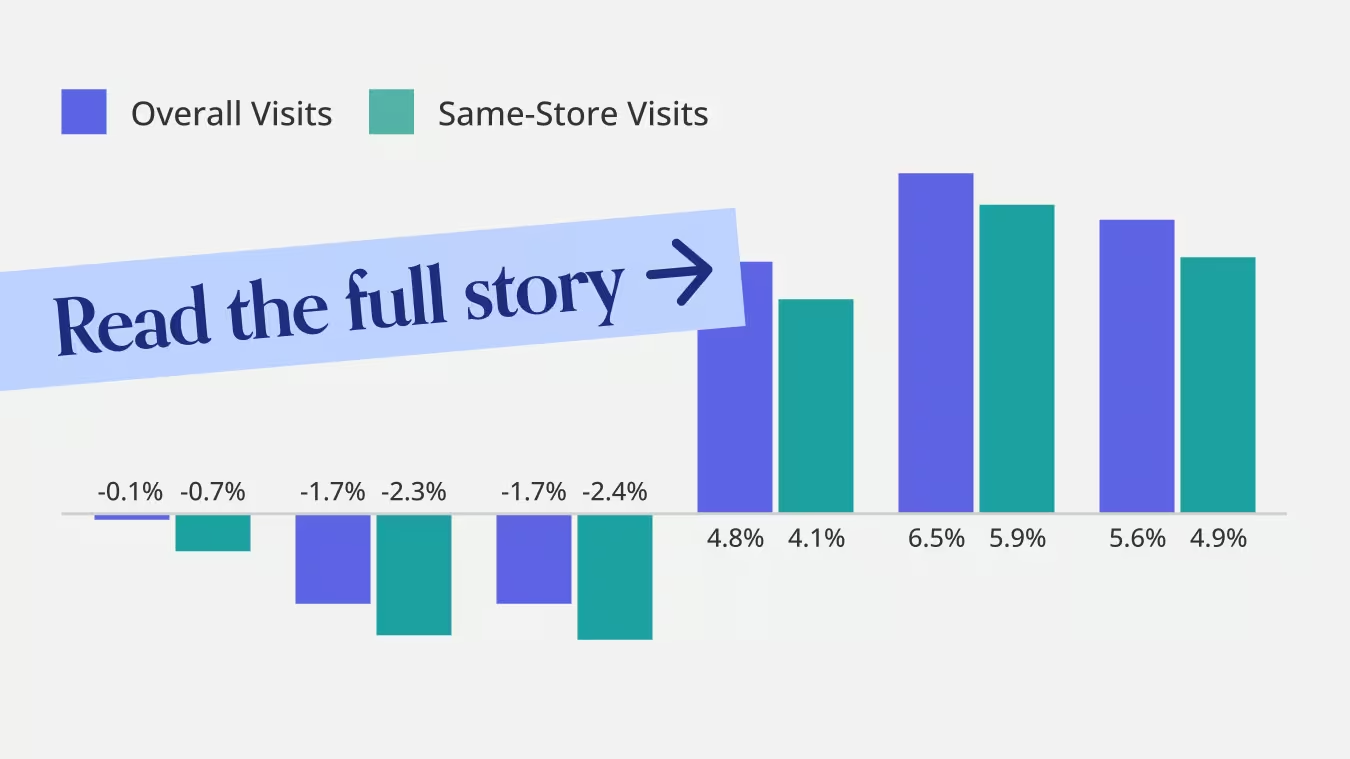
The coffee space has become increasingly competitive in recent years. And while traffic to the segment is up, the growth of small and medium sized chains may be coming at the expense of Starbucks. Visits to the reigning coffee giant were down slightly (0.1%) YoY in Q2 2025 while average visits per location declined 4.2% in the same period.
Still, these trends mark an improvement compared to last quarter, when YoY visits and average visits per venue were down 0.9% and 5.4%, respectively – suggesting that the company's "Back to Starbucks" strategy and recent menu innovations are beginning to drive a turnaround.
Meanwhile, Dunkin' – the second-largest coffee chain in the country – is seeing modest growth, with overall visits and average visits per venue up 1.7% and 0.3% YoY, respectively, in Q2 2025. Like Starbucks, Dunkin' showed improvement in Q2 2025 compared to Q1 2025 – perhaps an early sign of strengthening consumer confidence.
But while broader market forces may have helped, Dunkin's Q2 2025 turnaround may also be attributed to the chain's promotional efforts – including a new ad campaign to promote the chain's $6 Meal Deals. As value continues to drive consumer decision-making, Dunkin's emphasis on affordable bundles positions it well to maintain its visit share despite the growing competition in the space.
Dutch Bros, one of the fastest growing coffee brands in recent years, maintained its momentum in Q2 2025, as coffee chains betting on small-format, largely drive-thru locations – including 7Brew, PJ's Coffee, Biggby, and Foxtail – continue to resonate with consumers.
Overall visits to the Oregon-based chain grew 13.8% YoY alongside a 0.8% increase in average visits per venue – indicating that the chain's ongoing expansion is not cannibalizing traffic from existing venues. This bodes well for the brand as it continues its aggressive expansion – 2,029 stores by 2029.
As we look to the second half of 2025, the coffee sector will be characterized by the distinct strategies of its key players. Dutch Bros' aggressive expansion will continue to challenge the incumbents on a local level, while Dunkin's focus on value will likely remain a key advantage with budget-conscious consumers. The ultimate test will be for Starbucks, as the industry leader's ability to translate its strategic innovations into sustained visit growth will determine its capacity to defend its market share.
For more data-driven dining insights, visit placer.ai/anchor.

Shake Shack traffic increased an impressive 13.7% year-over-year (YoY) in Q2 2025 while average visits per venue held relatively steady at -1.7% – indicating that the chain's aggressive expansion strategy is capturing new market share without cannibalizing existing locations.
Meanwhile, although Q2 2025 visits to Wingstop were up 3.6%, the chain's average visits per venue declined 6.3% – which may suggest that discretionary dining brands serving lower-income consumers may be experiencing pressure from tightening household budgets.
Analyzing trade area demographic data reveals that Wingstop's captured market has a median household income of $69.5K – significantly lower than Shake Shack's $97.0K. Wingstop's trade area also includes a much higher proportion of households with children.
Wingstop attracts families with tighter budgets who must stretch their dining dollars further, which likely contributed to the decline in average visits per venue during this period of economic uncertainty. Meanwhile, Shake Shack's appeals to higher-income consumers with more discretionary spending power could explain the chain's impressive visit strength despite the ongoing headwinds.
Looking at the change in visit frequency compared to 2024 also suggests that Wingstop is feeling the impact of its visitors' tighter budgets.
Wingstop still maintains a significant advantage in customer loyalty, with 16.8% to 18.1% repeat monthly visitors in H1 2025 compared to Shake Shack's 10.5% to 11.4%. But comparing these numbers to 2024 reveals that Wingstop's share of repeat visitors has declined slightly since 2024, while Shake Shack has posted modest monthly gains throughout H1 2025.
This shift suggests that budget-conscious families may be reducing their regular Wingstop visits to save money, while Shake Shack's strategic expansion is bringing locations closer to customers which could be driving increased repeat visitation.
Despite facing economic headwinds, Wingstop's continued positive visit growth and superior customer loyalty metrics demonstrate the brand's strong fundamentals and deep connection with its core family demographic.
As economic conditions stabilize, Wingstop's established customer base and proven appeal to budget-conscious families positions the chain for a strong rebound, particularly given that families with children represent a large and resilient market segment that will likely return to regular dining patterns when household budgets recover.
Visit Placer.ai/anchor for the latest data-driven dining insights.

Eyewear chain Warby Parker continues to be a disruptor. The glasses chain got its start online and made the pivot to brick-and-mortar in 2013. And while many retailers who made that move have since shifted to other retail formats, Warby Parker is pressing on – the brand has plans to open 45 new locations in 2025 alone and is partnering with Target to open store-in-stores in H2 2025.
The chain's ongoing expansion drove year-over-year (YoY) visit increases for all months of 2025 so far. Average visits per location showed more variance – average visits per venue declined 2.7% YoY in Q2 2025 – perhaps reflecting the brand's deliberate focus on market penetration and its use of stores as strategic omnichannel touchpoints rather than purely traffic-dependent locations.
Like Warby Parker, footwear brand Allbirds began online before pivoting to physical retail. But Allbirds is now going in a different direction and shrinking rather than expanding its footprint. In March 2024, the company made the strategic decision to shutter about one-third of its store fleet – and the result has been impressive. While overall visits declined YoY by -12.5% in Q2 2025, visits per location surged, increasing by 18.2% in the same period.
Monthly visits followed a similar pattern, with overall visits generally lower than they were in 2024 while visits per location were largely positive – and looking at visits since the beginning of 2025 shows that the YoY overall visit gap has also been narrowing. Visits in January 2025 were 37.1% lower than they were in January 2024, but by June 2025 that visit gap had narrowed to just 15.1%. Meanwhile, average visits per location were elevated by 13.2% YoY in June 2025. This impressive shift highlights that demand for in-store shopping at Allbirds is strong, and the decision to focus on its highest-performing stores has had the intended effect.
Warby Parker and Allbirds have taken divergent approaches to their brick-and-mortar strategy, and both chains are managing to keep things moving forward.
What will H2 look like for these brands? Visit Placer.ai/anchor for the latest data-driven retail insights.

Movie theater visits were up year-over-year in Q2 2025, but traffic generally remains significantly below 2019 levels – with the exception of Cinemark, where visits are almost on par with pre-pandemic levels. We analyzed the data to understand how movie-going behavior has changed since COVID and why Cinemark is staying ahead of the curve.
Movie theater traffic jumped year-over-year (YoY) in Q2 2025 thanks to the release of several successful blockbusters, including A Minecraft Movie, Sinners, Lilo & Stitch, and Mission Impossible: The Final Reckoning.
Still, baseline movie theater attendance remains significantly lower than it was pre-pandemic. And although YoY trends for AMC, Regal, and Cinemark were relatively consistent, comparing these chains' recent visit trends to pre-pandemic traffic reveals major differences in long-term performance.
Between July 2024 and June 2025, visits to the two largest chains – AMC and Regal – were 33.2% and 40.0% lower, respectively, than they were between July 2018 to June 2019. The visits per location gap was slightly narrower – due to rightsizing efforts that consolidated traffic into fewer movie theaters – but the data still indicates that AMC and Regal theaters are generally emptier than they were in 2018-2019.
But bucking the trend is Cinemark, which saw traffic to its flagship Cinemark brand dip just 2.6% compared to pre-COVID, while average visits per location were relatively stable at -0.8%. Thanks to this impressive recovery, Cinemark has significantly strengthened its position in the wider movie theater landscape.
A deeper look at the data confirms Cinemark's success in attracting moviegoers. Cinemark theaters average more visits both per location and per square foot, indicating that their higher visit numbers stem from fuller theaters rather than larger venues or more locations.
But just because Cinemark's visit numbers are relatively aligned with 2018-2019 traffic levels does not mean that the chain has not been impacted by the shift in post-COVID movie-going behavior.
Comparing monthly visits between July 2018-June 2019 and July 2024-June 2025 reveals increased traffic volatility at all three chains, with higher peaks and deeper valleys compared to average monthly baselines. This volatility likely stems from blockbusters playing a more central role in driving movie visits. Fewer consumers now go to movies casually – instead, they save their limited movie budgets for major releases.
The data also shows that all three chains have seen a relative drop in visits to matinee screenings (before 5 PM) along with a relative increase in late-night visits (9 PM to 1 AM) – which could also be consistent with a more intentional and less casual movie-going pattern.
And Cinemark hasn't been immune to these changes. The chain has also experienced similar monthly visit volatility, fewer matinee visits, and more late-night visits – matching the patterns seen at AMC and Regal.
So what is driving Cinemark's success? Some of the answer may lie in its strategic focus on less affluent family audiences. Compared to AMC and Regal, Cinemark attracts visitors from areas with lower median household incomes and higher concentrations of families – a positioning the chain seems to be deliberately cultivating.
Cinemark has built an ecosystem designed for budget-conscious families: their Movie Club membership includes monthly rollover ticket credits and concession discounts, while their Summer Movie Clubhouse offers discounted family packages. Select locations also feature Camp Cinemark auditoriums – screening rooms specifically designed to be child-friendly.
This strategy creates a virtuous cycle. While Cinemark's lower-income audience has tighter entertainment budgets, they're also less likely to have premium home theater setups that compete with the theatrical experience.
When these families do decide to splurge on entertainment, Cinemark's value-oriented approach and family-friendly amenities make it the logical choice – turning occasional visits into a more loyal customer base that sustains traffic even during industry-wide downturns.
While most movie theater chains continue to struggle with significantly lower attendance compared to pre-pandemic levels, the strong YoY performance suggests that the movie theater recovery story is still being written. Cinemark's success demonstrates that chains willing to adapt their strategies to serve underserved audiences can not only survive but thrive in the transformed post-pandemic entertainment landscape.
For more data-driven consumer insights, visit placer.ai/anchor.

Major retailers held promotional events around Amazon's Prime Day sales event. How did the promotional events impact retail foot traffic? And what does the data reveal about the state of consumers going into the second half of 2025?
Comparing daily visits to major retailers during their July campaigns against same-day YTD averages (e.g., Sunday July 6th traffic versus average Sunday visits in 2025) reveals that sales primarily boosted weekday traffic. Visits increased Monday through Friday during the promotional periods, but every retailer that extended its campaign to Saturday – typically the busiest in-store shopping day – experienced traffic declines compared to YTD Saturday averages.
Individual retailer analysis shows Best Buy achieved the strongest response, with visits increasing 13.2% to 21.9% between July 7th and 11th compared to same-day YTD averages, and the final day (Sunday July 13th) posting a 7.2% increase. Conversely, Dollar General saw the weakest performance – only three of seven promotional days generated visit increases, all remaining in low single digits.
This pattern suggests consumers leveraged sales for big-ticket purchases at discounts but didn't use the opportunity to stock up on lower-priced items.
Comparing average daily visits during 2024 and 2025 July campaigns shows generally lower in-store traffic this year. Timing likely played a role – except for Best Buy, all analyzed retailers ran their 2024 campaigns before Amazon Prime Day, while this year all five overlapped with Amazon's event. This means that, unlike in 2024, Target, Walmart, Kohl's, and Dollar General directly competed with Amazon Prime Day in 2025, potentially driving the in-store traffic decline.
This calendar shift makes Walmart's performance particularly noteworthy. Average daily visits during "Walmart Deals" increased 8.9% compared to last year – despite facing direct Amazon competition for the first time.
Walmart's strength may stem from its recent "Who Knew?" advertising campaign, which may have kept the retailer top-of-mind for many customers during this period of intense retail competition.
The YoY visit growth during July campaigns represents another milestone in the company's turnaround and brand refresh, demonstrating the legacy retailer's continued relevance in today's competitive retail landscape.
The data reveals that consumers approached July 2025 promotional events with strategic intent, focusing on high-value purchases during convenient weekday shopping windows rather than impulse buying across all categories.
Walmart's standout performance amid increased competition suggests that strong brand messaging and strategic positioning can overcome market headwinds, providing optimism for retailers heading into the second half of 2025.
For more data-driven retail insights, visit placer.ai/anchor.

McDonald's recent re-introduction of the snack wrap joins the recent wave of nostalgia-driven menu innovations – and initial data suggests that the fan-favorite is already driving up visits to the chain. On July 10th – the day of the launch – McDonald's traffic nationwide was up 15.0% compared to the 2025 YTD daily average and 11.4% higher than the YTD Thursday average, and visits remained high on Friday and Saturday as well.
The Snack Wrap's return comes at a critical time for McDonald's, as the chain continues to lean on menu innovations to turn around its recent traffic plateau plateau and sales dips.
Will the initial excitement translate into a sustained visit hike?
Visit placer.ai/anchor for the latest data-driven dining analysis.

1. Idaho and South Carolina have emerged as significant domestic migration magnets over the past four years. Between January 2021 and 2025, both states gained over 3.0% of their populations through domestic migration. Other Mountain and Sun Belt states – including Nevada, Montana, and Florida – also drew significant inflow, while California, New York, and Illinois experienced the greatest outmigration.
2. Interstate migration cooled noticeably in 2024. During the 12-month period ending January 2025, California, New York and Illinois saw their outflows slow dramatically, while domestic migration hotspots like Georgia, Texas, and Florida saw inflows flatten to zero. A similar cooling trend emerged on a CBSA level.
3. Still, some states continued to see notable relocation activity over the past year. In 2024, Idaho, South Carolina, and North Dakota drew the most relocators relative to their populations. And among the nation’s ten largest states, North Carolina led with an inflow of 0.4%.
4. Phoenix remained a rare bright spot among the nation’s ten largest metro areas. The CBSA was the only major analyzed hub to maintain positive net domestic migration through 2024.
Over the past several years, the United States has experienced significant domestic migration shifts, driven by factors like remote work, housing affordability, and regional economic opportunities. As some areas reap the benefits of population inflows, others grapple with outflows tied to higher living costs and evolving workplace dynamics.
This report dives into the location analytics to explore where Americans have moved since 2021 – and how these patterns began to change in 2024.
Since 2021, Americans have flocked toward warmer climates, expansive natural scenery, and more affordable housing options – particularly in the Mountain and Sun Belt states.
Between January 2021 and January 2025, South Carolina led the nation in positive net domestic migration – drawing an influx of newcomers equivalent to 3.6% of its January 2025 population. (This metric is referred to as a state’s “net migrated percent of population.”) Next in line was Idaho with a 3.4% net migrated percent of population, followed by Nevada, (2.8%), Montana (2.8%), Florida (2.1%), South Dakota (2.1%), Wyoming (2.0%), North Carolina (2.0%), and Tennessee (1.9%). Texas saw positive net migration of just 0.9% during the same period. However, the Lone Star State’s large overall population means a substantial number of newcomers in absolute terms.
Meanwhile, California (-2.2%), New York (-2.1%), and Illinois (-1.9%) experienced the greatest outflows relative to their populations. This exodus was driven largely by soaring housing costs and the rise of remote work, which lowered barriers to moving out of high-priced areas.
Between January 2024 and January 2025, many of the same broad patterns persisted, but at a more moderate clip – suggesting a stabilization of domestic migration nationwide. This leveling off could reflect factors such as rising mortgage interest rates, which dampened home buying and selling, as well as the increased push for employees to return to the office.
Still, South Carolina (+0.6%) and Idaho (+0.6%) remained among the top inflow states. The two hotspots were joined – and slightly surpassed – by North Dakota (+0.8%), where even modest waves of newcomers make a big impact due to the state’s lower population base. A wealth of affordable housing and a strong job market have positioned North Dakota as a particularly attractive destination for U.S. relocators in recent years. And Microsoft and Amazon’s establishment of major presences around Fargo has strengthened the region’s economy.
Meanwhile, California (-0.3%), New York (-0.2%), and Illinois (-0.1%) continued to post negative net migration, but at a markedly slower rate than in prior years. And notably, several states that had been struggling with outflow, such as Michigan, Minnesota, Virginia, Ohio, and Oregon, began showing minor positive inflow during the same 12-month window. As home affordability erodes in pandemic-era hot spots like the Mountain states and Sun Belt, these areas may emerge as new destinations for Americans seeking lower costs of living.
Zooming in on the ten most populous U.S. states offers an even clearer picture of how domestic migration patterns have stabilized over the past year. The graph below shows a side-by-side comparison of domestic migration patterns during the 36-month period ending January 2024 and the 12-month period ending January 2025.
California, New York, and Illinois saw population outflows slow dramatically during the 12 months ending January 2025 – while domestic migration magnets such as Georgia, Texas, and Florida saw inflow flatten to zero. Meanwhile, Ohio, Michigan, and Pennsylvania flipped from slightly negative to slightly positive net migration – incremental upticks that could signal a possible turnaround.
The only “Big Ten” pandemic-era migration magnet to maintain strong inflow in 2024 was North Carolina – which saw a 0.4% influx in 2024 as a result of interstate moves.
A closer look at the top four states receiving outmigration from California and New York (October 2020 to October 2024) reveals that residents leaving both states tended to settle in nearby areas or in Florida.
Among those leaving New York, 37.4% ended up in neighboring states – 21.1% moved to New Jersey, 9.2% to Pennsylvania, and 7.1% to Connecticut. But an astonishing 28.8% decamped all the way to the Sunshine State, trading the Northeast’s colder climate for Florida sunshine.
Similarly, 20.1% of California leavers chose to stay nearby, moving to Nevada (11.5%) or Arizona (8.6%). Another 19.1% moved to Texas, and 8.0% moved to Florida, making it the fourth-largest destination for Californians.
Zooming in on CBSA-level data – focusing on the nation’s ten largest metropolitan areas, all with over five million people – reveals a similar picture of slowing domestic migration over the last year.
Los Angeles, New York, Chicago, and Washington, D.C. – four cities that experienced notable population outflows between January 2021 and January 2024 – saw those outflows flatten considerably. For these metros, this leveling-off may serve as a promising sign that the waves of departures seen in recent years may have begun to subside. Conversely, Houston and Dallas, which both welcomed positive net migration between January 2021 and January 2024, registered zero-net domestic migration in 2024. Atlanta, for its part, remained flat in both of the analyzed periods.
In Miami, however, outmigration persisted at a substantial rate. Despite Florida’s overall status as a domestic migration magnet, Miami lost 2.6% of its population to domestic net migration between January 2020 and January 2024 – and another 1.0% between January 2024 and January 2025. As one of Florida’s most expensive housing markets, Miami may be losing some residents to other parts of the state or elsewhere in the region. Meanwhile, Philadelphia, which lost 0.3% of its population to net domestic migration between January 2021 and January 2024, continued losing residents at a slightly faster pace in 2024 – another 0.3% just last year.
Of the ten biggest CBSAs nationwide, only Phoenix continued to see a net domestic migration gain through 2024 (+0.2%). This highlights the CBSA’s continued draw as a (relative) relocation hotspot even in 2024’s cooling market.
Who are the domestic relocators heading to Phoenix?
From October 2020 to October 2024, the top five metro areas sending residents to the Phoenix CBSA each registered median household incomes (HHIs) of $73K to $98K – surpassing Phoenix’s own median of $72K. This suggests that many of those moving in are arriving from wealthier, often more expensive metro areas – for whom even Phoenix’s high-priced market may offer more affordable living.
Overall, domestic migration patterns appear to have cooled in 2024, reflecting economic and societal trends that have slowed the rush from pricey coastal hubs to more affordable regions. Yet states like South Carolina, Idaho, and North Dakota – as well as metro areas like Phoenix – continue to attract new arrivals, paving the way for evolving regional demographics in the years to come.

In today’s retail landscape, consumer behavior is influenced by a multitude of factors, directly impacting the success of products and brands. This report explores the latest trends in value perception, shopping behavior, and media consumption that impact which brands consumers are most likely to engage with – and how.
In the apparel space, consumers continue to prioritize value and unique merchandise.
Analysis of visits to various apparel categories reveals a steady increase in the share of visits going to off-price retailers and thrift stores at the expense of traditional apparel chains.
And the popularity of off-price chains and thrift stores appears to be widespread across multiple audience segments. Analyzing trade area data with the Experian: Mosaic psychographic dataset reveals a clear preference for second-hand retailers among both younger (ages 25-30) and older (51+) consumer segments. Meanwhile, middle-class parents aged 36-45 with teenagers – the “Family Union” segment – are significantly more likely to shop at off-price apparel stores, highlighting their emphasis on buying new, while saving both time and money.
This suggests that the powerful blend of treasure-hunting and deep value, central to both the off-price and thrift experiences, is driving traffic from a variety of audiences, and that other industries could benefit from combining affordability with the allure of unique products.
Diving deeper into the location intelligence for the apparel space further highlights thrift and off-price’s broad appeal – and that a combination of quality and price motivates consumers to visit different retailers.
Between 2019 and 2024, the share of Bloomingdale’s, Saks Fifth Avenue, Neiman Marcus, and Nordstrom visitors that also visited a Goodwill or Ross Dress for Less increased significantly.
And while this could mean that the current economic climate is causing some higher-income consumers to trade down to lower-priced retailers, it could also be that consumers are prioritizing sustainability and seeking value in terms of “bang for their buck” – shopping a combination of retailers depending on the cost versus quality considerations for each purchase.
Consumers increasingly expect to shop on their own terms, opting for a more flexible shopping experience that blurs the lines between traditional retail channels and categories.
Superstores and warehouse stores, for example, often evoke the image of navigating aisle after aisle of nearly every product imaginable – a time-consuming endeavor given the sheer size of their stores. But the latest location intelligence shows that more consumers are turning to these retailers for super-quick shopping trips.
Between 2019 and 2024, the share of visits lasting less than ten minutes at Target, Walmart, BJ’s Wholesale Club, Sam’s Club, and to a lesser extent Costco, rose steadily – perhaps due to increased use of flexible BOPIS (buy online, pick-up in-store) and curbside pick-up options. These stores may also be seeing a rise in consumers popping in to grab just a few items as-needed or to cherry-pick particular deals to complement their larger online shopping orders.
This trend highlights the demand for frictionless store experiences that allow visitors to conveniently shop or pick up orders even at large physical retailers.
And the breaking down of traditional retail silos isn’t limited to big-box chains. Diving into the data for quick service restaurants (QSR), fast casual chains, and grocery stores indicates that more consumers are also looking for new ways to grab a convenient bite.
Since 2019, grocery stores have been claiming an increasingly large share of the midday short visit pie – i.e. visits between 11:00 AM 3:00 PM lasting less than ten minutes – at the expense of QSR chains. This suggests that consumers seeking quick and affordable lunches are increasingly turning to grocery stores to pick up a few items or take advantage of self-service food bars. Notably, the rise in supermarket lunching hasn’t come at the expense of fast-casual restaurants, which have also upped their quick-service games – and have seen a small increase in their share of the quick lunchtime crowd over the past five years.
While some of QSR’s relative decline in short lunchtime visits could be due to discontent with rising fast-food prices, it’s clear that an increasing share of consumers see grocery and fast-casual chains as viable options during the lunch rush.
In 2025, tapping into hot trends and creating viral moments are among the most powerful tools for amplifying promotions and driving foot traffic to physical stores.
Retailers across categories have successfully harnessed the power of pop culture collaborations to generate excitement – and visits – by leaning into trending themes. On October 8th, 2024, for example, Wendy’s launched its epic Krabby Patty Collab, inspired by the beloved SpongeBob franchise. And during the week of the offering, the chain experienced a remarkable 21.5% increase in foot traffic compared to an average week that year.
Similarly, Crumbl – adept at creating buzz through manufactured scarcity – sparked a frenzy with the debut of its exclusive Olivia Rodrigo GUTS cookie. Initially available only at select locations near the artist’s concert venues, the cookie was launched nationwide for a limited time from August 19th to 24th, 2024. This buzz-driven release resulted in a 27.7% traffic surge during the week of the launch, as fans rushed to get a taste of the star-studded treat.
And it’s not just dining chains benefiting from these pop-culture moments. On February 16th, 2025, Bath & Body Works launched a Disney Princess-inspired fragrance line, perfect for fans of Cinderella, Ariel, Belle, Jasmine, Moana, and Tiana. The collaboration resonated, fueling a 23.2% visit spike for the chain.
While tapping into existing pop-culture trends has the ability to drive traffic, so does creating a new one. Analysis of movie theater visits on National Popcorn Day (Sunday, January 19th, 2025) shows how initiating a trend can spur social media engagement and impact in-person traffic to physical retail spaces.
National Popcorn Day was a successful promotional holiday across the movie theater industry in 2025. Both Regal Cinemas and AMC Theatres offered popcorn-based promotions on the day, but Cinemark’s “Bring Your Own Bucket” campaign, in particular, appears to have spurred a significant foot traffic boost during the event.
Visits to Cinemark on National Popcorn Day in 2025 increased 57.5% relative to the Sunday visit average for January and February 2025, as movie-goers showed off their out-of-the-bucket popcorn receptacles on social media. Clearly, by starting a trend that invited creativity and expression, Cinemark was able to amplify the impact of its National Popcorn Day promotion.
Location intelligence illuminates some of the key trends shaping consumer behavior in 2025. The data reveals that value-driven shopping, demand for flexibility across touchpoints, and the power of unique retail moments have the power to drive consumer engagement and the success of retail categories, brands, and products.

Placer.ai observes a panel of mobile devices in order to extrapolate and generate visitation insights for a variety of locations across the U.S. This panel covers only visitors from within the United States and does not represent or take into account international visitors.
Downtown districts in the nation’s major cities attract domestic travelers all year long with their iconic sights, lively entertainment, and diverse dining offerings. But each hub follows its own rhythm, shaped by distinct seasonal peaks and dips in visitor flow.
This white paper examines downtown hotel visitation patterns in four of the nation’s most popular destinations for domestic tourists: Miami, Chicago, New York, and Los Angeles. Focusing on 20 downtown hotels in each city, the analysis explores seasonal variations in domestic travel, city-specific dynamics, and differentiating factors.
Domestic tourism has rebounded strongly in recent years, and hotels in Miami and Chicago have been the biggest beneficiaries. In 2024, visits to analyzed hotels in each of these cities’ downtown areas grew by 8.9% and 7.4%, respectively, compared to 2023. Meanwhile, hotels in downtown and midtown Manhattan saw a more modest 2.0% increase, while Los Angeles experienced a slight year-over-year (YoY) decline in downtown hotel visits.
One factor that may be driving Miami and Chicago’s stronger performance is their higher proportion of long-distance visitors, defined as those visiting from over 250 miles away. Miami remains a top destination for snowbirds and spring breakers, while Chicago serves as a cultural and entertainment hub for the sprawling Midwest. These long-distance leisure travelers may be more likely to splurge on downtown hotel stays during their trips, helping drive hotel visit growth in the two cities.
By contrast, hotels in the Los Angeles and Manhattan city centers drew lower shares of domestic travelers coming from less than 250 miles away. These shorter-haul domestic tourists may be less likely to splurge on downtown hotels than those taking longer vacations. Both cities are also surrounded by numerous regional getaway options that can draw long-haul leisure travelers away from their downtown cores.
Each of the four analyzed cities has its own unique ebbs and flows – and city center hotel visits reflect these patterns. Miami, with its warm, sunny climate, experiences influxes of tourists during the winter and spring, with March seeing the biggest jump in downtown hotel visits last year (13.0% above the monthly visit average). Chicago, which thrives in the summer with its many festivals and events, saw its biggest downtown hotel visit bump in August. Meanwhile, Manhattan experienced a major uptick in December, likely fueled by holiday tourism and New Year celebrations, and Los Angeles visits were highest in the summertime.
What drives these seasonal visit peaks? Miami has long been a top tourism destination, especially in early spring, when snowbirds and spring breakers flock to the city for sun and relaxation. In recent years, the city has seen a rise in short-term domestic tourism, suggesting that the city is becoming increasingly popular for weekend getaways. According to the Placer.ai Tourism Dashboard, the share of domestic tourists staying just one or two nights grew from 71.7% in March 2022 to 78.3% in March 2024.
This shift aligns with an impressive increase in the magnitude of downtown Miami’s springtime hotel visit peak: In March 2022, visits to downtown hotels were 5.0% above the monthly average for the year, a share that more than doubled by 2024 to 12.9%.
These numbers may mean that more people are choosing to head to Miami for a quick break from the cold – and staying in downtown hotels to make the most of their short getaway.
Chicago’s major August visit spike was likely driven by the Windy City’s impressive lineup of major summer festivals, from Lollapalooza to the Chicago Air and Water Show, which draw thousands of attendees from across the country.
Lollapalooza fueled the largest visit spike to the city – between Thursday, August 1st and Sunday, August 4th, visits to downtown Chicago hotels surged between 51.1% and 63.8% above 2024 daily averages for those days of the week. The Air and Water Show and the Chicago Jazz Festival also generated significant hotel visit increases – highlighting the boost these events bring to the city’s tourism and hospitality sector.
The Big Apple draws a diverse mix of visitors throughout the year. But in December – the city’s peak tourist season – visitors pour in from all over the country to skate in Rockefeller Center, browse Fifth Avenue’s festive window displays and experience the city’s unique holiday magic.
And analyzing data from hotels in midtown and downtown Manhattan reveals a striking shift in the types of visitors who stay in the heart of NYC during the holiday season. While visitors from other urban centers dominated downtown hotel stays throughout most of the year – accounting for 47.9% of visits from January to November 2024 – their share dropped to 42.0% in December 2024. Meanwhile, the share of guests from suburban areas and small towns rose from 37.3% to 41.0%, and the share of guests from rural and semi-rural areas nearly doubled, from 3.5% to 6.1%.
These patterns suggest that, though Manhattan typically attracts a wide range of visitors, the holiday season is uniquely appealing to tourists from smaller towns and suburban areas. Understanding these trends can provide crucial context for hotels and civic stakeholders alike as they work to maximize the opportunities presented by the city’s December visit surge.
Los Angeles hotels also experience significant demographic shifts during peak season. In July, visits to downtown LA hotels surged by 15.3% relative to the 2024 monthly visit average. And a closer look at audience segmentation data suggests a corresponding surge in the share of "Flourishing Families" – an Experian: Mosaic segment consisting of affluent, middle-aged households with children. Throughout the year, "Flourishing Families" comprised between 7.7% and 8.7% of the census block groups (CBGs) driving visits to downtown LA hotels. But in July, this share jumped to 9.9%.
These families may be taking advantage of summer vacations to enjoy Los Angeles’ cultural attractions and entertainment. Hotels and city stakeholders who understand the appeal the city holds for this demographic can better cater to them through family-friendly promotions and strategic marketing efforts to target these households.
Downtowns are making a comeback – and hotels in the heart of the nation’s major tourist hubs are reaping the benefits. By understanding who frequents these downtown hotels and when, local businesses and civic leaders can optimize their resource management and strategic planning to make the most of these opportunities.