.png)
.png)

.png)
.png)

The Lollapalooza festival, held annually in Chicago's Grant Park, is one of the world's most iconic music events. We dove into the location intelligence data to explore how the festival impacts tourism to the Windy City – and understand the characteristics and preferences of the audience that flocks to the city each year.
The festival acts as a powerful magnet for tourists, particularly those from nearby regions. During Lollapalooza, the number of domestic tourists to Chicago (i.e., out-of-market visitors traveling more than 50 miles) surged by 180.7% compared to an average Thursday through Sunday – and by 43.8% compared to the already-busy summer period of June and July.
But a closer look at the data reveals that the greatest increase came from visitors living 50 to 100 miles away, with a massive 343.3% increase over the 12-month average. In contrast, the smallest increase stemmed from long-distance travelers journeying 250 miles or more, with visits up just 145.7% from the average. This strong local pull shows that Lollapalooza is a regional tourism powerhouse, driving an incredible surge in visits from a concentrated market that views the festival as a premiere, must-attend event.
This substantial influx of tourists also brought a more affluent crowd than usual. Summer – peak Chicago tourist season – attracts a slightly wealthier crowd than the rest of the year. But the median household income (HHI) of visitors’ home areas hit $89.7K during Lollapalooza, a clear jump from both the June-July average of $83.9K and the 12-month average of $82.5K.
The festival’s audience is also more diverse than its reputation might suggest. The share of “Young Professionals” in the visitor mix rose to 16.6% during Lollapalooza, up from 14.5% during the summer, while the share of “Ultra Wealthy Families” climbed to 7.6% from 6.4% and the share of “Sunset Boomers” rose to 5.1% from 4.7%. The increase in these segments shows the festival’s broad appeal, attracting not just young people but also older, established, and affluent families.
In addition to being wealthier, Lollapalooza attendees had a distinctly different lifestyle profile. Compared to both the 12-month and summer averages, visitors were more likely to be married couples and to enjoy wine and good coffee. Notably, the share of visitors who worked from home increased to 18.7% during the festival, compared to a 17.0% summertime benchmark. These lifestyle markers signal a premium, high-value consumer that presents an ideal audience for local businesses and sponsors looking to create targeted on-site experiences, from specialized pop-up cafes to wine-tasting events.
Overall, these findings highlight Lollapalooza’s potent role in supercharging Chicago’s tourism sector. Beyond the simple boost in overall visitor numbers, the festival draws a more affluent and distinctive demographic than the typical summer crowd – making it a powerful economic engine for the city.
For more data-driven insights, visit placer.ai/anchor.

For many Americans, Walmart functions as a grocer and essential-goods provider. Target’s competitive advantage, meanwhile, lies in higher-margin discretionary categories – stylish home goods, affordable fashion, and exclusive brand collaborations. In the face of ongoing macroeconomic pressures, both retailers are adopting elements of each other’s approaches: Walmart is seeking to elevate its image and expand discretionary offerings through a rebrand, while Target is ramping up its focus on essentials. But Q2 2025 location intelligence data reveals that the two brands’ immediate challenges remain distinctly different.
Walmart has been thriving in recent months, exceeding analyst expectations with solid sales growth driven largely by a profitable e-commerce segment. Last quarter (ending April 30th, 2025), Walmart U.S. posted comparable sales growth (excluding fuel) of +4.5%, with e-commerce contributing approximately 3.5 percentage points to that growth. And in June 2025, the company built on this momentum with the debut of its “Walmart, Who Knew” campaign – part of a strategic rebranding highlighting expanded, premium product offerings alongside enhanced e-commerce capabilities – such as one-hour express delivery and an online marketplace of over half a billion items.
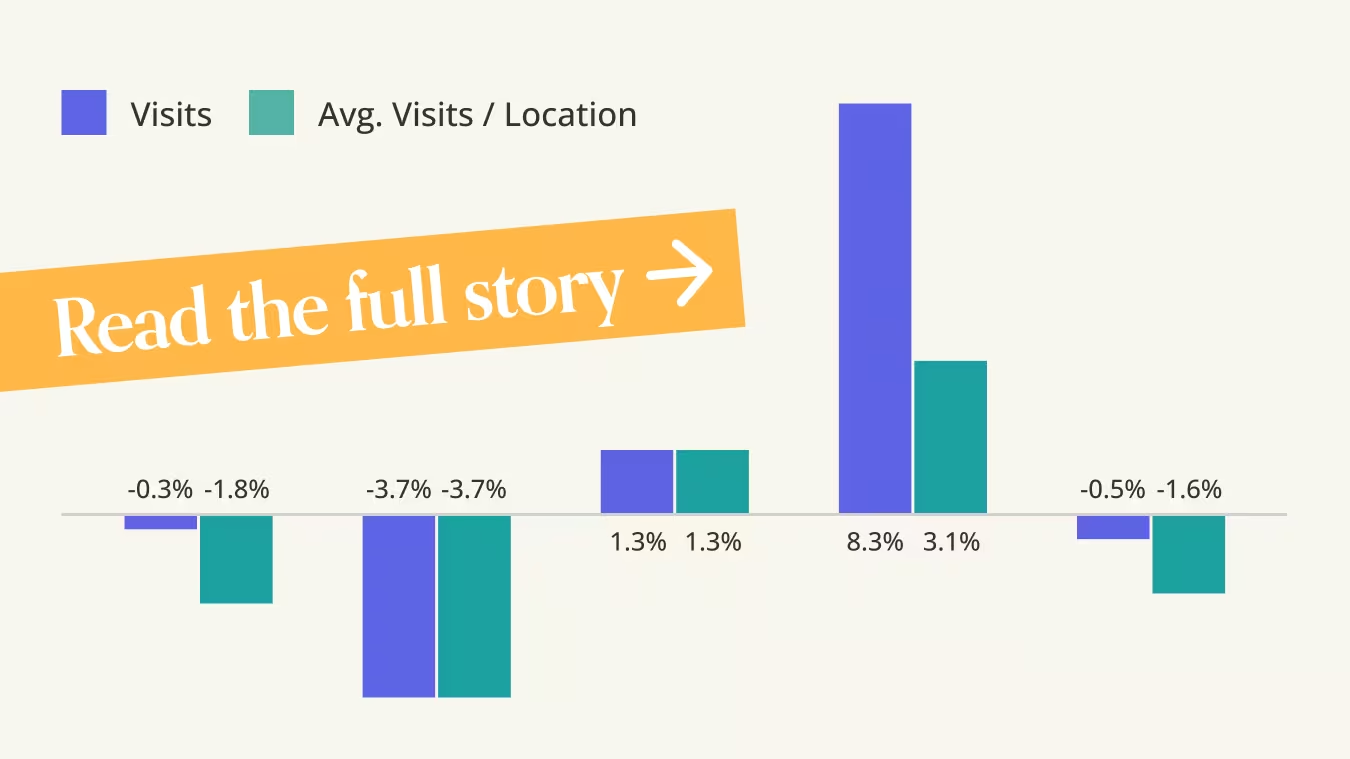
Against this backdrop, Walmart’s stable YoY foot traffic – hovering between +0.8% and -1.6% monthly May through July – is a powerful signal of its continued strength. The data validates the company’s omnichannel strategy, indicating an ability to grow its digital business without materially sacrificing its foundational in-store visitor base.
In contrast, Target has faced meaningful challenges, with YoY same-store visit gaps ranging from 2.2% to 9.7% since February 2025. Like Walmart, Target’s online growth has been a bright spot – last quarter, the company reported a 4.7% increase in digital comp sales, aided by more than 35% growth in same-day delivery. But this was not enough to offset a 5.7% decline in in-store comp sales. And though consumer reactions to Target’s recent policy updates do appear to have contributed to the retailer’s softening YoY performance, persistent challenges point to a more fundamental shift in consumer preferences amid discretionary cutbacks.
Both Walmart and Target are borrowing elements of each other’s playbooks. But consumer visitation data shows that while Walmart and Target can learn from each other, they service fundamentally different shopping missions.
Walmart’s vast scale and extensive grocery selection make it a prime destination for habitual, necessity-driven shopping. Between May and July 2025, about 34.0% of shoppers visited Walmart at least four times a month. Target’s 14% frequent visitor share, on the other hand, reflects its role as a more occasional destination centered on discovery-led shopping experiences – such as its successful Kate Spade collaboration, hailed by the company as the most successful design collab in a decade. While strengthening essentials plays to the current economic climate and likely contributed to the modest increase in Target’s frequent visitors over the past year, the retailer’s future success depends on sharpening – not blurring – its core strengths.
Walmart’s foot traffic stability combined with proven ecommerce growth positions it well to continue outperforming, especially as consumer caution favors essentials and convenience. Furthermore, the retailer’s rebranding and push into broader, discretionary categories may help attract higher-income consumers who are trading down.
Target, for its part, faces a more difficult strategic balancing act in the months ahead. Augmenting its offerings with compelling essentials will be critical. But as demonstrated by the strong performance of retailers like Five Below and T.J. Maxx, there still exists a healthy market for discretionary treasure hunting. Ultimately, Target’s ability to reignite growth will depend on its success in rejuvenating its competitive edge in the discretionary market – a task likely to be further complicated by anticipated tariffs.
For more data-driven retail insights, follow Placer.ai/anchor.

The office recovery is back in full swing. Major employers such as Samsung, Google, and Starbucks have tightened return-to-office (RTO) policies in recent months. And though hybrid work remains prevalent across industries, Q2 2025 saw a majority of Fortune 100 employees subject to full-time in-office mandates – up from just 5.0% in Q2 2023.
In June, accumulating RTO mandates helped shrink the post-pandemic office visit gap to 27.4% compared to the same period in 2019. And July 2025 set a new record for office attendance, with visits down just 21.8% relative to July 2019 (both Julys had 22 working days) – making it the single busiest in-office month since COVID.
Stark regional differences remain, however, between major business hubs nationwide. New York City, where many employees are subject to the stricter in-office requirements of the finance world, saw positive (+1.3%) year-over-six-year (Yo6Y) office foot traffic growth in July 2025 – a first since Placer.ai began tracking these trends. Miami, which has developed a thriving financial sector of its own, followed closely behind, effectively closing its visit gap with a 0.1% lag.
Atlanta and Dallas also made considerable headway – both markets saw visit gaps dip below 20% compared to 2019. Meanwhile, Denver – an emerging hub for tech startups and one of the most remote-friendly labor markets in the U.S. – took up the rear, while San Francisco inched up two notches in the rankings, beating out both Denver and Los Angeles.
Indeed, San Francisco appears to be in the midst of a major revival, with rising rents, improving public sentiment, and waves of new restaurant, retail, and small business openings breathing fresh life into a city once dismissed as stuck in a “doom loop”. And in July 2025, the City by the Bay once again topped the year-over-year (YoY) office recovery charts, outpacing all other analyzed hubs with remarkable 21.6% visit growth – more tangible evidence of the progress San Francisco continues to make.
If past experience is any guide, the road to office recovery will continue to be anything but linear. RTO policies remain far from uniform, and hybrid work continues to serve as a key baseline for many organizations. Still, July 2025 seems to mark a meaningful RTO tipping point, with numerous markets making substantial progress toward pre‐COVID office foot traffic levels.
Follow Placer.ai/anchor for more office visitation insights.

Same-store visit growth at TJX chains in recent months exceeded the company's official guidance of 2-3% same-store sales growth for Q2 FY26 (May 4 - August 2, 2025), aligning with analyst expectations for an earnings beat.
The largest growth in same-store visits went to HomeGoods, which continues to be a key growth engine for TJX, with its outperformance stemming from a multi-faceted competitive edge. Its consistent lead over the core apparel banners, T.J. Maxx and Marshalls, may be due to its more defensible position in the less-crowded off-price home category. And when compared to its sister brand, Homesense, HomeGoods' superior performance may be attributed to its significant brand maturity and a merchandise mix centered on higher-frequency, smaller-ticket items. This positions the banner effectively to capture discretionary spending from consumers seeking affordable indulgences in the current economic environment.
All banners experienced YoY growth in overall traffic, but the strongest growth went to the latest newest additions to the company's U.S. portfolio – Homesense and Sierra, suggesting that both brands have a long runway for unit potential.
Sierra is engineered to capture a significant share of the lucrative outdoor and active lifestyle market, a space that critically lacks a dominant, national, off-price competitor, giving it a clearer and more defensible runway for explosive growth. In contrast, while Homesense plays the vital role of deepening TJX's penetration in the home category with larger-scale items like furniture, it enters a more contested field and must contend with established competition from other discount and value-oriented furniture retailers.
Both expansions are ultimately underpinned by TJX's core competency: leveraging its world-class buying organization and real estate expertise to dominate new off-price segments and capture a larger share of total consumer discretionary spending.
This push into new product categories is happening in parallel with a push into new markets. Year-over-year analysis reveals TJX has systematically expanded its rural and semi-rural household penetration across all banners – aligning with management's stated focus on "smaller markets and smaller footprint stores" as identified growth opportunities. With TJX planning around 130 net new stores in 2025, this rural expansion strategy provides a credible pathway for continued domestic growth in an increasingly competitive retail landscape.
For more data-driven retail insights, visit placer.ai/anchor.
The information, data, analyses and opinions presented herein do not constitute investment advice; are provided solely for informational purposes and therefore are not an offer to buy or sell a security; and are not warranted to be correct, complete or accurate. By means of this publication, Placer Labs Inc. (“Placer”) is not rendering accounting, business, financial, investment, legal, tax or other professional advice or services. This publication is not a substitute for such professional advice or services, nor should it be used as a basis for any decision or action that may affect your business. Before making any decision or taking any action that may affect your business, you should consult a qualified professional advisor.
Placer shall not be responsible for any loss sustained by any person who relies on this publication. The opinions and data presented are as of the date written and are subject to change without notice. The information contained herein is the proprietary property of Placer and may not be reproduced, in whole or in part, or used in any manner, without the prior written consent of Placer.

As the U.S. economy enters the second half of 2025, evidence is mounting that consumers are pulling back on discretionary purchases. This possibility was something we recently discussed when highlighting the divergence between industrial and retail activity. While last week's Amazon Prime Day and other sales events drove a temporary surge in visits for big-ticket and back-to-school items, persistent macroeconomic uncertainty and the first real impacts of tariff-related price increases appear to be taking a toll on consumer confidence. With sentiment remaining fragile, households are becoming more selective, prioritizing essential spending while cutting back on discretionary purchases and travel.
Recently, Placer’s analyst team looked at visitation trends for airports, but we’re also seeing a slowdown in car travel based on visitation data to gas stations. After a sluggish February, foot traffic to gas stations and convenience stores has continued to show year-over-year declines through the spring and into the summer. This trend points to more than just fluctuating fuel prices; it reflects a conscious pullback by consumers who appear to be consolidating trips and reducing non-essential driving. This financial anxiety is causing many to shorten or delay vacation plans, resulting in weaker foot traffic at airports and fewer long-distance road trips.
Our analysis confirms that the traditional summer vacation is being reshaped by this economic uncertainty. Using our new Markets data, we’ve seen a decrease in the average miles traveled during the first half of 2025 for roughly two-thirds of the top 25 most populated markets in the U.S.
This has led to a rise in shorter "micro-cations" rather than extended, long-haul journeys. Consequently, while people are still traveling, the overall distance covered per trip has decreased, a sentiment that also extends to air travel, where a slowdown in both leisure and corporate bookings reflects a broad pullback on expensive, long-distance commitments in favor of more predictable, regional getaways.
As we move through July, the consumer narrative for the second half of 2025 is being defined by a strategic retreat in discretionary spending, particularly travel. While major sales events can still create temporary bursts of activity, the underlying trend shows a more cautious consumer responding to economic pressures by reducing non-essential driving, shortening vacation distances, and opting for more budget-friendly "micro-cations." This shift away from long-haul travel, visible in both gas station and airport traffic data, signals a significant recalibration of household budgets that will likely shape the broader retail and travel landscape for the remainder of the year.

Mall visit trends improved slightly in July 2025. Indoor mall traffic grew 1.3% year-over-year, reversing June's visit declines. This growth highlights indoor malls' rebound and suggests that enclosed shopping centers continue to attract consumers seeking climate-controlled comfort during peak summer heat.
Meanwhile, open-air shopping centers and outlet malls narrowed their visit gaps, with visits to open-air shopping centers almost on par with July 2024 levels and visits to outlet malls just 2.1% lower than this time last year.
Diving into the weekly data reveals a more complex picture. While mid-July visits were generally up relative to 2024 – perhaps boosted by the various July sales events – traffic across all three formats softened towards the end of the month. This may suggest that these major promotional events may be pulling demand forward rather than generating sustained, incremental traffic and highlights the challenge of converting a promotional 'sugar rush' into lasting momentum.
Boise Towne Square significantly outpaced the broader Placer.ai Indoor Mall Index in July, posting 12.2% year-over-year growth versus the national average of 1.3% – extending the Idaho mall's exceptional performance streak throughout 2025. And remarkably, Boise Towne Square has also consistently surpassed its pre-pandemic visit level every month of 2025 so far.
While multiple factors likely contribute to this strength, a major traffic driver has been the new In-N-Out location that opened in the mall in late October 2024. Since the opening, visits to Boise Towne Square have steadily increased, and other tenants – including other dining establishments – have also benefited from sustained visit improvements across the entire mall.
This demonstrates the powerful halo effect that a high-draw non-traditional anchor tenant can create for an entire shopping center.
To check out retail foot traffic trends for yourself, try Placer.ai's free industry trends tool.

1. The hypergrowth of Costco, Dollar Tree, and Dollar General between 2019 and 2025 has fundamentally changed the brick-and-mortar retail landscape.
2. Overall visits to Target and Walmart have remained essentially stable even as traffic to the new retail giants skyrocketed – so the increased competition is not necessarily coming at legacy giants' expense. Instead, each retail giant is filling a different need, and success now requires excelling at specific shopping missions rather than broad market dominance.
3. Cross-shopping has become the new normal, with Walmart and Target maintaining their popularity even as their relative visit shares decline, creating opportunities for complementary rather than purely competitive strategies.
4. Dollar stores are rapidly graduating from "fill-in" destinations to primary shopping locations, signaling a fundamental shift in how Americans approach everyday retail.
5. Walmart still enjoys the highest visit frequency, but the other four chains – and especially Dollar General – are gaining ground in this realm.
6. Geographic and demographic specialization is becoming the key differentiator, as each chain carves out distinct niches rather than competing head-to-head across all markets and customer segments.
Evolving shopper priorities, economic pressures, and new competitors are reshaping how and where Americans buy everyday goods. And as value-focused players gain ground, legacy retail powerhouses are adapting their strategies in a bid to maintain their visit share. In this new consumer reality, shoppers no longer stick to one lane, creating a complex ecosystem where loyalty, geography, and cross-visitation patterns – not just market share – define who is truly winning.
This report explores the latest retail traffic data for Walmart, Target, Costco, Dollar Tree, and Dollar General to decode what consumers want from retail giants in 2025. By analyzing visit patterns, loyalty trends, and cross-shopping shifts, we reveal how fast-growing chains are winning over consumers and uncover the strategies helping legacy players stay competitive in today's value-driven retail landscape.
In 2019, Walmart and Target were the two major behemoths in the brick-and-mortar retail space. And while traffic to these chains remains close to 2019 levels, overall visits to Dollar General, Dollar Tree, and Costco have increased 36.6% to 45.9% in the past six years. Much of the growth was driven by aggressive store expansions, but average visits per location stayed constant (in the case of Dollar Tree) or grew as well (in the case of Dollar General and Costco). This means that these chains are successfully filling new stores with visitors – consumers who in the past may have gone to Walmart or Target for at least some of the items now purchased at wholesale clubs and dollar stores.
This substantial increase in visits to Costco, Dollar General, and Dollar Tree has altered the competitive landscape in which Walmart and Target operate. In 2019, 55.9% of combined visits to the five retailers went to Walmart. Now, Walmart’s relative visit share is less than 50%. Target received the second-highest share of visits to the five retailers in 2019, with 15.9% of combined traffic to the chains. But Between January and July 2025, Dollar General received more visits than Target – even though the discount store had received just 12.1% of combined visits in 2019.
Some of the growth of the new retail giants could be attributed to well-timed expansion. But the success of these chains is also due to the extreme value orientation of U.S. consumers in recent years. Dollar General, Dollar Tree, and Costco each offer a unique value proposition, giving today's increasingly budget-conscious shoppers more options.
Walmart’s strategy of "everyday low prices" and its strongholds in rural and semi-rural areas reflect its emphasis on serving broad, value-focused households – often catering to essential, non-discretionary shopping.
Dollar General serves an even larger share of rural and semi-rural shoppers than Walmart, following its strategy of bringing a curated selection of everyday basics to underserved communities. The retailer's packaging is typically smaller than Walmart's, which allows Dollar General to price each item very affordably – and its geographic concentration in rural and semi-rural areas also highlights its direct competition to Walmart.
By contrast, Target and Costco both compete for consumer attention in suburban and small city settings, where shopper profiles tilt more toward families seeking one-stop-shopping and broader discretionary offerings. But Costco's audience skews slightly more affluent – the retailer attracts consumers who can afford the membership fees and bulk purchasing requirements – and its visit growth may be partially driven by higher income Target shoppers now shopping at Costco.
Dollar Tree, meanwhile, showcases a uniquely balanced real estate strategy. The chain's primary strength lies in suburban and small cities but it maintains a solid footing in both rural and urban areas. The chain also offers a unique value proposition, with a smaller store format and a fixed $1.25 price point on most items. So while the retailer isn't consistently cheaper than Walmart or Dollar General across all products, its convenience and predictability are helping it cement its role as a go-to chain for quick shopping trips or small quantities of discretionary items. And its versatile, three-pronged geographic footprint allows it to compete across diverse markets: Dollar Tree can serve as a convenient, quick-trip alternative to big-box retailers in the suburbs while also providing essential value in both rural and dense urban communities.
As each chain carves out distinct geographic and demographic niches, success increasingly depends on being the best option for particular shopping missions (bulk buying, quick trips, essential needs) rather than trying to be everything to everyone.
Still, despite – or perhaps due to – the increased competition, shoppers are increasingly spreading their visits across multiple retailers: Cross-shopping between major chains rose significantly between 2019 and 2025. And Walmart remains the most popular brick-and-mortar retailer, consistently ranking as the most popular cross-shopping destination for visitors of every other chain, followed by Target.
This creates an interesting paradox when viewed alongside the overall visit share shift. Even as Walmart and Target's total share of visits has declined, their importance as a secondary stop has actually grown. This suggests that the legacy retail giants' dip in market share isn't due to shoppers abandoning them. Instead, consumers are expanding their shopping routines by visiting other growing chains in addition to their regular trips to Walmart and Target, effectively diluting the giants' share of a larger, more fragmented retail landscape.
Cross-visitation to Costco from Walmart, Target, and Dollar Tree also grew between 2019 and 2025, suggesting that Costco is attracting a more varied audience to its stores.
But the most significant jumps in cross-visitation went to Dollar Tree and Dollar General, with cross-visitation to these chains from Target, Walmart, and Costco doubling or tripling over the past six years. This suggests that these brands are rapidly graduating from “fill-in” fare to primary shopping destinations for millions of households.
The dramatic rise in cross-visitation to dollar stores signals an opportunity for all retailers to identify and capitalize on specific shopping missions while building complementary partnerships rather than viewing every chain as direct competition.
Walmart’s status as the go-to destination for essential, non-discretionary spending is clearly reflected in its exceptional loyalty rates – nearly half its visitors return at least three times per month on average -between January to July 2025, a figure virtually unchanged since 2019. This steady high-frequency visitation underscores how necessity-driven shopping anchors customer routines and keeps Walmart atop the retail loyalty ranks.
But the data also reveals that other retail giants – and Dollar General in particular – are steadily gaining ground. Dollar General's increased visit frequency is largely fueled by its strategic emphasis on adding fresh produce and other grocery items, making it a viable everyday stop for more households and positioning it to compete more directly with Walmart.
Target also demonstrates a notable uptick in loyal visitors, with its share of frequent shoppers visiting at least three times a month rising from 20.1% to 23.6% between 2019 and 2025. This growth may suggest that its strategic initiatives – like the popular Drive Up service, same-day delivery options, and an appealing mix of essentials and exclusive brands – are successfully converting some casual shoppers into repeat customers.
Costco stands out for a different reason: while overall visits increased, loyalty rates remained essentially unchanged. This speaks to Costco’s unique position as a membership-based outlet for targeted bulk and premium-value purchases, where the shopping behavior of new visitors tends to follow the same patterns as those of its already-loyal core. As a result, trip frequency – rooted largely in planned stock-ups – remains remarkably consistent even as the warehouse giant grows foot traffic overall.
Dollar Tree currently has the smallest share of repeat visitors but is improving this metric. As it successfully encourages more frequent trips and narrows the loyalty gap with its larger rivals, it's poised to become an increasing source of competition for both Target and Costco.
The increase in repeat visits and cross-shopping across the five retail giants showcases consumers' current appetite for value-oriented mass merchants and discount chains. And although the retail giants landscape may be more fragmented, the data also reveals that the pie itself has grown significantly – so the increased competition does not necessarily need to come at the expense of legacy retail giants.
The retail landscape of 2025 demands a fundamental shift from zero-sum competition to strategic complementarity, where success lies in owning specific shopping missions rather than fighting for total market dominance. Retailers that forego attempting to compete on every front and instead clearly communicate their mission-specific value propositions – whether that's emergency runs, bulk essentials, or family shopping experiences – may come out on top.

1. Market Divergence: While San Francisco's return-to-office trends have stabilized, Los Angeles is increasingly lagging behind national averages with office visits down 46.6% compared to pre-pandemic levels as of June 2025.
2. Commuter Pattern Shifts: Los Angeles faces a persistent decline in out-of-market commuters while San Francisco's share of out-of-market commuters has recovered slightly, indicating deeper structural challenges in LA's office market recovery.
3. Visit vs. Visitor Gap: Unlike other markets where increased visits per worker offset declining visitor numbers, Los Angeles saw both metrics decline year-over-year, suggesting fundamental workforce retention issues.
4. Century City Exception: Century City emerges as LA's strongest office submarket with visits only 28.1% below pre-pandemic levels, driven by its premium amenities and strategic location adjacent to Westfield Century City shopping center.
5. Demographic Advantage: Century City's success may stem from its success in attracting affluent, educated young professionals who value lifestyle integration and are more likely to maintain consistent office attendance in hybrid work arrangements.
While return-to-office trends have stabilized in many markets nationwide, Los Angeles and San Francisco face unique challenges that set them apart from national patterns. This report examines the divergent trajectories of these two major West Coast markets, with particular focus on Los Angeles' ongoing struggles and the emergence of one specific submarket that bucks broader trends.
Through analysis of commuter patterns, demographic shifts, and localized performance data, we explore how factors ranging from out-of-market workforce changes to amenity-driven location advantages are reshaping the competitive landscape for office real estate in Southern California.
Both Los Angeles and San Francisco continue to significantly underperform the national office occupancy average. In June 2025, average nationwide visits to office buildings were 30.5% below January 2019 levels, compared to a 46.6% and 46.4% decline in visits to Los Angeles and San Francisco offices, respectively.
While both cities now show similar RTO rates, they arrived there through different trajectories. San Francisco has consistently lagged behind national return-to-office levels since pandemic restrictions first lifted.
Los Angeles, however, initially mirrored nationwide trends before its office market began diverging and falling behind around mid-2022.
The decline in office visits in Los Angeles and San Francisco can be partly attributed to fewer out-of-market commuters. Both cities saw significant drops in the percentage of employees who live outside the city but commute to work between H1 2019 and H1 2023.
However, here too, the two cities diverged in recent years: San Francisco's share of out-of-market commuters relative to local employees rebounded between 2023 and 2024, while Los Angeles' continued to decline – another indication that LA's RTO is decelerating as San Francisco stabilizes.
Like in other markets, Los Angeles saw a larger drop in office visits than in office visitors when comparing current trends to pre-pandemic levels. This is consistent with the shift to hybrid work arrangements, where many of the workers who returned to the office are coming in less frequently than before the pandemic, leading to a larger drop in visits compared to the drop in visitors.
But looking at the trajectory of RTO more recently shows that in most markets – including San Francisco – office visits are up year-over-year (YoY) while visitor numbers are down. This suggests that the workers slated to return to the office have already done so, and increasing the numbers of visits per visitor is now the path towards increased office occupancy.
In Los Angeles, visits also outperformed visitors – but both figures were down YoY (the gap in visits was smaller than the gap in visitors). So while the visitors who did head to the office in LA in Q2 2025 clocked in more visits per person compared to Q2 2024, the increase in visits per visitor was not enough to offset the decline in office visitors.
While Los Angeles may be lagging in terms of its overall office recovery, the city does have pockets of strength – most notably Century City. In Q2 2025, the number of inbound commuters visiting the neighborhood was just 24.7% lower than it was in Q2 2019 and higher (+1.0%) than last year's levels.
According to Colliers' Q2 2025 report, Century City accounts for 27% of year-to-date leasing activity in West Los Angeles – more than double any other submarket – and commands the highest asking rental rates. The area benefits from Trophy and Class A office towers that may create a flight-to-quality dynamic where tenants migrate from urban core locations to this Westside submarket.
The submarket's success is likely bolstered by its strategic location adjacent to Westfield Century City shopping center – visit data reveals that 45% of weekday commuters to Century City also visited Westfield Century City during Q2 2025. The convenience of accessing the mall's extensive retail, dining, and entertainment options during lunch breaks or after work may encourage employees to come into the office more frequently.
Perhaps thanks to its strategic locations and amenities-rich office buildings, Century City succeeds in attracting relatively affluent office workers.
Century City's office submarket has a higher median trade area household income (HHI) than either mid-Wilshire or Downtown LA. The neighborhood also attracts significant shares of the "Educated Urbanite" Spatial.ai: PersonaLive segment – defined as "well educated young singles living in dense urban areas working relatively high paying jobs".
This demographic typically has fewer family obligations and greater flexibility in their work arrangements, making them more likely to embrace hybrid schedules that include regular office attendance. Affluent singles also tend to value the lifestyle amenities and networking opportunities that come with working in a premium office environment like Century City: This demographic is often in career-building phases where in-person collaboration and visibility matter more, driving consistent office utilization that helps sustain the submarket's performance even as other LA office areas struggle with lower occupancy rates.
The higher disposable income of this audience also aligns well with the submarket's upscale retail and dining options at nearby Westfield Century City, creating a mutually reinforcing ecosystem where the office environment and surrounding amenities cater to their preferences.
As the broader Los Angeles market grapples with a shrinking commuter base and declining office utilization, the performance gap between premium, amenity-rich locations and traditional office districts is likely to widen. For investors and tenants alike, these trends underscore the growing importance of location quality, demographic targeting, and lifestyle integration in determining long-term office market viability across Southern California.
Century City's success – anchored by its affluent, career-focused workforce and integrated lifestyle amenities – can offer a blueprint for office market resilience in the hybrid work era.

1. Appetite for offline retail & dining is stronger than ever. Both retail and dining visits were higher in H1 2025 than they were pre-pandemic.
2. Consumers are willing to go the extra mile for the perfect product or brand. The era of one-stop-shops may be waning, as many consumers now prefer to visit multiple chains or stores to score the perfect product match for every item on their shopping list.
3. Value – and value perception – gives chains a clear advantage. Value-oriented retail and dining segments have seen their visits skyrocket since the pandemic.
4. Consumer behavior has bifurcated toward budget and premium options. This trend is driving strength at the ends of the spectrum while putting pressure on many middle-market players.
5. The out-of-home entertainment landscape has been fundamentally altered. Eatertainment and museums have stabilized at a different set point than pre-COVID, while movie theater traffic trends are now characterized by box-office-driven volatility.
6. Hybrid work permanently reshaped office utilization. Visits to office buildings nationwide are still 33.3% below 2019 levels, despite RTO efforts.
The first half of 2025 marked five years since the onset of the pandemic – an event that continues to impact retail, dining, entertainment, and office visitation trends today.
This report analyzes visitation patterns in the first half of 2025 compared to H1 2019 and H1 2024 to identify some of the lasting shifts in consumer behavior over the past five years. What is driving consumers to stores and dining venues? Which categories are stabilizing at a higher visit point? Where have the traffic declines stalled? And which segments are still in flux? Read the report to find out.
In the first half of 2025, visits to both the retail and dining segments were consistently higher than they were in 2019. In both the dining and the retail space, the increases compared to pre-COVID were probably driven by significant expansions from major players, including Costco, Chick-fil-A, Raising Cane's, and Dutch Bros, which offset the numerous retail and dining closures of recent years.
The overall increase in visits indicates that, despite the ubiquity of online marketplaces and delivery services, consumer appetite for offline retail and dining remains strong – whether to browse in store, eat on-premises, collect a BOPIS order, or pick up takeaway.
A closer look at the chart above also reveals that, while both retail and dining visits have exceeded pre-pandemic levels, retail visit growth has slightly outpaced the dining traffic increase.
The larger volume of retail visits could be due to a shift in consumer behavior – from favoring convenience to prioritizing the perfect product match and exhibiting a willingness to visit multiple chains to benefit from each store's signature offering. Indeed, zooming into the superstore and grocery sector shows an increase in cross-shopping since COVID, with a larger share of visitors to major grocery chains regularly visiting superstores and wholesale clubs. It seems, then, that many consumers are no longer looking for a one-stop-shop where they can buy everything at once. Instead, shoppers may be heading to the grocery stores for some things, the dollar store for other items, and the wholesale club for a third set of products.
This trend also explains the success of limited assortment grocers in recent years – shoppers are willing to visit these stores to pick up their favorite snack or a particularly cheap store-branded basic, knowing that this will be just one of several stops on their grocery run.
Diving into the traffic data by retail category reveals that much of the growth in retail visits since COVID can be attributed to the surge in visits to value-oriented categories, such as discount & dollar stores, value grocery stores, and off-price apparel. This period has been defined by an endless array of economic obstacles like inflation, recession concerns, gas price spikes, and tariffs that all trigger an orientation to value. The shift also speaks to an ability of these categories to capitalize on swings – consumers who visited value-oriented retailers to cut costs in the short term likely continued visiting those chains even after their economic situation stabilized.
Some of the visit increases are due to the aggressive expansion strategies of leaders in those categories – including Dollar General and Dollar Tree, Aldi, and all the off-price leaders. But the dramatic increase in traffic – around 30% for all three categories since H1 2019 – also highlights the strong appetite for value-oriented offerings among today's consumers. And zooming into YoY trends shows that the visit growth is still ongoing, indicating that the demand for value has not yet reached a ceiling.
While affordable pricing has clearly driven success for value retailers, offering low prices isn't a guaranteed path to growth. Although traffic to beauty and wellness chains remains significantly higher than in 2019, this growth has now plateaued – even top performers like Ulta saw slight YoY declines following their post-pandemic surge – despite the relatively affordable price points found at these chains.
Some of the beauty visit declines likely stems from consumers cutting discretionary spending – but off-price apparel's ongoing success in the same non-essential category suggests budget constraints aren't the full story. Instead, the plateauing of beauty and drugstore visits while off-price apparel visits boom may be due to the difference in value perception: Off-price retailers are inherently associated with savings, while drugstores and beauty retailers, despite carrying affordable items, lack that same value-driven brand positioning. This may suggest that in today's market, perceived value matters as much as actual affordability.
Another indicator of the importance of value perception is the decline in visits to chains selling bigger-ticket items – both home furnishing chains and electronic stores saw double-digit drops in traffic since H1 2019.
And looking at YoY trends shows that visits here have stabilized – like in the beauty and drugstore categories – suggesting that these sectors have reached a new baseline that reflects permanently shifted consumer priorities around discretionary spending.
A major post-pandemic consumer trend has been the bifurcation of consumer spending – with high-end chains and discount retailers thriving while the middle falls behind. This trend is particularly evident in the apparel space – although off-price visits have taken off since 2019 (as illustrated in the earlier graph) overall apparel traffic declined dramatically – while luxury apparel traffic is 7.6% higher than in 2019.
Dining traffic trends also illustrate this shift: Categories that typically offer lower price points such as QSR, fast casual, and coffee have expanded significantly since 2019, as has the upscale & fine dining segment. But casual dining – which includes classic full-service chains such as Red Lobster, Applebee's, and TGI Fridays – has seen its footprint shrink in recent years as consumers trade down to lower-priced options or visit higher-end venues for special occasions.
Chili's has been a major exception to the casual dining downturn, largely driven by the chain's success in cementing its value-perception among consumers – suggesting that casual dining chains can still shine in the current climate by positioning themselves as leaders in value.
Consumers' current value orientation seems to be having an impact beyond the retail and dining space: When budgets are tight, spending money in one place means having less money to spend in another – and recent data suggests that the consumer resilience in retail and dining may be coming at the expense of travel – or perhaps experiences more generally.
While airport visits from domestic travelers were up compared to pre-COVID, diving into the data reveals that the growth is mostly driven by frequent travelers visiting airports two or more times in a month. Meanwhile, the number of more casual travelers – those visiting airports no more than once a month – is lower than it was in 2019.
This may suggest that – despite consumers' self-reported preferences for "memorable, shareable moments" – at least some Americans are actually de-prioritizing experiences in the first half of 2025, and choosing instead to spend their budgets in retail and dining venues.
The out of home entertainment landscape has also undergone a significant change since COVID – and the sector seems to have settled into a new equilibrium, though for part of the sector, the equilibrium is marked by consistent volatility.
Eatertainment chains – led by significant expansions from venues like Top Golf – saw a 5.5% visit increase compared to pre-pandemic levels, though YoY growth remained modest at 1.1%. On the other hand, H1 2025 museum traffic fell 10.9% below 2019 levels with flat YoY performance (+0.2%). The minimal year-over-year changes in both categories suggest that these entertainment segments have found their new post-COVID equilibrium.
The rise of eatertainment alongside the drop in museum visits may also reflect the intense focus on value for today's consumers. Museums in 2025 offer essentially the same value proposition that they offered in 2019 – and for some, that value proposition may no longer justify the entrance fee. But eatertainment has gained popularity in recent years as a format that offers consumers more bang for their buck relative to stand-alone dining or entertainment venues – which makes it the perfect candidate for success in today's value-driven consumer landscape.
But movie theaters traffic trends are still evolving – even accounting for venue closures, visits in H1 2025 were well below H1 2019 levels. But compared to 2024, movie traffic was also up – buoyed by the release of several blockbusters that drove audiences back to cinemas in the first half of 2025. So while the segment is still far from its pre-COVID baseline, movie theaters retain the potential for significant traffic spikes when compelling content drives consumer demand.
The blockbuster-driven YoY increase can perhaps also be linked to consumers' spending caution. With budgets tight, movie-goers may want to make sure that they're spending time and money on films they are sure to enjoy – taking fewer risks than they did in 2019, when movie tickets and concession prices were lower and consumers were less budget-conscious.
H1 2025 also brought some moderate good news on the return to office (RTO) front, with YoY visits nationwide up 2.1% and most offices seeing YoY office visit increases – perhaps due to the plethora of RTO mandates from major companies. But comparing office visitation levels to pre pandemic levels highlights the way left to go – nationwide visits were 33.3% below H1 2019 levels in H1 2025, with even RTO leaders New York and Miami still seeing 11.9% and 16.1% visit gaps, respectively.
So while the data suggests that the office recovery story is still being written – with visits inching up slowly – the substantial gap from pre-pandemic levels suggests that remote and hybrid work models have fundamentally reshaped office utilization patterns.
Five years post-pandemic, consumer behavior across the retail, dining, entertainment, and office spaces has crystallized into distinct new patterns.
Traffic to retail and dining venues now surpasses pre-pandemic levels, driven primarily by value-focused segments. But retail and dining segments that cater to higher income consumers –such as luxury apparel and fine dining – have also stabilized at a higher level, highlighting the bifurcation of consumer behavior that has emerged in recent years. Entertainment formats show more variability – while eatertainment traffic has settled above and museums below 2019 levels, and movie theaters still seeking stability. Office spaces remain the laggard, with visits well below pre-pandemic levels despite corporate return-to-office initiatives showing modest impact.
It seems, then, that the new consumer landscape rewards businesses that can clearly articulate their value proposition to attract consumers' increasingly selective spending and time allocation – or offer a premium product or experience catering to higher-income audiences.