.png)
.png)

.png)
.png)


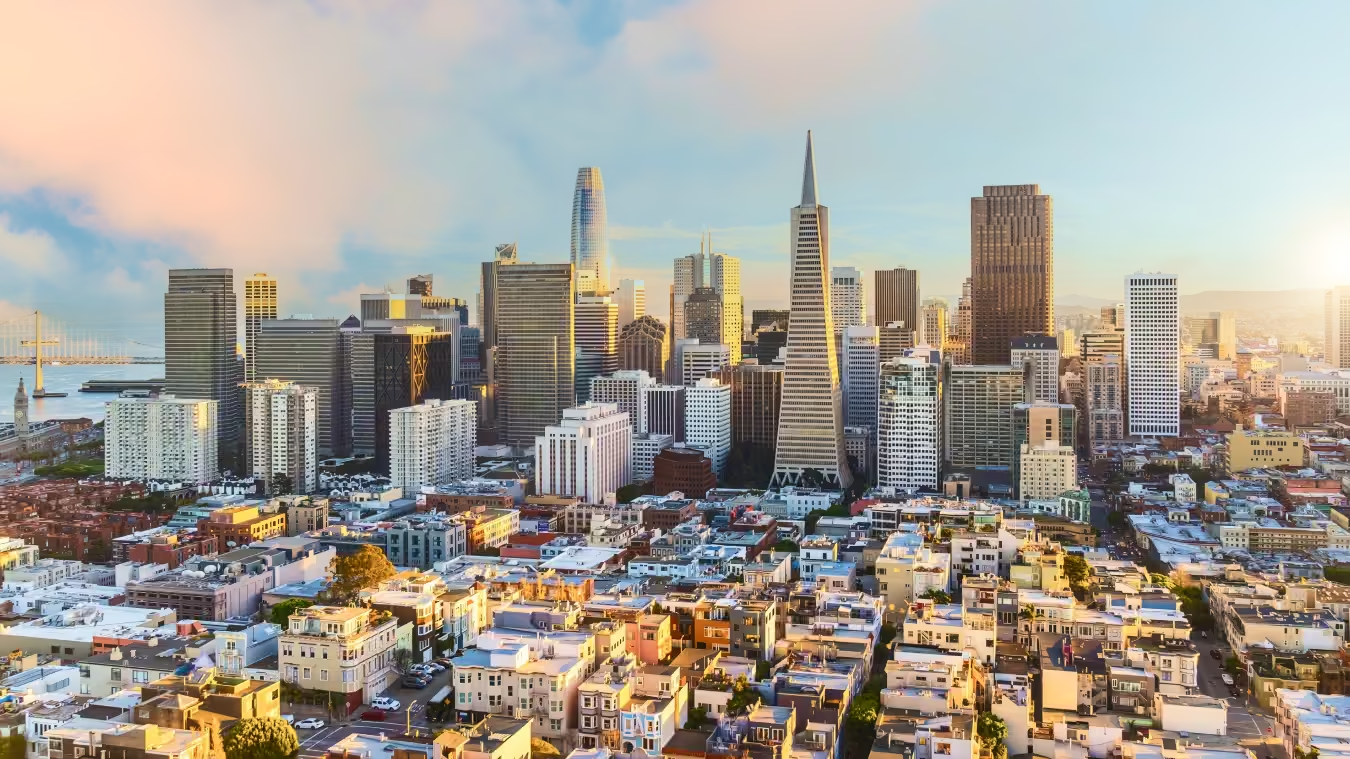
Super Bowl LX kicked off on Sunday, February 8th at Levi’s Stadium in Santa Clara, but celebrations across the Bay Area – from fan festivals and concerts to immersive cultural activations – began well before game day.
An AI-powered analysis of two marquee Super Bowl week events – the Ferry Building Projection Show and Chris Stapleton’s concert at the Bill Graham Civic Auditorium – highlights the role pre-game attractions played in extending the championship into a multi-day driver of regional foot traffic.
Between February 5th and 7th – the three nights leading up to the Super Bowl – San Francisco’s iconic Ferry Building became the canvas for a large-scale projection show celebrating 60 years of Super Bowl history. Comparing evening visits during the installation to the nightly average since January 1st, 2025 highlights the magnitude of the crowds drawn downtown for the spectacle.
The Ferry Building is no stranger to major surges in visitation tied to visual events. On July 4th, 2025, visits to the area were 217.5% above the daily average as fireworks lit up the Bay, while New Year’s Eve drove an even larger spike of 336.9%. Other recent activations – including a drone light show on October 8th and the multi-day “Let’s Glow SF” installation from December 5th to 14th – also generated noticeable visit increases.
But, the pre-Super Bowl Projection Show stood apart. Evening visits to the Ferry Building spiked by 141.6% on the first night of the installation and by 265.7% on the second. On the eve of the Super Bowl, February 7th, visits surged 479.1% above the nightly average, surpassing every other evening visit peak observed over the previous twelve months. This shows that the event was not only visually compelling, but also exceptionally effective at drawing crowds into the city core during Super Bowl week.
While the Ferry Building Projection Show was a major draw in its own right, many attendees treated it as just one stop on a broader evening itinerary.
Location intelligence shows that 18.2% of visitors to the projection show also made an evening visit to Moscone Center, home of the Super Bowl LX Experience between February 3rd and 7th. Other popular destinations included Pier 39, Ghirardelli Square, and the Fillmore Shopping District – all well-established tourist and retail corridors.
Regional indoor shopping centers also benefited from an influx of visitors. Serramonte Center and Stonestown Galleria ranked among the more common evening stops for projection show attendees, a pattern that could suggest travelers sought warm, indoor environments for dining and shopping after spending time along the waterfront.
Taken together, the data indicates that Super Bowl-themed activations drove visit spikes while generating spillover benefits for a diverse mix of retail, dining, and entertainment destinations across the Bay Area.
Among Super Bowl week’s most anticipated and in-demand ticketed events was Chris Stapleton’s concert at the Bill Graham Civic Auditorium on February 7th.
With limited ticket availability and a premium price-tag, the concert drew a notably affluent audience. On the day of the show, households classified as “Ultra Wealthy Families” accounted for 45.5% of the venue’s captured market, compared to 23.5% across the prior twelve months. Similarly, households earning more than $175K represented 46.5% of the venue’s captured market on concert day, well above the 34.9% average observed over the previous year. These shifts demonstrate the robust demand for exclusive Super Bowl week experiences among higher-income music fans.
But affluence alone only tells part of the story. Using location intelligence to examine visitor journeys offers clearer insight into the concert’s audience – whether it skewed local or was bolstered by visiting Super Bowl guests.
Trade area analysis reveals that 36.6% of visitors to the Bill Graham Civic Auditorium on the day of the show traveled between 10 and 30 miles – a higher share than usual for the venue, indicating stronger representation from the extended Bay Area.
At the same time, the event also drew a meaningful influx of long-distance travelers. Visitors coming from more than 250 miles away accounted for 12.9% of concertgoers on February 7th, up from 8.0% over the previous twelve months. This increase suggests that many Super Bowl tourists incorporated the high-profile live show into their itineraries, reinforcing the role of major concerts as drivers of valuable traffic during destination sporting events.
For civic leaders, major activations like these highlight how strategic programming can amplify the regional impact of tentpole sporting events – generating surges in visitation and meaningful spillover to retail corridors, entertainment districts, and shopping centers.
For more data-driven civic insights, visit placer.ai/anchor.
Placer.ai leverages a panel of tens of millions of devices and utilizes machine learning to make estimations for visits to locations across the US. The data is trusted by thousands of industry leaders who leverage Placer.ai for insights into foot traffic, demographic breakdowns, retail sale predictions, migration trends, site selection, and more.

Wingstop closed out Q4 2025 with soft same-store traffic but a clearly defined strategic trajectory. While same-store visits remained under pressure, performance in Dallas – the brand’s most mature market – suggests that improvements in operational efficiency could play a central role in unlocking Wingstop’s next phase of growth.
Wingstop continued to expand its physical footprint in Q4 2025, driving total chain-wide traffic up 1.0% year over year (YoY) for the quarter and 4.5% for 2025 as a whole. At the same time, same-store traffic remained soft, extending a pattern that persisted throughout the second half of the year.
Some of that pressure reflects a challenging baseline comparison. Wingstop is lapping an unusually strong 2024, when domestic same-store sales surged nearly 20% YoY – setting a high bar for subsequent growth. The decline in same-store visits also aligns with the brand’s deliberate shift toward off-premise occasions: By Q3 2025, 72.8% of Wingstop’s sales were digital, underscoring the brand’s evolution into a tech-led, delivery-forward concept.
Still, looking more closely at Wingstop’s Dallas, TX market – home to the majority of its company-owned restaurants – offers a compelling signal for how the brand can reverse recent traffic trends. In 2025 earnings calls, management repeatedly pointed to Dallas as a top performer, attributing its resilience to the early integration of the chain’s AI-powered Smart Kitchen platform.
Piloted in Dallas before its nationwide rollout in late 2025, the AI-powered system is designed to optimize throughput and accuracy to deliver a more consistent pickup experience. And location analytics appear to support management’s view: In Q4 2025, 44.5% of Wingstop visits in the Dallas DMA lasted under ten minutes, compared to 40.8% nationwide.
Comparing YoY performance for shorter and longer visits to Wingstop – both in Dallas and nationwide – further highlights the growing importance of speed of service. In Q4 2025, visits lasting under ten minutes increased YoY on a per-location basis nationwide, with even stronger gains in Dallas, while longer visits continued to lag.
Crucially, although Dallas was not immune to the broader pressures weighing on longer visits, its YoY decline was notably less severe than the national trend. This divergence suggests that, beyond reducing wait times, the faster and more accurate service enabled by the Smart Kitchen platform may be contributing to a stronger overall visitor experience.
Location analytics suggest that operational improvements and faster service are beginning to translate into stronger traffic for Wingstop. And with the chain’s new loyalty platform set to launch nationwide later this year the brand may be poised for renewed same-store momentum.
For more data-driven dining insights, follow Placer.ai/anchor.
Placer.ai leverages a panel of tens of millions of devices and utilizes machine learning to make estimations for visits to locations across the US. The data is trusted by thousands of industry leaders who leverage Placer.ai for insights into foot traffic, demographic breakdowns, retail sale predictions, migration trends, site selection, and more.

The return to office was put to the test last month as a slew of new RTO mandates took effect – coinciding with the late-January arrival of Winter Storm Fern. With policies pulling in one direction and weather disruptions pulling in the other, how were offices impacted on the ground?
January 2026 delivered a reminder that return-to-office progress is anything but linear – but it is still gaining ground. Despite Winter Storm Fern disrupting travel and commutes across large parts of the country toward the end of the month, office attendance continued its gradual recovery. Visits to the Nationwide Office Index were 38.3% below January 2019 levels, a modest improvement from January 2025, when a Polar Vortex similarly inhibited commutes.
And while total monthly visits came in slightly below January 2024 levels, adjusting for the number of working days reveals a more encouraging picture. On a per-working-day basis, January 2026 was the busiest in-office January since COVID – no small feat in a month when ice and snow covered large swaths of the contiguous U.S. for several days. The fact that offices were generally fuller than in prior Januaries, even amid widespread disruptions, points to a robust underlying RTO trajectory.
Fern’s influence becomes clearer, however, when zooming in on individual metros. Cities that avoided the worst of the storm generally posted stronger year-over-year (YoY) gains, while heavily impacted markets saw flatter or negative results. Miami, for example, continued to record YoY increases, while New York City – hit hard by Fern – saw visits edge down 0.3% YoY.
Last year’s winter conditions also played a meaningful role in YoY comparisons. Both Dallas and Houston were affected by Fern this January, though Dallas bore the brunt of the storm, with snow, ice, travel disruptions, and flight cancellations contributing to a 6.7% YoY drop in office visits. Houston, by contrast, experienced more limited disruption in January 2026 and posted a YoY increase – in part because it was lapping the January 2025 Gulf Coast Blizzard, which saw rare snow accumulations effectively shut the city down. In other words, Houston’s biggest weather-related disruption occurred last winter, while Dallas faced a more acute shock this year.
Washington, D.C.’s 3.2% YoY uptick and Atlanta’s 9.1% gain similarly reflect comparisons to January 2025, when both markets were hampered by extreme winter weather. But these rebounds also point to underlying recovery momentum – especially for Atlanta, which, despite being impacted by Fern, ranked third among the analyzed cities for post-pandemic office recovery.
Meanwhile, West Coast markets that were largely spared severe winter conditions posted the strongest year-over-year gains. Los Angeles and San Francisco led the pack, with YoY increases of 15.6% and 10.9%, respectively.
In today’s hybrid workplace, weather disruptions have become an increasingly accepted reason to skip the commute and work from home. And as a result, January – one of the most weather-prone months of the year – has emerged as a softer period for office attendance, regardless of broader RTO momentum.
Still, when adjusting for the number of working days, office visits this January marked a meaningful improvement over last year – further evidence that return-to-office progress continues to move steadily forward.
For more data-driven office recovery analyses, visit Placer.ai/anchor.
Placer.ai leverages a panel of tens of millions of devices and utilizes machine learning to make estimations for visits to locations across the US. The data is trusted by thousands of industry leaders who leverage Placer.ai for insights into foot traffic, demographic breakdowns, retail sale predictions, migration trends, site selection, and more.

The fast casual space has become an increasingly competitive battleground for share-of-stomach as price-sensitive consumers trade down to lower-cost food channels. Against this backdrop, CAVA and sweetgreen offer a timely case study in resilience. Both brands continue to expand their footprints and diversify their audiences while leaning on loyalty programs and menu innovation to sustain growth during a volatile period for the dining sector. Using AI-powered location analytics, we uncover how macroeconomic pressures have shaped foot traffic trends to both chains and explore the strategies helping to keep them on a positive growth trajectory.
CAVA and sweetgreen continue to pursue aggressive expansion strategies, contributing to the overall visit growth of both brands. But while CAVA showed relative stability in both overall visits and same-store performance in H2 2025, sweetgreen experienced softer year-over-year (YoY) visit growth and moderate same-store visit declines in most months – raising the possibility of emerging “bowl fatigue.”
In Q4 2025, CAVA posted 16.6% YoY visit growth, with loyalty program enhancements and a holiday campaign likely helping to sustain visits.
Sweetgreen’s 4.4% visit growth in Q4 2025 was moderate by comparison, although December stood out for delivering positive YoY visits and same-store visits. This boost may have been driven by the value-focused $10 Harvest Bowl promotion alongside continued adoption of the brand’s refreshed loyalty program.
For both chains, revamped loyalty programs and continued expansion may set the stage for growth in the year ahead.
Even as refreshed loyalty programs and expansion act as growth levers, both chains have recently called out a shared headwind – softer engagement among Gen Z and Millennial diners amid sustained financial pressure on younger consumers.
However, AI-powered captured market analysis combined with the Spatial.ai: PersonaLive dataset suggests early signs of renewed momentum. In Q4 2025, both chains saw an increased share of visitors from the “Young Urban Singles” segment – a cohort that skews heavily Gen Z and Millennial – compared to Q4 2024. And sweetgreen saw growth in its “Educated Urbanites” segment – another cohort that skews heavily Gen Z and Millennial, and which makes up a large share of the chain’s captured market. These shifts could indicate that both brands reclaimed some younger traffic toward the end of the year.
At the same time, both brands saw broader audience diversification within their captured markets. Sweetgreen increased its share of “Wealthy Suburban Families”, while CAVA saw gains among “Upper Suburban Diverse Families” and “Near-Urban Diverse Families”. This suggests that growth among older and more financially stable segments is likely helping to offset some of the pullback from younger diners.
And while some of CAVA and sweetgreen’s suburban and near-urban audience gains likely reflect both chains’ continued unit expansion beyond urban cores, the rise in young urban traffic indicates that strategic initiatives are resonating with traditional audiences. Menu innovation and tools that give diners greater control over nutritional inputs – particularly offerings aligned with protein-forward trends – may be helping to re-engage young urban diners.
As consumer budgets remain under pressure, CAVA and sweetgreen illustrate that sustaining momentum in today’s dining landscape requires a deliberate, multi-pronged strategy. Thoughtful real estate decisions can expand a brand’s consumer base while innovation and loyalty programs keep existing audiences engaged.
The broader industry takeaway is clear: brands that deepen relevance across multiple consumer segments may be best positioned to compete for share-of-stomach in the months ahead.
Which restaurant brands will succeed in 2026? Visit Placer.ai/anchor to find out.
Placer.ai leverages a panel of tens of millions of devices and utilizes machine learning to make estimations for visits to locations across the US. The data is trusted by thousands of industry leaders who leverage Placer.ai for insights into foot traffic, demographic breakdowns, retail sale predictions, migration trends, site selection, and more.

Malls started the year on a strong note, with year-over-year traffic increases across all three mall formats. Open-air shopping centers received the largest gains, with visits up 6.2% compared to January 2025. Indoor malls, which outperformed the other formats for much of 2025, also posted solid growth of 4.5% YoY – a notable result given their already strong performance last January. Even outlet malls, which struggled to maintain growth momentum for most of 2025, saw a 3.6% increase in visits – perhaps suggesting that consumers are entering 2026 more willing to return to discretionary shopping destinations after a cautious 2025.
A closer look at the data suggests that a meaningful share of last month’s mall traffic may have been driven by post-holiday retail returns. There is some evidence that return activity was higher this January than in January 2025, and the timing of visits supports this interpretation.
Mall traffic was heavily front-loaded to the first two weeks of the year – consistent with the post-holiday returns window – with visit growth already beginning to moderate during the third week of January. (The more pronounced decline in traffic observed in the final week of the month was likely driven by the impact of Winter Storm Fern, which weighed on visits across all mall formats).
Visit duration patterns further support the idea that increased returns activity drove much of January’s mall traffic surge – the largest gains were concentrated in short visits, with trips lasting 10 minutes or less increasing by double digits across all mall formats.
At the same time, the data also shows year-over-year growth in longer visits, indicating that higher-quality, more engaged mall trips increased in January 2026 as well. So while post-holiday returns clearly played a role in driving January foot traffic, the simultaneous growth in longer trips suggests that shoppers were also spending time browsing or making additional purchases.
As 2026 unfolds, this blend of efficiency and engagement will be a key dynamic to watch: consumers appear increasingly willing to re-enter physical retail spaces, but they remain intentional about how they shop. Mall formats that can seamlessly support quick, frictionless visits while also encouraging extended dwell time may be best positioned to capture both sides of evolving consumer behavior in the year ahead.
For more data-driven retail insights, visit placer.ai/anchor.
Placer.ai leverages a panel of tens of millions of devices and utilizes machine learning to make estimations for visits to locations across the US. The data is trusted by thousands of industry leaders who leverage Placer.ai for insights into foot traffic, demographic breakdowns, retail sale predictions, migration trends, site selection, and more.

Year-over-year (YoY) visit performance for RBI chains was mixed in Q4 2025. Burger King (0.7%) and Popeyes (-0.5%) had nearly flat foot traffic, while Firehouse Subs (3.9%) had more significant growth. Meanwhile, Tim Hortons (-4.5%) experienced a significant visit gap.
Foot traffic trends across RBI brands in Q4 2025 reveal a divide in chain performance. Burger King and Firehouse Subs were the primary drivers of domestic visit growth, while Popeyes and Tim Hortons experienced softer traffic patterns.
As the monthly visit graph below shows, Burger King’s Q4 2025 momentum came mostly in December 2025, coinciding with the brand’s limited-time SpongeBob Movie Menu and its 13 Days of Deals promotion. Meanwhile, Firehouse Subs sustained visit growth throughout Q4 2025, supported by continued expansion of its store footprint.
Popeyes visits and same-store visits tracked closely and remained largely flat in Q4 2025, pointing to continued challenges for the brand. RBI has emphasized long-term operational improvements and a renewed focus on core menu items as key levers for improving Popeyes’ performance, and while the impact of these initiatives has yet to materialize in the visit data, they could begin to support meaningful growth in 2026.
Domestic traffic to Tim Hortons – a relatively small chain in the U.S. coffee space – lagged significantly in Q4 2025. However, RBI has signaled ambitions to replicate the brand’s international success domestically, leveraging a robust promotional calendar and an accelerated expansion strategy that could help lift brand awareness and strengthen consumer loyalty over time.
What’s next for these brands in 2026? Visit Placer.ai/anchor to find out.
Placer.ai leverages a panel of tens of millions of devices and utilizes machine learning to make estimations for visits to locations across the US. The data is trusted by thousands of industry leaders who leverage Placer.ai for insights into foot traffic, demographic breakdowns, retail sale predictions, migration trends, site selection, and more.

This report leverages location intelligence data to analyze the auto dealership market in the United States. By looking at visit trends to branded showrooms, used car lots, and mixed inventory dealerships – and analyzing the types of visitors that visit each category – this white paper sheds light on the state of car dealership space in 2023.
Prior to the pandemic and throughout most of 2020, visits to both car brand and used-only dealerships followed relatively similar trends. But the two categories began to diverge in early 2021.
Visits to car brand dealerships briefly returned to pre-pandemic levels in mid-2021, but traffic fell consistently in the second half of the year as supply-chain issues drove consistent price increases. So despite the brief mid-year bump, 2021 ended with overall new car sales – as well as overall foot traffic to car brand dealerships – below 2019 levels. Visits continued falling in 2022 as low inventory and high prices hampered growth.
Meanwhile, although the price for used cars rose even more (the average price for a new and used car was up 12.1% and 27.1% YoY, respectively, in September 2021), used cars still remained, on average, more affordable than new ones. So with rising demand for alternatives to public transportation – and with new cars now beyond the reach of many consumers – the used car market took off and visits to used car dealerships skyrocketed for much of 2021 and into 2022. But in the second half of last year, as gas prices remained elevated – tacking an additional cost onto operating a vehicle – visits to used car dealerships began falling dramatically.
Now, the price of both used and new cars has finally begun falling slightly. Foot traffic data indicates that the price drops appear to be impacting the two markets differently. So far this year, sales and visits to dealerships of pre-owned vehicles have slowed, while new car sales grew – perhaps due to the more significant pent-up demand in the new car market. The ongoing inflation, which has had a stronger impact on lower-income households, may also be somewhat inhibiting used-car dealership visit growth. At the same time, foot traffic to used car dealerships did remain close to or slightly above 2019 levels for most of 2023, while visits to branded dealerships were significantly lower year-over-four-years.
The situation remains dynamic – with some reports of prices creeping back up – so the auto dealership landscape may well continue to shift going into 2024.
With car prices soaring, the demand for pre-owned vehicles has grown substantially. Analyzing the trade area composition of leading dealerships that sell used cars reveals the wide spectrum of consumers in this market.
Dealerships carrying a mixed inventory of both new and used vehicles seem to attract relatively high-income consumers. Using the STI: Popstats 2022 data set to analyze the trade areas of Penske Automotive, AutoNation, and Lithia Auto Stores – which all sell used and new cars – reveals that the HHI in the three dealerships’ trade areas is higher than the nationwide median. Differences did emerge within the trade areas of the mixed inventory car dealerships, but the range was relatively narrow – between $77.5K to $84.5K trade area median HHI.
Meanwhile, the dealerships selling exclusively used cars – DriveTime, Carvana, and CarMax – exhibited a much wider range of trade area median HHIs. CarMax, the largest used-only car dealership in the United States, had a yearly median HHI of $75.9K in its trade area – just slightly below the median HHI for mixed inventory dealerships Lithia Auto Stores and AutoNation and above the nationwide median of $69.5K. Carvana, a used car dealership that operates according to a Buy Online, Pick Up in Store (BOPIS) model, served an audience with a median HHI of $69.1K – more or less in-line with the nationwide median. And DriveTime’s trade areas have a median HHI of $57.6K – significantly below the nationwide median.
The variance in HHI among the audiences of the different used-only car dealerships may reflect the wide variety of offerings within the used-car market – from virtually new luxury vehicles to basic sedans with 150k+ miles on the odometer.
Visits to car brands nationwide between January and September 2023 dipped 0.9% YoY, although several outliers reveal the potential for success in the space even during times of economic headwinds.
Visits to Tesla’s dealerships have skyrocketed recently, perhaps thanks to the company’s frequent price cuts over the past year – between September 2022 and 2023, the average price for a new Tesla fell by 24.7%. And with the company’s network of Superchargers gearing up to serve non-Tesla Electric Vehicles (EVs), Tesla is finding room for growth beyond its already successful core EV manufacturing business and positioning itself for a strong 2024.
Japan-based Mazda used the pandemic as an opportunity to strengthen its standing among U.S. consumers, and the company is now reaping the fruits of its labor as visits rise YoY. Porsche, the winner of U.S New & World Report Best Luxury Car Brand for 2023, also outperformed the wider car dealership sector. Kia – owned in part by Hyundai – and Hyundai both saw their foot traffic increase YoY as well, thanks in part to the popularity of their SUV models.
Analyzing dealerships on a national level can help car manufacturers make macro-level decisions on marketing, product design, and brick-and-mortar fleet configurations. But diving deeper into the unique characteristics of each dealership’s trade area on a state level reveals differences that can serve brands looking to optimize their offerings for their local audience.
For example, analyzing the share of households with children in the trade areas of four car brand dealership chains in four different states reveals significant variation across the regional markets.
Nationwide, Tesla served a larger share of households with children than Kia, Ford, or Land Rover. But focusing on California shows that in the Golden State, Kia’s trade area population included the largest share of this segment than the other three brands, while Land Rover led this segment in Illinois. Meanwhile, Ford served the smallest share of households with children on a nationwide basis – but although the trend held in Illinois and Pennsylvania, California Ford dealerships served more households with children than either Tesla or Land Rover.
Leveraging location intelligence to analyze car dealerships adds a layer of consumer insights to industry provided sales numbers. Visit patterns and audience demographics reveal how foot traffic to used-car lots, mixed inventory dealerships, and manufacturers’ showrooms change over time and who visits these businesses on a national or regional level. These insights allow auto industry stakeholders to assess current demand, predict future trends, and keep a finger on the pulse of car-purchasing habits in the United States.