.png)

.png)

.png)
.png)

Mixing high-low fashion means pairing expensive designer items with more budget-friendly ones, think H&M jeans with a tweed Chanel jacket. This concept has been around for a while, and though one may originally have had to frequent different stores to attain this, with the way investment firms are snapping up different brands, shopping “High-Low” may become a more commonplace occurrence. Regent acquired Escada in 2019 and Club Monaco in 2021. While one might not normally think of those brands in the same sentence, if you’re walking on Beverly Drive and enticed by the Club Monaco outfits, walk in a bit deeper and before you know it, you will be encountering designer pantsuits and evening gowns by Escada.

Since the space is all one, it’s hard to decipher who’s going in for Club Monaco versus for Escada. Technically, Escada has its own entrance on Brighton Way. Either way, overall traffic for this space is up in the last few months, so perhaps this is simply the evolution of real estate as owners become creative with how they use their spaces and the brands within. As for us shoppers, we love to be surprised and delighted, so for sure finding an unexpected brand as you meander around is always welcome.


Over the past few months, we’ve noted how consumers–particularly from lower-income trade areas–have started to migrate from QSR to value-grocers, dollar stores, and convenience stores. Against that backdrop, we wanted to examine visitation trends for QSR chains in the state of California, where a $20 per hour minimum wage law was put in place on April 1 for employees of fast-food chains with more than 60 locations nationwide (with some exemptions for smaller stores at grocery stores, airports, and entertainment venues). This represented a 25% increase from the previous minimum wage for fast-food employees of $16 per hour (which remains the state’s minimum wage for other categories except for workers in healthcare facilities, which also saw minimum wage increased to $20 per hour).
As a result of the minimum wage increase, most chains have raised prices in the region anywhere from the mid-single digits to the midteens. We compared year-over-year visit trends for QSR chains nationwide and California, and it’s clear that the menu price increase is having an impact. During February-March 2024 (we’ve excluded January due to inclement weather across much of the country), year-over-year QSR visit trends in the state of California had been running slightly ahead of national averages (below). However, this abruptly shifted when the minimum wage increase went into effect, with the nationwide visit trend year-over-year exceeding the state average seven of the eight weeks during the April-May 2024 timeframe.

We also see the impact at the chain level. Below, we’ve looked at year-over-year visitation trends for McDonald’s nationwide and in California (where about 9% of its restaurants are located) from February through May. Again, we see a situation where McDonald’s California was seeing roughly the same year-over-year visit trends as its national average during February-March but underperformed by almost 250 basis points after the minimum wage increase went into effect.

Our data indicates that QSR burger chains have generally been the hardest hit by the California increase in minimum wage and subsequent increase in menu prices. In addition to McDonald’s, we see that other large QSR burger chains in the state also underperformed their national average following the minimum wage increase. Chipotle–which raised menu prices by 6%-7% in California to help offset the minimum wage increase–also saw year-over-year visit trends in California underperform its national average in April and May.

It’s early, but we’re starting to see the ripple effect of the minimum wage increase across the broader restaurant industry. First, we’ve started to see some operators close locations in the state, especially chains that were already facing financial difficulties. Earlier this week, Rubio’s Coastal Grill shut down almost 50 locations in California and filed for Chapter 11 bankruptcy protection, citing “significant increases to the minimum wage in California” as a reason for closing the restaurants. Second, the minimum wage hike and subsequent increase in QSR menu prices may be benefitting casual dining chains (many of which were already paying above the new minimum wages for many employees). Below, we see that Darden’s Olive Garden concept and Brinker International’s Chili’s concept in California have outperformed their national averages with respect to year-over-year visit trends starting in April (below). Finally, the minimum wage increase could make it more costly to do business across other retail and restaurant categories, something we called out in our recap of 99 Cents Only going out of business.

As we discussed following this year’s National Restaurant Association show, casual dining has been making a comeback the past several months, with many chains accentuating value proposition through promotions. Chili’s has seen visitation trends outperform casual-dining category averages by a significant amount the past several weeks (below) through its value messaging, while Buffalo Wild Wings All-You-Can Eat wings promotions on Monday and Wednesdays starting in mid-May has been one of the more successful promotions that we’ve seen in the full-service restaurant category in some time. However, with several QSR chains starting to get more promotional ahead of McDonald’s planned $5 value menu promotion at the end of the month, it’s clear that QSR chains are looking to also emphasize value in the coming months, even while facing higher labor costs.


About the Mall Index: The Index analyzes data from 100 top-tier indoor malls, 100 open-air shopping centers (not including outlet malls) and 100 outlet malls across the country, in both urban and suburban areas. Placer.ai leverages a panel of tens of millions of devices and utilizes machine learning to make estimations for visits to locations across the country.
After a brief calendar-driven slowdown in April, May saw a resurgence in foot traffic to malls. Indoor malls led the way with an 8.6% YoY increase, followed by open-air shopping centers and outlet malls, which experienced YoY jumps of 6.2% and 5.7%, respectively.
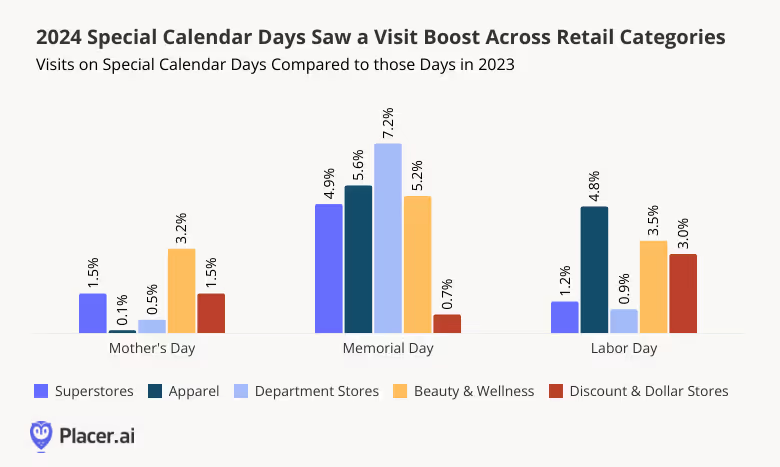
This uptick is likely due to a variety of factors – from warmer weather to rising consumer confidence amidst slowly easing inflation. And malls’ particularly strong showing on two of May’s most important retail milestones – Mother’s day and Memorial day also helped propel the segment forward.
Taking a closer look at visit patterns to the three mall types on Mother’s Day and Memorial Day shows how significant these special days were for mall foot traffic. On Mother’s Day (May 12th), indoor malls, open-air shopping centers, and outlet malls saw respective visit spikes of 15.8%, 26.0%, and 11.4%, compared to an average year-to-date (YTD) Sunday. And Mother’s Day visits were up significantly YoY as well – further highlighting the category’s robust positioning.
All three mall types also saw impressive visit bumps on Memorial Day – this time compared to an average YTD Monday. The relative spikes were bigger across the board, since malls tend to be less busy on Mondays than on Sundays. But for outlet malls, Memorial Day visits really hit it out of the park – with foot traffic up by a whopping 123.3%. As a day off work featuring plenty of markdowns, Memorial Day is an ideal time to make the longer trip to an outlet mall and hunt for bargains.
And in another promising sign for the category, Memorial Day visits to all three mall types increased YoY – showing that despite continued headwinds, malls are still on the rise.
Comparing weekly mall visits to an early January baseline also shows the varying impact of different holidays on the three mall types.
On Easter, and even more so on Memorial Day – an extended weekend very much focused on savings – outlet malls won the day. On these holidays, shoppers may be more likely to have the time and state of mind to make a day of their shopping trip and lean into the treasure-hunting experience.
But on Mother’s Day, more upscale open-air shopping centers took the lead, as consumers embraced a more unique and luxurious shopping experience. Still, all three mall types drew increased traffic on the different special days – showing that each can benefit from a variety of calendar highlights.
Malls’ strong May performance – especially on the holidays – shows that shopping centers are on the upswing once again. This could be an encouraging sign for the category heading into the summer, and may hint at a promising shopping season during the warm months ahead.
For more data-driven retail insights, visit our blog at Placer.ai.

The Placer.ai Nationwide Office Building Index: The office building index analyzes foot traffic data from some 1,000 office buildings across the country. It only includes commercial office buildings, and commercial office buildings with retail offerings on the first floor (like an office building that might include a national coffee chain on the ground floor). It does NOT include mixed-use buildings that are both residential and commercial.
With summer nearly upon us, we dove into the data to see how the return-to-office fared in May 2024. Did the post-pandemic visit recovery trajectory observed in April continue apace? And which major regional hub saw the most YoY visit growth?
The office recovery is still very much underway. Visits to office buildings nationwide in May 2024 were just 32.2% lower than in May 2019 – and slightly higher than they’ve been during any other month since COVID. Year-over-year (YoY), office foot traffic in May increased by 8.6%.

And drilling down into the data for 11 major business hubs nationwide shows recovery continuing unabated throughout (most of) the country. For New York, Atlanta, Boston, Los Angeles, and San Francisco, May 2024 was the single busiest in-office month since February 2020. And for Miami, Washington, D.C., and Denver, it was the second-busiest month.

Consistent with recent trends, Miami continued to lead the post-COVID recovery pack, followed by New York: Foot traffic to the two cities was just 12.8% and 17.3%, respectively, below May 2019 levels.
But the data also contained some surprises. Atlanta, which saw the biggest YoY visit jump of any analyzed city, pulled into third place – outpacing Washington, D.C. And Houston, the only city to see a YoY decline in visits, fell significantly in the rankings.

Why did Houston YoY office visits drop in May? A look at weekly YoY visits to local office buildings confirms that this was likely due to the extreme weather that engulfed the city during the second half of the month. On Thursday, May 16th, Houston was hit by a particularly violent storm that caused significant damage to the downtown area – breaking windows, downing power lines, and leaving a battered city in its wake. Additional severe weather events pummeled the region as the month wore on – forcing many residents to hunker down at home. And it was when the storm hit that YoY visits began to turn negative, with the week of May 20th seeing a significant 20.0% drop. As the weather improves in the southeast Texas hub, office recovery will likely resume.

Five years after COVID upended office routines, employees and companies are still feeling out the ideal balance between WFH and in-person interaction. Will office attendance increase or decrease as the weather warms up?
Follow Placer.ai’s data-driven office analyses to find out.

With summer upon us, we dove into the data to explore Memorial Day foot traffic trends. How did people spend the long weekend? And how did major dining and retail categories fare on the holiday?
Gas stations were bustling on Friday, May 24th, as people filled their tanks in anticipation of a long, travel or activity-filled weekend. Visits to gas stations were up 32.3% compared to an average day this year – and the highest they’ve been since January 1st, 2024.
Year over year (YoY), gas station foot traffic increased 1.5%. And compared to pre-COVID, too, gas station visits were up 1.8% – showing that people are once again hitting the road, whether to go on weekend getaways or to visit nearby parks and attractions.

Indeed, Americans partake in many different activities on Memorial Day – from attending parades and memorial events to sight-seeing or enjoying the great outdoors. And visiting museums is a time-honored holiday tradition: On Monday, May 27th, museums nationwide drew a whopping 71.5% more visits than on an average Monday this year.
YoY, Museums were 1.6% busier on May 27th than in 2023 – and museum-goers spent more time exploring the exhibits (who says attention spans are decreasing?), browsing the gift shop, or fueling up at the cafeteria.

Memorial Day weekend is a prime time for picnics and barbecues. But for many Americans, it’s also an opportunity to enjoy a nice meal at a restaurant with friends and family.
Like on Mother’s Day, full-service restaurants get a much bigger Memorial Day visit boost than either fast-casual eateries or fast-food (QSR) joints. But all three dining segments enjoyed a significant YoY holiday visit increase this year – proving that despite still-high food-away-from-home prices, people are finding room in their budgets to treat themselves on their day off.

And the last Monday in May is, of course, a big day for savings, on everything from big-ticket items like mattresses, furniture, and major appliances, to clothing and other discretionary items. This year, apparel stores saw the biggest Memorial Day visit spike, with foot traffic up 40.5% compared to an average day and 88.2% compared to an average Monday. But home furnishing stores, home improvement stores, electronics retailers, and (to a lesser extent), grocery stores, all experienced considerable holiday visit spikes of their own.
And comparing Memorial Day retail activity to last year shows most of the analyzed categories seeing minor visit increases or holding steady – no small feat in today’s challenging retail environment. Like dining segments, grocery stores impressed with a 9.3% YoY visit increase – perhaps buoyed by consumers buying last-minute ingredients for their picnics or barbecues.

People were on the move this year on Memorial Day – fueling up their cars, and enjoying museums, restaurants, and retail sales. What does the rest of the summer hold in store for American consumers?
Follow Placer.ai’s data driven analyses to find out.

Known as the entertainment capital of the world, Las Vegas has always been a tourist hotspot. But for a growing segment of the population, Vegas is also becoming a popular place to lay down permanent roots. We dove into the tourism and migration data for the region in order to take a closer look at Las Vegas’ changing visitor and resident populations.
Like many vacation destinations, Las Vegas took a significant tourism hit at the onset of COVID. But with travel restrictions now a thing of the past, visitation to Las Vegas is roaring back.
Analyzing travel to Las Vegas using the Travel & Tourism Report shows that since the halfway mark of 2023, the total number of visit nights spent by travelers in the city (i.e. by those staying up 31 days) have consistently outperformed pre-pandemic levels. And with the sole exception of July 2023, visit nights have increased year-over-year (YoY) as well.

Alongside robust demand for experiences, investment in new, one-of-a-kind entertainment venues like the Sphere – which opened towards the end of 2023 – has likely played a part in reigniting tourism.
Who are the tourists driving this comeback? To explore the demographic characteristics of today’s visitors to Las Vegas, we zoomed in on the Las Vegas Strip – the iconic epicenter of it all, where most of the city’s luxury hotels, shops, restaurants, and casinos are concentrated.
Analysis of the Strip’s captured market with demographic data from AGS: Demographic Dimensions reveals that as tourist activity in the city began to pick up again, the median household income (HHI) of visitors to the Strip increased steadily. In Q1 2024, the median HHI of visitors to the Strip reached $93.0K, perhaps aided by tourism surrounding this year’s Super Bowl.
This indicates that the Strip is becoming a more upscale visit destination, and that demand for Vegas’ luxury offerings are driving visits. As more consumers with ample discretionary dollars make their way to Vegas, pricey shows – in addition to retail – are likely to become ever-more lucrative advertising opportunities.

A tourism boom isn’t the only phenomenon making waves in Sin City. In recent years, more and more out-of-towners have made Greater Las Vegas their home, and unlike some pandemic-era migration hotspots, Las Vegas continues to attract new residents.
Migration data indicates that many of those moving in are high-earners who are likely incentivized by the cost of living and tax benefits in the region.
Between December 2019 and December 2023, the Las Vegas-Henderson-Paradise CBSA experienced net-positive domestic migration of 3.9%. In other words, the total number of people that moved to Las Vegas over the four-year period from elsewhere in the U.S., minus those that left, was equivalent to 3.9% of the region’s December 2023 population. Meanwhile, analysis of the CBSA’s origin to destination HHI ratio reveals that between December 2019 and December 2023, the median HHI of incoming residents was 20% higher than the median HHI of the local population.
And comparing migration data in December 2023 to December 2020, 2021, and 2022, revealed consistently positive net migration and origin to destination HHI ratios in the years since 2019. This indicates that the Las Vegas-Henderson-Paradise CBSA continues to attract many new and affluent residents. When planning future amenities and services, the region may want to take into account the opportunities – and challenges – presented by these population shifts.

Be it for a quick trip or full-on relocation, Las Vegas remains a prime destination in both the U.S. tourism and domestic migration landscapes. New entertainment venues and amenities keep Vegas top-of-mind for upscale vacationers while economic incentives drive moves from a high-income cohort.
For more tourism and migration insights, visit Placer.ai.

Malls have long acted as a gleaming symbol of American retail. Following the opening of the first indoor mall in 1956, and as the American middle class increasingly moved from the city to the suburbs, malls continued to open at a rapid rate. By 1960, some 4,500 shopping centers had opened nationwide, filling the growing demand for “third places” – spaces that allowed the newly suburban populations to gather, socialize, and create community. And while that role evolved over the years, it’s safe to say that malls have played a major part in shaping the American shopping culture.
But malls’ rapid expansion led to an oversaturated market – some estimates suggest that there are approximately 24 square feet of retail space per U.S. citizen, as compared to 4.6 for the U.K. and 2.8 for China. Many began to predict the demise and downfall of malls, and that narrative intensified as online shopping grew in popularity. The rise of big-box stores, a focus on “services, not things,” and COVID-19 only accelerated these trends.
A lot of the doom and gloom predictions tend to de-emphasize the mall's role as a modern incarnation of a bustling downtown shopping area.
But a lot of these doom and gloom predictions focus on malls only as a place to shop, and tend to de-emphasize their other role as the third place – a modern incarnation of a bustling downtown shopping area, replete with shops, services, and places to meet. And after two years of isolation and a new, pandemic-induced wave of suburban relocation, malls’ potential to bring people together is more prized than ever.
So although malls were hit hard during COVID-19, many of them are finding ways to reinvent themselves and stay relevant. Today, more than halfway through 2022, the challenges that malls face continue to evolve and change – but malls are evolving too. This white paper covers a few specific ways that some malls have found to thrive in the new normal. Some shopping centers are turning to entertainment to draw crowds into their doors. Others are focusing on offering a full visitor experience that extends beyond simply grabbing a new shirt or a burger at the food court. Still, more are embracing omnichannel options, offering an integrated on and offline experience to their shoppers. In the face of significant retail challenges, top-tier malls are turning to innovative solutions to stay ahead of the game.
The pandemic posed significant challenges to malls. Although foot traffic to the category rose back up in the summer of 2021, the Delta and subsequent Omicron waves brought visits down once more. And as visit gaps post-Omicron began to narrow, inflation and gas prices put the brakes on any return to normalcy. April and May 2022 saw visits beginning to trend up, though the unrelenting rise of inflation, the highest it’s been in the past 40 years, has slowed that recovery slightly.
Foot traffic data shows that malls are continuing to attract visitors, despite the challenges that seem to crop up weekly.
Still, foot traffic data shows that malls are continuing to attract visitors, despite the challenges that seem to crop up weekly. And while they may no longer play the central role they once did in Americans’ shopping routines, malls still serve as indoor community hubs where friends and family can come together for diverse food, shops, and entertainment options. This could explain why top-tier malls keep on coming back despite the seemingly constant obstacles.
Comparing monthly visits from January 2022 through July 2022 to the same period in 2019 highlights the significant difficulties facing the sector. Indoor malls, open-air lifestyle centers, and outlet malls alike saw marked lags in foot traffic as compared to three years ago.
Monthly year-over-three-year (Yo3Y) foot traffic comparisons also highlight mall resilience.
The monthly year-over-three-year (Yo3Y) foot traffic comparisons also highlight mall resilience. Following an Omicron-plagued January, the visit gaps narrowed in February 2022 to less than 5% for all the segments. And although the increase in gas prices and inflation brought visits down in March, malls quickly bounced back in April 2022, with indoor malls seeing only 1.8% fewer visits than in 2019 and open-air shopping centers down only 4.8% Yo3Y. Foot traffic fell again in May and June as consumers tightened their budgets in the face of rising prices, but consumers appear to have quickly made peace with the new economic reality. By July 2022, visits to indoor malls and open-air lifestyle centers were only 3.5% and 2.7% lower than they had been in July 2019.
COVID didn’t just impact visit numbers – since 2020, mall visits have also gotten shorter, likely a result of pandemic restrictions and a general desire not to congregate any longer than necessary. And although 2021 and 2022 saw a slight uptick in time spent at malls and shopping centers – from 60 minutes in 2020 to 62 minutes in 2021 and 2022 – the median dwell time is still significantly lower than the 70 minutes median dwell time of pre-COVID 2018 and 2019.
Shorter visits are not necessarily a bad thing – intent-driven shoppers may simply be doing more research ahead of time and less in-mall browsing.
Shorter visits are not necessarily a bad thing in and of themselves – consumers today are highly informed, so many intent-driven shoppers may simply be doing more research ahead of time and less in-mall browsing. But shorter (and fewer) visits do mean that malls must focus on giving shoppers a reason to visit. We explore some successful strategies below.
Malls have long integrated entertainment into their overall experience in the form of arcades, movie theaters, and even coin-operated animal rides. Some malls, however, are taking their entertainment offerings to the next level.
In August 2021, CBL Properties, a Tennessee-based property developer, announced the opening of the Hollywood Casino by Penn National Gaming in the York Galleria Mall in York, Pennsylvania. The 80,000 square foot casino, which boasts 500 slots and 24 live-action table games, opened in the mall’s lower level. The space was occupied by a now-closed Sears department store, and the entertainment venue now functions as a new anchor to draw customers in.
The casino’s opening has had a dramatic impact on the mall’s foot traffic. In a year-over-three-year (Yo3Y) comparison, July 2021 saw 2.4% fewer visitors than July 2018. But when the casino opened in August 2021, visits to the location jumped to 31.4% Yo3Y. This increase is all the more impressive considering that the casino opened on August 19th, with only 12 days left in the month.
The mall, which had seen negative Yo3Y visit numbers until the casino’s opening, has sustained the positive visit trend through July 2022 – a testament to the appeal of in-mall entertainment.
Another mall betting on indoor entertainment is the Pierre Bossier Mall in Bossier City, Louisiana. In April 2022, Surge Entertainment opened a child-friendly space, which includes zip-lining, bowling, laser tag and arcade games. The Surge Entertainment chain is co-owned by Drew Brees, the former New Orleans Saints quarterback, and has 15 locations around the country. The Pierre Bossier Mall branch is filling the space vacated by Virginia College, which closed its doors in 2018.
Since Surge Entertainment opened its Bossier City location, the mall has seen a dramatic increase in average dwell time.
Since Surge Entertainment opened its Bossier City location, the mall has seen a dramatic increase in average dwell time. Between July 2021 and March 2022, median dwell time hovered between 51 and 58 minutes. But following the center’s opening, median dwell time jumped to 78 minutes. Since then, the median dwell time has remained consistently elevated: In the four months since the Surge Entertainment opening, median dwell times did not drop below 75 minutes.
Brick-and-mortar retailers once viewed online shopping as a threat – but now, mall owners and operators are increasingly turning to digital channels to complement existing approaches. COVID-19 and the surge of online shopping further fueled malls’ digital progress. Over the past two years, large malls and suburban shopping centers across the country have been rolling out various online and social shopping options and adopting omnichannel strategies.
In September 2020, Centennial, a real estate investment firm with many malls and mixed-use entertainment centers in its portfolio, launched a chain-wide omnichannel platform called Shop Now!. The app allows consumers to shop across all Centennial malls the way someone would shop on Amazon.
The first phase of the program, which launched in October 2020, allowed users to browse an AI-powered search engine connected to the inventory of all of the stores operating in their mall of interest. In February 2022, Centennial debuted phase two of the program at its Santa Ana, CA based MainPlace Mall. It allows customers to consolidate orders from several stores into a single cart, get the order fulfilled by personal shoppers, and have the orders ready for same-day delivery or on-site pickup.
The e-commerce app could have detracted shoppers from physically going to the mall – but instead, the program increased both monthly and loyal visitors.
The app allows consumers to browse and shop from the comfort of their phones. It could have detracted shoppers from physically going to the mall – but instead, the program has increased both monthly and loyal visitors. In the months following the launch of the second phase, MainPlace Mall saw its loyal visits increase by 5% (from 46.2% in February ‘22 to 51.3% in June ‘22), while overall monthly visits in April ‘22 increased by 5.5% when compared to 2019. The digital investment also helped the mall make sales that could have been lost to other e-commerce platforms. The mall’s brick-and-mortar success following the addition of a digital channel highlights how malls can rise to the top by embracing an omnichannel strategy.
Continuing its innovative streak, the MainPlace Mall recently added an experiential component with the opening the American Ninja Warrior Adventure Park in July 2022 in the place of four former retail stores. During its first month of operation, the park drove the mall’s share of loyal visits up by 13.4% compared to the previous month while boosting Yo3Y monthly visits by 18.0%.
The difference in impact between the online platform launch and the opening of the American Ninja Warrior Adventure Park indicates that malls can enjoy both gradual gains over time as well as jumps in foot traffic and loyalty, depending on the strategy they adopt.
Omnichannel strategies can also revitalize food courts hit hard by the pandemic. Arundel Mills Mall, part of the Simon Property Group, began offering online orders in February 2022 via a platform called Snackpass, allowing users to use the app at various eateries around the mall. Snackpass, launched in 2017 as a food ordering app on the Yale campus, facilitates group ordering and includes various social features. Its current iteration allows customers to pre-order food, skip lines, collect rewards, and engage with friends. It also offers discounts on group orders, in an effort to promote social dining.
Since the beginning of the Snackpass partnership, the shopping center itself is seeing more visitors – many of whom are coming from farther away.
Since the beginning of the Snackpass partnership, the shopping center itself is seeing more visitors – many of whom are coming from farther away. In the five months following the app’s launch, Arundel Mills saw an overall increase of 15 square miles to its True Trade Area (TTA), and an increase of 29.5% in visits per sq. ft. – The consistent increase in TTA and visits per sq. ft. are a testament to the power of innovative dining partnerships to draw traffic to top-tier malls.
With many retailers reducing their on-mall presence, empty brick-and-mortar stores have attracted plenty of negative attention. But now, malls are increasingly repurposing vacated spaces in new, innovative ways that resonate with local communities and can fill their evolving needs.
At the Ocean County Mall in Toms River, NJ, Simon Property Group repurposed the huge space left by a former Sears store and turned it into a lifestyle center, with stores opening throughout 2020. The space is now being used by a number of highly popular chains such as LA Fitness, Ulta Beauty, HomeSense, and P.F. Chang’s and also includes a children's play area.
This pivot seems to be working. Median dwell time to the mall has increased from 53 minutes to 56 minutes, a significant change when considering that a majority of malls have recently seen their dwell times drop.
The center has also seen the median age for its trade area decrease from 40.5 years old in the first half of 2021 to 37.2 in the first half of 2022, a dramatic shift in visitor demographics. Yo3Y visits are strong as well – July 2022 were up by 17.1%.
In a similar tale of a closed Sears turning into a lifestyle center, the Northshore Mall in Peabody, MA turned the space vacated by the department store into a mixed-use center. The most significant anchor is now the high-end Life Time Fitness Center that offers cardio, weights, and functional training rooms, and includes yoga, pilates, and cycling studios, indoor and outdoor pools, basketball and pickleball courts, saunas, and a bistro.
As soon as the health club opened its doors in July 2021, visits to the mall increased – significantly outpacing the levels seen when Sears was still open.
As soon as the health club opened its doors in July 2021, visits to the mall increased – significantly outpacing the levels seen when Sears was still open. Both Yo3Y and year-over-four-year (Yo4Y) foot traffic numbers were impressive, with July 2022 seeing 17.2% more visitors than three years prior.
As visits to malls become more focussed, selecting the right tenant has never been more important – and that may mean looking at unconventional occupants to draw in customers.
In one example of tapping into local needs, the Westfield Oakridge shopping center in San Jose, CA, opened a specialty grocery store on its premises. 99 Ranch Market, one of the largest Asian supermarket chains in the U.S., began operating its first mall location in March 2022. The location includes classic grocery store items such as produce, meat, and seafood sections, and also boasts a dining hall, tea bar, and bakery.
Its opening day saw lines snaking out the door, as excited locals queued to sample the store’s delicacies. And the crowd-drawing hype seems to be more than a flash in the pan – the months following the opening were the mall’s strongest in the past year and a half. Yo3Y visits were up by 10.1% in July 2022 , with some shoppers reporting that the addition of the grocery store had turned Westfield Oakridge into their all-in-one stop shop.
Although the area was not lacking in grocery options, retail foot traffic data indicates that the new 99 Ranch Market at Westfield Oakridge Mall still filled a void.
Although the area was not lacking in grocery options, retail foot traffic data indicates that the new 99 Ranch Market at Westfield Oakridge Mall still filled a void – the new grocery store’s trade area has only minimal overlaps with the other trade areas of the nearby 99 Ranch Markets locations. This means that most of the new 99 Ranch Market’s customers were not being well-served by the existing locations of the chain.
Westfield Oakridge is not the only San Jose mall turning to food to attract the crowds. On June 16th 2022, following much hype and a pandemic-related delay, Eataly, the all-in-one Italian market, restaurant, and cooking school opened its first Northern California location at the Westfield Valley Fair in Santa Clara, CA.
Prior to the launch, the Westfield Valley Fair mall was already one of the more successful malls in the country – but the opening of Eataly seems to be driving even more foot traffic. Yo3Y visits to malls during Eataly’s opening week exceeded 20% for the first time in months and have since remained consistently elevated, with visits for the week of July 25th up 27.7% relative to the equivalent week in 2019.
In March 2022, regional department store Von Maur opened its doors at The Village of Rochester Hills, an open-air lifestyle center in Michigan. The retailer, which has 36 locations throughout the Midwest, took over the space left vacant by Carson’s, another Midwest-based department store.
What may be the first new department store in the Detroit metropolitan area in over a decade is driving visits to the shopping center.
What may be the first new department store in the Detroit metropolitan area in over a decade is driving visits to the shopping center. Von Maur’s March 2022 opening pushed Yo3Y visits up by 16.9% compared to the mere 4.3% Yo3Y increase the month before.
Part of the secret to Von Maur’s success lies in the psychographic characteristics of residents within the mall’s trade area. Using Spatial.ai’s GeoWeb data, a tool which tracks online engagement with various trends and topics by neighborhood, we found that the TTA surrounding The Village had an index of 131 for department store shoppers. In other words, people in the mall’s trade area exhibited heightened interest in department stores – they engaged with department-store-related content at a rate that was 1.3 times higher than the national average – which helps explain why Von Maur is thriving in this specific location. And in another testament to the strength of immersive retail experiences, Von Maur, which focuses on curating a unique shopper journey and features a pianist at all of its locations, has been ranked the top department store in America.
The addition of Von Maur is not the only change that The Village is implementing – the mall has continued adding new stores and will be opening more throughout the year. These, too, will likely boost foot traffic to the lifestyle center.
The mall’s ability to select tenants that cater to, and reflect the needs and behaviors of its consumers is likely to continue driving success. By drilling down into the nitty-gritty details of who comes to shop, where they come from, and what shops they enjoy frequenting, mall management can tailor the shopping center to meet the needs of its base.
The “death of the American mall” has been predicted for years. The reality, however, is much more nuanced than that – like many other sectors, malls are undergoing a shift to help them better serve evolving customer needs and survive and thrive in an ever-shifting retail landscape.
The malls featured in this white paper have found ways to consistently attract visitors despite the various obstacles faced by the category over the past two years. By understanding that the American mall must evolve along with the consumers, mall owners can successfully revitalize their retail spaces.

This report leverages location intelligence data to analyze the auto dealership market in the United States. By looking at visit trends to branded showrooms, used car lots, and mixed inventory dealerships – and analyzing the types of visitors that visit each category – this white paper sheds light on the state of car dealership space in 2023.
Prior to the pandemic and throughout most of 2020, visits to both car brand and used-only dealerships followed relatively similar trends. But the two categories began to diverge in early 2021.
Visits to car brand dealerships briefly returned to pre-pandemic levels in mid-2021, but traffic fell consistently in the second half of the year as supply-chain issues drove consistent price increases. So despite the brief mid-year bump, 2021 ended with overall new car sales – as well as overall foot traffic to car brand dealerships – below 2019 levels. Visits continued falling in 2022 as low inventory and high prices hampered growth.
Meanwhile, although the price for used cars rose even more (the average price for a new and used car was up 12.1% and 27.1% YoY, respectively, in September 2021), used cars still remained, on average, more affordable than new ones. So with rising demand for alternatives to public transportation – and with new cars now beyond the reach of many consumers – the used car market took off and visits to used car dealerships skyrocketed for much of 2021 and into 2022. But in the second half of last year, as gas prices remained elevated – tacking an additional cost onto operating a vehicle – visits to used car dealerships began falling dramatically.
Now, the price of both used and new cars has finally begun falling slightly. Foot traffic data indicates that the price drops appear to be impacting the two markets differently. So far this year, sales and visits to dealerships of pre-owned vehicles have slowed, while new car sales grew – perhaps due to the more significant pent-up demand in the new car market. The ongoing inflation, which has had a stronger impact on lower-income households, may also be somewhat inhibiting used-car dealership visit growth. At the same time, foot traffic to used car dealerships did remain close to or slightly above 2019 levels for most of 2023, while visits to branded dealerships were significantly lower year-over-four-years.
The situation remains dynamic – with some reports of prices creeping back up – so the auto dealership landscape may well continue to shift going into 2024.
With car prices soaring, the demand for pre-owned vehicles has grown substantially. Analyzing the trade area composition of leading dealerships that sell used cars reveals the wide spectrum of consumers in this market.
Dealerships carrying a mixed inventory of both new and used vehicles seem to attract relatively high-income consumers. Using the STI: Popstats 2022 data set to analyze the trade areas of Penske Automotive, AutoNation, and Lithia Auto Stores – which all sell used and new cars – reveals that the HHI in the three dealerships’ trade areas is higher than the nationwide median. Differences did emerge within the trade areas of the mixed inventory car dealerships, but the range was relatively narrow – between $77.5K to $84.5K trade area median HHI.
Meanwhile, the dealerships selling exclusively used cars – DriveTime, Carvana, and CarMax – exhibited a much wider range of trade area median HHIs. CarMax, the largest used-only car dealership in the United States, had a yearly median HHI of $75.9K in its trade area – just slightly below the median HHI for mixed inventory dealerships Lithia Auto Stores and AutoNation and above the nationwide median of $69.5K. Carvana, a used car dealership that operates according to a Buy Online, Pick Up in Store (BOPIS) model, served an audience with a median HHI of $69.1K – more or less in-line with the nationwide median. And DriveTime’s trade areas have a median HHI of $57.6K – significantly below the nationwide median.
The variance in HHI among the audiences of the different used-only car dealerships may reflect the wide variety of offerings within the used-car market – from virtually new luxury vehicles to basic sedans with 150k+ miles on the odometer.
Visits to car brands nationwide between January and September 2023 dipped 0.9% YoY, although several outliers reveal the potential for success in the space even during times of economic headwinds.
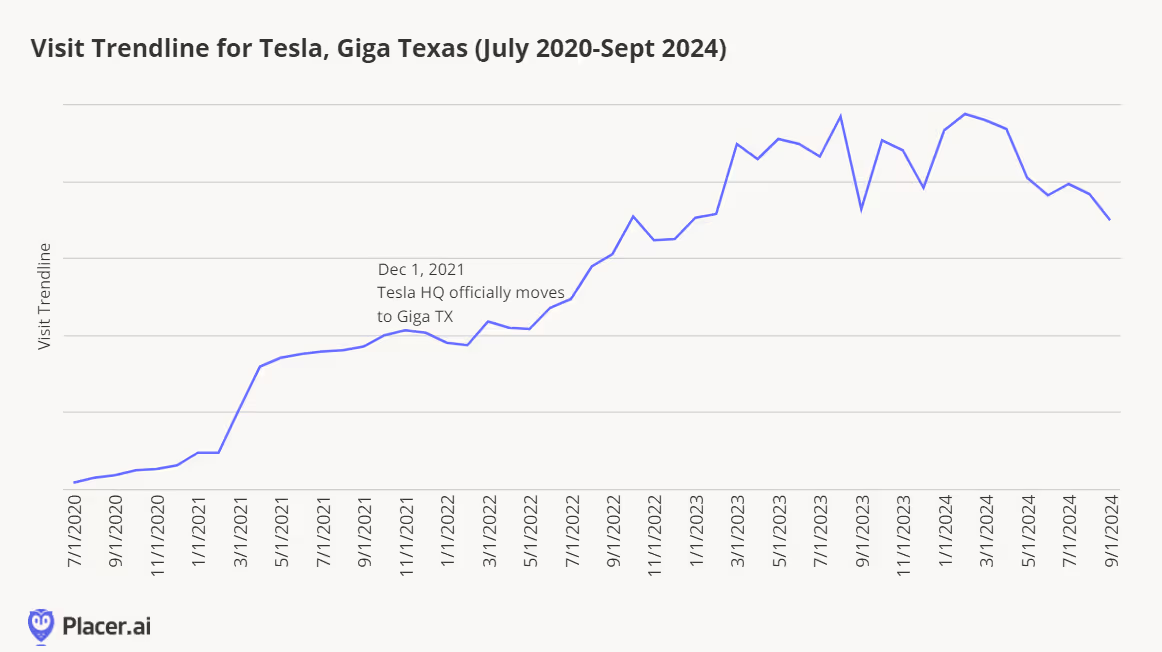
Visits to Tesla’s dealerships have skyrocketed recently, perhaps thanks to the company’s frequent price cuts over the past year – between September 2022 and 2023, the average price for a new Tesla fell by 24.7%. And with the company’s network of Superchargers gearing up to serve non-Tesla Electric Vehicles (EVs), Tesla is finding room for growth beyond its already successful core EV manufacturing business and positioning itself for a strong 2024.
Japan-based Mazda used the pandemic as an opportunity to strengthen its standing among U.S. consumers, and the company is now reaping the fruits of its labor as visits rise YoY. Porsche, the winner of U.S New & World Report Best Luxury Car Brand for 2023, also outperformed the wider car dealership sector. Kia – owned in part by Hyundai – and Hyundai both saw their foot traffic increase YoY as well, thanks in part to the popularity of their SUV models.
Analyzing dealerships on a national level can help car manufacturers make macro-level decisions on marketing, product design, and brick-and-mortar fleet configurations. But diving deeper into the unique characteristics of each dealership’s trade area on a state level reveals differences that can serve brands looking to optimize their offerings for their local audience.
For example, analyzing the share of households with children in the trade areas of four car brand dealership chains in four different states reveals significant variation across the regional markets.
Nationwide, Tesla served a larger share of households with children than Kia, Ford, or Land Rover. But focusing on California shows that in the Golden State, Kia’s trade area population included the largest share of this segment than the other three brands, while Land Rover led this segment in Illinois. Meanwhile, Ford served the smallest share of households with children on a nationwide basis – but although the trend held in Illinois and Pennsylvania, California Ford dealerships served more households with children than either Tesla or Land Rover.
Leveraging location intelligence to analyze car dealerships adds a layer of consumer insights to industry provided sales numbers. Visit patterns and audience demographics reveal how foot traffic to used-car lots, mixed inventory dealerships, and manufacturers’ showrooms change over time and who visits these businesses on a national or regional level. These insights allow auto industry stakeholders to assess current demand, predict future trends, and keep a finger on the pulse of car-purchasing habits in the United States.