.png)
.png)

.png)
.png)

In 2024, auto parts retailers are continuing to see visit growth compared to last year. We dove into the data for three of the industry’s leaders – AutoZone, O’Reilly Auto Parts, and NAPA Auto Parts – to explore the consumer behavior and profiles behind the space’s ongoing success.
Auto parts retail visits have been bolstered in recent months by still-high vehicle prices – which have incentivized many cash-strapped consumers to fix up the car they have rather than buy a new one. To be sure, the industry hasn’t been entirely spared the effects of inflation, which has caused many consumers to tighten their (seat)belts and defer non-essential car repairs. Still, one of the key factors benefiting the space has been the greater prevalence of older vehicles on the road, which are more likely to need significant – and essential – maintenance.
Since the start of 2024, AutoZone and O’Reilly have sustained consistent year-over-year (YoY) monthly visit growth. And though NAPA saw mild visit gaps in March, June, and August – coinciding with traffic fall-off to some of the repair shops it supplies – it too experienced YoY increases throughout most of the analyzed period.
As auto parts inflation continues to wane in 2024, more consumers may begin taking on repairs they postponed last year, providing these retailers with continued foot traffic boosts.
Less affluent consumers are more likely to be deterred from buying a new ride by high prices and interest rates. And analyzing the demographic characteristics of visitors to AutoZone, O’Reilly, and NAPA reveals that in H1 2024, the median household incomes (HHIs) of the chains’ captured markets were indeed significantly lower than those of new car dealerships ($75.6K).
The data reveals a divide between consumers in the market for new cars – who generally have higher income levels – and those that frequent auto parts retailers to invest in their current set of wheels. And consumers seeking to repair rather than replace may be even more inclined to do so while vehicle prices and financing costs remain elevated.
Analysis of consumer spending habits provides a further indication that AutoZone, O’Reilly and NAPA’s audiences are more likely to invest in upgrades and repairs than in the purchase of a new vehicle.
In H1 2024, residents of AutoZone and O’Reilly’s captured markets spent 17% less annually on buying used cars than the nationwide average, while residents of NAPA’s captured market spent 14% less.
And residents of all three auto parts retailers’ trade areas spent even less on new car buying. In H1 2024, AutoZone’s captured market spent 23% less on new cars than the nationwide average, and O’Reilly’s and NAPA’s captured markets spent 22% and 18% less, respectively.
AutoZone and O’Reilly’s relatively large share of DIY consumers – those who repair or upgrade their cars on their own to save money – likely contributed to their trade areas’ smaller car buying expenditures. Meanwhile, the slightly larger spend on both new and used cars in NAPA’s trade area – though still significantly lower than the nationwide average – may be due to the retailer’s predominantly commercial business.
Auto parts chains have been riding strong tailwinds on the road to success – and they appear geared up for more foot traffic success in the homestretch of 2024. As more older vehicles stay on the road and car-buying costs remain high, robust demand for parts is likely to continue.
Will the auto parts industry accelerate even further in the months to come? Visit Placer.ai to find out.
This blog includes data from Placer.ai Data Version 2.1, which introduces a new dynamic model that stabilizes daily fluctuations in the panel, improving accuracy and alignment with external ground truth sources.

It’s that time of year again. On August 22nd, Starbucks launched its much-vaunted autumn menu, including the iconic Pumpkin Spice Latte (PSL). We dove into the data to see what happened on the big day – and how Starbucks visitation patterns were impacted by the much-anticipated release.
Last year, Starbucks broke with tradition to move its PSL launch from Tuesday to Thursday. And perhaps due to Thursday’s proximity to the weekend (especially in the age of the TGIF work week), the step has proven advantageous – generating a sustained visit spike lasting through the weekend.
On Thursday, August 22nd, 2024, foot traffic to Starbucks surged 24.1% higher than the coffee giant’s daily average for the previous eight Thursdays. And the PSL effect worked its magic throughout the weekend, with visits to Starbucks on the following Friday, Saturday, and Sunday significantly elevated compared to recent daily averages for those days of the week.
Since its debut in 2003, Starbucks’ PSL has become part of the cultural landscape. Each year, the beverage’s release generates a social media frenzy. And between 2021 and 2023, the number of people visiting Starbucks on Pumpkin Spice Latte launch day increased steadily.
Last year, the PSL visit spike reached new heights, with foot traffic 27.1% higher than on August 27th, 2019 – the last pre-pandemic PSL launch. And despite Starbucks’ recent challenges, visits on PSL day held steady this year, maintaining last year’s impressive gains.
Comparing visits on August 22nd, 2024 to recent Thursday visit averages across the continental U.S. highlights the broad appeal enjoyed by Starbucks’ fall menu. Every analyzed state enjoyed a visit bump – though the extent of the boost varied considerably between regions.
Many southern states – including Alabama, Louisiana, and Mississippi, saw only slight foot traffic bumps, perhaps due in part to the region’s warmer weather, which may render the early autumn launch less compelling. (Mississippi in particular, it seems, really couldn’t care less about Pumpkin Spice.) But in other areas, led by North Dakota (45.5%), Kansas (42.6%), Utah (42.2%), Iowa (41.3%), and Pennsylvania (39.5%), visits skyrocketed.
Starbucks’ successful PSL launch shows that even as consumers count their pennies, people are finding room in their budgets for sweet, cozy indulgences that don’t break the bank. What does the winning release portend for the upcoming winter season?
Follow Placer.ai’s data-driven dining and retail analyses to find out.
This blog includes data from Placer.ai Data Version 2.1, which introduces a new dynamic model that stabilizes daily fluctuations in the panel, improving accuracy and alignment with external ground truth sources.

Back-to-school shopping is a major driver of retail visits and sales – and this year, spending on the upcoming school year was set to be the second-highest on record. So with the frenzy winding down, we took a look at how several key retail categories and chains performed during this important season.
Overall, retail rallied throughout July and August, with weekly visits to major back-to-school categories – including superstores, department stores, and other apparel retailers – mainly outperforming last year’s visit levels. Though department stores and apparel chains saw very slight YoY declines in late July, all the analyzed categories enjoyed YoY boosts beginning the week of August 5th. And since the back-to-school season is traditionally a high-traffic period, the ability of these categories to sustain YoY growth is particularly impressive.
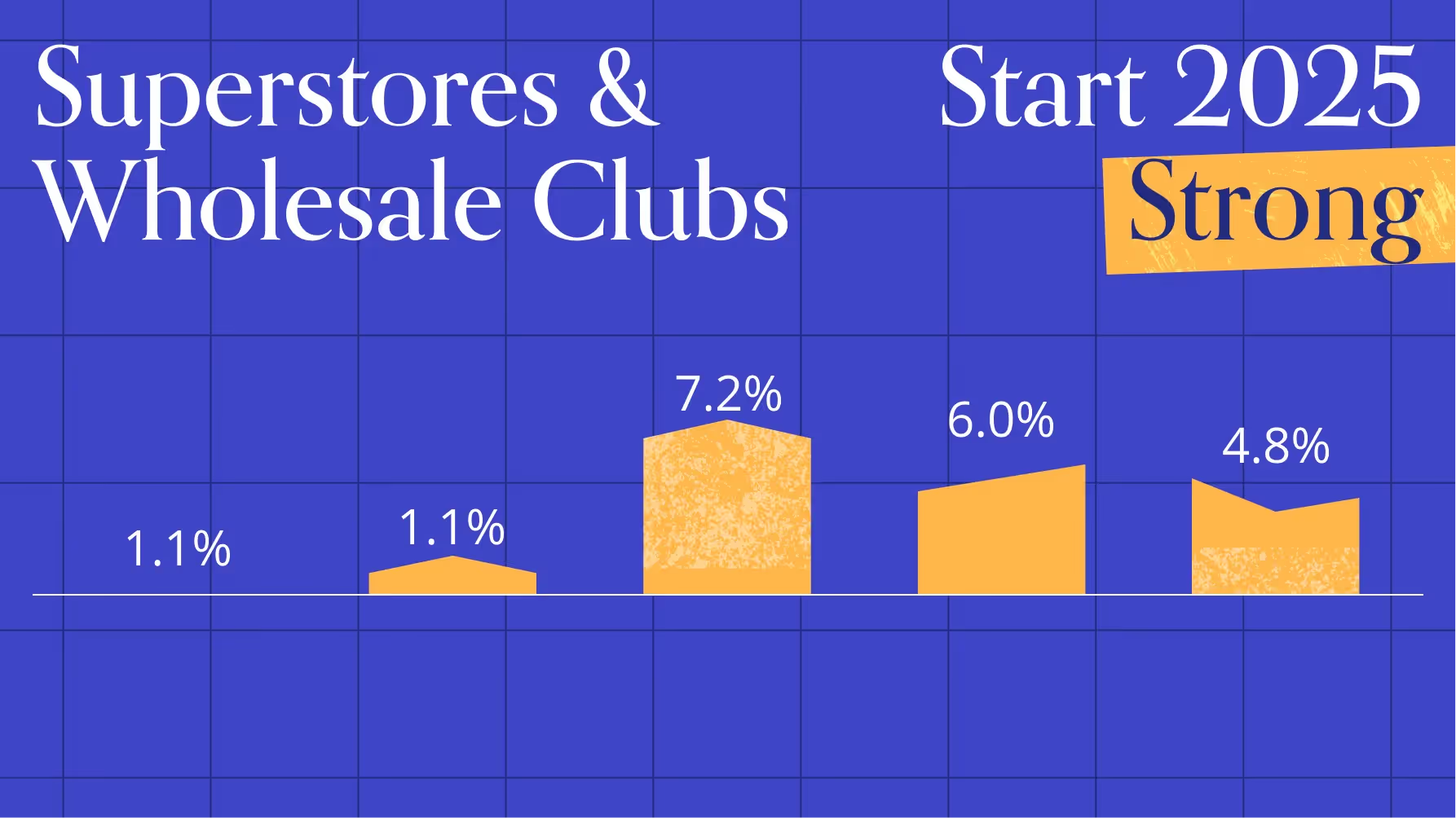
Digging deeper into individual brands reveals substantial visit boosts at superstores Target and Walmart and warehouse membership club Costco.
Target, already enjoying positive momentum from summer sales events, drove visits even higher with steep discounts on essential back-to-school items. In addition to attracting parents on the hunt for kids’ school supplies, Target has emerged as a favorite destination for college students seeking to load up on dorm decor and other collegian necessities. And between the weeks of July 9th, 2024 and August 19th, 2024, the retailer saw weekly visits jump a remarkable 9.7% to 20.8% compared to a year-to-date (YTD) weekly average. Walmart and Costco, too, saw significant visit boosts in July August, as they drew crowds with discount and bulk offerings.
The strong performance of these retailers during the back-to-school season bodes well as they head into the critical holiday shopping period. With momentum on their side, Target, Walmart, and Costco are poised to capitalize on their competitive pricing and value offerings, potentially driving another period of robust growth.
Back-to-school often means outfitting kids and teens with new clothing, and off-price retailers – including Burlington, Marshalls, Ross, and T.J. Maxx – are reaping the benefits. With a reputation for low prices and everything from apparel to backpacks, these chains are popular choices for the back-to-school crowd. And this year, weekly visits to these retailers got a significant boost, with August 19th foot traffic up 11.0% at Burlington, 13.9% at Marshalls, 6.0% at Ross, and 15.8% at T.J. Maxx, compared to a YTD weekly average.
Superstores, department stores, and apparel retailers aren’t the only ones to benefit from the back-to-school craze – office supply stores, predictably, also experience major boosts. While weekly visits to Office Depot, OfficeMax (both owned by The ODP Corporation), and Staples had lagged behind the chains’ year-to-date (YTD) weekly visit averages during April and May, they began to recover in early July. By August, visits were surging, with the week of August 19th showing increases of 24.4% for Office Depot, 32.7% for OfficeMax, and 39.2% for Staples.
Getting a pair of new shoes for school is another time-honored tradition – and DICK’s Sporting Goods has heeded the call with massive markdowns. The chain drew back-to-school shoe and apparel shoppers with a major 50%-off sale, and visits jumped significantly – peaking during the week of August 12th at 40.5% above a January 1st, 2024 baseline.
Hibbett, meanwhile, supercharged its back-to-school campaign with discounts and free children’s haircuts, offered between July 28th and August 25th at different locations. And the events boosted foot traffic dramatically, with the week of July 29th seeing a whopping 76.1% visit increase compared to a January 1st, 2024 baseline. Though visits to both sporting goods chains began to taper off as August wore on, they remained elevated – serving as a reminder of the power of back-to-school shopping and sales.
Back-to-school season remains one of the most important shopping periods of the year, with significant consumer demand drawing visit growth across major retail categories.
Can these retailers continue drawing on this momentum into the holiday season?
Visit Placer.ai to keep up with the latest data-driven retail news.
This blog includes data from Placer.ai Data Version 2.1, which introduces a new dynamic model that stabilizes daily fluctuations in the panel, improving accuracy and alignment with external ground truth sources.

In July & August 2024, Placer.ai released multiple white papers: Los Angeles Office Trends in 2024, Q2 2024 – Retail & Restaurant Review, Domestic Tourism Trends in NYC and LA, 2024 Hotel Visit Trends, Emerging Trends for CRE in 2024, and Retail Giants in 2024: Walmart, Costco, and Target's Competitive Edge.
Below is a taste of our findings from two white papers: 2024 Hotel Visit Trends and Retail Giants in 2024: Walmart, Costco, and Target's Competitive Edge. The two white papers take a look at the visitation data to explore how leading hotel chains are driving visits in 2024, as well as exploring how Walmart, Costco, and Target are maintaining their success.
The pandemic and economic headwinds that marked the past few years presented the multi-billion dollar hotel industry with significant challenges. But five years later, the industry is rallying – and some hotel segments are showing significant growth.
Overall, visits to hotels were 4.3% lower in Q2 2024 than in Q2 2019 (pre-pandemic). But this metric only tells part of the story. A deeper dive into the data shows that each hotel tier has been on a more nuanced recovery trajectory.
Economy chains – those offering the most basic accommodations at the lowest prices – saw visits down 24.6% in Q2 2024 compared to pre-pandemic – likely due in part to hotel closures that have plagued the tier in recent years. Though these chains were initially less impacted by the pandemic, they were dealt a significant blow by inflation – and have seen visits decline over the past three years. As hotels that cater to the most price-sensitive guests, these chains are particularly vulnerable to rising costs, and the first to suffer when consumer confidence takes a hit.
Luxury Hotels, on the other hand, have seen accelerated visit growth over the past year – and have succeeded in closing their pre-pandemic visit gap. Upscale chains, too, saw Q2 2024 visits on par with Q2 2019 levels. As tiers that serve wealthier guests with more disposable income, Luxury and Upscale Hotels are continuing to thrive in the face of headwinds.
But it is the Upper Midscale level – a tier that includes brands like Trademark Collection by Wyndham, Fairfield by Marriott, Holiday Inn Express by IHG Hotels & Resorts, and Hampton by Hilton – that has experienced the most robust visit growth compared to pre-pandemic. In Q2 2024, Upper Midscale Hotels drew 3.5% more visits than in Q2 2019. And during last year’s peak season (Q3 2023), Upper Midscale hotels saw the biggest visit boost of any analyzed tier.
Analyzing the captured markets* of Upper Midscale chains Trademark Collection by Wyndham, Fairfield by Marriott, Holiday Inn Express by IHG Hotels & Resorts, and Hampton by Hilton with demographics from STI: Popstats (2023) shows variance in the relative affluence of their visitor bases.
Fairfield by Marriott drew visitors from areas with a median household income (HHI) of $84.0K in H1 2024, well above the nationwide average of $76.1K. Hampton by Hilton and Trademark Collection by Wyndham, for their parts, drew guests from areas with respective HHIs of $79.6K and $78.5K – just above the nationwide average. Meanwhile, Holiday Inn Express by IHG Hotels & Resorts drew visitors from areas below the nationwide average.
But all four brands saw increases in the median HHIs of their captured markets over the past five years. This provides a further indication that it is wealthier consumers – those who have had to cut back less in the face of inflation – who are driving hotel recovery in 2024.
(*A chain’s captured market is obtained by weighting each Census Block Group (CBG) in its trade area according to the CBG’s share of visits to the chain – and so reflects the population that actually visits the chain in practice.)
Walmart, Target, and Costco are three of the country’s most popular retailers, drawing millions of shoppers each day. Each has distinct strengths that cater to their unique customer bases, helping them thrive in a competitive market.
Costco’s wholesale club model led the way in H1 2024, with consistent year-over-year (YoY) visit growth ranging from 6.1% in January 2024 to 13.3% in June. Walmart followed closely, with YoY foot traffic growth during all but two months. Target had a slower start, with visits below 2023 levels from January to April, and a 3.7% decline in YoY comparable sales. However, visits rebounded in May (2.5%), June (8.9%), and July (4.7%). This renewed growth bodes well for Target, especially as the back-to-school season ramps up.
For all three chains, Q2 2024’s visit success was likely bolstered by summer deals and intensifying price wars aimed at attracting inflation-weary consumers back to the store.
While inflation is cooling, prices remain high, and discount and dollar stores are increasingly challenging Walmart, Target, and Costco. Many customers, especially those of more modest means, are drawn to the rock-bottom prices at dollar stores.
Analysis of cross-shopping patterns shows that a growing share of Walmart, Target, and Costco visitors also frequent Dollar Tree regularly. In Q2 2019, between 9.8% and 13.7% of visitors to these retailers visited Dollar Tree at least three times, but by Q2 2024, that share rose to 16.7%-21.6%.
Dollar Tree is capitalizing on this interest. Over the past year, it added 350 Dollar Tree locations while closing nearly 400 Family Dollar stores. The chain also acquired leases for 170 99 Cents Only Stores, gaining access to customers who buy everything from groceries to household goods. As Dollar Tree expands its footprint and food offerings, it poses a growing challenge to Walmart, Target, and Costco.
Read the full reports to discover more hotel and superstore insights. For more data-driven consumer research, visit our resource library.

Big Lots – the big-box discount store offering everything from snacks to higher-ticket items like furniture and mattresses – recently announced a major rightsizing initiative. Against the backdrop of declining sales, the company disclosed its intention to shutter up to 315 stores in coming months.
We dove into the data to explore some of the factors that may be impacting Big Lots’ store closure decisions – and to see which chains stand to benefit the most from Big Lots’ big move.
Store closures mean major markdowns – and the some 280 Big Lots locations already slated to close are drawing crowds with big sales. Analyzing monthly visit fluctuations at Big Lots shows that the shuttering locations experienced an impressive 19.2% month-over-month (MoM) visit spike in July 2024, even as the chain as a whole saw just a 1.9% uptick. Customers, it seems, are flocking to the stores on the chopping block to snag high-ticket items at even steeper discounts.

Rightsizing is all about fleet optimization – trimming underperforming locations and retaining those stores best equipped to meet the needs of a chain’s evolving customer base. And identifying common denominators among stores slated for closure can shed light on the considerations informing a retailer’s rightsizing strategy.
Analyzing the median household incomes (HHIs) of Big Lots’ closing locations' captured markets shows that the retailer is shuttering stores that serve more affluent consumers than the chain as a whole. Nationwide, for example, Big Lots drew visitors from areas with a median HHI of $65.5K in H1 2024. But the Big Lots slated for closure drew shoppers from areas with a median HHI of $73.5K. This pattern repeated itself across major markets where Big Lots is reducing its footprint – including Ohio, Florida, Washington, California, and Arizona.
Big Lots has noted a revitalization strategy focused on value and even more extreme bargain offerings. And the decision to shutter stores in more affluent areas may reflect a move by the retailer to lean into its core audience of price-conscious shoppers – though higher HHI customers can still benefit from the chain’s value offerings.
As Big Lots reduces its fleet, shoppers will naturally seek out alternatives. But which chains are best poised to reap the benefits? Cross-shopping data shows, unsurprisingly, that the vast majority of Big Lots visitors also frequent superstores – especially Walmart. In Q2 2024, a whopping 92.3% of Big Lots visitors nationwide stopped by a Walmart – compared to 52.7% for Target and just 20.8% for Costco.
But shopping behaviors vary significantly between regions. And zooming in on California, where Big Lots plans to close a majority of its 109 locations, paints a different picture. Golden State Big Lots shoppers, to be sure, also visit Walmart in high numbers (74.6% in Q2 2024). But they are much more likely than nationwide visitors to the chain to frequent Target and Costco. Given Big Lots’ significant fleet reduction in California, these two chains appear well-positioned to acquire some of this new regional business.

And drilling down even deeper into the habits of California shoppers at Big Lots, Walmart, Target, and Costco shows that of the three retail giants, Costco may be especially well-positioned to benefit from Big Lots’ Golden State closures.
Like Big Lots, Costco draws a high share of visits during the mornings and afternoons – with just over 50.0% of 10:00 AM - 8:00 PM visits taking place between 10:00 AM and 3:00 PM. As Big Lots’ California footprint contracts, some of these mid-day shoppers may hop over to Costco, which is also bustling during these hours.

Rightsizing creates opportunities – both for chains taking proactive steps to optimize their fleets, and for competitors seeking to pick up extra business. How will Big Lots’ big rightsizing move continue to play out in the months ahead?
Follow Placer.ai’s data-driven retail analyses to find out.
This blog includes data from Placer.ai Data Version 2.1, which introduces a new dynamic model that stabilizes daily fluctuations in the panel, improving accuracy and alignment with external ground truth sources.

Dave & Buster's and Main Event, two leading chains in the eatertainment industry, offer a unique mix of dining, arcade games, and immersive experiences, successfully drawing crowds seeking more than just a meal out.
We took a closer look at the two chains – both of them owned by parent company Dave & Busters Entertainment, Inc. – to see how they are faring as summer winds down.
Dave & Buster’s and Main Event have plenty of games for children – but with extensive drinks menus, they also decidedly cater to adults, offering both groups a much-needed opportunity to kick back, play some games, and enjoy a meal out with friends.
And recent foot traffic data shows that despite challenges, both chains are seeing overall YoY visit increases – partially driven by the chains’ fleet expansions. On a quarterly basis, foot traffic to Dave & Buster’s and Main Event has remained elevated year over year (YoY) since Q3 2023, finishing out Q2 2024 with respective visit boosts of 6.9% and 4.7%.

As prime eatertainment destinations, Dave & Buster’s and Main Event are busiest on weekends – with Saturday evening between 7:00 to 10:00 PM drawing the biggest crowds to both chains.
Between August 2023 and July 2024, 11.9% of visits to Dave & Buster’s and 9.4% of visits to Main Event took place during the Saturday evening time slot. Friday and Sunday also experienced increased foot traffic, with hourly fluctuations reflecting the rhythms of weekend activities: Friday visits picked up between 7:00 and 10:00 PM, as people likely wrapped up their work weeks and headed out to unwind with a drink and some skee ball. Sunday visits followed the opposite pattern, with stronger foot traffic earlier in the day that tapered off towards evening, as people put down their pool cues and got ready for the upcoming week.
But Dave & Buster’s and Main Event are both adept at harnessing special promotions to drive visits on off-peak, weekday hours. Dave & Buster’s famous Wednesdays half-off deals fueled significant visit upticks throughout the analyzed period – so it may come as no surprise that the chain recently stepped up its off-peak offerings with a new all-you-can-eat weekday wings deal. And Main Event, which has long offered a Monday Night Madness promotions, also unveiled a “Summer Season Pass” to encourage weekday visits among its customers.

Visitor behavior to Dave and Buster’s and Main Event also changes throughout the week. Analyzing the average driving distances of visitors to the two chains shows, unsurprisingly, that people drive further distances to visit the venues on the weekends – when they have more time on their hands.
Between August 2023 and July 2024, 43.9% of weekend visits (Friday to Sunday) to Dave & Buster’s, and 49.7% of weekend visits to Main Event were made by people traveling 10 miles or less to reach the restaurant. On Weekdays (Monday to Thursday), these numbers increased to 49.4% and 55.3%, respectively – indicating that on weekdays, the eatertainment chains are particularly appealing to locals looking for a convenient night out.
But interestingly, it was on weekdays that visitors to the two chains were most likely to come from more than 100 miles away, suggesting that these customers may be on vacation away from home – the perfect time to pop into an arcade mid-week and “unlearn adulthood.”

Dave & Buster's and Main Event Entertainment continue to flourish, attracting weekend crowds and drawing visitors from near and far. Can the two eatertainment chains continue to draw crowds as summer draws to a close?
Visit Placer.ai to keep up with the latest data-driven dining and entertainment trends.

This report leverages location intelligence data to analyze the auto dealership market in the United States. By looking at visit trends to branded showrooms, used car lots, and mixed inventory dealerships – and analyzing the types of visitors that visit each category – this white paper sheds light on the state of car dealership space in 2023.
Prior to the pandemic and throughout most of 2020, visits to both car brand and used-only dealerships followed relatively similar trends. But the two categories began to diverge in early 2021.
Visits to car brand dealerships briefly returned to pre-pandemic levels in mid-2021, but traffic fell consistently in the second half of the year as supply-chain issues drove consistent price increases. So despite the brief mid-year bump, 2021 ended with overall new car sales – as well as overall foot traffic to car brand dealerships – below 2019 levels. Visits continued falling in 2022 as low inventory and high prices hampered growth.
Meanwhile, although the price for used cars rose even more (the average price for a new and used car was up 12.1% and 27.1% YoY, respectively, in September 2021), used cars still remained, on average, more affordable than new ones. So with rising demand for alternatives to public transportation – and with new cars now beyond the reach of many consumers – the used car market took off and visits to used car dealerships skyrocketed for much of 2021 and into 2022. But in the second half of last year, as gas prices remained elevated – tacking an additional cost onto operating a vehicle – visits to used car dealerships began falling dramatically.
Now, the price of both used and new cars has finally begun falling slightly. Foot traffic data indicates that the price drops appear to be impacting the two markets differently. So far this year, sales and visits to dealerships of pre-owned vehicles have slowed, while new car sales grew – perhaps due to the more significant pent-up demand in the new car market. The ongoing inflation, which has had a stronger impact on lower-income households, may also be somewhat inhibiting used-car dealership visit growth. At the same time, foot traffic to used car dealerships did remain close to or slightly above 2019 levels for most of 2023, while visits to branded dealerships were significantly lower year-over-four-years.
The situation remains dynamic – with some reports of prices creeping back up – so the auto dealership landscape may well continue to shift going into 2024.
With car prices soaring, the demand for pre-owned vehicles has grown substantially. Analyzing the trade area composition of leading dealerships that sell used cars reveals the wide spectrum of consumers in this market.
Dealerships carrying a mixed inventory of both new and used vehicles seem to attract relatively high-income consumers. Using the STI: Popstats 2022 data set to analyze the trade areas of Penske Automotive, AutoNation, and Lithia Auto Stores – which all sell used and new cars – reveals that the HHI in the three dealerships’ trade areas is higher than the nationwide median. Differences did emerge within the trade areas of the mixed inventory car dealerships, but the range was relatively narrow – between $77.5K to $84.5K trade area median HHI.
Meanwhile, the dealerships selling exclusively used cars – DriveTime, Carvana, and CarMax – exhibited a much wider range of trade area median HHIs. CarMax, the largest used-only car dealership in the United States, had a yearly median HHI of $75.9K in its trade area – just slightly below the median HHI for mixed inventory dealerships Lithia Auto Stores and AutoNation and above the nationwide median of $69.5K. Carvana, a used car dealership that operates according to a Buy Online, Pick Up in Store (BOPIS) model, served an audience with a median HHI of $69.1K – more or less in-line with the nationwide median. And DriveTime’s trade areas have a median HHI of $57.6K – significantly below the nationwide median.
The variance in HHI among the audiences of the different used-only car dealerships may reflect the wide variety of offerings within the used-car market – from virtually new luxury vehicles to basic sedans with 150k+ miles on the odometer.
Visits to car brands nationwide between January and September 2023 dipped 0.9% YoY, although several outliers reveal the potential for success in the space even during times of economic headwinds.
Visits to Tesla’s dealerships have skyrocketed recently, perhaps thanks to the company’s frequent price cuts over the past year – between September 2022 and 2023, the average price for a new Tesla fell by 24.7%. And with the company’s network of Superchargers gearing up to serve non-Tesla Electric Vehicles (EVs), Tesla is finding room for growth beyond its already successful core EV manufacturing business and positioning itself for a strong 2024.
Japan-based Mazda used the pandemic as an opportunity to strengthen its standing among U.S. consumers, and the company is now reaping the fruits of its labor as visits rise YoY. Porsche, the winner of U.S New & World Report Best Luxury Car Brand for 2023, also outperformed the wider car dealership sector. Kia – owned in part by Hyundai – and Hyundai both saw their foot traffic increase YoY as well, thanks in part to the popularity of their SUV models.
Analyzing dealerships on a national level can help car manufacturers make macro-level decisions on marketing, product design, and brick-and-mortar fleet configurations. But diving deeper into the unique characteristics of each dealership’s trade area on a state level reveals differences that can serve brands looking to optimize their offerings for their local audience.
For example, analyzing the share of households with children in the trade areas of four car brand dealership chains in four different states reveals significant variation across the regional markets.
Nationwide, Tesla served a larger share of households with children than Kia, Ford, or Land Rover. But focusing on California shows that in the Golden State, Kia’s trade area population included the largest share of this segment than the other three brands, while Land Rover led this segment in Illinois. Meanwhile, Ford served the smallest share of households with children on a nationwide basis – but although the trend held in Illinois and Pennsylvania, California Ford dealerships served more households with children than either Tesla or Land Rover.
Leveraging location intelligence to analyze car dealerships adds a layer of consumer insights to industry provided sales numbers. Visit patterns and audience demographics reveal how foot traffic to used-car lots, mixed inventory dealerships, and manufacturers’ showrooms change over time and who visits these businesses on a national or regional level. These insights allow auto industry stakeholders to assess current demand, predict future trends, and keep a finger on the pulse of car-purchasing habits in the United States.