.png)
.png)

.png)
.png)


Summer is a time when many consumers are on the go – and vacationers moving between activities look to quick-service restaurants (QSR) and fast-casual chains to fill up and beat the heat.
We checked in with McDonald’s, Wendy’s, Wingstop, and Shake Shack to see how they are performing heading into the summer, and examined location analytics for McDonald’s latest concept – CosMc’s – to uncover emerging visitation trends for the new chain.
Popular wing and burger destinations Wingstop and Shake Shack are thriving this summer, as both chains double down on expansion plans. Shake Shack is on track to add dozens of new locations to its 300+ domestic shacks in 2024, and Wingstop’s hundreds of newly added locations bring its U.S. restaurant count to nearly 2000 venues.
These aggressive expansion strategies are playing a significant role in the chains’ respective visit growth. In June 2024, Wingstop’s visits were up 34.2% YoY, while Shake Shack’s were up 28.1%.
As the chains expand their footprints, both are taking steps to increase store efficiency and improve service. Wingstop recently adopted a new in-house transaction software, while Shack Shack continues to streamline the kiosk ordering experience.
.png)
The experience at many eateries continues to change – as do the prices diners see on their menus. During the first months of 2024, inflation drove price increases across the QSR space. And as consumers took note of the higher prices, “the summer of value wars” got underway – with a long list of chains, including fast-food giants McDonald’s and Wendy’s, introducing low-cost meals and menus to reel in inflation-wary diners.
Despite price hikes felt by consumers, in Q2 2024, McDonald’s visits grew by 0.4% YoY and Wendy’s grew by 1.4%. And the late-June launch of McDonald’s and Wendy’s new limited-time $5 bundles – which are already making their impact felt on the ground – may drive further foot traffic growth for the two chains throughout the summer.
.png)
While many fast-food diners are looking for value this summer, they’re also proving eager to try new culinary experiences. McDonald’s spin-off restaurant CosMc’s landed in late 2023, with throngs of eager diners lining up for a taste of the unique concept. Since the first location opened in Bolingbrook, IL, several new CosMc’s have emerged to heavy fanfare, including one in Watauga, TX and another in Dallas.
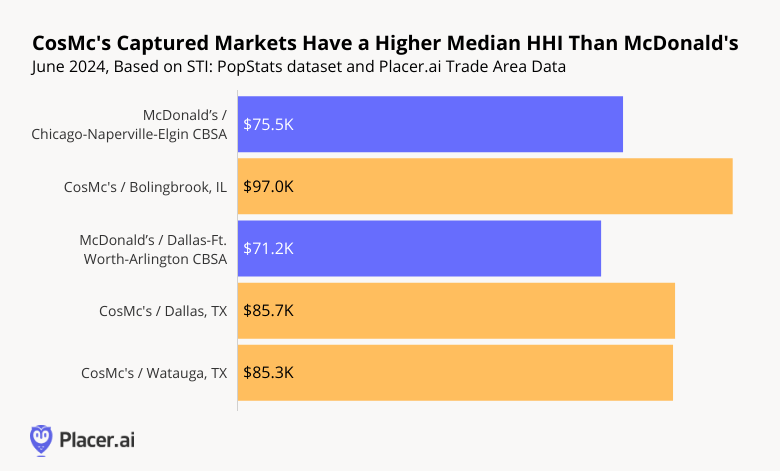
And although CosMc’s is still in its infancy, location analytics shows that the concept already drives traffic from more affluent consumers than the traditional McDonald’s chain.
In June 2024, for example, the median household income (HHI) in the captured market of the Bolingbrook, IL CosMc’s was $97.0K – significantly higher than that of McDonald’s in the Chicago metro area ($75.5K) or of McDonald’s nationwide ($65K).
A similar trend could be observed in the Dallas-Ft. Worth-Arlington CBSA – where the captured markets of local CosMc’s featured significantly higher median HHIs than those of McDonald’s.
As a beverage-led concept, CosMc’s may drive more traffic from higher-income consumers than a traditional McDonald’s – where simple soft drinks typically come as an inexpensive meal add-on. And as a result, the chain may help McDonald’s bring a new consumer cohort into the fold.

Summer 2024 is undoubtedly shaping up to be the “Summer of Value” and perhaps the “Summer of Fast Food” as well. Will favorable trends continue in the months ahead?
Visit Placer.ai to find out.

The fast-casual space has been having a moment – with rising QSR prices leading many diners to embrace an upgraded experience. So with Q2 2024 in the rearview mirror, we dove into the data to check in with two fast-casual restaurant chains that have been doing particularly well: Chipotle and sweetgreen. How did their Q2 performance compare to that of the wider fast-casual segment? And what is it, exactly, that they are doing right?
We dove into the data to find out.
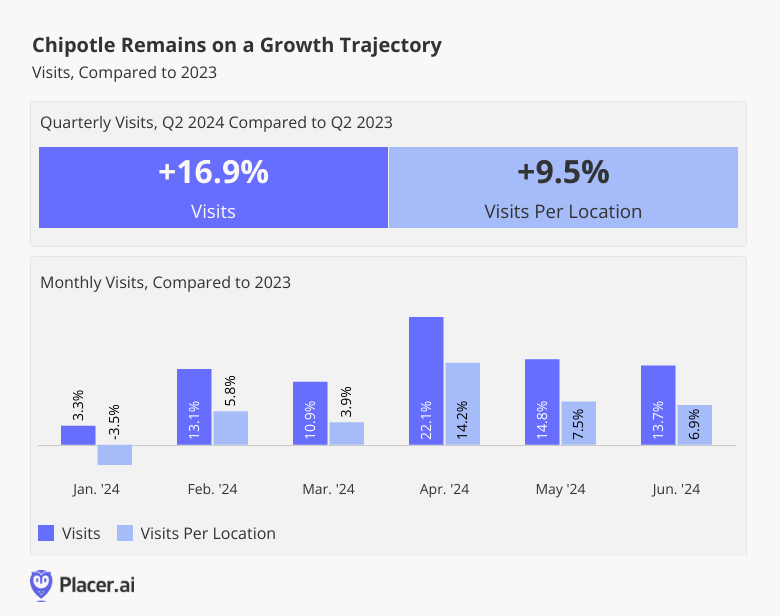
In the first quarter of 2024, Chipotle reported a 14.1% YoY increase in total revenue, and a 7.0% increase in comparable restaurant sales. And the chain isn’t showing any signs of slowing down. In Q2 2024, Chipotle saw YoY chain-wide foot traffic growth of 16.9%. And while some of this increase was undoubtedly due to the chain’s continued expansion – Chipotle added some 247 U.S. restaurants over the past year – the average number of visits to each of Chipotle’s restaurants also increased by an impressive 9.5%. By way of comparison, fast-casual restaurants experienced average quarterly YoY visit growth of just 4.2%, and visit-per-location growth of 2.9%.

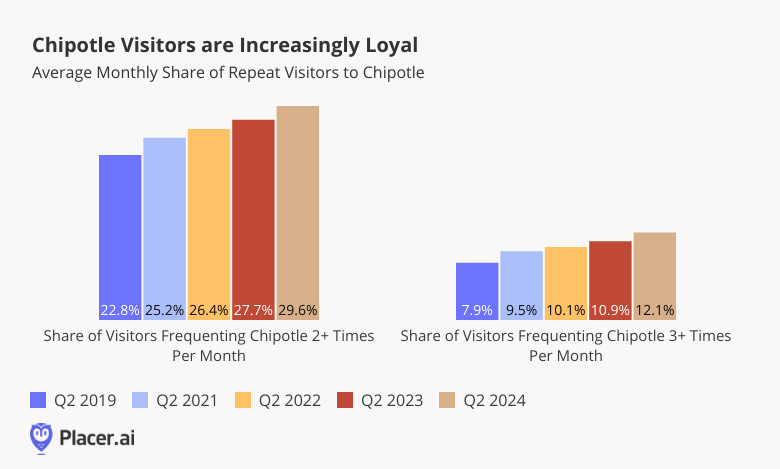
One factor that appears to be contributing to Chipotle’s remarkable visit growth is its repeat customer base – which is growing more loyal with every passing year. Between Q2 2019 and Q2 2024, the share of visitors frequenting a Chipotle at least twice a month increased from 22.8% to 29.6%, while the share of visitors frequenting a Chipotle at least three times a month grew from 7.9% to 12.1%.
This rise in loyalty has taken place against the backdrop of Chipotle’s growing loyalty program – Chipotle Rewards – which launched in Q1 2019 and today boasts more than 40 million members. The program, which lets members earn points for every dollar spent, offers diners access to personalized deals and a range of special promotions – like free delivery on National Burrito Day. (Before you ask, foot traffic data shows that National Burrito Day, which fell on Thursday, April 4th, 2024 wasn’t just a day for ordering online: It was Chipotle’s busiest Thursday of the year so far, with visits up 19.7% compared to a regular Thursday). This April, Chipotle also partnered with Tekken 8 to offer diners in-game currency in exchange for orders – with special perks for Rewards members.

Another eatery that has been performing remarkably well in 2024 is sweetgreen – the fast-casual restaurant known for its healthy, fresh food. During Q2 2024, visits to sweetgreen were up a remarkable 19.9% YoY, a reflection of the chain’s growing footprint. But foot traffic data shows that there is more than enough demand to sustain sweetgreen’s accelerated expansion – over the analyzed period, the average number of visits to each sweetgreen location also increased by 5.9%.

A look at the hourly distribution of visits to sweetgreen shows that though the chain has made inroads into the dinner daypart, lunchtime remains its prime time to shine – especially on weekdays.
During the first half of 2024, 24.9% of weekday visits to sweetgreen took place between noon and 2:00 PM – compared to just 21.7% for the wider fast-casual category. But while sweetgreen, popular among the in-office crowd, drew a greater share of lunchtime visitors on weekdays, the fast-casual segment as a whole drew a greater share of lunchtime visitors on the weekends. Indeed, on Saturdays and Sundays, the share of lunchtime sweetgreen visitors dropped to 22.7%, while the share of fast-casual lunchtime visitors increased to 22.2%.
Still, suppertime is also a popular daypart for the salad chain on weekdays – with 20.0% of Monday - Friday visits taking place between 6:00 and 8:00 PM. As sweetgreen continues to lean into steaks and other dinner fare, it will be interesting to see if the restaurant begins to capture even more evening traffic.

Chipotle’s and sweetgreen’s strong quarter positions them well for further growth as the year wears on. Will Chipotle’s loyalty continue to increase? And will sweetgreen double down on dinner?
Follow Placer.ai’s data-driven restaurant analyses to find out.

Millennials everywhere, rejoice, because a beloved brand is back, for the next generation. Limited Too, an apparel staple for girls growing up in the 1990’s and 2000’s, has found its way back to the retail stage after years of dormancy. The brand began teasing its return a month ago, but last week brought the announcement that Limited Too’s relaunch will take place via a new apparel line at Kohl’s. With the Fourth of July over and Amazon Prime Day complete, the back-to-school season is officially upon us, even if it still feels like summer. In Kohl’s press release on Friday, the Limited Too introduction is a part of its larger back-to-school efforts, and it appears to be aimed at expanding apparel offerings for girls. And, with Kohl’s recent and upcoming additions like Sephora, Babies”R”Us, and now Limited Too, the target is clearly to woo and excite the Millennial shopper.
The relaunch of Limited Too includes fashion for girls size 7-16, the same Tween demographic that the brand originally captured. Mall-based Limited Too shut its doors in 2008, and the majority of stores were converted into rival retailer, Justice, who shuttered all of its stores in 2020. The brand revival is likely positioned by Kohl’s to appeal to parents who grew up with an affinity for the brand who can now purchase for their children.
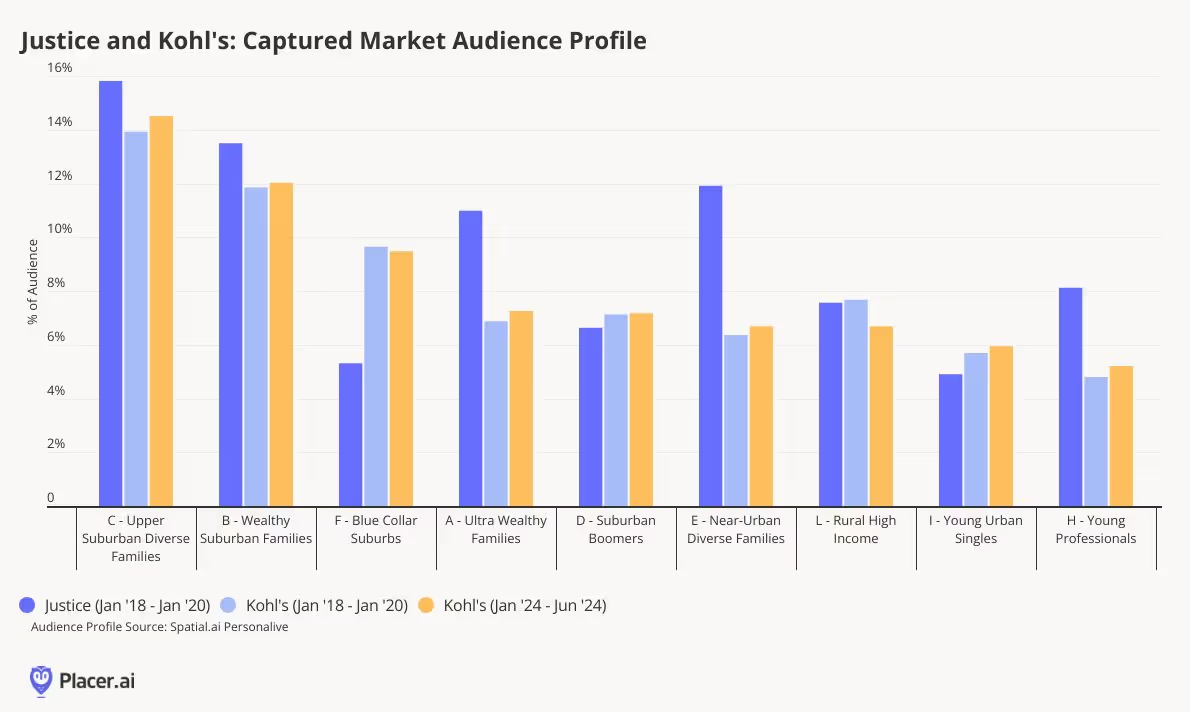
With the relaunch, how well situated is Kohl’s to attract this ideal “Limited Too Loyalist”? We took a look at a sampling of former Justice stores prior to closing, from 2018 to January 2020, and compared the audience profile of Justice visitors to Kohl’s visitors using Spatial.ai PersonaLive, both during the same time period as well as in 2024.
Our data highlights that both retailers actually have a similar audience profile of visitors, and that Kohl’s has continued to grow its percentage of Upper Suburban Diverse Families and Wealthy Suburban Families to more closely align with the former Justice demographics. Since the pandemic and through its new partnerships and planned additions, Kohl’s has been able to capture wealthier suburban families, and as Millennials continue to migrate out of urban centers, the retailer may have set itself up well to welcome these shoppers.

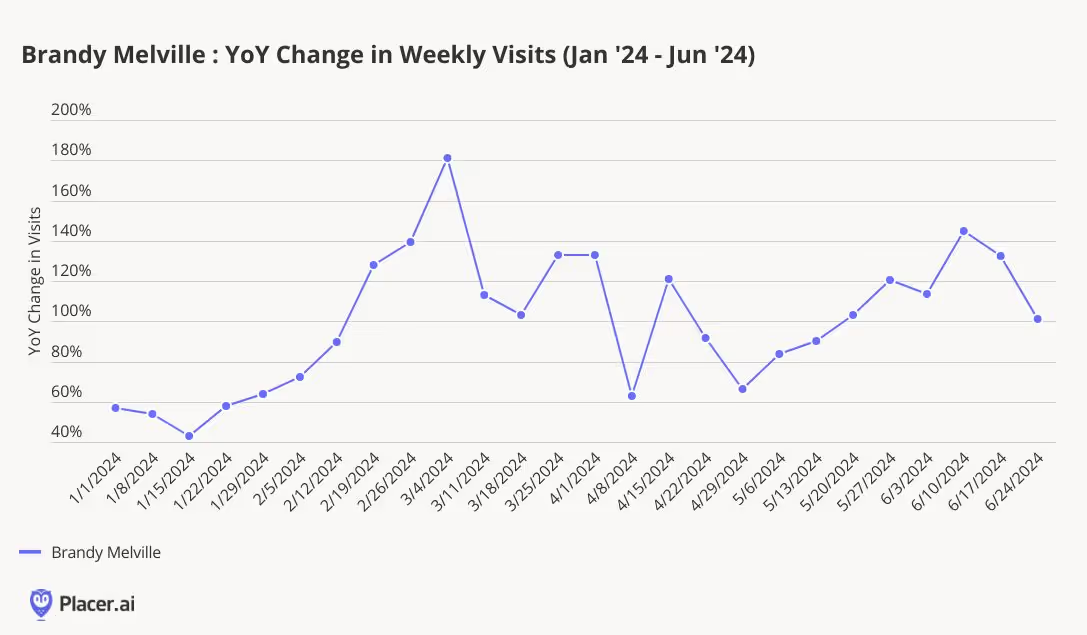
The tween apparel market today is highly fragmented, as is true with most areas of discretionary retail, with shoppers having access to countless brands and channels to choose from. Mass merchants, fast fashion, and athleisure brands are all vying for the attention of tweens, who are in turn influencing the retail decisions of their parents. A few months ago, we wrote about Brandy Melville, a somewhat controversial retailer that is still hugely popular with tweens. The retailer has the cool and elusive styling that young shoppers crave, and continues to be a strong traffic performer so far in 2024 (below). We’ve also written about the renaissance of Abercrombie & Fitch, another 2000’s brand with a strong connection to Millennials that has been able to recapture visitors’ attention, and still operates the Abercrombie Kids brand aimed at the same size range as the newly launched Limited Too.

Kohl’s new bet for the back-to-school season hangs on appealing to nostalgic Millennial parents, a group that quickly is becoming a target for many retailer strategies. We wrote last week about the rise of younger visitors to warehouse clubs, and the importance of younger shoppers to growing the member base. In a competitive and value-oriented retail environment, appealing to this group and gaining their loyalty in visits is critical to long-term success. It will be interesting to see if the Millennial love for Limited Too still remains, even after all these years.

Another year, another acquisition for casual-dining restaurant leader Darden Restaurants. Following up last year’s acquisition of Ruth’s Chris Steakhouse, Darden plans to acquire Chuy's for $605M (representing 10.3x Chuy’s trailing-twelve-month adjusted EBITDA of $59, or 8.2x adjusting for run-rate G&A costs that can be eliminated by adding Chuy’s to the Darden portfolio). Chuy’s is among the leading players in the Mexican casual-dining space in terms of revenue ($451M in revenue during 2023, adjusting for the extra week in the reporting calendar), average revenue per unit ($4.5M), and restaurant-level EBITDA (20%).
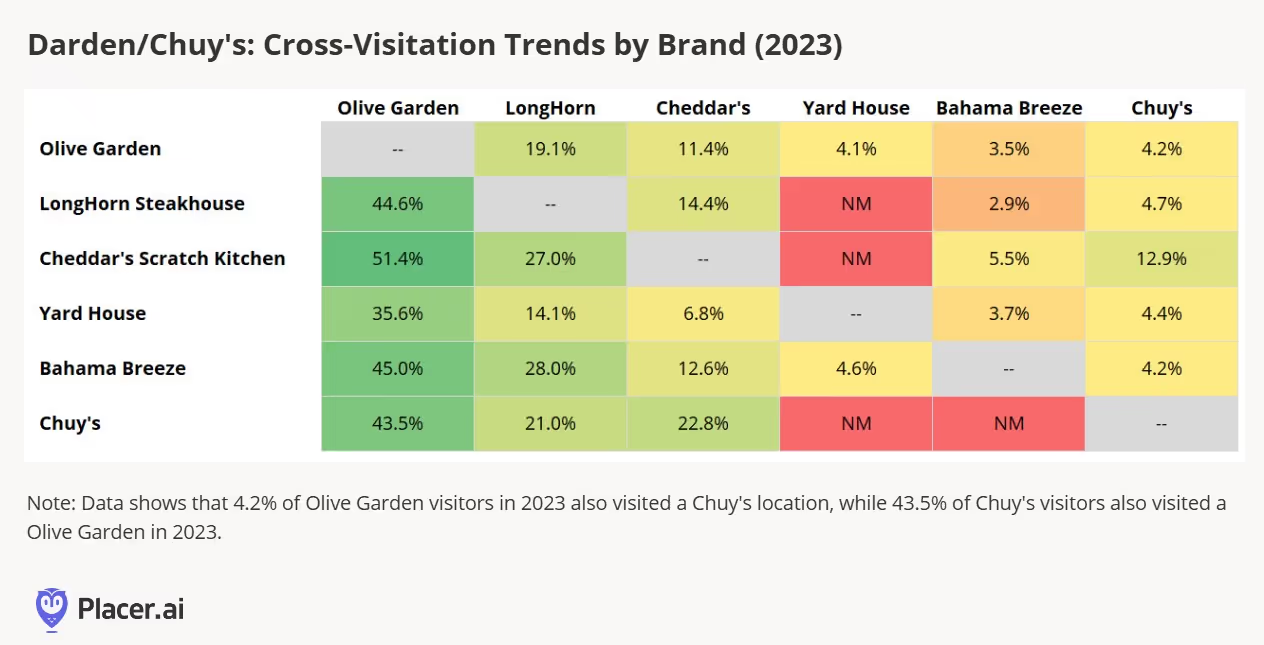
The acquisition of Chuy’s makes sense to us on a number of levels. First, and most obviously, Chuy’s fills a gap in the Darden portfolio. The company already owns the top player among casual-dining Italian chains (Olive Garden) and the number-two player in casual-dining steakhouses in addition to its other casual-dining (Cheddar’s, Yard House, Bahama Breeze) and fine-dining (Ruth’s Chris, The Capital Grille, Eddie V's, Seasons 52) concepts. By adding a casual-dining Mexican concept to its portfolio, we believe there will be an opportunity to attract incremental visitors. Below, we’ve presented cross visitation for Darden’s casual-dining brands and Chuy’s in 2023, and we see minimal overlap (although the cross-visit data is admittedly impacted by chain size and geography). According to our data, only 4%-5% of visitors to Darden’s existing restaurants also visited a Chuy’s location in 2023 (with the exception of Cheddar’s, which saw a 12.9% cross-visitation percentage).

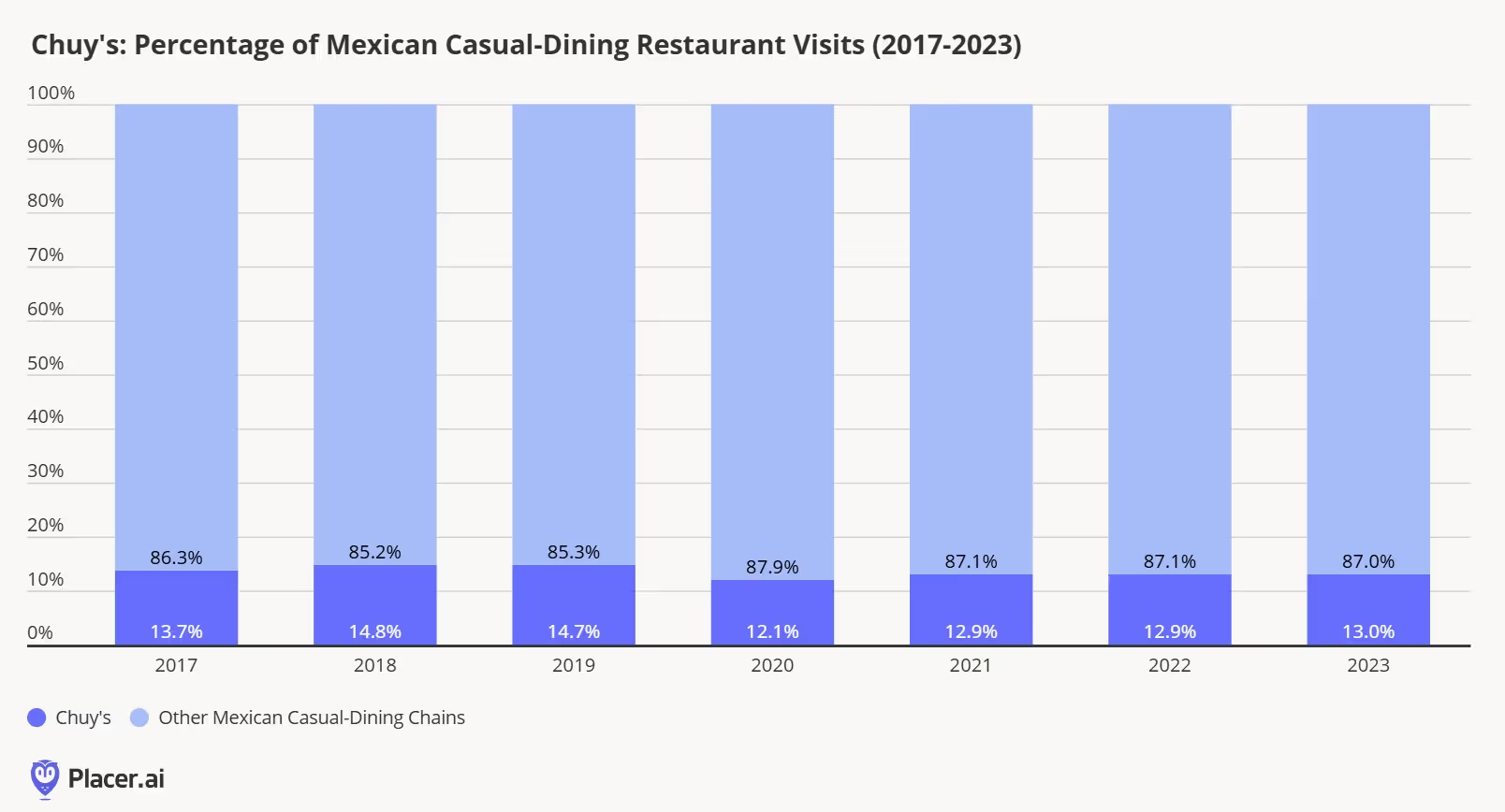
Second, despite Chuy’s being the leading player in the Mexican casual dining space, it’s still a relatively fragmented category that is ripe for consolidation. Below, we show the share of visitation data for Chuy’s compared to almost 20 other full-service Mexican restaurant chains from 2017-2023. Despite Chuy’s growth, its share of visits relative to the rest of the category has remained relatively healthy in the 12%-15% range. Backed by Darden’s purchasing, advertising, and real estate scale advantages, we see a meaningful opportunity to consolidate share of visits going forward, including visit per location improvement.

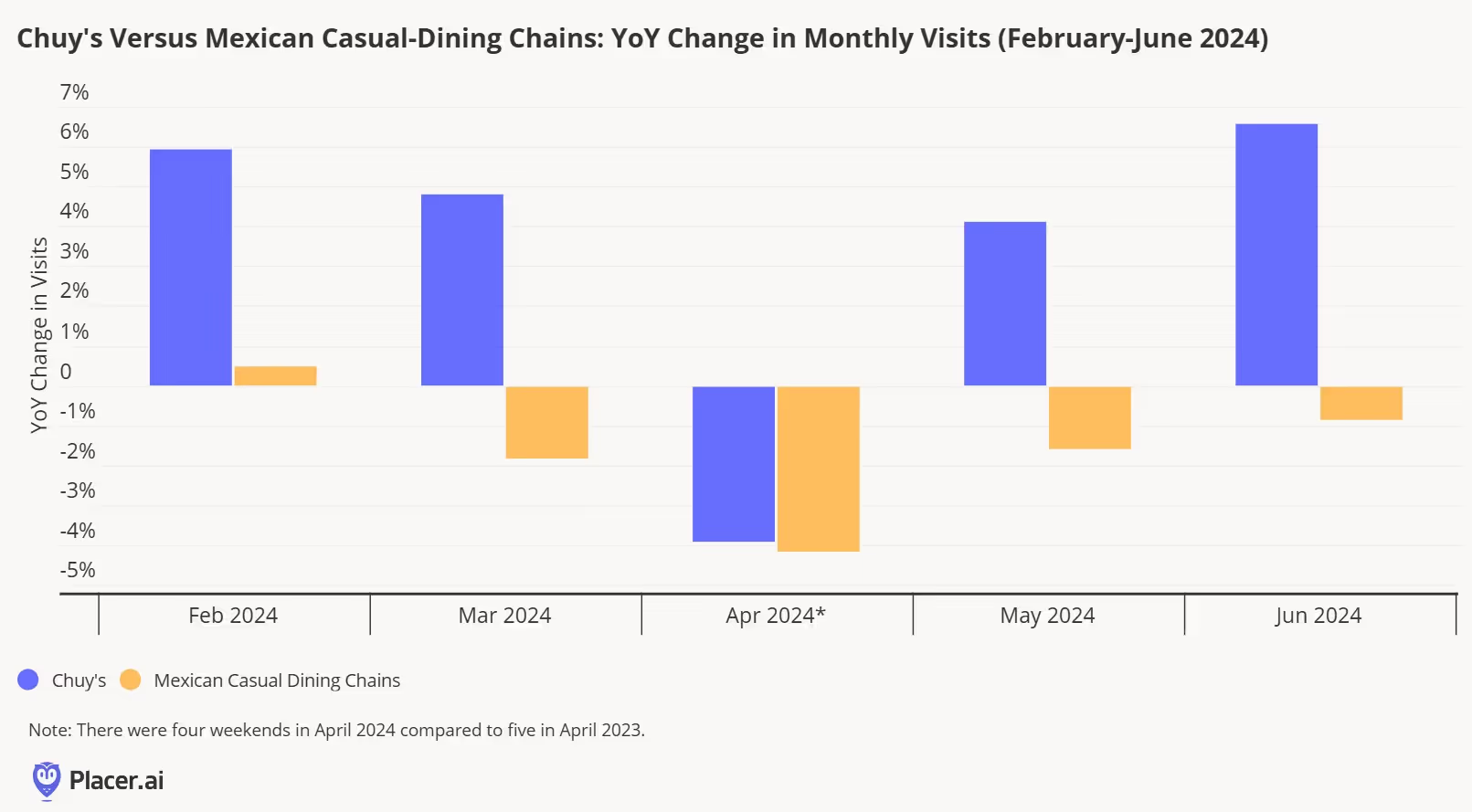
Chuy’s has been one of the leaders in the Mexican casual-dining chains in terms of visitation growth this year, outpacing monthly visits for the category by 5% on average (below). While integration will take time, applying guest experience, menu innovation, pricing, and marketing best practices from Darden should help to maintain this leadership.

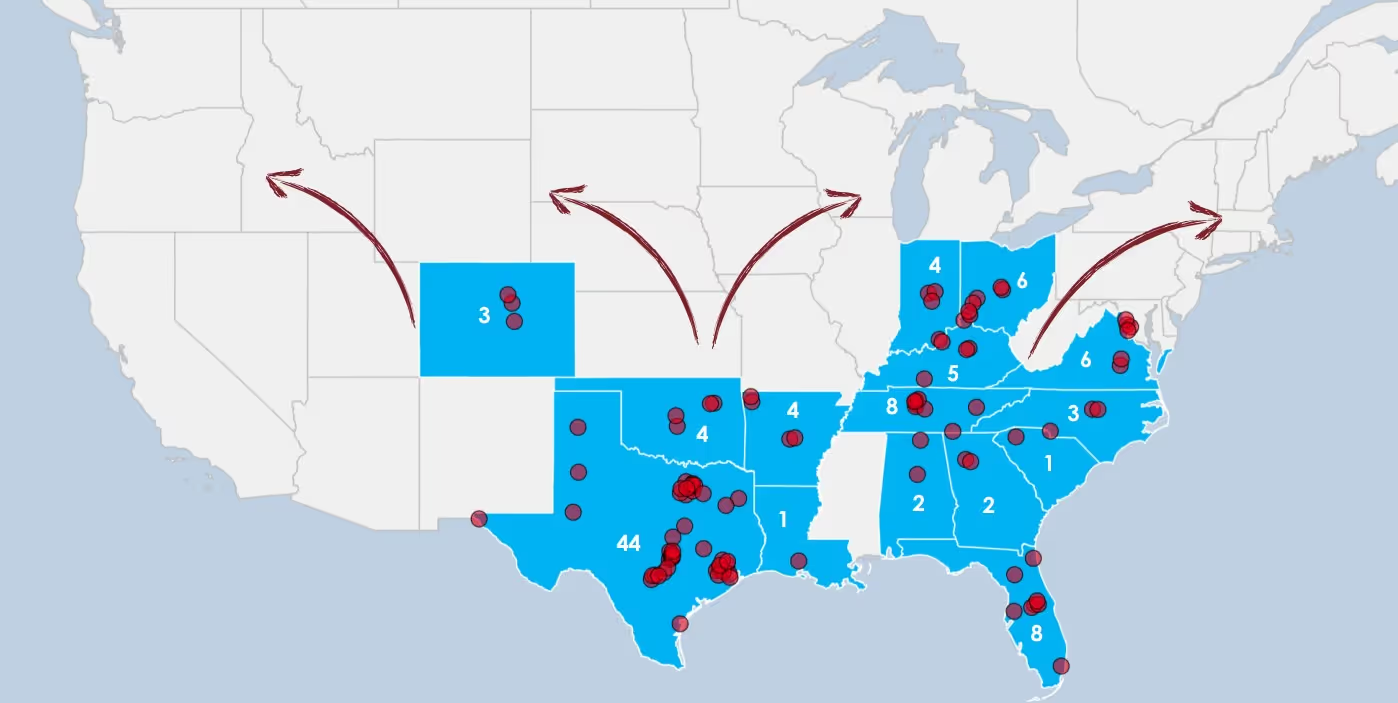
At 101 company-owned restaurants today, Chuy’s is comparable to several other brands in the Darden portfolio (including Yard House at 88 units and Ruth’s Chris at 79). The chain is well established in Texas (44 company-owned units) but has a relatively small presence in other states across the Southeast and Midwest (below).

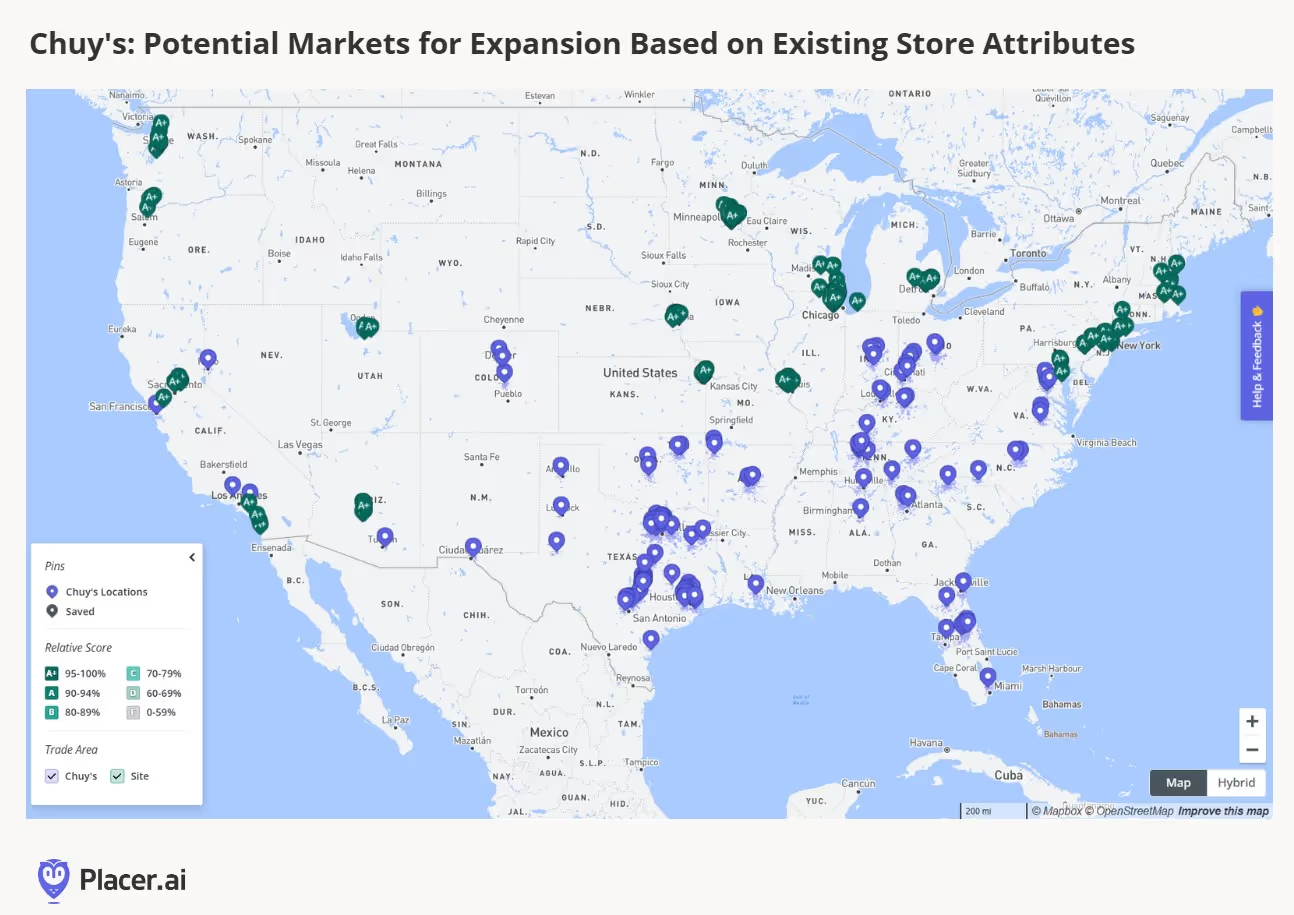
As Darden and Chuy’s management pointed out in a conference call to discuss the transaction, there are significant opportunities in both existing and new markets. Placer’s Site Selection tool (which identifies the characteristics of Chuy’s top locations–including trade area populations, demographic fit, cannibalization risk, and competition density–and finds markets/sites with similar characteristics) sees the best fits for expansion in several West, Midwest, and Northeast markets.


The first half of 2024 is proving to be more heavily visited for all types of shopping centers. June in particular is stronger than it was last year. After some January doldrums, where all shopping traffic was lower than the prior year due to weather, February began to pick up and March was particularly strong comparatively for outlet malls compared to last year. April saw a general downtick for more discretionary shopping, but May and June are looking strong so far.

The top 5 outlet malls by traffic during the last week of June were Arundel Mills, Ontario Mills, Sawgrass Mills, Legends Outlets Kansas City, and The Outlets at Orange. Among indoor malls, shoppers flocked to Mall of America, Roosevelt Field, Westfield Valley Fair, Del Amo Fashion Center, and Westfield Southcenter. Weather is always a consideration in the summer months, but as shopping centers have become increasingly sophisticated about strategically placed shade or places to take a break, it can be quite refreshing to visit an open-air lifestyle center. Tops in the nation for traffic include Ala Moana Center, Pier Park, Easton Town Center, Irvine Spectrum Center, and Victoria Gardens. As for high street retail corridors, no one can match the Big Apple. Three of the top five high streets were here, including Times Square and 42nd St at #1, SoHo at #3, and 5th Ave at #4. In second place was Michigan Ave in Chicago and in fifth place was Beverly Hills.

Against the backdrop of what remains a challenging time for full-service restaurants (FSRs), we dove into the data to check in with three of America’s leading FSR chains – First Watch, Texas Roadhouse, and Applebee’s. How did they fare in Q2 2024? And what lies in store for them in the months ahead?
First Watch has emerged as a rising star in recent years, rapidly expanding its footprint while at the same time taking pains to preserve the feel of a small, local eatery. The restaurant is nimble on its feet – growing its audience through a strategy centered on continual menu innovation and special seasonal offerings.
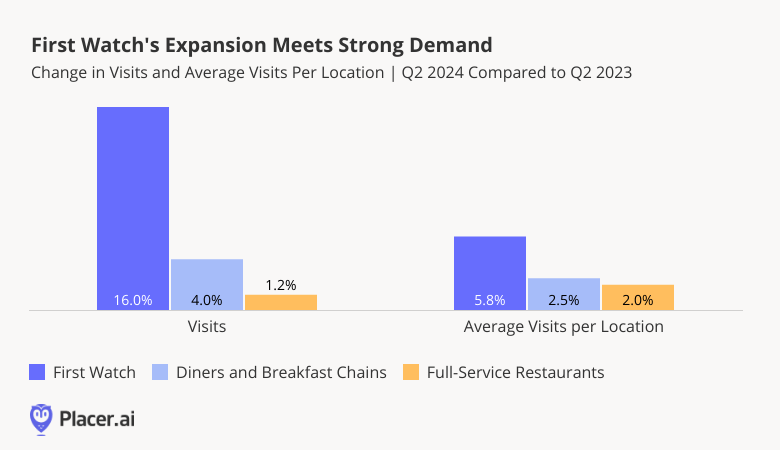
In the past year alone, First Watch added dozens of new locations to its fleet. And foot traffic data shows that the chain’s aggressive growth strategy is meeting robust demand. In Q2 2024, YoY visits to First Watch grew by 16.0%, far outperforming FSR and diner & breakfast chain averages. And perhaps more importantly, the average number of visits to each individual First Watch restaurant rose 5.8% over the same period.

Texas Roadhouse is another chain that has been crushing it in 2024 – and not just on Father’s Day. Over the past year, the popular steakhouse opened some 30 new U.S. locations, and plans to continue expanding this year.
And foot traffic data shows that Texas Roadhouse’s high-quality, affordable offerings are resonating with consumers. Despite inflation-driven price hikes, YoY visits to the chain have continued to grow. And though some of this increase is due to the restaurant’s expansion, the average number of visits per location has also been on the rise: Between January and June 2024, Texas Roadhouse experienced near-consistent YoY visit and visit-per-location growth. Only in January and in April did visits per location falter, likely due to January’s inclement weather and an April Easter calendar shift.

On a quarterly basis, too, foot traffic to Texas Roadhouse increased 6.2% in Q2 2024 – significantly outpacing averages for both steakhouses (2.6%) and full-service restaurants (1.2%).
Like many full-service restaurants, Dine Brands’ Applebee’s has faced its share of headwinds in recent years. Over the past 12 months, Applebee’s shuttered at least 30 locations, contributing to a drop in the chain’s overall foot traffic. But analyzing changes in the average number of visits to each Applebee’s restaurant shows that the closures may actually be helping to put Applebee’s back on a firmer footing.
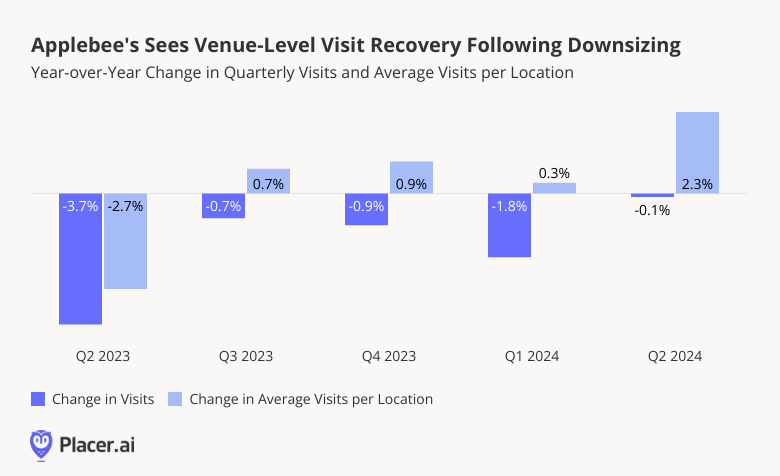
In Q2 2023, visits to Applebee’s nationwide declined 3.7% YoY, while the average number of visits per location dropped 2.7%. Since then, the chain’s YoY visit gap has narrowed – while the average number of visits per location has begun to increase. And in Q2 2024, Applebee’s closed its overall YoY visit gap and grew its visits per location by 2.3%. Though the chain has yet to return to positive unit growth, the rightsizing of its fleet appears to be bolstering Applebee’s remaining stores – positioning it for long-term success.

Full-service restaurants have had a tough time in recent years, and concerns that consumer spending may moderate as the year wears on continue to weigh on the industry. Still, foot traffic data suggests that consumers are once again visiting restaurants – fueling expansion for First Watch and Texas Roadhouse, and helping shore up Applebee’s long-term prospects.
What does the rest of 2024 have in store for restaurant chains?
Follow Placer.ai’s data-driven restaurant analyses to find out.

1. AI is raising the bar for physical retail as shoppers arrive more informed, more intentional, and less tolerant of friction – though the impact varies by category and format.
2. As discovery shifts upstream, stores increasingly serve as confirmation rather than discovery points where shoppers validate decisions through hands-on experience and expert guidance.
3. AI-based tools can improve in-store performance by removing operational friction – shortening trips in efficiency-led formats and supporting deeper engagement in experience-led ones.
4. By embedding expertise directly into frontline workflows, AI helps retailers deliver consistent, high-quality service despite high turnover and limited training windows.
5. AI enables precise, location-specific marketing and execution, allowing retailers of any size to align assortments, staffing, and messaging with real local demand.
6. Retailers can also use AI to manage their store fleets with greater discipline and understand where to expand, where to avoid cannibalization, and where to rightsize based on observed demand rather than static assumptions.
7. AI is not a universal lever in physical retail; its value depends on the store format, and in discovery-driven models it should support operations behind the scenes rather than reshape the customer experience.
Physical retail has faced repeated claims of obsolescence, from the rise of e-commerce to the shock of COVID. Each time, analysts predicted a structural decline in brick-and-mortar. And each time, physical retail adapted.
AI has triggered a similar round of predictions. Much of the current discussion frames retail’s future as a binary outcome: either stores become heavily automated, or e-commerce becomes so optimized that physical locations lose relevance altogether.
But past disruptions point in a different direction. E-commerce changed how physical retail operated by raising expectations for omnichannel integration, speed, and clarity of purpose. Retailers that adjusted store formats, merchandising, and operations accordingly went on to drive sustained growth.
AI likely represents another inflection point for physical retail. As shoppers arrive with more information, clearer intent, and even less tolerance for friction than in the age of "old-fashioned" e-commerce, physical stores will remain – but the standards they are held to continue to rise.
This report presents four ways retailers are using AI to get – and stay – ahead as physical retail adapts to this next wave of disruption.
E-commerce moved discovery earlier in the shopping journey. Instead of beginning the process in-store, many shoppers now arrive at brick-and-mortar locations after having deeply researched products, comparing options, and narrowing choices online – entering the store to validate rather than initiate their purchasing decision.
AI-powered shopping accelerates this pattern. Conversational assistants, recommendation engines, and AI-driven discovery across search and social reduce the time and effort required to evaluate options – and this shift is changing consumers' expectations around the in-store experience.
Apple shows what it looks like when a physical store is built for well-informed shoppers. Given the prevalence of AI-powered search and assistants in high-consideration categories like consumer electronics, Apple customers likely arrive at the Apple Store with more preferences already shaped by AI-assisted research than other retail categories.
Apple Stores were designed for this kind of customer long before AI became widespread. The layout puts working products directly in customers’ hands, merchandising emphasizes live use over promotional signage, and associates are trained to answer detailed technical questions rather than walk shoppers through basic options.
That alignment is showing up in store behavior. Even as AI-powered shopping expands, Apple Stores continue to see rising foot traffic and longer visits thanks to the store's specific and curated role in the customer journey – a place where customers confirm decisions through hands-on experience and expert guidance.
Some applications of AI extend trends that e-commerce has already introduced. Others address operational challenges that previously required manual coordination or tradeoffs.
AI can reduce friction and make store visits more predictable by improving staffing allocation, reducing checkout delays, optimizing inventory placement, and managing traffic flow. These changes reduce friction without altering the visible customer experience.
Sam's Club offers a clear, recent example of AI solving a specific in-store bottleneck. For years, customers completed checkout only to face a second line at the exit, where an employee manually scanned paper receipts and spot-checked carts.
In early 2024, Sam’s Club introduced computer vision-powered exit gates, allowing customers to exit the store without stopping as AI algorithms instantly captured images of the items in their carts and matched them against digital purchase data. Employees previously tasked with receipt checks could now shift their focus to member assistance and in-store support.
The impact was measurable. Sam’s Club reported that customers now exit stores 23% faster than under manual receipt checks, a result confirmed by a sustained nationwide decline in average dwell time. During the same period, in-store traffic increased 3.3% year-over-year – demonstrating how removing friction with AI can deliver tangible gains.
AI optimizes stores for different outcomes. At Sam’s Club, it shortens visits by removing friction from task-driven trips. At Apple, upstream research leads to longer visits focused on testing, questions, and decision validation. In both cases, AI aligns store execution with shopper intent – prioritizing speed and throughput in efficiency-led formats and deeper engagement in experience-led ones.
Beyond shaping store roles and streamlining operations, AI can also address a long-standing challenge in physical retail: delivering consistent, high-quality expertise on the sales floor despite high turnover and seasonal staffing. In the past, retailers relied on heavy training investments that often failed to pay off. AI can now embed that expertise directly into frontline workflows, allowing associates to deliver confident, informed service regardless of tenure and strengthening the in-store experience at scale.
In May 2025, Lowe’s rolled out a major in-store AI enhancement called Mylow Companion, an AI-powered assistant that equips frontline staff with real-time, expert support on product details, home improvement projects, inventory, and customer questions.
Mylow Companion is embedded directly into associates’ handheld devices, delivering instant guidance through natural, conversational interactions, including voice-to-text. This enables even newly hired employees to provide confident, expert-level advice from day one, while helping experienced associates upsell and cross-sell more effectively. The tool complements Mylow, a customer-facing AI advisor launched the same year to help shoppers plan projects and discover the right products, leading to increased customer satisfaction.
While AI alone cannot solve demand challenges—especially amid macroeconomic pressure on large-ticket discretionary spending—early signals suggest it may still play a meaningful role. Location analytics indicate narrowing year-over-year visit gaps at Lowe’s post-deployment, pointing to a potentially improved in-store experience. And Home Depot’s recent announcement of agentic AI tools developed with Google Cloud suggests that these technologies are becoming table stakes in this category.
As more retailers roll out similar capabilities, those that moved earlier are better positioned to help set the bar – and benefit as the market adapts.
Beyond improving the in-store experience, AI also gives retailers a powerful way to drive foot traffic through precision marketing. By processing large volumes of behavioral, location, and timing data, AI can help retailers decide who to reach, when to engage them, where to activate, and what message or assortment will resonate – shifting marketing from broad seasonal pushes to campaigns grounded in local demand.
Target offers an early example of this approach before AI became widespread. Stores near college campuses have long tailored assortments and messaging around the academic calendar, especially during the back-to-school season. In August, these locations emphasize dorm essentials, compact storage, bedding, tech accessories, and affordable décor – supported by campaigns aimed at students and parents preparing for move-in. That localized approach has been effective in driving in-store traffic to Target stores near college campuses, with these venues seeing consistent visit spikes every August and outperforming the national average across multiple back-to-school seasons from 2023 to 2025.
AI makes local execution repeatable at scale. By analyzing visit patterns, past performance, and timing signals across thousands of locations, retailers can decide which products to promote, how to staff stores, and when to run campaigns at each location. Marketing, merchandising, and store operations then act on the same demand signals instead of separate assumptions.
Crucially, AI makes this level of localization accessible to retailers of all sizes. What once required the resources and institutional knowledge of a big-box giant can now be achieved through precision marketing and demand forecasting tools, allowing brands to adapt each store’s messaging, assortment, and execution to the unique rhythms of its community.
Beyond improving performance at individual stores, AI can also give retailers a clearer view of how their entire store fleet is working – and where it should grow, contract, or change. By analyzing foot traffic patterns, trade areas, customer overlap, and visit frequency across locations, AI helps retailers identify which sites are truly reaching their target audiences and which are underperforming relative to local demand.
AI also plays a critical role in smarter expansion. Retailers can use it to identify markets and neighborhoods where demand is growing, customer overlap is low, and incremental visits are likely – reducing the risk of cannibalization when opening new stores. By modeling how shoppers move between existing locations, AI can flag when a proposed site will attract new customers versus simply shifting traffic from nearby stores, grounding expansion decisions in observed behavior rather than demographic proxies or intuition alone.
Equally important, AI helps retailers recognize when expansion no longer makes sense. By tracking total fleet traffic, visit growth, and trade-area saturation, retailers can assess whether new stores are adding net demand or diluting performance. The same signals can identify locations where demand has structurally declined, informing rightsizing decisions and store closures. In this way, AI supports a more disciplined approach to physical retail – one that treats the store fleet as a dynamic system to be optimized over time, rather than a footprint that only grows.
The impact of AI on physical retail will vary significantly by category and format. Not every successful store experience is built around efficiency, prediction, or pre-qualification. Retailers with clearly differentiated offline value don’t necessarily benefit from forcing AI into customer-facing experiences that dilute what makes their stores work.
“Treasure hunt” formats are a clear example. Off-price retailers like TJ Maxx, Marshalls, Ross, and Burlington continue to drive strong traffic by offering unpredictability, scarcity, and discovery that cannot be replicated – or meaningfully enhanced – through AI-driven search or recommendation. The appeal lies precisely in not knowing what you’ll find. For these retailers, heavy investment in AI-led personalization or pre-shopping guidance risks undermining the core experience rather than improving it.
Similar dynamics apply in other categories. Independent boutiques, vintage stores, resale shops, and certain specialty retailers succeed by offering curation, serendipity, and human taste rather than optimization. In these cases, AI may still play a role behind the scenes – supporting inventory planning, pricing, or site selection – but it should not reshape the customer-facing experience. AI is most valuable when it reinforces a retailer’s existing value proposition. Formats built around discovery, surprise, or experiential browsing should protect those strengths, even as other parts of the retail landscape move toward greater efficiency and intent-driven shopping.
AI is forcing physical retail to evolve with intention. By creating a supportive environment for customers who arrive with made-up minds, removing friction inside the store, offering the best in-store services, and orchestrating demand with greater precision, retailers are adapting to the new world standards set by AI. All five strategies focus on aligning stores with shopper intent – what customers want, how the store supports it, and when the interaction happens.
The retailers that win in this next era won’t be the ones that use AI to simply automate what already exists. They’ll be the ones that use it to sharpen the role of physical retail – turning stores into places that help shoppers validate decisions, deliver value beyond convenience, and show up at exactly the right moment in a customer’s journey.
In the age of AI, physical retail wins by becoming more intentional – designed around informed shoppers, optimized for the right outcome in each format, and activated at moments when demand is real.

If 2025 proved anything, it’s that the American consumer hasn’t stopped spending – they’ve just become incredibly selective about who earns their dollar. As we look toward 2026, success isn't just about weathering headwinds; it's about identifying the specific operational levers that drive traffic.
We analyzed the data to identify ten retail and dining standouts (presented in no particular order) that are especially well-positioned for the year ahead. From grocery icons mastering hyper-authenticity to fitness challengers proving that low price doesn't mean low quality, these companies have demonstrated a powerful understanding of their audience and the operational agility to meet them where they are.
Here – in no particular order – are the brands setting the pace for 2026.
When we pick retailers for our Ten Top list, there are some that rest on the edgier side and others that look fairly down the middle. Picking H-E-B, a grocer that has seen monthly visits up year over year (YoY) for all but one month since April of 2021, is clearly not one of the bolder claims. But consistent success shouldn’t preclude a retailer from receiving its well deserved kudos, and there are some unique reasons that H-E-B specifically needs to be included this year.
H-E-B exemplifies the single most important trend in retail: the need for a brand to have authenticity and a clear reason for being. The retailer understands its audience, and as a result, it’s able to optimize its merchandising, promotions, and experience to best serve that loyal customer base. This pops in the data when we see the loyalty H-E-B commands, especially when compared to the grocery average.
In addition, the chain has also embraced adjacent innovation, leveraging its existing fleet by adding True Texas BBQ to a growing number of locations. The offering not only helps maximize the revenue potential of each visit, it taps into the core identity of the brand, further deepening customer connection and authenticity. The strategy also signals H-E-B’s understanding of emerging consumer behaviors – particularly the increase in shoppers turning to grocery stores for affordable, restaurant-quality lunches. And this combination of expanding revenue channels while heightening H-E-B’s uniqueness should also carry over into the value and impact of its retail media network.
In short, H-E-B has not only identified a critical route to success, it continues to embrace channels that widen revenue potential while doubling down on foundational strengths.
In 2024, Michaels held nearly 32.0% of overall visit share among the top four retailers in the wider crafts and hobby space. By the second half of 2025, that number had skyrocketed to just over 40.0% – driven largely by the closures of key competitors JoAnn Fabrics and Party City.
And it isn’t just that the removal of competitors is increasing the share of overall visits; the rate of capture appears to be accelerating. In Q2 2025, visits rose 7.3% YoY as Michaels began absorbing traffic from Party City, which closed the bulk of its locations by March. Growth strengthened further in Q3, with visits up 13.1% YoY following the completion of JoAnn’s shutdown in May. But during the all-important Q4, traffic surged even higher YoY, suggesting that that consolidation alone doesn’t fully explain the gains.
While the tailwinds of competitor closures clearly help, there are other strategies that are helping the retailer maximize this wave. Whether it be NFL partnerships to boost the retailer’s Sunday role in American households, a push into the framing space with 10-minute custom framing, the addition of JoAnn’s branded merchandise to its offerings, or even a challenge to Etsy’s online dominance with a new marketplace – Michaels is making moves to take full advantage of their improved positioning. There is also an argument to be made that Michaels is the retailer best poised to benefit from the segment’s consolidation, given that it is also the most oriented to a higher income consumer among top players in the category. This could help unlock other more focused concepts and promotions, and better align with an audience now looking for a retail replacement.
Walmart is the dominant player in physical retail.
And they leverage this position to push forward new offerings that extend revenue potential while maximizing per-store impact. They are a pioneer in the retail media space and have been using their unique reach to push that side of the business forward. Add to that the fact that they have been among the savviest players in all of retail in identifying the ideal approach to omnichannel, utilizing their massive physical footprint to improve their reach via BOPIS and store-fulfilled e-commerce.
All good reasons for inclusion, right?
But, here’s the kicker - from a pure visit perspective, things are going from good to better. Between January and September 2025, Walmart visits were essentially flat year over year – a good position for a retailer with such a massive reach and such strength shown in recent years. Yet, since October, visits have actually been on the rise, with Q4 2025 showing a 2.5% YoY traffic increase and several weeks exceeding 4.0% YoY.
A retail giant with even more potential growth than we might have expected – and one that’s pushing the very strategies we believe are the key to future success? That’s certainly a reason for inclusion.
Including a department store again on this year’s list? It seems counterintuitive to many of the narratives that ran through 2025, especially as middle-class consumers continue to be squeezed financially. However, Dillard’s still appears to be an exception to the rule, with performance more closely aligned to that of luxury department store brands like Bloomingdales & Nordstrom than to its true competitive set.
In 2025, visitation to Dillard’s was essentially flat YoY – though the chain has consistently outperformed the wider department store category. Dillard’s stands at a unique point somewhere between a mid-tier and luxury department store, and that distinction may be its secret to success. The retailer continues to wow with strong private label offerings that rival and often exceed national brands, a diverse merchandise mix, and locations that often benefit from indoor mall traffic trends.
While Dillard’s lags behind the wider department store category, for example, in terms of repeat visitation and the share of wealthy visitors, these factors may actually create an advantage. Efforts by Dillard's to refresh its product mix through limited-edition capsule collections and new brand launches may be helping it attract a steady inflow of economically diverse new shoppers. And the ability to continually win over new segments without alienating a “core customer” could be a strength amid economic headwinds and waning consumer sentiment.
At the same time, a more diverse visitor profile means that Dillard’s can truly be the department store for many consumers, with a product range that strikes a chord with different shopper segments.
Department stores truly aren’t dead, and those who have found their reason to exist continue to garner attention with shoppers.
If the retail industry had a symbol for 2025, it was probably Labubu. The toy-and-collectible-turned–bag charm took consumers by storm in the second quarter of the year, and POP MART – the retailer responsible for bringing Labubus stateside – quickly became an overnight sensation. Visits to the chain surged over the summer at the height of the craze, while trade areas expanded as customers traveled significant distances to get their hands on a doll.
And although the frenzy cooled somewhat in early fall, visits to POP MART locations like the one in Tulalip, WA began trending upward once again in November 2025 as the holiday season approached, surging even higher in December. Trade area size also increased dramatically during the holiday shopping period, as consumers rushed to get their hands on the chain’s coveted line of festive blind boxes.
As demonstrated by the recent Starbucks Bearista craze, consumers are all-in on cool collectible items that make life more fun – a trend POP MART, strategically located in high-traffic malls popular with younger shoppers, is uniquely positioned to ride. During times of economic uncertainty, consumers crave small ways to indulge, and affordable collectibles that are cute, cuddly, and fun have worked their way into the American zeitgeist.
So, what is next for POP MART? Can it continue to sustain its momentum? It seems likely that Labubus are here to stay, at least for a little while longer, before the retailer hopefully strikes it big with the next “must have”.
When all is said and done, 2021-2025 will likely be viewed as a pivotal turning point for the U.S. coffee industry. As the country recovered from the pandemic, consumer interaction with coffee brands fundamentally shifted. With more employees working from home – bypassing the traditional pre-work coffee run – visit trends migrated to later in the morning and afternoon. Meanwhile, industry-wide dwell times shortened as consumers renewed their focus on convenience.
This move away from the sit-down café experience placed significant pressure on industry leaders, accelerating the shift toward drive-thru and mobile order-and-pay options. This moment of friction also created space for drive-thru-centric challengers like Dutch Bros, which rapidly expanded on the strength of speed and menu innovation.
Among these challengers, 7 Brew stands out as a fast-rising powerhouse heading into 2026. Expanding outward from its Arkansas roots, 7 Brew has been strategic about market entry and site selection for its unique double-drive-thru format. And with a concept that resonates with younger demographics and a footprint adaptable to various geographies, the coffee chain has become a go-to destination for rural and small-town communities, while also maintaining solid reach among more traditional coffee segments like wealthy suburbanites and urban singles. Thanks in part to this broad appeal, 7 Brew is well-positioned for future growth, even as it faces stiffer competition in new markets.
It is no secret that most of the growth in the QSR space over the past two decades has been driven by chicken concepts. Chick-fil-A, rising from a regional chain to a national player throughout the late 1990s and 2000s, was the first to disrupt the burger’s stranglehold on QSR. Raising Cane’s followed in the 2010s with a model built on menu simplicity and operational excellence, earning its place as one of the largest chains in the category. More recently, hot chicken has emerged as one of the fastest-growing segments – and Dave’s Hot Chicken is leading the charge.
No single factor accounts for Dave’s growth from a lone unit in Los Angeles to over 350 units today. Certainly, a wide assortment of sauces and flavor profiles has resonated with U.S. consumers who are increasingly seeking spicier products, while Dave’s 'rebel' brand positioning has successfully attracted younger audiences. And at a time when many QSR and fast-casual chains are abandoning urban locations in favor of suburban markets, Dave’s Hot Chicken continues to open predominantly in urban settings – a strategy that may prove advantageous as migration patterns shift back toward major cities this year.
With so much of the industry’s expansion driven by chicken concepts, it is natural to ask: Have we reached 'peak chicken'? While we are certainly seeing other categories gain traction – think CAVA – Dave’s unique product mix and edgier marketing should help it stand out, even amidst increased competition.
While many discretionary retail categories – including consumer electronics, sporting goods, home improvement, and furniture – are still waiting for post-pandemic demand to recover, housewares retailers have generally enjoyed solid visit trends in 2025. Although consumers may not be financially positioned for large-scale remodels, we are now five years past the pandemic, and many residents (many of whom still work from home) are looking to refresh their living spaces.
It may therefore come as no surprise that TJX Companies’ HomeGoods and Homesense brands had an exceptional 2025 and are well-positioned to repeat this success in 2026.
This year, we observed a behavioral shift among middle-income consumers, including a clear “trade down” from mid-tier department stores and other discretionary categories. In addition, accumulated housing wear-and-tear, the recent bankruptcies of value-oriented competitors such as Conn’s and At Home, and the enduring appeal of the treasure hunt retail model, have all reinforced the brands’ momentum. Taken together, these trends leave HomeGoods and Homesense poised for both continued unit growth and increased traffic in the year ahead.
With the heightened emphasis on health and wellness post-pandemic, fitness is proving to be a category with remarkable staying power well beyond New Year’s resolution season – even in an era of macroeconomic uncertainty. Whether it’s pumping iron, hitting the treadmill, or joining fitness classes, staying healthy no longer requires breaking the bank – for just a dollar a day or less, gymgoers can build strength and endurance, achieve their rep goals, and hit their mileage targets. And affordable fitness chains – those that charge less than $30 per month – are reaping the benefits, outperforming more expensive gyms for YoY visit growth.
Among this value-oriented fitness cohort, EōS saw outsized traffic growth in 2025, with both overall visits and average visits per location outpacing competitors as the chain expands its footprint. EōS’s motto, “High Value, Low Price,” appears to be resonating strongly – especially in a year when similar value propositions are driving momentum across off-price retailers, value grocers, and dollar stores. Longer-than-average dwell times at EōS provide another encouraging signal, suggesting that its amenities, including pools, saunas, basketball courts, and equipment assortments typically found in higher-priced gyms, are truly connecting with visitors. And since visitors who stay longer are more likely to return – and to renew their memberships – EōS is well-positioned to convert this year’s traffic gains into lasting market share.
Eating and entertainment are a match made in heaven — and by leaning into a subscription model that meets price-sensitive customers where they are, Chuck E. Cheese has solidified its position as a standout in the eatertainment category.
Nearly 50 years old, this evergreen children’s entertainment concept has stood the test of time and now boasts roughly 500 venues nationwide. Its perennial tagline – “where a kid can be a kid” – still resonates with today’s children and with the parents who grew up with the brand. After languishing for several years in the wake of COVID, the company turned things around with a revamped Summer Fun Pass launched on April 30th, 2024. The offer of unlimited play per month sparked a dramatic boost in customer loyalty, and the model proved so successful that the company extended it year-round with a family pass as low as $7.99 per month.
This strategy has helped sustain visit growth throughout 2025. Despite closing several locations during the year, visits to Chuck E. Cheese rose 8.3% YoY – well above the flat eatertainment average. And the company’s loyalty rates outpaced last year from August through November, indicating that the offering isn’t losing steam and that customers continue to respond enthusiastically.
The diversity of brands featured in this report highlights that there is no single path to success in 2026.
H-E-B and Chuck E. Cheese demonstrate the power of deepening loyalty through authentic experiences and value-driven memberships. Michaels and HomeGoods show how savvy retailers can capitalize on competitor consolidation and changing consumer spending habits. Meanwhile, Walmart and 7 Brew prove that even in saturated markets, operational innovation can drive fresh momentum.
As we move deeper into 2026, the brands that win will be those that, like the ten profiled here, combine a clear understanding of their unique value proposition with the agility to execute on it.
.avif)
Coffee’s success in 2025 offers several key lessons for dining operators across categories:
1. Strategic expansion into under-penetrated regions can supercharge growth. YoY visits to coffee chains are growing fastest in areas of the Southeast and Sunbelt where the category still accounts for a relatively low share of dining visits.
2. Pairing craveable products with genuinely human, personalized service can build durable loyalty. Aroma Joe’s proves that when standout offerings are combined with warm, consistent personal touches, brands can create habit loops that drive repeat visits even in crowded markets.
3. Prioritizing hyper-efficient convenience models can unlock meaningful growth. Scooter’s Coffee demonstrates that fast, reliable, frictionless experiences can materially increase traffic while supporting rapid expansion.
4. Building recurring limited-time rituals can create predictable demand spikes and deepen engagement. From the annual Pumpkin Spice Latte launch to Jackpot Day, coffee chains show that ritualized promotions can “own the calendar,” generating predictable traffic spikes and deepening emotional engagement.
5. Using scarce, hype-driven offerings can generate high-impact moments that shift behavior. Starbucks’ Bearista drop illustrates how limited, buzzworthy merchandise or products can not only spike visits but also shift customer behavior, driving traffic outside typical dayparts.
6. Leveraging cultural collaborations can create excitement without relying on discounts. Dunkin’s Wicked partnership shows that tapping into moments in pop culture can deliver multi-day visit lifts comparable to major promotions – often without relying on giveaways.
Coffee has become one of the most resilient and inventive corners of the U.S. food and beverage industry. Even as consumers wrestle with higher prices and trim discretionary spending, they continue to show up for cold foam, caffeinated boosts, and treat-worthy daily indulgences.
Throughout 2025, coffee chains saw consistent year-over-year (YoY) quarterly visit growth, as brands from Starbucks to 7 Brew expanded their footprints. Crucially, per-location category-wide traffic also remained close to 2024 levels throughout most of the year before trending upward heading into the holiday season – showing that this expansion has not diluted demand at existing coffee shop locations.
What’s fueling coffee’s ongoing momentum? Which strategies are helping leading chains accelerate despite this year’s headwinds? And what can operators across dining categories learn from coffee’s success?
This white paper dives into the data to reveal the strategies behind coffee’s standout performance – and how they can help dining concepts across segments succeed in 2026.
Analyzing market-level (DMA) dining traffic data reveals that coffee chains are prioritizing growth in markets with lighter competition – and this formula is paying off.
In the graphic below, the top map shows the share of dining visits commanded by coffee in each DMA, while the bottom map highlights the year-over-year (YoY) change in visits to the coffee category. Perhaps unsurprisingly, markets where coffee already commands a high share of dining visits (specifically on the West Coast and in the Northeast) are seeing the softest year-over-year performance, while DMAs with lower coffee penetration are delivering the strongest visit growth.
In other words, traditional coffee markets such as Northwestern metros– where competition is high and incremental gains are harder to capture – are no longer the primary engines of category momentum. Instead, coffee visits are growing fastest across the Southeast, Sun Belt, and Texas – regions where branded coffee still represents a relatively small share of dining visits. Operators across dining segments can learn from coffee's approach and identify markets with low category penetration to lean into those whitespace opportunities.
But geography is only part of the story. And the coffee segment shows that a strong concept that delivers on fundamentals – great products and exceptional service – can thrive even in tougher coffee markets such as the northeast.
The experience of expanding Northeastern chain Aroma Joe’s shows how pairing craveable beverages with an unusually personal service model can drive visit growth even in relatively hard-to-break-into regions.
Aroma Joe’s, a rapidly-expanding coffee chain headquartered in Maine, with over 125 locations, has become something of a local obsession: Customers rave about the chain’s addictive signature beverages – as well as the feel-good atmosphere cultivated by its warm, friendly staff. And this combination of human touch and product quality creates a powerful habit loop: In October 2025, nearly one quarter of visitors to Aroma Joe’s stopped at the chain at least four times during the month – a much higher loyalty rate than that seen by other leading coffee brands.
The takeaway: Craveable products paired with exceptional service can create a scalable loyalty engine.
Another key differentiator for the coffee sector is convenience. Drive-thrus have become ubiquitous across the category, with many of the fastest-growing upstarts embracing drive-thru only models and legacy leaders also leaning more heavily into the format.
Scooter’s Coffee – named for its core promise to help customers “scoot” in and out quickly – exemplifies this advantage. In Q3 2025, the chain posted a 3.1% YoY increase in average visits per location, even as it continued to scale its footprint. And its customers averaged a dwell time of just 7.3 minutes – significantly lower than other leading coffee chains, including other drive-thru-forward peers.
By delivering consistently quick experiences without compromising quality, Scooter’s has emerged as a traffic leader in the coffee space – demonstrating the power of efficiency to drive demand.
No category has mastered the “event-ization” of the menu quite like coffee – and few brands own the category’s calendar as effectively as Starbucks. The annual return of the Pumpkin Spice Latte has become a cultural milestone that marks the unofficial start of fall for millions, driving double-digit visit spikes and shaping seasonal traffic patterns.
And the importance of the event only continues to grow. On August 26th, 2025, PSL day drove a 19.5% spike in traffic compared to the prior ten-week average – a higher relative spike than that seen in 2024 or 2023.
But this playbook isn’t reserved for mega-brands. 7 Brew’s monthly Jackpot Day, held on the 7th of each month, shows how recurring promotions can also build anticipation and deliver repeatable traffic lifts for up-and-coming concepts.
Beginning in August 2025, Jackpot Day shifted from a limited “Jackpot Hour” to an all-day activation. That month’s offer – two medium drinks for $8 plus a Kindness wristband – generated a 47.1% lift versus an average Thursday. And in subsequent months, giveaways ranging from tote bags to footballs kept the excitement going, sustaining elevated visits each time the 7th rolled around.
These rituals create emotional consistency: Customers know when to expect something special and plan around it. Dining chains beyond the coffee space can also create dependable spikes in traffic by implementing recurring, ritualized LTOs that create an emotional calendar and keep customers engaged.
Offering recurring LTOs is one way to keep customers consistently engaged. But one-time, limited-edition merch drops can create even bigger visit surges. Starbucks’ much-hyped “Bearista” launch this November is a prime example: Customers lined up nationwide for the chance to buy – not receive – an adorable, limited-edition, bear-shaped reusable cup. And despite its hefty $30 price tag, the merch drop drove a massive nationwide visit spike, making it the chain’s biggest sales day ever and fueling additional momentum leading into Red Cup Day.
And location data shows that this kind of hype-driven, scarce merchandise can shift not just visitor volume but daypart behavior. Visits surged as early as 4:00 AM as FOMO-driven customers showed up at the crack of dawn to secure a bear. And the shift toward early morning visits (though not quite as early) continued the following day as stores quickly ran out of stock.
Starbucks' Bearista frenzy suggests that scarcity isn’t just a retail tactic – it’s a powerful behavioral trigger that restaurants can harness as well. Limited-run items, exclusive merch drops, or time-bound specials can generate excitement, pull visits forward, and reshape daypart patterns in ways traditional promotions rarely do.
Cultural tie-ins add another accelerant. In November, Dunkin’ launched its Wicked collaboration alongside its holiday menu, generating a significant multi-day traffic spike – achieved, like Bearista, without giveaways. The event leaned on playful thematic branding, seasonal flavors, and limited-run items that tapped into Wicked fandom.
Dunkin's Wicked surge shows that when executed well, cultural relevance can also significantly move the needle. Other dining segments may also lean into thoughtful collabs to create outsized excitement and traffic lift – even without deep discounts or free offers.
The coffee sector’s 2025 performance offers a blueprint for dining success: Chains are expanding smartly into underpenetrated regions, successfully implementing both hyper-efficient and hyper-personal service models, using recurring LTOs to build seasonal and monthly rituals, and leveraging merch and pop culture partnerships to reshape demand.
Together, these strategies provide a practical playbook for dining brands to increase visit frequency, deepen customer commitment, and capture new growth opportunities in 2026 and beyond.