Skip to Main Content
Thank you! Your submission has been received!
Oops! Something went wrong while submitting the form.
0
0
0
0
----------
0
0
Articles
Article
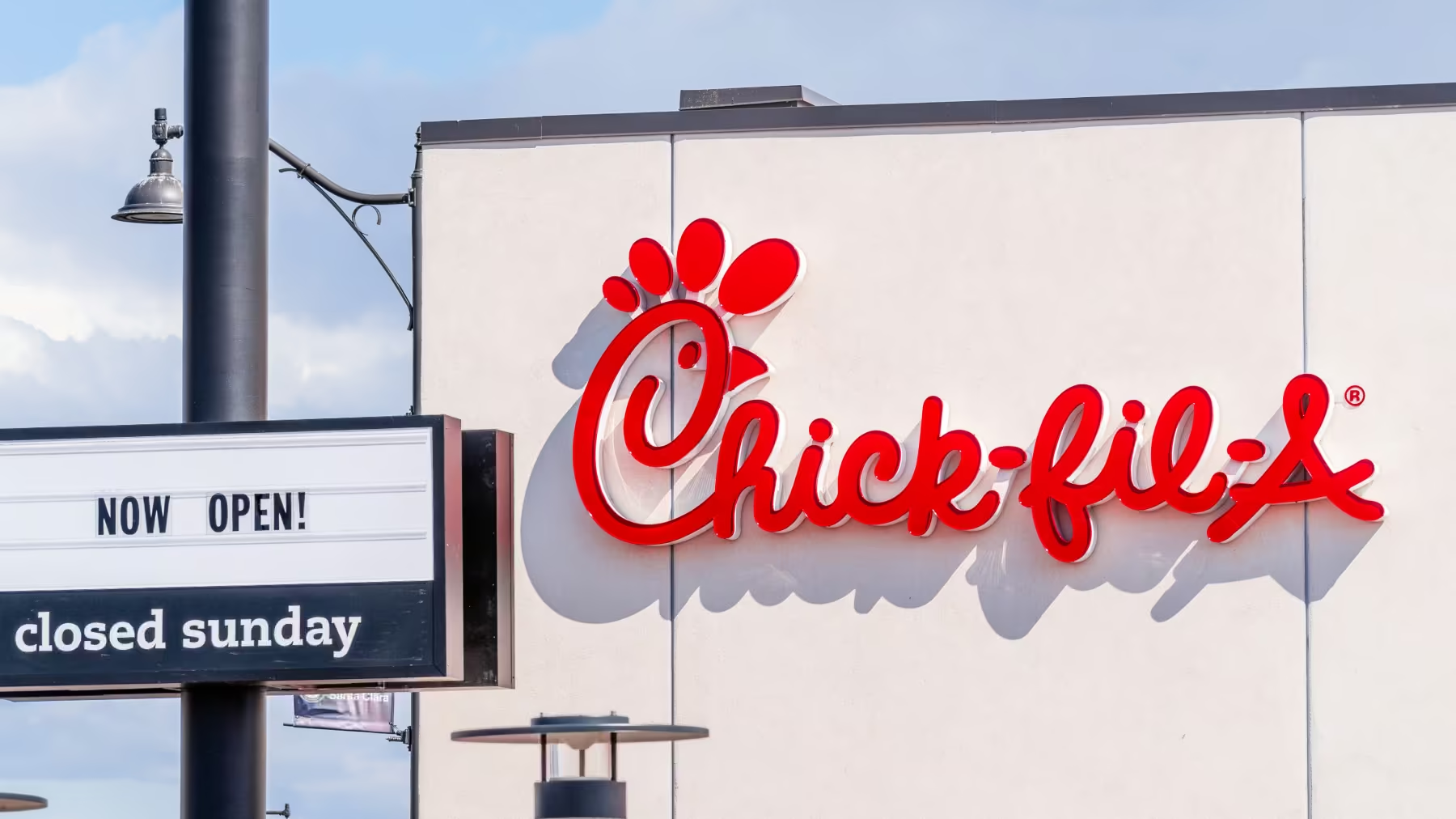
What Are the Fast-Growing QSR Categories in 2025?
Coffee, chicken, and Mexican-inspired chains stand out as 2025’s QSR growth leaders, though August softness signals the need for strategic discipline.
Bracha Arnold
Sep 9, 2025
3 minutes

Chicken, Mexican, and Coffee Chains Lead 2025 QSR Trends

This year has posed challenges for limited-service dining chains as inflation and higher prices continued to weigh on consumer traffic. We analyzed visitation trends in 2025 so far across major segments to better understand which categories are holding up – and which may need to adjust strategies.

Coffee, Chicken, and Mexican-Inspired Chains Lead Limited Service Dining

This year brought significant challenges for the limited-service dining industry, as persistent price increases kept many would-be diners at home. Even industry giants like McDonald’s reported declines in same-store sales as lower- and middle-income consumers pulled back spending. Yet several categories, including the ever-impressive chicken segment, managed to buck the trend.

The chart below highlights the differences in YoY foot traffic for major limited service dining concepts in H1 2025. Pizza, burger, and sandwich chains experienced declines, while coffee, chicken, and Mexican-inspired concepts emerged as the growth drivers in terms of overall visit increases. 

These segments were likely aided by aggressive unit expansion and consumer preferences shifting toward more affordable, customizable, and protein-forward options. Coffee continues to hold steady as a daily staple, while chicken and Mexican-inspired operators are capturing demand for protein-forward and customizable formats. 

However, per-location data tempers this growth narrative. Visits per store declined across every major category – even those with overall visit increases – indicating that expansion may be outpacing underlying demand and pushing the segment toward potential oversaturation.

Softer August Results

Recent summer data underscores the cautionary signals. Year-over-year traffic growth for coffee, chicken, and Mexican-inspired concepts was weaker in July than in the first half of the year. By August, declines had spread across nearly every category – with chicken chains in particular seeing a dip in traffic and an even steeper drop in average visits per location – leaving coffee as the only segment to sustain growth.

This broader slowdown in limited-service dining, combined with persistent economic uncertainty, suggests that consumers may be scaling back restaurant spending – even in categories traditionally viewed as more budget-friendly.

Final Thoughts

While 2025 has been marked by volatility, the underlying consumer appetite for convenient, protein-forward, and customizable dining is helping some limited-service segments stay ahead of the pack. Still, visit per location data suggests that expansion plans may need to be put on ice for the next few quarters. 

Instead, operators that focus on menu innovation, building loyalty, and driving higher output per store stand to capture demand when economic pressures ease. As confidence rebounds, concepts that have expanded strategically may be especially well positioned to benefit from renewed consumer traffic.

For the most up-to-date dining data, check out Placer.ai’s free tools.

Placer.ai leverages a panel of tens of millions of devices and utilizes machine learning to make estimations for visits to locations across the US. The data is trusted by thousands of industry leaders who leverage Placer.ai for insights into foot traffic, demographic breakdowns, retail sale predictions, migration trends, site selection, and more.

Article
Placer.ai August 2025 Mall Index: Is Consumer Caution Weighing on Mall Performance? 
Placer.ai’s August 2025 Mall Index reveals a summer slowdown in mall traffic, with indoor malls showing modest gains and outlet malls closing visit gaps. Shorter visit durations and softer Labor Day results signal rising consumer caution. The holiday season presents a pivotal chance to recapture momentum.
Shira Petrack
Sep 8, 2025
4 minutes

Slowing Momentum Continues in August 

After a strong spring for mall traffic, momentum slowed over the summer. As the chart below shows, visits in June declined year-over-year across all three formats, while July and August traffic leveled off. 

Yet, even in this softer environment, indoor malls stood out as the only format to register growth – albeit modest – in both July and August. At the same time, outlet malls managed to close their YoY visit gap, likely buoyed by families looking to save on back-to-school shopping. This trend also points to the potential for a rebound in the format, as consumers’ growing focus on value continues to shape shopping behaviors in new ways.

Traffic Falls Slightly Over Labor Day 

A softer Labor Day capped off the slower summer, with slight dips in visits across all three mall formats compared to Labor Day weekend 2024 (though indoor malls continued to lead with the smallest YoY visit gap). Outlet malls saw the biggest drop, which combined with their flat August performance, suggests that shoppers frequented outlets earlier in the month rather than holding off for Labor Day promotions. 

Taken together, these trends indicate that the summer slowdown was not simply the result of consumers holding back for holiday sales. Instead, with sentiment weakening, shoppers appear to be reducing discretionary purchases that typically drive mall traffic, or looking for better value on a routine basis rather than waiting for special sales. 

Visit Length on the Decline

The decline in average mall visit length offers another indicator of softening consumer sentiment and a cutting back on discretionary purchases. Visit length plummeted over the pandemic as consumers tried to limit their time spent in enclosed spaces, but the average visit duration to malls rose in 2023 and again in 2024 – suggesting that malls were slowly regaining their role as destinations for leisure, dining, and extended shopping trips. 

The drop in August 2025, however, signals a reversal of that momentum, perhaps reflecting heightened consumer caution and a renewed focus on efficiency and essentials over browsing and discretionary spending.

Early Signs, Not Final Conclusions

Malls’ strong visitation trends just a few months ago caution against drawing overly dire conclusions, and the softer summer may represent a temporary reset rather than a lasting shift. Seasonal headwinds, travel, and consumer caution likely weighed on recent performance, while the steady resilience of indoor malls points to enduring shopper demand for in-person experiences. Outlet malls' success in closing their visit gap also adds reason for optimism. 

The upcoming holiday season offers malls a chance to regain momentum and recapture consumer attention. While recent trends highlight caution and shorter visit durations, they also underscore consumers’ growing appetite for value and convenience – dynamics that indoor and outlet malls are uniquely positioned to meet. By pairing value-driven promotions with engaging experiences and festive activations, malls can reassert their role as destinations not just for shopping, but for leisure and community during the holidays. This combination positions shopping centers to benefit from seasonal demand, even as consumers remain more selective with discretionary spending.

For more data-driven consumer insights, visit placer.ai/anchor 

Placer.ai leverages a panel of tens of millions of devices and utilizes machine learning to make estimations for visits to locations across the US. The data is trusted by thousands of industry leaders who leverage Placer.ai for insights into foot traffic, demographic breakdowns, retail sale predictions, migration trends, site selection, and more

Article
Subscriptions Drive Eatertainment Visits for Topgolf, Dave & Buster’s, and Chuck E. Cheese 
In Q2 2025, the eatertainment industry is finding new momentum in subscription-based models that encourage repeat visits and build customer loyalty. Although these unlimited-play programs are reshaping consumer behavior, the challenge lies in turning heightened loyalty into long-term revenue gains.
Lila Margalit
Sep 4, 2025
4 minutes

After a period of robust growth following COVID, the eatertainment sector has slowed. Rising prices and economic uncertainty have led many consumers to tighten their budgets, cutting back on discretionary activities. But Q2 2025 data points to an emerging trend that could reshape the industry's trajectory: unlimited-play subscription models that drive repeat visits to major chains. 

Different Post-COVID Paths

Eatertainment’s leading brands have followed very different trajectories since 2019. Topgolf and Dave & Buster’s expanded significantly after COVID, driving overall visits above 2019 levels and outperforming the broader full-service restaurant (FSR) segment. By Q2 2025, Topgolf’s systemwide foot traffic was up 59.2% compared to the same period in 2019, while Dave & Buster’s overall visits rose 7.1%. However, both chains began to slow at the unit level in 2022 as inflation weighed on household budgets.

Chuck E. Cheese, meanwhile, shuttered dozens of locations after its 2020 bankruptcy. But in  mid-2024, the brand’s systemwide and per-location visits began rebounding significantly, surpassing even the broader FSR segment by Q1 2025.

Chuck E. Cheese’s Fun Pass Comeback

Chuck E. Cheese’s resurgence can be traced to a revamped Summer Fun Pass program launched in the summer of 2024. By offering unlimited play, the company drove a dramatic increase in repeat visits – and the model proved so successful that the company extended it year-round, fueling sustained visit growth that continued into 2025.

Between March and May 2025, per-location visits to Chuck E. Cheese surged 17.6% to 23.0% year over year (YoY), before stabilizing in June and July as the chain began lapping its extraordinary 2024 performance. Importantly, this plateau doesn’t indicate decline – instead, it highlights Chuck E. Cheese’s ability to maintain traffic levels that seemed unimaginable just two years ago.

Chuck E. Cheese’s loyalty surge also shows no signs of abating. In June 2024 12.0% of visitors came in at least twice during the month – up from 7.2% to 8.0% the previous summer. And although repeat visitation dipped somewhat when school resumed in the fall, it remained elevated YoY and rebounded again this summer.

Topgolf: Signs of a Turnaround

Topgolf has long relied on expansion to drive growth. But even as overall foot traffic has continued surging past pre-COVID benchmarks, visits per location began declining in 2022. 

Recent data, however, suggests this dynamic is shifting. Since May, the chain has posted high single-digit per-location YoY growth – a clear indicator of unit-level recovery. And though same-venue sales still fell 6.0% last quarter, the company raised its guidance, signaling an improved outlook.  

Here too, loyalty metrics point to the central role of Topgolf’s revived Summer Fun Pass in reigniting traffic by offering value-conscious consumers more affordable access to its premium experience. Though the gains are smaller than those seen by Chuck E. Cheese’s, they still mark a meaningful step in Topgolf’s recovery.

Dave & Buster’s: A Solid Foundation

Dave & Buster’s flagship chain continues to lag peers on YoY visitation, with Q2 2025 traffic below 2024 levels. Still, visit data for May to July 2025 points to an improving trend, aligning with the company’s recent report of better comp sales in June. 

Once again, progress appears tied to a new subscription model – Dave & Buster’s first-ever Summer Season Pass. Priced similarly to last year’s new Winter Pass, but timed to coincide with school and college vacations, the summer program significantly boosted repeat visits and strengthened customer engagement. And although per-location traffic at Dave & Buster’s remains a challenge, the brand’s growing loyalty base and expanding footprint give it a foundation for steady, sustainable growth.

Subscriptions, Subscriptions, Subscriptions!

Much like gym memberships, affordable flat fees for gameplay at eatertainment venues allow budget-conscious consumers to stretch their dollars by visiting more often. And these subscription-based models appear to be resonating with consumers in 2025. 

But the model comes with its own challenges. For Chuck E. Cheese, Topgolf, and Dave & Buster’s, the key test will be turning higher visitation into greater spend. Converting traffic gains into food, beverage, and event revenue – without eroding margins – will ultimately determine whether subscription-driven loyalty can deliver sustainable long-term growth.

For more data-driven consumer insights, visit placer.ai/anchor.

Article
Has Starbucks' Pumpkin Spice Latte Retained Its Appeal in 2025? 
Starbucks’ 2025 Pumpkin Spice Latte launch once again fueled a nationwide traffic surge, reaffirming its enduring cultural and financial impact. Competitors like Dunkin’ and Dutch Bros. lag behind, underscoring Starbucks’ unrivaled mastery in seasonal LTO strategy.
Shira Petrack
Sep 4, 2025
3 minutes

Starbucks launched its latest fall menu on August 26th, 2025, which included the fan-favorite Pumpkin Spice Latte (PSL). How did the return of the anticipated beverage impact visits this year? We dove into the data to find out. 

More Than Two Decades In, PSL and Fall Menu Continue to Resonate 

The fall menu launch and PSL return drove significant visit spikes to Starbucks, as shown in the chart below. And traffic on this year's PSL launch was nearly identical to 2024 levels – highlighting the remarkable consistency of the seasonal offering that has now become a cultural staple. The ability of the PSL to drive traffic at scale – even after two decades – underscores its unique role in Starbucks' playbook.

Where is the Pumpkin Spice Latte Most Popular? 

While the PSL's appeal is coast-to-coast, enthusiasm varies geographically.

The map below plots the increase in Starbucks visits on the launch of the fall menu compared to each state's pre-fall menu launch daily average. The Mountain region emerged as this year's PSL epicenter: Utah led the nation with a traffic surge of over 40% above its daily average, with neighboring states like Colorado, Idaho, and Nevada also showing exceptional gains. The Midwest and Appalachia, including West Virginia and Kentucky, followed with their own impressive double-digit increases.

By contrast, increases were more muted in the Northeast and Southeast, with single-digit visit growth in Louisiana, Mississippi, Georgia, New York, Vermont, and New Hampshire. Together, these patterns reveal both the universal draw of Starbucks’ seasonal offerings and the regional nuances that shape consumer response.

How Does the Fall Menu Launch at Dunkin' and Dutch Bros. Stack Up to Starbucks? 

While competitors like Dunkin' and Dutch Bros. also leverage seasonal menus to attract customers, their launch-day boosts don't match the scale of the PSL phenomenon, as shown in the chart below. Starbucks has successfully transformed a menu update into a highly anticipated cultural moment that competitors struggle to replicate.

This data suggests that Starbucks' fall launch doesn't just boost its own traffic – it sets the benchmark for the entire industry. The brand’s ability to blend product innovation with cultural relevance reinforces its position as the undisputed leader in the seasonal beverage market.

Starbucks' Fall Menu Still a Reliable Traffic Driver

The data from the 2025 fall menu launch suggests that the Pumpkin Spice Latte is far more than a seasonal beverage; it is one of Starbucks' most reliable and defensible strategic assets. The popular LTO provides a predictable traffic and revenue anchor, transforming the fall menu and the PSL at its center into a reliable financial instrument that widens the company's competitive advantage.

Ultimately, the enduring success of the PSL highlights Starbucks' mastery in transforming a product into a cultural tradition, proving that the most powerful driver of consumer behavior isn't just the product itself, but the anticipation and ritual built around it.

For more data-driven insights, visit placer.ai/anchor 

Article
Thrift Store Visit Growth Outpaces Apparel as Tariffs Loom
Thrift stores are defying retail headwinds – and with higher-income and rural and suburban shoppers joining the mix, thrifting has gone mainstream. As tariffs loom, secondhand appears set to remain one of retail’s standout success stories.
Lila Margalit
Sep 3, 2025
3 minutes

Secondhand shopping has emerged as a major storyline this season amid potential tariff-driven apparel price hikes – but foot traffic data shows that thrifting's move into the mainstream has been years in the making. We dove into the data to assess the state of the thrift store segment in 2025 and explore what’s driving its continued momentum.

Thrift Stores Give Apparel a Dressing Down

Thrift store foot traffic has been on an impressive upward trajectory since COVID. In Q2 2025, visits were up 39.5% compared to Q2 2019 – far exceeding the 9.5% growth seen across the broader clothing industry. 

This visit growth advantage reflects a mix of factors, including heightened economic pressures and sustainability concerns. In addition, while much apparel shopping has shifted online – and digital resale platforms like ThredUp are gaining traction – thrifting remains inherently experiential and in-person.

Thrifting’s unique seasonality also highlights its important role in the consumer shopping cycle. As the chart below illustrates, conventional apparel peaks during the holiday shopping season (Q4) while thrift stores hit their stride in summer (Q3) – likely buoyed by warm-weather wardrobe refreshes and back-to-school shopping.

More Stores, More Visits Per Store

A closer look at year-over-year (YoY) trends show industry-wide thrift store visit increases outpacing per-location gains, suggesting that the segment’s growth is partly driven by store openings. Yet established locations are thriving too, with average visits per location continuing to rise even against last year’s strong benchmarks. 

This dual pattern – new stores bringing in additional shoppers while established locations continue to grow – shows that thrifting’s momentum reflects true market expansion rather than merely a redistribution of demand.

Thrifting Goes Mainstream

Demographic data also points to thrifting’s ongoing move into the mainstream. The median household income of areas feeding visits to thrift stores has risen steadily since 2019, signaling a significant broadening of these stores' customer base beyond their traditional lower-income demographic.

Geographically, thrift shopping has also expanded beyond its urban roots. The share of visits from rural, semi-rural, and suburban communities has climbed consistently over the past six years, making secondhand shopping a fixture of consumer culture across regions and income levels.

The Future is Secondhand

With potential tariffs threatening to raise the cost of imported clothing, continued economic pressures, and rising demand for sustainable alternatives, thrift stores appear poised to thrive well into the future. Will secondhand visits climb to new highs this summer?

Follow Placer.ai/anchor to find out. 

Article
America’s Parks Are Calling: Later, Longer, Busier
America’s parks are experiencing rising visits and shifting usage patterns. People are coming more in spring, staying longer, and shifting their visits to weekends and later in the day. Park audiences are also evolving – including more middle-income households and families with children. These changes carry major implications for cities and communities.
Maytal Cohen
Sep 2, 2025
4 minutes

Whether it’s a family picnic, a romantic stroll, or a casual jog, local parks have long been woven into the fabric of American life. In recent years, however, when and how people use these green spaces has shifted in important ways.

Using Placer.ai’s index of 3,000 local parks (i.e., smaller parks within cities, towns, and suburbs and excluding national and state parks), we analyzed visitation patterns over the past year and compared them to pre-COVID baselines. The results reveal not only a steady rise in park traffic, but also meaningful changes in how Americans engage with these public spaces.

Local Park Visits on the Rise – Especially in Spring and Early Summer

Visits to local parks have steadily increased since 2019 as shown in the graph below – reflecting a sustained post-pandemic shift toward outdoor activities

But the data also shows an interesting seasonal shift. Unsurprisingly, park visits tend to peak in spring and summer (Q2 and Q3), and drop in winter. But whereas in 2019 and 2021, Q3 slightly outperformed Q2, this trend began to reverse in 2022 – and over the past three years, spring and early summer have consistently outpaced the July to September period. Additionally, while Q2 visits have grown year after year, Q3 visits began to decline in 2024 – and July 2025 data suggests the trend may be continuing. 

The shift, though subtle, may be tied to extreme summer heat waves in recent years – but it remains to be seen if this pattern will hold long-term. 

Longer, Later, and on the Weekends

Beyond sheer numbers, how people use parks is also changing. Since 2019, the share of visits lasting under 30 minutes has dropped, while visits over 30 minutes have increased – pointing to more intentional, extended outings that may include picnics, sports, or social gatherings.

At the same time, the share of weekday and early-day visits have declined, while weekend and evening visits have grown. This suggests that park trips are increasingly seen as dedicated leisure activities – part of people’s weekend plans rather than casual, quick visits.

More Middle-Income Families With Children

Meanwhile, analyzing parks' trade areas indicates a subtle but significant shift in the demographic profiles of park-goers. 

In both 2018/9 and 2024/5, park visitors tended to come from relatively affluent areas, with median household incomes (HHIs) above the nationwide average of $79.6K. But the analyzed period saw a modest but significant decline in the median HHI of parks’ trade areas. indicating a broadening of the audience making use of these spaces. 

This shift was accompanied by an increase in the participation of families with children – further evidence of the emergence of local parks as communal, family-oriented spaces.

What This Means for Cities

The growth in visitation along with the shifts in timing, duration, and demography carry important implications for local governments and park planners – and understanding these trends can help cities serve their communities and allocate relevant resources more effectively. 

For example, with weekend visitation on the rise, cities could plan more park events on Saturdays and Sundays to maximize attendance and community engagement. In addition, more weekend visitors may require expanded parking, public transport options, or bike access to accommodate higher demand.

The growth in later and longer park visits may also suggest a greater need for improved evening amenities, such as better lighting for safety and extended hours for public facilities. Longer visits could also mean higher demand for seating, shaded areas, restrooms, and refreshment vendors. And more families with children could drive demand for enhanced playground equipment, family-friendly programming, and child safety features.

By aligning park services with these evolving patterns, local governments can better serve residents, attract more visitors, and make the most of the growing enthusiasm for outdoor public spaces.

For more up-to-date insights into population movement and civic trends, explore our free migration tool

Reports
INSIDER
Report
10 Top Brands to Watch in 2026
Meet the ten retail and dining powerhouses, including H-E-B, Walmart, and Dave’s Hot Chicken, redefining success and winning consumer loyalty in 2026.
January 12, 2026

If 2025 proved anything, it’s that the American consumer hasn’t stopped spending – they’ve just become incredibly selective about who earns their dollar. As we look toward 2026, success isn't just about weathering headwinds; it's about identifying the specific operational levers that drive traffic.

We analyzed the data to identify ten retail and dining standouts (presented in no particular order) that are especially well-positioned for the year ahead. From grocery icons mastering hyper-authenticity to fitness challengers proving that low price doesn't mean low quality, these companies have demonstrated a powerful understanding of their audience and the operational agility to meet them where they are.

Here – in no particular order – are the brands setting the pace for 2026.

1. H-E-B 

When we pick retailers for our Ten Top list, there are some that rest on the edgier side and others that look fairly down the middle. Picking H-E-B, a grocer that has seen monthly visits up year over year (YoY) for all but one month since April of 2021, is clearly not one of the bolder claims. But consistent success shouldn’t preclude a retailer from receiving its well deserved kudos, and there are some unique reasons that H-E-B specifically needs to be included this year. 

H-E-B exemplifies the single most important trend in retail: the need for a brand to have authenticity and a clear reason for being. The retailer understands its audience, and as a result, it’s able to optimize its merchandising, promotions, and experience to best serve that loyal customer base. This pops in the data when we see the loyalty H-E-B commands, especially when compared to the grocery average.

In addition, the chain has also embraced adjacent innovation, leveraging its existing fleet by adding True Texas BBQ to a growing number of locations. The offering not only helps maximize the revenue potential of each visit, it taps into the core identity of the brand, further deepening customer connection and authenticity. The strategy also signals H-E-B’s understanding of emerging consumer behaviors – particularly the increase in shoppers turning to grocery stores for affordable, restaurant-quality lunches. And this combination of expanding revenue channels while heightening H-E-B’s uniqueness should also carry over into the value and impact of its retail media network.

In short, H-E-B has not only identified a critical route to success, it continues to embrace channels that widen revenue potential while doubling down on foundational strengths.

2. Michaels

In 2024, Michaels held nearly 32.0% of overall visit share among the top four retailers in the wider crafts and hobby space. By the second half of 2025, that number had skyrocketed to just over 40.0% – driven largely by the closures of key competitors JoAnn Fabrics and Party City.

And it isn’t just that the removal of competitors is increasing the share of overall visits; the rate of capture appears to be accelerating. In Q2 2025, visits rose 7.3% YoY as Michaels began absorbing traffic from Party City, which closed the bulk of its locations by March. Growth strengthened further in Q3, with visits up 13.1% YoY following the completion of JoAnn’s shutdown in May. But during the all-important Q4, traffic surged even higher YoY, suggesting that  that consolidation alone doesn’t fully explain the gains.

While the tailwinds of competitor closures clearly help, there are other strategies that are helping the retailer maximize this wave. Whether it be NFL partnerships to boost the retailer’s Sunday role in American households, a push into the framing space with 10-minute custom framing, the addition of JoAnn’s branded merchandise to its offerings, or even a challenge to Etsy’s online dominance with a new marketplace – Michaels is making moves to take full advantage of their improved positioning. There is also an argument to be made that Michaels is the retailer best poised to benefit from the segment’s consolidation, given that it is also the most oriented to a higher income consumer among top players in the category. This could help unlock other more focused concepts and promotions, and better align with an audience now looking for a retail replacement.

3. Walmart

Walmart is the dominant player in physical retail. 

And they leverage this position to push forward new offerings that extend revenue potential while maximizing per-store impact. They are a pioneer in the retail media space and have been using their unique reach to push that side of the business forward. Add to that the fact that they have been among the savviest players in all of retail in identifying the ideal approach to omnichannel, utilizing their massive physical footprint to improve their reach via BOPIS and store-fulfilled e-commerce.

All good reasons for inclusion, right?

But, here’s the kicker - from a pure visit perspective, things are going from good to better. Between January and September 2025, Walmart visits were essentially flat year over year – a good position for a retailer with such a massive reach and such strength shown in recent years. Yet, since October, visits have actually been on the rise, with Q4 2025 showing a 2.5% YoY traffic increase and several weeks exceeding 4.0% YoY.  

A retail giant with even more potential growth than we might have expected – and one that’s pushing the very strategies we believe are the key to future success? That’s certainly a reason for inclusion.

4. Dillard’s

Including a department store again on this year’s list? It seems counterintuitive to many of the narratives that ran through 2025, especially as middle-class consumers continue to be squeezed financially. However, Dillard’s still appears to be an exception to the rule, with performance more closely aligned to that of luxury department store brands like Bloomingdales & Nordstrom than to its true competitive set. 

In 2025, visitation to Dillard’s was essentially flat YoY – though the chain has consistently outperformed the wider department store category. Dillard’s stands at a unique point somewhere between a mid-tier and luxury department store, and that distinction may be its secret to success. The retailer continues to wow with strong private label offerings that rival and often exceed national brands, a diverse merchandise mix, and locations that often benefit from indoor mall traffic trends.

While Dillard’s lags behind the wider department store category, for example, in terms of repeat visitation and the share of wealthy visitors, these factors may actually create an advantage. Efforts by Dillard's to refresh its product mix through limited-edition capsule collections and new brand launches may be helping it attract a steady inflow of economically diverse new shoppers. And the ability to continually win over new segments without alienating a “core customer” could be a strength amid economic headwinds and waning consumer sentiment. 

At the same time, a more diverse visitor profile means that Dillard’s can truly be the department store for many consumers, with a product range that strikes a chord with different shopper segments. 

Department stores truly aren’t dead, and those who have found their reason to exist continue to garner attention with shoppers.

5. POP MART

If the retail industry had a symbol for 2025, it was probably Labubu. The toy-and-collectible-turned–bag charm took consumers by storm in the second quarter of the year, and POP MART – the retailer responsible for bringing Labubus stateside – quickly became an overnight sensation. Visits to the chain surged over the summer at the height of the craze, while trade areas expanded as customers traveled significant distances to get their hands on a doll. 

And although the frenzy cooled somewhat in early fall, visits to POP MART locations like the one in Tulalip, WA began trending upward once again in November 2025 as the holiday season approached, surging even higher in December. Trade area size also increased dramatically during the holiday shopping period, as consumers rushed to get their hands on the chain’s coveted line of festive blind boxes.

As demonstrated by the recent Starbucks Bearista craze, consumers are all-in on cool collectible items that make life more fun – a trend POP MART, strategically located in high-traffic malls popular with younger shoppers, is uniquely positioned to ride. During times of economic uncertainty, consumers crave small ways to indulge, and affordable collectibles that are cute, cuddly, and fun have worked their way into the American zeitgeist.

So, what is next for POP MART? Can it continue to sustain its momentum? It seems likely that Labubus are here to stay, at least for a little while longer, before the retailer hopefully strikes it big with the next “must have”.

6. 7 Brew 

When all is said and done, 2021-2025 will likely be viewed as a pivotal turning point for the U.S. coffee industry. As the country recovered from the pandemic, consumer interaction with coffee brands fundamentally shifted. With more employees working from home – bypassing the traditional pre-work coffee run – visit trends migrated to later in the morning and afternoon. Meanwhile, industry-wide dwell times shortened as consumers renewed their focus on convenience.

This move away from the sit-down café experience placed significant pressure on industry leaders, accelerating the shift toward drive-thru and mobile order-and-pay options. This moment of friction also created space for drive-thru-centric challengers like Dutch Bros, which rapidly expanded on the strength of speed and menu innovation. 

Among these challengers, 7 Brew stands out as a fast-rising powerhouse heading into 2026. Expanding outward from its Arkansas roots, 7 Brew has been strategic about market entry and site selection for its unique double-drive-thru format. And with a concept that resonates with younger demographics and a footprint adaptable to various geographies, the coffee chain has become a go-to destination for rural and small-town communities, while also maintaining solid reach among more traditional coffee segments like wealthy suburbanites and urban singles. Thanks in part to this broad appeal, 7 Brew is well-positioned for future growth, even as it faces stiffer competition in new markets.

7. Dave's Hot Chicken

It is no secret that most of the growth in the QSR space over the past two decades has been driven by chicken concepts. Chick-fil-A, rising from a regional chain to a national player throughout the late 1990s and 2000s, was the first to disrupt the burger’s stranglehold on QSR. Raising Cane’s followed in the 2010s with a model built on menu simplicity and operational excellence, earning its place as one of the largest chains in the category. More recently, hot chicken has emerged as one of the fastest-growing segments – and Dave’s Hot Chicken is leading the charge. 

No single factor accounts for Dave’s growth from a lone unit in Los Angeles to over 350 units today. Certainly, a wide assortment of sauces and flavor profiles has resonated with U.S. consumers who are increasingly seeking spicier products, while Dave’s 'rebel' brand positioning has successfully attracted  younger audiences. And at a time when many QSR and fast-casual chains are abandoning urban locations in favor of suburban markets, Dave’s Hot Chicken continues to open predominantly in urban settings – a strategy that may prove advantageous as migration patterns shift back toward major cities this year.

With so much of the industry’s expansion driven by chicken concepts, it is natural to ask: Have we reached 'peak chicken'? While we are certainly seeing other categories gain traction – think CAVA – Dave’s unique product mix and edgier marketing should help it stand out, even amidst increased competition.

8. HomeGoods & Homesense

While many discretionary retail categories – including consumer electronics, sporting goods, home improvement, and furniture – are still waiting for post-pandemic demand to recover, housewares retailers have generally enjoyed solid visit trends in 2025. Although consumers may not be financially positioned for large-scale remodels, we are now five years past the pandemic, and many residents (many of whom still work from home) are looking to refresh their living spaces. 

It may therefore come as no surprise that TJX Companies’ HomeGoods and Homesense brands had an exceptional 2025 and are well-positioned to repeat this success in 2026. 

This year, we observed a behavioral shift among middle-income consumers, including a clear “trade down” from mid-tier department stores and other discretionary categories. In addition, accumulated housing wear-and-tear, the recent bankruptcies of value-oriented competitors such as Conn’s and At Home, and the enduring appeal of the treasure hunt retail model, have all reinforced the brands’ momentum. Taken together, these trends leave HomeGoods and Homesense poised for both continued unit growth and increased traffic in the year ahead.

9. EōS Fitness

With the heightened emphasis on health and wellness post-pandemic, fitness is proving to be a category with remarkable staying power well beyond New Year’s resolution season – even in an era of macroeconomic uncertainty. Whether it’s pumping iron, hitting the treadmill, or joining fitness classes, staying healthy no longer requires breaking the bank – for just a dollar a day or less, gymgoers can build strength and endurance, achieve their rep goals, and hit their mileage targets. And affordable fitness chains – those that charge less than $30 per month – are reaping the benefits, outperforming more expensive gyms for YoY visit growth.

Among this value-oriented fitness cohort, EōS saw outsized traffic growth in 2025, with both overall visits and average visits per location outpacing competitors as the chain expands its footprint. EōS’s motto, “High Value, Low Price,” appears to be resonating strongly – especially in a year when similar value propositions are driving momentum across off-price retailers, value grocers, and dollar stores. Longer-than-average dwell times at EōS provide another encouraging signal, suggesting that its amenities, including pools, saunas, basketball courts, and equipment assortments typically found in higher-priced gyms, are truly connecting with visitors. And since visitors who stay longer are more likely to return – and to renew their memberships – EōS is well-positioned to convert this year’s traffic gains into lasting market share.

10. Chuck E. Cheese

Eating and entertainment are a match made in heaven — and by leaning into a subscription model that meets price-sensitive customers where they are, Chuck E. Cheese has solidified its position as a standout in the eatertainment category.

Nearly 50 years old, this evergreen children’s entertainment concept has stood the test of time and now boasts roughly 500 venues nationwide. Its perennial tagline – “where a kid can be a kid” – still resonates with today’s children and with the parents who grew up with the brand. After languishing for several years in the wake of COVID, the company turned things around with a revamped Summer Fun Pass launched on April 30th, 2024. The offer of unlimited play per month sparked a dramatic boost in customer loyalty, and the model proved so successful that the company extended it year-round with a family pass as low as $7.99 per month.

This strategy has helped sustain visit growth throughout 2025. Despite closing several locations during the year, visits to Chuck E. Cheese rose 8.3% YoY – well above the flat eatertainment average. And the company’s loyalty rates outpaced last year from August through November, indicating that the offering isn’t losing steam and that customers continue to respond enthusiastically.

Retail’s Next Chapter

The diversity of brands featured in this report highlights that there is no single path to success in 2026.

H-E-B and Chuck E. Cheese demonstrate the power of deepening loyalty through authentic experiences and value-driven memberships. Michaels and HomeGoods show how savvy retailers can capitalize on competitor consolidation and changing consumer spending habits. Meanwhile, Walmart and 7 Brew prove that even in saturated markets, operational innovation can drive fresh momentum.

As we move deeper into 2026, the brands that win will be those that, like the ten profiled here, combine a clear understanding of their unique value proposition with the agility to execute on it.

INSIDER
Report
6 Coffee-Inspired Strategies That Can Reshape Dining in 2026
Dive into the data to see how coffee became one of this year’s strongest dining performers – and explore strategies that can drive restaurant success across concepts in 2026.
December 18, 2025

Key Takeaways:

Coffee’s success in 2025 offers several key lessons for dining operators across categories:

1. Strategic expansion into under-penetrated regions can supercharge growth. YoY visits to coffee chains are growing fastest in areas of the Southeast and Sunbelt where the category still accounts for a relatively low share of dining visits. 

2. Pairing craveable products with genuinely human, personalized service can build durable loyalty. Aroma Joe’s proves that when standout offerings are combined with warm, consistent personal touches, brands can create habit loops that drive repeat visits even in crowded markets.

3. Prioritizing hyper-efficient convenience models can unlock meaningful growth. Scooter’s Coffee demonstrates that fast, reliable, frictionless experiences can materially increase traffic while supporting rapid expansion.

4. Building recurring limited-time rituals can create predictable demand spikes and deepen engagement. From the annual Pumpkin Spice Latte launch to Jackpot Day, coffee chains show that ritualized promotions can “own the calendar,” generating predictable traffic spikes and deepening emotional engagement.

5. Using scarce, hype-driven offerings can generate high-impact moments that shift behavior. Starbucks’ Bearista drop illustrates how limited, buzzworthy merchandise or products can not only spike visits but also shift customer behavior, driving traffic outside typical dayparts.

6. Leveraging cultural collaborations can create excitement without relying on discounts. Dunkin’s Wicked partnership shows that tapping into moments in pop culture can deliver multi-day visit lifts comparable to major promotions – often without relying on giveaways.

What Dining Chains Can Learn from Coffee's Success 

Coffee has become one of the most resilient and inventive corners of the U.S. food and beverage industry. Even as consumers wrestle with higher prices and trim discretionary spending, they continue to show up for cold foam, caffeinated boosts, and treat-worthy daily indulgences.

Throughout 2025, coffee chains saw consistent year-over-year (YoY) quarterly visit growth, as brands from Starbucks to 7 Brew expanded their footprints. Crucially, per-location category-wide traffic also remained close to 2024 levels throughout most of the year before trending upward heading into the holiday season – showing that this expansion has not diluted demand at existing coffee shop locations. 

What’s fueling coffee’s ongoing momentum? Which strategies are helping leading chains accelerate despite this year’s headwinds? And what can operators across dining categories learn from coffee’s success?

This white paper dives into the data to reveal the strategies behind coffee’s standout performance – and how they can help dining concepts across segments succeed in 2026.

1. Winning the Whitespace: A Growth Playbook for Dining Chains

Analyzing market-level (DMA) dining traffic data reveals that coffee chains are prioritizing growth in markets with lighter competition – and this formula is paying off.

In the graphic below, the top map shows the share of dining visits commanded by coffee in each DMA, while the bottom map highlights the year-over-year (YoY) change in visits to the coffee category. Perhaps unsurprisingly, markets where coffee already commands a high share of dining visits (specifically on the West Coast and in the Northeast) are seeing the softest year-over-year performance, while DMAs with lower coffee penetration are delivering the strongest visit growth. 

In other words, traditional coffee markets such as Northwestern metros– where competition is high and incremental gains are harder to capture – are no longer the primary engines of category momentum. Instead, coffee visits are growing fastest across the Southeast, Sun Belt, and Texas – regions where branded coffee still represents a relatively small share of dining visits. Operators across dining segments can learn from coffee's approach and identify markets with low category penetration to lean into those whitespace opportunities.

2. Mastering the Fundamentals: Aroma Joe’s

But geography is only part of the story. And the coffee segment shows that a strong concept that delivers on fundamentals – great products and exceptional service – can thrive even in tougher coffee markets such as the northeast. 

The experience of expanding Northeastern chain Aroma Joe’s shows how pairing craveable beverages with an unusually personal service model can drive visit growth even in relatively hard-to-break-into regions.

Aroma Joe’s, a rapidly-expanding coffee chain headquartered in Maine, with over 125 locations, has become something of a local obsession: Customers rave about the chain’s addictive signature beverages – as well as the feel-good atmosphere cultivated by its warm, friendly staff. And this combination of human touch and product quality creates a powerful habit loop: In October 2025, nearly one quarter of visitors to Aroma Joe’s stopped at the chain at least four times during the month – a much higher loyalty rate than that seen by other leading coffee brands.

The takeaway: Craveable products paired with exceptional service can create a scalable loyalty engine.

3. Delivering on Convenience: Scooter’s Coffee

Another key differentiator for the coffee sector is convenience. Drive-thrus have become ubiquitous across the category, with many of the fastest-growing upstarts embracing drive-thru only models and legacy leaders also leaning more heavily into the format. 

Scooter’s Coffee – named for its core promise to help customers “scoot” in and out quickly – exemplifies this advantage. In Q3 2025, the chain posted a 3.1% YoY increase in average visits per location, even as it continued to scale its footprint. And its customers averaged a dwell time of just 7.3 minutes – significantly lower than other leading coffee chains, including other drive-thru-forward peers.

By delivering consistently quick experiences without compromising quality, Scooter’s has emerged as a traffic leader in the coffee space – demonstrating the power of efficiency to drive demand.

4. Owning the Calendar With Recurring LTOs: Starbucks and 7 Brew

No category has mastered the “event-ization” of the menu quite like coffee – and few brands own the category’s calendar as effectively as Starbucks. The annual return of the Pumpkin Spice Latte has become a cultural milestone that marks the unofficial start of fall for millions, driving double-digit visit spikes and shaping seasonal traffic patterns. 

And the importance of the event only continues to grow. On August 26th, 2025, PSL day drove a 19.5% spike in traffic compared to the prior ten-week average – a higher relative spike than that seen in 2024 or 2023. 

But this playbook isn’t reserved for mega-brands. 7 Brew’s monthly Jackpot Day, held on the 7th of each month, shows how recurring promotions can also build anticipation and deliver repeatable traffic lifts for up-and-coming concepts.

Beginning in August 2025, Jackpot Day shifted from a limited “Jackpot Hour” to an all-day activation. That month’s offer – two medium drinks for $8 plus a Kindness wristband – generated a 47.1% lift versus an average Thursday. And in subsequent months, giveaways ranging from tote bags to footballs kept the excitement going, sustaining elevated visits each time the 7th rolled around.

These rituals create emotional consistency: Customers know when to expect something special and plan around it. Dining chains beyond the coffee space can also create dependable spikes in traffic by implementing recurring, ritualized LTOs that create an emotional calendar and keep customers engaged. 

5. Moving Beyond Food & Drink: Starbucks’ Bearista Win 

Offering recurring LTOs is one way to keep customers consistently engaged. But one-time, limited-edition merch drops can create even bigger visit surges. Starbucks’ much-hyped “Bearista” launch this November is a prime example: Customers lined up nationwide for the chance to buy – not receive – an adorable, limited-edition, bear-shaped reusable cup. And despite its hefty $30 price tag, the merch drop drove a massive nationwide visit spike, making it the chain’s biggest sales day ever and fueling additional momentum leading into Red Cup Day

And location data shows that this kind of hype-driven, scarce merchandise can shift not just visitor volume but daypart behavior. Visits surged as early as 4:00 AM as FOMO-driven customers showed up at the crack of dawn to secure a bear. And the shift toward early morning visits (though not quite as early) continued the following day as stores quickly ran out of stock. 

Starbucks' Bearista frenzy suggests that scarcity isn’t just a retail tactic – it’s a powerful behavioral trigger that restaurants can harness as well. Limited-run items, exclusive merch drops, or time-bound specials can generate excitement, pull visits forward, and reshape daypart patterns in ways traditional promotions rarely do. 

6. When Pop Culture Meets Coffee: Dunkin’s Wicked Collab

Cultural tie-ins add another accelerant. In November, Dunkin’ launched its Wicked collaboration alongside its holiday menu, generating a significant multi-day traffic spike – achieved, like Bearista, without giveaways. The event leaned on playful thematic branding, seasonal flavors, and limited-run items that tapped into Wicked fandom.

Dunkin's Wicked surge shows that when executed well, cultural relevance can also significantly move the needle. Other dining segments may also lean into thoughtful collabs to create outsized excitement and traffic lift – even without deep discounts or free offers.

Coffee As A Playbook

The coffee sector’s 2025 performance offers a blueprint for dining success: Chains are expanding smartly into underpenetrated regions, successfully implementing both hyper-efficient and hyper-personal service models, using recurring LTOs to build seasonal and monthly rituals, and leveraging merch and pop culture partnerships to reshape demand. 

Together, these strategies provide a practical playbook for dining brands to increase visit frequency, deepen customer commitment, and capture new growth opportunities in 2026 and beyond.

INSIDER
Report
5 Markets to Watch in 2026
Find out why Salt Lake City, Reno, Indianapolis, Raleigh, and Tampa are Placer.ai's markets to watch in 2026.
December 5, 2025

Five Consumer Markets to Watch in 2026

Five metros from across the United States stand out for consumer momentum going into 2026: Salt Lake City (UT), Reno (NV), Indianapolis (IN), Tampa-St. Petersburg-Clearwater (FL), and Raleigh-Durham (NC). All five metro areas saw their populations increase by more than the average U.S. metro between 2023 and 2024, and year-over-year (YoY) retail and dining traffic trends outpaced the nationwide average.  

Salt Lake City, UT – Strong Home-Focused Demand

Utah is one of the fastest-growing states in the U.S. The state’s population has grown steadily for more than two decades with unemployment remaining consistently below the nationwide average, with one of the youngest workforces in the country. According to some analysts, the median household income in Utah, when adjusted for cost of living, is the highest in the nation. 

Foot Traffic on the Rise Across Salt Lake City Neighborhoods

All of this positions Salt Lake City – the state’s capital – as a particularly attractive market heading into 2026. Location analytics show year-over-year increases in foot traffic across many neighborhoods, from established retail hubs like Sugar House and Downtown SLC to the more mixed-use Central City and primarily residential areas such as The Avenues and East Bench. The city also serves as a gateway to a diverse mix of audiences, attracting younger residents and commuters as well as affluent families who come into the city to shop, dine, and enjoy local attractions.

Home-Centric Retail Outperforms in Salt Lake City 

Salt Lake City’s diversity in age and household composition as well as Utah's strong homeownership culture – even among younger cohorts – creates opportunities for retail and dining chains across categories. Home-forward concepts are particularly poised to outperform, as shown by recent location analytics. Traffic to furniture & home furnishing chains increased 7.4% YoY in the Salt Lake City DMA compared to a 2.5% increase nationwide, and grocery stores and home improvement retailers outperformed in the market as well. These trends point to a solid market for retailers tied to home life – from furniture and décor to everyday grocery needs –driven not only by steady population growth and household spending, but also by a local culture that places strong emphasis on family and the home.

Reno, NV – Attracting a New Generation of Visitors

While Salt Lake City continues to build on its strong foundation, another Western city is quietly gaining momentum. Reno, Nevada, which is often viewed as a regional gaming-town, is increasingly emerging as a dynamic travel destination in its own right. 

In 2024 Washoe County (including the city of Reno) welcomed approximately 3.8 million visitors whose spending of about $3.4 billion generated a total economic impact of $5.2 billion. This growth signals a robust visitor-economy that supports roughly 43,800 jobs and generates over $420 million in state and local tax revenue. 

Drive-Market Advantage and Cost Resilience

What makes this particularly compelling is that while Las Vegas, Nevada is facing mounting pressures from increasing costs, the Reno-Tahoe region is showing stronger resilience thanks in part to a drive-market model and diversified appeal. Analyzing the traffic data shows that visits from non-residents, and non-employees to downtown Reno have increased YoY for the past three years. And though Reno may be thought of as a vacation spot for older Gen X and Baby Boomer vacationers, the data also indicates that Singles & Starters –"young singles starting out and some starter families living a city lifestyle" – make up an increasingly large share of Reno's visitor base. 

Younger Demographics Fuel Consumer Growth 

This generational diversification carries important implications for both retail and real estate investment. As younger visitors drive up spending in food, entertainment, and shopping centers, the market is poised for renewed urban energy – fueling redevelopment across downtown corridors and mixed-use projects. With strategic public–private investments and an expanding visitor economy, Reno stands out as a market to watch in 2026, combining strong fundamentals with emerging demographic momentum.

Indianapolis, IN – Family-Friendly Affordability

The Midwest also contains several metro areas on the rise. Large-scale manufacturing projects like Intel’s $20 billion chip plants and Honda and LG Energy Solution’s EV battery facility are spurring housing and retail expansion around Columbus, Ohio. Kansas City, Missouri, is benefiting from logistics growth and projected tourism growth linked to its role as a FIFA World Cup 2026 host city. And Madison, Wisconsin, is seeing steady consumer growth is supported by its diverse tech and biotech economy. 

Suburban Families Lead the Charge in Indianapolis

But Indianapolis, Indiana tops the charts in terms of YoY overall retail visit growth between May and October 2025 (+4.3%, see first chart). And much of the consumer traffic in the Indianapolis DMA consists of suburban and rural households – precisely the segments that many retailers are now  trying to woo. 

Cost-of-Living Advantage Boosts Discretionary Spending

Family-friendly retailers and dining chains are particularly well positioned to thrive in Indiana heading into 2026. Indianapolis has some of the best job prospects and most affordable home prices in the country – and its favorable salary to cost of living ratio likely allows many families to have leftover income left over for discretionary spending. 

Recent data shows that a range of family-oriented brands – from Chili’s and Marshall’s to Kroger – have outperformed in Indianapolis over the past six months. The city’s growing middle-income population and its suburban, family-focused consumer base appear to be fueling stronger in-person spending, particularly at convenient, affordable, and community-oriented retail and dining destinations.

Raleigh, NC – High-Income Consumers Fueling Mixed-Use Traffic

Moving east to North Carolina brings several additional growing metros into focus, including Myrtle Beach, Wilmington, and Charlotte. But Raleigh rises above the pack with its powerful combination of job growth, steady in-migration, and a well-balanced, diversified economy.

In-Market Visit Growth in Raleigh 

All this is leading to YoY increases in total traffic within the Raleigh-Durham, NC DMA, driven in part by major firms – including entrants in finance and life-sciences – continuing to expand operations in the area. The city of Raleigh also has relatively low median age and relatively high median household income. This combination of robust job creation, wage gains, and a growing pool of young, high-spending residents positions Raleigh as one of the most dynamic consumer markets in the Southeast heading into 2026.

Affluent Singles and Professionals Boost Traffic to Mixed-Use Developments in Raleigh, NC

Raleigh's consumer growth potential is particularly stark when looking at performance of major mixed-use developments across the region. Foot traffic at leading projects such as Smoky Hollow, the Main District at North Hills Street, and Fenton in Cary has climbed sharply. 

The data also shows that these destinations attract a disproportionately high share of wealthy singles and one-person households – a demographic with strong discretionary spending power. Together, these trends point to a deepening base of urban, high-income consumers fueling growth in dining, retail, and entertainment – making Raleigh one of the country's most dynamic and opportunity-rich metro areas heading into 2026.

Tampa, FL – Urban Revival Powering Dining Gains

In the Southeast, Tampa is one of the nation’s standout metro areas heading into 2026. Strong fundamentals – such as no state income tax and expanding employment in sectors like technology, healthcare, and logistics – have attracted a significant influx of Gen Z and millennial residents. And although in-migration is beginning to slow somewhat, the city's expanding economy and youthful talent base continue to fuel growth across housing, retail, and dining. 

Commuter and Visitor Activity on the Rise

And as more companies require employees to spend additional days in the office, YoY commuter traffic has increased across Tampa’s major cities. Leisure visits from non-residents are also on the rise, suggesting that retailers and dining chains seeking to capture this expanding market could benefit from growing their presence throughout the Tampa metro area.

Tampa Area Dining Growth Outpaces the Nation

Rising traffic across Tampa’s major urban areas appears to be translating into stronger dining activity as well. Over the past six months, average YoY visits to Tampa area full-service restaurants, coffee shops, and fast-casual chains have all exceeded the national average, which may reflect a broader acceleration in both local workforce and leisure-visitor demand. 

Loading results...
We couldn't find anything matching your search.
Browse one of our topic pages to help find what you're looking for.
For more in-depth analyses on a variety of subjects, explore Reports.
The Anchor Logo
INSIDER
Stay Anchored: Subscribe to Insider & Unlock more Foot Traffic Insights
Gain insider insights with our in-depth analytics crafted by industry experts
— giving you the knowledge and edge to stay ahead.
Subscribe