.png)
.png)

.png)
.png)


Swig, the Utah-born drive-thru concept that helped popularize customizable dirty sodas, has evolved from a regional novelty into one of the fastest-growing beverage chains in the country. Known for mixing classic soft drinks with flavored syrups, creams, and fruit add-ins – alongside cookies and pretzel bites – the brand has expanded well beyond its Mountain West roots.
This expansion is fueled by significant online hype, with new locations often generating lines that wrap around the block and leave some customers waiting over an hour to try their first drink. And as the brand pushes deeper into the Sunbelt and beyond, location analytics offer a window into how this growth is impacting traffic trends and reshaping the brand's audience.
Unsurprisingly, the data shows that as Swig has expanded its footprint, it has successfully grown its overall traffic. In February 2026, visits to the chain were 137.9% higher than in February 2023 – and up 30.7% year-over-year compared to February 2025.
The data also shows the emergence of a clear seasonal pattern, with visits to Swig peaking each year in the summer as people seek out cool soda treats to beat the heat. Notably, the magnitude of the summer peak in 2025 was larger than ever before, suggesting that as the chain becomes more mainstream, its seasonal appeal may be increasing. But the dramatic increase in off-season visits as well shows that Swig is successfully building a loyal customer base that craves its offerings year-round.
This rapid growth is also leading to a meaningful broadening of Swig’s customer base. While the chain’s trade areas still remain affluent relative to the average U.S. household, the median household income (HHI) of its captured market is dropping as it reaches a more varied demographic.
And while "Wealthy Suburban Families" and "Upper Suburban Diverse Families" remain Swig’s largest audience segments, their total share of the market has edged down as engagement deepens across additional cohorts. This includes, notably, households in Blue Collar Suburbs who are now overindexed at 8.1% of Swig’s captured market, compared to a 6.9% nationwide baseline.
As Swig continues its transition from a niche favorite to a broad staple, it will inevitably face the challenges of sustained growth, such as maintaining unit-level productivity and operational consistency. However, for now, the data and the visible excitement surrounding new openings suggest that the dirty soda pioneer still has plenty of fizz left.
For more data-driven dining analyses follow Placer.ai/anchor.
Placer.ai leverages a panel of tens of millions of devices and utilizes machine learning to make estimations for visits to locations across the US. The data is trusted by thousands of industry leaders who leverage Placer.ai for insights into foot traffic, demographic breakdowns, retail sale predictions, migration trends, site selection, and more.

Foot traffic to retail corridors nationwide plummeted during the shelter-in-place restrictions of 2020, and recent data shows that visits have yet to fully recover to 2019 levels. While traffic has steadily improved each year since the pandemic lows, 2025 visits remain 11.7% below their pre-pandemic baseline.
What is holding the retail corridor recovery back? We dove into the data to find out.
Retail corridors are typically concentrated in downtown areas, featuring a mix of stores, restaurants, bars, and offices – and are often surrounded by even more office space. And comparing average visits per day of week in 2025 and 2019 suggests that the persistence of hybrid and remote work is likely driving much of the lag.
Monday through Thursday foot traffic to retail corridors was down between 16.3% and 17.3% in 2025 compared to 2019. The gap narrowed to 11.7% on Friday as activity began to shift toward the weekend, and nearly disappeared on Saturday (-2.8%) and Sunday (-4.2%).
The much larger weekday deficit suggests that reduced office attendance continues to weigh on downtown retail activity. With fewer workers commuting daily, there are fewer pre-work coffee stops, lunchtime errands, and spontaneous after-work visits that once fueled these corridors. So while leisure-driven weekend traffic has largely rebounded, the office-driven weekday ecosystem that historically sustained retail corridors has yet to fully return.
Hourly data reinforces the role that office attendance (or lack thereof) is playing in the retail corridor visit lag. The steepest declines are concentrated squarely within traditional workday hours: visits between 7 AM and 11 AM are down 23.7% compared to 2019, followed by a 19.2% decline from 11 AM to 3 PM. But the gap is much more moderate both earlier and later in the day (from 12 AM to 7 AM and 3 PM to 12 PM) in the day later in the day, with visits down 13.7% from 3 PM to 7 PM and just 9.6% after 7 PM. This suggests that the missing traffic is closely tied to reduced daily commuting – fewer morning coffee runs, lunch breaks, and midday errands – while evening and leisure-oriented visits have proven far more resilient. With more schedule flexibility, downtown businesses and civic stakeholders may need to focus on creating reasons for consumers to intentionally visit downtowns during slower weekday hours, rather than relying on routine commuter traffic to fill stores organically.
The retail corridor traffic data suggests that downtowns are facing a structural shift in when and why people visit. With fewer daily commuters, stakeholders may need to focus less on restoring a five-day office week and more on activating the days and hours that already show strength. Civic leaders can prioritize safety, cleanliness, transit reliability, and targeted weekday programming or events that encourage intentional trips downtown. Retailers and dining concepts can adapt hours, promotions, and experiences to better align with flexible work schedules. In a hybrid era, success may depend less on recreating old commuting patterns and more on making downtown a destination people choose – not just a place they pass through.
For more data-driven retail insights, visit placer.ai/anchor.
Placer.ai leverages a panel of tens of millions of devices and utilizes machine learning to make estimations for visits to locations across the US. The data is trusted by thousands of industry leaders who leverage Placer.ai for insights into foot traffic, demographic breakdowns, retail sale predictions, migration trends, site selection, and more.

Downtown Austin is navigating a period of unusual complexity. A convention center renovation and major highway construction have created significant disruption, while extreme summer heat and pullbacks in consumer spending are adding further pressure.
Yet despite these headwinds, visitation is nearing pre-pandemic levels. And a key factor driving Austin’s recovery has been its deliberate use of data to guide strategy, align stakeholders, and deploy resources where they can have the greatest impact.
Since 2022, Downtown Austin has been on a steady recovery trajectory. By 2025, non-resident and non-employee visits to the area reached 94.4% of 2019 levels – a milestone that becomes even more meaningful against the backdrop of this year’s intensely hot summer and the temporary closure of Austin’s convention center, which has remained offline since April 2025.
This data reveals resilience that might otherwise have gone unnoticed – critical framing when coordinating across agencies and reassuring stakeholders that downtown remains a reliable economic engine even during infrastructure transitions.
The composition of that visitation tells an equally important story. A growing share of visitors to downtown Austin are coming from within Texas – especially on weekends.
In an environment where consumers are more value-conscious and long-haul travel remains uneven, this regional draw has become a strategic asset. In-state travelers are more likely to make shorter, repeat trips, creating consistent demand for restaurants, entertainment venues, and retail corridors.
The Downtown Austin Alliance uses this insight to refine both marketing and access strategies. Partnerships such as discounted ride programs within a 30-mile radius reduce friction for local visitors during the holiday season, while targeted programming ensures downtown remains competitive as a weekend destination.
At the policy level, this data strengthens the case that downtown’s success benefits the broader state economy. When a rising share of visitors originates within Texas, the dollars spent downtown circulate locally – supporting jobs, generating tax revenue, and reinforcing Austin’s role as an economic anchor.
Data also helps the Alliance optimize services around major events that drive tourism to Austin – such as the annual ACL Music Festival and Formula 1 Grand Prix – supporting operational precision. High-traffic areas receive intensified cleaning and hospitality services, while lower-traffic zones become candidates for murals, activations, and smaller-scale programming designed to distribute energy more evenly. Event-driven data also informs conversations with transportation partners as construction continues to reshape mobility routes.
The strategic use of data is also evident in the revitalization of East Sixth Street. Long known as a historic entertainment corridor with a late-night reputation, the district is now the focus of a coordinated effort to evolve its positioning and offerings.
And data has played an important role in getting people on board. Location analytics, for example, show that out-of-market visitors to the district are coming from more affluent areas, showing that spending power exists and is growing – and that the district’s offerings may have room to evolve alongside its audience.
For property owners and local businesses, this data provides a clearer picture of market potential. And for public-sector partners, it strengthens the case for infrastructure upgrades and placemaking investments.
Austin’s experience offers a broader lesson for cities navigating disruption. Infrastructure transitions, climate pressures, and evolving travel patterns present real challenges – but by grounding placemaking strategies in clear, measurable data, Austin is strengthening downtown’s economic foundation and aligning stakeholders around a shared vision.
.avif)
Amid a tightening job market, the list of employers requiring workers to show up in person – many now mandating five days a week – continues to grow. But how did the office recovery fare in February 2026, a month marked by heavy snowstorms across major Northeast markets?
We dove into the data to find out.
In February 2026, visits to the Placer.ai Nationwide Office Index were 31.9% below 2019 levels – marking the smallest February post-pandemic visit gap to date. Overall attendance even slightly outpaced February 2024, a leap year that benefited from 20 business days instead of the usual 19.
While this is hardly the most impressive RTO showing we’ve seen in recent months, February’s gains came in spite of meaningful headwinds.
A late-February blizzard disrupted major Northeast markets, driving a year-over-year (YoY) decline in New York City office visits and widening Manhattan’s post-pandemic gap to 21.3% below 2019 levels. Boston, also hit hard by snow, saw visits remain flat YoY, slipping behind San Francisco and Denver in overall recovery progress.
By contrast, cities in other regions posted clear gains, with San Francisco – still benefiting from AI-driven hiring and renewed tech activity – once again seeing some of the strongest growth at +11.9% YoY.
February’s performance underscores a familiar pattern of month-to-month fluctuation, even as the broader RTO trajectory continues its upward climb. Regional dynamics – from weather disruptions to sector-specific hiring cycles – are shaping local outcomes, but the national baseline for office utilization is steadily rising.
For more data driven CRE insights, visit placer.ai/anchor.
Placer.ai leverages a panel of tens of millions of devices and utilizes machine learning to make estimations for visits to locations across the US. The data is trusted by thousands of industry leaders who leverage Placer.ai for insights into foot traffic, demographic breakdowns, retail sale predictions, migration trends, site selection, and more.
.avif)
The bifurcated consumer trends established in the second half of 2025 have persisted. While higher-income shoppers maintain relatively stable spending habits, lower- and middle-income households continue to feel the squeeze on essential categories like groceries and fuel. These consumers have become increasingly selective and price-sensitive, actively pivoting away from traditional mid-market chains in favor of discount retailers and value-oriented brands. Because affordability remains a core focus, average households are spreading their visits across a wider number of non-discretionary stores to hunt for deals. For example, our data shows that grocery visit growth is currently being driven by low- and middle-income households, as elevated food costs necessitate more frequent, budget-conscious trips.
However, despite this intense focus on everyday value, it would be a mistake to count out the discretionary sector, where consumer visits have also been mostly positive year-over-year (YoY) since the start of 2026. Despite weather-driven volatility, we continue to see healthy demand for discretionary categories as consumers start to put their tax refunds to work, actively seeking affordable indulgences and high-end brands at a discount.
E-commerce fulfillment centers are also seeing robust activity. Excluding a brief weather-related slump in late January, visits to these facilities are growing at a high-single to low-double-digit clip.
This surge in logistics activity is being driven by a perfect storm of consumer behavior and retail strategy: value-seeking shoppers, massive supply chain investments from giants like Walmart and Target, and the rise of frictionless "agentic" and social commerce. Furthermore, record-high product returns are forcing these centers to process a massive wave of reverse logistics, keeping facility utilization incredibly high.
As delayed tax refunds finally hit consumer bank accounts in the months ahead, we expect this strong e-commerce and fulfillment momentum to continue.
Manufacturing data has been highly volatile in early 2026. Placer.ai’s Industrial Manufacturing Index – which measures physical visits to manufacturing facilities across a wide range of verticals – showed an ebb and flow in the early weeks of the year. Severe winter storms heavily weighed on facility visits in late January, followed by a clear rebound in February.
This physical, on-the-ground improvement aligns with the latest macroeconomic indicators. According to the most recent ISM report, the U.S. manufacturing sector expanded for the second consecutive month in February, with the PMI registering a solid 52.4. Crucially, this growth is being driven by strong forward-looking demand, as the ISM New Orders Index remained firmly in expansion territory at 55.8. Ultimately, while underlying production and new orders show sustained momentum, unpredictable weather patterns continue to create short-term fluctuations in actual facility operations.
Looking ahead, volatility will likely be the baseline expectation for both the retail and manufacturing sectors throughout 2026. Unpredictable weather events, shifting supply chain dynamics, and the complexities of lapping 2025's macroeconomic hurdles will continue to create week-to-week fluctuations in physical foot traffic and industrial output.
Yet, beneath this turbulence lies a remarkably stable foundation: the American consumer. Despite the ongoing pressures of inflation and depleted household savings, shoppers remain incredibly resilient. They are highly strategic – pinching pennies on daily essentials and heavily utilizing value channels – precisely so they can continue to fund discretionary spending and lifestyle upgrades. The market may be volatile, but the 2026 consumer is proving that they are willing and able to spend when the value proposition is right.
Placer.ai leverages a panel of tens of millions of devices and utilizes machine learning to make estimations for visits to locations across the US. The data is trusted by thousands of industry leaders who leverage Placer.ai for insights into foot traffic, demographic breakdowns, retail sale predictions, migration trends, site selection, and more.

With its recent IPO, Bob’s Discount Furniture has officially entered a new chapter, stepping onto the public stage at a time when the home furnishings sector continues to face macroeconomic pressures. Yet despite these challenges, Bob’s has demonstrated notable momentum. This AI-powered data analysis takes a closer look at Bob’s performance, examining traffic trends, demographic positioning, and cross-shopping behavior to better understand what’s driving the company’s success.
Bob’s continued expansion supported year-over-year (YoY) visit increases throughout 2025 – but growth was not driven by footprint alone. Visits per location to the chain also climbed by 1.8% in 2025, indicating that existing stores captured incremental demand alongside new openings.
Analysis of Bob’s and the broader home furnishings category suggests that a favorable mix of value-oriented and affluent shoppers may be supporting the brand’s growth.
In 2025, the median household income of Bob’s captured market was $89.0K – below the category median of $92.5K, yet above the nationwide median of $79.6K. A similar pattern emerged when examining Bob’s audience by income groups. Among households earning under $100K and those earning over $150K, Bob’s share fell between the category benchmark and the national baseline.
This positioning suggests that while Bob’s resonates strongly with value-seeking consumers, its appeal is not limited to lower-income households – which could reflect the strength of its "Good, Better, Best" assortment strategy. As value-prioritization has gained traction across income levels, Bob’s appears to be attracting shoppers who are price-conscious yet still maintain discretionary spending power – a combination that is especially advantageous in a bigger-ticket category like furniture.
Reinforcing its position as a primary destination for furniture shoppers appears to be another factor fueling Bob’s growth.
AI-based location intelligence reveals that in 2025, the share of Bob’s visitors who also visited other major home furnishings chains declined compared to 2024. The shift was consistent across several key competitors, suggesting that fewer shoppers felt compelled to compare offerings at other chains before visiting Bob's Discount Furniture.
In a category where consumers frequently comparison-shop, declining cross-visitation may signal that Bob’s relaxed in-store environment – featuring the “Little Bob” sock-puppet and complementary cafés – is resonating with shoppers, reducing the incentive to look elsewhere.
These insights underscore Bob’s differentiated strategy within a volatile retail landscape. By combining disciplined expansion with broad cross-income appeal and brand loyalty, Bob’s is building both growth and resilience as it enters its public chapter.
Will Bob’s continue to find success in 2026? Visit Placer.ai/anchor to find out.
Placer.ai leverages a panel of tens of millions of devices and utilizes machine learning to make estimations for visits to locations across the US. The data is trusted by thousands of industry leaders who leverage Placer.ai for insights into foot traffic, demographic breakdowns, retail sale predictions, migration trends, site selection, and more.
The past few years have provided the tourism sector with a multitude of headwinds, from pandemic-induced lockdowns to persistent inflation and a rise in extreme weather events. But despite these challenges, people are more excited than ever to travel – more than half of respondents to a recent survey are planning on increasing their travel budgets in the coming months.
And while revenge travel to overseas destinations is still very much alive and well, the often high costs associated with traveling abroad are shaping the way people choose to travel. Domestic travel and tourism are seeing significant growth as more affordable alternatives.
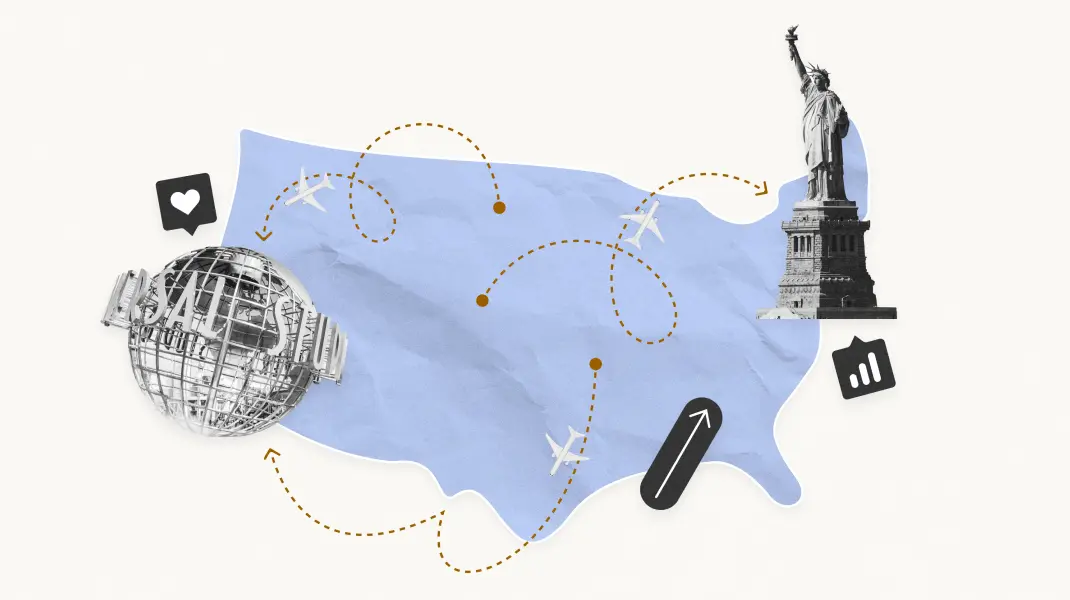
This white paper takes a closer look at two of the most popular domestic tourism destinations in the country – New York City and Los Angeles. Over the past year, both cities have continued to be leading tourism hotspots, offering a wealth of attractions for visitors. What does tourism to these two cities look like in 2024, and what has changed since before the pandemic? How have inflation and rising airfare prices affected the demographics and psychographics of visitors to these major hubs?
Analyzing the distribution of domestic tourists across CBSAs nationwide from May 2023 to April 2024 reveals New York and Los Angeles to be two of the nation’s most popular destinations. (Tourists include overnight visitors staying in a given CBSA for up to 31 days).
The New York-Newark-Jersey City, NY-NJ-PA metro area drew the largest share of domestic tourists of any CBSA during the analyzed period (2.7%), followed closely by the Los Angeles-Long Beach-Anaheim, CA CBSA (2.5%). Other domestic tourism hotspots included Orlando-Kissimmee-Sanford, FL (tied for second place with 2.5% of visitors), Dallas-Fort Worth-Arlington, TX (1.9%), Las Vegas-Henderson-Paradise, NV (1.8%), Miami-Fort Lauderdale-Pompano Beach, FL (1.8%), and Chicago-Naperville, Elgin, IL-IN-WI (1.6%).
The Big Apple. The City That Never Sleeps. Empire City. Whatever it’s called, New York City remains one of the most well-known tourist destinations in the world. And for many Americans, New York is the perfect place for an extended weekend getaway – or for a multi-day excursion to see the sights.
But where do these NYC-bound vacationers come from? Diving into the data on the origin of visitors making medium-length trips to New York City (three to seven nights) reveals that increasingly, these domestic tourists are coming from nearby metro areas.
Between 2018-2019 and 2023-2024, for example, the number of tourists visiting New York City from the Philadelphia metro area increased by 19.2%.
The number of tourists coming from the Boston and Washington, D.C metro areas, and from the New York CBSA itself (New York-Newark-Jersey City, NY-NJ-PA) also increased over the same period.
Meanwhile, further-away CBSAs like San Francisco-Oakland-Berkeley, CA, Atlanta-Sandy Springs-Alpharetta, GA, and Miami-Fort Lauderdale-Pompano Beach, FL fed fewer tourists to NYC in 2023-2024 than they did pre-pandemic. It seems that residents of these more distant metro areas are opting for vacation destinations closer to home to avoid the high costs of air travel.
Diving even deeper into the characteristics of visitors taking medium-length trips to New York City reveals another demographic shift: Tourists staying between three and seven nights in the Big Apple are skewing younger.
Between 2018-2019 and 2023-2024, the share of visitors to New York City from areas with median ages under 30 grew from 2.1% to 4.5%. Meanwhile, the share of visitors from areas with median ages between 31 and 40 increased from 34.3% to 37.7%.
The impact of this trend is already being felt in the Big Apple, with The Broadway League reporting that the average age of audiences to its shows during the 2022- 2023 season was the youngest it had been in 20 seasons.
The shift towards younger tourists can also be seen when examining the psychographic makeup of visitors to popular attractions in New York City. Analyzing the captured markets of major NYC landmarks with data from Spatial.ai’s PersonaLive dataset reveals an increase in households belonging to the “Educated Urbanites” segment between 2018-2019 and 2023-2024.
These well-educated, young singles are increasingly visiting iconic NYC venues such as the Whitney Museum of American Art, The Metropolitan Museum of Art, The American Museum of Natural History, and the Statue of Liberty. This shift highlights the growing popularity of these attractions among young, educated singles, reflecting a broader trend of increased domestic tourism among this demographic.
New York City’s tourism sector is adapting to meet the changing needs of travelers, fueled increasingly by younger visitors who may be unable to take a costly international vacation. How have travel patterns to Los Angeles changed in response to increasing travel costs?
While New York City is the East Coast’s tourism hotspot, Los Angeles takes center stage on the West Coast. And as overseas travel has become increasingly out of reach for Americans with less discretionary income, the share of domestic tourists originating from areas with lower HHIs has risen.
Before the pandemic, 57.6% of visitors to LA came from affluent areas with median household incomes (HHIs) of over $90K/year. But by 2023-2024, this share decreased to 50.7%. Over the same period, the share of visitors from areas with median HHIs between $41K and $60K increased from 9.7% to 12.5%, while the share of visitors from areas with HHIs between $61K and $90K rose from 32.1% to 35.8%.
Diving into the psychographic makeup of visitors to popular Los Angeles attractions – Universal Studios Hollywood, Disneyland California, the Santa Monica Pier, and Griffith Observatory – also reflects the above-mentioned shift in HHI. The captured markets of these attractions had higher shares of middle-income households belonging to the “Family Union” psychographic segment in 2023-2024 than in 2018-2019.
Experian: Mosaic defines this segment as “middle income, middle-aged families living in homes supported by solid blue-collar occupations.” Pre-pandemic, 16.0% of visitors to Universal Studios Hollywood came from trade areas with high shares of “Family Union” households. This number jumped to 18.8% over the past year. A similar trend occurred at Disneyland, Santa Monica Pier, and Griffith Observatory.
And like in New York City, growing numbers of visitors to Los Angeles appear to be coming from nearby areas. Between 2018-2019 and 2023-2024, the share of in-state visitors to major Los Angeles attractions increased substantially – as people likely sought to cut costs by keeping things local.
Pre-pandemic, for example, 68.9% of visitors to Universal Studios Hollywood came from within California – a share that increased to 72.0% over the past year. Similarly, 59.7% of Griffith Observatory visitors in 2018-2019 came from within the state – and by 2023-2024, that number grew to 64.7%.
Even when times are tight, people love to travel – and New York and Los Angeles are two of their favorite destinations. With prices for airfare, hotels, and dining out increasing across the board, younger and more price-conscious households are adapting, choosing to visit nearby cities and enjoy attractions closer to home. And as the tourism industry continues its recovery, understanding emerging visitation trends can help stakeholders meet travelers where they are.
The positive retail momentum observed in Q1 2024 continued into Q2 – as stabilizing prices and a strong job market fostered cautious optimism among consumers. Year-over-year (YoY) retail foot traffic remained elevated throughout the quarter, with June in particular seeing significant weekly visit boosts ranging from 4.7% to 8.5%.
The robustness of the retail sector in Q2 was also highlighted by positive visit growth during the quarter’s special calendar occasions, including Mother’s Day (the week of May 6th) and Memorial Day (the week of May 27th). And though consumer spending may moderate as the year wears on, retail’s strong Q2 showing offers plenty of room for optimism ahead of back-to-school sales and other summer milestones.
On a quarterly basis, overall retail visits rose 4.2% in Q2. And diving into specific categories shows that value continued to reign supreme, with discount and dollar stores seeing the most robust YoY visit growth (11.2%) of any analyzed category.
Other essential goods purveyors, such as grocery store chains (7.6%) and superstores (4.6%), also outperformed the overall retail baseline. And fitness – a category deemed essential by many health-conscious consumers – outpaced overall retail with a substantial 6.0% YoY foot traffic increase.
The decidedly more discretionary home improvement industry performed less well than overall retail in Q2 – but in another sign of consumer resilience, it too experienced a YoY visit uptick. And overall restaurant foot traffic increased 2.6% YoY.
Discount and dollar stores enjoyed a strong Q2 2024, maintaining YoY visit growth above 10.0% for six out of the quarter’s 13 weeks. Only during the week of April 1st did the category see a temporary decline, likely the result of an Easter calendar shift. (The week of April 1st 2024 is being compared to the week of April 3rd, 2023, which included the run-up to Easter)
Some of this growth can be attributed to the continued expansion of segment leaders like Dollar General. But the category has also been bolstered by the emphasis consumers continue to place on value in the face of still-high prices and economic uncertainty.
Dollar General, which has been expanding both its store count and its grocery offerings, saw YoY visits increase between 9.1% and 15.9% throughout the quarter. Affordable-indulgence-oriented Five Below, which has also been adding locations at a brisk clip, saw YoY visits increase between 4.9% and 18.8%.
And though Dollar Tree has taken steps to rightsize its Family Dollar brand, the company’s eponymous banner – which caters to middle-income consumers in suburban areas – continued to grow both its store count and its visits in Q2.
Grocery store chains also performed well in Q2 2024 – experiencing strongly positive foot traffic growth throughout the quarter. Though the sector continues to face its share of challenges, stabilizing food-at-home prices and improvements in employee retention and supply chain management have helped propel the industry forward.
Diving into the performance of specific chains shows that within the grocery segment, too, price was paramount in Q2 2024 – with limited-assortment value grocery stores like Aldi and Trader Joe’s leading the way.
Traditional chains H-E-B and Food Lion (owned by Ahold Delhaize) – both of which are known for relatively low prices – outperformed the wider grocery sector with respective YoY foot traffic boosts of 11.4% and 8.7%. But ShopRite, Safeway (owned by Albertsons), Kroger, and Albertsons also drew more visits in Q2 2024 than in the equivalent period of last year.
Fitness has proven to be relatively inflation-proof in recent years – thriving even in the face of reduced discretionary spending and consumer cutbacks. Indeed, rising prices may have actually helped boost gym attendance, as people sought to squeeze the most value out of their monthly fees and replace pricy outings with already-paid-for gym excursions.
And despite lapping a remarkably strong 2023, visits to gyms nationwide remained elevated YoY in Q2 2024.
Diving into the data for some of the nation’s leading gyms shows that today’s fitness market has plenty of room at the top. Planet Fitness, 24 Hour Fitness, Life Time Fitness, Orangetheory Fitness, and LA Fitness all experienced YoY visit growth in Q2 2024 – reflecting consumers’ enduring interest in all things wellness-related.
But it was EōS Fitness and Crunch Fitness – two value gyms that have been pursuing aggressive expansion strategies – that really hit it out of the park, with respective YoY foot traffic increases of 23.4% and 21.4%.
The week of April 1st saw a decline in YoY visits to superstores – likely attributable to the Easter calendar shift noted above. But the category quickly rallied, and with back-to-school shopping and major superstore sales events coming up this July, the category appears poised to enjoy continued success throughout the summer.
Within the superstore category, wholesale clubs continued to stand out – with Costco Wholesale, Sam’s Club and BJ’s Wholesale Club enjoying YoY foot traffic growth ranging from 12.0% to 7.4%. But Target and Walmart also impressed with 4.6% and 4.0% YoY visit increases.
Inflation, elevated interest rates, and a sluggish real estate market have created a perfect storm for the home improvement industry, with spending on renovations in decline. The accelerated return to office has likely also taken its toll on the category, as people spend more time outside the home and have less availability to immerse themselves in DIY projects.
But despite these challenges, weekly YoY foot traffic to home improvement and furnishing chains remained elevated throughout much of the Q2 – with June and April seeing mostly positive YoY visit growth, and May hovering just below 2023 levels. This (modest) visit growth may be driven by consumers loading up on supplies for necessary home repairs, or by shoppers seeking materials for smaller projects. And given the importance of Q2 for the home improvement sector, this largely positive snapshot may offer some promise of good things to come.
Some chains within the home improvement category continued to perform especially well in Q2 2024 – with rapidly expanding, budget-oriented Harbor Freight Tools leading the pack. But Ace Hardware, Menards, The Home Depot, and Lowe’s also saw foot traffic increases in Q2, showcasing the category’s resilience in the face of headwinds.
Restaurants – including full-service restaurants (FSR), quick-service restaurants (QSR), fast-casual chains, and coffee chains – lagged behind grocery stores and other essential goods retailers in Q2 2024, as price-sensitive consumers prioritized needs over wants and ate at home more often.
Still, YoY restaurant foot traffic remained up throughout most of the quarter. And impressively, the sector saw a YoY visit uptick during the week of Mother’s Day (the week of May 6th, 2024, compared to the week of May 8th, 2023) – an important milestone for FSR.
The restaurant industry’s YoY visit growth was felt across segments – though fast-casual and coffee chains experienced the biggest visit boosts. Like in Q1 2024, fast-casual restaurants hit the sweet spot between indulgence and affordability, outpacing QSR in the wake of fast food price hikes. And building on the positive YoY trendline that began to emerge last quarter, full-service restaurants finished Q2 2024 with a 1.4% YoY visit uptick.
Chain expansion was the name of the restaurant game in Q2 2024, with several chains that have been growing their footprints outperforming segment averages – including CAVA, Chipotle Mexican Grill, Ziggi’s Coffee, California-based Philz Coffee, Raising Cane’s, Whataburger, and First Watch. Chili’s Grill and Bar also outpaced the full-service category average, aided by the revamping of its “3 for Me” menu.
Retailers and restaurants in Q2 2024 continued to face plenty of challenges, from inflation to rising labor costs and volatile consumer confidence. But foot traffic trends across industries – including both essential goods purveyors like grocery stores and more discretionary categories like home improvement and restaurants – suggest plenty of room for cautious optimism as 2024 wears on.
Return-to-office (RTO) trends have been closely watched over the past few years, with relevant stakeholders trying to puzzle out the impact remote and hybrid work have had on business operations and worker performance. And while visits to office buildings, overall, remain below pre-pandemic levels, office recovery varies from city to city – reflecting the complex and nuanced nature of regional economic trends, workforce preferences, and industry-specific needs.
This white paper harnesses location analytics to explore office recovery in the country’s second-largest economy – Los Angeles. The first part of the report is based on an analysis of foot traffic data from Placer.ai’s Los Angeles Office Index – an index comprising 100 office buildings in LA (including several in the greater metro area). The second part of the report broadens the lens to analyze visits by local employees to points of interest (POIs) corresponding to four major LA-area office districts: Century City, Downtown LA, Santa Monica, and Culver City. The white paper examines the impact that return-to-work mandates have had on visits to office buildings, discovers which demographic groups are driving the RTO, and explores the connection between commute time and return-to-office rates.
The return to office in Los Angeles has consistently lagged behind other major cities, underperforming nationwide recovery levels since the pandemic ground in-office work to a virtual halt. Still, the city’s office buildings are seeing a steady increase in visits, with foot traffic tending to spike at the beginning of each year. This indicates that even though office visits in LA are still below national averages, they are on a steady growth trajectory – a promising sign for stakeholders in the city.
A closer examination of Los Angeles office buildings also shows that despite the overall lag, some top-performing buildings in the LA metro area are defying the odds. Visits to the 20 local office buildings with the narrowest Q2 2024 post-COVID visit gaps were down just 8.7% in June 2024 compared to January 2019 – significantly outperforming the nationwide average.
So while overall office recovery in the city is still behind nationwide trends, these top-performing buildings indicate an optimistic outlook for the city’s office spaces.
Diving into the demographics of visitors to LA’s top-performing office buildings reveals an important insight: these buildings are attracting younger workers. This cohort has shown a stronger preference for in-person work compared to their older colleagues.
Analyzing the buildings’ captured markets with psychographics from AGS: Panorama reveals that these buildings are attracting visitors from areas with larger shares of "Emerging Leaders" and "Young Coastal Technocrats" than the broader metro area.
"Emerging Leaders'' – upper-middle-class professionals in early stages of their careers – make up 20.3% of households in the trade areas feeding visits to these top-performing buildings, compared to 14.9% in the broader LA CBSA. Similarly, "Young Coastal Technocrats," young and highly educated professionals in tech and professional services, account for 14.7% of households driving visits to the top-performing buildings, compared to only 12.1% in the broader area.
The trend suggests that companies in these high-performing office buildings employ many early-career professionals eager to accelerate their careers and work in-person with colleagues and mentors. This is a positive sign for the future of the office market in the LA metro area, indicating that it is attractive to key demographic groups that are likely to drive future growth and innovation.
Over the past few years, the debate regarding return-to-office mandates has been a heated one. Will employees follow return-to-office requirements? Can companies enforce the return to office after offering remote and hybrid work options? Recent location analytics data suggests that, at least in the Los Angeles metro area, some return-to-office mandates have been effective.
Three major tech companies – Activision Blizzard, TikTok, and SNAP Inc. – recently made their return-to-office policies stricter. Activision mandated a full return to the office in January 2024. TikTok has also intensified its return-to-office policy while seeking to expand its office presence in the greater Los Angeles area. And SNAP Inc. required employees to return to the office earlier this year as a condition of continued employment.
Visitation patterns at each of these companies' respective headquarters suggest that their policies have directly impacted visit frequency. Since the beginning of the year, the share of repeat office visits (defined as two or more visits per week) has increased for all three locations. Activision saw its share of repeat office visits grow from 52.1% in H1 2023 to 61.4% in the same period of 2024. TikTok’s repeat visits grew from 49.5% to 61.0%, and SNAP’s repeat visits increased from 36.6% to 42.8%.
These numbers highlight how return-to-office policies can lead to noticeable changes in office visit patterns and offer a blueprint to other businesses looking to foster a stronger in-office workforce.
Los Angeles is the second-largest metro area in the country, with several distinct business districts across its sprawling landscape. And a closer look at four major office hubs in the greater LA area – Century City, Downtown LA, Santa Monica, and Culver City – highlights how the office recovery can vary, not just by city or demographic, but on a neighborhood level.
Weekday visits by local employees to all four analyzed business districts have rebounded significantly since 2020 – though each area has followed its own particular trajectory.
Culver City, home to major businesses including Sony Pictures and Disney Digital Network, saw the least pronounced drop in employee visits during the early days of the pandemic. And in Q2 2024, weekday visits by local workers were down just 18.4% compared to Q1 2019.
Century City, on the other hand, saw the most marked drop in local employee foot traffic as the pandemic set in. But the district’s recovery trajectory has also been the most dramatic – with a Q2 2024 visit gap of just 28.5%, smaller than Downtown LA’s 29.7% visit gap. Perhaps capitalizing on this momentum, Century City is expanding its business district with the addition of a major new office building, set to be completed in 2026 and serve as the headquarters for Creative Artists Agency. Santa Monica, for its part, finished off Q2 2024 with a 23.3% visit gap.
Century City stands out within the Los Angeles metropolitan area for its dramatic decline and subsequent resurgence in local employee foot traffic. And looking at another metric of office recovery – employee commute distance – further underscores the district’s remarkable comeback.
The share of employees commuting to Century City from three to seven miles away has nearly returned to pre-COVID levels – suggesting a normalization of commuting patterns by local workers living in the area. In H1 2019, 33.5% of workers in Century City commuted between 3 and 7 miles to work; in 2022, that number had dropped to 29.8%. But by 2024, the share of visitors making that commute had grown to 32.5% – much closer to pre-COVID numbers.
Similarly, the region’s trade area size, which had contracted significantly in the wake of the pandemic, bounced back significantly in 2024. This serves as another indication of Century City’s rebound, cementing Century City’s status as a key business hub within the Los Angeles metropolitan area.
Five years after the upheaval caused by the pandemic, office spaces are still changing. Although the Los Angeles area has taken longer to recover than other major cities, analyzing local visitation data shows significant potential for the city’s business areas. With young employees leading the return-to-office charge, the city is poised to keep driving its strong economy and adjust to an evolving office environment.