.png)
.png)

.png)
.png)


Chipotle, Wingstop, and Shake Shack have emerged as restaurant leaders, thriving and outperforming the wider fast-casual and quick-service restaurant (QSR) categories. How did these chains perform in Q3 2024? We dove into the data to find out.
Chipotle, Wingstop, and Shake Shack have become some of the most popular dining chains in the nation, each within its own respective niche: Chipotle excels at health-focused Tex-Mex meals, Wingstop serves up chicken wings and other game-day style dishes, and Shake Shack is known for its burgers and frozen custards. All three chains are leaning into growing demand for their offerings by adding new restaurants at a brisk clip. And for all three, the investment in fleet expansion is paying off, driving double-digit YoY visit growth.
Of the three chains, Wingstop enjoyed the strongest YoY growth between June and September of this year, with visits rising 16.5% to 33.5% throughout the analyzed period. Shake Shack, for its part, saw visits increase between 12.4% and 25.9%. Meanwhile, Chipotle, continuing several years of visit growth, posted 10.0% to 12.9% YoY boosts. In contrast, the overall quick-service and fast-casual restaurant segments saw much more muted performance, with QSR visits hovering at or slightly below 2023 levels and fast-casual segments seeing modest visit upticks.

One key driver behind the significant foot traffic growth for these three chains is their aggressive expansion. Wingstop, which saw the largest year-over-year (YoY) increase in foot traffic, opened some 138 new restaurants in 2024 alone, and hopes to open around 300 by year’s end. Chipotle has also been expanding rapidly, with around 52 new stores in 2024 so far and more on the way. Shake Shack, aiming to open 80 new locations this year, is similarly focused on growth.
A closer look at shifts in the average number of visits to the chains’ individual locations shows that this expansion is being met with strong demand. Chipotle and Wingstop saw monthly YoY visit-per-location increases throughout the analyzed period, while Shake Shack saw increases between June and August and experienced just a minor dip in September.
These foot traffic trends – both across the chains and at individual locations – indicate that the new stores are successfully attracting steady customer interest.

Another key factor driving success for the three chains is their pivot towards convenient takeaway options. Chipotle has focused on expanding its Chipotlane drive-thru service, while Wingstop has invested in an in-store digital platform meant to streamline the ordering process. And despite Shake Shack’s “anti fast-food” identity, the chain has also embraced drive-thrus and ordering kiosks to speed up service.
The data suggests that consumers appreciate the increased convenience of these quicker options: In Q3 2024, short visits (10 minutes or less) to Chipotle, Wingstop, and Shake Shack surged between 17.0% and 25.5% compared to Q3 2023.
For Chipotle and Shake Shack, short visits increased significantly more than extended ones in Q3, likely due in part to the brands’ intense focus on drive-thrus: Of the 271 restaurants opened by Chipotle in 2023, 238 included Chipotlanes. And since adding its first drive-thru in 2022, Shake Shack has expanded this option to more than thirty locations. For Wingstop, longer visits increased somewhat more YoY than shorter ones – but in the wake of the chain’s rapid expansion, short and long visits both increased more than 20% YoY.

Chipotle, Wingstop, and Shake Shack are succeeding, consistently increasing foot traffic and visits per location. Through strategic expansion and the adoption of drive-through and online ordering, these brands have firmly established their presence in the fast-casual and quick-service dining landscape.
Will the three restaurants continue to drive visit growth? Visit Placer.ai to find out.
This blog includes data from Placer.ai Data Version 2.1, which introduces a new dynamic model that stabilizes daily fluctuations in the panel, improving accuracy and alignment with external ground truth sources.

With Q3 2024 in the rearview mirror, we dove into the data to check in with two smoothie and bowl spots that are firmly in expansion mode – Playa Bowls and Tropical Smoothie Cafe. What lies behind their smashing success? And what awaits them in Q4?
We dove into the data to find out.
Looking first at quarterly YoY visit trends shows both Playa Bowls and Tropical Smoothie Cafe experiencing substantial year-over-year visit growth during the first three quarters of 2024 – driven in part by their rapidly growing fleets. In Q1 2024, Playa Bowls – recently acquired by Sycamore Partners – saw a YoY foot traffic jump of 8.7%. And Tropical Smoothie Cafe, acquired by Blackstone this year, saw a YoY visit boost of 8.7%. For both chains, this positive trajectory continued, though at a more moderate pace, through Q3 2024.

What's behind the fast expansion and visit growth of these smoothie leaders? With high food prices still weighing on consumers, and health still top of mind for many, brands that provide nutritious, affordable indulgences are poised to win. Those that do so while meeting the rising demand for quick and convenient dining options are especially well-positioned to thrive.
And drilling down deeper into the data for Playa Bowls and Tropical Smoothie Cafe shows that the two chains’ outsize success is being fueled, in large part, by customers dropping by for a quick pick-me-up on the go, rather than a sit-down meal.
In Q3 2024, the number of short visits to Playa Bowls (i.e. those lasting less than 10 minutes) increased 9.4% YoY, while longer visits increased just 4.5%. (In Q3 2024, short visits accounted for 31.2% of visits to Playa Bowls, compared with 30.3% in Q3 2023). This suggests that robust demand for off-premises dining has emerged as a major driver of growth for the brand.
A similar trend emerged at Tropical Smoothie Cafe, where nearly half of all Q3 2024 visits (48.4%) lasted less than 10 minutes – likely due to the chain’s ubiquitous drive-thrus. Short visits to Tropical Smoothie Cafe increased 6.0% YoY in Q3, while more extended visits increased 3.3%.

Playa Bowls and Tropical Smoothie Cafe have also fueled success by marking special calendar days with limited-time promotions.
For Playa Bowls, for example, the busiest day of 2024 so far was April 6th – National Acai Day – when the juice bar offered rewards members $5 off any acai bowl. The promotion was wildly successful, fueling a remarkable 122.7% visit surge compared to a year-to-date (January to September) daily average.
For Tropical Smoothie Cafe, it was National Flip Flop Day (yes, that’s a thing) that drew major crowds this year. On May 29th, 2024, the brand marked the occasion with free Island Punch Smoothies for guests who visited participating locations while wearing flip flops. And the promotion was a hit, generating enough excitement to drive a 94.0% visit spike for the brand.

Successful harnessing of the growing demand for convenient, healthy, and affordable off-premises dining options together with unbeatable limited-time promotions have helped propel growth for both Playa Bowls and Tropical Smoothie Cafe.
Will visits to the two chains continue to surge in the months ahead?
Follow Placer.ai’s data driven dining analyses to find out.
This blog includes data from Placer.ai Data Version 2.1, which introduces a new dynamic model that stabilizes daily fluctuations in the panel, improving accuracy and alignment with external ground truth sources.

Most chains attending the 2024 Fast Casual Executive Summit in Denver acknowledged that this year has been difficult (unless you happen to be Chipotle, CAVA, or sweetgreen). We’ve highlighted a number of the challenges restaurant operators faced this past year, including inclement weather to start the year, the restaurant value wars of 2024, encroachment from other food retail channels, and the rising cost of operating a restaurant, which has resulted in increased bankruptcies. Our data validates this stance–our data shows that the fast casual category excluding the three aforementioned chains has seen year-over-year visitation declines.

Why are these three chains outperforming? As we’ve discussed in the past, we believe it comes down to (1) innovation; and (2) operational excellence. Recently, we looked at the importance of Chipotle’s Chicken al Pastor relaunch for Q2 2024 sales trends, sweetgreen’s increase in comparable visits that was helped by the launch of Caramelized Garlic Steak as a protein option, and CAVA’s exceptionally strong visitation trends due the launch of grilled steak at the beginning of June. However, innovation is only part of the outperformance, as each of these chains have also done a great job integrating their digital ordering platforms and in-store assembly line efforts, allowing for greater customization (something consumers appear to be willing to pay a premium for) and driving some of the strongest throughput numbers we’ve observed with our data.
The executives we spoke to at this week’s event had a gameplan to overcome these challenges in 2025.

Another executive told us that the currently challenging backdrop would ultimately make chains better operators. Not every chain can be Chipotle, CAVA, or sweetgreen, but there are still a lot of their strategies that restaurants can adopt to improve their own operations.

The inaugural Shoptalk Fall event brought a new energy to Chicago this week. The smaller format event allowed us to dive deeper into the trends across the retail industry and hear from key retail players about their initiatives and innovations across the industry.
One thing that is clear, retailers are bullish about physical retail. Many retailers shared plans for store openings in 2025, and there is a real focus on creating the right types of store formats and finding locations that are in line with a brand’s consumers. We may truly be at a point of inflection from a channel perspective, and physical retail is likely to become a more important part of the equation.
There’s a real energy shift in the industry in regard to the importance of stores, and it’s refreshing to see. As the industry settles from the migration shifts of consumers during and after the pandemic, the opportunity for new stores to directly cater to these new groups of shoppers is immense.

And it’s not just about the rise of physical retail, but the stories that retailers are able to tell through their offline channels. Retailers are actively focused on ways to eliminate friction for shoppers, arm store employees with more insights and tools and create experiences that forge lasting bonds with shoppers. We heard from Wayfair, Build-A-Bear Workshop, Michaels and Studs, who all referenced that differentiating experiences are driving loyalty and fostering long-term connections with consumers. Stores are an essential part of building and retaining brand equity with consumers.
The other key theme centers around none other than the consumer. The retail industry feels more customer centric than ever before, especially as we get further away from the pandemic. Retailers and brands recognize that today, the shopper is in the driver’s seat, and many initiatives and innovations center around providing the consumer with more power and knowledge. This is why we are hearing more about "micro-merchandising". Retailers need and can enhance their relevancy by understanding the unique demographics/psychographic differences and preferences of their individual locations.
Executives at McDonald’s provided more insight into the success of June 2023's immensely popular birthday celebration for Grimace, including the Grimace Shake; they built the concept around the idea that many consumers celebrate a birthday at McDonald’s restaurants, but from there they let consumers drive the conversation around the promotion on social media.

We heard from many that word of mouth marketing is truly the key to success in retail today, and empowering consumers to share their thoughts and affinities with others in person or through social media platforms is driving engagement and adoption. Through the lens of foot traffic, we may see more consumers head to stores after hearing about them from others in their network. Marketing departments no longer consist of teams within an organization, but incorporate consumers as well.
Overall, we felt a lot of positivity from the industry about where we’re headed in the near term. As we see the slow rebound of the discretionary side of retail, new stores and innovations in the coming year and a consumer that still remains resilient despite many economic headwinds, the best might be ahead for the industry.

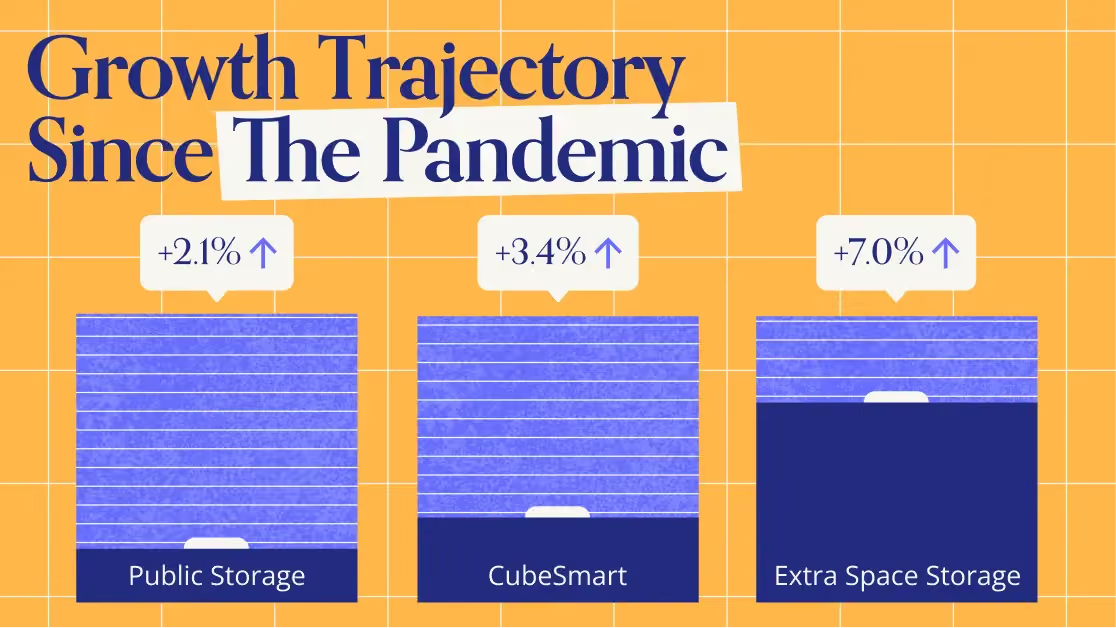
Americans have a love affair with stuff, and one of the hallmarks of this is the enduring strength of self-storage units. Public Storage takes the lead in overall visits, with Extra Space Storage not far behind. Looking at the Public Storage visits data, we see a clear spike in visits near the end of the month. This is due be due to housing transitions that also tend to occur with this pattern, as people prepare to move out at month’s end or conversely to pick up items for move-in at the beginning of a month.

Compared to last year, visits are generally up across most of these chains (which is partly the result of the industry consolidation trend we examined last year). The highest variance is seen with Prime Storage, a company largely based on the East Coast, but with a presence in the Midwest as well. StorageMart bought Manhattan Mini Storage in 2021 and has over 250 locations now.


In just a few months, we will be coming on the 5-year anniversary of COVID-19. During that time, we hunkered down, bought tons of athleisure, and stared at our forlorn office clothing sitting unworn in our closets. Fast forward a few years to present day and much like bootcut jeans are back in style, the pendulum is starting to veer back towards a more tailored style. This time around, the suits may not be as constricting, but there is certainly more structure to fall’s fashion than the cozy comfy sweatpants and leggings that the whole world came to embrace upon working from home. Among locations that are not multi-story or in enclosed malls, we see that Ann Taylor increased traffic to its locations in March, June, and August compared to last year, and that Polo Ralph Lauren has also seen increases in the past few months. This particular grouping of brands all has at least 30 or more locations each tracked by Placer and tend to be ubiquitous at many malls or as standalone boutiques. A recent visit to Banana Republic indicated a merchandising assortment that appeared to be more than 50% office wear in the women’s section, with blazers and tailored pants, silky shirts, and dresses ready to be accessorized with heels and some statement jewelry.

However, we are seeing even larger increases in year-over-year traffic at some of the more specialized/high-end brands, particularly in women’s contemporary that offer sharp-looking items that look just as polished at the boardroom or the PTA meeting, like the blazers at Veronica Beard or the “Effortless Pant” from Aritzia that is a smash hit on social media. The majority of this next grouping of brands got their start at department stores or specialty retailers, but with increased success, many are launching their own brick-and-mortar boutiques. Clearly, having a holy grail item that is on the fashion editors’ favorites list gives a boost to store traffic. One of the trends we are seeing is the continuation of the love for comfort everyone adopted during Covid mixed with a slightly more structured but still understated minimalist but luxe aesthetic, like COS. Theory, a wardrobe staple with its neutral color palette and streamlined silhouettes, has been generating positive year-over-year traffic during the back-to-school and fall season. Vince, also featuring rather understated and neutral basics, also saw its traffic lift for the fall season. Eileen Fisher is another interesting brand. Once regarded as clothing adapted to your mom’s generation, Gen Z is also starting to embrace it for its softness and sustainability, and it is one of the more popular brands to buy secondhand. In April of this year, Guess and WHP Global completed the acquisition of rag & bone, which has long been hailed for their on-trend jeans and boots. Time will tell what direction they will take the brand, or if they will stick with its tried-and-true New York roots.

Another brand to keep an eye on that we’re already familiar with from prestige department stores like Nordstrom, Bloomingdale’s, and Saks Fifth Avenue is L’Agence. This brand goes seamlessly from day to night with classics like tweed blazers, satiny tank tops, and perfectly-fitting jeans. They’ve now expanded to more stand-alone stores, including Southern California shopping meccas like Malibu and Beverly Hills. While the Malibu one just opened in late fall 2023, its traffic has been growing steadily upwards, even overtaking that of the Beverly Hills outpost of late.

One interesting thing to note is that the Malibu location attracts a higher proportion of its audience during the morning hours, whereas the Beverly Hills location gets the evening crowd. This information would be useful for staffing purposes or for knowing when to hold events.

Walmart, Target, and Costco are three of the most popular retailers in the country, drawing millions of shoppers through their doors each day. Each of these retail giants boasts distinct strengths and strategies that cater to their unique customer bases, allowing them to thrive in a highly competitive market.
This white paper takes a closer look at some of the factors that are helping the three chains flourish. How does Walmart’s positioning as a family-friendly retailer help it drive visits in its more competitive markets? How can Target leverage its reach to drive more loyal visits? And what does the increase in young shoppers frequenting membership warehouse clubs mean for Costco?
We dove into the location analytics to explore these questions further.
Examining monthly visitation patterns for the three retail giants shows Costco’s wholesale club model leading the way with consistent year-over-year (YoY) visit growth – ranging from 6.1% in stormy January 2024 to 13.3% in June. Family favorite Walmart followed closely behind, seeing YoY foot traffic growth during all but two months, when visits briefly trailed slightly behind 2023 levels before rebounding.
Target, meanwhile, had a slower start to the year, with visits trending below 2023 levels for most of January to April. Over this same period (the three months ending May 2024), Target reported a 3.7% decline in YoY comparable sales. But since then, things have begun to turn around for the chain, with YoY visits rising in May (2.5%), June (8.9%), and July (4.7%). This renewed visit growth into the second half of the year bodes well for the superstore – and the ongoing back-to-school season may well push visits up further as the summer winds down.
For all three chains, Q2 2024’s visit success has likely been bolstered in part by summer deals and intensifying price wars – as the retailers slash prices to woo inflation-weary consumers back to the store.
Over the past few years, consumer behaviors have been changing rapidly in response to shifting economic conditions. This next section explores some of these changes at Walmart, Target, and Costco, to better understand what may be driving these shifts.
One way that consumers have traditionally responded to inflation and other headwinds has been through the adoption of mission-driven shopping – making fewer, but longer, trips to retailers, so that every visit counts. Superstores and wholesale clubs, which offer one-stop shopping experiences, have long been prime destinations for these extended shopping trips. And even during periods when visits have lagged, these retailers have often benefited from extended dwell times – leading to bigger basket sizes.
A look at changes in average dwell times at Walmart and Target suggests that as YoY visits have picked up, dwell times have come down – perhaps reflecting a normalization of consumers’ shopping patterns. With inflation stabilizing and gas prices lower than they were in 2022 and 2023, customers may feel less pressure to consolidate shopping trips than they have in recent years.
In contrast, Costco’s comparatively long dwell times have remained stable over the past several years. The warehouse club’s bulk offerings, plentiful free samples, and inexpensive food court encourage shoppers to spend more time browsing the aisles than they would at other retailers. And even if mission-driven shopping continues to subside, Costco customers will likely keep on making extra-long shopping trips.
While inflation is cooling faster than expected, prices remain high, and new players are stepping into the retail space occupied by Walmart, Target, and Costco – especially dollar stores. Though higher-income customers increasingly rely on the three retail giants for many of their purchases, customers of more modest means are often drawn to the rock-bottom prices offered at dollar stores.
And analyzing the cross-shopping patterns of visitors to Walmart, Target, and Costco shows that growing shares of visitors to the three behemoths also visit Dollar Tree on a regular basis. In Q2 2019, the share of visitors to Walmart, Target, and Costco who frequented Dollar Tree at least three times ranged between 9.8% and 13.7%. But by Q2 2024, that share rose to 16.7%-21.6%.
Dollar Tree is leaning into this increased interest among superstore shoppers. Over the past year, Dollar Tree added some 350 Dollar Tree locations, even as it shuttered nearly 400 Family Dollar stores. And the chain recently acquired the leases of some 170 99 Cents Only Stores – offering Dollar Tree access to a customer base accustomed to buying everything from groceries to household goods. As Dollar Tree continues to grow its footprint and expand its food offerings, the chain will be better positioned than ever to provide a real challenge to Walmart, Target, and Costco.
Still, the three retail giants each have unique offerings that distinguish them from dollar stores. This next section examines what sets Walmart, Target, and Costco apart – and how they can continue to strengthen their competitive edge.
With competition on the rise, Walmart, Target, and Costco must display agility in navigating an ever-evolving market landscape. This section dives into the data for each chain’s more successful metro areas to see what factors are helping them outperform nationwide averages – and what metrics the retailers can harness to try to replicate these results nationwide.
Target recently expanded its Target Circle Rewards program, rolling out three new tiers for its 100 million members. And this focus on loyalty has proven successful for the chain. Demographic and visitation data reveal a strong correlation between the median household incomes (HHIs) of Target locations’ captured markets across CBSAs (core-based statistical areas), and their share of loyal visitors in Q2 2024: CBSAs where Target locations’ captured markets had higher median HHIs also tended to draw more repeat monthly visitors.
Target’s captured markets in the Los Angeles-Long Beach-Anaheim, LA CBSA, for example, featured a median HHI of $89.8K in Q2 2024 – and 48.0% of the chain’s LA visitors frequented a Target at least twice a month during the quarter. Target stores in the Chicago-Naperville-Elgin, IL-IN-WI CBSA, where the chain’s captured markets had a median HHI of $88.7K in Q2 2024, also had a loyalty rate of 48.0%.
Target generally attracts a more affluent audience than Walmart. And even as the superstore slashes prices to attract more price-conscious consumers, the retailer is also taking steps likely to enhance its popularity among higher-income households. In April 2024, Target debuted a paid membership tier within its loyalty program offering perks like same-day delivery for a fee. Maintaining and expanding these premium offerings will be key for Target as it seeks to attract more affluent customers and replicate its high-performing results in CBSAs nationwide.
The persistent inflation of the past few years, while challenging for some retailers, has also created new opportunities – particularly for wholesalers. Membership warehouse clubs, including Costco, are gaining popularity among younger shoppers, a cohort often looking for new ways to stretch their more limited budgets. An October 2023 survey revealed that nearly 15% of respondents aged 18 to 24 and 17% of those aged 25 to 30 shop at Costco.
A closer look at some of Costco’s best-performing CBSAs for YoY visit-per-location growth highlights the significance of these younger shoppers: In H1 2024, the company’s YoY visit-per-location growth was strongest in areas with higher-than-average shares of young urban singles.
For example, the San Diego-Chula Vista-Carlsbad, CA CBSA experienced visit-per-location growth of 10.4% YoY in H1 2024, while the nationwide average stood at 7.9%. And the CBSA’s share of Young Urban Singles, defined by the Spatial.ai: PersonaLive dataset as “singles starting their careers in trade and service jobs,” was 12.1%, well above Costco’s nationwide average of 7.3%.
Walmart is a one-stop shop for everything from affordable groceries to clothing to home furnishings, making it especially popular among families. The retailer actively courts this segment with baby offerings designed to meet the needs of both kids and parents, virtual offerings in the metaverse, and collectible toys.
And visitation data reveals a connection between the extent of different Walmart locations’ YoY visit growth and the share of households with children in their captured markets.
In H1 2024, nationwide visits to Walmart increased by 4.1% YoY, while the share of households with children in the chain’s overall captured market hovered just under the nationwide baseline. But in some CBSAs where Walmart outpaced this nationwide growth, the retail giant also proved especially adept at attracting parental households – outpacing relevant statewide baselines.
In Boston-Cambridge-Newton, MA, for example, Walmart experienced 5.0% YoY visit growth in H1 2024 – while the share of households with children in the chain’s local captured market stood 7% above the Massachusetts state average. And in Grand Rapids-Kentwood, MI, where Walmart’s share of parental households outpaced the Minnesota state average by an even wider 15% margin, the retailer saw impressive 7.3% YoY visit growth. This pattern repeated itself in other metro areas, suggesting that there may be a correlation between local Walmart locations’ visit growth and their relative ability to draw households with children.
Walmart can continue solidifying its market position by leaning into its family-oriented offerings and expanding its footprint in regions with growing populations of young families.
Walmart, Target, and Costco all experienced YoY visit growth in the final months of H1 2024, with Costco leading the way. And though the three chains still face considerable challenges, each one brings unique strengths to the table. By continuously innovating and responding to changing market conditions, Walmart, Target, and Costco can not only overcome obstacles but also leverage them to reinforce their market positions and drive continued growth.

The first Lollapalooza – a four-day music festival – took place in 1991. Chicago’s Grant Park became the event’s permanent home (at least in the United States) in 2005, drawing thousands of revelers and music fans to the park each year.
This year, the festival once again demonstrated its powerful impact on the city. On August 1st, 2024, visits to Grant Park surged by 1,313.2% relative to the YTD daily average, as crowds converged on the park to see Chappell Roan’s much-anticipated performance. And during the first three days of the event, the event drew significantly more foot traffic than in 2023 – with visits up 18.9% to 35.9% compared to the first three days of last year’s festival (August 3rd to 5th, 2023).
Lollapalooza led to a dramatic spike in visits to Grant Park – and it also attracted a different type of visitor compared to the rest of the year.
Analyzing Grant Park’s captured market with Spatial.ai’s PersonaLive dataset reveals that Lollapalooza attendees are more likely to belong to the “Young Professionals” and “Ultra Wealthy Families” segment groups than the typical Grant Park visitor.
By contrast, the “Near-Urban Diverse Families” segment group, comprising middle-class diverse families living in or near cities, made up only 6.5% of visitors during the festival, compared to 12.0% during the rest of the year.
Additionally, visitors during Lollapalooza came from areas with higher HHIs than both the nationwide baseline of $76.1K and the average for park visitors throughout the year. Understanding the demographic profile of visitors to the park during Lollapalooza can help planners and city officials tailor future events to these segment groups – or look for ways to make the festival accessible to a wider range of music lovers.
Lollapalooza’s impact on Chicago extended beyond the boundaries of Grant Park, with nearby hotels seeing remarkable surges in foot traffic. The Congress Plaza Hotel on South Michigan Avenue witnessed a staggering 249.1% rise in visits during the week of July 29, 2024, compared to the YTD visit average. And Travelodge on East Harrison Street saw an impressive 181.8% increase. These spikes reflect the festival’s draw not just for locals but for out-of-town visitors who fill hotels across the city.
The North Michigan Avenue retail corridor also enjoyed a significant increase in foot traffic during the festival, with visits on Thursday, August 1st 56.0% higher than the YTD Thursday visit average. On Friday, August 2nd, visits to the corridor were 55.7% higher than the Friday visit average. These numbers highlight Lollapalooza’s role in driving economic activity across Chicago, as festival-goers venture beyond the park to explore the city’s vibrant retail and hospitality offerings.
City parks often serve as community hubs, and Flushing Meadows Corona Park in Queens, NY, has been a major gathering point for New Yorkers. The park hosted one of New York’s most beloved summer concerts – Governors Ball – which moved from Governors Island to Flushing Meadows in 2023.
During the festival (June 9th -11th, 2024), musicians like Post Malone and The Killers drew massive crowds to the park, with visits soaring to the highest levels seen all year. On June 9th, the opening day of the festival, foot traffic in the park was up 214.8% compared to the YTD daily average, and at its height, on June 8th, the festival drew 392.7% more visits than the YTD average.
The park also hosted other big events this summer – a July 21st set by DMC helped boost visits to 185.1% above the YTD average. And the Hong Kong Dragon Boat Festival on August 3rd and 4th led to major visit boosts of 221.4% and 51.6%, respectively.
These events not only draw large crowds, but also highlight the park’s role as a space where cultural and civic life can find expression, flourish, and contribute to the health of local communities.
Analyzing changes in Flushing Meadows Corona Park’s trade area size offers insight into how far people are willing to travel for these events. During Governors Ball, for example, the park’s trade area ballooned to 254.5 square miles, showing the festival's wide appeal. On July 20th, by contrast, when the park hosted several local bands and DJs, the trade area was a much more modest 57.0 square miles.
Summer events drive community engagement, economic activity, and civic pride. Cities that invest in their parks and event hubs, fostering lively and inclusive spaces, can create lasting value for both residents and visitors, enriching the cultural and social life of urban areas.
For more data-driven civic stories, visit Placer.ai.
The pandemic and economic headwinds that marked the past few years presented the multi-billion dollar hotel industry with significant challenges. But five years later, the industry is rallying – and some hotel segments are showing significant growth.
This white paper delves into location analytics across six major hotel categories – Luxury Hotels, Upper Upscale Hotels, Upscale Hotels, Upper Midscale Hotels, Midscale Hotels, and Economy Hotels – to explore the current state of the American hospitality market. The report examines changes in guest behavior, personas, and characteristics and looks at factors driving current visitation trends.
Overall, visits to hotels were 4.3% lower in Q2 2024 than in Q2 2019 (pre-pandemic). But this metric only tells part of the story. A deeper dive into the data shows that each hotel tier has been on a more nuanced recovery trajectory.
Economy chains – those offering the most basic accommodations at the lowest prices – saw visits down 24.6% in Q2 2024 compared to pre-pandemic – likely due in part to hotel closures that have plagued the tier in recent years. Though these chains were initially less impacted by the pandemic, they were dealt a significant blow by inflation – and have seen visits decline over the past three years. As hotels that cater to the most price-sensitive guests, these chains are particularly vulnerable to rising costs, and the first to suffer when consumer confidence takes a hit.
Luxury Hotels, on the other hand, have seen accelerated visit growth over the past year – and have succeeded in closing their pre-pandemic visit gap. Upscale chains, too, saw Q2 2024 visits on par with Q2 2019 levels. As tiers that serve wealthier guests with more disposable income, Luxury and Upscale Hotels are continuing to thrive in the face of headwinds.
But it is the Upper Midscale level – a tier that includes brands like Trademark Collection by Wyndham, Fairfield by Marriott, Holiday Inn Express by IHG Hotels & Resorts, and Hampton by Hilton – that has experienced the most robust visit growth compared to pre-pandemic. In Q2 2024, Upper Midscale Hotels drew 3.5% more visits than in Q2 2019. And during last year’s peak season (Q3 2023), Upper Midscale hotels saw the biggest visit boost of any analyzed tier.
As mid-range hotels that still offer a broad range of amenities, Upper Midscale chains strike a balance between indulgence and affordability. And perhaps unsurprisingly, hotel operators have been investing in this tier: In Q4 2023, Upper Midscale Hotels had the highest project count of any tier in the U.S. hotel construction and renovation pipeline.
The shift in favor of Upper Midscale Hotels and away from Economy chains is also evident when analyzing changes in relative visit share among the six hotel categories.
Upper Midscale hotels have always been major players: In H1 2019 they drew 28.7% of overall hotel visits – the most of any tier. But by H1 2024, their share of visits increased to 31.2%. Upscale Hotels – the second-largest tier – also saw their visit share increase, from 24.8% to 26.1%.
Meanwhile, Economy, Midscale, and Upper Upscale Hotels saw drops in visit share – with Economy chains, unsurprisingly, seeing the biggest decline. Luxury Hotels, for their parts, held firmly onto their piece of the pie, drawing 2.8% of visits in H1 2024.
Who are the visitors fueling the Upper Midscale visit revival? This next section explores shifts in visitor demographics to four Upper Midscale chains that are outperforming pre-pandemic visit levels: Trademark Collection by Wyndham, Holiday Inn Express by IHG Hotels & Resorts, Fairfield by Marriott, and Hampton by Hilton.
Analyzing the captured markets* of the four chains with demographics from STI: Popstats (2023) shows variance in the relative affluence of their visitor bases.
Fairfield by Marriott drew visitors from areas with a median household income (HHI) of $84.0K in H1 2024, well above the nationwide average of $76.1K. Hampton by Hilton and Trademark Collection by Wyndham, for their parts, drew guests from areas with respective HHIs of $79.6K and $78.5K – just above the nationwide average. Meanwhile, Holiday Inn Express by IHG Hotels & Resorts drew visitors from areas below the nationwide average.
But all four brands saw increases in the median HHIs of their captured markets over the past five years. This provides a further indication that it is wealthier consumers – those who have had to cut back less in the face of inflation – who are driving hotel recovery in 2024.
(*A chain’s captured market is obtained by weighting each Census Block Group (CBG) in its trade area according to the CBG’s share of visits to the chain – and so reflects the population that actually visits the chain in practice.)
Much of the Upper Midscale visit growth is being driven by chain expansion. But in some areas of the country, the average number of visits to individual hotel locations is also on the rise – highlighting especially robust growth potential.
Analyzing visits to existing Upper Midscale chains in four metropolitan areas with booming tourism industries – Salt Lake City, UT, Palm Bay, FL, San Diego, CA, and Richmond, VA – shows that these markets feature robust untapped demand.
Utah, for example, has emerged as a tourist hotspot in recent years – with millions of visitors flocking each year to local destinations like Salt Lake City to see the sights and take in the great outdoors. And Upper Midscale hotels in the region are reaping the benefits. In H1 2024, the overall number of visits to Upper Midscale chains in Salt Lake City was 69.4% higher than in H1 2019. Though some of this increase can be attributed to local chain expansion, the average number of visits to each individual Upper Midscale location in the area also rose by 12.5% over the same period.
Palm Bay, FL (the Space Coast) – another tourist favorite – is experiencing a similar trend. Between H1 2019 and H1 2024, overall visits to local Upper Midscale hotel chains grew by 36.4% – while the average number of visits per location increased a substantial 16.9%. Given this strong demand, it may come as no surprise that the area is undergoing a hotel construction boom. Upper Midscale hotels in other areas with flourishing tourism sectors, like San Diego, CA and Richmond, VA, are seeing similar trends, with increases in both overall visits and and in the average number of visits per location.
Though Economy chains have underperformed versus other categories in recent years, the tier does feature some bright spots. Some extended-stay brands in the Economy tier – hotels with perks and amenities that cater to the needs of longer-stay travelers – are succeeding despite category headwinds.
Choice Hotels’ portfolio, for example, includes WoodSpring Suites, an Economy chain offering affordable extended-stay accommodations in 35 states. In H1 2024, the chain drew 7.7% more visits than in the first half of 2019 – even as the wider Economy sector continued to languish. InTown Suites, another Economy extended stay chain, saw visits increase by 8.9% over the same period.
And location intelligence shows that the success of these two chains is likely being driven, in part, by their growing appeal to young, well-educated professionals. In H1 2019, households belonging to Spatial.ai: PersonaLive’s “Young Professionals” segment made up 9.6% of WoodSpring Suites’ captured market. But by H1 2024, the share of this group jumped dramatically to 13.3%. At the same time, InTown Suites saw its share of Young Professionals increase from 12.0% to 13.4%.
Whether due to an affinity for prolonged “workcations” (so-called “bleisure” excursions) or an embrace of super-commuting, younger guests have emerged as key drivers of growth for the extended stay segment. And by offering low–cost accommodations that meet the needs of these travelers, Economy chains can continue to grow their share of the pie.
The hospitality industry recovery continues – led by Upper Midscale Hotels, which offer elevated experiences that don’t break the bank. But today’s market has room for other tiers as well. By keeping abreast of local visitation patterns and changing consumer profiles, hotels across chain scales can personalize the visitor experience and drive customer satisfaction.