.png)
.png)

.png)
.png)

While brutally cold weather blasts much of the continental U.S. this week--including the Midwest, Deep South, and Montana--one might just dream about moving to the balmy shores of Hawaii, where temperatures have been hovering in the high 70s of late. Besides being home to the Ala Moana Center, the most-visited open-air shopping center in the US over the holidays, there is also constant redevelopment and improvement occurring on the island of Oahu.
For instance, the International Market Place on Kalakaua Ave, once known for decades as a touristy collection of kiosks, has upped its game and now boasts a Tesla showroom and a Balenciaga store at its entrance. Were it not for the commanding Banyan Tree that has been preserved, one would hardly recognize this iteration of the shopping venue compared to 10 years ago. Since it re-opened in early 2017, traffic has steadily been climbing. Hawaii tourism was hit hard by COVID in Spring 2020, but by July 2021 we begin to see a marked increase, to be repeated and exceeded in subsequent Julys as well. The summer of 2023 boasts a record in traffic originating from domestic visitors for the International Market Place.
Just down the street is the Royal Hawaiian Center, which encompasses three separate buildings that are connected by skywalks. Since its opening in 1980, it too has seen numerous changes, though its commitment to sharing the spirit of Aloha remains the same. The food options are extensive and come from all corners of the globe, such as Wolfgang’s Steakhouse, Tsurutontan Udon Noodle, Tim Ho Wan dim sum, and Wicked Maine Lobster. There was a massive spike in visitation in July 2021, which has since decreased a bit, but is still above pre-COVID levels.
There are definitely some unique, only-in-Hawaii treats, such as the shaka waffle ice cream cone at Kokoro Cafe at the Royal Hawaiian Center.

The other notable shift at the Royal Hawaiian Center is the bountiful array of luxury shopping available. From Hermes to Fendi, Harry Winston to Tiffany, designer showcases beckon from the street as well as from the interior corridors.

When we last checked in on the home furnishing retail category, we noted that we had started to see a divergence among several of the various subcategories, with houseware retailers seeing great visits year-over-year relative to furniture retailers. At the time, we hypothesized that housewares were outperforming because of several reasons, including (1) consumers’ willingness to spend around holiday periods last year due to post-pandemic home entertaining trends; (2) the departure of Bed Bath & Beyond and other retailer from the market driving visits to other housewares retailers; and (3) urban residential migration trends among younger families increasing demand for houseware trends. The divergence in visitation trends continued through the back half of 2023, with housewares continuing to outperform through December.
One of the home furnishing subcategories that flew under the radar in 2023 is mattresses. As shown above, this retail category didn’t quite keep pace with houseware retail visit trends, but outperformed value and full-priced furniture. What’s behind this outperformance? For starters, our data indicates that migration trends may play a role. We reviewed visitation trends for pure-play mattress retailers across the top 25 CBSAs in the U.S. (ranked by population) during the Black Friday promotional period (early November 2023 to early December 2023) and found that several of the top performing markets–New York, San Francisco, Minneapolis, Chicago, Detroit–had seen total population declines since the pandemic (according to Placer's Migration Trends Report) but also experienced a rebound in population growth this past summer, creating increased demand for mattresses. However, population trends continued on a downward trajectory in the second half of 2023 in a number of these markets, indicating this demand may not be sustainable.
What should home furnishing retailers expect in 2024? From a year-over-year visitation standpoint, we expect the subcategories to remain roughly the same in terms of rankings through the first half of the year, with housewares continuing to lead, followed by mattresses, value furniture, and then full-priced furniture. Continued migration trends across the U.S.--especially smaller markets–should continue to stimulate demand for housewares and mattresses (although Temu and other online retailers will also compete for houseware spending in the year ahead). Migration trends should also create demand for value furniture retailers, as should new smaller-format and smaller-market store openings from IKEA and others. Full-priced furniture will continue to face headwinds in the form of elevated mortgage rates (compared to last year), sluggish new housing development trends, and stagnant housing turnover, suggesting that visitation trends could be challenged for much of 2024 (despite facing easier comparisons).

What does 2024 hold for malls and shopping centers? We dove into the data to unearth the trends likely to shape the space in the coming year.
The move towards greater tenant diversity in malls shaped the shopping center space in recent years, and the trend appears set to be taken to the next level in 2024. Placemaking – crafting public spaces that go beyond utilitarian needs to foster social interaction and exchange – is at the forefront of many urban development initiatives, and the trend is already boosting retail performance in successful placemaking projects.
Fenton, a mixed-use district in Cary, N.C., opened in June 2022. The project showcases the potential of placemaking to transform an underutilized space into a vibrant “live-work-play” community with something for individuals and families of all ages. The retail and entertainment village includes shops, restaurants, seasonal attractions, entertainment venues, and other diverse offerings that are establishing Fenton as a community hub and a prime destination for residents. Visits were up 53.2% between July and December 2023 compared to the same period in 2022, while median dwell time increased from 64 to 83 minutes.
.avif)
Across the country, in Phoenix, AZ, Park Central Mall – the state’s first open-air shopping center – was also redesigned as a mixed-use development Park Central. The complex includes restaurants, office space, medical facilities, and bioscience research labs, with more hospitality and housing under construction. And although the project first reopened in 2019, visits to the revitalized Park Central continue to grow – between 2022 and 2023, foot traffic to Park Central increased by 32.8% while median dwell time grew from 75 to 80 minutes.
.avif)
In 2023, malls attracted relatively high income shoppers – and as the trend is likely to continue in 2024, with high-income shoppers displaying significantly stronger consumer confidence than their middle- and low-income counterparts.
Households in the potential market trade areas of Indoor Malls, Open-Air Lifestyle Centers, and Outlet Malls tended to have higher incomes relative to the nationwide median – and the median HHI was even higher in the malls’ captured market trade area. This means that many of these malls are located within relatively affluent communities (hence the relatively high potential market median HHI) and attract the higher-income shoppers within those areas (as shown by the even higher captured market median HHI).
With middle-income shoppers expected to tighten their budgets in 2024, high-income consumers will likely remain a significant share of mall-goers in 2024 as well.
.avif)
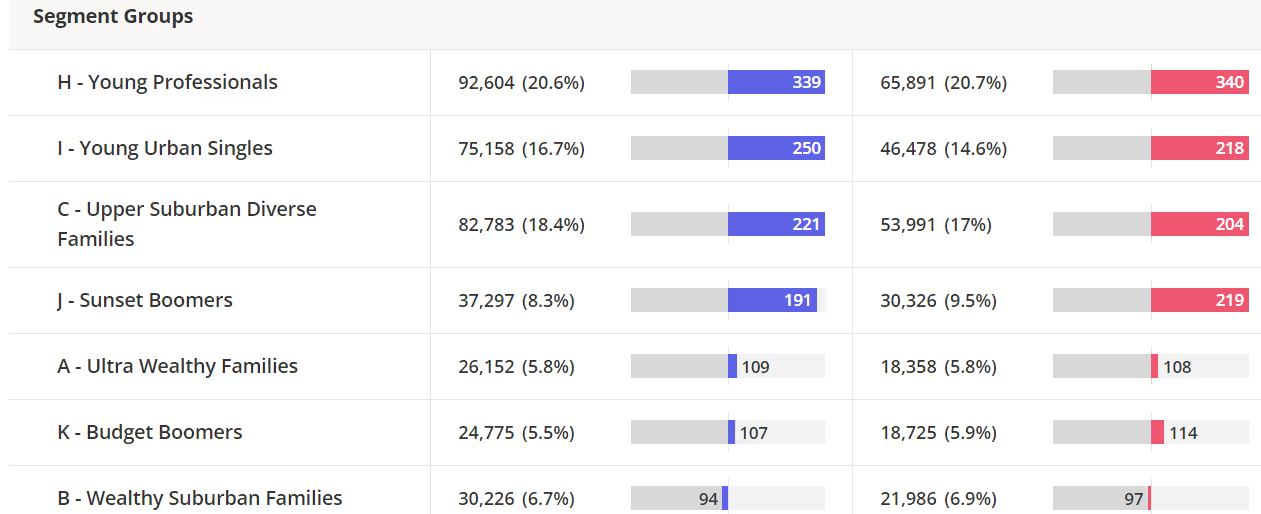
Malls used to be the place for teens to hang out on weekends – and it looks like shopping centers are once again attracting younger generations of consumers. Between 2019 and 2023, the share of “Young Professionals” and “Young Urban Singles” in the captured market trade areas of Indoor Malls, Open-Air Shopping Centers, and Outlet Malls increased. At the same time, the share of older segments – “Suburban Boomers” and “Sunset Boomers” – decreased.
As Gen-Z shoppers rediscover physical stores and increasingly seek out the mall-going experience, the share of younger consumers visiting shopping centers may well grow larger in the upcoming year.
.avif)
Last year’s ongoing inflation brought a unique set of challenges to a brick-and-mortar space still recovering from the pandemic’s impact. But 2023 ended with a surge in consumer confidence, and 2024 may well bring a positive shift to malls and the wider retail landscape. And shopping centers – especially those that offer a diversity of experience and succeed in catering high-income and/or younger shoppers – can take advantage of the opportunities in the year ahead.
For more data-driven insights, visit placer.ai/blog.

Few things are as universally loved as freshly baked bread. And the options for where to find a loaf are plentiful, from local artisan shops to bakery chains to grocery store bread counters. Is there room in the crowded bakery scene for everyone? We take a closer look at the visitation data for a few bakery chains that are on the rise to find out.
Paris Baguette, the South Korean bakery and cafe chain, inaugurated its first U.S. store in Los Angeles in 2005. True to its name, the chain offers a menu inspired by classic French boulangeries with a Korean twist – think mochi donuts sold alongside croissants.
Paris Baguette hopes to operate 1,000 stores across the country by 2030; to that end, it embraced a franchising approach in 2015 to accelerate growth and store openings. Visitation patterns suggest that this move has proven itself to be a winning one.
Examining the change in monthly visits to Paris Baguette locations since November 2019 underscores the brand’s remarkable growth. The chain operated 77 stores in the U.S. in November 2019; today, that number has nearly doubled. And visits have soared accordingly, with December 2023 seeing 96.7% more monthly visits than December 2019.
As Paris Baguette continues to see its success rising, the bakery chain appears well-positioned to maintain its momentum and achieve its ambitious expansion plans.
.avif)
85°C Bakery, often dubbed the "Starbucks of Taiwan," made its way to the U.S. in 2008. The chain, which operated 59 U.S. stores as of March 2023 in addition to its significant international presence, seeks to solidify its standing in the American market.
Named after the ideal coffee-brewing temperature, 85°C has enjoyed year-over-year (YoY) foot traffic growth throughout most of 2023. And the chain, which currently operates in the West and in Texas, announced plans for an East Coast expansion in August 2023, signaling its intent to reach new consumer segments.
Diving into the visitation data reveals that 85°C not only enjoys strong monthly foot traffic but also draws more family households (defined by the Spatial.ai: PersonaLive dataset) to its trade areas compared to the statewide average. In California, Texas, and Washington, the trade areas show an overrepresentation of "Near-Urban Diverse Families," "Ultra Wealthy Families," and "Wealthy Suburban Families." This suggests that families – particularly affluent ones – are drawn to the chain.
As 85°C continues expanding, including into new markets and dining concepts – such as the recent addition of a dumpling shop – the chain hopes to continue bringing its Taiwanese flavors to a wider audience.
.avif)
Tartine and Porto’s are two Los Angeles natives with very different approaches to dough. Tartine, the brainchild of breadmasters Chad Robertson and Elizabeth Prueitt, is thought to have brought sourdough bread into the mainstream in the U.S. Porto’s, on the other hand, began as an immigrant-owned bakery in the 1970s, bringing the taste of Cuba to California.
And the two chains, while both based in the same city, see significant differences in their visitor demographics. Analyzing visitors to both bakery brands using the STI: Popstats dataset reveals that, while 29.1% of Porto’s captured market* trade area was made up of households with children – very close to the California median of 29.6% – only 17.3% of Tartine’s captured market* trade area was made up of households with children. And the median household income (HHI) also showed significant variance between the brands, with Tartine visitors earning significantly more than Porto’s and the California median HHI.
*A business’s captured market refers to the trade area with each census block weighted according to its share of visits to the chain or venue in question.
.avif)
The variance in demographics across these two iconic Los Angeles bakeries serves as testament to the city's diverse culinary landscape and ability to embrace and sustain a wide array of eateries.
The four bakeries prove that there is plenty of room in a crowded kitchen for different kinds of bakeries to succeed, from tiny artisan bakeries to major chains.
For more data-driven dining insights, visit placer.ai/blog.

Country clubs are changing with the times, moving away from the once-exclusive image of business dealings on the golf course. A more inclusive concept is taking root – and attracting a growing number of young members.
We took a closer look at the location intelligence metrics of country clubs throughout the country to understand how they are shifting and what might be driving these changes.
Golf and tennis, two country club stalwarts, surged in popularity over the COVID-19 pandemic, and that increase has sustained itself – more people than ever are playing the games. Looking at year-over-four-year (Yo4Y) visits to country clubs suggests that these establishments are reaping the benefits of the interest in both sports. Visits were elevated compared to the same period in 2019 for all but two months analyzed.
June, when the U.S. Open was held, saw the most impressive Yo4Y visit growth of 28.7%. The championship, the most-watched golf tournament since 2019, was held in the Los Angeles Country Club, and likely contributed to a spike in visits to golf clubs, either for U.S. Open-related events or a U.S. Open-inspired desire to golf. The year ended on a high note, with December visits to country clubs up by 12.1% Yo4Y – a solid indication that interest in membership clubs remains strong.
.avif)
Millennials, a consumer cohort that has historically shown little interest in joining country clubs, seem to be changing course and may be driving some of the visit growth. This population is increasingly seeking spaces to socialize and network – and in response, many golf clubs are shifting their offerings to appeal to a younger demographic. Location intelligence indicates that the strategy is working.
Examining country club demographics across the country – in Long Island, New York; Austin, Texas; Atlanta, Georgia; and Minneapolis, Minnesota – suggests a shift in membership makeup. Some of these areas have seen an influx of millennials in recent years, which likely expanded the pool of younger potential country club members. But the trade areas of many of the country clubs’ also skewed younger in 2023 than they did in 2019 – meaning that these clubs are attracting visitors from neighborhoods with lower median ages compared to the neighborhoods feeding visits to country clubs in 2019.
Some clubs, like the Capital City Country Club in Atlanta, Georgia, saw relatively small drops in median age – from 41.2 in 2019 to 40.2 in 2023. But other clubs saw much more pronounced drops – the Hazeltine National Golf Club near Minneapolis, Minnesota saw its median age drop by 7.8 years between 2019 and 2023. The Country Club Of The South in Atlanta, Georgia, also saw a Yo4Y drop in median age – from 38.0 to 31.8.
.avif)
Country clubs tend to have a steep financial barrier to entry, with costs including annual membership dues, initiation fees, and expenses for food and beverages. And perhaps unsurprisingly, most country club members boast a median household income (HHI) well above the nationwide median. And although younger demographics generally have to have less income than their older counterparts, the drop in median age across many country clubs does not seem to be having a major impact on the affluence of these clubs’ visitor bases.
Some clubs that experienced Yo4Y drops in the median age of visitors – Great Hills Country Club in Austin, Texas, for example – did see the median HHI of its visitors drop slightly. But for the most part, the median HHI of visitors to country clubs remained stable Yo4Y, and some, like the Edina Country Club in Minnesota, saw the median HHI grow Yo4Y. This suggests that the decline in median age within membership clubs may be driven by a desire for socializing and new experiences rather than a shift towards increased financial accessibility for a broader range of members.
.avif)
The shift in the demographics of country club visitors, marked by the rising number of younger members, is a trend that may solidify further. Clubs in tune with this demographic – young professionals and millennials – can consider what is important to this cohort to continue attracting the younger generation.
For more data-driven leisure and entertainment insights, visit placer.ai/blog.

Florida, known for its year-round sunny weather and iconic attractions like Disneyland and EPCOT, has long been a popular tourist destination. And though many people think of Miami and Orlando when planning a trip to Florida, Tampa is fast becoming one of the country's most popular getaway spots. The city has seen its tourism sector grow over the past few years, so we dove into the location analytics data to better understand these tourism trends.
Tampa has emerged as an attractive place for out-of-state home buyers and relocators in recent years – especially for younger generations looking to take advantage of the city’s status as an emerging tech hub as well as enjoy the pleasant climate and beautiful beaches. But examining foot traffic trends to Downtown Tampa also reveals Tampa’s growing popularity among out-of-state visitors.
Tampa International Airport – named the “best large airport in North America in 2023” – is growing fast, and visits to the Downtown Tampa POI from visitors coming from 250+ miles away were up almost every month of 2023, especially compared to pre-pandemic 2019. (Most places 250 miles or more outside Tampa are also outside Florida.) And although YoY foot traffic did dip some months, the drop was likely due to the comparison with a particularly strong 2022 that brought a record number of tourists to the Hillsborough County seat.
.avif)
Diving into the demographic data of visitors traveling to Downtown Tampa from at least 250 miles away helps shed light on who is driving this domestic tourism surge.
Between 2019 and 2023, the share of households with children in the trade areas feeding out-of-state visits to downtown Tampa grew from 25.9% in 2019 to 27.1% in 2023. Similarly, the median household income (HHI) of visitors to the city’s downtown also increased from $85.1K/year to $91.8K/year. These shifts in visitor demographics suggest that at least some of the tourism surge to the city may be driven by families with children and wealthy families.
It seems, then, that Tampa is on the rise not just as a retirement hub or as a millennial and Gen-Z hotspot. The city is also attracting an increasingly larger share of affluent families with children, indicating that this rising Florida star with something for everyone may soar even higher in 2024.
.avif)
With its pristine beaches and diverse attractions, Tampa has long boasted a robust tourism sector – and the city’s popularity has surged even higher post-pandemic. So far, 2024 looks promising for the city’s tourism segment. Will Tampa continue to attract vacationers and sight-seers?
Visit placer.ai/blog to find out.

The first Lollapalooza – a four-day music festival – took place in 1991. Chicago’s Grant Park became the event’s permanent home (at least in the United States) in 2005, drawing thousands of revelers and music fans to the park each year.
This year, the festival once again demonstrated its powerful impact on the city. On August 1st, 2024, visits to Grant Park surged by 1,313.2% relative to the YTD daily average, as crowds converged on the park to see Chappell Roan’s much-anticipated performance. And during the first three days of the event, the event drew significantly more foot traffic than in 2023 – with visits up 18.9% to 35.9% compared to the first three days of last year’s festival (August 3rd to 5th, 2023).
Lollapalooza led to a dramatic spike in visits to Grant Park – and it also attracted a different type of visitor compared to the rest of the year.
Analyzing Grant Park’s captured market with Spatial.ai’s PersonaLive dataset reveals that Lollapalooza attendees are more likely to belong to the “Young Professionals” and “Ultra Wealthy Families” segment groups than the typical Grant Park visitor.
By contrast, the “Near-Urban Diverse Families” segment group, comprising middle-class diverse families living in or near cities, made up only 6.5% of visitors during the festival, compared to 12.0% during the rest of the year.
Additionally, visitors during Lollapalooza came from areas with higher HHIs than both the nationwide baseline of $76.1K and the average for park visitors throughout the year. Understanding the demographic profile of visitors to the park during Lollapalooza can help planners and city officials tailor future events to these segment groups – or look for ways to make the festival accessible to a wider range of music lovers.
Lollapalooza’s impact on Chicago extended beyond the boundaries of Grant Park, with nearby hotels seeing remarkable surges in foot traffic. The Congress Plaza Hotel on South Michigan Avenue witnessed a staggering 249.1% rise in visits during the week of July 29, 2024, compared to the YTD visit average. And Travelodge on East Harrison Street saw an impressive 181.8% increase. These spikes reflect the festival’s draw not just for locals but for out-of-town visitors who fill hotels across the city.
The North Michigan Avenue retail corridor also enjoyed a significant increase in foot traffic during the festival, with visits on Thursday, August 1st 56.0% higher than the YTD Thursday visit average. On Friday, August 2nd, visits to the corridor were 55.7% higher than the Friday visit average. These numbers highlight Lollapalooza’s role in driving economic activity across Chicago, as festival-goers venture beyond the park to explore the city’s vibrant retail and hospitality offerings.
City parks often serve as community hubs, and Flushing Meadows Corona Park in Queens, NY, has been a major gathering point for New Yorkers. The park hosted one of New York’s most beloved summer concerts – Governors Ball – which moved from Governors Island to Flushing Meadows in 2023.
During the festival (June 9th -11th, 2024), musicians like Post Malone and The Killers drew massive crowds to the park, with visits soaring to the highest levels seen all year. On June 9th, the opening day of the festival, foot traffic in the park was up 214.8% compared to the YTD daily average, and at its height, on June 8th, the festival drew 392.7% more visits than the YTD average.
The park also hosted other big events this summer – a July 21st set by DMC helped boost visits to 185.1% above the YTD average. And the Hong Kong Dragon Boat Festival on August 3rd and 4th led to major visit boosts of 221.4% and 51.6%, respectively.
These events not only draw large crowds, but also highlight the park’s role as a space where cultural and civic life can find expression, flourish, and contribute to the health of local communities.
Analyzing changes in Flushing Meadows Corona Park’s trade area size offers insight into how far people are willing to travel for these events. During Governors Ball, for example, the park’s trade area ballooned to 254.5 square miles, showing the festival's wide appeal. On July 20th, by contrast, when the park hosted several local bands and DJs, the trade area was a much more modest 57.0 square miles.
Summer events drive community engagement, economic activity, and civic pride. Cities that invest in their parks and event hubs, fostering lively and inclusive spaces, can create lasting value for both residents and visitors, enriching the cultural and social life of urban areas.
For more data-driven civic stories, visit Placer.ai.
The pandemic and economic headwinds that marked the past few years presented the multi-billion dollar hotel industry with significant challenges. But five years later, the industry is rallying – and some hotel segments are showing significant growth.
This white paper delves into location analytics across six major hotel categories – Luxury Hotels, Upper Upscale Hotels, Upscale Hotels, Upper Midscale Hotels, Midscale Hotels, and Economy Hotels – to explore the current state of the American hospitality market. The report examines changes in guest behavior, personas, and characteristics and looks at factors driving current visitation trends.
Overall, visits to hotels were 4.3% lower in Q2 2024 than in Q2 2019 (pre-pandemic). But this metric only tells part of the story. A deeper dive into the data shows that each hotel tier has been on a more nuanced recovery trajectory.
Economy chains – those offering the most basic accommodations at the lowest prices – saw visits down 24.6% in Q2 2024 compared to pre-pandemic – likely due in part to hotel closures that have plagued the tier in recent years. Though these chains were initially less impacted by the pandemic, they were dealt a significant blow by inflation – and have seen visits decline over the past three years. As hotels that cater to the most price-sensitive guests, these chains are particularly vulnerable to rising costs, and the first to suffer when consumer confidence takes a hit.
Luxury Hotels, on the other hand, have seen accelerated visit growth over the past year – and have succeeded in closing their pre-pandemic visit gap. Upscale chains, too, saw Q2 2024 visits on par with Q2 2019 levels. As tiers that serve wealthier guests with more disposable income, Luxury and Upscale Hotels are continuing to thrive in the face of headwinds.
But it is the Upper Midscale level – a tier that includes brands like Trademark Collection by Wyndham, Fairfield by Marriott, Holiday Inn Express by IHG Hotels & Resorts, and Hampton by Hilton – that has experienced the most robust visit growth compared to pre-pandemic. In Q2 2024, Upper Midscale Hotels drew 3.5% more visits than in Q2 2019. And during last year’s peak season (Q3 2023), Upper Midscale hotels saw the biggest visit boost of any analyzed tier.
As mid-range hotels that still offer a broad range of amenities, Upper Midscale chains strike a balance between indulgence and affordability. And perhaps unsurprisingly, hotel operators have been investing in this tier: In Q4 2023, Upper Midscale Hotels had the highest project count of any tier in the U.S. hotel construction and renovation pipeline.
The shift in favor of Upper Midscale Hotels and away from Economy chains is also evident when analyzing changes in relative visit share among the six hotel categories.
Upper Midscale hotels have always been major players: In H1 2019 they drew 28.7% of overall hotel visits – the most of any tier. But by H1 2024, their share of visits increased to 31.2%. Upscale Hotels – the second-largest tier – also saw their visit share increase, from 24.8% to 26.1%.
Meanwhile, Economy, Midscale, and Upper Upscale Hotels saw drops in visit share – with Economy chains, unsurprisingly, seeing the biggest decline. Luxury Hotels, for their parts, held firmly onto their piece of the pie, drawing 2.8% of visits in H1 2024.
Who are the visitors fueling the Upper Midscale visit revival? This next section explores shifts in visitor demographics to four Upper Midscale chains that are outperforming pre-pandemic visit levels: Trademark Collection by Wyndham, Holiday Inn Express by IHG Hotels & Resorts, Fairfield by Marriott, and Hampton by Hilton.
Analyzing the captured markets* of the four chains with demographics from STI: Popstats (2023) shows variance in the relative affluence of their visitor bases.
Fairfield by Marriott drew visitors from areas with a median household income (HHI) of $84.0K in H1 2024, well above the nationwide average of $76.1K. Hampton by Hilton and Trademark Collection by Wyndham, for their parts, drew guests from areas with respective HHIs of $79.6K and $78.5K – just above the nationwide average. Meanwhile, Holiday Inn Express by IHG Hotels & Resorts drew visitors from areas below the nationwide average.
But all four brands saw increases in the median HHIs of their captured markets over the past five years. This provides a further indication that it is wealthier consumers – those who have had to cut back less in the face of inflation – who are driving hotel recovery in 2024.
(*A chain’s captured market is obtained by weighting each Census Block Group (CBG) in its trade area according to the CBG’s share of visits to the chain – and so reflects the population that actually visits the chain in practice.)
Much of the Upper Midscale visit growth is being driven by chain expansion. But in some areas of the country, the average number of visits to individual hotel locations is also on the rise – highlighting especially robust growth potential.
Analyzing visits to existing Upper Midscale chains in four metropolitan areas with booming tourism industries – Salt Lake City, UT, Palm Bay, FL, San Diego, CA, and Richmond, VA – shows that these markets feature robust untapped demand.
Utah, for example, has emerged as a tourist hotspot in recent years – with millions of visitors flocking each year to local destinations like Salt Lake City to see the sights and take in the great outdoors. And Upper Midscale hotels in the region are reaping the benefits. In H1 2024, the overall number of visits to Upper Midscale chains in Salt Lake City was 69.4% higher than in H1 2019. Though some of this increase can be attributed to local chain expansion, the average number of visits to each individual Upper Midscale location in the area also rose by 12.5% over the same period.
Palm Bay, FL (the Space Coast) – another tourist favorite – is experiencing a similar trend. Between H1 2019 and H1 2024, overall visits to local Upper Midscale hotel chains grew by 36.4% – while the average number of visits per location increased a substantial 16.9%. Given this strong demand, it may come as no surprise that the area is undergoing a hotel construction boom. Upper Midscale hotels in other areas with flourishing tourism sectors, like San Diego, CA and Richmond, VA, are seeing similar trends, with increases in both overall visits and and in the average number of visits per location.
Though Economy chains have underperformed versus other categories in recent years, the tier does feature some bright spots. Some extended-stay brands in the Economy tier – hotels with perks and amenities that cater to the needs of longer-stay travelers – are succeeding despite category headwinds.
Choice Hotels’ portfolio, for example, includes WoodSpring Suites, an Economy chain offering affordable extended-stay accommodations in 35 states. In H1 2024, the chain drew 7.7% more visits than in the first half of 2019 – even as the wider Economy sector continued to languish. InTown Suites, another Economy extended stay chain, saw visits increase by 8.9% over the same period.
And location intelligence shows that the success of these two chains is likely being driven, in part, by their growing appeal to young, well-educated professionals. In H1 2019, households belonging to Spatial.ai: PersonaLive’s “Young Professionals” segment made up 9.6% of WoodSpring Suites’ captured market. But by H1 2024, the share of this group jumped dramatically to 13.3%. At the same time, InTown Suites saw its share of Young Professionals increase from 12.0% to 13.4%.
Whether due to an affinity for prolonged “workcations” (so-called “bleisure” excursions) or an embrace of super-commuting, younger guests have emerged as key drivers of growth for the extended stay segment. And by offering low–cost accommodations that meet the needs of these travelers, Economy chains can continue to grow their share of the pie.
The hospitality industry recovery continues – led by Upper Midscale Hotels, which offer elevated experiences that don’t break the bank. But today’s market has room for other tiers as well. By keeping abreast of local visitation patterns and changing consumer profiles, hotels across chain scales can personalize the visitor experience and drive customer satisfaction.
The past few years have provided the tourism sector with a multitude of headwinds, from pandemic-induced lockdowns to persistent inflation and a rise in extreme weather events. But despite these challenges, people are more excited than ever to travel – more than half of respondents to a recent survey are planning on increasing their travel budgets in the coming months.
And while revenge travel to overseas destinations is still very much alive and well, the often high costs associated with traveling abroad are shaping the way people choose to travel. Domestic travel and tourism are seeing significant growth as more affordable alternatives.
This white paper takes a closer look at two of the most popular domestic tourism destinations in the country – New York City and Los Angeles. Over the past year, both cities have continued to be leading tourism hotspots, offering a wealth of attractions for visitors. What does tourism to these two cities look like in 2024, and what has changed since before the pandemic? How have inflation and rising airfare prices affected the demographics and psychographics of visitors to these major hubs?
Analyzing the distribution of domestic tourists across CBSAs nationwide from May 2023 to April 2024 reveals New York and Los Angeles to be two of the nation’s most popular destinations. (Tourists include overnight visitors staying in a given CBSA for up to 31 days).
The New York-Newark-Jersey City, NY-NJ-PA metro area drew the largest share of domestic tourists of any CBSA during the analyzed period (2.7%), followed closely by the Los Angeles-Long Beach-Anaheim, CA CBSA (2.5%). Other domestic tourism hotspots included Orlando-Kissimmee-Sanford, FL (tied for second place with 2.5% of visitors), Dallas-Fort Worth-Arlington, TX (1.9%), Las Vegas-Henderson-Paradise, NV (1.8%), Miami-Fort Lauderdale-Pompano Beach, FL (1.8%), and Chicago-Naperville, Elgin, IL-IN-WI (1.6%).
The Big Apple. The City That Never Sleeps. Empire City. Whatever it’s called, New York City remains one of the most well-known tourist destinations in the world. And for many Americans, New York is the perfect place for an extended weekend getaway – or for a multi-day excursion to see the sights.
But where do these NYC-bound vacationers come from? Diving into the data on the origin of visitors making medium-length trips to New York City (three to seven nights) reveals that increasingly, these domestic tourists are coming from nearby metro areas.
Between 2018-2019 and 2023-2024, for example, the number of tourists visiting New York City from the Philadelphia metro area increased by 19.2%.
The number of tourists coming from the Boston and Washington, D.C metro areas, and from the New York CBSA itself (New York-Newark-Jersey City, NY-NJ-PA) also increased over the same period.
Meanwhile, further-away CBSAs like San Francisco-Oakland-Berkeley, CA, Atlanta-Sandy Springs-Alpharetta, GA, and Miami-Fort Lauderdale-Pompano Beach, FL fed fewer tourists to NYC in 2023-2024 than they did pre-pandemic. It seems that residents of these more distant metro areas are opting for vacation destinations closer to home to avoid the high costs of air travel.
Diving even deeper into the characteristics of visitors taking medium-length trips to New York City reveals another demographic shift: Tourists staying between three and seven nights in the Big Apple are skewing younger.
Between 2018-2019 and 2023-2024, the share of visitors to New York City from areas with median ages under 30 grew from 2.1% to 4.5%. Meanwhile, the share of visitors from areas with median ages between 31 and 40 increased from 34.3% to 37.7%.
The impact of this trend is already being felt in the Big Apple, with The Broadway League reporting that the average age of audiences to its shows during the 2022- 2023 season was the youngest it had been in 20 seasons.
The shift towards younger tourists can also be seen when examining the psychographic makeup of visitors to popular attractions in New York City. Analyzing the captured markets of major NYC landmarks with data from Spatial.ai’s PersonaLive dataset reveals an increase in households belonging to the “Educated Urbanites” segment between 2018-2019 and 2023-2024.
These well-educated, young singles are increasingly visiting iconic NYC venues such as the Whitney Museum of American Art, The Metropolitan Museum of Art, The American Museum of Natural History, and the Statue of Liberty. This shift highlights the growing popularity of these attractions among young, educated singles, reflecting a broader trend of increased domestic tourism among this demographic.
New York City’s tourism sector is adapting to meet the changing needs of travelers, fueled increasingly by younger visitors who may be unable to take a costly international vacation. How have travel patterns to Los Angeles changed in response to increasing travel costs?
While New York City is the East Coast’s tourism hotspot, Los Angeles takes center stage on the West Coast. And as overseas travel has become increasingly out of reach for Americans with less discretionary income, the share of domestic tourists originating from areas with lower HHIs has risen.
Before the pandemic, 57.6% of visitors to LA came from affluent areas with median household incomes (HHIs) of over $90K/year. But by 2023-2024, this share decreased to 50.7%. Over the same period, the share of visitors from areas with median HHIs between $41K and $60K increased from 9.7% to 12.5%, while the share of visitors from areas with HHIs between $61K and $90K rose from 32.1% to 35.8%.
Diving into the psychographic makeup of visitors to popular Los Angeles attractions – Universal Studios Hollywood, Disneyland California, the Santa Monica Pier, and Griffith Observatory – also reflects the above-mentioned shift in HHI. The captured markets of these attractions had higher shares of middle-income households belonging to the “Family Union” psychographic segment in 2023-2024 than in 2018-2019.
Experian: Mosaic defines this segment as “middle income, middle-aged families living in homes supported by solid blue-collar occupations.” Pre-pandemic, 16.0% of visitors to Universal Studios Hollywood came from trade areas with high shares of “Family Union” households. This number jumped to 18.8% over the past year. A similar trend occurred at Disneyland, Santa Monica Pier, and Griffith Observatory.
And like in New York City, growing numbers of visitors to Los Angeles appear to be coming from nearby areas. Between 2018-2019 and 2023-2024, the share of in-state visitors to major Los Angeles attractions increased substantially – as people likely sought to cut costs by keeping things local.
Pre-pandemic, for example, 68.9% of visitors to Universal Studios Hollywood came from within California – a share that increased to 72.0% over the past year. Similarly, 59.7% of Griffith Observatory visitors in 2018-2019 came from within the state – and by 2023-2024, that number grew to 64.7%.
Even when times are tight, people love to travel – and New York and Los Angeles are two of their favorite destinations. With prices for airfare, hotels, and dining out increasing across the board, younger and more price-conscious households are adapting, choosing to visit nearby cities and enjoy attractions closer to home. And as the tourism industry continues its recovery, understanding emerging visitation trends can help stakeholders meet travelers where they are.