


.svg)





.avif)
Gotta Glaze 'Em All
Krispy Kreme's free doughnut giveaways are crowd favorites – but the sweetest visits, of course, are the ones customers pay for. So when Pikachu and friends landed in shops this August, we dug into a year of promotion-day visit data to see just how much punch a for-purchase promotion could pack.
Pikachu Pulls His Weight, No Freebie Required
Krispy Kreme runs one of the most reliable traffic plays in the QSR world: pick a day, give away an Original Glazed, and watch the lines form. The chart below compares visits on top promotion days over the past 12 months to the chain's average for the same weekday, and the freebies predictably rule the leaderboard – St. Patrick's Day (+152.0%), National Doughnut Day (+143.8%), and Veterans Day (+107.9%) all more than doubled a typical day's visits.
But Pokémon proved the chain can draw a crowd at full price. On August 18th, Krispy Kreme launched its limited-time Pokémon Collection – six doughnuts starring Pikachu, Charmander, and friends, celebrating the franchise's 30th anniversary – and visits jumped 45.7% above a typical Tuesday. Pre-orders sold out almost immediately, and resellers were soon listing empty boxes on eBay for up to $100.
The sequel came Saturday, August 22nd, when fans in Pokémon attire could claim a free Original Glazed. Visits ran 19.9% above a typical Saturday – a solid bump on the chain's busiest day of the week.
A Sweet Takeaway
For a brand in the middle of a turnaround, the lesson is sweet: Even without giving away free doughnuts, Krispy Kreme can still pack the house.
For more data-driven QSR insights, follow Placer.ai/anchor.

A Tougher Consumer
With H1 2026 in the rearview mirror – and shoppers navigating still-elevated gas prices and macroeconomic uncertainty – we examined foot traffic at Ulta Beauty and Bath & Body Works to see how one of America’s favorite discretionary categories is holding up amid the pressure.
Lipstick Effect on Display at Ulta Beauty
Ulta Beauty entered the summer with the wind at its back. Q2 2026 foot traffic grew 3.5% year over year (YoY), while monthly trends showed steady acceleration from May onward, culminating in a 5.2% YoY visit increase in July.
Overall traffic outpaced same-store visits throughout the period as Ulta continued progressing toward its long-term goal of more than 1,800 stores. Still, strong same-store visit trends indicate that the retailer’s draw is strengthening not only through expansion, but also across the brand’s existing store base.
Ulta’s strong visit momentum aligns with the company's recent financial performance. Last quarter, Ulta reported comparable sales growth of 5.3%, driven by gains in both ticket and transactions – and buoyed in part by the chain’s "Ulta Beauty Unleashed" strategy.
Shaky consumer confidence may even be working in Ulta Beauty’s favor by reinforcing the “lipstick effect” – the tendency for consumers to continue spending on smaller, affordable luxuries like beauty products while pulling back on bigger-ticket discretionary purchases. And with growing numbers of consumers viewing beauty through a wellness lens, shoppers may increasingly rely on it as an accessible way to practice self-care when times are tough.
Bath & Body Works Holds Steady
Bath & Body Works’ monthly visit trends were choppier, with traffic shifting from -3.1% YoY in April to +1.9% in May, +0.4% in June, and -3.4% in July. Part of July’s dip may reflect a calendar quirk: July 4th fell on a Saturday this year, likely weighing on traffic during the brand’s key Semi-Annual Sale.
On a quarterly basis, however, visits slipped just 0.2% YoY, suggesting that customers continued to prioritize Bath & Body Works even as they pulled back elsewhere. That resilience also points to early traction for the company’s “Consumer First Formula” turnaround, which helped Q1 results exceed guidance, even as YoY sales remained subdued.
A Resilient Corner of Retail
Even as consumers remain cautious, Ulta Beauty’s strong visit growth and Bath & Body Works’ steadier performance suggest shoppers are still making room for beauty and personal-care purchases. The question now is whether that resilience can hold through the holiday season, as competition for discretionary spending intensifies.
For more data-driven retail insights, visit Placer.ai/anchor.
Winning When Budgets are Tight
Dollar General and Dollar Tree have both been major beneficiaries of the trade-down economy, delivering consistent overall and comparable sales growth for several quarters running. And while both offer a broad mix of products, each has found success by leaning into a distinct shopping mission: Dollar General as a go-to stop for routine essentials, and Dollar Tree as a destination for shorter, mission-driven trips that often skew more discretionary.
Dollar Tree Takes the Lead as Summer Shopping Picks Up
While both chains have thrived, Dollar General outpaced Dollar Tree earlier in the year, as consumers tightened their belts and pulled back on discretionary spending. Rising gas prices in spring also played to Dollar General’s strengths – its hyper-local footprint made it especially well positioned to capture quick, low-distance trips at a time when shoppers were paying closer attention to fuel costs. Meanwhile, Dollar Tree’s comparable sales growth last quarter was driven by higher ticket sizes, while traffic remained below year-ago levels.
But as fuel-price pressure eased heading into the summer, Dollar Tree regained momentum – and in July, the chain overtook Dollar General in year-over-year same-store visit growth, with visits up 4.8% YoY compared with 1.9% for Dollar General.
What’s Behind Dollar Tree’s July Visit Surge?
Several factors may have contributed to Dollar Tree’s summer visit jump. In addition to pent-up demand following the spring pullback, the chain is well known for its holiday offerings – and America’s 250th anniversary may have given an additional boost to July 4th shopping.
Dollar Tree also draws a higher share of parental households than Dollar General, and its expanded multi-price assortment may have drawn more families looking to stretch their budgets on school supplies.
Both Chains Enter H2 on Strong Footing
Dollar Tree’s July acceleration shows that there is more than one way to win in the dollar-store space. Dollar General’s convenience-oriented footprint gives it an edge for frequent, essentials-driven trips, while Dollar Tree can shine when seasonal, discretionary, and family-oriented shopping picks up. And as value remains top of mind, both chains appear poised to continue capturing consumer demand in the months ahead.
Momentum at the Milestone
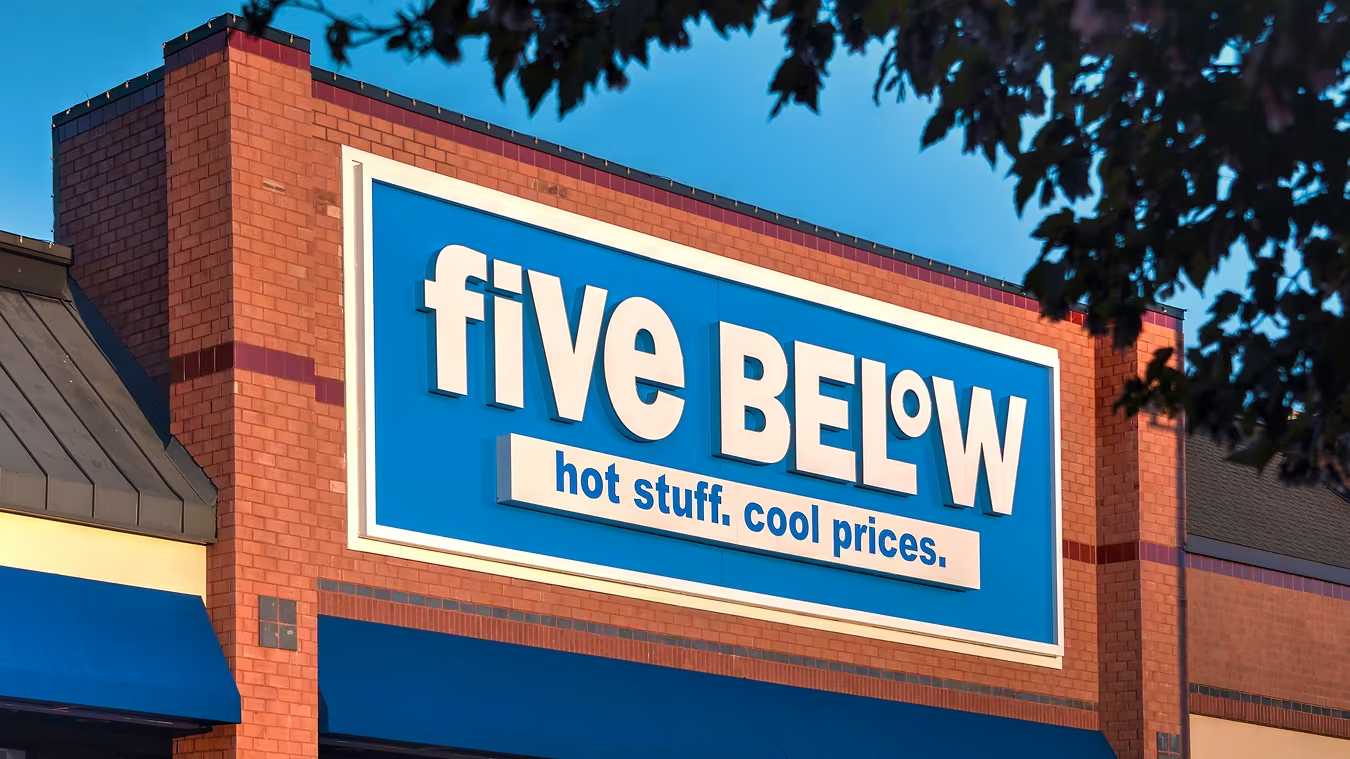
Five Below opened its 2,000th store in July, after an H1 in which a $5 bao-bun squishy turned the value retailer into a cultural destination.
But location analytics suggest the chain's traffic story runs much deeper than one viral dumpling craze – and with summer underway, the company's visit data remains impressively firm.
Every Store Is Pulling More Weight
For much of last year, Five Below's visit growth leaned heavily on new real estate. In Q1 2025, overall visits were up 8.2% year over year while average visits per location declined 4.6% – the chain was adding stores faster than it was adding shoppers.
One year later, however, per-location traffic is catching up fast. In Q1 2026, overall visits jumped 26.2% YoY while average visits per location surged 20.4%, and in Q2 2026 the pattern held, with overall visits up 19.8% and per-location visits up 15.9%.
To some extent, the shift is due to a deliberate slowing of expansion to focus on site quality and grand-opening execution. And the strategy appears to be working, with new stores opening strong and existing stores drawing steadily bigger crowds. The company's last reported results told a similar story from the register's side of the counter: Five Below reported comparable sales growth of 22.7%, with comparable transactions up 19%.
The Dumpling Hype Cooled… But the Crowds Kept Coming
Five Below's Q1 2026 traffic surge was likely due at least in part to consumers craving the Mystery Squishy Dumpling, the blind-box collectible that CNBC crowned the heir to Labubu back in March.
But while interest in the dumplings began to fade heading into summer, the craze hasn’t run out of steam yet: Toymaker RMS recently named an exclusive licensing agent after selling more than 40 million units worldwide. Meanwhile, newer trends such as Pokémon trading card releases are stepping in to keep the registers busy – management noted that trading cards have proved an especially durable traffic driver. And the company also continues to lean into a broader “chase-and-amplify” strategy, using social listening and a deliberately wide assortment across categories like beauty, lounge and licensed exclusives to spot emerging trends early and scale into the next viral moment.
Full Steam Ahead
Viral moments come and go, but Five Below's 2026 traffic data points to something sturdier: 2,000 stores, each one busier than it was a year ago, posting double-digit visit growth every single month of 2026 so far.
For more data-driven retail analyses, visit Placer.ai/anchor.

Back-to-School, Here We Go!
Every summer, many states hold sales tax holidays – in part to give parents a break on the ever-growing list of items they need to purchase at the start of the school year. And with a record $43.3 billion in back-to-school spending up for grabs this year, the stakes for capturing that traffic have never been higher.
We dove into the data to see how the timing of these holidays shapes their impact on retail traffic – and found that the same tax break can drive very different results, depending on how close it falls to the first day of school.
The Tax Holiday Retail Map
Of the twenty states offering summer sales tax holidays in 2026, six scheduled theirs across the full August 7-9 weekend: Texas, Oklahoma, South Carolina, Missouri, Virginia, and Ohio. While the specifics varied by state, all six waived sales tax on apparel, and all but Oklahoma extended the exemption to school supplies as well.
But it was the timing of these holidays relative to the start of school – more than their precise scope – that appeared to determine the size of the retail traffic boost.
In Texas, Oklahoma, and South Carolina, the impact was especially pronounced. Brick-and-mortar retail visits jumped by double digits in all three states compared with the average Friday-to-Sunday period over the prior 12 months, with Oklahoma seeing the strongest increase (13.9%). And tellingly, in each of these states, the largest school district began classes the following week – meaning the tax break landed at the exact moment back-to-school shopping urgency peaked.
Missouri, Virginia, and Ohio, on the other hand, where the school year tends to start later, saw smaller gains. Florida’s month-long tax holiday also produced a more modest weekend lift – even though most districts started school the following week – likely because shoppers had less reason to concentrate purchases into a single three-day stretch.
On average, Texas, Oklahoma, and South Carolina saw visits increase by 12.9%, compared to 9.6% for Missouri, Virginia, and Ohio – while the rest of the country saw a milder seasonal bump of 5.7%.
A Calendar Worth Watching
For retailers, shopping center operators, policymakers and other stakeholders, the lesson is that tax holidays can have the biggest impact when they align closely with major retail milestones. Combining the tax break with peak back-to-school urgency can turn a seasonal shopping bump into a much more powerful traffic driver.
For more data-driven retail insights, visit placer.ai/anchor.
Growth All Around
Costco led the pack in Q2 2026, with overall visits up 8.2% YoY and average visits per location up 6.0%. BJ's Wholesale Club, Sam's Club, and Target each grew overall visits just shy of 5.0%, while Walmart added a more modest 0.7% increase.
All five retailers saw overall visits grow faster than visits per location, pointing to the role of footprint expansion in the sector’s gains. But the size of that gap varied considerably by retailer – revealing important differences in what was driving growth.
Target Turns the Corner While Walmart's Growth Shifts Online
Target’s recovery gathered momentum through the spring, with visits improving each month before jumping 7.3% YoY in July – the retailer’s strongest performance of the year. The improvement builds on Target’s positive comparable-sales result last quarter, when comparable sales rose 5.6% on 4.4% traffic growth. And July’s spike is especially notable given that Target’s Circle deal event, held in July 2025, shifted to June this year alongside Prime Day. Fresh summer designer collaborations and a strong back-to-school push appear to have resonated strongly with shoppers.
Walmart, meanwhile, saw near-flat spring visit trends despite comparable sales growth of 4.1% last fiscal quarter – reflecting the growing contribution of digital channels to the retailer’s growth. June was Walmart’s weakest visit month of the analyzed period, even as Walmart Deals also shifted to June – suggesting that much of the promotional lift also occurred online. Still, July visits rebounded 2.4% YoY, coinciding with Walmart’s back-to-school campaign, which touted its lowest prices since 2019.
The Club Channel Keeps Compounding
Wholesale clubs outpaced superstores in every month from April through July, reflecting continued consumer demand for bulk value amid persistent macro-economic pressures. Costco's visits grew 7.6% to 9.0% every month – its clubs getting busier even as new ones opened – aligning with U.S. comps that accelerated to 10.3% in July. Sam's Club held steady at 4.5% to 5.2%, with same-store traffic driving most of the gains.
BJ's was choppier, with YoY visits swinging from 7.1% growth in May to 3.2% in June and the widest quarterly gap in the sector between overall and same-store visits. Its softer same-store performance may partly reflect the chain’s Northeast-heavy footprint, as the region has lagged this summer amid unfavorable weather and higher urban inflation than in other parts of the country.
And across all three wholesale clubs, gas remained an important visit driver. Although YoY gas station visit growth moderated from May peaks – when gas prices also reached a high point – July visits remained elevated across the board.
Different Paths to Growth
With deal weeks shifting to June, July’s broad strength points to genuine momentum across value retail – even as each chain is finding growth in a different way. The next test will be whether that strength holds as the sector heads into the crucial holiday season.
For more data-driven retail insights visit Placer.ai/anchor.

