


.svg)





.avif)
It’s mid-January, and you promised yourself this would be the year you finally join a gym and get in shape.
But let’s be honest – choosing a gym is about more than fitness goals alone. You’ll still need to judge the equipment, locker rooms, and showers for yourself (we’re not here to do your dirty work) but there are other, less obvious factors that can determine which gym feels like the right fit – and that’s where we come in.
Trying to dodge the morning rush? Hoping to make new friends? Curious where other singles work out? Letting AI-powered location analytics do some of the heavy lifting, we analyzed major fitness chains to uncover the patterns that could help you find your ideal gym in 2026.
Get Gains, Skip the Crowds
Few things derail motivation faster than showing up ready to work out – only to find every treadmill and weight machine taken. To understand which gyms are most likely to offer breathing room during the busiest parts of the day, we analyzed hourly visit patterns across the nation’s largest fitness chains.
The analysis shows clear differences in how morning traffic is distributed. For early risers, LA Fitness recorded the lowest share of daily visits between 5:00 AM and 8:00 AM in 2025, at just 8.9%. 24 Hour Fitness and EōS Fitness also kept morning traffic below the 10% mark, suggesting these chains may be better options for members looking to avoid crowded early workouts.
If after-work workouts are more your style – and minimizing crowds is the priority – the data points to a few clear standouts.
Among the analyzed gyms, Club Pilates recorded the smallest share of visits between 5:00 PM and 8:00 PM at 16.5%, followed by Orangetheory (17.3%) and Burn Boot Camp (18.7%). That lighter early-evening traffic likely reflects the structured nature of class-based formats, which can help limit overcrowding even during peak hours.
Looking specifically at traditional gyms, EōS Fitness, Life Time, and Vasa Fitness saw the lowest share of early-evening visits – making them potential options for those hoping to squeeze in a workout while avoiding the after-work rush.
Are you…ehm…single?
If getting in shape and finding love are both on the agenda this year, there may be a way to double up. Using AI-powered captured market data, we analyzed major gym chains to understand where members are most likely to be single – which may mean a higher chance of meeting someone special.
The analysis shows that Genesis Health Clubs had the highest combined share of one-person households and non-family households – i.e. people living alone or with roommates – in its captured market, at 36.6%. Crunch Fitness followed closely at 35.8%, with Planet Fitness just behind at 35.2%. These household segmentation patterns suggest that these gyms may offer more opportunities to meet other singles while getting in a workout.
Which Gyms Attract Younger vs. Older Members?
If you’re looking for love, or simply to make new friends, age demographics may be something to consider when choosing a gym.
Our analysis of major fitness chains shows that the potential markets of Fitness Connection, Vasa Fitness, and In-Shape Family Fitness – i.e. the areas from which each chain draws its visitors – skewed younger in 2025, with large shares of visitors under 30.
By contrast, gyms such as The Edge Fitness Club, Retro Fitness, and Life Time tended to attract older audiences, with large shares of visitors 45 and older. For members looking to work out alongside peers closer to their own age, these demographic patterns could help narrow the field.
Find a Gym Where Members Share Your Interests
Age is just a number, right? So if you’re looking to make a real connection at the gym this year, you might look for some common areas of interest with other members. Our analysis highlights which gyms are most likely to attract visitors with your shared passions.
For dog lovers hoping to meet a fellow fitness enthusiast who’s just as excited about the dog park as leg day, Burn Boot Camp stands out. The chain over-indexed most strongly for the “Dog Lovers” segment, based on Spatial.ai: Proximity and AI-powered captured market data.
Prefer bonding over a good book? Genesis Health Clubs led the pack for the “Bookish” segment, suggesting a higher likelihood of members who enjoy reading as much as a solid workout. Coffee aficionados may find their people at 24 Hour Fitness, which showed the strongest over-indexing for the “Coffee Connoisseur” segment.
For those with travel on the brain, Workout Anytime over-indexed for the “Wanderlust” segment – pointing to a member base more likely to dream about their next destination. And if your ideal post-workout plan includes a movie or live show, 24 Hour Fitness and Gold’s Gym emerged as standouts, over-indexing for the “Film Lovers” and “Live & Local Music” segments, respectively.
Ready for a Workout that Fits Your Lifestyle?
Ultimately, choosing the right gym goes beyond equipment, pricing, or proximity. Visit patterns, demographics, and shared interests all shape the experience – influencing when you’ll work out, who you’ll see, and how the gym fits into your broader lifestyle. While no dataset can guarantee a perfect match, these patterns offer a data-backed starting point for finding a gym that aligns with how you want to train, socialize, and show up in 2026.
Want more data-driven insights for the real world? Visit Placer.ai/anchor.
Placer.ai leverages a panel of tens of millions of devices and utilizes machine learning to make estimations for visits to locations across the US. The data is trusted by thousands of industry leaders who leverage Placer.ai for insights into foot traffic, demographic breakdowns, retail sale predictions, migration trends, site selection, and more.
*This article excludes data from Washington State due to local regulations
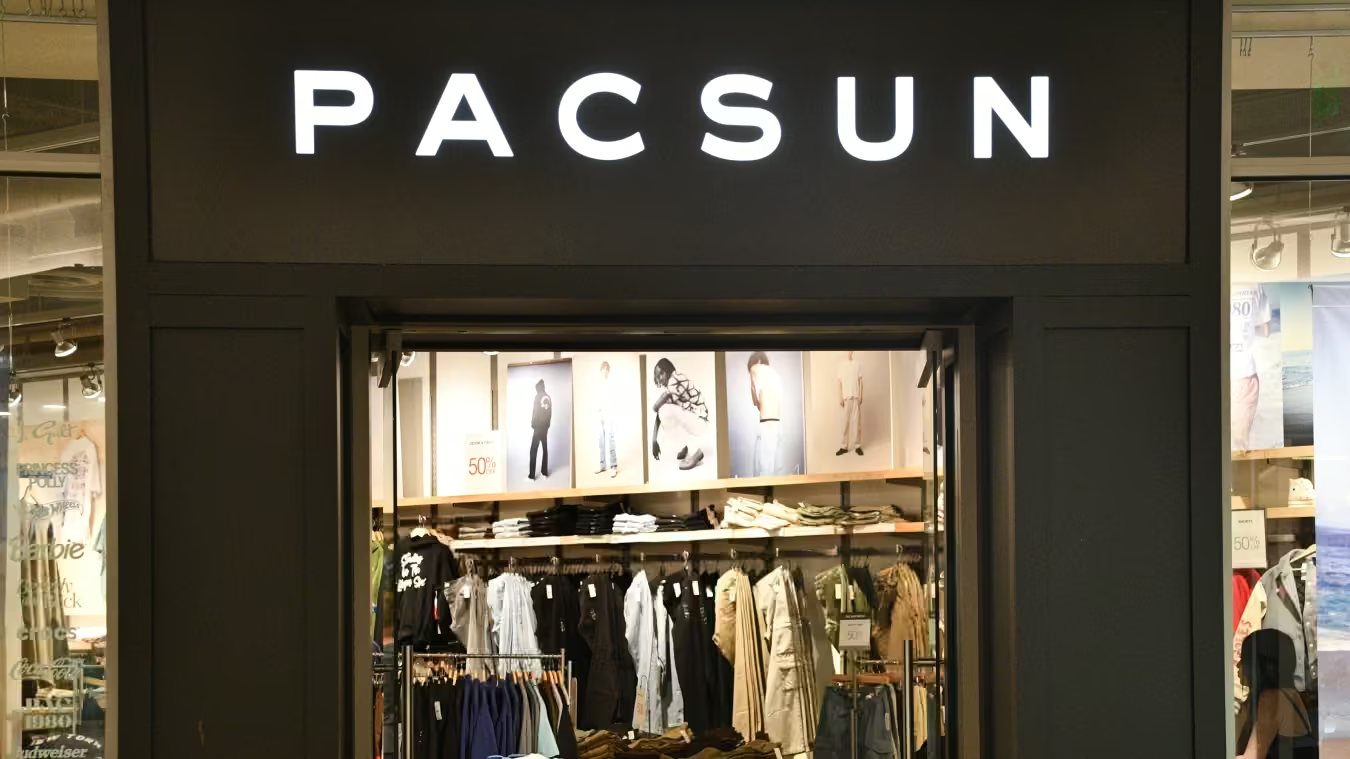
Pacsun has seen its fair share of challenges in its more than forty years of business. Now, the brand is entering a new phase of growth, with a major brick-and-mortar expansion alongside concrete steps to engage Gen Z consumers. We dove into the data for several Pacsun locations outperforming their host malls to understand what a growing footprint could mean for shopping centers and how the brand is connecting with young consumers online and off.
Pacsun Can Help Drive Traffic to Malls
Pacsun has faced its share of challenges over the years. More recently, however, the legacy brand and mall staple appears to be in the midst of a renaissance – with plans to further expand its domestic brick-and-mortar footprint in 2026.
Foot traffic data for several Pacsun locations that experienced notable foot traffic growth in 2025 suggests that the brand’s stores have the potential to help drive traffic to the shopping centers that host them. At The Promenade Shops at Centerra in Colorado, visits to Pacsun rose 35.7% YoY in 2025, significantly outpacing the -5.5% visit gap of the mall as a whole.
Pacsun’s Eye on Gen Z: Online and In-Store
Psychographic segmentation suggests that beyond driving visits, these locations also help attract key young demographics to the mall.
At Winter Garden Village, for example, the Gen Z-aligned "Young Professionals" segment accounted for 19.4% of the Pacsun store’s captured market, compared to the mall’s 16.2% share of the segment.
These locations may be an example of how Pacsun’s physical retail presence works together with its social-sales strategy to engage with a younger generation; driving traffic, in part, by serving as spaces to experience products seen on trusted social channels or at creator-led events.
And Pacsun appears firmly committed to its younger audience as part of its wider strategy. Although the brand looks to move upmarket, the latest example of which being the launch of a premium eyewear collection, by maintaining what it views as an accessible price point, Pacsun remains focused on consumers yet to reach their peak earning years.
Pacsun’s ability to drive traffic from this key demographic makes it an attractive potential tenant for malls looking to build long-term loyalty among younger audiences with earning potential.
Will Pacsun Stay Hot?
The Pacsun model demonstrates that physical retail remains a critical touchpoint for brands investing in digital engagement and younger audiences. With plans to open dozens of new locations over the next few years, Pacsun emerges as a compelling tenant for shopping centers seeking cultural relevance and the next generation of consumers.
For more retail insights, visit Placer.ai/anchor.
Placer.ai leverages a panel of tens of millions of devices and utilizes machine learning to make estimations for visits to locations across the US. The data is trusted by thousands of industry leaders who leverage Placer.ai for insights into foot traffic, demographic breakdowns, retail sale predictions, migration trends, site selection, and more.

The grocery category saw notable shifts in consumer behavior in 2025 as inflation and tariff uncertainty continued to weigh on household budgets. Analyzing consumer traffic trends for several grocery formats – including wholesale clubs, which serve as primary grocery destinations for many families – reveals how evolving consumer preferences shaped grocery performance in 2025 and highlights key lessons for grocers and CPG companies heading into 2026.
Fresh Format and Value-Forward Grocers Lead in YoY Growth in 2025
Like many retail categories in 2025, grocery was shaped by continued economic uncertainty and value-seeking behavior. But AI-powered location analytics shows that consumers also prioritized quality when forming a value perception in the grocery space.
The graph below shows that grocery visits increased across formats, likely reflecting consumers’ shift toward more meals at home as a way to save money in a persistently inflationary environment.
Fresh format grocers posted the strongest year-over-year (YoY) visit growth, perhaps due to their selection of prepared foods and salad bars as an alternative to eating out, as well as their emphasis on health and wellness – an emerging priority among grocery shoppers. Meanwhile, value grocers and wholesale clubs, known for their ability to deliver savings, consistently outperformed traditional grocers in YoY visit growth.
These patterns indicate that consumers are increasingly weighing up quality and price in the grocery aisle, a trend that is driving the expansion of private-label offerings.
Increased Demand For Grocery Store Lunches
As consumers substituted restaurant meals with more cost-conscious options, grocery stores also emerged as increasingly important destinations for quick, convenient lunches.
Analyzing relative visit share between the grocery category and quick-service restaurants (QSRs) shows that between 2024 and 2025, grocery stores claimed an increasingly large share of short midday visits – i.e. visits lasting less than ten minutes between 11:00 AM and 3:00 PM.
And while some of QSR’s relative decline in short lunchtime visits could be due to discontent with rising fast-food prices among highly value-conscious consumers, it also suggests that a growing share of consumers see grocery stores – where they can pick up ready-to-eat items – as convenient options during the lunch rush. Traditional grocers saw the largest increase in short midday visits (from 15.9% to 16.6%) while value and fresh format grocers saw more modest increases. Notably, the share of short midday visits to wholesale clubs was unchanged between 2024 and 2025 (2.1%), perhaps since these chains don’t offer the same pre-prepared and small-package options like other grocery formats.
These metrics underscore the strong demand for on-the-go meal options and single-serving, shelf-stable products that both grocery stores and CPG companies can provide.
Turkey Wednesday and Christmas Eve Were Busiest Grocery Days of 2025
Beyond the lunchtime rush, celebration-driven demand continued to play a central role in grocery traffic this year. Like in past years, Turkey Wednesday – the day before Thanksgiving – was by far the busiest grocery shopping day of the year, with category visits up 80.5% compared to the 2025 daily average. Several of the year’s other busiest grocery days similarly fell immediately ahead of major holidays, including New Year’s Eve, Easter, Mother’s Day, and the 4th of July, as consumers stocked up ahead of gatherings with family and friends.
Leading up to Christmas, grocery shopping appeared to be spread across several high-traffic days rather than concentrated on a single peak; Christmas Eve and December 23rd had nearly identical foot traffic boosts of 57.9% and 58.0%, respectively. And even December 22nd – three days before Christmas – stood out as one of the year’s busiest grocery shopping days, with visits running 28.9% above average for 2025.
Some consumers may have made multiple “re-stocking” grocery trips in the days leading up to Christmas – potentially driven by the presence of out-of-town guests requiring ongoing food replenishment – or visited multiple stores to secure specific ingredients for holiday meals.
Grocers could leverage this trend by stocking a wide range of holiday-specific ingredients and rotating promotions that encourage repeat visits ahead of Thanksgiving and Christmas.
Grocery Formats Preferred By Singles vs. Households With Children
The grocery landscape in 2025 was also shaped by distinct shopping preferences across demographic groups.
AI-powered captured market data combined with the STI: PopStats dataset shows that singles – defined as non-family and one-person households – heavily favored fresh-format grocers, while households with children were most likely to visit wholesale clubs and value grocers.
Grocers and CPGs can unlock growth by tailoring assortments and promotional strategies to their target audience – emphasizing bulk value and price-driven messaging for family shoppers, while leaning into curated selection, prepared foods, and convenience to engage singles.
Several consumer trends shaped the grocery space in 2025 – including holiday visit surges, the prioritization of value, and convenient on-the-go meals.
How will these trends shape the grocery space in 2026? Visit Placer.ai/anchor to find out.
Placer.ai leverages a panel of tens of millions of devices and utilizes machine learning to make estimations for visits to locations across the US. The data is trusted by thousands of industry leaders who leverage Placer.ai for insights into foot traffic, demographic breakdowns, retail sale predictions, migration trends, site selection, and more.
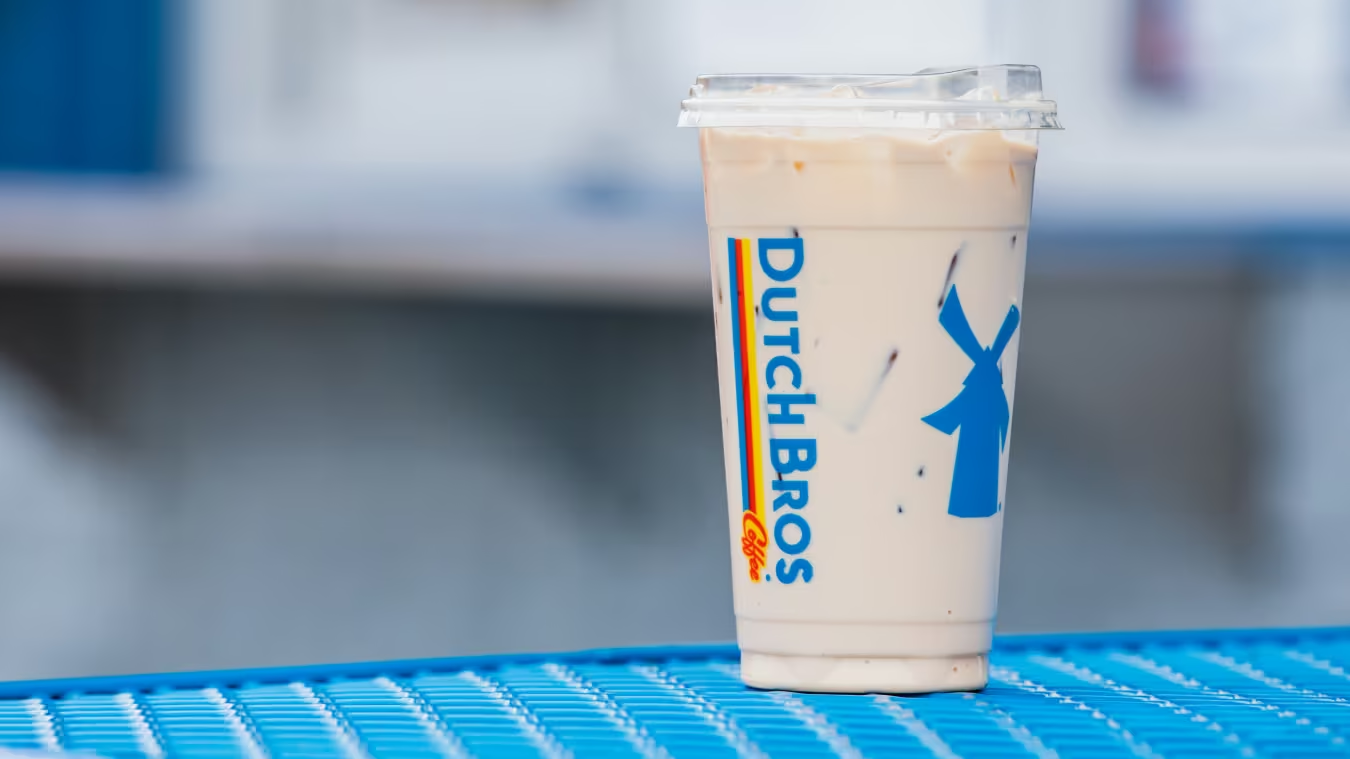
Dutch Bros has long been a powerhouse in the beverage space, building its business with rapid expansion and securing a loyal following. But to maintain its growth momentum, Dutch Bros will likely need to look beyond its beverage-first identity. By strategically expanding its breakfast offerings, the brand can attract a new segment of morning diners while driving incremental spend from its existing loyal customer base.
Balancing Rapid Growth with Store Maturity
Dutch Bros is still on an aggressive growth trajectory, with plans to continue opening new locations at a brisk pace. The company passed the 1,000-unit mark this year and aims to reach over 2,000 locations nationwide by 2029. However, recent data suggests that while the brand's overall footprint is expanding, its established locations are facing the typical challenges of a maturing brand.
Throughout much of 2025, total visits to Dutch Bros increased rapidly year-over-year (YoY), driven largely by new store openings. And while same-store visits – which measure the performance of locations open for at least a year – were also generally positive, the growth was somewhat uneven. So although the brand’s expansion is still meeting robust demand, the gap between total growth and same-store performance may indicate that Dutch Bros is reaching a level of saturation in its initial markets.
To sustain growth, the brand is targeting the morning daypart by introducing breakfast offerings, reaching approximately 160 stores by the end of September 2025 and plans to deploy the menu across its store fleet in 2026. This strategy appears to be paying off: November saw same-store visits surge to their highest levels of the year. While this spike was likely supported by holiday menu launches and Black Friday, it also suggests the breakfast initiative is gaining traction and successfully revitalizing performance at established locations.
Closing the Breakfast Gap
Why is Dutch Bros betting on breakfast? Historically, Dutch Bros has seen a lower percentage of its daily traffic occur during the morning daypart than its competitors. And when comparing the chain’s hourly visit distribution to the wider coffee category, it becomes clear why the shift toward a more robust breakfast offering is a logical move for Dutch Bros. While the coffee category as a whole sees 43.1% of its total daily visits between 5:00 and 11:00 AM, Dutch Bros captures only 32.6% during that same window, according to the chart below.
To bridge this gap, Dutch Bros is evolving its menu to include more substantial food options. Food currently accounts for only about 2% of Dutch Bros’ total sales, a figure it hopes to increase significantly with the help of hot breakfast items. As Dutch Bros continues to roll out the expanded food lineup to more locations in 2026, the brand is positioning itself to compete directly for the morning commuter who currently heads to a competitor for a meal-and-drink combo.
And to further bolster its morning performance, Dutch Bros could lean into "functional fuel" trends that complement its popular protein coffee and are likely to appeal in particular to younger consumers who prioritize health-conscious menu options.
More Fuel for the Future
Dutch Bros is at a pivotal point in its evolution. While new store openings continue to drive visits, the brand is now focusing on deepening its relationship with customers through the breakfast daypart. If the recent uptick in same-store visits is any indication, the shift from a "beverage-first" destination to a well-rounded morning stop could be exactly what the company needs to sustain its long-term momentum.
For more dining insights, visit Placer.ai/anchor.
Placer.ai leverages a panel of tens of millions of devices and utilizes machine learning to make estimations for visits to locations across the US. The data is trusted by thousands of industry leaders who leverage Placer.ai for insights into foot traffic, demographic breakdowns, retail sale predictions, migration trends, site selection, and more.

Retail corridors have long been central to the holiday experience, offering festive spaces for shopping and intricate window displays to admire. But retail corridors can vary significantly – some cluster large global flagship stores, while others lean into smaller regional formats and boutique-style shops, creating a more lifestyle-oriented setting for spending time with friends and family.
We dove into the data for these two types of retail corridors to explore the foot traffic trends defining each space this holiday season.
End-of-Year Traffic Boost Particularly Strong For Flagship-Led Corridors
Flagship-led corridors such as SoHo in New York City and Union Square in San Francisco typically see their visitation peak in December, when consumers come to browse elegant window displays, holiday lights, and seasonal attractions – often turning a shopping trip into a full outing with friends or family. Union Square’s towering Macy’s Christmas tree, outdoor ice rink, and “Winter Walk” draw crowds looking for a quintessential holiday atmosphere. And SoHo, home to numerous high-end flagship stores, remains one of Manhattan’s most sought-after luxury shopping districts during the holidays.
Both corridors have seen rising visits throughout 2025, suggesting that their December 2025 lifts could exceed last year’s levels.
Lifestyle-Driven Retail Corridors See Strong Lift in Spring & Summer
However, retail corridors that center on boutiques, independent retailers, and lifestyle-oriented offerings rather than global luxury flagships – like Back Bay in Boston and South Congress Avenue in Austin – follow a different seasonal rhythm. Rather than peaking at year-end, visits to these districts spike earlier in the calendar.
Back Bay perhaps benefits from “Open Newbury,” the summer program that closes Newbury Street to vehicular traffic and turns the corridor into a pedestrian promenade, while South Congress sees heightened activity in the spring, before the Texas heat arrives. Both have also seen solid visit growth in 2025, indicating the potential for a healthy December – even if holiday foot traffic plays a smaller role in their overall annual performance compared to flagship-led districts.
Positioning Retail Corridors for a Strong 2026
As both flagship-led and lifestyle-driven corridors head into December with solid year-to-date momentum, high street retailers have a clear opportunity to capitalize on distinct seasonal strengths. Flagship districts should be prepared for an especially pronounced holiday surge, while lifestyle-oriented corridors can focus on converting growing spring and summer foot traffic bumps into sustained engagement year-round.
For more foot traffic insights, visit Placer.ai/anchor.
Placer.ai leverages a panel of tens of millions of devices and utilizes machine learning to make estimations for visits to locations across the US. The data is trusted by thousands of industry leaders who leverage Placer.ai for insights into foot traffic, demographic breakdowns, retail sale predictions, migration trends, site selection, and more.

As the retail calendar approaches its most pivotal stretch, we took a closer look at foot traffic trends across superstores and warehouse clubs to see how these key players are performing.
Superstores and Warehouse Clubs Ramp Up Towards the Holidays
Warehouse clubs – Costco, Sam’s Club, and BJ’s Wholesale – continued to post visit gains in recent months, extending the momentum that has defined the segment for much of the past year. Their consistent performance reinforces the appeal of the wholesale model among value-driven shoppers navigating inflationary pressures and tighter budgets.
However, within the broader mass merchandise sector, October marked a clear turning point. Walmart saw its strongest year-over-year (YoY) visit gains of the last six months, while Target’s traffic shifted from negative to positive growth for the first time during the same period. The October surge coincided with the superstores' early early holiday sales events, signaling that the early holiday season has evolved into a pivotal retail moment.
Costco’s Opening Hours Shift Continues to Shape Consumer Behavior
Costco led foot traffic growth among mass merchants in September and October 2025. And some of that momentum may stem from the chain’s new early opening hours for Executive Members, which appears to have eased peak-hour congestion and enhanced the overall shopping experience.
As a reminder, Costco Executive Members pay almost twice as much as standard Gold Star members and account for over 74% of the chain’s sales, so it makes sense that Costco would look to add value and additional perks to its premium memberships.
But since extending its hours to open an hour early for Executive Members, Costco has likely enhanced the overall shopping experience for all visitors.
The graph below shows that between July and October 2025, after the introduction of early openings, the extended morning hours reduced Costco’s traffic at peak times compared to 2024, spreading visits more evenly throughout the day – which means less crowding for everyone.
Earlier openings also affect how Costco shoppers shop. Since the new hours took effect, the share of Costco visits lasting 30 to 45 minutes has increased, while the share of 45- to 60-minute visits has declined. This shift suggests that with lighter crowds and easier navigation, Costco shoppers are more purposeful and efficient.
Meanwhile, the share of Costco visits lasting less than 30 minutes also fell during the July to October period, suggesting that in a more streamlined environment, some shoppers feel comfortable taking extra time to browse – and perhaps add a few more items to their baskets – rather than rushing through a crowded store.
Well-Positioned Before the Holiday Rush
As the main holiday season approaches and consumer sentiment reaches new lows, value-forward warehouse clubs appear to remain in a strong position. Meanwhile, superstores’ success with early sales events demonstrates that shoppers remain highly responsive to promotions, an encouraging sign heading into the peak shopping period.
By offering early access to Executive Members, Costco is both recognizing its most valuable shoppers and alleviating crowding for everyone during typical rush periods – a move that could give the retailer an edge during the busy holiday season.
How will these retailers close out the holiday season? Visit Placer.ai/anchor to find out.
Placer.ai leverages a panel of tens of millions of devices and utilizes machine learning to make estimations for visits to locations across the US. The data is trusted by thousands of industry leaders who leverage Placer.ai for insights into foot traffic, demographic breakdowns, retail sale predictions, migration trends, site selection, and more.

Digging Into Dining
The dining industry showcased its agility over the past couple of years as it rapidly adapted to shifts in consumer preference brought on by COVID and rising prices. And with a new year around the corner, the pace of change shows no signs of slowing down.
This white paper harnesses location analytics, including visitation patterns, demographic data, and psychographic insights, to explore the trends that will shape the dining space in 2024. Which dining segments are likely to pull ahead of the pack? How are chains responding to changes in visitor behavior? And where are brands driving dining foot traffic by taking advantage of a new advertising possibility? Read on to find out how dining leaders can tap into emerging trends to stay ahead of the competition in 2024.
Stepping Up To The Plate
Comparing quarterly visits in 2023 and 2022 highlights the impact of the ongoing economic headwinds on the dining industry. The year started off strong, with year-over-year (YoY) dining visits up overall in Q1 2023 – perhaps aided by the comparison to an Omicron-impacted muted Q1 2022. And while overall dining growth stalled in Q2 2023, several segments – including QSR, Fast Casual, and Coffee – continued posting YoY visit increases, likely bolstered by consumers trading down from pricier full-service concepts.
Foot traffic slowed significantly in Q3 2023 as inflation and tighter consumer budgets constrained discretionary spending. Overall dining visits fell 2.4% YoY, and full-service restaurants – with their relatively high price point compared to other dining segments – seemed to be particularly impacted by the wider economic outlook. But the data also revealed some bright spots: Fast Casual still succeeded in maintaining positive YoY visit numbers and Coffee saw its Q3 visit grow an impressive 5.4% YoY. As the return to office continues, a pre-work coffee run or lunchtime foray to a fast-casual chain may continue propelling the two segments forward.
Shifting Demographics and Shifting Dining Behavior
Restaurant visitation patterns have evolved over the past few years. Although an 8 PM seating was once the most coveted slot at fine-dining restaurants, recent visitation data suggests that sitting down to dinner earlier is rising in popularity.
But among the QSR segment, the opposite trend is emerging, with late-night visits rising. Analyzing hourly foot traffic to several major QSR chains reveals that the share of visits between 9 PM and 12 AM increased significantly between Q3 2019 and Q3 2023. Even Taco Bell – already known for its popularity among the late-night crowd – saw a substantial increase in late-night visits YoY – from 15.4% to 20.3%.
Younger Customers Staying Out Later
Who is driving the late night visit surge? One reason restaurants have been expanding their opening hours is to capture more Gen-Z diners, who tend to seek out nighttime dining options. But location intelligence reveals that younger millennials are also taking advantage of the later QSR closing times.
An analysis of the captured market for trade areas of top locations within one of Taco Bell’s major markets – the Chicago-Naperville-Elgin, IL-IN-WI Metropolitan area – reveals a year-over-four-year (Yo4Y) increase in “Singles & Starters.” The “Singles & Starters” segment is defined by Experian: Mosaic as young singles and starter families living in cities who are typically between 25 and 30 years old. As consumers continue to prioritize experiential entertainment and going out with friends, late-night dining may continue to see increased interest from young city-dwellers.
Smoothies Drive Weekend Visits
Millennials and Gen-Z consumers aren’t only heading to their favorite fast food joint for a late-night bite – these audience segments are also helping drive visits on the weekends. Smoothie King is one chain feeling the benefits of young, health-conscious consumers.
The chain, which opened in New Orleans, LA, in 1973 as a health food store, has since grown to over 1,100 locations nationwide and is currently expanding, focusing on the Dallas-Fort Worth CBSA. The area’s Smoothie King venues have seen strong visitation patterns, particularly on the weekends – weekend visits were up 3.4% YoY in Q3 2023. The smoothie brand’s trade areas in the greater Dallas region is also seeing a YoY increase in weekend visits from “Young Professionals” – defined by the Spatial.ai PersonaLive dataset as “well-educated young professionals starting their careers in white-collar or technical jobs.”
Sports and Dining - Match Made in Heaven
While some dining chains are appealing to the late-night or weekend crowd, others are driving visits by appealing to sports lovers. How have recent rule changes around student athletes changed the restaurant game, and how can college football teams drive business in their hometowns?
Scoring Big: Leveraging Fan Insights to Fuel Successful Partnerships
College sports have long been a major moneymaker, with top-tier teams raking in billions of dollars annually. And as of 2021, college athletes can enjoy a piece of the significant fan following of college sports thanks to the change in the NCAA’s Name, Image, and Likeness (NIL) rules, which now allows student athletes to sign endorsement deals.
Since then, multiple restaurants have jumped on the opportunity to partner with student athletes, some of whom have millions of followers on Instagram and TikTok. Chains like Chipotle, Sweetgreen, Slim Chickens, and Hooters have all signed college athletes to various brand deals.
How can brands ensure they partner with athletes their customers will want to engage with? Analyzing a chain’s audience by looking at the interests of residents in a given chain’s trade area can reveal which type of athlete will be the most attractive to each brand’s customer base. For example, data from Spatial.ai: Followgraph provides insight into the social media activity of consumers in a given trade area and can highlight desirable partnerships.
Examining the trade areas of Chipotle, Sweetgreen, Slim Chickens, and Hooters, for instance, reveals that Sweetgreen’s visitors tended to have the largest share of Women’s Soccer followers. Conversely, Sweetgreen’s trade area had lower-than-average shares of College Football Fans or College Basketball Fans, while residents of the trade areas of the other three chains showed greater-than-average interest in these sports. Leveraging location intelligence can help companies choose brand deals that their customers resonate with and find the ideal athletes to represent the chain.
College Gameday - Wins for Dining
Finding the right college athlete partnership is one way for dining brands to appeal to college sports enthusiasts. But dining chains and venues located near major college stadiums also benefit from the popularity of their local team by enjoying a major game day visit boost.
One of the country’s most popular college football teams, the Ohio State Buckeyes, can draw millions of TV viewers, and its stadium has a capacity of 102,780 – one of the largest stadiums in the country. And while tailgating is a popular activity for Buckeyes fans, nearby restaurants are some of the biggest beneficiaries of the college football craze. Panera experienced a 235.3% increase on game days as compared to a typical day, Domino’s Pizza visits grew by 283.3%, and Tommy’s Pizza, a local pie shop, saw its visits jump by a whopping 600.9%.
Game Day Visitor Spikes
This influx in diners also causes a major shift in game day visitor demographics, as revealed by changes in visitors at dining venues located near stadiums of two of the nation’s best college football teams – the Ohio State Buckeyes and Ole Miss Rebels. Based on Spatial.ai: Personalive data for the captured market of these dining venues, game day visitors tended to come from “Ultra Wealthy Families” when compared to visitors during a typical non-game day in September or October.
The analysis indicates that popular sporting events create a unique opportunity for restaurants near college stadiums to attract high-income customers game day after game day, year after year.
Subwars: Room for Everyone
While some spend game day tailgating or visiting a college restaurant, others hold a viewing party – with a six-foot submarine. And the sub’s popularity extends beyond Superbowl Sundays. Sandwich chains including Jersey Mike’s, Firehouse Subs, Jimmy John’s, and Subway (recently purchased by the same company that owns Jimmy John’s) have seen sustained YoY increases in visits and visits per venue in the first three quarters of 2023.
Some of the growth to these chains may be related to their affordability, a draw at all times but especially during a period marked by consumer uncertainty and rising food costs. And subway leaders seem to be seizing the moment and striking while the iron is hot – Jersey Mike’s opened 350 stores in 2023 and still saw its YoY visits per venue grow by 6.6%. And Subway reported ten consecutive quarters of positive sales, a promising sign for its new owner.
Sandwich Chains Attract a Wide Consumer Base
The love for a healthy, affordable sandwich extends across all income levels, with all four chains seeing a range in their visitors' median household income (HHI). Out of the four chains analyzed, Jersey Mike’s – which has long prioritized a suburban, middle-income customer – had the highest trade area median household income of the four chains at $77.3K/year. Subway, known for its affordability, had the lowest, with $62.9K/year. The variance in median HHI combined with the strong foot traffic growth shows that when it comes to sandwiches, there’s something for everyone.
So What’s The Dining Space Cooking Up?
Persistent inflation and declining consumer sentiment may pose serious challenges for the dining space, but emerging trends are helping boost some restaurants. Customers seeking out a late-night bite drive visits to QSR chains, and health-conscious diners are boosting foot traffic to smoothie bars and sandwich shops. Meanwhile, sports sponsorships and game-day restaurant visits can provide a boost to dining businesses that take advantage of these opportunities.

