.png)
.png)

.png)
.png)

Mercado Gonzalez: This Mexican Food Hall is a Magnet
Mercado Gonzalez opened less than six months ago, and boy, is it making a splash! This marketplace/food hall located in Costa Mesa, CA hosts 20 food stalls where one can stroll through, buy colorful produce, and imagine that one is at the Mercado de Coyoacan in Mexico City, one of various mercados from which this location takes inspiration. Already, we see from the Placer data below that since opening in mid-November (just in time for the holidays!), Mercado Gonzalez is proving to be one of the most-visited locations in the Northgate Gonzalez portfolio.
The weekend spikes really stand out as patrons from all over Southern California come to partake of pan dulces, aguas frescas, and oh-so-delectable hot and fresh churros at Churreria El Moro.

We wrote about food fusion last week, and indeed, in addition to traditional Mexican specialties like tortas ahogadas at Chiva Torta, one can also find Mexican-style sushi at Sushi El Sinaloense. From street food to gourmet at Maizano and Entre Nos, one has options that run the gamut from hot tortillas to cochinita pibil with fresh masa.
This food hall extravaganza bills itself as the “ultimate destination for Mexican food and culture” and it appears that customers who travel from a trade area of over 150 miles are in total agreement.
Compared to another top–trafficked Northgate Gonzalez market in Los Angeles, which draws from a much more local crowd of 11 sq miles (keep in mind, there are numerous Northgate Gonzalez markets across the Southern California landscape), this novel food hall concept attracts a much more diverse audience, across multiple dimensions like geography, ethnicity, and household income.

While the traditional grocery store attracts heavily from the segment of Lower Hispanic Families at the Los Angeles and San Diego locations, and also from Near-Urban Diverse Families and Young Urban Singles in San Diego, the segment data from Spatial.ai: PersonaLive reveals that Mercado Gonzalez also brings in Young Professionals, Educated Urbanites, Wealthy Suburban Families, and Ultra Wealthy Families.

In addition, the average HHI of those visiting Mercado Gonzalez is roughly twice that of the other Northgate Gonzalez grocery stores.

The food hall also attracts a broader swath of ethnicities.

Much like Eataly before it, Jose Andres’ Spanish Mercado Little Spain, or Asian food halls that we wrote about recently in our Lunar New Year articles, there is enthusiastic appetite for an immersive encounter reminiscent of being in another country and having access to authentic flavors and eating experiences.

Despite the inflationary headwinds that marked 2023, year-over-year (YoY) foot traffic to Indoor Malls and Open-Air Shopping Centers exceeded 2022 levels every quarter of 2023, with the two shopping center formats competing head-to-head for the top spot: Open-Air Shopping Centers outperformed Indoor Malls during the first three quarters of the year, but Indoor Malls came out ahead during the critical holiday-focused Q4. Ultimately, overall yearly visit numbers slightly favored Open-Air Shopping Centers, which finished 2023 with a 3.0% overall YoY increase in visits compared to 2.9% overall growth for Indoor Malls.
Meanwhile, Outlet Malls struggled to keep up with the other two formats. This segment saw a 1.6% YoY decline in yearly visits in 2023, perhaps due consumers looking to save on gas expenses and avoid the typically longer driving time required to get to these types of shopping centers.
.png)
Visits to all three mall formats dipped YoY in January 2024, likely due to the extreme cold temperatures that swept through much of the country and to the challenging comparisons to a strong January 2023.
But YoY foot traffic to Indoor Malls and Open-Air Shopping Centers swung positive in the second months of the year. Visits to Indoor Malls grew an impressive 6.0% relative to the same month in 2023, and foot traffic to Open-Air Shopping Centers increased 3.9% in the same period. The YoY visit gap to Outlet Malls also narrowed significantly, with foot traffic to the format just 1.6% lower than it was in February 2023, indicating that – despite predictions – 2024 consumers are still willing to spend on discretionary categories.
.png)
While visits to the mall space appear to be generally growing on a YoY basis, comparing the foot traffic performance to pre-COVID visits levels reveals a more nuanced picture. Of the three shopping centers formats, Open-Air Shopping Centers drew closest to pre-COVID levels, with 2023 visits just 1.5% lower than they were in 2019. The visit gap to Indoor Malls was slightly larger, with the format attracting 4.6% fewer visits in 2023 than in 2019. And Outlet Malls appear to be having the toughest recovery, with 2023 visits to the format 9.7% lower than in 2019.
But just because visits to the shopping center space are still catching up to 2019 levels does not mean that all is lost – a deeper dive into location intelligence data indicates that post-pandemic shopping habits are still in flux.
.png)
Analyzing shifts in shopping behavior in recent years reveals that many shoppers are still returning to pre-COVID behaviors. For example, comparing the share of shopping center visits between the hours of 12 PM and 4 PM in 2019, 2022, and 2023 indicates that the “new normal” of mid-day shopping sprees is on its way out.
The share of hourly visits between 12 PM and 4 PM jumped over the pandemic thanks to consumers’ newly flexible schedules, and mid-day foot traffic to shopping centers was still higher in 2022 compared to pre-COVID. But the relative share of mid-day visits dropped from 2022 to 2023 and moved closer to 2019 levels – indicating that shopping patterns have not yet reached a post-COVID equilibrium.
Critically, there appears to be a correlation between the return to 2019 shopping patterns and the visit recovery rate. Visits to Open-Air Shopping Centers in 2023 were almost on par with 2019 levels, and the format’s mid-day visit share was only half a percentage point higher in 2023 than in 2019. The mid-day visit share at Indoor Malls, where the year-over-four-year (Yo4Y) visit lag was slightly larger than for Open-Air Shopping Centers, was still 1.9 percentage points higher in 2023 when compared to 2019. And Outlet Malls had the largest Yo4Y visit gap along with the largest Yo4Y difference in mid-day visit share.
This data indicates that post-pandemic shopping patterns are still dynamic – and even retail sectors that appear to have permanent COVID scars may well bounce back as consumer behavior continues to normalize.
.png)
Despite predictions of slower consumer spending, foot traffic data indicates that demand for malls and shopping centers remains stable. Location intelligence showing strong monthly visit numbers and positive shifts in shopping behavior indicates that the shopping center space is off to a strong start in 2024.
For more data-driven retail insights, visit our blog at placer.ai.
This blog includes data from Placer.ai Data Version 2.0, which implements improvements to our extrapolation capabilities, adds short visit monitoring, and enhances visit detection.

The Placer.ai Nationwide Office Building Index: The office building index analyzes foot traffic data from some 1,000 office buildings across the country. It only includes commercial office buildings, and commercial office buildings with retail offerings on the first floor (like an office building that might include a national coffee chain on the ground floor). It does NOT include mixed-use buildings that are both residential and commercial.
Just when we thought the return-to-office (RTO) debate was finally settled, things are heating up once again. Leading financial institutions like Goldman Sachs are requiring employees to come into the office five days a week (gasp!). And though research shows that remote-capable employees now live twice as far from the office as they did before COVID, some are now being asked to move back closer to the office and show up in person more often.
But what impact are these renewed skirmishes having on the ground? Has the office recovery needle begun to move once again? Or is all the talk merely that – talk?
We dove into the data to find out.
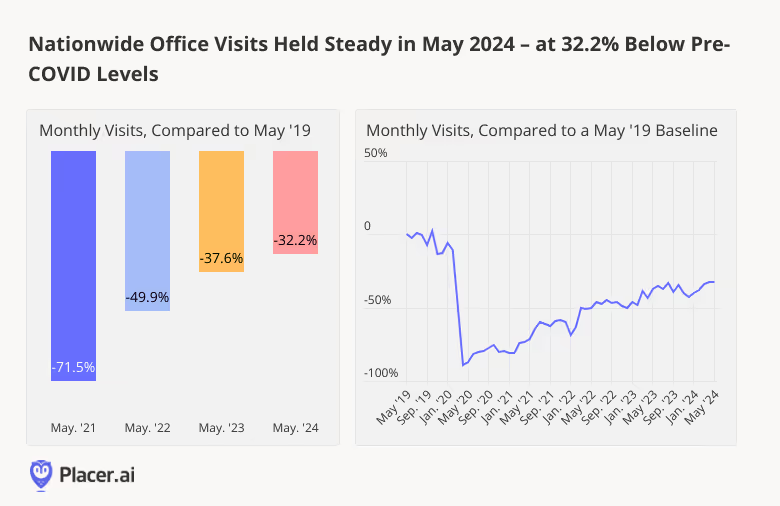
Nationwide, visits to office buildings were down just 31.3% in February 2024 compared to February 2020 – the nation’s last “normal” in-office month before COVID changed everything. This relatively narrow year-over-four-year (Yo4Y) visit gap may be partially due to this year’s February leap day: Last month had 20 working days, compared to just 19 in February 2020 and 2023. (2020 was also a leap year, but the extra day fell on the weekend.)
Still, office visits in February 2024 were also higher than in January 2024, when unusually cold and stormy weather stranded many Americans at home. And year over year (YoY), February 2024 visits were up 18.6% – which, even accounting for the month’s extra day, points towards significant growth.
.avif)
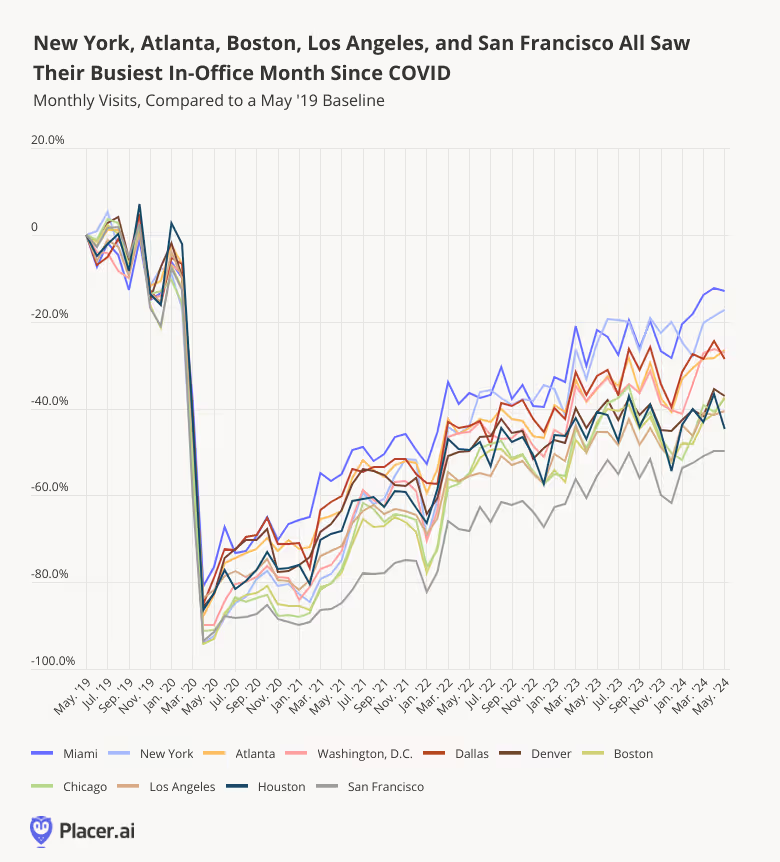
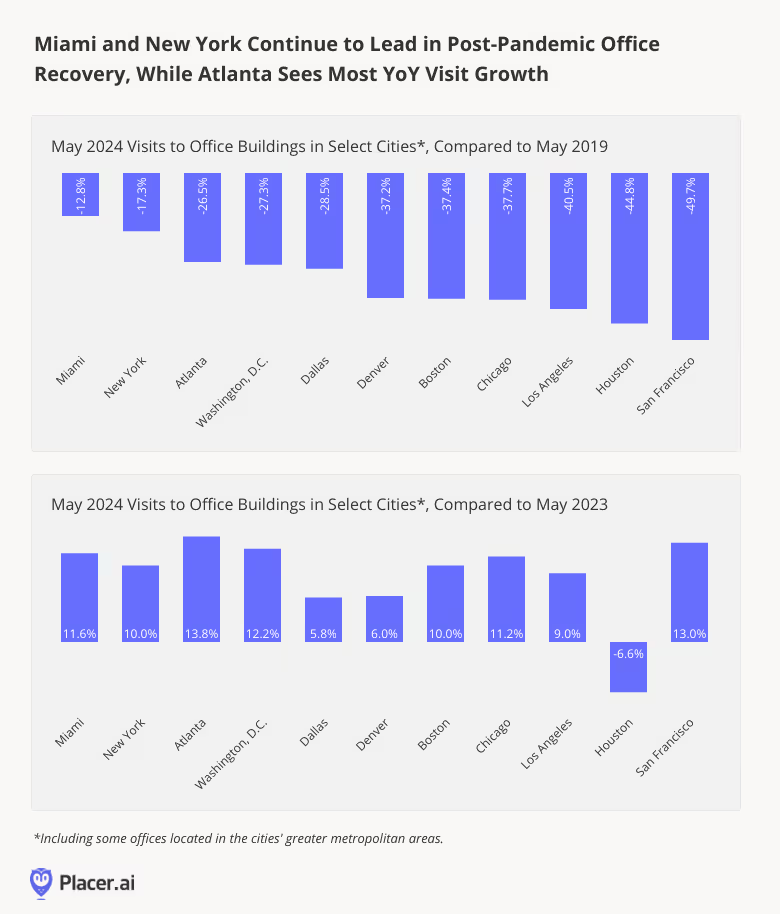
Taking a look at city-wide trends shows the persistence of significant regional variation – with Miami and New York continuing to lead the post-COVID office recovery pack, and San Francisco bringing up the rear. Dallas, Atlanta, and Washington, D.C. also outperformed the nationwide Yo4Y baseline of -31.3%. And of the cities that continued to lag behind, Chicago, Boston, and San Francisco all outpaced the national average for YoY visit growth.
Here, too, February 2024’s additional business day did some of the work. Nevertheless, urban centers like Miami and New York – where office visits were down just 9.4% and 14.5%, respectively, compared to February 2020 – are clearly experiencing accelerated recovery. In Miami, an influx of tech companies may be contributing to the narrowing foot traffic gap – while in New York, the finance sector is likely a major driver of visit growth. And though San Francisco continues to lag behind other cities, the tech hub’s impressive YoY foot traffic increases indicate real change on the ground.
.avif)
Hybrid work may be here to stay – but February’s office foot traffic data appears to indicate that companies and employees are still feeling out the ideal balance between RTO and WFH. And whether due to growing demands by employers or workers’ own concerns about the possible deleterious effects of fully remote work on their careers, further office recovery may yet be on the table.
How will RTO progress as 2024 gets into full swing? Will New York and Miami close the gap? And what will happen in San Francisco?
Follow Placer.ai’s data-driven office recovery analyses to find out.
This blog includes data from Placer.ai Data Version 2.0, which implements improvements to our extrapolation capabilities, adds short visit monitoring, and enhances visit detection.

The multi-billion dollar beauty industry has proved to be one of the most resilient retail categories over the past few years – and Ulta Beauty has been one of the biggest beneficiaries of this trend, reporting record growth and experiencing strong foot traffic to its stores.
We dove into the location intelligence data for Ulta to analyze recent foot traffic performance, explore seasonal trends, and better understand the chain’s visitor base.
The past few years have seen Ulta’s monthly foot traffic growing on a near-constant basis – and 2023 was no exception. Year-over-year (YoY) visits to the chain were up by double digits most months and Ulta consistently outperformed the wider Beauty & Spa segment. The company’s success appears poised to continue in 2024, with January 2024 visits up 4.9% relative to the already impressive January 2023, even as foot traffic to the wider Beauty & Spa category dipped.
The consistent foot traffic growth Ulta experienced in 2023 and early 2024 is particularly impressive given that 2022 was also a banner year for the brand – meaning that foot traffic has exceeded the previous years’ growth for two years straight. And the company seems to be capitalizing on its success by further enhancing its shopping experience, expanding its presence with new stores, and emphasizing wellness offerings at existing locations to keep its customers coming back.
.png)
Charting the change in monthly foot traffic to Ulta helps visualize the chain’s seasonal visit patterns and highlight the company’s consistent upward climb since the 2021 retail reopening. The COVID-19 pandemic and ensuing lockdowns led to a steep drop in foot traffic, but visits picked up – and stayed up – as soon as social-distancing restrictions eased. And though inflation replaced the pandemic as an economic concern, Ulta visits continued on their upward climb, highlighting the broad appeal the chain offers to shoppers of all economic levels.
Ulta also enjoys significantly elevated visits during the holiday season, with foot traffic surging every December. And visits to the chain, even without a holiday spike, continue to exhibit growth – January 2024’s visits were 43.3% higher than they were in January 2019.
.avif)
While December may be the month that Ulta sees the most visits, there are plenty of other minor holidays and retail opportunities that contribute to foot traffic spikes to the retailer. And although Valentine’s Day isn’t a holiday in the official sense of the word, Ulta still enjoyed a mid-week boost in visits on Wednesday, February 14th 2024.
Visits to Ulta grew 17.2% on Valentine’s Day compared to traffic of the previous six Wednesdays. February 14th 2024 also saw 10.5% more visitors to Ulta than the day did in 2023, signaling a continued, growing interest in the beauty retailer.
.png)
Ulta has taken pains to carry products for consumers of all ages, genders, and backgrounds –and recently, one age group in particular has been making headlines for its interest in beauty and skincare. Teens and tweens have been flocking to their local malls to try out products from brands like Drunk Elephant, driven, in part, by the rise of #BeautyTok, where influencers on TikTok post their makeup and skincare routines.
And indeed, trade area data indicates that families of all types are overrepresented among Ulta’s visitor base: Analyzing the psychographic makeup of Ulta’s trade areas using the Spatial.ai: PersonaLive dataset revealed that the chain’s captured market* includes more family segments when compared to the chain’s potential market*. Specifically, the chain’s captured markets had higher rates of “Near-Urban Diverse Families”, “Upper Suburban Diverse Families”, and “Wealthy Suburban Families” relative to the chain’s potential market. On the flip side, “Young Urban Singles” saw a smaller share of visitors in Ulta’s captured market than in its potential market.
Ulta’s popularity with family segments may be due to the increased demand for skincare and makeup among the families’ younger generations. And by continuing to cater to these younger consumers – alongside the numerous other segment that shop at Ulta – the company can hope to foster long-term brand loyalty and continue driving sales and foot traffic to its stores.
.png)
*A chain’s potential market refers to the population residing in a given trade area, where the Census Block Groups (CBGs) making up the trade area are weighted to reflect the number of households in each CBG.. A chain’s captured market weighs each CBG according to the actual number of visits originating to the chain from that CBG.
Ulta continues to impress, growing its sales and foot traffic even during a uniquely challenging period for the average consumer. By creating a shopping experience that is accessible to people across all ages and income levels, the company ensures that its visits can continue to grow.
For more data-driven retail insights, follow placer.ai.
This blog includes data from Placer.ai Data Version 2.0, which implements improvements to our extrapolation capabilities, adds short visit monitoring, and enhances visit detection.

First Watch has been around for over 40 years and is famous for being open from morning to early afternoon and a revolving menu that leans into seasonal ingredients. In recent years, the casual cafe – which derives its name from the nautical term for the first shift of the day – has made significant waves. The chain went public in 2021 and continues to drive consistent revenue and foot traffic – despite a stormy economic climate. We dove into the data to take a closer look at the consumer behavior behind First Watch’s success and understand where the chain could be heading in 2024 and beyond.
The Early Advantage
At First Watch, brunch and lunch join breakfast as the most important meals of the day. And while some of the chain’s competitors are open all day – or even all night – sticking to limited business hours has not steered the brand off course. Analysis of First Watch’s H2 2023 foot traffic compared to the wider breakfast-first category shows that First Watch’s monthly year-over-year (YoY) visits consistently outperformed the Breakfast, Coffee, Bakeries, and Dessert Shops space as a whole.
Some of the chain’s success is due to its expanding store fleet, with visits during the last five months of 2023 up by double digits compared to the equivalent months in 2022. And the chain is likely to rise even further in 2024 and beyond, with CEO Christopher Tomasso seeing continued expansion on the horizon.
.avif)
Indeed, looking at more recent data shows that First Watch’s growth is continuing even relative to the already strong 2023, with foot traffic to the chain up YoY and outperforming the wider Breakfast, Bakeries & Dessert Shops space every week of 2024 so far.
.avif)
The Next Voyage
C.E.O. Tomasso is determined to stay “true to who we are and what we’ve done regardless of how big we get.” And one way First Watch has stayed true to its identity is by being attentive to the preferences of its target audience. When customers wanted cocktails as a way to unwind with friends over brunch – First Watch delivered. And location intelligence can help identify the next consumer trend to drive the brand’s continued success.
Trade Area Analysis of First Watch in Q4 2023 using the AGS: Behavior & Attitudes dataset revealed that “Food Label Readers”, “Organic Foodies”, and “Vegans” were overrepresented in the restaurant’s trade areas compared to the nationwide benchmark. This indicates that First Watch’s commitment to fresh ingredients resonates with clientele that prioritize a healthy diet. Meanwhile, the data also showed that these consumers were likely to be involved in various forms of exercise; “Fitness Fans”, “Joggers”, “Pilates People”, and “Weight Lifters” were also prevalent psychographic segments in First Watch’s trade area.
This suggests that First Watch might consider exploring uncharted waters by adding smoothies or post-workout shakes to its menu, or by opening smaller-format locations in fitness centers to better serve its health-conscious audience.
.avif)
Land Ho!
First Watch has enjoyed smooth sailing through a commitment to bringing diners a fresh take on breakfast, brunch, and lunch. As long as this ship stays anchored in its identity, First Watch should find that the wind is at its back for the foreseeable future.
For updates and more data-driven dining insights, visit Placer.ai.
This blog includes data from Placer.ai Data Version 2.0, which implements improvements to our extrapolation capabilities, adds short visit monitoring, and enhances visit detection.

Whether it’s an at-home yoga practice, a workout at the gym, or a sports league at the park, the biggest players in the sporting goods space – Hibbett Sports and DICK’s Sporting Goods – have the gear to keep a variety of consumers outfitted. Armed with the latest location intelligence data, we took a closer look at these retailers’ recent offline performance and analyzed some of the psychographic characteristics of visitors to DICK’s and Hibbett’s.
Last year started off strong for DICK’s Sporting Goods and Hibbett Sports, with visits to both retailers up in Q1 2023 relative to the equivalent quarter in 2022. But ongoing inflation and tighter consumer budgets weighed on visits as the year progressed, and foot traffic to DICK’s and Hibbett dipped slightly year-over-year (YoY) in the second half of the year. Still, in spite of the challenges, both brands succeeded in keeping their visits close to 2022 levels and maintaining minimal visit gaps.
.png)
The strong Q1 2023 combined with unusually cold weather were likely partially to blame for DICK’s and Hibbett’s sluggish early 2024 performance. But by the end of January, YoY visit gaps had narrowed for both brands – a promising sign for the year ahead.
Who is likely to visit these brands in 2024? We looked at the retailers’ trade area composition to find out.
.png)
Analyzing DICK’s and Hibbett’s trade area using the Spatial.ai: Proximity dataset revealed that both brands were positioned to drive traffic from two significant fitness-related psychographic segments at the end of 2023.
In Q4 2023, “Yoga Advocates” as well as fans of “Functional Fitness” were overrepresented in DICK’s and Hibbett’s trade area relative to the nationwide average. And DICK’s and Hibbett are investing heavily in getting these consumers in the door. DICK’s debut of a new functional fabric and ad campaign for its CALIA clothing line and Hibbett’s new joint loyalty program with Nike could provide an extra foot traffic boost from fitness-forward consumers as 2024 progresses. As temperatures thaw and demand rebounds, these consumers are likely to play a part in a foot traffic resurgence for both brands.
.png)
But while certain sporty audience segments seem to visit both brands, diving deeper into DICK’s and Hibbett’s trade areas using the Spatial.ai: Followgraph dataset also revealed differences between the two retailers’ offline consumer base.
For example, the share of “Hunting Enthusiasts” in DICK’s trade area was 8% smaller compared to the nationwide average, while Hibbett’s trade area included 20% more “Hunting Enthusiasts” than the prevalence of the segment nationwide. Meanwhile, the “Triathlon Participants'’ segment was overrepresented in DICK’s potential market – 4.0% above the national average – and underrepresented in Hibbet’s potential market (8.0% below). These differences suggest that the sporting goods space is big enough to accommodate multiple players at the top, with leading retailers each carving out their own slice of the market.
.avif)
So Much Potential
After a relatively rocky end to 2023, foot traffic appears to be on the upswing for both DICK’s and Hibbett early on in 2024. The prevalence of fitness-minded and sporting consumers in the trade areas of both brands could provide a continued foot traffic lift in the weeks and months ahead.
For updates and more data-driven foot traffic insights, visit Placer.ai.
This blog includes data from Placer.ai Data Version 2.0, which implements improvements to our extrapolation capabilities, adds short visit monitoring, and enhances visit detection.
.avif)
Coffee’s success in 2025 offers several key lessons for dining operators across categories:
1. Strategic expansion into under-penetrated regions can supercharge growth. YoY visits to coffee chains are growing fastest in areas of the Southeast and Sunbelt where the category still accounts for a relatively low share of dining visits.
2. Pairing craveable products with genuinely human, personalized service can build durable loyalty. Aroma Joe’s proves that when standout offerings are combined with warm, consistent personal touches, brands can create habit loops that drive repeat visits even in crowded markets.
3. Prioritizing hyper-efficient convenience models can unlock meaningful growth. Scooter’s Coffee demonstrates that fast, reliable, frictionless experiences can materially increase traffic while supporting rapid expansion.
4. Building recurring limited-time rituals can create predictable demand spikes and deepen engagement. From the annual Pumpkin Spice Latte launch to Jackpot Day, coffee chains show that ritualized promotions can “own the calendar,” generating predictable traffic spikes and deepening emotional engagement.
5. Using scarce, hype-driven offerings can generate high-impact moments that shift behavior. Starbucks’ Bearista drop illustrates how limited, buzzworthy merchandise or products can not only spike visits but also shift customer behavior, driving traffic outside typical dayparts.
6. Leveraging cultural collaborations can create excitement without relying on discounts. Dunkin’s Wicked partnership shows that tapping into moments in pop culture can deliver multi-day visit lifts comparable to major promotions – often without relying on giveaways.
Coffee has become one of the most resilient and inventive corners of the U.S. food and beverage industry. Even as consumers wrestle with higher prices and trim discretionary spending, they continue to show up for cold foam, caffeinated boosts, and treat-worthy daily indulgences.
Throughout 2025, coffee chains saw consistent year-over-year (YoY) quarterly visit growth, as brands from Starbucks to 7 Brew expanded their footprints. Crucially, per-location category-wide traffic also remained close to 2024 levels throughout most of the year before trending upward heading into the holiday season – showing that this expansion has not diluted demand at existing coffee shop locations.
What’s fueling coffee’s ongoing momentum? Which strategies are helping leading chains accelerate despite this year’s headwinds? And what can operators across dining categories learn from coffee’s success?
This white paper dives into the data to reveal the strategies behind coffee’s standout performance – and how they can help dining concepts across segments succeed in 2026.
Analyzing market-level (DMA) dining traffic data reveals that coffee chains are prioritizing growth in markets with lighter competition – and this formula is paying off.
In the graphic below, the top map shows the share of dining visits commanded by coffee in each DMA, while the bottom map highlights the year-over-year (YoY) change in visits to the coffee category. Perhaps unsurprisingly, markets where coffee already commands a high share of dining visits (specifically on the West Coast and in the Northeast) are seeing the softest year-over-year performance, while DMAs with lower coffee penetration are delivering the strongest visit growth.
In other words, traditional coffee markets such as Northwestern metros– where competition is high and incremental gains are harder to capture – are no longer the primary engines of category momentum. Instead, coffee visits are growing fastest across the Southeast, Sun Belt, and Texas – regions where branded coffee still represents a relatively small share of dining visits. Operators across dining segments can learn from coffee's approach and identify markets with low category penetration to lean into those whitespace opportunities.
But geography is only part of the story. And the coffee segment shows that a strong concept that delivers on fundamentals – great products and exceptional service – can thrive even in tougher coffee markets such as the northeast.
The experience of expanding Northeastern chain Aroma Joe’s shows how pairing craveable beverages with an unusually personal service model can drive visit growth even in relatively hard-to-break-into regions.
Aroma Joe’s, a rapidly-expanding coffee chain headquartered in Maine, with over 125 locations, has become something of a local obsession: Customers rave about the chain’s addictive signature beverages – as well as the feel-good atmosphere cultivated by its warm, friendly staff. And this combination of human touch and product quality creates a powerful habit loop: In October 2025, nearly one quarter of visitors to Aroma Joe’s stopped at the chain at least four times during the month – a much higher loyalty rate than that seen by other leading coffee brands.
The takeaway: Craveable products paired with exceptional service can create a scalable loyalty engine.
Another key differentiator for the coffee sector is convenience. Drive-thrus have become ubiquitous across the category, with many of the fastest-growing upstarts embracing drive-thru only models and legacy leaders also leaning more heavily into the format.
Scooter’s Coffee – named for its core promise to help customers “scoot” in and out quickly – exemplifies this advantage. In Q3 2025, the chain posted a 3.1% YoY increase in average visits per location, even as it continued to scale its footprint. And its customers averaged a dwell time of just 7.3 minutes – significantly lower than other leading coffee chains, including other drive-thru-forward peers.
By delivering consistently quick experiences without compromising quality, Scooter’s has emerged as a traffic leader in the coffee space – demonstrating the power of efficiency to drive demand.
No category has mastered the “event-ization” of the menu quite like coffee – and few brands own the category’s calendar as effectively as Starbucks. The annual return of the Pumpkin Spice Latte has become a cultural milestone that marks the unofficial start of fall for millions, driving double-digit visit spikes and shaping seasonal traffic patterns.
And the importance of the event only continues to grow. On August 26th, 2025, PSL day drove a 19.5% spike in traffic compared to the prior ten-week average – a higher relative spike than that seen in 2024 or 2023.
But this playbook isn’t reserved for mega-brands. 7 Brew’s monthly Jackpot Day, held on the 7th of each month, shows how recurring promotions can also build anticipation and deliver repeatable traffic lifts for up-and-coming concepts.
Beginning in August 2025, Jackpot Day shifted from a limited “Jackpot Hour” to an all-day activation. That month’s offer – two medium drinks for $8 plus a Kindness wristband – generated a 47.1% lift versus an average Thursday. And in subsequent months, giveaways ranging from tote bags to footballs kept the excitement going, sustaining elevated visits each time the 7th rolled around.
These rituals create emotional consistency: Customers know when to expect something special and plan around it. Dining chains beyond the coffee space can also create dependable spikes in traffic by implementing recurring, ritualized LTOs that create an emotional calendar and keep customers engaged.
Offering recurring LTOs is one way to keep customers consistently engaged. But one-time, limited-edition merch drops can create even bigger visit surges. Starbucks’ much-hyped “Bearista” launch this November is a prime example: Customers lined up nationwide for the chance to buy – not receive – an adorable, limited-edition, bear-shaped reusable cup. And despite its hefty $30 price tag, the merch drop drove a massive nationwide visit spike, making it the chain’s biggest sales day ever and fueling additional momentum leading into Red Cup Day.
And location data shows that this kind of hype-driven, scarce merchandise can shift not just visitor volume but daypart behavior. Visits surged as early as 4:00 AM as FOMO-driven customers showed up at the crack of dawn to secure a bear. And the shift toward early morning visits (though not quite as early) continued the following day as stores quickly ran out of stock.
Starbucks' Bearista frenzy suggests that scarcity isn’t just a retail tactic – it’s a powerful behavioral trigger that restaurants can harness as well. Limited-run items, exclusive merch drops, or time-bound specials can generate excitement, pull visits forward, and reshape daypart patterns in ways traditional promotions rarely do.
Cultural tie-ins add another accelerant. In November, Dunkin’ launched its Wicked collaboration alongside its holiday menu, generating a significant multi-day traffic spike – achieved, like Bearista, without giveaways. The event leaned on playful thematic branding, seasonal flavors, and limited-run items that tapped into Wicked fandom.
Dunkin's Wicked surge shows that when executed well, cultural relevance can also significantly move the needle. Other dining segments may also lean into thoughtful collabs to create outsized excitement and traffic lift – even without deep discounts or free offers.
The coffee sector’s 2025 performance offers a blueprint for dining success: Chains are expanding smartly into underpenetrated regions, successfully implementing both hyper-efficient and hyper-personal service models, using recurring LTOs to build seasonal and monthly rituals, and leveraging merch and pop culture partnerships to reshape demand.
Together, these strategies provide a practical playbook for dining brands to increase visit frequency, deepen customer commitment, and capture new growth opportunities in 2026 and beyond.

Five metros from across the United States stand out for consumer momentum going into 2026: Salt Lake City (UT), Reno (NV), Indianapolis (IN), Tampa-St. Petersburg-Clearwater (FL), and Raleigh-Durham (NC). All five metro areas saw their populations increase by more than the average U.S. metro between 2023 and 2024, and year-over-year (YoY) retail and dining traffic trends outpaced the nationwide average.
Utah is one of the fastest-growing states in the U.S. The state’s population has grown steadily for more than two decades with unemployment remaining consistently below the nationwide average, with one of the youngest workforces in the country. According to some analysts, the median household income in Utah, when adjusted for cost of living, is the highest in the nation.
All of this positions Salt Lake City – the state’s capital – as a particularly attractive market heading into 2026. Location analytics show year-over-year increases in foot traffic across many neighborhoods, from established retail hubs like Sugar House and Downtown SLC to the more mixed-use Central City and primarily residential areas such as The Avenues and East Bench. The city also serves as a gateway to a diverse mix of audiences, attracting younger residents and commuters as well as affluent families who come into the city to shop, dine, and enjoy local attractions.
Salt Lake City’s diversity in age and household composition as well as Utah's strong homeownership culture – even among younger cohorts – creates opportunities for retail and dining chains across categories. Home-forward concepts are particularly poised to outperform, as shown by recent location analytics. Traffic to furniture & home furnishing chains increased 7.4% YoY in the Salt Lake City DMA compared to a 2.5% increase nationwide, and grocery stores and home improvement retailers outperformed in the market as well. These trends point to a solid market for retailers tied to home life – from furniture and décor to everyday grocery needs –driven not only by steady population growth and household spending, but also by a local culture that places strong emphasis on family and the home.
While Salt Lake City continues to build on its strong foundation, another Western city is quietly gaining momentum. Reno, Nevada, which is often viewed as a regional gaming-town, is increasingly emerging as a dynamic travel destination in its own right.
In 2024 Washoe County (including the city of Reno) welcomed approximately 3.8 million visitors whose spending of about $3.4 billion generated a total economic impact of $5.2 billion. This growth signals a robust visitor-economy that supports roughly 43,800 jobs and generates over $420 million in state and local tax revenue.
What makes this particularly compelling is that while Las Vegas, Nevada is facing mounting pressures from increasing costs, the Reno-Tahoe region is showing stronger resilience thanks in part to a drive-market model and diversified appeal. Analyzing the traffic data shows that visits from non-residents, and non-employees to downtown Reno have increased YoY for the past three years. And though Reno may be thought of as a vacation spot for older Gen X and Baby Boomer vacationers, the data also indicates that Singles & Starters –"young singles starting out and some starter families living a city lifestyle" – make up an increasingly large share of Reno's visitor base.
This generational diversification carries important implications for both retail and real estate investment. As younger visitors drive up spending in food, entertainment, and shopping centers, the market is poised for renewed urban energy – fueling redevelopment across downtown corridors and mixed-use projects. With strategic public–private investments and an expanding visitor economy, Reno stands out as a market to watch in 2026, combining strong fundamentals with emerging demographic momentum.
The Midwest also contains several metro areas on the rise. Large-scale manufacturing projects like Intel’s $20 billion chip plants and Honda and LG Energy Solution’s EV battery facility are spurring housing and retail expansion around Columbus, Ohio. Kansas City, Missouri, is benefiting from logistics growth and projected tourism growth linked to its role as a FIFA World Cup 2026 host city. And Madison, Wisconsin, is seeing steady consumer growth is supported by its diverse tech and biotech economy.
But Indianapolis, Indiana tops the charts in terms of YoY overall retail visit growth between May and October 2025 (+4.3%, see first chart). And much of the consumer traffic in the Indianapolis DMA consists of suburban and rural households – precisely the segments that many retailers are now trying to woo.
Family-friendly retailers and dining chains are particularly well positioned to thrive in Indiana heading into 2026. Indianapolis has some of the best job prospects and most affordable home prices in the country – and its favorable salary to cost of living ratio likely allows many families to have leftover income left over for discretionary spending.
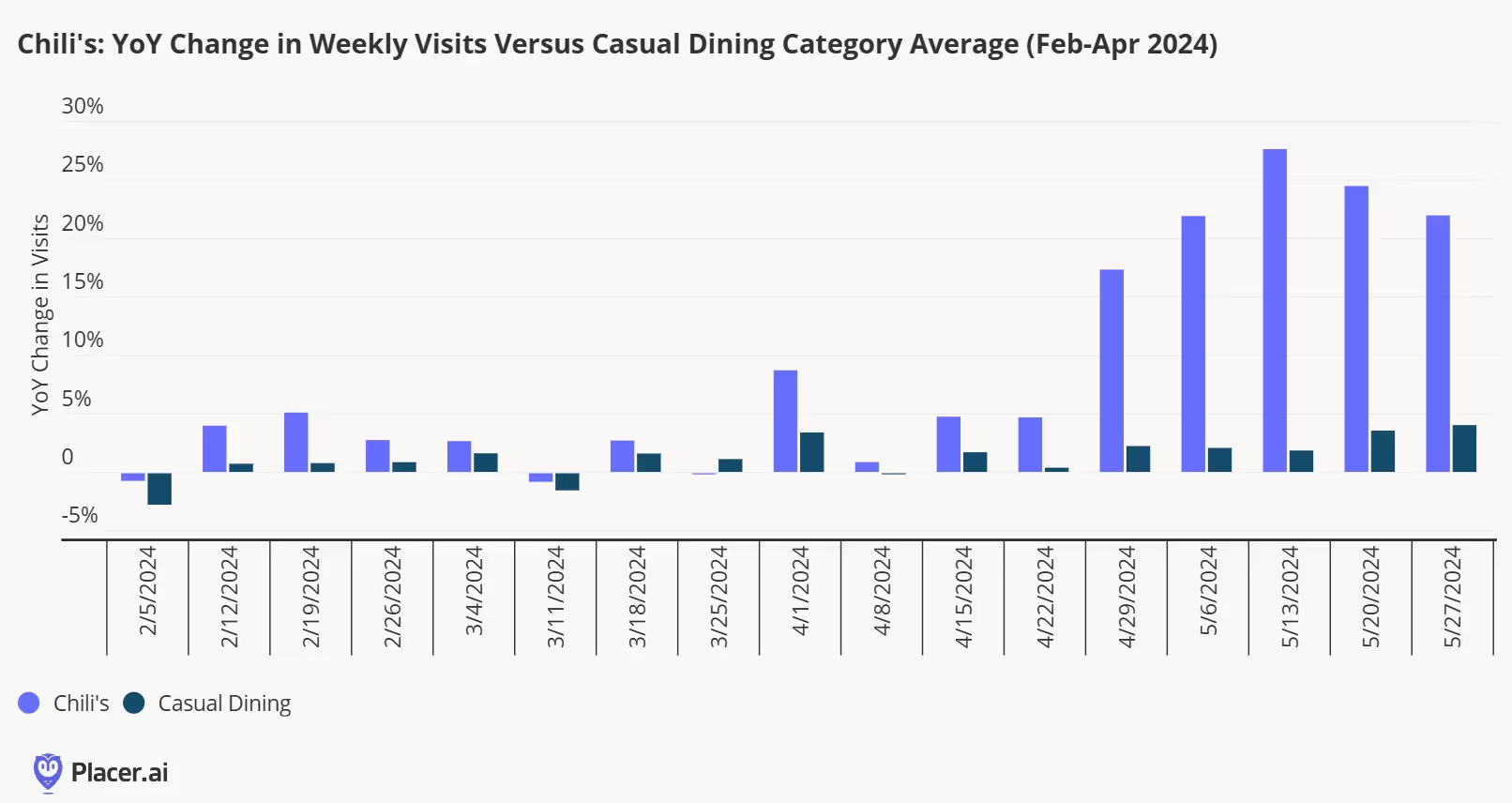
Recent data shows that a range of family-oriented brands – from Chili’s and Marshall’s to Kroger – have outperformed in Indianapolis over the past six months. The city’s growing middle-income population and its suburban, family-focused consumer base appear to be fueling stronger in-person spending, particularly at convenient, affordable, and community-oriented retail and dining destinations.
Moving east to North Carolina brings several additional growing metros into focus, including Myrtle Beach, Wilmington, and Charlotte. But Raleigh rises above the pack with its powerful combination of job growth, steady in-migration, and a well-balanced, diversified economy.
All this is leading to YoY increases in total traffic within the Raleigh-Durham, NC DMA, driven in part by major firms – including entrants in finance and life-sciences – continuing to expand operations in the area. The city of Raleigh also has relatively low median age and relatively high median household income. This combination of robust job creation, wage gains, and a growing pool of young, high-spending residents positions Raleigh as one of the most dynamic consumer markets in the Southeast heading into 2026.
Raleigh's consumer growth potential is particularly stark when looking at performance of major mixed-use developments across the region. Foot traffic at leading projects such as Smoky Hollow, the Main District at North Hills Street, and Fenton in Cary has climbed sharply.
The data also shows that these destinations attract a disproportionately high share of wealthy singles and one-person households – a demographic with strong discretionary spending power. Together, these trends point to a deepening base of urban, high-income consumers fueling growth in dining, retail, and entertainment – making Raleigh one of the country's most dynamic and opportunity-rich metro areas heading into 2026.
In the Southeast, Tampa is one of the nation’s standout metro areas heading into 2026. Strong fundamentals – such as no state income tax and expanding employment in sectors like technology, healthcare, and logistics – have attracted a significant influx of Gen Z and millennial residents. And although in-migration is beginning to slow somewhat, the city's expanding economy and youthful talent base continue to fuel growth across housing, retail, and dining.
And as more companies require employees to spend additional days in the office, YoY commuter traffic has increased across Tampa’s major cities. Leisure visits from non-residents are also on the rise, suggesting that retailers and dining chains seeking to capture this expanding market could benefit from growing their presence throughout the Tampa metro area.
Rising traffic across Tampa’s major urban areas appears to be translating into stronger dining activity as well. Over the past six months, average YoY visits to Tampa area full-service restaurants, coffee shops, and fast-casual chains have all exceeded the national average, which may reflect a broader acceleration in both local workforce and leisure-visitor demand.

1. Retail is deeply divided. Visits to value and luxury apparel segments grew YoY in 2025 while traffic to mid-tier retailers flagged.
2. Upscale dining momentum reflects similar bifurcation. More resilient, affluent consumers are bolstering fine-dining traffic.
3. Authenticity is key. Brands successfully executing on a clear sense of purpose – from community-driven grocers to bookstores – are driving consistent visit growth.
4. Online and offline retail are converging into a seamless ecosystem. As consumers seek online value and in-person convenience, AI fulfillment, dark stores, and local pickup are accelerating.
5. Digitally native brands expanding into physical retail are redefining omnichannel. These chains provide a blueprint for merging digital efficiency with personalized in-store experiences.
6. Traditionally urban brands are shifting to suburbia to capture new audiences. With consumers rooted in hybrid lifestyles and growing suburban demand, chains that adapt their footprints drive fresh traffic.
7. Expansion into college markets and celebrity pop-ups are helping retailers and malls connect with younger consumers. Brands that grew their footprints in college towns or on campuses increased their Gen Z traffic, as did malls that hosted celebrity or influencer activations.
Retail and dining faced another complex year in 2025. Persistent economic headwinds and uncertainty surrounding tariffs intensified consumers’ focus on value, even as affluent shoppers continued to indulge in luxury brands and upscale dining experiences.
Yet the year also revealed behavioral shifts that extended beyond price sensitivity. Shoppers increasingly prioritized brands that convey authenticity and a clear sense of purpose – those that deliver value not only through price, but through omnichannel convenience, product quality, and brand ethos.
For their part, retailers and malls continued to evolve, adopting strategies to capture both the expanding suburban market and a rising generation of younger consumers emerging as a defining force in retail.
How have these trends evolved, and how will they shape the retail landscape in 2026? We dove into the data to find out.
The first three quarters of 2025 underscored a widening divide in the apparel sector, with strength at both ends of the price and income spectrums.
Off-price retailers and thrift stores, which draw shoppers from lower- and middle-income trade areas, gained significant ground – reflecting consumers’ ongoing search for value and treasure-hunt experiences that feel both economical and rewarding. At the same time, luxury maintained modest growth, showing that high-income shoppers remain resilient and willing to spend on premium experiences. Meanwhile, traditional apparel and mid-tier department stores continued to see visit declines, signaling further pressure on the retail middle. Retailers such as Target and Kohl’s, traditional staples of this middle segment, are contending with the challenge of defining their identity to consumers in a market increasingly split between value and luxury.
Looking ahead to 2026, mid-tier retailers will need to navigate a complex and polarized landscape. Without the clear positioning enjoyed by value and luxury players, success will require sharper differentiation and disciplined execution. But though the middle remains a tough place to compete, it still holds potential: Brands that can redefine relevance – something many of these same chains achieved just a few years ago – stand to capture consumers with spending power.
A similar bifurcation dynamic is also unfolding in the dining sector.
Upscale full-service restaurants (FSRs) are outperforming their casual dining counterparts, as higher-income consumers – and those dining out for special occasions – seek elevated experiences at fine-dining chains.
At the same time, more cost-conscious diners are trading down from casual dining FSRs to fast-casual chains, which continue to outperform the casual dining segment. Fast-casual brands are also benefiting from trading up within the limited-service segment, as consumers who choose to eat out – rather than eat at home or grab a lower-cost prepared meal at a c-store or grocery – opt for more experiences that feel more premium yet remain accessible.
Across both retail and dining, bifurcation doesn’t tell the whole story. Even as spending concentrates at the high and low ends of the market, a growing number of brands are succeeding by delivering an experience that feels intentional, distinctive, and true to their identity. These concepts share a clear raison d’être – a sense of purpose that resonates with consumers – as well as successful execution. The data shows that brands providing this kind of “on-point” experience are driving consistent visit growth in 2025, signaling that authenticity may be important retail currency in 2026.
Trader Joe’s sustained momentum reflects its ability to make shopping feel like discovery. The chain’s locally-inspired assortments, roughly 80% private-label mix, and steady rotation of seasonal products keep visits fresh and engagement high.
Sprouts, for its part, continues to benefit from a sharpened identity centered on freshness, sustainability, and health. Its smaller-format stores, curated product mix, and messaging around healthy living have helped it build a loyal base of wellness‐oriented shoppers.
Meanwhile, Barnes & Noble’s transformation offers a compelling case study in the power of experience. Its strategy of empowering local managers to curate store selections and host community events has turned stores into cultural touchpoints – driving increased visits and dwell times.
All three brands derive their strength from their clarity of purpose – illustrating how authenticity and intentionality are becoming meaningful factors shaping consumer engagement.
Authenticity isn’t limited to national names. Regional players such as H-E-B and In-N-Out Burger demonstrate how deeply ingrained local identity can translate into sustained growth.
H-E-B’s community-driven ethos, local sourcing, and operational excellence have built trust across Texas markets, helping it remain one of the country’s most beloved grocery chains, with high rates of shoppers visiting multiple times a month. And in the quick-service category, California-native In-N-Out Burger stands out for its quality, nostalgia, and mystique, as the chain continues to attract visitation trends that exceed national QSR benchmarks.
These brands demonstrate that authenticity can have a local element. Their success reflects not just product strength or efficiency, but a deeper connection to the communities they serve.
While regional and experience-driven brands continue to build deep consumer connections, the broader retail landscape is also being reshaped by operational innovation. As technology and infrastructure improve, retailers are finding new ways to merge digital efficiency with convenient physical touchpoints.
E-commerce growth and in-store activity are increasingly interconnected. Visits to ecommerce distribution centers* climbed steadily between October 2021 and September 2025, while the share of short, under-10-minute trips to big-box chains Target, Walmart, BJ’s Wholesale Club, and Sam’s Club also increased. Together, these patterns suggest that while online shopping continues to expand, consumers remain highly engaged with physical locations through buy-online-pick-up-in-store (BOPIS) and same-day fulfillment channels – combining the value of online deals with the convenience of quick, local pickup.
This trend also reflects ongoing advancements in AI-driven fulfillment and Walmart’s testing of dark stores – retail spaces converted into local fulfillment hubs that accelerate delivery and enable quick customer pickup. These innovations are shortening fulfillment windows while optimizing store networks for hybrid demand.
As retailers continue to blur the boundaries between digital and physical commerce in 2026, expect them to become increasingly complementary parts of a single, omnichannel ecosystem.
*The Placer.ai E-commerce Distribution Center Index measures foot traffic across more than 400 distribution centers nationwide, including facilities operated by leading retailers such as Amazon, Walmart, and Target. Designed as a barometer for U.S. e-commerce activity, the index captures two key audiences: employees, estimated through dwell-time patterns, and visitors, who often represent logistics partners delivering raw materials, moving in-process goods, or collecting finished products.
The resurgence of digitally native brands embracing physical retail underscores how online and offline strategies are converging into an integrated model, combining digital efficiency with the benefits of a physical presence.
Framebridge, a DTC custom framing brand, offers a clear example of this trend. As the brand has expanded its footprint, the average number of monthly visits to each of its locations rose sharply throughout 2025.
Framebridge’s success lies in its well-executed omnichannel model. Customers can place orders online or in store, with the option to ship directly to their homes or pick up in person.
But for Framebridge, physical locations aren’t just about convenience. Art and memories are often one of a kind, so having knowledgeable staff in store and the opportunity to engage with materials firsthand transforms a transaction into a personalized, consultative experience.
Framebridge exemplifies how digitally native brands are merging the ease of online shopping with physical spaces that provide a personal touch. And more digitally native brands, like Gymshark, are looking to bring their business offline with the hope of adding value for consumers.
As retailers advance their omnichannel strategies, another enduring shift is reshaping the retail map post-pandemic – the continued rise of suburban traffic. Brands that entered the pandemic with strong suburban footprints were among the first to benefit as in-person activity rebounded, while urban-focused chains that expanded outward have met migrating consumers and captured new audiences anchored in hybrid lifestyles and local shopping routines.
Large-format and drive-thru focused brands like Costco, Cava, and Dutch Bros. entered the pandemic era from a position of strength as they are traditionally situated in suburban and exurban areas. As consumers spent more time close to home and away from urban centers, these chains captured heightened local demand and saw visits rebound rapidly once in-person shopping resumed.
And as the pandemic reshaped consumer traffic patterns, brands like Shake Shack and Chipotle quickly recognized emerging opportunities in suburban markets and adjusted their strategies to capture this shifting demand. For Shake Shack – a brand once defined by its urban storefronts – the shift toward suburban drive-thrus and stand-alone locations represented a significant pivot. Chipotle followed a similar path, accelerating its suburban expansion through the rollout of “Chipotlane” drive-thru lanes.
Arriving somewhat later to the suburban landscape, sweetgreen, once synonymous with its urban footprint, opened its first drive-thru in 2022, and by 2024 had made suburban markets a core pillar of its growth strategy.
These real estate moves positioned all three brands to capture demand from remote and hybrid workers, helping sustain visit growth well above pre-pandemic baselines.
As suburban demand continues to grow, the suburbs will likely remain a critical growth frontier for many brands in the year ahead.
Investment in suburban markets underscores how changing market conditions and strategy adaptation can allow brands to meet consumers where they are. And a parallel trend is unfolding in college towns and youth-dense trade areas, where brands are channeling investment to capture rising Gen Z spending power.
Expansion in college-anchored markets, paired with celebrity and influencer-driven pop-ups, is helping retailers build cultural relevance and increase engagement with this emerging consumer base.
The graph below underscores how targeted expansion into college-anchored markets can meaningfully shift audience composition. Over the last several years, many brands have expanded their near-campus footprints – and in turn, attracted a higher share of the Spatial.ai:PersonaLive “Young Urban Singles” segment, one highly aligned with Gen Z consumers.
CAVA’s rapid unit growth, including openings near major universities and in college towns, helped the brand increase its share of “Young Urban Singles” within its captured trade areas between October 2018-September 2019 and October 2024-September 2025. Meanwhile, Panda Express and Raising Cane's, which already had relatively large shares of the segment six years ago, have also invested in college-adjacent locations, lifting their “Young Urban Singles” audience share.
Even legacy mass retailer Target benefited from small-format and large store expansions near universities – growing its captured market share of “Young Urban Singles”.
These shifts suggest that college towns will continue to be strategic growth markets, including for luxury brands like Hermès. By making inroads in college towns and with Gen Z shoppers, brands can strengthen loyalty early and build durable market share that remains as these young adults move on from campus life.
As Gen Z’s influence expands beyond campus borders, retail engagement is increasingly driven by cultural moments that resonate with this cohort. And malls are finding that temporary pop-ups including influencer collaborations and celebrity-led activations can attract these young consumers.
At The Grove, the Pandora pop-up with brand ambassador girl-group Katseye in October 2024 led to a modest but significant increase in the Gen Z-dominant “Young Professionals” and “Young Urban Singles” segments within the mall’s captured trade area during the first week of the activation – compared to the average for the last twelve months.
Similarly, at Westfield Century City, the Taylor Swift x TikTok activation from October 3rd-9th, 2025 – which allowed fans to immerse themselves in the sets from the viral “The Fate of Ophelia” music video boosted the shares of “Young Urban Singles” and Young Professionals”, underscoring the star power of everything Taylor Swift.
And at American Dream, the pattern extended beyond younger audiences. On September 5th and 6th, 2025, Ninja Kidz attended the grand opening of their Action Park while Salish Matters made an appearance at the mall on September 6th for her skincare pop-up – which drew such large crowds that it had to be shut down. During these two event days, the mall’s shares of both “Young Professionals” and “Ultra-Wealthy Families” increased substantially, highlighting that pop-up events can draw young and affluent family audiences.
Together, these examples reinforce that, in 2026, the integration of short-term pop-ups will continue to be a strategy for malls and individual brands to gain relevance for key demographic segments.
2025 reinforced that retail remains as dynamic as ever. Value continues to anchor decisions, but consumers are redefining what value means – blending price sensitivity with expectations for authenticity. And in the current retail landscape, online and physical retail are growing more interconnected as consumers demand convenience and experience.
In 2026, adaptability will be retailers’ greatest competitive edge. The next era of retail will belong to brands that can continue to refine their operating strategy – while staying true to a clear brand identity.