Skip to Main Content
Thank you! Your submission has been received!
Oops! Something went wrong while submitting the form.
0
0
0
0
----------
0
0
Articles
Article
What 2025’s Biggest QSR Traffic Surges Reveal About Dining Strategies for 2026
Lila Margalit
Jan 8, 2026
6 minutes

Limited-service restaurants faced a challenging landscape in 2025, with many price-sensitive consumers pulling back on dining out in favor of grocery prepared meals and brown-bag lunches. Traffic was harder to come by, and everyday demand softened across much of the category.

Even so, chains found creative ways to stand out. We dug into the data behind the busiest weeks of the year for quick-service and fast-casual restaurants to understand what actually moved traffic – and which strategies are most likely to help brands compete in what’s shaping up to be another value-conscious year.

1. Eye-Catching Discounts That Cut Through the Noise

Everyday value became table stakes across limited service in 2025, with $5 meals, bundles, and loyalty pricing no longer serving as clear differentiators. Yet unsurprisingly, freebies and truly memorable discounts still drew crowds. 

The chains featured in the chart below all saw their highest weekly traffic peaks during promotions that felt distinctive, easy to understand, and clearly worth acting on. Some – like Dairy Queen’s Free Cone Day and Dave’s Hot Chicken’s Free Slider Day – involved no-purchase-necessary giveaways. Others relied on steep, attention-grabbing discounts, such as Whataburger’s Anniversary 75-cent burger and Pizza Hut’s $2 Tuesday promo, or culturally timed activations like Chipotle’s Stanley Cup–inspired hockey jersey BOGO.

For 2026, the takeaway is clear: Discounting still works, but the offers likely to truly motivate consumers are the ones that stand out from the everyday value they already expect. 

2. Culture Can Rival Free

Fortunately for restaurants, however, deep discounts and giveaways aren’t the only way to draw crowds - if they were, the economics wouldn’t be sustainable for long. In 2025, culture-driven moments came surprisingly close to matching the power of freebies, without the same margin trade-offs.

Take Krispy Kreme, for example. The chain’s annual National Donut Day promotion – including a no-purchase-necessary free donut and a $2 dozen with the purchase of 12 more – produced the chain’s largest single-day visit spike of the year (+219.7% versus an average day on June 6th, 2025) and helped push weekly visits to a yearly high.

But Krispy Kreme’s Back to Hogwarts collection which launched on August 18, 2025, generated a more sustained lift that nearly matched National Donut Day’s impact at the weekly level. While the campaign did include a free donut giveaway on Saturday, August 23rd for fans representing their favorite house, the data shows the surge wasn’t driven by the freebie alone: Traffic jumped 40.7% above an average Monday on launch day, compared with a 30.9% lift over an average Saturday on the day of the giveaway.

At McDonald’s and Burger King, too, pop-culture tie-ins dominated the promotional calendar. For both chains, the week of December 1st emerged as the busiest week of 2025, and also delivered the largest YoY weekly visit increase. 

At Burger King, the lift came from the chain’s SpongeBob Movie Menu – starring the Krabby Whopper – launched on December 1st ahead of the film’s December 19th release. The promotion drove an 18.4% YoY traffic increase, with traffic – largely flat or down since September – remaining elevated in the weeks that followed.  

At McDonald’s, momentum was fueled by a holiday-themed Grinched Menu, which arrived on the heels of the fast food leader’s highly successful Boo Bucket merchandise drop in October. The Boo Buckets drove McDonald’s second- and third-largest year-over-year visit spikes during the weeks of October 20 and 27, and the Grinch Meal built on that lift, pushing visits higher yet during the week of December 1st and sustaining momentum through the rest of the month. 

The lesson here is twofold: Well-timed promotions tied to widely recognized cultural moments can still drive outsized traffic on their own, as Krispy Kreme and Burger King’s activations showed. But McDonald’s performance also underscores the value of sequencing – using one successful launch to carry momentum into the next.

3. Bearista: Storytelling and Scarcity

Speaking of timing and sequencing, Starbucks’ viral Bearista offering, launched strategically just before the Brand’s iconic Red Cup Day, shows how well-timed promotions can compound impact. 

Red Cup Day during the week of November 10th was Starbucks’ busiest day of 2025. But the week of Bearista (November 3rd) came awfully close – and delivered the brand’s largest YoY weekly visit increase of 2025. Just as importantly, the Bearista launch helped build visit momentum, setting the stage for what ultimately became Starbucks’ biggest Red Cup Day ever.

Consumers lining up to pay $30 for the Bearista also challenged another long-held assumption about QSR traffic in 2025: that offerings have to be cheap to deliver results. What makes this especially notable is that Bearista wasn’t tied to a movie release or external cultural IP. It was brand-first, premium-priced merchandise that still drove traffic at scale. And while not easily replicated, Starbucks’ Bearista success shows that scarcity, storytelling, and timing can unlock value beyond low-price promotions.

4. Ummm… What About Food? 

If you’ve gotten this far, you might be wondering: What about food? Don’t people still go to restaurants to eat – and aren’t craveable menu items supposed to drive traffic?

The answer is yes. Amid all the noise around discounts, collaborations, and merchandise, food still mattered in 2025. At Popeyes, the June 2nd launch of Chicken Wraps, priced accessibly at $3.99, drove the chain’s busiest week of the year. While wraps weren’t totally new to Popeyes’ menu, this rollout was framed as a value-forward, easy-to-understand innovation at a moment when affordability mattered – and consumers responded.

At Taco Bell and KFC, food-driven traffic spikes leaned more heavily on nostalgia. Taco Bell’s limited-time revival of Cheesy Street Chalupas and Quesaritos lifted visits roughly 8% above average, while KFC saw an even larger jump (11.4%) with the return of Potato Wedges and Hot & Spicy Wings. These weren’t experimental launches, but deliberate re-releases of proven favorites, giving diners something familiar and a reason to act quickly.

Together, these examples show that even in a crowded promotional landscape, menu remains a core traffic lever – and that clearly positioned items can rise above the noise without flashy add-ons.

Lessons for 2026

The busiest weeks of 2025 show that even in a tough, value-conscious environment, limited-service restaurants still have multiple, proven ways to drive traffic. From clear deep discounts that rise above the noise to culture-led moments, narrative-driven merchandise, and well-timed menu strategies also delivered some of the year’s strongest results. 

As QSRs and fast-casual chains look ahead to 2026, the data suggests that winning won’t hinge on any single tactic, but on choosing the right lever for the right moment, and executing it clearly enough to cut through a crowded landscape.

For more data-driven dining insights, follow Placer.a/anchor.

Placer.ai leverages a panel of tens of millions of devices and utilizes machine learning to make estimations for visits to locations across the US. The data is trusted by thousands of industry leaders who leverage Placer.ai for insights into foot traffic, demographic breakdowns, retail sale predictions, migration trends, site selection, and more.

Article
Placer.ai December 2025 Mall Index: Recapping 2025 Shopping Center Trends
Shira Petrack
Jan 7, 2026
4 minutes

Indoor Malls Led On a Full-Year Basis, Open-Air Outperformed Over the Holidays 

Indoor malls outperformed both open-air centers and outlet malls on a full-year basis as the only format to post visit gains during all four quarters – signaling a shift from recovery into growth. 

Open-air shopping centers came in second – and though the format trailed indoor malls on a full-year basis, open-air shopping centers came out on top over the holidays, with Q4 visits up 2.0% year over year (YoY) and December traffic up 1.5%. This seasonal strength can be attributed to the format's sit-down and alcohol-forward dining options, which attract social holiday visits, as well as layouts that support quick trips and easy access to both essential and discretionary retail.

Meanwhile, outlet malls remained the weakest-performing format throughout 2025, with an annual traffic decline driven in part by a 1.1% drop in visits during the critical holiday season. This softness could reflect a broader shift in value perception. Price-conscious consumers may be increasingly weighing time cost alongside monetary savings, and long drives can offset the appeal of discounted pricing – particularly when promotions and loyalty incentives are widely available online and in traditional retail formats. To win consumers back, outlet malls may need to reduce the perceived time tradeoff by strengthening food and entertainment offerings and positioning themselves as curated, experience-driven value destinations rather than purely price-led ones.

Families Lead Mall Visitation

Malls continue to resonate with a wide range of family segments, though different formats appeal to different household profiles. Across formats, higher-income and suburban family segments over-index among mall visitors. Indoor malls and open-air centers attract a disproportionate share of ultra-wealthy and affluent suburban households, underscoring malls’ ongoing relevance for consumers seeking family-friendly activities and experiences. Outlet malls, meanwhile, skew more heavily toward near-urban diverse families, reflecting their positioning as value-oriented destinations rather than lifestyle hubs. 

At the same time, young professionals also play a meaningful role in mall traffic, over-indexing across all formats relative to their 5.8% share of the national population.

Malls Compete Within Broader Shopping Ecosystems 

Across all formats, mall visitors also frequented mass merchants, big-box retailers, and off-price chains at high rates in 2025, underscoring that mall trips are often embedded within broader, multi-stop shopping routines rather than standing alone.

More than 70% of visitors across all mall formats also visited Walmart and Target at some point in 2025, and over half of mall visitors also visited Dollar Tree – underscoring how deeply mass merchants and discount chains are embedded in consumers’ retail lives. This indicates that malls face stiff competition as an everyday shopping destination. Malls that want to pull ahead in 2026 may focus on differentiating themselves from superstores by leaning into experiences and services that mass merchants cannot efficiently deliver – using tenant mix and programming to capture discretionary spend beyond routine retail needs.

Of the three formats, outlet malls showed the highest overlap with value-oriented and off-price chains, highlighting both their competitive pressure and their opportunity to redefine value. As discounted retail becomes increasingly ubiquitous, outlets can differentiate by extending value beyond merchandise—pairing sharp pricing with affordable dining, family-friendly entertainment, and experience-led programming that reinforces the outlet trip as a high-value day out, not just a bargain hunt.

Maximizing Visit Quality Across Mall Formats in 2026

Mall success in 2026 will likely hinge on maximizing the quality and purpose of each visit. Indoor malls are best positioned to double down on experiential retail, entertainment, and family-friendly programming that supports longer dwell times and higher discretionary spend. Open-air centers can continue to capitalize on convenience and dining-led visitation by optimizing for short, high-intent trips – particularly during peak seasonal periods.

For outlet malls, the opportunity lies in expanding the definition of value. As discounts become easier to access everywhere, outlets can differentiate by applying value thinking to food, entertainment, and experiences – turning the outlet trip into an affordable day out rather than a pure bargain hunt. Across all formats, operators and retailers that align tenant mix, layout, and programming with how consumers actually shop – across channels and formats – will be best positioned to capture wallet share in an increasingly fragmented retail landscape.

For more data-driven retail insights, visit placer.ai/anchor

Placer.ai leverages a panel of tens of millions of devices and utilizes machine learning to make estimations for visits to locations across the US. The data is trusted by thousands of industry leaders who leverage Placer.ai for insights into foot traffic, demographic breakdowns, retail sale predictions, migration trends, site selection, and more.

Article
Discretionary Retail in 2025: A Year of Discernment, Reinvention & Small Joys
Elizabeth Lafontaine
Jan 6, 2026
6 minutes

The 2025 Consumer Context

At the start of 2025, expectations for retail were optimistic – focused on replacement cycles, a rebound in discretionary spending, and continued consumer strength. In reality, the year has been far more disruptive than that early narrative anticipated.

Consumers faced ongoing pressure from economic uncertainty, weather disruptions, employment concerns, and declining confidence. With consumers more connected to real-time news than ever, shoppers adjusted their retail decisions quickly as conditions changed, often taking a cautious, defensive approach to spending.

Category-Level Divergence 

The discretionary side of the retail industry, also known as general merchandise, has shouldered most of the impact of changing consumer dynamics. As consumers looked to create a balance between their needs and their wants, oftentimes the “needs” won out. In general, visitation to non-discretionary categories has remained relatively stable, while there has been more volatility across the discretionary space. 

The non-discretionary retail sectors benefited from value based models like value grocery chains and dollar and discount stores. Warehouse clubs emerged as the new one-stop-shop for consumers as superstores struggled to maintain in-store traffic. And fresh format grocery stores still found success with wealthier consumers and new store formats.

Despite the challenges overall, there have still been pockets of growth and emerging trends that have shaped the discretionary sector. And, despite a lot of stormy weather, consumers continue to maintain some level of resilience. In particular, the holiday season has been shaped by this unforeseen optimism despite the circumstances of many shoppers.

Here’s a look back at the trends and stories that shaped discretionary categories in 2025:

Loss of Aspirational Shoppers

One of the most stark examples of the current retail climate continues to be the bifurcation of consumers. The retail industry, particularly in discretionary categories, has been bolstered by wealthier shoppers, as lower and middle income families become more discerning and stretched financially. This trend became more pronounced throughout 2025, and the second half of 2025 saw a large pullback by “aspirational” shoppers.

What a Shrinking Aspirational Base Means for Luxury 

The luxury market has been greatly impacted by this trend, as visits by wealthier consumers haven’t been able to offset the decline by more infrequent, aspirational visitors. Overall visit growth to luxury apparel and accessories retailers slowed in Q3 when compared to 2024 levels, and those trends have continued into the holiday season. 

According to Spatial.ai’s PersonaLive consumer segmentation, 2025 has seen a higher distribution of visits by Ultra Wealthy Families, Sunset Boomers, and Upper Suburban Diverse Families as there has been a contraction of visits by Near-Urban Diverse Families, and City Hopefuls. Aspirational shoppers who may have once saved for or set aside disposable income for luxury purchases may have had to shift those funds elsewhere as lower income shoppers become more financially strained. 

Rising Pressure on Full-Price Retailers 

Retailers are going to face more pressure next year as this bifurcation continues and consumer spending becomes more polarized. Full-price brands and those that fit somewhere in the middle are going to need creative solutions to court consumers, especially those who have become much more discerning this year.

Going Back to Retail Roots

The American retail landscape has long been associated with the wide array of specialty retailers that operate all across the country. Whether mastering American fashion, stories, or experiences, retailers have ingrained themselves into the fabric of consumers’ celebrations, gifts, and leisure time.

For many retailers that have led both media coverage and performance in 2025, success has come down to one simple concept: going back to their roots. Retail brands have always been synonymous with specialties, whether it be quality, styling, service, or expertise. Brands that have once again harnessed these elements to repair relationships with consumers and cement their brand value have been able to circumvent a lot of the economic challenges this year.

Gap: Reintroducing Accessible American Style

The return of Gap has been well documented this year, but it bears repeating because it has been remarkable. While all Gap Inc. brands are somewhere along the road to recovery, the flagship brand has been most impressive. Traffic in 2025 was up 1.1% compared to 2024, which is impressive after years of declines. The brand has focused its marketing and merchandising around the return of trend-right, high quality and affordable American fashion, and shoppers have bought in wholeheartedly.

Nordstrom: Service as a Competitive Advantage

Nordstrom, another top pick for 2025, cemented its place as a category expert and customer service titan. Whether it be the shoe department, the cafe, or the in-store experience, Nordstrom is once again a top-of-mind destination for shoppers, especially those who have higher levels of disposable income. The chain is benefiting from this return to form, with visits up 2.3% in 2025.

Barnes & Noble: Community as Commerce

Finally, against all odds, Barnes & Noble has continued its momentum this year. As the industry to be first disrupted by e-commerce, the bookstore category has faced an uphill climb after losing major retail chains and a strong digital presence. Barnes & Noble has been able to harness the power of in-store experience to cement itself as part of the consumers’ communities. As shoppers increasingly look to the retail industry as a third place for socializing, the chain has been able to adapt to keep customers in stores for longer. 

Small Indulgences

With uncertain economic conditions, consumers have been much more discerning about discretionary purchases in 2025 – but still crave the concept of treating themselves. Self-gifting has been on the rise for the past few holiday seasons, but 2025 signaled that even when consumers are more intentional about purchasing, they still crave that joy of the shopping experience. 

Beauty’s Resilience in a More Selective Spend Environment

Small indulgence categories have been on the rise or rebound since the second half of 2025. Beauty, in particular, saw a turn in its business as consumers became more discerning. Beauty has always been synonymous with challenging economic times for consumers, with the “lipstick index” often seen as a barometer for consumer sentiment. Beauty’s rebound could very well continue into 2026 if consumers look for those small ways to update their look and satisfy their need to shop.

Low-Cost Collectibles and the Power of Attainable Joy

Collectibles can also fit into the small indulgence category, especially with 2025’s hottest item, Labubu. Although the viral sensation from retailer POP MART became almost impossible to secure, the price point was attainable for most consumers. Similarly, Trade Joe’s viral mini tote bag also comes at a low price point, at $2.99, and consumers continue to flock to the brand’s stores to purchase during the bag's drops in spring and fall. 

Pet Spending Continues to Hold Steady

The pet category has also had a strong 2025 performance, which can somewhat be attributed to the small indulgence trend. Consumers tend to pull back on self-purchasing, but will often limit the impact felt by pets or children. The pet category has not seen much change in consumer behavior and this trend is likely to continue into 2026.

Signals From 2025 That Will Shape 2026

At the start of 2026, discretionary retail has not so much rebounded as recalibrated. The year revealed a consumer who is highly informed, highly selective, and increasingly comfortable walking away – forcing retailers to compete not just on price or promotion, but on relevance. The winners were not those that chased volume at all costs, but those that clearly articulated why they exist, who they serve, and what role they play in consumers’ lives.

Looking ahead to 2026, the forces that shaped this year – income bifurcation, cautious spending, and the prioritization of emotional value – are likely to intensify. Retailers operating in the middle will face the greatest test, as consumers continue to polarize between value-seeking and premium experiences. Growth will likely come from precision: sharper assortments, clearer brand positioning, and formats that respect both consumers’ financial realities and their desire for moments of joy.

For more data-driven retail insights, visit placer.ai/anchor

Placer.ai leverages a panel of tens of millions of devices and utilizes machine learning to make estimations for visits to locations across the US. The data is trusted by thousands of industry leaders who leverage Placer.ai for insights into foot traffic, demographic breakdowns, retail sale predictions, migration trends, site selection, and more.

Article
Surprises You Should Have Expected
Ethan Chernofsky
Jan 5, 2026
3 minutes

The Home Depot

Between May of 2021 and November of 2025, The Home Depot saw year-over-year (YoY) visits down 50 of 55 months. The initial downturn was likely driven by the intense pull forward of demand during the pandemic, while the latter struggles were driven by a combination of economic headwinds and sector specific challenges. But, however you contextualize the issues, the result was an average monthly decline of 3.6% YoY from May 2021 to April 2025, despite the final months of that period taking place during the retailer’s normal annual visit peak. 

But, there were also very positive signs during that period. The weeks prior to Liberation Day saw YoY visit increases of 2.5% and 4.6%, before tariff concerns drove significant declines, and those declines continued with 14 of the next 15 weeks seeing YoY visit drops. 

So where are the signs of a sleeping giant?

For one, visits are getting better. The visit gap between May and November 2025 shrunk to just 0.5% – essentially flat.

Then November saw a visit jump of 3.8%, and the strength was part of a sustained effort, with the eight week period from October 20th to the week beginning December 9th seeing consistent YoY visit increases.

In addition, this strength during the holiday period gives added emphasis to the thinking that Home Depot’s return to growth could have been much earlier were it not for the tariff obstacles that appeared in March and April. 

Great brand, clear market leadership and smoother sailing? Sounds like a recipe for a 2026 winner.

Starbucks

In the first half of 2025, Starbucks monthly visits were down 0.6% on average. In the first five months of the second half, that number jumped to being up 1.6%, including a 14 week period between September 1st and the week beginning December 1st where the coffee giant saw visits up 12 of 14 weeks driving October and November visits up 3.2% on average YoY. For context, Q4 2024 was down 2.9% YoY.

The takeaway?

There was real reason to be excited about the directional shifts CEO Brian Niccol built his Back to Starbucks strategy around. The concepts resonated and hearkened back to a Starbucks experience that would leverage its unique brand and status. But ultimately, the excitement needed to center around the belief that these strategies could work and be executed effectively.

The last few months have been a powerful indication that those who held this belief were justified. Visits didn’t improve because of strong coffee headwinds, they improved because Starbucks did what they do best – they owned the calendar and leveraged their creativity and brand to drive huge visit spikes. Cups – whether of the Red or Bearista variety – and menu shifts including the epic annual PSL launch drove visit surges, and the chain's massive footprint positioned it to dominate on major shopping days like Black Friday.

TLDR – the new strategy sounded exciting, there’s real evidence that it’s working, and the chain has maintained its unique hold on the calendar and an industry leading ability to drive urgency and visits almost at the flick of a switch. Lots of reasons to expect the Starbucks recovery to continue gaining momentum.

For more data-driven insights, visit placer.ai/anchor.

Placer.ai leverages a panel of tens of millions of devices and utilizes machine learning to make estimations for visits to locations across the US. The data is trusted by thousands of industry leaders who leverage Placer.ai for insights into foot traffic, demographic breakdowns, retail sale predictions, migration trends, site selection, and more.

Article
Younger Shoppers, Consolidation Boost Holiday Traffic to Michaels & Hobby Lobby
Saskia Freud Stiebel
Jan 2, 2026
3 minutes

Craft retailers – one of the top destinations for purchasing holiday decor – posted impressive year-over-year (YoY) gains this holiday season: AI-powered location analytics reveals that visits to industry leaders Michaels and Hobby Lobby were up YoY by double-digits almost every week of the holiday season. And while some of these chains' success is likely due to the reduced competition – with Party City having ceased its operations earlier this year – the strong growth also suggests that, despite digital competition, the demand for physical browsing and festive inspiration remains high.

We dove into the data to analyze how the holiday decor market is evolving.

Crafting Their Way Into The Holiday Spirit

The 2025 closures of Party City and JOANN consolidated the crafting sector, leaving Michaels and Hobby Lobby with fewer competitors and driving up YoY visits. This market shift proved particularly advantageous in Q4 as shoppers seeking Halloween decorations and holiday trimmings flocked to the remaining specialty retailers. 

A New Generation Getting Festive

But Michaels and Hobby Lobby's success is due to more than just a market consolidation – the two chains have cemented themselves as premier destinations for holiday home decor. And while these retailers have traditionally relied on families looking to fill suburban homes with seasonal cheer, AI-powered location analytics reveal that younger, more urban shoppers are also fueling the holiday traffic boost.

Focusing on October and November data reveals that both chains saw the share of "households with children" in their captured market dip between 2024 and 2025, while the share of Young Professionals and Young Urban Singles increased. This suggests that at least some of the holiday decorating in 2025 was fueled not just by family traditions, but also by a younger generation curating their spaces with viral, budget-friendly finds.

Turning Consolidation into Opportunity

While the exit of competitors like Party City and JOANN cleared the playing field in 2025, Michaels and Hobby Lobby's success is due to more than just absorbing the displaced demand. By capturing a new wave of young, urban shoppers hunting for viral trends, these retailers have proven that holiday décor is no longer solely the domain of suburban families. This successful pivot from traditional utility to trend-driven destination suggests that the craft sector isn't just surviving the retail shakeout; it is effectively reshaping itself for a new generation of consumers.

For more data-driven insights, visit placer.ai/anchor.

Placer.ai leverages a panel of tens of millions of devices and utilizes machine learning to make estimations for visits to locations across the US. The data is trusted by thousands of industry leaders who leverage Placer.ai for insights into foot traffic, demographic breakdowns, retail sale predictions, migration trends, site selection, and more.

Article
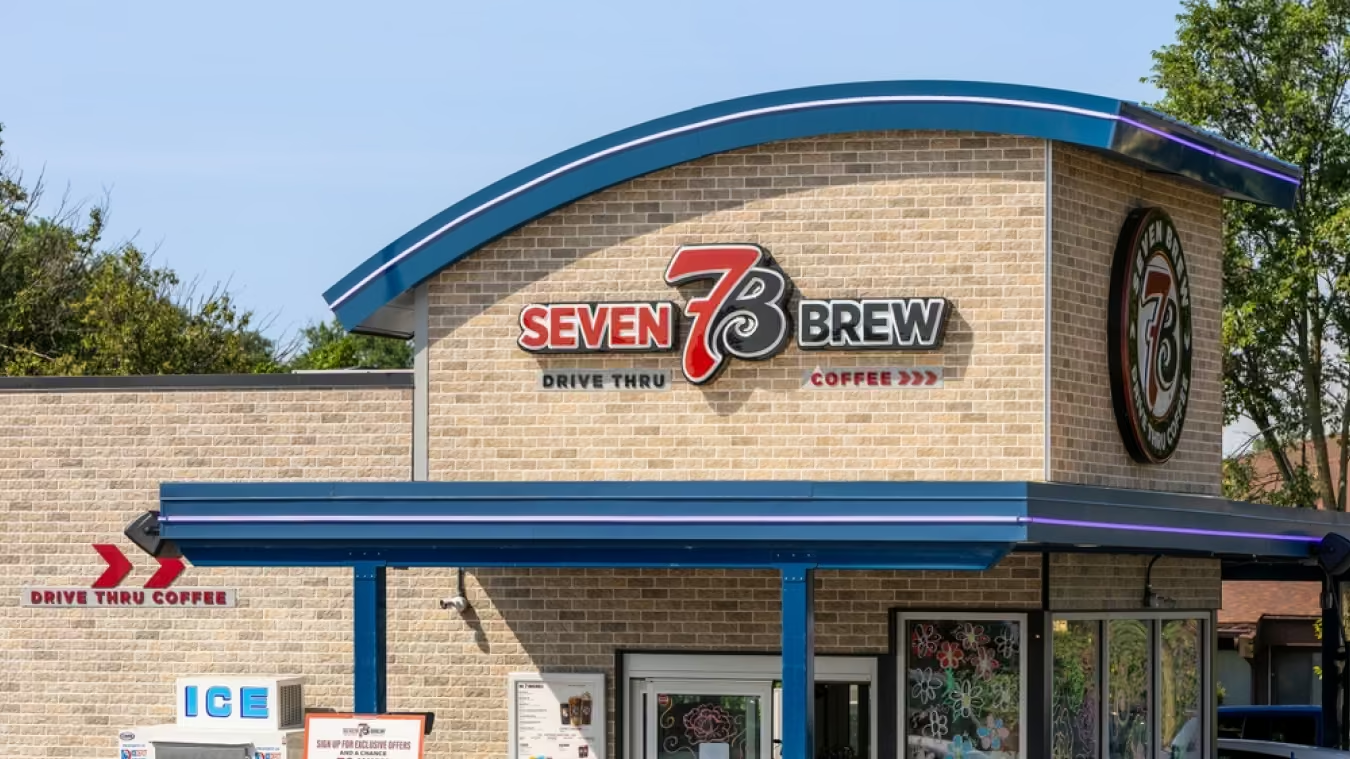
7 Brew's Rapid Rise 
7 Brew Coffee’s explosive expansion is driving strong traffic growth per location, outpacing rivals and reshaping the drive-thru coffee market.
Shira Petrack
Dec 31, 2025
2 minutes

7 Brew’s Explosive Growth 

7 Brew Coffee may be the fastest-growing coffee chain in the US right now. The chain surged from just 14 locations at the start of 2022 to around 500 locations by October 2025. And average visits per location also increased significantly – indicating that despite the breakneck expansion, the drive-thru brand still has significant runway left to grow.   

The chain's hypergrowth has been fueled by significant capital, including an equity investment from Blackstone in 2024 and a massive franchise agreement with the Flynn Group to develop an additional 160 stores. With a modular building model that allows for rapid deployment, 7 Brew is positioned to aggressively challenge major drive-thru competitors like Dutch Bros and Scooter's Coffee.

Riding the Drive-Thru Wave 

7 Brew's success can also be linked to a broader rise in drive-thru-centric coffee concepts. The chart below illustrates the shifting category dynamics in recent years as leading drive-thru coffee chains – with Dutch Bros in the lead – commanding a growing share of overall coffee visits since 2019. 

Even amid the broader rise of drive-thru coffee chains, 7 Brew’s growth continues to stand out. While the brand still holds a relatively small share of the overall coffee market, the brand’s proportional growth outpaces its peers, reflecting both aggressive unit expansion and strong consumer adoption. The chart also underscores how 7 Brew is increasingly carving out space within a segment historically dominated by brands like Dutch Bros – suggesting meaningful long-term competitive potential.

With drive-thru coffee continuing to surge in popularity and consumers gravitating toward convenience-forward formats, 7 Brew is well positioned to continue capturing incremental market share and solidifying its status as one of the fastest-rising brands in the category.

For more data-driven retail insights, visit placer.ai/anchor

Placer.ai leverages a panel of tens of millions of devices and utilizes machine learning to make estimations for visits to locations across the US. The data is trusted by thousands of industry leaders who leverage Placer.ai for insights into foot traffic, demographic breakdowns, retail sale predictions, migration trends, site selection, and more.

Reports
INSIDER
Report
Crafting Targeted Promotions in 2025: A Regional Perspective
Dive into the data to see how consumer response to major promotional events – from Black Friday and the back-to-school shopping rush to brand-crafted LTOs – varies by market.
June 19, 2025

Key Takeaways

1. The Midwest is the only region where Black Friday retail visits outpace Super Saturday.

But several major Midwestern markets, including Chicago and Detroit, actually see higher shopper turnout on Super Saturday.

2. Holiday season demographic shifts also vary across regions. 

Nationwide, electronics stores see a slight uptick in median household income (HHI) in December – yet in certain markets, electronics retailers such as Best Buy see a drop in captured market median HHI during this period. 

3. Back-to-school shopping starts earliest for clothing and office supplies retailers in the South Central region, likely tied to earlier school schedules. 

But back-to-school visits surge higher for these retailers in the Northeast later in the season. 

4. The share of college students among back-to-school shoppers varies by region

In August 2024, “Collegians” made up the largest share of Target’s back-to-school shopping crowd in New England, and the smallest in the West. 

5. Mother’s Day drives the biggest restaurant visit spikes in the Middle Atlantic Region, while Father’s Day sees its biggest boosts in the South Atlantic states

Mother’s Day diners also tend to travel farther to celebrate, suggesting an extra effort to treat mom. 

6. Western states proved particularly responsive to McDonald’s recent Minecraft promotion. 

During the week of A Minecraft Movie’s release, the promotion drove significantly higher visit spikes in the West than in the Eastern U.S.

Zooming in on Local Trends

Retailers rely on promotional events to fuel sales – from classics like Black Friday and back-to-school sales to unique limited-time offers (LTOs) and pop-culture collaborations. Yet consumer preferences and behavior can vary significantly by region, making it critical to tailor campaigns to local markets. 

This report dives into the data to reveal how consumers in 2025 are responding to major retail promotions, exploring both broad regional trends and more localized market-level nuances. Where is Black Friday most popular, and which areas see a bigger turnout on Super Saturday? Where are restaurants most packed on Mother’s Day, and where on Father’s Day? Which region kicks off back-to-school shopping – and where are August shoppers most likely to be college students? And also – which part of the country went all out on McDonald’s recent Minecraft LTO? 

Read on to find out. 

The Holiday Season: A Regional Story

Promotions aimed at boosting foot traffic on key holiday season milestones like Black Friday and Super Saturday are central to retailers’  strategies across industries. The day after Thanksgiving and the Saturday before Christmas typically rank among in-store retail’s busiest days, last year generating foot traffic surges of 50.1% and 56.3%, respectively, compared to a 12-month daily average. And 

But a closer look at regional data shows that these promotions land differently across the country. In the Midwest, Black Friday outperformed Super Saturday last year, fueling the nation’s biggest post-Thanksgiving retail visit spike – a testament to the milestone’s strong local appeal. Meanwhile, in the Western U.S. Black Friday trailed well behind Super Saturday, though both milestones drove smaller upticks than in other regions. And in New England and the South Central states, Super Saturday achieved its biggest impact, suggesting that last-minute holiday specials may resonate especially well in that area. 

Plenty of Local Variety

Digging deeper into major Midwestern hubs shows that even within a single region, holiday promotions can produce widely different responses.

In St. Louis, Indianapolis, and Minneapolis, for example, consumers followed the broader Midwestern pattern, flocking to stores on Black Friday exhibiting less enthusiasm for Super Saturday deals. By contrast, Chicago and Detroit saw Super Saturday edge ahead, with Chicago’s Black Friday peak falling below the nationwide average of 50.1%.  examples highlight the power of local preferences to shape holiday campaign results.  

Differing Demographic Shifts Across Regions

Holiday promotions don’t just drive visit spikes; they also spark subtle but significant changes in the demographic profiles of brick-and-mortar shoppers, expanding many retailers’ audiences during peak periods. And these shifts, too, can vary widely across regions. 

Outlet malls, department stores, and beauty & self-care chains, for instance, which typically attract higher-income consumers, tend to see slight declines in the median household incomes (HHI) of their visitor bases in December. This dip may be due to promotions drawing in more mid- and lower-income shoppers during the peak holiday season. Electronics stores and superstores, on the other hand, which generally serve a less affluent base, see modest upticks in median HHI in the lead-up to Christmas. 

But once again, drilling further down into regional chain-level data reveals more nuanced regional patterns. Take Best Buy, a leading holiday season electronics destination. In some of the chain’s biggest, more affluent markets – including New York, Los Angeles, and Chicago – the big-box retailer sees small dips in median HHI during December. But in Atlanta and Houston – also relatively affluent, but slightly less so – December saw a minor HHI uptick, hinting at a stronger holiday rush from higher-income shoppers in those cities. 

Back-to-School Bonanzas

Back-to-school promotions also play a pivotal role in the retail calendar, with superstores, apparel chains, office supply stores and others all vying for shopper attention. And though summer markdowns drive increased foot traffic nationwide, both the timing of these shifts and the composition of the back-to-school shopping crowd differ among regions. 

A Southern Head Start

Analyzing weekly fluctuations in regional foot traffic to clothing and office supplies stores shows, for example, that back-to-school shopping picks up earliest in the South Central region, likely due to earlier school start dates. 

But the biggest visit peaks occur in the Northeast – with clothing retailer foot traffic surging in New England in late August, and office supplies stores seeing an even bigger surge in the Middle Atlantic region in early September. Retailers and advertisers can plan their back-to-school deals around these differences, targeting promotions to local trends. 

A New England Collegian Affair

Though K-12 families drive much of the back-to-school rush, college student shoppers also play a substantial role. And here, too, their participation varies by region. 

For instance, the “Collegians” segment accounted for 2.2% of Target’s shopper base nationwide over the past year – rising to 3.0% in August 2024. But regionally, the share of “Collegians” soared as high as 4.0% in New England versus just 2.2% in the West. So while retailers in New England may choose to lean into the college vibe, those in Western states may place greater emphasis on families with children.

Mother’s Day and Father’s Day: Differing Dining Peaks 

When it comes to dining, Mother’s Day and Father’s Day are the busiest days of the year for the full-service restaurant (FSR) category, as families treat their parents to a hassle-free meal out. And eateries nationwide capitalize on this trend by offering a variety of deals and promotions that add a little extra charm (and value) to the experience. 

Atlantic Specials

Nationwide, Mother’s Day drives more FSR foot traffic than Father’s Day – except in parts of the Pacific Northwest, where Father’s Day traditions run especially deep. Still, the size of these holiday boosts varies substantially by region.  

This year, for instance, Mother’s Day (May 11, 2025) drove the largest FSR surge in the Middle Atlantic, with the South Atlantic and Midwest not far behind. Father’s Day, by contrast, saw its biggest lift in the South Atlantic. Mother’s Day proved least resonant in the West, whereas Father’s Day had its smallest impact in New England.

Going the Extra Mile for Mom

Dining behavior also differs between the two occasions. Mother’s Day celebrants display a slight preference for morning FSR visits and a bigger one for afternoon visits, while Father’s Day crowds favor evenings – perhaps reflecting a preference for sports bars and later dinners with dad. Another interesting nuance: On Mother’s Day, a larger share of FSR visits originate from between 3 and 50 miles away compared to Father’s Day, suggesting that families go the extra mile – sometimes literally – to celebrate mom. 

Self-Styled Celebrations: Driving Traffic with DIY Milestones

While established dates like Black Friday or Mother’s Day naturally spur promotions, brands can also craft their own moments with limited-time offers (LTOs). And much like holiday campaigns, these retailer-led events can produce varied outcomes across different regions.   

Fast food restaurants, for example, have leaned heavily on limited-time offers (LTOs) and pop-culture tie-ins to fuel buzz in what remains a challenging overall market. And McDonald’s recent Minecraft promotion, launched on April 1, 2025 to coincide with the April 3 release of A Minecraft Move, shows just how impactful the practice can be. 

Nationally, the Minecraft promotion (featuring offerings for both kids and adults) drove a 6.9% lift in visits during the movie’s opening week. But the impact of the promotion was far from uniform across the U.S. Many of McDonald’s Western markets – including Utah, Idaho, Nevada, California, Texas, Arizona, Colorado, and Oregon – recorded visit lifts above 10.0%. Meanwhile, Kentucky saw a 2.1% dip, and several other Eastern states registered modest gains below 3.0%. The McDonald’s example illustrates the power of regional tastes to shape the success of even the most creative pop-culture collabs.

Adopting a Regional Lens

Whether it’s properly timing holiday and back-to-school discounts, recognizing where Mother’s Day or Father’s Day will resonate more, or pinpointing markets that respond best to pop-culture tie-ins, the data reveals that effective promotions depend heavily on local nuances. And by analyzing regional and DMA-level trends, retailers and advertisers can craft compelling, relevant campaigns that heighten engagement where it matters most. 

INSIDER
Report
Rethinking the Mall Anchor in 2025: A Visit-Focused Approach
Discover how mall anchors are transforming in 2025 – and how a foot-traffic-focused approach to choosing key tenants can drive visits and shopper engagement.
May 29, 2025
8 minutes

Key Takeaways 

1. Experiential and niche retailers can deliver anchor-level traffic. At Towne East Square Mall, the addition of a Scheels in 2023 significantly increased foot traffic and long-distance travelers, while Barnes & Noble at Coronado Center in Albuquerque has become a key driver of both foot traffic and higher-spend demographics. 

2. Size isn’t everything – especially for dining venues. At Glendale Galleria and Northridge Fashion Center, smaller restaurants attracted more foot traffic than some traditional anchors.  

3. Refocusing on tenants’ actual traffic contributions enables a flexible anchor approach. Balancing weekend draws like Scheels with weekday favorites such as Costco or Chick-fil-A can help maintain steady visitor flow throughout the week. Similarly, onsite fitness clubs can shift traffic to earlier in the day – an opportunity to adjust store hours and capture additional morning shoppers. 

4. Temporary pop-ups can form an integral part of a visit-focused anchor strategy. The Barbie Dreamhouse Living Truck Tour generates mall visit spikes well above typical Saturday levels. Operators can integrate these events into their overall anchor strategies, offering preferential terms to high-performing pop-ups. 

5. New tenants can boost traffic for existing stores in similar categories. After Aldi joined Green Acres Commons in February 2020, visits to an existing BJ’s Wholesale Club trended upwards. This synergy highlights how overlapping audiences can become a strength, creating a larger overall customer base. 

The Retail Comeback Kid 

Malls, it seems, are cool once again. After languishing in the wake of the pandemic, shopping centers across the country are thriving – reinventing themselves as prime “third places” where people can hang out, shop, and grab a bite to eat. 

One key driver behind this resurgence is a shift in how malls view their anchor tenants. While traditional mainstays like Macy’s and JCPenney still play an important role, specialized offerings – from popular eateries to fitness centers and immersive retailtainment destinations – are increasingly taking center stage. These attractions maximize the experiential value that brick-and-mortar venues can deliver, driving visits and sales for the center as a whole. 

Against this backdrop, this report leverages the latest location intelligence data to explore the types of tenants that can function as mall anchors in 2025. Should mall operators still focus on general merchandisers to draw crowds, or can dining chains and more niche retailers also do the job? How important is square footage in identifying the anchor-like tenants in a shopping center? And how can a visit-focused approach help mall operators select effective anchor or anchor-like tenants – whether to fill big-box spaces or to leverage the leasing perks traditionally reserved for major large-format chains? 

Out-of-the-(Big)-Box Visit Drivers

One of the most important functions of a mall anchor is to ensure steady visitation – providing its smaller tenants with a constant flow of potential customers. And as the role of the mall continues to evolve, analyzing the actual foot traffic impacts of different types of businesses can help identify the kinds of non-traditional anchors best suited to fulfill that purpose. 

The Power of a Well-Placed Scheels

Experiential venues, for example, are particularly well-poised to serve as powerful anchors in today’s retail environment – as illustrated by the visit surge experienced by Towne East Square Mall in Wichita, KS following the addition of a Scheels in July 2023. 

By blending traditional retail with immersive experiences, Scheels has emerged as a true experiential destination. And this pull has also helped the mall draw more long-distance visitors willing to travel to enjoy Scheels’ offerings. In 2024, 41.9% of the mall’s customers traveled more than 50 miles to visit, compared to 35.8% back in 2018 when Sears occupied the same lot. 

The Barnes & Noble Effect

Traditionally, anchors aimed to please the widest possible audiences – with department stores, big-box chains, and grocery stores leading the way. But visitation data shows that niche concepts can also deliver anchor-level traffic if they’re compelling enough to attract dedicated fans. 

The experience of the Barnes & Noble at Coronado Center in Albuquerque, NM is a case in point. After being written off as all but obsolete, Barnes & Noble has staged an impressive comeback in recent years, finding success through a more curated, localized approach to book selling. And despite not being a formal anchor, the Coronado Center Barnes & Noble accounted for 7.9% of visits to the mall in 2024 – outperforming both Macy’s and JCPenney.

Year-over-year data also shows foot traffic surging at the Coronado Center Barnes & Noble, lifting overall visitation to the mall. And demographic data reveals that the bookstore draws a more affluent audience than either the center as a whole or the two department stores – attracting a crowd with more spending power.

This example also illustrates how smaller tenants can sometimes draw larger crowds. Even though Barnes & Noble occupies a smaller onsite space than either Macy’s or JCPenney, it is proving a powerful visit driver out of proportion to its physical size. 

Dining Chains Punching Above Their Size

Dining chains are also adept at punching above their square footage – often attracting crowds disproportionate to their size.

Despite its relatively small footprint, for example, the In-N-Out Burger at Glendale Galleria drew an impressive 8.6% of visits to the mall complex in 2024, outpacing some of the mall’s official anchors like DICK’s Sporting Goods, Macy’s, and JCPenney. Still, the onsite Target drew even larger crowds at 14.4% of visits. 

A similar pattern emerged at Northridge Fashion Center, where Porto’s Bakery and Cafe captured a notable 15.6% of visits to the complex in 2024 – more than some of the center’s traditional department stores. 

These examples underscore the potential for dining chains, which typically require less space, to serve as micro-anchors by consistently attracting outsized crowds – a key consideration for mall operators looking to sustain visitor traffic. 

Choosing a Mall Anchor in 2025

Refocusing on tenants’ actual foot traffic contributions also opens the door to a more flexible and dynamic approach to anchor selection and management – one that considers each venue’s unique visitation patterns. 

The Weekend/Weekday Divide

Seasonal factors, for example, can make certain anchors more powerful at specific times of the year, while different venues shine on particular days of the week.

At Jordan Creek Town Center in West Des Moines, Iowa, for instance, Scheels and Costco each delivered just under 20.0% of the complex’s overall visits in 2024. But the two retailers’ daily patterns differed significantly: Scheels saw bigger crowds on weekends, while Costco was the primary weekday destination. 

Understanding differences like these can help operators optimize their tenant mix to maintain a balanced flow of shoppers throughout the week.

Another example of the impact of differing weekday traffic patterns is offered by the impact of mall-based Chick-fil-A locations on the distribution of mall visits throughout the week. 

Despite its relatively small size, Chick-fil-A draws substantial traffic to malls. And after adding Chick-fil-A locations, both Northridge and Miller Hill Malls saw meaningful drops in the share of visits to the centers taking place on Sundays – even as the wider indoor mall segment saw slight upticks. 

Recognizing this trend could prompt mall operators to compensate by adding more weekend-friendly traffic drivers – or to lean into this distinction by taking additional steps to bolster the mall’s role as a go-to weekday destination. 

The Early-Morning Fitness Advantage

The power of different mall traffic magnets also varies throughout the day. Increasingly, shopping centers are turning to fitness centers as experiential anchors. And since many people work out early in the morning, these gyms are having a significant impact on the distribution of mall visits across dayparts. 

The addition of gyms to Northshore Mall in Peabody, MA and Jackson Crossing in Jackson, MI, for instance, led to a significant rise in visits between 7:00 AM and noon. And though the rest of the stores in these malls typically open at 10:00 or 11:00 AM, this shift presents the centers with a significant opportunity. 

By adjusting opening hours to accommodate these early-morning patrons, malls can capitalize on this added traffic, driving up visits and sales for relevant tenants – especially health-focused retailers such as juice bars and sporting goods stores.

Adding Temporary Pop-Ups Into the Mix 

Adopting a broader, visit-focused view of anchoring also allows mall operators to apply some of the strategies typically reserved for anchors to non-conventional traffic-generating businesses, to ensure a consistent flow of traffic year-round.

Pop-up stores and events, for example, generally don’t follow the same seasonal trends as other retailers – instead, they generate short-term visit boosts during their runs, whenever in the year that may be. And a visit-focused anchor strategy can leverage some of the perks traditionally reserved for anchor tenants – such as preferential leasing terms – to complement traditional full-time anchors during slower retail periods.  

The Barbie Dreamhouse Living Truck Tour is a prime example of a traffic-driving pop-up. By bringing exclusive merchandise to malls across the U.S., the truck generates plenty of buzz, drawing crowds eager to snatch up limited-edition items and immerse themselves in all things Barbie. As a result, malls hosting the tour often see significant visit spikes, with foot traffic surging well above typical Saturday levels. Well-timed pop-ups like these can help balance out traffic throughout the year, offsetting traditional slow periods.

Creating a Bigger Visit Pie

A visit-focused approach to anchor management can also help mall operators assess the potential impact of new tenants on existing stores operating in similar categories. For example, mall owners often worry that new tenants operating in similar categories might cannibalize existing businesses. But a visit-focused anchor approach reveals that a well-chosen addition can sometimes benefit current tenants – especially if they cater to similar audiences. 

In February 2020, for instance, value supermarket Aldi opened at Green Acres Commons in Valley Stream, NY – a center that already hosted budget-friendly BJ’s Wholesale Club. While BJ’s visits were relatively flat in 2018 and 2019, they began to rise after Aldi’s opening (and following a pandemic-induced dip). Cross-shopping data also shows that Aldi customers were more likely to visit BJ’s than the average Green Acres patron last year.

This synergy may be due in part to the two retailers’ similar visitor bases: In 2024, the Aldi and BJ’s stores in Green Acres Common drew shoppers with comparable economic profiles. This suggests that overlapping audiences can become a strength if aligned brands attract new shoppers, who then explore multiple stores in the same center.

Anchor’s Away

Looking ahead, effective mall anchors will be defined less by physical footprint and more by their capacity to maintain consistent, valuable foot traffic. While traditional department stores remain pivotal, smaller or niche brands can often rival – or surpass – large-format retailers. And by thinking out of the anchor box and choosing tenants that cultivate a balanced visitor flow and align with local preferences, operators can position their centers as true go-to destinations. 

INSIDER
Report
Grocery in 2025: Visitation Trends and Consumer Behavior
Dive into the data to see the trends shaping the grocery space in 2025 and uncover actionable insights for strategic decision-making in the competitive food-at-home market.
May 15, 2025
8 minutes

Key Takeaways: 

1. Shoppers are taking more, shorter trips to grocery stores. Over the past 12 months, grocery stores have experienced nearly uniform YoY visit growth. And since COVID, the segment has steadily increased both overall visits and average visits per location – even as average dwell times have consistently declined.

2. Grocery stores are holding ground against fierce competition. Despite growing inroads by discount and dollar stores, wholesale clubs, and general mass retailers like Walmart and Target, grocery stores have maintained their share of the overall food-at-home visit pie over the past several years. 

3. Grocery visit share is most pronounced on the coasts. In Q1 2025, grocery stores claimed the majority of food-at-home visits on the West Coast, in parts of the Northeast, Mid-Atlantic, and Mountain Regions, and in Florida and Michigan.

4. Fresh-format, value, and ethnic grocery visit shares are growing at the expense of traditional chains. And in Q1 2025, fresh-format and value grocers outperformed the other sub-segments with positive YoY visit and average visit-per-location growth. 

5. Hispanic markets are on the rise. Though the broader ethnic grocery sub-segment was essentially flat YoY in Q1 2025, Hispanic-focused stores recorded increases in both visits and visits per location – and have been steadily growing visits since 2021. 

6. Smaller formats for the win. In Q1 2025, smaller-format grocery store locations outpaced mid-sized and larger-format ones, underscoring the power of compact spaces to deliver significant foot traffic gains. 

A Study in Resilience

Brick-and-mortar grocery stores face an uncertain market in 2025. Rising food-at-home prices (eggs, anyone?), declining consumer confidence, and increased competition from discounters, superstores, and online shopping channels all present the segment with significant headwinds. Yet even in the face of these challenges, the sector has demonstrated remarkable resilience – growing its foot traffic and holding onto visit share.  

What strategies have helped the segment navigate today’s tough market? And how can industry stakeholders make the most of the opportunities in the current market? This report draws on the latest location intelligence to uncover the trends shaping grocery retail in early 2025 – highlighting insights to help key players make informed, data-driven decisions on store formats, product offerings, and more. 

Growth in Aisle One

The grocery segment has experienced nearly uniform positive year-over-year (YoY) growth over the last 12 months. This sustained performance in the face of inflation and other headwinds highlights the underlying strength of the category.

Visits Up, Dwell Time Down

What is driving this growth? Since 2022, the grocery segment has seen consistent overall visit growth that has outpaced increases in visits per location – a sign that chain expansion has played a key role in the category’s success. But the average number of visits to each grocery store has also been on the rise, indicating that the segment continues to expand without cannibalizing existing store traffic. 

At the same time, visitor dwell times have been steadily dropping since 2021. This shift appears to reflect a trend towards multiple, shorter trips by inflation-wary consumers eager to avoid large, costly carts or cherry pick deals across various retailers. Many shoppers may also be placing more bulk orders online and supplementing those deliveries with brief in-store stops for additional items as needed. 

The bottom line: Shoppers are taking more grocery trips overall each year, but spending less time in-store during each visit. Operators can respond to this trend by optimizing layouts and promoting “grab-and-go” areas for an even more efficient quick-trip experience.

Still in Stock

Visit share data also shows that despite fierce competition from discount and dollar stores, wholesalers, and general mass retailers, the grocery segment has steadfastly preserved its share of the overall food-at-home visit pie. 

Between Q1 2019 and Q1 2025, wholesale clubs and discount and dollar stores increased their share of total food-at-home visits, gains that have come primarily at the expense of Walmart and Target. Meanwhile, grocery outlets have held firm – despite some fluctuations over the years, their Q1 2019 visit share remained essentially unchanged in Q1 2025. 

So even as consumers flock to alternative food purveyors in search of lower prices, grocery stores aren’t losing ground – and on a nationwide level, they remain the biggest player by far in the food-at-home shopping space.

A Coastal Advantage

Still, grocery store visit share varies significantly by region. On the West Coast, in parts of the Northeast, Mid-Atlantic, and Mountain regions, and in Florida and Michigan, grocery stores accounted for the majority of food-at-home visits in Q1 2025. Oregon (61.6%) and Washington (59.6%) led the pack, followed by Massachusetts (59.2%), Vermont (58.5%), and California (57.9%). Meanwhile, in West Virginia, Arkansas, South Dakota, Oklahoma, North Dakota, and Mississippi, less than 30% of food-at-home traffic went to grocery stores, with more shoppers in these regions turning to general mass retailers or discounters. 

Grocery store operators in lower-grocery-share regions may choose to focus on price competitiveness and convenient store locations to capture more foot traffic from competitors in the space.

Fresh and Frugal on the Rise

Which types of grocery stores are thriving the most? The grocery segment is diverse, encompassing traditional grocery chains like Kroger, Safeway, and H-E-B; budget-oriented value chains such as Aldi, WinCo Foods, Grocery Outlet Bargain Market, and Market Basket; fresh-format specialty brands like Trader Joe’s, Whole Foods, and Sprouts Farmers Market; and numerous ethnic grocers. 

Examining shifts in visit share among these various grocery store segments shows that traditional grocery still dominates, commanding over 70.0% of total grocery store foot traffic. 

Still, over the past several years, traditional grocers have gradually ceded ground to other segments – especially value chains. Budget grocers saw a temporary surge in visits during the panic-buying days of early 2020 – and have been more gradually gaining visit share since Q1 2023. . Fresh-format banners, which lost ground in 2021 after a Q1 2020 bump,  in the wake of COVID, have also been on the upswing and appear poised to capture additional visit share in the coming months and years. And though ethnic grocers still account for a relatively small portion of the overall market, they have slightly increased their visit share, reflecting heightened consumer interest in these specialized offerings.

The Discount and Premium Edge

Recent performance metrics point to a bifurcation in the grocery market similar to that observed in other retail categories. In Q1 2025, fresh-format and value retailers – which appeal, respectively, to the most and least affluent visitor bases – saw the greatest growth in both overall visits and average visits per location. 

This trend highlights the power of both value and health-focused quality to motivate consumers in 2025. And grocery players that can meet these needs will be well-positioned for success in the months ahead.

WFH Fresh-Format Lunch Crunch

One factor fueling fresh-format’s success may be its role as a convenient, relatively affordable midday lunch destination for the remote work crowd. 

In Q1 2025, consumers working from home accounted for 20.2% of fresh-format grocery stores’ captured market – a significantly higher share than any other analyzed grocery segment. These stores also tended to be busier midday than the other segments. Remote workers may be stopping by to grab a quick bite – and some may be choosing to do their grocery shopping during their lunch break when stores are less crowded. 

This finding suggests an opportunity for grocery operators across all segments to develop or enhance in-store salad bars and quick-serve sections to tap into the lunch rush. Likewise, CPG companies may benefit from developing more ready-made, nutritious meal options that align with these midday dining habits.

Salsa Surge

Though the broader ethnic grocery category remained essentially flat in Q1 2025, Hispanic-focused grocers emerged as a sub-segment to watch. Both overall visits and average visits per location to these stores have been on the rise since 2021. 

This robust demand presents an opportunity for CPG brands and grocers across segments to expand Hispanic-focused offerings, capturing a slice of this growing market.

Less is More

Finally, store size matters more than ever in 2025. During the first quarter of the year, smaller format grocery store locations (locations under 30K square feet, across different chains) outpaced larger stores with a 3.2% YoY jump in visits, showing that bigger isn’t always better in the grocery store space. 

This pattern aligns with the decrease in dwell times noted above – shoppers may be making shorter trips to smaller, more convenient grocery store locations. These quick errands are ideal for picking up a few items to supplement online orders, shopping multiple deals, or sourcing specialty products unavailable at larger grocery destinations. And to lean into this trend, grocery operators might consider testing neighborhood “micro-store” concepts, focusing on curated selections, and offering convenient parking or pickup to match consumer preferences for targeted purchases and quicker trips.

Final Thoughts

Location intelligence reveals a growing, dynamic grocery landscape which is holding its ground in the face of increased competition. Shorter trips, busier lifestyles, and changing work routines are reshaping in-store experiences. And grocery players that refine their store formats, target both lunch and on-the-go shoppers, and adapt to shifting demographics can position themselves to thrive in this competitive sector. As the market continues to evolve, continuous attention to these changing patterns will be key to maintaining and expanding market share.

Loading results...
We couldn't find anything matching your search.
Browse one of our topic pages to help find what you're looking for.
For more in-depth analyses on a variety of subjects, explore Reports.
The Anchor Logo
INSIDER
Stay Anchored: Subscribe to Insider & Unlock more Foot Traffic Insights
Gain insider insights with our in-depth analytics crafted by industry experts
— giving you the knowledge and edge to stay ahead.
Subscribe