.png)
.png)

.png)
.png)

Darden Restaurants, Inc. operates a portfolio that includes some of the biggest names in full-service dining, including Olive Garden, LongHorn Steakhouse, Cheddar’s Scratch Kitchen, Yard House, Ruth’s Chris Steak House, Bahama Breeze, and Eddie V’s Prime Seafood.
How are these restaurants performing as Q3 2024 approaches? We took a closer look at the location analytics to find out which restaurant chains are thriving in today’s challenging economic climate.
Darden’s three largest restaurant chains – Olive Garden, LongHorn Steakhouse, and Cheddar’s Scratch Kitchen – are some of the best-known names in casual, full-service dining. These chains have a strong presence across the country and have experienced mainly positive YoY foot traffic this year so far.
Although foot traffic was lower YoY in January and April 2024, these dips can be attributed to external factors, such as January’s inclement weather and an April calendar shift (i.e. the timing of Easter, as well as the extra Saturday in April 2023). And in May the three chains quickly rebounded, ending the month with respective YoY visit increases of 2.4%, 6.4%, and 2.3%.

Darden operates various smaller brands offering different dining styles and price points, ranging from upscale options like Eddie V’s and Ruth’s Chris Steakhouse to more casual spots like Bahama Breeze and Yard House. These smaller chains also experienced strong visitation patterns in early 2024 – with May YoY visits up between 3.9% and 8.5%.

Darden’s strong February and May showings were likely fueled, in part, by two distinctly important days on the Darden restaurant calendar: Valentine’s Day and Mother’s Day.
In absolute terms, Olive Garden – Darden’s largest chain by far – drew the most visits on both holidays as compared to a January 1, 2024 baseline, claiming the top spot this year as America’s favorite Mother’s Day destination. But on a relative basis, Darden’s premium brands Eddie V’s and Ruth Chris experienced the biggest visit spikes, as people splurged on celebratory outings. And laid-back chain Bahama Breeze saw a sustained visit boost from Valentine’s Day through Mother’s Day, likely owing to its strong presence in Florida – making it an attractive destination for the snowbirds and vacationers who visit the state during the winter.
And surprisingly, even casual dining venue Yard House – known for its beer and sports atmosphere rather than romantic setting – experienced a Valentine’s Day visit boost. This suggests that there is a tangible benefit from these holidays across a wide range of dining styles – and restaurant operators can use these insights to encourage visits on such occasions.

Darden continues to attract customers to its restaurants in spite of a challenging economy by offering a variety of dining choices and capitalizing on popular dining-out occasions such as Mother’s Day and Valentine’s Day.
Will the company’s visit growth continue to trend upward as 2024 wears on?
Follow Placer.ai for the latest data-driven dining insights.

After a frigid start to the year, how have retail and dining foot traffic fared in the subsequent months? We dove into the data to find out.
Last year was all about experiences. But in 2024, consumer demand is once again striking a balance between “fun and stuff.” Though both retail and dining foot traffic were weighed down by January 2024’s extreme temperatures, the two categories bounced back in February, going on to see consistently positive YoY foot traffic growth through May.
May 2024’s strong showing was likely driven in part by impressive visit boosts on two important calendar highlights: Mother’s Day weekend and Memorial Day weekend. On both of these occasions, retail and dining foot traffic outperformed 2023 levels, a further sign of consumer resilience this year.

And drilling down deeper into data shows that some of this dining growth is being driven by full-service restaurants – another sign that the segment may be experiencing a comeback.
For quite some time, casual dining concepts – including both fast-casual & QSR – have had the upper hand among dining formats, as consumers sought inexpensive ways to splurge and cut back on full-service indulgences. But FSR has begun to rally, with experiential concepts, eatertainment, and breakfast-first chains driving significant traffic.
And location analytics points to a much more level playing field this year, with FSR YoY visit growth outperforming fast-casual & QSR in both March and in May. May’s visit boost in particular was likely aided by holiday visits – on both Mother’s Day and Memorial Day, full-service restaurants drew outsize crowds eager to enjoy nice meals out with friends and family.

A look at statewide visit data for both fast-casual & QSR and for full-service chains during the past three months – comparing March to May 2024 to the equivalent period of last year – shows both segments doing remarkably well throughout most of the U.S.
In the fast-casual & QSR space, all 50 states enjoyed positive YoY visit growth over the past three months – led by North Dakota (6.8%), New Hampshire (5.3%), Minnesota (5.1%), New Mexico (4.3%), and Rhode Island (4.2%). And in FSR, 42 states enjoyed positive growth – with some of the same states, including Rhode Island, New Hampshire, and New Mexico, claiming top spots.

Will full service continue its turnaround in the second half of 2024 and can fast-casual & QSR maintain its strength? How will overall retail traffic fare during the summer months and critical back-to-school season?
Visit Placer.ai to find out.

Hilton Hotels & Resorts and InterContinental Hotels Group (IHG) are two of the biggest names in lodging. The two companies operate a wide range of hotel brands, ranging from luxury chains to budget options. And falling in the middle of this range are two midscale hotel chains: TRU by Hilton and avid Hotels, operated by IHG.
What can foot traffic and demographic data reveal about the preferences of visitors to these chains? We took a closer look.
TRU by Hilton and avid Hotels both opened their first locations in 2017, with the goal of offering travelers modern and comfortable accommodations while eschewing the amenities typically associated with more luxurious hotel categories. By streamlining services, these hotels can appeal to a diverse range of travelers while maintaining a lower price point.
The two hotel chains have expanded since their openings, with TRU operating 279 locations and avid operating 70 nationwide as of May 2024. And this expansion seems to be paying off for both brands, helping drive YoY monthly visit increases. Since June 2023, visits to the two chains have been consistently elevated YoY, save for a few minor visit lags at TRU.
Hilton and IHG both hope to continue expanding their midscale hotel concepts, with projects in the pipeline for 2024 and beyond. And diving into the demographics can help the hotels identify their strengths and plan out marketing strategies more effectively.

Analyzing the psychographic makeup of TRU and avid’s trade areas by layering Spatial.ai’s PersonaLive dataset onto the two chains’ captured markets reveals that despite their budget offerings, both hotels appeal to economically diverse audiences.
Between June 2023 and May 2024, TRU and avid both attracted visitors from areas with higher-than-average shares of both “Ultra Wealthy Families” and “Blue Collar Suburbs.” The chains’ ability to appeal to both groups shows that their no-frills offerings are appreciated not just by the most price-conscious customers, but also by those with more room in their budgets to splurge.

Still, TRU drew a greater share of visitors over the analyzed period from areas over-indexed for “Ultra Wealthy Families'' – while avid drew slightly more customers from areas over-indexed for “Blue Collar Suburbs.” And diving deeper into the demographic and psychographic characteristics of TRU’s and avid’s captured markets shows that though both chains have broad appeal, there are some differences between their customer bases.
The median household income (HHI) of TRU’s captured market stood at $79.4K during the analyzed period – above the nationwide median – while that of avid remained slightly below it. And while avid’s captured market included a higher-than-average share of “Young Urban Singles” (also from Spatial.ai’s PersonaLive dataset), TRU was more likely to attract “Suburban Boomers.” So while TRU draws a wealthier and more settled clientele, avid tends to attract younger, less established guests.
These differences serve as a reminder of the differences that exist even within similar accommodation categories, and may help the two chains when deciding how to market to their respective customer bases.

Both TRU and avid seem similar enough on paper – two midscale hotel chains, geared towards a traveler that prioritizes value and convenience. And while both chains attract a wide range of households to their venues, TRU tends to see a more affluent, established visitor, while avid seems to attract more guests who are starting out in life.
For more data-driven travel & leisure insights, visit Placer.ai.

With sales exceeding $148 billion in 2023, The Kroger Co. is a leading player in the grocery store space. In addition to its flagship eponymous brand, the company owns a variety of regional banners, including (among others) Fred Meyer, Harris Teeter, Ralphs, Smith’s Food and Drug, Fry’s Food Stores, King Soopers, and Food 4 Less.
We dove into the data to see how key Kroger chains are faring in 2024 – and to explore the different audiences served by the company’s varied portfolio.
With some 1255 locations across 19 states, Kroger is The Kroger Co.’s largest grocery banner by far. And between January and May 2024, visits to the chain accounted for 47.6% of overall foot traffic to the company’s grocery portfolio. The remaining 52.4% of visits went to The Kroger Co.’s smaller banners – with Fred Meyer, Ralphs, and Harris Teeter leading the charge.

And drilling down deeper into the regional distribution of the company’s various grocery banners shows that each chain serves a different area of the country.
Kroger’s eponymous banner holds sway throughout much of the Midwest and South – while Harris Teeter serves shoppers in Maryland, Florida, and the Carolinas. Meanwhile, Fred Meyer, Smith’s, Ralphs, Fry’s, and King Soopers dominate the Western United States. And throughout some parts of the Midwest, Kroger draws consumers with a variety of smaller banners.
Like that of Albertsons, Kroger Co.’s strategy of acquiring and maintaining regional brands has allowed the company to expand its footprint across the country – while catering to the needs and preferences of local shoppers. Indeed, Kroger’s footprint now extends across three of the four U.S. regions – the West, South, and Midwest – with only the Northeast lacking a Kroger Co. presence.

A look at recent visitation trends for Kroger Co.’s largest banners – i.e. those with at least 100 locations – shows that all experienced positive YoY visit growth in Q1 2024. The most impressive foot traffic bumps were seen by Mountain region banners Smith’s and King Soopers, followed by value-oriented Food 4 Less, and the South Atlantic-focused Harris Teeter.
On a monthly basis, too, The Kroger Co.’s major Banners saw nearly uniform YoY visit growth between January and May 2024.

Analyzing demographic differences among the trade areas of Kroger’s different chains shows how the company leverages its portfolio of banners to serve distinct customer bases.
Virginia, for example, is served by two Kroger Co. banners – Kroger and Harris Teeter. And while the former draws shoppers from areas with a median HHI below the statewide baseline of $87.2K, the latter – with somewhat more upscale, pricier offerings – attracts a much more affluent audience. Similar differences can be observed in Wisconsin – where Pick ‘n Save and Metro Market serve different demographics.
By offering a diverse spectrum of shopping experiences, The Kroger Co. strategically positions itself to maximize market penetration and appeal to a broad range of consumers.

The Kroger Co. entered 2024 with a bang. With its extensive reach and adaptive approach, can the grocery leader maintain its positive momentum throughout the rest of the year?
Visit our blog at Placer.ai to find out.

Post-March Madness, many of the NCAA women’s basketball players went on to the WNBA. Caitlin Clark to the Indiana Fever, Cameron Brink to the LA Sparks, and Angel Reese to the Chicago Sky were some of the most hotly anticipated draft picks. The newfound appetite for the WNBA is real. Take Gainbridge Fieldhouse in Indianapolis as an example. Just comparing the time period of April 30-May 31, 2023 vs April 30-May 31, 2024, there is a stark contrast in the number of attendees to home games. In just five games, attendance to this year’s Fever games has already surpassed that of the entire 2023 season.

The trade area draw is also something to note as the area from which 70% of visits originated practically doubled from May 2023 (blue) to May 2024 (red), showing the magnetic effect a star player can have.

This heightened interest is great news for concepts like The Sports Bra, a bar and restaurant based in Portland, Oregon. It’s 100% dedicated to women’s sports so you can be sure to catch your favorite female player on the screen. Since opening in the spring of 2022, it’s had steady business, and odds are with all the women’s sports to watch, there should be a busy summer ahead.

In addition, might the added exposure bring new fans to brands such as Wilson Sporting Goods, which signed Caitlin Clark? This familiar brand opened its first West Coast brick and mortar store on Santa Monica’s Third Street Promenade just about a year ago. Meanwhile, Angel Reese has signed on some big brands such as Reebok, Raising Cane’s and AirBnB. Former Stanford Cardinal and now LA Sparks superstar Cameron Brink is one of the faces of New Balance, and has starred in an ad with Shohei Otani and Coco Gauff.

Over Memorial Day Weekend, Wayfair opened its highly anticipated addition to the world of physical retail, something we've been waiting for since the company's large-format store plan first came into view in early 2022. Technically, Wayfair’s new mega-store, sized at 150,000 square feet in Wilmette, Illinois, isn’t its first foray into brick-and-mortar, but it is certainly its splashiest. In an era when many home furnishing retailers are going small, early indications from Placer show that betting big has yielded success in attracting visitors, but questions about the longevity of success and health of the broader home industry remain.
This week, we had a chance to visit the store ourselves, and it's immediately evident how much attention was put into the store. Most visitors enter through the "Market Square", which feature unique housewares, locally-relevant products, and seasonal merchandise. Above the Market Square is a large video board that showcases certain products and other digital media assets which help set the tone for the shopping experience.


According to the retailer, its first namesake location brings a new shopping experience to consumers and features its first food service offering, The Porch (below).

The store also features an expanded selection and one-on-one personal design services, which can be seen in store layout below. The new location clearly took learnings from other Wayfair-owned brands like Joss & Main or All Modern, each of which have also opened physical stores.

The Wilmette large format store opened on May 23, just in time for Memorial Day Weekend foot traffic, and the location greatly benefitted from the timing. According to Placer’s early reads from May 18-June 1, 2024, Wayfair’s visits accounted for almost half of the visits to Edens Plaza (below), the shopping center in which it’s located. Beyond that, during its opening weekend from May 23-27, it drove 60% of visits to the plaza. The shopping center is located right off the Edens expressway, and the store is visible from the road, which helping to draw the attention of travelers.

Wayfair’s debut is a clear victory for the shopping center, with the store’s first few weeks helping to attract new visitors to the center. Comparing the two week period before the store opening to the two weeks of its opening using Spatial.ai’s PersonaLive segments, the percentage of visits coming from trade areas from Ultra Wealthy Families--the typical center visitors--actually decreased from 45% to 32%. However, there was a large increase in the percentage of visits by Educated Urbanites and Young Professionals. Buzzworthy openings help to revitalize shopping centers and Wayfair’s initial success will hopefully provide some meaningful shifts in visitors beyond the first few weeks.

Home furnishing retailers, in particular, have made experiences and expanded service offerings a cornerstone of their strategies to foster a captive consumer audience and increase dwell time, and hopefully conversion. Looking at local home furnishing experiential retail locations in the Metro Chicago area, Wayfair’s opening splash is even more apparent with its two story, expansive footprint. Compared to the closest IKEA store (Schaumburg), Wayfair Wilmette's visits were 12% higher during its initial two-week period and saw 19% more visits than IKEA during the highest traffic day of opening weekend. The trade area of the two retailers, even in the first two weeks, starts to tell the story of the visiting consumer; Wayfair drove more visits despite having a smaller trade area than IKEA and more overlapping territory, and primarily pulled its visitors from the northern Chicago suburbs.

Wayfair’s early indicators of traffic highlight a combination of the right concept, the right consumer, and the right location. It will be fascinating to watch the long-term visit trends for Wayfair, especially compared to other large-scale regional furniture retailers. Despite many home furnishing retailers looking to smaller formats for growth, if Wayfair’s location sustains its traffic growth, larger-format stores may become an attractive solution for shopping centers to revitalize themselves.

1. Idaho and South Carolina have emerged as significant domestic migration magnets over the past four years. Between January 2021 and 2025, both states gained over 3.0% of their populations through domestic migration. Other Mountain and Sun Belt states – including Nevada, Montana, and Florida – also drew significant inflow, while California, New York, and Illinois experienced the greatest outmigration.
2. Interstate migration cooled noticeably in 2024. During the 12-month period ending January 2025, California, New York and Illinois saw their outflows slow dramatically, while domestic migration hotspots like Georgia, Texas, and Florida saw inflows flatten to zero. A similar cooling trend emerged on a CBSA level.
3. Still, some states continued to see notable relocation activity over the past year. In 2024, Idaho, South Carolina, and North Dakota drew the most relocators relative to their populations. And among the nation’s ten largest states, North Carolina led with an inflow of 0.4%.
4. Phoenix remained a rare bright spot among the nation’s ten largest metro areas. The CBSA was the only major analyzed hub to maintain positive net domestic migration through 2024.
Over the past several years, the United States has experienced significant domestic migration shifts, driven by factors like remote work, housing affordability, and regional economic opportunities. As some areas reap the benefits of population inflows, others grapple with outflows tied to higher living costs and evolving workplace dynamics.
This report dives into the location analytics to explore where Americans have moved since 2021 – and how these patterns began to change in 2024.
Since 2021, Americans have flocked toward warmer climates, expansive natural scenery, and more affordable housing options – particularly in the Mountain and Sun Belt states.
Between January 2021 and January 2025, South Carolina led the nation in positive net domestic migration – drawing an influx of newcomers equivalent to 3.6% of its January 2025 population. (This metric is referred to as a state’s “net migrated percent of population.”) Next in line was Idaho with a 3.4% net migrated percent of population, followed by Nevada, (2.8%), Montana (2.8%), Florida (2.1%), South Dakota (2.1%), Wyoming (2.0%), North Carolina (2.0%), and Tennessee (1.9%). Texas saw positive net migration of just 0.9% during the same period. However, the Lone Star State’s large overall population means a substantial number of newcomers in absolute terms.
Meanwhile, California (-2.2%), New York (-2.1%), and Illinois (-1.9%) experienced the greatest outflows relative to their populations. This exodus was driven largely by soaring housing costs and the rise of remote work, which lowered barriers to moving out of high-priced areas.
Between January 2024 and January 2025, many of the same broad patterns persisted, but at a more moderate clip – suggesting a stabilization of domestic migration nationwide. This leveling off could reflect factors such as rising mortgage interest rates, which dampened home buying and selling, as well as the increased push for employees to return to the office.
Still, South Carolina (+0.6%) and Idaho (+0.6%) remained among the top inflow states. The two hotspots were joined – and slightly surpassed – by North Dakota (+0.8%), where even modest waves of newcomers make a big impact due to the state’s lower population base. A wealth of affordable housing and a strong job market have positioned North Dakota as a particularly attractive destination for U.S. relocators in recent years. And Microsoft and Amazon’s establishment of major presences around Fargo has strengthened the region’s economy.
Meanwhile, California (-0.3%), New York (-0.2%), and Illinois (-0.1%) continued to post negative net migration, but at a markedly slower rate than in prior years. And notably, several states that had been struggling with outflow, such as Michigan, Minnesota, Virginia, Ohio, and Oregon, began showing minor positive inflow during the same 12-month window. As home affordability erodes in pandemic-era hot spots like the Mountain states and Sun Belt, these areas may emerge as new destinations for Americans seeking lower costs of living.
Zooming in on the ten most populous U.S. states offers an even clearer picture of how domestic migration patterns have stabilized over the past year. The graph below shows a side-by-side comparison of domestic migration patterns during the 36-month period ending January 2024 and the 12-month period ending January 2025.
California, New York, and Illinois saw population outflows slow dramatically during the 12 months ending January 2025 – while domestic migration magnets such as Georgia, Texas, and Florida saw inflow flatten to zero. Meanwhile, Ohio, Michigan, and Pennsylvania flipped from slightly negative to slightly positive net migration – incremental upticks that could signal a possible turnaround.
The only “Big Ten” pandemic-era migration magnet to maintain strong inflow in 2024 was North Carolina – which saw a 0.4% influx in 2024 as a result of interstate moves.
A closer look at the top four states receiving outmigration from California and New York (October 2020 to October 2024) reveals that residents leaving both states tended to settle in nearby areas or in Florida.
Among those leaving New York, 37.4% ended up in neighboring states – 21.1% moved to New Jersey, 9.2% to Pennsylvania, and 7.1% to Connecticut. But an astonishing 28.8% decamped all the way to the Sunshine State, trading the Northeast’s colder climate for Florida sunshine.
Similarly, 20.1% of California leavers chose to stay nearby, moving to Nevada (11.5%) or Arizona (8.6%). Another 19.1% moved to Texas, and 8.0% moved to Florida, making it the fourth-largest destination for Californians.
Zooming in on CBSA-level data – focusing on the nation’s ten largest metropolitan areas, all with over five million people – reveals a similar picture of slowing domestic migration over the last year.
Los Angeles, New York, Chicago, and Washington, D.C. – four cities that experienced notable population outflows between January 2021 and January 2024 – saw those outflows flatten considerably. For these metros, this leveling-off may serve as a promising sign that the waves of departures seen in recent years may have begun to subside. Conversely, Houston and Dallas, which both welcomed positive net migration between January 2021 and January 2024, registered zero-net domestic migration in 2024. Atlanta, for its part, remained flat in both of the analyzed periods.
In Miami, however, outmigration persisted at a substantial rate. Despite Florida’s overall status as a domestic migration magnet, Miami lost 2.6% of its population to domestic net migration between January 2020 and January 2024 – and another 1.0% between January 2024 and January 2025. As one of Florida’s most expensive housing markets, Miami may be losing some residents to other parts of the state or elsewhere in the region. Meanwhile, Philadelphia, which lost 0.3% of its population to net domestic migration between January 2021 and January 2024, continued losing residents at a slightly faster pace in 2024 – another 0.3% just last year.
Of the ten biggest CBSAs nationwide, only Phoenix continued to see a net domestic migration gain through 2024 (+0.2%). This highlights the CBSA’s continued draw as a (relative) relocation hotspot even in 2024’s cooling market.
Who are the domestic relocators heading to Phoenix?
From October 2020 to October 2024, the top five metro areas sending residents to the Phoenix CBSA each registered median household incomes (HHIs) of $73K to $98K – surpassing Phoenix’s own median of $72K. This suggests that many of those moving in are arriving from wealthier, often more expensive metro areas – for whom even Phoenix’s high-priced market may offer more affordable living.
Overall, domestic migration patterns appear to have cooled in 2024, reflecting economic and societal trends that have slowed the rush from pricey coastal hubs to more affordable regions. Yet states like South Carolina, Idaho, and North Dakota – as well as metro areas like Phoenix – continue to attract new arrivals, paving the way for evolving regional demographics in the years to come.

In today’s retail landscape, consumer behavior is influenced by a multitude of factors, directly impacting the success of products and brands. This report explores the latest trends in value perception, shopping behavior, and media consumption that impact which brands consumers are most likely to engage with – and how.
In the apparel space, consumers continue to prioritize value and unique merchandise.
Analysis of visits to various apparel categories reveals a steady increase in the share of visits going to off-price retailers and thrift stores at the expense of traditional apparel chains.
And the popularity of off-price chains and thrift stores appears to be widespread across multiple audience segments. Analyzing trade area data with the Experian: Mosaic psychographic dataset reveals a clear preference for second-hand retailers among both younger (ages 25-30) and older (51+) consumer segments. Meanwhile, middle-class parents aged 36-45 with teenagers – the “Family Union” segment – are significantly more likely to shop at off-price apparel stores, highlighting their emphasis on buying new, while saving both time and money.
This suggests that the powerful blend of treasure-hunting and deep value, central to both the off-price and thrift experiences, is driving traffic from a variety of audiences, and that other industries could benefit from combining affordability with the allure of unique products.
Diving deeper into the location intelligence for the apparel space further highlights thrift and off-price’s broad appeal – and that a combination of quality and price motivates consumers to visit different retailers.
Between 2019 and 2024, the share of Bloomingdale’s, Saks Fifth Avenue, Neiman Marcus, and Nordstrom visitors that also visited a Goodwill or Ross Dress for Less increased significantly.
And while this could mean that the current economic climate is causing some higher-income consumers to trade down to lower-priced retailers, it could also be that consumers are prioritizing sustainability and seeking value in terms of “bang for their buck” – shopping a combination of retailers depending on the cost versus quality considerations for each purchase.
Consumers increasingly expect to shop on their own terms, opting for a more flexible shopping experience that blurs the lines between traditional retail channels and categories.
Superstores and warehouse stores, for example, often evoke the image of navigating aisle after aisle of nearly every product imaginable – a time-consuming endeavor given the sheer size of their stores. But the latest location intelligence shows that more consumers are turning to these retailers for super-quick shopping trips.
Between 2019 and 2024, the share of visits lasting less than ten minutes at Target, Walmart, BJ’s Wholesale Club, Sam’s Club, and to a lesser extent Costco, rose steadily – perhaps due to increased use of flexible BOPIS (buy online, pick-up in-store) and curbside pick-up options. These stores may also be seeing a rise in consumers popping in to grab just a few items as-needed or to cherry-pick particular deals to complement their larger online shopping orders.
This trend highlights the demand for frictionless store experiences that allow visitors to conveniently shop or pick up orders even at large physical retailers.
And the breaking down of traditional retail silos isn’t limited to big-box chains. Diving into the data for quick service restaurants (QSR), fast casual chains, and grocery stores indicates that more consumers are also looking for new ways to grab a convenient bite.
Since 2019, grocery stores have been claiming an increasingly large share of the midday short visit pie – i.e. visits between 11:00 AM 3:00 PM lasting less than ten minutes – at the expense of QSR chains. This suggests that consumers seeking quick and affordable lunches are increasingly turning to grocery stores to pick up a few items or take advantage of self-service food bars. Notably, the rise in supermarket lunching hasn’t come at the expense of fast-casual restaurants, which have also upped their quick-service games – and have seen a small increase in their share of the quick lunchtime crowd over the past five years.
While some of QSR’s relative decline in short lunchtime visits could be due to discontent with rising fast-food prices, it’s clear that an increasing share of consumers see grocery and fast-casual chains as viable options during the lunch rush.
In 2025, tapping into hot trends and creating viral moments are among the most powerful tools for amplifying promotions and driving foot traffic to physical stores.
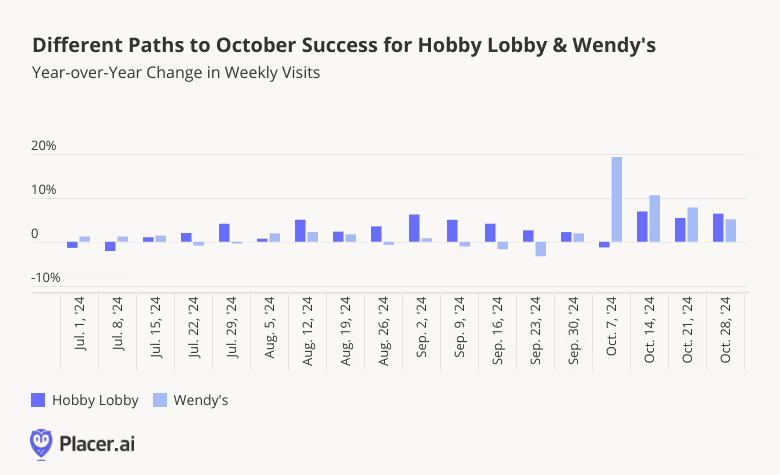
Retailers across categories have successfully harnessed the power of pop culture collaborations to generate excitement – and visits – by leaning into trending themes. On October 8th, 2024, for example, Wendy’s launched its epic Krabby Patty Collab, inspired by the beloved SpongeBob franchise. And during the week of the offering, the chain experienced a remarkable 21.5% increase in foot traffic compared to an average week that year.
Similarly, Crumbl – adept at creating buzz through manufactured scarcity – sparked a frenzy with the debut of its exclusive Olivia Rodrigo GUTS cookie. Initially available only at select locations near the artist’s concert venues, the cookie was launched nationwide for a limited time from August 19th to 24th, 2024. This buzz-driven release resulted in a 27.7% traffic surge during the week of the launch, as fans rushed to get a taste of the star-studded treat.
And it’s not just dining chains benefiting from these pop-culture moments. On February 16th, 2025, Bath & Body Works launched a Disney Princess-inspired fragrance line, perfect for fans of Cinderella, Ariel, Belle, Jasmine, Moana, and Tiana. The collaboration resonated, fueling a 23.2% visit spike for the chain.
While tapping into existing pop-culture trends has the ability to drive traffic, so does creating a new one. Analysis of movie theater visits on National Popcorn Day (Sunday, January 19th, 2025) shows how initiating a trend can spur social media engagement and impact in-person traffic to physical retail spaces.
National Popcorn Day was a successful promotional holiday across the movie theater industry in 2025. Both Regal Cinemas and AMC Theatres offered popcorn-based promotions on the day, but Cinemark’s “Bring Your Own Bucket” campaign, in particular, appears to have spurred a significant foot traffic boost during the event.
Visits to Cinemark on National Popcorn Day in 2025 increased 57.5% relative to the Sunday visit average for January and February 2025, as movie-goers showed off their out-of-the-bucket popcorn receptacles on social media. Clearly, by starting a trend that invited creativity and expression, Cinemark was able to amplify the impact of its National Popcorn Day promotion.
Location intelligence illuminates some of the key trends shaping consumer behavior in 2025. The data reveals that value-driven shopping, demand for flexibility across touchpoints, and the power of unique retail moments have the power to drive consumer engagement and the success of retail categories, brands, and products.

Placer.ai observes a panel of mobile devices in order to extrapolate and generate visitation insights for a variety of locations across the U.S. This panel covers only visitors from within the United States and does not represent or take into account international visitors.
Downtown districts in the nation’s major cities attract domestic travelers all year long with their iconic sights, lively entertainment, and diverse dining offerings. But each hub follows its own rhythm, shaped by distinct seasonal peaks and dips in visitor flow.
This white paper examines downtown hotel visitation patterns in four of the nation’s most popular destinations for domestic tourists: Miami, Chicago, New York, and Los Angeles. Focusing on 20 downtown hotels in each city, the analysis explores seasonal variations in domestic travel, city-specific dynamics, and differentiating factors.
Domestic tourism has rebounded strongly in recent years, and hotels in Miami and Chicago have been the biggest beneficiaries. In 2024, visits to analyzed hotels in each of these cities’ downtown areas grew by 8.9% and 7.4%, respectively, compared to 2023. Meanwhile, hotels in downtown and midtown Manhattan saw a more modest 2.0% increase, while Los Angeles experienced a slight year-over-year (YoY) decline in downtown hotel visits.
One factor that may be driving Miami and Chicago’s stronger performance is their higher proportion of long-distance visitors, defined as those visiting from over 250 miles away. Miami remains a top destination for snowbirds and spring breakers, while Chicago serves as a cultural and entertainment hub for the sprawling Midwest. These long-distance leisure travelers may be more likely to splurge on downtown hotel stays during their trips, helping drive hotel visit growth in the two cities.
By contrast, hotels in the Los Angeles and Manhattan city centers drew lower shares of domestic travelers coming from less than 250 miles away. These shorter-haul domestic tourists may be less likely to splurge on downtown hotels than those taking longer vacations. Both cities are also surrounded by numerous regional getaway options that can draw long-haul leisure travelers away from their downtown cores.
Each of the four analyzed cities has its own unique ebbs and flows – and city center hotel visits reflect these patterns. Miami, with its warm, sunny climate, experiences influxes of tourists during the winter and spring, with March seeing the biggest jump in downtown hotel visits last year (13.0% above the monthly visit average). Chicago, which thrives in the summer with its many festivals and events, saw its biggest downtown hotel visit bump in August. Meanwhile, Manhattan experienced a major uptick in December, likely fueled by holiday tourism and New Year celebrations, and Los Angeles visits were highest in the summertime.
What drives these seasonal visit peaks? Miami has long been a top tourism destination, especially in early spring, when snowbirds and spring breakers flock to the city for sun and relaxation. In recent years, the city has seen a rise in short-term domestic tourism, suggesting that the city is becoming increasingly popular for weekend getaways. According to the Placer.ai Tourism Dashboard, the share of domestic tourists staying just one or two nights grew from 71.7% in March 2022 to 78.3% in March 2024.
This shift aligns with an impressive increase in the magnitude of downtown Miami’s springtime hotel visit peak: In March 2022, visits to downtown hotels were 5.0% above the monthly average for the year, a share that more than doubled by 2024 to 12.9%.
These numbers may mean that more people are choosing to head to Miami for a quick break from the cold – and staying in downtown hotels to make the most of their short getaway.
Chicago’s major August visit spike was likely driven by the Windy City’s impressive lineup of major summer festivals, from Lollapalooza to the Chicago Air and Water Show, which draw thousands of attendees from across the country.
Lollapalooza fueled the largest visit spike to the city – between Thursday, August 1st and Sunday, August 4th, visits to downtown Chicago hotels surged between 51.1% and 63.8% above 2024 daily averages for those days of the week. The Air and Water Show and the Chicago Jazz Festival also generated significant hotel visit increases – highlighting the boost these events bring to the city’s tourism and hospitality sector.
The Big Apple draws a diverse mix of visitors throughout the year. But in December – the city’s peak tourist season – visitors pour in from all over the country to skate in Rockefeller Center, browse Fifth Avenue’s festive window displays and experience the city’s unique holiday magic.
And analyzing data from hotels in midtown and downtown Manhattan reveals a striking shift in the types of visitors who stay in the heart of NYC during the holiday season. While visitors from other urban centers dominated downtown hotel stays throughout most of the year – accounting for 47.9% of visits from January to November 2024 – their share dropped to 42.0% in December 2024. Meanwhile, the share of guests from suburban areas and small towns rose from 37.3% to 41.0%, and the share of guests from rural and semi-rural areas nearly doubled, from 3.5% to 6.1%.
These patterns suggest that, though Manhattan typically attracts a wide range of visitors, the holiday season is uniquely appealing to tourists from smaller towns and suburban areas. Understanding these trends can provide crucial context for hotels and civic stakeholders alike as they work to maximize the opportunities presented by the city’s December visit surge.
Los Angeles hotels also experience significant demographic shifts during peak season. In July, visits to downtown LA hotels surged by 15.3% relative to the 2024 monthly visit average. And a closer look at audience segmentation data suggests a corresponding surge in the share of "Flourishing Families" – an Experian: Mosaic segment consisting of affluent, middle-aged households with children. Throughout the year, "Flourishing Families" comprised between 7.7% and 8.7% of the census block groups (CBGs) driving visits to downtown LA hotels. But in July, this share jumped to 9.9%.
These families may be taking advantage of summer vacations to enjoy Los Angeles’ cultural attractions and entertainment. Hotels and city stakeholders who understand the appeal the city holds for this demographic can better cater to them through family-friendly promotions and strategic marketing efforts to target these households.
Downtowns are making a comeback – and hotels in the heart of the nation’s major tourist hubs are reaping the benefits. By understanding who frequents these downtown hotels and when, local businesses and civic leaders can optimize their resource management and strategic planning to make the most of these opportunities.