.png)
.png)

.png)
.png)


A cool housing market, still-high interest rates, and other economic headwinds have weighed on the home improvement industry this year. But how did category leaders The Home Depot and Lowe’s fare in Q3 2024 – and what lies ahead for them this holiday season?
We dove into the data to find out.
Looking first at the relative positioning of Home Depot and Lowe’s within the wider home improvement sector shows that the two leaders have maintained their dominance, despite the growing popularity of smaller chains like Harbor Freight Tools and Tractor Supply Co.
In Q3 2024, Home Depot accounted for 29.4% of visits to home improvement and furnishing chains nationwide – while Lowe’s accounted for 20.7%. And diving into the data on a statewide level shows that each of the giants holds sway in a different area of the country. Home Depot drew the most visits in much of the Western United States as well as in most of New England. Lowe’s, on the other hand, led parts of the South and Midwest. And in some states, smaller chains like Menards and Ace Hardware dominated the landscape.

Given the challenges faced by the home improvement industry this year, it may come as no surprise that both Home Depot and Lowe’s sustained year-over-year (YoY) visit gaps in Q3 2024 – 3.1% and 4.1%, respectively. But digging deeper into the data suggests that the two chains may still be poised to enjoy a robust holiday season.
Unlike many other categories, visits to home improvement chains tend to peak in spring rather than during the holiday season. Still, Home Depot and Lowe’s do see visit spikes on Q4 retail milestones like Black Friday and Super Saturday. Last year, for example, Home Depot and Lowe’s drew 77.8% and 78.6% more visits, respectively, on Black Friday (Nov. 24th) than on an average day in 2023. Indeed, the big day was Home Depot’s busiest day of 2023 and Lowe’s second-busiest.
And a look at Home Depot and Lowe’s visit performance during Labor Day – another, more recent retail milestone – shows that the two chains continue to excel at attracting visits on key calendar days. On September 4th, 2023 (Labor Day last year), visits to Lowe’s were 23.8% higher than the January to October 2023 daily visit average. And this year, Lowe’s relative Labor Day spike was even more significant – 24.8%. Home Depot, too, saw a slightly more pronounced Labor Day boost this year than last. So even if overall foot traffic to the home improvement leaders remained somewhat below last year’s levels, they may be in for a busy Q4.

The home improvement industry has yet to regain its pandemic-era glory. But analyzing visit trends to category leaders shows that holiday visit spikes may help fuel a successful holiday season this year. How will Lowe’s and Home Depot perform on Black Friday?
Follow Placer.ai’s data-driven retail analyses to find out.

It’s been an eventful week for the QSR Burger category, with much of the focus on this week’s quarterly updates focusing on events that took place after Q3 2024 ended. Let’s start with McDonald’s, where an E.Coli outbreak overshadowed what was largely a positive quarter of visitation gains, where the chain had reversed the visitation declines that it saw during the driven year-over-year visitation increases through its $5 Meal Deal and Collector’s Edition promotion (below).

According to the company, the $5 Meal Deal “continued drawing customers back into our restaurants throughout the quarter, maintaining an average check north of $10 and being profitable for our franchisees.” Importantly, McDonald’s management also called out that the $5 Meal Deal is gaining traction among low-income consumers and that it “successfully [grew] traffic share with this group for the first time in over a year.” Our data indicates this as well. Over the past several months, we’ve looked at McDonald’s cross visitation trends with Aldi as a barometer of its traction with lower-income consumers. The percentage of McDonald’s visitors that also visited an Aldi had been steadily increasing through Q2 2024, but we did see a reversal of this trend in Q3 2024, suggesting that more consumers are finding value at the chain. The company remains committed to having the $5 Meal Deal on its menus until December as it works towards “sustainable guest count-led growth.”

McDonald’s E. Coli outbreak did have a negative impact on visitation trends, but these trends may be short-lived. Our data indicated a 6.5% decline in year-over-year visits nationwide on Wednesday, Oct. 25 (the day after the E. Coli outbreak investigation was announced), 10%-11% declines from Oct. 26-Oct. 28, and 7%-8% declines from Oct 29-30. It’s natural to compare this situation to Chipotle’s E. Coli outbreak in 2015, where visitation trends were severely impacted for many months. However, there are meaningful differences between McDonald’s and Chipotle’s cases. First, McDonald’s was quickly able to identify and communicate the source of the outbreak–slivered onions from a Colorado Springs facility at supplier Taylor Farms, which were immediately removed from the company’s supply chain–while also ruling out its beef patties as a source, which has helped to keep the outbreak relatively contained. Second, in addition to an E. Coli outbreak, Chipotle also faced a norovirus outbreak, calling into question the safety of the chain’s entire supply chain. These differences help to explain why we may already be seeing visitation declines inflect at McDonald’s.

McDonald’s Collector’s Edition was not the only nostalgia-driven promotion driving visits in recent weeks, as Wendy’s Krabby Patty Burger and Pineapple Under the Sea Frosty celebrating SpongeBob's 25th anniversary drove a meaningful lift in visits (below). In fact, this might be the most successful limited-time-offer promotion that we’ve seen across the QSR sector since McDonald’s Adult Happy Meal in October 2022. Importantly, this promotion innovated on existing core menu items without adding complexity. Given the strong visitation lift, we expect more nostalgia-themed promotions in the year ahead.


Affecting everything from merchandise sales to local bars to entire neighborhoods, the economic effect of the Los Angeles Dodgers’ road to the World Series cannot be disputed.
After a comeback from 5-0 to win 7-6 against the New York Yankees, the Dodgers kept everyone on the edge of their seats. With history made by Freddie Freeman’s walk-off grand slam to win Game 1, fans will have moments seared in their memories for decades to come. Dodgers fans are willing to shell out big to celebrate their champions. Fanatics reported that after winning Wednesday night, “the Dodgers set a Fanatics sales record for first-hour sales of a team's merchandise, across any sport, after claiming a championship.” The top five players for merchandise sales were Ohtani, Freeman, Betts, Yamamoto, and Kershaw.
Local bars in various parts of L.A. that featured Dodgers games saw an uptick in year-over-year traffic most weeks, particularly in recent weeks leading up to the National League Championship and the World Series. Spontaneous parades erupted in locations such as Whittier Blvd in East L.A., in Downtown L.A., and near Dodger Stadium in Elysian Park.

We’ve previously written about the Shohei Effect on hotels like the Miyako that features the mural “LA Rising” by Robert Vargas, but now after a World Series championship, the Boys in Blue are set to go even higher into the stratosphere of fandom. We looked at the foot traffic to Dodger Stadium and to Little Tokyo, and no surprise there’s definitely an uptick to the latter on game days, especially on Saturdays. Vargas is currently working on a mural of the late Fernando Valenzuela in Boyle Heights, and Angelenos will likely be flocking in droves to come see “Fernandomania Forever” when it is unveiled.
One interesting finding is that visitation was actually higher during some of the regular season games than for the World Series Games 1 and 2 that took place in LA. One reason may be the sky high prices. Per reseller Ticket IQ, “the average price for a World Series ticket on the secondary market was $3,887, the second most expensive average since it started tracking data in 2010.” For some fans, it was a dream of a lifetime, one that some were willing to “sell a kidney” to attend.


As we enter November, the holiday season is already in full swing across the country. We’re likely to see the consumer’s embrace of seasonal decorations soon, just as we saw in the fall season. The retail industry has already lived through one major promotional event in October, and it’s time to take the temperature on physical retail foot traffic as we head into the busiest part of the season.
One thing that jumped out upon initial review was the foot traffic from department stores, excluding off-price retail. Looking at the four full weeks of October 2024, traffic to full line department stores was flat to last year, compared to the same period last year when traffic was down 8% to 2022 in October (store counts are about even to last year). Visits to luxury department stores show a similar story; traffic in 2023 was down 9% in October and trended down 2% this year. Coming from a sector of retail that has been challenged for years, this slight improvement is worthy of celebration.

Just how important is October’s contribution to holiday shopping visits? For full line department stores, October accounted for 22% of total holiday season visits in both 2022 and 2023; October traffic for luxury department stores was 24% of total holiday traffic in 2022 and 23% in 2023. That means that there’s still almost ¾ of total visitation still left for retailers to capture over the next two months. However, with traffic trending better in 2024 than in 2023 for department stores overall, this year might actually be a proof point for pull forward holiday demand.

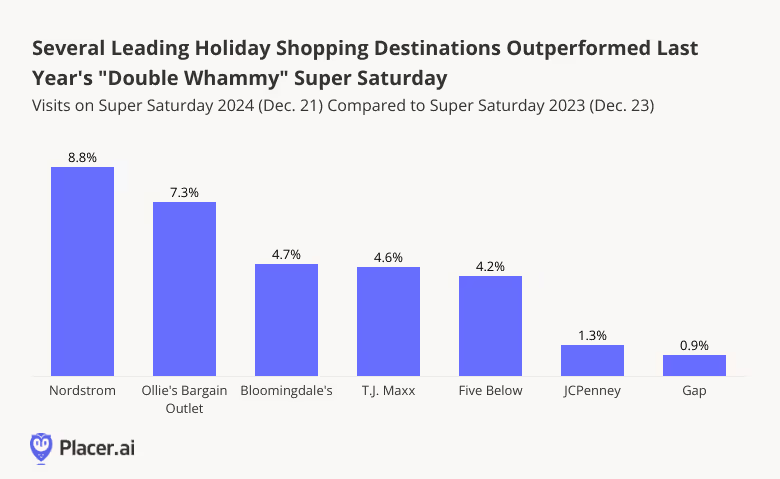
Looking at visitation by retailers within the two sectors, Dillard’s, unsurprisingly led the charge for full line department stores in visitation growth. JCPenney also saw a lot of trend improvement compared to last year, as did Macy’s in the back half of the month. The only major retailer that has underperformed 2023 in October was Kohl’s. Through the lens of luxury department stores, Bloomingdale’s and Nordstrom grew traffic in the low to mid-single digits in October, with Neiman Marcus only down slightly to 2023 levels.

Another interesting insight Placer’s data uncovered; department stores are more of a destination for consumers this year. Looking at Macy’s cross-visitation specifically in October, the percent of visitors to Macy’s that traveled home after visiting was almost 50 basis points higher than in 2023. Our data also showed a lower percentage of cross visitation between Macy’s and other department stores this year compared to last October. Department stores may be doing a better job of capturing consumers' attention and better aligning themselves with the needs of their shoppers. This is in contrast of what we're seeing in essential retail categories such as grocery stores and superstores, where consumers are willing to cross shop multiple retailers; this underscores just how different consumer behavior is by category.

What does this signal about the remainder of the “true” holiday season? It’s hard to tell as we stand today, but the trend improvement across department stores this year gives us some optimism about consumers flocking to physical stores this year. But, it’s important to give consumers a reason to visit as many times as possible, especially as retail fatigue sets in from shopping earlier in the season. Value is still going to be the top driver of visitation this year, but unique products, services and experiences are still important to capturing the joy of the season.

If you’ve ever wished you could root for your alma mater from afar, attend a World Series, or blast into space, Cosm may have the solution. This immersive technology company combines state-of-the art stadium experiences with dining and bar service. Think a smaller version of the Sphere, a larger version of an IMAX theater, with the simulation of being at an actual stadium all while enjoying the comforts of a booth with food brought to you.
For fans of large screen immersive experiences, this venue allows you to be enveloped by the aquatic performers of Cirque du Soleil's “O”, feel like you’re on the 50-yard line for the Ohio State versus Penn State football game, or be a pioneering astronaut seeing the earth from space in “Orbital.”
Since it opened at the end of June this year, popular showings have included “Seek,” which takes you on a journey through the cosmos, as well as sports favorites like the New York Jets versus Pittsburgh Steelers game. Game 2 of the World Series had a sell-out crowd as those who chose not to buy tickets for thousands of dollars still had the joy of celebrating in an arena venue with hundreds of other fans, with the feeling of being behind the dugout.

The Los Angeles Times describes Cosm as “part planetarium, part mini-Sphere,” so instead of needing to travel to Griffith Observatory or Las Vegas, one can just jet down the 405 to Inglewood to have a similar experience. So, who’s visiting Cosm? Roughly 3 in 10 (29%) have a hold income (HHI) of $50K-$99.9K. Nearly 1 in 5 (19%) have a HHI of $25K-$49.9K. These two household income segments over index compared to the CA household incomes (shown in gray).

In terms of demographics, per Spatial.ai PersonaLive, Near-Urban Diverse Families, Educated Urbanites, and Melting Pot Families make up the top 3 segments.


Starbucks, the largest coffee chain in the world, and Dutch Bros, one of the fastest growing in the country, are major players in the hot and cold beverage space. With Q3 2024 in the rearview mirror, we took a closer look at the visitation patterns to both chains to see how they are faring – and what might lie ahead for both brands.
Starbucks is one of the most dominant names in coffee across the world, with thousands of stores in the United States alone. Between July 2023 and July 2024, the chain added more than 500 stores to its domestic fleet, bringing its U.S. store count to 16,730. And though Starbucks has faced its share of challenges, these store additions helped keep overall traffic to the coffee leader on par with 2023 levels throughout the summer – though visits dipped somewhat in September as consumers went back to their routines.
But digging deeper into the visit data shows that even as Starbucks saw overall foot traffic growth stall in Q3, the number of short visits to the chain – i.e. those lasting less than 10 minutes – increased. In August and September 2024, the chain drew 8.5% and 4.7% more short visits, respectively, than in the same periods of 2023 – revealing how important these quick stops are for the chain.
In-app ordering, which together with drive-thru orders made up about 70% of sales at the chain as of January 2024, may be contributing to the short visit trend. Still, new CEO Brian Niccol is looking for ways to return the chain to its roots as the third place, and the chain may yet implement shifts to encourage longer visits in the coming months.

Dutch Bros has been one of the most impressive coffee chains to watch over the past few years. The Oregon-based chain has been on an expansion tear – opening more than 150 stores between Q2 2023 and Q2 2024 – and has seen the elevated monthly visits to match. Between June and September 2024, visits to Dutch Bros increased between 13.7% and 16.9%, highlighting the chain’s success at growing its audience.
But like at Starbucks, short visits outperformed longer ones at Dutch Bros – and by a lot. In September 2024, for example, overall visits to the chain grew by 13.7% – but visits lasting less than 10 minutes shot up by 26.6%.
The strength of these short visits, for both Starbucks and Dutch Bros, suggests a shift towards convenience, with both chains utilizing drive-thru services and in-app ordering to accommodate busy consumers.

Digging down deeper into the data shows that for both Starbucks and Dutch Bros, these all-important short visits follow a distinct weekly pattern.
While longer visits (≥10 minutes) to both chains peaked in Q3 2024 on Saturdays, shorter visits were more evenly distributed throughout the week, peaking on Fridays. Overall, 34.1% of long visits to Starbucks, and 37.8% of long visits to Dutch Bros, took place on the weekends in Q3 2024 – compared to 28.1% and and 28.7%, respectively, for shorter visits.
Unsurprisingly, customers may be more likely to grab a quick coffee to go during the work week. And with the return to office still underway, quick visits may be enjoying a boost fueled by commuters in need of a quick cubicle pick-me-up.

As Starbucks works to adapt to shifting consumer preferences, understanding when customers spend more time in-store can help the brand reconnect with its roots as a community hub. And Dutch Bros can continue to enhance the quick-service experience that has fueled its growth. How will the two chains continue to perform in what remains a competitive coffee environment?
Follow Placer.ai for the latest data-driven dining insights.
.png)
1) Value Wins in 2025: Discount & Dollar Stores and Off-Price Apparel are outperforming as consumers prioritize value and the “treasure-hunt” experience.
2) Small Splurges Over Big Projects: Clothing and Home Furnishing traffic remains strong as shoppers favor accessible wardrobe updates and decor refreshes instead of major renovations.
3) Big-Ticket Weakness: Electronics and Home Improvement visits continue to lag, reflecting a continued deferment of larger purchases.
4) Bifurcation in Apparel: Visits to off-price and luxury segments are growing, while general apparel, athleisure, and department stores face ongoing pressures from consumer trade-downs.
5) Income Dynamics Shape Apparel: Higher-income shoppers sustain luxury and athleisure, while off-price is driving traffic from more lower-income consumers.
6) Beauty Normalizes but Stays Relevant: After a pandemic-driven surge, YoY declines likely indicate that beauty visits are stabilizing; shorter trips are giving way to longer visits as retailers deploy new tech and immersive experiences.
Economic headwinds, including tariffs and higher everyday costs, are limiting discretionary budgets and prompting consumers to make more selective choices about where they spend. But despite these pressures, foot traffic to several discretionary retail categories continues to thrive year-over-year (YoY).
Of the discretionary categories analyzed, fitness and apparel had the strongest year-over-year traffic trends – likely thanks to consumers finding perceived value in these segments.
Fitness and apparel (boosted by off-price) appeal to value-driven, experience seeking consumers – fitness thanks to its membership model of unlimited visits for an often low fee, and off-price with its discount prices and treasure-hunt dynamic. Both categories may also be riding a cultural wave tied to the growing use of GLP-1s, as more consumers pursue fitness goals and refresh their wardrobes to match changing lifestyles and sizes.
Big-ticket categories, including electronics, also faced significant challenges, as tighter consumer budgets hamper growth in the space. Traffic to home improvement retailers also generally declined, as lagging home sales and consumers putting off costly renovations likely contributed to the softness in the space.
But home furnishing visits pulled ahead in July and August 2025 – benefitting from strong performances at discount chains such as HomeGoods – suggesting that consumers are directing their home-oriented spending towards more accessible decor.
The beauty sector – typically a resilient "affordable luxury" category – also experienced declines in recent months. The slowdown can be partially attributed to stabilization following several years of intense growth, but it may also mean that consumers are simplifying their beauty routines or shifting their beauty buying online.
> Traffic to fitness and apparel chains – led by off-price – continued to grow YoY in 2025, as value and experiences continue to draw consumers.
> Consumers are shopping for accessible home decor upgrades to refresh their space rather than undertaking major renovations.
> Shoppers are holding off on big-ticket purchases, leading to YoY declines in the electronics and home improvement categories.
> Beauty has experienced softening traffic trends as the sector stabilizes following its recent years of hypergrowth as shoppers simplify routines and shift some of their spending online.
After two years of visit declines, the Home Furnishings category rebounded in 2025, with visits up 4.9% YoY between January and August. By contrast, Home Improvement continued its multi-year downward trend, though the pace of decline appears to have slowed.
So what’s fueling Home Furnishings’ resurgence while Home Improvement visits remain soft? Probably a combination of factors, including a more affluent shopper base and a product mix that includes a variety of lower-ticket items.
On the audience side, this category draws a much larger share of visits from suburban and urban areas, with a median household income well above that of home improvement shoppers. The differences are especially pronounced when analyzing the audience in their captured markets – indicating that the gap stems not just from store locations, but from meaningful differences in the types of consumers each category attracts.
Home improvement's larger share of rural visits is not accidental – home improvement leaders have been intentionally expanding into smaller markets for a while. But while betting on rural markets is likely to pay off down the line, home improvement may continue to face headwinds in the near future as its rural shopper base grapples with fewer discretionary dollars.
On the merchandise side, home improvement chains cater to larger renovations and higher-cost projects – and have likely been impacted by the slowdown in larger-ticket purchases which is also impacting the electronics space. Meanwhile, home furnishing chains carry a large assortment of lower-ticket items, including home decor, accessories, and tableware.
Consumers are still spending more time at home now than they were pre-COVID, and investing in comfortable living spaces is more important than ever. And although many high-income consumers are also tightening their belts, upgrading tableware or even a piece of furniture is still much cheaper than undertaking a renovation – which could explain the differences in traffic trends.
Traditional apparel, mid-tier department stores, and activewear chains all experienced similar levels of YoY traffic declines in 2025 YTD, as shown in the graph above. But analyzing traffic data from 2021 shows that each segment's dip is part of a trajectory unique to that segment.
Traffic to mid-tier department stores has been trending downward since 2021, a shift tied not only to macroeconomic headwinds but also to structural changes in the sector. The pandemic accelerated e-commerce adoption, hitting department stores particularly hard as consumers seeking one-stop shopping and broad assortments increasingly turned to the convenience of online channels.
Traffic to traditional apparel chains has also not fully recovered from the pandemic, but the segment did consistently outperform mid-tier department stores and luxury retailers between 2021 and 2024. But in H1 2025, the dynamic with luxury shifted, so that traffic trends at luxury apparel retailers are now stronger than at traditional apparel both YoY and compared to Q1 2019. This highlights the current bifurcation of consumer spending also in the apparel space, as luxury and off-price segments outperform mid-market chains.
In contrast, the activewear & athleisure category continues to outperform its pre-pandemic baseline, despite experiencing a slight YoY softening in 2025 as consumers tighten their budgets. The category has capitalized on post-lockdown lifestyle shifts, and comfort-driven wardrobes that blur the line between work, fitness, and leisure remain entrenched consumer staples several years on.
The two segments with the highest YoY growth – off-price and luxury – are at the two ends of the spectrum in terms of household income levels, highlighting the bifurcation that has characterized much of the retail space in 2025. And luxury and off-price are also benefiting from larger consumer trends that are boosting performance at both premium and value-focused retailers.
In-store traffic behavior reveals that these two segments enjoy the longest average dwell times in the apparel category, with an average visit to a luxury or off-price retailer lasting 39.2 and 41.3 minutes, respectively. This suggests that consumers are drawn to the experiential aspect of both segments – treasure hunting at off-price chains or indulging in a sense of prestige at a luxury retailer. Together, these patterns highlight that – despite appealing to different consumer groups – both ends of the market are thriving by offering shopping experiences that foster longer engagement.
> Off-price and luxury segments are outperforming, while general apparel, athleisure, and department store visits lag YoY under tariff pressures and consumer trade-downs.
> Looking over the longer term reveals that athleisure is still far ahead of its pre-pandemic baseline – even if YoY demand has softened.
> Luxury and off-price both are thriving by offering shopping experiences that foster longer engagement.
The beauty sector has long benefitted from the “lipstick effect” — the tendency for consumers to indulge in small luxuries even when discretionary spending is constrained. And while the beauty category’s softening in today’s cautious spending environment could suggest that this effect has weakened, a longer view of the data tells a more nuanced story.
Beauty visits grew significantly between 2021 and 2024, fueled by a confluence of factors including post-pandemic “revenge shopping,” demand for bolder looks as consumers returned to social life, and new store openings and retail partnerships. Against that backdrop, recent YoY traffic dips are likely a sign of stabilization rather than true declines. Social commerce, and minimalist skincare routines may be moderating in-store traffic, but shoppers are still engaged, even as they blend online and offline shopping or seek out lower-cost alternatives to maximize value.
Analysis of average visit duration for three leading beauty chains – Ulta Beauty, Bath & Body Works, and Sally Beauty Supply – highlights the shifting role but continued relevance of physical stores in the space.
Average visit duration decreased post-pandemic – likely due to more purposeful trips and increased online product discovery. But that trend began to reverse in H1 2025, signaling the changing role of physical stores. Enhanced tech for in-store product exploration and rich experiences may be helping drive deeper engagement, underscoring beauty retail’s staying power even in a more measured spending environment.
Bottom Line:
> Beauty’s slight YoY visit declines point to a period of normalization following a post-pandemic boom, while longer-term trends show the category remains stronger than pre-pandemic levels.
> Visits grew shorter post-pandemic, driven by more purposeful trips and increased online product discovery – but dwell time is now lengthening again, signaling renewed in-store engagement driven by tech-enabled discovery and immersive experiences.
Foot traffic data highlight major differences in the recent performance of various discretionary apparel categories. Off-price, fitness, and home furnishings are pulling ahead, well-positioned to keep capitalizing on shifting priorities. Luxury also remains resilient, likely thanks to its higher-income visitor base.
At the same time, beauty’s normalization and the slowdown in mid-tier apparel, electronics, and home improvement show that caution persists across discretionary budgets. Moving forward, retailers that align with consumers’ demand for value, accessible upgrades, and immersive experiences may be best placed to thrive in this era of selective spending.
1) Broad-based growth: All four grocery formats grew year-over-year in Q2 2025, with traditional grocers posting their first rebound since early 2024.
2) Value grocers slow: After leading during the 2022–24 trade-down wave, value grocer growth has decelerated as that shift matures.
3) Fresh formats surge: Now the fastest-growing segment, fueled by affluent shoppers seeking health, wellness, and convenience.
4) Bifurcation widens: Growth concentrated at both the low-income (value) and high-income (fresh) ends, highlighting polarized spending.
5) Shopping missions diverge: Short trips are rising, supporting fresh formats, while traditional grocers retain loyal stock-up customers and value chains capture fill-in trips through private labels.
6) Traditional grocers adapt: H-E-B and Harris Teeter outperformed by tailoring strategies to their core geographies and demographics.Bifurcation of Consumer Spending Help Fresh Format Lead Grocery Growth
Grocery traffic across all four major categories – value grocers, fresh format, traditional grocery, ethnic grocers – was up year over year in Q2 2025 as shoppers continue to engage with a wide range of grocery formats. Traditional grocery posted its first YoY traffic increase since Q1 2024, while ethnic grocers maintained their steady pattern of modest but consistent gains.
Value grocers, which dominated growth through most of 2024 as shoppers prioritized affordability, continued to expand but have now ceded leadership to fresh-format grocers. Rising food costs between 2022 and 2024 drove many consumers to chains like Aldi and Lidl, but much of this “trade-down” movement has already occurred. Although price sensitivity still shapes consumer choices – keeping the value segment on an upward trajectory – its growth momentum has slowed, making it less of a driver for the overall sector.
Fresh-format grocers have now taken the lead, posting the strongest YoY traffic gains of any category in 2025. This segment, anchored by players like Sprouts, appeals to the highest-income households of the four categories, signaling a growing influence of affluent shoppers on the competitive grocery landscape. Despite accounting for just 7.0% of total grocery visits in H1 2025, the segment’s rapid gains point to a broader shift: premium brands emphasizing health and wellness are emerging as the primary engine of growth in the grocery sector.
The fact that value grocers and fresh-format grocers – segments with the lowest and highest median household incomes among their customer bases – are the two categories driving the most growth underscores how the bifurcation of consumer spending is playing out in the grocery space as well. On one end, price-sensitive shoppers continue to seek out affordable options, while on the other, affluent consumers are fueling demand for premium, health-oriented formats. This dual-track growth pattern highlights how widening economic divides are reshaping competitive dynamics in grocery retail.
1) Broad-based growth: All four grocery categories posted YoY traffic gains in Q2 2025.
2) Traditional grocery rebound: First YoY increase since Q1 2024.
3) Ethnic grocers: Continued steady but modest upward trend.
4) Value grocers: Still growing, but slowing after most trade-down activity already occurred (2022–24).
5) Fresh formats: Now the fastest-growing segment, driven by affluent shoppers and interest in health & wellness.
6) Market shift: Premium, health-oriented brands are becoming the new growth driver in grocery.
7) Bifurcation of spending: Growth at both value and fresh-format grocers highlights a polarization in consumer spending patterns that is reshaping grocery competition.
Over the past two years, short grocery trips (under 10 minutes) have grown far more quickly than longer visits. While they still make up less than one-quarter of all U.S. grocery trips, their steady expansion suggests this behavioral shift is here to stay and that its full impact on the industry has yet to be realized.
One format particularly aligned with this trend is the fresh-format grocer, where average dwell times are shorter than in other categories. Yet despite benefiting from the rise of convenience-driven shopping, fresh formats attract the smallest share of loyal visitors (4+ times per month). This indicates they are rarely used for a primary weekly shop. Instead, they capture supplemental trips from consumers looking for specific needs – unique items, high-quality produce, or a prepared meal – who also value the ability to get in and out quickly.
In contrast, leading traditional grocers like H-E-B and Kroger thrive on a classic supermarket model built around frequent, comprehensive shopping trips. With the highest share of loyal visitors (38.5% and 27.6% respectively), they command a reliable customer base coming for full grocery runs and taking time to fill their carts.
Value grocers follow a different, but equally effective playbook. Positioned as primary “fill-in” stores, they sit between traditional and fresh formats in both dwell time and visit frequency. Many rely on limited assortments and a heavy emphasis on private-label goods, encouraging shoppers to build larger baskets around basics and store brands. Still, the data suggests consumers reserve their main grocery hauls for traditional supermarkets with broader selections, while using value grocers to stretch budgets and stock up on essentials.
1) Short trips surge: Under-10-minute visits have grown fastest, signaling a lasting behavioral shift.
2) Fresh formats thrive on convenience: Small footprints, prepared foods, and specialty items align with quick missions.
3) Traditional grocers retain loyalty: Traditional grocers such as H-E-B and Kroger attract frequent, comprehensive stock-up trips.
4) Value grocers fill the middle ground: Limited assortments and private label drive larger baskets, but main hauls remain with traditional supermarkets.
5) Fresh formats as supplements: Fresh format grocers such as The Fresh Market capture quick, specialized trips rather than weekly shops.
While broad market trends favor value and fresh-format grocers, certain traditional grocers are proving that a tailored strategy is a powerful tool for success. In the first half of 2025, H-E-B and Harris Teeter significantly outperformed their category's modest 0.6% average year-over-year visit growth, posting impressive gains of 5.6% and 2.8%, respectively. Their success demonstrates that even in a polarizing environment, there is ample room for traditional formats to thrive by deeply understanding and catering to a specific target audience.
These two brands achieve their success with distinctly different, yet equally focused, demographic strategies. H-E-B, a Texas powerhouse, leans heavily into major metropolitan areas like Austin and San Antonio. This urban focus is clear, with 32.6% of its visitors coming from urban centers and their peripheries, far above the category average. Conversely, Harris Teeter has cultivated a strong following in suburban and satellite cities in the South Atlantic region, drawing a massive 78.3% of its traffic from these areas. This deliberate targeting shows that knowing your customer's geography and lifestyle remains a winning formula for growth.
1) Traditional grocers can still be competitive: H-E-B (+5.6% YoY) and Harris Teeter (+2.8% YoY) outpaced the category average of +0.6% in H1 2025.
2) H-E-B’s strategy: Strong urban focus, with 32.6% of traffic from major metro areas like Austin and San Antonio.
3) Harris Teeter’s strategy: Suburban and satellite city focus, with 78.3% of traffic from South Atlantic suburbs.