.png)
.png)

.png)
.png)

Sweetgreen and First Watch both went public in 2021 and have since steadily increased in popularity – and in store count. So with 2024 well underway, we checked in with the two brands to see how they fared in Q1 and to explore some of the factors underlying their success.
Despite the dining challenges of much of 2023 and early 2024, sweetgreen posted impressive visits between April 2023 and March 2024, with the chain’s YoY traffic increases ranging from 21.4% to 51.6%.
The remarkable visit surge was partially driven by the sweetgreen’s significant expansion, which could explain the slight dips in average visits per location for much of 2023 while consumers around sweetgreen’s newer restaurantes familiarized themselves with the brand’s offerings. But since December 2023, YoY visits per location have been positive – with the exception of a weather-induced slump in January – indicating that the chain’s newer venues have established themselves within their community.
This narrowing of the gap between visits and visits per location may also signal the success of sweetgreen’s strategic shift towards prioritizing "quality over quantity” – slowing down expansion and investing in an enhanced customer experience.

As a salad and grain-bowl chain, sweetgreen holds special appeal for wellness-focused younger consumers, including singles and members of the coveted Gen Z demographic. But as the chain has expanded, it has also succeeded in reaching new audiences.
Sweetgreen has been explicit about its goal of reaching Gen Z consumers. And analyzing the demographic makeup of the chain’s captured market reveals that sweetgreen’s trade area includes a relatively large share of one-person households (that tend to be on the younger side) But analyzing shifts in the chain’s captured market composition over the past five years also reveals that the share of one-person households has been decreasing – while remaining above the nationwide average of 28.0% – and the share of households with children has increased. So even as sweetgreen continues serving its core consumers, the chain’s expansion has also allowed sweetgreen to reach new audiences.

First Watch is also in expansion mode, and with plans to open some 50 more restaurants this year the chain shows no signs of slowing down. And, like sweetgreen, First Watch’s expansion has driven significant growth to the chain’s overall visits – and the chain’s average visits per location numbers are up as well, indicating that the new venues are finding a receptive audience.
By staying nimble on its feet and continually changing up its menu offerings, First Watch has succeeded in differentiating itself from other breakfast chain giants – and appears poised to enjoy continued success throughout the year.

First Watch’s expansion has also helped the company reach new types of diners even as the chain continues catering to its core audience. The share of the Spatial.ai: PersonaLive’s “Upper Suburban Diverse Families” segment in First Watch’s captured market has held steady over the past five years, even as the share of the “Blue Collar Suburbs” and “Urban Low Income” segments increased. It seems, then, that First Watch has also succeeded in leveraging its store fleet expansion to reach new audience segments – without sacrificing its core patrons.
.avif)
Sweetgreen and First Watch’s expansions have helped the companies increase visits and reach new segments – without sacrificing their core audiences. What does the rest of 2024 have in store for the chains?
Visit our blog at placer.ai to find out.

Dining took a hit over the past few years, with major challenges from COVID to rising costs weighing on the category. And perhaps no food-away-from-home segment was more impacted than Full Service Restaurants (FSR) – which stagnated as consumers traded down and sought out more affordable ways to treat themselves.
But new years present new opportunities – and there are signs that sit-down restaurants may be springing back to life. So with 2024 underway, we dove into the data to explore the current state of FSR. Is cooling inflation prompting a rise in Full Service Restaurant activity? How did FSR leaders like Dine Brands (owner of casual dining favorites Applebee’s and IHOP), Bloomin’ Brands (owner of popular grill and steak chains like Outback Steakhouse and Carrabba’s Italian Grill along with high-end Fleming’s Prime Steakhouse & Wine Bar), and Texas Roadhouse fare in Q1?
With some 1500 locations nationwide, Applebee’s has long been a mainstay of the American casual dining scene. Like other FSR chains, Applebee’s experienced a setback during the pandemic and has since faced industry-wide headwinds. But even though the brand’s store fleet shrunk by around 30 stores last year, overall YoY visits to Applebee’s declined just slightly between October 2023 and February 2024 (January’s weather-driven slump aside). And in March, the chain saw a promising 3.8% YoY visit uptick.
Breakfast leader IHOP also experienced negative YoY visits in October and November 2023, but in December – when the pancake chain traditionally enjoys a major holiday boost – visits jumped 2.8% YoY. Like Applebee’s, IHOP felt the effects of January’s Arctic blast, but saw its visits recover quickly in February and March 2024.

Bloomin’ Brands’ leading casual dining chains Outback Steakhouse, Carrabba’s Italian Grill, and Bonefish Grill appear to be following largely similar trajectories.
Though the brands experienced YoY visit gaps through most of Q3 2023 – and were whalloped by January’s inclement weather – all three chains experienced YoY visit increases in March 2024. Given the fact that the restaurants’ store counts didn’t change significantly last year, this visit growth appears to portend good things for Bloomin’s fast casual portfolio in the year ahead.
But it is Bloomin’ Brands’ fine dining concept, Fleming’s Prime Steakhouse & Wine Bar, that really seems to be hitting it out of the park. While Fleming’s also saw visit gaps between October 2023 and January 2024, the chain experienced 9.6% and 7.5% visit growth, respectively, in February and March 2024 – closing out Q1 with a bang.

Fleming’s particularly robust recent performance may be due in part to its relatively affluent customer base. Nearly one-third of households in Fleming’s captured market have an annual income of $150K or more – compared to just 18.6% to 23.7% for Bloomin’s casual dining concepts. Though a night out at the fine-dining steakhouse can be expensive, Fleming’s well-heeled visitor base is better positioned to absorb price increases than other consumers.

Appealing to affluent consumers, however, isn’t the only way to go. Texas Roadhouse is firmly in the casual dining space and tends to cater to average-income diners. (In Q1 2024, just 15.2% of its captured market had a household income ≥$150K.) But the steakhouse’s strategy of satisfying steak lovers with high-quality, affordable offerings is working: Throughout Q1, Texas Roadhouse experienced strongly positive YoY visit growth. And while some of this growth is attributable to the brand’s increasing unit count, the average number of visits per location is generally keeping pace – showing that Texas Roadhouse’s expansion continues to meet strong demand.

Though more affordable Dining segments like QSR and Fast Casual began to spring back to life last year, FSR has yet to fully recover from the double whammy of COVID and inflation. But if March 2024’s promising numbers are any indication, the category may be in for a turnaround. How will FSR continue to perform as 2024 progresses?
Follow Placer.ai’s Dining deep dives to find out.

Restaurants continue to face headwinds, from still-high food-away-from-home prices to rising labor costs. But despite these challenges, there are promising signs that the industry may be in for an upturn. And increasingly, chains are leaning into breakfast and late night offerings to maximize revenue and foster customer loyalty.
So with Q1 2024 under our belts, we checked in with Wendy’s and Denny’s, two dining leaders with very different offerings in the breakfast space. How did they weather the first quarter of 2024 (pun intended)? And which dayparts experienced the biggest visit boosts in Q1?
After a tough Q4 2023 – and a January 2024 dragged down by cold and stormy weather – YoY visits to Wendy’s and Denny’s began to pick up in February and March 2024. And even accounting for January’s Arctic blast, Wendy’s and Denny’s came out ahead on a quarterly basis, with YoY visits up 0.7% and 1.0% respectively.

Wendy’s first launched its breakfast menu in March 2020, just before COVID sent the dining industry into a tailspin. But despite a rocky start, Wendy’s doubled down on the morning daypart, continually tweaking its breakfast offerings and investing ad dollars to boost breakfast sales.
Drilling down into hourly visit data shows that this strategy is paying off. Visits to Wendy’s during the morning daypart (between 6:00 AM and 11:00 AM) jumped 9.3% in Q1 2024 compared to Q1 2023. The chain’s nighttime daypart – which the burger giant began advertising in 2023 for the first time in four years – also saw a YoY boost. Meanwhile, Wendy’s traditional lunch and dinner time slots held steady, with just minor quarterly visit gaps, indicating that the chain’s overall YoY visit growth in Q1 was driven by its breakfast and nighttime push.

Denny’s has always been all about breakfast. And with some 75.0% of Denny’s locations open 24/7 (even on Christmas), hungry diners frequent the chain day and night to satisfy their cravings for hash browns, eggs, pancakes, and other breakfast favorites.
Unsurprisingly, the chain gets most of its visits in the morning and early afternoon. But in Q1 2024, it was the late night daypart that experienced the biggest YoY visit bump – perhaps driven in part by Denny’s push last year to increase the number of locations open in the wee hours.
But Denny’s busiest time slot, between 11:00 AM and 3:00 PM, also experienced a YoY visit increase – showing that even as the chain cements its role as a go-to nighttime destination, it continues to face healthy demand during more traditional dining dayparts.

Breakfast and late night dining offerings have emerged as important drivers of dining success. How will these dayparts continue to fare as the year wears on? And which other brands will make inroads into the breakfast and nighttime dining game?
Follow Placer.ai’s data-driven dining analyses to find out.

At a time when retail loyalty appears to be low, warehouse clubs remain the exception. Bulk is big business in the U.S. retail market, and clubs have found a way to deliver on a combination of value, convenience and experience, and sometimes $1.50 hot dogs. The allure of the warehouse club defies some current consumer logic; U.S. households are not growing according to the U.S. Census Bureau. But, clubs also represent much of what is good in retail today: a broad combination of goods and services, inherent value and high quality private labels.
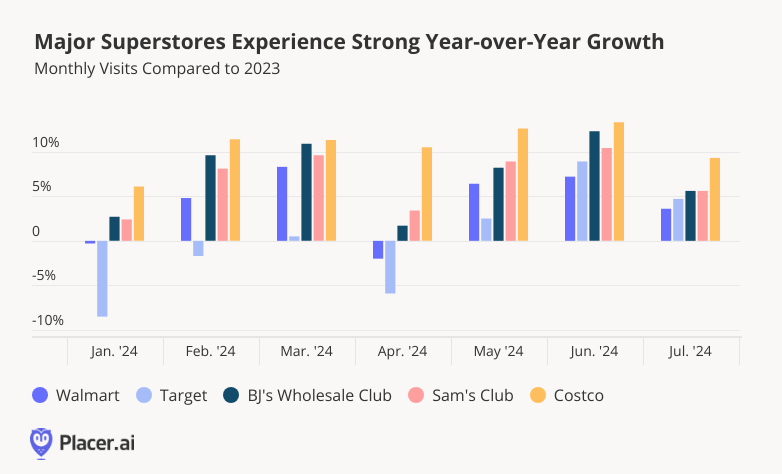
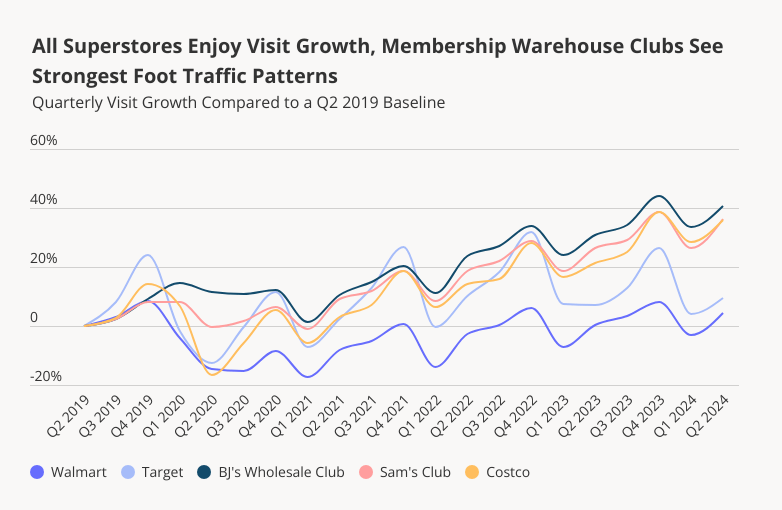
These factors have aided warehouses in growing store traffic compared to their mass merchant counterparts, particularly in the first quarter of 2024. Clubs--including BJ’s Wholesale Club, Sam’s Club and Costco Wholesale--saw visits increase by almost 8% year-over-year, almost double the combined growth of Walmart and Target during the same period. Mass merchants have been squeezed by other value sectors, clubs have been able to hold their own and continue to provide “perceived” value to shoppers, contributing to their traffic volumes.
Beneath the umbrella of growth, each chain has some surprising competitive advantages, and it’s clear that each club serves a distinct purpose to its visitors. In reviewing daily visits, Sam’s Club owns Saturdays, with 22% of visits occurring that day (as shown below), the highest percentage of visits compared to its competition. In contrast, Costco sees a higher percentage of visits on weekdays, specifically Tuesday through Thursday, compared to the other chains.
While Sam’s Club and Costco stand out in terms of their daily visits, BJ’s excels in the time of day that it attracts higher levels of visitors to its locations. BJ’s draws 7% of visits between 8:00-10:00 AM (show below), which is two points higher than Sam’s Club and more than double Costco’s percentage of visits. Not only does BJ’s attract the morning shopper, but also the afterhours customer. BJ’s over indexes in the percentage of visits between 7:00-10:00 PM, with almost 11% of visits occurring during those later hours. BJ’s locations tend to open earlier and stay open later than their Sam’s Club and Costco counterparts, which vary in operational hours for the clubs themselves outside of gas stations. This creates a distinct advantage for BJ’s, especially in areas of direct competition, as visitors looking to shop at off-hours are likely to visit BJ’s.
It’s clear that each club chain has its key day and time to attract visitors that doesn’t overlap too much with its competitors. Warehouse clubs are doing a fantastic job at meeting their consumers where they are and when they prefer to shop. Clubs benefit from increased loyalty due to membership, but it appears that visitors flock to these clubs no matter the day or time. Maybe it’s time to bring breakfast to the Costco & Sam’s Club food courts?

Arrowhead Towne Centre in Glendale, AZ recently opened the newest family fun entertainment center with both a ROUND1 Bowling & Arcade as well as a Spo-Cha. Taking over an erstwhile Mervyn’s, the former includes eight bowling lanes, a variety of favorite games like a claw machine, and two party/karaoke rooms. Upstairs is Spo-Cha, short for Sports Challenge, which is an indoor sports complex where one pays a flat fee for 90 minutes to access activities like riding a mechanical bull, batting cages, a trampoline park, basketball, different sport courts, and billiards.
Spo-Cha is currently in five mall locations in the United States, with plans for more. Overall foot traffic at the malls where it’s currently operational has been positive year-over-year for the month of March.
In addition to the mechanical bull, there is also a Kids Spo-Cha climbing gym and obstacle course.

Source: Spo-Cha

Source: Spo-Cha
At an overall chain level, Round1 Entertainment tends to attract Near Urban Diverse Families and Wealthy Suburban Families the most.


Pandemic restrictions ushered in a new age of remote work that slashed commuting and office-wide coffee orders. But the coffee space has adapted to changing consumer behavior, and category leaders – Starbucks, Dunkin’, and Dutch Bros. Coffee – have found success in the new normal.
With Q1 2024 in the rearview mirror, we took a closer look at how visitation to the coffee space has changed since the pandemic.
Over the last few years, Starbucks, Dunkin’, and Dutch Bros have expanded their footprints, helping drive visits in a turbulent retail environment. Notably, visits to all three chains have remained above pre-pandemic levels nearly every quarter since Q2 2021, signifying a rapid and robust foot traffic recovery for the space.
Starbucks and Dunkin’ have both implemented expansion plans recently, with Starbucks focusing on smaller-format stores and Dunkin’ going after non-traditional sites such as airports, universities, and travel plazas. The store fleet growth likely contributed to both chains’ visit increases – in Q1 2024, foot traffic to Starbucks and Dunkin’s was up 14.5% and 9.5%, respectively, compared to Q1 2019.

Meanwhile Dutch Bros.’ physical footprint has grown exponentially since 2019, and the chain is now working on developing its digital footprint, including the rollout of mobile ordering.The company’s aggressive expansion contributed to Dutch Bros.’ significantly elevated visits in Q1 2024 – 177.6% above the Q1 2019 baseline. (The chain’s considerably larger year-over-five-year visit increases compared to Starbucks and Dunkin’ can be attributed to Dutch Bros.’ substantially smaller starting footprint, so that every opening brings a larger visit boost to the chain as a whole.)

Zooming in on visits since the halfway point of 2023 shows that the coffee space’s post-pandemic momentum continued in recent months, with year-over-year (YoY) monthly visits to all three chains positive since the beginning of 2024.
Dutch Bros.’ ongoing aggressive expansion once again gave the Oregon-based chain the largest year-over-year boost, and Starbucks and Dunkin’ also sustained YoY visit growth nearly every month.

Each Coffee Brand Fills a Different Need
The visit growth for the three coffee leaders analyzed shows that there is enough consumer demand to support across-the-board growth in the space. And analyzing the Q1 2024 hourly visit distribution for Starbucks, Dunkin’, and Dutch Bros. reveals that visits to each chain follow a unique pattern – suggesting that every brand plays a unique role in the wider coffee landscape.

Dunkin’ received almost half (47.8%) of its visits before 11:00 AM, indicating that many guests visit Dunkin’ primarily for coffee or other breakfast fare. Starbucks’s guests tended to visit a little later in the day – with 38.5% of Starbucks visits taking place between 11:00 AM and 3:59 PM – so many consumers may be visiting the Seattle-based chain for a midday pick-me-up. Meanwhile, Dutch Bros. saw the largest share of late afternoon and evening visits (between 4:00 and 10:59 PM) relative to the other two chains – perhaps thanks to the chain’s wide variety of non-caffeinated beverages.
The variance in the hourly visit distribution between the three chains shows that the coffee space is big enough for multiple players and bodes well for the three chains’ performance in 2024.
For more data-driven pick-me-ups, visit Placer.ai.
This blog includes data from Placer.ai Data Version 2.0, which implements improvements to our extrapolation capabilities, adds short visit monitoring, and enhances visit detection.

This report leverages location intelligence data to analyze the auto dealership market in the United States. By looking at visit trends to branded showrooms, used car lots, and mixed inventory dealerships – and analyzing the types of visitors that visit each category – this white paper sheds light on the state of car dealership space in 2023.
Prior to the pandemic and throughout most of 2020, visits to both car brand and used-only dealerships followed relatively similar trends. But the two categories began to diverge in early 2021.
Visits to car brand dealerships briefly returned to pre-pandemic levels in mid-2021, but traffic fell consistently in the second half of the year as supply-chain issues drove consistent price increases. So despite the brief mid-year bump, 2021 ended with overall new car sales – as well as overall foot traffic to car brand dealerships – below 2019 levels. Visits continued falling in 2022 as low inventory and high prices hampered growth.
Meanwhile, although the price for used cars rose even more (the average price for a new and used car was up 12.1% and 27.1% YoY, respectively, in September 2021), used cars still remained, on average, more affordable than new ones. So with rising demand for alternatives to public transportation – and with new cars now beyond the reach of many consumers – the used car market took off and visits to used car dealerships skyrocketed for much of 2021 and into 2022. But in the second half of last year, as gas prices remained elevated – tacking an additional cost onto operating a vehicle – visits to used car dealerships began falling dramatically.
Now, the price of both used and new cars has finally begun falling slightly. Foot traffic data indicates that the price drops appear to be impacting the two markets differently. So far this year, sales and visits to dealerships of pre-owned vehicles have slowed, while new car sales grew – perhaps due to the more significant pent-up demand in the new car market. The ongoing inflation, which has had a stronger impact on lower-income households, may also be somewhat inhibiting used-car dealership visit growth. At the same time, foot traffic to used car dealerships did remain close to or slightly above 2019 levels for most of 2023, while visits to branded dealerships were significantly lower year-over-four-years.
The situation remains dynamic – with some reports of prices creeping back up – so the auto dealership landscape may well continue to shift going into 2024.
With car prices soaring, the demand for pre-owned vehicles has grown substantially. Analyzing the trade area composition of leading dealerships that sell used cars reveals the wide spectrum of consumers in this market.
Dealerships carrying a mixed inventory of both new and used vehicles seem to attract relatively high-income consumers. Using the STI: Popstats 2022 data set to analyze the trade areas of Penske Automotive, AutoNation, and Lithia Auto Stores – which all sell used and new cars – reveals that the HHI in the three dealerships’ trade areas is higher than the nationwide median. Differences did emerge within the trade areas of the mixed inventory car dealerships, but the range was relatively narrow – between $77.5K to $84.5K trade area median HHI.
Meanwhile, the dealerships selling exclusively used cars – DriveTime, Carvana, and CarMax – exhibited a much wider range of trade area median HHIs. CarMax, the largest used-only car dealership in the United States, had a yearly median HHI of $75.9K in its trade area – just slightly below the median HHI for mixed inventory dealerships Lithia Auto Stores and AutoNation and above the nationwide median of $69.5K. Carvana, a used car dealership that operates according to a Buy Online, Pick Up in Store (BOPIS) model, served an audience with a median HHI of $69.1K – more or less in-line with the nationwide median. And DriveTime’s trade areas have a median HHI of $57.6K – significantly below the nationwide median.
The variance in HHI among the audiences of the different used-only car dealerships may reflect the wide variety of offerings within the used-car market – from virtually new luxury vehicles to basic sedans with 150k+ miles on the odometer.
Visits to car brands nationwide between January and September 2023 dipped 0.9% YoY, although several outliers reveal the potential for success in the space even during times of economic headwinds.
Visits to Tesla’s dealerships have skyrocketed recently, perhaps thanks to the company’s frequent price cuts over the past year – between September 2022 and 2023, the average price for a new Tesla fell by 24.7%. And with the company’s network of Superchargers gearing up to serve non-Tesla Electric Vehicles (EVs), Tesla is finding room for growth beyond its already successful core EV manufacturing business and positioning itself for a strong 2024.
Japan-based Mazda used the pandemic as an opportunity to strengthen its standing among U.S. consumers, and the company is now reaping the fruits of its labor as visits rise YoY. Porsche, the winner of U.S New & World Report Best Luxury Car Brand for 2023, also outperformed the wider car dealership sector. Kia – owned in part by Hyundai – and Hyundai both saw their foot traffic increase YoY as well, thanks in part to the popularity of their SUV models.
Analyzing dealerships on a national level can help car manufacturers make macro-level decisions on marketing, product design, and brick-and-mortar fleet configurations. But diving deeper into the unique characteristics of each dealership’s trade area on a state level reveals differences that can serve brands looking to optimize their offerings for their local audience.
For example, analyzing the share of households with children in the trade areas of four car brand dealership chains in four different states reveals significant variation across the regional markets.
Nationwide, Tesla served a larger share of households with children than Kia, Ford, or Land Rover. But focusing on California shows that in the Golden State, Kia’s trade area population included the largest share of this segment than the other three brands, while Land Rover led this segment in Illinois. Meanwhile, Ford served the smallest share of households with children on a nationwide basis – but although the trend held in Illinois and Pennsylvania, California Ford dealerships served more households with children than either Tesla or Land Rover.
Leveraging location intelligence to analyze car dealerships adds a layer of consumer insights to industry provided sales numbers. Visit patterns and audience demographics reveal how foot traffic to used-car lots, mixed inventory dealerships, and manufacturers’ showrooms change over time and who visits these businesses on a national or regional level. These insights allow auto industry stakeholders to assess current demand, predict future trends, and keep a finger on the pulse of car-purchasing habits in the United States.