Skip to Main Content
Thank you! Your submission has been received!
Oops! Something went wrong while submitting the form.
0
0
0
0
----------
0
0
Articles
Article
Hybrid Work Has Reshaped Downtown Retail Traffic
Shira Petrack
Mar 17, 2026
5 minutes

Retail Corridor Traffic Has Recovered – But Not Fully

Foot traffic to retail corridors nationwide plummeted during the shelter-in-place restrictions of 2020, and recent data shows that visits have yet to fully recover to 2019 levels. While traffic has steadily improved each year since the pandemic lows, 2025 visits remain 11.7% below their pre-pandemic baseline. 

What is holding the retail corridor recovery back? We dove into the data to find out. 

Weekday Weakness Highlights the Impact of Hybrid Work

Retail corridors are typically concentrated in downtown areas, featuring a mix of stores, restaurants, bars, and offices – and are often surrounded by even more office space. And comparing average visits per day of week in 2025 and 2019 suggests that the persistence of hybrid and remote work is likely driving much of the lag. 

Monday through Thursday foot traffic to retail corridors was down between 16.3% and 17.3% in 2025 compared to 2019. The gap narrowed to 11.7% on Friday as activity began to shift toward the weekend, and nearly disappeared on Saturday (-2.8%) and Sunday (-4.2%).

The much larger weekday deficit suggests that reduced office attendance continues to weigh on downtown retail activity. With fewer workers commuting daily, there are fewer pre-work coffee stops, lunchtime errands, and spontaneous after-work visits that once fueled these corridors. So while leisure-driven weekend traffic has largely rebounded, the office-driven weekday ecosystem that historically sustained retail corridors has yet to fully return.

Office Hours Show the Largest Traffic Gaps

Hourly data reinforces the role that office attendance (or lack thereof) is playing in the retail corridor visit lag. The steepest declines are concentrated squarely within traditional workday hours: visits between 7 AM and 11 AM are down 23.7% compared to 2019, followed by a 19.2% decline from 11 AM to 3 PM. But the gap is much more moderate both earlier and later in the day (from 12 AM to 7 AM and 3 PM to 12 PM) in the day later in the day, with visits down 13.7% from 3 PM to 7 PM and just 9.6% after 7 PM. This suggests that the missing traffic is closely tied to reduced daily commuting – fewer morning coffee runs, lunch breaks, and midday errands – while evening and leisure-oriented visits have proven far more resilient. With more schedule flexibility, downtown businesses and civic stakeholders may need to focus on creating reasons for consumers to intentionally visit downtowns during slower weekday hours, rather than relying on routine commuter traffic to fill stores organically.

Adapting Downtown Retail to a Hybrid Era

The retail corridor traffic data suggests that downtowns are facing a structural shift in when and why people visit. With fewer daily commuters, stakeholders may need to focus less on restoring a five-day office week and more on activating the days and hours that already show strength. Civic leaders can prioritize safety, cleanliness, transit reliability, and targeted weekday programming or events that encourage intentional trips downtown. Retailers and dining concepts can adapt hours, promotions, and experiences to better align with flexible work schedules. In a hybrid era, success may depend less on recreating old commuting patterns and more on making downtown a destination people choose – not just a place they pass through.

For more data-driven retail insights, visit placer.ai/anchor.

Placer.ai leverages a panel of tens of millions of devices and utilizes machine learning to make estimations for visits to locations across the US. The data is trusted by thousands of industry leaders who leverage Placer.ai for insights into foot traffic, demographic breakdowns, retail sale predictions, migration trends, site selection, and more.

Guest Contributor
How Austin Uses Data to Promote Visitation Amid Climate and Construction Challenges
Davon Barbour
Mar 16, 2026
5 minutes

Downtown Austin is navigating a period of unusual complexity. A convention center renovation and major highway construction have created significant disruption, while extreme summer heat and pullbacks in consumer spending are adding further pressure.

Yet despite these headwinds, visitation is nearing pre-pandemic levels. And a key factor driving Austin’s recovery has been its deliberate use of data to guide strategy, align stakeholders, and deploy resources where they can have the greatest impact.

A Measured Recovery in a Disrupted Environment

Since 2022, Downtown Austin has been on a steady recovery trajectory. By 2025, non-resident and non-employee visits to the area reached 94.4% of 2019 levels – a milestone that becomes even more meaningful against the backdrop of this year’s intensely hot summer and the temporary closure of Austin’s convention center, which has remained offline since April 2025.

This data reveals resilience that might otherwise have gone unnoticed – critical framing when coordinating across agencies and reassuring stakeholders that downtown remains a reliable economic engine even during infrastructure transitions.

In-State Travel as a Strategic Advantage

The composition of that visitation tells an equally important story. A growing share of visitors to downtown Austin are coming from within Texas – especially on weekends.

In an environment where consumers are more value-conscious and long-haul travel remains uneven, this regional draw has become a strategic asset. In-state travelers are more likely to make shorter, repeat trips, creating consistent demand for restaurants, entertainment venues, and retail corridors.

The Downtown Austin Alliance uses this insight to refine both marketing and access strategies. Partnerships such as discounted ride programs within a 30-mile radius reduce friction for local visitors during the holiday season, while targeted programming ensures downtown remains competitive as a weekend destination.

At the policy level, this data strengthens the case that downtown’s success benefits the broader state economy. When a rising share of visitors originates within Texas, the dollars spent downtown circulate locally – supporting jobs, generating tax revenue, and reinforcing Austin’s role as an economic anchor.

Events as Predictable Traffic Drivers

Data also helps the Alliance optimize services around major events that drive tourism to Austin – such as the annual ACL Music Festival and Formula 1 Grand Prix – supporting operational precision. High-traffic areas receive intensified cleaning and hospitality services, while lower-traffic zones become candidates for murals, activations, and smaller-scale programming designed to distribute energy more evenly. Event-driven data also informs conversations with transportation partners as construction continues to reshape mobility routes. 

East Sixth Street and the Investment Case

The strategic use of data is also evident in the revitalization of East Sixth Street. Long known as a historic entertainment corridor with a late-night reputation, the district is now the focus of a coordinated effort to evolve its positioning and offerings.

And data has played an important role in getting people on board. Location analytics, for example, show that out-of-market visitors to the district are coming from more affluent areas, showing that spending power exists and is growing –  and that the district’s offerings may have room to evolve alongside its audience.

For property owners and local businesses, this data provides a clearer picture of market potential. And for public-sector partners, it strengthens the case for infrastructure upgrades and placemaking investments. 

A Blueprint for Resilient Growth

Austin’s experience offers a broader lesson for cities navigating disruption. Infrastructure transitions, climate pressures, and evolving travel patterns present real challenges – but by grounding placemaking strategies in clear, measurable data, Austin is strengthening downtown’s economic foundation and aligning stakeholders around a shared vision.

Article
Placer.ai February 2026 Office Index: Another Weather-Tested Step Forward for RTO
Lila Margalit
Mar 13, 2026
2 Minutes

Amid a tightening job market, the list of employers requiring workers to show up in person – many now mandating five days a week – continues to grow. But how did the office recovery fare in February 2026, a month marked by heavy snowstorms across major Northeast markets? 

We dove into the data to find out.

The Busiest February Since COVID

In February 2026, visits to the Placer.ai Nationwide Office Index were 31.9% below 2019 levels – marking the smallest February post-pandemic visit gap to date. Overall attendance even slightly outpaced February 2024, a leap year that benefited from 20 business days instead of the usual 19.

Snowstorms Skew the Northeast

While this is hardly the most impressive RTO showing we’ve seen in recent months, February’s gains came in spite of meaningful headwinds. 

A late-February blizzard disrupted major Northeast markets, driving a year-over-year (YoY) decline in New York City office visits and widening Manhattan’s post-pandemic gap to 21.3% below 2019 levels. Boston, also hit hard by snow, saw visits remain flat YoY, slipping behind San Francisco and Denver in overall recovery progress.

By contrast, cities in other regions posted clear gains, with San Francisco – still benefiting from AI-driven hiring and renewed tech activity – once again seeing some of the strongest growth at +11.9% YoY.

Still on Track

February’s performance underscores a familiar pattern of month-to-month fluctuation, even as the broader RTO trajectory continues its upward climb. Regional dynamics – from weather disruptions to sector-specific hiring cycles – are shaping local outcomes, but the national baseline for office utilization is steadily rising.

For more data driven CRE insights, visit placer.ai/anchor

Placer.ai leverages a panel of tens of millions of devices and utilizes machine learning to make estimations for visits to locations across the US. The data is trusted by thousands of industry leaders who leverage Placer.ai for insights into foot traffic, demographic breakdowns, retail sale predictions, migration trends, site selection, and more.

Article
Placer.ai Macroeconomic Indicators Analysis, February 2026
R.J. Hottovy
Mar 12, 2026
4 minutes

The Bifurcated Consumer

The bifurcated consumer trends established in the second half of 2025 have persisted. While higher-income shoppers maintain relatively stable spending habits, lower- and middle-income households continue to feel the squeeze on essential categories like groceries and fuel. These consumers have become increasingly selective and price-sensitive, actively pivoting away from traditional mid-market chains in favor of discount retailers and value-oriented brands. Because affordability remains a core focus, average households are spreading their visits across a wider number of non-discretionary stores to hunt for deals. For example, our data shows that grocery visit growth is currently being driven by low- and middle-income households, as elevated food costs necessitate more frequent, budget-conscious trips.

However, despite this intense focus on everyday value, it would be a mistake to count out the discretionary sector, where consumer visits have also been mostly positive year-over-year (YoY) since the start of 2026. Despite weather-driven volatility, we continue to see healthy demand for discretionary categories as consumers start to put their tax refunds to work, actively seeking affordable indulgences and high-end brands at a discount. 

E-Commerce & Reverse Logistics

E-commerce fulfillment centers are also seeing robust activity. Excluding a brief weather-related slump in late January, visits to these facilities are growing at a high-single to low-double-digit clip.

This surge in logistics activity is being driven by a perfect storm of consumer behavior and retail strategy: value-seeking shoppers, massive supply chain investments from giants like Walmart and Target, and the rise of frictionless "agentic" and social commerce. Furthermore, record-high product returns are forcing these centers to process a massive wave of reverse logistics, keeping facility utilization incredibly high.

As delayed tax refunds finally hit consumer bank accounts in the months ahead, we expect this strong e-commerce and fulfillment momentum to continue.

Manufacturing Activity 

Manufacturing data has been highly volatile in early 2026. Placer.ai’s Industrial Manufacturing Index – which measures physical visits to manufacturing facilities across a wide range of verticals – showed an ebb and flow in the early weeks of the year. Severe winter storms heavily weighed on facility visits in late January, followed by a clear rebound in February.

This physical, on-the-ground improvement aligns with the latest macroeconomic indicators. According to the most recent ISM report, the U.S. manufacturing sector expanded for the second consecutive month in February, with the PMI registering a solid 52.4. Crucially, this growth is being driven by strong forward-looking demand, as the ISM New Orders Index remained firmly in expansion territory at 55.8. Ultimately, while underlying production and new orders show sustained momentum, unpredictable weather patterns continue to create short-term fluctuations in actual facility operations.

Volatility Meets Resilience

Looking ahead, volatility will likely be the baseline expectation for both the retail and manufacturing sectors throughout 2026. Unpredictable weather events, shifting supply chain dynamics, and the complexities of lapping 2025's macroeconomic hurdles will continue to create week-to-week fluctuations in physical foot traffic and industrial output.

Yet, beneath this turbulence lies a remarkably stable foundation: the American consumer. Despite the ongoing pressures of inflation and depleted household savings, shoppers remain incredibly resilient. They are highly strategic – pinching pennies on daily essentials and heavily utilizing value channels – precisely so they can continue to fund discretionary spending and lifestyle upgrades. The market may be volatile, but the 2026 consumer is proving that they are willing and able to spend when the value proposition is right.

Placer.ai leverages a panel of tens of millions of devices and utilizes machine learning to make estimations for visits to locations across the US. The data is trusted by thousands of industry leaders who leverage Placer.ai for insights into foot traffic, demographic breakdowns, retail sale predictions, migration trends, site selection, and more.

Article
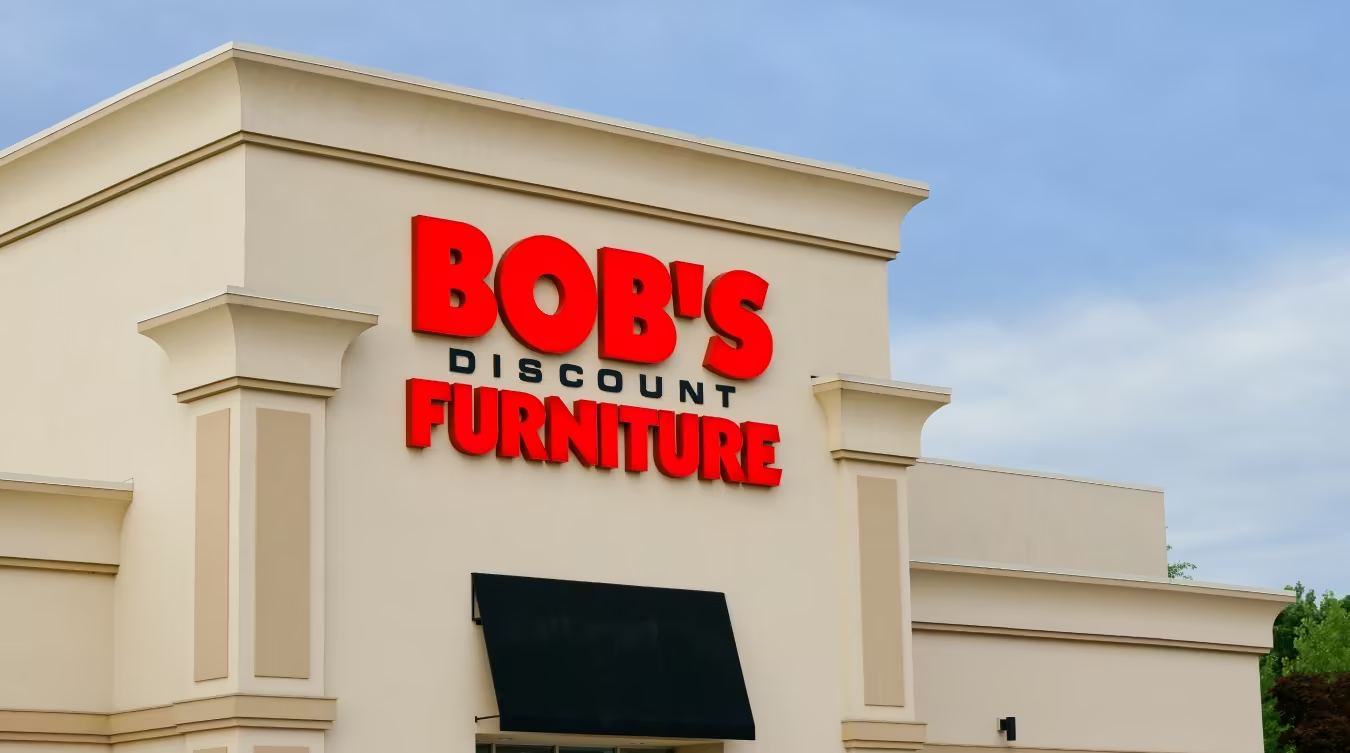
The Strategy That Helped Propel Bob’s Discount Furniture to an IPO
Ezra Carmel
Mar 11, 2026
4 minutes

With its recent IPO, Bob’s Discount Furniture has officially entered a new chapter, stepping onto the public stage at a time when the home furnishings sector continues to face macroeconomic pressures. Yet despite these challenges, Bob’s has demonstrated notable momentum. This AI-powered data analysis takes a closer look at Bob’s performance, examining traffic trends, demographic positioning, and cross-shopping behavior to better understand what’s driving the company’s success. 

Traffic Gains Reflect More Than Expansion

Bob’s continued expansion supported year-over-year (YoY) visit increases throughout 2025 – but growth was not driven by footprint alone. Visits per location to the chain also climbed by 1.8% in 2025, indicating that existing stores captured incremental demand alongside new openings. 

A Demographic Sweet Spot

Analysis of Bob’s and the broader home furnishings category suggests that a favorable mix of value-oriented and affluent shoppers may be supporting the brand’s growth. 

In 2025, the median household income of Bob’s captured market was $89.0K – below the category median of $92.5K, yet above the nationwide median of $79.6K. A similar pattern emerged when examining Bob’s audience by income groups. Among households earning under $100K and those earning over $150K, Bob’s share fell between the category benchmark and the national baseline.

This positioning suggests that while Bob’s resonates strongly with value-seeking consumers, its appeal is not limited to lower-income households – which could reflect the strength of its "Good, Better, Best" assortment strategy. As value-prioritization has gained traction across income levels, Bob’s appears to be attracting shoppers who are price-conscious yet still maintain discretionary spending power – a combination that is especially advantageous in a bigger-ticket category like furniture. 

Strengthening Loyalty in a Comparison-Driven Category

Reinforcing its position as a primary destination for furniture shoppers appears to be another factor fueling Bob’s growth.

AI-based location intelligence reveals that in 2025, the share of Bob’s visitors who also visited other major home furnishings chains declined compared to 2024. The shift was consistent across several key competitors, suggesting that fewer shoppers felt compelled to compare offerings at other chains before visiting Bob's Discount Furniture. 

In a category where consumers frequently comparison-shop, declining cross-visitation may signal that Bob’s relaxed in-store environment – featuring the “Little Bob” sock-puppet and complementary cafés – is resonating with shoppers, reducing the incentive to look elsewhere.

Positioned for Its Public Chapter

These insights underscore Bob’s differentiated strategy within a volatile retail landscape. By combining disciplined expansion with broad cross-income appeal and brand loyalty, Bob’s is building both growth and resilience as it enters its public chapter.

Will Bob’s continue to find success in 2026? Visit Placer.ai/anchor to find out.

Placer.ai leverages a panel of tens of millions of devices and utilizes machine learning to make estimations for visits to locations across the US. The data is trusted by thousands of industry leaders who leverage Placer.ai for insights into foot traffic, demographic breakdowns, retail sale predictions, migration trends, site selection, and more.

Article
Premium Brands, LongHorn Boost Darden’s 2025 Performance
Shira Petrack
Mar 10, 2026
3 minutes

Darden Posts Modest Q4 2025 Gains 

Traffic to Darden banners remained relatively stable in 2025, with the company seeing an average increase of 1.2% in overall visits coupled with a slight dip of 0.3% in average visits per venue across its brands. Average visits per venue improved towards the end of the year relative to the annual average, growing 1.5% YoY in Q4 2025 – likely due to the closure of several Bahama Breeze restaurants in 2025, part of the company's plans to sunset the banner entirely by April 2026. 

LongHorn & Premium Brands Lead 

Analyzing traffic by banner points to clear resilience at the top of the market, with upscale casual and premium brands such as Yard House and Ruth's Chris Steakhouse generally showing the strongest and most consistent traffic growth. This pattern suggests that higher-income consumers remain relatively insulated and willing to spend, even amid broader volatility. 

At the same time, LongHorn Steakhouse, one of Darden’s largest brands, also emerged as a standout performer, delivering steady positive traffic across multiple months. Given its scale within the portfolio, LongHorn likely made an outsized contribution to Darden’s overall positive traffic trends, helping to offset softness in other chains and reinforcing the company’s momentum.

Same-Store Traffic Trends Signal Genuine Demand Resilience 

Same-store YoY visit trends in recent months are very close to overall visit trends, suggesting that Darden’s traffic trends are largely same-store-driven rather than expansion-driven, with little evidence that unit growth is materially distorting overall traffic trends. Premium brands continue to perform well, and LongHorn is generating steady same-store growth across its large footprint, suggesting that Darden’s results are being driven by real consumer demand – especially among higher-income diners.

Darden’s results suggest that performance is being driven less by sheer scale and more by brand positioning, with concepts that offer either premium experiences or strong value perception (like LongHorn) capturing disproportionate demand. As consumer budgets remain tight, growth is likely to concentrate further in brands that clearly justify their price point – leaving middle-of-the-road concepts increasingly pressured to sharpen their value proposition or differentiate more meaningfully.

For up-to-date restaurant foot traffic, visit our free Industry Trends tool.

Placer.ai leverages a panel of tens of millions of devices and utilizes machine learning to make estimations for visits to locations across the US. The data is trusted by thousands of industry leaders who leverage Placer.ai for insights into foot traffic, demographic breakdowns, retail sale predictions, migration trends, site selection, and more.

Reports
INSIDER
Report
The Return to Office
Dive into the data to uncover the state of office recovery in major cities nationwide – and see how the in-office workforce has evolved since COVID.
March 7, 2024
9 minutes

The Placer.ai Nationwide Office Building Index: The office building index analyzes foot traffic data from some 1,000 office buildings across the country. It only includes commercial office buildings, and commercial office buildings with retail offerings on the first floor (like an office building that might include a national coffee chain on the ground floor). It does NOT include mixed-use buildings that are both residential and commercial.

This white paper includes data from Placer.ai Data Version 2.0, which implements improvements to our extrapolation capabilities, adds short visit monitoring, and enhances visit detection.

A Shifting Landscape

The remote work war is far from over – and as the labor market cools, companies are ramping up efforts to get workers back in the office. But even those employers that are cracking down on WFH aren’t generally insisting that employees come in five days a week – for the most part.

Indeed, a growing consensus seems to posit that though in-person work carries important benefits, plugging in remotely at least part of the time also has its upsides. Nixing the daily commute can put the ever-elusive work/life balance within reach. And there’s evidence to suggest that remote work can enhance productivity – limiting distractions and letting workers lean into their individual biological clocks (so-called “chronoworking”). 

But the precise contours of the new hybrid status-quo are still a work in progress. And to keep up, relevant stakeholders – from employers and workers to municipalities and local businesses – need to keep their fingers on the pulse of how this fast-changing reality is evolving on the ground. 

This white paper dives into the data to explore some of the key trends shaping the office recovery. The analysis is based on Placer.ai’s Nationwide Office Index, which examines foot traffic data from more than 1,000 office buildings across the country. What was the trajectory of the post-COVID office recovery in 2023?  What impact did return-to-office (RTO) mandates have on major cities nationwide, including New York, Dallas, San Francisco, and others? And how has the demographic and psychographic profile of office-goers changed since the pandemic?

Rumors Greatly Exaggerated?

Analyzing office building foot traffic over the past several years suggests that the office recovery story is still very much being written. After plummeting during COVID, nationwide office visits began a slow but steady upward climb in 2021, reaching about 70.0% of January 2019 levels in August 2023. 

Since then, the recovery appears to have stalled – with some observers even proclaiming the death of RTO. But looking back at the office visit trajectory since 2019 shows that the process has been anything but linear, with plenty of jumps, dips, and plateaus along the way. And though office foot traffic tapered somewhat between November 2023 and January 2024, this may be a reflection of holiday work patterns and of January’s unusually cold and stormy weather, rather than of any true reversal of RTO gains. Indeed, if 2024 is anything like last year, office visits may yet experience an additional boost as the year wears on.  

TGIF Vibes

But for now, at least, a full return to pre-COVID work norms doesn’t appear to be in the cards. And like in 2022, last year’s hybrid work week gave off some serious TGIF vibes. 

On Tuesdays, Wednesdays, and Thursdays, office foot traffic was just 33.2% to 35.3% lower than it was pre-COVID. But on Mondays and Fridays, visits were down a whopping 46.0% and 48.9%, respectively. From a Year-over-year (YoY) perspective too, the middle of the week experienced the most pronounced visit recovery, with Tuesday, Wednesday, and Thursday visits up about 27.0% compared to 2022. 

The slower Monday and Friday office recovery may be driven in part by workers seeking to leverage the flexibility of WFH for extended weekend trips. (Indeed, hybrid work even gave rise to a new form of nuptials – the remote-work wedding.) So-called super commuters, many of whom decamped to more remote locales during COVID, may also prefer to concentrate visits mid-week to limit time on the road. And let’s face it – few people would object to easing in and out of the weekend by working in their pajamas. Whatever the motivating factors – and despite employer pushback – the TGIF work week appears poised to remain a fixture of the post-pandemic working world. 

New York and Miami Approach 80.0% Recovery

Analyzing nationwide office visitation patterns can shed important light on evolving work and commuting norms. But to really understand the dynamics of office recovery, it is crucial to zoom in on local trends. RTO in tech-heavy San Francisco doesn’t look the same as it does in New York’s financial districts. And commutes in Dallas are very different than in Chicago or Washington, D.C.

Overall, foot traffic to buildings in Placer.ai’s Nationwide Office Index was down 36.8% in 2023 compared to 2019 – and up 23.6% compared to 2022. But drilling down into the data for seven major markets shows that each one experienced a very different recovery trajectory. 

In New York and Miami, offices drew just 22.5% and 21.9% less visits, respectively, in 2023 than in 2019 – meaning that they recovered nearly 80.0% of their pre-COVID foot traffic. In New York, remote work policy shifts by major employers like Goldman Sachs and JPMorgan appear to have helped set a new tone for the financial sector. And Miami may have benefited from Florida’s early lifting of COVID restrictions in late 2020, as well as from the steady influx of tech companies over the past several years.  

San Francisco, for its part, continued to lag behind the other major cities in 2023, with office building foot traffic still 55.1% below 2019 levels. But on a YoY basis, the northern California hub experienced the greatest visit growth of any analyzed city, indicating that San Francisco’s office recovery is still unfolding.

Financial Sector Helps Drive RTO

To better understand the relationship between employees’ occupational backgrounds and local office recovery trends, we examined the share of Financial, Insurance, and Real Estate sector workers in the captured markets of different cities’ office buildings. (A POI’s captured market is derived by weighting the census block groups (CBGs) in its True Trade Area according to the share of actual visits from each CBG – thus providing a snapshot of the people that actually visit the POI in practice). We then compared this metric to each city’s year-over-four-year (Yo4Y) office visit gap.

The analysis suggests that the finance sector has indeed been an important driver of office recovery. Generally speaking, cities with greater shares of employees from this sector tended to experience greater office recovery than other urban centers. And for New York City in particular, the dominance of the finance industry may go some way towards explaining the city’s emergence as an RTO leader. 

Edging Towards Normalcy

Regional differences notwithstanding, office foot traffic has yet to rebound to pre-COVID levels in any major U.S. market. But counting visits only tells part of the RTO story. Stakeholders seeking to adapt to the new normal also need to understand the evolving characteristics of the in-office crowd. Are office-goers more or less affluent than they were four years ago? And is there a difference in the employee age breakdown?

To explore the evolution of the demographic and psychographic attributes of office-goers since COVID, we analyzed the captured markets of buildings included in the Placer.ai Office Indexes with data from STI (Popstats) and Spatial.ai (PersonaLive). And strikingly, despite stubborn Yo4Y office visit gaps, the profiles of last year’s office visitors largely resembled what they were before COVID – with some marked shifts. This may serve as a further indication that 2023 brought us closer to an emerging new normal.

Rebounding Income Levels – With Regional Variation

The median household income (HHI) of the Office Indexes fell during COVID. But by 2022, the median HHI in the trade areas of the Office Indexes was climbing back nationwide in all cities analyzed, and fell just 0.6% short of 2019 levels in 2023. And in some cities, including San Francisco and Dallas, the median HHI of office-goers is higher now than it was pre-pandemic. 

Better-paid, and more experienced employees often have more access to remote and hybrid work opportunities – and at the height of the pandemic, it was these workers that disproportionately stayed home. But as COVID receded, many of them came back to the office. Now, even if high-income workers – like many other employees – are coming in less frequently, their share of office visitors has very nearly bounced back to what it was before COVID.

Younger Employees Lean In to In-Person Work

Who are the affluent employees driving the median HHI back up? Foot traffic data suggests that much of the HHI rebound may be fueled by “Educated Urbanites” – a segment defined by Spatial.ai PersonaLive as affluent, educated singles between the ages of 24 and 35 living in urban areas. 

For younger employees in particular, fully remote work can come at a significant cost. A lot of learning takes place at the water cooler – and informal interactions with more experienced colleagues can be critical for professional development. Out of sight can also equal out of mind, making it more difficult for younger workers that don’t develop personal bonds with their co-workers and to potentially take other steps to advance their careers. 

Analyzing the trade areas of offices across major markets shows that – while parents were somewhat less likely to visit office buildings in 2023 than in 2019 – affluent young professionals are making in-person attendance a priority. Indeed, in 2023, the share of “Educated Urbanites” in offices’ captured markets exceeded pre-COVID levels in most analyzed cities – although the share of this segment still varied between regions, as did the magnitude of the shift over time. 

Miami and Dallas, both of which feature relatively small shares of this demographic, saw more dramatic increases relative to their 2019 baselines – but smaller jumps in absolute terms. On the other end of the spectrum lay San Francisco, where the share of “Educated Urbanites” jumped from 47.8% in 2019 to a remarkable 50.0% in 2023. New York office buildings, for their parts, saw the share of this segment rise from 28.8% in 2019 to 31.0% in 2023.

Affluent Gen Xers Lead by Example

Other segments’ RTO patterns seem a little more mixed. The share of “Ultra Wealthy Families” – a segment consisting of affluent Gen Xers between the ages of 45 and 54 – is still slightly below pre-COVID levels on a nationwide basis. In 2023, this segment made up 13.0% of the Nationwide Office Index’s captured market – down slightly from 13.3% in 2019. In New York and San Francisco, for example – both of which saw the share of “Educated Urbanites” exceed pre-COVID levels last year – the share of “Ultra Wealthy Families” remained lower in 2023 than in 2019. At the same time, some cities’ Office Indexes, such as Miami, Dallas, and Los Angeles, have seen the share of this segment grow Yo4Y. 

Workers belonging to this demographic tend to be more established in their careers, and may be less likely to be caring for small children. Well-to-do Gen Xers may also be more likely to be executives, called back to the office to lead by example. But employees belonging to this segment may consider the return to in-person work to be a choice rather than a necessity, which could explain this cohort’s more varied pace of RTO.

Negotiations Still Underway

COVID supercharged the WFH revolution, upending traditional commuting patterns and offering employees and companies alike a taste of the advantages of a more flexible approach to work. But as employers and workers seek to negotiate the right balance between at-home and in-person work, the office landscape remains very much in flux. And by keeping abreast of nationwide and regional foot traffic trends – as well as the shifting demographic and psychographic characteristics of today’s office-goers – stakeholders can adapt to this fast-changing reality.

INSIDER
Q4 2023 Quarterly Index
Find out how the Fitness, Beauty & Self Care, Discount & Dollar Stores, Superstores, Grocery Stores, and Dining categories fared during last year’s all-important holiday shopping season.
February 15, 2024
6 minutes

Overview of Categories: Q4 2023 and Yearly Review

Last year ended on a high note for many retailers, with cooling inflation and rebounding consumer confidence contributing to a robust holiday season. Still, 2023 was a year of headwinds for the sector, as consumers traded down and cut back on unnecessary indulgences. 

In the midst of these challenges, some segments thrived. Continued prioritization of health and wellness by consumers drove strong visit growth for the Fitness and Beauty & Self Care segments – which emerged as 2023 winners and enjoyed positive foot traffic growth in Q4. At the same time, price consciousness drove foot traffic to Discount & Dollar Stores and Superstores, both of which made inroads into the affordable grocery space during the year. 

The Grocery category, too, saw a 4.3% jump in visits last year compared to 2022, as well as a slight uptick in Q4 visits. And even the discretionary Dining sector held its own, with a 2.1% year-over-year (YoY) annual increase in foot traffic, and a Q4 quarterly visit gap of just 1.8%.

Fitness: Not Just for New Year’s Resolutions Anymore

Fitness had a particularly strong 2023, buoyed by consumers’ sustained interest in self-care and wellness. Since the pandemic, gym memberships have graduated from a discretionary expense to something of a necessity – an important investment in health and wellbeing. The category has also likely continued to benefit from the post-COVID craving for experiences

And quarterly data shows that the Fitness segment is positively flourishing. Throughout most of Q4 2023, Fitness venues experienced YoY weekly visit growth ranging from 8.8% to 12.2%. (The unusual visit spike and dip during the last two weeks of the quarter are due to calendar discrepancies: The week of December 18th, 2023 is being compared to the week of December 19th, 2022, which included Christmas Day – while the week of December 25th, 2023 is being compared to the week of December 26th, 2022, which did not). 

Budget and Premium Fitness on the Rise

Drilling down into the data for several leading fitness chains shows that there’s plenty of success to go around. Crunch Fitness – ranked by Entrepreneur as 2024’s top fitness franchise – led the pack with a remarkable 28.2% YoY annual increase in visits, partly fueled by the steady expansion of its fleet. And while other value gyms like Planet Fitness also saw robust visit growth, the boost wasn’t limited to budget options. Given the Fitness sector’s already-impressive 2022 performance, the category’s strong YoY showing is especially noteworthy.

Beauty & Self Care: Wellness-Driven Success

Beauty & Self Care was another category to benefit from 2023’s obsession with wellness – as well as the “lipstick effect”, which sees consumers treating themselves to fun, affordable luxuries when money’s tight. Driven in part by the evolving preferences of Gen Z consumers, cosmetics leaders have embraced wellness-focused approaches to cosmetics that prioritize self-care and self-expression. This strategy continues to prove successful: Throughout Q4 2023, Beauty & Self Care chains saw steady YoY weekly visit growth, especially in November and early December – perhaps highlighting Beauty’s growing role in the holiday shopping frenzy. 

Ulta Beauty Stays Ahead of the Pack

One brand leading the cosmetics pack in 2023 was Ulta Beauty – which drew growing crowds with its diverse product selection. Everybody loves makeup, and Ulta makes sure to have something for everyone – from discount fare to more upscale products. Buff City Soap, which now pairs its signature offerings with experiential vibes at some 270 locations across 33 states, also experienced YoY annual visit growth of 14.7%. And Bath & Body Works, which made the Wall Street Journal’s list of best-managed companies for 2023, also saw visit strength, with an overall increase in annual foot traffic, even as Q4 visits saw a slight decline. 

Discount & Dollar Stores: Entering the Mainstream

If wellness was a key retail buzzword in 2023, value was an equally discussed topic. And Discount & Dollar Stores – ideal destinations for cash-strapped consumers seeking bargain merchandise – made the most of this opportunity. Shoppers frequented these chains year-round for everything from groceries to home goods, propelling the category firmly into the mainstream

And in Q4 2023, shoppers flocked to discount chains in droves to snag food items, stocking stuffers, and other holiday fare – fueling near-uniform positive YoY foot traffic growth throughout the quarter. The week of October 30th seems to have kicked off the Discount & Dollar holiday shopping season, perhaps showcasing the segment’s growing role as a Halloween candy and costume hotspot.

Five Below Above the Rest

Every discount chain is somewhat different – and the success of the various Discount & Dollar chains can be attributed to a range of factors. Dollar Tree and Dollar General likely benefited from the broadening and diversification of their grocery selections – while Ollie’s (“Get Good Stuff Cheap!”) solidified its position as a place to find relatively upscale items at a bargain. All three chains – and particularly Dollar General and Ollie’s – also grew their footprints over the past year. Family Dollar (also owned by Dollar Tree) also came out ahead on an annual basis – despite the comparison to a strong 2022. 

Of all the Discount & Dollar chains, Five Below saw the biggest surge in foot traffic, partly as a result of its increasing store count. But the retailer’s offerings – affordable toys, party supplies, and other fun splurges – also appear to have been tailor-made for 2023’s retail vibe. 

Superstores: Capturing the Crowds

During the fourth quarter of the year, Superstores saw a slight YoY increase in visits – including during the all-important week of Black Friday, beginning on November 20th. (This week was compared with the week of November 21st, 2022, which also included Black Friday). Like Discount & Dollar chains, Superstores saw an appreciable YoY visit uptick during the week of Halloween. 

Members Only, Please

On an annual basis, Superstore mainstays Walmart and Target experienced visit increases of 2.8% and 4.7%, respectively. But while all the major category players enjoyed a successful year, membership warehouse chains’ YoY visit numbers were especially strong. As perfect venues for mission-driven shopping expeditions, Costco, Sam’s Club, and BJ’s likely drew shoppers eager to load up on both inexpensive gifts and essentials. 

Grocery Stores: Holding Onto Gains

The traditional Grocery sector also held its own during Q4 2023. Notably, grocery stores saw positive visit growth for most weeks of November and December, a period encompassing the critical Turkey Wednesday milestone – no small feat given the disruptions experienced by the category. 

Value Grocers Lead the Way

Unsurprisingly, it was discount grocery chains that saw some of the greatest YoY visit growth, as shoppers – including higher-income segments – sought to counter inflation with lower-priced food-at-home alternatives. Whether through opportunistic buying models, private label merchandising, or no-frills customer experiences, value supermarkets proved once again that even quality specialty items don’t have to carry high price tags.

Dining: Staying the Course

Eating out can be expensive – and when money’s tight, restaurants and other discretionary categories are often first to feel the crunch. But the Dining category seems to have emerged from 2023 relatively unscathed, with overall yearly visits up 2.1% compared to 2022 despite the modest YoY weekly visit gaps in Q4 2023. And given the myriad challenges out-of-home eateries had to contend with in 2023 – from inflation to labor shortages – even the minor weekly gaps are quite an attainment. (As noted, the last two weeks of the quarter reflect calendar discrepancies).  

Success Across Dining Sub-Categories

Foot traffic data shows that dining success could be found across sub-categories. Wingstop, Shake Shack, and Jersey Mike’s Subs rocked Fast Casual and QSR, with annual YoY visit growth ranging from 11.8% to 20.3%, partly fueled by the chains’ growing footprints. Full-Service Restaurants also had their bright spots, including all-you-can-eat buffet star Golden Corral and two steak venues: Texas Roadhouse and LongHorn Steakhouse. 

And in the Coffee, Breakfast, and Bakeries space, Playa Bowls led the charge. The superfruit bowl chain’s affordable, wellness-oriented treats seem to have been created with 2023 in mind – and during the year Playa Bowls expanded its fleet while also seeing double-digit increases in comparable store sales. Steadily expanding Biggby Coffee and Dutch Bros. Coffee also saw significant YoY foot traffic growth. 

INSIDER
10 Top Brands to Watch in 2024
This report analyzes the latest location intelligence data to identify ten brands poised to succeed in 2024.
February 8, 2024

The State Of Retail 

New year, new retail opportunities. And though 2023 is firmly in the rearview mirror, the economic headwinds that characterized much of the year have yet to fully dissipate. But every challenge also brings with it new opportunities, and many retailers are adapting to meet their customers' changing wants and needs. 

This white paper analyzes location intelligence for 10 brands poised to succeed in 2024. Some, like low-cost apparel and home furnishing stores, are benefitting from consumer trade-down. Others are expanding into rural or suburban areas to meet customers where they are. Read on for some of 2024’s retail winners. 

1. New Balance: From Dad To Dapper

Until around four years ago, New Balance sneakers were commonly seen on the feet of suburban dads – not exactly a recipe for high fashion. But all that began to change in 2019 when the company began collaborating with Teddy Santis, who eventually became New Balance’s creative director. Since then, the brand’s popularity has surged among Gen Z and X and is now one of the fastest-growing sneaker companies in the industry, despite the increasing competition in sneaker space. In 2023, foot traffic to New Balance stores grew 3.3% year-over-year (YoY) and the brand has firmly established itself as ultimate retro cool. 

Diving into the demographics of New Balance stores’ captured market trade area reveals the success of the chain’s rebranding. In 2023, New Balance’s trade area included larger shares of “Ultra Wealthy Families,” “Young Professionals,” and “Educated Urbanites” than the average shoe store’s trade area – highlighting New Balance’s successful reinvention as a brand for the young and hip.  

2. Harbor Freight Tools: A Wide Reach 

The home improvement space is dominated by Lowe’s and Home Depot – but Harbor Freight Tools is quickly making a name for itself as a go-to destination for affordable tools and supplies. 

Over the past few years, Harbor Freight Tools has expanded rapidly, with many of its new stores opening in smaller towns and cities. And the expansion appears to be paying off, with visits up YoY during every month of 2023. And although the chain is now operating with a significantly larger store fleet, the average number of visits per venue has generally increased – indicating that the company is expanding into markets where it is meeting a ready demand.    

3. Winmark: Poppin’ Tags

Over a decade after Mackelmore dropped his smash hit “Thrift Shop” in 2012, second-hand stores are still enjoying their time in the limelight. Shoppers, driven by a desire to reduce waste, find unique styles, and to save a few dollars at the till, continue to flock to thrift stores. And Winmark Corporation, which operates five secondhand goods chains – including apparel brands Plato’s Closet (young adult clothes), Once Upon a Child (children's clothes and toys), and Style Encore (women's clothing) – has benefited from the strong demand. Visits to the three Winmark clothing banners increased an average of 5.3% YoY in 2023. 

The median household income (HHI) in the trade areas of Winmark’s apparel chains tends to be lower than the median HHI in the wider apparel category – so budget-conscious consumers are driving at least some of the company’s growth. With more consumers looking for ways to cut back on spending in 2024, the demand for second-hand clothes is expected to grow even further – and Winmark is likely to continue reaping the benefits. 

4. HomeGoods: Hunting For Deals

HomeGoods, a treasure hunter's dream, is the discount home furnishing retailer owned by off-price retail giant TJX Companies. The chain, which operates over 900 brick-and-mortar stores, recently closed its e-commerce platform to focus on its physical locations – where foot traffic grew 6.0% between 2023 and 2022.

HomeGoods carries kitchen and home decor items along with furniture, and may be benefiting from the relative strength of the houseware segment, driven in part by an increase in at-home entertainment. And in a surprising twist, this low-cost retailer attracts more affluent visitors than visitors to the home furnishing segment overall. The median household income (HHI) in HomeGoods’ trade area stood at $84.7K/year compared to a $78.5K median HHI in the trade area of the average home furnishing chain. As economic uncertainty and the resumption of student loan payments impact consumers, wealthier shoppers seeking a budget-friendly home refresh are likely to continue choosing HomeGoods over pricier alternatives.

5. Bealls: Rural Expansion

Florida-based Bealls, Inc., which got its start as a small town five-and-dime in 1915 in Bradenton, Florida, now operates over 600 stores across the country. The company, which saw an impressive 9.0% YoY increase in visits in 2023, recently consolidated its two largest banners – Burkes Outlet and Bealls Outlet – under the Bealls name. 

One reason for Bealls’ success could be its appeal to rural consumers. Over the past five years, the share of households falling into Spatial.ai: PersonaLive’s “Rural Average Income” segment has steadily increased, growing from 12.6% in 2019 to 15.1% in 2023. With rural shoppers continuing to command ever-more attention from retailers, the increase in visits from this segment bodes well for Bealls in 2024.

6. Ollie’s Bargain Outlet: Built To Last

Ollie’s Bargain Outlet was built for this economy. The chain saw a 13.0% YoY increase in visits in 2023, thanks in part to its popularity among a wide array of budget-conscious consumers. Ollie’s has found success with rural shoppers while maintaining its appeal among value-oriented suburban segments – and the chain’s diverse audience base seems to be setting it apart from other discount retailers. 

A closer look at the chain’s captured market data, layered with the Spatial.ai: Personalive dataset, reveals that Ollie’s trade area includes larger shares of the “Blue Collar Suburbs” and “Suburban Boomer” segments when compared to the wider Discount & Dollar Stores category. As the chain plots its expansion, focusing on suburban and rural areas may help Ollie’s meet its customers where they are. 

7. Trader Joe’s: Young And Hungry

Trader Joe’s has managed to do what few stores can. The company does not invest in marketing, has no online shopping options, and loyalty programs? Forget about it. But despite this unusual approach to running a business, the California native has enjoyed consistent success over the years, with a 12.4% YoY increase in visits in 2023. 

Trader Joe’s is particularly popular among younger shoppers, perhaps thanks to the company’s focus on sustainability and social responsibility – as well as its famously low prices. Analyzing the chain’s trade area using the AGS: Panorama dataset reveals that Trader Joe’s attracts more “Emerging Leaders” and “Young Coastal Technocrats” (segments that describe highly educated young professionals) than the average grocery chain. With Gen Z particularly concerned about putting their money where their mouth is, Trader Joe’s is likely to sustain its momentum in 2024 and beyond.

8. Foxtrot Market: The C-Store Connoisseur

Convenience stores are growing up and evolving into bona-fide dining destinations. And Foxtrot, a Chicago-based chain with 29 stores across Texas, Illinois, Washington, Maryland, and Virginia, is one c-store redefining what a convenience store can be. The chain, which announced a merger with Dom’s Kitchen in November 2023, offers an upscale convenience store experience and is particularly known for including local brands in its product assortment as well as its excellent wine curation and dining options.

Visitors to the chain were significantly more likely to fall into AGS: Behavior & Attitudes dataset’s  “Wine Drinker” or “Nutritionally Aware” segments than visitors to nearby convenience stores. The company plans to ramp up store openings, particularly in the suburbs, where convenience and a good bottle of wine might just find the perfect home as a welcome distraction from the daily grind.

9. Jersey Mike’s: Suburban Style

Jersey Mike’s is one of the fastest-growing franchise dining chains in the country, operating over 2,500 locations in all 50 states. The sandwich chain has seen its popularity take off over the past few years, with 2023 visits up 14.1% YoY and plans to open 350 new stores in 2024. 

The company has long prioritized affluent class suburban customers – and visitation data layered with the Experian: Mosaic dataset reveals that Jersey Mike’s has indeed succeeded in attracting this audience. The percentage of “Booming with Confidence” and “Flourishing Families” (both affluent segments) in Jersey Mike’s trade area was larger than in the trade areas of the average sub sandwich chain. As Jersey Mike’s continues its expansion, focusing on suburban areas may continue to serve the chain well. 

10. Playa Bowl: Surf’s Up

The East Coast may not be the first region that pops to mind when thinking about tropical smoothies – but New Jersey-based Playa Bowls is making it work. The company was founded by avid surf enthusiasts determined to bring the flavors of their favorite surfing towns stateside. 

Playa Bowls has enjoyed strong visit numbers in 2023, with overall visits up 23.0% and average visits per venue up 17.1% YoY – and part of the chain’s success may be driven by its ability to draw wealthier customers to its stores. The Experian: Mosaic dataset reveals that the “Power Elite” segment is overrepresented in the company’s trade areas: The share of households falling into that segment from Playa Bowl’s captured market exceeded their share in the company’s potential market. As the chain continues expanding its domestic footprint, it seems to have found its niche among a wealthy customer base.

Starting The New Year Strong

The past year saw a wide range of challenges facing brick-and-mortar retailers as economic fears continued to shake consumer confidence. But there are plenty of bright spots as the new year gets underway. These ten brands prove that the retail world never stands still, and that the next opportunity is just around the corner.

Loading results...
We couldn't find anything matching your search.
Browse one of our topic pages to help find what you're looking for.
For more in-depth analyses on a variety of subjects, explore Reports.
The Anchor Logo
INSIDER
Stay Anchored: Subscribe to Insider & Unlock more Foot Traffic Insights
Gain insider insights with our in-depth analytics crafted by industry experts
— giving you the knowledge and edge to stay ahead.
Subscribe