Skip to Main Content
Thank you! Your submission has been received!
Oops! Something went wrong while submitting the form.
0
0
0
0
----------
0
0
Articles
Article
Backcountry: Another DTC Brand Accelerates its Push into Physical Retail
Caroline Wu
Jan 13, 2024

With sales of mountain passes up and eager skiers and snowboarders ready to hit the slopes, let’s take a look at how Backcountry has been performing of late. This brand may be familiar to many, as it has been an online retailer for the past 27 years. Lately, though, the retailer has made a foray into brick-and-mortar stores in areas where they have a strong concentration of online customers, with the store count currently up to 9 nationwide.

The Palo Alto store opened in Spring 2023. Visitation trendlines show that this store at the Stanford Shopping Center has jumped to be neck-and-neck with the Seattle store in Dec 2023.

The majority of Backcountry shoppers come from very high-income households, such as Ultra Wealthy Families, Educated Urbanites, and Sunset Boomers (using PersonaLive data for select store trade areas).

Backcountry opened its first physical store downstairs from its corporate headquarters in Park City, UT in 2021. The impetus for opening a brick-and-mortar store was to “deepen connections with its customers.” In addition to the Palo Alto store, Backcountry also opened its first east coast outpost on 14th St in Washington DC during spring 2023, one of the hot retail corridors we wrote about. The newest entrant is a 23,000 square-foot flagship location open at the Grove in Los Angeles in July, which will provide gear for all sorts of popular outdoor activities, such as hiking, camping, water sports, running and climbing.

Article
Christmas Day Dining Recap
We take a closer look at nationwide dining trends on Christmas, focusing on full-service restaurants with significant national or regional presence. Which brands are most popular on Christmas, and how does this popularity differ by region of the country?
Lila Margalit
Jan 11, 2024
4 minutes

The holidays conjure up warm, cozy images of families sitting around artfully-set tables and enjoying delicious home-cooked meals. But for many people, Christmas Day is also a time to eat out. And while many restaurants are closed on December 25th, several national and regional chains keep their doors open for patrons eager to enjoy a nice, stress-free meal with loved ones – without the clean-up. 

So with the holiday season in the rearview mirror, we dove into the data to explore nationwide December 25th dining trends – focusing our analysis on more than 100 chains, mostly full-service, with significant national or regional presence. Which brands are most popular on Christmas Day? And what differences can be observed in different regions of the country? 

The Pacific West Takes the Lead

Nationwide, visits to dining chains nationwide were down 59.7% on December 25th, 2023, compared to a Q4 2023 daily average. But digging down deeper into the different areas of the country reveals significant regional differences. 

The Pacific states – including California, Washington, Oregon, Alaska, and Hawaii – saw a drop of just 33.8% in dining visits on Christmas Day compared to the region’s Q4 2023 daily average. Next in line were the various regions of the South, where December 25th foot traffic dropped between 51.2% and 56.9%, followed by the Mountain states. And on the other end of the spectrum lay New England, where visits were down 83.3% compared to a Q4 baseline. Other areas of the Northeast and Midwest also experienced foot traffic dips in excess of 70.0% – indicating that residents of these areas are less likely to dine out on the holiday. 

Map: US regions, Pacific states lead christmas day dining visits, based on analysis of 129 restaurant chains with significant national or regional presence.

Christmas Day is Breakfast Day

But which chains are most popular on December 25th? Analyzing the distribution of holiday visits among 25 leading Christmas Day restaurant destinations shows that three all-day breakfast chains – Waffle House, IHOP, and Denny’s – dominated the Christmas Day dining market this year. 

Together, these 24/7 eateries, which tend to experience significant holiday visit bumps, accounted for an impressive 70.4% of holiday dining foot traffic. After a leisurely morning of presents and hot cocoa, it seems, nothing quite hits the spot like waffles, pancakes, and other breakfast favorites. And with affordable prices, seasonal menus, and special holiday vibes (complete with pajama-clad customers), these restaurants offer plenty of holiday cheer. 

But breakfast chains aren’t the only dining venues that draw Christmas Day crowds. Red Lobster, the popular seafood chain, cornered 4.9% of this year’s December 25th dining foot traffic. And Applebee’s, Black Bear Diner, Golden Corral, and TGI Fridays each received between 2.0% and 3.0% of Christmas Day visits.


Pie Chart: Waffle House, IHOP, and Denny's Drive Christmas Day Dining Visits, based on analysis of relative visit share for 25 national and regional restaurant chains with locations open on Dec. 25th

A Variety of Local Favs

Drilling down deeper into the data for holiday visit trends shows that each state has its own favorite Christmas Day destination. In no fewer than 21 states nationwide – including New York, Texas, Michigan, and Florida – IHOP topped the chart. Denny’s and Waffle House, for their parts, each led the charge in 11 states, with Waffle House dominating the Christmas Day scene in much of the South. 

But in some places, other chains topped the Christmas Day rankings. In Iowa, Minnesota, and North Dakota, people flocked to Perkins Restaurant & Bakery – the casual-dining chain known for its iconic pies and pancakes. In Wyoming and South Dakota, Red Lobster drew the biggest crowds. And in Oregon, Shari’s – a chain with some 80 locations in the western region of the country – attracted the most holiday visits.

Map: IHOP tops Christmas Day Visit Share Rankings in 21 States, based on analysis of 129 restaurant chains with significant national or regional presence.

More Leisurely Meals

Foot traffic data also reveals, unsurprisingly, that visitors to the three Christmas Day leaders – Waffle House, IHOP, and Denny’s – spent more time in the restaurants on Christmas Day than they usually do. Some 17.3% of Christmas Day Waffle House visits lasted more than one hour – compared to 14.7% on an average day in 2023. IHOP and Denny’s also saw significant holiday increases in dwell time. 

Graph Christmas Day Diners Linger Longer over their meals

If You Stay Open, They Will Come

Though many restaurants are closed on December 25th, chains that do stay open – especially all-day breakfast eateries – draw significant crowds. How will holiday winners like Waffle House, IHOP, and Denny’s continue to fare as people settle back into their post-holiday routines? And how will Christmas Day dining trends evolve nationwide in the years to come? 

Follow placer.ai/blog to find out.

Article
Placer.ai Office Index: December 2023 Recap
Find out how December 2023 office visits compared to pre-COVID trends and what impact the holiday season had on the demographic profile of the typical office-goer.
Lila Margalit
Jan 10, 2024
4 minutes

The Placer.ai Nationwide Office Building Index: The office building index analyzes foot traffic data from some 1,000 office buildings across the country. It only includes commercial office buildings, and commercial office buildings with retail offerings on the first floor (like an office building that might include a national coffee chain on the ground floor). It does NOT include mixed-use buildings that are both residential and commercial.

Has the remote work war run its course? For a while last year, it seemed like not a day went by without another headline proclaiming the demise of WFH. And as return-to-office mandates continued to pile up (et tu, Zoom?), the debate over offsite work productivity grew ever more rancorous. 

But amidst all the noise, a new hybrid reality appears to have taken hold, offering both companies and employees the benefits of a mixed model. Yes, productivity can thrive outside the office – but there is something about the intangible spark that ignites when people interact with one another in person that has proven crucial to business success. So while recent survey data shows a precipitous drop in fully remote work over the past three years, most companies aren’t requiring people to go back to the office full time.   

With these trends in mind, we dove into the data to explore the state of office foot traffic as the year drew to a close. How did December 2023 office visits compare to pre-COVID? And what impact did the holiday season have on the demographic profile of the typical office-goer?

December Holding Pattern Amidst Regional Differences

Last month, buildings in our Nationwide Office Index received 36.5% fewer visits than they did in December 2019 – reflecting a continuation of the same general holding pattern that has seen foot traffic hovering around 40.0% of pre-COVID levels, with some minor fluctuations. 

But delving further into the data for key commercial hubs nationwide highlights the persistence of important regional differences – with New York City emerging as last month’s clear office recovery winner. In December 2023, the Big Apple experienced a year-over-four-year (Yo4Y) visit gap of just 19.2% – the smallest seen by the city in some time. At the other end of the spectrum lay San Francisco, with a Yo4Y visit gap of 53.1%. 

Graph: In December 2023 Nationwide Office Visits were 36.5% lower than pre-COVID levels, but regional differences persisted. (some offices located in greater NYC and Dallas included

Who Goes to the Office in December?

But December is a bit of an outlier, work-wise. It’s the heart of the holiday season – kicked off by Thanksgiving at the end of November, and bookended by New Year’s Eve on the other side. And foot traffic data shows a small but distinct shift in the demographic profiles of office buildings’ captured markets – i.e. the areas their visitors come from – during the last month of the year. 

Nationwide, and in major cities like New York and San Francisco, office-goers tend to come from relatively affluent areas with greater-than-average shares of one-person households. But over the final three months of 2023, both of these metrics in office buildings’ captured markets gradually declined. November office visitors were more likely to come from larger and lower-HHI households than October visitors – and December visitors were more likely to come from such households than November ones. This may reflect the greater flexibility of higher-HHI employees to work from home more often during the holiday season. It may also reflect a greater tendency on the part of singles to take extended trips to visit family during the holidays, and plug in from afar.

Graph: As the Holidays Set in, visitors to office buildings were more likely to come from bigger, less affluent households. Based on STI: PopStats data and placer.ai captured trade area data. including buildings from greater NYC region

Key Takeaways

Hybrid work may be here to stay, but employees and companies will likely continue to negotiate the exact terms of the new model in the months and years ahead. Are the remote work wars really over? And what will office recovery look like in the new year?

Follow placer.ai/blog to find out.

Article
Major Urban Shopping Districts – Holiday Season Recap
With the new year upon us, we dove into the data to see how major urban shopping districts nationwide fared this holiday season. How did visits to these corridors in the final months of 2023 compare to last year? And who are the consumers driving the high-street revival? 
Lila Margalit
Jan 9, 2024
4 minutes

With their experiential vibes and treasured blends of well-known brands and local gems, high-street retail corridors are experiencing something of a renaissance. Iconic shopping districts like Fifth Avenue and SoHo in New York City, Rodeo Drive in Beverly Hills, and Newbury Street in Boston are seeing steady influxes of luxury and high-end apparel brands. And economic headwinds notwithstanding, consumers continue to flock to these important retail destinations to shop, grab a bite to eat, and take in all the sights and sounds they have to offer. 

So with the new year upon us, we dove into the data to see how major urban shopping districts nationwide fared this holiday season. How did visits to these corridors in the final months of 2023 compare to last year? And who are the consumers driving the high-street revival? 

Visits on an Upswing

Over the past six months, visits to major urban shopping districts have been consistently higher than they were last year. And as the holiday season kicked into gear, the year-over-year (YoY) growth trajectory trended upwards – indicating a robust turnout during this holiday period.


Graph: Monthly visits to major urban shopping districts have been on an upswing

Affluent, Educated Urbanites Driving Growth

To examine some of the factors behind this growth, we analyzed the demographic profiles of the captured markets of POIs (points of interest) corresponding to major high-street corridors throughout the country. 

The analysis shows that throughout the U.S., high-street shopping districts hold special appeal for affluent audiences – and for consumers belonging to Spatial.ai’s PersonaLive’s “Educated Urbanite” psychographic segment. This segment encompasses well-educated young singles that live in dense urban areas and make relatively high salaries. Given the demographic profile of their visitors, it’s no wonder that high-street corridors are finding success while expanding their luxury and high-end apparel portfolios.

New York City’s Iconic Corridors

In Q4 2023, the captured markets of Fifth Avenue, SoHo, and Times Square all featured higher median household incomes (HHIs), and greater shares of the “Educated Urbanite” segment than New York’s statewide baselines. Each of these quintessential New York City landmarks, however, drew a somewhat different visitor base. 

Fifth Avenue, with its array of museums, luxury high-rises, and expensive department stores, drew the most affluent crowd, with a captured market median HHI of $105.6K – some 35.7% above the statewide median. SoHo, for its part, known for designer apparel stores, trendy cafes, and whimsical tourist attractions (Museum of Ice Cream, anyone?), attracted the largest share of “Educated Urbanites.” And Times Square, a top Big Apple attraction with broad popular appeal, boasted a visitor profile closest to statewide baselines. 

Graph: major urban shopping districts in New York attract affluent, educated urbanites

California’s Main Drags

A look at the visitor profiles of major California shopping districts reveals a similar trend. The captured markets of Beverly Hills’ Rodeo Drive, Santa Monica’s 3rd Street Promenade, Hayes Valley in San Francisco, and Abbot Kinney in Los Angeles all had higher median HHIs in Q4 2023 than the statewide median of $85.7K. Of these, the captured market with the highest median HHI was that of Hayes Valley in San Francisco – an unsurprising finding given the relative affluence of the Bay Area. Not far behind was Rodeo Drive, with a median HHI of $113.9K.

Hayes Valley also led the charge for “Educated Urbanites,” with no less than 61.4% of the population of its captured market  – nearly two-thirds – belonging to this segment. But all four of the analyzed high-street corridors were significantly over-indexed for this demographic compared to the California baseline of 13.1%.

Graph: major urban shopping districts in California also attract affluent, Educated Urbanites

A Regional Roundup: Boston, Chicago, and Philadelphia

Looking at urban shopping districts in other major cities nationwide – including Newbury Street in Boston, Fulton Market in Chicago, and Walnut Street in Philadelphia – shows that the unique draw of these corridors for young, affluent singles isn’t confined to New York and Chicago. In all three corridors, the median HHIs and shares of “Educated Urbanites” in the captured markets 

also exceeded statewide baselines – oftentimes by a wide margin.

Graph: major shopping districts in other regions of the country also attract Educated Urbanites

Final Thoughts

Evolving work routines and post-COVID population shifts continue to present municipalities and other civic stakeholders with significant challenges. But the revival of high-street retail corridors shows that cities are up to the task. How will major urban shopping districts fare in the new year? And how will their audiences continue to evolve? 

Follow Placer.ai’s data-driven retail foot traffic analyses to find out.

Article
Recapping the 2023 Holiday Shopping Season
How did the brick-and-mortar divisions of Walmart, Target, and other leading retailers perform this holiday season? Which days drove the most visits, and how did foot traffic performance this year compare to 2022? We dove into the data to find out. 
Shira Petrack
Jan 8, 2024
5 minutes

How did the brick-and-mortar divisions of Walmart, Target, and other leading retailers perform this holiday season? Which days drove the most visits, and how did foot traffic performance this year compare to 2022? We dove into the data to find out. 

General 2023 Holiday Season Trends 

Looking at daily visits to Target, Walmart, mid-tier department stores (including Macy’s, JCPenney, Kohl’s Belk, and Dillard’s), luxury department stores (including Saks Fifth Avenue, Neiman Marcus, Bloomingdale’s, and Nordstrom) and Best Buy reveals several common trends.

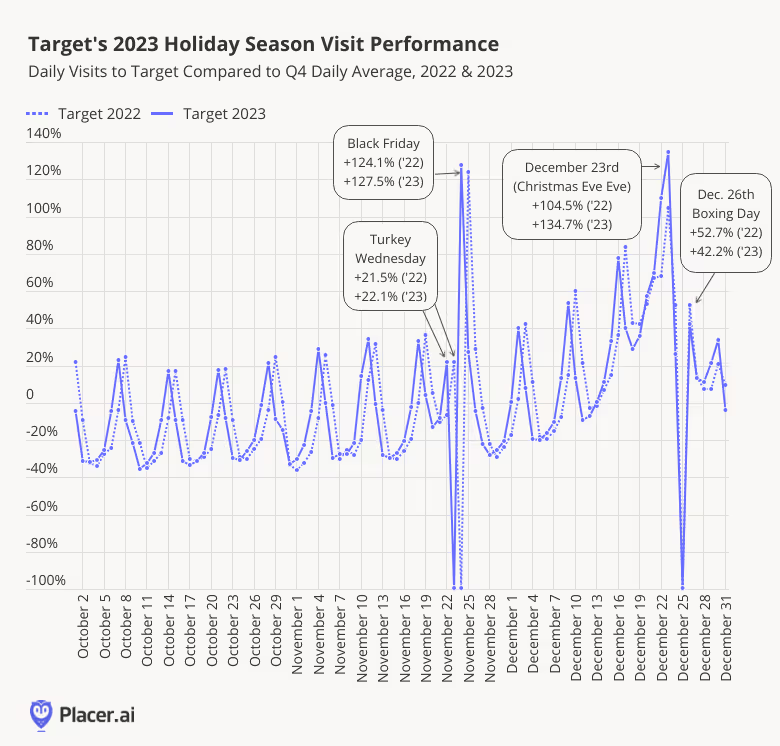
In all cases, retail visits began to creep up over the days leading up to Thanksgiving (Monday through Wednesday) as consumers took advantage of early Black Friday discounts. And the visit increase on Black Friday 2023 relative to the Q4 daily average was larger than in 2022 – perhaps thanks to budget-conscious consumers holding out for the steep discounts offered the day after Thanksgiving. The Christmas Eve Eve (December 23rd) and Super Saturday spikes were also particularly pronounced in 2023, likely thanks to the combination of both retail events falling on the same day this year. 

All retailers and retail segments analyzed also saw smaller surges on Boxing Day (December 26th) 2023 when compared to 2022, likely due to calendar differences. Christmas fell on a Sunday in 2022, so December 26th was declared a federal holiday in lieu of December 25th, and many private-sector employers likely gave time off as well – giving consumers the opportunity to hit the stores and enjoy after-Christmas sales. But Boxing Day still drove visit peaks across the board in 2023 (albeit not smaller peaks than in 2022) – indicating that Boxing Day is now a U.S. phenomenon as well. 

December 27th, 28th, and 29th saw a greater increase relative to the daily Q4 average in 2023 compared to 2022, culminating in a larger New Years Eve Eve (December 30th) spike. The December 30th surge may be because this year’s December 30th fell on a Saturday, which is a major shopping day in its own right. But the increase in the days prior to New Years Eve Eve, when after-Christmas sales were in full force, could indicate that consumers are still particularly attune to sales events.

Still, despite the similarities across retail categories, foot traffic data also reveals some important differences between the segments.

Target’s Major December Visit Build-Up 

Visits to Target began to increase in November 2023 relative to October as the retailer offered “Four Weeks of Early Black Friday Deals,” starting October 29th. And like the other categories analyzed, Target saw its first small visit peak of the season on the Wednesday before Thanksgiving (also known as Turkey Wednesday thanks to the massive Grocery visit spikes on the day). Visits on the day before Thanksgiving were up by 21.5% and 22.1%, in 2022 and 2023, respectively, despite foot traffic on an average Wednesday tends to be lower than the Q4 daily average – indicating that “Turkey Wednesday” also holds retail significance for grocery-adjacent categories. 

Visits then spiked on Black Friday and returned to seasonally normal levels on Saturday. Throughout December, foot traffic continued to swell, with every week exceeding the previous week’s visit performance. The intensity of the visit growth picked up the week before Christmas, with Christmas Eve Eve/Super Saturday seeing a significant jump. Finally, Target visits on Boxing Day and the week following Christmas also exceeded the Q4 daily average as consumers took advantage of end-of-season sales and looked for festive attire for their New Year’s Eve celebrations.

Line graph: Target's 2023 Holiday Season Visit Performance, 2022 and 2023 compared to Q4 Daily Avg.

Walmart’s Grocery Offerings Drive Its Holiday Visit Patterns 

The holiday season visit pattern at Walmart differs from those at Target in several instances. The superstore’s Turkey Visit spike was significantly more pronounced than Target’s, likely thanks to Walmart’s more extensive grocery offerings. Walmart also saw smaller spikes on Black Friday – perhaps due to the retailer’s famous “everyday low prices,” which may reduce the appeal of specific sales events. The Christmas Eve Eve/Super Saturday surge were also lower than for Target, but the Super Saturday increase relative to Black Friday spike was more pronounced, with some consumers probably visiting Walmart for last-minute groceries ahead of their Christmas dinners.


Line graph: Walmart's 2023 Holiday Season Visit Performance, Daily Visits Compared to Daily Average, 2022 and 2023

Luxury Department Stores Visit Trends Influenced by Calendar Differences

Visits to luxury department stores (Saks Fifth Avenue, Neiman Marcus, Nordstrom, and Bloomingdale’s) followed the general retail foot traffic trends, with larger peaks on Black Friday and on Christmas Eve Eve/Super Saturday in 2023 compared to 2022. Boxing Day 2023 drove a smaller visit spike relative to last year, but foot traffic was still 98.2% higher than the Q4 2023 daily average – indicating that the day is still emerging as an important retail milestone, especially for pricier segments.


Line graph: Luxury Dept Stores' 2023 Holiday Performance, Daily Visits 2022 and 2023 compared to Q4 Avg.

Different End of Year Trends for Mid-Tier and Luxury Department Stores 

Mid-tier department stores (Macy’s, Kohl’s, JCPenney, Belk, and Dillard’s) saw more significant spikes on Black Friday and Christmas Eve Eve/Super Saturday, and smaller spikes on Boxing Day. Luxury’s department stores’ biggest post-Christmas visit peak was on Boxing Day, but mid-tier department stores experienced their largest end-of-year increase on New Year’s Eve Eve (December 30th).


line graph: mid-tier dept. stores' 2023 Holiday Season visit performance, 2022 and 2023 Daily Visits compared to Q4 Daily Avg.

Retail Milestones Drive Massive Visit Surges for Best Buy  

Best Buy saw the strongest Q4 visit spike on Black Friday out of all the retailers and retail segments analyzed, with foot traffic up a whopping 510.9% compared to its Q4 2023 daily average. The electronics leader also had the largest Christmas Eve Eve/Super Saturday bump – with visits up 188.1% – and Boxing Day boost, with traffic up 112.9% compared to the Q4 daily average. The visit surges over the holiday season’s retail milestones indicate that demand for electronics remains strong – even as some consumers may be putting off large purchases due to economic headwinds. 

Line graph: Best Buy's Holiday Season Visit Performance, Daily Visits 2022 and 2023 Compared to Q4 Daily Avg.

The holiday season drove significant retail foot traffic across categories, with every segment displaying its own unique Q4 visitation pattern. How will these sectors perform in the year ahead? 

Visit placer.ai/blog to find out.  

Article
CosMc’s Field Trip: Does McDonald’s New Concept Have Escape Velocity?
R.J. Hottovy
Jan 6, 2024

2023 was a year that forced restaurant operators to stay agile. Inflation was top-of-mind for most consumers throughout the year, resulting in a trade-down to value-oriented restaurants (or trading out to value grocery chains, dollar stores, and convenience stores). That said, value wasn’t the only factor driving visits, as new menu innovations (Taco Bell was a standout) or marketing partnerships (McDonald’s Famous Orders and “adult” happy meals helping the chain to outperform from a visitation perspective). While we’ve seen visitation trends for the morning daypart improve due to a steady recovery in return to office trends, we continue to see visits during late morning and early afternoon for coffee and QSR chains due to changes in consumer routines (not to mention a resurgence in late night dining). This has also prompted several chains to refine their approach to drive-thrus and pick-up windows (Shake Shack, Chipotle, Taco Bell, among several others). On top of these trends, we’ve seen massive changes in restaurant trade areas, driving many chains to rethink their expansion plans (including an emphasis on South and Southeast, which have seen population growth due to migration).

McDonald’s new exploratory restaurant concept CosMc’s sits at the intersection of several of these trends. The smaller-format (approximately 2,800 square feet, compared to 4,000-4,500 square feet for the average McDonald’s), drive-thru only concept opened its doors last month in Bolingbrook, IL, and is part of a “limited test run”.  Its menu heavily focuses on beverages, including four “Signature Galactic Boosts” (featuring Sour Cherry Energy Boost and Island Pick-Me-Up Punch drinks), iced teas and lemonades (such as a Tropical Spiceade and Blackberry Mist Green Tea), slushes and frappes (including a Chai Frappe Burst and Popping Pear Slush), and coffee-based products (highlighted by the S’Mores Cold Brew and Turmeric Spiced Latte). While beverages are the focal point, there are also a variety of breakfast and snack food options, including a Spicy Queso and Creamy Avocado Tomatillo breakfast sandwiches, McPops (filled doughnuts), Savory Hash Brown Bites, and Pretzel Bites. In addition to the experimental fare, the menu also features a host of traditional breakfast sandwiches and beverage offerings. 

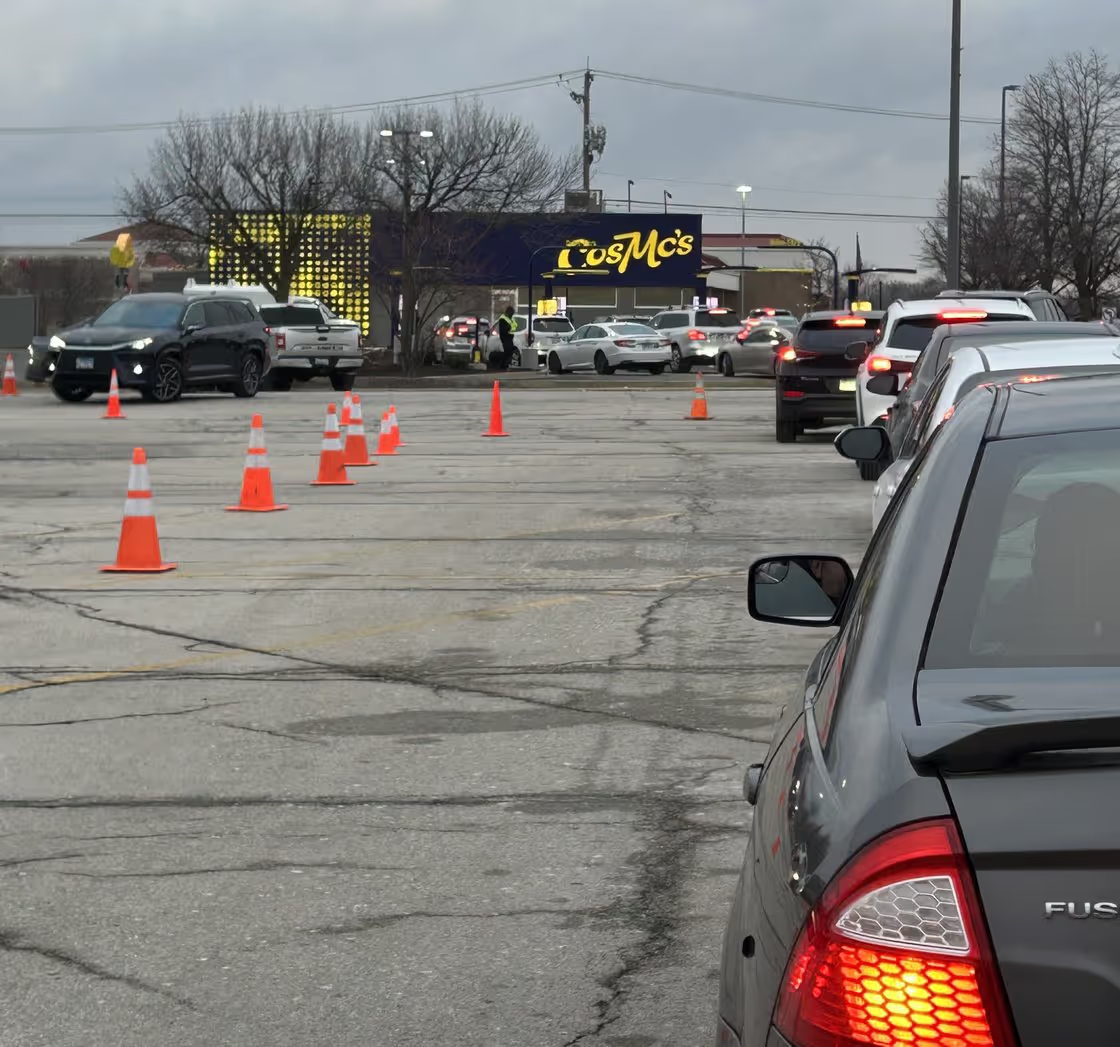
Given the early buzz, we decided to check out the concept for ourselves this week. It was immediately apparent how much interest CosMc’s was drawing, as the drive-thru lane spanned roughly 80 vehicles upon arrival (which required use of a separate parking lot at the Maple Park Place shopping center, which also features Burlington, Ross Dress for Less, Dollar Tree, Aldi, and Best Buy stores).

While its unique menu has rightfully generated a significant amount of attention, it’s also clear that McDonald’s is also using CosMc’s as a test for other potential drive-thru only locations in the future. Customers order from dynamic menu boards and cashless payment devices are used to expedite the payment process. Visitors wait at the menu board until their order is ready, and then pickup windows are assigned when the order is ready.

Admittedly, it’s tough to make definitive conclusions about CosMc’s with the location being open for only a few weeks. Placer’s data suggests that CosMc’s saw more than double the number of visits that a typical McDonald’s saw chainwide during December 2023 (despite being open only since Dec. 7) and more than triple the number of visits per square foot (given CosMc’s smaller, roughly 2,500 square feet footprint). However, it’s also worth noting that CosMc’s visitation numbers would likely have been much higher if the location had additional capacity to satisfy the overwhelming demand. 
Still, Placer offers some other ways to evaluate CosMc’s early trends. Based on 2019 Census Block Group data, CosMc’s trade area size (using a 70% of visit threshold) was just over 155 square miles during December 2023 (below). This is roughly 2.5 times the size of the trade area for the average McDonald’s location during December 2023 (62 miles) and significantly larger than the average trade area for most coffee brands (25-35 miles for more urban focused brands to 50-60 miles for more suburban/secondary market brands). In fact, the closest recent comparison we could find for CosMc’s was Raising Cane’s Post Malone and Dallas Cowboys restaurant collaboration, which had an impressive 264-mile trade area during its initial month of opening (though also helped by cross-traffic from Dallas Cowboys home game visitors from across the state of Texas). In some ways, there were also similarities between CosMc's and the Hello Kitty Cafe Trucks, which the Placer.ai Blog team wrote about last September.

Given that McDonald’s also appears to be targeting a younger demographic with CosMc’s, we thought we’d also look at the age breakdown for the potential market trade area (the population living within the trade area for the CosMc’s store). McDonald’s collective potential market trade area largely mirrors U.S. trends given its reach (the company has previously stated that 85% of the population in its top five markets–the U.S., France, the U.K., Germany and Canada–are within three miles of a McDonald’s location), it’s interesting that the potential market trade area for CosMc’s does skew to a younger audience, particularly the 22–29-year-old cohort.

By the end of 2024, McDonald’s plans to open an additional 10 CosMc’s test units, including locations in the Dallas-Fort Worth and San Antonio markets (notably some of the fastest growing markets in the U.S.). Does CosMc’s have the potential to be something more than a 10-unit test over a longer horizon? McDonald's has attempted to differentiate its coffee business in the past with its McCafe menu and standalone McCafe locations in international markets, but competition with Starbucks and others made it difficult for the company to distinguish McCafe as a standalone retail brand in the U.S. CosMc's is interesting from this perspective, as it may allow the company to build a brand more naturally and stand out with a younger audience (which appears to be working). It’s unlikely that future CosMc’s will look or operate like the pilot location in Bolingbrook. Nevertheless, the excitement around new products, an expansive trade area, and potential to connect with younger audience make it a worthwhile test (especially with 2024 shaping up to be a strong year for unit growth within the coffee category).

Reports
INSIDER
Report
Office Attendance Drivers in 2026: The New Rules of Showing Up
Dive into the data to learn how convenience-driven behaviors are impacting the office recovery – and how stakeholders from employers to office owners and local retailers can best adapt.
February 5, 2026

Key Takeaways:

To optimize office utilization and surrounding activity in 2026, stakeholders should: 

1. Plan for continued, but slower, office recovery. Attendance continues to rise and has reached a post-pandemic high, but moderating growth suggests the return-to-office may progress at a more gradual and incremental pace than in prior years.

2. Account for growing seasonality in office staffing, local retail operations, and municipal services. As office visitation becomes increasingly concentrated in late spring and summer, offices, downtown retailers, and cities may need to plan for more predictable peaks and troughs by adjusting hours, staffing levels, and local services accordingly, rather than relying on annual averages.

3. Align leasing strategies with seasonal demand. Stronger attendance in Q2 and Q3 suggests these quarters are best suited for leasing activity, while softer Q1 and Q4 periods may be better used for renovations, repositioning, and targeted activation efforts designed to draw workers in.

4. Design hybrid policies around midweek anchor days. With Tuesdays and Wednesdays consistently driving the highest office attendance, employers can maximize collaboration and space utilization by concentrating meetings, programming, and in-office expectations midweek.

5. Reduce early-week commute friction to support attendance. Monday office attendance appears closely correlated with commute ease, suggesting that reliable and efficient transportation may be an important factor in early-week office recovery.

6. Prioritize proximity in leasing and development decisions. Visits from employees traveling less than five miles to work have increased steadily since 2019, reinforcing the value of centrally located offices and housing near employment hubs.

When Policy Isn’t Enough

2025 was the year of the return-to-office (RTO) mandate. Employers across industries – from Amazon to JPMorgan Chase –  instituted full-time on-site requirements and sought to rein in remote work. But the year also underscored the limits of policy. As employee pushback and enforcement challenges mounted, many organizations turned to quieter tactics such as “hybrid creep” to gradually expand in-office expectations without triggering outright resistance.

For employers seeking to boost attendance, as well as office owners, retailers, and cities looking to maximize today’s visitation patterns, understanding what actually drives employee behavior has become more critical than ever. This reports dives into the data to examine office visitation patterns in 2025 – and explore how structural factors such as weather, commute convenience, and workplace proximity have emerged as key differentiators shaping how and when, and how often workers come into the office. 

Office Attendance Reaches a New High, But Momentum Slows

National office visits rose 5.6% year over year in 2025, bringing attendance to just 31.7% below pre-pandemic levels and marking the highest point since COVID disrupted workplace routines. At the same time, the pace of growth slowed compared to 2024, signaling a possible transition into a steadier phase of recovery.

With new return-to-office mandates expected in 2026, and the balance of power quietly shifting towards employers, additional gains remain likely. But the trajectory suggested by the data points toward gradual progress rather than a return to the more rapid rebounds seen in 2023 or 2024. 

Weather, Workations, and a New Kind of Seasonality 

Before COVID, “I couldn’t come in, it was raining” would have sounded like a flimsy excuse to most bosses. But today, weather, travel, and individual scheduling are widely accepted reasons to stay home, reflecting a broader assumption that face time should flex around convenience.

This shift is visible in the growing seasonality of office visitation, which has intensified even as overall attendance continues to rise. In 2019, office life followed a relatively steady year-round cadence, with only modest quarterly variation after adjusting for the number of working days. In recent years, however, greater seasonality has emerged. Since 2024, Q1 and Q4 have consistently underperformed while Q2 and Q3 have posted meaningfully stronger attendance – a pattern that became even more pronounced in 2025. Winter weather disruptions, extended holiday travel, and the growing normalization of “workations” appear to be pulling some visits out of the colder, holiday-heavy months and concentrating them into late spring and summer.

For employers, office owners, downtown retailers, and city planners, this emerging seasonality matters. Staffing, operating budgets, and programming decisions increasingly need to account for predictable soft quarters and peak periods, making quarterly planning a more useful lens than annual averages. Leasing activity may also convert best in Q2 and Q3, when districts feel most active. Slower quarters, meanwhile, may be better suited for renovations, construction, or employer- and city-led programming designed to give workers a reason to show up.

The Quest for Convenience and the TGIF Workweek

The growing premium placed on convenience is also evident in the persistence of the TGIF workweek – and in the factors shaping its regional variability.

Before COVID, Mondays were typically the busiest day of the week, followed by relatively steady attendance through Thursday and a modest drop-off on Fridays. Today, Tuesdays and Wednesdays have firmly established themselves as the primary anchor days, while Mondays and Fridays see consistently lower activity. And notably, this pattern has remained essentially stable over the past three years – despite minor fluctuations – as workers continue to cluster their in-office time around the days that offer the most perceived value while preserving flexibility at the edges of the week.

Commute Friction Shaping the Start of the Week

At the same time, while the hybrid workweek remains firmly entrenched nationwide, its contours vary significantly across regions – and the data suggests that convenience is once again a key differentiator.

Across major markets, a clear pattern emerges: Cities with higher reliance on public transportation tend to see weaker Monday office attendance, while markets where more workers drive alone show stronger early-week presence. While industry mix and local office culture still matter, the data points to commute hassle as another factor potentially shaping Monday attendance. 

New York City, excluded from the chart below as a clear outlier, stands as the exception that proves the rule. Despite nearly half of local employees relying on public transportation (48.7% according to the Census 2024 (ACS)), the city’s extensive and deeply embedded transit system appears to reduce perceived friction. In 2025, Mondays accounted for 18.4% of weekly office visits in the city, even with heavy transit usage.

The contrast highlights an important nuance: Where transit is fast, frequent, and integrated into daily routines, it can support office recovery, offering a potential roadmap for other dense urban markets seeking to rebuild early-week momentum. 

Proximity as a Key Attendance Driver

Another powerful signal of today’s convenience-first mindset shows up in commute distances. Since 2019, the share of office visits generated by employees traveling less than five miles has steadily increased, largely at the expense of mid-distance commuters traveling 10 to 25 miles.

To be sure, this metric reflects total visits rather than unique visitors, so the shift may be driven by increased visit frequency among workers with shorter, simpler commutes rather than a change in where employees live overall. Still, the pattern is telling: Workers with shorter commutes appear more likely to generate repeat in-person visits, while longer and more complex commutes correspond with fewer trips. Over time, this dynamic could shape office leasing decisions, residential demand near employment centers – whether in urban cores or in nearby suburbs – and the geography of the workforce.

Friction in Focus 

Taken together, the data paints a clear picture of the modern return-to-office landscape. Attendance is rising, but behavior is no longer driven by mandates alone. Instead, workers are making rational, convenience-based decisions about when coming in is worth the effort.

For cities, the implication is straightforward: Ease of access matters. Investments in transit reliability, last-mile connectivity, and housing near employment centers can all play a meaningful role in shaping how consistently people show up. For employers, too, the lesson is that the path back to the office runs through convenience, not just compulsion, as attendance gains are increasingly driven by how effectively organizations reduce friction and increase the perceived value of being on-site.

INSIDER
Report
Five Ways Retailers Can Leverage AI Without Losing What Works
Read the report to learn how AI is changing store roles, operations, marketing, and fleet strategy – and how to apply it without undermining what already works.
January 29, 2026

Strategic Insights

1. AI is raising the bar for physical retail as shoppers arrive more informed, more intentional, and less tolerant of friction – though the impact varies by category and format.

2. As discovery shifts upstream, stores increasingly serve as confirmation rather than discovery points where shoppers validate decisions through hands-on experience and expert guidance.

3. AI-based tools can improve in-store performance by removing operational friction – shortening trips in efficiency-led formats and supporting deeper engagement in experience-led ones.

4. By embedding expertise directly into frontline workflows, AI helps retailers deliver consistent, high-quality service despite high turnover and limited training windows.

5. AI enables precise, location-specific marketing and execution, allowing retailers of any size to align assortments, staffing, and messaging with real local demand.

6. Retailers can also use AI to manage their store fleets with greater discipline and understand where to expand, where to avoid cannibalization, and where to rightsize based on observed demand rather than static assumptions.

7. AI is not a universal lever in physical retail; its value depends on the store format, and in discovery-driven models it should support operations behind the scenes rather than reshape the customer experience.

Another Inflection Point for Physical Retail?

Physical retail has faced repeated claims of obsolescence, from the rise of e-commerce to the shock of COVID. Each time, analysts predicted a structural decline in brick-and-mortar. And each time, physical retail adapted.

AI has triggered a similar round of predictions. Much of the current discussion frames retail’s future as a binary outcome: either stores become heavily automated, or e-commerce becomes so optimized that physical locations lose relevance altogether.

But past disruptions point in a different direction. E-commerce changed how physical retail operated by raising expectations for omnichannel integration, speed, and clarity of purpose. Retailers that adjusted store formats, merchandising, and operations accordingly went on to drive sustained growth.

AI likely represents another inflection point for physical retail. As shoppers arrive with more information, clearer intent, and even less tolerance for friction than in the age of "old-fashioned" e-commerce, physical stores will remain – but the standards they are held to continue to rise. 

This report presents four ways retailers are using AI to get – and stay – ahead as physical retail adapts to this next wave of disruption.

1. Driving Engagement & Conversion in Physical Retail

The Store as Confirmation Point

E-commerce moved discovery earlier in the shopping journey. Instead of beginning the process in-store, many shoppers now arrive at brick-and-mortar locations after having deeply researched products, comparing options, and narrowing choices online – entering the store to validate rather than initiate their purchasing decision. 

AI-powered shopping accelerates this pattern. Conversational assistants, recommendation engines, and AI-driven discovery across search and social reduce the time and effort required to evaluate options – and this shift is changing consumers' expectations around the in-store experience. 

Apple’s Early Bet on the Informed Consumer Pays Off

Apple shows what it looks like when a physical store is built for well-informed shoppers. Given the prevalence of AI-powered search and assistants in high-consideration categories like consumer electronics, Apple customers likely arrive at the Apple Store with more preferences already shaped by AI-assisted research than other retail categories.

Apple Stores were designed for this kind of customer long before AI became widespread. The layout puts working products directly in customers’ hands, merchandising emphasizes live use over promotional signage, and associates are trained to answer detailed technical questions rather than walk shoppers through basic options.

That alignment is showing up in store behavior. Even as AI-powered shopping expands, Apple Stores continue to see rising foot traffic and longer visits thanks to the store's specific and curated role in the customer journey – a place where customers confirm decisions through hands-on experience and expert guidance.

2. Creating Seamless In-Store Experiences 

AI Inside the Store

Some applications of AI extend trends that e-commerce has already introduced. Others address operational challenges that previously required manual coordination or tradeoffs.

AI can reduce friction and make store visits more predictable by improving staffing allocation, reducing checkout delays, optimizing inventory placement, and managing traffic flow. These changes reduce friction without altering the visible customer experience.

Using AI to Remove Exit Friction at Sam’s Club

Sam's Club offers a clear, recent example of AI solving a specific in-store bottleneck. For years, customers completed checkout only to face a second line at the exit, where an employee manually scanned paper receipts and spot-checked carts. 

In early 2024, Sam’s Club introduced computer vision-powered exit gates, allowing customers to exit the store without stopping as AI algorithms instantly captured images of the items in their carts and matched them against digital purchase data. Employees previously tasked with receipt checks could now shift their focus to member assistance and in-store support.

The impact was measurable. Sam’s Club reported that customers now exit stores 23% faster than under manual receipt checks, a result confirmed by a sustained nationwide decline in average dwell time. During the same period, in-store traffic increased 3.3% year-over-year – demonstrating how removing friction with AI can deliver tangible gains.

Aligning AI with Store Purpose

AI optimizes stores for different outcomes. At Sam’s Club, it shortens visits by removing friction from task-driven trips. At Apple, upstream research leads to longer visits focused on testing, questions, and decision validation. In both cases, AI aligns store execution with shopper intent – prioritizing speed and throughput in efficiency-led formats and deeper engagement in experience-led ones.

3. Scaling Expertise on the Sales Floor

Beyond shaping store roles and streamlining operations, AI can also address a long-standing challenge in physical retail: delivering consistent, high-quality expertise on the sales floor despite high turnover and seasonal staffing. In the past, retailers relied on heavy training investments that often failed to pay off. AI can now embed that expertise directly into frontline workflows, allowing associates to deliver confident, informed service regardless of tenure and strengthening the in-store experience at scale.

In May 2025, Lowe’s rolled out a major in-store AI enhancement called Mylow Companion, an AI-powered assistant that equips frontline staff with real-time, expert support on product details, home improvement projects, inventory, and customer questions.

Mylow Companion is embedded directly into associates’ handheld devices, delivering instant guidance through natural, conversational interactions, including voice-to-text. This enables even newly hired employees to provide confident, expert-level advice from day one, while helping experienced associates upsell and cross-sell more effectively. The tool complements Mylow, a customer-facing AI advisor launched the same year to help shoppers plan projects and discover the right products, leading to increased customer satisfaction.

While AI alone cannot solve demand challenges—especially amid macroeconomic pressure on large-ticket discretionary spending—early signals suggest it may still play a meaningful role. Location analytics indicate narrowing year-over-year visit gaps at Lowe’s post-deployment, pointing to a potentially improved in-store experience. And Home Depot’s recent announcement of agentic AI tools developed with Google Cloud suggests that these technologies are becoming table stakes in this category.

As more retailers roll out similar capabilities, those that moved earlier are better positioned to help set the bar – and benefit as the market adapts.

4. Reaching the Right Audience at the Right Moment

Beyond improving the in-store experience, AI also gives retailers a powerful way to drive foot traffic through precision marketing. By processing large volumes of behavioral, location, and timing data, AI can help retailers decide who to reach, when to engage them, where to activate, and what message or assortment will resonate – shifting marketing from broad seasonal pushes to campaigns grounded in local demand.

Target offers an early example of this approach before AI became widespread. Stores near college campuses have long tailored assortments and messaging around the academic calendar, especially during the back-to-school season. In August, these locations emphasize dorm essentials, compact storage, bedding, tech accessories, and affordable décor – supported by campaigns aimed at students and parents preparing for move-in. That localized approach has been effective in driving in-store traffic to Target stores near college campuses, with these venues seeing consistent visit spikes every August and outperforming the national average across multiple back-to-school seasons from 2023 to 2025.

AI makes local execution repeatable at scale. By analyzing visit patterns, past performance, and timing signals across thousands of locations, retailers can decide which products to promote, how to staff stores, and when to run campaigns at each location. Marketing, merchandising, and store operations then act on the same demand signals instead of separate assumptions.

Crucially, AI makes this level of localization accessible to retailers of all sizes. What once required the resources and institutional knowledge of a big-box giant can now be achieved through precision marketing and demand forecasting tools, allowing brands to adapt each store’s messaging, assortment, and execution to the unique rhythms of its community.

5. Building Smarter Store Fleets With AI

Beyond improving performance at individual stores, AI can also give retailers a clearer view of how their entire store fleet is working – and where it should grow, contract, or change. By analyzing foot traffic patterns, trade areas, customer overlap, and visit frequency across locations, AI helps retailers identify which sites are truly reaching their target audiences and which are underperforming relative to local demand. 

AI also plays a critical role in smarter expansion. Retailers can use it to identify markets and neighborhoods where demand is growing, customer overlap is low, and incremental visits are likely – reducing the risk of cannibalization when opening new stores. By modeling how shoppers move between existing locations, AI can flag when a proposed site will attract new customers versus simply shifting traffic from nearby stores, grounding expansion decisions in observed behavior rather than demographic proxies or intuition alone.

Equally important, AI helps retailers recognize when expansion no longer makes sense. By tracking total fleet traffic, visit growth, and trade-area saturation, retailers can assess whether new stores are adding net demand or diluting performance. The same signals can identify locations where demand has structurally declined, informing rightsizing decisions and store closures. In this way, AI supports a more disciplined approach to physical retail – one that treats the store fleet as a dynamic system to be optimized over time, rather than a footprint that only grows.

AI Won’t Matter Equally Across All Retail Formats

The impact of AI on physical retail will vary significantly by category and format. Not every successful store experience is built around efficiency, prediction, or pre-qualification. Retailers with clearly differentiated offline value don’t necessarily benefit from forcing AI into customer-facing experiences that dilute what makes their stores work.

“Treasure hunt” formats are a clear example. Off-price retailers like TJ Maxx, Marshalls, Ross, and Burlington continue to drive strong traffic by offering unpredictability, scarcity, and discovery that cannot be replicated – or meaningfully enhanced – through AI-driven search or recommendation. The appeal lies precisely in not knowing what you’ll find. For these retailers, heavy investment in AI-led personalization or pre-shopping guidance risks undermining the core experience rather than improving it.

Similar dynamics apply in other categories. Independent boutiques, vintage stores, resale shops, and certain specialty retailers succeed by offering curation, serendipity, and human taste rather than optimization. In these cases, AI may still play a role behind the scenes – supporting inventory planning, pricing, or site selection – but it should not reshape the customer-facing experience. AI is most valuable when it reinforces a retailer’s existing value proposition. Formats built around discovery, surprise, or experiential browsing should protect those strengths, even as other parts of the retail landscape move toward greater efficiency and intent-driven shopping.

Raising the Bar for Physical Retail

AI is forcing physical retail to evolve with intention. By creating a supportive environment for customers who arrive with made-up minds, removing friction inside the store, offering the best in-store services, and orchestrating demand with greater precision, retailers are adapting to the new world standards set by AI. All five strategies focus on aligning stores with shopper intent – what customers want, how the store supports it, and when the interaction happens.

The retailers that win in this next era won’t be the ones that use AI to simply automate what already exists. They’ll be the ones that use it to sharpen the role of physical retail – turning stores into places that help shoppers validate decisions, deliver value beyond convenience, and show up at exactly the right moment in a customer’s journey.

In the age of AI, physical retail wins by becoming more intentional – designed around informed shoppers, optimized for the right outcome in each format, and activated at moments when demand is real.

INSIDER
Report
10 Top Brands to Watch in 2026
Meet the ten retail and dining powerhouses, including H-E-B, Walmart, and Dave’s Hot Chicken, redefining success and winning consumer loyalty in 2026.
January 12, 2026

If 2025 proved anything, it’s that the American consumer hasn’t stopped spending – they’ve just become incredibly selective about who earns their dollar. As we look toward 2026, success isn't just about weathering headwinds; it's about identifying the specific operational levers that drive traffic.

We analyzed the data to identify ten retail and dining standouts (presented in no particular order) that are especially well-positioned for the year ahead. From grocery icons mastering hyper-authenticity to fitness challengers proving that low price doesn't mean low quality, these companies have demonstrated a powerful understanding of their audience and the operational agility to meet them where they are.

Here – in no particular order – are the brands setting the pace for 2026.

1. H-E-B 

When we pick retailers for our Ten Top list, there are some that rest on the edgier side and others that look fairly down the middle. Picking H-E-B, a grocer that has seen monthly visits up year over year (YoY) for all but one month since April of 2021, is clearly not one of the bolder claims. But consistent success shouldn’t preclude a retailer from receiving its well deserved kudos, and there are some unique reasons that H-E-B specifically needs to be included this year. 

H-E-B exemplifies the single most important trend in retail: the need for a brand to have authenticity and a clear reason for being. The retailer understands its audience, and as a result, it’s able to optimize its merchandising, promotions, and experience to best serve that loyal customer base. This pops in the data when we see the loyalty H-E-B commands, especially when compared to the grocery average.

In addition, the chain has also embraced adjacent innovation, leveraging its existing fleet by adding True Texas BBQ to a growing number of locations. The offering not only helps maximize the revenue potential of each visit, it taps into the core identity of the brand, further deepening customer connection and authenticity. The strategy also signals H-E-B’s understanding of emerging consumer behaviors – particularly the increase in shoppers turning to grocery stores for affordable, restaurant-quality lunches. And this combination of expanding revenue channels while heightening H-E-B’s uniqueness should also carry over into the value and impact of its retail media network.

In short, H-E-B has not only identified a critical route to success, it continues to embrace channels that widen revenue potential while doubling down on foundational strengths.

2. Michaels

In 2024, Michaels held nearly 32.0% of overall visit share among the top four retailers in the wider crafts and hobby space. By the second half of 2025, that number had skyrocketed to just over 40.0% – driven largely by the closures of key competitors JoAnn Fabrics and Party City.

And it isn’t just that the removal of competitors is increasing the share of overall visits; the rate of capture appears to be accelerating. In Q2 2025, visits rose 7.3% YoY as Michaels began absorbing traffic from Party City, which closed the bulk of its locations by March. Growth strengthened further in Q3, with visits up 13.1% YoY following the completion of JoAnn’s shutdown in May. But during the all-important Q4, traffic surged even higher YoY, suggesting that  that consolidation alone doesn’t fully explain the gains.

While the tailwinds of competitor closures clearly help, there are other strategies that are helping the retailer maximize this wave. Whether it be NFL partnerships to boost the retailer’s Sunday role in American households, a push into the framing space with 10-minute custom framing, the addition of JoAnn’s branded merchandise to its offerings, or even a challenge to Etsy’s online dominance with a new marketplace – Michaels is making moves to take full advantage of their improved positioning. There is also an argument to be made that Michaels is the retailer best poised to benefit from the segment’s consolidation, given that it is also the most oriented to a higher income consumer among top players in the category. This could help unlock other more focused concepts and promotions, and better align with an audience now looking for a retail replacement.

3. Walmart

Walmart is the dominant player in physical retail. 

And they leverage this position to push forward new offerings that extend revenue potential while maximizing per-store impact. They are a pioneer in the retail media space and have been using their unique reach to push that side of the business forward. Add to that the fact that they have been among the savviest players in all of retail in identifying the ideal approach to omnichannel, utilizing their massive physical footprint to improve their reach via BOPIS and store-fulfilled e-commerce.

All good reasons for inclusion, right?

But, here’s the kicker - from a pure visit perspective, things are going from good to better. Between January and September 2025, Walmart visits were essentially flat year over year – a good position for a retailer with such a massive reach and such strength shown in recent years. Yet, since October, visits have actually been on the rise, with Q4 2025 showing a 2.5% YoY traffic increase and several weeks exceeding 4.0% YoY.  

A retail giant with even more potential growth than we might have expected – and one that’s pushing the very strategies we believe are the key to future success? That’s certainly a reason for inclusion.

4. Dillard’s

Including a department store again on this year’s list? It seems counterintuitive to many of the narratives that ran through 2025, especially as middle-class consumers continue to be squeezed financially. However, Dillard’s still appears to be an exception to the rule, with performance more closely aligned to that of luxury department store brands like Bloomingdales & Nordstrom than to its true competitive set. 

In 2025, visitation to Dillard’s was essentially flat YoY – though the chain has consistently outperformed the wider department store category. Dillard’s stands at a unique point somewhere between a mid-tier and luxury department store, and that distinction may be its secret to success. The retailer continues to wow with strong private label offerings that rival and often exceed national brands, a diverse merchandise mix, and locations that often benefit from indoor mall traffic trends.

While Dillard’s lags behind the wider department store category, for example, in terms of repeat visitation and the share of wealthy visitors, these factors may actually create an advantage. Efforts by Dillard's to refresh its product mix through limited-edition capsule collections and new brand launches may be helping it attract a steady inflow of economically diverse new shoppers. And the ability to continually win over new segments without alienating a “core customer” could be a strength amid economic headwinds and waning consumer sentiment. 

At the same time, a more diverse visitor profile means that Dillard’s can truly be the department store for many consumers, with a product range that strikes a chord with different shopper segments. 

Department stores truly aren’t dead, and those who have found their reason to exist continue to garner attention with shoppers.

5. POP MART

If the retail industry had a symbol for 2025, it was probably Labubu. The toy-and-collectible-turned–bag charm took consumers by storm in the second quarter of the year, and POP MART – the retailer responsible for bringing Labubus stateside – quickly became an overnight sensation. Visits to the chain surged over the summer at the height of the craze, while trade areas expanded as customers traveled significant distances to get their hands on a doll. 

And although the frenzy cooled somewhat in early fall, visits to POP MART locations like the one in Tulalip, WA began trending upward once again in November 2025 as the holiday season approached, surging even higher in December. Trade area size also increased dramatically during the holiday shopping period, as consumers rushed to get their hands on the chain’s coveted line of festive blind boxes.

As demonstrated by the recent Starbucks Bearista craze, consumers are all-in on cool collectible items that make life more fun – a trend POP MART, strategically located in high-traffic malls popular with younger shoppers, is uniquely positioned to ride. During times of economic uncertainty, consumers crave small ways to indulge, and affordable collectibles that are cute, cuddly, and fun have worked their way into the American zeitgeist.

So, what is next for POP MART? Can it continue to sustain its momentum? It seems likely that Labubus are here to stay, at least for a little while longer, before the retailer hopefully strikes it big with the next “must have”.

6. 7 Brew 

When all is said and done, 2021-2025 will likely be viewed as a pivotal turning point for the U.S. coffee industry. As the country recovered from the pandemic, consumer interaction with coffee brands fundamentally shifted. With more employees working from home – bypassing the traditional pre-work coffee run – visit trends migrated to later in the morning and afternoon. Meanwhile, industry-wide dwell times shortened as consumers renewed their focus on convenience.

This move away from the sit-down café experience placed significant pressure on industry leaders, accelerating the shift toward drive-thru and mobile order-and-pay options. This moment of friction also created space for drive-thru-centric challengers like Dutch Bros, which rapidly expanded on the strength of speed and menu innovation. 

Among these challengers, 7 Brew stands out as a fast-rising powerhouse heading into 2026. Expanding outward from its Arkansas roots, 7 Brew has been strategic about market entry and site selection for its unique double-drive-thru format. And with a concept that resonates with younger demographics and a footprint adaptable to various geographies, the coffee chain has become a go-to destination for rural and small-town communities, while also maintaining solid reach among more traditional coffee segments like wealthy suburbanites and urban singles. Thanks in part to this broad appeal, 7 Brew is well-positioned for future growth, even as it faces stiffer competition in new markets.

7. Dave's Hot Chicken

It is no secret that most of the growth in the QSR space over the past two decades has been driven by chicken concepts. Chick-fil-A, rising from a regional chain to a national player throughout the late 1990s and 2000s, was the first to disrupt the burger’s stranglehold on QSR. Raising Cane’s followed in the 2010s with a model built on menu simplicity and operational excellence, earning its place as one of the largest chains in the category. More recently, hot chicken has emerged as one of the fastest-growing segments – and Dave’s Hot Chicken is leading the charge. 

No single factor accounts for Dave’s growth from a lone unit in Los Angeles to over 350 units today. Certainly, a wide assortment of sauces and flavor profiles has resonated with U.S. consumers who are increasingly seeking spicier products, while Dave’s 'rebel' brand positioning has successfully attracted  younger audiences. And at a time when many QSR and fast-casual chains are abandoning urban locations in favor of suburban markets, Dave’s Hot Chicken continues to open predominantly in urban settings – a strategy that may prove advantageous as migration patterns shift back toward major cities this year.

With so much of the industry’s expansion driven by chicken concepts, it is natural to ask: Have we reached 'peak chicken'? While we are certainly seeing other categories gain traction – think CAVA – Dave’s unique product mix and edgier marketing should help it stand out, even amidst increased competition.

8. HomeGoods & Homesense

While many discretionary retail categories – including consumer electronics, sporting goods, home improvement, and furniture – are still waiting for post-pandemic demand to recover, housewares retailers have generally enjoyed solid visit trends in 2025. Although consumers may not be financially positioned for large-scale remodels, we are now five years past the pandemic, and many residents (many of whom still work from home) are looking to refresh their living spaces. 

It may therefore come as no surprise that TJX Companies’ HomeGoods and Homesense brands had an exceptional 2025 and are well-positioned to repeat this success in 2026. 

This year, we observed a behavioral shift among middle-income consumers, including a clear “trade down” from mid-tier department stores and other discretionary categories. In addition, accumulated housing wear-and-tear, the recent bankruptcies of value-oriented competitors such as Conn’s and At Home, and the enduring appeal of the treasure hunt retail model, have all reinforced the brands’ momentum. Taken together, these trends leave HomeGoods and Homesense poised for both continued unit growth and increased traffic in the year ahead.

9. EōS Fitness

With the heightened emphasis on health and wellness post-pandemic, fitness is proving to be a category with remarkable staying power well beyond New Year’s resolution season – even in an era of macroeconomic uncertainty. Whether it’s pumping iron, hitting the treadmill, or joining fitness classes, staying healthy no longer requires breaking the bank – for just a dollar a day or less, gymgoers can build strength and endurance, achieve their rep goals, and hit their mileage targets. And affordable fitness chains – those that charge less than $30 per month – are reaping the benefits, outperforming more expensive gyms for YoY visit growth.

Among this value-oriented fitness cohort, EōS saw outsized traffic growth in 2025, with both overall visits and average visits per location outpacing competitors as the chain expands its footprint. EōS’s motto, “High Value, Low Price,” appears to be resonating strongly – especially in a year when similar value propositions are driving momentum across off-price retailers, value grocers, and dollar stores. Longer-than-average dwell times at EōS provide another encouraging signal, suggesting that its amenities, including pools, saunas, basketball courts, and equipment assortments typically found in higher-priced gyms, are truly connecting with visitors. And since visitors who stay longer are more likely to return – and to renew their memberships – EōS is well-positioned to convert this year’s traffic gains into lasting market share.

10. Chuck E. Cheese

Eating and entertainment are a match made in heaven — and by leaning into a subscription model that meets price-sensitive customers where they are, Chuck E. Cheese has solidified its position as a standout in the eatertainment category.

Nearly 50 years old, this evergreen children’s entertainment concept has stood the test of time and now boasts roughly 500 venues nationwide. Its perennial tagline – “where a kid can be a kid” – still resonates with today’s children and with the parents who grew up with the brand. After languishing for several years in the wake of COVID, the company turned things around with a revamped Summer Fun Pass launched on April 30th, 2024. The offer of unlimited play per month sparked a dramatic boost in customer loyalty, and the model proved so successful that the company extended it year-round with a family pass as low as $7.99 per month.

This strategy has helped sustain visit growth throughout 2025. Despite closing several locations during the year, visits to Chuck E. Cheese rose 8.3% YoY – well above the flat eatertainment average. And the company’s loyalty rates outpaced last year from August through November, indicating that the offering isn’t losing steam and that customers continue to respond enthusiastically.

Retail’s Next Chapter

The diversity of brands featured in this report highlights that there is no single path to success in 2026.

H-E-B and Chuck E. Cheese demonstrate the power of deepening loyalty through authentic experiences and value-driven memberships. Michaels and HomeGoods show how savvy retailers can capitalize on competitor consolidation and changing consumer spending habits. Meanwhile, Walmart and 7 Brew prove that even in saturated markets, operational innovation can drive fresh momentum.

As we move deeper into 2026, the brands that win will be those that, like the ten profiled here, combine a clear understanding of their unique value proposition with the agility to execute on it.

Loading results...
We couldn't find anything matching your search.
Browse one of our topic pages to help find what you're looking for.
For more in-depth analyses on a variety of subjects, explore Reports.
The Anchor Logo
INSIDER
Stay Anchored: Subscribe to Insider & Unlock more Foot Traffic Insights
Gain insider insights with our in-depth analytics crafted by industry experts
— giving you the knowledge and edge to stay ahead.
Subscribe