Skip to Main Content
Thank you! Your submission has been received!
Oops! Something went wrong while submitting the form.
0
0
0
0
----------
0
0
Articles

Article
McDonald’s LTOs Deliver Traffic Lift Ahead of the McValue 2.0 Launch
Shira Petrack
Mar 20, 2026
3 minutes

Shamrock Shake and Big Arch Generate Modest Traffic Gains

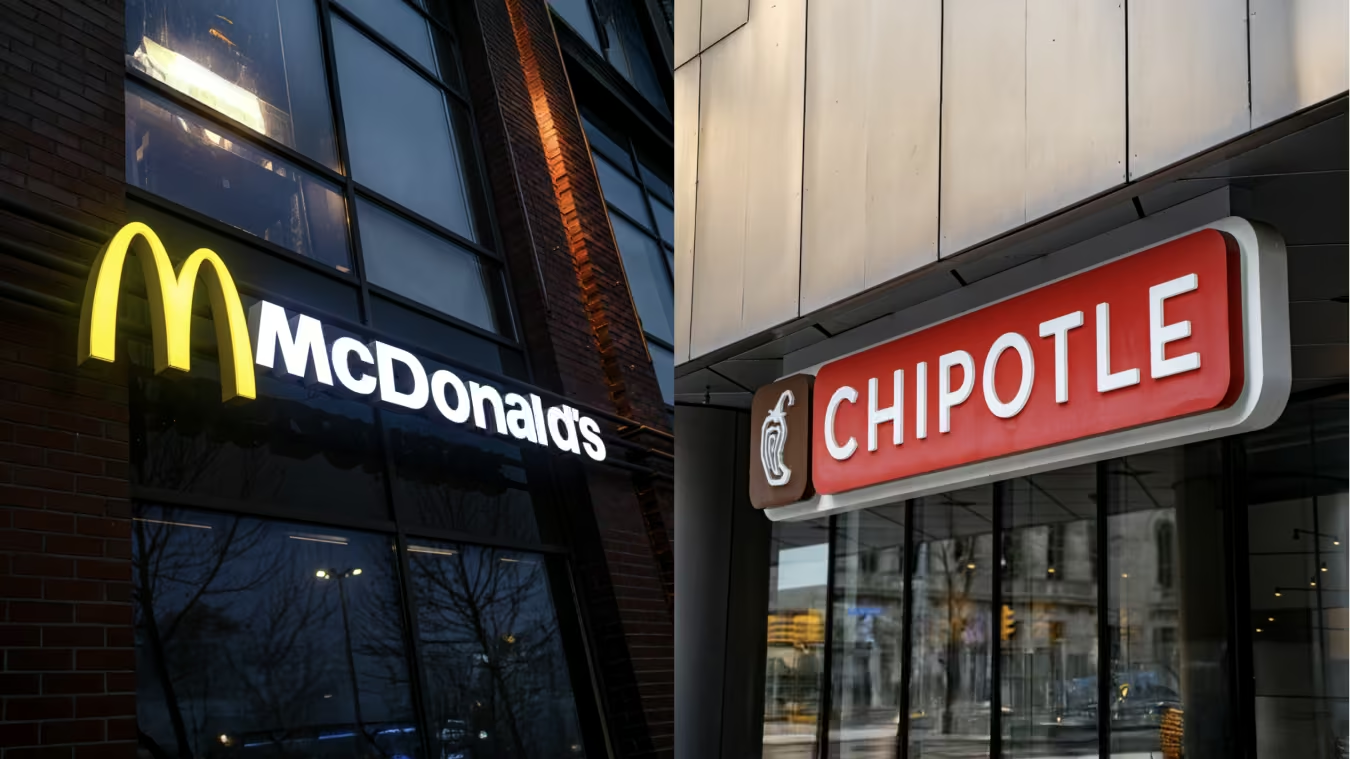
Recent McDonald's menu additions such as the annual Shamrock Shake release and the Big Arch Burger pilot appear to have generated only a modest lift in McDonald’s foot traffic. Although visits increased 5.5% year-over-year during the week of February 16th 2026 – the week of the Shamrock Shake's launch – traffic the following week dipped -0.5%, suggesting the seasonal item generated only a short-lived bump rather than a sustained lift in visits. And the heavily publicized Big Arch generated just a 2.2% YoY traffic boost during its launch week of March 2nd to March 8th 2026 – although performance may strengthen as the item gains traction with consumers.

Consumers May Be Growing More Selective as Economic Pressures Persist

So while these LTOs did generate modest traffic lifts for the chain, the impact was relatively muted compared to some of last year’s stronger performers, such as McDonald’s Grinch Meals. These results may suggest that consumers are becoming increasingly selective in their spending – potentially making it more difficult for QSR chains to rely on LTOs alone to drive meaningful traffic momentum without additional value-oriented offerings.

Combining Value and Innovation May Improve Traffic Momentum 

While recent LTOs delivered only modest gains on their own, pairing LTOs with a clearer value proposition – such as the upcoming McValue 2.0 – may prove more effective, with limited-time items drawing attention and value-focused offerings encouraging repeat visits. In a price-sensitive environment, this dual strategy could drive a more sustainable traffic lift than product innovation or value promotions alone.

For more data-driven restaurant insights, visit placer.ai/anchor

Placer.ai leverages a panel of tens of millions of devices and utilizes machine learning to make estimations for visits to locations across the US. The data is trusted by thousands of industry leaders who leverage Placer.ai for insights into foot traffic, demographic breakdowns, retail sale predictions, migration trends, site selection, and more.

Article
What’s Next for Retail in 2026: An Industry Perspective
Lila Margalit
Mar 19, 2026
10 minutes

A Cautiously Optimistic Outlook

Confidence in physical retail remains solid this year. More than 55% of survey respondents said they feel confident or very confident about brick-and-mortar performance in 2026, while only around 20% expressed concern.

This sentiment aligns with the broader performance of the sector. The chart below shows two consecutive years of modest but positive retail visit growth, with year-over-year (YoY) gains hovering around 1%. While that pace reflects a relatively stable – rather than booming – environment, it reinforces the idea that physical retail continues to demonstrate resilience despite macroeconomic uncertainty.

Still, the results also highlight an element of caution. Nearly half of respondents reported feeling neutral or concerned about the coming year, suggesting that while the foundation for brick-and-mortar retail remains strong, industry leaders are watching economic conditions closely.

Physical and Digital: A Step Closer to Harmonized Retail

At the same time, most respondents believe online retail will continue to grow faster than physical stores. Nearly 70% said they expect e-commerce to outpace brick-and-mortar growth over the next twelve months.

This outlook is hardly surprising given e-commerce’s smaller starting point and the ongoing digital expansion across the retail landscape. But crucially, the expectation of stronger online growth does not translate into pessimism about stores. Nearly a third of respondents said they were actually more bullish on physical retail than on e-commerce. 

These findings suggest the industry has moved beyond the once-dominant narrative that e-commerce would inevitably replace physical retail. Instead, the data reflects a growing consensus that the two channels are increasingly complementary – a story also supported by visit data, which shows e-commerce activity growing faster than brick-and-mortar retail even as both continue to expand. The rise of online retail doesn’t reduce the necessity of physical stores – it pushes retailers, brands, and landlords alike to develop clearer strategies for how online and offline channels work together to create a seamless consumer journey that leverages the unique advantages of each.

Agentic AI - A Tide That Lifts All Boats?

When we asked professionals about the role agentic AI could play in retail in the coming years, our expectation was a resounding vote for the lift it would provide e-commerce. And indeed, 44% of respondents said they expect agentic AI to increase the share of online retail.

However, reflecting the growing recognition that retail’s future lies in more harmonized commerce, 34% of respondents said they believe agentic AI will lift all boats – increasing incremental growth across commerce more broadly.

This is a significant signal. It reinforces the idea that innovation, whether centered on physical or digital shopping, is most powerful when it creates value across the entire ecosystem. Rather than viewing technology as a zero-sum competition between channels, many retail leaders increasingly see tools like AI as ways to strengthen the overall shopping experience. And that perspective makes it more likely that retailers and brands will evaluate new technologies through a broader lens that prioritizes integrated commerce.

What Draws Shoppers Into Stores

Understanding why consumers visit stores remains central to shaping the next phase of brick-and-mortar retail. When survey participants were asked to identify the key drivers of in-store visits, tactile experiences topped the list, with nearly 80% of respondents pointing to the ability to see, touch, and try products as among the biggest advantages of physical retail. Another 70% highlighted the enjoyment of the in-store shopping experience itself – emphasizing another element that is difficult to replicate online.

At the same time, respondents expressed skepticism about some of the strategies often cited as drivers of store traffic. Only 12% identified services such as buy-online-pickup-in-store (BOPIS) or in-store returns as major traffic drivers. This suggests that while these services are important components of omnichannel retail – reflected, for example, in a growing share of short in-store visits across industries – they may not yet be fully integrated into shopping journeys in ways that maximize their potential.

Perhaps most surprisingly, only 30% of respondents said stores excel at inspiring shoppers to discover new products. Yet this capability may represent one of brick-and-mortar retail’s greatest untapped opportunities. Physical environments are uniquely positioned to spark discovery through merchandising, layout, and experiential elements – factors that can expand baskets and deepen customer engagement.

The Retail Sectors Inspiring the Most Confidence

Industry sentiment also varies significantly across retail segments, with sector-level expectations closely tracking last year’s visit performance. When asked whether they expected various categories to grow, remain stable, or decline over the next twelve months, respondents were more likely to express confidence in continued growth or stability for segments that experienced stronger YoY traffic trends in 2025. 

Wholesale clubs, which saw visits rise 5.0% YoY in 2025, topped the list – with 97% of respondents expecting growth or stability in the months ahead, followed by grocery stores at 96%. The strength of both sectors reflects broader consumer trends, including suburban living, increased home cooking, and a heightened focus on value and wellness.

Still, respondents are significantly more bullish on wholesale clubs than on traditional grocery stores: Breaking down the growth / stability outlook down further, 61% of respondents expect clubs to see continued growth, compared with about 35% for grocery stores.

One reason may be the club model’s ability to capture large shopping baskets. While consumers today are increasingly willing to visit multiple stores to find the best value or selection, club retailers excel at capturing a significant share of the shopping list once they secure the visit. Grocery stores, on the other hand, attract frequent trips – but these may include fewer items as shoppers spread spending across multiple retailers. This dynamic may push grocers to focus more heavily on specialization, differentiated offerings, and higher value per visit.

Mass merchandisers such as Walmart and Target also received strong confidence scores, reflecting Walmart’s recent performance and expectations surrounding Target’s ongoing turnaround strategy. Meanwhile, discount and dollar stores – another category that has performed well recently – were widely expected to remain stable, with fewer respondents predicting continued rapid growth for the sector in the months ahead.

Malls and the Space for Surprises

There are few sectors we love talking about more than malls. Several years ago, the prevailing expectation was of a perpetual decline for the sector as a whole. But the “death of the mall” narrative has quickly diminished – or at least evolved. In our survey, 54% of respondents expected continued success for Tier 1 malls, while 30% anticipated decline across all mall types. Only 16% expected Tier 2 malls to perform well, and less than half of those believed that success would extend further down the tier ladder.

This largely aligns with visit data, with top-tier indoor malls driving significant success in recent years – a trend that will likely be further reinforced by the continued shift of key audiences toward the suburbs.

However, the potential of Tier 2 malls remains an area worth watching. A major part of the success of top malls has been a shift away from heavy concentrations of apparel and beauty toward more diverse tenant mixes, along with a stronger emphasis on elevated dining and experiences. This has been a critical element for the highest-performing malls. But in an environment where space is increasingly at a premium – and where less space is being dedicated to apparel and beauty in these top locations – a significant opportunity may emerge for Tier 2 malls to provide a stage for retailers that can no longer find a home in the most sought-after centers.

The result is an opportunity for these properties to become the “big fish” in smaller ponds, particularly if they focus on building tenant mixes that complement major regional players rather than compete with them directly. Executed well, this strategy could reduce direct competition while creating more destinations where consumers want to spend time.

Confidence, Convergence, and New Opportunities in Retail

Industry sentiment, especially when combined with visit data, offers a valuable snapshot of how retail is likely to evolve in the year ahead. Together, they point to a sector defined by steady physical retail performance, growing integration between online and in-store channels, optimism around technologies like AI, and shifting opportunities across segments from wholesale clubs and grocery to evolving mall formats.

For more data-driven retail insights visit Placer.ai/anchor

Placer.ai leverages a panel of tens of millions of devices and utilizes machine learning to make estimations for visits to locations across the US. The data is trusted by thousands of industry leaders who leverage Placer.ai for insights into foot traffic, demographic breakdowns, retail sale predictions, migration trends, site selection, and more.

Article
Swig’s Rapid Growth Draws Long Lines and Broader Audiences
Lila Margalit
Mar 18, 2026
4 minutes

Swig, the Utah-born drive-thru concept that helped popularize customizable dirty sodas, has evolved from a regional novelty into one of the fastest-growing beverage chains in the country. Known for mixing classic soft drinks with flavored syrups, creams, and fruit add-ins – alongside cookies and pretzel bites – the brand has expanded well beyond its Mountain West roots. 

This expansion is fueled by significant online hype, with new locations often generating lines that wrap around the block and leave some customers waiting over an hour to try their first drink. And as the brand pushes deeper into the Sunbelt and beyond, location analytics offer a window into how this growth is impacting traffic trends and reshaping the brand's audience.

Scaling the Fizz

Unsurprisingly, the data shows that as Swig has expanded its footprint, it has successfully grown its overall traffic. In February 2026, visits to the chain were 137.9% higher than in February 2023 – and up 30.7% year-over-year compared to February 2025.

The data also shows the emergence of a clear seasonal pattern, with visits to Swig peaking each year in the summer as people seek out cool soda treats to beat the heat. Notably, the magnitude of the summer peak in 2025 was larger than ever before, suggesting that as the chain becomes more mainstream, its seasonal appeal may be increasing. But the dramatic increase in off-season visits as well shows that Swig is successfully building a loyal customer base that craves its offerings year-round.

A New Flavor of Foot Traffic

This rapid growth is also leading to a meaningful broadening of Swig’s customer base. While the chain’s trade areas still remain affluent relative to the average U.S. household, the median household income (HHI) of its captured market is dropping as it reaches a more varied demographic. 

And while "Wealthy Suburban Families" and "Upper Suburban Diverse Families" remain Swig’s largest audience segments, their total share of the market has edged down as engagement deepens across additional cohorts. This includes, notably, households in Blue Collar Suburbs who are now overindexed at 8.1% of Swig’s captured market, compared to a 6.9% nationwide baseline.

A Sweet Outlook

As Swig continues its transition from a niche favorite to a broad staple, it will inevitably face the challenges of sustained growth, such as maintaining unit-level productivity and operational consistency. However, for now, the data and the visible excitement surrounding new openings suggest that the dirty soda pioneer still has plenty of fizz left.

For more data-driven dining analyses follow Placer.ai/anchor

‍Placer.ai leverages a panel of tens of millions of devices and utilizes machine learning to make estimations for visits to locations across the US. The data is trusted by thousands of industry leaders who leverage Placer.ai for insights into foot traffic, demographic breakdowns, retail sale predictions, migration trends, site selection, and more.

Article
Hybrid Work Has Reshaped Downtown Retail Traffic
Shira Petrack
Mar 17, 2026
5 minutes

Retail Corridor Traffic Has Recovered – But Not Fully

Foot traffic to retail corridors nationwide plummeted during the shelter-in-place restrictions of 2020, and recent data shows that visits have yet to fully recover to 2019 levels. While traffic has steadily improved each year since the pandemic lows, 2025 visits remain 11.7% below their pre-pandemic baseline. 

What is holding the retail corridor recovery back? We dove into the data to find out. 

Weekday Weakness Highlights the Impact of Hybrid Work

Retail corridors are typically concentrated in downtown areas, featuring a mix of stores, restaurants, bars, and offices – and are often surrounded by even more office space. And comparing average visits per day of week in 2025 and 2019 suggests that the persistence of hybrid and remote work is likely driving much of the lag. 

Monday through Thursday foot traffic to retail corridors was down between 16.3% and 17.3% in 2025 compared to 2019. The gap narrowed to 11.7% on Friday as activity began to shift toward the weekend, and nearly disappeared on Saturday (-2.8%) and Sunday (-4.2%).

The much larger weekday deficit suggests that reduced office attendance continues to weigh on downtown retail activity. With fewer workers commuting daily, there are fewer pre-work coffee stops, lunchtime errands, and spontaneous after-work visits that once fueled these corridors. So while leisure-driven weekend traffic has largely rebounded, the office-driven weekday ecosystem that historically sustained retail corridors has yet to fully return.

Office Hours Show the Largest Traffic Gaps

Hourly data reinforces the role that office attendance (or lack thereof) is playing in the retail corridor visit lag. The steepest declines are concentrated squarely within traditional workday hours: visits between 7 AM and 11 AM are down 23.7% compared to 2019, followed by a 19.2% decline from 11 AM to 3 PM. But the gap is much more moderate both earlier and later in the day (from 12 AM to 7 AM and 3 PM to 12 PM) in the day later in the day, with visits down 13.7% from 3 PM to 7 PM and just 9.6% after 7 PM. This suggests that the missing traffic is closely tied to reduced daily commuting – fewer morning coffee runs, lunch breaks, and midday errands – while evening and leisure-oriented visits have proven far more resilient. With more schedule flexibility, downtown businesses and civic stakeholders may need to focus on creating reasons for consumers to intentionally visit downtowns during slower weekday hours, rather than relying on routine commuter traffic to fill stores organically.

Adapting Downtown Retail to a Hybrid Era

The retail corridor traffic data suggests that downtowns are facing a structural shift in when and why people visit. With fewer daily commuters, stakeholders may need to focus less on restoring a five-day office week and more on activating the days and hours that already show strength. Civic leaders can prioritize safety, cleanliness, transit reliability, and targeted weekday programming or events that encourage intentional trips downtown. Retailers and dining concepts can adapt hours, promotions, and experiences to better align with flexible work schedules. In a hybrid era, success may depend less on recreating old commuting patterns and more on making downtown a destination people choose – not just a place they pass through.

For more data-driven retail insights, visit placer.ai/anchor.

Placer.ai leverages a panel of tens of millions of devices and utilizes machine learning to make estimations for visits to locations across the US. The data is trusted by thousands of industry leaders who leverage Placer.ai for insights into foot traffic, demographic breakdowns, retail sale predictions, migration trends, site selection, and more.

Guest Contributor
How Austin Uses Data to Promote Visitation Amid Climate and Construction Challenges
Davon Barbour
Mar 16, 2026
5 minutes

Downtown Austin is navigating a period of unusual complexity. A convention center renovation and major highway construction have created significant disruption, while extreme summer heat and pullbacks in consumer spending are adding further pressure.

Yet despite these headwinds, visitation is nearing pre-pandemic levels. And a key factor driving Austin’s recovery has been its deliberate use of data to guide strategy, align stakeholders, and deploy resources where they can have the greatest impact.

A Measured Recovery in a Disrupted Environment

Since 2022, Downtown Austin has been on a steady recovery trajectory. By 2025, non-resident and non-employee visits to the area reached 94.4% of 2019 levels – a milestone that becomes even more meaningful against the backdrop of this year’s intensely hot summer and the temporary closure of Austin’s convention center, which has remained offline since April 2025.

This data reveals resilience that might otherwise have gone unnoticed – critical framing when coordinating across agencies and reassuring stakeholders that downtown remains a reliable economic engine even during infrastructure transitions.

In-State Travel as a Strategic Advantage

The composition of that visitation tells an equally important story. A growing share of visitors to downtown Austin are coming from within Texas – especially on weekends.

In an environment where consumers are more value-conscious and long-haul travel remains uneven, this regional draw has become a strategic asset. In-state travelers are more likely to make shorter, repeat trips, creating consistent demand for restaurants, entertainment venues, and retail corridors.

The Downtown Austin Alliance uses this insight to refine both marketing and access strategies. Partnerships such as discounted ride programs within a 30-mile radius reduce friction for local visitors during the holiday season, while targeted programming ensures downtown remains competitive as a weekend destination.

At the policy level, this data strengthens the case that downtown’s success benefits the broader state economy. When a rising share of visitors originates within Texas, the dollars spent downtown circulate locally – supporting jobs, generating tax revenue, and reinforcing Austin’s role as an economic anchor.

Events as Predictable Traffic Drivers

Data also helps the Alliance optimize services around major events that drive tourism to Austin – such as the annual ACL Music Festival and Formula 1 Grand Prix – supporting operational precision. High-traffic areas receive intensified cleaning and hospitality services, while lower-traffic zones become candidates for murals, activations, and smaller-scale programming designed to distribute energy more evenly. Event-driven data also informs conversations with transportation partners as construction continues to reshape mobility routes. 

East Sixth Street and the Investment Case

The strategic use of data is also evident in the revitalization of East Sixth Street. Long known as a historic entertainment corridor with a late-night reputation, the district is now the focus of a coordinated effort to evolve its positioning and offerings.

And data has played an important role in getting people on board. Location analytics, for example, show that out-of-market visitors to the district are coming from more affluent areas, showing that spending power exists and is growing –  and that the district’s offerings may have room to evolve alongside its audience.

For property owners and local businesses, this data provides a clearer picture of market potential. And for public-sector partners, it strengthens the case for infrastructure upgrades and placemaking investments. 

A Blueprint for Resilient Growth

Austin’s experience offers a broader lesson for cities navigating disruption. Infrastructure transitions, climate pressures, and evolving travel patterns present real challenges – but by grounding placemaking strategies in clear, measurable data, Austin is strengthening downtown’s economic foundation and aligning stakeholders around a shared vision.

Article
Placer.ai February 2026 Office Index: Another Weather-Tested Step Forward for RTO
Lila Margalit
Mar 13, 2026
2 Minutes

Amid a tightening job market, the list of employers requiring workers to show up in person – many now mandating five days a week – continues to grow. But how did the office recovery fare in February 2026, a month marked by heavy snowstorms across major Northeast markets? 

We dove into the data to find out.

The Busiest February Since COVID

In February 2026, visits to the Placer.ai Nationwide Office Index were 31.9% below 2019 levels – marking the smallest February post-pandemic visit gap to date. Overall attendance even slightly outpaced February 2024, a leap year that benefited from 20 business days instead of the usual 19.

Snowstorms Skew the Northeast

While this is hardly the most impressive RTO showing we’ve seen in recent months, February’s gains came in spite of meaningful headwinds. 

A late-February blizzard disrupted major Northeast markets, driving a year-over-year (YoY) decline in New York City office visits and widening Manhattan’s post-pandemic gap to 21.3% below 2019 levels. Boston, also hit hard by snow, saw visits remain flat YoY, slipping behind San Francisco and Denver in overall recovery progress.

By contrast, cities in other regions posted clear gains, with San Francisco – still benefiting from AI-driven hiring and renewed tech activity – once again seeing some of the strongest growth at +11.9% YoY.

Still on Track

February’s performance underscores a familiar pattern of month-to-month fluctuation, even as the broader RTO trajectory continues its upward climb. Regional dynamics – from weather disruptions to sector-specific hiring cycles – are shaping local outcomes, but the national baseline for office utilization is steadily rising.

For more data driven CRE insights, visit placer.ai/anchor

Placer.ai leverages a panel of tens of millions of devices and utilizes machine learning to make estimations for visits to locations across the US. The data is trusted by thousands of industry leaders who leverage Placer.ai for insights into foot traffic, demographic breakdowns, retail sale predictions, migration trends, site selection, and more.

Reports
INSIDER
Los Angeles Office Trends in 2024
Discover the state of office recovery in the Los Angeles metro area – and explore key trends shaping the return to office in some of LA's major business districts.
July 7, 2024
6 minutes

A Return-to-Office Overview 

Return-to-office (RTO) trends have been closely watched over the past few years, with relevant stakeholders trying to puzzle out the impact remote and hybrid work have had on business operations and worker performance. And while visits to office buildings, overall, remain below pre-pandemic levels, office recovery varies from city to city – reflecting the complex and nuanced nature of regional economic trends, workforce preferences, and industry-specific needs.

This white paper harnesses location analytics to explore office recovery in the country’s second-largest economy – Los Angeles. The first part of the report is based on an analysis of foot traffic data from Placer.ai’s Los Angeles Office Index – an index comprising 100 office buildings in LA (including several in the greater metro area). The second part of the report broadens the lens to analyze visits by local employees to points of interest (POIs) corresponding to four major LA-area office districts: Century City, Downtown LA, Santa Monica, and Culver City. The white paper examines the impact that return-to-work mandates have had on visits to office buildings, discovers which demographic groups are driving the RTO, and explores the connection between commute time and return-to-office rates.

LA’s Cubicle Comeback 

Slow But Steady Wins The Race

The return to office in Los Angeles has consistently lagged behind other major cities, underperforming nationwide recovery levels since the pandemic ground in-office work to a virtual halt. Still, the city’s office buildings are seeing a steady increase in visits, with foot traffic tending to spike at the beginning of each year. This indicates that even though office visits in LA are still below national averages, they are on a steady growth trajectory – a promising sign for stakeholders in the city.

A closer examination of Los Angeles office buildings also shows that despite the overall lag, some top-performing buildings in the LA metro area are defying the odds. Visits to the 20 local office buildings with the narrowest Q2 2024 post-COVID visit gaps were down just 8.7% in June 2024 compared to January 2019 – significantly outperforming the nationwide average.

So while overall office recovery in the city is still behind nationwide trends, these top-performing buildings indicate an optimistic outlook for the city’s office spaces.

From Zooms To Office Rooms

Diving into the demographics of visitors to LA’s top-performing office buildings reveals an important insight: these buildings are attracting younger workers. This cohort has shown a stronger preference for in-person work compared to their older colleagues.

Analyzing the buildings’ captured markets with psychographics from AGS: Panorama reveals that these buildings are attracting visitors from areas with larger shares of "Emerging Leaders" and "Young Coastal Technocrats" than the broader metro area.

"Emerging Leaders'' – upper-middle-class professionals in early stages of their careers – make up 20.3% of households in the trade areas feeding visits to these top-performing buildings, compared to 14.9% in the broader LA CBSA. Similarly, "Young Coastal Technocrats," young and highly educated professionals in tech and professional services, account for 14.7% of households driving visits to the top-performing buildings, compared to only 12.1% in the broader area.

The trend suggests that companies in these high-performing office buildings employ many early-career professionals eager to accelerate their careers and work in-person with colleagues and mentors. This is a positive sign for the future of the office market in the LA metro area, indicating that it is attractive to key demographic groups that are likely to drive future growth and innovation.

Mandates in Action

Over the past few years, the debate regarding return-to-office mandates has been a heated one. Will employees follow return-to-office requirements? Can companies enforce the return to office after offering remote and hybrid work options? Recent location analytics data suggests that, at least in the Los Angeles metro area, some return-to-office mandates have been effective. 

Three major tech companies – Activision Blizzard, TikTok, and SNAP Inc. – recently made their return-to-office policies stricter. Activision mandated a full return to the office in January 2024. TikTok has also intensified its return-to-office policy while seeking to expand its office presence in the greater Los Angeles area. And SNAP Inc. required employees to return to the office earlier this year as a condition of continued employment. 

Visitation patterns at each of these companies' respective headquarters suggest that their policies have directly impacted visit frequency. Since the beginning of the year, the share of repeat office visits (defined as two or more visits per week) has increased for all three locations. Activision saw its share of repeat office visits grow from 52.1% in H1 2023 to 61.4% in the same period of 2024. TikTok’s repeat visits grew from 49.5% to 61.0%, and SNAP’s repeat visits increased from 36.6% to 42.8%.

These numbers highlight how return-to-office policies can lead to noticeable changes in office visit patterns and offer a blueprint to other businesses looking to foster a stronger in-office workforce.

A Regional Office Revival 

Business Districts Bounce Back

Los Angeles is the second-largest metro area in the country, with several distinct business districts across its sprawling landscape. And a closer look at four major office hubs in the greater LA area – Century City, Downtown LA, Santa Monica, and Culver City – highlights how the office recovery can vary, not just by city or demographic, but on a neighborhood level. 

Weekday visits by local employees to all four analyzed business districts have rebounded significantly since 2020 – though each area has followed its own particular trajectory.

Culver City, home to major businesses including Sony Pictures and Disney Digital Network, saw the least pronounced drop in employee visits during the early days of the pandemic. And in Q2 2024, weekday visits by local workers were down just 18.4% compared to Q1 2019.

Century City, on the other hand, saw the most marked drop in local employee foot traffic as the pandemic set in. But the district’s recovery trajectory has also been the most dramatic – with a Q2 2024 visit gap of just 28.5%, smaller than Downtown LA’s 29.7% visit gap. Perhaps capitalizing on this momentum, Century City is expanding its business district with the addition of a major new office building, set to be completed in 2026 and serve as the headquarters for Creative Artists Agency. Santa Monica, for its part, finished off Q2 2024 with a 23.3% visit gap. 

Commuter Chronicles in Century City

Century City stands out within the Los Angeles metropolitan area for its dramatic decline and subsequent resurgence in local employee foot traffic. And looking at another metric of office recovery – employee commute distance – further underscores the district’s remarkable comeback.

The share of employees commuting to Century City from three to seven miles away has nearly returned to pre-COVID levels – suggesting a normalization of commuting patterns by local workers living in the area. In H1 2019, 33.5% of workers in Century City commuted between 3 and 7 miles to work; in 2022, that number had dropped to 29.8%. But by 2024, the share of visitors making that commute had grown to 32.5% – much closer to pre-COVID numbers. 

Similarly, the region’s trade area size, which had contracted significantly in the wake of the pandemic, bounced back significantly in 2024. This serves as another indication of Century City’s rebound, cementing Century City’s status as a key business hub within the Los Angeles metropolitan area.

Back In Business

Five years after the upheaval caused by the pandemic, office spaces are still changing. Although the Los Angeles area has taken longer to recover than other major cities, analyzing local visitation data shows significant potential for the city’s business areas. With young employees leading the return-to-office charge, the city is poised to keep driving its strong economy and adjust to an evolving office environment. 

INSIDER
Advantages of New Players in the Retail Media Space
Discover the unique brick-and-mortar advertising potential of Costco's and Wawa's new retail media networks - and how advertisers can best leverage this opportunity.
June 27, 2024

Retail Media: The Wave of the Present

Retail media networks (RMNs) have cemented their roles as the future – and present – of advertising. These networks enable advertisers to promote products and services through a retailer’s online properties and physical stores, when consumers are close to the point-of-purchase and primed to buy.  

Today, we take a closer look at two newcomers to the retail media space: Costco Wholesale and Wawa. Both chains have an online presence – but both also excel at in-store experiences, offering unique opportunities for consumer engagement and exposure to new products.

This white paper dives into the data to explore some of the key advantages Costco and Wawa bring to the retail media table –  and examine how the retailers’ physical reach can best be leveraged to help advertising partners find new audiences. 

The Costco and Wawa Brick-and-Mortar Opportunity

Wawa and Costco, the latest additions to the growing number of companies with retail media networks, exhibit significant advertising potential. Both brands boast a wide reach and diverse customer base, and both have access to troves of customer data through membership and loyalty programs. 

Foot traffic data confirms the robust offline positioning of the two retailers. In Q1 2024, year-over-year (YoY) visits to Costco and Wawa increased 9.5% and 7.5% respectively – showing that their in-store engagement is on a growth trajectory. 

And since consumers tend to spend a lot more time in-store than they do on retailers’ websites, Costco’s and Wawa’s strong brick-and-mortar growth positions them especially well to help advertisers reach new customers. In Q1 2024, the average visits to Costco’s and Wawa’s physical stores lasted 37.4 and 11.4 minutes respectively – compared to just 6.7 and 4.6 minutes for the chains’ websites. These longer in-store dwell times can be harnessed to maximize ad exposure and offer partners more extended opportunities for meaningful interactions with customers. Partners can also analyze the behavior and preferences of the two chains’ growing visitor bases to craft targeted online campaigns.  

Costco Enters the Wholesale Club RMN Space

RMN Potential Nationwide 

Costco’s retail media network will tap into the on- and offline shopping habits of its staggering 74.5 million members to inform targeted advertising by partners. And the retailer’s tremendous reach offers a significant opportunity to engage customers in-store. 

But while Costco is dominant in some areas of the country, other markets are led by competitors like Sam’s Club and BJ’s Wholesale Club. And advertisers looking to choose between competing RMNs or hone in on the areas where Costco is strongest can analyze Costco's performance and visit share – on a local or national level – to determine where to focus their efforts.

An analysis of the share of visits to wholesalers across the country reveals that Costco is the dominant wholesale membership club in much of the Western United States. But Costco also captures the largest share of wholesale club visits in many other major population centers, including important markets like New York, Chicago, Phoenix, and San Antonio. Costco’s widespread brick-and-mortar dominance offers prospective advertising partners a significant opportunity to connect with regional audiences in a wide array of key markets.  

Longer, More Frequent Visits

Another one of Costco’s key advantages as a retail media provider lies in its highly loyal and engaged audience. In May 2024, a whopping 41.4% of Costco’s visitors frequented the club at least twice during the month – compared to 36.6% for Sam’s Club and 36.0% for BJ’s Wholesale. 

Moreover, Costco led in average visit duration compared to its competitors. In May 2024, customers spent an average of 37.1 minutes at Costco – surpassing even the impressive dwell times at Sam’s Club and BJ’s Wholesale Club.

YoY visits per location to Costco, too, were the highest of the analyzed wholesalers, all three of which saw YoY increases. These metrics further establish the wholesaler’s position as an effective retail media provider. 

Unique Audience Preferences and Characteristics 

Even when foot traffic doesn't show a brand’s clear regional dominance, location analytics can reveal other metrics that signal its unique potential. Take the Richmond-Petersburg, VA, designated market area (DMA), for example. In May 2024, BJ’s Wholesale Club led the DMA with 41.2% of wholesale club visits, while Costco was a close second with 37.3% of visits.

But despite BJ’s lead in visit share, Costco's Richmond audience was more affluent. Costco's visitors came from trade areas with a median household income (HHI) of $93.2K/year, compared to $73.1K/year for Sam’s Club and $89.5K/year for BJ’s. Additionally, Costco drew a higher share of weekday visits than its counterparts. 

Analyzing shopper habits and preferences across chains on a local level can provide crucial context for strategists working on media campaigns. Advertisers can partner with the brands most likely to attract consumers interested in their offerings, and identify where – and when – to focus their advertising efforts. 

Wawa Debuts Retail Media

Convenience stores, or c-stores, are emerging as destinations in and of themselves – and their rising popularity among a wider-than-ever swath of consumers opens up significant opportunities in the retail advertising space. 

A C-Store RMN Advantage

Wawa is a relative newcomer to the world of retail media, after other c-stores like 7-Eleven and Casey’s launched their networks in 2022 and 2023. But despite coming a bit late to the party, the potential for Wawa’s Goose Media Network is significant – thanks to a cadre of highly loyal visitors who enjoy the physical shopping experience the c-store chain offers.

In May 2024, Wawa’s share of loyal visitors (defined as those who visited the chain at least twice in a month) was 60.1%. In contrast, other leading c-store chains operating in Wawa’s market area – QuickTrip and 7-Eleven, for example – saw loyalty rates of 56.0% and 47.9%, respectively, for the same period. 

Additionally, Wawa visitors browsed the aisles longer than those at other convenience retailers. In May 2024, 39.9% of Wawa visitors stayed in-store for 10 minutes or longer, compared to 29.6% at QuickTrip and 25.7% at 7-Eleven.

Wawa's loyal customer base and longer visit durations make it a strong contender in the retail media space. By harnessing this high level of customer engagement, Wawa can draw in advertisers and develop targeted marketing strategies that resonate with its dedicated shoppers.

Doubling Down on Miami

Wawa has been on an expansion roll over the past few years, with plans to open at least 280 stores over the next decade in North Carolina, Tennessee, Georgia, Alabama, Ohio, Indiana, and Kentucky. The chain has also been steadily increasing its footprint in Florida – between January 2019 and April 2024, Wawa grew from 167 Sunshine State locations to 280, with more to come.

And analyzing changes in Wawa’s visit share in one of Florida’s biggest markets – the Miami-Ft. Lauderdale DMA – shows how successful the chain’s local expansion has been. Between January 2019 and April 2024, Wawa more than doubled its category-wide visit share in the Miami area (i.e. the portion of total c-store visits in the DMA going to Wawa) – from 19.0% to nearly 40.0%. 

A Growing and Evolving Audience

A look at changes in Wawa’s Miami-Ft. Lauderdale trade area shows that the chain’s growing visit share has been driven by an expanding market and an increasingly diverse audience. 

In April 2019, there were some 55 zip code tabulation areas (ZCTAs) in the Miami-Ft. Lauderdale DMA from which Wawa drew at least 3,000 visits per month. By April 2021, this figure grew to 96 – and by April 2024, it reached 129. 

Over the same period, the share of “Family Union” households in Wawa’s local captured market – defined by the Experian: Mosaic dataset as families comprised of middle-income, blue collar workers – nearly doubled, growing from 7.4% in April 2019 to 14.4% in April 2024.  

Final Thoughts

Retail media networks that make it easier to introduce shoppers to products and brands that are closely aligned with their preferences and habits offer a win-win-win for retailers, advertisers, and consumers alike. And Costco and Wawa are extremely well-positioned to make the most of this opportunity. 

INSIDER
Brewing Success: Winning Strategies for Coffee Chains
Dive into the data to explore foot traffic trends in the coffee space – and uncover factors driving visits to Starbucks, Dunkin’, and other leading chains.
June 20, 2024

Coffee on the Rise

Everybody loves coffee. And with some 75% of American adults indulging in a cup of joe at least once a week, it’s no wonder the industry is constantly on an upswing.

In early 2024, year-over-year (YoY) visits to coffee chains increased nationwide – with every state in the continental U.S. experiencing year-over-year (YoY) coffee visit growth.

The most substantial foot traffic boosts were seen in smaller markets like Oklahoma (19.4%), Wyoming (19.3%), and Arkansas (16.9%), where expansions may have a more substantial impact on statewide industry growth. But the nation’s largest coffee markets, including Texas (10.9%), California (4.2%), Florida (4.2%), and New York (3.5%), also experienced significant YoY upticks. 

Expanding to Meet Growing Demand

The nation’s coffee visit growth is being fueled, in large part, by chain expansions: Major coffee players are leaning into growing demand by steadily increasing their footprints. And a look at per-location foot traffic trends shows that by and large, they are doing so without significantly diluting visitation to existing stores. 

On an industry-wide level, visits to coffee chains increased 5.1% YoY during the first five months of 2024. And over the same period, the average number of visits to each individual coffee location declined just slightly by 0.6% – meaning that individual stores drew just about the same amount of foot traffic as they did in 2023. 

Drilling down into chain-level data shows some variation between brands. Dutch Bros., BIGGBY COFFEE and Dunkin’ all saw significant chain-wide visit boosts, accompanied by minor increases in their average number of visits per location. 

Starbucks, for its part, which reported a YoY decline in U.S. sales for Q2 2024, maintained a small lag in visits per location. But given the coffee leader’s massive footprint – some 16,600 stores nationwide – its ability to expand while avoiding more significant dilution of individual store performance shows that Starbucks’ growth is meeting robust demand. 

What is driving the coffee industry’s remarkable category-wide growth? And who are the customers behind it? This white paper dives into the data to explore key factors driving foot traffic to leading coffee chains in early 2024. The report explores the demographic and psychographic characteristics of visitors to major players in the coffee space and examines strategies brands can use to make the most of the opportunity presented by a thriving industry.

Starbucks Visits Fueled by RTO

One factor shaping the surge in coffee visit growth is the slow-but-sure return-to-office (RTO). Hybrid work may be the post-COVID new normal – but RTO mandates and WFH fatigue have led to steady increases in office foot traffic over the past year. And in some major hubs – including New York and Miami – office visits are back to more than 80.0% of what they were pre-pandemic.

A look at shifting Starbucks visitation patterns shows that customer journeys and behavior increasingly reflect those of office-goers. In April and May 2022, for example, 18.6% of Starbucks visitors proceeded to their workplace immediately following their coffee stop – but by 2024, this share shot up to 21.0%. 

Over the same period, the percentage of early morning (7:00 to 10:00 AM) Starbucks visits lasting less than 10 minutes also increased significantly – from 64.3% in 2022 to 68.7% in 2024. More customers are picking up their coffee on the go – many of them on the way to work – rather than settling down to enjoy it on-site.

Short Visits Driving Success at Dunkin’

Dunkin’ is another chain that is benefiting from consumers on the go. Examining the coffee giant’s performance across major regional markets – those where the chain maintains a significant presence – reveals a strong correlation between the share of Dunkin’ visits in each state lasting less than five minutes and the chain’s local YoY trajectory. 

In Wisconsin, for example, 50.9% of visits to Dunkin’ between January and May 2024 lasted less than five minutes. And Wisconsin also saw the most impressive YoY visit growth (5.9%). Illinois, Ohio, Maine, and Connecticut followed similar patterns, with high shares of very short visits and strong YoY showings. 

On the other end of the spectrum lay Tennessee, Alabama, and Florida, where very short visits accounted for a low share of the chain’s statewide total – under 40.% – and where visits declined YoY. 

Dunkin’s success with very short visits may be driven in part by its popular app, which makes it easy for harried customers to place their order online and save time in-store. And this is good news indeed for the coffee leader – since customers using the app also tend to generate bigger tickets. 

Dutch Bros. Appealing to Singles

Dutch Bros.’ meteoric rise has been fueled, in part, by its appeal to younger audiences. Recently ranked as Gen Z’s favorite quick-service restaurant, the rapidly-expanding coffee chain sets itself apart with a strong brand identity built on cultivating a positive, friendly customer experience. 

And Dutch Bros.’ people-centered approach is resonating especially well with singles – including young adults living alone – who may particularly appreciate the chain’s community atmosphere.

Analyzing the relative performance of Dutch Bros.’ locations across metro areas – focusing on regions where the chain has a strong local presence – shows that it performs best in areas with plenty of singles. Indeed, the share of one-person households in Dutch Bros.’ local captured markets is very strongly correlated with the coffee brand’s CBSA-level YoY per-location visit performance. Areas with higher concentrations of one-person households saw significantly more YoY visit growth in the first part of 2024.  (A chain’s captured market is obtained by weighting each Census Block Group (CBG) in its trade area according to the CBG’s share of visits to the chain – and so reflects the population that actually visits the chain in practice). 

The share of one-person households in Dutch Bros.’ Tucson, AZ captured market, for example, stands at 33.4% – well above the nationwide baseline of 27.5%. And between January and May 2024, Tucson-area Dutch Bros. saw a 6.0% increase in the average number of visits per location. Tulsa, OK, Medford, OR, and Oklahoma City, OK – which also feature high shares of one-person households (over 30.0%) – similarly saw per-location visit increases ranging from 3.6% - 7.0%. On the flip side, Fresno, CA, Las Vegas-Henderson-Paradise, NV, and San Antonio-New Braunfels, TX, which feature lower-than-average shares of single-person households, saw YoY per-location visit declines ranging from 1.5%-9.5%. 

As Dutch Bros. forges ahead with its planned expansions, it may benefit from doubling down on this trends and focusing its development efforts on markets with higher-than-average shares of one-person households – such as university towns or urban areas with lots of young professionals.

BIGGBY COFFEE: Pressing the Suburban Advantage  

Michigan-based BIGGBY COFFEE is another java winner in expansion mode. With a growth strategy focused on emerging markets with less brand saturation, BIGGBY has been setting its sights on small towns and rural areas throughout the Midwest and South. Though the chain does have locations in bigger cities like Detroit and Cincinnati, some of its most significant markets are in smaller population centers.

And a look at the captured markets of BIGGBY’s 20 top-performing locations in early 2024 shows that they are significantly over-indexed for suburban consumers – both compared to BIGGBY as a whole and compared to nationwide baselines. (Top-performing locations are defined as those that experienced the greatest YoY visit growth between January and May 2024).

“Suburban Boomers”, for example – a Spatial.ai: PersonaLive segment encompassing middle-class empty-nesters living in suburbs – comprised 10.6% of BIGGBY’s top captured markets in early 2024, compared to just 6.6% for BIGGBY’s overall. (The nationwide baseline for Suburban Boomers is even lower – 4.4%.) And Upper Diverse Suburban Families – a segment made up of upper-middle-class suburbanites – accounted for 9.6% of the captured markets of BIGGBY’s 20 top locations, compared to just 7.2% for BIGGBY’s as a whole, and 8.3% nationwide. 

Coffee for Everyone

Coffee has long been one of America’s favorite beverages. And java chains that offer consumers an enjoyable, affordable way to splurge are expanding both their footprints and their audiences. By leaning into shifting work routines and catering to customers’ varying habits and preferences, major coffee players like Starbucks, Dunkin’, Dutch Bros., and BIGGBY COFFEE are continuing to thrive.

Loading results...
We couldn't find anything matching your search.
Browse one of our topic pages to help find what you're looking for.
For more in-depth analyses on a variety of subjects, explore Reports.
The Anchor Logo
INSIDER
Stay Anchored: Subscribe to Insider & Unlock more Foot Traffic Insights
Gain insider insights with our in-depth analytics crafted by industry experts
— giving you the knowledge and edge to stay ahead.
Subscribe