Thank you! Your submission has been received!
Oops! Something went wrong while submitting the form.
0
0
0
0
----------
0
0
Articles
Article
Discretionary Slowdown Impacts Kohl's & Macy's Mid-Market Brands
Q2 2025 data shows how a bifurcated retail landscape is impacting mid-market retailers, as traffic to the Kohl's and Macy's banners fell while visits to Macy's luxury brands remained resilient.
Shira Petrack
Aug 18, 2025
3 minutes

Discretionary Pull-Back Impacts Kohl's (KSS) Traffic 

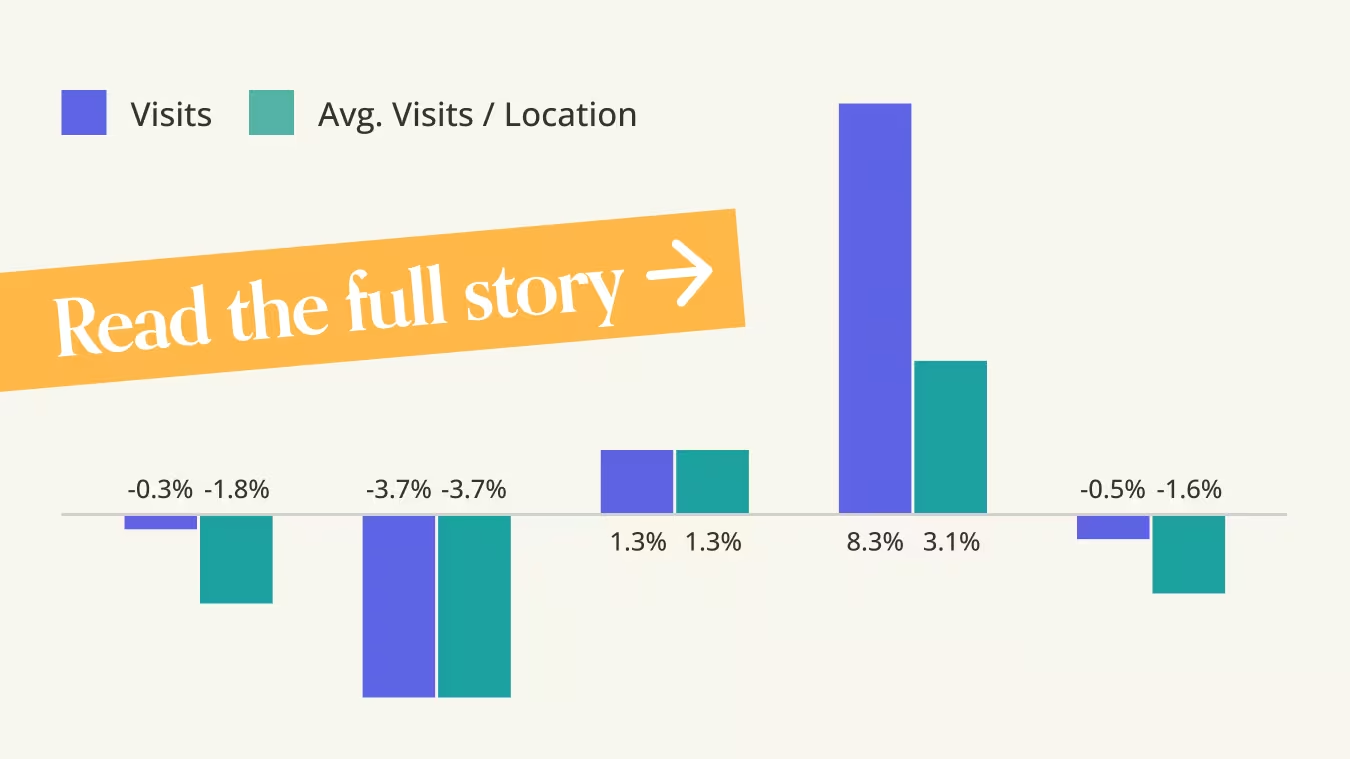
Kohl's (KSS) brick-and-mortar stores continue to play in the company's overall business strategy. During the company's first fiscal quarter (ending May 3rd, 2025), in-store comparable sales declined 2.6% year-over-year – aligning closely with the 2.8% same-store visit decline between February and April 2025 – while digital sales fell 7.7%. And while the visit gap has widened slightly since – between May and July 2025, same-store visits declined 3.4% YoY – in-store traffic trends continue to outperform Kohl’s full-year guidance, which anticipated a 4.0% to 6.0% drop in comparable store sales.

The recent softness can be partially attributed to a sector-wide slowdown in June retail traffic, as shoppers who had pulled forward purchases to avoid anticipated tariff-driven price hikes reduced their shopping activity in June. The wider macroeconomic uncertainty also appears to be hitting mid-market discretionary retailers like Kohl's particularly hard, as many middle-income shoppers continue to trade down to value-forward chains and high-income shoppers gravitate to luxury brands.

Macy's (M) Portfolio Performance Highlights Bifurcated Consumer Spending 

Macy's (M) reported a 2.0% YoY decline in comparable sales on an owned basis for its first quarter of 2025 (ending May 3rd 2025) – consistent with the 2.2% YoY decline in combined same-store visits at its three major banners (Macy's, Bloomingdale's, and Bluemercury) between February and April 2025. 

Like for Kohl's, Macy's same-store visit gap widened in recent months, with combined visits to the three banners down 4.0% YoY between May and July 2025. The company's namesake banner, Macy's, saw the largest traffic declines, while visits to its luxury banners Bloomingdale's and Bluemercury generally increased YoY between May and July 2025. This likely reflects the different economic pressures facing visitors to the Macy's brand: The chain serves a more budget-conscious demographic, with a median household income of $87.7K in H1 2025 in its trade areas, while Bloomingdale's and Bluemercury attract higher-income shoppers with median household incomes of $126.5K and $123.0K, respectively.

This divergence highlights how economic uncertainty is creating a tale of two retails – where luxury resilience and mass market vulnerability are impacting competitive dynamics across Macy's portfolio as well as in the wider retail space. 

The softer visit trends at Kohl's and the performance gap between Macy's luxury banners and its namesake brand highlights the challenges faced by mid-market discretionary banners in 2025. As discretionary spending continues to face pressure, retailers serving the middle market may need to adapt their strategies to compete for increasingly budget-conscious consumers. 

To see up-to-date department store visit trends, try Placer's free Industry Trends tool. 

Article
Home Depot & Lowe's: Navigating Challenges & Finding Growth in 2025
In the first half of 2025, Home Depot and Lowe's faced visit declines, but trends moderated by July. Home Depot showed regional strength in the Midwest, while Lowe's accelerated its pivot to professional contractors to build a more resilient business model.
Bracha Arnold
Aug 13, 2025
4 minutes

The home improvement segment continues to face challenges in 2025, but a deeper look into the data for Home Depot and Lowe's reveals a nuanced story of sector-wide headwinds, divergent brand performances, and potential signs of recovery.

Home Depot Visits Start to Stabilize

Existing-home sales, which can often serve as a powerful indicator for how the home improvement retail sector may behave, are at some of their lowest rates in years. This housing market softness has translated into lowered consumer activity at project-driven stores like The Home Depot. Visits to the home improvement chain were down by -3.9% YoY in Q1 2025 before moderating to a 2.2% decline in Q2.

Monthly visit data offers a more granular view of Home Depot's performance. Despite a sharp YoY decline of 9.2% in February – likely due to inclement weather and the leap year comparison – visits recovered quickly. By July, foot traffic was down by just 2.5% YoY. 

These trends point to a cautious stabilization, perhaps driven by shifting economic realities. With home equities up roughly 6% YoY and over half of U.S. homes at least 40 years old, homeowners are undertaking necessary repairs – and Home Depot's status as a contractor hub may help boost visits as economic concerns cool. The company is also leaning into its strengths and driving sales through other channels, such as its B2B offerings, helping position it for growth as market conditions improve. 

Lowe’s Professional Pivot

Lowe's also faced a challenging first half of 2025, with foot traffic trends mirroring the broader home improvement sector's struggles. Quarterly visits declined by 3.7% in Q1 and 3.8% in Q2 on a year-over-year (YoY) basis, reflecting persistent pressure on consumer spending. But visit gaps narrowed by the end of Q2, and by July 2025 were just 1.1% lower than in July 2024.

Like Home Depot, Lowe's was likely impacted by the economic uncertainties and a slower housing market. But unlike Home Depot, Lowe’s still relies on DIYers for the majority of its business. Executives blamed unfavorable weather for pushing back the spring home improvement season, which led to softer DIY performance at Lowe’s in their first fiscal quarter (ending May 2nd 2025) and may have contributed to Lowe's underperformance relative to Home Depot.

A Midwest Opportunity

Drilling down into regional foot traffic trends for Home Depot and Lowe’s in July reveals that success in the home improvement sector in 2025 is highly localized. Even during the recent challenging period, both chains experienced pockets of YoY visit growth, particularly clustered in parts of the Midwest and Southeast. For Home Depot, traffic trends were strongest in North Dakota, where YoY visits grew by 7.6% – but visit growth was clustered throughout the region. Lowe’s also enjoyed visit growth across several states, with its strongest performance centered in Midwestern states like Indiana (+4.4%) and Kentucky (+2.8%).

These geographic patterns highlight how demand in the home improvement segment shows significant variance by market, with both chains appearing to benefit in areas with steadier home sales. This is a reminder that, while nationwide visits are lower than in previous years, pockets of strong local demand can still provide a significant boost for each brand.

Strategic Insights

Moving forward, the home improvement segment has plenty of ways to adapt to a softening economic environment and slowing home sales. Will home improvement visits pick up? Or will housing market challenges continue to spill over to foot traffic? 

Visit Placer.ai/anchor for the latest data-driven retail insights.

Article
Lollapalooza Supercharges Summer Tourism in Chicago
The Lollapalooza festival is a powerful economic driver for Chicago, attracting a highly regional, affluent, and demographically distinct audience. This report analyzes the foot traffic data to reveal how the festival supercharges local tourism and provides valuable insights for both civic leaders and sponsors. 
Lila Margalit
Aug 13, 2025
4 minutes

The Lollapalooza festival, held annually in Chicago's Grant Park, is one of the world's most iconic music events. We dove into the location intelligence data to explore how the festival impacts tourism to the Windy City – and understand the characteristics and preferences of the audience that flocks to the city each year.

A Regional Tourist Magnet

The festival acts as a powerful magnet for tourists, particularly those from nearby regions. During Lollapalooza, the number of domestic tourists to Chicago (i.e., out-of-market visitors traveling more than 50 miles) surged by 180.7% compared to an average Thursday through Sunday – and by 43.8% compared to the already-busy summer period of June and July.

But a closer look at the data reveals that the greatest increase came from visitors living 50 to 100 miles away, with a massive 343.3% increase over the 12-month average. In contrast, the smallest increase stemmed from long-distance travelers journeying 250 miles or more, with visits up just 145.7% from the average. This strong local pull shows that Lollapalooza is a regional tourism powerhouse, driving an incredible surge in visits from a concentrated market that views the festival as a premiere, must-attend event.

An Affluent, Diverse Audience

This substantial influx of tourists also brought a more affluent crowd than usual. Summer – peak Chicago tourist season – attracts a slightly wealthier crowd than the rest of the year. But the median household income (HHI) of visitors’ home areas hit $89.7K during Lollapalooza, a clear jump from both the June-July average of $83.9K and the 12-month average of $82.5K.

The festival’s audience is also more diverse than its reputation might suggest. The share of “Young Professionals” in the visitor mix rose to 16.6% during Lollapalooza, up from 14.5% during the summer, while the share of “Ultra Wealthy Families” climbed to 7.6% from 6.4% and the share of “Sunset Boomers” rose to 5.1% from 4.7%. The increase in these segments shows the festival’s broad appeal, attracting not just young people but also older, established, and affluent families.

Married Wine Lovers Who Work From Home

In addition to being wealthier, Lollapalooza attendees had a distinctly different lifestyle profile. Compared to both the 12-month and summer averages, visitors were more likely to be married couples and to enjoy wine and good coffee. Notably, the share of visitors who worked from home increased to 18.7% during the festival, compared to a 17.0% summertime benchmark. These lifestyle markers signal a premium, high-value consumer that presents an ideal audience for local businesses and sponsors looking to create targeted on-site experiences, from specialized pop-up cafes to wine-tasting events.

The Lollapalooza Effect

Overall, these findings highlight Lollapalooza’s potent role in supercharging Chicago’s tourism sector. Beyond the simple boost in overall visitor numbers, the festival draws a more affluent and distinctive demographic than the typical summer crowd – making it a powerful economic engine for the city.

For more data-driven insights, visit placer.ai/anchor

Article
What Walmart and Target's Q2 2025 Traffic Reveals About Future Performance
Our analysis of Q2 2025 retail foot traffic data reveals a stark divergence between America’s top retailers. Walmart showcased resilient in-store traffic, validating its omnichannel investments and reinforcing its dominance in essential goods. Meanwhile, Target faced persistent declines, signaling significant headwinds from the consumer pullback in discretionary spending. This report breaks down the data, the underlying strategies, and the investor outlook for both retail giants.
Lila Margalit
Aug 12, 2025
4 minutes

For many Americans, Walmart functions as a grocer and essential-goods provider. Target’s competitive advantage, meanwhile, lies in higher-margin discretionary categories – stylish home goods, affordable fashion, and exclusive brand collaborations. In the face of ongoing macroeconomic pressures, both retailers are adopting elements of each other’s approaches: Walmart is seeking to elevate its image and expand discretionary offerings through a rebrand, while Target is ramping up its focus on essentials. But Q2 2025 location intelligence data reveals that the two brands’ immediate challenges remain distinctly different. 

Walmart’s Resilient Traffic Validates Omnichannel Strategy

Walmart has been thriving in recent months, exceeding analyst expectations with solid sales growth driven largely by a profitable e-commerce segment. Last quarter (ending April 30th, 2025), Walmart U.S. posted comparable sales growth (excluding fuel) of +4.5%, with e-commerce contributing approximately 3.5 percentage points to that growth. And in June 2025, the company built on this momentum with the debut of its “Walmart, Who Knew” campaign – part of a strategic rebranding highlighting expanded, premium product offerings alongside enhanced e-commerce capabilities – such as one-hour express delivery and an online marketplace of over half a billion items.

Against this backdrop, Walmart’s stable YoY foot traffic – hovering between +0.8% and -1.6% monthly May through July – is a powerful signal of its continued strength. The data validates the company’s omnichannel strategy, indicating an ability to grow its digital business without materially sacrificing its foundational in-store visitor base. 

Target Confronts Headwinds From Softening Discretionary Demand

In contrast, Target has faced meaningful challenges, with YoY same-store visit gaps ranging from 2.2% to 9.7% since February 2025. Like Walmart, Target’s online growth has been a bright spot – last quarter, the company reported a 4.7% increase in digital comp sales, aided by more than 35% growth in same-day delivery. But this was not enough to offset a 5.7% decline in in-store comp sales. And though consumer reactions to Target’s recent policy updates do appear to have contributed to the retailer’s softening YoY performance, persistent challenges point to a more fundamental shift in consumer preferences amid discretionary cutbacks.

Strategic Emulation Meets Core Differences in Customer Behavior

Both Walmart and Target are borrowing elements of each other’s playbooks. But consumer visitation data shows that while Walmart and Target can learn from each other, they service fundamentally different shopping missions. 

Walmart’s vast scale and extensive grocery selection make it a prime destination for habitual, necessity-driven shopping. Between May and July 2025, about 34.0% of shoppers visited Walmart at least four times a month. Target’s 14% frequent visitor share, on the other hand, reflects its role as a more occasional destination centered on discovery-led shopping experiences – such as its successful Kate Spade collaboration, hailed by the company as the most successful design collab in a decade. While strengthening essentials plays to the current economic climate and likely contributed to the modest increase in Target’s frequent visitors over the past year, the retailer’s future success depends on sharpening – not blurring – its core strengths.

Different Paths Ahead

Walmart’s foot traffic stability combined with proven ecommerce growth positions it well to continue outperforming, especially as consumer caution favors essentials and convenience. Furthermore, the retailer’s rebranding and push into broader, discretionary categories may help attract higher-income consumers who are trading down. 

Target, for its part, faces a more difficult strategic balancing act in the months ahead. Augmenting its offerings with compelling essentials will be critical. But as demonstrated by the strong performance of retailers like Five Below and T.J. Maxx, there still exists a healthy market for discretionary treasure hunting. Ultimately, Target’s ability to reignite growth will depend on its success in rejuvenating its competitive edge in the discretionary market – a task likely to be further complicated by anticipated tariffs. 

For more data-driven retail insights, follow Placer.ai/anchor

Article
Placer.ai Office Index: July 2025
In July 2025, office visits were at their highest point since the pandemic, down just 21.8% from 2019. NYC and Miami effectively closed their pre-COVID visit gaps, marking a potential RTO tipping point. San Francisco also showed a remarkable 21.6% YoY growth, signaling a significant turnaround.
Lila Margalit
Aug 11, 2025
3 minutes

Office Visits Nearly 80% of Pre-COVID Levels

The office recovery is back in full swing. Major employers such as Samsung, Google, and Starbucks have tightened return-to-office (RTO) policies in recent months. And though hybrid work remains prevalent across industries, Q2 2025 saw a majority of Fortune 100 employees subject to full-time in-office mandates – up from just 5.0% in Q2 2023. 

In June, accumulating RTO mandates helped shrink the post-pandemic office visit gap to 27.4% compared to the same period in 2019. And July 2025 set a new record for office attendance, with visits down just 21.8% relative to July 2019 (both Julys had 22 working days) – making it the single busiest in-office month since COVID.

Office Visit Gaps Close in NYC and Miami

Stark regional differences remain, however, between major business hubs nationwide. New York City, where many employees are subject to the stricter in-office requirements of the finance world, saw positive (+1.3%) year-over-six-year (Yo6Y) office foot traffic growth in July 2025 – a first since Placer.ai began tracking these trends. Miami, which has developed a thriving financial sector of its own, followed closely behind, effectively closing its visit gap with a 0.1% lag. 

Atlanta and Dallas also made considerable headway – both markets saw visit gaps dip below 20% compared to 2019. Meanwhile, Denver – an emerging hub for tech startups and one of the most remote-friendly labor markets in the U.S. – took up the rear, while San Francisco inched up two notches in the rankings, beating out both Denver and Los Angeles.

The San Francisco Turnaround

Indeed, San Francisco appears to be in the midst of a major revival, with rising rents, improving public sentiment, and waves of new restaurant, retail, and small business openings breathing fresh life into a city once dismissed as stuck in a “doom loop”. And in July 2025, the City by the Bay once again topped the year-over-year (YoY) office recovery charts, outpacing all other analyzed hubs with remarkable 21.6% visit growth – more tangible evidence of the progress San Francisco continues to make.

Charting the Future of RTO

If past experience is any guide, the road to office recovery will continue to be anything but linear. RTO policies remain far from uniform, and hybrid work continues to serve as a key baseline for many organizations. Still, July 2025 seems to mark a meaningful RTO tipping point, with numerous markets making substantial progress toward pre‐COVID office foot traffic levels.

Follow Placer.ai/anchor for more office visitation insights.

Article
TJX Q2 2025 Visit Data Points to Strong Performance
TJX saw strong Q2 2025 performance, exceeding company guidance. HomeGoods led same-store visit growth, while the newest brands, Sierra and Homesense, drove overall traffic increases. The company is also successfully penetrating rural and semi-rural markets, creating a path for continued domestic growth.
Shira Petrack
Aug 8, 2025
3 minutes

HomeGoods Leads Same-Store Visit Growth At TJX

Same-store visit growth at TJX chains in recent months exceeded the company's official guidance of 2-3% same-store sales growth for Q2 FY26 (May 4 - August 2, 2025), aligning with analyst expectations for an earnings beat. 

The largest growth in same-store visits went to HomeGoods, which continues to be a key growth engine for TJX, with its outperformance stemming from a multi-faceted competitive edge. Its consistent lead over the core apparel banners, T.J. Maxx and Marshalls, may be due to its more defensible position in the less-crowded off-price home category. And when compared to its sister brand, Homesense, HomeGoods' superior performance may be attributed to its significant brand maturity and a merchandise mix centered on higher-frequency, smaller-ticket items. This positions the banner effectively to capture discretionary spending from consumers seeking affordable indulgences in the current economic environment.

Unpacking the Sierra & Homesense Expansion Strategy 

All banners experienced YoY growth in overall traffic, but the strongest growth went to the latest newest additions to the company's U.S. portfolio – Homesense and Sierra, suggesting that both brands have a long runway for unit potential.

Sierra is engineered to capture a significant share of the lucrative outdoor and active lifestyle market, a space that critically lacks a dominant, national, off-price competitor, giving it a clearer and more defensible runway for explosive growth. In contrast, while Homesense plays the vital role of deepening TJX's penetration in the home category with larger-scale items like furniture, it enters a more contested field and must contend with established competition from other discount and value-oriented furniture retailers. 

Both expansions are ultimately underpinned by TJX's core competency: leveraging its world-class buying organization and real estate expertise to dominate new off-price segments and capture a larger share of total consumer discretionary spending. 

Capturing Market Share in Rural & Semirural America

This push into new product categories is happening in parallel with a push into new markets. Year-over-year analysis reveals TJX has systematically expanded its rural and semi-rural household penetration across all banners – aligning with management's stated focus on "smaller markets and smaller footprint stores" as identified growth opportunities. With TJX planning around 130 net new stores in 2025, this rural expansion strategy provides a credible pathway for continued domestic growth in an increasingly competitive retail landscape.

For more data-driven retail insights, visit placer.ai/anchor.

The information, data, analyses and opinions presented herein do not constitute investment advice; are provided solely for informational purposes and therefore are not an offer to buy or sell a security; and are not warranted to be correct, complete or accurate. By means of this publication, Placer Labs Inc. (“Placer”) is not rendering accounting, business, financial, investment, legal, tax or other professional advice or services. This publication is not a substitute for such professional advice or services, nor should it be used as a basis for any decision or action that may affect your business. Before making any decision or taking any action that may affect your business, you should consult a qualified professional advisor.

Placer shall not be responsible for any loss sustained by any person who relies on this publication. The opinions and data presented are as of the date written and are subject to change without notice. The information contained herein is the proprietary property of Placer and may not be reproduced, in whole or in part, or used in any manner, without the prior written consent of Placer. 

Reports
INSIDER
C-Stores: From Convenient Stops to Go-To Destinations
Discover key strategies helping C-Stores drive visits, engage customers, and cement their roles as dining, shopping, and tourism destinations in their own right.
April 25, 2024
5 minutes

This report includes data from Placer.ai Data Version 2.0, which implements improvements to our extrapolation capabilities, adds short visit monitoring, and enhances visit detection.

C-Stores: Charging Ahead

Grabbing a coffee or snack at a convenience store is a time-honored road trip tradition – but increasingly, Convenience Stores (C-Stores) have also emerged as places people go out of their way to visit. 

Convenience stores have thrived in recent years, making inroads into the discretionary dining space and growing both their audiences and their sales. Between April 2023 and March 2024, C-Stores experienced consistent year-over-year (YoY) visit growth, generally outperforming Overall Retail. Unsurprisingly, C-Stores fell behind Overall Retail in November and December 2023, when holiday shoppers flocked to malls and superstores to buy gifts for loved ones. But in January 2024, the segment regained its lead, growing YoY visits even as Overall Retail languished in the face of an Arctic blast that had many consumers hunkering down at home.

C-Stores’ current strength is partially due to the significant innovation by leading players in the space: Chains like Casey’s, Maverik, Buc-ee’s, and Rutter’s are investing in both in their product offerings and in their physical venues to transform the humble C-Store from a stop along the way into a bona fide destination. Dive into the data to explore some of the key strategies helping C-Stores drive consumer engagement and stay ahead of the pack. 

Four C-Store Brands Ahead of the Curve

While chain expansion may explain some of the C-Store segment growth, a look at visit-per-location trends shows that demand is growing at the store level as well. Over the past year (April 2023 to March 2024), average visits per location on an industry-wide basis grew by 1.8%, compared to the year prior (April 2022 to 2023). 

And within this growing segment, some brands are distinguishing themselves and outperforming category averages. Casey’s, for example, saw the average number of visits to each of its locations increase by 2.3% over the same time frame – while Maverik, Buc-ee’s and Rutter’s saw visits per location increase by 3.2%, 3.4% and 3.9%, respectively.

Chains That Are Becoming The Final C-Store Destinations

Each in its own way, Casey’s, Maverik, Buc-ee’s, and Rutter’s, are helping to transform C-Stores from pit stops where people can stretch their legs and grab a cup of coffee to destinations in and of themselves. 

Casey’s & Maverik: Leaning into Breakfast 

Midwestern gas and c-store chain Casey’s – famous for its breakfast pizza and other grab-and-go breakfast items – has emerged as a prime spot for fast food pizza lovers to grab a slice first thing in the morning. And Salt Lake City, Utah-based Maverik – which recently acquired Kum & Go and its 400-plus stores – is also establishing itself as a breakfast destination thanks to its specialty burritos and other chef-inspired creations.  

Casey’s and Maverik’s popular breakfast options are likely helping the chains receive its larger-than-average share of morning visits: In Q1 2024, 16.3% of visits to Maverik and 17.5% of visits to Casey’s took place during the 7:00 AM - 10:00 AM daypart, compared to just 14.9% of visits to the wider C-Store category.

Psychographic data from the Spatial.ai’s FollowGraph dataset – which looks at the social media activity of a given audience – also suggests that Casey’s and Maverik’s have opened stores in locations that allow them to reach their target audience. Compared to the average consumer, residents of Casey’s potential market are 7% more likely to be “Fast Food Pizza Lovers” than both the average consumer and the average C-Store trade area resident. Residents of Maverik’s potential market are 16% more likely than the average consumer to be “Mexican Food Enthusiasts,” compared to residents of the average C-Store’s trade area who are only 1% more likely to fall into that category.

With both chains expanding, Casey’s and Maverik can hope to introduce new audiences to their unique breakfast options and solidify their hold over the morning daypart within the C-Store space over the next few years. 

Buc-ee’s: Bigger Is Better

Everything is said to be bigger in the Lone Star State, and Texas-based convenience store chain Buc-ee’s – holder of the record for the worlds’ largest C-Store – is no exception. With a unique array of specialty food items and award-winning bathrooms, Buc-ee’s has emerged as a well-known tourist attraction. And the popular chain’s status as a visitor hotspot is reflected in two key metrics. 

First, Buc-ee’s attracts a much greater share of weekend visits than other convenience store chains. In Q1 2024, 39.6% of visits to Buc-ee’s took place on the weekends, compared to just 28.3% for the wider C-Store industry. And second, Buc-ee’s captured markets feature higher-than-average shares of family-centric households – including those belonging to Experian: Mosaic’s Suburban Style, Flourishing Families, and Promising Families segments.

Rather than merely a place to stop on the way to work, Buc-ee’s has emerged as a favored destination for families and for people looking for something fun to do on their days off.

Rutter’s: Expanding Upward

Buc-ee’s isn’t the only C-Store chain that believes bigger is better. Pennsylvania-based Rutter’s is increasing visits and customer dwell time by expanding its footprint – both in terms of store count and venue size. New stores will be 10,000 to 12,000 square feet – significantly larger than the industry average of around 3,100 square feet. And in more urban areas, where space is at a premium, the company is building upwards.

Rutter’s added a second floor to one of its existing locations in York, PA in December 2023. The remodel, which was met with enthusiasm by customers, provided additional seating for up to 30 diners, a beer cave, and an expanded wine selection. And in Q1 2024, the location experienced 15.6% YoY visit growth – compared to a chainwide average of 7.6%. Visitors to the newly remodeled Rutter’s also stayed significantly longer than they did pre-renovation. The share of extended visits to the store (longer than ten minutes) grew from 20.8% in Q1 2023 to 27.0% in Q1 2024 – likely from people browsing the chain’s selection of beers or grabbing a bite to eat. 

Convenience At Every Corner

Convenience stores are flourishing, transforming into some of the most exciting dining and tourist destinations in the country. Today, C-Store customers can expect to find brisket sandwiches, gourmet coffees, or craft beers, rather than the stale cups of coffee of old. And the data shows that customers are receptive to these innovations, helping drive the segment’s success. 

INSIDER
Q1 2024 Retail & Dining Review
Discover how the Discount & Dollar Stores, Grocery Stores, Fitness, Superstores, Dining, and Home Improvement & Furnishings categories performed in Q1 2024.
April 18, 2024
6 minutes

Q1 2024 Overview 

Overall Retail on the Rise

The first quarter of 2024 was generally a good one for retailers. Though unusually cold and stormy weather left its mark on the sector’s January performance, February and March saw steady year-over-year (YoY) weekly visit growth that grew more robust as the quarter wore on. 

March ended on a high note, with the week of March 25th – including Easter Sunday – seeing a 6.1% YoY visit boost, driven in part by increased retail activity in the run-up to the holiday. (Last year, Easter fell on April 9th, 2023, so the week of March 25th is being compared to a regular week.)

Though prices remain high and consumer confidence has yet to fully regain its footing, retail’s healthy Q1 showing may be a sign of good things to come in 2024. 

Success Across Categories

Drilling down into the data for leading retail segments demonstrates the continued success of value-priced, essential, and wellness-related categories. 

Discount & Dollar Stores led the pack with 11.2% YoY quarterly visit growth, followed by Grocery Stores, Fitness, and Superstores – all of which outperformed Overall Retail. Dining also enjoyed a YoY quarterly visit bump, despite the segment’s largely discretionary nature. And despite the high interest rates continuing to weigh on the housing and home renovation markets, Home Improvement & Furnishings maintained just a minor YoY visit gap. 

Discount & Dollar Stores 

Discount & Dollar Stores experienced strong YoY visit growth throughout most of Q1 – and as go-to destinations for groceries and other other essential goods, they held their own even during mid-January’s Arctic blast. In the last week of March, shoppers flocked to leading discount chains for everything from chocolate Easter bunnies to basket-making supplies – driving a remarkable 21.5% YoY visit spike.

Dollar General Reins Supreme

Dollar General continued to dominate the Discount & Dollar Store space in Q1, with visits to its locations accounting for nearly half of the segment’s quarterly foot traffic (44.7%). Next in line was Dollar Tree, followed by Family Dollar and Five Below. Together, the four chains – all of which experienced positive YoY quarterly visit growth – drew a whopping 91.6% of quarterly visits to the category.

Grocery Stores

Rain or shine, people have to eat. And like Discount & Dollar Stores, traditional Grocery Stores were relatively busy through January as shoppers braved the storms to stock up on needed items. Momentum continued to build throughout the quarter, culminating in a 10.5% foot traffic increase in the week ending with Easter Sunday. 

Aldi Leads the Way

Like in other categories, it was budget-friendly Grocery banners that took the lead. No-frills Aldi drove a chain-wide 24.4% foot traffic increase in Q1, by expanding its fleet – while also growing the average number of visits per location. Other value-oriented chains, including Trader Joe’s and Food Lion, experienced significant foot traffic increases of their own. And though conventional grocery leaders like H-E-B, Kroger, and Albertsons saw smaller visit bumps, they too outperformed Q1 2023 by meaningful margins.

Fitness

January is New Year’s resolution season – when people famously pick themselves up off the couch, dust off their trainers, and vow to go to the gym more often. And with wellness still top of mind for many consumers, the Fitness category enjoyed robust YoY visit growth throughout most of Q1 – despite lapping a strong Q1 2023.

Predictably, Fitness’s visit growth slowed during the last week of March, when many Americans likely indulged in Easter treats rather than work out. But given the category’s strength over the past several years, there is every reason to believe it will continue to flourish.

Value Chains Come out Ahead

For Fitness chains, too, cost was key to success in Q1 – with value gyms experiencing the biggest visit jumps. EōS Fitness and Crunch Fitness, both of which offer low-cost membership options, saw their Q1 visits skyrocket 28.9% and 22.0% YoY, respectively – helped in part by aggressive expansions. At the same time, premium and mid-range gyms like Life Time and LA Fitness are also finding success – showing that when it comes to Fitness, there’s plenty of room for a variety of models to thrive. 

Superstores

Superstores – including wholesale clubs – are prime destinations for big, planned shopping expeditions – during which customers can load up on a month’s supply of food items or stock up on home goods. And perhaps for this reason, the category felt the impact of January’s inclement weather more than either dollar chains or supermarkets – which are more likely to see shoppers pop in as needed for daily essentials.

But like Grocery Stores and Discount & Dollar Stores, Superstores ended the quarter with an impressive YoY visit spike, likely fueled by Easter holiday shoppers.

Warehouse Clubs Continue to Thrive

As in Q4 2023, membership warehouse chains – Costco Wholesale, BJ’s Wholesale Club, and Sam’s Club – drove much of the Superstore category’s positive visit growth, as shoppers likely engaged in  mission-driven shopping in an effort to stretch their budgets. Still, segment mainstays Walmart and Target also enjoyed positive foot traffic growth, with YoY visits up 3.9% and 3.5%, respectively.

Dining

Moving into more discretionary territory, Dining experienced a marked January slump, as hunkered-down consumers likely opted for delivery. But the segment rallied in February and March, even though foot traffic dipped slightly during the last week of March, when many families gathered to enjoy home-cooked holiday meals. 

Coffee, Coffee, Coffee!

Coffee Chains and Fast-Casual Restaurants saw the largest YoY  visit increases, followed by QSR – highlighting the enduring power of lower-cost, quick-serve dining options. But Full-Service Restaurants (FSR) also saw a slight segment-wide YoY visit uptick in Q1 – good news for a sector that has yet to bounce back from the one-two punch of COVID and inflation. Within each Dining category, however, some chains experienced outsize visit growth  – including favorites like Dutch Bros. Coffee, Slim Chickens, In-N-Out Burger, and Texas Roadhouse.

Home Improvement 

Since the shelter-in-place days of COVID – when everybody had their sourdough starter and DIY was all the rage – Home Improvement & Furnishings chains have faced a tough environment. Many deferred or abandoned home improvement projects in the wake of inflation, and elevated interest rates coupled with a sluggish housing market put a further damper on the category.

Against this backdrop, Home Improvement & Furnishings’ relatively lackluster Q1 visit performance should come as no surprise. But the narrowing of the visit gap in March – which also saw one week of positive visit growth – may serve as a promising sign for the segment. (The abrupt foot traffic drop during the week of March 25th, 2024 is likely a just reflection of Easter holiday shopping pattern.)

Home Improvement Bright Spots

Within the Home Improvement & Furnishings space, some bright spots stood out in Q1 – including Harbor Freight Tools, which saw visits increase by 10.0%, partly due to the brand’s growing store count. Tractor Supply Co., Menards, and Ace Hardware also registered visit increases.

Good Things to Come

January 2024’s stormy weather left its mark on the Q1 retail environment, especially for discretionary categories. But as the quarter progressed, retailers rallied, with healthy YoY foot traffic growth that peaked during the last week of March – the week of Easter Sunday. All in all, retail’s positive Q1 performance leaves plenty of room for optimism about what’s in store for the rest of 2024.

INSIDER
The QSR Dining Advantage
Dive into the latest location intelligence to see how QSR and Fast-Casual restaurants are driving visits and staying ahead of the wider Dining sector.
April 11, 2024
6 minutes

This report includes data from Placer.ai Data Version 2.0, which implements improvements to our extrapolation capabilities, adds short visit monitoring, and enhances visit detection.

The State of QSR and Fast Casual

Over the past year, Fast-Casual & Quick-Service Restaurant (QSR) chains have thrived, consistently outperforming the Full-Service Dining segment with positive year-over-year (YoY) visit growth every quarter since 2023. In this white paper, we dive into the data for leading dining chains to take a closer look at what’s driving visitors to the QSR segment and what other dining categories can learn from fast-food’s success. 

Speed of Service: It’s the Name of the Game

One of the key factors separating QSR chains – aptly known as “fast food” – from the rest of the dining industry is the speed at which diners can get a ready-to-eat meal in their hands. And within the QSR space, speed of service is one of the ways chains differentiate themselves from their competition

Getting Customers (In and) Out the Door

Leading fast-food chains are investing heavily in technologies and systems designed to help them serve customers ever more quickly:  

Taco Bells “Touch Display Kitchen System” is designed to optimize cooking operations and improve wait times, while the chain’s Go Mobile restaurant format seeks to alleviate bottlenecks in the drive-thru lane. Chick-fil-A also has dedicated channels for quick mobile order pick-up and is planning four-lane drive-thrus with second-floor kitchens to get meals out even faster. And to save time at the drive-thru, Wendy’s is experimenting with generative AI and developing an underground, robotic system to deliver digital orders to designated parking spots within seconds.

And location intelligence shows that all three chains are succeeding in reducing customer wait times. Over the past four years, Taco Bell, Chick-fil-A, and Wendy’s have seen steady increases in the share of visits to their venues lasting less than 10 minutes. 

Faster Service Driving Visits 

The data also suggests that investment in speed of service can increase overall visitation to QSR venues.

In late 2022, McDonald’s opened a to-go-only location outside of Dallas, TX with a lane dedicated to mobile order fulfillment via a conveyor belt. And in Q1 2024, this venue not only had a larger share of short visits compared to the other McDonald’s locations in the region, but also more visits compared to the McDonald’s average visits per venue in the Dallas-Fort Worth CBSA. 

This provides further support for the power of fast order fulfillment to drive QSR visits, with customers motivated by the prospect of getting in and out quickly. 

Full-Service Restaurants Experiments with Fast Service

The success of the fast-food segment is even driving other restaurants to borrow typical QSR formats – especially during time slots when people are most likely to grab a bite to eat on the go.

In September 2023, full-service leader Applebee’s opened a new format: a fast casual location focusing on To Go orders in Deer Park, NY, featuring pick-up lockers for digital orders and limited dine-in options without table service.

And the new format is already attracting outsized weekday and lunchtime crowds. In Q1 2024, 20.5% of visits to the chain’s To Go venue took place during the 12:00 PM - 2:00 PM time slot, while the average Applebee’s in the New York-Newark-Jersey City CBSA received less than 10% of its daily visits during that daypart. The new restaurant also drew a significantly higher share of weekday visits than other nearby venues. 

This suggests that takeaway-focused venues could help full-service chains grow their visit share during weekdays and the coveted lunch rush, when consumers may be less inclined to have a sit-down meal. 

The Rise of Chicken Concepts  

An additional factor contributing to QSR and Fast Casual success in 2024 may be the rise of chicken-based chains. Chicken is a versatile ingredient that has remained relatively affordable, which could be contributing to its growing popularity and the rapid expansion of several chicken chains. 

Comparing the relative visit share (not including delivery) of various sub-segments within the wider Fast Casual & QSR space showed that the share of visits to chains with chicken-based menus has increased steadily between 2019 and 2023: In Q1 2024, 15.3% of Fast Casual & QSR visits were to a chicken restaurant concept, compared to just 13.4% in Q1 2019.

Big Players with Big Visits Per Venue

The strength of chicken-based concepts is also evident when comparing average visits per venue at leading chicken chains with the wider Fast Casual & QSR average. 

Both Chick-fil-A, the nation’s predominant chicken chain, and Raising Cane’s, a rapidly expanding player in the fast-food chicken space, are receiving significantly more visits per venue than their Fast Casual & QSR peers: In Q1 2024, Raising Cane’s and Chick-fil-A restaurants saw an average of 153.0% and 237.7% more visits per venue, respectively, compared to the combined Fast Casual & QSR industries average.

The elevated traffic at chicken chains likely plays a part in their profitability per restaurant relative to other Fast Casual & QSR concepts with more sizable fleets.

Celebrating the Calendar

QSR and Fast-Casual chains are also particularly adept at generating seasonal visit spikes through unique Limited Time Offers and holiday promotions adapted to the calendar. 

Diving into Seafood for Lent

Arby’s recently launched a 2 for $6 sandwich promotion on February 1st, with two of the three sandwich options on promotion being fish-based in an apparent attempt to entice diners eschewing meat in observance of Lent. The company also brought back a specialty fish sandwich, likely with the goal of further appealing to the Lent-observing demographic. 

The offers seem to have driven significant traffic spikes, with foot traffic during the promotion period significantly higher than the January daily visit average. And traffic was particularly elevated during Lent – which this year fell on Wednesday, February 14th through Thursday, March 28th, with visits spiking on Fridays when those observing are most likely to seek out fish-based meals. 

Some of the elevated visits in the second half of Q1 may be attributed to the comparison to a weaker January across the dining segment. But the success of the fish-forward promotion specifically during Lent suggests that the company’s calendar-appropriate LTO played a major role in driving visits to the chain. 

Visits in the Air at White Castle’s Valentine’s Dinner

Shorter-term promotions – even those lasting just a single day – can also drive major visit spikes. 

Since 1991, White Castle has transformed its fast-food restaurants into a reservation-only, “fine-dining” experience for dinner on Valentine's Day. In 2024, Valentine’s Day fell on a Wednesday, and White Castle’s sit-down event drove a 11.8% visit increase relative to the average Wednesday in Q1 2024 and a 3.9% visit increase compared to the overall Q1 2024 daily average.

The elevated visit numbers over Valentine’s Day are even more impressive when considering that a full-service dining room can accommodate fewer visitors than the drive-thrus and counter service of White Castle’s typical QSR configuration. The spike in February 14th visits may also be attributed to an increased number of diners showing up throughout the day to take in the Valentine’s Day buzz. 

QSR & Fast Casual Lead the Way 

QSR and Fast-Casual dining are having a moment. And the data shows that a combination of factors – including fast and efficient service, the rising popularity of chicken-based dining concepts, and effective LTOs – are all playing a part in the categories’ recent success. 

Loading results...
We couldn't find anything matching your search.
Browse one of our topic pages to help find what you're looking for.
For more in-depth analyses on a variety of subjects, explore Reports.
INSIDER
Stay Anchored: Subscribe to Insider & Unlock more Foot Traffic Insights
Gain insider insights with our in-depth analytics crafted by industry experts
— giving you the knowledge and edge to stay ahead.
Subscribe