.png)
.png)

.png)
.png)

Final Four weekend capped off the NCAA “March Madness” basketball tournaments with a full schedule of fan experiences on both the men’s and women’s sides of the ball.
The Women’s Final Four took place between April 4th and 7th, 2024 in Cleveland, Ohio with on-court action at Rocket Mortgage FieldHouse. “Tourney Town” – an interactive basketball exhibition – ran concurrently at the Huntington Convention Center.
The Men’s Final Four commenced on April 5th at State Farm Stadium in Glendale, Arizona, culminating with the championship game on April 8th. The multi-day exhibition “Final Four Fan Fest” took place at the Phoenix Convention Center.
We dove into the location analytics and audience segmentation for visitors to several Final Four events to better understand the fans in attendance throughout the tournament weekend.
The men and women’s Final Four weekend attracted spectators from near and far, with each event attracting a unique mix of out of town tourists and locals.
Both men and women’s championship games attracted a relatively large share of out-of-town guests, likely due to the excitement surrounding a national title game. Analysis of visitors by home location revealed that the men and women’s championship games had the smallest share of visitors from less than 100 miles away – 29.8% and 33.3% respectively. In other words, these two events had the largest share of visitors that lived more than 100 miles from the venues.
The men’s open practice appeared to be more popular with long-distance travelers than the women’s, perhaps because all four men’s teams participated – as opposed to just two at the women’s open practice. The men’s practice was also followed by an all-star game which likely increased its appeal for visitors traveling from afar in the hopes of spotting their favorite players. The data revealed that more than half of the spectators traveled over 250 miles to watch the men’s practice, as opposed to under a quarter of spectators for the women’s practice.
Meanwhile, the women’s experiential exhibition at Huntington Convention Center drew more out-of-towners than the men’s exhibition at Phoenix Convention Center – only 23.3% of visitors to the women’s exhibition came from under 30 miles away, compared to almost half (48.3%) of the men’s exhibition visitors. The larger share of out-of-town visitors to the women’s exhibition may be because the event was close to the arena, making it a more convenient stop for non-local fans. On the other hand, the distance between the men’s exhibition in downtown Phoenix and the stadium in Glendale meant that the off-court experience was more out-of-the-way for tourists who had traveled specifically for the on-court action.

Analysis of Final Four visitors by income level provides further insight into the differences between each event’s fan base. According to the STI: Popstats dataset, the women’s events generally drew visitors from areas with a lower median household income (HHI) compared to the men’s events, although the gaps between the men and women’s visitor bases varied from event to event. Some of the difference in trade area HHI may be due to regional variance and the mix of locals and tourists at each event.
The visitor bases of the men and women’s championship games exhibited the widest disparity, with the men’s championship spectator base coming from areas with a median HHI of $99.9K, compared to $74.6K for the women’s championship’s trade area. The difference may be due to the relatively higher face value of tickets to the men’s championship game – even though the star-power of Iowa’s Caitlin Clark drove up the price of women’s tickets on the secondary market. In contrast, both the men’s and women’s practices and exhibitions were free or nearly free events and drove traffic from relatively lower-income areas – even though visitors to the men’s practice still came from more affluent areas than the trade area of the women’s championship match.
Visitors to the men and women’s convention center exhibition displayed the smallest income differences, with respective trade area median HHI of $80.0K and $76.6K. The data also reveals that visitors to the women’s exhibition came from a trade area with a median HHI that was higher than the median HHI for both the championship game and the open practice, perhaps because the exhibition drew a relatively large share of tourists who could afford to be in town for a slightly longer stay.

Further demographic analysis indicates that a greater share of singles – who tend to be on the younger side – attended the women’s Final Four events than the men’s. During the women’s championship, 41.0% of households in the trade area of the Rocket Mortgage FieldHouse were made up of one-person households. This segment also made up 34.2% and 36.3% of the households in the trade areas of the venues for the women’s practice and exhibition, respectively. On the men’s side, singles comprised just 29.3% of the championship’s trade area, 28.4% of the practice’s, and 27.0% of the exhibition’s.
This reflects the growing popularity of women’s college basketball players on social media which is bringing more viewership to the sport.

Want more data-driven visitor insights for sporting events? Visit Placer.ai.
This blog includes data from Placer.ai Data Version 2.0, which implements improvements to our extrapolation capabilities, adds short visit monitoring, and enhances visit detection.

During last week’s solar eclipse, people from all over the country converged on cities within the path of totality to witness the excitement first hand. And for municipalities and local businesses, the influx of tourists was expected to generate a boon.
But just how did the celestial event impact business activity on the ground? Which sectors benefited from the hype – and which geographic areas saw the biggest visit spikes?
We dove into the data to find out.
On April 8th, 2024, hotels in CBSAs where the eclipse could be viewed in all its glory (or close to it) experienced major visit boosts. And mapping hotel visits on the big day to CBSAs nationwide – compared to year-to-date daily averages – shows just how significant the cosmic alignment was for areas lucky enough to be located along or near the path of totality.

Within metropolitan CBSAs (CBSAs with at least 50,000 residents), Danville, IL – where visitors could either view a near-total eclipse or drive to a nearby location with 100% totality – experienced the biggest jump in Hotel visits, with visits to the category up 111.3%. But urban centers from north to south – including in New York, Indiana, Ohio, Arkansas, and Missouri – also experienced substantial hotel visit spikes.
.avif)
Hotels weren’t the only locations to reap the rewards of the solar eclipse. Fast Food & QSR chains in and around the path of totality enjoyed meaningful April 8th visit spikes of their own. And while the Hotel visit increases were more closely concentrated in prime viewing areas, Fast Food & QSR visits increased along a wider radius as people likely grabbed a bite to eat while making their way to a sun-gazing hotspot.

And the impact of the solar eclipse wasn’t limited to locations located in or near the path of totality. Retailers and dining chains nationwide got in on the action with special deals and limited-time offers meant to make the most of the unique interstellar opportunity.
In the week leading up to April 8th, 2024, Warby Parker drew crowds with the promise of free solar eclipse glasses. And while a burger joint may not be the first place people associate with eyewear, fast food favorite SONIC Drive In also attracted astronomy aficionados with a limited-time Blackout Slush Float that came with free eclipse viewing gear.
Krispy Kreme Doughnuts, for its part, marked the occasion with a limited-edition Total Solar Eclipse Doughnut. And though Mondays aren’t typically busy days for the chain, the special offering produced a clear visit uptick nationwide. In states along the path of totality, Krispy Kreme visits were up 55.5% on April 8th when compared to an average Monday this year, and in the rest of the country they were up 33.9%.
.avif)
For retailers across categories, landmark events from movie launches to cosmic occurrences have the potential to drive visit spikes and generate business. What other big opportunities lie in store for retailers this year?
Follow Placer.ai’s data-driven retail analyses to find out.
This blog includes data from Placer.ai Data Version 2.0, which implements improvements to our extrapolation capabilities, adds short visit monitoring, and enhances visit detection.

This year’s March Madness really lived up to its name, buoyed by the star power of Caitlin Clark, Angel Reese, Paige Bueckers, and Juju Watkins driving viewership to new heights. For the first time in history, the NCAA women’s basketball title drew more viewers than the men’s at 18.9M for the women’s and 14.8M for the men’s, per Nielsen.
Tickets to the Final Four cost $532 on average, an 82% increase over last year, and for the championship game, Rocket Mortgage Fieldhouse Stadium in Cleveland, OH was packed to the gills.
In the days leading up to the women’s final, nearby hotels saw visits increase as well.

Last week, we took a look at where the retail sector stood after Q1 2024, with a focus on superstores, home improvement, athletic footwear and apparel, and beauty. This week, to mark the release of short visit data with Placer’s Data Version 2.0 (which better captures visits that lasted 1 minute or longer for QSR/drive-thru locations) and the publishing of our latest dining whitepaper (The QSR Dining Advantage), we thought we’d take closer look at where the restaurant sector stands after Q1 2024.
When we looked at the restaurant category in January, most chains were reporting that visits were down on a year-over-year basis (which was partly a byproduct of inclement weather across much of the country) but that there was a sense of optimism about 2024. Looking at trends by category, we see that operators were justified in this optimism, as visit trends have increased on a year-over-year basis for most categories since late January. After adjusting for calendar shifts for both Valentine’s Day and Easter, we also see strong fine dining visits for these holidays, indicating that consumers remain motivated by holiday and events (a theme we called out several times last year).
We’ve also been fielding several questions about daypart shifts given that the Placer.ai Nationwide Office Building Index (an index of data from some 1,000 office buildings across the country) continued to show an uptick in visits during March 2024 and now stands at about 67.3% of March 2019 visits. Below, we show the percentage of visits by daypart for quick-service restaurant (QSR) and full-service restaurant chains. Given the lift in office visits, it’s not surprising that we continue to see improvement in early morning (6:00 AM-9:00 AM) visits, but it’s notable that we continue to see strength in late morning (9:00 AM-12:00 PM) and afternoon (3:00 PM-6:00 PM) visits. We’ve already seen many QSR chains test new menu items that better address consumer preferences in these dayparts–McDonald's CosMc’s is just one example--and we’d expect more in the months ahead. We also continue to see strength in late night QSR visits, something that we’ve called out in the past. On the full-service dining front, we see 2023 visits still down compared to 2019 levels, but with improvement versus 2021 in most cases. Here, it’s interesting that the afternoon visits to full-service dining chains in 2023 is down only slightly compared to 2019, while the gap during the evening daypart is much wider. This reinforces some of our previous analyses on earlier dining times
With our Data Version 2.0 update, we can now more accurately monitor dwell time by restaurant channel. After bottoming-out in Q2 2020 as most chains shifted to a largely takeout model, we’ve seen dwell time steadily increase across most restaurant channels the past several years. The QSR and fast casual categories remain below pre-pandemic levels, which isn’t a surprise given an increase in drive-thru and takeout orders compared to 2019 levels. Still, some of the operators we’ve spoken to have indicated that drive-thru bottlenecks have become more of an issue in recent quarters, which may reflect in the increase in dwell times for the QSR category the past 4-5 quarters. On the other side of the spectrum, dwell time for casual dining chains has fully recovered. We believe this has been helped by the continued popularity of eatertainment concepts, which have almost twice the average dwell time as most casual dining chains. We also see that fine dining dwell time now exceeds pre-pandemic levels, which may be the result of consumers’ aforementioned focus on holiday/event dining, which tends to drive dwell times higher.
Restaurant chains still face obstacles–the spread between food at home (grocery prices) and food away from home (restaurant prices) remains high and the $20 minimum wage for QSR workers recently went into effect in California (our data does not indicate major visit changes going into effect as it may be too recent for behavioral changes to be noticeable). However, March and early April visitation trends help the optimism that many restaurant operators felt at the beginning of the year. With Panera (and other chains) evaluating a possible IPO and many other brands finally accelerating growth plans (with an increased emphasis on higher-growth markets in the Southern/Southeastern U.S.), we’d expect visitation trends to remain positive on a year-over-year basis in the months to come.

Say the word New Mexico and one might picture the stunning cliff dwellings at Bandelier Monument, rich troves of Native American Pueblo culture, or the stunning artworks of Georgia O’Keefe. This vibrant state’s largest city is Albuquerque, but Santa Fe also lays claim to fame by being the oldest state capital in the United States.
In Albuquerque, a large development is taking place centered around the Indian Pueblo Cultural Center. While one may be a bit surprised at its location, which is within an outdoor shopping center, it serves as a perfect anchoring point for a convention or a leisure trip. The museum features insights into 19 Pueblo cultures, and also hosts an authentic Indian kitchen where one can try indigenous favorites such as red chile beef stew, calabacitas, and assorted fruit pies. There is a Holiday Inn Express & Suites and a Towneplace Suites by Marriott just across the street for those who need accommodations. Meetings, parties, and events can be held onsite with particularly memorable experiences to be had in the outdoor arena and fire pit. One can even hold a wedding at the venue. And in a sign of the convenience store trend we are seeing towards localization, Four Winds offers a walk-in humidor with cigar selection, the ability to fill a growler with local craft beers, and an assortment of food, beer, wine, liquor, and tobacco.
Further afield, an hour away in Santa Fe, visitors flock to the galleries galore, restaurants and bars like Coyote Cantina, or simply enjoy an ice cream while people watching at Santa Fe Plaza. One of the highlights for opera lovers around the world is coming to Santa Fe Opera House during its season, which runs from the end of June to the end of August. Here, one can enjoy the unique open-air aspect of the opera house while sobbing along to the sad fate of Violetta in La Traviata.
Junior Rangers might enjoy exploring Carlsbad Caverns, Aztec Ruins National Monument, or venture to Petroglyph National Monument. Adults seeking R&R can ski the day away in Taos or opt for a therapeutic visit to Ojo Caliente Mineral Springs Resort & Spa. A review of the resort describes it as “Just you, the blue New Mexico sky, peace and quiet.” Add to that a massage or spa treatment, and it sounds like just what the doctor ordered.

One of the major employers in New Mexico is Los Alamos National Laboratory. A visit to the National Historic Park there will take you on an intriguing journey of key sites that were relevant to the Manhattan Project. Between last summer’s Oppenheimer blockbuster and current global sensation The Three-Body Problem fanning interest in cutting-edge science, this is a must-see location.

Albertsons Companies is one of the largest grocers in the country, with around 20 grocery banners in its portfolio boasting around 2,200 stores in 34 states. Aside from its eponymous brand, Albertsons, the company owns major chains like Safeway and Vons, as well as smaller regional banners.
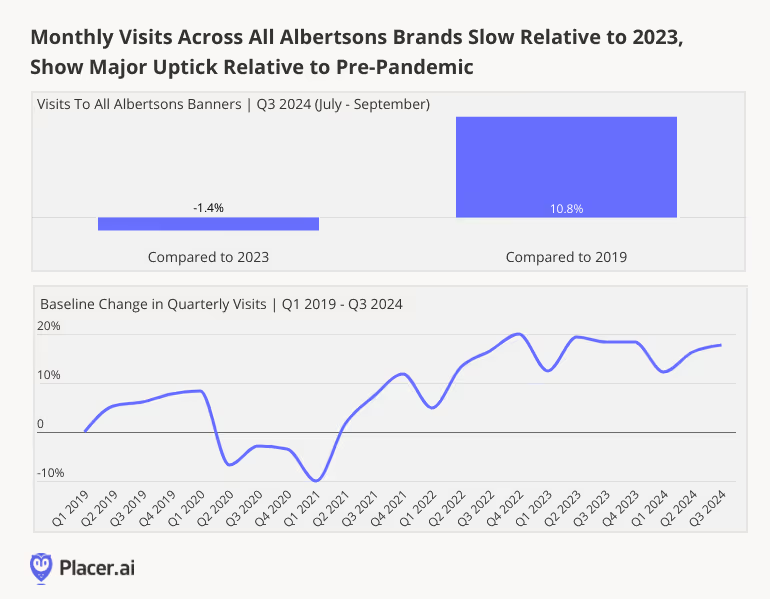
With Q1 2024 under wraps, we take a closer look at visit trends to some of Albertsons Companies’ main banners, examine the top-performing chains by state, and dive into the demographics in the company’s two largest markets.
Diving into 2023’s visits shows that the company’s eight major banners – Albertsons, Safeway, Vons, Jewel-Osco, ACME Markets, Shaw's Supermarket, United Supermarkets, and Tom Thumb – enjoyed year-over-year (YoY) visit growth during every quarters of the year. Visits to Jewel-Osco, and Shaw’s Supermarket were particularly elevated, with Q4 2023 visits YoY up 5.8%, and 5.9%, respectively.
.avif)
Albertsons Companies’ positive performance has continued in 2024. Visits to most of the chains remained positive YoY in January despite the chilling retail impact of early 2024’s arctic blast, and all banners saw significant growth in February and March.
.avif)
Albertsons Companies is headquartered in Boise, Idaho, and its eponymous banner is highly popular in the western United States. But the company has also gained a foothold in the South, Midwest, Mid-Atlantic, and Northeast – and solidified its dominance in the West – through several successful mergers.
The company’s strategy of acquiring regional channels means that most states now have an Albertsons Companies’ banner catering to local grocery shoppers. Nationwide, the company’s most visited chains are Albertsons and Safeway – likely due to the sheer number of locations – but regional chains like Tom Thumb in Texas and Jewel-Osco in the Midwest are still the reigning Albertsons Companies banners in their areas.

California and Texas, the country's two most populous states, also boast the highest number of Albertsons Companies-owned grocery chains. Analyzing the demographic differences between the trade areas of the top three Albertsons Companies banners in each of the two states shows how the company leverages its banner variety to reach a larger audience.
According to the STI:Popstats 2023 dataset, the median household income (HHI) in Texas is $75.9K. Two of the top three Albertsons Companies’ banners in the state had a trade area median HHI below the Texas statewide median – United Supermarkets at $58.7K/year, and Albertsons at $68.3K/year – while Tom Thumb drew visitors from neighborhoods with a median HHI of $99.5K. And in California, although all three most visited Albertsons Companies banners drew visitors from neighborhoods with a median income above the statewide median, the trade area HHI also exhibited a range – from $99.2K/year for Albertsons to $115.0K/year for Safeway.
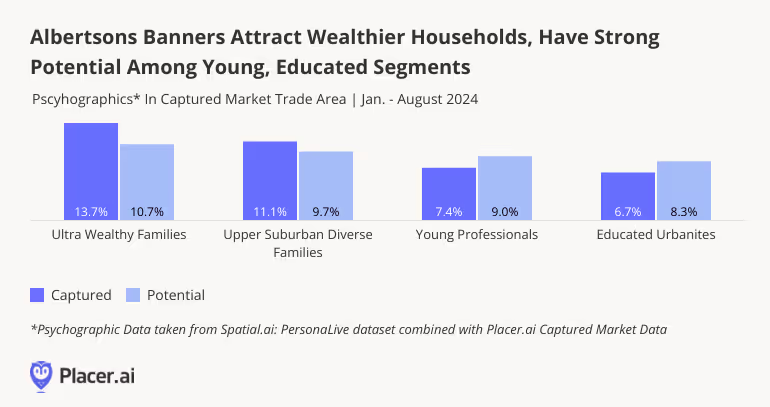
The variance in median HHI by banner and state highlights the benefit of operating grocery banners that can attract a range of shoppers from all along the income scale. By offering shopping options that cater to shoppers of all kinds, Albertsons Companies can hope to maximize its market reach and attract a diverse array of consumers.
.png)
Albertsons Companies has set up shop across the country and offers a wide range of shoppers multiple grocery experiences across regions and price points. Will its grocery banners continue to see elevated foot traffic into 2024?
Visit placer.ai to stay on top of the latest grocery developments.
This blog includes data from Placer.ai Data Version 2.0, which implements improvements to our extrapolation capabilities, adds short visit monitoring, and enhances visit detection.

The first Lollapalooza – a four-day music festival – took place in 1991. Chicago’s Grant Park became the event’s permanent home (at least in the United States) in 2005, drawing thousands of revelers and music fans to the park each year.
This year, the festival once again demonstrated its powerful impact on the city. On August 1st, 2024, visits to Grant Park surged by 1,313.2% relative to the YTD daily average, as crowds converged on the park to see Chappell Roan’s much-anticipated performance. And during the first three days of the event, the event drew significantly more foot traffic than in 2023 – with visits up 18.9% to 35.9% compared to the first three days of last year’s festival (August 3rd to 5th, 2023).
Lollapalooza led to a dramatic spike in visits to Grant Park – and it also attracted a different type of visitor compared to the rest of the year.
Analyzing Grant Park’s captured market with Spatial.ai’s PersonaLive dataset reveals that Lollapalooza attendees are more likely to belong to the “Young Professionals” and “Ultra Wealthy Families” segment groups than the typical Grant Park visitor.
By contrast, the “Near-Urban Diverse Families” segment group, comprising middle-class diverse families living in or near cities, made up only 6.5% of visitors during the festival, compared to 12.0% during the rest of the year.
Additionally, visitors during Lollapalooza came from areas with higher HHIs than both the nationwide baseline of $76.1K and the average for park visitors throughout the year. Understanding the demographic profile of visitors to the park during Lollapalooza can help planners and city officials tailor future events to these segment groups – or look for ways to make the festival accessible to a wider range of music lovers.
Lollapalooza’s impact on Chicago extended beyond the boundaries of Grant Park, with nearby hotels seeing remarkable surges in foot traffic. The Congress Plaza Hotel on South Michigan Avenue witnessed a staggering 249.1% rise in visits during the week of July 29, 2024, compared to the YTD visit average. And Travelodge on East Harrison Street saw an impressive 181.8% increase. These spikes reflect the festival’s draw not just for locals but for out-of-town visitors who fill hotels across the city.
The North Michigan Avenue retail corridor also enjoyed a significant increase in foot traffic during the festival, with visits on Thursday, August 1st 56.0% higher than the YTD Thursday visit average. On Friday, August 2nd, visits to the corridor were 55.7% higher than the Friday visit average. These numbers highlight Lollapalooza’s role in driving economic activity across Chicago, as festival-goers venture beyond the park to explore the city’s vibrant retail and hospitality offerings.
City parks often serve as community hubs, and Flushing Meadows Corona Park in Queens, NY, has been a major gathering point for New Yorkers. The park hosted one of New York’s most beloved summer concerts – Governors Ball – which moved from Governors Island to Flushing Meadows in 2023.
During the festival (June 9th -11th, 2024), musicians like Post Malone and The Killers drew massive crowds to the park, with visits soaring to the highest levels seen all year. On June 9th, the opening day of the festival, foot traffic in the park was up 214.8% compared to the YTD daily average, and at its height, on June 8th, the festival drew 392.7% more visits than the YTD average.
The park also hosted other big events this summer – a July 21st set by DMC helped boost visits to 185.1% above the YTD average. And the Hong Kong Dragon Boat Festival on August 3rd and 4th led to major visit boosts of 221.4% and 51.6%, respectively.
These events not only draw large crowds, but also highlight the park’s role as a space where cultural and civic life can find expression, flourish, and contribute to the health of local communities.
Analyzing changes in Flushing Meadows Corona Park’s trade area size offers insight into how far people are willing to travel for these events. During Governors Ball, for example, the park’s trade area ballooned to 254.5 square miles, showing the festival's wide appeal. On July 20th, by contrast, when the park hosted several local bands and DJs, the trade area was a much more modest 57.0 square miles.
Summer events drive community engagement, economic activity, and civic pride. Cities that invest in their parks and event hubs, fostering lively and inclusive spaces, can create lasting value for both residents and visitors, enriching the cultural and social life of urban areas.
For more data-driven civic stories, visit Placer.ai.
The pandemic and economic headwinds that marked the past few years presented the multi-billion dollar hotel industry with significant challenges. But five years later, the industry is rallying – and some hotel segments are showing significant growth.
This white paper delves into location analytics across six major hotel categories – Luxury Hotels, Upper Upscale Hotels, Upscale Hotels, Upper Midscale Hotels, Midscale Hotels, and Economy Hotels – to explore the current state of the American hospitality market. The report examines changes in guest behavior, personas, and characteristics and looks at factors driving current visitation trends.
Overall, visits to hotels were 4.3% lower in Q2 2024 than in Q2 2019 (pre-pandemic). But this metric only tells part of the story. A deeper dive into the data shows that each hotel tier has been on a more nuanced recovery trajectory.
Economy chains – those offering the most basic accommodations at the lowest prices – saw visits down 24.6% in Q2 2024 compared to pre-pandemic – likely due in part to hotel closures that have plagued the tier in recent years. Though these chains were initially less impacted by the pandemic, they were dealt a significant blow by inflation – and have seen visits decline over the past three years. As hotels that cater to the most price-sensitive guests, these chains are particularly vulnerable to rising costs, and the first to suffer when consumer confidence takes a hit.
Luxury Hotels, on the other hand, have seen accelerated visit growth over the past year – and have succeeded in closing their pre-pandemic visit gap. Upscale chains, too, saw Q2 2024 visits on par with Q2 2019 levels. As tiers that serve wealthier guests with more disposable income, Luxury and Upscale Hotels are continuing to thrive in the face of headwinds.
But it is the Upper Midscale level – a tier that includes brands like Trademark Collection by Wyndham, Fairfield by Marriott, Holiday Inn Express by IHG Hotels & Resorts, and Hampton by Hilton – that has experienced the most robust visit growth compared to pre-pandemic. In Q2 2024, Upper Midscale Hotels drew 3.5% more visits than in Q2 2019. And during last year’s peak season (Q3 2023), Upper Midscale hotels saw the biggest visit boost of any analyzed tier.
As mid-range hotels that still offer a broad range of amenities, Upper Midscale chains strike a balance between indulgence and affordability. And perhaps unsurprisingly, hotel operators have been investing in this tier: In Q4 2023, Upper Midscale Hotels had the highest project count of any tier in the U.S. hotel construction and renovation pipeline.
The shift in favor of Upper Midscale Hotels and away from Economy chains is also evident when analyzing changes in relative visit share among the six hotel categories.
Upper Midscale hotels have always been major players: In H1 2019 they drew 28.7% of overall hotel visits – the most of any tier. But by H1 2024, their share of visits increased to 31.2%. Upscale Hotels – the second-largest tier – also saw their visit share increase, from 24.8% to 26.1%.
Meanwhile, Economy, Midscale, and Upper Upscale Hotels saw drops in visit share – with Economy chains, unsurprisingly, seeing the biggest decline. Luxury Hotels, for their parts, held firmly onto their piece of the pie, drawing 2.8% of visits in H1 2024.
Who are the visitors fueling the Upper Midscale visit revival? This next section explores shifts in visitor demographics to four Upper Midscale chains that are outperforming pre-pandemic visit levels: Trademark Collection by Wyndham, Holiday Inn Express by IHG Hotels & Resorts, Fairfield by Marriott, and Hampton by Hilton.
Analyzing the captured markets* of the four chains with demographics from STI: Popstats (2023) shows variance in the relative affluence of their visitor bases.
Fairfield by Marriott drew visitors from areas with a median household income (HHI) of $84.0K in H1 2024, well above the nationwide average of $76.1K. Hampton by Hilton and Trademark Collection by Wyndham, for their parts, drew guests from areas with respective HHIs of $79.6K and $78.5K – just above the nationwide average. Meanwhile, Holiday Inn Express by IHG Hotels & Resorts drew visitors from areas below the nationwide average.
But all four brands saw increases in the median HHIs of their captured markets over the past five years. This provides a further indication that it is wealthier consumers – those who have had to cut back less in the face of inflation – who are driving hotel recovery in 2024.
(*A chain’s captured market is obtained by weighting each Census Block Group (CBG) in its trade area according to the CBG’s share of visits to the chain – and so reflects the population that actually visits the chain in practice.)
Much of the Upper Midscale visit growth is being driven by chain expansion. But in some areas of the country, the average number of visits to individual hotel locations is also on the rise – highlighting especially robust growth potential.
Analyzing visits to existing Upper Midscale chains in four metropolitan areas with booming tourism industries – Salt Lake City, UT, Palm Bay, FL, San Diego, CA, and Richmond, VA – shows that these markets feature robust untapped demand.
Utah, for example, has emerged as a tourist hotspot in recent years – with millions of visitors flocking each year to local destinations like Salt Lake City to see the sights and take in the great outdoors. And Upper Midscale hotels in the region are reaping the benefits. In H1 2024, the overall number of visits to Upper Midscale chains in Salt Lake City was 69.4% higher than in H1 2019. Though some of this increase can be attributed to local chain expansion, the average number of visits to each individual Upper Midscale location in the area also rose by 12.5% over the same period.
Palm Bay, FL (the Space Coast) – another tourist favorite – is experiencing a similar trend. Between H1 2019 and H1 2024, overall visits to local Upper Midscale hotel chains grew by 36.4% – while the average number of visits per location increased a substantial 16.9%. Given this strong demand, it may come as no surprise that the area is undergoing a hotel construction boom. Upper Midscale hotels in other areas with flourishing tourism sectors, like San Diego, CA and Richmond, VA, are seeing similar trends, with increases in both overall visits and and in the average number of visits per location.
Though Economy chains have underperformed versus other categories in recent years, the tier does feature some bright spots. Some extended-stay brands in the Economy tier – hotels with perks and amenities that cater to the needs of longer-stay travelers – are succeeding despite category headwinds.
Choice Hotels’ portfolio, for example, includes WoodSpring Suites, an Economy chain offering affordable extended-stay accommodations in 35 states. In H1 2024, the chain drew 7.7% more visits than in the first half of 2019 – even as the wider Economy sector continued to languish. InTown Suites, another Economy extended stay chain, saw visits increase by 8.9% over the same period.
And location intelligence shows that the success of these two chains is likely being driven, in part, by their growing appeal to young, well-educated professionals. In H1 2019, households belonging to Spatial.ai: PersonaLive’s “Young Professionals” segment made up 9.6% of WoodSpring Suites’ captured market. But by H1 2024, the share of this group jumped dramatically to 13.3%. At the same time, InTown Suites saw its share of Young Professionals increase from 12.0% to 13.4%.
Whether due to an affinity for prolonged “workcations” (so-called “bleisure” excursions) or an embrace of super-commuting, younger guests have emerged as key drivers of growth for the extended stay segment. And by offering low–cost accommodations that meet the needs of these travelers, Economy chains can continue to grow their share of the pie.
The hospitality industry recovery continues – led by Upper Midscale Hotels, which offer elevated experiences that don’t break the bank. But today’s market has room for other tiers as well. By keeping abreast of local visitation patterns and changing consumer profiles, hotels across chain scales can personalize the visitor experience and drive customer satisfaction.
The past few years have provided the tourism sector with a multitude of headwinds, from pandemic-induced lockdowns to persistent inflation and a rise in extreme weather events. But despite these challenges, people are more excited than ever to travel – more than half of respondents to a recent survey are planning on increasing their travel budgets in the coming months.
And while revenge travel to overseas destinations is still very much alive and well, the often high costs associated with traveling abroad are shaping the way people choose to travel. Domestic travel and tourism are seeing significant growth as more affordable alternatives.
This white paper takes a closer look at two of the most popular domestic tourism destinations in the country – New York City and Los Angeles. Over the past year, both cities have continued to be leading tourism hotspots, offering a wealth of attractions for visitors. What does tourism to these two cities look like in 2024, and what has changed since before the pandemic? How have inflation and rising airfare prices affected the demographics and psychographics of visitors to these major hubs?
Analyzing the distribution of domestic tourists across CBSAs nationwide from May 2023 to April 2024 reveals New York and Los Angeles to be two of the nation’s most popular destinations. (Tourists include overnight visitors staying in a given CBSA for up to 31 days).
The New York-Newark-Jersey City, NY-NJ-PA metro area drew the largest share of domestic tourists of any CBSA during the analyzed period (2.7%), followed closely by the Los Angeles-Long Beach-Anaheim, CA CBSA (2.5%). Other domestic tourism hotspots included Orlando-Kissimmee-Sanford, FL (tied for second place with 2.5% of visitors), Dallas-Fort Worth-Arlington, TX (1.9%), Las Vegas-Henderson-Paradise, NV (1.8%), Miami-Fort Lauderdale-Pompano Beach, FL (1.8%), and Chicago-Naperville, Elgin, IL-IN-WI (1.6%).
The Big Apple. The City That Never Sleeps. Empire City. Whatever it’s called, New York City remains one of the most well-known tourist destinations in the world. And for many Americans, New York is the perfect place for an extended weekend getaway – or for a multi-day excursion to see the sights.
But where do these NYC-bound vacationers come from? Diving into the data on the origin of visitors making medium-length trips to New York City (three to seven nights) reveals that increasingly, these domestic tourists are coming from nearby metro areas.
Between 2018-2019 and 2023-2024, for example, the number of tourists visiting New York City from the Philadelphia metro area increased by 19.2%.
The number of tourists coming from the Boston and Washington, D.C metro areas, and from the New York CBSA itself (New York-Newark-Jersey City, NY-NJ-PA) also increased over the same period.
Meanwhile, further-away CBSAs like San Francisco-Oakland-Berkeley, CA, Atlanta-Sandy Springs-Alpharetta, GA, and Miami-Fort Lauderdale-Pompano Beach, FL fed fewer tourists to NYC in 2023-2024 than they did pre-pandemic. It seems that residents of these more distant metro areas are opting for vacation destinations closer to home to avoid the high costs of air travel.
Diving even deeper into the characteristics of visitors taking medium-length trips to New York City reveals another demographic shift: Tourists staying between three and seven nights in the Big Apple are skewing younger.
Between 2018-2019 and 2023-2024, the share of visitors to New York City from areas with median ages under 30 grew from 2.1% to 4.5%. Meanwhile, the share of visitors from areas with median ages between 31 and 40 increased from 34.3% to 37.7%.
The impact of this trend is already being felt in the Big Apple, with The Broadway League reporting that the average age of audiences to its shows during the 2022- 2023 season was the youngest it had been in 20 seasons.
The shift towards younger tourists can also be seen when examining the psychographic makeup of visitors to popular attractions in New York City. Analyzing the captured markets of major NYC landmarks with data from Spatial.ai’s PersonaLive dataset reveals an increase in households belonging to the “Educated Urbanites” segment between 2018-2019 and 2023-2024.
These well-educated, young singles are increasingly visiting iconic NYC venues such as the Whitney Museum of American Art, The Metropolitan Museum of Art, The American Museum of Natural History, and the Statue of Liberty. This shift highlights the growing popularity of these attractions among young, educated singles, reflecting a broader trend of increased domestic tourism among this demographic.
New York City’s tourism sector is adapting to meet the changing needs of travelers, fueled increasingly by younger visitors who may be unable to take a costly international vacation. How have travel patterns to Los Angeles changed in response to increasing travel costs?
While New York City is the East Coast’s tourism hotspot, Los Angeles takes center stage on the West Coast. And as overseas travel has become increasingly out of reach for Americans with less discretionary income, the share of domestic tourists originating from areas with lower HHIs has risen.
Before the pandemic, 57.6% of visitors to LA came from affluent areas with median household incomes (HHIs) of over $90K/year. But by 2023-2024, this share decreased to 50.7%. Over the same period, the share of visitors from areas with median HHIs between $41K and $60K increased from 9.7% to 12.5%, while the share of visitors from areas with HHIs between $61K and $90K rose from 32.1% to 35.8%.
Diving into the psychographic makeup of visitors to popular Los Angeles attractions – Universal Studios Hollywood, Disneyland California, the Santa Monica Pier, and Griffith Observatory – also reflects the above-mentioned shift in HHI. The captured markets of these attractions had higher shares of middle-income households belonging to the “Family Union” psychographic segment in 2023-2024 than in 2018-2019.
Experian: Mosaic defines this segment as “middle income, middle-aged families living in homes supported by solid blue-collar occupations.” Pre-pandemic, 16.0% of visitors to Universal Studios Hollywood came from trade areas with high shares of “Family Union” households. This number jumped to 18.8% over the past year. A similar trend occurred at Disneyland, Santa Monica Pier, and Griffith Observatory.
And like in New York City, growing numbers of visitors to Los Angeles appear to be coming from nearby areas. Between 2018-2019 and 2023-2024, the share of in-state visitors to major Los Angeles attractions increased substantially – as people likely sought to cut costs by keeping things local.
Pre-pandemic, for example, 68.9% of visitors to Universal Studios Hollywood came from within California – a share that increased to 72.0% over the past year. Similarly, 59.7% of Griffith Observatory visitors in 2018-2019 came from within the state – and by 2023-2024, that number grew to 64.7%.
Even when times are tight, people love to travel – and New York and Los Angeles are two of their favorite destinations. With prices for airfare, hotels, and dining out increasing across the board, younger and more price-conscious households are adapting, choosing to visit nearby cities and enjoy attractions closer to home. And as the tourism industry continues its recovery, understanding emerging visitation trends can help stakeholders meet travelers where they are.