.png)
.png)

.png)
.png)


With their experiential vibes and treasured blends of well-known brands and local gems, high-street retail corridors are experiencing something of a renaissance. Iconic shopping districts like Fifth Avenue and SoHo in New York City, Rodeo Drive in Beverly Hills, and Newbury Street in Boston are seeing steady influxes of luxury and high-end apparel brands. And economic headwinds notwithstanding, consumers continue to flock to these important retail destinations to shop, grab a bite to eat, and take in all the sights and sounds they have to offer.
So with the new year upon us, we dove into the data to see how major urban shopping districts nationwide fared this holiday season. How did visits to these corridors in the final months of 2023 compare to last year? And who are the consumers driving the high-street revival?
Over the past six months, visits to major urban shopping districts have been consistently higher than they were last year. And as the holiday season kicked into gear, the year-over-year (YoY) growth trajectory trended upwards – indicating a robust turnout during this holiday period.
%20(1).avif)
To examine some of the factors behind this growth, we analyzed the demographic profiles of the captured markets of POIs (points of interest) corresponding to major high-street corridors throughout the country.
The analysis shows that throughout the U.S., high-street shopping districts hold special appeal for affluent audiences – and for consumers belonging to Spatial.ai’s PersonaLive’s “Educated Urbanite” psychographic segment. This segment encompasses well-educated young singles that live in dense urban areas and make relatively high salaries. Given the demographic profile of their visitors, it’s no wonder that high-street corridors are finding success while expanding their luxury and high-end apparel portfolios.
In Q4 2023, the captured markets of Fifth Avenue, SoHo, and Times Square all featured higher median household incomes (HHIs), and greater shares of the “Educated Urbanite” segment than New York’s statewide baselines. Each of these quintessential New York City landmarks, however, drew a somewhat different visitor base.
Fifth Avenue, with its array of museums, luxury high-rises, and expensive department stores, drew the most affluent crowd, with a captured market median HHI of $105.6K – some 35.7% above the statewide median. SoHo, for its part, known for designer apparel stores, trendy cafes, and whimsical tourist attractions (Museum of Ice Cream, anyone?), attracted the largest share of “Educated Urbanites.” And Times Square, a top Big Apple attraction with broad popular appeal, boasted a visitor profile closest to statewide baselines.
.avif)
A look at the visitor profiles of major California shopping districts reveals a similar trend. The captured markets of Beverly Hills’ Rodeo Drive, Santa Monica’s 3rd Street Promenade, Hayes Valley in San Francisco, and Abbot Kinney in Los Angeles all had higher median HHIs in Q4 2023 than the statewide median of $85.7K. Of these, the captured market with the highest median HHI was that of Hayes Valley in San Francisco – an unsurprising finding given the relative affluence of the Bay Area. Not far behind was Rodeo Drive, with a median HHI of $113.9K.
Hayes Valley also led the charge for “Educated Urbanites,” with no less than 61.4% of the population of its captured market – nearly two-thirds – belonging to this segment. But all four of the analyzed high-street corridors were significantly over-indexed for this demographic compared to the California baseline of 13.1%.
.avif)
Looking at urban shopping districts in other major cities nationwide – including Newbury Street in Boston, Fulton Market in Chicago, and Walnut Street in Philadelphia – shows that the unique draw of these corridors for young, affluent singles isn’t confined to New York and Chicago. In all three corridors, the median HHIs and shares of “Educated Urbanites” in the captured markets
also exceeded statewide baselines – oftentimes by a wide margin.
.avif)
Evolving work routines and post-COVID population shifts continue to present municipalities and other civic stakeholders with significant challenges. But the revival of high-street retail corridors shows that cities are up to the task. How will major urban shopping districts fare in the new year? And how will their audiences continue to evolve?
Follow Placer.ai’s data-driven retail foot traffic analyses to find out.

How did the brick-and-mortar divisions of Walmart, Target, and other leading retailers perform this holiday season? Which days drove the most visits, and how did foot traffic performance this year compare to 2022? We dove into the data to find out.
Looking at daily visits to Target, Walmart, mid-tier department stores (including Macy’s, JCPenney, Kohl’s Belk, and Dillard’s), luxury department stores (including Saks Fifth Avenue, Neiman Marcus, Bloomingdale’s, and Nordstrom) and Best Buy reveals several common trends.
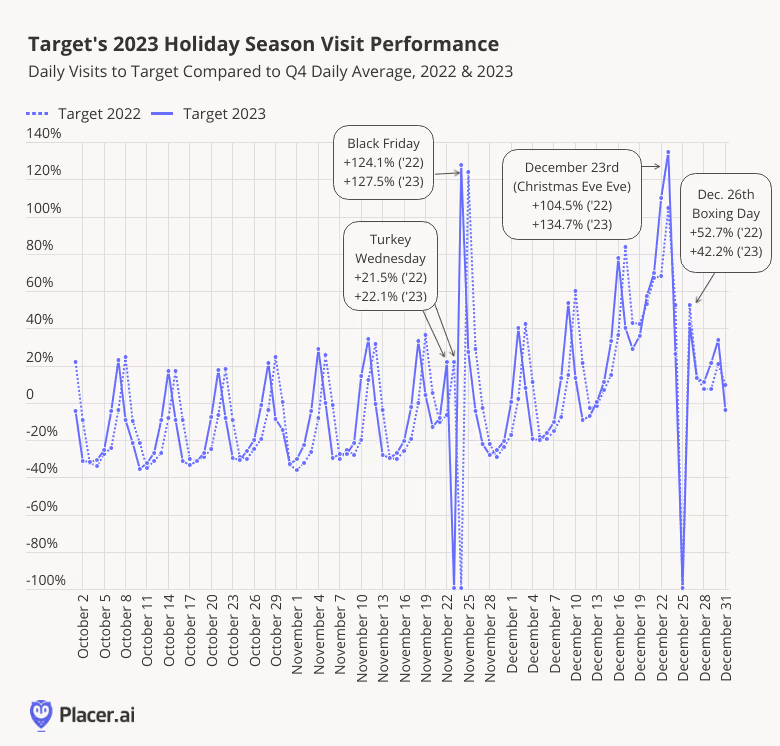
In all cases, retail visits began to creep up over the days leading up to Thanksgiving (Monday through Wednesday) as consumers took advantage of early Black Friday discounts. And the visit increase on Black Friday 2023 relative to the Q4 daily average was larger than in 2022 – perhaps thanks to budget-conscious consumers holding out for the steep discounts offered the day after Thanksgiving. The Christmas Eve Eve (December 23rd) and Super Saturday spikes were also particularly pronounced in 2023, likely thanks to the combination of both retail events falling on the same day this year.
All retailers and retail segments analyzed also saw smaller surges on Boxing Day (December 26th) 2023 when compared to 2022, likely due to calendar differences. Christmas fell on a Sunday in 2022, so December 26th was declared a federal holiday in lieu of December 25th, and many private-sector employers likely gave time off as well – giving consumers the opportunity to hit the stores and enjoy after-Christmas sales. But Boxing Day still drove visit peaks across the board in 2023 (albeit not smaller peaks than in 2022) – indicating that Boxing Day is now a U.S. phenomenon as well.
December 27th, 28th, and 29th saw a greater increase relative to the daily Q4 average in 2023 compared to 2022, culminating in a larger New Years Eve Eve (December 30th) spike. The December 30th surge may be because this year’s December 30th fell on a Saturday, which is a major shopping day in its own right. But the increase in the days prior to New Years Eve Eve, when after-Christmas sales were in full force, could indicate that consumers are still particularly attune to sales events.
Still, despite the similarities across retail categories, foot traffic data also reveals some important differences between the segments.
Visits to Target began to increase in November 2023 relative to October as the retailer offered “Four Weeks of Early Black Friday Deals,” starting October 29th. And like the other categories analyzed, Target saw its first small visit peak of the season on the Wednesday before Thanksgiving (also known as Turkey Wednesday thanks to the massive Grocery visit spikes on the day). Visits on the day before Thanksgiving were up by 21.5% and 22.1%, in 2022 and 2023, respectively, despite foot traffic on an average Wednesday tends to be lower than the Q4 daily average – indicating that “Turkey Wednesday” also holds retail significance for grocery-adjacent categories.
Visits then spiked on Black Friday and returned to seasonally normal levels on Saturday. Throughout December, foot traffic continued to swell, with every week exceeding the previous week’s visit performance. The intensity of the visit growth picked up the week before Christmas, with Christmas Eve Eve/Super Saturday seeing a significant jump. Finally, Target visits on Boxing Day and the week following Christmas also exceeded the Q4 daily average as consumers took advantage of end-of-season sales and looked for festive attire for their New Year’s Eve celebrations.

The holiday season visit pattern at Walmart differs from those at Target in several instances. The superstore’s Turkey Visit spike was significantly more pronounced than Target’s, likely thanks to Walmart’s more extensive grocery offerings. Walmart also saw smaller spikes on Black Friday – perhaps due to the retailer’s famous “everyday low prices,” which may reduce the appeal of specific sales events. The Christmas Eve Eve/Super Saturday surge were also lower than for Target, but the Super Saturday increase relative to Black Friday spike was more pronounced, with some consumers probably visiting Walmart for last-minute groceries ahead of their Christmas dinners.
.avif)
Visits to luxury department stores (Saks Fifth Avenue, Neiman Marcus, Nordstrom, and Bloomingdale’s) followed the general retail foot traffic trends, with larger peaks on Black Friday and on Christmas Eve Eve/Super Saturday in 2023 compared to 2022. Boxing Day 2023 drove a smaller visit spike relative to last year, but foot traffic was still 98.2% higher than the Q4 2023 daily average – indicating that the day is still emerging as an important retail milestone, especially for pricier segments.
.avif)
Mid-tier department stores (Macy’s, Kohl’s, JCPenney, Belk, and Dillard’s) saw more significant spikes on Black Friday and Christmas Eve Eve/Super Saturday, and smaller spikes on Boxing Day. Luxury’s department stores’ biggest post-Christmas visit peak was on Boxing Day, but mid-tier department stores experienced their largest end-of-year increase on New Year’s Eve Eve (December 30th).
.avif)
Best Buy saw the strongest Q4 visit spike on Black Friday out of all the retailers and retail segments analyzed, with foot traffic up a whopping 510.9% compared to its Q4 2023 daily average. The electronics leader also had the largest Christmas Eve Eve/Super Saturday bump – with visits up 188.1% – and Boxing Day boost, with traffic up 112.9% compared to the Q4 daily average. The visit surges over the holiday season’s retail milestones indicate that demand for electronics remains strong – even as some consumers may be putting off large purchases due to economic headwinds.
.avif)
The holiday season drove significant retail foot traffic across categories, with every segment displaying its own unique Q4 visitation pattern. How will these sectors perform in the year ahead?
Visit placer.ai/blog to find out.

2023 was a year that forced restaurant operators to stay agile. Inflation was top-of-mind for most consumers throughout the year, resulting in a trade-down to value-oriented restaurants (or trading out to value grocery chains, dollar stores, and convenience stores). That said, value wasn’t the only factor driving visits, as new menu innovations (Taco Bell was a standout) or marketing partnerships (McDonald’s Famous Orders and “adult” happy meals helping the chain to outperform from a visitation perspective). While we’ve seen visitation trends for the morning daypart improve due to a steady recovery in return to office trends, we continue to see visits during late morning and early afternoon for coffee and QSR chains due to changes in consumer routines (not to mention a resurgence in late night dining). This has also prompted several chains to refine their approach to drive-thrus and pick-up windows (Shake Shack, Chipotle, Taco Bell, among several others). On top of these trends, we’ve seen massive changes in restaurant trade areas, driving many chains to rethink their expansion plans (including an emphasis on South and Southeast, which have seen population growth due to migration).
McDonald’s new exploratory restaurant concept CosMc’s sits at the intersection of several of these trends. The smaller-format (approximately 2,800 square feet, compared to 4,000-4,500 square feet for the average McDonald’s), drive-thru only concept opened its doors last month in Bolingbrook, IL, and is part of a “limited test run”. Its menu heavily focuses on beverages, including four “Signature Galactic Boosts” (featuring Sour Cherry Energy Boost and Island Pick-Me-Up Punch drinks), iced teas and lemonades (such as a Tropical Spiceade and Blackberry Mist Green Tea), slushes and frappes (including a Chai Frappe Burst and Popping Pear Slush), and coffee-based products (highlighted by the S’Mores Cold Brew and Turmeric Spiced Latte). While beverages are the focal point, there are also a variety of breakfast and snack food options, including a Spicy Queso and Creamy Avocado Tomatillo breakfast sandwiches, McPops (filled doughnuts), Savory Hash Brown Bites, and Pretzel Bites. In addition to the experimental fare, the menu also features a host of traditional breakfast sandwiches and beverage offerings.
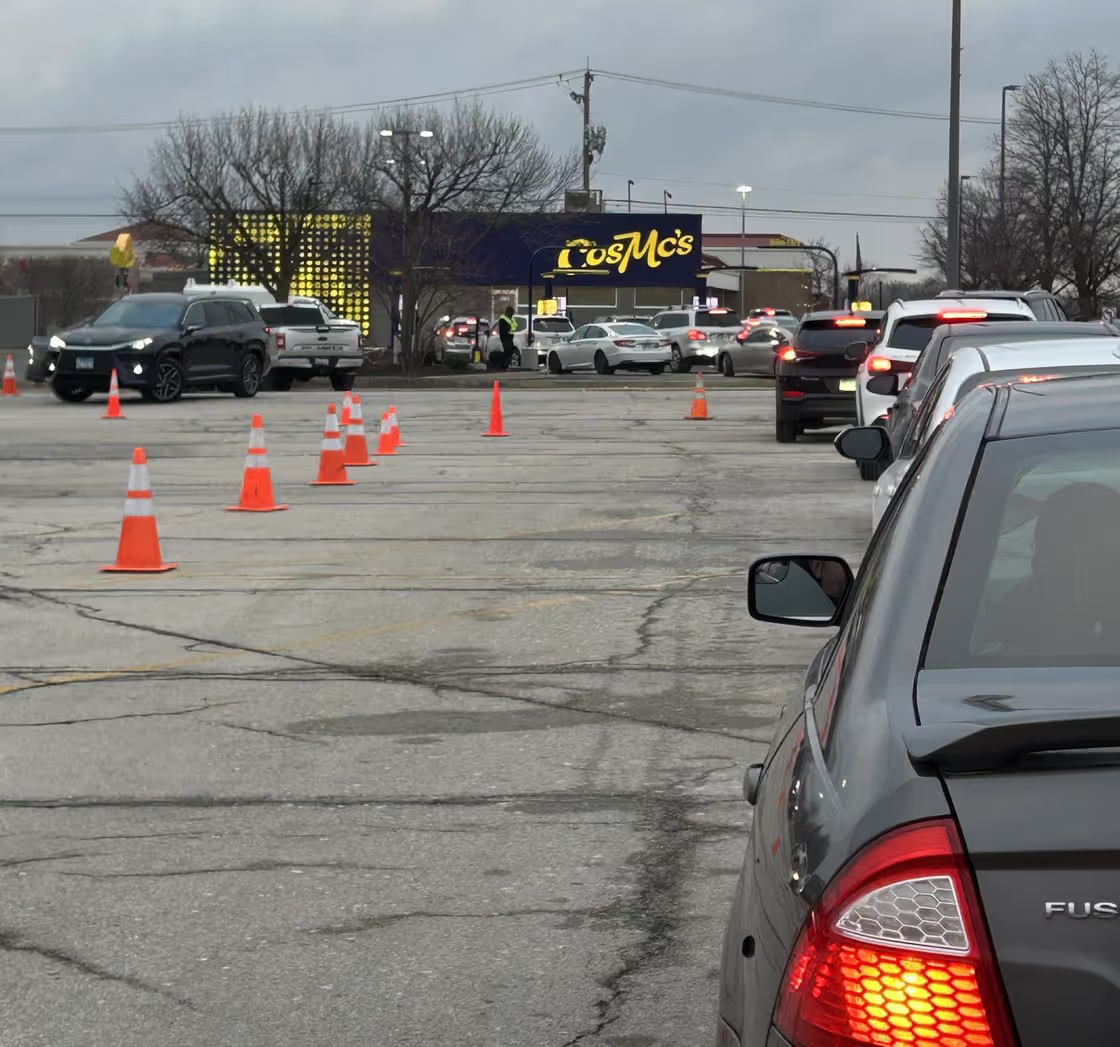
Given the early buzz, we decided to check out the concept for ourselves this week. It was immediately apparent how much interest CosMc’s was drawing, as the drive-thru lane spanned roughly 80 vehicles upon arrival (which required use of a separate parking lot at the Maple Park Place shopping center, which also features Burlington, Ross Dress for Less, Dollar Tree, Aldi, and Best Buy stores).

.avif)
While its unique menu has rightfully generated a significant amount of attention, it’s also clear that McDonald’s is also using CosMc’s as a test for other potential drive-thru only locations in the future. Customers order from dynamic menu boards and cashless payment devices are used to expedite the payment process. Visitors wait at the menu board until their order is ready, and then pickup windows are assigned when the order is ready.
.avif)
.avif)
Admittedly, it’s tough to make definitive conclusions about CosMc’s with the location being open for only a few weeks. Placer’s data suggests that CosMc’s saw more than double the number of visits that a typical McDonald’s saw chainwide during December 2023 (despite being open only since Dec. 7) and more than triple the number of visits per square foot (given CosMc’s smaller, roughly 2,500 square feet footprint). However, it’s also worth noting that CosMc’s visitation numbers would likely have been much higher if the location had additional capacity to satisfy the overwhelming demand.
Still, Placer offers some other ways to evaluate CosMc’s early trends. Based on 2019 Census Block Group data, CosMc’s trade area size (using a 70% of visit threshold) was just over 155 square miles during December 2023 (below). This is roughly 2.5 times the size of the trade area for the average McDonald’s location during December 2023 (62 miles) and significantly larger than the average trade area for most coffee brands (25-35 miles for more urban focused brands to 50-60 miles for more suburban/secondary market brands). In fact, the closest recent comparison we could find for CosMc’s was Raising Cane’s Post Malone and Dallas Cowboys restaurant collaboration, which had an impressive 264-mile trade area during its initial month of opening (though also helped by cross-traffic from Dallas Cowboys home game visitors from across the state of Texas). In some ways, there were also similarities between CosMc's and the Hello Kitty Cafe Trucks, which the Placer.ai Blog team wrote about last September.
Given that McDonald’s also appears to be targeting a younger demographic with CosMc’s, we thought we’d also look at the age breakdown for the potential market trade area (the population living within the trade area for the CosMc’s store). McDonald’s collective potential market trade area largely mirrors U.S. trends given its reach (the company has previously stated that 85% of the population in its top five markets–the U.S., France, the U.K., Germany and Canada–are within three miles of a McDonald’s location), it’s interesting that the potential market trade area for CosMc’s does skew to a younger audience, particularly the 22–29-year-old cohort.
By the end of 2024, McDonald’s plans to open an additional 10 CosMc’s test units, including locations in the Dallas-Fort Worth and San Antonio markets (notably some of the fastest growing markets in the U.S.). Does CosMc’s have the potential to be something more than a 10-unit test over a longer horizon? McDonald's has attempted to differentiate its coffee business in the past with its McCafe menu and standalone McCafe locations in international markets, but competition with Starbucks and others made it difficult for the company to distinguish McCafe as a standalone retail brand in the U.S. CosMc's is interesting from this perspective, as it may allow the company to build a brand more naturally and stand out with a younger audience (which appears to be working). It’s unlikely that future CosMc’s will look or operate like the pilot location in Bolingbrook. Nevertheless, the excitement around new products, an expansive trade area, and potential to connect with younger audience make it a worthwhile test (especially with 2024 shaping up to be a strong year for unit growth within the coffee category).

In December 2023, Placer.ai released two white papers: How Physical Stores Help DNBs Thrive and East Coast Migration Hubs. Below is a taste of our findings. To read more data-driven consumer research, visit our library.
DNBs – Digitally Native Brands – refer to retailers that began their retail journey exclusively online, selling their product line direct-to-consumers through their owned digital channel. But although all these businesses start out as a pure e-commerce play, many DNBs eventually move offline, choosing to leverage the various benefits of brick-and-mortar channels to grow their business even further.
Analyzing year-over-year (YoY) data for Q3 2023 shows that, while many retailers struggled, DNB leaders such as Vuori, Allbirds, Everlane, and Warby Parker all saw significant growth in quarterly visits per venue. Many of these brands also underwent significant expansions, but the increase in visits per venue reveals that many of the DNBs are seeing more crowded stores despite the increase in number of overall venues. The success of these brands in operating stores that consumers want to keep visiting – even in times of economic headwinds – suggests that DNBs are particularly well positioned to take advantage of the diverse benefits of offline stores.
How Physical Stores Help DNBs Thrive uses location intelligence to reveal the different brick-and-mortar strategies helping DNBs broaden their reach, build their brand, and acquire new audiences. Several DNBs are building massive store fleets, while others focus on a couple well-placed stores – and some focus on temporary pop-ups to reap the benefits of physical stores without the long-term commitment.
Read the full report here to discover the diverse methods that digitally native brands are enlisting to to drive growth through brick-and-mortar expansion.
Much has been written about the recent population outflows from New York, Massachusetts, and other northeastern states. But many states on the East Coast – including Maine, Vermont, Rhode Island, Delaware, North and South Carolina, and Florida – are actually seeing influxes of newcomers.
Each of these states – and each of the metropolitan areas attracting relocators within them – offers its own set of benefits. But those willing to make the move often fit a similar profile – younger individuals or families looking for a more favorable housing market, better schools, or more job opportunities.
East Coast Migration Hubs looks at several states and metro areas on the East Coast to explore the factors driving migration to these emerging hubs. Using location data to understand who is moving, and harnessing Niche’s Neighborhood Grades dataset to identify differences between origin and destination areas, the report seeks to shed light on recent domestic migration trends in the Eastern United States.
Read the full report here to discover the factors driving domestic migration to several popular relocation destinations on the East Coast.
For more data-driven consumer research, visit our library.

Last year was marked by inflation and consumer cutbacks as shoppers adjusted to price hikes across key retail and dining categories. But despite the challenges, many categories and retailers not only weathered the storm but positively thrived under the ongoing headwinds.
Now, with a new year offering fresh opportunities for growth, what are the retail and dining segments positioned for success in 2024? We dove into the data to find out.
Last year’s high grocery prices led to a surge in foot traffic to affordable supermarket chains – but food-away-from-home inflation also seems to have driven visits to high-end grocers. Visits to chains such as New York-based Uncle Giuseppe’s, Illinois-based Cermak Fresh Market, and California-based Lazy Acres saw consistent year-over-year (YoY) visit increases as consumers sought specialty ingredients to recreate restaurant-quality dishes at home. Rising interest in sustainability, natural products, and organic ingredients – especially among Gen-Z – likely helped drive traffic growth as well.
But the success of specialty grocers isn’t just coming from singles willing to splurge on the latest influencer-backed food trend – trade area demographic data reveals that families with children are overrepresented in the captured market trade area of all three specialty grocers analyzed. With restaurant prices likely increasing slightly in 2024, consumers looking to feed their families tasty dishes without breaking the bank – or shoppers feeding the growing demand for natural food products – will likely keep visits to specialty grocers high in the coming year.
.avif)
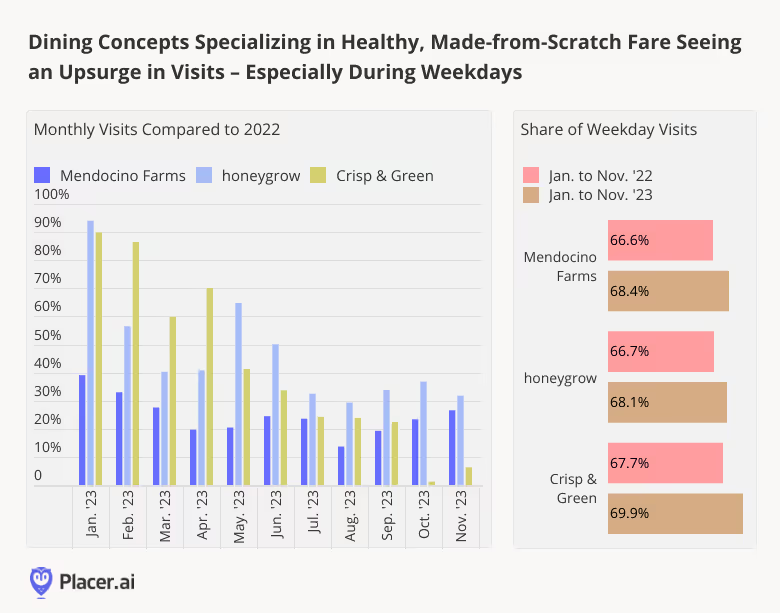
Along with the rise in specialty grocers selling natural and organic ingredients, restaurants focusing on whole, healthy foods are also seeing a boost – and the segment is positioned for further growth in 2024. Consumers are flocking to concepts such as Mendocino Farms, honeygrow, and Crisp & Green that boast fresh ingredients and made-from-scratch dishes – and these chains are all expanding to meet the growing demand.
Visits to healthy dining concepts are no longer reserved for special occasions – weekday foot traffic is also on the rise, with all three dining brands analyzed seeing a YoY rise in the share of Monday to Friday visits. With employees slowly but surely returning to the office and looking to grab a nutritious lunch mid-day or meet up with friends for a balanced dinner on their way home, demand for health-focused dining concepts is likely to continue growing in 2024.

Dave’s Hot Chicken was one of 2023’s biggest dining success stories, and the chain was not the only fried chicken franchise attracting significant foot traffic. Raising Cane’s, which has been on a roll for several years, and Huey Magoo’s Chicken Tenders – which serves grilled chicken and other fare alongside its signature fried tenders – are also taking the country by storm.
Foot traffic to the chains surged in 2023, driven in part by aggressive expansions. But zooming into November 2023 data reveals that average visits per venue are also up YoY, despite all three brands’ much larger store fleets – indicating that the fried chicken boom is meeting a ready demand. It seems, then, that while some diners will favor healthy foods in the new year, other consumers are likely to continue driving visits to fried chicken chains in 2024.
.avif)
Fried chicken isn’t the only indulgence positioned to thrive in 2024. Other affordable luxuries raked in visits last year and are likely to continue seeing growth in the year ahead.
Although inflation appears to be cooling, prices across many goods and services still remain elevated, with some shoppers still putting off large purchases. But consumers are willing to splurge on small treats that won’t break the bank, and tasty snacks and food items – from craft doughnuts to gourmet deli sandwiches to specialty coffee concoctions – could provide the perfect affordable and guilt-free pick-me-up. Parlor Doughnuts, Pickleman’s Gourmet Cafe, and Dutch Bros. Coffee are some of the chains that benefited from this trend in 2023 and will likely continue to grow in the new year.
The trade areas of the three chains analyzed all include a larger-than-average share of “non-family households” – people living with unrelated individuals. As high housing costs continue to lead more U.S. adults to live with roommates, the number of consumers looking to escape their daily grind with an affordable indulgence is likely to increase in 2024 – and drive even larger visit surges to chains offering budget-friendly treats.
.avif)
Non-comestible affordable indulgence such as tanning salons, hair-removal parlors, and eyelash salons are also seeing a rise in visits that will likely continue in the coming year. Deka Lash, Tan Republic, Glo Tanning, and LaserAway are some of the chains that saw their YoY visits increase significantly in 2023, and the growth does not appear to be slowing down.
All four chains’ trade areas included a larger share of Gen-Z visitors (aged 18-24) than the share of 18-24 year olds nationwide. And since, despite inflation, younger shoppers tend to spend more than the average American on beauty and self care – and Gen Z’s spending power is only expected to grow in the coming year – personal grooming chains are well positioned to succeed even further in 2024.
.avif)
Another personal care-adjacent segment slated for growth in 2024 is themed fitness. Gyms and studios that focus on a particular type of activity or fitness regimen – such as climbing, yoga, pilates, or HIIT are seeing their visits skyrocket, with both the number of monthly visits and the average visit frequency on the rise YoY.
The rising popularity of themed fitness concepts may be aided by the sense of community fostered by many of these chains. Touchstone Climbing organizes meetup groups geared towards specific audiences, while F45 Training prides itself on facilitating a sense of purpose and belonging among its members. And yoga and pilates classes have long been recognized for their capacity for connection-building.
With loneliness on the rise and many consumers looking to incorporate a fun, social element into their fitness routines, the demand for themed fitness concepts will likely keep on growing in 2024.
.avif)
Cost-effectiveness does not necessarily mean cheap. And while some retail segments to watch in 2024 stand out for their low price points, other segments that offer consumers a particularly strong value proposition also appear well positioned to thrive in the coming year. Chains such as Theory, Anthropologie, and Marine Layer all saw YoY increases in monthly visits every month of 2023, perhaps aided by the “quiet luxury” trend that drove demand for high-quality, non-ostentatious fashion. And while these brands may not offer the cheapest price, the focus on good craftsmanship and premium fabrics may help consumers feel better about shelling out a little more for each item.
All three brands analyzed have a significant presence in California. Diving into their captured market in the Golden State reveals that visitors to these upscale apparel retailers tend to be wealthier and are more likely to live alone when compared to the average California resident. So even as many companies look to cater to the increasing share of budget-conscious consumers, other retailers willing to invest in quality materials and offer a premium customer experience can still thrive in 2024 by meeting the needs of more affluent audiences.
.avif)
From healthy foods to fried fare, and from affordable treats to higher-priced apparel, the diversity of retail and dining segments to watch in 2024 highlights the many opportunities for success in the coming year. Where will visits skyrocket? Which brands will hit it out of the park?
Visit placer.ai/blog to find out.

Streets adorned in holiday lights, bustling Christmas stores and pop-ups, and local festivals all make the holiday season a truly magical time of year. So with Christmas in the rearview mirror, we dug into the data to explore some of the most beloved holiday spots throughout the country. Who visits Christmas stores? How do holiday events affect foot traffic to local hangouts? And what impact do annual parades have on major retail corridors like Chicago’s Mag Mile?
We dove into the data to find out.
Bronner’s Christmas Wonderland in Frankenmuth, MI is the biggest Christmas store in the country – nay, the world. Spanning some 27 acres, the store carries everything from personalized holiday ornaments to Christmas trees. And the venue, which is open 361 days a year, has emerged as a true destination, where visitors can enjoy a taste of the holiday spirit and load up on all their Christmas essentials.
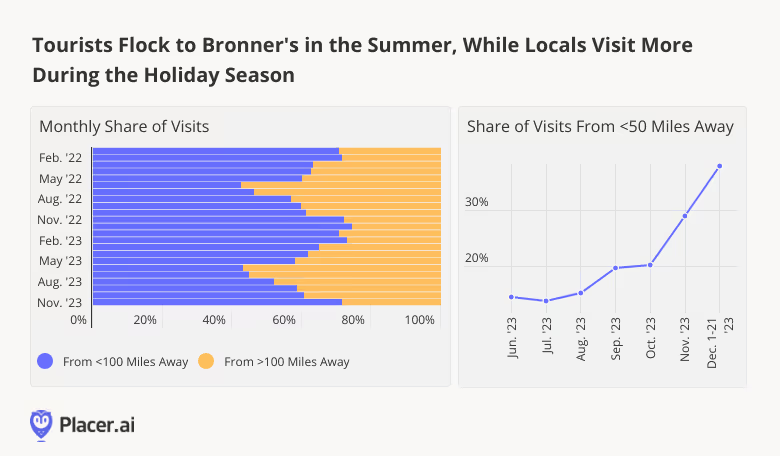
People visit Bronner’s all year round – but foot traffic to the store really picks up during the holiday season: Between November 1st and December 21st, 2023, the holiday wonderland drew a stunning 438.0% more daily visits, on average, than it did between January and October of this year.
Drilling down deeper into the data shows that much of this visit bump is driven by locals, who flock to Bronner’s during the Christmas season. Throughout the year, Bronner’s draws tourists from all over the country – and in the summer, most visits to the shop are by shoppers living more than 100 miles away. Individuals living within 100 miles of Bronner’s tend to visit closer to Christmas, when the time comes to stock up on supplies for the holiday. And as the holiday approaches, the share of true locals in Bronner’s visitor base – i.e. those living less than 50 miles away from the store – increases significantly.

As the Yuletide season kicks into gear, special holiday-themed pop-ups and happenings also spring up throughout the country, with bars, malls, and restaurants all hosting special events filled with holiday cheer.
One venue that goes all out for the holidays is Mozart’s Coffee Roasters, the lakeside Austin, TX coffee shop that’s been a local landmark since 1993. With free wifi, expansive seating, and bottomless coffee, Mozart’s is the perfect place for remote employees to get some work done. And with hundreds of artists performing at the venue each year and a weekly open mic night, it’s also a great place to go out in the evenings. In the run-up to Christmas, Mozart’s hosts its famed annual holiday lights show, replete with a Bavarian Marketplace, a silent disco, and this year, an actual piece of Taylor Swift’s dance floor.
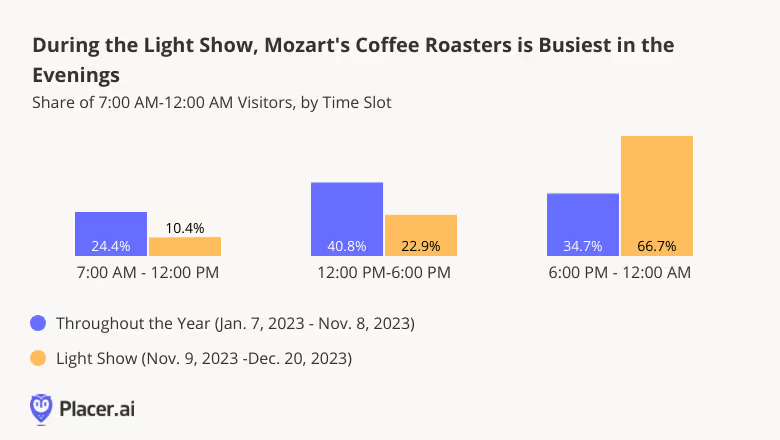
During the light show, Mozart’s is positively teeming with customers: Since the start of the event this year (November 9th), the coffee shop drew 104.3% more daily visitors, on average, than it did between January 7th (the end of last year’s show) and November 8th, 2023. And unsurprisingly, foot traffic data shows that most of this visit bump is driven by evening customers: During most of the year, the majority of visits to Mozart’s take place before 6:00 PM, with 24.4% concentrated in the morning hours. But when the festival kicks off, this pattern reverses – with 66.7% of visits taking place between 6:00 PM and midnight.

Local parades and festivals are another mainstay of the holiday season. From New York’s iconic Macy’s Thanksgiving Day Parade to the Hollywood Christmas Parade in Los Angeles, cities across America draw massive crowds to streets decked out with holiday cheer.
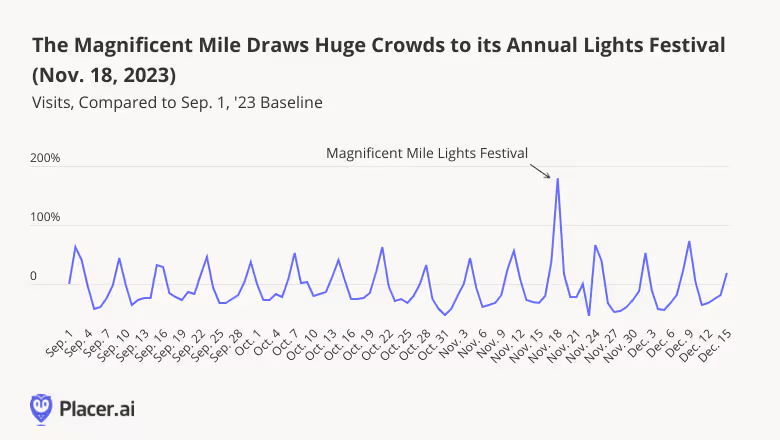
One of the nation’s most timeless Christmas celebrations is Chicago’s Wintrust Magnificent Mile Lights Festival – an all-day bonanza that features a slew of booths and activities, a televised parade, and an impressive fireworks display. The festival, which famously illuminates the city with a million lights, is one of the Mag Mile’s prime events of the year. And comparing November 18th, 2023 foot traffic to the popular Chicago retail corridor – the day of the big event – to a September 1st 2023 baseline, shows that the festivities generated a tremendous 179.5% visit spike.

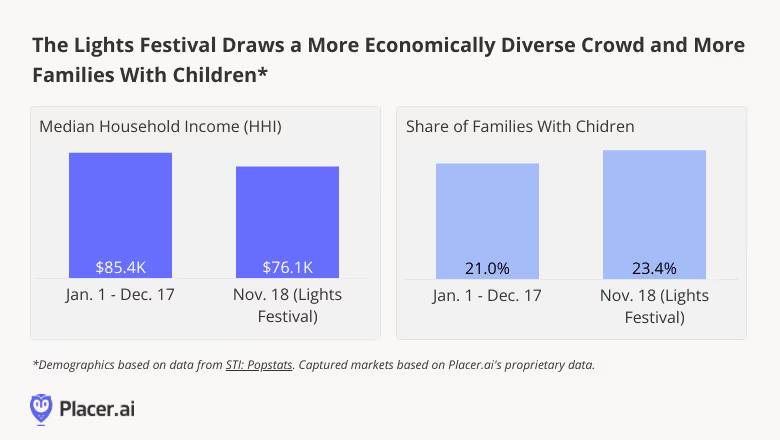
And a look at the demographic characteristics of visitors to the Mag Mile during the Lights Festival reveals that the celebration draws a more economically diverse crowd, as well as a larger share of families with children. Throughout most of this year, the median household income (HHI) of the Magnificent Mile’s captured market was relatively high – $85.4K. At the same time, the share of parental households in the retail corridor’s captured market increased from 21.0% to 23.4%, highlighting the event’s special appeal for families.

Everybody needs some seasonal cheer – and the sheer variety of holiday-themed events and festivals means there’s something for everybody. How will Christmas stores fare as the retail environment continues to evolve? And how will shifting urban landscapes impact local events, parades, and festivals in the years to come?
Follow Placer.ai’s data-driven retail and civic analyses to find out.
The grocery industry has navigated unprecedented challenges in recent years – from pandemic-driven shifts in consumer behavior and supply chain disruptions to rising costs, labor shortages, and increased operational demands. In the face of these hurdles, the category has been pushed to innovate, adapting everything from product selections to shopping formats to meet changing consumer expectations.
But within the grocery industry, some segments resonate particularly strongly with the 2024 consumer. This white paper dives into the data to explore two segments that have been leading category-wide visit growth for some time: specialty and fresh format stores, which focus on produce, organic foods, and culturally specific items (think Trader Joe’s, Sprouts Farmers Market, and H Mart, to name a few), and value grocery chains like Aldi, WinCo Foods, and Grocery Outlet Bargain Market. Location analytics show shoppers are increasingly drawn to these two grocery store types, a shift that has the potential to reshape the grocery landscape.
How did value and specialty grocery chains perform in Q3 2024 in comparison to traditional supermarkets like Kroger, Albertsons, and H-E-B? How does visitor behavior vary between the three grocery segments, and what differences can be observed in the demographic and psychographic make-ups of their trade areas? The report explores these questions and more below.
The grocery industry has performed well over the past few months, with steady weekly year-over-year (YoY) visit increases throughout Q3 2024. During the week of July 1st, the segment saw a 4.6% YoY foot traffic boost, likely driven by shoppers loading up on ingredients for Independence Day barbecues and picnics. And after tapering somewhat in early August, visits picked up again in September, with YoY increases ranging from 2.0% to 2.9% throughout the month. This positive growth is a good sign for the segment – which has experienced more than its fair share of challenges over the past few years.
Though the grocery category as a whole is thriving, a closer look at different segments within the industry reveals that some are seeing more significant growth than others.
Indeed, digging deeper into grocery visits throughout Q3 2024 reveals that much of the industry’s growth is being driven by specialty and fresh format stores and value grocery chains. The two segments offer markedly different shopping experiences: Specialty chains tend to emphasize harder-to-find ingredients and fresh produce – sometimes even at higher price points than traditional grocery stores – while value grocery stores focus on affordability. But both categories are experiencing outsize visit growth in 2024, highlighting consumers’ dual interest in both quality and value.
In July and August 2024, traditional supermarkets, specialty grocers, and value chains all experienced positive YoY visit growth. But while traditional grocery stores saw a 3.1% increase in July and just a 0.9% uptick in August, value and specialty chains saw YoY growth ranging from 4.7% to 7.7% during the two months. In September 2024, YoY visits to traditional grocery stores fell by 0.5%, while value and specialty chains saw 5.0% and 5.2% increases, respectively. For today’s consumer, it seems, savings are key – but specialty offerings also resonate strongly.
Today’s grocery shoppers are increasingly embracing specialty grocery options – and analyzing consumer driving habits to grocery stores shows that they are willing to go the extra mile to reach them.
Breaking down grocery visits by distance traveled reveals that just 18.5% of visits to specialty and fresh format grocery chains came from less than one mile away in Q3 2024 – compared to 23.9% for traditional grocery stores and 23.2% for value chains. Similarly, 31.3% of visits to specialty and fresh format grocery stores originated from one to three miles away, compared to 34.7% and 34.5% for the other analyzed segments.
On the flip side, some 26.4% of visits to specialty and fresh format stores were made by people traveling at least seven miles to do their shopping – compared to 22.7% and 21.4% for traditional and value chains, respectively. Specialty grocery operators can account for this difference, locating stores in areas accessible to geographically dispersed audiences eager to shop their unique offerings.
And a look at changes in visitor behavior at three key specialty chains – Trader Joe’s, Sprouts Farmers Market, and Great Wall Supermarket – shows that even as these brands expand their footprints, customers are increasingly willing to travel the distance to visit them. Between 2019 and 2024, all three chains saw a marked increase in the share of visitors traveling over seven miles to shop their offerings. .
Asian grocery chain Great Wall Supermarket, a relatively small regional chain with some 22 locations across eight states, saw the most significant increase in visits from afar over the analyzed period. In Q3 2024, 32.3% of visits to the chain originated from seven or more miles away, up from 28.3% in Q3 2019. Ranked America’s Best Supermarket by Newsweek in 2024, the chain’s wide selection of everything from seafood to fresh produce has made it a hit among Asian food aficionados – and as the supermarket’s reputation grows, so does its draw among customers living further away from its venues.
Consumer favorite Trader Joe’s and organic grocery chain Sprouts Farmers Market also grew their shares of long-distance visits between 2019 and 2024 – no small feat for the two chains, given their expansion over the past several years.
This travel distance snapshot serves as a reminder of the unique role played by specialty grocery stores that offer their customers unique shopping experiences, premium or organic products, and culturally specific items. Shoppers will go out of their way to travel to these stores – and even as they expand and become more readily accessible, their growing popularity makes them ever-more attractive destinations for customers coming from further away.
While visitors to specialty grocery chains often travel long distances for unique offerings, cost-conscious consumers at value stores exhibit other behaviors that differentiate them from traditional and specialty grocery shoppers.
The rising cost of living has pushed the discount retail segment into overdrive – and value grocery chains are also benefiting. The category has flourished in recent years, with many bargain-oriented grocery chains adding new stores at a rapid clip to meet burgeoning consumer demand.
Like visitors to specialty grocery chains, value grocery shoppers demonstrate segment-specific behaviors that reflect their preferences and habits. And perhaps most strikingly, foot traffic data reveals that these shoppers tend to stay longer in-store than visitors to traditional and specialty grocery chains.
In Q3 2024, 26.5% of visits to value grocery chains lasted longer than 30 minutes, compared to 23.4% for traditional grocery chains and 23.7% for specialty and fresh format chains. This suggests that these stores attract shoppers who take their time and carefully consider price points, looking for the best value for their dollar – a need that the chains they frequent seem to be meeting.
Given the tremendous success of the value grocery space in recent years, it may come as no surprise that some traditional supermarkets are getting in on the action by opening or expanding discount banners of their own. How do such off-shoot banners impact these grocers’ reach?
Cult-favorite Texas grocery chain H-E-B opened the first branch of its value banner, Joe V’s Smart Shop, in 2010. The discount arm currently includes 11 stores – mainly in the Houston area – with several new stores opening, or in planning stages, in Dallas.
And foot traffic data shows that Joe V's attracts mission-driven shoppers who make less frequent but significantly longer trips than visitors to traditional grocery stores. In Q3 2024, the average visit duration at Joe V’s was 37.8 minutes, compared to just 26.8 minutes at H-E-B – a full 11 minute difference. At the same time, while 38.5% of Q3 visits to H-E-B were made by customers frequenting the chain, on average, at least four times a month, just 11.8% of visits to Joe V’s were made by visitors reaching that threshold.
Joe V’s is also more likely than H-E-B to attract parental households, with 36.8% of its captured market made up of households with children – significantly higher than H-E-B’s 32.0%.
Together, these data points paint a picture of the average Joe V’s shopper: cost-conscious, likely to have children, and inclined to carefully plan shopping trips to maximize savings and cut down on grocery runs. This suggests that they are mission-driven and focused on stocking up rather than running out to grab ingredients as the need arises.
Major grocery store operators often operate a variety of store types at different price points to appeal to as many shoppers as possible, and Hy-Vee is no exception. The regional grocery favorite launched a discount chain, Dollar Fresh, in 2018 and currently operates 25 stores under that banner, aiming to attract middle-class, cost-conscious shoppers.
Using Experian’s Mosaic dataset to analyze Dollar Fresh’s trade area reveals that the chain’s captured market features significantly higher shares of lower-middle-class family consumers than its potential one – highlighting its special draw for these shoppers. (A chain’s potential market is obtained by weighting each Census Block Group (CBG) in its trade area according to population size, thus reflecting the overall makeup of the chain’s trade area. A business’ captured market, on the other hand, is obtained by weighting each CBG according to its share of visits to the chain in question – and thus represents the profile of its actual visitor base. Comparing a chain’s captured market to its potential one can serve as a helpful gauge of the brand’s success at attracting key audience segments.)
In Q3 2024, the “Pastoral Pride” family segment represented 11.4% of Dollar Fresh’s captured market, compared to just 5.3% of its potential market. This over-representation of lower-middle-class consumers from small towns in Dollar Fresh’s captured market indicates that the chain is especially effective at drawing customers that belong to this segment. Though Hy-Vee’s captured market also boasted a higher share of this demographic than its potential one in Q3, the difference was much smaller – and the chain’s overall reach among these consumers was more limited.
In contrast, Hy-Vee excels at attracting “Flourishing Families” – affluent, middle-aged families and couples – who made up 10.3% of the supermarket’s captured market in Q3 2024. Dollar Fresh’s captured market, on the other hand, featured a smaller share of this segment than its potential one – showing that the discount chain is of less interest to these consumers. So while Hy-Vee tends to appeal to higher-income families with more spending flexibility, value-conscious shoppers have been making their way to Dollar Fresh.
This audience segmentation analysis shows how value offerings help grocery chains attract wider audiences – and highlights the advantage of operating multiple store types to appeal to a broader range of shoppers.
People will always need access to a variety of fresh foods – ensuring that grocery stores and supermarkets continue to play a vital role in in the retail landscape. And while the category as a whole has continued to thrive even in today’s challenging environment, specialty and value grocery chains resonate particularly strongly with the 2024 consumer. As grocery retailers diversify their formats, those aligning with consumer preferences for affordability, uniqueness, and quality are well-positioned for continued growth.
Malls have come a long way since their introduction to the world in the 1950s. These gleaming retail hubs promised shoppers a taste of the American dream, offering a third place for teens, families, and everyone in between to shop, socialize, and hang out.
And though malls have faced challenges in recent years, as e-commerce and pandemic-induced store closures led to shifts in consumer habits, the outlook is brightening. Malls have embraced innovation, incorporating enhanced entertainment, dining, and experiential offerings that attract a diverse range of visitors and redefine their purpose.
This white paper takes a look at the recent location intelligence metrics to gain an understanding of the changes taking place at malls across the country – including both indoor malls and open-air shopping centers. The report explores questions like: Why do malls experience foot traffic bumps during the summer months? How much of an impact do movie theaters have on mall visits, and what can mall operators learn from the Mall of America and American Dream malls’ focus on experiential entertainment?
Mall visitation is highly seasonal, with strikingly consistent monthly visitation patterns. Each year, visits decline somewhat in February, pick up in March, and begin to trend upward again in May – before peaking again in August. Then, after a slower September and October, foot traffic skyrockets during the holiday season, spiking dramatically in December.
And while these trends follow similar patterns every year, comparing monthly visits throughout 2019, 2023, and 2024 (YTD) to each year’s own January baseline shows that this seasonality is growing more pronounced - especially for indoor malls.
Following a lackluster 2023, visits to both indoor malls and open-air shopping centers peaked higher in March 2024 than in 2019. And this summer, indoor malls in particular saw a much larger visit boost than in previous years. In August 2024, for example, visits to indoor malls were 27.3% higher than in January 2024 – a substantially higher baseline jump than that seen either in August 2019 (17.0%) or in August 2023 (12.0%). And though open-air shopping centers experienced a smaller summer visit boost, they too saw a bigger bump this year than in 2019 or in 2023.
But malls aren’t just seeing larger visit spikes this year relative to their January baselines – they are also drawing bigger crowds than they did in 2023.
Between June and August 2024, indoor malls and open-air shopping centers both experienced year-over-year (YoY) visit growth. Indoor malls saw the largest YoY foot traffic boost (3.7%) – perhaps owing in part to 2024’s record-breaking heat, which led many patrons to seek refuge in air conditioned spaces. Still, open-air shopping centers, which feature plenty of air conditioned stores and restaurants, also enjoyed a YoY visit boost of 2.8% during the analyzed period.
Malls’ strong summer baseline and YoY foot traffic growth built upon the strong performance seen during most of 2024 so far, leading to the question: What is driving malls’ positive momentum? We delve into some of the factors propelling these changes below.
One offering that continues to play a significant role in driving foot traffic to malls is on-site movie theaters. Summer blockbuster releases, in particular, help attract crowds to theaters, in turn boosting overall visits to malls.
Much like malls, movie theaters have also proven their resilience over the past few years. While pundits fretted about the theater’s impending death, production houses were busy releasing blockbuster after blockbuster and shattering box-office records at an impressive clip. And while 2023 was certainly a banner year for blockbuster summer releases, 2024 has had its fair share of stunning box-office successes, leading to major visit boosts at theaters across the country.
Analyzing visits to malls with and without movie theaters highlights the impact of these summer Hollywood hits. Between June and August 2024, malls with theaters saw bigger visit boosts compared to a monthly year-to-date (YTD) average than malls without – an effect observed both for indoor malls and for open-air shopping centers.
For both mall types, the gap between centers with and without movie theaters was most pronounced in July 2024, likely owing to the release of Inside Out 2 in mid-June as well as the July releases of Deadpool & Wolverine and Twister. But in June and August 2024, too, centers with movie theaters sustained particularly impressive visit boosts – a solid sign that movie theaters and malls remain a winning combination.
Malls with movie theaters also drew higher shares of evening visits (7:00 PM - 10:00 PM) this summer than those without. Between June and August 2024, for example, evening outings accounted for 22.9% of visits to open-air shopping centers with movie theaters – compared to 18.2% of visits to centers without theaters. Indoor malls with theaters also saw a larger share of evening visits than those without – 18.1% compared to 15.0%.
This increase in evening traffic is likely driven by major summer movie releases and the flexibility of summer schedules, with many visitors – including families – taking advantage of late-night outings without the concern of early wakeup calls. These summer visitation trends benefit both theaters and malls, opening up opportunities for increased sales through concessions, promotions, and evening deals that attract a more relaxed and engaged crowd.
Analyzing the demographics of malls’ captured markets also reveals that centers with movie theaters are more likely to attract certain family-oriented segments than those without. (A mall’s captured market consists of the mall’s trade areas – the census block groups (CBGs) feeding visitors to the mall – weighted according to each CBG’s actual share of visits to the mall.)
Between June and August 2024, for example, 14.2% of the captured markets of open-air shopping centers with movie theaters were made up of “Wealthy Suburban Families” – compared to 9.7% for open-air shopping centers without theaters.
Indoor malls saw a similar pattern with regard to “Near-Urban Diverse Families”: Middle class families living in and around cities made up 9.0% of the captured markets of indoor malls with movie theaters, compared to 7.1% of the captured markets of those without.
This increase in foot traffic from middle-class and wealthy family segments can be a boon for malls and retail tenants – driving up food court profits and bolstering sales at stores with kid-friendly offerings.
Malls have long positioned themselves as destinations for summer entertainment as well as retail therapy, holding – in addition to back to school sales – events like Fourth of July celebrations and even indoor basketball and arena football games. And during the summer months, malls attract visitors from further away.
Between June and August 2024, indoor malls drew 18.2% of visitors from 30+ miles away – compared to just 16.7% during the first five months of the year. Similarly, open-air shopping centers drew 19.6% of visits from 30+ miles away during the summer, compared to 17.1% between January and May.
Extended daylight hours, summer trips away from home, and more free time are likely among the contributors to the summer draw for long-distance mall visitors. But in addition to their classic offerings – from movie theaters to stores and food courts – malls have also invested in other kinds of unique experiences to attract visitors. This next section takes a look at two mega-malls winning at the visitation game, to see what sets them apart.
The Minneapolis-based Mall of America opened in 1992, redefining the limits of what a mall could offer. The mall boasts hundreds of stores, games, rides, and more – and is constantly expanding its attractions, cementing its status as a top destination for retail and entertainment.
Between June and August 2024, Mall of America experienced a 13.8% YoY visit increase, far outperforming the 3.7% visit boost seen by the wider indoor mall space. And as a major tourist attraction – the mall hosted a series of Olympic-themed events throughout the summer – it also drew 41.6% of visits from 30+ miles away. This share of distant visitors was significantly higher than that seen at the mall during the first five months of 2024, and more than double the segment-wide summer average of 18.2%.
The Mall of America also seems to be attracting more upper-middle-class families during the summer than other indoor malls: Between June and August 2024, some 18.0% of Mall of America’s captured market consisted of “Upper Suburban Diverse Family Households” – a segment including upper-middle-class suburbanites – compared to just 11.1% for the wider indoor mall segment. The increased presence of these families at the Mall of America may be driven by the variety of events offered during the summer.
In 2019, the American Dream Mall in New Jersey opened and became the second-largest mall in the country. Since the mall opened its doors, it has also focused on blending retail and entertainment to draw in as wide a range of visitors as possible – and summer 2024 was no exception.
The mall hosted the Arena Football League Championship, ArenaBowl XXXIII, on Friday, July 19th. The event successfully attracted a higher share of visitors traveling from 30+ miles away compared to the average summer Friday – 35.4% compared to 25.7%.
Visits to the mall on the day of the championship were also 13.6% higher than the Friday visit average for the period between June and August 2024, showcasing the mall’s ability to draw in crowds by hosting major events.
Malls – both indoor and open-air – continue to evolve while playing a central role in the American retail landscape. Increasingly, malls are emerging as destinations for more than just shopping – especially during the summer – driving up foot traffic and attracting visitors from near and far. And while much is often said about the impact of holiday seasons on mall foot traffic, summer months offer another opportunity to boost mall visits. Malls that can curate experiences that resonate with their clientele can hope to see foot traffic growth – in the summer months and beyond.
New York City is one of the world’s leading commercial centers – and Manhattan, home to some of the nation's most prominent corporations, is at its epicenter. Manhattan’s substantial in-office workforce has helped make New York a post-pandemic office recovery leader, outpacing most other major U.S. hubs. And the plethora of healthcare, service, and other on-site workers that keep the island humming along also contribute to its thriving employment landscape.
Using the latest location analytics, this report examines the shifting dynamics of the many on-site workers employed in Manhattan and the up-and-coming Hudson Yards neighborhood. Where does today’s Manhattan workforce come from? How often do on-site employees visit Hudson Yards? And how has the share of young professionals across Manhattan’s different districts shifted since the pandemic?
Read on to find out.
The rise in work-from-home (WFH) trends during the pandemic and the persistence of hybrid work have changed the face of commuting in Manhattan.
In Q2 2019, nearly 60% of employee visits to Manhattan originated off the island. But in Q2 2021, that share fell to just 43.9% – likely due to many commuters avoiding public transportation and practicing social distancing during COVID.
Since Q2 2022, however, the share of employee visits to Manhattan from outside the borough has rebounded – steadily approaching, but not yet reaching, pre-pandemic levels. By Q2 2024, 54.7% of employee visits to Manhattan originated from elsewhere – likely a reflection of the Big Apple’s accelerated RTO that is drawing in-office workers back into the city.
Unsurprisingly, some nearby boroughs – including Queens and the Bronx – have seen their share of Manhattan worker visits bounce back to what they were in 2019, while further-away areas of New York and New Jersey continue to lag behind. But Q2 2024 also saw an increase in the share of Manhattan workers commuting from other states – both compared to 2023 and compared to 2019 – perhaps reflecting the rise of super commuting.
Commuting into Manhattan is on the rise – but how often are employees making the trip? Diving into the data for employees based in Hudson Yards – Manhattan’s newest retail, office, and residential hub, which was officially opened to the public in March 2019 – reveals that the local workforce favors fewer in-person work days than in the past.
In August 2019, before the pandemic, 60.2% of Hudson Yards-based employees visited the neighborhood at least fifteen times. But by August 2021, the neighborhood’s share of near-full-time on-site workers had begun to drop – and it has declined ever since. In August 2024, only 22.6% of local workers visited the neighborhood 15+ times throughout the month. Meanwhile, the share of Hudson Yards-based employees making an appearance between five and nine times during the month emerged as the most common visit frequency by August 2022 – and has continued to increase since. In August 2024, 25.0% of employees visited the neighborhood less than five times a month, 32.5% visited between five and nine times, and 19.2% visited between 10 and 14 times.
Like other workers throughout Manhattan, Hudson Yards employees seem to have fully embraced the new hybrid normal – coming into the office between one and four times a week.
But not all employment centers in the Hudson Yards neighborhood see the same patterns of on-site work. Some of the newest office buildings in the area appear to attract employees more frequently and from further away than other properties.
Of the Hudson Yards properties analyzed, Two Manhattan West, which was completed this year, attracted the largest share of frequent, long-distance commuters in August 2024 (15.3%) – defined as employees visiting 10+ times per month from at least 30 miles away. And The Spiral, which opened last year, drew the second-largest share of such on-site workers (12.3%).
Employees in these skyscrapers may prioritize in-person work – or have been encouraged by their employers to return to the office – more than their counterparts in other Hudson Yards buildings. Employees may also choose to come in more frequently to enjoy these properties’ newer and more advanced amenities. And service and shift workers at these properties may also be coming in more frequently to support the buildings’ elevated occupancy.
Diving deeper into the segmentation of on-site employees in the Hudson Yards district provides further insight into this unique on-site workforce.
Analysis of POIs corresponding to several commercial and office hubs in the borough reveals that between August 2019 and August 2024, Hudson Yards’ captured market had the fastest-growing share of employees belonging to STI: Landscape's “Apprentices” segment, which encompasses young, highly-paid professionals in urban settings.
Companies looking to attract young talent have already noticed that these young professionals are receptive to Hudson Yards’ vibrant atmosphere and collaborative spaces, and describe this as a key factor in their choice to lease local offices.
Manhattan is a bastion of commerce, and its strong on-site workforce has helped lead the nation’s post-pandemic office recovery. But the dynamics of the many Manhattan-based workers continues to shift. And as new commercial and residential hubs emerge on the island, workplace trends and the characteristics of employees are almost certain to evolve with them.