.png)
.png)

.png)
.png)


The home improvement space has faced sustained pressure from macroeconomic headwinds – including persistent inflation and a cooling housing market – prompting many consumers to delay major projects and defer big-ticket purchases. But is a category turnaround in the works? An AI-powered foot traffic analysis of the sector’s largest players – The Home Depot and Lowe’s – offers insight into whether momentum has shifted and a period of growth is on the horizon.
Both The Home Depot and Lowe's reported sales growth alongside an uptick in big-ticket purchases in fiscal Q3 2025, indicating that consumers were investing in significant upgrades despite many bigger renovations remaining on the back-burner. And the latest foot traffic data suggests that this momentum likely carried forward into the subsequent months.
In November 2025, both chains saw visit and same-store visit growth of roughly 3% year-over-year (YoY) – a sign of meaningful Black Friday traffic and a healthy start to the holiday shopping season.
And while December 2025 saw modest visit gaps, these likely stemmed in part from tough YoY comparisons to December 2024’s storm-related demand.
Traffic to both chains rebounded in the new year, with preparations ahead of Storm Fern likely accounting for some of January 2026’s YoY visit gains.
Overall, the past several months of foot traffic data paint a picture of continued positive momentum for The Home Depot and Lowe’s through fiscal Q4.
Large-scale projects may not yet be at hoped-for levels, but the data suggests consumers are still investing in their homes. And with mortgage rates trending lower, housing activity showing early signs of a turnaround, and the potential for abundant home equity to fund renovations, the home improvement sector appears poised for continued growth.
Will the home improvement space build on its successes in 2026? Visit Placer.ai/anchor to find out.
Placer.ai leverages a panel of tens of millions of devices and utilizes machine learning to make estimations for visits to locations across the US. The data is trusted by thousands of industry leaders who leverage Placer.ai for insights into foot traffic, demographic breakdowns, retail sale predictions, migration trends, site selection, and more.

E-commerce distribution centers outpaced brick-and-mortar retail chains in year-over-year (YoY) foot traffic growth throughout the 2025 holiday stretch. This pattern aligns with broader holiday-season data showing that e-commerce sales growth exceeded brick-and-mortar growth in 2025.
Still, physical retail continued to account for the majority of total holiday spending, and in-store visits also saw steady, positive YoY growth throughout the season. The data points to a retail environment where digital and physical channels are not competing for relevance but operating in parallel, each capturing different dimensions of consumer demand. That dynamic carried into the new year as well: January 2026 visits remained above year-ago levels for both e-commerce distribution centers and brick-and-mortar retail, rising 2.6% and 1.8% YoY, respectively.
Visits to Placer.ai’s Industrial Manufacturing Index, on the other hand, softened in January 2026, following stronger YoY momentum in December. At first glance, this decline may seem surprising: January marked a clear improvement in manufacturing sentiment, with the ISM Manufacturing PMI rising to 52.6% – its first expansionary reading in at least a year – and the Production sub-index also improving. While the ISM captures month-over-month shifts in sentiment rather than year-over-year change, a sharply improving outlook may seem inconsistent with such a steep YoY decline following a positive month.
But a closer look at the weekly data helps explain the divergence. Sentiment surveys capture outlook, orders, and expectations, while foot traffic reflects physical, on-site activity. Winter Storm Fern, which caused widespread disruptions late in the month, weighed heavily on manufacturing visits and pulled down the overall January figure. Weather events like this can meaningfully suppress foot traffic even as underlying sentiment improves – and they tend to register far more clearly in mobility data than in survey-based indicators.
Calendar effects likely contributed as well. January 2026 had one fewer working day than January 2025, a difference that can have an outsized impact on visit-based measures tied to operational and industrial activity.
Overall, the data points to an economy that ended 2025 with solid momentum across consumer-facing channels, even as early-2026 manufacturing activity reflected short-term disruption. As weather normalizes, will on-the-ground industrial activity rebound?
Follow Placer.ai/anchor for more data-driven insights into the trends shaping retail, logistics, and manufacturing.
Placer.ai leverages a panel of tens of millions of devices and utilizes machine learning to make estimations for visits to locations across the US. The data is trusted by thousands of industry leaders who leverage Placer.ai for insights into foot traffic, demographic breakdowns, retail sale predictions, migration trends, site selection, and more.
%20(1).avif)
Traditional department stores aren’t going anywhere. But over the past several years, the balance of power has shifted decisively toward retailers like off-price chains with the clearest value story. The latest signal of that shift came as Saks Global – parent of Saks Fifth Avenue, Neiman Marcus, and Bergdorf Goodman – filed for bankruptcy and began closing stores.
How wide has the gap between department stores and off-price really become? And what lies in store for the two categories in 2026?
The chart below shows just how dramatically the category split has changed since 2019. Pre-COVID, department stores held a slight edge, capturing just over half of visits to the two segments. But by 2025, that relationship had fully reversed, with off-price claiming a remarkable 62.9% share of visits. As consumers grow more price-sensitive and the retail landscape becomes more bifurcated, traditional department stores have struggled to articulate a clear competitive edge – while off-price continues to benefit from a straightforward, discovery-driven model.
Year-over-year data reinforces the structural strength of the off-price model. In Q4, the segment once again delivered solid gains, extending a winning streak that’s become harder for traditional department stores to match.
Notably, all four major off-price players expanded their footprints over the past year, and in each case overall visit growth outpaced per-location gains. Ross Dress for Less led the group with per-location visit growth ranging from 11.5% to 7.5% between October 2025 and January 2026. Some of that strength reflects easier baseline comparisons, but the scale of the gain still signals durable demand. Burlington delivered 9.4% overall visit growth even as per-location visits were essentially flat at -0.3%, a pattern consistent with rapid store expansion paired with steady interest at existing locations.
Meanwhile, T.J. Maxx and Marshalls turned in low single-digit gains while lapping a strong prior year: T.J. Maxx grew 2.1% per-location and 2.8% overall, while Marshalls rose 1.6% and 3.3%, respectively.
Department stores, by contrast, faced a more challenging traffic environment, with several chains continuing to shrink their footprints. Yet even within the category, performance was mixed. And the brands with the clearest identities – whether rooted in regional loyalty or premium, service-led positioning – continued to thrive.
Regional players led the traditional segment, with Von Maur seeing the most pronounced and consistent per-location growth during the analyzed period. Repeatedly ranked “America’s Best Department Store” by Newsweek, the chain has built its reputation on a differentiated, service-first in-store experience. Boscov’s, another regional operator with a loyal customer base, delivered a solid Q4 as well, even though per-location traffic dipped slightly YoY in December and January.
Among national banners, several higher-end brands also showed relative strength. Nordstrom – long associated with standout customer service – grew per-location visits by 4.2% YoY in Q4, even as overall traffic slipped 0.6% amid store closures. Blooingdale’s posted 1.9% per-location growth. And while Saks Fifth Avenue has faced well-publicized corporate headwinds, its traffic declines remained comparatively modest in Q4.
The pressure was most visible among mid-market chains without a sharply defined value or experiential proposition. Kohl’s saw per-location visits fall 3.2%, with overall traffic down 5.0%, while JCPenney declined 3.8% and 5.5%, respectively. Macy’s, meanwhile, saw overall traffic drop as it continued rightsizing – though per-location visits held relatively steady, suggesting its turnaround strategy is beginning to bear fruit.
The Q4 data underscores a defining theme in department store and off-price retail: Consumers are rewarding clarity. Off-price is winning on value and discovery, regionals are winning on loyalty, and premium banners are holding up where the experience is distinct. In a bifurcated retail environment, the middle is the toughest place to be.
For more data-driven retail insights, follow Placer.ai/anchor.
Placer.ai leverages a panel of tens of millions of devices and utilizes machine learning to make estimations for visits to locations across the US. The data is trusted by thousands of industry leaders who leverage Placer.ai for insights into foot traffic, demographic breakdowns, retail sale predictions, migration trends, site selection, and more.
.avif)
The success of the dollar store category hadn’t been all too surprising in 2025. However, the ability for the category to shine so brightly during the holiday season was unexpected. Traffic to dollar and discount chains was up 4.5% year-over-year in the fourth quarter, mirroring the growth of categories like off-price and wholesale clubs and overperforming compared to traditional holiday staples like apparel, department stores, beauty, consumer electronics, and home.
The retail industry doesn't traditionally think of dollar stores as a holiday shopping destination, but 2025 proved that the definition might need to change in coming years. Dollar stores have done a fantastic job at expanding their assortments and becoming a staple in consumers’ weekly shopping rotation.
Each of the major retailers saw strong traffic trends during the elongated holiday timeframe. In particular, Five Below had a strong same store visit trend over the holidays, focusing on gifting categories, holiday decor, and wrapping supplies. Dollar Tree and Five Below tend to skew their assortments towards more discretionary items, which benefitted both chains over the holidays.
The inherent value proposition of dollar stores has built trust with consumers and aided retailers in winning with shoppers whose holiday budgets might have been more constrained last year, especially with lower income households. The median household income of the largest dollar chains is lower than the average across total retail visitors, indicating that despite higher economic concerns of lower income shoppers, consumers still wanted to ensure that their holidays weren’t impacted. Brands focusing on more discretionary items like stocking stuffers and smaller gift items helped price conscious consumers to round out their holiday shopping without having to abstain from gifting all together.
For more data-driven insights, visit placer.ai/anchor.
Placer.ai leverages a panel of tens of millions of devices and utilizes machine learning to make estimations for visits to locations across the US. The data is trusted by thousands of industry leaders who leverage Placer.ai for insights into foot traffic, demographic breakdowns, retail sale predictions, migration trends, site selection, and more.

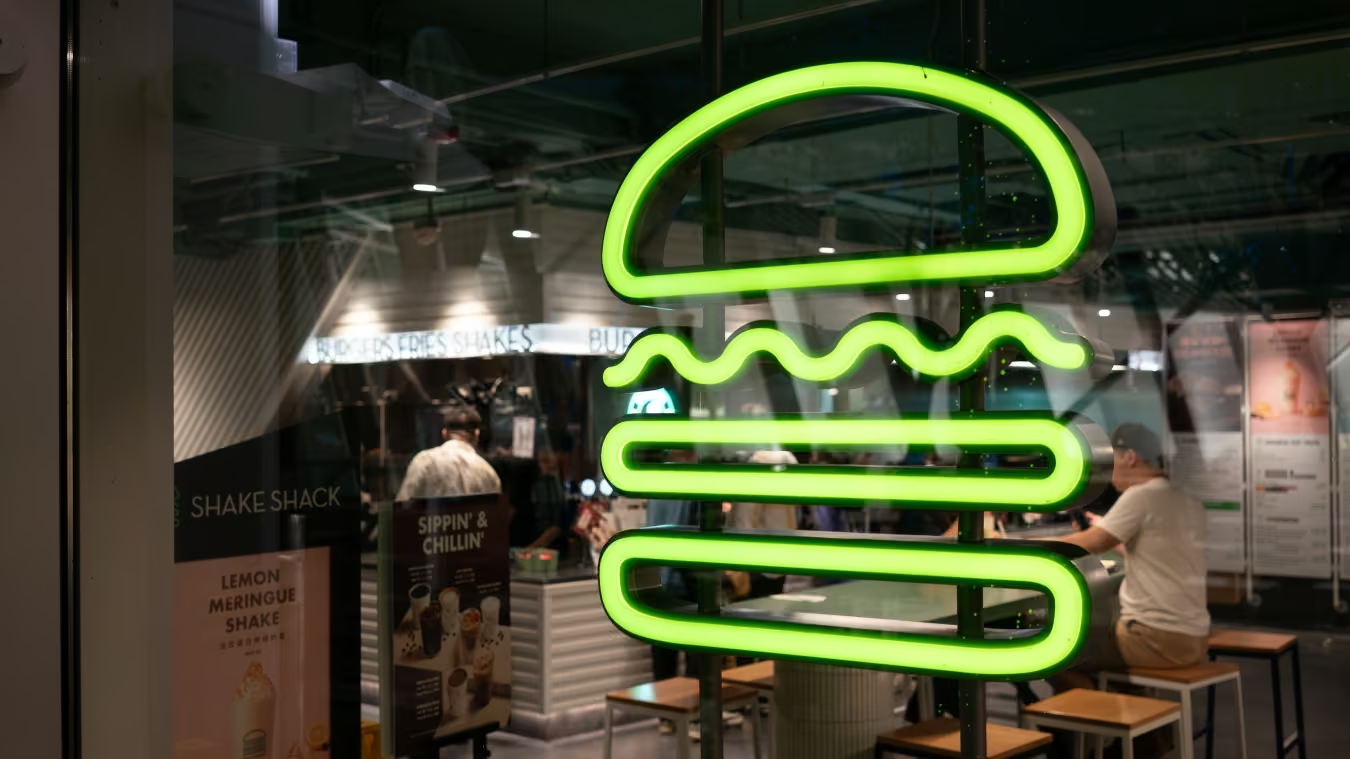
Throughout 2025, Shake Shack significantly outperformed the broader fast-casual segment with strong double-digit year-over-year (YoY) visit growth.
This outsized performance was driven primarily by fleet expansion – but same-store visit data indicates the chain has successfully grown its store count without meaningfully diluting demand at existing locations.
Across most of the second half of 2025, same-store traffic remained modestly positive YoY, with a more pronounced dip occurring only in December. That decline likely reflects weather disruptions, which the company noted in a recent 2025 update had a meaningful impact on performance late in the quarter. Despite these headwinds, early Q4 earnings data shows same-shack sales up 2.1% YoY in Q4 and 2.3% for 2025 overall – underscoring Shake Shack’s ability to sustain demand even amid external pressures.
As Shake Shack enters 2026, the key question is whether the brand can continue scaling its footprint while preserving same-store performance in an increasingly competitive fast-casual landscape. With expansion driving growth and existing locations holding steady, the data suggests the company remains well positioned – but execution will be critical as macro challenges persist.
For more data driven dining insights follow Placer.ai/anchor.
Placer.ai leverages a panel of tens of millions of devices and utilizes machine learning to make estimations for visits to locations across the US. The data is trusted by thousands of industry leaders who leverage Placer.ai for insights into foot traffic, demographic breakdowns, retail sale predictions, migration trends, site selection, and more.
.jpg)
Sprouts closed Q4 2025 on a positive traffic note, with overall visits rising 4.0% year-over-year (YoY), although average visits per location declined slightly – suggesting that growth in its more established core markets may be beginning to normalize. As such, the company’s recent expansion into new states – including the opening of its first New York location – reflects a logical next phase of growth, as Sprouts looks beyond its traditional strongholds to unlock incremental demand in less penetrated geographies.
A closer look at visit patterns by distance suggests that Sprouts’ growth is increasingly being driven by customers traveling from farther away – a dynamic that aligns with its broader national expansion strategy. From September through January, visit gains from shoppers located more than five miles away consistently outpaced those from within a five-mile radius.
This pattern points to expanding trade areas and growing destination appeal, which is critical as the retailer enters new states and builds brand awareness beyond its traditional strongholds. As Sprouts pushes into newer geographies, its ability to draw shoppers from a wider radius reinforces the scalability of its model and supports its strategy of growing into a more nationally recognized specialty grocer.
For more data-driven grocery insights, visit placer.ai/anchor.
Placer.ai leverages a panel of tens of millions of devices and utilizes machine learning to make estimations for visits to locations across the US. The data is trusted by thousands of industry leaders who leverage Placer.ai for insights into foot traffic, demographic breakdowns, retail sale predictions, migration trends, site selection, and more.

Convenience stores, or c-stores, have been one of the more exciting retail categories to watch over the past few years. The segment has undergone significant shifts, embracing more diverse offerings like fresh food and expanded dining options, while also exploring new markets and adapting to changing consumer needs. We looked at the recent foot traffic data to see what this category's successes reveal about the current state of brick-and-mortar retail.
Convenience stores are increasingly viewed not only as places to fuel up, but as affordable destinations for quick meals, snacks, and other necessities. And analyzing monthly visits to the category shows that it is continuing to benefit from its positioning as a stop for food, fuel, and in some cases, tourism.
Despite lapping a strong H1 2023, visits to the category either exceeded last year’s levels or held steady during all but one of the first eight months of 2024 – highlighting the segment’s ongoing strength. Only in January 2024 did C-stores see a slight YoY dip, likely reflecting a weather-induced exaggeration of the segment’s normal seasonality.
Indeed, examining monthly fluctuations in visits to c-stores (compared to a January 2021 baseline) shows that foot traffic to the category tends to peak in summer months – perhaps driven by summer road trips and vacations – and slow down significantly in winter. Given summer’s importance for convenience stores, the category’s August YoY visit bump is a particularly promising indication of c-stores’ robust positioning this year.
While some C-store chains, like 7-Eleven, have a nationwide presence, others are concentrated in specific areas of the country. But as the popularity of C-stores continues to grow, regional chains like Wawa, Buc-ee’s, and Sheetz are expanding into new territories, broadening their reach.
Wawa, a beloved brand with roots in Pennsylvania, has become synonymous with its fresh sandwiches, coffee, and a highly loyal customer base. Wawa has been a major player in the c-store space in recent years, with a revamped menu driving ever-stronger foot traffic to its Mid-Atlantic region stores. Between January and August 2024, YoY visits to the chain were mostly elevated. And the chain is now venturing into states like Florida – where its store count has grown significantly over the past few years – as well as Georgia and Alabama.
Meanwhile, Texas favorite Buc-ee’s, though known for its enormous stores and mind boggling array of dining options, has a relatively small footprint – but that might be changing. The chain, which also outpaced its already-strong 2023 performance this year, is opening locations in Arkansas and North Carolina, further building on its reputation as a destination for travelers. And Sheetz, another regional chain with a strong presence in Pennsylvania, is also expanding, with plans to open locations in Southern states like North Carolina and Tennessee.
This trend toward regional expansion offers significant opportunities for growth, not only by increasing store count, but also by reaching new consumer bases and target audiences. Customer behavior differs between markets – and by expanding into new areas, c-stores can tap into unique local visitation patterns.
One metric that highlights local differences in consumer behavior is dwell time, or the amount of time a customer spends inside a convenience store per visit. In some regions, visitors tend to move in and out quickly, while in others, customers linger for longer periods of time.
Analyzing convenience store dwell times by state highlights substantial differences in visitor behavior. During the first eight months of 2024, coastal states (with the exception of Oregon) tended to see shorter average dwell times (between 7.5 and 11.8 minutes). On the other hand, in states like Wyoming, Montana, and North Dakota, average dwell times ranged between 21.2 and 28.2 minutes.
Interestingly, the states with the longest dwell times also have some of the highest percentages of truck traffic on interstate highways – suggesting that these longer stops are perhaps made by long-haul truckers looking for a place to shower, relax, and grab a bite to eat.
Even as regional favorites expand their reach, nationwide classic 7-Eleven is taking steps to further cement its growing role as a prime grab-and-go food and beverage destination. And like other dining destinations, the chain relies on limited-time offers (LTOs) to fuel excitement – and visits.
One of the most iconic, and beloved c-store LTOs is 7-Eleven’s Slurpee Day, which falls each year on July 11th. The event, during which all 7-Eleven locations hand out free slurpees, tends to drive significant upticks in foot traffic – and this year was no exception. Visits to the convenience store jumped by a whopping 127.3% on July 11th, 2024 relative to the YTD daily visit average – proving that good deals will bring customers in the door.
The convenience store sector continues building on the impressive growth seen in 2023. As many chains double down on expanding both their regional presence and their offerings, will they continue to drive growth in the coming years?
Visit Placer.ai to keep up with the latest data-driven convenience store updates.
Grocery chains in the United States are increasingly investing in on-site healthcare clinics, transforming their stores into hubs for both food and wellness. While grocery stores have long featured pharmacies and some basic healthcare services like vaccinations, recent years have seen a shift towards more extensive healthcare offerings.
Today, many grocery stores offer a range of services – from primary and urgent care to dental and mental health care. In addition to providing an important community service, grocery-anchored healthcare clinics can boost foot traffic at chains, help health providers reach more patients, and allow shoppers to manage their health and home needs in one convenient trip.
This white paper examines the impact these in-store clinics have on grocery chain visitation patterns and trade area characteristics. Are shoppers more or less likely to make repeat visits to grocery stores with healthcare services? And how does the addition of a clinic affect the demographic profile of a grocery store’s captured market? The report examines these questions and more, offering insights for stakeholders across the grocery and healthcare industries.
Analyzing foot traffic to grocery stores with and without in-store clinics shows the positive impact of these services: Across chains, locations with on-site healthcare offerings drew more visits in H1 2024 than their chain-wide averages.
The Kroger Co., which operates numerous regional banners as well as its own eponymous chain, has been a leader in in-store healthcare services since the early aughts. The company introduced its in-store medical center, The Little Clinic in 2003 – and today operates over 225 Little Clinic locations across its Kroger banner, as well as regional chains Dillons, Jay C Food Stores, Fry’s, and King Soopers.
And in H1 2024, the eight Dillons locations with clinics saw, on average, 93.0% more visits per location than the chain’s banner-wide average. Jay C, which offers two in-store clinics, also saw visits to these venues outpace the H1 2024 banner-wide average by 92.9%. For both chains, relatively small overall footprints may contribute to their outsize visit differences: Indiana-focused Jay C operates just 22 locations, all in the Hoosier State, while Kansas-based Dillons has some 64 locations.
But similar patterns, if somewhat less pronounced, could be observed at Kroger (43.0%), Fry’s (19.2%), and King Soopers (16.5%) – as well as at H-E-B (14.5%), which boasts its own expanding network of in-store clinics.
Analyzing the trade areas of grocery stores with healthcare clinics shows that these services tend to draw more affluent visitors from within the stores’ trade areas.
For some chains, including King Soopers, H-E-B, and Jay C, the clinics are positioned to begin with in areas serving higher-income communities. The median household income (HHI) of King Soopers’ in-store clinic’s potential markets, for example, came in at $92.3K in H1 2024 – significantly above the chain’s overall potential market median HHI of $88.1K. Similarly, the potential markets of H-E-B and Jay C Food Stores with clinics had higher median HHIs than the chains’ overall averages.
And for all three chains, stores with clinics tended to attract visitors from captured markets with even higher median HHIs – showing that within these affluent communities, it is the more well-to-do customers that tend to frequent these venues. (A chain or store’s potential market is obtained by weighting each CBG in its trade area according to the size of the population – thus reflecting the general composition of the community it serves. A chain or store’s captured market, on the other hand, is obtained by weighting each CBG according to its share of visits to the business in question – and thus represents the population that actually visits it in practice.)
Other brands, including Fry’s, Kroger, and Dillons, have positioned clinics in stores with potential market median HHIs slightly below chain-wide averages. But within these markets, too, it is the more affluent consumers that are visiting these stores, pushing up the median HHI of their captured markets.
These patterns highlight that, for now, grocery store clinics tend to attract consumers on the upper ends of local income spectrums. This information can be utilized by healthcare professionals and grocery store owners to pinpoint neighborhoods that may be open to grocery-anchored clinics, or to take steps to increase penetration in other areas.
Supermarket giant Kroger is a major player in the world of grocery-anchored healthcare, offering visitors access to pharmacies, clinics, and telehealth options via its grocery stores. What impact has the company’s embrace of healthcare had on visits and loyalty?
An analysis of household compositions across the potential and captured markets of Kroger-owned stores with and without Little Clinic offerings suggests that families with children are extremely receptive to these services.
In H1 2024, Kroger, King Soopers, Fry’s, Jay C, and Dillons all featured captured markets with higher shares of STI: PopStats’ “Households With Children” segment than their potential ones – highlighting the chains’ appeal for families. But the share of parental households in those stores with Little Clinics jumped significantly higher for all five banners.
The share of families with children in King Soopers’ overall captured market stood at 28.3% in H1 2024, higher than the 27.2% in its potential one. But the households with children in the captured markets of King Soopers locations with Little Clinics was significantly higher – 30.6% – and similar patterns emerged at Jay C, Dillons, Kroger, and Fry’s.
This special draw is likely linked to the clinics' focus on family health services like physicals, nutrition plans, and vaccines. The convenience of being able to take care of healthcare, grocery shopping, and pharmacy needs all in one go makes these stores particularly attractive to parents. And this jump in foot traffic shows the strategic advantage of incorporating healthcare services into the retail environment.
Providing essential healthcare services at the supermarket can establish a grocery chain as a crucial part of a shopper's daily life, enhancing visitor loyalty, and helping nurture long-term customer relationships. Indeed, in-store clinics offer a unique opportunity for grocery providers to connect with customers on a level that extends beyond the transactional.
An analysis of several Kroger-branded locations in the Cincinnati metro area showcases the profound impact in-store clinics can have on customer loyalty. In H1 2024, stores with Little Clinics had significantly higher shares of repeat visitors – defined as those making six or more stops at the store during the analyzed period – than those without.
For instance, 36.4% of visitors to a Kroger Marketplace store with an in-store clinic in Harrison, Ohio, frequented the location at least six times during the first half of 2024. But over the same period, only 29.0% of visitors stopped by at least six times to a nearby Kroger location in Cleves, Ohio – just ten miles away. Similarly, 30.7% of visitors to the Beechmont Ave. Kroger Food & Drug location with a clinic visited at least six times in H1 2024, compared to 23.0% for the nearby Ohio Pike Kroger store.
This trend was consistent across the analyzed locations, with those offering in-store clinics attracting significantly higher shares of loyal visitors. These metrics support the value of offering additional services as a draw for frequent visitors, while also providing the clinics themselves with the visitor volume needed to operate profitably.
Texan grocery chain H-E-B is beloved across the state – and though the chain isn’t new to the healthcare scene, it has been doubling down on wellness. In 2022, H-E-B launched H-E-B Wellness, a healthcare platform that offers patrons a variety of medical services, including – as of today – some 12 primary care clinics, many of them inside stores.
H-E-B stores with primary care clinics are helping to cement the grocer’s role as a convenient one-stop for local residents – allowing them to drop in to a nearby location for both daily grocery needs and wellness care.
H-E-B has always placed a premium on community, stepping up to help local residents in times of need. And though the chain as a whole draws an overwhelming majority of its visitors from nearby areas, those with clinics do so even more effectively. In H1 2024, some 83.6% of visitors to H-E-B came from less than 10 miles away. But for locations with primary care clinics, this share increased to 88.0%.
This suggests that wellness services are particularly appealing to nearby residents, strengthening H-E-B’s connection with local consumers even further. And for a grocery store centered on community engagement, the integration of health services into its offerings is proving to be a winning strategy.
H-E-B has been steadily expanding its primary care offerings since it launched the Wellness concept, adding two primary clinics at locations in Cypress, TX and Katy, TX in June 2023. Following the opening of these clinics – which operate Mondays through Fridays – both locations saw marked increases in the share of “Urban Cliff Dwellers” in their weekday captured markets. This STI: Landscape segment group encompasses families both with and without children, earning modest incomes and enjoying middle-class pleasantries.
Between June 2022 - May 2023, the share of “Urban Cliff Dwellers” in the weekday captured markets of the Cypress and Katy locations stood at 9.5% and 7.2%, respectively. But once the stores had clinics in place, those numbers jumped to 12.4% and 11.0%, respectively.
This increase in the stores’ reach among “Urban Cliff Dwellers” immediately following the clinics’ openings suggests that in addition to more affluent consumers, middle-class families also harbor considerable interest in these services. As more retailers continue making inroads into the healthcare sector, they may find similar success in attracting diverse groups of convenience-seeking shoppers.
As grocery stores lean into healthcare, they are transforming into multifaceted hubs that offer both essential health services and everyday shopping needs. Retailers like Kroger and H-E-B are reaping the benefits of boosted foot traffic, higher-income visitors, and strengthened community ties – while offering their shoppers convenience that helps streamline their daily routines.
Walmart, Target, and Costco are three of the most popular retailers in the country, drawing millions of shoppers through their doors each day. Each of these retail giants boasts distinct strengths and strategies that cater to their unique customer bases, allowing them to thrive in a highly competitive market.
This white paper takes a closer look at some of the factors that are helping the three chains flourish. How does Walmart’s positioning as a family-friendly retailer help it drive visits in its more competitive markets? How can Target leverage its reach to drive more loyal visits? And what does the increase in young shoppers frequenting membership warehouse clubs mean for Costco?
We dove into the location analytics to explore these questions further.
Examining monthly visitation patterns for the three retail giants shows Costco’s wholesale club model leading the way with consistent year-over-year (YoY) visit growth – ranging from 6.1% in stormy January 2024 to 13.3% in June. Family favorite Walmart followed closely behind, seeing YoY foot traffic growth during all but two months, when visits briefly trailed slightly behind 2023 levels before rebounding.
Target, meanwhile, had a slower start to the year, with visits trending below 2023 levels for most of January to April. Over this same period (the three months ending May 2024), Target reported a 3.7% decline in YoY comparable sales. But since then, things have begun to turn around for the chain, with YoY visits rising in May (2.5%), June (8.9%), and July (4.7%). This renewed visit growth into the second half of the year bodes well for the superstore – and the ongoing back-to-school season may well push visits up further as the summer winds down.
For all three chains, Q2 2024’s visit success has likely been bolstered in part by summer deals and intensifying price wars – as the retailers slash prices to woo inflation-weary consumers back to the store.
Over the past few years, consumer behaviors have been changing rapidly in response to shifting economic conditions. This next section explores some of these changes at Walmart, Target, and Costco, to better understand what may be driving these shifts.
One way that consumers have traditionally responded to inflation and other headwinds has been through the adoption of mission-driven shopping – making fewer, but longer, trips to retailers, so that every visit counts. Superstores and wholesale clubs, which offer one-stop shopping experiences, have long been prime destinations for these extended shopping trips. And even during periods when visits have lagged, these retailers have often benefited from extended dwell times – leading to bigger basket sizes.
A look at changes in average dwell times at Walmart and Target suggests that as YoY visits have picked up, dwell times have come down – perhaps reflecting a normalization of consumers’ shopping patterns. With inflation stabilizing and gas prices lower than they were in 2022 and 2023, customers may feel less pressure to consolidate shopping trips than they have in recent years.
In contrast, Costco’s comparatively long dwell times have remained stable over the past several years. The warehouse club’s bulk offerings, plentiful free samples, and inexpensive food court encourage shoppers to spend more time browsing the aisles than they would at other retailers. And even if mission-driven shopping continues to subside, Costco customers will likely keep on making extra-long shopping trips.
While inflation is cooling faster than expected, prices remain high, and new players are stepping into the retail space occupied by Walmart, Target, and Costco – especially dollar stores. Though higher-income customers increasingly rely on the three retail giants for many of their purchases, customers of more modest means are often drawn to the rock-bottom prices offered at dollar stores.
And analyzing the cross-shopping patterns of visitors to Walmart, Target, and Costco shows that growing shares of visitors to the three behemoths also visit Dollar Tree on a regular basis. In Q2 2019, the share of visitors to Walmart, Target, and Costco who frequented Dollar Tree at least three times ranged between 9.8% and 13.7%. But by Q2 2024, that share rose to 16.7%-21.6%.
Dollar Tree is leaning into this increased interest among superstore shoppers. Over the past year, Dollar Tree added some 350 Dollar Tree locations, even as it shuttered nearly 400 Family Dollar stores. And the chain recently acquired the leases of some 170 99 Cents Only Stores – offering Dollar Tree access to a customer base accustomed to buying everything from groceries to household goods. As Dollar Tree continues to grow its footprint and expand its food offerings, the chain will be better positioned than ever to provide a real challenge to Walmart, Target, and Costco.
Still, the three retail giants each have unique offerings that distinguish them from dollar stores. This next section examines what sets Walmart, Target, and Costco apart – and how they can continue to strengthen their competitive edge.
With competition on the rise, Walmart, Target, and Costco must display agility in navigating an ever-evolving market landscape. This section dives into the data for each chain’s more successful metro areas to see what factors are helping them outperform nationwide averages – and what metrics the retailers can harness to try to replicate these results nationwide.
Target recently expanded its Target Circle Rewards program, rolling out three new tiers for its 100 million members. And this focus on loyalty has proven successful for the chain. Demographic and visitation data reveal a strong correlation between the median household incomes (HHIs) of Target locations’ captured markets across CBSAs (core-based statistical areas), and their share of loyal visitors in Q2 2024: CBSAs where Target locations’ captured markets had higher median HHIs also tended to draw more repeat monthly visitors.
Target’s captured markets in the Los Angeles-Long Beach-Anaheim, LA CBSA, for example, featured a median HHI of $89.8K in Q2 2024 – and 48.0% of the chain’s LA visitors frequented a Target at least twice a month during the quarter. Target stores in the Chicago-Naperville-Elgin, IL-IN-WI CBSA, where the chain’s captured markets had a median HHI of $88.7K in Q2 2024, also had a loyalty rate of 48.0%.
Target generally attracts a more affluent audience than Walmart. And even as the superstore slashes prices to attract more price-conscious consumers, the retailer is also taking steps likely to enhance its popularity among higher-income households. In April 2024, Target debuted a paid membership tier within its loyalty program offering perks like same-day delivery for a fee. Maintaining and expanding these premium offerings will be key for Target as it seeks to attract more affluent customers and replicate its high-performing results in CBSAs nationwide.
The persistent inflation of the past few years, while challenging for some retailers, has also created new opportunities – particularly for wholesalers. Membership warehouse clubs, including Costco, are gaining popularity among younger shoppers, a cohort often looking for new ways to stretch their more limited budgets. An October 2023 survey revealed that nearly 15% of respondents aged 18 to 24 and 17% of those aged 25 to 30 shop at Costco.
A closer look at some of Costco’s best-performing CBSAs for YoY visit-per-location growth highlights the significance of these younger shoppers: In H1 2024, the company’s YoY visit-per-location growth was strongest in areas with higher-than-average shares of young urban singles.
For example, the San Diego-Chula Vista-Carlsbad, CA CBSA experienced visit-per-location growth of 10.4% YoY in H1 2024, while the nationwide average stood at 7.9%. And the CBSA’s share of Young Urban Singles, defined by the Spatial.ai: PersonaLive dataset as “singles starting their careers in trade and service jobs,” was 12.1%, well above Costco’s nationwide average of 7.3%.
Walmart is a one-stop shop for everything from affordable groceries to clothing to home furnishings, making it especially popular among families. The retailer actively courts this segment with baby offerings designed to meet the needs of both kids and parents, virtual offerings in the metaverse, and collectible toys.
And visitation data reveals a connection between the extent of different Walmart locations’ YoY visit growth and the share of households with children in their captured markets.
In H1 2024, nationwide visits to Walmart increased by 4.1% YoY, while the share of households with children in the chain’s overall captured market hovered just under the nationwide baseline. But in some CBSAs where Walmart outpaced this nationwide growth, the retail giant also proved especially adept at attracting parental households – outpacing relevant statewide baselines.
In Boston-Cambridge-Newton, MA, for example, Walmart experienced 5.0% YoY visit growth in H1 2024 – while the share of households with children in the chain’s local captured market stood 7% above the Massachusetts state average. And in Grand Rapids-Kentwood, MI, where Walmart’s share of parental households outpaced the Minnesota state average by an even wider 15% margin, the retailer saw impressive 7.3% YoY visit growth. This pattern repeated itself in other metro areas, suggesting that there may be a correlation between local Walmart locations’ visit growth and their relative ability to draw households with children.
Walmart can continue solidifying its market position by leaning into its family-oriented offerings and expanding its footprint in regions with growing populations of young families.
Walmart, Target, and Costco all experienced YoY visit growth in the final months of H1 2024, with Costco leading the way. And though the three chains still face considerable challenges, each one brings unique strengths to the table. By continuously innovating and responding to changing market conditions, Walmart, Target, and Costco can not only overcome obstacles but also leverage them to reinforce their market positions and drive continued growth.