


.svg)






There may be more digital entertainment than ever before, but consumers still seek out places to socialize and have fun in the physical world. And in-person entertainment venues – from stadiums to experiential viewing concepts – are attracting unique audiences that span a range of psychographic segments.
A closer look at venues in the Dallas and Los Angeles areas reveals how this diversity plays out across markets, and what it could signal for stakeholders in the business of out-of-home entertainment.
A Suburban Skew in Dallas
In-person entertainment includes a variety of venues and formats. In the Dallas area, legacy venues AT&T Stadium, American Airlines Center, and Globe Life Field – and eatertainment concepts, movie theaters, and “shared reality” experiences such as Cosm – are just some of the in-person entertainment options.
And in the Dallas region, AI-powered trade area analysis reveals that affluent and suburban families dominate the out-of-home entertainment scene. Across every analyzed venue and entertainment category, either Ultra Wealthy Families or Wealthy Suburban Families ranks as the top audience segment – reflecting the region's family-oriented, suburban fabric.
That said, each venue or category attracts a distinct audience mix. Cosm Dallas and the American Airlines Center over-index on Ultra Wealthy Families and draw a relatively higher share of Young Professionals than other venues. This likely reflects their premium positioning: Cosm as a novelty experience, and the AAC as an upscale urban destination where higher costs may skew attendance toward more affluent consumers.
By contrast, Wealthy Suburban Families lead at Globe Life Field (home to the Texas Rangers) and AT&T Stadium (home to the Dallas Cowboys), both of which also attract meaningful shares of blue-collar suburban audiences.
And there is clear demand for in-person entertainment among Dallas’s up-and-coming and working-class consumers. Blue Collar Suburbs and Young Urban Singles segments tend to favor eatertainment venues and movie theaters – more affordable options for going out.
Los Angeles – Diversity Within Density
Greater Los Angeles offers a similarly diverse mix of entertainment anchors: SoFi Stadium, Dodger Stadium, Angel Stadium, and Crypto.com Arena – as well as a Cosm location, eatertainment chains, and movie theaters.
However, audience segmentation for in-person entertainment in the region shows a distinct profile compared to Dallas – shaped by SoCal’s urban density and demographic diversity. Near-Urban Diverse Families represent the largest segment across every analyzed venue and entertainment category, while Wealthy Suburban Families also account for a significant share of visitors across formats – particularly at Angel Stadium, likely due to its suburban Orange County location. The prevalence of these two segments suggests that urban, middle-class family audiences are the backbone of entertainment demand in the region while higher-income, suburban households play a strong supporting role in out-of-home entertainment consumption.
Two other patterns also jump out from the data.
First, Cosm Los Angeles and Crypto.com Arena’s audiences draw more heavily from the Educated Urbanites and Ultra Wealthy Families segments, which could point to a somewhat more premium-leaning audience mix at these destinations.
Second, the Young Urban Singles segment accounts for a relatively consistent audience share across all categories – suggesting broad-based entertainment preferences. With no single entertainment format commanding outsized engagement from this young cohort, operators in the Los Angeles market have an opportunity to further tailor experiences and potentially shape future demand among this audience.
Converging Trends, Distinct Market Expressions
In both Dallas and Los Angeles, the composition of out-of-home entertainment audiences reflects each market’s underlying demographics and urban structure.
And yet, certain consumer segments prefer particular entertainment venues or formats over others, and understanding who shows up is critical. Operators and advertisers that tailor their offerings to the dominant segments – whether through pricing or programming – may be better positioned to capture sustained demand and attain better ROI within their market.
For more insights, visit Placer.ai/anchor.
Placer.ai leverages a panel of tens of millions of devices and utilizes machine learning to make estimations for visits to locations across the US. The data is trusted by thousands of industry leaders who leverage Placer.ai for insights into foot traffic, demographic breakdowns, retail sale predictions, migration trends, site selection, and more.

Dining closed out Q1 2026 on uneven ground. While February offered renewed momentum across segments, macroeconomic headwinds continue to influence dining behavior – putting some categories on more favorable growth trajectories than others. We dive into the data below.
Fast Casual Leads
Quarterly dining data underscores a clear standout. Fast casual posted a 3.1% year-over-year (YoY) increase in Q1 2026 visits – outperforming other dining formats and signaling strong demand for the segment.
The trend likely reflects the current economic climate. Fast casual’s perception of quality, at a price point still below full-service dining, appears to be resonating as consumers weigh discretionary spending.
By contrast, traffic for the QSR segment remained essentially on par with last year in Q1 2026 – a sign that LTOs and value offerings are helping maintain traffic, even as the segment faces pressure from lower-income pullback.
Lastly, full-service restaurants showed the weakest performance, with visits declining 1.4% YoY in Q1 2026 – potentially reflecting softer demand as consumers scale back on higher-cost dining occasions.
Behavioral Shifts in the Making
A broader view of monthly visit patterns provides additional context to these trends.
The graph below shows that between April and October 2025, QSR traffic was essentially flat or below the previous year’s levels, likely a reflection of consumer sentiment regarding inflation and a degraded value perception in fast food.
But during the same window, full-service restaurants mustered several YoY visit lifts, suggesting that higher-income consumers continued to support sit-down dining – even as more price-sensitive audiences reeled from inflation.
However, the landscape began to shift toward the end of 2025. QSR trends improved, reflecting refreshed value strategies and LTOs designed to re-engage cost-conscious diners.
At the same time, full-service performance weakened. After a sharp dip in December 2025, the segment saw only a partial recovery before declining again in March 2026 – likely influenced by one fewer Saturday compared to March 2025. But overall, this pattern suggests that sustained economic pressure may be prompting even higher-income consumers to moderate discretionary spending in recent months.
Fast casual, meanwhile, has maintained an upward growth trajectory throughout the last twelve months, reinforcing its role as a middle-ground that can succeed in dynamic economic conditions.
Weekday Strength Drives Limited-Service
Examining visit patterns by day of week reveals another layer of evolving consumer dining behavior amid ongoing economic uncertainty.
Fast casual’s Q1 2026 strength was driven primarily by weekday traffic, which rose 4.7% YoY, alongside a more modest 1.3% increase on weekends. This imbalance suggests that fast casual’s momentum is tied to workweek routines – lunch breaks, quick dinners, and on-the-go meals – where demand for convenience and perceived quality intersect. In the current macroeconomic environment, these habitual visits appear more resilient than discretionary weekend outings.
QSR’s visits followed a more muted version of this pattern. Weekday visits rose 0.6%, while weekend traffic dipped slightly (-0.4%), indicating that mid-week promotions may be sustaining convenience-driven demand, but basic value may be less effective at driving weekend traffic.
Full service visits, meanwhile, declined across both weekparts, with a steeper drop on weekends (-1.9%) than weekdays (-0.6%). Weekends – when busy schedules free-up for socializing and celebrations – are a cornerstone for sit-down dining, and this gap may point to the increased vulnerability of the full-service segment as consumers reassess discretionary spend.
A Value-Driven Dining Landscape
The data points to a dining environment increasingly defined by value – with nuance in how that value is delivered.
QSR’s steady performance underscores the importance of affordability, particularly for budget-conscious consumers, while fast casual’s growth suggests that value is increasingly defined by price, quality, and convenience that justify spend.
On the other hand, full-service restaurants, and their elevated experience, appear more exposed to value-conscious decision-making. If economic pressures persist, more discretionary, sit-down dining occasions may come under greater scrutiny from consumers.
For more dining insights, visit Placer.ai/anchor.
Placer.ai leverages a panel of tens of millions of devices and utilizes machine learning to make estimations for visits to locations across the US. The data is trusted by thousands of industry leaders who leverage Placer.ai for insights into foot traffic, demographic breakdowns, retail sale predictions, migration trends, site selection, and more.

Lands’ End is entering a new chapter. The recently announced joint venture with WHP Global signals a strategic shift for the heritage apparel brand – one that could expand its reach through licensing, brand partnerships, and new distribution channels.
Under the agreement, WHP assumes control of Lands’ End’s licensing business, while the brand retains its retail operations. And while Lands’ End has long been associated with its catalog and e-commerce dominance, AI-powered location analytics suggest that its physical store fleet maintains an important role.
Lands’ End Stores Outpace the Apparel Category
As an apparel brand with a history of catalogue retail, Lands’ End continues to generate the majority of its sales online. Yet its physical stores remain a critical component of the business – and an increasingly bright spot.
Lands’ End outpaced the broader apparel category in year-over-year visit growth in three of the past four quarters, with the only decline in Q1 2026 likely tied to store closures as part of ongoing optimization. At the same time, visits per location have remained consistently positive and above category benchmarks, highlighting the strength of the remaining fleet. This suggests that brick-and-mortar continues to be an effective driver of growth as the brand moves into its next phase.
A High-Value and Emerging Customer Base
Further evidence of the fleet’s strength – and its long-term potential – can be seen in the audience it attracts.
AI-powered audience segmentation indicates that in 2025, the brand captured an outsized share of visits from Ultra Wealthy Families, as well as from singles – the combined one-person and non-family households – segments, relative to the traditional apparel category.
The significant share of affluent families points to a customer base with both spending power and relative insulation from macroeconomic pressure. Meanwhile, strength among singles – a cohort that skews younger and includes a meaningful share of Gen Z consumers – highlights traction with a target demographic critical to long-term relevance.
The prevalence of both these audiences in Land's End's trade area suggests a dual advantage. Strong engagement from affluent households may help support near-term stability, while resonance with younger shoppers could indicate a developing pipeline for sustained growth in the years ahead.
A Foundation for Future Growth
The performance of Lands’ End’s store fleet, coupled with the composition of its audience, suggests a brand with momentum in physical retail – a notable advantage as it retains control of that side of the business. A productive fleet and a resilient, evolving customer base provide stability today, and could offer a strong foundation for broader brand expansion in the years ahead.
How will Lands’ End leverage this momentum as it enters its next phase? Visit Placer.ai/anchor to find out.
Placer.ai leverages a panel of tens of millions of devices and utilizes machine learning to make estimations for visits to locations across the US. The data is trusted by thousands of industry leaders who leverage Placer.ai for insights into foot traffic, demographic breakdowns, retail sale predictions, migration trends, site selection, and more.

The Men’s Final Four tips off this week in Indianapolis, IN, with UConn, Illinois, Arizona, and Michigan all vying for the title. While much of the attention will center on the action inside Lucas Oil Stadium, the experience extends far beyond the court, with a series of events unfolding across downtown. To better understand the impact of this multi-day spectacle, we looked back at last year’s Final Four in San Antonio, TX – examining the moments that drove meaningful consumer engagement and what they could signal for this year’s conclusion to March Madness.
Much like this year’s Final Four in Indianapolis, IN, the 2025 event in San Antonio, TX was spread over several days and multiple downtown locations. The Alamodome hosted the semifinals and national championship, while Fan Fest – a hub for sponsor activations, presentations, and interactive experiences – took place at the nearby Henry B. González Convention Center. Just outside, in Hemisfair’s Tower Park and Civic Park, free concerts, watch parties, giveaways, and games captured fan engagement beyond the arena.
Layered Experiences Broaden Reach and Accessibility
AI-powered analysis of the 2025 Final Four revealed that fans attending a semifinal or national championship game were likely to have a higher household income (HHI) than visitors to other Final Four events – a trend consistent with the premium ticket prices associated with a national tournament. The free or low-cost admission to Fan Fest, Tip-Off Tailgate, and the Music Festival, on the other hand, meant that visitors to the convention center and Hemisfair were more likely to have a household income aligned with state and nationwide benchmarks.
This underscores the importance of layered engagement during a high-profile sporting event. Not every fan will splurge on game tickets, but a diverse mix of accessible experiences allows a broader audience to participate. By investing in these touchpoints, organizers expand the event’s reach and amplify its overall impact.
Travel Patterns Shape Event Audiences
A deeper dive into the 2025 Final Four highlights how each venue attracted a distinct audience segment – working together to create a more complete, destination-worthy experience for a wide range of fans.
Trade area analysis underscores the differences between the events at each venue. The games at the Alamodome drew a significant share of out-of-town visitors, with more than half traveling over 250 miles. Fan Fest at the convention center skewed far more local, with nearly 70% of visitors coming from within 100 miles.
Meanwhile, music and tailgate events at Hemisfair struck a balance between the two. The venue’s proximity to the stadium, combined with a lineup of high-profile artists, likely made it a natural stop for traveling fans already in town for the games. At the same time, the open-air activities appear to have resonated with local audiences, many of whom may have paired their visit with the nearby Fan Fest at the convention center.
What does last year's analysis tell us about this year's Final Four events?
First, this year's Fan Fest and Tip-Off Tailgate in Indianapolis may possess an even stronger local skew than last year's. The addition of the Division II and Division III championships alongside the National Invitational Tournament (NIT) at nearby Gainbridge Fieldhouse introduces more budget-friendly viewing options – a factor that may attract even more local fans. This shift may benefit certain sponsor activations while limiting the reach of others, depending on their target audience.
Second, headline concerts can serve as a powerful draw for out-of-town visitors. And when scheduled before the games, these performances may encourage longer stays – as visitors who travel from afar are likely to remain through the championship game – providing a more sustained hotel and tourism lift across the full event window.
Taken together, these findings reinforce the importance of a multi-layered event strategy. By offering varied experiences that appeal to different audiences, organizers can maximize engagement and elevate the overall impact of a high-profile sporting showcase like the Final Four.
Pedestrian-Friendly Programming Extends Impact
A closer look at the Hemisfair district – home to the Final Four’s Music Festival and Tip-Off Tailgate in 2025 – further highlights the potential of these events to drive local consumer engagement.
Relative to the 2025 daily visit average, traffic during the 2025 Final Four weekend (most notably, April 4th to 6th) ranked as the second-busiest stretch of the year for Hemisfair – surpassed only by the Saturday of Muertos Fest on October 25th.
This visit spike underscores the outsized role of ancillary programming in driving visitation – an effect that can be expected from the 2026 Final Four events as well. But unlike 2025’s closely clustered setup, the 2026 event hubs are set a short distance apart in Indianapolis’s downtown core. This could encourage pedestrian movement along connecting corridors – increasing retail and dining exposure and broadening the tournament’s economic impact.
Impact Beyond the Court
All eyes will be on this week’s matchups between the final four teams, as the nation awaits the crowning of a new college basketball champion.
But if last year’s Final Four is any indication, the impact will extend well beyond the court. The broader ecosystem of multi-day programming is poised to drive local consumer engagement, reinforcing the tournament’s role as a catalyst for foot traffic and economic activity.
For more in-depth event insights, visit Placer.ai/anchor.
Placer.ai leverages a panel of tens of millions of devices and utilizes machine learning to make estimations for visits to locations across the US. The data is trusted by thousands of industry leaders who leverage Placer.ai for insights into foot traffic, demographic breakdowns, retail sale predictions, migration trends, site selection, and more.

As economic pressure continues to reshape consumer behavior, one retail segment is accelerating through the storm. Thrift stores, long viewed as a niche segment, are emerging as a core apparel channel – attracting more affluent value-seekers and a younger generation of shoppers. An AI-powered analysis of the thrift category and one of its leading players – Goodwill – highlights the segment’s rise to prominence and the takeaways for other apparel players in an uncertain retail environment.
Thrift Traffic Outpaces Traditional and Luxury Apparel
Thrift stores have seen sustained visit growth in recent years. The chart below compares visits across thrift, traditional apparel, and luxury apparel chains relative to Q4 2022. Thrift has maintained a clear upward trajectory, outperforming both traditional and luxury apparel since Q1 2025, as visits to those segments wane.
This trend likely reflects several dynamics at work. Economic pressure has encouraged consumers to seek out lower-cost alternatives, while the opportunity to score stylish, high-quality, and even luxury items at a fraction of their original price introduces a “treasure hunt” dynamic that traditional retail often struggles to replicate.
In this sense, thrifting has redefined value-seeking behavior – not out of necessity, but because it enhances the thrill of the hunt: a wholly discretionary shopping mentality.
Visitor Frequency Fueled By Resale and Social Media
Thrift’s visit growth is also being driven by increasing visitor frequency.
At Goodwill, for example, customer loyalty has been on the rise. Between early 2022 and early 2026, the share of visitors making an average of two or more visits per month, rose from roughly 28% to around 30%.
This trend aligns with the very nature of the thrift experience. Constantly changing inventory combined with meaningful variation across locations encourages shoppers to visit more often and explore multiple stores within short timeframes.
At the same time, online resale activity is increasing, particularly among younger, digitally savvy consumers. As economic uncertainty persists, many are turning thrifting into a side hustle, leveraging low-cost sourcing and online platforms to generate income – providing additional financial incentive to make repeat trips.
Social creators are further accelerating this behavior. “Thrift flip” videos, haul content, and store walkthroughs are reshaping discovery and growing in popularity among Gen Z audiences. And operators are adapting accordingly – partnering with influencers and refreshing store environments to better align with younger consumers’ expectations.
A Higher-Income Shopper Enters the Fold
In addition to attracting younger audiences and frequent visitors, the profile of thrift store shoppers is evolving in another way. Operators such as Goodwill have increasingly expanded into higher-income areas, improving both the quality of donated inventory and access to more affluent customer segments. Likely as a result, the median household income (HHI) of the segment’s overall trade area – its potential market – has risen steadily.
At the same time, the median HHI of the category’s captured market – the areas within its trade area generating the most visits – has also increased, evidence that thrifting is gaining traction among more affluent consumers driven by value-seeking and treasure-hunting.
And crucially, while thrift stores still attract a somewhat less affluent audience than their overall trade area, this gap is narrowing: The income differential between potential and captured markets declined from 5.3% in 2022 to 4.8% in 2025, with the customer base increasingly reflecting the demographics of the communities where stores operate.
A Sector Redefined
Taken together, these trends point to a broader repositioning of thrift retail. What began as a value-driven alternative is evolving into a hybrid model – one that blends affordability and discovery.
And in a time of economic uncertainty, a channel that resonates across income levels, engages younger shoppers, and thrives at the intersection of physical retail and digital culture is well positioned to not only remain resilient, but continue to build momentum.
Will the thrift space build on its successes in 2026? Visit Placer.ai/anchor to find out.
Placer.ai leverages a panel of tens of millions of devices and utilizes machine learning to make estimations for visits to locations across the US. The data is trusted by thousands of industry leaders who leverage Placer.ai for insights into foot traffic, demographic breakdowns, retail sale predictions, migration trends, site selection, and more.
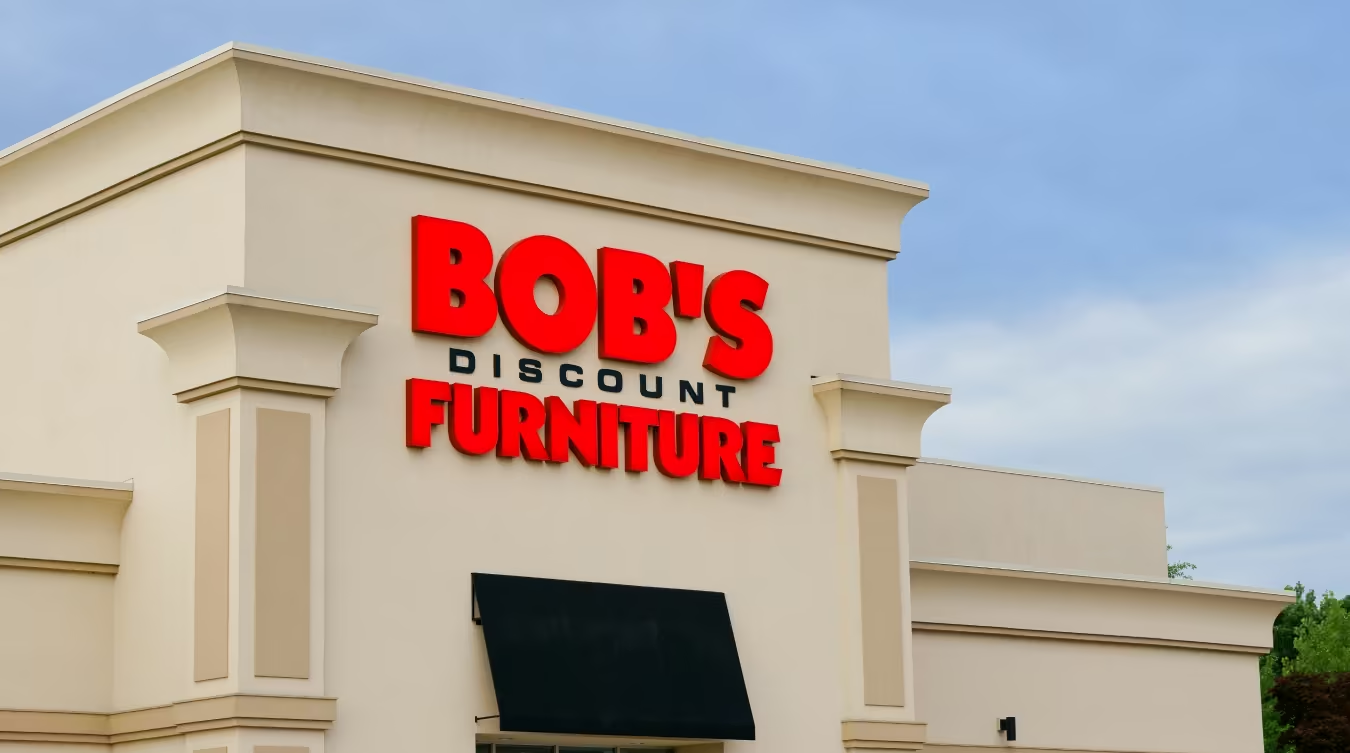
With its recent IPO, Bob’s Discount Furniture has officially entered a new chapter, stepping onto the public stage at a time when the home furnishings sector continues to face macroeconomic pressures. Yet despite these challenges, Bob’s has demonstrated notable momentum. This AI-powered data analysis takes a closer look at Bob’s performance, examining traffic trends, demographic positioning, and cross-shopping behavior to better understand what’s driving the company’s success.
Traffic Gains Reflect More Than Expansion
Bob’s continued expansion supported year-over-year (YoY) visit increases throughout 2025 – but growth was not driven by footprint alone. Visits per location to the chain also climbed by 1.8% in 2025, indicating that existing stores captured incremental demand alongside new openings.
A Demographic Sweet Spot
Analysis of Bob’s and the broader home furnishings category suggests that a favorable mix of value-oriented and affluent shoppers may be supporting the brand’s growth.
In 2025, the median household income of Bob’s captured market was $89.0K – below the category median of $92.5K, yet above the nationwide median of $79.6K. A similar pattern emerged when examining Bob’s audience by income groups. Among households earning under $100K and those earning over $150K, Bob’s share fell between the category benchmark and the national baseline.
This positioning suggests that while Bob’s resonates strongly with value-seeking consumers, its appeal is not limited to lower-income households – which could reflect the strength of its "Good, Better, Best" assortment strategy. As value-prioritization has gained traction across income levels, Bob’s appears to be attracting shoppers who are price-conscious yet still maintain discretionary spending power – a combination that is especially advantageous in a bigger-ticket category like furniture.
Strengthening Loyalty in a Comparison-Driven Category
Reinforcing its position as a primary destination for furniture shoppers appears to be another factor fueling Bob’s growth.
AI-based location intelligence reveals that in 2025, the share of Bob’s visitors who also visited other major home furnishings chains declined compared to 2024. The shift was consistent across several key competitors, suggesting that fewer shoppers felt compelled to compare offerings at other chains before visiting Bob's Discount Furniture.
In a category where consumers frequently comparison-shop, declining cross-visitation may signal that Bob’s relaxed in-store environment – featuring the “Little Bob” sock-puppet and complementary cafés – is resonating with shoppers, reducing the incentive to look elsewhere.
Positioned for Its Public Chapter
These insights underscore Bob’s differentiated strategy within a volatile retail landscape. By combining disciplined expansion with broad cross-income appeal and brand loyalty, Bob’s is building both growth and resilience as it enters its public chapter.
Will Bob’s continue to find success in 2026? Visit Placer.ai/anchor to find out.
Placer.ai leverages a panel of tens of millions of devices and utilizes machine learning to make estimations for visits to locations across the US. The data is trusted by thousands of industry leaders who leverage Placer.ai for insights into foot traffic, demographic breakdowns, retail sale predictions, migration trends, site selection, and more.
Digging Into Dining
The dining industry showcased its agility over the past couple of years as it rapidly adapted to shifts in consumer preference brought on by COVID and rising prices. And with a new year around the corner, the pace of change shows no signs of slowing down.
This white paper harnesses location analytics, including visitation patterns, demographic data, and psychographic insights, to explore the trends that will shape the dining space in 2024. Which dining segments are likely to pull ahead of the pack? How are chains responding to changes in visitor behavior? And where are brands driving dining foot traffic by taking advantage of a new advertising possibility? Read on to find out how dining leaders can tap into emerging trends to stay ahead of the competition in 2024.
Stepping Up To The Plate
Comparing quarterly visits in 2023 and 2022 highlights the impact of the ongoing economic headwinds on the dining industry. The year started off strong, with year-over-year (YoY) dining visits up overall in Q1 2023 – perhaps aided by the comparison to an Omicron-impacted muted Q1 2022. And while overall dining growth stalled in Q2 2023, several segments – including QSR, Fast Casual, and Coffee – continued posting YoY visit increases, likely bolstered by consumers trading down from pricier full-service concepts.
Foot traffic slowed significantly in Q3 2023 as inflation and tighter consumer budgets constrained discretionary spending. Overall dining visits fell 2.4% YoY, and full-service restaurants – with their relatively high price point compared to other dining segments – seemed to be particularly impacted by the wider economic outlook. But the data also revealed some bright spots: Fast Casual still succeeded in maintaining positive YoY visit numbers and Coffee saw its Q3 visit grow an impressive 5.4% YoY. As the return to office continues, a pre-work coffee run or lunchtime foray to a fast-casual chain may continue propelling the two segments forward.
Shifting Demographics and Shifting Dining Behavior
Restaurant visitation patterns have evolved over the past few years. Although an 8 PM seating was once the most coveted slot at fine-dining restaurants, recent visitation data suggests that sitting down to dinner earlier is rising in popularity.
But among the QSR segment, the opposite trend is emerging, with late-night visits rising. Analyzing hourly foot traffic to several major QSR chains reveals that the share of visits between 9 PM and 12 AM increased significantly between Q3 2019 and Q3 2023. Even Taco Bell – already known for its popularity among the late-night crowd – saw a substantial increase in late-night visits YoY – from 15.4% to 20.3%.
Younger Customers Staying Out Later
Who is driving the late night visit surge? One reason restaurants have been expanding their opening hours is to capture more Gen-Z diners, who tend to seek out nighttime dining options. But location intelligence reveals that younger millennials are also taking advantage of the later QSR closing times.
An analysis of the captured market for trade areas of top locations within one of Taco Bell’s major markets – the Chicago-Naperville-Elgin, IL-IN-WI Metropolitan area – reveals a year-over-four-year (Yo4Y) increase in “Singles & Starters.” The “Singles & Starters” segment is defined by Experian: Mosaic as young singles and starter families living in cities who are typically between 25 and 30 years old. As consumers continue to prioritize experiential entertainment and going out with friends, late-night dining may continue to see increased interest from young city-dwellers.
Smoothies Drive Weekend Visits
Millennials and Gen-Z consumers aren’t only heading to their favorite fast food joint for a late-night bite – these audience segments are also helping drive visits on the weekends. Smoothie King is one chain feeling the benefits of young, health-conscious consumers.
The chain, which opened in New Orleans, LA, in 1973 as a health food store, has since grown to over 1,100 locations nationwide and is currently expanding, focusing on the Dallas-Fort Worth CBSA. The area’s Smoothie King venues have seen strong visitation patterns, particularly on the weekends – weekend visits were up 3.4% YoY in Q3 2023. The smoothie brand’s trade areas in the greater Dallas region is also seeing a YoY increase in weekend visits from “Young Professionals” – defined by the Spatial.ai PersonaLive dataset as “well-educated young professionals starting their careers in white-collar or technical jobs.”
Sports and Dining - Match Made in Heaven
While some dining chains are appealing to the late-night or weekend crowd, others are driving visits by appealing to sports lovers. How have recent rule changes around student athletes changed the restaurant game, and how can college football teams drive business in their hometowns?
Scoring Big: Leveraging Fan Insights to Fuel Successful Partnerships
College sports have long been a major moneymaker, with top-tier teams raking in billions of dollars annually. And as of 2021, college athletes can enjoy a piece of the significant fan following of college sports thanks to the change in the NCAA’s Name, Image, and Likeness (NIL) rules, which now allows student athletes to sign endorsement deals.
Since then, multiple restaurants have jumped on the opportunity to partner with student athletes, some of whom have millions of followers on Instagram and TikTok. Chains like Chipotle, Sweetgreen, Slim Chickens, and Hooters have all signed college athletes to various brand deals.
How can brands ensure they partner with athletes their customers will want to engage with? Analyzing a chain’s audience by looking at the interests of residents in a given chain’s trade area can reveal which type of athlete will be the most attractive to each brand’s customer base. For example, data from Spatial.ai: Followgraph provides insight into the social media activity of consumers in a given trade area and can highlight desirable partnerships.
Examining the trade areas of Chipotle, Sweetgreen, Slim Chickens, and Hooters, for instance, reveals that Sweetgreen’s visitors tended to have the largest share of Women’s Soccer followers. Conversely, Sweetgreen’s trade area had lower-than-average shares of College Football Fans or College Basketball Fans, while residents of the trade areas of the other three chains showed greater-than-average interest in these sports. Leveraging location intelligence can help companies choose brand deals that their customers resonate with and find the ideal athletes to represent the chain.
College Gameday - Wins for Dining
Finding the right college athlete partnership is one way for dining brands to appeal to college sports enthusiasts. But dining chains and venues located near major college stadiums also benefit from the popularity of their local team by enjoying a major game day visit boost.
One of the country’s most popular college football teams, the Ohio State Buckeyes, can draw millions of TV viewers, and its stadium has a capacity of 102,780 – one of the largest stadiums in the country. And while tailgating is a popular activity for Buckeyes fans, nearby restaurants are some of the biggest beneficiaries of the college football craze. Panera experienced a 235.3% increase on game days as compared to a typical day, Domino’s Pizza visits grew by 283.3%, and Tommy’s Pizza, a local pie shop, saw its visits jump by a whopping 600.9%.
Game Day Visitor Spikes
This influx in diners also causes a major shift in game day visitor demographics, as revealed by changes in visitors at dining venues located near stadiums of two of the nation’s best college football teams – the Ohio State Buckeyes and Ole Miss Rebels. Based on Spatial.ai: Personalive data for the captured market of these dining venues, game day visitors tended to come from “Ultra Wealthy Families” when compared to visitors during a typical non-game day in September or October.
The analysis indicates that popular sporting events create a unique opportunity for restaurants near college stadiums to attract high-income customers game day after game day, year after year.
Subwars: Room for Everyone
While some spend game day tailgating or visiting a college restaurant, others hold a viewing party – with a six-foot submarine. And the sub’s popularity extends beyond Superbowl Sundays. Sandwich chains including Jersey Mike’s, Firehouse Subs, Jimmy John’s, and Subway (recently purchased by the same company that owns Jimmy John’s) have seen sustained YoY increases in visits and visits per venue in the first three quarters of 2023.
Some of the growth to these chains may be related to their affordability, a draw at all times but especially during a period marked by consumer uncertainty and rising food costs. And subway leaders seem to be seizing the moment and striking while the iron is hot – Jersey Mike’s opened 350 stores in 2023 and still saw its YoY visits per venue grow by 6.6%. And Subway reported ten consecutive quarters of positive sales, a promising sign for its new owner.
Sandwich Chains Attract a Wide Consumer Base
The love for a healthy, affordable sandwich extends across all income levels, with all four chains seeing a range in their visitors' median household income (HHI). Out of the four chains analyzed, Jersey Mike’s – which has long prioritized a suburban, middle-income customer – had the highest trade area median household income of the four chains at $77.3K/year. Subway, known for its affordability, had the lowest, with $62.9K/year. The variance in median HHI combined with the strong foot traffic growth shows that when it comes to sandwiches, there’s something for everyone.
So What’s The Dining Space Cooking Up?
Persistent inflation and declining consumer sentiment may pose serious challenges for the dining space, but emerging trends are helping boost some restaurants. Customers seeking out a late-night bite drive visits to QSR chains, and health-conscious diners are boosting foot traffic to smoothie bars and sandwich shops. Meanwhile, sports sponsorships and game-day restaurant visits can provide a boost to dining businesses that take advantage of these opportunities.

