.png)
.png)

.png)
.png)


Darden Restaurants, Inc. is a major player in the restaurant industry, operating restaurants across a wide range of dining styles and price points. Recently, Darden announced plans to acquire Tex-Mex chain Chuy’s, a move that would add some 100 new locations across 16 states to the Darden portfolio.
We took a closer look at how the dining brand has performed over the past few months, and dug deeper into what impact the Chuy’s acquisition might have on Darden.
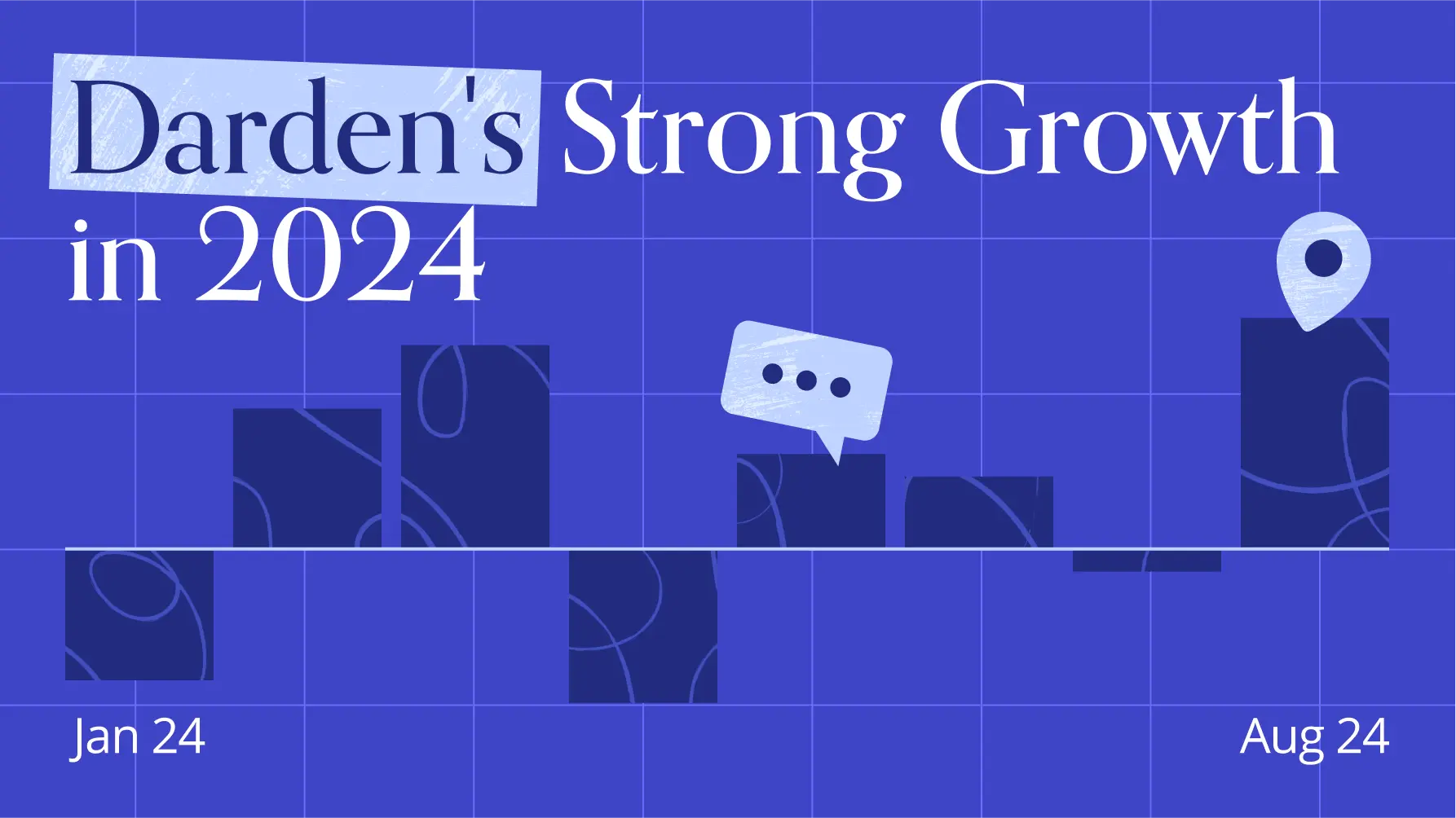
Darden's 2024 performance has been strong, with only three months – January, April, and July – showing YoY visit declines. January’s 2.9% decline was likely driven by unseasonably cold weather, while Easter weekend shifted visits across multiple retail categories in April 2024. And though July visits experienced a modest dip of 0.5% YoY, the drop was quickly offset by a 5.1% YoY increase in August.
This trend points to a recovery in consumer dining behavior, particularly in the full-service restaurant sector, where growth is being driven by consumers opting for higher-quality dining experiences over fast food options.
Darden owns and operates nearly 2,000 restaurants nationwide. Its three core brands – Olive Garden, LongHorn Steakhouse, and Cheddar’s Scratch Kitchen make up the bulk of these locations.
All three restaurant chains enjoyed overall positive momentum over the past few months, with LongHorn emerging as a standout performer. The chain saw its foot traffic increase in all months analyzed, with August 2024 visits elevated by 10.4% YoY.
Cheddar’s Scratch Kitchen and Olive Garden, too, experienced growth in all but two of the analyzed months, with August 2024 visits elevated by 3.1% and 6.9%, respectively, YoY. These trends point to consistent – and perhaps growing – consumer demand, a solid position as the holiday season approaches.
In July 2024, Darden announced its intention to acquire Chuy’s, an Austin-based Tex-Mex chain, a move that could add 101 stores to Darden’s already extensive portfolio. And while the acquisition is still pending, digging into the demographic and psychographic data offers some insight into what might make Chuy’s at home with the Darden family.
One defining factor of Darden’s restaurant portfolio might be its range – the chain offers dining options that appeal to people across a variety of income brackets. Its core brands – Cheddar’s Scratch Kitchen, Longhorn Steakhouse, and Olive Garden – cater to a customer base with household incomes similar to the nationwide median of $76.1K. But Darden’s broader portfolio includes several chains that appeal to wealthier patrons – visitors to Eddie V’s Prime Seafood, for example, came from trade areas where the median household income (HHI) was $105K.
Chuy’s visitor base, meanwhile, hails from trade areas with a median HHI of $86.2K. So the addition might help the restaurant group build on its core audience while appealing to higher-income diners who may be looking to “trade down” to a more casual, affordable meal without compromising on quality. This alignment allows Chuy’s to seamlessly fit within Darden's strategy, providing a diverse range of dining experiences while expanding its reach into higher-income markets.
Darden’s acquisition of Chuy’s also appears to be a strategic play to attract younger diners, a segment that continues to drive interest in Mexican and Teex-Mex cuisine. And examining the demographics of visitors across all Darden brands reveals that Chuy’s is particularly popular among “Young Professionals”, with 9.4% of its diners coming from trade areas classified as such by the Spatial.ai: PersonaLive dataset.
As young diners continue to be a category of interest for Darden, the Chuy’s acquisition may be the ticket to Darden maintaining its visit dominance in the coming years.
Darden continues to drive foot traffic across its wide portfolio of brands, offering something for every kind of diner. With plans to expand its core audience underway, will the restaurant group continue to improve its monthly visits?
Visit Placer.ai to keep up with the latest data-driven dining news.
This blog includes data from Placer.ai Data Version 2.1, which introduces a new dynamic model that stabilizes daily fluctuations in the panel, improving accuracy and alignment with external ground truth sources.

How did the Placer 100 Index for Retail & Dining fare in August 2024? We dove into the data to find out.
The final days of summer were a critical retail moment, with all eyes on back-to-school traffic performance. Analyzing year-over-year (YoY) foot traffic performance for the Placer 100 Index for Retail and Dining shows that since May 2024, visits have been on a positive growth trajectory – reaching a summer highpoint of 3.0% in August.
Back to school, it seems, was a significant driver of retail and dining foot traffic. And recent indications that consumer confidence has turned a corner may bode well for the fast-approaching holiday season.
How much of an impact did back-to-school activity have on retail and dining visits in August 2024? Further analysis of the Placer 100 Index reveals that the top-performing metro areas last month were college towns, which suggests that a surge in students out and about – shopping for back-to-school essentials and dining out – was a likely driver of local foot traffic.
The State College, PA Metro Area, home to Penn State University, for example, saw a 14.5% YoY change in overall retail and dining visits in August 2024. And other college towns with large student populations were also top YoY visit performers during the month. Blacksburg-Christiansburg, VA (14.2%), home to Virginia Tech, Ithaca, NY (12.1%), home to Cornell University, and Bloomington, IN (12.1%), home to Indiana University Bloomington – to name a few – all experienced significant visit growth compared to August 2023.
While the Placer 100 Index experienced foot traffic gains last month, digging deeper into the data reveals that in August 2024 consumers continued to prioritize value as they dined and shopped.
In addition to rapidly growing discount grocer Aldi, four value-focused chains were among August 2024’s top YoY visit performers. Five Below (17.5%), Big Lots (15.7%), HomeGoods (13.8%), and Ollie’s Bargain Outlet (13.7%) all showed impressive YoY traffic – and three out of the four were also among the top chains in terms of YoY visit-per-location growth.
One of the biggest YoY visits and visits-per-location winners in August 2024 was Big Lots, which recently announced voluntary Chapter 11 proceedings and an ownership transition while continuing to rightsize. With soon-to-be-closed locations offering steep markdowns, the chain has been driving significant traffic. And since Big Lots offers small-ticket items as well as big-ticket home furnishings, a back-to-school push likely contributed to the chain’s jump in August visits.
HomeGoods was also among the top chains in August 2024, with both YoY visits and visits-per-location (9.8%) growth. The chain’s social media campaign featuring college students furnishing their living spaces appears to have buoyed foot traffic during the homestretch of back-to-school shopping.
With summer in the rearview mirror, the focus shifts to fall and the fast-approaching holiday season. Will retail and dining visits sustain their momentum in the critical months ahead?
Visit Placer.ai to find out.
This blog includes data from Placer.ai Data Version 2.1, which introduces a new dynamic model that stabilizes daily fluctuations in the panel, improving accuracy and alignment with external ground truth sources.

The return to office (RTO) has been on an upswing, with employers across industries cracking down on remote work and requiring employees to put in more face time. Indeed, July 2024 emerged as the busiest in-office month since the pandemic. But what happened in August?
We dove into the data to find out.
August is a time for family vacations – and millions of Americans planned to take the roads and skies this summer to get away from it all and enjoy some downtime. So it may come as no surprise that the accelerated mandate-driven RTO seen in recent months – moderated somewhat in August, with a larger visit gap compared to the equivalent period of 2019 than that seen in July or in June.
Still, despite an end-of-summer slump, the nationwide office recovery appears to be very much underway. Office foot traffic last month was just 31.2% below pre-pandemic levels. Or put another way, August 2024 office visits were 68.8% of what they were in August 2019.
Drilling down into the data for major urban hubs throughout the country shows a continuation of recent trends, with Miami, New York, Atlanta, and Dallas outperforming the nationwide baseline. In Miami and New York, office visits were nearly 90.0% and 85.0%, respectively, of what they were pre-pandemic. And Atlanta, where employers from the CDC to UPS have begun enforcing stricter in-office policies, held onto its high ranking, with visits 75.6% of what they were in August 2019.
Indeed, Atlanta, which has seen a surge in office leasing activity, saw 7.3% year-over-year (YoY) visit growth in August 2024 – followed by Miami (5.7%). San Francisco – which despite lagging behind other cities compared to pre-pandemic, has been making steady YoY gains – came in third with a YoY visit increase of 3.0%.
Who are the employees driving this summer’s accelerated recovery?
Analyzing the trade areas of office buildings nationwide reveals that between June and August 2024, the Census Block Groups (CBGs) feeding visits to office buildings (their captured markets) continued to see a decline in their share of households with children – indicating that parents still account for fewer office visits than they did pre-pandemic. Employees with children, it seems, remain especially likely to place a premium on flexibility – embracing work routines that allow them to more efficiently juggle home and work responsibilities.
Over the same period, the share of one-person households in offices’ captured markets rose substantially, highlighting the important role played by young professionals – who may be more likely to be single – in today’s office recovery. Whether driven by a desire to embrace in-office career growth and mentorship opportunities, or by a craving for more social interaction, these employees are returning to the office in ever greater numbers.
With the school year underway and summer vacations already a not-so-distant memory, office foot traffic is likely to resume its upward trajectory. Will September 2024 set a new post-pandemic RTO record?
Follow Placer.ai’s data driven analyses to find out.
This blog includes data from Placer.ai Data Version 2.1, which introduces a new dynamic model that stabilizes daily fluctuations in the panel, improving accuracy and alignment with external ground truth sources.

Malls ended summer with a bang. In May and June 2024, indoor malls, open-air shopping centers and outlet malls all experienced year-over-year (YoY) visit growth, with indoor malls – which offer an escape from the sweltering heat – leading the way.
In July 2024, all three mall types experienced slight YoY visit gaps. But these were likely due to a calendar shift rather than to any flagging back-to-school momentum: July 2024 contained one less Saturday and Sunday than the equivalent period of 2023, when malls draw some of their biggest crowds. (In January-August 2024, weekends accounted for 39.0% of visits to indoor malls, 35.6% for open-air shopping centers, and 43.0% for outlet malls.) This shift, which likely had the most pronounced impact on outlet malls, may have obscured stronger YoY performance in July 2024.
And this year’s intense weather didn’t stop consumers from visiting malls in droves to take advantage of back-to-school shopping – which was in full swing by August 2024. That month saw the most substantial YoY foot traffic growth of the analyzed period, with YoY visit increases of 7.3% for indoor malls, 5.8% for open-air shopping centers, and 6.1% for outlet malls.
Who shopped at malls in August 2024? With back-to-school shopping being a significant motivator for consumers, it may come as no surprise that college students and families with children were overrepresented among end-of-summer mall hoppers – though not for all mall types.
Analysis of all three mall segments’ captured markets reveals that in August 2024, the share of college students in the trade areas of indoor malls and open-air shopping centers exceeded the nationwide average by 67% and 170%, respectively. These malls may be popular with college students due to their greater accessibility for students without cars, and for their recreational atmosphere – making them a good place to catch up with friends while shopping.
Meanwhile, the captured markets of outlet malls included slightly higher-than-average shares of households with children, perhaps as families on tight back-to-school budgets prioritized steep discounts. Indoor malls were also slightly more likely than average to draw this demographic.
With Summer 2024 in the books, it’s fair to say that mall foot traffic thrived during this critical retail season. How will mall visits shape up come spring?
Visit Placer.ai to find out.
This blog includes data from Placer.ai Data Version 2.1, which introduces a new dynamic model that stabilizes daily fluctuations in the panel, improving accuracy and alignment with external ground truth sources.

In 2024, auto parts retailers are continuing to see visit growth compared to last year. We dove into the data for three of the industry’s leaders – AutoZone, O’Reilly Auto Parts, and NAPA Auto Parts – to explore the consumer behavior and profiles behind the space’s ongoing success.
Auto parts retail visits have been bolstered in recent months by still-high vehicle prices – which have incentivized many cash-strapped consumers to fix up the car they have rather than buy a new one. To be sure, the industry hasn’t been entirely spared the effects of inflation, which has caused many consumers to tighten their (seat)belts and defer non-essential car repairs. Still, one of the key factors benefiting the space has been the greater prevalence of older vehicles on the road, which are more likely to need significant – and essential – maintenance.
Since the start of 2024, AutoZone and O’Reilly have sustained consistent year-over-year (YoY) monthly visit growth. And though NAPA saw mild visit gaps in March, June, and August – coinciding with traffic fall-off to some of the repair shops it supplies – it too experienced YoY increases throughout most of the analyzed period.
As auto parts inflation continues to wane in 2024, more consumers may begin taking on repairs they postponed last year, providing these retailers with continued foot traffic boosts.
Less affluent consumers are more likely to be deterred from buying a new ride by high prices and interest rates. And analyzing the demographic characteristics of visitors to AutoZone, O’Reilly, and NAPA reveals that in H1 2024, the median household incomes (HHIs) of the chains’ captured markets were indeed significantly lower than those of new car dealerships ($75.6K).
The data reveals a divide between consumers in the market for new cars – who generally have higher income levels – and those that frequent auto parts retailers to invest in their current set of wheels. And consumers seeking to repair rather than replace may be even more inclined to do so while vehicle prices and financing costs remain elevated.
Analysis of consumer spending habits provides a further indication that AutoZone, O’Reilly and NAPA’s audiences are more likely to invest in upgrades and repairs than in the purchase of a new vehicle.
In H1 2024, residents of AutoZone and O’Reilly’s captured markets spent 17% less annually on buying used cars than the nationwide average, while residents of NAPA’s captured market spent 14% less.
And residents of all three auto parts retailers’ trade areas spent even less on new car buying. In H1 2024, AutoZone’s captured market spent 23% less on new cars than the nationwide average, and O’Reilly’s and NAPA’s captured markets spent 22% and 18% less, respectively.
AutoZone and O’Reilly’s relatively large share of DIY consumers – those who repair or upgrade their cars on their own to save money – likely contributed to their trade areas’ smaller car buying expenditures. Meanwhile, the slightly larger spend on both new and used cars in NAPA’s trade area – though still significantly lower than the nationwide average – may be due to the retailer’s predominantly commercial business.
Auto parts chains have been riding strong tailwinds on the road to success – and they appear geared up for more foot traffic success in the homestretch of 2024. As more older vehicles stay on the road and car-buying costs remain high, robust demand for parts is likely to continue.
Will the auto parts industry accelerate even further in the months to come? Visit Placer.ai to find out.
This blog includes data from Placer.ai Data Version 2.1, which introduces a new dynamic model that stabilizes daily fluctuations in the panel, improving accuracy and alignment with external ground truth sources.

It’s that time of year again. On August 22nd, Starbucks launched its much-vaunted autumn menu, including the iconic Pumpkin Spice Latte (PSL). We dove into the data to see what happened on the big day – and how Starbucks visitation patterns were impacted by the much-anticipated release.
Last year, Starbucks broke with tradition to move its PSL launch from Tuesday to Thursday. And perhaps due to Thursday’s proximity to the weekend (especially in the age of the TGIF work week), the step has proven advantageous – generating a sustained visit spike lasting through the weekend.
On Thursday, August 22nd, 2024, foot traffic to Starbucks surged 24.1% higher than the coffee giant’s daily average for the previous eight Thursdays. And the PSL effect worked its magic throughout the weekend, with visits to Starbucks on the following Friday, Saturday, and Sunday significantly elevated compared to recent daily averages for those days of the week.
Since its debut in 2003, Starbucks’ PSL has become part of the cultural landscape. Each year, the beverage’s release generates a social media frenzy. And between 2021 and 2023, the number of people visiting Starbucks on Pumpkin Spice Latte launch day increased steadily.
Last year, the PSL visit spike reached new heights, with foot traffic 27.1% higher than on August 27th, 2019 – the last pre-pandemic PSL launch. And despite Starbucks’ recent challenges, visits on PSL day held steady this year, maintaining last year’s impressive gains.
Comparing visits on August 22nd, 2024 to recent Thursday visit averages across the continental U.S. highlights the broad appeal enjoyed by Starbucks’ fall menu. Every analyzed state enjoyed a visit bump – though the extent of the boost varied considerably between regions.
Many southern states – including Alabama, Louisiana, and Mississippi, saw only slight foot traffic bumps, perhaps due in part to the region’s warmer weather, which may render the early autumn launch less compelling. (Mississippi in particular, it seems, really couldn’t care less about Pumpkin Spice.) But in other areas, led by North Dakota (45.5%), Kansas (42.6%), Utah (42.2%), Iowa (41.3%), and Pennsylvania (39.5%), visits skyrocketed.
Starbucks’ successful PSL launch shows that even as consumers count their pennies, people are finding room in their budgets for sweet, cozy indulgences that don’t break the bank. What does the winning release portend for the upcoming winter season?
Follow Placer.ai’s data-driven dining and retail analyses to find out.
This blog includes data from Placer.ai Data Version 2.1, which introduces a new dynamic model that stabilizes daily fluctuations in the panel, improving accuracy and alignment with external ground truth sources.