Skip to Main Content
Thank you! Your submission has been received!
Oops! Something went wrong while submitting the form.
0
0
0
0
----------
0
0
Articles
Article
How Club Pilates is Turning Scale into a Sustainable Super-Brand
Shira Petrack
Apr 10, 2026
3 minutes

Club Pilates Enters the Next Phase of Growth 

Club Pilates’ journey since its acquisition by Xponential Fitness represents a rare and large-scale success in the boutique fitness space. Since 2019, the chain has increased its monthly visits by over 200%, largely by expanding aggressively and saturating existing markets. 

But same-store data suggests that the brand, having built a dense and expansive studio footprint, may be hitting its first ceiling, and expansion alone may not be enough to sustain the momentum of the past couple of years. Instead, the chain will likely need to combine new location openings with unlocking the latent value within its existing network of 1,400+ studios – growing membership, driving more engagement, improving utilization, and deepening customer relationships.

To that end, Xponential is pursuing a multi-pronged strategy aimed at boosting unit-level economics, including improving member acquisition and investing in digital upgrades to enhance conversion and retention. The company is also testing pricing and packaging strategies alongside studio refreshes and new class formats to increase engagement and utilization with the goal of improving profitability across the existing studio base.

Why Keep Expanding? 

But even as Xponential Fitness works to improve performance at existing locations, expansion – which has been Club Pilates’ primary growth engine to date – will remain an important part of the strategy, with the company aiming to open locations in both "new and existing geographies."  

AI-powered location analytics reveal that most Club Pilates visits come from local clients, a trend which has remained remarkably consistent throughout the chain's aggressive expansion. In 2025, around 70% of visits came from patrons travelling less than five miles to reach the studio and more than 85% originated within a 10-mile radius – underscoring the highly local nature of the business. 

Because most customers come from nearby, opening additional studios allows the brand to reach new local audiences rather than relying on a single location to cover an entire market. When spaced appropriately, this can grow total demand with limited overlap, while marketing across the market helps reduce the cost of acquiring each new member. As a result, even if same-store visits begin to level off, the brand can continue to grow by expanding its footprint – capturing new pockets of local demand that existing studios do not fully serve.

From Scaling Up to Scaling Better

As Club Pilates enters its next phase, growth will depend both on opening new studios and on optimizing its existing network – improving utilization, deepening engagement, and refining pricing. With strong local density and a loyal, routine-driven customer base, the brand is well positioned to increase member lifetime value through digital enhancements and more personalized experiences. If executed well, this shift from pure expansion to expansion and optimization could elevate Club Pilates from a fast-growing chain to a true fitness super-brand.

For more data-driven consumer insights, visit placer.ai/anchor

Placer.ai leverages a panel of tens of millions of devices and utilizes machine learning to make estimations for visits to locations across the US. The data is trusted by thousands of industry leaders who leverage Placer.ai for insights into foot traffic, demographic breakdowns, retail sale predictions, migration trends, site selection, and more.

Article
Placer.ai March 2026 Mall Index: Edge Growth, Midday Risk
Shira Petrack
Apr 9, 2026
3 min

Overall Traffic to Malls Up YoY in Q1 2026

Traffic to malls increased in Q1 2026 across all three formats analyzed – indoor malls, open-air shopping centers, and outlet malls – largely thanks to strong performances in the first two months of the year. 

March Visits More Subdued 

But March 2026 visits were more subdued, with indoor malls seeing a slight year-over-year (YoY) decline of 1.1% and outlet malls experiencing a steeper drop of 4.1% compared to March 2025. Open-air shopping centers were the only format to maintain growth, though their 3.2% YoY visit increase – though solid – was still more modest than the stronger gains seen by the format in January and February.

So what happened in March? Why did open-air shopping centers fare better than their peers? And how can malls return to growth across formats going into Q2?  

Daypart Visit Analysis Sheds Light On Malls' Growth Path

Some of the dip may be due to calendar differences – March 2026 had one less Saturday than March 2025 – and since Saturdays are typically malls' busiest day, the shift likely impacted overall visits for the month.

But a closer look at daypart trends can shed additional light on both the strength earlier in the quarter and the slowdown in March. In Q1 overall, growth was concentrated at the edges of the day: traffic before 11 AM and after 8 PM saw the strongest gains, with additional support from the early evening (5 PM–8 PM). In contrast, midday traffic – the largest share of visits – was relatively flat for open-air centers and slightly negative for indoor and outlet malls. Still, robust edge growth was sufficient to offset this softness and drive overall quarterly gains. 

But in March, growth in morning and evening hours slowed – particularly for indoor and outlet malls – while midday declines became more pronounced. This meant that the off-peak gains were no longer sufficient to offset weakness in the core of the day – leading to the YoY traffic declines for indoor and outlet malls. 

How Did Open-Air Shopping Centers Maintain Growth Momentum? 

But even as traffic to indoor and outlet malls declined, open-air shopping centers maintained growth momentum due to two key advantages. First, the format maintained most of its morning and evening gains, and its midday traffic trends ease from growth to stability rather than from stability to decline like for indoor and outlet malls – so the growth at the edges was still enough to offset the flat visits midday. Second, open-air centers are less dependent on midday visits, with around 77% of visits to open-air shopping centers occurring between 11 AM and 8 PM, compared to 83% to 84% for indoor and outlet malls. This means that open-air shopping centers are more resilient to dips in midday visits than the other two formats. 

How Can Malls Cement Their Recovery? 

The softness seen in March at indoor and outlet malls does not negate the strong start to 2026, which drove overall YoY visit growth in Q1. However, it does highlight what will be required to sustain that momentum going forward.

The data points to two paths to more durable growth: reigniting demand during peak midday hours through programming, tenant mix, and convenience-driven visits or reducing reliance on that window by expanding traffic in the morning and evening. Open-air shopping centers provide a model for the latter, with a more balanced daypart mix – likely driven by their dining, entertainment, and extended-hour experiences – that has helped cushion midday softness. For indoor and outlet malls, long-term stability will likely depend on a combination of both – strengthening midday performance while also building consistent off-peak demand. 

For more data-driven retail insights, visit placer.ai/anchor

Article
Lands’ End’s Store Fleet Emerges as a Growth Engine in a New Strategic Era
Ezra Carmel
Apr 8, 2026
3 minutes

Lands’ End is entering a new chapter. The recently announced joint venture with WHP Global signals a strategic shift for the heritage apparel brand – one that could expand its reach through licensing, brand partnerships, and new distribution channels.

Under the agreement, WHP assumes control of Lands’ End’s licensing business, while the brand retains its retail operations. And while Lands’ End has long been associated with its catalog and e-commerce dominance, AI-powered location analytics suggest that its physical store fleet maintains an important role.

Lands’ End Stores Outpace the Apparel Category

As an apparel brand with a history of catalogue retail, Lands’ End continues to generate the majority of its sales online. Yet its physical stores remain a critical component of the business – and an increasingly bright spot. 

Lands’ End outpaced the broader apparel category in year-over-year visit growth in three of the past four quarters, with the only decline in Q1 2026 likely tied to store closures as part of ongoing optimization. At the same time, visits per location have remained consistently positive and above category benchmarks, highlighting the strength of the remaining fleet. This suggests that brick-and-mortar continues to be an effective driver of growth as the brand moves into its next phase.

A High-Value and Emerging Customer Base

Further evidence of the fleet’s strength – and its long-term potential – can be seen in the audience it attracts.

AI-powered audience segmentation indicates that in 2025, the brand captured an outsized share of visits from Ultra Wealthy Families, as well as from singles – the combined one-person and non-family households – segments, relative to the traditional apparel category.

The significant share of affluent families points to a customer base with both spending power and relative insulation from macroeconomic pressure. Meanwhile, strength among singles – a cohort that skews younger and includes a meaningful share of Gen Z consumers – highlights traction with a target demographic critical to long-term relevance.

The prevalence of both these audiences in Land's End's trade area suggests a dual advantage. Strong engagement from affluent households may help support near-term stability, while resonance with younger shoppers could indicate a developing pipeline for sustained growth in the years ahead.

A Foundation for Future Growth

The performance of Lands’ End’s store fleet, coupled with the composition of its audience, suggests a brand with momentum in physical retail – a notable advantage as it retains control of that side of the business. A productive fleet and a resilient, evolving customer base provide stability today, and could offer a strong foundation for broader brand expansion in the years ahead.

How will Lands’ End leverage this momentum as it enters its next phase? Visit Placer.ai/anchor to find out.

Placer.ai leverages a panel of tens of millions of devices and utilizes machine learning to make estimations for visits to locations across the US. The data is trusted by thousands of industry leaders who leverage Placer.ai for insights into foot traffic, demographic breakdowns, retail sale predictions, migration trends, site selection, and more.

Article
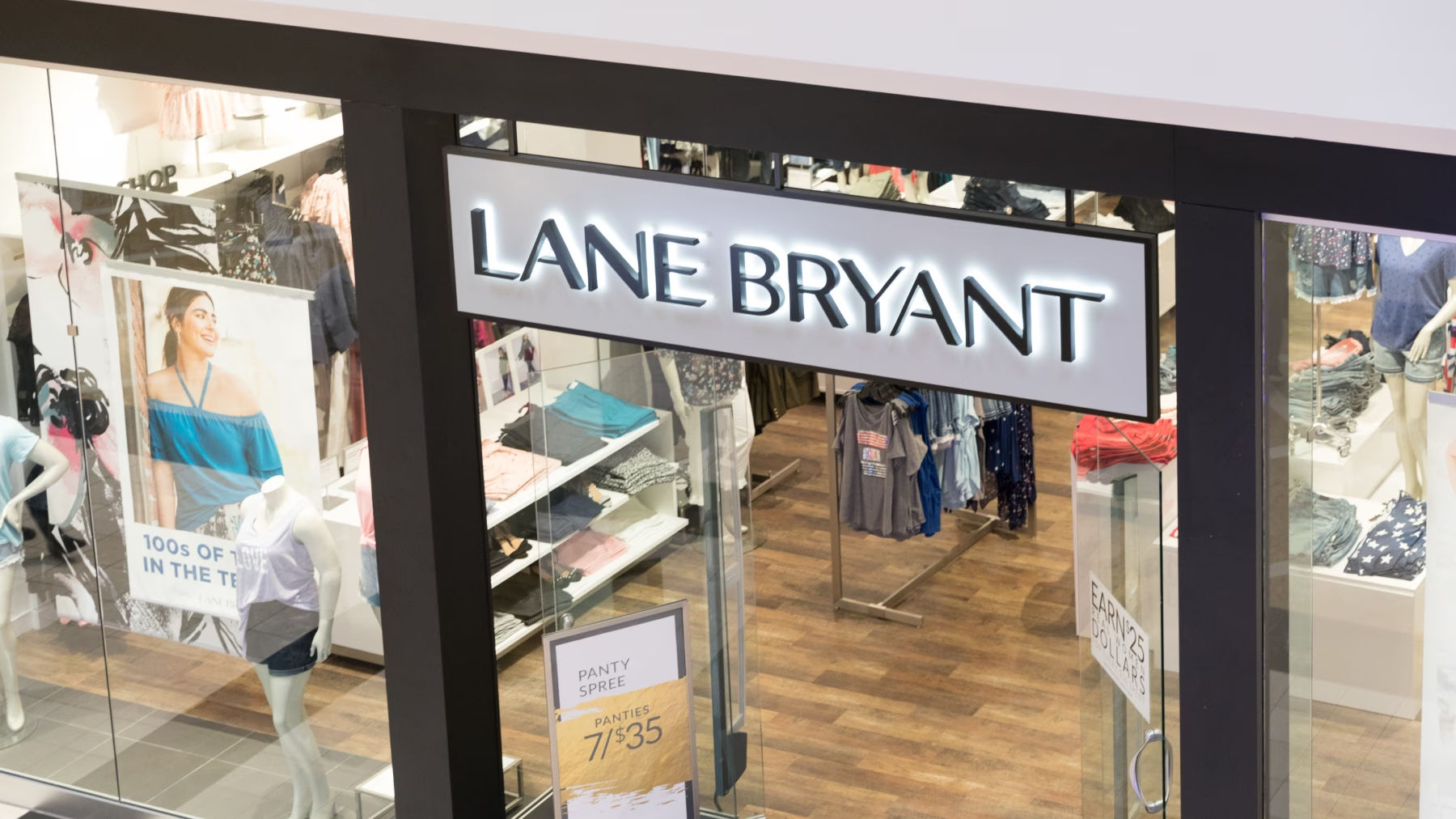
Lane Bryant’s Reset Finds Its Footing as GLP-1 Use Reshapes Apparel Demand
Lila Margalit
Apr 7, 2026
4 minutes

Lane Bryant faced significant challenges during the pandemic and has continued to gradually shrink its store fleet in the years since. And now, with nearly one in eight U.S. consumers using GLP-1 medications, plus-size apparel demand is beginning to shift in meaningful ways – introducing a new layer of complexity for the legacy retailer.

How is Lane Bryant navigating these challenges, and what does its customer base reveal about its ability to adapt?

Rightsized Fleet Finds Its Rhythm

In July 2020, Lane Bryant’s parent company filed for bankruptcy and closed more than 150 stores. But following its acquisition later that year by Sycamore Partners, the brand began to regain its footing – and recent location analytics suggest those stabilization efforts are taking hold.

While the reduced footprint has, unsurprisingly, led to lower overall traffic, average annual visits per location remain above 2019 levels, suggesting that demand has been successfully consolidated into existing locations. Average visits per location also held steady between 2024 and 2025, even as the company continued to quietly trim its unit count. The result is a smaller but more productive fleet, with steady activity supported by fewer, better-aligned stores.

Family Core Anchors Demand with Room to Expand

Still, as Lane Bryant continues to stabilize, the question becomes how it can further increase store-level productivity. And analyzing the demographic profile of its trade areas offers insight into both its core strengths and where the next phase of optimization may emerge.

One of the brand’s clearest advantages is Lane Bryant’s strong reach among family-oriented segments, which are overrepresented in its captured market – the areas within its trade area generating the highest share of visits – compared both to its overall trade area (its potential market) and to the national baseline. These segments, including parents of young children and households with teenagers at home, tend to skew younger than peak GLP-1 users, potentially offering the chain some near-term insulation from rapid GLP-1-driven disruption. Still, these cohorts are also seeing growing adoption – and as usage expands within this demographic, Lane Bryant will need to increasingly support customers through evolving size needs rather than rely on demand tied to a stable size identity.

At the same time, the data points to opportunities to expand reach across other segments. Among older households, Lane Bryant’s captured audience aligns with its trade area but falls below the nationwide average, highlighting potential whitespace that could be unlocked through footprint adjustments or more targeted engagement in markets where this segment is more concentrated.

Among younger “Contemporary Households,” by contrast – a segment that includes singles, non-family households, and married couples without children – the brand under-indexes relative to its trade area while slightly outperforming the national benchmark. This suggests Lane Bryant has geographic access to a larger pool of these consumers but has yet to fully capture their demand, pointing to an opportunity for growth through more targeted marketing and merchandising.

Challenges and Opportunities Ahead

GLP-1 adoption is disrupting traditional plus-size apparel demand, while also creating new opportunities as consumers undergoing weight loss journeys increase spend while moving through sizes. Retailers that can support customers across these transitions with more flexible assortments will be better positioned to capture this shift. And Lane Bryant’s steady operational footing and well-defined core audience provide it with a solid foundation to compete in this next phase of growth.

For more data-driven retail insights, visit placer.ai/anchor.

Placer.ai leverages a panel of tens of millions of devices and utilizes machine learning to make estimations for visits to locations across the US. The data is trusted by thousands of industry leaders who leverage Placer.ai for insights into foot traffic, demographic breakdowns, retail sale predictions, migration trends, site selection, and more.

Article
Target's Baby Push, Babylist Showroom Highlight Demand for Offline Baby Retail
Elizabeth Lafontaine
Apr 6, 2026
4 minutes

Target Steps Into Baby Category White Space 

Oh baby! The competition for ownership of the baby retail space has once again intensified. Target recently announced the debut of its new “Baby Boutique” concept, which launched online on March 15th and is expected to roll out to 200 locations this year. The updated format greatly expands Target’s assortment of brands and baby items, including the debut of beloved and upscale baby brands like Uppababy, Doona, Bugaboo and Stokke, which previously hadn’t been sold at the retailer. Target’s strategy appears to be aimed at courting and retaining new and expectant parents who are looking for a one-stop shopping experience for baby products, whether in hardlines or softlines.

The baby category, in particular, has presented a white space opportunity for retailers across the country since the closure of buybuy Baby in 2023. Since then, Kohl’s launched a shop-in-shop concept with Babies”R”Us and buybuy Baby had a small but unsuccessful relaunch after being sold. That has left consumers with fractured options, including e-commerce only, department stores, mass merchants and local boutiques. Target’s push could propel it into the national leader role for the category, and also help the brand to revitalize itself after a challenging 2025 performance.

Strong Overlap Between Target and buybuy Baby's Visitor Base

Looking at some of the insights behind this new pivot, it’s clear that Target is hoping to capture the attention of shoppers who would have normally shopped at the former buybuy Baby. According to Placer.ai’s foot traffic combined with Personalive consumer segmentation, Target’s shopper profile looks very similar to that of buybuy Baby during its operation. Specifically, the share of visits by Wealthy Suburban Families, Near Urban Diverse Families and Ultra Wealthy Families are all very closely aligned between the two chains, indicating that Target’s strategy could easily entrench itself with today’s consumer.

Traffic Continues to Increase Babylist's Physical Showroom – Especially from Affluent Audiences 

Despite the battle for national attention, there have also been innovations on a smaller scale in baby products. Babylist, a popular digitally native registry service, opened its first brick and mortar location in Beverly Hills in 2023, bringing the showroom experience to life for shoppers who want to test and learn before committing to baby gear. Baby items, particularly in hardlines like car seats and strollers, tend to be large ticket items, and many parents still want that tactile experience while shopping.

According to Placer’s foot traffic insights, the location has been successful in attracting the right customer base. The store allows shoppers to gain product knowledge and compare brands and models by category, making it easier to plan an online baby registry more effectively. Traffic has grown over the last year to the showroom, and the store's audience over-indexes for Ultra Wealthy Families, which both could drive conversion to the online marketplace.

Another group that has a high share of visits are Sunset Boomers, which would account for potential new grandparents. Grandparents are a vital shopper base for baby retailers, as they have higher levels of disposable income and are often purchasing gifts for others. Target could benefit from the buy-in of this group as it continues its journey into the world of baby-focused retail.

For more data-driven retail insights, visit placer.ai/anchor

Placer.ai leverages a panel of tens of millions of devices and utilizes machine learning to make estimations for visits to locations across the US. The data is trusted by thousands of industry leaders who leverage Placer.ai for insights into foot traffic, demographic breakdowns, retail sale predictions, migration trends, site selection, and more.

Article
The Advertising and Retail Opportunities of the 2026 Final Four in Indianapolis
Ezra Carmel
Apr 2, 2026
4 minutes

The Men’s Final Four tips off this week in Indianapolis, IN, with UConn, Illinois, Arizona, and Michigan all vying for the title. While much of the attention will center on the action inside Lucas Oil Stadium, the experience extends far beyond the court, with a series of events unfolding across downtown. To better understand the impact of this multi-day spectacle, we looked back at last year’s Final Four in San Antonio, TX – examining the moments that drove meaningful consumer engagement and what they could signal for this year’s conclusion to March Madness.

Much like this year’s Final Four in Indianapolis, IN, the 2025 event in San Antonio, TX was spread over several days and multiple downtown locations. The Alamodome hosted the semifinals and national championship, while Fan Fest – a hub for sponsor activations, presentations, and interactive experiences – took place at the nearby Henry B. González Convention Center. Just outside, in Hemisfair’s Tower Park and Civic Park, free concerts, watch parties, giveaways, and games captured fan engagement beyond the arena.

Layered Experiences Broaden Reach and Accessibility

AI-powered analysis of the 2025 Final Four revealed that fans attending a semifinal or national championship game were likely to have a higher household income (HHI) than visitors to other Final Four events – a trend consistent with the premium ticket prices associated with a national tournament. The free or low-cost admission to Fan Fest, Tip-Off Tailgate, and the Music Festival, on the other hand, meant that visitors to the convention center and Hemisfair were more likely to have a household income aligned with state and nationwide benchmarks.

This underscores the importance of layered engagement during a high-profile sporting event. Not every fan will splurge on game tickets, but a diverse mix of accessible experiences allows a broader audience to participate. By investing in these touchpoints, organizers expand the event’s reach and amplify its overall impact.

Travel Patterns Shape Event Audiences

A deeper dive into the 2025 Final Four highlights how each venue attracted a distinct audience segment – working together to create a more complete, destination-worthy experience for a wide range of fans.

Trade area analysis underscores the differences between the events at each venue. The games at the Alamodome drew a significant share of out-of-town visitors, with more than half traveling over 250 miles. Fan Fest at the convention center skewed far more local, with nearly 70% of visitors coming from within 100 miles. 

Meanwhile, music and tailgate events at Hemisfair struck a balance between the two. The venue’s proximity to the stadium, combined with a lineup of high-profile artists, likely made it a natural stop for traveling fans already in town for the games. At the same time, the open-air activities appear to have resonated with local audiences, many of whom may have paired their visit with the nearby Fan Fest at the convention center.

What does last year's analysis tell us about this year's Final Four events? 

First, this year's Fan Fest and Tip-Off Tailgate in Indianapolis may possess an even stronger local skew than last year's. The addition of the Division II and Division III championships alongside the National Invitational Tournament (NIT) at nearby Gainbridge Fieldhouse introduces more budget-friendly viewing options – a factor that may attract even more local fans. This shift may benefit certain sponsor activations while limiting the reach of others, depending on their target audience.

Second, headline concerts can serve as a powerful draw for out-of-town visitors. And when scheduled before the games, these performances may encourage longer stays –  as visitors who travel from afar are likely to remain through the championship game – providing a more sustained hotel and tourism lift across the full event window.

Taken together, these findings reinforce the importance of a multi-layered event strategy. By offering varied experiences that appeal to different audiences, organizers can maximize engagement and elevate the overall impact of a high-profile sporting showcase like the Final Four.

Pedestrian-Friendly Programming Extends Impact

A closer look at the Hemisfair district – home to the Final Four’s Music Festival and Tip-Off Tailgate in 2025 – further highlights the potential of these events to drive local consumer engagement.

Relative to the 2025 daily visit average, traffic during the 2025 Final Four weekend (most notably, April 4th to 6th) ranked as the second-busiest stretch of the year for Hemisfair –  surpassed only by the Saturday of Muertos Fest on October 25th.

This visit spike underscores the outsized role of ancillary programming in driving visitation – an effect that can be expected from the 2026 Final Four events as well. But unlike 2025’s closely clustered setup, the 2026 event hubs are set a short distance apart in Indianapolis’s downtown core. This could encourage pedestrian movement along connecting corridors – increasing retail and dining exposure and broadening the tournament’s economic impact.

Impact Beyond the Court

All eyes will be on this week’s matchups between the final four teams, as the nation awaits the crowning of a new college basketball champion.

But if last year’s Final Four is any indication, the impact will extend well beyond the court. The broader ecosystem of multi-day programming is poised to drive local consumer engagement, reinforcing the tournament’s role as a catalyst for foot traffic and economic activity.

For more in-depth event insights, visit Placer.ai/anchor.

Placer.ai leverages a panel of tens of millions of devices and utilizes machine learning to make estimations for visits to locations across the US. The data is trusted by thousands of industry leaders who leverage Placer.ai for insights into foot traffic, demographic breakdowns, retail sale predictions, migration trends, site selection, and more.

Reports
No items found.
Loading results...
We couldn't find anything matching your search.
Browse one of our topic pages to help find what you're looking for.
For more in-depth analyses on a variety of subjects, explore Reports.
The Anchor Logo
INSIDER
Stay Anchored: Subscribe to Insider & Unlock more Foot Traffic Insights
Gain insider insights with our in-depth analytics crafted by industry experts
— giving you the knowledge and edge to stay ahead.
Subscribe