.png)
.png)

.png)
.png)

.avif)
We're living through one of the most consequential technology shifts of our lifetimes. Generative AI is reshaping how people analyze information, make decisions, and do their work at a pace that would have seemed implausible only a few years ago. For industries like ours, where professionals rely on data to make high-stakes decisions about the physical world, the opportunity is especially exciting. Insights that once took weeks can now surface in minutes. Analytical workflows that once required specialized training can become accessible to anyone.
But that opportunity comes with real responsibility. The same capabilities that make GenAI so powerful also introduce risks such as bias, accuracy, privacy, and misuse - and those risks compound when the underlying technology is moving faster than the norms and regulations around it. The companies building with AI today are, in many ways, writing the operating rules in real time. How we choose to do that matters.
At Placer, we want to be clear about how we choose to do it. Placer doesn't build its own large language models (LLMs). Instead, we use well-established, trusted models from leading providers - the same foundation models that power the most widely adopted AI tools in the enterprise today. That's a deliberate choice. Our value to customers comes from the depth and quality of our data and the analytical expertise built around it, not from reinventing general-purpose AI infrastructure.
But not building the models ourselves doesn't let us off the hook for how we use them. If anything, it raises the bar. When we embed GenAI into our platform, whether as an analytical assistant, an automated summary, or a future agent that helps professionals move faster through their workflows, our customers trust us with the outcome. They're trusting us to pick the right models, apply the right guardrails, protect their data, and be transparent about what the technology is and isn't doing.
That's why we're publishing our Responsible AI Principles today. They're clear, concise, and they reflect how we actually operate.
The four Responsible AI principles address the issues we believe matter most to the professionals who rely on Placer every day:
Fairness and bias mitigation. AI systems can reflect and amplify existing biases in their training data. Our core defense is something we've been doing since long before GenAI: continuously validating our models, monitoring our AI practices and de-biasing outputs where appropriate.
Transparency and accountability. When we use GenAI in customer-facing features, we say so. We build feedback mechanisms into the product and treat that feedback as a real input to how the system evolves.
Privacy by design. Our AI tools are built to identify patterns about places and brands, not individuals. The same strict privacy measures that govern the rest of the Placer platform apply to every new GenAI feature we ship.
Security and safety. We are responsible custodians of our customers' data and are committed to safeguarding its integrity using industry leading standards.
We've also published a clear statement on how Placer's GenAI capabilities may be used and what restrictions we apply. These aren't new restrictions; they extend the responsible-use commitments that have always governed how our data can be used.
We're excited about the era of GenAI and about the value these new capabilities will create for our customers. The AI principles we're publishing are part of a broader effort across the company that’s grounded in a simple idea: trust isn't something we claim once and move on from. It's something we earn in every feature we ship.
.avif)
April 2025 set a high bar for movie theater performance, with A Minecraft Movie (April 4) and Sinners (April 18) driving significant spikes in foot traffic. Against this strong comparison, year-over-year (YoY) theater visits trended negative through much of April 2026. This followed a stronger March 2026, when releases like Scream 7 and Project Hail Mary – and easier comparisons – helped sustain significant YoY traffic gains
While the highly anticipated The Devil Wears Prada 2 (released May 1) did not generate a meaningful YoY uplift – given the difficult April 2025 comparison – it appears to have helped stabilize visitation trends, halting the declines seen in prior weeks.
Overall, the data reinforces that theater traffic remains highly blockbuster-driven, with consumers still willing to return to theaters when content feels like a must-see experience. With a slate of major releases ahead – including Star Wars: The Mandalorian and Grogu in late May and Toy Story 5 in mid-June – the sector is likely to see renewed spikes in visitation tied to tentpole premieres.
For more data-driven consumer insights, visit placer.ai/anchor.
Placer.ai leverages a panel of tens of millions of devices and utilizes machine learning to make estimations for visits to locations across the US. The data is trusted by thousands of industry leaders who leverage Placer.ai for insights into foot traffic, demographic breakdowns, retail sale predictions, migration trends, site selection, and more.
%20(1).avif)
April data indicates positive momentum for the mall sector, with year-over-year (YoY) traffic increases across all three formats analyzed – indoor malls, open-air shopping centers, and outlet malls. This performance is particularly notable given the strong April baseline last year, when traffic rose between 3.7% and 4.3% across formats compared to April 2024.
Open-air centers came out on top, extending a trend in place since December 2025, with visits rising 3.5% YoY. This marks a return to the top growth position after ceding the lead to indoor malls for much of 2025. Indoor malls followed with a 2.2% increase, while outlet malls lagged behind, posting a modest 0.5% YoY gain in April 2025 – potentially reflecting greater sensitivity to elevated gas prices in recent weeks.
At the same time, the average visit duration declined YoY, with all formats experiencing a shift toward shorter visits (under 30 minutes) and a corresponding drop in longer visits (45+ minutes).
This divergence between rising traffic and shorter dwell times suggests that a growing share of consumers are engaging in more mission-driven trips – visiting with a specific purpose in mind rather than for extended browsing. As a result, malls may be seeing more targeted, efficiency-oriented behavior that could concentrate spend within fewer stores per trip.
Still, this shift does not signal a wholesale move away from malls as destinations: across formats, over 40% of visits continue to last more than 60 minutes, indicating that a significant segment of consumers remains engaged in longer, more experiential visits even as quick trips become more prevalent.
April’s data suggests that malls are evolving to meet a wider range of consumer needs. The combination of rising traffic and varied visit lengths suggests that malls are successfully functioning both as convenient, mission-driven retail hubs and as destinations for longer, experiential outings. This dual role may ultimately prove to be a strength, enabling operators and tenants to capture multiple trip types and occasions. If sustained, these trends position the sector for continued resilience, with opportunities to further optimize tenant mix, merchandising strategies, and on-site experiences to align with increasingly dynamic consumer behavior.
Placer.ai leverages a panel of tens of millions of devices and utilizes machine learning to make estimations for visits to locations across the US. The data is trusted by thousands of industry leaders who leverage Placer.ai for insights into foot traffic, demographic breakdowns, retail sale predictions, migration trends, site selection, and more.
.avif)
The home improvement category has faced sustained headwinds in recent years – from elevated mortgage rates to sluggish existing-home sales and a consumer base hesitant to take on major remodeling projects. But after a prolonged stretch of year-over-year (YoY) visit declines, both Home Depot and Lowe’s have returned to growth – and the foot traffic data suggests this shift is more than just a seasonal uptick.
Both home improvement leaders closed Q1 2026 with YoY visit gains – Home Depot up 1.9% and Lowe’s up 2.0% – building on the stabilization seen in Q4 2025. This improvement aligns with their latest financial results: Home Depot reported U.S. comparable sales growth of 0.3%, while Lowe’s posted a stronger 1.3%. And for both chains, the return to positive territory suggests a long-awaited recovery may finally be underway.
Monthly data also suggests that while inclement weather contributed to the segment's strong performance in January, the underlying recovery is genuine. Home improvement benefits from unusual weather events, and January's strong gains for both chains – Home Depot +2.5%, Lowe's +3.9% – were partly fueled by Winter Storm Fern, which impacted communities across more than thirty states. But the momentum carried into February, and while growth moderated in March – and for Home Depot again in April – neither brand slipped into negative territory.
That resilience is an encouraging signal for the category during the critical spring home improvement season, particularly given renewed headwinds like rising gas prices and softening consumer sentiment. Lowe's stronger performance in April 2026, supported by easier comparisons, may also reflect its greater exposure to DIY customers tackling smaller repairs and at-home projects as consumers redirect spending closer to home.
Interest rates remain elevated and the housing market sluggish – but those same forces may now be working in the category's favor, as homeowners staying put begin to tackle a growing backlog of deferred repairs and maintenance. The bigger question is whether that momentum eventually unlocks the large discretionary projects both retailers say consumers are still holding back on – especially amid continued tariff uncertainty and elevated prices at the pump.
For more data-driven retail insights, follow Placer.ai/anchor.
Placer.ai leverages a panel of tens of millions of devices and utilizes machine learning to make estimations for visits to locations across the US. The data is trusted by thousands of industry leaders who leverage Placer.ai for insights into foot traffic, demographic breakdowns, retail sale predictions, migration trends, site selection, and more.

There may be more digital entertainment than ever before, but consumers still seek out places to socialize and have fun in the physical world. And in-person entertainment venues – from stadiums to experiential viewing concepts – are attracting unique audiences that span a range of psychographic segments.
A closer look at venues in the Dallas and Los Angeles areas reveals how this diversity plays out across markets, and what it could signal for stakeholders in the business of out-of-home entertainment.
In-person entertainment includes a variety of venues and formats. In the Dallas area, legacy venues AT&T Stadium, American Airlines Center, and Globe Life Field – and eatertainment concepts, movie theaters, and “shared reality” experiences such as Cosm – are just some of the in-person entertainment options.
And in the Dallas region, AI-powered trade area analysis reveals that affluent and suburban families dominate the out-of-home entertainment scene. Across every analyzed venue and entertainment category, either Ultra Wealthy Families or Wealthy Suburban Families ranks as the top audience segment – reflecting the region's family-oriented, suburban fabric.
That said, each venue or category attracts a distinct audience mix. Cosm Dallas and the American Airlines Center over-index on Ultra Wealthy Families and draw a relatively higher share of Young Professionals than other venues. This likely reflects their premium positioning: Cosm as a novelty experience, and the AAC as an upscale urban destination where higher costs may skew attendance toward more affluent consumers.
By contrast, Wealthy Suburban Families lead at Globe Life Field (home to the Texas Rangers) and AT&T Stadium (home to the Dallas Cowboys), both of which also attract meaningful shares of blue-collar suburban audiences.
And there is clear demand for in-person entertainment among Dallas’s up-and-coming and working-class consumers. Blue Collar Suburbs and Young Urban Singles segments tend to favor eatertainment venues and movie theaters – more affordable options for going out.
Greater Los Angeles offers a similarly diverse mix of entertainment anchors: SoFi Stadium, Dodger Stadium, Angel Stadium, and Crypto.com Arena – as well as a Cosm location, eatertainment chains, and movie theaters.
However, audience segmentation for in-person entertainment in the region shows a distinct profile compared to Dallas – shaped by SoCal’s urban density and demographic diversity. Near-Urban Diverse Families represent the largest segment across every analyzed venue and entertainment category, while Wealthy Suburban Families also account for a significant share of visitors across formats – particularly at Angel Stadium, likely due to its suburban Orange County location. The prevalence of these two segments suggests that urban, middle-class family audiences are the backbone of entertainment demand in the region while higher-income, suburban households play a strong supporting role in out-of-home entertainment consumption.
Two other patterns also jump out from the data.
First, Cosm Los Angeles and Crypto.com Arena’s audiences draw more heavily from the Educated Urbanites and Ultra Wealthy Families segments, which could point to a somewhat more premium-leaning audience mix at these destinations.
Second, the Young Urban Singles segment accounts for a relatively consistent audience share across all categories – suggesting broad-based entertainment preferences. With no single entertainment format commanding outsized engagement from this young cohort, operators in the Los Angeles market have an opportunity to further tailor experiences and potentially shape future demand among this audience.
In both Dallas and Los Angeles, the composition of out-of-home entertainment audiences reflects each market’s underlying demographics and urban structure.
And yet, certain consumer segments prefer particular entertainment venues or formats over others, and understanding who shows up is critical. Operators and advertisers that tailor their offerings to the dominant segments – whether through pricing or programming – may be better positioned to capture sustained demand and attain better ROI within their market.
For more insights, visit Placer.ai/anchor.
Placer.ai leverages a panel of tens of millions of devices and utilizes machine learning to make estimations for visits to locations across the US. The data is trusted by thousands of industry leaders who leverage Placer.ai for insights into foot traffic, demographic breakdowns, retail sale predictions, migration trends, site selection, and more.

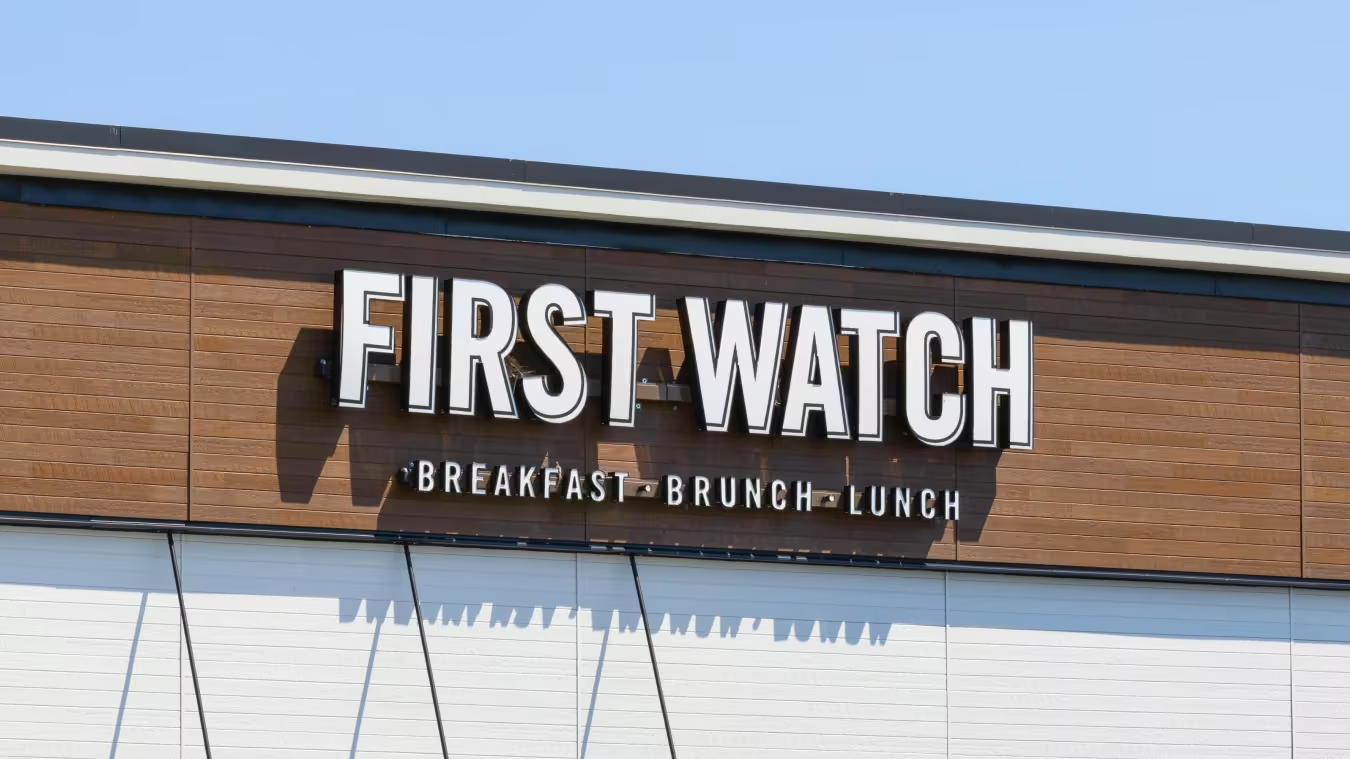
The U.S. restaurant industry navigated a challenging first quarter in 2026, marked by macroeconomic headwinds, unfavorable weather, and cautious consumer spending. Yet, within the breakfast-first sector, a clear narrative is emerging: The era of the traditional legacy diner is fading, making way for premium, experience-driven concepts. And at the forefront of this shift is First Watch. Armed with a differentiated culinary menu, rapid but disciplined expansion, and a highly resilient consumer base, the brand is not only defying broader casual dining trends but is fundamentally rewriting the playbook for daytime dining.
Over the past few years, the breakfast-first restaurant category has bifurcated into two distinct camps: premium and experience-driven concepts capturing visit share, and legacy diner-style chains, many of which are struggling to keep up. While Q1 2026 proved to be a tighter traffic environment overall amid macroeconomic uncertainty and unfavorable weather conditions across the U.S., several experience-focused brands and resilient fan-favorites continued growing their footprints – and their audiences.
First Watch led the pack in overall visit growth as it continued expanding its store count, while average visits per location held steady – demonstrating its ability to scale without diluting demand at existing locations – while Snooze saw a 1.1% increase in visits per location.
Conversely, the steepest laggards in the segment were legacy diner chains IHOP, Denny’s, and Huddle House, all of which saw overall visits decline as they continued rightsizing their footprints, with visits per location also modestly down. These brands are increasingly tracking closer to casual dining peers like Applebee’s and Outback Steakhouse, which have faced significant headwinds in recent months.
Still, among legacy diners, Waffle House stood out as a clear outperformer in Q1 2026, likely due in part to its status as a regional institution across much of the South. And the chain’s operational resilience may have also played a role: While Winter Storm Fern pushed the so-called “Waffle House Index” into the red across much of the region in late January, the brand’s unique disaster-readiness appears to have enabled some locations to reopen quickly or avoid closure entirely.
Ultimately, despite a challenging macroeconomic environment, brands that leverage a differentiated culinary menu, high-touch customer service, or fierce brand loyalty are successfully navigating the highly fragmented daypart much better than their traditional diner counterparts.
While several premium concepts have successfully carved out a lucrative niche in breakfast-first dining, First Watch has redefined the category. By blending the elevated, chef-driven culinary experience of a localized brunch spot with the operational efficiency of a national powerhouse, First Watch has created a model that sees success across multiple regions of the U.S. This unique positioning provides the brand with a massive structural advantage, fueling a physical growth trajectory that far outpaces its competitors.
Importantly, visitation data also reinforces that First Watch’s restaurant classes from 2024 and 2025 have consistently kept pace with the maturity curve of recent openings. An analysis of visit-per-location trends for First Watch locations opened in 2024 and 2025 versus the chain’s nationwide fleet reveals that the class of 2024 outpaced nationwide trends, while the 2025 cohort – even when factoring in the high volume of openings that took place in Q3 2025 – has also kept pace. These are incredibly positive indicators for a brand rapidly scaling its national footprint.
First Watch has set a long-term goal of reaching more than 2,200 restaurants across the United States – an ambitious target that would more than triple its current size. Reaching this milestone is achievable, but it will require the brand to meaningfully deepen its penetration in large coastal and Sun Belt metros, where it remains under-penetrated relative to its proven suburban strongholds. Placer.ai foot traffic data across more than 100 Core Based Statistical Areas (CBSAs) reveals that First Watch's unit economics are remarkably consistent, confirming the model works across multiple geographies. While newer markets like New York, Chicago, Boston, and Las Vegas currently generate lower visits per capita than the chain's core Sun Belt and Midwest suburban markets, there are significant opportunities for expansion. First Watch's breakfast-first model, strong unit-level economics, and growing brand recognition give it a credible platform to aggressively capture market share in these new territories.
Despite slowing early-spring trends, First Watch remains well-positioned to hit its 2026 same-store sales growth target of 1% to 3%. This confidence is rooted in a few key factors. First, the brand benefits from a resilient core consumer who is materially less sensitive to macroeconomic pressures than the traditional diner customer, providing a much higher floor for baseline traffic. Second, First Watch leverages reliable pricing power, as its premium positioning and highly anticipated seasonal menu rotations consistently drive check growth. Finally, the company's commitment to operational excellence through its company-owned model ensures that execution remains strong and the guest experience is uncompromised, even during slower traffic periods. By driving outsized performance from its newest units and maintaining a highly loyal customer base, the brand is not merely surviving the breakfast category's headwinds; it is actively redefining what leadership in daytime dining looks like.
For more data-driven dining insights, follow Placer.ai/anchor.
Placer.ai leverages a panel of tens of millions of devices and utilizes machine learning to make estimations for visits to locations across the US. The data is trusted by thousands of industry leaders who leverage Placer.ai for insights into foot traffic, demographic breakdowns, retail sale predictions, migration trends, site selection, and more.

In today’s retail landscape, consumer behavior is influenced by a multitude of factors, directly impacting the success of products and brands. This report explores the latest trends in value perception, shopping behavior, and media consumption that impact which brands consumers are most likely to engage with – and how.
In the apparel space, consumers continue to prioritize value and unique merchandise.
Analysis of visits to various apparel categories reveals a steady increase in the share of visits going to off-price retailers and thrift stores at the expense of traditional apparel chains.
And the popularity of off-price chains and thrift stores appears to be widespread across multiple audience segments. Analyzing trade area data with the Experian: Mosaic psychographic dataset reveals a clear preference for second-hand retailers among both younger (ages 25-30) and older (51+) consumer segments. Meanwhile, middle-class parents aged 36-45 with teenagers – the “Family Union” segment – are significantly more likely to shop at off-price apparel stores, highlighting their emphasis on buying new, while saving both time and money.
This suggests that the powerful blend of treasure-hunting and deep value, central to both the off-price and thrift experiences, is driving traffic from a variety of audiences, and that other industries could benefit from combining affordability with the allure of unique products.
Diving deeper into the location intelligence for the apparel space further highlights thrift and off-price’s broad appeal – and that a combination of quality and price motivates consumers to visit different retailers.
Between 2019 and 2024, the share of Bloomingdale’s, Saks Fifth Avenue, Neiman Marcus, and Nordstrom visitors that also visited a Goodwill or Ross Dress for Less increased significantly.
And while this could mean that the current economic climate is causing some higher-income consumers to trade down to lower-priced retailers, it could also be that consumers are prioritizing sustainability and seeking value in terms of “bang for their buck” – shopping a combination of retailers depending on the cost versus quality considerations for each purchase.
Consumers increasingly expect to shop on their own terms, opting for a more flexible shopping experience that blurs the lines between traditional retail channels and categories.
Superstores and warehouse stores, for example, often evoke the image of navigating aisle after aisle of nearly every product imaginable – a time-consuming endeavor given the sheer size of their stores. But the latest location intelligence shows that more consumers are turning to these retailers for super-quick shopping trips.
Between 2019 and 2024, the share of visits lasting less than ten minutes at Target, Walmart, BJ’s Wholesale Club, Sam’s Club, and to a lesser extent Costco, rose steadily – perhaps due to increased use of flexible BOPIS (buy online, pick-up in-store) and curbside pick-up options. These stores may also be seeing a rise in consumers popping in to grab just a few items as-needed or to cherry-pick particular deals to complement their larger online shopping orders.
This trend highlights the demand for frictionless store experiences that allow visitors to conveniently shop or pick up orders even at large physical retailers.
And the breaking down of traditional retail silos isn’t limited to big-box chains. Diving into the data for quick service restaurants (QSR), fast casual chains, and grocery stores indicates that more consumers are also looking for new ways to grab a convenient bite.
Since 2019, grocery stores have been claiming an increasingly large share of the midday short visit pie – i.e. visits between 11:00 AM 3:00 PM lasting less than ten minutes – at the expense of QSR chains. This suggests that consumers seeking quick and affordable lunches are increasingly turning to grocery stores to pick up a few items or take advantage of self-service food bars. Notably, the rise in supermarket lunching hasn’t come at the expense of fast-casual restaurants, which have also upped their quick-service games – and have seen a small increase in their share of the quick lunchtime crowd over the past five years.
While some of QSR’s relative decline in short lunchtime visits could be due to discontent with rising fast-food prices, it’s clear that an increasing share of consumers see grocery and fast-casual chains as viable options during the lunch rush.
In 2025, tapping into hot trends and creating viral moments are among the most powerful tools for amplifying promotions and driving foot traffic to physical stores.
Retailers across categories have successfully harnessed the power of pop culture collaborations to generate excitement – and visits – by leaning into trending themes. On October 8th, 2024, for example, Wendy’s launched its epic Krabby Patty Collab, inspired by the beloved SpongeBob franchise. And during the week of the offering, the chain experienced a remarkable 21.5% increase in foot traffic compared to an average week that year.
Similarly, Crumbl – adept at creating buzz through manufactured scarcity – sparked a frenzy with the debut of its exclusive Olivia Rodrigo GUTS cookie. Initially available only at select locations near the artist’s concert venues, the cookie was launched nationwide for a limited time from August 19th to 24th, 2024. This buzz-driven release resulted in a 27.7% traffic surge during the week of the launch, as fans rushed to get a taste of the star-studded treat.
And it’s not just dining chains benefiting from these pop-culture moments. On February 16th, 2025, Bath & Body Works launched a Disney Princess-inspired fragrance line, perfect for fans of Cinderella, Ariel, Belle, Jasmine, Moana, and Tiana. The collaboration resonated, fueling a 23.2% visit spike for the chain.
While tapping into existing pop-culture trends has the ability to drive traffic, so does creating a new one. Analysis of movie theater visits on National Popcorn Day (Sunday, January 19th, 2025) shows how initiating a trend can spur social media engagement and impact in-person traffic to physical retail spaces.
National Popcorn Day was a successful promotional holiday across the movie theater industry in 2025. Both Regal Cinemas and AMC Theatres offered popcorn-based promotions on the day, but Cinemark’s “Bring Your Own Bucket” campaign, in particular, appears to have spurred a significant foot traffic boost during the event.
Visits to Cinemark on National Popcorn Day in 2025 increased 57.5% relative to the Sunday visit average for January and February 2025, as movie-goers showed off their out-of-the-bucket popcorn receptacles on social media. Clearly, by starting a trend that invited creativity and expression, Cinemark was able to amplify the impact of its National Popcorn Day promotion.
Location intelligence illuminates some of the key trends shaping consumer behavior in 2025. The data reveals that value-driven shopping, demand for flexibility across touchpoints, and the power of unique retail moments have the power to drive consumer engagement and the success of retail categories, brands, and products.

Placer.ai observes a panel of mobile devices in order to extrapolate and generate visitation insights for a variety of locations across the U.S. This panel covers only visitors from within the United States and does not represent or take into account international visitors.
Downtown districts in the nation’s major cities attract domestic travelers all year long with their iconic sights, lively entertainment, and diverse dining offerings. But each hub follows its own rhythm, shaped by distinct seasonal peaks and dips in visitor flow.
This white paper examines downtown hotel visitation patterns in four of the nation’s most popular destinations for domestic tourists: Miami, Chicago, New York, and Los Angeles. Focusing on 20 downtown hotels in each city, the analysis explores seasonal variations in domestic travel, city-specific dynamics, and differentiating factors.
Domestic tourism has rebounded strongly in recent years, and hotels in Miami and Chicago have been the biggest beneficiaries. In 2024, visits to analyzed hotels in each of these cities’ downtown areas grew by 8.9% and 7.4%, respectively, compared to 2023. Meanwhile, hotels in downtown and midtown Manhattan saw a more modest 2.0% increase, while Los Angeles experienced a slight year-over-year (YoY) decline in downtown hotel visits.
One factor that may be driving Miami and Chicago’s stronger performance is their higher proportion of long-distance visitors, defined as those visiting from over 250 miles away. Miami remains a top destination for snowbirds and spring breakers, while Chicago serves as a cultural and entertainment hub for the sprawling Midwest. These long-distance leisure travelers may be more likely to splurge on downtown hotel stays during their trips, helping drive hotel visit growth in the two cities.
By contrast, hotels in the Los Angeles and Manhattan city centers drew lower shares of domestic travelers coming from less than 250 miles away. These shorter-haul domestic tourists may be less likely to splurge on downtown hotels than those taking longer vacations. Both cities are also surrounded by numerous regional getaway options that can draw long-haul leisure travelers away from their downtown cores.
Each of the four analyzed cities has its own unique ebbs and flows – and city center hotel visits reflect these patterns. Miami, with its warm, sunny climate, experiences influxes of tourists during the winter and spring, with March seeing the biggest jump in downtown hotel visits last year (13.0% above the monthly visit average). Chicago, which thrives in the summer with its many festivals and events, saw its biggest downtown hotel visit bump in August. Meanwhile, Manhattan experienced a major uptick in December, likely fueled by holiday tourism and New Year celebrations, and Los Angeles visits were highest in the summertime.
What drives these seasonal visit peaks? Miami has long been a top tourism destination, especially in early spring, when snowbirds and spring breakers flock to the city for sun and relaxation. In recent years, the city has seen a rise in short-term domestic tourism, suggesting that the city is becoming increasingly popular for weekend getaways. According to the Placer.ai Tourism Dashboard, the share of domestic tourists staying just one or two nights grew from 71.7% in March 2022 to 78.3% in March 2024.
This shift aligns with an impressive increase in the magnitude of downtown Miami’s springtime hotel visit peak: In March 2022, visits to downtown hotels were 5.0% above the monthly average for the year, a share that more than doubled by 2024 to 12.9%.
These numbers may mean that more people are choosing to head to Miami for a quick break from the cold – and staying in downtown hotels to make the most of their short getaway.
Chicago’s major August visit spike was likely driven by the Windy City’s impressive lineup of major summer festivals, from Lollapalooza to the Chicago Air and Water Show, which draw thousands of attendees from across the country.
Lollapalooza fueled the largest visit spike to the city – between Thursday, August 1st and Sunday, August 4th, visits to downtown Chicago hotels surged between 51.1% and 63.8% above 2024 daily averages for those days of the week. The Air and Water Show and the Chicago Jazz Festival also generated significant hotel visit increases – highlighting the boost these events bring to the city’s tourism and hospitality sector.
The Big Apple draws a diverse mix of visitors throughout the year. But in December – the city’s peak tourist season – visitors pour in from all over the country to skate in Rockefeller Center, browse Fifth Avenue’s festive window displays and experience the city’s unique holiday magic.
And analyzing data from hotels in midtown and downtown Manhattan reveals a striking shift in the types of visitors who stay in the heart of NYC during the holiday season. While visitors from other urban centers dominated downtown hotel stays throughout most of the year – accounting for 47.9% of visits from January to November 2024 – their share dropped to 42.0% in December 2024. Meanwhile, the share of guests from suburban areas and small towns rose from 37.3% to 41.0%, and the share of guests from rural and semi-rural areas nearly doubled, from 3.5% to 6.1%.
These patterns suggest that, though Manhattan typically attracts a wide range of visitors, the holiday season is uniquely appealing to tourists from smaller towns and suburban areas. Understanding these trends can provide crucial context for hotels and civic stakeholders alike as they work to maximize the opportunities presented by the city’s December visit surge.
Los Angeles hotels also experience significant demographic shifts during peak season. In July, visits to downtown LA hotels surged by 15.3% relative to the 2024 monthly visit average. And a closer look at audience segmentation data suggests a corresponding surge in the share of "Flourishing Families" – an Experian: Mosaic segment consisting of affluent, middle-aged households with children. Throughout the year, "Flourishing Families" comprised between 7.7% and 8.7% of the census block groups (CBGs) driving visits to downtown LA hotels. But in July, this share jumped to 9.9%.
These families may be taking advantage of summer vacations to enjoy Los Angeles’ cultural attractions and entertainment. Hotels and city stakeholders who understand the appeal the city holds for this demographic can better cater to them through family-friendly promotions and strategic marketing efforts to target these households.
Downtowns are making a comeback – and hotels in the heart of the nation’s major tourist hubs are reaping the benefits. By understanding who frequents these downtown hotels and when, local businesses and civic leaders can optimize their resource management and strategic planning to make the most of these opportunities.

The New York office scene is buzzing once again, as companies from JPMorgan to Meta double down on return-to-office (RTO) mandates. But just how did New York office foot traffic fare in 2024? How did Big Apple office foot traffic compare to that of other major business hubs nationwide? And how is New York’s office recovery impacting post-COVID trends like the TGIF work week? Are office visits still concentrated mid-week, or are people coming in more on Fridays and Mondays? And how has Manhattan’s RTO affected local commuting patterns?
We dove into the data to find out.
In 2024, New York City cemented its position as the nationwide leader in office recovery. Thanks in part to remote work crackdowns by banking behemoths like Goldman Sachs, Morgan Stanley, and JPMorgan, visits to NYC office buildings in 2024 were just 13.1% below pre-pandemic (2019) levels.
For comparison, Miami’s office foot traffic remained 16.2% below pre-pandemic levels, while Atlanta, Washington D.C., and Boston saw significantly larger gaps at 28.6%, 37.8%, and 43.9%, respectively.
Perhaps unsurprisingly given the Big Apple’s robust year-over-five-year (Yo5Y) recovery, the pace of year-over-year (YoY) visit growth to NYC office buildings was somewhat slower in 2024 than in other major East Coast business centers. Still, New York’s YoY office recovery rate of 12.4% outpaced the nationwide baseline, and came in just slightly below Washington, D.C.’s 15.2% and Atlanta’s 14.6%.
Interestingly, New York’s return to office has not led to a significant retreat from the TGIF work week that emerged during COVID. In 2024, just 11.9% of weekday (Monday to Friday) visits to NYC offices took place on Fridays – only slightly more than the 11.5% recorded in 2023 and significantly below the pre-pandemic baseline of 17.2%.
Meanwhile, Monday has quietly regained its footing as the dreaded start of the New York work week. After dropping significantly in 2022 and 2023, the share of weekday office visits taking place on Mondays rebounded to 18.2% in 2024 – just slightly below 2019’s 19.5%. Still, Tuesday remained the Big Apple’s busiest in-office day of the week last year, accounting for nearly a quarter (24.6%) of weekday NYC office foot traffic.
And diving into Yo5Y data for each day of the work week shows just how much New York’s overall recovery is driven by mid-week visits – and especially Tuesday ones. In 2024, Friday visits to NYC office buildings were down 40.2% compared to 2019. But on Tuesdays, visits were essentially on par with pre-pandemic levels (-0.3%), even as nationwide office visits remained 24.6% below 2019.
Another post-COVID trend that has shown staying power in New York is the growing share of office visits coming from employees who live nearby. As hybrid schedules become the norm, it seems that those commuting more frequently are often just a short subway ride -or even a stroll- away.
The share of NYC office workers coming from less than five miles away, for example, has risen steadily since COVID, reaching 46.0% in 2024. Over the same period, the share of workers coming from 5-10 miles, 10-15 miles, or 25+ miles away has declined.
Looking at commuting trends across the East Coast helps put New York City’s shift into perspective. In 2019, NYC’s share of nearby commuters was on par with Washington, D.C. and slightly below Boston. But while both cities experienced moderate increases in local commuters between 2019 and 2024, New York pulled ahead, outpacing all other analyzed cities in its share of nearby office workers last year.
Miami and Atlanta – two other standout cities in office recovery – also saw significant growth in the percentage of short-distance commuters over the past five years. This trend underscores a broader shift: As hybrid work reshapes commuting habits, employees across multiple markets are more likely to go into the office if they live nearby, reducing reliance on long-haul commutes.
As the nation’s office recovery leader, New York offers a glimpse into what other cities can expect as office visitation rates continue to improve. Even at just 13.1% below pre-pandemic levels, NYC office visit levels continue to rise. And as recovery nears completion, trends that took hold during COVID remain firmly entrenched.