.png)
.png)

.png)
.png)

How did the home improvement and decor segments fare in the first months of 2024? We checked in with some of the categories’ biggest names – including Home Depot, Lowe’s, Tractor Supply Co., Harbor Freight Tools, Homesense, HomeGoods, and At Home – to see what Q1 portends for their performance the rest of the year.
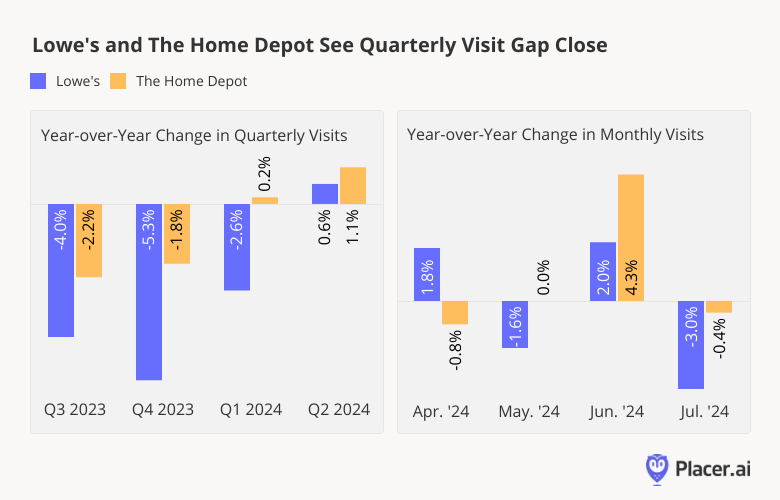
Last year was a challenging one for the home improvement space – as consumers cut back on discretionary spending and put pricey renovations on hold. But Q1 2024 visit data suggests that the category may be ready for a comeback. Throughout Q1 2024, Lowe’s saw its monthly visit gap narrow steadily – and in April 2024 saw the first YoY visit uptick the chain has experienced since 2021. And YoY visits to Home Depot were down just 0.3% in February 2024 and up 1.0% in March. Though Home Depot saw a minor visit gap emerge once again in April, the home improvement powerhouse appears to be on solid footing heading into the spring season.
While Home Depot and Lowe’s are rebounding, other home improvement chains are thriving. Discount chain Harbor Freight Tools continued to grow its footprint – and its visits – by expanding into new markets and cementing its role as a go-to destination for inexpensive home maintenance supplies. And farming essentials retailer Tractor Supply Co. also increased its store count together with its traffic. By occupying somewhat less discretionary niches, these two retailers have managed to avoid some of the headwinds plaguing the category.

The home decor segment, including brands like Homesense, HomeGoods (both owned by parent company TJX Companies), and At Home, offers consumers a way to enhance their living spaces while avoiding the high costs associated with renovations or moving. And in Q1 2024, shoppers leaned into the category’s offerings.
Despite lapping a strong 2023, Homesense – which recently decided to close its ecommerce channel and focus on offline expansion – saw YoY visit growth throughout Q1. And though inclement weather weighed on HomeGoods’ and At Home’s January performance, YoY visits to the two brands increased or remained stable in February and March. In April 2024, all three chains held steady with slight YoY visit gaps – no small feat given the category’s largely discretionary nature.

Indeed, diving into the demographics of visitors to Homesense, HomeGoods, and At Home reveals that it is more affluent consumers that are driving visits to the three chains. Each chain's potential market* boasts a median household income (HHI) close to or above the nationwide median of $76.1K/year. But the median HHI of each chain’s captured market is notably higher – suggesting it is the wealthiest consumer segments in each chain’s trade area that are visiting the brands.
*A chain’s potential market refers to the population residing in a given trade area, where the Census Block Groups (CBGs) making up the trade area are weighted to reflect the number of households in each CBG. A chain’s captured market weighs each CBG according to the actual number of visits originating to the chain from that CBG.
.avif)
Home improvement and decor chains have seen their shares of ups and downs over the past few years, from pandemic highs to inflationary lows. And while some players thrived in Q1 2024, others weathered headwinds while maintaining their equilibrium. How will the space continue to fare as 2024 progresses?
Follow Placer.ai to find out.

The Placer.ai Nationwide Office Building Index: The office building index analyzes foot traffic data from some 1,000 office buildings across the country. It only includes commercial office buildings, and commercial office buildings with retail offerings on the first floor (like an office building that might include a national coffee chain on the ground floor). It does NOT include mixed-use buildings that are both residential and commercial.
Recent survey data shows that while most people don’t want to go back to the office five days a week, they also don’t want to be fully remote. Many employees – and companies – prefer a middle-of-the-road approach that balances flexibility with opportunities for in-person engagement, learning, and collaboration.
But what’s happening on the ground? We checked in with our Nationwide and regional Office Indexes to find out.
Last month saw a continuation of the positive office recovery momentum observed in February and March 2024. April 2024 office visits were just 32.2% below what they were in the equivalent period of 2019 (pre-pandemic), and nearly the highest they’ve been since COVID. Comparing monthly visits to an April 2019 baseline also shows that April 2024 was outperformed only by August 2023 – a rare month featuring 23 business days. (April 2024 had 22 business days – as did April 2019).

Drilling down into the data for major regional hubs shows Miami and New York solidifying their office recovery leads with respective pre-COVID visit gaps of just 14.0% and 16.9%. But these weren’t the only cities to shine: Washington, D.C., Dallas, and Atlanta also outperformed the nationwide baseline – and like Miami, experienced their single busiest in-office months since COVID.

All the analyzed regional hubs saw significant YoY office visit growth – with the prize once again going to San Francisco, where visits were up 26.0%. Though San Francisco still lags significantly behind other regional hubs compared to pre-COVID, the city’s persistent YoY office visit growth may signal a light at the end of the Golden Gate City’s commercial real estate tunnel.
To be fair, April 2023 had two less business days than April 2024 – a fact that may have served to amplify YoY growth trends across the board. But even accounting for this discrepancy, last month’s strong office recovery was a particularly strong one – showing that RTO remains very much a work in progress.

The benefits and drawbacks of remote work are still being debated. But no matter how you slice it, spending some time in the office each week seems to have its benefits. As companies and employees continue to negotiate the new hybrid status quo, office visit patterns will continue to shift nationwide.
Follow Placer.ai for more data-driven office insights.

We dove into the latest foot traffic analytics for leading movie theater chains – AMC Theatres, Regal Cinemas, and Cinemark – to uncover how recent consumer behavior and visitor demographics are setting the stage for the cinema category’s next chapter.
Cinemas have yet to reclaim their pre-COVID glory – and during the first few months of 2024, visits to AMC and Regal, and to a lesser extent Cinemark, remained substantially below 2019 levels. While some of these visit gaps can be attributed to exhibitors downsizing their real estate portfolios, the rise in at-home entertainment continues to impact pre-pandemic foot traffic comparisons.
In addition, since the pandemic, blockbuster releases have taken on even greater importance as drivers of movie theater visit spikes. And in early 2024, a relative absence of new blockbusters took its toll on theater operators’ performance. Between January and April 2024, cinema leaders saw YoY visit dips – likely attributable in part to delayed releases. And smash-hit titles that drove box-office success in early 2023 – including Avatar: The Way of Water, Ant Man, and The Super Mario Bros. Movie – helped set the stage for challenging YoY comparisons.

Despite these visit gaps, analysis of changing visitor demographics suggests that there remain a variety of ways for theater operators to succeed.
Analyzing cinema leaders’ captured markets with demographics from STI: PopStats shows that today’s movie-goers are more affluent than they were before COVID. After dipping in Q1 2023, the median household incomes (HHIs) of AMC, Regal Cinema, and Cinemark’s captured markets spiked in Q1 2024, surpassing the chains’ own pre-pandemic benchmarks. This shift may be due in part to discretionary spending cutbacks by less affluent consumers – who may be particularly inclined to hold off on going to the movies when there are no big releases on offer.
For exhibitors, the increase in visitors’ spending power presents an important opportunity: Affluent movie-goers are likely to spend more on revenue-boosting concessions and premium formats, a boon for theater chains at a time when visit gaps linger.

Five years after COVID sent movie theaters into a tailspin, the category is holding its own. Though routine visits remain lower than they were before the pandemic, a shifting customer base continues to provide operators with new avenues for success.
For more data-driven entertainment insights, visit Placer.ai.
This blog includes data from Placer.ai Data Version 2.0, which implements improvements to our extrapolation capabilities, adds short visit monitoring, and enhances visit detection.

The fitness industry has experienced steady growth in recent years, propelled by consumers’ prioritization of health and wellness – and gyms across the country are benefiting.
So with 2024 underway, we dove into the data to examine the segment’s performance during the first months of the year. Did Fitness’ strong January showing persist beyond the season of new year’s resolutions? And how did major gym chains – including Planet Fitness, Life Time, Crunch Fitness, and EōS – perform in Q1 2024 relative to last year?
Fitness has been a consistent success story over the past few years, and the category is showing no signs of slowing down. Year-over-year (YoY) visits to the industry were up nearly every week between January and April 2024, with the sole exception of the week of January 15th, when an Arctic blast saw many people hunkering down indoors. And visits remained slightly elevated even during the week of March 25th, when Easter celebrations likely distracted many people from their gym goals – an impressive feat given the comparison to a non-holiday week in 2023.

Drilling down into visit trends for eight major fitness chains shows that in today’s robust fitness environment, there’s enough demand to sustain a variety of chains: Both premium and mid-range options like Life Time and LA Fitness as well as more affordable choices like Planet Fitness and Crunch Fitness saw visits increase or remain steady for most of Q1 – and all saw YoY visit bumps in April.

Some gym-goers hit the gym several times a week and spend hours working out, while others have a more relaxed get-in-shape schedule. And analyzing leading chains’ visitation patterns shows that gyms are finding success by catering to fitness buffs’ varying preferences.
Perhaps unsurprisingly, the data reveals a strong correlation between a chain’s share of frequent visitors (i.e. those visiting the gym eight or more times in a month), and a chain’s share of visitors staying longer than 90 minutes. While some clubs, including Life Time and EōS appear to attract highly dedicated gym-goers, others, including Planet Fitness and Anytime Fitness, seem to draw more casual visitors.
The fact that both fitness chains attracting frequent visitors for longer workouts and gyms that cater to more casual exercisers who spend less time in the gym during each session are seeing positive visitation trends indicates that there are plenty of models for fitness success in 2024.

One thing seems clear – interest in gyms is not going away anytime soon. Visits continue to show YoY growth, and the industry is full of options for every kind of fitness enthusiast. Whether opting for occasional visits or adhering to a structured workout regimen – there’s something for everyone.
To stay ahead of the latest retail and fitness developments, visit placer.ai/blog.

Following a busy week of Q1 2024 updates several restaurant chains, the key question facing operators is whether menu price increases the past several years have forced consumers into alternative food retail channels. Several restaurant chains--most notably McDonald’s–highlighted a more “discriminating” consumer during their quarterly updates. According McDonald’s CEO Chris Kempczinski on the company’s Q1 2024 update this week: “U.S. consumers continued to be even more discriminating with every dollar that they spend as they faced elevated prices in their day-to-day spending which is putting pressure on the QSR industry.” In turn, this has resulted in flat-to-declining industry traffic in the U.S. during the quarter. Looking at year-to-date visitation trends across the different restaurant categories, we see a weak start to the year due to inclement weather, followed by a rebound to low-single-digit growth for the limited-service categories (QSR and fast casual) and low-single-digit declines for the full-service restaurant chains.
As we discuss throughout this week’s Anchor report, consumers will likely remain discriminating over the next several quarters. As such, we expect a continuation of the channel shifts we’ve been witnessing across the broader food retail sector. According to our data, the QSR category saw a +5% increase in visits from 2019-2023, while the full-service restaurant category saw a -8% decrease in visits (partly explained by the permanent closure of many smaller, regional full-service dining chains). Conversely, the grocery, superstore, convenience store, and dollar/discount stores have all seen meaningfully higher visit growth over the same period (as our friends at Restaurant Business have also called out), indicating these channels are taking share from the restaurant industry.
Looking at McDonald’s cross-visitation trends during the quarter, we see further evidence of this shift. We’ve compared the favorite grocery chains of McDonald’s visitors in Q1 2024 to Q1 2023 below. We see a material increase in the percentage of McDonald’s visitors that visited an Aldi location year-over-year–24% versus 17% in the year ago period. We also see a decrease in percentage of visits to most conventional grocery chains.

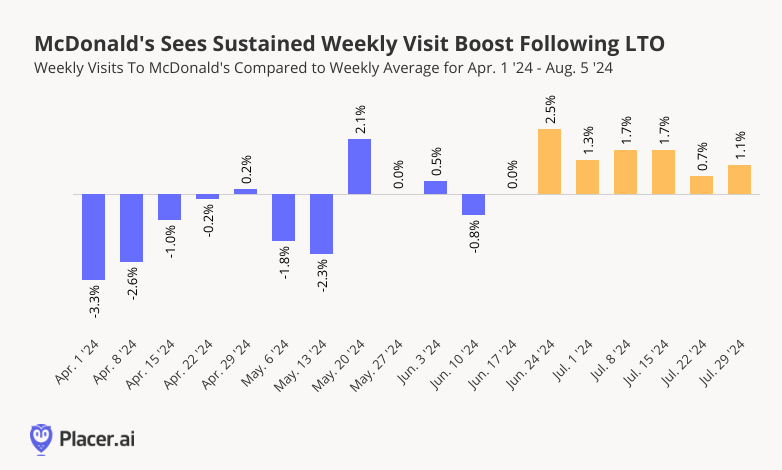
Not surprisingly, McDonald’s plans to accentuate its value offerings in the coming quarters. On its update call, management noted that 90% of its U.S. locations offer meal bundles for $4 or less and that it has been running several promotions through its digital app. The company also noted the need to align around a strong national value proposition so that the company can use its tremendous media scale to drive high consumer awareness. It will likely take time for McDonald’s to organize around its value platform, but once it does start to promote its value offerings on a nationwide basis, we would expect much of the rest of the QSR category to follow suit.

This weekend, Formula 1 is once again ready to take the track in the United States, this time at the Miami Grand Prix on Sunday. The Miami Grand Prix is the first U.S. race in the 2024 calendar, followed by the U.S. Grand Prix in Austin, Texas and the Las Vegas Grand Prix in the fall.
America has grown into the new epicenter of the sport and is the only country besides Italy to host multiple races in a singular season. Not only does the U.S. host races, but countless American retail, tech, CPG and hospitality brands serve as team sponsors, including Marriott, Rokt, Tommy Hilfiger, Google, eBay, Coca Cola and more. For brands looking at the consumption habits of younger, more affluent consumers, the rise of Formula 1 in the U.S. can help unlock insights on this group. Credit for Formula 1’s exponential growth in popularity is largely due to the Netflix docuseries, Drive to Survive, which just released its sixth season in the first quarter of 2024. According to Netflix, over 90 million hours of the program were watched throughout the first half of last year. The immense popularity of the show and its behind the scenes access to the luxurious world of F1 generated a large demand for the sport by Americans, and the appetite for home grown F1 races where U.S. based fans can participate is palpable.
2024 is the third running of the Miami Grand Prix, held around Hard Rock Stadium, with the event debuting in 2022. According to Placer.ai data, traffic at the event, which usually runs Thursday-Sunday, in 2023 increased 3% compared to 2022. Usually during grand prix weekends, visitors have the option to purchase single or multi-day passes, and our data (as shown below) indicates that there were fewer repeat visits in 2023 compared to 2022; consumers may have chosen single day passes more often or made the event a part of a larger weekend in Miami. The highest number of visits occurred on Sunday each year, which aligns with the fact that the actual race takes place that day, with practice sessions and qualifying taking place on Friday and Saturday respectively.

Despite slightly fewer loyal visits during the weekend, the time spent at the event increased, with an average of 179 minutes, up 4% year-over-year. With consumers spending around three hours at the venue, there is a huge opportunity for American CPG and retail companies to engage with this captive audience.
The U.S. Grand Prix, held annually in Austin, has seen similar success from the influx of American F1 fans. Traffic at the 2023 event weekend grew by 38% compared to 2019. 2022 saw peak event attendance, most likely due to a competitive and exhilarating end to the 2021 season that bled into the next year. 2023 also saw the highest percentage of three-day visits during the weekend, highlighting that most U.S. Grand Prix attendees visit the track multiple days for the various race weekend events.
While the growth of the event itself is impressive, the change in visitor demographics provides an even more striking opportunity for American retailers and brands. 2023 brought the highest percentage of visits from young professionals and young urban singles compared to all other segments in 2023. Young professionals also grew to 36% of visits in 2023 from less than 30% in 2019, showcasing the rise in younger and more affluent visitors. Both the popularity of Netflix coupled with the increase in influencer marketing brand trips to races may both have contributed to this shift over time.
It’s clear that Formula 1’s growing popularity has no doubt fueled race expansion stateside and that has been able to capture the attention of the elusive younger consumer, especially those with disposable income. Brands, licensees and retailers have all jumped on the opportunity to collaborate with drivers, teams and race weekends to tap into this growth market. Sporting events are a highly competitive landscape, excuse the pun, but the intersection of sports and content have paved the way for Formula 1’s success in the U.S.

Starbucks. Amazon. Barclays. AT&T. UPS. These are just some of the major corporations that have made waves in recent months with return-to-office (RTO) mandates requiring employees to show up in person more often – some of them five days a week.
But how are crackdowns like these taking shape on the ground? Is the office recovery still underway, or has it run its course? And how are evolving in-office work patterns impacting commuting hubs and dining trends? This white paper dives into the data to assess the state of office recovery in 2024 – and to explore what lies ahead for the sector in 2025.
In 2024, office foot traffic continued its slow upward climb, with visits to the Placer.ai Office Index down just 34.3% compared to 2019. (In other words, visits to the Placer.ai Office Index were 65.7% of their pre-COVID levels). And zooming in on year-over-year (YoY) trends reveals that office visits grew by 10.0% in 2024 compared to 2023 – showing that employee (and manager) pushback notwithstanding, the RTO is still very much taking place.
Indeed, diving into quarterly office visit fluctuations since Q4 2019 shows that office visits have been on a slow, steady upward trajectory since Q2 2020, following – at least since 2022 – a fairly consistent seasonal pattern. In Q1, Q2, and Q3 of each year, office visit levels increased steadily before dipping in holiday-heavy Q4 – only to recover to an even higher start-of-year baseline in the following Q1.
Between Q1 and Q3 2022, for example, the post pandemic office visit gap (compared to a Q4 2019 baseline) narrowed from 63.1% to 47.5%. It then widened temporarily in Q4 before reaching a new low – 41.4% – in Q1 2023. The same pattern repeated itself in both 2023 and 2024. So even though Q4 2024 saw a predictable visit decline, the first quarter of Q1 2025 may well set a new RTO record – especially given the slew of strict RTO mandates set to take effect in Q1 at companies like AT&T and Amazon.
Despite the ongoing recovery, the TGIF work week – which sees remote-capable employees concentrating office visits midweek and working remotely on Fridays – remains more firmly entrenched than ever.
In 2024, just 12.3% of office visits took place on Fridays – less than in 2022 (13.3%) and on par with 2023 (12.4%). Though Fridays were always popular vacation days – after all, why not take a long weekend if you can – this shift represents a significant departure from the pre-COVID norm, which saw Fridays accounting for 17.3% of weekday office visits.
Unsurprisingly, Tuesdays and Wednesdays remained the busiest in-office days of the week, followed by Thursdays. And Mondays saw a slight resurgence in visit share – up to 17.9% from 16.9% in 2023 – suggesting that as the RTO progresses, Manic Mondays are once again on the agenda.
Indeed, a closer look at year-over-five-year (Yo5Y) visit trends throughout the work week shows that on Tuesdays and Wednesdays, 2024 office foot traffic was down just 24.3% and 26.9%, respectively, compared to 2019 levels. The Thursday visit gap registered at 30.3%, while the Monday gap came in at 40.5%.
But on Fridays, offices were less than half as busy as they were in 2019 – with foot traffic down a substantial 53.2% compared to 2019.
Before COVID, long commutes on crowded subways, trains, and buses were a mainstay of the nine-to-five grind. But the rise of remote and hybrid work put a dent in rush hour traffic – leading to a substantial slowdown in the utilization of public transportation. As the office recovery continues to pick up steam, examining foot traffic patterns at major ground transportation commuting hubs, such as Penn Station in New York or Union Station in Washington, D.C., offers additional insight into the state of RTO.
Rush hour, for one thing – especially in the mornings – isn’t quite what it used to be. In 2024, overall visits to ground transportation hubs were down 25.0% compared to 2019. But during morning rush hour – weekdays between 6:00 AM and 9:00 AM – visits were down between 44.6% and 53.0%, with Fridays (53.0%) and Mondays (49.7%) seeing the steepest drops. Even as people return to the office, it seems, many may be coming in later – leaning into their biological clocks and getting more sleep. And with today’s office-goers less likely to be suburban commuters than in the past (see below), hubs like Penn Station aren’t as bustling first thing in the morning as they were pre-pandemic.
Evening rush hour, meanwhile, has been quicker to bounce back, with 2024 visit gaps ranging from 36.4% on Fridays to 30.0% on Tuesdays and Wednesdays. Office-goers likely form a smaller part of the late afternoon and evening rush hour crowd, which may include more travelers heading to a variety of places. And commuters going to work later in the day – including “coffee badgers” – may still be apt to head home between four and seven.
The drop in early-morning public transportation traffic may also be due to a shift in the geographical distribution of would-be commuters. Data from Placer.ai’s RTO dashboard shows that visits originating from areas closer to office locations have recovered faster than visits from farther away – indicating that people living closer to work are more likely to be back at their desks.
And analyzing the captured markets of major ground transportation hubs shows that the share of households from “Principal Urban Centers” (the most densely populated neighborhoods of the largest cities) rose substantially over the past five years. At the same time, the share of households from the “Suburban Periphery” dropped from 39.1% in 2019 to 32.7% in 2024. (A location’s captured market refers to the census block groups (CBGs) from which it draws its visitors, weighted to reflect the share of visits from each one – and thus reflects the profile of the location’s visitor base.)
This shift in the profile of public transportation consumers may explain the relatively slow recovery of morning transportation visits: City dwellers , who seem to be coming into the office more frequently than suburbanites, may not need to get as early a start to make it in on time.
While the RTO debate is often framed around employer and worker interests, what happens in the office doesn’t stay in the office. Office attendance levels leave their mark on everything from local real estate markets to nationwide relocation patterns. And industries from apparel to dining have undergone significant shifts in the face of evolving work routines.
Within the dining space, for example, fast-casual chains have always been workplace favorites. Offering quick, healthy, and inexpensive lunch options, these restaurants appeal to busy office workers seeking to fuel up during a long day at their desks.
Traditionally, the category has drawn a significant share of its traffic from workplaces. And after dropping during COVID, the share of visits to leading fast-casual brands coming from workplaces is once again on the rise.
In 2019, for example, 17.3% of visits to Chipotle came directly from workplaces, a share that fell to just 11.6% in 2022. But each year since, the share has increased – reaching 16.0% in 2024. Similar patterns have emerged at other segment leaders, including Jersey Mike’s Subs, Panda Express, and Five Guys. So as people increasingly go back to the office, they are also returning to their favorite lunch spots.
For many Americans, coffee is an integral part of the working day. So it may come as no surprise that shifting work routines are also reflected in visit patterns at leading coffee chains.
In 2019, 27.5% of visits to Dunkin’ and 20.1% of visits to Starbucks were immediately followed by a workplace visit, as many employees grabbed a cup of Joe on the way to work or popped out of the office for a midday coffee break. In the wake of COVID, this share dropped for both coffee leaders. But since 2022, it has been steadily rebounding – another sign of how the RTO is shaping consumer behavior beyond the office.
Five years after the pandemic upended work routines and supercharged the soft pants revolution, the office recovery story is still being written. Workplace attendance is still on the rise, and restaurants and coffee chains are in the process of reclaiming their roles as office mainstays. Still, office visit data and foot traffic patterns at commuting hubs show that the TGIF work week is holding firm – and that people aren’t coming in as early or from as far away as they used to. As new office mandates take effect in 2025, the office recovery and its ripple effects will remain a story to watch.

Many retail and dining chains performed well in 2024 despite the ongoing economic uncertainty. But with the consumer headwinds continuing into 2025, which brands can continue pulling ahead of the pack?
This report highlights 10 brands (in no particular order) that exhibit significant potential to grow in 2025 – as well as three chains that have faced some challenges in 2024 but appear poised to make a comeback in the year ahead. Which chains made the cut? Dive into the report to find out.
Through 2024, visits to Sprouts Farmers Market locations increased an average of 7.2% year-over-year (YoY) each month, outpacing the wider grocery segment standard by an average of six percentage points. And not only were visits up – monthly visits per location also grew YoY.
The promising coupling of overall and visits per location growth seems driven by the brands’ powerful understanding of who they are and what they bring to the market. The focus on high quality, fresh products is resonating, and the utilization of small- format locations is empowering the chain to bring locations to the doorstep of their ideal audiences.
This combination of forces positions the brand to better identify and reach key markets efficiently, offering an ideal path to continued growth. The result is a recipe for ongoing grocery success.
CAVA has emerged as a standout success story in the restaurant industry over the past several years. Traditionally, Mediterranean concepts have not commanded the same level of demand as burger, sandwich, Mexican, or Asian fast-casual concepts, which is why the category lacked a true national player until CAVA's rise. However, evolving consumer tastes have created a fertile landscape for Mediterranean cuisine to thrive, driven by factors such as social media influence, expanded food options via third-party delivery, growing demand for healthier choices, the rise of food-focused television programming, and the globalization of restaurant concepts .
CAVA’s success can be attributed to several key factors. Roughly 80% of CAVA locations were in suburban areas before the pandemic, aligning well with consumer migration and work-from-home trends. Additionally, CAVA was an early adopter of digital drive-thru lanes, similar to Chipotle’s "Chipotlanes," and began developing these store formats well before the pandemic. The brand has also utilized innovative tools like motion sensors in its restaurants to optimize throughput and staffing during peak lunchtime hours, enabling it to refine restaurant design and equipment placement as it expanded. CAVA’s higher employee retention rates have also contributed to its ability to maintain speed-of-service levels above category averages.
These strengths allowed CAVA to successfully enter new markets like Chicago in 2024. While many emerging brands have struggled to gain traction in new areas, CAVA’s visit-per-location metrics in recently entered markets have matched its national averages, positioning the brand for continued growth in 2025.
Ashley’s recent strategy shift to differentiate itself through experiential events, such as live music, workshops, and giveaways, is a compelling approach in the challenging consumer discretionary category. Post-pandemic, commercial property owners have successfully used community events to boost visit frequency, dwell time, and trade area size for mall properties. It’s no surprise that retailers like Ashley are adopting similar strategies to engage customers and enhance their in-store experience.
The decision to incorporate live events into its marketing strategy reflects the growing demand for experiential and immersive retail experiences. While home furnishings saw a surge in demand during the pandemic, the category has struggled over the past two years, underperforming other discretionary retail sectors compared to pre-pandemic levels. Recognizing this challenge, Ashley’s rebrand focuses on creating interactive and memorable experiences that allow customers to engage directly with its products and explore various design possibilities. In turn, this has helped to drive visits from trade areas with younger consumers with lower household incomes.
Ashley has leaned into collaborations with interior designers and industry experts to offer informative sessions and workshops during these events. These initiatives not only attract traffic but also provide valuable insights into customers’ preferences, which can be used to refine product offerings, enhance customer service, and shape future marketing efforts. This approach is particularly relevant as millennials and Gen Z drive new household formation. While still early, Ashley’s pivot to live events is showing promising results in attracting visits and increasing customer engagement.
Department stores have had many challenges in navigating changing consumer behavior and finding their place in an evolving retail landscape. Nordstrom, an example of department store success in 2024, has been able to maintain a strong brand relationship with its shoppers and regain its footing with its store fleet. While the chain has certainly benefited from catering to a more affluent, and less price sensitive, consumer base, it still shines in fostering a shopping experience that stands out.
Value might be a driver of retail visitation across the industry, but for Nordstrom, service and experience is paramount. The retailer has downplayed promotional activity in favor of driving loyalty among key visitors. Nordstrom also has captured higher shares of high-value, younger consumer segments, which defies commonly held thoughts about department stores. The chain was a top visited chain during Black Friday in 2024, showcasing that it’s top of mind for shoppers for both gift giving and self-gifting.
What’s next? Nordstrom announced at the end of December that it plans to go private with the help of Mexican retail chain Liverpool. We expect to see even more innovation in store experience, assortments and services with this newfound flexibility and investment. And, we cannot forget about Nordstrom Rack, which allows the retailer to still engage price-conscious shoppers of all income levels, which is certainly still a bright spot as we head into 2025.
Visits are up, and the audience visiting Sam’s Club locations seems to be getting younger which – when taken together – tells us a few critical things. First, Sam’s Club has parlayed its pandemic resurgence into something longer term, leveraging the value and experience it provides to create loyal customers. Second, the power of its offering is attracting a newer audience that had previously been less apt to take advantage of the unique Sam’s Club benefits.
The result is a retailer that is proving particularly adept at understanding the value of a visit. The membership club model incentives loyalty which means that once a visitor takes the plunge, the likelihood of more visits is heightened significantly. And the orientation to value, a longer visit duration, and a wide array of items on sale leads to a larger than normal basket size.
In a retail segment where the value of loyalty and owning ‘share of shopping list’ is at a premium, Sam’s Club is positioned for the type of success that builds a foundation for strength for years to come.
Raising Cane’s exemplifies the power of focus by excelling at a simple menu done exceptionally well. Over the past several years, the chain has been one of the fastest-growing in the QSR segment, driven by a streamlined menu that enhances speed and efficiency, innovative marketing campaigns, and strategic site selection in both new and existing markets. Notably, Raising Cane’s ranked among the top QSR chains for visit-per-location growth last year. Unlike many competitors that leaned on deep discounts or nostalgic product launches to boost traffic in 2024, Raising Cane’s relied on operational excellence to build brand awareness and drive visits. This approach has translated into some of the highest average unit sales in the segment, with restaurants averaging around $6 million in sales last year.
Raising Cane’s operational efficiency has also been a key driver of its rapid expansion, growing from 460 locations at the end of 2019 to more than 830 heading into 2025. This includes over 100 new store openings in 2024 alone, placing it among the top QSR chains for year-over-year visit growth. The chain’s ability to maintain exceptional performance while scaling rapidly highlights its strong foundation and operational strategy.
While Life Time has fitness at its core, it has also expanded to become a lifestyle. Healthy living is its mantra and this extends to both the gym aspect, but also the social health of its members with offerings like yoga, childcare, personalized fitness programs, coworking, and even an option for luxury living just steps away.
With all these choices, it’s no wonder that its members are more loyal than others in its peer group.
To the delight of book lovers everywhere, Barnes & Noble is back in force. With a presence in every single state and approximately 600 stores, location options are growing to browse bestsellers, chat with in-store bibliophiles, or grab a latte. Stores are feeling cozier and more local, with handwritten recommendations across the store. The chain’s extensive selection of gifts and toys mean that one can stop in for more than just books. The membership program is also relaunching, rewarding members for their purchases. Even though some locations have downsized, efficiency is up with average visits per square foot increasing over the last 3 years. Customers are also lingering, with nearly 3 in 10 visitors staying 45 minutes or longer.
With options for a “third place” that’s not home or work dwindling, Barnes & Noble is poised to fill that hole.
From its origins as a corner grocery store in Queens, NY 42 years ago, H Mart now boasts over 80 stores throughout the US. Shoppers are enticed by the aroma of hot roasted sweet potatoes wafting through the store, the opportunities to try new brands like Little Jasmine fruit teas, and the array of prepared foods such as gimbap and japchae. In addition to traditional Korean, Chinese, and Japanese groceries, H Mart’s assortment has expanded to staple items and American brands as well like Chobani yogurt or Doritos.
As the Hallyu wave sweeps across the nation and K-pop stars like Rose top the charts for the eight straight week with the catchy “APT”, so too is the appetite for Asian food. At the second-most visited H Mart in the nation in Carrollton, TX, the ethnic makeup of customers is 39% White, 14% Black, 23% Hispanic or Latino, and 20% Asian – reflecting the truly universal appeal of this supermarket chain.
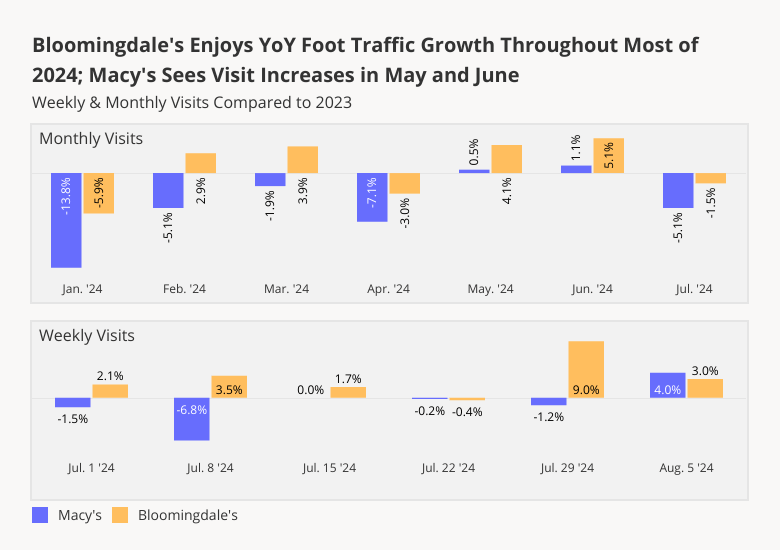
Beauty retail had a transformative 2024, with a general cooling off in demand for the category. Competition between chains has increased and delivering quality products, expertise and services is critical to maintain visits. Against this backdrop, Bluemercury stands out as a shining star in parent company Macy’s portfolio of brands, with the brand well positioned to take on this next chapter of beauty retail.
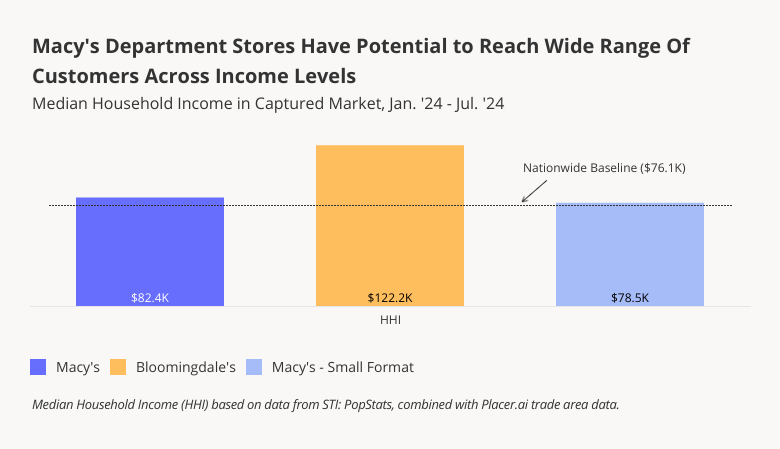
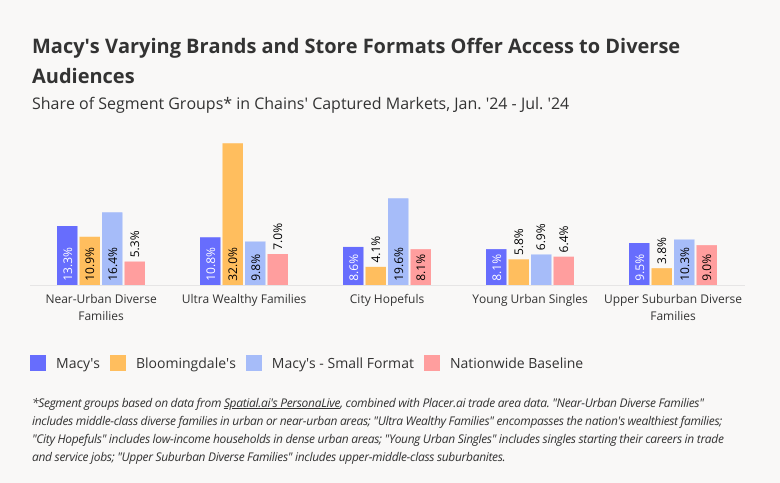
Bluemercury’s success lies in its ability to be a retailer, an expert, and a spa service provider to its consumers. Placer data has shown that beauty chains with a service and retail component tend to attract more visitors than those who just specialize in retail offerings, and Bluemercury is no exception. The chain also focuses solely on the prestige market within the beauty industry and caters to higher income households compared to the broader beauty category; both of those factors have contributed to more elastic demand than with other retailers.
Bluemercury’s bet on product expertise and knowledge combined with a smaller format store help to foster a strong connection between the beauty retailer and its consumers. The brand overindexes with visitors “seeking youthful appearance” and has cemented itself as a destination for niche and emerging beauty brands. As the larger Macy’s brand grapples with its transformation, Bluemercury’s relevance and deep connection to its consumer base can serve as an inspiration, especially as the beauty industry faces mounting uncertainty.
Competitors like Dutch Bros and 7Brew are on the rise, critical office visitation patterns remain far behind pre-pandemic levels, and the chain did not end the year in the most amazing way in terms of visit performance. But there is still so much to love about Starbucks – and the addition of new CEO Brian Niccol positions the coffee giant to rebound powerfully.
The focused attention on leaning into its legendary ‘third place’ concept is in excellent alignment with the shift to the suburbs and hybrid work and with audiences that continue to show they value experience over convenience. But the convenience-oriented customer will likely also benefit from the brand’s recent initiatives, including pushes to improve staffing, mobile ordering alignment and menu simplification. In addition, the brand is still the gold standard when it comes to owning the calendar, as seen with their annual visit surges for the release of the Pumpkin Spice Latte or Red Cup Day and their ability to capitalize on wider retail holidays like Black Friday and Super Saturday.
The combination of the tremendous reach, brand equity, remaining opportunities in growing markets and the combined ability to address both convenience and experience oriented customers speaks to a unique capacity to regain lost ground and drive a significant resurgence against the expectations of many.
Retail has had its challenges this year, with many consumers opting for off-price to snag deals – but the strength of the Adidas brand should not be underestimated. Gazelles and Sambas are still highly coveted, and a partnership with Messi x Bad Bunny racked up over a million likes. Consumers are favoring classic silhouettes across both shoes and clothing, and nothing says classic like those three stripes.
Gap, and its family of brands including Old Navy and Banana Republic, are synonymous with American apparel retail. The namesake brand has always been at the center of comfort, value and style, but over time lost its way with consumers. However, over the past year and a half, the reinvigoration of the Gap family of brands has started to take shape under the direction of CEO Richard Dickson.
New designs, collaborations, splashy marketing campaigns and store layouts have taken shape across the portfolio. While we haven’t seen a lot of change in visitation to stores over the past year, trends are certainly moving in the right direction and outpacing many other brands in the apparel space. Gap has also reinserted itself into the fabric of American fashion this past year with designs for the Met Gala.
The benefit of Gap Inc.’s portfolio is that each brand has a distinct and unique audience of consumers that it draws from. This allows each brand to focus on meeting the needs of its visitors directly instead of trying to be all things for a broader group of consumers. Old Navy in particular has a strong opportunity with consumers as value continues to be a key motivator.
Gap has done all of the right things to not only catch up to consumers’ expectations but to rise beyond them. Even as legacy store-based retail brands have seen more disruption over the past few years, Gap is ready to step back into the spotlight.
The diversity of brands featured in this report highlight the variety of categories and strategic initiatives that can drive retail and dining success in 2025.
Sprouts’ focus on quality products and small-format stores, CAVA’s rise as a suburban dining powerhouse, and Nordstrom’s commitment to customer experience all highlight how understanding and responding to consumer needs can drive success. Brands like Ashley Furniture, Sam’s Club, H Mart, and Life Time have shown how offering a unique value proposition within a crowded segment, leveraging loyalty, and creating memorable experiences can fuel growth. And Raising Cane’s demonstrates the power of simplicity and operational efficiency in building momentum.
At the same time, niche players like Bluemercury are excelling by catering to specific audiences with authenticity and expertise. And while Starbucks, Adidas, and Gap Inc. face challenges, the three companies’ brand equity and revitalization efforts suggest potential for a significant comeback.