.png)
.png)

.png)
.png)

Mall visit trends improved slightly in July 2025. Indoor mall traffic grew 1.3% year-over-year, reversing June's visit declines. This growth highlights indoor malls' rebound and suggests that enclosed shopping centers continue to attract consumers seeking climate-controlled comfort during peak summer heat.
Meanwhile, open-air shopping centers and outlet malls narrowed their visit gaps, with visits to open-air shopping centers almost on par with July 2024 levels and visits to outlet malls just 2.1% lower than this time last year.
Diving into the weekly data reveals a more complex picture. While mid-July visits were generally up relative to 2024 – perhaps boosted by the various July sales events – traffic across all three formats softened towards the end of the month. This may suggest that these major promotional events may be pulling demand forward rather than generating sustained, incremental traffic and highlights the challenge of converting a promotional 'sugar rush' into lasting momentum.
Boise Towne Square significantly outpaced the broader Placer.ai Indoor Mall Index in July, posting 12.2% year-over-year growth versus the national average of 1.3% – extending the Idaho mall's exceptional performance streak throughout 2025. And remarkably, Boise Towne Square has also consistently surpassed its pre-pandemic visit level every month of 2025 so far.
While multiple factors likely contribute to this strength, a major traffic driver has been the new In-N-Out location that opened in the mall in late October 2024. Since the opening, visits to Boise Towne Square have steadily increased, and other tenants – including other dining establishments – have also benefited from sustained visit improvements across the entire mall.
This demonstrates the powerful halo effect that a high-draw non-traditional anchor tenant can create for an entire shopping center.
To check out retail foot traffic trends for yourself, try Placer.ai's free industry trends tool.
.avif)
Despite persistent economic uncertainty, the retail sector continues to show signs of stability, though not without caveats. Store closures have put pressure on vacancies, while new construction remains limited. Yet, leasing momentum has persisted in prime locations, supported by resilient consumer demand and evolving tenant strategies. In this report, we explore the key takeaways across retail fundamentals and shifting consumer behavior, using foot traffic trends to illuminate where the market is headed next.
Overall consumer foot traffic was up year-over-year in the first half of 2025, pointing to the resilience of the U.S. consumer and the continued demand for brick-and-mortar channels. Car wash services received the most significant visit spike, followed by theaters, music venues, and attractions. However, out-of-home entertainment still has a way to go before reaching pre-COVID visit levels. Traffic to fitness chains also increased, an impressive accomplishment given the category's multi-year growth streak.
Meanwhile, visits lagged for discretionary categories, especially those carrying larger-ticket items, such as home improvement retailers and electronics stores. Traffic to gas stations and C-stores was also below 2024, perhaps due to the recent dip in domestic travel.
Source: Colliers, Placer.ai
Analyzing the top 10 chains from the Placer 100 Retail and Dining Index with the most significant YoY growth in visits per venue in H1 2025 highlights consumers' current preference for affordable brands. Chili's took the top spot – its ongoing value promotions are still resonating with diners and driving traffic to the chain in 2025. Crunch Fitness, Ollie's Bargain Outlet, and HomeGoods – each known for their affordability– also made the top 10 list.
Several chains catering to mid- and high-income consumers – including Nordstrom, Staples, LA Fitness, and Barnes & Noble – experienced significant growth in visits per venue. This suggests that while value matters, brands don't need the lowest prices to win customers. Consumers want confidence that they're getting their money's worth. Brands that effectively communicate their value proposition can thrive, no matter the final price point.
Source: Colliers, Placer.ai
The first half of 2025 painted a mixed picture for retail real estate. While well-located centers continued to see solid leasing activity and rent stability, a surge in store closures placed an upward pressure on vacancies across lower-tier assets. New construction remains muted amid high borrowing costs, with most developers focusing on repositioning existing spaces. Absorption and leasing activity reflected the broader theme of bifurcation—strong demand for value-driven and experiential retail on one end, and lingering weakness in legacy retail formats.
Despite ongoing macroeconomic noise – from inflationary pressures to tariff uncertainty – U.S. retail sales posted steady year-over-year growth across the first half of 2025.
Source: Colliers, Census Bureau
One of the most overlooked trends this year is who is driving the spending. A recent Fed working paper highlighted that when using granular, self-reported income data, the narrative shifts dramatically: much of the consumer "resilience" is being propped up by high-income households, while middle- and lower-income groups are pulling back. Retailers that cater to affluent demographics or can flex their value proposition are faring better than those stuck in the middle.
Retailers should note that underlying volume growth, which strips out inflation and tariff-influenced buying, has been consistently weaker than top-line figures suggest. Analysts warn that this could foreshadow softer performance in the second half of 2025, especially as inflation, interest rates, and tariff impacts start to ripple more clearly through the supply chain.
Looking ahead to the second half of 2025, the retail sector is expected to remain stable but face growing macroeconomic pressures. Vacancy rates should hold steady, supported by a sharp 45% drop in new construction, though closures in freestanding formats (like pharmacies and discount stores) may cause localized upticks. Asking rents are projected to rise by about 2%, driven by limited supply and steady tenant demand. While net absorption may ease slightly, it is expected to remain positive across malls and open-air centers. Store-based retail sales are forecast to grow 1.5% in 2025, maintaining a 76% share of total retail sales. However, elevated inflation could weigh on consumer volume growth and leasing momentum in more price-sensitive segments.
For more data-driven insights, visit placer.ai/anchor.
At Colliers, we’re proud to partner with Placer.ai, an industry-leading foot traffic analytics platform, to deliver more profound insights into the evolving retail landscape. As enterprise users of the tool, we’ve combined location intelligence with market fundamentals to uncover the trends shaping retail real estate in the first half of 2025.

Xiao Long Bao, or soup dumplings, have long been a staple at Chinese restaurants. Kids’ faces would light up as the bamboo steamer was uncovered and the big question swirled around how to eat it: take a small nibble and slowly savor the soup first or let it cool and eat in one big bite? Both options were enormously satisfying, and now the cat is out of the bag and xiao long bao have taken the world by storm.
Din Tai Fung began selling dumplings in 1978 in Taipei, Taiwan. Over the years, one of the Hong Kong branches has become a 5-time Michelin Star winner, and the chain has now expanded to 13 countries with 180 locations around the world. A recent Restaurant Business Online article revealed that “Din Tai Fung’s per-restaurant average of $27.4 million is nearly two times higher than the next closest brand, an astounding feat for a casual-dining chain.” The next 4 highest AUV restaurants are all steakhouses. The article continues with saying that “to generate unit volumes of that magnitude, a restaurant generally has to do three things: It has to be big, customers have to spend a decent amount, and it has to be busy. Din Tai Fung checks all three of those boxes.”
Go to any Din Tai Fung and you will often see lines snaking out the door, even in between meal times, like at 2pm. Their enormous popularity also has a great upside for the malls in which they reside. There’s a wait? No problem, one can shop while waiting to be called.
In the past year, malls with a Din Tai Fung consistently outperformed the indoor mall and open-air lifestyle center index. Even in some months where mall traffic was down year-over-year, the malls with a Din Tai Fung were often positive.
There are two likely explanations for these trends: 1) that Din Tai Fung is simply good at choosing its locations, placing its restaurants in centers that are already bustling and with an audience or trade area receptive to its offering, or 2) that Din Tai Fung is helping to drive this mall traffic. It may also be a bit of both, with a symbiotic relationship occurring.
Analyzing a location that has had a recent Din Tai Fung opening, namely Santa Monica Place in Southern California reveals that the addition of the restaurant also helps boost dwell time and evening visits.
This makes sense, as the opening of large restaurants in a shopping center increases one of the “occasions” for visiting, namely dinner. In particular, the timeframe after 7 PM has also expanded in popularity. Concurrently, dwell time at the mall has risen with the opening of this new restaurant, from an average of 45 minutes to now 58 minutes.
Din Tai Fung’s first US location was on Baldwin Ave in Arcadia, CA which opened in 2000. Before its worldwide expansion, it was already a local San Gabriel Valley gem. Looking at Placer data for this stand-alone restaurant in an outdoor center, we see that it was already showing signs of greater visits per square foot than many other peer establishments in the neighborhood, including other Chinese restaurants. After flying a bit under the radar for over a dozen years, a flagship restaurant opened at Santa Anita mall across the way in 2016. The original Arcadia location eventually closed in late July 2020, but since then many others have popped open all over the US.
Din Tai Fung has many things going for it, particularly as Asian food and culture has been exploding in popularity in the United States. One San Francisco Chronicle article talks about how two SF malls, Japantown and Stonestown Galleria, are defying the mall doom loop by “capturing the zeitgeist by offering unique Japanese, Korean, and Chinese pop culture.” In addition to providing tasty food, Din Tai Fung is also in the unique position of featuring a lot of shareables at affordable price points.
While steak dinners might be more for business or special occasion meals, Din Tai Fung is elevated enough to be a treat, but a lesser hit on the wallet. As dining becomes more experiential, diners enjoy being able to try a variety of main and side dishes. Locations allow you to peek in on the action, with the chefs painstakingly pleating the soup dumplings to exacting proportions of 18 folds and 21 grams. As someone who has been frequenting Din Tai Fung since its first US location opened as a stand-alone restaurant in Arcadia, as well as 11 of the US locations and the original in Taiwan, the company also maintains extremely high standards and consistent execution.

Ultimately, Din Tai Fung's success suggests that a combination of operational excellence and experiential dining can create a destination brand that elevates the entire ecosystem around it.
For more data-driven insights, visit placer.ai/anchor.

Following a period of caution in May and June, U.S. industrial manufacturing facilities saw a significant surge of activity in July 2025. As we've noted previously, many manufacturers experienced an increase in visits during March and April to build inventory ahead of initial tariff implementation dates, followed by a normalization period in May and June as businesses adopted a "wait-and-see" approach. However, with the hard deadline of August 1st for new, widespread tariffs, July was marked by a dramatic uptick in visits from both employees and logistics partners as companies made a last-ditch effort to maximize output and shipments.
This flurry of activity was particularly intense in highly interconnected sectors like auto manufacturing, industrial machinery, and metals processing, all of which are vulnerable to tariffs on imported raw materials and components. Metals processing plants, for example, ramped up operations to convert as much raw steel and aluminum as possible before their costs increased. In turn, auto and industrial machinery manufacturers accelerated their own production lines, pulling in vast quantities of both processed metals and specialized foreign parts to build up inventory before the new duties could disrupt their supply chains.
This final pre-tariff rush was evident in our data: the increase in employee visits to factories signaled that production lines were running at high capacity, while a sharp rise in visits from logistics partners – like truckers and other carriers – indicated a massive push to move finished goods and components through the supply chain before the August 1st implementation date.
For more data-driven consumer insights, visit placer.ai/anchor.

In a challenging macroeconomic environment, full-service restaurants (FSRs) face mounting pressure to attract and retain diners. Recent foot traffic data underscores a growing divide among top FSR players:
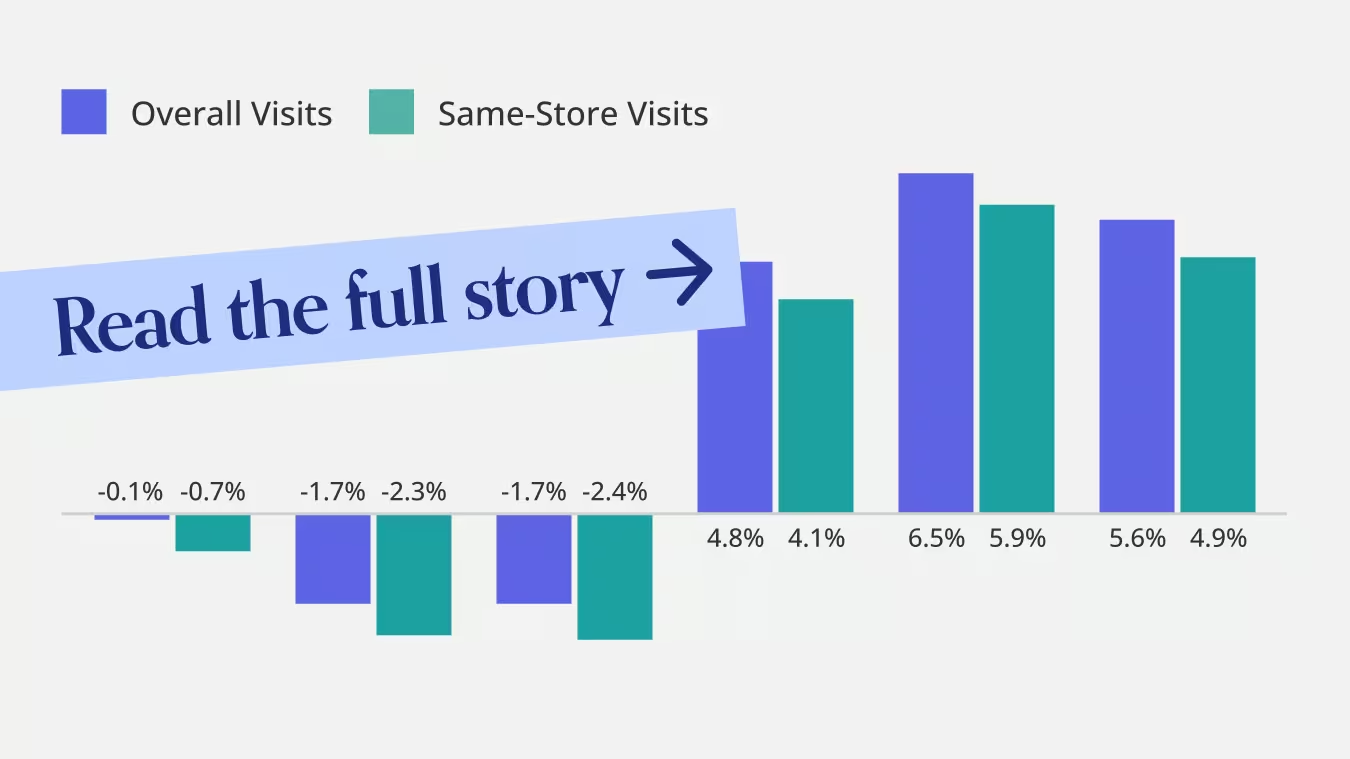
Brinker International (EAT), parent to Chili’s Grill & Bar and Maggiano’s Little Italy, continued its winning streak with double-digit YoY visit growth in Q2.
Texas Roadhouse’s portfolio (TXRH), featuring its flagship steakhouse, Bubba-33, and Jaggers, saw moderate (+4.1%) YoY overall visit gains and slightly increased same-store visits, reflecting steady performance at existing sites amid ongoing expansion.
Bloomin’ Brands (Outback Steakhouse, Carrabba's Italian Grill, Bonefish Grill, and Fleming's Prime Steakhouse & Wine Bar) experienced YoY foot traffic declines. While Bloomin’ narrowed its YoY visit gap in Q2, it remains squeezed between the aggressive value messaging of chains like Chili’s and the focused execution of competitors like Texas Roadhouse.
What lies behind Chili’s and Texas Roadhouse’s standout success in 2025?
Chili’s visits began to surge in Q2 2024 – the result of a turnaround plan executed by CEO Kevin Hochman after he took the helm in 2022. By reducing and refining the menu, boosting efficiency, and focusing on craveable yet affordable dishes, Chili’s cut costs and funneled the savings into compelling promotions. The company also worked to make its brand more fun and buzzworthy, setting the stage for viral TikTok moments amplified by well-coordinated influencer campaigns. Meanwhile, menu innovations – most notably the Big Smash Burger, added to the company’s “3 for Me” value menu in April 2024 – drove a lasting traffic boost that persisted into 2025 as the chain continued updating its value meal.
Texas Roadhouse, by contrast, has pursued steady expansion over the past several years. Like Chili’s, it relies on a focused, core menu to maintain quality and efficiency, but unlike Chili’s it rarely changes up its offerings, sticking instead to consistently excelling at what it does best. The steakhouse chain also famously forgoes nationwide advertising in favor of local engagement and a strong reputation for everyday value. Although per-location visit growth at Texas Roadhouse softened slightly in early 2025 – perhaps reflecting heightened consumer attention to limited-time offers and special promotions – the steakhouse continues to grow its footprint while limiting cannibalization.
Despite following different paths to growth, Chili’s and Texas Roadhouse have both made focused menus a core tenet of their strategies. And with menu simplification proving effective in today’s crowded market, it is no surprise that Bloomin’ Brands has recently outlined its own plans to cut costs and boost consistency by trimming menus – particularly at Outback Steakhouse.
Ultimately, foot traffic translates into market share, and both Chili’s and Texas Roadhouse have grown their portions of the overall FSR visit pie. While Texas Roadhouse has steadily augmented its reach over several years, Chili’s saw a sharp surge in H1 2025, propelled by its aggressive value-driven initiatives.
The varied performances of Brinker, Texas Roadhouse, and Bloomin’ Brands underscore the critical need for a clear, disciplined strategy in today’s competitive casual dining sector. And Chili's and Texas Roadhouse’s successes demonstrate how menu simplicity and operational efficiency can fuel distinct avenues to success.
As these brands head into the second half of 2025, several questions loom large for executives and investors:
The coming months will test whether Chili’s and Texas Roadhouse can maintain their winning formulas – and whether Bloomin’ Brands can course-correct through targeted menu reductions and promotional recalibrations.
For more data-driven dining insights, visit placer.ai/anchor.

Health and wellness continue to be a major priority for most Americans, and the fitness industry continues to reap the benefits. This segment has ample room for all kinds of gym-goers, from luxury athletic chains like Life Time to more accessible and affordable options like Planet Fitness. We took a look at visitation patterns to these two chains in Q2 2025 to understand their recent performance
Upscale gym chain Life Time has evolved into a wellness powerhouse over the years, offering its members access to fitness classes, luxury amenities, and even co-working and residential spaces.
Though the chain experienced impressive visit growth in 2024, YoY visits slowed slightly in 2025 – perhaps owing in part to the difficult comparison to a particularly strong 2024. Still, visit gaps were fairly minimal – Q2 2025 visits were just -0.6% lower than in Q2 2024, and average visits per location were just -1.5% lower year-over-year.
And while visits may have moderated somewhat in the first half of the year, Life Time seems confident about its market position, with several new locations in the pipeline for 2025 and 2026.
While Life Time caters to gym-goers looking for a luxury wellness experience, Planet Fitness offers easily accessible, judgment-free fitness zones that welcomes all kinds of gym-goers. This model, characterized by its low monthly fees and basic amenities, aims to appeal to a broad consumer base.
And foot traffic trends suggest that this model is not just working, it’s thriving: YoY visits were elevated by 10.1% in Q2 2025, and average visits per location grew by 6.2% in the same period. This growth comes on the heels of its elevated visits throughout H2 2024 – a promising sign for the chain as it begins a major expansion push.
A closer look at visit data highlights that visit frequency at Life Time is consistently higher than at Planet Fitness. Throughout 2025, visitors to Planet Fitness visited an average of 4.1 to 4.4 times a month, while visitors to Life Time visit an average of 5.7 to 6.2 times a month.
This reflects the two brands’ different models: Life Time aims to be a true one-stop-shop for wellness, combining co-working spaces and residential living with its fitness offerings, elements that encourage members to visit more frequently. Meanwhile, Planet Fitness’s focus on affordability and a straightforward gym-going experience attracts budget-conscious gym-goers whose visits, while slightly less frequent, align with their demand for simple, convenient fitness.
Life Time and Planet Fitness occupy two very different ends of the fitness and wellness spectrum – and both are proving that there’s room for variety in the gym segment.
How might the second half of the year look for these two chains?
Visit Placer.ai/anchor for the latest data-driven fitness insights.

Many retail and dining chains performed well in 2024 despite the ongoing economic uncertainty. But with the consumer headwinds continuing into 2025, which brands can continue pulling ahead of the pack?
This report highlights 10 brands (in no particular order) that exhibit significant potential to grow in 2025 – as well as three chains that have faced some challenges in 2024 but appear poised to make a comeback in the year ahead. Which chains made the cut? Dive into the report to find out.
Through 2024, visits to Sprouts Farmers Market locations increased an average of 7.2% year-over-year (YoY) each month, outpacing the wider grocery segment standard by an average of six percentage points. And not only were visits up – monthly visits per location also grew YoY.
The promising coupling of overall and visits per location growth seems driven by the brands’ powerful understanding of who they are and what they bring to the market. The focus on high quality, fresh products is resonating, and the utilization of small- format locations is empowering the chain to bring locations to the doorstep of their ideal audiences.
This combination of forces positions the brand to better identify and reach key markets efficiently, offering an ideal path to continued growth. The result is a recipe for ongoing grocery success.
CAVA has emerged as a standout success story in the restaurant industry over the past several years. Traditionally, Mediterranean concepts have not commanded the same level of demand as burger, sandwich, Mexican, or Asian fast-casual concepts, which is why the category lacked a true national player until CAVA's rise. However, evolving consumer tastes have created a fertile landscape for Mediterranean cuisine to thrive, driven by factors such as social media influence, expanded food options via third-party delivery, growing demand for healthier choices, the rise of food-focused television programming, and the globalization of restaurant concepts .
CAVA’s success can be attributed to several key factors. Roughly 80% of CAVA locations were in suburban areas before the pandemic, aligning well with consumer migration and work-from-home trends. Additionally, CAVA was an early adopter of digital drive-thru lanes, similar to Chipotle’s "Chipotlanes," and began developing these store formats well before the pandemic. The brand has also utilized innovative tools like motion sensors in its restaurants to optimize throughput and staffing during peak lunchtime hours, enabling it to refine restaurant design and equipment placement as it expanded. CAVA’s higher employee retention rates have also contributed to its ability to maintain speed-of-service levels above category averages.
These strengths allowed CAVA to successfully enter new markets like Chicago in 2024. While many emerging brands have struggled to gain traction in new areas, CAVA’s visit-per-location metrics in recently entered markets have matched its national averages, positioning the brand for continued growth in 2025.
Ashley’s recent strategy shift to differentiate itself through experiential events, such as live music, workshops, and giveaways, is a compelling approach in the challenging consumer discretionary category. Post-pandemic, commercial property owners have successfully used community events to boost visit frequency, dwell time, and trade area size for mall properties. It’s no surprise that retailers like Ashley are adopting similar strategies to engage customers and enhance their in-store experience.
The decision to incorporate live events into its marketing strategy reflects the growing demand for experiential and immersive retail experiences. While home furnishings saw a surge in demand during the pandemic, the category has struggled over the past two years, underperforming other discretionary retail sectors compared to pre-pandemic levels. Recognizing this challenge, Ashley’s rebrand focuses on creating interactive and memorable experiences that allow customers to engage directly with its products and explore various design possibilities. In turn, this has helped to drive visits from trade areas with younger consumers with lower household incomes.
Ashley has leaned into collaborations with interior designers and industry experts to offer informative sessions and workshops during these events. These initiatives not only attract traffic but also provide valuable insights into customers’ preferences, which can be used to refine product offerings, enhance customer service, and shape future marketing efforts. This approach is particularly relevant as millennials and Gen Z drive new household formation. While still early, Ashley’s pivot to live events is showing promising results in attracting visits and increasing customer engagement.
Department stores have had many challenges in navigating changing consumer behavior and finding their place in an evolving retail landscape. Nordstrom, an example of department store success in 2024, has been able to maintain a strong brand relationship with its shoppers and regain its footing with its store fleet. While the chain has certainly benefited from catering to a more affluent, and less price sensitive, consumer base, it still shines in fostering a shopping experience that stands out.
Value might be a driver of retail visitation across the industry, but for Nordstrom, service and experience is paramount. The retailer has downplayed promotional activity in favor of driving loyalty among key visitors. Nordstrom also has captured higher shares of high-value, younger consumer segments, which defies commonly held thoughts about department stores. The chain was a top visited chain during Black Friday in 2024, showcasing that it’s top of mind for shoppers for both gift giving and self-gifting.
What’s next? Nordstrom announced at the end of December that it plans to go private with the help of Mexican retail chain Liverpool. We expect to see even more innovation in store experience, assortments and services with this newfound flexibility and investment. And, we cannot forget about Nordstrom Rack, which allows the retailer to still engage price-conscious shoppers of all income levels, which is certainly still a bright spot as we head into 2025.
Visits are up, and the audience visiting Sam’s Club locations seems to be getting younger which – when taken together – tells us a few critical things. First, Sam’s Club has parlayed its pandemic resurgence into something longer term, leveraging the value and experience it provides to create loyal customers. Second, the power of its offering is attracting a newer audience that had previously been less apt to take advantage of the unique Sam’s Club benefits.
The result is a retailer that is proving particularly adept at understanding the value of a visit. The membership club model incentives loyalty which means that once a visitor takes the plunge, the likelihood of more visits is heightened significantly. And the orientation to value, a longer visit duration, and a wide array of items on sale leads to a larger than normal basket size.
In a retail segment where the value of loyalty and owning ‘share of shopping list’ is at a premium, Sam’s Club is positioned for the type of success that builds a foundation for strength for years to come.
Raising Cane’s exemplifies the power of focus by excelling at a simple menu done exceptionally well. Over the past several years, the chain has been one of the fastest-growing in the QSR segment, driven by a streamlined menu that enhances speed and efficiency, innovative marketing campaigns, and strategic site selection in both new and existing markets. Notably, Raising Cane’s ranked among the top QSR chains for visit-per-location growth last year. Unlike many competitors that leaned on deep discounts or nostalgic product launches to boost traffic in 2024, Raising Cane’s relied on operational excellence to build brand awareness and drive visits. This approach has translated into some of the highest average unit sales in the segment, with restaurants averaging around $6 million in sales last year.
Raising Cane’s operational efficiency has also been a key driver of its rapid expansion, growing from 460 locations at the end of 2019 to more than 830 heading into 2025. This includes over 100 new store openings in 2024 alone, placing it among the top QSR chains for year-over-year visit growth. The chain’s ability to maintain exceptional performance while scaling rapidly highlights its strong foundation and operational strategy.
While Life Time has fitness at its core, it has also expanded to become a lifestyle. Healthy living is its mantra and this extends to both the gym aspect, but also the social health of its members with offerings like yoga, childcare, personalized fitness programs, coworking, and even an option for luxury living just steps away.
With all these choices, it’s no wonder that its members are more loyal than others in its peer group.
To the delight of book lovers everywhere, Barnes & Noble is back in force. With a presence in every single state and approximately 600 stores, location options are growing to browse bestsellers, chat with in-store bibliophiles, or grab a latte. Stores are feeling cozier and more local, with handwritten recommendations across the store. The chain’s extensive selection of gifts and toys mean that one can stop in for more than just books. The membership program is also relaunching, rewarding members for their purchases. Even though some locations have downsized, efficiency is up with average visits per square foot increasing over the last 3 years. Customers are also lingering, with nearly 3 in 10 visitors staying 45 minutes or longer.
With options for a “third place” that’s not home or work dwindling, Barnes & Noble is poised to fill that hole.
From its origins as a corner grocery store in Queens, NY 42 years ago, H Mart now boasts over 80 stores throughout the US. Shoppers are enticed by the aroma of hot roasted sweet potatoes wafting through the store, the opportunities to try new brands like Little Jasmine fruit teas, and the array of prepared foods such as gimbap and japchae. In addition to traditional Korean, Chinese, and Japanese groceries, H Mart’s assortment has expanded to staple items and American brands as well like Chobani yogurt or Doritos.
As the Hallyu wave sweeps across the nation and K-pop stars like Rose top the charts for the eight straight week with the catchy “APT”, so too is the appetite for Asian food. At the second-most visited H Mart in the nation in Carrollton, TX, the ethnic makeup of customers is 39% White, 14% Black, 23% Hispanic or Latino, and 20% Asian – reflecting the truly universal appeal of this supermarket chain.
Beauty retail had a transformative 2024, with a general cooling off in demand for the category. Competition between chains has increased and delivering quality products, expertise and services is critical to maintain visits. Against this backdrop, Bluemercury stands out as a shining star in parent company Macy’s portfolio of brands, with the brand well positioned to take on this next chapter of beauty retail.
Bluemercury’s success lies in its ability to be a retailer, an expert, and a spa service provider to its consumers. Placer data has shown that beauty chains with a service and retail component tend to attract more visitors than those who just specialize in retail offerings, and Bluemercury is no exception. The chain also focuses solely on the prestige market within the beauty industry and caters to higher income households compared to the broader beauty category; both of those factors have contributed to more elastic demand than with other retailers.
Bluemercury’s bet on product expertise and knowledge combined with a smaller format store help to foster a strong connection between the beauty retailer and its consumers. The brand overindexes with visitors “seeking youthful appearance” and has cemented itself as a destination for niche and emerging beauty brands. As the larger Macy’s brand grapples with its transformation, Bluemercury’s relevance and deep connection to its consumer base can serve as an inspiration, especially as the beauty industry faces mounting uncertainty.
Competitors like Dutch Bros and 7Brew are on the rise, critical office visitation patterns remain far behind pre-pandemic levels, and the chain did not end the year in the most amazing way in terms of visit performance. But there is still so much to love about Starbucks – and the addition of new CEO Brian Niccol positions the coffee giant to rebound powerfully.
The focused attention on leaning into its legendary ‘third place’ concept is in excellent alignment with the shift to the suburbs and hybrid work and with audiences that continue to show they value experience over convenience. But the convenience-oriented customer will likely also benefit from the brand’s recent initiatives, including pushes to improve staffing, mobile ordering alignment and menu simplification. In addition, the brand is still the gold standard when it comes to owning the calendar, as seen with their annual visit surges for the release of the Pumpkin Spice Latte or Red Cup Day and their ability to capitalize on wider retail holidays like Black Friday and Super Saturday.
The combination of the tremendous reach, brand equity, remaining opportunities in growing markets and the combined ability to address both convenience and experience oriented customers speaks to a unique capacity to regain lost ground and drive a significant resurgence against the expectations of many.
Retail has had its challenges this year, with many consumers opting for off-price to snag deals – but the strength of the Adidas brand should not be underestimated. Gazelles and Sambas are still highly coveted, and a partnership with Messi x Bad Bunny racked up over a million likes. Consumers are favoring classic silhouettes across both shoes and clothing, and nothing says classic like those three stripes.
Gap, and its family of brands including Old Navy and Banana Republic, are synonymous with American apparel retail. The namesake brand has always been at the center of comfort, value and style, but over time lost its way with consumers. However, over the past year and a half, the reinvigoration of the Gap family of brands has started to take shape under the direction of CEO Richard Dickson.
New designs, collaborations, splashy marketing campaigns and store layouts have taken shape across the portfolio. While we haven’t seen a lot of change in visitation to stores over the past year, trends are certainly moving in the right direction and outpacing many other brands in the apparel space. Gap has also reinserted itself into the fabric of American fashion this past year with designs for the Met Gala.
The benefit of Gap Inc.’s portfolio is that each brand has a distinct and unique audience of consumers that it draws from. This allows each brand to focus on meeting the needs of its visitors directly instead of trying to be all things for a broader group of consumers. Old Navy in particular has a strong opportunity with consumers as value continues to be a key motivator.
Gap has done all of the right things to not only catch up to consumers’ expectations but to rise beyond them. Even as legacy store-based retail brands have seen more disruption over the past few years, Gap is ready to step back into the spotlight.
The diversity of brands featured in this report highlight the variety of categories and strategic initiatives that can drive retail and dining success in 2025.
Sprouts’ focus on quality products and small-format stores, CAVA’s rise as a suburban dining powerhouse, and Nordstrom’s commitment to customer experience all highlight how understanding and responding to consumer needs can drive success. Brands like Ashley Furniture, Sam’s Club, H Mart, and Life Time have shown how offering a unique value proposition within a crowded segment, leveraging loyalty, and creating memorable experiences can fuel growth. And Raising Cane’s demonstrates the power of simplicity and operational efficiency in building momentum.
At the same time, niche players like Bluemercury are excelling by catering to specific audiences with authenticity and expertise. And while Starbucks, Adidas, and Gap Inc. face challenges, the three companies’ brand equity and revitalization efforts suggest potential for a significant comeback.

The holiday shopping season traditionally stretches from Black Friday to New Years Eve: Shoppers looking to snag deals, purchase gifts, or enhance their celebrations drive visit spikes at retailers across the country. And although many consumers expressed concern over high prices impacting their holiday budget, spending in 2024 actually increased compared to 2023, with brick-and-mortar stores playing a key role in last year’s holiday season.
So where were the largest holiday spikes? How did last year’s calendar configuration impact retail traffic? Which segment came out ahead – and how did dining fit into the mix? Most importantly – what can we learn from the 2024 holiday season to prepare for 2025?
The holiday shopping season is the busiest time of the year for many retail categories. Between Black Friday and December 31st 2024, daily visits to brick-and-mortar stores increased 12.7%, on average, compared to the rest of the year.
Department stores led the pack, with visits to the segment 102.1% higher than the pre-holiday season average – likely aided by strong Black Friday performances. Other favorite gifting categories, including beauty & self care (72.7%), hobbies, gifts & crafts (60.9%), recreational & sporting goods (55.5%), clothing (41.8%), and electronics stores (32.7%) also received significant traffic boosts. Shopping centers benefited as well with a 24.8% increase in daily visits over the holiday season. Retailers in these segments can capitalize on their holiday popularity and stand out amidst the crowd by promoting their brand early and ensuring their staffing and inventory can accommodate the season’s traffic increases.
The holidays are also a time for entertainment – and purchasing gifts for hosts – which likely helped drive the 48.4% and 41.7% traffic increases at liquor stores and at furniture & home furnishings retailers, respectively. Superstores and discount & dollar stores – with their selection of affordable giftable products and entertainment essentials – also saw holiday-driven visit bumps of 21.2% and 20.2%, respectively. Retailers may choose to highlight seasonal items and hosting-friendly products to increase these traffic bumps in 2025.
Pet stores & services received a smaller (10.0%) bump than the wider retail average – indicating that, although some shoppers buy gifts for their fur babies, pets may not be at the top of most Americans’ gift lists. And visits to the home improvement segment were essentially on par with the pre-holiday period – indicating that the holidays are not the time for extensive home renovation projects. But home improvement chains looking to get in on the holiday action might consider promoting decorations and smaller giftable items in December.
And despite the grocery frenzy of Turkey Wednesday and Christmas Eve Eve, the Grocery segment received a relatively minor holiday boost of 5.0% – perhaps due to holiday travelers skipping their weekly grocery haul. Grocers who lean into prepared foods or pre-packaged meal kits might get an additional bump.
Although the holidays drive retail visit surges across the country, some regions see a bigger traffic bump than others.
In December 2024, almost all 50 states (with the exception of Wyoming ) received a holiday-driven retail traffic boost ranging from a 3.3% (Montana) to a 16.8% (New Hampshire). On a regional basis, the South received the largest increase: The West South Central, East South Central, and South Atlantic divisions received a collective 12.2% increase in daily visits between Black Friday and New Years Eve compared to the pre-Black Friday daily average. (Washington, D.C. saw a slight visit decline of 0.4%, likely due to the many residents leaving the capital for the holiday break.) Retailers in this region may choose to increase staffing and inventory ahead of the 2025 holiday season to handle the increased demand.
Meanwhile, the Midwest region had the smallest holiday-driven traffic spike (9.2%) – despite starting the season ahead of the pack, with the highest Black Friday weekend visit boost. This suggests that Midwestern retailers may have more success with early promotions than with last-minute discounts.
While the holiday season drove an overall retail visit boost nationwide, diving deeper into the data reveals that different retail segments peak at different points of the holiday season.
Most categories – especially the ones that tend to offer steep post-Thanksgiving discounts, such as recreational & sporting goods, department stores, electronics stores, and beauty retailers – received the biggest visit spikes on Black Friday. Retailers in these categories may benefit from promotional campaigns ahead of Thanksgiving to cater to early shoppers and maximize their performance on their busiest day.
Other segments that carry more affordable gifts, stocking stuffers, and food items gained momentum as Christmas approached – with superstores visits spiking on December 23rd and discount & dollar stores peaking on December 24th. These retailers may get even larger end-of-year visit bumps by offering discounts and bundles to last-minute shoppers.
The grocery segment received its largest boost ahead of Thanksgiving, with visits also surging on the days before Christmas as home cooks picked up supplies for the holiday dinner. Grocers who can save their shoppers time during this busy period by offering curbside pickup, pre-prepped ingredients or meal kits, and other conveniences may see particularly strong performances in 2025.
Calendar shifts also play an important role in shaping holiday shopping patterns. Last year, Super Saturday and “Christmas Eve Eve” – each a significant milestone in its own right – coincided on December 23rd, 2023 to create a supercharged shopping event that generated massive visit spikes at retailers across categories.
But in 2024, when the milestones occurred separately, important differences emerged between retailers. Gift-shopping destinations like Macy’s, Nordstrom, and Best Buy saw bigger visit spikes on Super Saturday, while retailers like Target, Walmart, and Costco – carrying both gifts and food items – saw visits surge higher on December 23rd. Dollar Tree, a prime destination for affordable stocking stuffers, also experienced a more pronounced visit spike on Super Saturday.
Predictably, this year’s pre-Christmas milestones generally drove smaller individual visit spikes, as shoppers spread their errands across a longer period. But the stand-alone Super Saturday on December 21st 2024 also allowed consumers to prioritize gift-shopping on Saturday and shop for groceries and last minute stocking stuffers on December 23rd – benefiting certain retailers.
Nordstrom, for instance, saw visits soar to 215.9% above the chain’s 2024 daily average on December 21, 2024 – surpassing the 196.2% increase recorded on December 23, 2023. Macy’s also experienced a slightly higher Super Saturday visit boost this year. Next year, retailers can expect another spread-out pre-Christmas shopping period, with Super Saturday falling on December 20th, 2025 – five days before the holiday. Gift-focused retailers can leverage this timing by ramping up promotions in the run-up to Super Saturday – or by enhancing offerings on December 23rd to capture more late-season shoppers.
Big box retailers like Target, Walmart, and Costco, conversely, can double down on December 23rd or amplify earlier deals to capture a larger share of Super Saturday traffic. And retailers across categories can benefit from the more extended last-minute shopping period by implementing multi-day sales and promotions that encourage repeat visits and drive traffic throughout the week.
Turkey Wednesday – the day before Thanksgiving – is traditionally the grocery sector’s time to shine. And this year didn’t disappoint: On November 27th, 2024, visits to traditional grocery mainstays like Kroger, Safeway, and H-E-B shot up by a remarkable 66.9% to 79.2% compared to the 2024 daily average. And on December 23rd, foot traffic to the chains rose once again, though somewhat more moderately, as shoppers geared up for Christmas celebrations.
But the holiday season stock-up, it turns out, is about more than just food. Whether to help smooth out the rough edges of family interactions or to take celebrations to the next level, consumers also make pre-holiday runs to liquor stores. On Turkey Wednesday, leading spirit purveyors outperformed traditional grocery stores with epic 140.1% to 236.5% visit spikes. And the day before Christmas Eve was an even bigger milestone for the segment, with foot traffic skyrocketing by a staggering 153.6% to 283.8% above daily averages.
Ethnic supermarkets – chains like El Super and Vallarta Supermarket – also thrived on these traditional pre-holiday grocery store milestones. But like liquor stores, they saw bigger visit spikes on December 23rd, as customers likely sought out ingredients for their festive holiday dinners.
Grocery stores seeking to maximize the power of these pre-holiday milestones in 2025 could enhance their liquor selections and launch targeted promotions in the lead-up to both Thanksgiving and Christmas.
Dining venues are also impacted by the rhythms of the holiday season – but each segment within the dining industry follows its own unique seasonal trajectory.
Visits to the fast-casual, coffee, and fine-dining segments increased the week before Thanksgiving, with fast-casual and coffee visits peaking on Wednesday and fine-dining peaking on Thanksgiving day. Both coffee and fine-dining chains also received a small traffic bump on Black Friday, with coffee traffic likely aided by consumers looking to refuel during their shopping.
But beginning in mid-December, the fine-dining category pulled ahead of the other dining segments, picking up steam as the month wore on before peaking on December 23rd and 24th. And while traffic predictably declined on Christmas Day, the drop was less pronounced than for the other analyzed segments. Fine dining then resumed its strong showing on December 26th, maintaining elevated visits through the following days, potentially reflecting its appeal as a festive holiday dining destination for families.
Coffee chains and fast-casual restaurants also enjoyed moderately elevated December traffic, with smaller visit spikes on December 23rd. Traffic to both segments then slowed during the holiday – though coffee chains continued to see higher-than-average foot traffic on Christmas Eve – before tapering off as the month drew to a close.
Looking ahead to 2025, each dining segment can take steps to maximize its holiday impact. Fine dining chains can attract more special-occasion celebrants with unique holiday-themed menu items – paired with targeted promotions that make its premium offerings more accessible to families. Meanwhile, fast-casual and coffee chains can capitalize on high-traffic days like December 23rd by catering to the needs of busy holiday shoppers – extending operating hours and offering streamlined ordering and pickup options.
The 2024 holiday season proved strong for most retail categories, with each retail category displaying a different holiday visit pattern. This year’s calendar layout also presented a unique advantage, with a longer stretch between Super Saturday and Christmas compared to last year.
By analyzing 2024 holiday regional visit trends, understanding the role that each year’s specific calendar configuration plays in shaping consumer behavior, and identifying the unique retail milestones for each chain and category, retail and dining stakeholders can refine their strategies and make the most of the 2025 holiday season.