.png)
.png)

.png)
.png)

In recent weeks, we’ve analyzed auto dealers and convenience stores, so we thought we’d extend the conversation by taking a look at the car wash industry. The car wash industry in the United States has been one of the fastest growing retail categories coming out of the pandemic due to the increasing number of vehicles on the road, an increase in average vehicle age, a shift to a membership-based model for many operators, as well as advancements in car wash technology that have made services more efficient and automated. This shift is evidenced by the fact that around 80% of car washes are now done at professional locations, compared to 48% in 1994 according to the International Car Wash Association.
According to car wash trade groups, there are approximately 65,000 car wash locations across the nation. Mister Car Wash is the largest car wash chain in the U.S., operates more than 480 locations across 21 states. However, the category remains highly fragmented, with nearly three-fourths of industry operators having less than 2 locations. This has naturally set the stage for industry consolidation the past several years, with larger companies acquiring smaller operators to expand their footprints. We see the overall growth and consolidation of the category in a visitation trendline of a custom grouping of nearly 60 of the largest car wash chains in the U.S., where total visits have increased by roughly seven times since 2017.

We also see consolidation show up share of visit numbers from 2019-2023, which we show below. Mister Car Wash has remained the largest player in the category with respect to share of visits the past several years by growing both its unit counts (from 322 at the end of 2019 to 482 as of March) and visits per location (up more than 8% over the same time period). There has been movement among the chains ranked number 2 through 6 the past several years, but the group has generally included Quick Quack Car Wash, Take 5 Car Wash, Tommy’s Express Car Wash, and Zips Car Wash. However, the most notable observation from share of visit trends is the tremendous growth in visit share among smaller chains the past several years.

Car washes have been an attractive investment for private equity the past several years, helping to fuel some of the growth of smaller chains. Individual car wash locations generate an estimated $1.5M in annual sales according to industry trade groups–which is slightly ahead of the average unit sales of a quick-service restaurant chain of $1.4 million–while offering lower labor requirements and more predictable results due to the increasing popularity of membership models. In many respects, the growth of the car wash category mirrors the growth we’ve seen across the fitness category the past several years.
Despite the strong industry growth the past several years, Q1 2024 trends were impacted by a number of factors according to Mister Car Wash’s management team, including increased competition and a lower-income customer cohort that's been under more pressure (inclement weather in January across much of the country also likely played a role). Placer data confirms that Q1 2024 was in fact the weakest quarter from a category visit per location standpoint in several years. However, we’ve seen a rebound in Q2 2024 trends so far, with quarter-to-date visitation trends pacing just behind the year ago period with just a few days left in the quarter.

We mentioned that a membership-based approach has helped to drive visitation growth for the category and led to more predictable results, and we see that when we look at visitor loyalty data for Mister Car Wash. According to the company’s most recent annual report, it increased overall Unlimited Car Wash (UWC) monthly subscription penetration to 71% of total wash sales in 2023, up from 68% the year prior. When we look at visits from “casual” (1 visit per month) versus “loyal” (2+ visits per month) customers, we’ve seen a meaningful shift toward more loyal customers the past several years, particularly during peak visitation months in the summer.

Despite a slower start to 2024 due to aforementioned factors, the U.S. car wash industry appears well positioned for continued growth and consolidation due to the continued aging of the auto fleet, population migration trends, the continued shift toward membership-based revenue models, attractive unit economics, and new technological advances.

In June 2024, Placer.ai released three white papers: Unlocking Potential in Underserved Grocery Markets, Brewing Success: Winning Strategies for Coffee Chains, and Advantages of New Players in the Retail Media Space.
Below is a taste of our findings from Brewing Success: Winning Strategies for Coffee Chains – which dove into the data to see how leading coffee chains including Starbucks, Dunkin’, Dutch Bros., and BIGGBY COFFEE are driving coffee visits in 2024.
Everybody loves coffee. And with some 75% of American adults indulging in a cup of joe at least once a week, it’s no wonder the industry is constantly on an upswing.
In early 2024, year-over-year (YoY) visits to coffee chains increased nationwide – with every state in the continental U.S. experiencing year-over-year (YoY) coffee visit growth. The most substantial foot traffic boosts were seen in smaller markets like Oklahoma (19.4%), Wyoming (19.3%), and Arkansas (16.9%), where expansions may have a more substantial impact on statewide industry growth. But the nation’s largest coffee markets, including Texas (10.9%), California (4.2%), Florida (4.2%), and New York (3.5%), also experienced significant YoY upticks.

The nation’s coffee visit growth is being fueled, in large part, by chain expansions: Major coffee players are leaning into growing demand by steadily increasing their footprints. And a look at per-location foot traffic trends shows that by and large, they are doing so without significantly diluting visitation to existing stores.
On an industry-wide level, visits to coffee chains increased 5.1% YoY during the first five months of 2024. And over the same period, the average number of visits to each individual coffee location declined just slightly by 0.6% – meaning that individual stores drew just about the same amount of foot traffic as they did in 2023.
Drilling down into chain-level data shows some variation between brands. Dutch Bros., BIGGBY COFFEE and Dunkin’ all saw significant chain-wide visit boosts, accompanied by minor increases in their average number of visits per location.
Starbucks, for its part, which reported a YoY decline in U.S. sales for Q2 2024, maintained a small lag in visits per location. But given the coffee leader’s massive footprint – some 16,600 stores nationwide – its ability to expand while avoiding more significant dilution of individual store performance shows that Starbucks’ growth is meeting robust demand.

Read the full report here to discover more coffee insights. For more data-driven consumer research, visit our resource library.

Barnes & Noble has undergone a transformation in recent years – with new leadership and a strategic shift towards smaller, more localized book stores.
But how have these changes impacted the chain’s performance? We dove into the data to find out.
Since November 2023, Barnes & Noble has experienced consistent YoY visit growth. Only in January did foot traffic dip into the red – likely a result of the unusual cold snap that weighed on retailers nationwide.
Like many booksellers, Barnes & Noble does a significant share of its yearly business during the holiday shopping season, when people flock to bookstores to buy gifts for loved ones. So the chain’s impressive YoY performance in November and December 2023 offers an especially promising sign of its positioning going forward.

Barnes & Noble boasts more than 600 stores across the country, and after several years during which it shuttered locations, the chain has begun to expand once again. The company recently acquired Tattered Cover – a Denver-based independent bookseller, which Barnes & Noble will continue to operate under its existing name. And the Chicago area is getting five new Barnes & Noble locations this year.
Examining the visitation patterns and characteristics of Barnes & Noble’s existing visitor base in these CBSAs highlights the bookseller’s growth potential in these regions. In both CBSAs, the chain experienced positive YoY foot traffic growth in early 2024. Barnes & Noble locations in both CBSAs also drew customers from areas with higher median household incomes (HHIs) and greater shares of families with children than the chain’s nationwide baseline – two groups that may be particularly likely to frequent bookstores.

One key factor that has powered Barnes & Noble’s growth trajectory is its emphasis on curating local, independent bookstore feel in its stores. This approach allows individual store managers autonomy in decision-making, and emphasizes stocking local authors and hosting community events.
And diving into the psychographic characteristics of Barnes & Noble’s visitor base in these two expansion markets reveals that, while visitors share some similarities across different geographical regions, they also have unique characteristics.
For example, the Experian: Mosaic dataset identified higher shares of “Singles and Starters” and “Promising Families” in the trade areas that feed visitors to Denver-Aurora-Lakewood Barnes & Noble locations. Meanwhile, stores in the Chicago-Naperville-Elgin tended to attract visitors coming from trade areas with higher shares of “Power Elite” residents.
Local stores can harness these insights to effectively curate a retail experience that resonates with their customer bases: Denver-area Barnes & Noble locations can actively court young families with children or singles who are starting out in their careers. On the flip side, Chicago-area stores can curate offerings to resonate with their more affluent customer base.

Barnes & Noble is demonstrating how to maintain relevance in a world dominated by Amazon. By creating an experience that satisfies book lovers' craving for an independent bookstore atmosphere, the company is thriving.
Will Barnes & Noble sustain strong visitor numbers while maintaining its local charm?
Visit Placer.ai to keep up with the latest data-driven retail insights.

Small-format stores which offer consumers more convenient and localized shopping experiences are on the rise. The trend has been gaining traction since COVID – spearheaded by major retailers like Macy's and Nordstrom, and followed by players such as IKEA, Target, Best Buy, and others.
But what impact do small-format stores have on shopper behavior? We dove into the data to explore consumer interaction with three retailers that are leaning into the small-format space: Sprouts Farmers Market, Bloomingdale’s, and BJ’s Wholesale Club.
Sprouts Farmers Market provides a great example of how a small-format expansion strategy can drive visit growth. Since January 2022, the chain has doubled down on a small-format strategy aimed at significantly reducing the chain’s square footage and environmental impact. And partially thanks to this expansion effort, Sprout saw visits to its smaller format stores increase by nearly 50.0% over the same period – helping the brand outpace the overall grocery sector in early 2024.
By focusing on customer acquisition through smaller accessible stores, Sprouts is successfully meeting the demand for convenience and sustainability. And as a pioneer in the small-format grocery space, Sprouts is setting a high bar for other grocery chains like Whole Foods and Trader Joe’s, who are rolling out their own smaller convenience-style locations. Could this mark the start of an overall shift in the grocery sector? Only time will tell.
In February 2024, Macy’s announced a turnaround plan calling for the closing of about 30% of its traditional department stores, the opening of smaller versions of the company’s eponymous chain, and the addition of more Bloomingdale’s locations. Macy’s also plans the addition of at least one more small-format Bloomie’s store this year – the highly curated, small-format neighborhood concept launched by Macy’s in 2021. With three locations nationwide – and a fourth set to open this fall in New Jersey – Bloomie’s features a mix of established brands and trendy pop-ups tailored to local tastes.
And zooming in on visitation data for the Bloomie’s in Skokie, Illinois shows how the format helps Bloomingdale’s attract new audience segments. Compared to Bloomingdale’s full-size locations, visitors to the Skokie Bloomie’s in May 2024 came from areas with higher shares of urbanites – including STI: Landscape’s “Urban Cliff Dwellers”, “Seasoned Urban Dwellers”, and “Urban Cliff Climbers” segments. This indicates that Bloomie’s appeals to city dwellers – aligning with Bloomingdale’s goal of providing a contemporary, accessible, and convenient shopping experience in urban settings.
In April 2022, BJ’s Wholesale Club unveiled BJ’s Market - a smaller-format store in Warwick, Rhode Island that’s roughly half the size of a full-sized club location. Examining the location’s visit performance over the last two years highlights the significant impact small-format stores can have on customer engagement and loyalty.
During the first five months of 2024, BJ’s small-format Warwick location experienced consistent YoY visit growth – outperforming the chain’s already-impressive state- and nationwide averages over nearly the entire analyzed period.
But visitors also interacted with the small-format venue differently in other important ways as well. Unsurprisingly, the average visit stay at the small format BJ’s in May 2024 was significantly shorter than the average stay at BJ’s in Rhode Island and at the chain nationwide (21 minutes, versus 27.6 and 30.7 minutes, respectively). And people tended to drop by the Warwick BJ’s more frequently – with 55.0% of visitors visiting the location at least twice during the month, compared to just 37.5% in Rhode Island and 38.7% nationwide.
BJ’s testing of the Warwick small-format location proves that wholesale can be extended beyond endless roaming through enormous big box stores in search for the best value bargain. There is a clear demand for a quicker, more frequent and more efficient shopping experience in the wholesale space, and BJ’s is seizing the opportunity.
Retailers across categories are increasingly incorporating small format stores into their evolving store footprints – with promising results. How will this trend continue to play out? And will consumer preferences continue to shift towards quick, efficient, experiential, and curated shopping experiences?
Follow Placer.ai to keep up with the latest data-driven retail trends.

June 16th, 2024 was Father’s Day – and sons and daughters nationwide took the opportunity to show their dad some appreciation. But how did Father’s Day retail and dining foot traffic compare to that of Mother’s Day?
We dove into the data to find out.
Last month, we observed that though Mother’s Day wasn’t actually created by the greeting card industry, the holiday is one of Hallmark’s busiest days of the year.
And foot traffic analytics show that Father’s Day isn’t far behind. On June 15th, 2024 (the Saturday before Father’s Day), Hallmark stores drew 54.9% more visits than on an average year-to-date (YTD) Saturday – making it the company’s third-busiest day of the year so far. Only May 10th and May 11th, the days before Mother’s Day, drew bigger crowds to the greeting card chain.

And a look at visits to major industries that are top picks for dads shows that a variety of segments enjoyed visit boosts in the run-up to Father’s Day – though for most categories, the magnitude of the bump was considerably smaller than that seen before Mother’s Day.
But for one category in particular – recreational and sporting goods – it was the day before Father’s Day that was the bigger deal. On June 15th, 2024, visits to these retailers jumped 30.9% compared to an average YTD Sunday – making them the biggest beneficiaries of dad’s special occasion. Hobbies, crafts, & gift stores, on the other hand – which saw a substantial visit boost in the lead-up to Mother’s Day – experienced a drop in foot traffic.

Like on Mother’s Day, grateful offspring ponied up on Father’s Day to treat their dads to a nice, sit-down meal. On June 16th, 2024, visits to full-service dining venues jumped 30.3% compared to a YTD Sunday average. Meanwhile, visits to quick-service restaurants increased just slightly, and those to fast-casual establishments declined.
Still, throughout most of the country, full-service restaurants (FSRs) were much busier this year on Mother’s Day than on Father’s Day. The discrepancy was most pronounced in Northeastern states like Connecticut, Pennsylvania, New York, New Hampshire, Massachusetts, Maine, and New Jersey – where Mother’s Day FSR visits were more than 20.0% higher than Father’s Day ones. But two states in the Pacific Northwest, Washington and Oregon, drew more FSR foot traffic on Father’s Day than on Mother’s Day – perhaps due in part to the region’s special connection to the occasion honoring dads. (The tradition of celebrating Father’s Day originated in Spokane, WA in the early 1900’s, decades before it was declared a federal holiday in 1972).

The dining difference between Father’s Day and Mother’s Day is about more than just quantity: Where moms have a clear soft spot for Olive Garden, dads are all about the steak. Texas Roadhouse was the single busiest FSR chain on Father’s Day this year, with visits outpacing an average YTD Sunday by 49.4%.

Father’s Day doesn’t have quite the same retail and dining impact as Mother’s Day – but it’s an important milestone nonetheless.
What other special calendar days are poised to draw outsize customer foot traffic in 2024?
Follow Placer.ai’s data-driven retail and dining analyses to find out.

We’ve previously written about the influence of East Asian, Southeast Asian, and Hispanic cultures and their influence on groceries, malls, and food halls with the likes of H Mart, 99 Ranch, Asia Garden Mall, and Mercado Gonazlez. Now, let’s turn our attention to the huge Indian subcontinent, which includes India, Pakistan, Bangladesh, Nepal, Bhutan, Sri Lanka, and the Maldives.
One of this summer’s breakout sports stories is that of Sarubh Netravalkar, Oracle software engineer by day, Cricket star on the side! He helped Team USA beat Pakistan during the Men’s T20 Cricket World Cup in a huge upset, and has now been nicknamed the “Desi Diaspora Darling.” The United States is co-hosting and participating in this Cricket tournament for the first time, and fans came out in droves to Eisenhower Stadium in Nassau, NY, which essentially became a pop-up stadium in order for the competition to take place. Tikka fries, an ultimate combo of South Asian flavor and American snack favorite, were on offer at the concession stands.
The embrace of South Asian flavors can also be seen in the growth and success at grocery. Patel Brothers and India Bazaar are two Indian grocery chains that have been growing rapidly. The former saw increased year-over-year growth in 8 of the 12 months preceding. Meanwhile, the latter saw year-over-year growth in 11 out of the last 12 months.

The grocery stores can be found in various states in the US, with a particular concentration for Patel Bros in the Chicago, New York, Boston, and DC areas and for India Bazaar in the Dallas area.

South Asian food has many highly flavorful vegetarian and vegan options, which makes it attractive to those seeking a taste boost to dishes. Chai is a staple at many tea and coffee specialty stores, and some are saying that naan sandwiches could be the next burrito. Having the right recipe can really open doors. Bombay Frankie, now located within Westfield Culver City, has its origins at a gas station, but the demand became so high that they opened up a brick-and-mortar restaurant. Their affectionately called “Indian Burrito” comes both rolled up or deconstructed. With deconstructed, one can decide the perfect bite ratio of fluffy naan, seasoned chicken, cool raita, crunchy cucumbers, and tomatoes bursting with flavor.

A quick Google search shows a burst of restaurants that incorporate naan into their name, such as Naan-tastic, Naansense, and Naan & Kabob. Naan n Curry is an example of a naan chain that has seen positive year-over-year growth.


The New York office scene is buzzing once again, as companies from JPMorgan to Meta double down on return-to-office (RTO) mandates. But just how did New York office foot traffic fare in 2024? How did Big Apple office foot traffic compare to that of other major business hubs nationwide? And how is New York’s office recovery impacting post-COVID trends like the TGIF work week? Are office visits still concentrated mid-week, or are people coming in more on Fridays and Mondays? And how has Manhattan’s RTO affected local commuting patterns?
We dove into the data to find out.
In 2024, New York City cemented its position as the nationwide leader in office recovery. Thanks in part to remote work crackdowns by banking behemoths like Goldman Sachs, Morgan Stanley, and JPMorgan, visits to NYC office buildings in 2024 were just 13.1% below pre-pandemic (2019) levels.
For comparison, Miami’s office foot traffic remained 16.2% below pre-pandemic levels, while Atlanta, Washington D.C., and Boston saw significantly larger gaps at 28.6%, 37.8%, and 43.9%, respectively.
Perhaps unsurprisingly given the Big Apple’s robust year-over-five-year (Yo5Y) recovery, the pace of year-over-year (YoY) visit growth to NYC office buildings was somewhat slower in 2024 than in other major East Coast business centers. Still, New York’s YoY office recovery rate of 12.4% outpaced the nationwide baseline, and came in just slightly below Washington, D.C.’s 15.2% and Atlanta’s 14.6%.
Interestingly, New York’s return to office has not led to a significant retreat from the TGIF work week that emerged during COVID. In 2024, just 11.9% of weekday (Monday to Friday) visits to NYC offices took place on Fridays – only slightly more than the 11.5% recorded in 2023 and significantly below the pre-pandemic baseline of 17.2%.
Meanwhile, Monday has quietly regained its footing as the dreaded start of the New York work week. After dropping significantly in 2022 and 2023, the share of weekday office visits taking place on Mondays rebounded to 18.2% in 2024 – just slightly below 2019’s 19.5%. Still, Tuesday remained the Big Apple’s busiest in-office day of the week last year, accounting for nearly a quarter (24.6%) of weekday NYC office foot traffic.
And diving into Yo5Y data for each day of the work week shows just how much New York’s overall recovery is driven by mid-week visits – and especially Tuesday ones. In 2024, Friday visits to NYC office buildings were down 40.2% compared to 2019. But on Tuesdays, visits were essentially on par with pre-pandemic levels (-0.3%), even as nationwide office visits remained 24.6% below 2019.
Another post-COVID trend that has shown staying power in New York is the growing share of office visits coming from employees who live nearby. As hybrid schedules become the norm, it seems that those commuting more frequently are often just a short subway ride -or even a stroll- away.
The share of NYC office workers coming from less than five miles away, for example, has risen steadily since COVID, reaching 46.0% in 2024. Over the same period, the share of workers coming from 5-10 miles, 10-15 miles, or 25+ miles away has declined.
Looking at commuting trends across the East Coast helps put New York City’s shift into perspective. In 2019, NYC’s share of nearby commuters was on par with Washington, D.C. and slightly below Boston. But while both cities experienced moderate increases in local commuters between 2019 and 2024, New York pulled ahead, outpacing all other analyzed cities in its share of nearby office workers last year.
Miami and Atlanta – two other standout cities in office recovery – also saw significant growth in the percentage of short-distance commuters over the past five years. This trend underscores a broader shift: As hybrid work reshapes commuting habits, employees across multiple markets are more likely to go into the office if they live nearby, reducing reliance on long-haul commutes.
As the nation’s office recovery leader, New York offers a glimpse into what other cities can expect as office visitation rates continue to improve. Even at just 13.1% below pre-pandemic levels, NYC office visit levels continue to rise. And as recovery nears completion, trends that took hold during COVID remain firmly entrenched.

The full-service dining segment has experienced its fair share of challenges over the past few years, with pandemic-era closures, rising food and labor costs, and cutbacks in discretionary spending contributing to visit lags. In 2024, visits were down 0.2% year over year (YoY) and remained 8.4% below 2019 levels – a reflection of the significant number of venues that permanently closed over COVID and a testament to the industry's ongoing struggle to regain its pre-pandemic footing.
Yet, even in a difficult environment, some full-service restaurant (FSR) chains are thriving. These brands aren’t waiting for the industry to rebound – they're becoming trendsetters in their own right, proving that stand-out strategy is everything in a challenging market.
This white paper explores brands that are harnessing three key differentiators – fixed-price value offerings, elevated social experiences, and a laser focus on product – to drive full-service dining success in 2025.
One of the most defining trends over the past few years has been the unrelenting march of price increases. And as consumers continue to seek out ways to save, some chains are staying ahead of the pack with fixed-price value offerings that help diners squeeze out the very best bang for their buck.
Golden Corral, the all-you-can-eat buffet chain that lets kids under three eat for free, is one FSR that is benefiting from consumers’ current value orientation. Despite closing several locations in 2024, overall visits to the chain still tracked closely with 2023 levels, declining by just 0.5% – while the average number visits to each Golden Corral restaurant grew 3.8% YoY.
Golden Corral’s value proposition is resonating strongly with budget-conscious Americans eager to enjoy a wide variety of comfort foods at an affordable price. The chain’s visitors tend to come from trade areas with lower median household incomes (HHIs) than traditional full-service restaurant (FSR) diners. And these patrons are willing to travel to enjoy the chain’s value buffet offerings, many of which are situated in rural areas and may require a longer drive. In 2024, 25.2% of Golden Corral’s diners came from over 30 miles away – compared to just 19.2% for the wider FSR segment.
Golden Corral’s continued flourishing proves that in an era of rising costs, diners are willing to go the extra mile (literally) for a restaurant that delivers both quality and affordability.
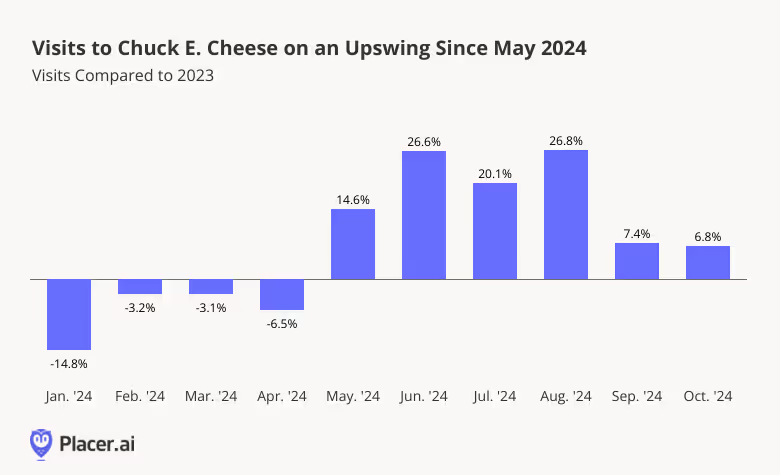
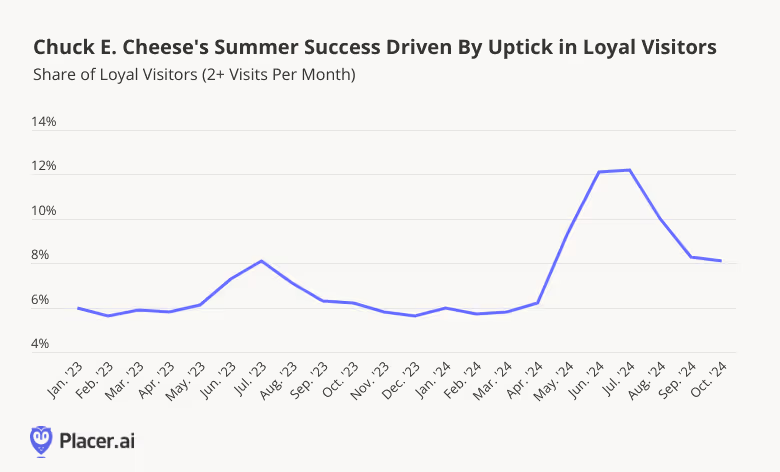
Children’s party space and eatertainment destination Chuck E. Cheese has had a transformative few years. Following the retirement of its iconic animatronic band, the chain shifted its focus to a new membership model, announcing a revamped Summer of Fun pass in May 2024 – including unlimited visits over a two-month period, steep discounts on food, and up to 250 games per day. The pass proved incredibly popular, with YoY visits surging by 15.6% in May 2024, when the offer launched – a sharp turnaround from the YoY visit declines of the previous months. Recognizing the strong demand, Chuck E. Cheese extended the program year-round – and the strategy has paid off as YoY visits remained positive through the end of 2024.
A closer look at the data suggests that parents are making full use of their unlimited passes: The share of weekday visits was higher in H2 2024 than in H2 2023, likely due to families using their passes for weekday entertainment rather than reserving visits for weekends and special occasions.
At the same time, the share of repeat visitors – those frequenting the chain at least twice a month – also grew. Although these repeat visitors may not purchase additional gameplay beyond the flat fee, their more frequent on-site presence likely translates into increased sales of pizza and other menu items.
While value has been a major motivator for restaurant-goers in recent years, low prices aren’t the only drivers of FSR success. Brands offering unique experiences aimed at maximizing social interaction are also seeing outsized gains.
Though many of these more innovative venues tend to be on the more expensive side, they draw enthusiastic crowds willing to pony up for concepts that combine good food with fun social occasions. And some of the more successful ones bolster perceived value through offerings like fixed-price menus or club memberships.
Korean cuisine has been on the rise in recent years, with restaurants like Bonchon Chicken and GEN Korean BBQ House making significant waves in the dining space. Another chain drawing attention is KPOT Korean BBQ and Hot Pot, which began modestly in 2018 and has since expanded to over 150 locations nationwide.
Diners at KPOT can customize their meals by selecting from a variety of proteins, broths, sauces, and side dishes, known as banchan, while barbecuing or cooking in a hotpot at their table and sipping on the drinks from the menu’s extensive selection. And though pricier than Golden Corral, KPOT also offers an all-you-can-eat experience that lets customers squeeze the most value out of their indulgence.
Location intelligence shows that KPOT’s experiential dining model is resonating with customers: Since Q4 2019, the average number of visits to each KPOT location has risen steadily – even as the chain has grown its footprint – while the average dwell time has also increased. Indeed, rather than a quick dining stop, KPOT has become a destination for guests to linger, enjoying both food and drinks – and an interactive and social experience.
By positioning themselves as gathering places for fine wine aficionados, wine-club-focused concepts such as Postino WineCafe and Cooper’s Hawk Winery are also benefiting from today’s consumers’ emphasis on social experiences. The two upscale dining destinations offer club memberships that combine periodic wine releases with a variety of perks.
And the data suggests that the model is strongly resonating with diners. Both Postino and Cooper’s Hawk have grown their footprints over the past year, driving substantial YoY chain-wide visit increases while average visits per location grew as well – showing that the expansions and experiential offerings are meeting robust demand.
And analyzing the two chains’ captured markets shows that the wine club model enjoys broad appeal across a variety of audience segments.
Unsurprisingly, both wine clubs’ visitor bases include higher-than-average shares of affluent consumers with money to spend, including Experian: Mosaic’s “Power Elite”, “Booming with Confidence”, and “Flourishing Families” segments (the nation’s wealthiest families, as well as affluent suburban and middle-aged households). But the two chains also attract younger, more budget-conscious consumers – Postino, which has many downtown locations, is popular among “Singles and Starters”, while Cooper’s Hawk is popular among “Promising Families” - i.e. young couples with children.
The success of the two brands across various segments underscores the impact of a distinctive experience – especially when paired with a loyalty-boosting membership – in attracting today’s consumers.
Value offerings and unique experiences have the power to drive restaurant visits – but ultimately, a good meal in an inviting atmosphere is a draw in and of itself, as is shown by the success of First Watch and Firebirds Wood Fired Grill.
Breakfast-only restaurant First Watch excels at ambiance and menu innovation, changing up its offerings five times a year and striving to maintain a neighborhood feel at each of its locations.
First Watch has made a point of leaning into its strengths, eschewing discounts in favor of a consistently elevated dining experience and doubling down its strongest day part (weekend brunch), rather than trying to artificially drive up interest at other times.
And the strategy appears to be working: In 2024, visits to First Watch increased 6.6% YoY – with Saturdays and Sundays between 11:00 A.M. and 1:00 P.M. remaining its busiest dayparts by far. Visitors to First Watch also tend to linger over their meals more than at other breakfast chains – in 2024, the restaurant experienced an average dwell time of 54.9 minutes, significantly longer than the 48.7-minute average at other breakfast-focused restaurants.
By focusing on what matters most to its diners – innovative and exciting food and a welcoming atmosphere that allows patrons to enjoy their meals at a leisurely pace – First Watch is continuing to flourish.
Another chain that is growing its footprint and its audience on the strength of a menu and ambiance-focused approach is Firebirds Wood Fired Grill. The chain, known for its “polished casual” vibe and bold, unique flavors, added several new restaurants last year, leading to a 6.5% increase in overall visits. Over the same period, the average number of visits to each Firebirds location held steady – showing that the new restaurants aren’t cannibalizing existing business.
The chain’s success may rest, in part, on its locating its venues in areas rife with enthusiastic foodies. Data from Spatial.ai’s FollowGraph shows that in 2024, Firebird’s trade areas had significantly higher shares of “BBQ Lovers”, “Gourmet Burger Lovers,” and “Foodies” than the nationwide average. This suggests that Firebirds is attracting diners who prioritize the experience of eating – key for a chain that prides itself on putting good food first. The chain is also known for its welcoming decor and design – another aspect that may lead to its strong visit success.
Necessity often serves as the mother of invention, and challenging economic periods continue to spark new trends and innovations in the dining scene. From a heightened focus on value – drawing families and lower-HHI consumers willing to travel for a good deal – to the growing appeal of social dining and the timeless draw of good food – new trends are emerging to meet changing consumer expectations.

Stadiums and arenas – and the communities they call home – have a stake in cultivating engaged team fanbases eager to participate in live events. And venues and teams can employ a variety of strategies to strengthen their connection with fans and draw crowds to the stands.
In this report, we leverage location analytics and audience segmentation to uncover some of the ways that sports franchises and venues are driving engagement – attracting visitors from farther away and appealing to fans more likely to splurge on stadium fare. How does the signing of a star athlete impact arena visitor profiles? What happens to stadium visitation trends when a team’s performance improves dramatically? And how can teams and venues tailor their offerings to more effectively cater to visitor preferences?
We dove into the data to find out.
In sports, the signing of a star athlete can have a ripple effect across the organization, hometown, and league. In addition to driving up overall attendance at games, star power can impact everything from visit frequency to audience profile – and the buying power of stadium attendees.
Lionel Messi’s move to Inter Miami CF after decades of European play brought a foot traffic boost to Chase Stadium (formerly DRV PNK Stadium). But it also shifted the demographics of stadium visitors and increased the distance they traveled to attend a game.
At Inter Miami’s 2022 and 2023 home openers without Messi (he joined the team mid-season in 2023), only 6.4% and 5.3% of visitors to Chase Stadium came from over 250 miles away. But for the 2024 home opener with Messi on the squad, 31.3% of stadium visitors traveled more than 250 miles to attend.
The demographics of visitors at the home opener also changed with Messi on the team. Trade area data combined with the Spatial.ai: PersonaLive dataset reveals that the 2024 home opener received a smaller share of households in the “Near-Urban Diverse Families” (11.2%) and “Young Urban Singles” (7.2%) segments than the two previous years. Meanwhile, shares of “Sunset Boomers” (13.0%) and “Ultra Wealthy Families” (20.1%) increased, indicating that Messi brought an older and more affluent demographic of visitors to the stadium compared to previous years. Messi’s arrival has generated increased revenue for Inter Miami CF, Major League Soccer, and Apple TV+, which has exclusive streaming rights for MLS games. And an influx of affluent out-of-town visitors also has the potential to drive positive outcomes for tourism and employment in the Miami area.
Caitlin Clark’s WNBA debut was another star-powered game changer – this time for women’s basketball. After dazzling the sports world during her college basketball career, Caitlin Clark was drafted first overall to the Indiana Fever before the 2024 WNBA season. The superstar’s arrival has had a staggering economic impact on the city of Indianapolis and the Fever franchise, highlighting the benefit of a top athlete within the local community. However, Clark’s stardom also had a far-reaching impact on the league as a whole, adding tremendous value to the WNBA. Trade area analysis reveals that several WNBA arenas saw an uptick in visitor affluence when hosting the Fever with Clark in the lineup – likely driven in part by the elevated ticket prices associated with her appearances.
When the Minnesota Lynx hosted the Fever on July 14th, 2024, for example, the median HHI of Target Center’s captured market shot up to just over $93K/year, well above the median HHIs for the games immediately before and after that event. (A venue’s captured market refers to the census block groups (CBGs) from which it draws its visitors, weighted to reflect the share of visits from each one – and thus reflects the profile of the venue’s visitor base.) Similarly, the Fever’s away game against the Connecticut Sun on May 14th, 2024 at Mohegan Sun Arena drove a higher audience median HHI ($103.6K/year) than either of the Sun’s next two home games.
Having a superstar on the roster can drive positive outcomes locally and league-wide – but overall team success is the ultimate goal for any franchise. So it may come as no surprise that stadiums and arenas can drive engagement when their home teams perform well on the field or court. And teams that reverse their fortunes often spark even greater excitement, boosting visitor loyalty, visit duration, and other key metrics.
The Baltimore Orioles had one of the worst records in baseball just a few years ago. But since 2022, the team has flipped the script – stringing together winning seasons and postseason berths. And location intelligence shows that as the team finds success, fans are becoming more engaged with their hometown stadium.
During the 2019 regular season, one of the worst for the club in recent history, stadium attendance suffered, with only 8.3% of visitors to Oriole Park at Camden Yards visiting the stadium at least three times. But during the 2024 regular season, Oriole Park’s share of repeat visitors (those who visited at least three times) was almost double 2019 levels (16.3%) – consistent with a sharp increase in sales of multi-game ticket packages.
In addition to attending games more often, visitors to Oriole Park also appear to be spending more time at the ballpark. During the 2019 regular season, visitors spent an average of 150 minutes at the stadium, but in 2024, the average time at the park increased to 178 minutes – potentially boosting ancillary spending and in-stadium advertising exposure. The increased dwell time of visitors is particularly noteworthy when considering that MLB’s rule changes have significantly shortened average game time.
The more engaged fandom engendered by team success not only impacts stadium visitor behavior, but also has the potential to drive revenue. The Orioles added 20 new corporate sponsors before the 2024 season, likely due to the attention garnered by the well-performing club.
The NFL’s Detroit Lions provide another example of team success that has driven visitor engagement. As the franchise has improved its record in recent years, the trade area size of its stadium – Ford Field – has also increased, indicating elevated attendance from fans living further away.
The Lions finished the regular season with losing records from 2019 to 2021, but finished over .500 in 2022 (9-8), 2023 (12-5), and 2024 (15-2). And with the team’s increasing wins each consecutive season, the size of its stadium's trade area has also increased steadily – reaching 81.3% above 2019 levels in 2024.
This underscores just how much team success matters to fans, who may be more inclined to travel longer distances if they believe their team is likely to win. Ultimately, broader fan engagement across a wider trade area also increases a team’s growth potential beyond in-stadium attendance – driving merchandise sales, increasing viewership, and benefitting both the team and the league as a whole.
While stadium attendance and visitor behavior is often correlated to the performance of the sports teams that play in the arena, sporting venues can also drive fan engagement in ways that aren’t solely tied to team success or big-name athletes. By adapting their concessions and venue operations to visitor preferences, stadiums and arenas can better serve their audiences and strengthen their community presence.
Consumers have been feeling the pinch of rising food costs for quite some time, but at least one NBA team has responded to make concessions at the game more affordable for fans. In December 2024, the Phoenix Suns announced a $2 value menu for all home games at Footprint Center – delivering steep discounts on hot dogs, water, soda, and snacks.
Location analytics suggest that since the value menu launch, more fans who would have otherwise waited until after leaving the venue to grab a bite are now enjoying food and drinks inside the arena. Analysis of five Suns home games just before the value menu launch – between November 26th and December 15th, 2024 – reveals that between 7.0% and 9.3% of stadium visitors visited a dining establishment after leaving the arena. But following the value menu launch before the December 19th, 2024 home game, post-game dining decreased to under 6.0% through the end of the year.
Suns owner Mat Ishbia’s announcement of the new menu called out the need for affordable food options for families at Suns games. As the season progresses, the new menu may drive a larger share of family households to Suns games, which could provide opportunities for advertisers and other stadium partners.
Consumers in Washington – and especially Seattle – are known for their affinity for plant-based diets and environmentally-friendly lifestyles. And that goes for local football fans as well: Audience segmentation provided by the AGS: Behavior & Attitudes dataset combined with trade area data reveals that during September to December 2024, households within Lumen Field’s potential visitor base were 36% more likely to be “Environmentally Conscious Buyers” and “Environmental Contributors” and 39% more likely to be “Vegans” compared to the nationwide average. By contrast, across all NFL stadiums, potential visiting households were 2%, 1%, and 3% less likely, respectively, to belong to these segments.
And Lumen Field has been actively catering to these consumer preferences. The stadium, which has been experimenting with plant-based culinary options for quite some time, was recently recognized as one of the most vegan-friendly stadiums in the NFL. And in December 2024, Lumen became the second stadium in the league to achieve TRUE precertification for its efforts to become a zero-waste venue.
By remaining aligned with its visitor base – including both football fans and people that visit the stadium for other events – Lumen Field encourages visitors to feel at home at their local stadium. And fans may be more connected to their team knowing the club shares their values and respects their lifestyle.
Stadiums and arenas can leverage a variety of strategies to engage visitors in attendance as well as wider audiences. Signing a star athlete, putting together a winning club, or adapting to local preferences are just some of the ways that sports franchises and athletic venues can find success.