.png)
.png)

.png)
.png)


Just as the dining space was beginning to recover from the COVID pandemic, the ongoing inflation brought a fresh set of challenges to the sector in 2022 and 2023. How did the headwinds impact Burger King, Popeyes Louisiana Kitchen, Taco Bell, KFC, and other leading brands from the RBI and Yum! Portfolio? We dove into the data to find out.
Restaurant Brands International (RBI) and Yum! Brands each own three QSR banners along with one fast-casual chain. RBI owns the Burger King, Popeyes Louisiana Kitchen, and Tim Hortons brands as well as fast-casual sub chain Firehouse Subs. Yum! Brands operates the KFC, Pizza Hut, and Taco Bell fast-food banners and the fast-casual The Habit Burger Grill.
Both companies’ banners saw year-over-year (YoY) growth in Q1 2023, likely aided by favorable comparisons to an Omicron-plagued Q1 2022. And although traffic dropped off as the year went on – perhaps due to consumers cutting back on dining out – the dip was subdued, with visits staying relatively close to 2022 levels.
RBI’s banners ended the year with just a 2.5% YoY dip in Q4 2023, although Firehouse Subs, Popeyes Louisiana Kitchen, and Tim Hortons all saw positive visit growth for three out of four quarters of 2023.
Following three quarters of YoY visit growth for the Pizza Hut banner and for the company as a whole, Yum! Brands also began feeling the impact of the consumer spending contraction, with the company’s Q4 2023 foot traffic performance 3.7% lower, on average, than in 2022.
.png)
The wider QSR space tends to serve trade areas composed of Census Block Groups with an overall median household income (HHI) that is lower than the median HHI nationwide ($63.2K for QSR compared with $69.5K nationwide). And the median HHI in the trade areas of Pizza Hut, Taco Bell, KFC, Burger King, Tim Hortons, and Popeyes is even lower than the median HHI in the wider QSR space.
The relatively low median HHI in the trade areas of RBI and Yum! Brands’ QSR banners means that visitors to these chains may be feeling particularly frugal, which could explain the slight dips in foot traffic towards the end of 2023.
But some of these brands are already implementing changes to woo back their budget-conscious customers. Taco Bell recently unveiled a new value menu that includes some items priced at $1.99, and several other chains in the Yum! and RBI portfolio have launched national campaigns advertising wallet-friendly promotions – which may well bring foot traffic back up in 2024.
.png)
QSR chains seem particularly attractive to singles, with the trade area of the average QSR brand containing a larger share of one-person and non-family (roommate) households compared to the nationwide average (33.8% to 33.2%). And analyzing the household composition of the QSR banners of RBI and Yum! reveals that the trade areas of these brands tend to include an even larger share of one-person and non-family households than the wider QSR industry. (Pizza Hut is the sole exception, with one-person and non-family households making up 33.6% of households in its trade area – slightly less than the QSR industry average of 33.8%, but still more than the nationwide average of 33.2%.)
The trade areas of QSR brands also tend to include a greater share of large households (households of four or more people) compared to the percentage of 4+ person households nationwide. But Yum! And RBI banners (with the exception of Popeyes) seem to serve fewer 4+ person households compared to the QSR average (although Pizza Hut, Taco Bell, KFC, Burger King, and Tim Hortons still have more 4+ person households in the trade areas compared to the nationwide average.)
This trade area demographic data could help Yum! and RBI plan their 2024 promotions – discounts on larger orders could be particularly appealing to Popeyes diners, but may not necessarily drive demand among the visitor base of the other QSR banners. At the same time, all brands analyzed may benefit from offering value-priced individual items that can help singles living alone or with roommates budget smartly.
.avif)
With food-away-from-home prices expected to increase in 2024, chains that offer low-cost options are likely to see a resurgence – and RBI and Yum! may well benefit from consumers’ continued thriftiness.

Who wouldn’t want weekends to last seven days? That’s the thinking behind Marine Layer’s eco-friendly and “absurdly soft” tees. This San Francisco-based company, founded in 2009, has its beginnings in a shirt thrown away by a girlfriend. One man’s trash is another man’s treasure, and from that action sprouted the seeds for founder Mike Natenshon as he set on his quest to create the ultimate soft-on-day-1 shirt. Forty-five stores later, Marine Layer has spread across the nation, timed perfectly with our desire for coziness after extended time at home made comfy clothing a must.
One of the higher-trafficked outdoor Marine Layer locations is at Ponce City Market in Atlanta. This shopping center boasts other in-demand brands like Lululemon, Reformation, and Buck Mason. Another popular location resides at 12South, a Nashville neighborhood spanning a half mile that includes walkable local businesses, bars, and bakeries. White Bison Coffee and Five Daughters Bakery are places to stop in for a bite while shopping. And in Boulder, Pearl St is another pedestrian-friendly venue for shoppers.
It’s clear that certain segments are attracted to Marine Layer’s offer - most notably Young Professionals in Atlanta and Boulder, who make up a quarter of the customers, as well as Ultra Wealthy Families across the board, particularly in Nashville where they comprise a fifth. There are a few clientele differences, such as the fact that Marine Layer draws Urban Low Income in Atlanta and more Sunset Boomers in Boulder.
Looking at the potential market for these three areas, we see some interesting patterns arise via Spatial.ai Followgraph. For instance, all three markets overindex in following the musical Hamilton, fitness brand Peloton, outdoor sporting goods store REI, and the confection Moon Pie. Regarding fashion brands, Tory Burch, J. Crew, Lululemon, Vineyard Vines, and Patagonia are popular too.

Faherty is a brand that has been around for 10 years but that we’ve seen accelerating its physical store footprint in the last few years. Evoking chill surf trips, family bonfires, and hikes in the great outdoors, this American brand invites you to cozy up in its sweaters, spend a Saturday riding the waves, or just all-out enjoy family time and making memories. Its locations span from east coast to west coast, with popular locations in Panama City Beach, New York City, Austin, Manhattan Beach, among others.
The appeal of this brand is such that it finds itself on the beach, in urban high streets, and suburban locations, indicating that it’s really more about the vibe. Not only that, the segments are quite varied in terms of who is shopping at Faherty (using PersonaLive segments). In Panama City Beach, we see largely Ultra Wealthy Families, Sunset Boomers, and Young Professionals. Meanwhile, in SoHo, Educated Urbanites and Young Urban Singles make up the lion’s share of the trade area. The Austin shopper profile is more similar to the Panama City Beach one, with the addition of Educated Urbanites as well. This intergenerational appeal is possibly rooted in the ethos of the brand with its focus on family, friends, and enjoying life’s moments.
One thing that these shoppers do have in common? High household incomes. Most of these shoppers come from households earning $150K+, with particularly high earners hailing from Greenwich, CT.
While the customers from Florida, New York, and Texas are geographically dispersed, they do share some commonalities: an above average propensity to be bubbly drinkers and wine drinkers, clearly in line with the brand’s positioning of celebratory moments. Customers in these three markets also consider themselves “Pilates People”, “Joggers,” and “Fitness Fans.” You will find Faherty devotees from all three of these markets at the spa, at the museum, or enjoying book clubs. And largely in keeping with Faherty’s sustainability promise, many of their customers consider themselves Environmental Activists.

In December 2023, Placer.ai released the white paper: The Retail Opportunity of Stadiums. Below is a taste of our findings. To read more data-driven consumer research, visit our resource library.
While every stadium provides a similar core of traditional game day eats, each venue also offers a unique set of dining options, both on- and off-premise. The visitor bases of the various venues also exhibit unique dining tastes – a reminder that no customer or fan base is alike. Aligning on- or off-site dining options with offerings that align with a given customer base’s preferences can improve overall visitor satisfaction and boost revenues.
The chart below shows the share of visitors coming to a stadium from a dining venue (on the x-axis) or going to a dining venue after visiting the stadium (on the y-axis). The data reveals a correlation between pre-stadium dining and post-stadium dining – stadiums where many guests visit dining venues before the stadium also tend to have a large share of guests going to dining venues after the event. For example, the AT&T Stadium in Arlington, Texas, saw large shares of visitors grabbing a bite to eat on their journey to or from the stadium, while the M&T Bank Stadium in Baltimore, Maryland saw low rates of pre- and post stadium dining engagement.
These trends present opportunities for both local businesses and stadium stakeholders. For example, venues with high dining engagement can explore partnerships with local restaurants, while those with lower rates can build out their in-house dining options for hungry sports fans.

Stadiums looking to enhance their food offerings – or local entrepreneurs thinking of opening a restaurant near a stadium – can also get inspired by stadium visitors’ dining preferences. For example, psychographic data taken from the Spatial.ai: FollowGraph dataset reveals that visitors to MetLife Stadium in East Rutherford, New Jersey have a much stronger preference for Asian cuisine compared to New Jersey residents overall. With that knowledge, the stadium can enhance the visitor experience by expanding its Asian food offerings.
On the other hand, MetLife Stadium goers seem much less partial to Brewery fare than average New Jerseyans, so the stadium operators and restaurateurs may want to avoid offering too many Brewery-themed dining options. Stadium stakeholders can reserve the craft beers for Caesars Stadium, M&T Bank Stadium, and Soldier Field Stadiums, where visitors seem to enjoy artisanal brews more than the average resident in Louisiana, Maryland, and Illinois, respectively.

Sports leagues like the NBA, NFL, and MLB boast billion-dollar revenues – and the venues where these games unfold hold significant commercial potential in their own rights. Stadium operators, restaurateurs, and other stakeholders can leverage location intelligence and analyze visitor behavior outside the stadiums to understand visit patterns and consumer preferences during games and in the off-season.
Read the full report here to discover more stadium insights. For more data-driven consumer research, visit our resource library.

Urban Outfitters, Inc., operates several apparel banners, including Anthropologie and the eponymous Urban Outfitters. Both brands sell bohemian-style women’s apparel and home goods, although Urban Outfitters’ selection is slightly more eclectic and also includes menswear. Location intelligence indicates that both brands have stores in areas that have the potential to attract similar types of shoppers – but in practice, the two chains’ audiences look rather different.
To better understand the contrast between the two chains, we dove into the demographic and psychographic data of Urban Outfitters’ and Anthropologie’s trade areas.
Location analytics can be used to analyze a chain’s area through two different methods. The potential market trade area focuses on the demographic and psychographic makeup of the Census Block Groups (CBGs) making up the trade area, with each CBG weighted according to the population size of that CBG. The captured market trade area, on the other hand, weighs the CBGs within the trade area according to the number of visits received by the chain from each CBG. So while a potential market analysis can show the types of visitors that a chain can reach on the basis of the geographic location of the chain’s venues, the captured market reveals the audience segments within the potential trade area that actually visit the chain in practice.
For example, the median HHI for both Anthropologie and Urban Outfitters is higher in the captured market than in the potential market. This means that both brands attract visits from the higher-income households within their potential trade area.
The data also indicates that both chains have a relatively similar potential market median HHI, so both chains can reach customers with relatively similar income levels, given their store fleet configuration: Anthropologie’s potential market median HHI is only 5.5% higher than Urban Outfitters’ ($84.7K vs. $80.3K). But in practice, Anthropologie visitors tend to come from much more affluent households than Urban Outfitters visitors, with Anthropologie’s captured market median HHI 17.3% higher than Urban Outfitters’ ($103.6K vs. $88.3K).
.png)
Looking at the household types in Anthropologie and Urban Outfitters’ potential markets reinforces how the two chains have the potential to draw a relatively similar visitor base. Anthropologie’s and Urban Outfitters’ potential trade areas have 38.5% and 38.8% of one-person and non-family (i.e. roommate) households, respectively, and 26.6% and 26.5% of households with children.
In practice, however, Anthropologie tends to attract more households than Urban Outfitters from family-friendly neighborhoods – the share of households with children in its captured market stands at 26.3%, compared with 23.6% for Urban Outfitters’ captured market. Meanwhile, Urban Outfitters seems to be more popular among visitors from one-person and non-family households, with 43.5% of its captured market belonging to this segment, compared to 38.5% of Anthropologie’s captured market.
.png)
Analyzing the captured and potential markets of Anthropologie and Urban Outfitters from a psychographic perspective also reveals differences between the two brands that align with the demographic profiles in the chains’ trade areas. Anthropologie tends to attract more suburban visitors – including shoppers belonging to Spatial.ai PersonaLive’s “Booming with Confidence” segment. Meanwhile, Urban Outfitters draws more Singles & Starters than Anthropologie in both its captured and potential trade area.
.png)
The differences between the makeup of Athropologie’s and Urban Outfitters’ potential and captured market indicate that a chain’s site selection strategy is not the only factor impacting who visits the chain’s stores in practice.
Both Anthropologie and Urban Outfitters have relatively similar psychographics and demographics in their potential trade areas, meaning that – based solely on the location of their stores – both brands’ stores have the potential to reach the same types of shoppers. But the demographics and psychographics in the captured markets are distinct, indicating that even stores carrying similar sorts of products and located in similar areas can use contrasting branding, price-points, and other factors to draw in the desired target audience.
For more data-driven retail insights, visit placer.ai/blog.

Hot on the heels of the burrito’s emergence as America’s favorite dish in 2022 – edging out even the iconic cheeseburger – spicy potato tacos rocked Grubhub’s list of 2023’s top five spicy food orders.
So with the new year upon us, we dove into the data to check in with three steadily-expanding taco chains that are likely to continue making waves this year: Bartaco, Condado Tacos, and El Vaquero. Each of the three chains fills a somewhat different niche, and each of them is growing – showing that despite the challenges facing the restaurant industry, there’s a hot market for taco chains that hit the sweet spot with the right food and ambiance.
Bartaco, the upscale eatery known for its beach-like vibe, specialty cocktails, and eclectic street food menu, is a taco restaurant with a twist. The diverse menu includes everything from falafel tacos to glazed pork belly rice bowls. And while guac and chips are on offer, hungry diners can also indulge in kale caesar salad or Korean-style kimchi. Over the past several years, Bartaco has expanded its fleet – and the restaurant now boasts some 29 locations across 12 states (and Washington, D.C).
Condado Tacos is another popular restaurant that has grown its footprint in recent years. The “come as you are” casual-dining chain known for its funky art decor now features some 49 locations across 10 states – 20 of them in Ohio. And with plans to open 90-100 restaurants by 2026, the chain is on a roll. Customers can build their own tacos with fillings like Thai Chili Tofu or Tequila-Lime Steak, or choose one of the menu’s tempting suggestions. And like Bartaco, Condado Tacos offers a variety of cocktails – including seasonal choices like the Harvest Pear Marg.
And location intelligence shows that the expansion of both chains is meeting growing demand. Visits to Bartaco and Condado Tacos have risen steadily over the past two years, reaching a respective 52.2% and 52.9% growth in Q4 2023 relative to Q1 2022.
.avif)
Ohio is also home to El Vaquero – a Mexican chain with 18 locations in the Buckeye State and two more in Michigan. El Vaquero, which has also expanded over the past several years, saw foot traffic rise 4.8% in Q4 2023 compared to the equivalent period of 2022. And with a menu that includes everything from nachos to huevos con chorizo, it’s no wonder the chain has emerged as a local favorite.
Like Bartaco and Condado Tacos, El Vaquero has a rich cocktail menu, as well as a varied selection of wines and beers. And while the chain’s offerings certainly draw crowds throughout the year, El Vaquero really goes crazy on Cinco de Mayo, the May 5th commemoration of Mexico's victory over Napoleon in 1862. El Vaquero marks the occasion with a five-day special menu and an all-day happy hour on Cinco de Mayo itself. And on May 5th, 2023, El Vaquero experienced its busiest day of the year by far, drawing a remarkable 200.2% more visitors than it did, on average, during April and May 2023.
.avif)
Drilling down into the data for Bartaco, Condado Tacos, and El Vaquero shows that despite their differences, the three chains experience similar hourly visitation patterns. All three are busiest in the evenings – but while El Vaquero and Condado Tacos peak between 6:00 PM and 8:00 PM, Bartaco peaks somewhat later, between 7:00 PM and 9:00 PM. Bartaco also stays busier into the 9:00 PM – 10:00 PM time slot.
.avif)
Bartaco’s, Condado Tacos’, and El Vaquero’s evening draw may be due, in part, to the special appeal they hold for singles: The captured markets of all three chains feature significant shares of one-person households – and in the case of Bartaco and Condado Tacos, smaller concentrations of families with children. (For El Vaquero, the proportion of households with children is on par with that of single-person households). Of the three, the more upscale Bartaco boasts the highest share of single-person households – and the lowest share of parental ones – perhaps explaining its later visit peak and greater late-night engagement.
.png)
Mexican food has arisen as a preferred cuisine for many consumers. And even in today’s challenging economic environment, brands that can offer a winning combination of good food, nice cocktails, and a welcoming atmosphere are poised to thrive. How will Bartaco, Condado Tacos, and El Vaquero continue to fare in the new year? And what lies in store for the wider taco restaurant space in the months to come?
Follow Placer.ai’s data-driven dining analyses to find out.
1) Broad-based growth: All four grocery formats grew year-over-year in Q2 2025, with traditional grocers posting their first rebound since early 2024.
2) Value grocers slow: After leading during the 2022–24 trade-down wave, value grocer growth has decelerated as that shift matures.
3) Fresh formats surge: Now the fastest-growing segment, fueled by affluent shoppers seeking health, wellness, and convenience.
4) Bifurcation widens: Growth concentrated at both the low-income (value) and high-income (fresh) ends, highlighting polarized spending.
5) Shopping missions diverge: Short trips are rising, supporting fresh formats, while traditional grocers retain loyal stock-up customers and value chains capture fill-in trips through private labels.
6) Traditional grocers adapt: H-E-B and Harris Teeter outperformed by tailoring strategies to their core geographies and demographics.Bifurcation of Consumer Spending Help Fresh Format Lead Grocery Growth
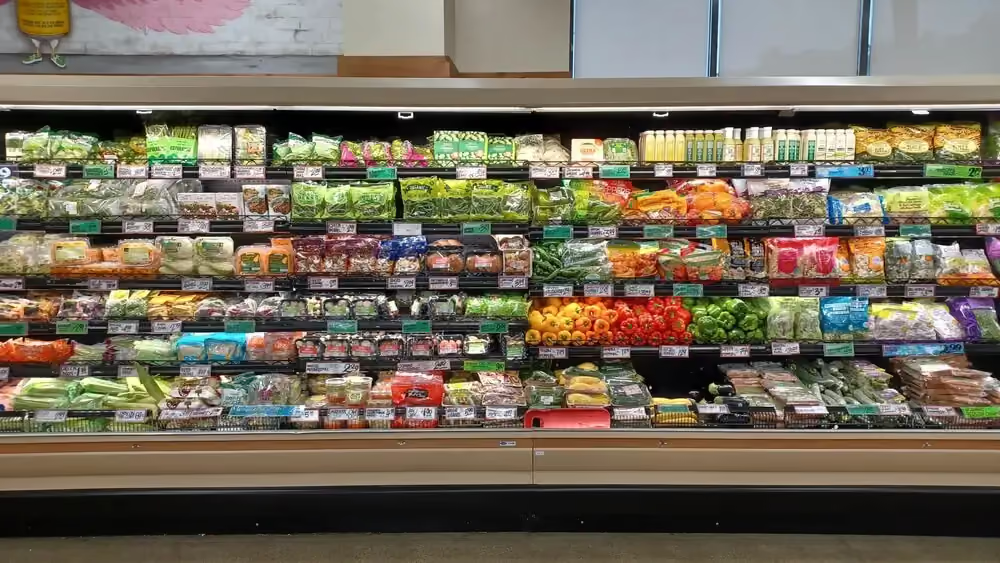
Grocery traffic across all four major categories – value grocers, fresh format, traditional grocery, ethnic grocers – was up year over year in Q2 2025 as shoppers continue to engage with a wide range of grocery formats. Traditional grocery posted its first YoY traffic increase since Q1 2024, while ethnic grocers maintained their steady pattern of modest but consistent gains.
Value grocers, which dominated growth through most of 2024 as shoppers prioritized affordability, continued to expand but have now ceded leadership to fresh-format grocers. Rising food costs between 2022 and 2024 drove many consumers to chains like Aldi and Lidl, but much of this “trade-down” movement has already occurred. Although price sensitivity still shapes consumer choices – keeping the value segment on an upward trajectory – its growth momentum has slowed, making it less of a driver for the overall sector.
Fresh-format grocers have now taken the lead, posting the strongest YoY traffic gains of any category in 2025. This segment, anchored by players like Sprouts, appeals to the highest-income households of the four categories, signaling a growing influence of affluent shoppers on the competitive grocery landscape. Despite accounting for just 7.0% of total grocery visits in H1 2025, the segment’s rapid gains point to a broader shift: premium brands emphasizing health and wellness are emerging as the primary engine of growth in the grocery sector.
The fact that value grocers and fresh-format grocers – segments with the lowest and highest median household incomes among their customer bases – are the two categories driving the most growth underscores how the bifurcation of consumer spending is playing out in the grocery space as well. On one end, price-sensitive shoppers continue to seek out affordable options, while on the other, affluent consumers are fueling demand for premium, health-oriented formats. This dual-track growth pattern highlights how widening economic divides are reshaping competitive dynamics in grocery retail.
1) Broad-based growth: All four grocery categories posted YoY traffic gains in Q2 2025.
2) Traditional grocery rebound: First YoY increase since Q1 2024.
3) Ethnic grocers: Continued steady but modest upward trend.
4) Value grocers: Still growing, but slowing after most trade-down activity already occurred (2022–24).
5) Fresh formats: Now the fastest-growing segment, driven by affluent shoppers and interest in health & wellness.
6) Market shift: Premium, health-oriented brands are becoming the new growth driver in grocery.
7) Bifurcation of spending: Growth at both value and fresh-format grocers highlights a polarization in consumer spending patterns that is reshaping grocery competition.
Over the past two years, short grocery trips (under 10 minutes) have grown far more quickly than longer visits. While they still make up less than one-quarter of all U.S. grocery trips, their steady expansion suggests this behavioral shift is here to stay and that its full impact on the industry has yet to be realized.
One format particularly aligned with this trend is the fresh-format grocer, where average dwell times are shorter than in other categories. Yet despite benefiting from the rise of convenience-driven shopping, fresh formats attract the smallest share of loyal visitors (4+ times per month). This indicates they are rarely used for a primary weekly shop. Instead, they capture supplemental trips from consumers looking for specific needs – unique items, high-quality produce, or a prepared meal – who also value the ability to get in and out quickly.
In contrast, leading traditional grocers like H-E-B and Kroger thrive on a classic supermarket model built around frequent, comprehensive shopping trips. With the highest share of loyal visitors (38.5% and 27.6% respectively), they command a reliable customer base coming for full grocery runs and taking time to fill their carts.
Value grocers follow a different, but equally effective playbook. Positioned as primary “fill-in” stores, they sit between traditional and fresh formats in both dwell time and visit frequency. Many rely on limited assortments and a heavy emphasis on private-label goods, encouraging shoppers to build larger baskets around basics and store brands. Still, the data suggests consumers reserve their main grocery hauls for traditional supermarkets with broader selections, while using value grocers to stretch budgets and stock up on essentials.
1) Short trips surge: Under-10-minute visits have grown fastest, signaling a lasting behavioral shift.
2) Fresh formats thrive on convenience: Small footprints, prepared foods, and specialty items align with quick missions.
3) Traditional grocers retain loyalty: Traditional grocers such as H-E-B and Kroger attract frequent, comprehensive stock-up trips.
4) Value grocers fill the middle ground: Limited assortments and private label drive larger baskets, but main hauls remain with traditional supermarkets.
5) Fresh formats as supplements: Fresh format grocers such as The Fresh Market capture quick, specialized trips rather than weekly shops.
While broad market trends favor value and fresh-format grocers, certain traditional grocers are proving that a tailored strategy is a powerful tool for success. In the first half of 2025, H-E-B and Harris Teeter significantly outperformed their category's modest 0.6% average year-over-year visit growth, posting impressive gains of 5.6% and 2.8%, respectively. Their success demonstrates that even in a polarizing environment, there is ample room for traditional formats to thrive by deeply understanding and catering to a specific target audience.
These two brands achieve their success with distinctly different, yet equally focused, demographic strategies. H-E-B, a Texas powerhouse, leans heavily into major metropolitan areas like Austin and San Antonio. This urban focus is clear, with 32.6% of its visitors coming from urban centers and their peripheries, far above the category average. Conversely, Harris Teeter has cultivated a strong following in suburban and satellite cities in the South Atlantic region, drawing a massive 78.3% of its traffic from these areas. This deliberate targeting shows that knowing your customer's geography and lifestyle remains a winning formula for growth.
1) Traditional grocers can still be competitive: H-E-B (+5.6% YoY) and Harris Teeter (+2.8% YoY) outpaced the category average of +0.6% in H1 2025.
2) H-E-B’s strategy: Strong urban focus, with 32.6% of traffic from major metro areas like Austin and San Antonio.
3) Harris Teeter’s strategy: Suburban and satellite city focus, with 78.3% of traffic from South Atlantic suburbs.


1. The hypergrowth of Costco, Dollar Tree, and Dollar General between 2019 and 2025 has fundamentally changed the brick-and-mortar retail landscape.
2. Overall visits to Target and Walmart have remained essentially stable even as traffic to the new retail giants skyrocketed – so the increased competition is not necessarily coming at legacy giants' expense. Instead, each retail giant is filling a different need, and success now requires excelling at specific shopping missions rather than broad market dominance.
3. Cross-shopping has become the new normal, with Walmart and Target maintaining their popularity even as their relative visit shares decline, creating opportunities for complementary rather than purely competitive strategies.
4. Dollar stores are rapidly graduating from "fill-in" destinations to primary shopping locations, signaling a fundamental shift in how Americans approach everyday retail.
5. Walmart still enjoys the highest visit frequency, but the other four chains – and especially Dollar General – are gaining ground in this realm.
6. Geographic and demographic specialization is becoming the key differentiator, as each chain carves out distinct niches rather than competing head-to-head across all markets and customer segments.
Evolving shopper priorities, economic pressures, and new competitors are reshaping how and where Americans buy everyday goods. And as value-focused players gain ground, legacy retail powerhouses are adapting their strategies in a bid to maintain their visit share. In this new consumer reality, shoppers no longer stick to one lane, creating a complex ecosystem where loyalty, geography, and cross-visitation patterns – not just market share – define who is truly winning.
This report explores the latest retail traffic data for Walmart, Target, Costco, Dollar Tree, and Dollar General to decode what consumers want from retail giants in 2025. By analyzing visit patterns, loyalty trends, and cross-shopping shifts, we reveal how fast-growing chains are winning over consumers and uncover the strategies helping legacy players stay competitive in today's value-driven retail landscape.
In 2019, Walmart and Target were the two major behemoths in the brick-and-mortar retail space. And while traffic to these chains remains close to 2019 levels, overall visits to Dollar General, Dollar Tree, and Costco have increased 36.6% to 45.9% in the past six years. Much of the growth was driven by aggressive store expansions, but average visits per location stayed constant (in the case of Dollar Tree) or grew as well (in the case of Dollar General and Costco). This means that these chains are successfully filling new stores with visitors – consumers who in the past may have gone to Walmart or Target for at least some of the items now purchased at wholesale clubs and dollar stores.
This substantial increase in visits to Costco, Dollar General, and Dollar Tree has altered the competitive landscape in which Walmart and Target operate. In 2019, 55.9% of combined visits to the five retailers went to Walmart. Now, Walmart’s relative visit share is less than 50%. Target received the second-highest share of visits to the five retailers in 2019, with 15.9% of combined traffic to the chains. But Between January and July 2025, Dollar General received more visits than Target – even though the discount store had received just 12.1% of combined visits in 2019.
Some of the growth of the new retail giants could be attributed to well-timed expansion. But the success of these chains is also due to the extreme value orientation of U.S. consumers in recent years. Dollar General, Dollar Tree, and Costco each offer a unique value proposition, giving today's increasingly budget-conscious shoppers more options.
Walmart’s strategy of "everyday low prices" and its strongholds in rural and semi-rural areas reflect its emphasis on serving broad, value-focused households – often catering to essential, non-discretionary shopping.
Dollar General serves an even larger share of rural and semi-rural shoppers than Walmart, following its strategy of bringing a curated selection of everyday basics to underserved communities. The retailer's packaging is typically smaller than Walmart's, which allows Dollar General to price each item very affordably – and its geographic concentration in rural and semi-rural areas also highlights its direct competition to Walmart.
By contrast, Target and Costco both compete for consumer attention in suburban and small city settings, where shopper profiles tilt more toward families seeking one-stop-shopping and broader discretionary offerings. But Costco's audience skews slightly more affluent – the retailer attracts consumers who can afford the membership fees and bulk purchasing requirements – and its visit growth may be partially driven by higher income Target shoppers now shopping at Costco.
Dollar Tree, meanwhile, showcases a uniquely balanced real estate strategy. The chain's primary strength lies in suburban and small cities but it maintains a solid footing in both rural and urban areas. The chain also offers a unique value proposition, with a smaller store format and a fixed $1.25 price point on most items. So while the retailer isn't consistently cheaper than Walmart or Dollar General across all products, its convenience and predictability are helping it cement its role as a go-to chain for quick shopping trips or small quantities of discretionary items. And its versatile, three-pronged geographic footprint allows it to compete across diverse markets: Dollar Tree can serve as a convenient, quick-trip alternative to big-box retailers in the suburbs while also providing essential value in both rural and dense urban communities.
As each chain carves out distinct geographic and demographic niches, success increasingly depends on being the best option for particular shopping missions (bulk buying, quick trips, essential needs) rather than trying to be everything to everyone.
Still, despite – or perhaps due to – the increased competition, shoppers are increasingly spreading their visits across multiple retailers: Cross-shopping between major chains rose significantly between 2019 and 2025. And Walmart remains the most popular brick-and-mortar retailer, consistently ranking as the most popular cross-shopping destination for visitors of every other chain, followed by Target.
This creates an interesting paradox when viewed alongside the overall visit share shift. Even as Walmart and Target's total share of visits has declined, their importance as a secondary stop has actually grown. This suggests that the legacy retail giants' dip in market share isn't due to shoppers abandoning them. Instead, consumers are expanding their shopping routines by visiting other growing chains in addition to their regular trips to Walmart and Target, effectively diluting the giants' share of a larger, more fragmented retail landscape.
Cross-visitation to Costco from Walmart, Target, and Dollar Tree also grew between 2019 and 2025, suggesting that Costco is attracting a more varied audience to its stores.
But the most significant jumps in cross-visitation went to Dollar Tree and Dollar General, with cross-visitation to these chains from Target, Walmart, and Costco doubling or tripling over the past six years. This suggests that these brands are rapidly graduating from “fill-in” fare to primary shopping destinations for millions of households.
The dramatic rise in cross-visitation to dollar stores signals an opportunity for all retailers to identify and capitalize on specific shopping missions while building complementary partnerships rather than viewing every chain as direct competition.
Walmart’s status as the go-to destination for essential, non-discretionary spending is clearly reflected in its exceptional loyalty rates – nearly half its visitors return at least three times per month on average -between January to July 2025, a figure virtually unchanged since 2019. This steady high-frequency visitation underscores how necessity-driven shopping anchors customer routines and keeps Walmart atop the retail loyalty ranks.
But the data also reveals that other retail giants – and Dollar General in particular – are steadily gaining ground. Dollar General's increased visit frequency is largely fueled by its strategic emphasis on adding fresh produce and other grocery items, making it a viable everyday stop for more households and positioning it to compete more directly with Walmart.
Target also demonstrates a notable uptick in loyal visitors, with its share of frequent shoppers visiting at least three times a month rising from 20.1% to 23.6% between 2019 and 2025. This growth may suggest that its strategic initiatives – like the popular Drive Up service, same-day delivery options, and an appealing mix of essentials and exclusive brands – are successfully converting some casual shoppers into repeat customers.
Costco stands out for a different reason: while overall visits increased, loyalty rates remained essentially unchanged. This speaks to Costco’s unique position as a membership-based outlet for targeted bulk and premium-value purchases, where the shopping behavior of new visitors tends to follow the same patterns as those of its already-loyal core. As a result, trip frequency – rooted largely in planned stock-ups – remains remarkably consistent even as the warehouse giant grows foot traffic overall.
Dollar Tree currently has the smallest share of repeat visitors but is improving this metric. As it successfully encourages more frequent trips and narrows the loyalty gap with its larger rivals, it's poised to become an increasing source of competition for both Target and Costco.
The increase in repeat visits and cross-shopping across the five retail giants showcases consumers' current appetite for value-oriented mass merchants and discount chains. And although the retail giants landscape may be more fragmented, the data also reveals that the pie itself has grown significantly – so the increased competition does not necessarily need to come at the expense of legacy retail giants.
The retail landscape of 2025 demands a fundamental shift from zero-sum competition to strategic complementarity, where success lies in owning specific shopping missions rather than fighting for total market dominance. Retailers that forego attempting to compete on every front and instead clearly communicate their mission-specific value propositions – whether that's emergency runs, bulk essentials, or family shopping experiences – may come out on top.