.png)
.png)

.png)
.png)


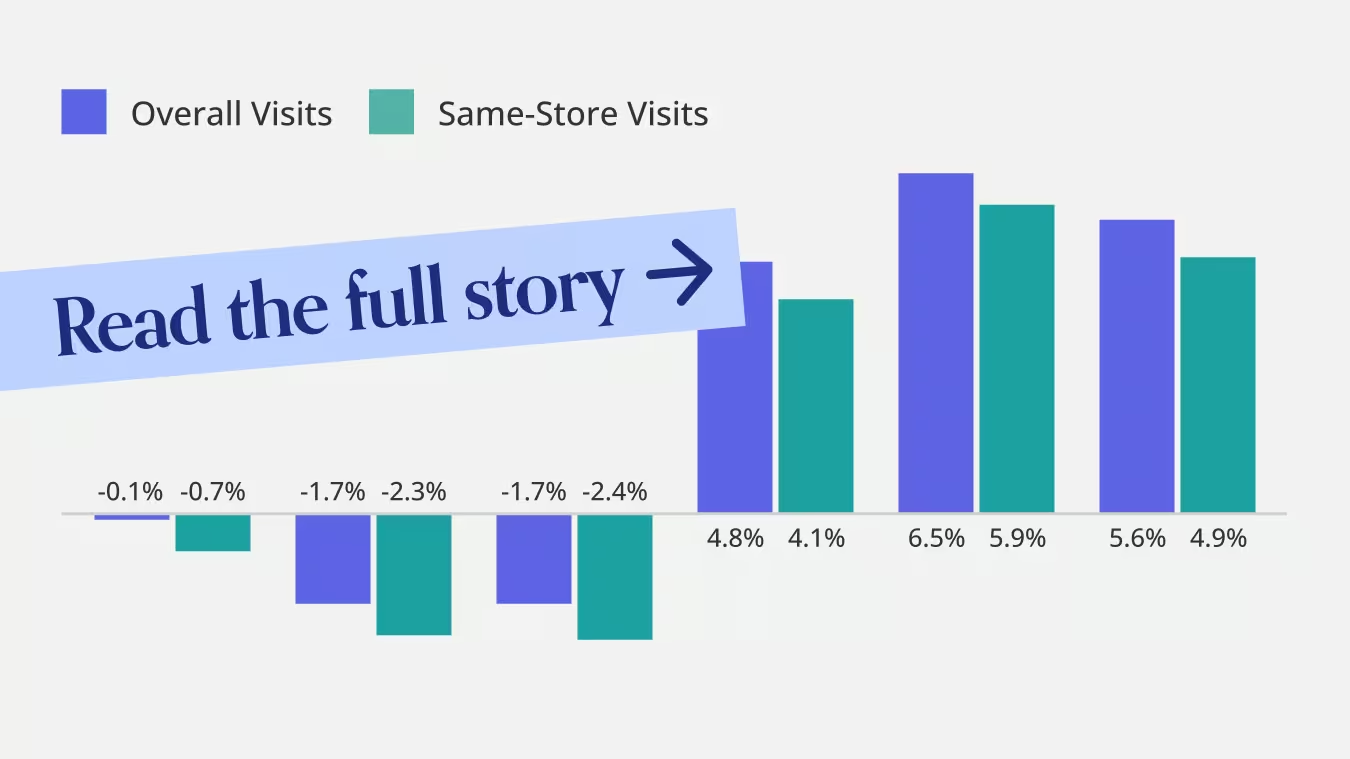
McDonald’s ended 2025 with clear visit momentum, reversing earlier softness and posting steady gains in the back half of the year. Same-store visits followed a similar trajectory, indicating that growth was driven by stronger underlying demand rather than unit expansion. This late-year rebound positions McDonald’s with solid visit momentum heading into 2026, suggesting improving consumer engagement as the year closed.
Some of the visit growth is likely due to the chain's popular Q4 LTOs – but diving deeper into the visit frequency data suggests that McDonald’s long-term investment in its loyalty program is also playing a part. The company's launch of MyMcDonald’s Rewards in 2021 seems to have succeeded in shifting traffic toward higher-frequency, incremental visits rather than relying on new customer acquisition.
Compared to pre-loyalty levels in H2 2019, a growing share of McDonald’s visits now comes from diners visiting an average of 4+ times per month, with the share of visits from consumers visiting the chain an average of 8+ times per month showing the most dramatic growth. Grouping YoY visit trends by visit frequency also shows that visits from high-frequency diners grew the most compared to H2 2024 and H2 2019. This dynamic points to a core benefit of loyalty-led growth: driving incremental visits from existing customers is typically far more efficient than acquiring new ones, especially in a mature, highly penetrated category like quick service restaurants.
McDonald’s executives have been explicit that loyalty is designed to increase frequency, not just enrollment. The continued growth of the program through 2025 – including deeper integration with value offers and digital ordering – suggests McDonald’s is still finding room to extract incremental visits from an already loyal base.
For other restaurant chains, McDonald’s experience points to the value of using loyalty as a lever for incremental growth, particularly once a customer has already been acquired. While many QSR brands continue to drive expansion by entering new markets or opening additional locations, McDonald’s data illustrates how meaningful gains can also come from increasing visit frequency among existing customers. Even without McDonald’s scale, the underlying strategy is broadly applicable: converting first-time or occasional visitors into higher-frequency customers can serve as a complementary – and often more efficient – path to growth alongside physical expansion.
Will these lessons shape the QSR space in 2026? Visit Placer.ai/anchor to find out.
Placer.ai leverages a panel of tens of millions of devices and utilizes machine learning to make estimations for visits to locations across the US. The data is trusted by thousands of industry leaders who leverage Placer.ai for insights into foot traffic, demographic breakdowns, retail sale predictions, migration trends, site selection, and more.

In 2024, Dollar Tree capitalized on the liquidation of the 99 Cents Only chain to execute a strategic "land grab" in the notoriously tight US retail market. By acquiring designation rights for 170 leases across priority markets like California, Arizona, Nevada, and Texas, the retailer aimed to bypass zoning hurdles and accelerate growth.
AI-powered location analytics indicates the selection process was highly disciplined: Looking at over 85 California stores that were converted from 99 Cents Only to Dollar Tree reveals that Dollar Tree cherry-picked high-performing sites that were generating 6.0% more foot traffic than the 99 Cents Only chain average in 2023. This suggests the acquisition was a calculated move to secure proven, high-quality real estate.
However, 2025 performance data reveals that capitalizing on this opportunity comes with distinct operational costs. Total visits to the converted stores have dropped 38.8% compared to their 2023 baselines. While some of this decline is structural – Dollar Tree operates a lower-frequency "treasure hunt" model compared to the high-frequency grocery model of the previous tenant – a significant portion is self-inflicted through network overlap.
A staggering 36% of the new sites are located less than a mile from an existing Dollar Tree, which inevitably dilutes local traffic through cannibalization. This serves as a critical lesson for retailers considering bulk acquisitions: purchasing a portfolio "en masse" often prevents perfect network optimization, forcing the acquirer to manage the friction where new footprints compete with the old.
Still, despite this cannibalization and the drop in raw volume, the transition offers a potential "healthy correction" for the business. The previous tenant collapsed under the weight of "rising levels of shrink" and low-margin grocery sales. By shifting the model, Dollar Tree is effectively filtering out non-paying visitors and low-value transactions, trading chaotic volume for a more controlled, margin-focused operation. The discrepancy between the sharp drop in total visits (-38.8%) and the more moderate dip in visits per square foot (-25.0%) suggests Dollar Tree is already rightsizing these operations, leaving some "ghost space" inactive rather than over-investing in labor to manage the entire cavernous floor.
And this excess square footage is only a liability if it remains empty; turning it into an asset requires leveraging the fundamental change in who is now shopping these aisles. The shift in shopper demographics – where "Wealthy Suburban Families" have replaced the "Young Urban Singles" and "Melting Pot Families" of the previous tenant – is crucial for Dollar Tree's future. This new audience, which is less price-sensitive, provides the ideal environment for Dollar Tree to deploy its "Multi-Price" strategy.
While CFO Jeff Davis has cited "start-up costs" regarding these conversions, the long-term opportunity is clear: if Dollar Tree can utilize the extra square footage to showcase this higher-margin assortment, these locations could evolve from overlapping burdens into profitable flagships that capture a share of wallet the traditional small-box fleet never could.
For more data-driven CRE insights, visit placer.ai/anchor.
Placer.ai leverages a panel of tens of millions of devices and utilizes machine learning to make estimations for visits to locations across the US. The data is trusted by thousands of industry leaders who leverage Placer.ai for insights into foot traffic, demographic breakdowns, retail sale predictions, migration trends, site selection, and more.
.avif)
It’s mid-January, and you promised yourself this would be the year you finally join a gym and get in shape.
But let’s be honest – choosing a gym is about more than fitness goals alone. You’ll still need to judge the equipment, locker rooms, and showers for yourself (we’re not here to do your dirty work) but there are other, less obvious factors that can determine which gym feels like the right fit – and that’s where we come in.
Trying to dodge the morning rush? Hoping to make new friends? Curious where other singles work out? Letting AI-powered location analytics do some of the heavy lifting, we analyzed major fitness chains to uncover the patterns that could help you find your ideal gym in 2026.
Few things derail motivation faster than showing up ready to work out – only to find every treadmill and weight machine taken. To understand which gyms are most likely to offer breathing room during the busiest parts of the day, we analyzed hourly visit patterns across the nation’s largest fitness chains.
The analysis shows clear differences in how morning traffic is distributed. For early risers, LA Fitness recorded the lowest share of daily visits between 5:00 AM and 8:00 AM in 2025, at just 8.9%. 24 Hour Fitness and EōS Fitness also kept morning traffic below the 10% mark, suggesting these chains may be better options for members looking to avoid crowded early workouts.
If after-work workouts are more your style – and minimizing crowds is the priority – the data points to a few clear standouts.
Among the analyzed gyms, Club Pilates recorded the smallest share of visits between 5:00 PM and 8:00 PM at 16.5%, followed by Orangetheory (17.3%) and Burn Boot Camp (18.7%). That lighter early-evening traffic likely reflects the structured nature of class-based formats, which can help limit overcrowding even during peak hours.
Looking specifically at traditional gyms, EōS Fitness, Life Time, and Vasa Fitness saw the lowest share of early-evening visits – making them potential options for those hoping to squeeze in a workout while avoiding the after-work rush.
If getting in shape and finding love are both on the agenda this year, there may be a way to double up. Using AI-powered captured market data, we analyzed major gym chains to understand where members are most likely to be single – which may mean a higher chance of meeting someone special.
The analysis shows that Genesis Health Clubs had the highest combined share of one-person households and non-family households – i.e. people living alone or with roommates – in its captured market, at 36.6%. Crunch Fitness followed closely at 35.8%, with Planet Fitness just behind at 35.2%. These household segmentation patterns suggest that these gyms may offer more opportunities to meet other singles while getting in a workout.
If you’re looking for love, or simply to make new friends, age demographics may be something to consider when choosing a gym.
Our analysis of major fitness chains shows that the potential markets of Fitness Connection, Vasa Fitness, and In-Shape Family Fitness – i.e. the areas from which each chain draws its visitors – skewed younger in 2025, with large shares of visitors under 30.
By contrast, gyms such as The Edge Fitness Club, Retro Fitness, and Life Time tended to attract older audiences, with large shares of visitors 45 and older. For members looking to work out alongside peers closer to their own age, these demographic patterns could help narrow the field.
Age is just a number, right? So if you’re looking to make a real connection at the gym this year, you might look for some common areas of interest with other members. Our analysis highlights which gyms are most likely to attract visitors with your shared passions.
For dog lovers hoping to meet a fellow fitness enthusiast who’s just as excited about the dog park as leg day, Burn Boot Camp stands out. The chain over-indexed most strongly for the “Dog Lovers” segment, based on Spatial.ai: Proximity and AI-powered captured market data.
Prefer bonding over a good book? Genesis Health Clubs led the pack for the “Bookish” segment, suggesting a higher likelihood of members who enjoy reading as much as a solid workout. Coffee aficionados may find their people at 24 Hour Fitness, which showed the strongest over-indexing for the “Coffee Connoisseur” segment.
For those with travel on the brain, Workout Anytime over-indexed for the “Wanderlust” segment – pointing to a member base more likely to dream about their next destination. And if your ideal post-workout plan includes a movie or live show, 24 Hour Fitness and Gold’s Gym emerged as standouts, over-indexing for the “Film Lovers” and “Live & Local Music” segments, respectively.
Ultimately, choosing the right gym goes beyond equipment, pricing, or proximity. Visit patterns, demographics, and shared interests all shape the experience – influencing when you’ll work out, who you’ll see, and how the gym fits into your broader lifestyle. While no dataset can guarantee a perfect match, these patterns offer a data-backed starting point for finding a gym that aligns with how you want to train, socialize, and show up in 2026.
Want more data-driven insights for the real world? Visit Placer.ai/anchor.
Placer.ai leverages a panel of tens of millions of devices and utilizes machine learning to make estimations for visits to locations across the US. The data is trusted by thousands of industry leaders who leverage Placer.ai for insights into foot traffic, demographic breakdowns, retail sale predictions, migration trends, site selection, and more.
*This article excludes data from Washington State due to local regulations

Brick-and-mortar retail ended 2025 on a high note, with offline retailers posting a 2.4% increase in traffic in Q4 2025 relative to Q4 2024. This growth underscores the sector’s continued relevance even amid ongoing e-commerce growth and reinforces that retail growth is not a zero-sum dynamic, but one in which physical and digital channels increasingly coexist and complement one another.
The traffic gains during the holiday season also highlights the particular appeal of physical retail during the holiday season, when demand for in-person shopping experiences is particularly high. And as retailers refine store formats, right-size footprints, and better integrate physical locations into omnichannel strategies, brick-and-mortar retail is well positioned to remain a critical growth and engagement channel heading into 2026.
Foot traffic to e-commerce distribution centers remained consistently positive YoY throughout 2025, underscoring the strength of the logistics segment and signaling durable demand for logistics space rather than short-term fluctuations. This pattern aligns with the broader trajectory of e-commerce in the U.S., where online retail sales are projected to continue expanding, and reflects a broader structural shift in how goods move through the economy, with fulfillment infrastructure playing an increasingly central role.
This consistency is driven by long-term forces shaping retail and supply chains, including omnichannel fulfillment, faster delivery expectations, and inventory decentralization. As retailers rely more heavily on regional distribution nodes to support ship-from-store, curbside pickup, and next-day delivery, logistics facilities have become essential infrastructure rather than optional back-end operations. Even as growth moderated slightly later in the year, the persistence of positive YoY traffic points to sustained operational intensity and long-term relevance.
Year-over-year (YoY) foot traffic to U.S. manufacturing facilities points to volatility rather than sustained growth, reflecting a sector that is actively managing uncertainty. Visits declined during much of the year, suggesting restrained hiring as manufacturers appear to be operating lean – adjusting labor and on-site activity quickly in response to demand changes. Productivity gains and automation are likely also playing a role, allowing facilities to maintain output with less consistent physical presence. As a result, the foot traffic volatility may be reflecting operational flexibility rather than simple expansion or contraction.
Against this backdrop, December stands out with a clear uptick in manufacturing visits, signaling increased end-of-year activity. This rise likely reflects a mix of year-end production runs, inventory adjustments, maintenance work, and preparation for early-year demand. The December traffic increase reinforces that U.S. manufacturing – still one of the largest and most economically significant sectors globally – is adapting, not retreating, maintaining operational relevance even as it recalibrates for efficiency, automation, and selective growth.
For more data-driven retail & CRE insights, visit placer.ai/anchor.

Pacsun has seen its fair share of challenges in its more than forty years of business. Now, the brand is entering a new phase of growth, with a major brick-and-mortar expansion alongside concrete steps to engage Gen Z consumers. We dove into the data for several Pacsun locations outperforming their host malls to understand what a growing footprint could mean for shopping centers and how the brand is connecting with young consumers online and off.
Pacsun has faced its share of challenges over the years. More recently, however, the legacy brand and mall staple appears to be in the midst of a renaissance – with plans to further expand its domestic brick-and-mortar footprint in 2026.
Foot traffic data for several Pacsun locations that experienced notable foot traffic growth in 2025 suggests that the brand’s stores have the potential to help drive traffic to the shopping centers that host them. At The Promenade Shops at Centerra in Colorado, visits to Pacsun rose 35.7% YoY in 2025, significantly outpacing the -5.5% visit gap of the mall as a whole.
Psychographic segmentation suggests that beyond driving visits, these locations also help attract key young demographics to the mall.
At Winter Garden Village, for example, the Gen Z-aligned "Young Professionals" segment accounted for 19.4% of the Pacsun store’s captured market, compared to the mall’s 16.2% share of the segment.
These locations may be an example of how Pacsun’s physical retail presence works together with its social-sales strategy to engage with a younger generation; driving traffic, in part, by serving as spaces to experience products seen on trusted social channels or at creator-led events.
And Pacsun appears firmly committed to its younger audience as part of its wider strategy. Although the brand looks to move upmarket, the latest example of which being the launch of a premium eyewear collection, by maintaining what it views as an accessible price point, Pacsun remains focused on consumers yet to reach their peak earning years.
Pacsun’s ability to drive traffic from this key demographic makes it an attractive potential tenant for malls looking to build long-term loyalty among younger audiences with earning potential.
The Pacsun model demonstrates that physical retail remains a critical touchpoint for brands investing in digital engagement and younger audiences. With plans to open dozens of new locations over the next few years, Pacsun emerges as a compelling tenant for shopping centers seeking cultural relevance and the next generation of consumers.
For more retail insights, visit Placer.ai/anchor.
Placer.ai leverages a panel of tens of millions of devices and utilizes machine learning to make estimations for visits to locations across the US. The data is trusted by thousands of industry leaders who leverage Placer.ai for insights into foot traffic, demographic breakdowns, retail sale predictions, migration trends, site selection, and more.

The grocery category saw notable shifts in consumer behavior in 2025 as inflation and tariff uncertainty continued to weigh on household budgets. Analyzing consumer traffic trends for several grocery formats – including wholesale clubs, which serve as primary grocery destinations for many families – reveals how evolving consumer preferences shaped grocery performance in 2025 and highlights key lessons for grocers and CPG companies heading into 2026.
Like many retail categories in 2025, grocery was shaped by continued economic uncertainty and value-seeking behavior. But AI-powered location analytics shows that consumers also prioritized quality when forming a value perception in the grocery space.
The graph below shows that grocery visits increased across formats, likely reflecting consumers’ shift toward more meals at home as a way to save money in a persistently inflationary environment.
Fresh format grocers posted the strongest year-over-year (YoY) visit growth, perhaps due to their selection of prepared foods and salad bars as an alternative to eating out, as well as their emphasis on health and wellness – an emerging priority among grocery shoppers. Meanwhile, value grocers and wholesale clubs, known for their ability to deliver savings, consistently outperformed traditional grocers in YoY visit growth.
These patterns indicate that consumers are increasingly weighing up quality and price in the grocery aisle, a trend that is driving the expansion of private-label offerings.
As consumers substituted restaurant meals with more cost-conscious options, grocery stores also emerged as increasingly important destinations for quick, convenient lunches.
Analyzing relative visit share between the grocery category and quick-service restaurants (QSRs) shows that between 2024 and 2025, grocery stores claimed an increasingly large share of short midday visits – i.e. visits lasting less than ten minutes between 11:00 AM and 3:00 PM.
And while some of QSR’s relative decline in short lunchtime visits could be due to discontent with rising fast-food prices among highly value-conscious consumers, it also suggests that a growing share of consumers see grocery stores – where they can pick up ready-to-eat items – as convenient options during the lunch rush. Traditional grocers saw the largest increase in short midday visits (from 15.9% to 16.6%) while value and fresh format grocers saw more modest increases. Notably, the share of short midday visits to wholesale clubs was unchanged between 2024 and 2025 (2.1%), perhaps since these chains don’t offer the same pre-prepared and small-package options like other grocery formats.
These metrics underscore the strong demand for on-the-go meal options and single-serving, shelf-stable products that both grocery stores and CPG companies can provide.
Beyond the lunchtime rush, celebration-driven demand continued to play a central role in grocery traffic this year. Like in past years, Turkey Wednesday – the day before Thanksgiving – was by far the busiest grocery shopping day of the year, with category visits up 80.5% compared to the 2025 daily average. Several of the year’s other busiest grocery days similarly fell immediately ahead of major holidays, including New Year’s Eve, Easter, Mother’s Day, and the 4th of July, as consumers stocked up ahead of gatherings with family and friends.
Leading up to Christmas, grocery shopping appeared to be spread across several high-traffic days rather than concentrated on a single peak; Christmas Eve and December 23rd had nearly identical foot traffic boosts of 57.9% and 58.0%, respectively. And even December 22nd – three days before Christmas – stood out as one of the year’s busiest grocery shopping days, with visits running 28.9% above average for 2025.
Some consumers may have made multiple “re-stocking” grocery trips in the days leading up to Christmas – potentially driven by the presence of out-of-town guests requiring ongoing food replenishment – or visited multiple stores to secure specific ingredients for holiday meals.
Grocers could leverage this trend by stocking a wide range of holiday-specific ingredients and rotating promotions that encourage repeat visits ahead of Thanksgiving and Christmas.
The grocery landscape in 2025 was also shaped by distinct shopping preferences across demographic groups.
AI-powered captured market data combined with the STI: PopStats dataset shows that singles – defined as non-family and one-person households – heavily favored fresh-format grocers, while households with children were most likely to visit wholesale clubs and value grocers.
Grocers and CPGs can unlock growth by tailoring assortments and promotional strategies to their target audience – emphasizing bulk value and price-driven messaging for family shoppers, while leaning into curated selection, prepared foods, and convenience to engage singles.
Several consumer trends shaped the grocery space in 2025 – including holiday visit surges, the prioritization of value, and convenient on-the-go meals.
How will these trends shape the grocery space in 2026? Visit Placer.ai/anchor to find out.
Placer.ai leverages a panel of tens of millions of devices and utilizes machine learning to make estimations for visits to locations across the US. The data is trusted by thousands of industry leaders who leverage Placer.ai for insights into foot traffic, demographic breakdowns, retail sale predictions, migration trends, site selection, and more.

This report leverages location intelligence data to analyze the auto dealership market in the United States. By looking at visit trends to branded showrooms, used car lots, and mixed inventory dealerships – and analyzing the types of visitors that visit each category – this white paper sheds light on the state of car dealership space in 2023.
Prior to the pandemic and throughout most of 2020, visits to both car brand and used-only dealerships followed relatively similar trends. But the two categories began to diverge in early 2021.
Visits to car brand dealerships briefly returned to pre-pandemic levels in mid-2021, but traffic fell consistently in the second half of the year as supply-chain issues drove consistent price increases. So despite the brief mid-year bump, 2021 ended with overall new car sales – as well as overall foot traffic to car brand dealerships – below 2019 levels. Visits continued falling in 2022 as low inventory and high prices hampered growth.
Meanwhile, although the price for used cars rose even more (the average price for a new and used car was up 12.1% and 27.1% YoY, respectively, in September 2021), used cars still remained, on average, more affordable than new ones. So with rising demand for alternatives to public transportation – and with new cars now beyond the reach of many consumers – the used car market took off and visits to used car dealerships skyrocketed for much of 2021 and into 2022. But in the second half of last year, as gas prices remained elevated – tacking an additional cost onto operating a vehicle – visits to used car dealerships began falling dramatically.
Now, the price of both used and new cars has finally begun falling slightly. Foot traffic data indicates that the price drops appear to be impacting the two markets differently. So far this year, sales and visits to dealerships of pre-owned vehicles have slowed, while new car sales grew – perhaps due to the more significant pent-up demand in the new car market. The ongoing inflation, which has had a stronger impact on lower-income households, may also be somewhat inhibiting used-car dealership visit growth. At the same time, foot traffic to used car dealerships did remain close to or slightly above 2019 levels for most of 2023, while visits to branded dealerships were significantly lower year-over-four-years.
The situation remains dynamic – with some reports of prices creeping back up – so the auto dealership landscape may well continue to shift going into 2024.
With car prices soaring, the demand for pre-owned vehicles has grown substantially. Analyzing the trade area composition of leading dealerships that sell used cars reveals the wide spectrum of consumers in this market.
Dealerships carrying a mixed inventory of both new and used vehicles seem to attract relatively high-income consumers. Using the STI: Popstats 2022 data set to analyze the trade areas of Penske Automotive, AutoNation, and Lithia Auto Stores – which all sell used and new cars – reveals that the HHI in the three dealerships’ trade areas is higher than the nationwide median. Differences did emerge within the trade areas of the mixed inventory car dealerships, but the range was relatively narrow – between $77.5K to $84.5K trade area median HHI.
Meanwhile, the dealerships selling exclusively used cars – DriveTime, Carvana, and CarMax – exhibited a much wider range of trade area median HHIs. CarMax, the largest used-only car dealership in the United States, had a yearly median HHI of $75.9K in its trade area – just slightly below the median HHI for mixed inventory dealerships Lithia Auto Stores and AutoNation and above the nationwide median of $69.5K. Carvana, a used car dealership that operates according to a Buy Online, Pick Up in Store (BOPIS) model, served an audience with a median HHI of $69.1K – more or less in-line with the nationwide median. And DriveTime’s trade areas have a median HHI of $57.6K – significantly below the nationwide median.
The variance in HHI among the audiences of the different used-only car dealerships may reflect the wide variety of offerings within the used-car market – from virtually new luxury vehicles to basic sedans with 150k+ miles on the odometer.
Visits to car brands nationwide between January and September 2023 dipped 0.9% YoY, although several outliers reveal the potential for success in the space even during times of economic headwinds.
Visits to Tesla’s dealerships have skyrocketed recently, perhaps thanks to the company’s frequent price cuts over the past year – between September 2022 and 2023, the average price for a new Tesla fell by 24.7%. And with the company’s network of Superchargers gearing up to serve non-Tesla Electric Vehicles (EVs), Tesla is finding room for growth beyond its already successful core EV manufacturing business and positioning itself for a strong 2024.
Japan-based Mazda used the pandemic as an opportunity to strengthen its standing among U.S. consumers, and the company is now reaping the fruits of its labor as visits rise YoY. Porsche, the winner of U.S New & World Report Best Luxury Car Brand for 2023, also outperformed the wider car dealership sector. Kia – owned in part by Hyundai – and Hyundai both saw their foot traffic increase YoY as well, thanks in part to the popularity of their SUV models.
Analyzing dealerships on a national level can help car manufacturers make macro-level decisions on marketing, product design, and brick-and-mortar fleet configurations. But diving deeper into the unique characteristics of each dealership’s trade area on a state level reveals differences that can serve brands looking to optimize their offerings for their local audience.
For example, analyzing the share of households with children in the trade areas of four car brand dealership chains in four different states reveals significant variation across the regional markets.
Nationwide, Tesla served a larger share of households with children than Kia, Ford, or Land Rover. But focusing on California shows that in the Golden State, Kia’s trade area population included the largest share of this segment than the other three brands, while Land Rover led this segment in Illinois. Meanwhile, Ford served the smallest share of households with children on a nationwide basis – but although the trend held in Illinois and Pennsylvania, California Ford dealerships served more households with children than either Tesla or Land Rover.
Leveraging location intelligence to analyze car dealerships adds a layer of consumer insights to industry provided sales numbers. Visit patterns and audience demographics reveal how foot traffic to used-car lots, mixed inventory dealerships, and manufacturers’ showrooms change over time and who visits these businesses on a national or regional level. These insights allow auto industry stakeholders to assess current demand, predict future trends, and keep a finger on the pulse of car-purchasing habits in the United States.