Skip to Main Content
Thank you! Your submission has been received!
Oops! Something went wrong while submitting the form.
0
0
0
0
----------
0
0
Articles
Article
Bifurcation in Apparel: Thrift and Luxury Ahead of the Holidays
Foot traffic trends in the luxury and thrift spaces reveal bifurcation and a shifting audience profile. The data points to a season defined by both value-seeking behavior and sustained premium demand.
Ezra Carmel
Dec 23, 2025
4 minutes

Luxury apparel retailers have long been central to the holiday experience, carrying premium gifts for the special people in our lives and offering intricate window displays to admire while out and about. And more recently, thrift stores have also entered the holiday shopping conversation as budget-conscious and sustainability-minded consumers increasingly turn to this segment. 

We dove into the data for the luxury apparel and thrift store segments to explore the trends defining each space this holiday season. 

Economic Pressure Lifts Thrift, Affluent Consumers Sustain Luxury Traffic

Bifurcation in apparel, which has been one of the defining themes of 2025, remains a factor during the holiday season thus far. Many consumers continue to prioritize value as inflation weighs on household budgets, while high-end segments are sustained by affluent shoppers less affected by near-term economic headwinds.

The graph below shows the latest visit trends for thrift stores and luxury apparel retailers, highlighting this bifurcation. Thrift stores have posted consistent double-digit visit growth through the second half of 2025, suggesting that economic pressure, sustainability concerns, and the appeal of the treasure-hunt experience are pushing more consumers toward secondhand shopping. And even though thrift store visits don’t generally surge during the holidays (consumers, it seems, prefer gifting from traditional retail channels), Black Friday traffic to the segment surged this year – highlighting the category's growth potential this holiday season.   

At the same time, luxury retailers are also maintaining their footing, outperforming traditional apparel. With the exception of a few softer months, luxury visits have hovered near or above 2024 levels for most of the year, as higher-income shoppers continue to stabilize the segment’s performance. 

With the core holiday period in full swing, both ends of the apparel spectrum appear positioned to succeed in the current bifurcated retail landscape.

Luxury Audience Growing More Affluent

The bifurcation in apparel and its impact on consumer behavior becomes even more apparent when analyzing the trade area median household income (HHI) of the thrift and luxury segments. 

The chart below shows that since 2022, the median HHI of luxury apparel retailers’ captured markets has continued to rise – reinforcing the category’s growing dependence on higher-income shoppers as prices climb and more aspirational consumers shift to other segments. 

And this trend is also impacting holiday consumer dynamics. Historically, the median household income (HHI) for luxury retailers dips in October and November as middle-income shoppers enter the market for gifts. However, as the sector's baseline affluence rises, the holiday audience is following suit, with the income gap between year-round and seasonal shoppers narrowing. This suggests that the traditional middle-income splurge is waning, replaced by a holiday consumer who increasingly mirrors the high-income profile of the core luxury client.

Thrift Stores Broaden Their Appeal

On the opposite side of the apparel spectrum, the thrift segment appears to be benefitting from the economic headwinds that have put luxury out of reach for many average-income consumers. The data shows that the segment’s captured market median HHI has inched upward since 2022 (although still below the nationwide median of $79.6K) – suggesting that some higher-income consumers are seeking price relief by trading down to thrift stores. 

And while the segment's captured market median HHI also decreases slightly in October and November, the decline is less marked than for the luxury segment, indicating only limited leakage of higher-income thrift visitors during the holiday season. These trends suggest that the thrift segment is benefiting from a more price-sensitive consumer base, as its trade area continues to broaden to include a greater share of higher-income households. 

The Luxury and Thrift Landscape Ahead of the Holidays

Foot traffic and consumer trends across the luxury and thrift segments reveal deeper shifts in the apparel industry. For luxury retailers, a core affluent audience continues to anchor year-round performance, while the aspirational holiday shopper who once traded up for premium gifts appears less engaged than in previous years. Meanwhile, the thrift segment – and other segments traditionally catering to lower-income shoppers – seem to be benefitting from an increasingly bifurcated landscape that has expanded their reach among a wider range of consumers.

While luxury retailers can’t control macroeconomic conditions, they can double-down on the authentic, premium experiences that sustain high-income loyalty and have historically drawn aspirational shoppers during the holidays. At the same time, thrift stores can’t simply introduce premium merchandise to attract higher-income shoppers, but they can continue to invest in store operations in ways that enhance the treasure-hunting experience and strengthen their overall value proposition.

For more holiday retail insights, visit Placer.ai/anchor

Article
Sacramento’s Quiet Rise
Analyze the location intelligence behind Sacramento's population boom, thriving retail scene, and rise in affluent tourism.
Lila Margalit
Dec 22, 2025
2 minutes

The Sacramento-Roseville-Folsom metro area is emerging as one of California’s most resilient growth stories. Between 2021 and 2023, the region added residents at a steady, if modest, pace, even as the state overall faced declining or stagnant population trends. And by 2024, the CBSA pulled ahead of the national metro average for year-over-year (YoY) population growth, outpacing major California peers including Los Angeles, San Francisco, and San Diego.

What’s driving this momentum? And how is Sacramento’s rise shaping local retail and dining trends? 

People Powering Progress

One factor behind Sacramento’s rise may be its economic diversity. The metro area is over-indexed for a broad cross-section of audience segments, ranging from wealthy and upper suburban families earning more than $100K to young urban singles and professionals bringing in less than $75K. And though the area’s median household income (HHI) sits below the California baseline, the diversity of household types – each contributing different spending patterns – creates a strong foundation for continued economic growth.

Retail on a Roll

Location analytics also show that Sacramento’s expanding, economically diverse population is fueling a flourishing retail scene. From May through October 2025, overall retail visits in the CBSA rose YoY, outperforming California’s state average and keeping pace with national trends. In several key categories – including discount and dollar stores, home furnishings, superstores, and traditional apparel – the metro area exceeded both state and national benchmarks, underscoring Sacramento’s rising consumer strength and regional momentum. 

Dining Finds Its Groove

Greater Sacramento’s dining scene is also thriving. Fast-casual and quick-service chains overperformed during the analyzed period, reflecting the region’s growing base of young professionals, urban singles, and families who may favor convenient, affordable dining choices. And while full-service chain visits dipped slightly below 2024 levels, they represented only 12.2% of total traffic across the three dining segments for the period.

A City at the Center

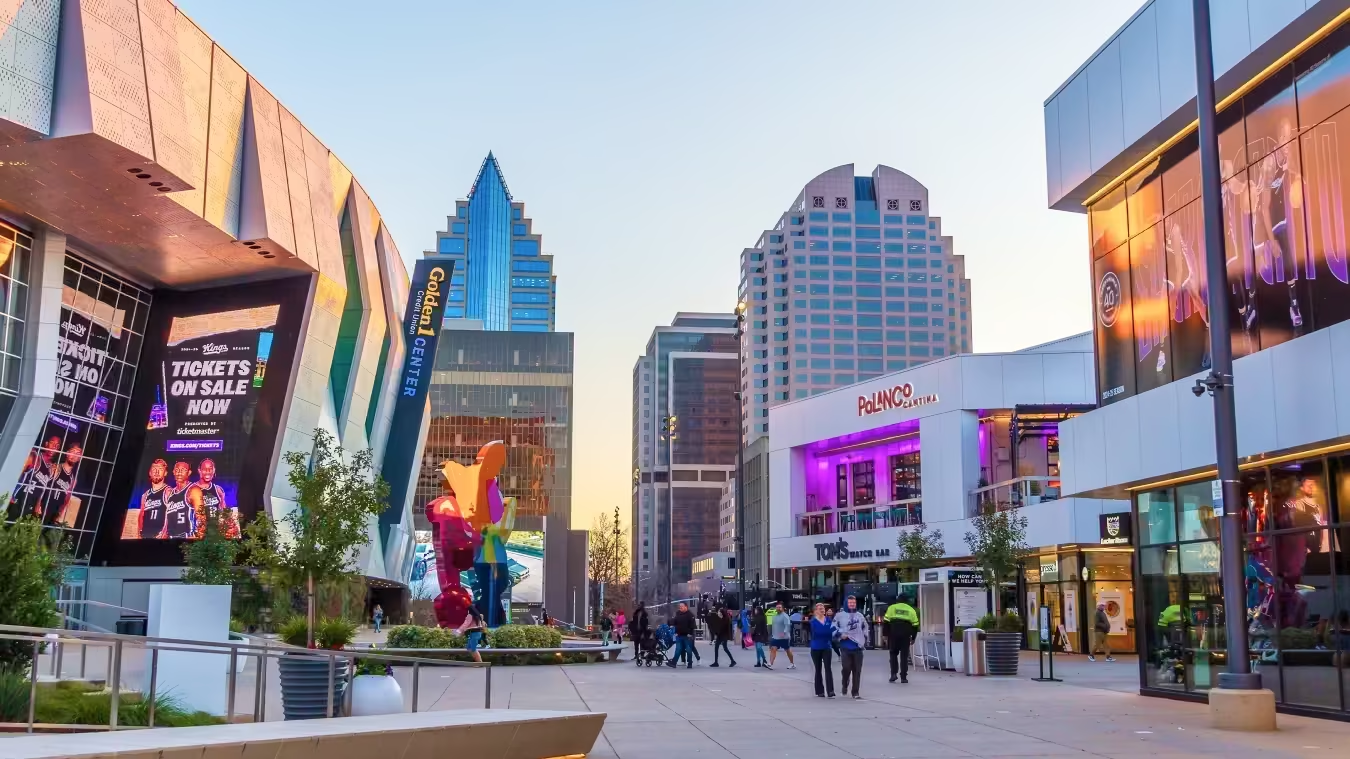
Sacramento’s broader rise is also closely tied to the vitality of the city itself. The chart below shows that out-of-market visits – defined here as visits by people who neither live nor work in the city – rose 3.5% YoY over the past 6 months. This influx includes visitors from across the metro and beyond – and HHI data indicates that, on average, they tend to be more affluent than local residents. 

These visitors are drawn to Sacramento’s concentration of independent restaurants, bars, retail, and cultural hubs, including its bustling Midtown neighborhood. And a growing calendar of major annual events, from Aftershock to Farm to Fork, is also helping to supercharge local tourism and cement the city’s regional appeal. 

Sacramento’s Upward Arc

Bolstered by investments in major new semiconductor plants and medical centers, the Sacramento CBSA was recently ranked among LinkedIn’s 25 fastest-growing U.S. metro areas for jobs and new talent. And the region’s demographic breadth, strong retail and dining performance, and increasingly magnetic urban core position it for continued growth.

For more data-driven analyses of the trends shaping America’s cities follow Placer.ai/anchor.

Article
Seasonal Foot Traffic Trends Tells a Tale of Two Types of Retail Corridors
Foot traffic trends reveal that flagship-led and lifestyle-driven retail corridors vary in their seasonal foot traffic patterns, but both types of corridors are poised for a busy end to the holiday season.
Ezra Carmel
Dec 19, 2025
2 minutes

Retail corridors have long been central to the holiday experience, offering festive spaces for shopping and intricate window displays to admire. But retail corridors can vary significantly – some cluster large global flagship stores, while others lean into smaller regional formats and boutique-style shops, creating a more lifestyle-oriented setting for spending time with friends and family.

We dove into the data for these two types of retail corridors to explore the foot traffic trends defining each space this holiday season. 

End-of-Year Traffic Boost Particularly Strong For Flagship-Led Corridors

Flagship-led corridors such as SoHo in New York City and Union Square in San Francisco typically see their visitation peak in December, when consumers come to browse elegant window displays, holiday lights, and seasonal attractions – often turning a shopping trip into a full outing with friends or family. Union Square’s towering Macy’s Christmas tree, outdoor ice rink, and “Winter Walk” draw crowds looking for a quintessential holiday atmosphere. And SoHo, home to numerous high-end flagship stores, remains one of Manhattan’s most sought-after luxury shopping districts during the holidays. 

Both corridors have seen rising visits throughout 2025, suggesting that their December 2025 lifts could exceed last year’s levels.

Lifestyle-Driven Retail Corridors See Strong Lift in Spring & Summer 

However, retail corridors that center on boutiques, independent retailers, and lifestyle-oriented offerings rather than global luxury flagships – like Back Bay in Boston and South Congress Avenue in Austin – follow a different seasonal rhythm. Rather than peaking at year-end, visits to these districts spike earlier in the calendar. 

Back Bay perhaps benefits from “Open Newbury,” the summer program that closes Newbury Street to vehicular traffic and turns the corridor into a pedestrian promenade, while South Congress sees heightened activity in the spring, before the Texas heat arrives. Both have also seen solid visit growth in 2025, indicating the potential for a healthy December – even if holiday foot traffic plays a smaller role in their overall annual performance compared to flagship-led districts.

Positioning Retail Corridors for a Strong 2026

As both flagship-led and lifestyle-driven corridors head into December with solid year-to-date momentum, high street retailers have a clear opportunity to capitalize on distinct seasonal strengths. Flagship districts should be prepared for an especially pronounced holiday surge, while lifestyle-oriented corridors can focus on converting growing spring and summer foot traffic bumps into sustained engagement year-round. 

For more foot traffic insights, visit Placer.ai/anchor

Placer.ai leverages a panel of tens of millions of devices and utilizes machine learning to make estimations for visits to locations across the US. The data is trusted by thousands of industry leaders who leverage Placer.ai for insights into foot traffic, demographic breakdowns, retail sale predictions, migration trends, site selection, and more.

Article
E-Commerce Strength Outpaces Manufacturing Weakness Going Into 2026
Placer.ai analysis reveals a two-speed economy heading into 2026: E-commerce fulfillment traffic surged 6.6% in November, outpacing a 3.5% decline in manufacturing activity.
Shira Petrack
Dec 18, 2025
2 minutes

Manufacturing Softness Heading Into December

Traffic for manufacturing facilities included in the Placer.ai Manufacturing Index declined 3.5% year over year (YoY) in November 2025, indicating reduced operational intensity that may reflect fewer production shifts, lower output volumes, or scaled-back facility utilization. While part of the decline reflects calendar shifts – November 2025 contained one fewer working day than the prior year – the broader trend aligns with official data. The ISM Manufacturing PMI remained in contraction during the month, underscoring a subdued end to 2025 for the U.S. manufacturing sector.

E-Commerce Fulfillment Traffic Peaked in November 

But even as macro headwinds weighed on other parts of the economy – particularly goods production – e-commerce operators seem to be scaling capacity, expanding hiring, and investing in distribution efficiency. This momentum is reflected in visit gains to e-commerce fulfillment facilities nationwide, with November posting the strongest growth of 2025 at 6.6% YoY.

The consistent upward trajectory in foot traffic indicates that digital retail channels remain a key engine of economic activity, with robust consumer demand fueling the growth of fulfillment networks despite broader industrial softness. The steady gains through the fall in particular suggest that operators are expecting strong holiday demand and are well prepared to handle it.

Two-Speed Economy Heading Into 2026

The softness of the Industrial Index combined with the strength of the E-Commerce Distribution Index highlights a growing paradox: manufacturing activity is weakening even as consumer demand remains firm. 

This divergence is likely due to a confluence of factors. Consumer spending may be flowing toward lower-cost online goods and everyday essentials rather than the higher-priced durable goods that drive factory output. Retailers may also be working through excess inventories and placing fewer new orders, while high interest rates make it more expensive for businesses to invest in equipment or expand production. Together, these dynamics point to a two-speed economy heading into 2026 – one powered by resilient consumption and digital commerce, while traditional production continues to recalibrate.

For more data-driven consumer insights, visit placer.ai/anchor

Placer.ai leverages a panel of tens of millions of devices and utilizes machine learning to make estimations for visits to locations across the US. The data is trusted by thousands of industry leaders who leverage Placer.ai for insights into foot traffic, demographic breakdowns, retail sale predictions, migration trends, site selection, and more. 

Article
How Much Does Price Really Matter to Today’s Dining Consumer?
Experience-Promoting Offers and LTOs at McDonald’s and Burger King are outperforming discounts, revealing how value and pricing expectations are evolving across the dining industry.
Shira Petrack
Dec 17, 2025
3 minutes

With budgets stretched and food inflation lingering, many dining concepts assume that value – specifically, a compelling price-per-food-item ratio – is the key to driving traffic in 2025. And this approach may work: chains like Chili's have shown that an array of deals – such as the 3 For Me and the Triple Dipper Deal – has helped the casual dining brand significantly outpace the wider dining category for more than a year. 

But looking at recent QSR traffic trends suggests a more nuanced story. At both McDonald’s and Burger King, the strongest visit lifts in recent months came from experiential promotions and culturally resonant LTOs – not from discounts.

Boo Buckets & The Grinch Meal Outperform Extra Value Meals

McDonald’s reintroduced its Extra Value Meals on September 8, 2025 – but despite substantial promotional support, the rollout produced only a modest uptick in visits that week. And while traffic improved slightly in the weeks that followed, analyzing recent foot traffic trends highlights that the real inflection points came from experiential activations. 

The return of Monopoly, which gave registered app users the chance to win prizes ranging from free food to high-value rewards, sustained elevated visits for weeks through gamification. Boo Buckets sparked a Halloween-season surge driven by nostalgia and collectability and drove a 10.8% increase in weekly visits compared to the January to August weekly visit average. And The Grinch Meal generated the strongest spike of the entire period by tapping into holiday IP and playful packaging. This data highlights that while consumers may appreciate affordability, moments that feel fun, shareable, and culturally relevant may sometimes be more effective at bringing them through the door. 

LTOs Outperform Deal Weaks at Burger King 

Burger King’s recent performance shows a similar pattern. The rollout of the limited-time Monster Menu generated a stronger visit lift than either Treat Week or Perks Week, both of which focused on giveaways and discounts. The debut of the chain’s nearly $20 Advent Calendar also outperformed Treat Week and Perks Week, underscoring how novelty and excitement may have a greater impact than price-based incentives. 

And the strongest surge came with the debut of the SpongeBob Menu, which produced the strongest spike of the entire period and pushed weekly visits well above the January to August average. By pairing a beloved character franchise with themed packaging, kids’ meal tie-ins, and a sense of occasion, Burger King tapped into the same emotional drivers fueling McDonald’s biggest wins.

Designing Value for 2026: Different Playbooks for QSR and Full-Service Chains

While price sensitivity will likely continue to influence dining decisions in 2026, recent QSR data underscores an important point: Consumers may be watching their wallets, but price alone doesn’t determine where they choose to eat. Chili’s success shows that a compelling value platform can be a powerful differentiator in full-service dining, where the experience is already baked into the visit. But the same strategy doesn’t automatically translate to the QSR landscape, where affordability is expected and price-based promotions quickly blur together. 

Consumers still care about value – but value now spans both price and experience. For full-service restaurants, this means leaning harder into the affordability side of that equation. With ambiance, service, and hospitality already part of the offering, emphasizing everyday value or reliable deal structures may help guests justify dining out more often.

For QSR brands, the calculus is different, and price alone may not be enough to unlock meaningful incremental traffic. Instead, traffic data shows that the strongest results in the QSR space come from experience-driven LTOs, cultural tie-ins, and moments that feel fun, collectible, or social. In other words, fast-food chains may need to focus less on matching grocery-store economics and more on delivering the kind of excitement consumers simply can’t get at home.

As budgets remain tight and expectations continue to evolve, the brands that win won’t be those that chase the lowest price – but those that understand how to deliver the right kind of value for their category: affordability where it matters, and memorable experiences where it counts.

For more data-driven insights, visit placer.ai/anchor

Placer.ai leverages a panel of tens of millions of devices and utilizes machine learning to make estimations for visits to locations across the US. The data is trusted by thousands of industry leaders who leverage Placer.ai for insights into foot traffic, demographic breakdowns, retail sale predictions, migration trends, site selection, and more.  

Article
Die-hard Shoppers Pack the Citadel for 27-Hour Shopping Marathon
Citadel Outlets' 27-hour Black Friday marathon drew dedicated, value-driven shoppers, generating a major Thanksgiving traffic surge and expanding the mall’s trade area through festive experiences and early store openings
Caroline Wu
Dec 16, 2025
2 minutes

Thanksgiving Night Opening Drove Exceptional Traffic

Black Friday deals may now be spread throughout the month of November – but for the Citadel Outlet’s most passionate shoppers, nothing beats the rush of standing in line with thousands of other eager customers awaiting the chance to be the first to scoop up deals. This year, the mall opened on Thanksgiving night once again – and the foot-traffic data shows that shoppers responded. While most malls in California and across the country saw visits plunge on the holiday, Citadel Outlets experienced a significant surge in traffic, despite being open for only a limited window.

27-Hour Shopping Marathon Attracted Dedicated Shoppers

Citadel Outlet as a whole opened Thanksgiving evening at 8pm, with certain stores opening even earlier at 4pm or 6pm. Black Friday sale hours ran until 11pm on Friday, giving these marathon shoppers 27 hours of continuous shopping. People driving northbound on the 5 freeway post-Thanksgiving dinner would have come across lines of cars visible already waiting to get into the Citadel parking lot to get a start on holiday shopping and burn off that turkey by hitting their step count. Once there, exciting experiences awaited, such as a giant Christmas tree and a gingerbread man scavenger hunt.

A quarter of visits to the Citadel on Thursday/Friday actually took place on the Thursday of Thanksgiving itself.

Value Seekers & Younger Shoppers Led the Charge

Value seekers came out in abundance, led by Melting Pot Families, Near-Urban Diverse Families, and City Hopefuls per Spatial.ai’s Personalive.

Citadel Outlets Pulled From an Exceptionally Wide Trade Area

Angelenos were willing to come from afar, with the Citadel shoppers encompassing a whopping 255.5 mile trade area to score their deals on Black Friday alone. They say shopping is a marathon and it appears that for these dedicated customers, nothing beats the thrill of the chase when it comes to saving money.

Ultimately, Citadel Outlets’ Black Friday performance suggests that immersive experiences, extended hours, and a strong value proposition can still transform holiday shopping into a destination-worthy event.

For more data-driven retail insights, visit placer.ai/anchor

Placer.ai leverages a panel of tens of millions of devices and utilizes machine learning to make estimations for visits to locations across the US. The data is trusted by thousands of industry leaders who leverage Placer.ai for insights into foot traffic, demographic breakdowns, retail sale predictions, migration trends, site selection, and more.  

Reports
INSIDER
3 Trends Shaping the Dining Industry
This report leverages the latest location intelligence data to identify three dining trends that will shape the dining industry in 2024.
November 30, 2023

Digging Into Dining

The dining industry showcased its agility over the past couple of years as it rapidly adapted to shifts in consumer preference brought on by COVID and rising prices. And with a new year around the corner, the pace of change shows no signs of slowing down. 

This white paper harnesses location analytics, including visitation patterns, demographic data, and psychographic insights, to explore the trends that will shape the dining space in 2024. Which dining segments are likely to pull ahead of the pack? How are chains responding to changes in visitor behavior? And where are brands driving dining foot traffic by taking advantage of a new advertising possibility? Read on to find out how dining leaders can tap into emerging trends to stay ahead of the competition in 2024. 

Stepping Up To The Plate

Comparing quarterly visits in 2023 and 2022 highlights the impact of the ongoing economic headwinds on the dining industry. The year started off strong, with year-over-year (YoY) dining visits up overall in Q1 2023 – perhaps aided by the comparison to an Omicron-impacted muted Q1 2022. And while overall dining growth stalled in Q2 2023, several segments – including QSR, Fast Casual, and Coffee – continued posting YoY visit increases, likely bolstered by consumers trading down from pricier full-service concepts. 

Foot traffic slowed significantly in Q3 2023 as inflation and tighter consumer budgets constrained discretionary spending. Overall dining visits fell 2.4% YoY, and full-service restaurants – with their relatively high price point compared to other dining segments – seemed to be particularly impacted by the wider economic outlook. But the data also revealed some bright spots: Fast Casual still succeeded in maintaining positive YoY visit numbers and Coffee saw its Q3 visit grow an impressive 5.4% YoY. As the return to office continues, a pre-work coffee run or lunchtime foray to a fast-casual chain may continue propelling the two segments forward. 

Shifting Demographics and Shifting Dining Behavior

Restaurant visitation patterns have evolved over the past few years. Although an 8 PM seating was once the most coveted slot at fine-dining restaurants, recent visitation data suggests that sitting down to dinner earlier is rising in popularity. 

But among the QSR segment, the opposite trend is emerging, with late-night visits rising. Analyzing hourly foot traffic to several major QSR chains reveals that the share of visits between 9 PM and 12 AM increased significantly between Q3 2019 and Q3 2023. Even Taco Bell – already known for its popularity among the late-night crowd – saw a substantial increase in late-night visits YoY – from 15.4% to 20.3%. 

Younger Customers Staying Out Later

Who is driving the late night visit surge? One reason restaurants have been expanding their opening hours is to capture more Gen-Z diners, who tend to seek out nighttime dining options. But location intelligence reveals that younger millennials are also taking advantage of the later QSR closing times. 

An analysis of the captured market for trade areas of top locations within one of Taco Bell’s major markets – the ​Chicago-Naperville-Elgin, IL-IN-WI Metropolitan area – reveals a year-over-four-year (Yo4Y) increase in “Singles & Starters.” The “Singles & Starters” segment is defined by Experian: Mosaic as young singles and starter families living in cities who are typically between 25 and 30 years old. As consumers continue to prioritize experiential entertainment and going out with friends, late-night dining may continue to see increased interest from young city-dwellers. 

Smoothies Drive Weekend Visits

Millennials and Gen-Z consumers aren’t only heading to their favorite fast food joint for a late-night bite – these audience segments are also helping drive visits on the weekends. Smoothie King is one chain feeling the benefits of young, health-conscious consumers.

The chain, which opened in New Orleans, LA, in 1973 as a health food store, has since grown to over 1,100 locations nationwide and is currently expanding, focusing on the Dallas-Fort Worth CBSA. The area’s Smoothie King venues have seen strong visitation patterns, particularly on the weekends – weekend visits were up 3.4% YoY in Q3 2023.  The smoothie brand’s trade areas in the greater Dallas region is also seeing a YoY increase in weekend visits from “Young Professionals” – defined by the Spatial.ai PersonaLive dataset as “well-educated young professionals starting their careers in white-collar or technical jobs.” 

Sports and Dining - Match Made in Heaven

While some dining chains are appealing to the late-night or weekend crowd, others are driving visits by appealing to sports lovers. How have recent rule changes around student athletes changed the restaurant game, and how can college football teams drive business in their hometowns?

Scoring Big: Leveraging Fan Insights to Fuel Successful Partnerships

College sports have long been a major moneymaker, with top-tier teams raking in billions of dollars annually. And as of 2021, college athletes can enjoy a piece of the significant fan following of college sports thanks to the change in the NCAA’s Name, Image, and Likeness (NIL) rules, which now allows student athletes to sign endorsement deals.

Since then, multiple restaurants have jumped on the opportunity to partner with student athletes, some of whom have millions of followers on Instagram and TikTok. Chains like Chipotle, Sweetgreen, Slim Chickens, and Hooters have all signed college athletes to various brand deals.

How can brands ensure they partner with athletes their customers will want to engage with? Analyzing a chain’s audience by looking at the interests of residents in a given chain’s trade area can reveal which type of athlete will be the most attractive to each brand’s customer base. For example, data from Spatial.ai: Followgraph provides insight into the social media activity of consumers in a given trade area and can highlight desirable partnerships. 

Examining the trade areas of Chipotle, Sweetgreen, Slim Chickens, and Hooters, for instance, reveals that Sweetgreen’s visitors tended to have the largest share of Women’s Soccer followers. Conversely, Sweetgreen’s trade area had lower-than-average shares of College Football Fans or College Basketball Fans, while residents of the trade areas of the other three chains showed greater-than-average interest in these sports. Leveraging location intelligence can help companies choose brand deals that their customers resonate with and find the ideal athletes to represent the chain. 

College Gameday - Wins for Dining

Finding the right college athlete partnership is one way for dining brands to appeal to college sports enthusiasts. But dining chains and venues located near major college stadiums also benefit from the popularity of their local team by enjoying a major game day visit boost. 

One of the country’s most popular college football teams, the Ohio State Buckeyes, can draw millions of TV viewers, and its stadium has a capacity of 102,780 – one of the largest stadiums in the country. And while tailgating is a popular activity for Buckeyes fans, nearby restaurants are some of the biggest beneficiaries of the college football craze. Panera experienced a 235.3% increase on game days as compared to a typical day, Domino’s Pizza visits grew by 283.3%, and Tommy’s Pizza, a local pie shop, saw its visits jump by a whopping 600.9%. 

Game Day Visitor Spikes

This influx in diners also causes a major shift in game day visitor demographics, as revealed by changes in visitors at dining venues located near stadiums of two of the nation’s best college football teams – the Ohio State Buckeyes and Ole Miss Rebels. Based on Spatial.ai: Personalive data for the captured market of these dining venues, game day visitors tended to come from “Ultra Wealthy Families” when compared to visitors during a typical non-game day in September or October. 

The analysis indicates that popular sporting events create a unique opportunity for restaurants near college stadiums to attract high-income customers game day after game day, year after year. 

Subwars: Room for Everyone

While some spend game day tailgating or visiting a college restaurant, others hold a viewing party – with a six-foot submarine. And the sub’s popularity extends beyond Superbowl Sundays. Sandwich chains including Jersey Mike’s, Firehouse Subs, Jimmy John’s, and Subway (recently purchased by the same company that owns Jimmy John’s) have seen sustained YoY increases in visits and visits per venue in the first three quarters of 2023.

Some of the growth to these chains may be related to their affordability, a draw at all times but especially during a period marked by consumer uncertainty and rising food costs. And subway leaders seem to be seizing the moment and striking while the iron is hot – Jersey Mike’s opened 350 stores in 2023 and still saw its YoY visits per venue grow by 6.6%. And Subway reported ten consecutive quarters of positive sales, a promising sign for its new owner. 

Sandwich Chains Attract a Wide Consumer Base

The love for a healthy, affordable sandwich extends across all income levels, with all four chains seeing a range in their visitors' median household income (HHI). Out of the four chains analyzed, Jersey Mike’s – which has long prioritized a suburban, middle-income customer – had the highest trade area median household income of the four chains at $77.3K/year. Subway, known for its affordability, had the lowest, with $62.9K/year. The variance in median HHI combined with the strong foot traffic growth shows that when it comes to sandwiches, there’s something for everyone. 

So What’s The Dining Space Cooking Up?

Persistent inflation and declining consumer sentiment may pose serious challenges for the dining space, but emerging trends are helping boost some restaurants. Customers seeking out a late-night bite drive visits to QSR chains, and health-conscious diners are boosting foot traffic to smoothie bars and sandwich shops. Meanwhile, sports sponsorships and game-day restaurant visits can provide a boost to dining businesses that take advantage of these opportunities. 

INSIDER
Retail’s New Media Power
Get a first look at the growing power of retail media networks. Learn how brick-and-mortar brands can measure reach and track impact to transform the advertising space.

“Retail media networks have turned retailers into ad moguls. That’s a huge change and nobody yet understands all the implications of it.”

Constantine von Hoffman, MARTECH

Retailers Stepping Into Their Media Power 

Companies operating consumer-facing brick-and-mortar venues traditionally relied on selling goods and services as their primary revenue stream. But recently, leading retailers such as Walmart and Target have begun to leverage their immense store fleet into a powerful advertising platform. 

Online retailers have been tapping into the advertising power of their digital sites for years by relying on various automated tools to show third-party advertisements to relevant consumer segments. But now, retailers with a strong offline presence can also leverage physical marketing impressions and focus their campaigns while reaching consumers at the point of purchase. Retailers have long recognized the intent that drives a store visit, and understanding the full value of leveraging that visit to its full extent is an important new frontier.

Major retailers are continuing to see their physical visits outnumber their online ones. 

And in spite of the gloomy predictions regarding the future of brick and mortar retail, major retailers are continuing to see their physical visits outnumber their online ones. Monthly numbers of visitors to Walmart and Target significantly outpace the brands’ online reach, according to web data from Similarweb. So although, up until recently, these brands have focused their media placements on their digital channels, it is becoming increasingly clear that these chains’ physical stores hold powerful – and currently untapped – advertising potential. 

Online visitor data source: similarweb.com

And with the recent rise in digital advertising costs, retail media networks are becoming more attractive for companies looking to make the most of their ad budget. Retail media networks can also help brands reach rural communities, elderly Americans, and other consumer segments that are currently underserved by digital advertisers.

This white paper explores several retailers on the cutting edge of the retail media network revolution. Keep reading to find out how advertisers can use retail media networks to promote to hard-to-reach consumers, segment their ad spending, and optimize their campaigns.

Leveraging Retail Media Networks to Reach Rural Customers 

Residents of rural areas use the internet less frequently, and have lower levels of technology ownership than their urban and suburban counterparts. As a result, companies that stick to digital advertising may have a harder time reaching rural consumers. Brick and mortar retailers popular in smaller markets can fill in the gaps and help brands promote their products and services to this hard-to-reach audience. 

Brick and mortar retailers popular in smaller markets can help brands advertise to hard-to-reach audiences. 

Dollar General’s Growing Strength 

Dollar General saw significant success over the pandemic, with the current economic climate continuing to benefit the brand. Between January and August 2022, nationwide visits to Dollar General venues were 35.6% higher than they were between January and August 2019, while the number of visitors increased 25.4% in the same period.Visit numbers aggregate the visits to the chain’s various locations in a given period, while visitor numbers track the number of people who enter the brand’s stores.

The company has also been operating a media network since 2018. The Dollar General Media Network (DGMN) enables advertisers to reach Dollar General consumers across the company’s channels to build awareness both digitally and in physical spaces. Advertisers with DGMN can display in-store bollard, blade, and wipe stand signs, security pedestals, basket bottomers, and shelfAdz to deliver in-store messaging from parking lot to purchase. Recently, Dollar General announced that its ad platform was now working with 21 new advertising partners, including Unilever, General Mills, Hershey’s, and Colgate-Palmolive. 

Embracing the Power of the Small Market

Advertising partners can leverage the DGMN to promote their goods and services to harder-to-reach consumers.

Dollar General has been serving rural residents for years, with the majority of the company’s stores located in communities with fewer than 20,00 residents. And while the brand is growing nationwide, Dollar General’s strength is particularly evident in small markets – which means that advertising partners can leverage the DGMN to promote their goods and services to harder-to-reach consumers.

Comparing year-over-three-year (Yo3Y) visit change to Dollar General stores in metropolitan and micropolitan core based statistical areas (CBSAs) highlights the company’s success in smaller markets. According to the United States Office of Management and Budget, metropolitan and micropolitan CBSAs have over and under 50,000 residents, respectively. Since January 2022, monthly Yo3Y visit growth to Dollar General venues in select Texas micropolitans has consistently outpaced foot traffic to nearby metropolitan areas. While the Sherman-Denison metro area saw August 2022 foot traffic hit a solid 24.5% increase over August 2019, the Gainesville, Texas micro area – around 35 miles east of Sherman – saw its foot traffic increase 54.5% in the same period.

Dollar General’s presence across a significant number of smaller markets means that advertising partners can use the growing DGMN to increase awareness and drive purchase consideration among these harder-to-reach consumers. 

Increasing Ad Impressions

In the digital space, three tech giants – Alphabet (previously Google), Meta (previously Facebook), and Amazon – enjoy over 60% of the digital ad revenue in the United States. This means that companies are competing for impressions on a small number of platforms – and smaller brands geared at specific consumer segments may need to spend significant advertising budgets to outbid the larger players. Retail media networks create additional advertising platforms, and enable advertisers to diversify their ad spend, increase their (physical) impressions, focus on more specialized channels to better reach their audience, and potentially reach customers at their highest point of intent. 

Retail media networks create additional advertising platforms and potentially reach customers at their highest point of intent. 

The Albertsons Advantage

Albertsons launched its retail media network, Albertsons Media Collective, in November 2021 with the goal of delivering “digitally native, shopper-centric and engaging branded content to the company’s ever-growing network of shoppers.” Currently, the grocer’s media network is primarily digital, but Albertsons’ head of retail media products Evan Hovorka recognizes the importance of leveraging in-store assets to deliver a unique advertising experience. The company is testing out smart carts that link with “Albertsons for U” loyalty program to display ads to shoppers – and Albertsons is likely to find more ways to reach in-store consumers as it continues to develop its retail media network. 

The chain is also one of the most popular grocers nationwide. With the exception of March and April 2022, when inflation and high gas prices temporarily halted growth, the brand’s monthly visits and visitor numbers have consistently exceeded pre-pandemic levels. Monthly visits for Albertsons in August 2022 were up 5.7% and monthly visitors were up 5.4% on a Yo3Y basis. This means that advertisers with Albertsons can increase their reach and grow their physical ad impressions just by displaying their ads in Albertsons locations and tapping into the chain’s growing visitor base.

Optimizing Physical Ad Campaigns

Looking beyond Albertsons' nationwide average foot traffic trends reveals some important regional differences. Between January and July 2022, visits to the brands increased 4.6% in Wyoming on a Yo3Y basis, while foot traffic to the brand’s locations in Oregon jumped 18.5% compared to January through July 2019. This means that a brand looking to reach consumers in Oregon can contract with Albertsons’ media network to show its ads to a fast-growing pool of visitors. 

A larger visitor count translates to an increase in unique ad impressions, while more visits from fewer visitors can drive repeated exposures.

Diving deeper into the data reveals an additional layer of insight. Some states with only moderate visit growth are seeing a surge in visitor numbers, while other states are seeing a drop in visitor numbers but a rise in visits. A larger visitor count translates to an increase in unique ad impressions and more people exposed to the ads, while more visits from fewer visitors translates to more overall impressions that can drive repeated exposure among a smaller group of visitors. So advertisers can use segmented foot traffic data to decide where to focus their marketing depending on the goal of the campaign. 

For example, Wyoming's moderate increase in visits hides a significant spike in visitors, which means that advertisers to Albertsons venues in Wyoming can get their impressions before a large number of different potential consumers. Meanwhile, Oregon's 18.5% increase in visits is the result of just a 9.4% increase in visitors – so Albertsons is cultivating an increasingly loyal following in the Beaver State, and the grocer’s advertising partners can expect that the same visitors will be exposed to their brand repeatedly. 

So companies that want to increase unique ad impressions and build awareness can advertise to Albertsons customers in Wyoming, where their ads will be seen by a large number of new people. But in Oregon, companies may want to promote a campaign that focuses on moving Albertsons visitors through their funnel. 

In order to accurately assess the ad distribution patterns in each location, brands operating retail media networks need to understand both visits and visitors trends in each region and for the chain as a whole.

Insights from Consumer Cross-Visits

Advertisers with retail media networks can use foot traffic data to refine their geographic audience by identifying the consumer preferences of a given brick-and-mortar brand on a store or city level.

CVS Launches a Media Network 

In August 2020, CVS Pharmacy launched its media network, the CVS Media Exchange (cMx). The company estimates that 76% of U.S. consumers live within five miles of at least one store, and the cMx allows partners to tap into the chain’s reach by giving advertisers access to CVS’ online and offline channels, including in-store ads. 

Although CVS has been closing locations recently, the brand is still one of the strongest players in the brick-and-mortar retail space. Its 2022 visit numbers have consistently exceeded pre-pandemic levels nationwide, and data from CVS locations in leading cities shows that its Yo3Y visits per venue and visitor numbers are even higher. 

CVS’s nationally distributed fleet means that the brand’s locations in different regions attract distinct consumer bases.

CVS carries a varied product mix of daily essentials in addition to its healthcare offerings, so the brand attracts a wide range of consumer segments. And the chain’s nationally distributed store fleet means that CVS has locations in different regions that attract distinct consumer bases who do not all have the same lifestyle preferences. By using foot traffic data to understand the regional consumer preferences of CVS consumers beyond the store, advertising partners can refine their market and make the most of the cMx. 

Reaching Health and Wellness Consumers Through the cMx

Different regions have different fitness cultures. Chains catering to health-conscious consumers can use retail media networks and foot traffic data to focus their efforts on areas where inhabitants exhibit a high demand for regular workouts.

Analyzing cross-visit data from CVS locations across five major urban centers in the U.S. shows that the percentage of those who also visited gyms or fitness studios varied significantly across each DMA. In the New York area, 62.7% of those who visited CVS in Q2 2022 also visited a fitness venue during that period, in contrast with only 38.0% of CVS visitors around Dallas-Ft. Worth, TX in the same period. This information can help advertising partners in the health and wellness space decide where to place their campaigns. 

Refining the Geographic Market 

Looking at cross-visit data on a city-wide level can provide a sense of the consumer culture in each area, but advertisers that dive into foot traffic data for individual stores can refine their messaging even further. 

On average, 43.8% of CVS visitors in the Chicago DMA also visited a gym in Q2 2022. But drilling down to the top CVS locations in the city reveals that the rate of cross-visits varies significantly from location to location. Both the E 53rd Street and W 103rd Street locations have a relatively high share of visitors who visit fitness locations  – 52.5% and 49.2%, respectively. Meanwhile fitness cross-visits were at just 36.6% for the South Stony Island Avenue location. Advertisers promoting health and wellness related products and services may want to focus on the 103rd St. and 53rd St. CVS locations. 

Diving into a customer’s behavior and preferences outside the store can help retail media network operators and advertising partners find the areas and locations best suited for each type of ad. 

Online Consumer Behavior Informing In-Store Preferences 

Cross-visit data is one way to identify consumer preferences beyond the physical store. Advertisers can also analyze digital preferences of offline visitors to focus their marketing on the most appropriate locations.

Advertisers can also analyze digital preferences of offline visitors to focus on the most appropriate locations.

Macy’s Continued Popularity 

Over the past couple of years, Macy’s has been finding ways to reinvent itself and optimize its store fleet – and foot traffic data indicates that the retailer's efforts are paying off. In the first half of 2022, Macy’s exceeded its H1 2021 overall visit and average visits per venue numbers and posted a positive year-over-year (YoY) visitor count. In Q2 2022, despite the wider economic challenges, Macy’s visitors, visits, and average visits per venue saw YoY increases of 3.4%, 4.0% and 9.9% increases.

Leveraging Macy’s Media Network to Reach the Right Shoppers

Like CVS, Macy’s launched its media network in August 2020, and by February 2021 the Macy’s Media Network was already generating $35 million annually. In addition to advertising on the company’s digital channels, Macy’s also offers partners the use of in-store screen displays, package inserts, and the brand’s iconic billboard in New York City’s Herald Square. 

Advertisers can optimize their advertising by analyzing the differences in consumer profiles between a chain’s various stores. 

Advertisers that understand the differences in consumer profiles between a chain’s various stores can optimize their advertising efforts. While looking at variations in cross-visit trends is one way to identify interested brick-and-mortar consumers, diving into visitor’s digital behavior and online preferences can also provide valuable insights.  

Tools such as Spatial.ai’s GeoWeb, which tracks online engagement with various trends and topics by neighborhood, can reveal how offline consumers behave online. An index score of 100 indicates that consumers in an area have an average interest in a given topic, while scores over (or under) 100 indicate that consumers are more (or less) interested in the topic when compared to the national average interest. 

We used Spatial.ai’s GeoWeb tool to analyze the online behavior of consumers in the True Trade Areas (TTA) of five Macy’s locations in the Philadelphia, PA DMA – and found that residents of the different TTAs stores showed differing indexes. For example, the Macy’s in the King of Prussia Mall location showed a high index of 161 in “Men’s Business Clothes Shoppers,” while the Cottman Ave. location had an only slightly above average index of 102. This means that advertisers of men’s business apparel may see more results by focussing their advertising on visitors to the King of Prussia location. 

Macy’s Herald Square Billboard 

Advertisers that use retail media networks do a lot more than just reach in-store shoppers. Stores exist in the physical world, so advertisers can also reach passers-by through physical venues’ windows, blade signs – or in the case of Macy’s, through its Herald Square Billboard. Here too, foot traffic data can reveal the consumer preferences of people walking by the sign.

We looked at the online behavior in the TTA around the traffic pin on the corner  where the billboard is located (Broadway/6th Ave and 34th Street in New York) to understand which advertisers might benefit most from a billboard at that location. While the “Men’s Business Clothes Shoppers” category was over-indexed compared to the national average, as would be expected in midtown Manhattan, “Women’s Fashion Brand Shoppers” had an even higher index. “Gen Z Apparel Shoppers” were over-represented, but “Leather Good Shoppers” and ”Athleisure Shoppers” were under-represented. So a brand that carries both elegant wear and athleisure may want to display its less casual clothing lines on the billboard.

Understanding how consumers behave both on and offline can help retail media networks and advertising partners promote their campaigns most effectively. 

Retail Media Networks Revolutionizing Advertising

To transform their physical store fleet into a media network, brands and companies need to analyze the reach of each venue. The same chain operating in multiple regions may be reaching different types of consumers in each area, or even in various neighborhoods of the same city. These distinct audiences may have contrasting products, brands, and shopping preferences. 

Retailers that leverage their brick and mortar presence can transform the advertisement space as it exists today.

Retailers can also partner with advertising partners who wish to promote goods and services not carried by the retailer. For this to succeed, the retailer will need to analyze how consumers behave outside of its stores. Understanding what characterizes the overall behavior of consumers in each locations’ trade area will allow the retailer to reach a larger audience and truly compete with the digital giants. And by leveraging their brick and mortar presence, brick and mortar retail can transform the advertisement space as it exists today.

INSIDER
Malls that are Rising to the Top
Find out how malls are reinventing themselves and staying relevant thanks to experiential offerings, omnichannel options, and strategic tenant selection.

Malls have long acted as a gleaming symbol of American retail. Following the opening of the first indoor mall in 1956, and as the American middle class increasingly moved from the city to the suburbs, malls continued to open at a rapid rate. By 1960, some 4,500 shopping centers had opened nationwide, filling the growing demand for  “third places” – spaces that allowed the newly suburban populations to  gather, socialize, and create community. And while that role evolved over the years, it’s safe to say that malls have played a major part in shaping the American shopping culture. 

But malls’ rapid expansion led to an oversaturated marketsome estimates suggest that there are approximately 24 square feet of retail space per U.S. citizen, as compared to 4.6 for the U.K. and 2.8 for China. Many began to predict the demise and downfall of malls, and that narrative intensified as online shopping grew in popularity. The rise of big-box stores, a focus on “services, not things,” and COVID-19 only accelerated these trends. 

A lot of the doom and gloom predictions tend to de-emphasize the mall's role as a modern incarnation of a bustling downtown shopping area.

But a lot of these doom and gloom predictions focus on malls only as a place to shop, and tend to de-emphasize their other role as the third place – a modern incarnation of a bustling downtown shopping area, replete with shops, services, and places to meet. And after two years of isolation and a new, pandemic-induced wave of suburban relocation, malls’ potential to bring people together is more prized than ever. 

So although malls were hit hard during COVID-19, many of them are finding ways to reinvent themselves and stay relevant. Today, more than halfway through 2022, the challenges that malls face continue to evolve and change – but malls are evolving too. This white paper covers a few specific ways that some malls have found to thrive in the new normal. Some shopping centers are turning to entertainment to draw crowds into their doors. Others are focusing on offering a full visitor experience that extends beyond simply grabbing a new shirt or a burger at the food court. Still, more are embracing omnichannel options, offering an integrated on and offline experience to their shoppers. In the face of significant retail challenges, top-tier malls are turning to innovative solutions to stay ahead of the game.

Overview

The pandemic posed significant challenges to malls. Although foot traffic to the category rose back up in the summer of 2021, the Delta and subsequent Omicron waves brought visits down once more. And as visit gaps post-Omicron began to narrow, inflation and gas prices put the brakes on any return to normalcy. April and May 2022 saw visits beginning to trend up, though the unrelenting rise of inflation, the highest it’s been in the past 40 years, has slowed that recovery slightly.

Foot traffic data shows that malls are continuing to attract visitors, despite the challenges that seem to crop up weekly.

Still, foot traffic data shows that malls are continuing to attract visitors, despite the challenges that seem to crop up weekly. And while they may no longer play the central role they once did in Americans’ shopping routines, malls still serve as indoor community hubs where friends and family can come together for diverse food, shops, and entertainment options. This could explain why top-tier malls keep on coming back despite the seemingly constant obstacles.  

Malls Facing Sustained Challenges

Comparing monthly visits from January 2022 through July 2022 to the same period in 2019 highlights the significant difficulties facing the sector. Indoor malls, open-air lifestyle centers, and outlet malls alike saw marked lags in foot traffic as compared to three years ago. 

Monthly year-over-three-year (Yo3Y) foot traffic comparisons also highlight mall resilience.

The monthly year-over-three-year (Yo3Y) foot traffic comparisons also highlight mall resilience. Following an Omicron-plagued January, the visit gaps narrowed in February 2022 to less than 5% for all the segments. And although the increase in gas prices and inflation brought visits down in March, malls quickly bounced back in April 2022, with indoor malls seeing only 1.8% fewer visits than in 2019 and open-air shopping centers down only 4.8% Yo3Y. Foot traffic fell again in May and June as consumers tightened their budgets in the face of rising prices, but consumers appear to have quickly made peace with the new economic reality. By July 2022, visits to indoor malls and open-air lifestyle centers were only 3.5% and 2.7% lower than they had been in July 2019.

Fewer Visitors, Shorter Stays

COVID didn’t just impact visit numbers – since 2020, mall visits have also gotten shorter, likely a result of pandemic restrictions and a general desire not to congregate any longer than necessary. And although 2021 and 2022 saw a slight uptick in time spent at malls and shopping centers – from 60 minutes in 2020 to 62 minutes in 2021 and 2022 – the median dwell time is still significantly lower than the 70 minutes median dwell time of pre-COVID 2018 and 2019.  

Shorter visits are not necessarily a bad thing – intent-driven shoppers may simply be doing more research ahead of time and less in-mall browsing.

Shorter visits are not necessarily a bad thing in and of themselves – consumers today are highly informed, so many intent-driven shoppers may simply be doing more research ahead of time and less in-mall browsing. But shorter (and fewer) visits do mean that  malls must focus on giving shoppers a reason to visit. We explore some successful strategies below. 

Going Experiential with Entertainment

Malls have long integrated entertainment into their overall experience in the form of arcades, movie theaters, and even coin-operated animal rides. Some malls, however, are taking their entertainment offerings to the next level.

In August 2021, CBL Properties, a Tennessee-based property developer, announced the opening of the Hollywood Casino by Penn National Gaming in the York Galleria Mall in York, Pennsylvania. The 80,000 square foot casino, which boasts 500 slots and 24 live-action table games, opened in the mall’s lower level. The space was occupied by a now-closed Sears department store, and the entertainment venue now functions as a new anchor to draw customers in. 

The casino’s opening has had a dramatic impact on the mall’s foot traffic. In a year-over-three-year (Yo3Y) comparison, July 2021 saw 2.4% fewer visitors than July 2018. But when the casino opened in August 2021, visits to the location jumped to 31.4% Yo3Y. This increase is all the more impressive considering that the casino opened on August 19th, with only 12 days left in the month. 

The mall, which had seen negative Yo3Y visit numbers until the casino’s opening, has sustained the positive visit trend through July 2022 – a testament to the appeal of in-mall entertainment. 

Children’s Entertainment Providing a Boost

Another mall betting on indoor entertainment is the Pierre Bossier Mall in Bossier City, Louisiana. In April 2022, Surge Entertainment opened a child-friendly space, which includes zip-lining, bowling, laser tag and arcade games. The Surge Entertainment chain is co-owned by Drew Brees, the former New Orleans Saints quarterback, and has 15 locations around the country. The Pierre Bossier Mall branch is filling the space vacated by Virginia College, which closed its doors in 2018. 

Since Surge Entertainment opened its Bossier City location, the mall has seen a dramatic increase in average dwell time.

Since Surge Entertainment opened its Bossier City location, the mall has seen a dramatic increase in average dwell time. Between July 2021 and March 2022, median dwell time hovered between 51 and 58 minutes. But following the center’s opening, median dwell time jumped to 78 minutes. Since then, the median dwell time has remained consistently elevated: In the four months since the Surge Entertainment opening, median dwell times did not drop below 75 minutes.

Going Omnichannel

Brick-and-mortar retailers once viewed online shopping as a threat – but now, mall owners and operators are increasingly turning to digital channels to complement existing approaches. COVID-19 and the surge of online shopping further fueled malls’ digital progress. Over the past two years, large malls and suburban shopping centers across the country have been rolling out various online and social shopping options and adopting omnichannel strategies.

In September 2020, Centennial, a real estate investment firm with many malls and mixed-use entertainment centers in its portfolio, launched a chain-wide omnichannel platform called Shop Now!. The app allows consumers to shop across all Centennial malls the way someone would shop on Amazon.

The first phase of the program, which launched in October 2020, allowed users to browse an AI-powered search engine connected to the inventory of all of the stores operating in their mall of interest. In February 2022, Centennial debuted phase two of the program at its Santa Ana, CA based MainPlace Mall. It allows customers to consolidate orders from several stores into a single cart, get the order fulfilled by personal shoppers, and have the orders ready for same-day delivery or on-site pickup.

The e-commerce app could have detracted shoppers from physically going to the mall – but instead, the program increased both monthly and loyal visitors. 

The app allows consumers to browse and shop from the comfort of their phones. It could have detracted shoppers from physically going to the mall – but instead, the program has increased both monthly and loyal visitors. In the months following the launch of the second phase, MainPlace Mall saw its loyal visits increase by 5% (from 46.2% in February ‘22 to 51.3% in June ‘22), while overall monthly visits in April ‘22 increased by 5.5%  when compared to 2019. The digital investment also helped the mall make sales that could have been lost to other e-commerce platforms. The mall’s brick-and-mortar success following the addition of a digital channel highlights how malls can rise to the top by embracing an omnichannel strategy. 

Continuing its innovative streak, the MainPlace Mall recently added an experiential component with the opening the American Ninja Warrior Adventure Park in July 2022 in the place of four former retail stores. During its first month of operation, the park drove the mall’s share of loyal visits up by 13.4% compared to the previous month while boosting Yo3Y monthly visits by 18.0%. 

The difference in impact between the online platform launch and the opening of the American Ninja Warrior Adventure Park indicates that malls can enjoy both gradual gains over time as well as jumps in foot traffic and loyalty, depending on the strategy they adopt.

Embracing Food Tech 

Omnichannel strategies can also revitalize food courts hit hard by the pandemic. Arundel Mills Mall, part of the Simon Property Group, began offering online orders in February 2022 via a platform called Snackpass, allowing users to use the app at various eateries around the mall. Snackpass, launched in 2017 as a food ordering app on the Yale campus, facilitates group ordering and includes various social features. Its current iteration allows customers to pre-order food, skip lines, collect rewards, and engage with friends. It also offers discounts on group orders, in an effort to promote social dining.

Since the beginning of the Snackpass partnership, the shopping center itself is seeing more visitors – many of whom are coming from farther away. 

Since the beginning of the Snackpass partnership, the shopping center itself is seeing more visitors – many of whom are coming from farther away. In the five months following the app’s launch, Arundel Mills saw an overall increase of 15 square miles to its True Trade Area (TTA), and an increase of 29.5% in visits per sq. ft. – The consistent increase in TTA and visits per sq. ft. are a testament to the power of innovative dining partnerships to draw traffic to top-tier malls. 

Reutilizing and Repurposing Space

With many retailers reducing their on-mall presence, empty brick-and-mortar stores have attracted plenty of negative attention. But now, malls are increasingly repurposing vacated spaces in new, innovative ways that resonate with local communities and can fill their evolving needs.

Younger Customers Linger Longer

At the Ocean County Mall in Toms River, NJ, Simon Property Group repurposed the huge space left by a former Sears store and turned it into a lifestyle center, with stores opening throughout 2020. The space is now being used by a number of highly popular chains such as  LA Fitness, Ulta Beauty, HomeSense, and P.F. Chang’s and also includes a children's play area. 

This pivot seems to be working. Median dwell time to the mall has increased from 53 minutes to 56 minutes, a significant change when considering that a majority of malls have recently seen their dwell times drop. 

The center has also seen the median age for its trade area decrease from 40.5 years old in the first half of 2021 to 37.2 in the first half of 2022, a dramatic shift in visitor demographics. Yo3Y visits are strong as well – July 2022 were up by 17.1%. 

Fitness Center Provides a Boost

In a similar tale of a closed Sears turning into a lifestyle center, the Northshore Mall in Peabody, MA turned the space vacated by the department store into a mixed-use center. The most significant anchor is now the high-end Life Time Fitness Center that offers cardio, weights, and functional training rooms, and includes yoga, pilates, and cycling studios, indoor and outdoor pools, basketball and pickleball courts, saunas, and a bistro. 

As soon as the health club opened its doors in July 2021, visits to the mall increased – significantly outpacing the levels seen when Sears was still open. 

As soon as the health club opened its doors in July 2021, visits to the mall increased – significantly outpacing the levels seen when Sears was still open. Both Yo3Y and year-over-four-year (Yo4Y) foot traffic numbers were impressive, with July 2022 seeing 17.2% more visitors than three years prior. 

Selecting the Right Tenants

As visits to malls become more focussed, selecting the right tenant has never been more important – and that may mean looking at unconventional occupants to draw in customers.

Filling a Void in California

In one example of tapping into local needs, the Westfield Oakridge shopping center in San Jose, CA, opened a specialty grocery store on its premises. 99 Ranch Market, one of the largest Asian supermarket chains in the U.S., began operating its first mall location in March 2022. The location includes classic grocery store items such as produce, meat, and seafood sections, and also boasts a dining hall, tea bar, and bakery. 

Its opening day saw lines snaking out the door, as excited locals queued to sample the store’s delicacies. And the crowd-drawing hype seems to be more than a flash in the pan – the months following the opening were the mall’s strongest in the past year and a half. Yo3Y visits were up by 10.1% in July 2022 , with some shoppers reporting that the addition of the grocery store had turned Westfield Oakridge into their all-in-one stop shop.

Although the area was not lacking in grocery options, retail foot traffic data indicates that the new 99 Ranch Market at Westfield Oakridge Mall still filled a void.

Although the area was not lacking in grocery options, retail foot traffic data indicates that the new 99 Ranch Market at Westfield Oakridge Mall still filled a void – the new grocery store’s trade area has only minimal overlaps with the other trade areas of the nearby 99 Ranch Markets locations. This means that most of the new 99 Ranch Market’s customers were not being well-served by the existing locations of the chain. 

Westfield Oakridge is not the only San Jose mall turning to food to attract the crowds. On June 16th 2022, following much hype and a pandemic-related delay, Eataly, the all-in-one Italian market, restaurant, and cooking school opened its first Northern California location at the Westfield Valley Fair in Santa Clara, CA. 

Prior to the launch, the Westfield Valley Fair mall was already one of the more successful malls in the country – but the opening of Eataly seems to be driving even more foot traffic. Yo3Y visits to malls during Eataly’s opening week exceeded 20% for the first time in months and have since remained consistently elevated, with visits for the week of July 25th up 27.7% relative to the equivalent week in 2019. 

Regional Department Stores Providing a Boost

In March 2022, regional department store Von Maur opened its doors at The Village of Rochester Hills, an open-air lifestyle center in Michigan. The retailer, which has 36 locations throughout the Midwest, took over the space left vacant by Carson’s, another Midwest-based department store. 

What may be the first new department store in the Detroit metropolitan area in over a decade is driving visits to the shopping center. 

What may be the first new department store in the Detroit metropolitan area in over a decade is driving visits to the shopping center. Von Maur’s March 2022 opening pushed Yo3Y visits up by 16.9% compared to the mere 4.3% Yo3Y increase the month before. 

Part of the secret to Von Maur’s success lies in the psychographic characteristics of residents within the mall’s trade area. Using Spatial.ai’s GeoWeb data, a tool which tracks online engagement with various trends and topics by neighborhood, we found that the TTA surrounding The Village had an index of 131 for department store shoppers. In other words, people in the mall’s trade area exhibited heightened interest in department stores – they engaged with department-store-related content at a rate that was 1.3 times higher than the national average – which helps explain why Von Maur is thriving in this specific location. And in another testament to the strength of immersive retail experiences, Von Maur, which focuses on curating a unique shopper journey and features a pianist at all of its locations, has been ranked the top department store in America. 

The addition of Von Maur is not the only change that The Village is implementing – the mall has continued adding new stores and will be opening more throughout the year. These, too, will likely boost foot traffic to the lifestyle center. 

The mall’s ability to select tenants that cater to, and reflect the needs and behaviors of its consumers is likely to continue driving success. By drilling down into the nitty-gritty details of who comes to shop, where they come from, and what shops they enjoy frequenting, mall management can tailor the shopping center to meet the needs of its base. 

Innovative Malls Staying Ahead of the Curve

The “death of the American mall” has been predicted for years. The reality, however, is much more nuanced than that – like many other sectors, malls are undergoing a shift to help them better serve evolving customer needs and survive and thrive in an ever-shifting retail landscape. 

The malls featured in this white paper have found ways to consistently attract visitors despite the various obstacles faced by the category over the past two years. By understanding that the American mall must evolve along with the consumers, mall owners can successfully revitalize their retail spaces. 

Loading results...
We couldn't find anything matching your search.
Browse one of our topic pages to help find what you're looking for.
For more in-depth analyses on a variety of subjects, explore Reports.
The Anchor Logo
INSIDER
Stay Anchored: Subscribe to Insider & Unlock more Foot Traffic Insights
Gain insider insights with our in-depth analytics crafted by industry experts
— giving you the knowledge and edge to stay ahead.
Subscribe