Thank you! Your submission has been received!
Oops! Something went wrong while submitting the form.
0
0
0
0
----------
0
0
Articles
Article
Happy Lunar New Year Part 2: Vietnamese, Korean, and Pan-Asian Malls
Caroline Wu
Feb 16, 2024

There are so many ways to say Happy New Year in Asian languages, such as  “Gong Xi Fa Cai” in Mandarin, which means wishing you prosperity in the coming year, “Saehae Bok Mani Badeuseyo” in Korean, wishing you lots of luck, and “Chuc mung nam moi” in Vietnamese, with a similar meaning of wishing you a joyful year.  Along with these auspicious greetings are traditional foods such as dumpling soup, mung bean pancake, BBQ beef, sticky rice cakes, and candied fruits.  Within the melting pot that is the USA, one can often find an Asian-themed shopping center in which to partake of the festivities. In Westminster, CA, Asian Garden Mall is one of the largest Vietnamese shopping centers in the U.S. At The Source OC, Korean shops and eateries abound. In the Midwest, one can visit Asia Mall Minnesota, with a pan-Asian panoply of offerings.

Last year, Lunar New Year kicked off on Jan. 22, and we can see that Asian Garden Mall visits skyrocketed on that day (below)

During the summer, there is also a vibrant night market there, open from 7-11pm on the weekends. Finds include pork skewers and buns, grilled scallops, mini shrimp crepes, and sugar cane juice.

Asian Garden Mall Night Market 2.14.24

The night market takes place in the parking lot of Asian Garden Mall and draws accretive business. What would normally be empty during the Feb-May period without a night market becomes a thriving evening adventure during the summer months.

In comparing Feb-May visits (blue) versus Jun-Sept visits (red) below, the mall also draws from a much larger trade area when the night market is occurring.

Night Market Trade Area image
Asian Garden Venn diagram image

In terms of festivities, parades and food stalls abound at celebrations like the Tet festival in New Orleans, which takes place this year on Feb. 16-18 in the Village de l’Est neighborhood. There will be fireworks and a dragon dance and of course vats of simmering pho, crispy spring rolls, and puffy fried bananas. In San Jose, CA, home to one of the US’s largest Vietnamese populations, a Tet celebration will be held in the former Sears parking lot at Eastridge Center from Feb 16-18.  There will be a talent contest, a visit from Miss Vietnam California, carnival rides, and of course plenty of food booths and desserts.

One of the newer Korean-themed malls is the Source OC, which opened in 2019.  While the majority of the food options transport you to being in Korea, there is also Italian at Il Fiora, Japanese at Izakaya Ichie, and Mexican at La Huasteca.  One can indulge in Gangnam House Korean BBQ, Monday to Sunday shaved ice, and Cheesetella Japanese Cheesecake. We saw the Source OC dip during Covid like practically all retail, but it has bounced back and is now exceeding pre-Covid visitation levels. Besides the draw of the food, there is also an indoor golf-simulator, a VR experience, and a children’s playground.

Both Koreatown Plaza and Koreatown Galleria are long-standing stalwarts in the heart of LA, but as Americans of all ethnicities increasingly migrate to suburbs, we will no doubt see more shopping center options catering to ethnic tastes outside of downtowns.

The nation’s first enclosed shopping mall was Southdale Center in Edina, MN, a project that opened in 1956, by Victor Gruen, an Austrian-American who would henceforth be known as the “father of the shopping mall.” His original vision was a community hub with access to many shops as well as medical centers, schools, and even residences. This did not occur in the 50s, but three-quarters of a century later, many mall developers are re-envisioning malls to be places to live, eat, play, and shop as well as have access to essential services and to be that third space for community gatherings and celebrations. How fitting that another recent mall in Minnesota, the Asia Mall has been conceived as a reflection of the local community. It opened in November 2022, inspired by the desire for a one-stop pan-Asian mall to get all groceries as opposed to dashing around Minneapolis, St. Paul, Brooklyn Park, and Brooklyn Center to obtain the desired goods. Food and drinks are procured from various Asian countries, such as Vietnam, China, and Korea and anchored by grocery store Asian Mart 88. Dining includes Pho Mai, Hot Pot City with all-you-can-eat hot pot, Cruncheez Korean hot dogs, and Mochi Dough doughnuts.  As part of the trend for including essential services, this mall also has a hair salon, insurance company, and travel agency.

It also appears the concept of one-stop-shop, be it for Asian groceries or for warehouse-sized purchases, is prized by the inhabitants of Eden Prairie who really value efficiency. Asia Mall does half the visits of the nearby Costco, which is impressive. Besides home and work, visitors of Asia Mall are most likely to visit Costco before or after a shopping trip (below).

Asia Mall Visitor Journey to Costco 2.16.24

Article
Hats Off For Off-Price
How did off-price leaders T.J. Maxx, Marshalls (both owned by TJX Companies), Burlington, and Ross perform in last year? And how is 2024 shaping up for the category? We dove into the foot traffic data to find out. 
Bracha Arnold
Feb 15, 2024
3 minutes

How did off-price leaders T.J. Maxx, Marshalls (both owned by TJX Companies), Burlington, and Ross perform in last year? And how is 2024 shaping up for the category? We dove into the foot traffic data to find out. 

Continuing To Grow

Off-price apparel retailers typically employ a straightforward method: sell excess or off-season merchandise that would otherwise remain unsold at a discount, benefiting both shoppers and manufacturers. 

This retail model has consistently performed well, as evidenced by the consistent growth in visits to T.J. Maxx, Marshalls, Ross, and Burlington over the past few years. And despite the overall sluggishness experienced by much of the apparel retail category in 2023, visits to these stores continued to increase year-over-year (YoY) in every quarter analyzed.

bar graph: visits to off=price retailers elevated all quarters of 2023

January 2024 YoY visit growth slowed slightly – perhaps due to Q1 2023’s exceptionally strong performance. But despite the difficult comparison, foot traffic for most chains remained close to 2023 levels while YoY January visits to Ross increased 5.5%, highlighting the resilience of the off-price sector.  

bar graph: Ross Dress for Less led the off-price category in January 2024

HHI Varies By Brand

The demographic and psychographic makeup of a chain’s trade area – which shows the types of visitors who frequent the chain – can be determined by looking at the chain’s potential or captured market. A chain’s potential market is calculated by weighing the Census Block Groups (CBGs) feeding visits to the chain according to the size of the CBG, while the captured market weighs each CBG according to the relative number of visits to the chain originating from that CBG.  

Using these tools to analyze the median household income (HHI) in the trade areas of the four chains reveals a divergence between the two TJX-owned chains T.J. Maxx and Marshalls, on one side, and Ross Dress for Less and Burlington, on the other. The median HHI in T.J. Maxx and Marshalls’ potential market is higher than the potential median HHI for Ross and Burlington – and the two TJX brands’ captured market median HHI is even higher. Meanwhile, the median HHI in Ross and Burlington’s captured market is lower than the median HHI in their own potential markets. 

The variance in median HHI between the chains may have to do with differences in branding and product selection. Marshalls and T.J. Maxx tend to have the higher price points, with T.J. Maxx in particular expanding its designer offerings over the past few years through its Runway stores. Ross and Burlington, known for their no-frills approach to clothing shopping, have relatively lower price points – and may see more customers seeking bargains over high fashion. 

bar chart: median HHI variances between off-price retailers. Based on STI: PopStats dataset combined with placer.ai captured and potential trade area data

Families Drawn To Off-Price Retailers

While an analysis of trade area median HHI highlights differences between the chains’ visitor bases, a deeper exploration of Marshalls, Ross, and Burlington’s trade areas suggests that the retailers also share common ground – specifically, their popularity with middle-income families. For almost all brands, the captured market share of households categorized by the Spatial.ai: PersonaLive dataset as “Family Union” and “Cultural Connections” was larger than the potential market share. T.J. Maxx, which had a slightly lower share of “Cultural Connection” households in its captured market relative to its potential market, was the sole exception.

All four chains continue to add stores to their fleets – Ross opened 97 stores in fiscal 2023, and Burlington is looking to expand in over 60 former Bed Bath and Beyond locations. Focusing on trade areas with diverse families, then, may serve Marshalls, Ross, and Burlington. And T.J. Maxx, which has been enjoying a resurgence of interest from younger shoppers, might consider expanding into areas that attract young professionals.

bar chart: off-price retailers attract more divers families in captured market vs. potential market

Dressing To Impress

Off-price apparel retailers continue to succeed despite – or perhaps because of – a challenging economic climate. Will their success continue into 2024? 

Visit placer.ai to keep up-to-date on the latest data-driven retail trends.

Article
Who Is Shopping at Malls?
With shopping center vacancy rates now lower than they were pre-COVID, we dove into the demographic and psychographic trade area data for leading Indoor Malls, Open-Air Shopping Centers, and Outlet Malls to understand who visited malls in 2023. 
Shira Petrack
Feb 14, 2024
2 minutes

With shopping center vacancy rates now lower than they were pre-COVID, we dove into the demographic and psychographic trade area data for leading Indoor Malls, Open-Air Shopping Centers, and Outlet Malls to understand who visited malls in 2023. 

Shopping Center Types Draw a Variety of Audiences 

Diving into the demographics of the trade areas of the various mall types in 2023 reveal both similarities and differences between the typical visitor to Indoor Malls, Open-Air Shopping Centers, and Outlet Malls. 

In all three mall types, the median trade area household income (HHI) in the three mall types was higher than the nationwide median HHI of $69.5K (according to the STI: Popstats 2022 dataset). But Open-Air Shopping Centers drew the highest income visitors, with a trade area median HHI of $87.8K in 2023. The trade area of Open-Air Shopping Centers also had the lowest share of Households with Children and the highest share of singles (One-Person and Non-Family Households). 

Outlet Malls lay at the other end of the spectrum, with a trade area median trade HHI of $73.9K, the highest share of Households with Children, and the lowest share of single households. And the median HHI and household composition for the trade area of Indoor Malls stood between those of the other two types. 

bar chart: demographic differences among trade areas of various mall types

Different Family Segments for Different Mall Types

Even though Outlet Malls tend to draw the highest, and Open-Air Shopping Centers draw the lowest share of family visitors (Households with Children), diving deeper into various family segments reveals a more nuanced picture. 

For example, the trade areas of Outlet Malls do indeed contain the highest shares of the “Family Union” and “Promising Families” segments – defined by Experian: Mosaic as blue-collar families and young families in starter homes, respectively. But Open-Air Shopping Centers tend to draw the highest share of the more affluent “Flourishing Families” segment – perhaps thanks to the Open-Air Shopping Centers’ higher trade area median HHI. 

So while the demographic analysis can provide an overall snapshot of the various mall types’ audience, diving into the psychographics can yield a higher-resolution picture of the types of shoppers frequenting each shopping center category. 

bar graph: different mall types attract different family segments

Looking Ahead to 2024 

For the most part, malls – especially Indoor Malls and Open-Air Shopping Centers – succeeded in exceeding or staying close to 2022 visit levels last year, despite the economic headwinds. And while January data indicates that the space may be entering a challenging period, there are plenty of reasons to think that the dip in early 2024 foot traffic is just a temporary setback driven by a unique set of circumstances. As the year continues to unfold, tracking visits in this sector will offer more insights into the state of the 2024 consumer. 

For more data-driven retail insights, visit placer.ai/blog

Article
Drilling Down Into Home Improvement
When we last checked in with the home improvement category, high interest rates and a cooling housing market had impacted visits to retailers The Home Depot, Lowe’s, and Tractor Supply. As 2024 gets underway, what might lie ahead for these chains? We take a look at the data to find out. 
Bracha Arnold
Feb 13, 2024

When we last checked in with the home improvement category, high interest rates and a cooling housing market had impacted visits to retailers The Home Depot, Lowe’s, and Tractor Supply. As 2024 gets underway, what might lie ahead for these chains? We take a look at the data to find out. 

Hammering Out The Visits

Home Depot and Lowe’s, two of the largest home improvement retailers in the country, command a significant share of the industry. The two chains experienced ups and downs over the past few years, from a pandemic-era spike in visits to a more recent slowdown as rising prices and slowing home sales led many would-be shoppers to rethink a renovation.

The turbulence in the Home Improvement space continued in 2023. In the first half of the year, foot traffic to The Home Depot and Lowe’s showed modest increases on a year-over-year (YoY) basis – but that momentum slowed into the years’ second half as home sales dropped to a six-month low

Visit performance to these retailers may well improve in 2024. Should home sales pick up  as mortgage rates continue on their expected downward trajectory, home improvement chains would likely see an increase in visits as new homeowners grab equipment for renovations.  

line graph: foot traffic to The Home Depot and Lowe's remained close to 2022 levels in H1 2023, slowed in H2

Nailed It: Median HHI Variances

Analyzing median household income (HHI) of visitors to The Home Depot and Lowe’s, segmented by potential and captured markets, may provide insights into The Home Depot's stronger year-over-year foot traffic performance. (A chain's potential market looks at the Census Block Groups (CBGs) where visitors to a chain originate, weighted according to the CBG’s population. In contrast, captured market visit data reflects figures weighted by the actual number of visits from each CBG.) 

The trade area median HHI tends to be higher for Home Depot than for Lowe’s in the chains’ potential markets – and the differences grow even more pronounced when analyzing the captured market. The Home Depot’s potential market median HHI stood at $71.5K/year – just slightly higher than Lowe’s $69.6K/year. But The Home Depot’s captured market median HHI was $74.3K/year in 2023 – around 4% higher than the chain’s potential market median HHI. Meanwhile, Lowe’s captured market median HHI of $69.0K/year was around 1% lower than its potential market median HHI.

The income disparity between the visitor bases of the two chains may provide context for The Home Depot’s foot traffic strength compared to Lowe’s – The Home Depot’s wealthier customers may be more insulated from the effects of inflation. And as inflation eases and demand for home renovations creeps up, Lowe’s may yet see visits tick up as its customers return to the chain. 

bar graph: median HHI for home improvement chains shows variance among brands.

Ranching Out: Visits To Tractor Supply

Tractor Supply Co. – another major home improvement chain – also offers a variety of products geared toward farm and ranch living, including animal feed and farm equipment. The company was a surprising pandemic winner, seeing its sales and foot traffic grow significantly as people moved to the countryside.

The chain's popularity has remained strong even as the pandemic-induced migration trends subside and the influx of city-dwellers to rural areas slows down. Visits to Tractor Supply remained consistently high throughout 2023, with only two months experiencing YoY foot traffic lags. Tractor Supply visits also outpaced visits to the home improvement category as a whole, indicating sustained demand for farm products. 

line chart: tractor supply outpaces wider home improvement category

Rural Renovations Rule

A deeper exploration of the three home improvement chains’ psychographic compositions indicates that Tractor Supply’s popularity with rural segments (as defined by the Spatial.ai: PersonaLive dataset) may be fueling some of its sustained visit success. 

All three chains saw a higher share of rural visitors in their captured market compared to their potential market – indicating that rural consumers are particularly interested in home improvement tools and products. And of the three chains, Tractor Supply served the largest share of rural visitors by far. The share of rural audience segments in Tractor Supply’s potential markets significantly exceeded the share of these segments in the trade areas of Lowe’s and The Home Depot’s, and the relative share of rural segments in Tractor Supply’s captured market was even more impressive. 

Lowe’s, which has bolstered its rural presence over the past year, had the second-highest percentage of rural segments in both its potential and captured markets – although its share of rural visitors was still considerably lower than Tractor Supply’s. 

Meanwhile, The Home Depot saw the smallest share of rural visitors across all rural segments analyzed. The company’s captured market had just slightly more Rural High Income and Rural Low Income visitors relative to its potential market, and there was no difference between its captured and potential market shares of Rural Average Income consumers.

The impressive over-representation of rural customers to Lowe’s and Tractor Supply suggest that the rural potential for home improvement chains is significant – and chains that tap into the segment may see further foot traffic to their stores. 

bar charts: tractor supply has cornered rural home improvement markets

Renovations, Renewed

The home improvement space has seen plenty of variance over the past few years, from the pandemic-fueled DIY highs of 2020 and 2021 to the overall slowdown brought on by inflation in 2023. Will visits begin to pick up again into 2024? 

Visit placer.ai/blog for the latest data-driven retail insights.

Article
Walmart, Target, Costco & Superstore Space 2023 Recap
How did Target, Walmart, Costco, Sam’s Club, and BJ’s Wholesale Club perform offline last year? Who visited the chains in 2023? And what does 2024 have in store for the space? We dove into the foot traffic and trade area composition data to find out. 
Shira Petrack
Feb 12, 2024
4 minutes

How did Target, Walmart, Costco, Sam’s Club, and BJ’s Wholesale Club perform offline last year? Who visited the chains in 2023? And what does 2024 have in store for the space? We dove into the foot traffic and trade area composition data to find out. 

Strong Year for the Superstore Space 

The superstore and wholesale space performed well across the board in 2023, with leading retailers seeing consistent year-over-year (YoY) quarterly visit growth throughout the year. Costco led the pack in terms of overall YoY visit performance, followed by Sam’s Club and BJ’s Wholesale Club. The wholesale clubs’ strength may be due in part to the chains’ attractive gas prices, which were likely particularly tempting to 2023 consumers looking to stretch their budget. 

Visits to Target also remained above the chain’s 2022 baseline during all four quarters, and Walmart – which closed several stores last year – mostly beat its 2022 visit performance, with the exception of Q4 where traffic remained essentially on par with last year’s levels. 

bar graph: superstores and wholesale club visits in 2023 were mostly up compared to 2022mo

January 2024 Visits Mostly On Par with 2023 Performance 

Visits to four out of five of the analyzed superstores and wholesale clubs dipped slightly in January 2024 relative to January 2023, perhaps due to comparisons to a strong Q1 2023 performance or to post-holidays consumer cutbacks. But despite the challenging circumstances, the YoY drops remained minimal – so the softer start to the year is not necessarily an indication of things to come. 

And in contrast to the subdued visit performance in the rest of the category, Costco foot traffic exceeded its January 2023 visit baseline – revealing the potential for the superstore space to grow in a positive direction in 2024.


bar chart: january 202 visits to superstores and wholesale clubs remained close to 2023 levels in January 2024

Monthly Visit Trends Vary Among Chains

Analyzing monthly visits to leading superstore and wholesale clubs in 2023 compared to each chain’s monthly visit average reveals different consumer patterns for each brand. 

While all chains saw their monthly visits peak in December, Target experienced the most significant holiday peak, with a 33.9% increase in monthly visits compared to its 2023 monthly average – more than double the increases of the other four chains analyzed. Target also saw the strongest August visit growth relative to its 2023 monthly average as parents and students likely flocked to the chain in search of Back-to-School apparel and supplies. 

In June and July, Walmart’s relative visit growth exceeded that of the other four chains – possible thanks to consumers stocking up on summer supplies. And the wholesale clubs saw larger relative increases in November, as those chains’ bulk grocery offerings may have helped consumers shop for a crowd ahead of Thanksgiving dinner.

line graph: different monthly visit patterns for each superstore and wholesale club

Who Shops at Superstores & Wholesale Clubs? 

The trade areas of all five chains analyzed included a higher share of Households with Children when compared to the nationwide average. But the two superstore brands – Walmart and Target – also had larger percentages of 1-Person and Non-Family (roommate) Households when compared to the nationwide average, while the three wholesale clubs had smaller shares. 

So while average wholesale clubs and their large selection of bulk packaged items cater primarily to families, superstores seem to attract a wider range of shoppers, including consumers shopping for one and living alone or with roommates. 

bar graph: superstores serve more singles, costco's visitor base includes largest shares of families with children, based on sti:PopStats dataset combined with placer.ai trade area data

Differences Between the Chains 

Diving into the psychographic composition of the trade areas highlights additional differences between the various chains’ audiences. 

The trade areas of Walmart and of its subsidiary Sam’s Club had the highest share of  Spatial.ai: PersonaLive’s small town and rural audience segments, including “Small Town Low Income,” “Rural Low Income,” “Rural Average Income,” and “Rural High Income.” 

Suburban segments were more distributed. Walmart and Sam’s Club served a higher share of “Blue Collar Suburbs” while Target and Costco drew more “Wealthy Suburban Families” – and BJ’s Wholesale Club received the largest percentage of “Upper Suburban Diverse Families.” 

BJ’s trade area also included the largest shares of almost all the urban segments with the exception of “Educated Urbanites” – defined by Spatial.ai as “well educated young singles living in dense urban areas working relatively high paying jobs” – for which Target came out on top.


bar graph: each superstore and wholesale club serves a specific audience

Looking Ahead to 2024

The leading superstore and wholesale clubs performed well in 2023 as consumers relied on their bulk-packaging and value-pricing to stretch their increasingly strained budgets. 

What does 2024 have in store? Visit the placer.ai blog to find out. 

Article
Year of the Dragon, Luckiest Animal in the Zodiac: Will that Luck Hold for Asian-Themed CRE?
Caroline Wu
Feb 10, 2024

It only comes around once every 12 years, and for those born in the Year of the Dragon, they are considered to be the luckiest of the Zodiac signs.  This year’s element is wood, and thus a Wood Dragon year can portend good fortune, action, and expansion.  Let’s take a look at some Asian concepts, brands, and shopping centers and see if our Placer trends indicate whether they might be in for a lucky, powerful year.

More Tea, Please: Tea is Anywhere and Everywhere, All at Once

Tea drinks, especially those including tapioca pearls otherwise known as boba have created billionaires in China, and global expansion means that you can get your fill of the chewy goodies all over the world nowadays.  Some of the largest chains in the US include Kung Fu Tea, with over 350 locations; Gong Cha; Sharetea with more than 500 stores in 15 locations; Boba Guys known for their famous strawberry puree matcha tea latte; and It’s Boba Time, Happy Lemon,  YiFang Taiwan Fruit Tea, and Boba Loca.

Tea has been an integral part of our global history.  As a precious commodity, it was traded along the Silk Road, leading to increased transcontinental commerce.  In American history, the Boston Tea Party was perhaps not so much about tea itself but about taxation and representation, but in any words, it was definitely a catalyst towards American independence.  And now,  thousands of years later, tea continues to be a tour de force for antioxidants, anti-aging, and an overall delicious base for a bevy of creative drinks.  Economists often talk about the “latte index” - used to estimate purchasing power parity in 16 countries around the world compared to the cost of a tall Starbucks latte in NYC.

Latte Index 2.9.24
Source: Visualcapitalist.com (The Latte Index: Using the Impartial Bean to Value Currencies)

With the way things are going with teas, could a boba index not be far behind?  We examined year-over-year traffic for some of the leading tea/boba chains compared to specialty coffee chains.  Boba has seen gains compared to last year, usually at a higher percentage than coffee.  Both beverage type chains have trended upwards in 2023, although coffee had a bit of a dip in the latter part of the year.

To be fair, one can often order a coffee at a tea store and vice versa, but there are certainly toppings and color sensations at tea stores that are uniquely suited to social media, such as butterfly pea, which is an intense shade of violet, or various vibrant toppings such as popping boba in pink and orange.  In some creations, the tea is even dispensed with entirely, such as Tiger Sugar’s brown sugar boba milk with a deep caramel flavor, or their highly-coveted ice cream bar version of the drink.

Tiger Sugar images side by side 2.9.24

Asian Malls in the US to Visit for Lunar New Year

For those wishing for an authentic taste of an Asian shopping mall experience during Lunar New Year, there are many options around the US including Chinese shopping malls in the west like Focus Plaza/San Gabriel Square in San Gabriel Valley, Diamond Jamboree in Irvine, Shanghai Plaza in Chinatown Las Vegas, and Great Wall Mall in Kent, WA as well as in the east like Tangram and New World Mall in Flushing, NY.

Of these malls, Diamond Jamboree is the most visited. It has local favorites like The Kickin' Crab, Hai Di Lao, and Pepper Lunch. For dessert, head on over to Meet Fresh, with its refreshing grass jelly or chewy taro balls or SomiSomi for the cutest fish-shaped pancakes and a delectable choice of soft-serve flavors like ube and sesame.

Next is Shanghai Plaza, which is located in Las Vegas Chinatown.  At Shanghai Taste, one can slurp xiao long bao soup dumplings, and another favorite - sheng jian bao - which is basically the love child of the more well known bao zi (meat bun) and the aforementioned xiao long bao. Somehow, it manages to have the fluffiness of the outer dough with a burst of soup and filling inside. Add the slight crunchiness of a pan-fried base and your mouth will be amazed by the variety of flavors and textures.

San Gabriel Square, also known as Focus Plaza, is the granddaddy of San Gabriel Valley larger-than-life malls. Also lovingly named “Chinese Disneyland” it offers a famous restaurant Five Star Seafood, a 99 Ranch, as well as other restaurants and jewelry stores. It opened in 1990 and became the place where one could go to buy laserdiscs for karaoke machines, as well as buy delicacies like honey-dried mangoes or salted plums. Nearly 25 years later, it is poised for renovation as it competes with other Chinese malls in the Greater Los Angeles and Orange County area for hot new restaurants and bakeries.

Moving across the country, we have Tangram in Queens, NY.  Who doesn’t love an Asian food hall, with its dizzying array of hawkers, smells, and bustle? Tangram opened its Food Hall in January 2023, with a mix of international cuisine such as Joju for Vietnamese sandwiches, Zaab Zaab for Thai food, and Na Tart for egg tarts. One unique offering at Xi’an Famous Food is their piece de resistance lamb noodles. Topped with melt-in-your-mouth lamb, the broth is composed of both cumin and chili, and the hand-pulled noodles offer you that perfect texture referred to as “qq” in Chinese, whose closest renditions for noodles in another language might be “al dente.” This food hall spans 24,000 square feet and is lit with neon to mimic the non-stop night market energy in cosmopolitan Asian cities.

Great Wall Mall in Kent, Seattle is another Pan-Asian shopping center, despite its Chinese-centric name. Anchored by a 99 Ranch market, it also includes Chinese and Vietnamese restaurants, a Korean clothing store, hair and nail salons, and home decor.  Architecturally, the outside is flanked by a fortress-style wall that mimics the Great Wall of China.

Last, but not least, we have New World Mall. Another sprawling food hall awaits, with over two dozen eateries to choose from. The exciting part of visiting food halls is the ability to get to the level of regional cuisine. Whether its Chongqing xiao mian featuring spicy Sichuan noodles or knife-cut noodles from Lanzhou, one has the opportunity to try a variety of cooking styles, nuances in similar-sounding dishes, and basically explore an entire country through its diversity of tastes.

Reports
INSIDER
Malls that are Rising to the Top
Find out how malls are reinventing themselves and staying relevant thanks to experiential offerings, omnichannel options, and strategic tenant selection.

Malls have long acted as a gleaming symbol of American retail. Following the opening of the first indoor mall in 1956, and as the American middle class increasingly moved from the city to the suburbs, malls continued to open at a rapid rate. By 1960, some 4,500 shopping centers had opened nationwide, filling the growing demand for  “third places” – spaces that allowed the newly suburban populations to  gather, socialize, and create community. And while that role evolved over the years, it’s safe to say that malls have played a major part in shaping the American shopping culture. 

But malls’ rapid expansion led to an oversaturated marketsome estimates suggest that there are approximately 24 square feet of retail space per U.S. citizen, as compared to 4.6 for the U.K. and 2.8 for China. Many began to predict the demise and downfall of malls, and that narrative intensified as online shopping grew in popularity. The rise of big-box stores, a focus on “services, not things,” and COVID-19 only accelerated these trends. 

A lot of the doom and gloom predictions tend to de-emphasize the mall's role as a modern incarnation of a bustling downtown shopping area.

But a lot of these doom and gloom predictions focus on malls only as a place to shop, and tend to de-emphasize their other role as the third place – a modern incarnation of a bustling downtown shopping area, replete with shops, services, and places to meet. And after two years of isolation and a new, pandemic-induced wave of suburban relocation, malls’ potential to bring people together is more prized than ever. 

So although malls were hit hard during COVID-19, many of them are finding ways to reinvent themselves and stay relevant. Today, more than halfway through 2022, the challenges that malls face continue to evolve and change – but malls are evolving too. This white paper covers a few specific ways that some malls have found to thrive in the new normal. Some shopping centers are turning to entertainment to draw crowds into their doors. Others are focusing on offering a full visitor experience that extends beyond simply grabbing a new shirt or a burger at the food court. Still, more are embracing omnichannel options, offering an integrated on and offline experience to their shoppers. In the face of significant retail challenges, top-tier malls are turning to innovative solutions to stay ahead of the game.

Overview

The pandemic posed significant challenges to malls. Although foot traffic to the category rose back up in the summer of 2021, the Delta and subsequent Omicron waves brought visits down once more. And as visit gaps post-Omicron began to narrow, inflation and gas prices put the brakes on any return to normalcy. April and May 2022 saw visits beginning to trend up, though the unrelenting rise of inflation, the highest it’s been in the past 40 years, has slowed that recovery slightly.

Foot traffic data shows that malls are continuing to attract visitors, despite the challenges that seem to crop up weekly.

Still, foot traffic data shows that malls are continuing to attract visitors, despite the challenges that seem to crop up weekly. And while they may no longer play the central role they once did in Americans’ shopping routines, malls still serve as indoor community hubs where friends and family can come together for diverse food, shops, and entertainment options. This could explain why top-tier malls keep on coming back despite the seemingly constant obstacles.  

Malls Facing Sustained Challenges

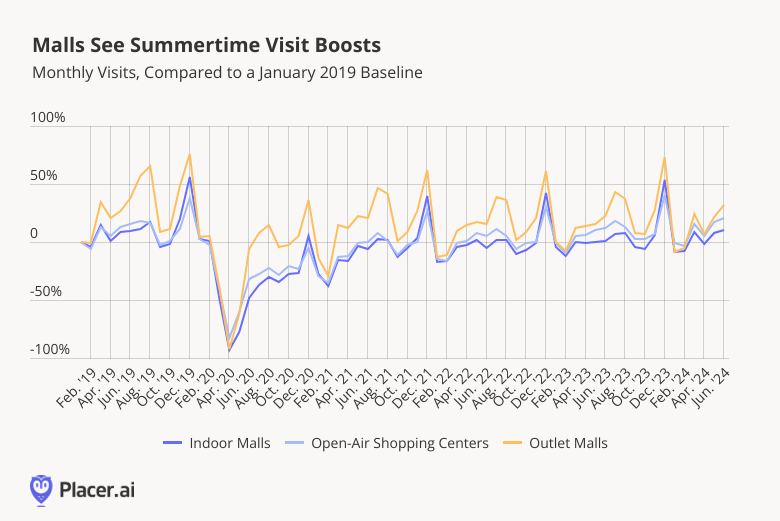
Comparing monthly visits from January 2022 through July 2022 to the same period in 2019 highlights the significant difficulties facing the sector. Indoor malls, open-air lifestyle centers, and outlet malls alike saw marked lags in foot traffic as compared to three years ago. 

Monthly year-over-three-year (Yo3Y) foot traffic comparisons also highlight mall resilience.

The monthly year-over-three-year (Yo3Y) foot traffic comparisons also highlight mall resilience. Following an Omicron-plagued January, the visit gaps narrowed in February 2022 to less than 5% for all the segments. And although the increase in gas prices and inflation brought visits down in March, malls quickly bounced back in April 2022, with indoor malls seeing only 1.8% fewer visits than in 2019 and open-air shopping centers down only 4.8% Yo3Y. Foot traffic fell again in May and June as consumers tightened their budgets in the face of rising prices, but consumers appear to have quickly made peace with the new economic reality. By July 2022, visits to indoor malls and open-air lifestyle centers were only 3.5% and 2.7% lower than they had been in July 2019.

Fewer Visitors, Shorter Stays

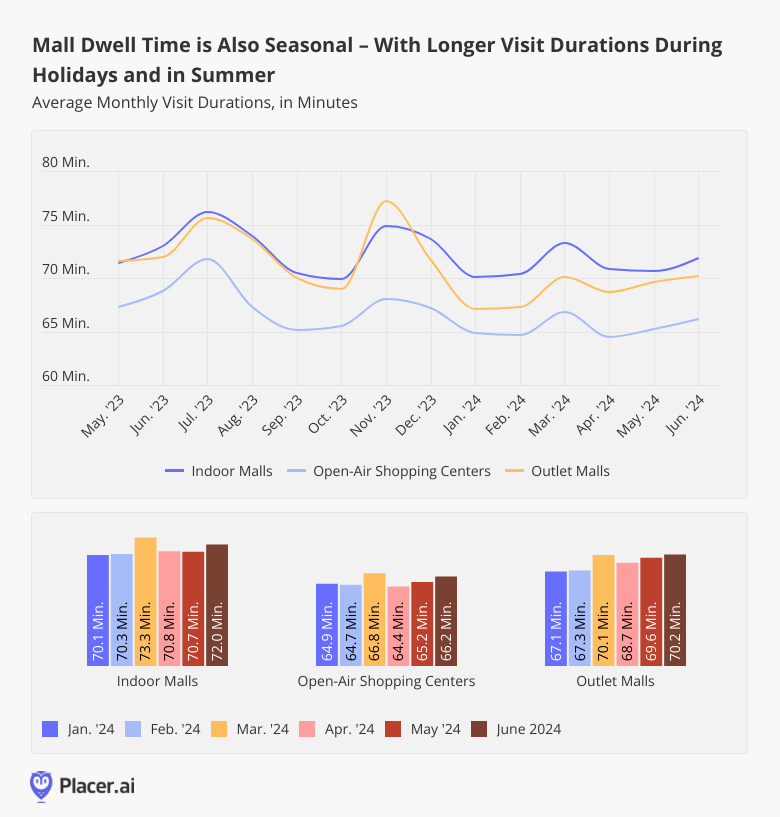
COVID didn’t just impact visit numbers – since 2020, mall visits have also gotten shorter, likely a result of pandemic restrictions and a general desire not to congregate any longer than necessary. And although 2021 and 2022 saw a slight uptick in time spent at malls and shopping centers – from 60 minutes in 2020 to 62 minutes in 2021 and 2022 – the median dwell time is still significantly lower than the 70 minutes median dwell time of pre-COVID 2018 and 2019.  

Shorter visits are not necessarily a bad thing – intent-driven shoppers may simply be doing more research ahead of time and less in-mall browsing.

Shorter visits are not necessarily a bad thing in and of themselves – consumers today are highly informed, so many intent-driven shoppers may simply be doing more research ahead of time and less in-mall browsing. But shorter (and fewer) visits do mean that  malls must focus on giving shoppers a reason to visit. We explore some successful strategies below. 

Going Experiential with Entertainment

Malls have long integrated entertainment into their overall experience in the form of arcades, movie theaters, and even coin-operated animal rides. Some malls, however, are taking their entertainment offerings to the next level.

In August 2021, CBL Properties, a Tennessee-based property developer, announced the opening of the Hollywood Casino by Penn National Gaming in the York Galleria Mall in York, Pennsylvania. The 80,000 square foot casino, which boasts 500 slots and 24 live-action table games, opened in the mall’s lower level. The space was occupied by a now-closed Sears department store, and the entertainment venue now functions as a new anchor to draw customers in. 

The casino’s opening has had a dramatic impact on the mall’s foot traffic. In a year-over-three-year (Yo3Y) comparison, July 2021 saw 2.4% fewer visitors than July 2018. But when the casino opened in August 2021, visits to the location jumped to 31.4% Yo3Y. This increase is all the more impressive considering that the casino opened on August 19th, with only 12 days left in the month. 

The mall, which had seen negative Yo3Y visit numbers until the casino’s opening, has sustained the positive visit trend through July 2022 – a testament to the appeal of in-mall entertainment. 

Children’s Entertainment Providing a Boost

Another mall betting on indoor entertainment is the Pierre Bossier Mall in Bossier City, Louisiana. In April 2022, Surge Entertainment opened a child-friendly space, which includes zip-lining, bowling, laser tag and arcade games. The Surge Entertainment chain is co-owned by Drew Brees, the former New Orleans Saints quarterback, and has 15 locations around the country. The Pierre Bossier Mall branch is filling the space vacated by Virginia College, which closed its doors in 2018. 

Since Surge Entertainment opened its Bossier City location, the mall has seen a dramatic increase in average dwell time.

Since Surge Entertainment opened its Bossier City location, the mall has seen a dramatic increase in average dwell time. Between July 2021 and March 2022, median dwell time hovered between 51 and 58 minutes. But following the center’s opening, median dwell time jumped to 78 minutes. Since then, the median dwell time has remained consistently elevated: In the four months since the Surge Entertainment opening, median dwell times did not drop below 75 minutes.

Going Omnichannel

Brick-and-mortar retailers once viewed online shopping as a threat – but now, mall owners and operators are increasingly turning to digital channels to complement existing approaches. COVID-19 and the surge of online shopping further fueled malls’ digital progress. Over the past two years, large malls and suburban shopping centers across the country have been rolling out various online and social shopping options and adopting omnichannel strategies.

In September 2020, Centennial, a real estate investment firm with many malls and mixed-use entertainment centers in its portfolio, launched a chain-wide omnichannel platform called Shop Now!. The app allows consumers to shop across all Centennial malls the way someone would shop on Amazon.

The first phase of the program, which launched in October 2020, allowed users to browse an AI-powered search engine connected to the inventory of all of the stores operating in their mall of interest. In February 2022, Centennial debuted phase two of the program at its Santa Ana, CA based MainPlace Mall. It allows customers to consolidate orders from several stores into a single cart, get the order fulfilled by personal shoppers, and have the orders ready for same-day delivery or on-site pickup.

The e-commerce app could have detracted shoppers from physically going to the mall – but instead, the program increased both monthly and loyal visitors. 

The app allows consumers to browse and shop from the comfort of their phones. It could have detracted shoppers from physically going to the mall – but instead, the program has increased both monthly and loyal visitors. In the months following the launch of the second phase, MainPlace Mall saw its loyal visits increase by 5% (from 46.2% in February ‘22 to 51.3% in June ‘22), while overall monthly visits in April ‘22 increased by 5.5%  when compared to 2019. The digital investment also helped the mall make sales that could have been lost to other e-commerce platforms. The mall’s brick-and-mortar success following the addition of a digital channel highlights how malls can rise to the top by embracing an omnichannel strategy. 

Continuing its innovative streak, the MainPlace Mall recently added an experiential component with the opening the American Ninja Warrior Adventure Park in July 2022 in the place of four former retail stores. During its first month of operation, the park drove the mall’s share of loyal visits up by 13.4% compared to the previous month while boosting Yo3Y monthly visits by 18.0%. 

The difference in impact between the online platform launch and the opening of the American Ninja Warrior Adventure Park indicates that malls can enjoy both gradual gains over time as well as jumps in foot traffic and loyalty, depending on the strategy they adopt.

Embracing Food Tech 

Omnichannel strategies can also revitalize food courts hit hard by the pandemic. Arundel Mills Mall, part of the Simon Property Group, began offering online orders in February 2022 via a platform called Snackpass, allowing users to use the app at various eateries around the mall. Snackpass, launched in 2017 as a food ordering app on the Yale campus, facilitates group ordering and includes various social features. Its current iteration allows customers to pre-order food, skip lines, collect rewards, and engage with friends. It also offers discounts on group orders, in an effort to promote social dining.

Since the beginning of the Snackpass partnership, the shopping center itself is seeing more visitors – many of whom are coming from farther away. 

Since the beginning of the Snackpass partnership, the shopping center itself is seeing more visitors – many of whom are coming from farther away. In the five months following the app’s launch, Arundel Mills saw an overall increase of 15 square miles to its True Trade Area (TTA), and an increase of 29.5% in visits per sq. ft. – The consistent increase in TTA and visits per sq. ft. are a testament to the power of innovative dining partnerships to draw traffic to top-tier malls. 

Reutilizing and Repurposing Space

With many retailers reducing their on-mall presence, empty brick-and-mortar stores have attracted plenty of negative attention. But now, malls are increasingly repurposing vacated spaces in new, innovative ways that resonate with local communities and can fill their evolving needs.

Younger Customers Linger Longer

At the Ocean County Mall in Toms River, NJ, Simon Property Group repurposed the huge space left by a former Sears store and turned it into a lifestyle center, with stores opening throughout 2020. The space is now being used by a number of highly popular chains such as  LA Fitness, Ulta Beauty, HomeSense, and P.F. Chang’s and also includes a children's play area. 

This pivot seems to be working. Median dwell time to the mall has increased from 53 minutes to 56 minutes, a significant change when considering that a majority of malls have recently seen their dwell times drop. 

The center has also seen the median age for its trade area decrease from 40.5 years old in the first half of 2021 to 37.2 in the first half of 2022, a dramatic shift in visitor demographics. Yo3Y visits are strong as well – July 2022 were up by 17.1%. 

Fitness Center Provides a Boost

In a similar tale of a closed Sears turning into a lifestyle center, the Northshore Mall in Peabody, MA turned the space vacated by the department store into a mixed-use center. The most significant anchor is now the high-end Life Time Fitness Center that offers cardio, weights, and functional training rooms, and includes yoga, pilates, and cycling studios, indoor and outdoor pools, basketball and pickleball courts, saunas, and a bistro. 

As soon as the health club opened its doors in July 2021, visits to the mall increased – significantly outpacing the levels seen when Sears was still open. 

As soon as the health club opened its doors in July 2021, visits to the mall increased – significantly outpacing the levels seen when Sears was still open. Both Yo3Y and year-over-four-year (Yo4Y) foot traffic numbers were impressive, with July 2022 seeing 17.2% more visitors than three years prior. 

Selecting the Right Tenants

As visits to malls become more focussed, selecting the right tenant has never been more important – and that may mean looking at unconventional occupants to draw in customers.

Filling a Void in California

In one example of tapping into local needs, the Westfield Oakridge shopping center in San Jose, CA, opened a specialty grocery store on its premises. 99 Ranch Market, one of the largest Asian supermarket chains in the U.S., began operating its first mall location in March 2022. The location includes classic grocery store items such as produce, meat, and seafood sections, and also boasts a dining hall, tea bar, and bakery. 

Its opening day saw lines snaking out the door, as excited locals queued to sample the store’s delicacies. And the crowd-drawing hype seems to be more than a flash in the pan – the months following the opening were the mall’s strongest in the past year and a half. Yo3Y visits were up by 10.1% in July 2022 , with some shoppers reporting that the addition of the grocery store had turned Westfield Oakridge into their all-in-one stop shop.

Although the area was not lacking in grocery options, retail foot traffic data indicates that the new 99 Ranch Market at Westfield Oakridge Mall still filled a void.

Although the area was not lacking in grocery options, retail foot traffic data indicates that the new 99 Ranch Market at Westfield Oakridge Mall still filled a void – the new grocery store’s trade area has only minimal overlaps with the other trade areas of the nearby 99 Ranch Markets locations. This means that most of the new 99 Ranch Market’s customers were not being well-served by the existing locations of the chain. 

Westfield Oakridge is not the only San Jose mall turning to food to attract the crowds. On June 16th 2022, following much hype and a pandemic-related delay, Eataly, the all-in-one Italian market, restaurant, and cooking school opened its first Northern California location at the Westfield Valley Fair in Santa Clara, CA. 

Prior to the launch, the Westfield Valley Fair mall was already one of the more successful malls in the country – but the opening of Eataly seems to be driving even more foot traffic. Yo3Y visits to malls during Eataly’s opening week exceeded 20% for the first time in months and have since remained consistently elevated, with visits for the week of July 25th up 27.7% relative to the equivalent week in 2019. 

Regional Department Stores Providing a Boost

In March 2022, regional department store Von Maur opened its doors at The Village of Rochester Hills, an open-air lifestyle center in Michigan. The retailer, which has 36 locations throughout the Midwest, took over the space left vacant by Carson’s, another Midwest-based department store. 

What may be the first new department store in the Detroit metropolitan area in over a decade is driving visits to the shopping center. 

What may be the first new department store in the Detroit metropolitan area in over a decade is driving visits to the shopping center. Von Maur’s March 2022 opening pushed Yo3Y visits up by 16.9% compared to the mere 4.3% Yo3Y increase the month before. 

Part of the secret to Von Maur’s success lies in the psychographic characteristics of residents within the mall’s trade area. Using Spatial.ai’s GeoWeb data, a tool which tracks online engagement with various trends and topics by neighborhood, we found that the TTA surrounding The Village had an index of 131 for department store shoppers. In other words, people in the mall’s trade area exhibited heightened interest in department stores – they engaged with department-store-related content at a rate that was 1.3 times higher than the national average – which helps explain why Von Maur is thriving in this specific location. And in another testament to the strength of immersive retail experiences, Von Maur, which focuses on curating a unique shopper journey and features a pianist at all of its locations, has been ranked the top department store in America. 

The addition of Von Maur is not the only change that The Village is implementing – the mall has continued adding new stores and will be opening more throughout the year. These, too, will likely boost foot traffic to the lifestyle center. 

The mall’s ability to select tenants that cater to, and reflect the needs and behaviors of its consumers is likely to continue driving success. By drilling down into the nitty-gritty details of who comes to shop, where they come from, and what shops they enjoy frequenting, mall management can tailor the shopping center to meet the needs of its base. 

Innovative Malls Staying Ahead of the Curve

The “death of the American mall” has been predicted for years. The reality, however, is much more nuanced than that – like many other sectors, malls are undergoing a shift to help them better serve evolving customer needs and survive and thrive in an ever-shifting retail landscape. 

The malls featured in this white paper have found ways to consistently attract visitors despite the various obstacles faced by the category over the past two years. By understanding that the American mall must evolve along with the consumers, mall owners can successfully revitalize their retail spaces. 

INSIDER
Exploring the Car Dealership Space
Dive into the foot traffic and audience segmentation data to find out where the new and used auto dealership space stands in 2023.

Overview 

This report leverages location intelligence data to analyze the auto dealership market in the United States. By looking at visit trends to branded showrooms, used car lots, and mixed inventory dealerships – and analyzing the types of visitors that visit each category – this white paper sheds light on the state of car dealership space in 2023. 

Shifts in Auto Dealerships Visit Trends

Prior to the pandemic and throughout most of 2020, visits to both car brand and used-only dealerships followed relatively similar trends. But the two categories began to diverge in early 2021. 

Visits to car brand dealerships briefly returned to pre-pandemic levels in mid-2021, but traffic fell consistently in the second half of the year as supply-chain issues drove consistent price increases. So despite the brief mid-year bump, 2021 ended with overall new car sales – as well as overall foot traffic to car brand dealerships – below 2019 levels. Visits continued falling in 2022 as low inventory and high prices hampered growth.  

Meanwhile, although the price for used cars rose even more (the average price for a new and used car was up 12.1% and 27.1% YoY, respectively, in September 2021), used cars still remained, on average, more affordable than new ones. So with rising demand for alternatives to public transportation – and with new cars now beyond the reach of many consumers – the used car market took off and visits to used car dealerships skyrocketed for much of 2021 and into 2022. But in the second half of last year, as gas prices remained elevated – tacking an additional cost onto operating a vehicle – visits to used car dealerships began falling dramatically. 

Now, the price of both used and new cars has finally begun falling slightly. Foot traffic data indicates that the price drops appear to be impacting the two markets differently. So far this year, sales and visits to dealerships of pre-owned vehicles have slowed, while new car sales grew – perhaps due to the more significant pent-up demand in the new car market. The ongoing inflation, which has had a stronger impact on lower-income households, may also be somewhat inhibiting used-car dealership visit growth. At the same time, foot traffic to used car dealerships did remain close to or slightly above 2019 levels for most of 2023, while visits to branded dealerships were significantly lower year-over-four-years. 

The situation remains dynamic – with some reports of prices creeping back up – so the auto dealership landscape may well continue to shift going into 2024.

Used Cars Appeal to a Range of Consumers

With car prices soaring, the demand for pre-owned vehicles has grown substantially. Analyzing the trade area composition of leading dealerships that sell used cars reveals the wide spectrum of consumers in this market. 

Dealerships carrying a mixed inventory of both new and used vehicles seem to attract relatively high-income consumers. Using the STI: Popstats 2022 data set to analyze the trade areas of Penske Automotive, AutoNation, and Lithia Auto Stores – which all sell used and new cars – reveals that the HHI in the three dealerships’ trade areas is higher than the nationwide median. Differences did emerge within the trade areas of the mixed inventory car dealerships, but the range was relatively narrow – between $77.5K to $84.5K trade area median HHI. 

Meanwhile, the dealerships selling exclusively used cars – DriveTime, Carvana, and CarMax – exhibited a much wider range of trade area median HHIs. CarMax, the largest used-only car dealership in the United States, had a yearly median HHI of $75.9K in its trade area – just slightly below the median HHI for mixed inventory dealerships Lithia Auto Stores and AutoNation and above the nationwide median of $69.5K. Carvana, a used car dealership that operates according to a Buy Online, Pick Up in Store (BOPIS) model, served an audience with a median HHI of $69.1K – more or less in-line with the nationwide median. And DriveTime’s trade areas have a median HHI of $57.6K – significantly below the nationwide median. 

The variance in HHI among the audiences of the different used-only car dealerships may reflect the wide variety of offerings within the used-car market – from virtually new luxury vehicles to basic sedans with 150k+ miles on the odometer. 

Tesla Leads the Car Brand Dealership Pack

Visits to car brands nationwide between January and September 2023 dipped 0.9% YoY, although several outliers reveal the potential for success in the space even during times of economic headwinds. 

Visits to Tesla’s dealerships have skyrocketed recently, perhaps thanks to the company’s frequent price cuts over the past year – between September 2022 and 2023, the average price for a new Tesla fell by 24.7%. And with the company’s network of Superchargers gearing up to serve non-Tesla Electric Vehicles (EVs), Tesla is finding room for growth beyond its already successful core EV manufacturing business and positioning itself for a strong 2024. 

Japan-based Mazda used the pandemic as an opportunity to strengthen its standing among U.S. consumers, and the company is now reaping the fruits of its labor as visits rise YoY. Porsche, the winner of U.S New & World Report Best Luxury Car Brand for 2023, also outperformed the wider car dealership sector. Kia – owned in part by Hyundai –  and Hyundai both saw their foot traffic increase YoY as well, thanks in part to the popularity of their SUV models.

Diving into Local Markets 

Analyzing dealerships on a national level can help car manufacturers make macro-level decisions on marketing, product design, and brick-and-mortar fleet configurations. But diving deeper into the unique characteristics of each dealership’s trade area on a state level reveals differences that can serve brands looking to optimize their offerings for their local audience. 

For example, analyzing the share of households with children in the trade areas of four car brand dealership chains in four different states reveals significant variation across the regional markets. 

Nationwide, Tesla served a larger share of households with children than Kia, Ford, or Land Rover. But focusing on California shows that in the Golden State, Kia’s trade area population included the largest share of this segment than the other three brands, while Land Rover led this segment in Illinois. Meanwhile, Ford served the smallest share of households with children on a nationwide basis – but although the trend held in Illinois and Pennsylvania, California Ford dealerships served more households with children than either Tesla or Land Rover.  

Leveraging Location Intelligence for Car Dealerships

Leveraging location intelligence to analyze car dealerships adds a layer of consumer insights to industry provided sales numbers. Visit patterns and audience demographics reveal how foot traffic to used-car lots, mixed inventory dealerships, and manufacturers’ showrooms change over time and who visits these businesses on a national or regional level. These insights allow auto industry stakeholders to assess current demand, predict future trends, and keep a finger on the pulse of car-purchasing habits in the United States. 

Loading results...
We couldn't find anything matching your search.
Browse one of our topic pages to help find what you're looking for.
For more in-depth analyses on a variety of subjects, explore Reports.
The Anchor Logo
INSIDER
Stay Anchored: Subscribe to Insider & Unlock more Foot Traffic Insights
Gain insider insights with our in-depth analytics crafted by industry experts
— giving you the knowledge and edge to stay ahead.
Subscribe