Thank you! Your submission has been received!
Oops! Something went wrong while submitting the form.
0
0
0
0
----------
0
0
Articles
Article
Happy Lunar New Year Part 2: Vietnamese, Korean, and Pan-Asian Malls
Caroline Wu
Feb 16, 2024

There are so many ways to say Happy New Year in Asian languages, such as  “Gong Xi Fa Cai” in Mandarin, which means wishing you prosperity in the coming year, “Saehae Bok Mani Badeuseyo” in Korean, wishing you lots of luck, and “Chuc mung nam moi” in Vietnamese, with a similar meaning of wishing you a joyful year.  Along with these auspicious greetings are traditional foods such as dumpling soup, mung bean pancake, BBQ beef, sticky rice cakes, and candied fruits.  Within the melting pot that is the USA, one can often find an Asian-themed shopping center in which to partake of the festivities. In Westminster, CA, Asian Garden Mall is one of the largest Vietnamese shopping centers in the U.S. At The Source OC, Korean shops and eateries abound. In the Midwest, one can visit Asia Mall Minnesota, with a pan-Asian panoply of offerings.

Last year, Lunar New Year kicked off on Jan. 22, and we can see that Asian Garden Mall visits skyrocketed on that day (below)

During the summer, there is also a vibrant night market there, open from 7-11pm on the weekends. Finds include pork skewers and buns, grilled scallops, mini shrimp crepes, and sugar cane juice.

Asian Garden Mall Night Market 2.14.24

The night market takes place in the parking lot of Asian Garden Mall and draws accretive business. What would normally be empty during the Feb-May period without a night market becomes a thriving evening adventure during the summer months.

In comparing Feb-May visits (blue) versus Jun-Sept visits (red) below, the mall also draws from a much larger trade area when the night market is occurring.

Night Market Trade Area image
Asian Garden Venn diagram image

In terms of festivities, parades and food stalls abound at celebrations like the Tet festival in New Orleans, which takes place this year on Feb. 16-18 in the Village de l’Est neighborhood. There will be fireworks and a dragon dance and of course vats of simmering pho, crispy spring rolls, and puffy fried bananas. In San Jose, CA, home to one of the US’s largest Vietnamese populations, a Tet celebration will be held in the former Sears parking lot at Eastridge Center from Feb 16-18.  There will be a talent contest, a visit from Miss Vietnam California, carnival rides, and of course plenty of food booths and desserts.

One of the newer Korean-themed malls is the Source OC, which opened in 2019.  While the majority of the food options transport you to being in Korea, there is also Italian at Il Fiora, Japanese at Izakaya Ichie, and Mexican at La Huasteca.  One can indulge in Gangnam House Korean BBQ, Monday to Sunday shaved ice, and Cheesetella Japanese Cheesecake. We saw the Source OC dip during Covid like practically all retail, but it has bounced back and is now exceeding pre-Covid visitation levels. Besides the draw of the food, there is also an indoor golf-simulator, a VR experience, and a children’s playground.

Both Koreatown Plaza and Koreatown Galleria are long-standing stalwarts in the heart of LA, but as Americans of all ethnicities increasingly migrate to suburbs, we will no doubt see more shopping center options catering to ethnic tastes outside of downtowns.

The nation’s first enclosed shopping mall was Southdale Center in Edina, MN, a project that opened in 1956, by Victor Gruen, an Austrian-American who would henceforth be known as the “father of the shopping mall.” His original vision was a community hub with access to many shops as well as medical centers, schools, and even residences. This did not occur in the 50s, but three-quarters of a century later, many mall developers are re-envisioning malls to be places to live, eat, play, and shop as well as have access to essential services and to be that third space for community gatherings and celebrations. How fitting that another recent mall in Minnesota, the Asia Mall has been conceived as a reflection of the local community. It opened in November 2022, inspired by the desire for a one-stop pan-Asian mall to get all groceries as opposed to dashing around Minneapolis, St. Paul, Brooklyn Park, and Brooklyn Center to obtain the desired goods. Food and drinks are procured from various Asian countries, such as Vietnam, China, and Korea and anchored by grocery store Asian Mart 88. Dining includes Pho Mai, Hot Pot City with all-you-can-eat hot pot, Cruncheez Korean hot dogs, and Mochi Dough doughnuts.  As part of the trend for including essential services, this mall also has a hair salon, insurance company, and travel agency.

It also appears the concept of one-stop-shop, be it for Asian groceries or for warehouse-sized purchases, is prized by the inhabitants of Eden Prairie who really value efficiency. Asia Mall does half the visits of the nearby Costco, which is impressive. Besides home and work, visitors of Asia Mall are most likely to visit Costco before or after a shopping trip (below).

Asia Mall Visitor Journey to Costco 2.16.24

Article
Hats Off For Off-Price
How did off-price leaders T.J. Maxx, Marshalls (both owned by TJX Companies), Burlington, and Ross perform in last year? And how is 2024 shaping up for the category? We dove into the foot traffic data to find out. 
Bracha Arnold
Feb 15, 2024
3 minutes

How did off-price leaders T.J. Maxx, Marshalls (both owned by TJX Companies), Burlington, and Ross perform in last year? And how is 2024 shaping up for the category? We dove into the foot traffic data to find out. 

Continuing To Grow

Off-price apparel retailers typically employ a straightforward method: sell excess or off-season merchandise that would otherwise remain unsold at a discount, benefiting both shoppers and manufacturers. 

This retail model has consistently performed well, as evidenced by the consistent growth in visits to T.J. Maxx, Marshalls, Ross, and Burlington over the past few years. And despite the overall sluggishness experienced by much of the apparel retail category in 2023, visits to these stores continued to increase year-over-year (YoY) in every quarter analyzed.

bar graph: visits to off=price retailers elevated all quarters of 2023

January 2024 YoY visit growth slowed slightly – perhaps due to Q1 2023’s exceptionally strong performance. But despite the difficult comparison, foot traffic for most chains remained close to 2023 levels while YoY January visits to Ross increased 5.5%, highlighting the resilience of the off-price sector.  

bar graph: Ross Dress for Less led the off-price category in January 2024

HHI Varies By Brand

The demographic and psychographic makeup of a chain’s trade area – which shows the types of visitors who frequent the chain – can be determined by looking at the chain’s potential or captured market. A chain’s potential market is calculated by weighing the Census Block Groups (CBGs) feeding visits to the chain according to the size of the CBG, while the captured market weighs each CBG according to the relative number of visits to the chain originating from that CBG.  

Using these tools to analyze the median household income (HHI) in the trade areas of the four chains reveals a divergence between the two TJX-owned chains T.J. Maxx and Marshalls, on one side, and Ross Dress for Less and Burlington, on the other. The median HHI in T.J. Maxx and Marshalls’ potential market is higher than the potential median HHI for Ross and Burlington – and the two TJX brands’ captured market median HHI is even higher. Meanwhile, the median HHI in Ross and Burlington’s captured market is lower than the median HHI in their own potential markets. 

The variance in median HHI between the chains may have to do with differences in branding and product selection. Marshalls and T.J. Maxx tend to have the higher price points, with T.J. Maxx in particular expanding its designer offerings over the past few years through its Runway stores. Ross and Burlington, known for their no-frills approach to clothing shopping, have relatively lower price points – and may see more customers seeking bargains over high fashion. 

bar chart: median HHI variances between off-price retailers. Based on STI: PopStats dataset combined with placer.ai captured and potential trade area data

Families Drawn To Off-Price Retailers

While an analysis of trade area median HHI highlights differences between the chains’ visitor bases, a deeper exploration of Marshalls, Ross, and Burlington’s trade areas suggests that the retailers also share common ground – specifically, their popularity with middle-income families. For almost all brands, the captured market share of households categorized by the Spatial.ai: PersonaLive dataset as “Family Union” and “Cultural Connections” was larger than the potential market share. T.J. Maxx, which had a slightly lower share of “Cultural Connection” households in its captured market relative to its potential market, was the sole exception.

All four chains continue to add stores to their fleets – Ross opened 97 stores in fiscal 2023, and Burlington is looking to expand in over 60 former Bed Bath and Beyond locations. Focusing on trade areas with diverse families, then, may serve Marshalls, Ross, and Burlington. And T.J. Maxx, which has been enjoying a resurgence of interest from younger shoppers, might consider expanding into areas that attract young professionals.

bar chart: off-price retailers attract more divers families in captured market vs. potential market

Dressing To Impress

Off-price apparel retailers continue to succeed despite – or perhaps because of – a challenging economic climate. Will their success continue into 2024? 

Visit placer.ai to keep up-to-date on the latest data-driven retail trends.

Article
Who Is Shopping at Malls?
With shopping center vacancy rates now lower than they were pre-COVID, we dove into the demographic and psychographic trade area data for leading Indoor Malls, Open-Air Shopping Centers, and Outlet Malls to understand who visited malls in 2023. 
Shira Petrack
Feb 14, 2024
2 minutes

With shopping center vacancy rates now lower than they were pre-COVID, we dove into the demographic and psychographic trade area data for leading Indoor Malls, Open-Air Shopping Centers, and Outlet Malls to understand who visited malls in 2023. 

Shopping Center Types Draw a Variety of Audiences 

Diving into the demographics of the trade areas of the various mall types in 2023 reveal both similarities and differences between the typical visitor to Indoor Malls, Open-Air Shopping Centers, and Outlet Malls. 

In all three mall types, the median trade area household income (HHI) in the three mall types was higher than the nationwide median HHI of $69.5K (according to the STI: Popstats 2022 dataset). But Open-Air Shopping Centers drew the highest income visitors, with a trade area median HHI of $87.8K in 2023. The trade area of Open-Air Shopping Centers also had the lowest share of Households with Children and the highest share of singles (One-Person and Non-Family Households). 

Outlet Malls lay at the other end of the spectrum, with a trade area median trade HHI of $73.9K, the highest share of Households with Children, and the lowest share of single households. And the median HHI and household composition for the trade area of Indoor Malls stood between those of the other two types. 

bar chart: demographic differences among trade areas of various mall types

Different Family Segments for Different Mall Types

Even though Outlet Malls tend to draw the highest, and Open-Air Shopping Centers draw the lowest share of family visitors (Households with Children), diving deeper into various family segments reveals a more nuanced picture. 

For example, the trade areas of Outlet Malls do indeed contain the highest shares of the “Family Union” and “Promising Families” segments – defined by Experian: Mosaic as blue-collar families and young families in starter homes, respectively. But Open-Air Shopping Centers tend to draw the highest share of the more affluent “Flourishing Families” segment – perhaps thanks to the Open-Air Shopping Centers’ higher trade area median HHI. 

So while the demographic analysis can provide an overall snapshot of the various mall types’ audience, diving into the psychographics can yield a higher-resolution picture of the types of shoppers frequenting each shopping center category. 

bar graph: different mall types attract different family segments

Looking Ahead to 2024 

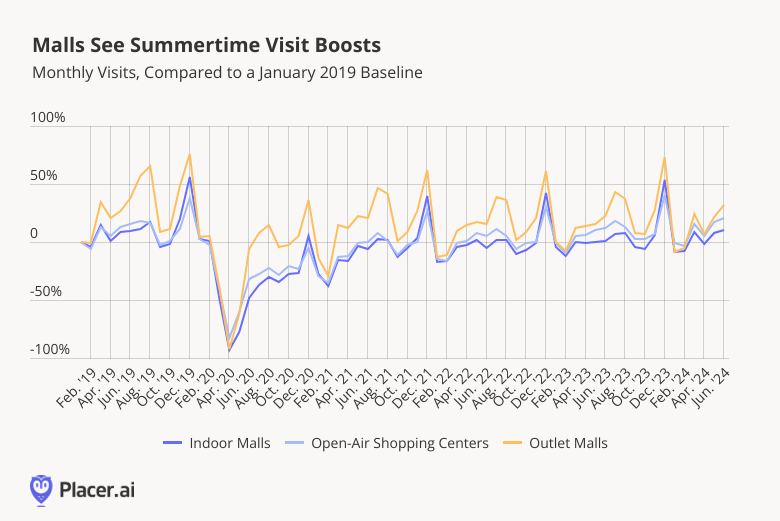
For the most part, malls – especially Indoor Malls and Open-Air Shopping Centers – succeeded in exceeding or staying close to 2022 visit levels last year, despite the economic headwinds. And while January data indicates that the space may be entering a challenging period, there are plenty of reasons to think that the dip in early 2024 foot traffic is just a temporary setback driven by a unique set of circumstances. As the year continues to unfold, tracking visits in this sector will offer more insights into the state of the 2024 consumer. 

For more data-driven retail insights, visit placer.ai/blog

Article
Drilling Down Into Home Improvement
When we last checked in with the home improvement category, high interest rates and a cooling housing market had impacted visits to retailers The Home Depot, Lowe’s, and Tractor Supply. As 2024 gets underway, what might lie ahead for these chains? We take a look at the data to find out. 
Bracha Arnold
Feb 13, 2024

When we last checked in with the home improvement category, high interest rates and a cooling housing market had impacted visits to retailers The Home Depot, Lowe’s, and Tractor Supply. As 2024 gets underway, what might lie ahead for these chains? We take a look at the data to find out. 

Hammering Out The Visits

Home Depot and Lowe’s, two of the largest home improvement retailers in the country, command a significant share of the industry. The two chains experienced ups and downs over the past few years, from a pandemic-era spike in visits to a more recent slowdown as rising prices and slowing home sales led many would-be shoppers to rethink a renovation.

The turbulence in the Home Improvement space continued in 2023. In the first half of the year, foot traffic to The Home Depot and Lowe’s showed modest increases on a year-over-year (YoY) basis – but that momentum slowed into the years’ second half as home sales dropped to a six-month low

Visit performance to these retailers may well improve in 2024. Should home sales pick up  as mortgage rates continue on their expected downward trajectory, home improvement chains would likely see an increase in visits as new homeowners grab equipment for renovations.  

line graph: foot traffic to The Home Depot and Lowe's remained close to 2022 levels in H1 2023, slowed in H2

Nailed It: Median HHI Variances

Analyzing median household income (HHI) of visitors to The Home Depot and Lowe’s, segmented by potential and captured markets, may provide insights into The Home Depot's stronger year-over-year foot traffic performance. (A chain's potential market looks at the Census Block Groups (CBGs) where visitors to a chain originate, weighted according to the CBG’s population. In contrast, captured market visit data reflects figures weighted by the actual number of visits from each CBG.) 

The trade area median HHI tends to be higher for Home Depot than for Lowe’s in the chains’ potential markets – and the differences grow even more pronounced when analyzing the captured market. The Home Depot’s potential market median HHI stood at $71.5K/year – just slightly higher than Lowe’s $69.6K/year. But The Home Depot’s captured market median HHI was $74.3K/year in 2023 – around 4% higher than the chain’s potential market median HHI. Meanwhile, Lowe’s captured market median HHI of $69.0K/year was around 1% lower than its potential market median HHI.

The income disparity between the visitor bases of the two chains may provide context for The Home Depot’s foot traffic strength compared to Lowe’s – The Home Depot’s wealthier customers may be more insulated from the effects of inflation. And as inflation eases and demand for home renovations creeps up, Lowe’s may yet see visits tick up as its customers return to the chain. 

bar graph: median HHI for home improvement chains shows variance among brands.

Ranching Out: Visits To Tractor Supply

Tractor Supply Co. – another major home improvement chain – also offers a variety of products geared toward farm and ranch living, including animal feed and farm equipment. The company was a surprising pandemic winner, seeing its sales and foot traffic grow significantly as people moved to the countryside.

The chain's popularity has remained strong even as the pandemic-induced migration trends subside and the influx of city-dwellers to rural areas slows down. Visits to Tractor Supply remained consistently high throughout 2023, with only two months experiencing YoY foot traffic lags. Tractor Supply visits also outpaced visits to the home improvement category as a whole, indicating sustained demand for farm products. 

line chart: tractor supply outpaces wider home improvement category

Rural Renovations Rule

A deeper exploration of the three home improvement chains’ psychographic compositions indicates that Tractor Supply’s popularity with rural segments (as defined by the Spatial.ai: PersonaLive dataset) may be fueling some of its sustained visit success. 

All three chains saw a higher share of rural visitors in their captured market compared to their potential market – indicating that rural consumers are particularly interested in home improvement tools and products. And of the three chains, Tractor Supply served the largest share of rural visitors by far. The share of rural audience segments in Tractor Supply’s potential markets significantly exceeded the share of these segments in the trade areas of Lowe’s and The Home Depot’s, and the relative share of rural segments in Tractor Supply’s captured market was even more impressive. 

Lowe’s, which has bolstered its rural presence over the past year, had the second-highest percentage of rural segments in both its potential and captured markets – although its share of rural visitors was still considerably lower than Tractor Supply’s. 

Meanwhile, The Home Depot saw the smallest share of rural visitors across all rural segments analyzed. The company’s captured market had just slightly more Rural High Income and Rural Low Income visitors relative to its potential market, and there was no difference between its captured and potential market shares of Rural Average Income consumers.

The impressive over-representation of rural customers to Lowe’s and Tractor Supply suggest that the rural potential for home improvement chains is significant – and chains that tap into the segment may see further foot traffic to their stores. 

bar charts: tractor supply has cornered rural home improvement markets

Renovations, Renewed

The home improvement space has seen plenty of variance over the past few years, from the pandemic-fueled DIY highs of 2020 and 2021 to the overall slowdown brought on by inflation in 2023. Will visits begin to pick up again into 2024? 

Visit placer.ai/blog for the latest data-driven retail insights.

Article
Walmart, Target, Costco & Superstore Space 2023 Recap
How did Target, Walmart, Costco, Sam’s Club, and BJ’s Wholesale Club perform offline last year? Who visited the chains in 2023? And what does 2024 have in store for the space? We dove into the foot traffic and trade area composition data to find out. 
Shira Petrack
Feb 12, 2024
4 minutes

How did Target, Walmart, Costco, Sam’s Club, and BJ’s Wholesale Club perform offline last year? Who visited the chains in 2023? And what does 2024 have in store for the space? We dove into the foot traffic and trade area composition data to find out. 

Strong Year for the Superstore Space 

The superstore and wholesale space performed well across the board in 2023, with leading retailers seeing consistent year-over-year (YoY) quarterly visit growth throughout the year. Costco led the pack in terms of overall YoY visit performance, followed by Sam’s Club and BJ’s Wholesale Club. The wholesale clubs’ strength may be due in part to the chains’ attractive gas prices, which were likely particularly tempting to 2023 consumers looking to stretch their budget. 

Visits to Target also remained above the chain’s 2022 baseline during all four quarters, and Walmart – which closed several stores last year – mostly beat its 2022 visit performance, with the exception of Q4 where traffic remained essentially on par with last year’s levels. 

bar graph: superstores and wholesale club visits in 2023 were mostly up compared to 2022mo

January 2024 Visits Mostly On Par with 2023 Performance 

Visits to four out of five of the analyzed superstores and wholesale clubs dipped slightly in January 2024 relative to January 2023, perhaps due to comparisons to a strong Q1 2023 performance or to post-holidays consumer cutbacks. But despite the challenging circumstances, the YoY drops remained minimal – so the softer start to the year is not necessarily an indication of things to come. 

And in contrast to the subdued visit performance in the rest of the category, Costco foot traffic exceeded its January 2023 visit baseline – revealing the potential for the superstore space to grow in a positive direction in 2024.


bar chart: january 202 visits to superstores and wholesale clubs remained close to 2023 levels in January 2024

Monthly Visit Trends Vary Among Chains

Analyzing monthly visits to leading superstore and wholesale clubs in 2023 compared to each chain’s monthly visit average reveals different consumer patterns for each brand. 

While all chains saw their monthly visits peak in December, Target experienced the most significant holiday peak, with a 33.9% increase in monthly visits compared to its 2023 monthly average – more than double the increases of the other four chains analyzed. Target also saw the strongest August visit growth relative to its 2023 monthly average as parents and students likely flocked to the chain in search of Back-to-School apparel and supplies. 

In June and July, Walmart’s relative visit growth exceeded that of the other four chains – possible thanks to consumers stocking up on summer supplies. And the wholesale clubs saw larger relative increases in November, as those chains’ bulk grocery offerings may have helped consumers shop for a crowd ahead of Thanksgiving dinner.

line graph: different monthly visit patterns for each superstore and wholesale club

Who Shops at Superstores & Wholesale Clubs? 

The trade areas of all five chains analyzed included a higher share of Households with Children when compared to the nationwide average. But the two superstore brands – Walmart and Target – also had larger percentages of 1-Person and Non-Family (roommate) Households when compared to the nationwide average, while the three wholesale clubs had smaller shares. 

So while average wholesale clubs and their large selection of bulk packaged items cater primarily to families, superstores seem to attract a wider range of shoppers, including consumers shopping for one and living alone or with roommates. 

bar graph: superstores serve more singles, costco's visitor base includes largest shares of families with children, based on sti:PopStats dataset combined with placer.ai trade area data

Differences Between the Chains 

Diving into the psychographic composition of the trade areas highlights additional differences between the various chains’ audiences. 

The trade areas of Walmart and of its subsidiary Sam’s Club had the highest share of  Spatial.ai: PersonaLive’s small town and rural audience segments, including “Small Town Low Income,” “Rural Low Income,” “Rural Average Income,” and “Rural High Income.” 

Suburban segments were more distributed. Walmart and Sam’s Club served a higher share of “Blue Collar Suburbs” while Target and Costco drew more “Wealthy Suburban Families” – and BJ’s Wholesale Club received the largest percentage of “Upper Suburban Diverse Families.” 

BJ’s trade area also included the largest shares of almost all the urban segments with the exception of “Educated Urbanites” – defined by Spatial.ai as “well educated young singles living in dense urban areas working relatively high paying jobs” – for which Target came out on top.


bar graph: each superstore and wholesale club serves a specific audience

Looking Ahead to 2024

The leading superstore and wholesale clubs performed well in 2023 as consumers relied on their bulk-packaging and value-pricing to stretch their increasingly strained budgets. 

What does 2024 have in store? Visit the placer.ai blog to find out. 

Article
Year of the Dragon, Luckiest Animal in the Zodiac: Will that Luck Hold for Asian-Themed CRE?
Caroline Wu
Feb 10, 2024

It only comes around once every 12 years, and for those born in the Year of the Dragon, they are considered to be the luckiest of the Zodiac signs.  This year’s element is wood, and thus a Wood Dragon year can portend good fortune, action, and expansion.  Let’s take a look at some Asian concepts, brands, and shopping centers and see if our Placer trends indicate whether they might be in for a lucky, powerful year.

More Tea, Please: Tea is Anywhere and Everywhere, All at Once

Tea drinks, especially those including tapioca pearls otherwise known as boba have created billionaires in China, and global expansion means that you can get your fill of the chewy goodies all over the world nowadays.  Some of the largest chains in the US include Kung Fu Tea, with over 350 locations; Gong Cha; Sharetea with more than 500 stores in 15 locations; Boba Guys known for their famous strawberry puree matcha tea latte; and It’s Boba Time, Happy Lemon,  YiFang Taiwan Fruit Tea, and Boba Loca.

Tea has been an integral part of our global history.  As a precious commodity, it was traded along the Silk Road, leading to increased transcontinental commerce.  In American history, the Boston Tea Party was perhaps not so much about tea itself but about taxation and representation, but in any words, it was definitely a catalyst towards American independence.  And now,  thousands of years later, tea continues to be a tour de force for antioxidants, anti-aging, and an overall delicious base for a bevy of creative drinks.  Economists often talk about the “latte index” - used to estimate purchasing power parity in 16 countries around the world compared to the cost of a tall Starbucks latte in NYC.

Latte Index 2.9.24
Source: Visualcapitalist.com (The Latte Index: Using the Impartial Bean to Value Currencies)

With the way things are going with teas, could a boba index not be far behind?  We examined year-over-year traffic for some of the leading tea/boba chains compared to specialty coffee chains.  Boba has seen gains compared to last year, usually at a higher percentage than coffee.  Both beverage type chains have trended upwards in 2023, although coffee had a bit of a dip in the latter part of the year.

To be fair, one can often order a coffee at a tea store and vice versa, but there are certainly toppings and color sensations at tea stores that are uniquely suited to social media, such as butterfly pea, which is an intense shade of violet, or various vibrant toppings such as popping boba in pink and orange.  In some creations, the tea is even dispensed with entirely, such as Tiger Sugar’s brown sugar boba milk with a deep caramel flavor, or their highly-coveted ice cream bar version of the drink.

Tiger Sugar images side by side 2.9.24

Asian Malls in the US to Visit for Lunar New Year

For those wishing for an authentic taste of an Asian shopping mall experience during Lunar New Year, there are many options around the US including Chinese shopping malls in the west like Focus Plaza/San Gabriel Square in San Gabriel Valley, Diamond Jamboree in Irvine, Shanghai Plaza in Chinatown Las Vegas, and Great Wall Mall in Kent, WA as well as in the east like Tangram and New World Mall in Flushing, NY.

Of these malls, Diamond Jamboree is the most visited. It has local favorites like The Kickin' Crab, Hai Di Lao, and Pepper Lunch. For dessert, head on over to Meet Fresh, with its refreshing grass jelly or chewy taro balls or SomiSomi for the cutest fish-shaped pancakes and a delectable choice of soft-serve flavors like ube and sesame.

Next is Shanghai Plaza, which is located in Las Vegas Chinatown.  At Shanghai Taste, one can slurp xiao long bao soup dumplings, and another favorite - sheng jian bao - which is basically the love child of the more well known bao zi (meat bun) and the aforementioned xiao long bao. Somehow, it manages to have the fluffiness of the outer dough with a burst of soup and filling inside. Add the slight crunchiness of a pan-fried base and your mouth will be amazed by the variety of flavors and textures.

San Gabriel Square, also known as Focus Plaza, is the granddaddy of San Gabriel Valley larger-than-life malls. Also lovingly named “Chinese Disneyland” it offers a famous restaurant Five Star Seafood, a 99 Ranch, as well as other restaurants and jewelry stores. It opened in 1990 and became the place where one could go to buy laserdiscs for karaoke machines, as well as buy delicacies like honey-dried mangoes or salted plums. Nearly 25 years later, it is poised for renovation as it competes with other Chinese malls in the Greater Los Angeles and Orange County area for hot new restaurants and bakeries.

Moving across the country, we have Tangram in Queens, NY.  Who doesn’t love an Asian food hall, with its dizzying array of hawkers, smells, and bustle? Tangram opened its Food Hall in January 2023, with a mix of international cuisine such as Joju for Vietnamese sandwiches, Zaab Zaab for Thai food, and Na Tart for egg tarts. One unique offering at Xi’an Famous Food is their piece de resistance lamb noodles. Topped with melt-in-your-mouth lamb, the broth is composed of both cumin and chili, and the hand-pulled noodles offer you that perfect texture referred to as “qq” in Chinese, whose closest renditions for noodles in another language might be “al dente.” This food hall spans 24,000 square feet and is lit with neon to mimic the non-stop night market energy in cosmopolitan Asian cities.

Great Wall Mall in Kent, Seattle is another Pan-Asian shopping center, despite its Chinese-centric name. Anchored by a 99 Ranch market, it also includes Chinese and Vietnamese restaurants, a Korean clothing store, hair and nail salons, and home decor.  Architecturally, the outside is flanked by a fortress-style wall that mimics the Great Wall of China.

Last, but not least, we have New World Mall. Another sprawling food hall awaits, with over two dozen eateries to choose from. The exciting part of visiting food halls is the ability to get to the level of regional cuisine. Whether its Chongqing xiao mian featuring spicy Sichuan noodles or knife-cut noodles from Lanzhou, one has the opportunity to try a variety of cooking styles, nuances in similar-sounding dishes, and basically explore an entire country through its diversity of tastes.

Reports
INSIDER
The Retail Opportunity of Stadiums
Dive into the location intelligence to understand the significant retail and dining opportunities in and around major stadiums – both during games and in the off-season.
January 11, 2024
7 minutes

Play Ball

Sports leagues like the NBA, NFL, and MLB boast billion-dollar revenues – and the venues where these games unfold hold significant commercial potential in their own rights. Many stadiums host concerts and other shows in addition to regularly held sporting matches and can accommodate tens of thousands of spectators at once – creating massive retail, dining, and advertisement opportunities.

This white paper analyzes location intelligence metrics for some of the biggest stadiums across the country to reveal the commercial potential of these venues beyond simple ticketing revenue. Where do visitors of various stadiums like to shop? Do specific sporting and cultural events impact the nearby restaurant scene differently? How can stadium operators, local businesses, and advertisers tailor their offerings to a stadium’s particular audience and make the most of the stadium and the space throughout the year?  

We take a closer look below. 

Major League Visits

The three major sports leagues – the National Basketball League (NBA), Major League Baseball (MLB), and the National Football League (NFL) – play at different points of the year, and the number of games each league holds during the season also varies. 

MLB leads in game frequency, with each team playing 162 games during the regular season, which runs approximately from April through September. Basketball season is also around six months – roughly from mid-October to mid-April – but each NBA team plays only 82 games a season. And the NFL has both the shortest season – 18 weeks running from early September to early January (with the pre-season starting in August) – and the fewest number of matches per team. Understanding the monthly visitation patterns for the various types of stadiums can help advertisers, stadium operators, and other stakeholders ensure that they are leveraging the full potential of the venue throughout the year.

Different Visitation Patterns During the On- and Off-Season

Unsurprisingly, the sports arenas serving the different leagues see visit spikes during their leagues’ respective season. But comparing visit numbers throughout the year to the average monthly visit numbers for each category in 2023 reveals that the relative visit increases and decreases during the on- and off-season vary for each type of stadium. 

MLB stadiums display the steadiest visit strength during the on-season – perhaps due to MLB’s packed game schedule. MLB tickets also tend to be relatively affordable compared to tickets to pro football or basketball matches, which may also contribute to MLB’s consistently strong visit numbers throughout the season. During the MLB off-season, baseball fields – which tend to be uncovered – are relatively empty. 

The seasonal visit spike to NBA arenas is less steady. The beginning and end of the season see strong peaks, and visits slow down slightly during the mid-season months of January and February. Visits then drop during the off-season spring and summer, but the off-season visit dip is not as low as it is for MLB fields – perhaps because the NBA arenas’ indoor nature make them suitable locations for concerts and other non-basketball events. 

Meanwhile, NFL stadiums see the least dramatic drop in visits during the NFL off-season, as these venues’ enormous size also make them the ideal location for concerts and other cultural events that draw large crowds. These arenas’ strong almost year-round visitation numbers mean that sponsors and advertisers looking to expand beyond sports fans to reach a diverse audience may have the most success with these venues. 

Stealing Bases, Winning Retail 

A Higher-Income Visitor Base 

Although MLB offers the most budget-friendly outing, combining STI: Popstats demographic metrics with trade area data reveals that MLB stadium visitors reside in higher-income areas when compared with visitors to NBA or NFL stadiums. 

Baseball fans tend to be older than fans of the other sports, which could partially explain MLB stadium visitors’ higher household income (HHI). The combination of lower ticket prices, higher median HHI among fans, and many games per season offers baseball stadiums significant opportunities to engage effectively with their fan bases. 

But while NBA and NFL stadium attendees may not come from as high-income areas as do MLB stadium visitors, fans of live basketball and football still reside in trade areas with a higher HHI compared to the nationwide median. So by leveraging stadium space, advertisers and other stakeholders can reach tens of thousands of relatively high-income consumers easily and effectively.

An Advertising Slam Dunk

Sports fans are known to be passionate, engaged, and willing to spend money on their team – but stadium visitors also shop for non-sports related goods and services. Retailers and advertisers can draw on location analytics to uncover the consumer preferences of stadium visitors and tailor campaigns, sponsorships, and collaborations accordingly. 

Distinct Retail Choices by Team

Visitation data to the top five most visited MLB stadiums during 2023 showed differences between the apparel and sporting goods shopping preferences of the various stadiums’ attendees. While 39.4% of visitors to Truist Park also visited DICK’s in 2023, only 30.8% of Yankee Stadium visitors stopped by the sporting goods retailer in the same period. Similarly, while 29.9% of visitors to Yankee Stadium frequented Kohl’s, that percentage jumped to 47.3% for Busch Stadium visitors.  

Harnessing location intelligence to see the consumer preferences of a stadium’s visitor base can help retailers, stadium operators, and even team managers choose partnerships and merchandising agreements that will yield the most effective results. 

Fan Tastes: Beyond the Bleachers

Sports and snacks go hand in hand – what would a baseball game be without a hot dog or peanuts? But while every stadium likely provides a similar core of traditional game day eats, each venue also offers a unique set of dining options, both on- and off-premise. And by leveraging location analytics to gain visibility into stadium-goers dining habits, stadium operators and local food businesses can understand how to best serve each arena’s audience.  

End Zone Eats

Mapping where stadium visitors dine before and after games can help stakeholders in the stadium industry reach more fans. 

The chart below shows the share of visitors coming to a stadium from a dining venue (on the x-axis) or going to a dining venue after visiting the stadium (on the y-axis). The data reveals a correlation between pre-stadium dining and post-stadium dining – stadiums where many guests visit dining venues before the stadium also tend to have a large share of guests going to dining venues after the event. For example, the AT&T Stadium in Arlington, Texas, saw large shares of visitors grabbing a bite to eat on their journey to or from the stadium, while the M&T Bank Stadium in Baltimore, Maryland saw low rates of pre- and post stadium dining engagement. 

These trends present opportunities for both local businesses and stadium stakeholders. For example, venues with high dining engagement can explore partnerships with local restaurants, while those with lower rates can build out their in-house dining options for hungry sports fans.

Different Events Drive Different Dining Patterns

Stadiums looking to enhance their food offerings – or local entrepreneurs thinking of opening a restaurant near a stadium – can also get inspired by stadium visitors’ dining preferences. For example, psychographic data taken from the Spatial.ai: FollowGraph dataset reveals that visitors to MetLife Stadium in East Rutherford, New Jersey have a much stronger preference for Asian cuisine compared to New Jersey residents overall. With that knowledge, the stadium can enhance the visitor experience by expanding its Asian food offerings. 

On the other hand, MetLife Stadium goers seem much less partial to Brewery fare than average New Jerseyans, so the stadium operators and restaurateurs may want to avoid offering too many Brewery-themed dining options. Stadium stakeholders can reserve the craft beers for Caesars Stadium, M&T Bank Stadium, and Soldier Field Stadiums, where visitors seem to enjoy artisanal brews more than the average resident in Louisiana, Maryland, and Illinois, respectively. 

All of the stadiums analyzed exhibited unique visitor dining tastes, a reminder that no customer or fan base is alike. Aligning on- or off-site dining options with offerings that align with a given customer base’s preferences can improve overall visitor satisfaction and boost revenues.

Pitches to Plates

Zooming in to look at consumer behavior around individual events reveals further variability in dining preferences even among visitors to the same stadium, with different types of events driving distinct dining behaviors.

State Farm Stadium in Glendale, Arizona, is home to the Arizona Cardinals. The stadium hosted the 2023 Super Bowl, but the NFL stadium also acts as a concert venue for acts ranging from Taylor Swift to Metallica. And location intelligence reveals that the dining preferences of stadium visitors vary based on the events held at the venue. 

During the Super Bowl, sports bars such as Yard House and Buffalo Wild Wings saw the largest increase in visits compared to the chains’ daily average. A month later, attendees at Taylor Swift's concert gave fried-chicken leader Raising Cane’s a significant boost. 

Local restaurants can leverage location analytics to see what types of events are popular with their visitor base and craft collaborations and advertising campaigns that resonate effectively with their patrons.

Final Buzzer

Sports stadiums and arenas are not just spaces for sports and music enthusiasts to gather; they also offer significant commercial opportunities for the surrounding communities. Stadium operators and local businesses can fine-tune their offerings by utilizing location analytics to better connect with their visitor bases and uncover new retail opportunities. 

INSIDER
3 Trends Shaping the Dining Industry
This report leverages the latest location intelligence data to identify three dining trends that will shape the dining industry in 2024.
November 30, 2023

Digging Into Dining

The dining industry showcased its agility over the past couple of years as it rapidly adapted to shifts in consumer preference brought on by COVID and rising prices. And with a new year around the corner, the pace of change shows no signs of slowing down. 

This white paper harnesses location analytics, including visitation patterns, demographic data, and psychographic insights, to explore the trends that will shape the dining space in 2024. Which dining segments are likely to pull ahead of the pack? How are chains responding to changes in visitor behavior? And where are brands driving dining foot traffic by taking advantage of a new advertising possibility? Read on to find out how dining leaders can tap into emerging trends to stay ahead of the competition in 2024. 

Stepping Up To The Plate

Comparing quarterly visits in 2023 and 2022 highlights the impact of the ongoing economic headwinds on the dining industry. The year started off strong, with year-over-year (YoY) dining visits up overall in Q1 2023 – perhaps aided by the comparison to an Omicron-impacted muted Q1 2022. And while overall dining growth stalled in Q2 2023, several segments – including QSR, Fast Casual, and Coffee – continued posting YoY visit increases, likely bolstered by consumers trading down from pricier full-service concepts. 

Foot traffic slowed significantly in Q3 2023 as inflation and tighter consumer budgets constrained discretionary spending. Overall dining visits fell 2.4% YoY, and full-service restaurants – with their relatively high price point compared to other dining segments – seemed to be particularly impacted by the wider economic outlook. But the data also revealed some bright spots: Fast Casual still succeeded in maintaining positive YoY visit numbers and Coffee saw its Q3 visit grow an impressive 5.4% YoY. As the return to office continues, a pre-work coffee run or lunchtime foray to a fast-casual chain may continue propelling the two segments forward. 

Shifting Demographics and Shifting Dining Behavior

Restaurant visitation patterns have evolved over the past few years. Although an 8 PM seating was once the most coveted slot at fine-dining restaurants, recent visitation data suggests that sitting down to dinner earlier is rising in popularity. 

But among the QSR segment, the opposite trend is emerging, with late-night visits rising. Analyzing hourly foot traffic to several major QSR chains reveals that the share of visits between 9 PM and 12 AM increased significantly between Q3 2019 and Q3 2023. Even Taco Bell – already known for its popularity among the late-night crowd – saw a substantial increase in late-night visits YoY – from 15.4% to 20.3%. 

Younger Customers Staying Out Later

Who is driving the late night visit surge? One reason restaurants have been expanding their opening hours is to capture more Gen-Z diners, who tend to seek out nighttime dining options. But location intelligence reveals that younger millennials are also taking advantage of the later QSR closing times. 

An analysis of the captured market for trade areas of top locations within one of Taco Bell’s major markets – the ​Chicago-Naperville-Elgin, IL-IN-WI Metropolitan area – reveals a year-over-four-year (Yo4Y) increase in “Singles & Starters.” The “Singles & Starters” segment is defined by Experian: Mosaic as young singles and starter families living in cities who are typically between 25 and 30 years old. As consumers continue to prioritize experiential entertainment and going out with friends, late-night dining may continue to see increased interest from young city-dwellers. 

Smoothies Drive Weekend Visits

Millennials and Gen-Z consumers aren’t only heading to their favorite fast food joint for a late-night bite – these audience segments are also helping drive visits on the weekends. Smoothie King is one chain feeling the benefits of young, health-conscious consumers.

The chain, which opened in New Orleans, LA, in 1973 as a health food store, has since grown to over 1,100 locations nationwide and is currently expanding, focusing on the Dallas-Fort Worth CBSA. The area’s Smoothie King venues have seen strong visitation patterns, particularly on the weekends – weekend visits were up 3.4% YoY in Q3 2023.  The smoothie brand’s trade areas in the greater Dallas region is also seeing a YoY increase in weekend visits from “Young Professionals” – defined by the Spatial.ai PersonaLive dataset as “well-educated young professionals starting their careers in white-collar or technical jobs.” 

Sports and Dining - Match Made in Heaven

While some dining chains are appealing to the late-night or weekend crowd, others are driving visits by appealing to sports lovers. How have recent rule changes around student athletes changed the restaurant game, and how can college football teams drive business in their hometowns?

Scoring Big: Leveraging Fan Insights to Fuel Successful Partnerships

College sports have long been a major moneymaker, with top-tier teams raking in billions of dollars annually. And as of 2021, college athletes can enjoy a piece of the significant fan following of college sports thanks to the change in the NCAA’s Name, Image, and Likeness (NIL) rules, which now allows student athletes to sign endorsement deals.

Since then, multiple restaurants have jumped on the opportunity to partner with student athletes, some of whom have millions of followers on Instagram and TikTok. Chains like Chipotle, Sweetgreen, Slim Chickens, and Hooters have all signed college athletes to various brand deals.

How can brands ensure they partner with athletes their customers will want to engage with? Analyzing a chain’s audience by looking at the interests of residents in a given chain’s trade area can reveal which type of athlete will be the most attractive to each brand’s customer base. For example, data from Spatial.ai: Followgraph provides insight into the social media activity of consumers in a given trade area and can highlight desirable partnerships. 

Examining the trade areas of Chipotle, Sweetgreen, Slim Chickens, and Hooters, for instance, reveals that Sweetgreen’s visitors tended to have the largest share of Women’s Soccer followers. Conversely, Sweetgreen’s trade area had lower-than-average shares of College Football Fans or College Basketball Fans, while residents of the trade areas of the other three chains showed greater-than-average interest in these sports. Leveraging location intelligence can help companies choose brand deals that their customers resonate with and find the ideal athletes to represent the chain. 

College Gameday - Wins for Dining

Finding the right college athlete partnership is one way for dining brands to appeal to college sports enthusiasts. But dining chains and venues located near major college stadiums also benefit from the popularity of their local team by enjoying a major game day visit boost. 

One of the country’s most popular college football teams, the Ohio State Buckeyes, can draw millions of TV viewers, and its stadium has a capacity of 102,780 – one of the largest stadiums in the country. And while tailgating is a popular activity for Buckeyes fans, nearby restaurants are some of the biggest beneficiaries of the college football craze. Panera experienced a 235.3% increase on game days as compared to a typical day, Domino’s Pizza visits grew by 283.3%, and Tommy’s Pizza, a local pie shop, saw its visits jump by a whopping 600.9%. 

Game Day Visitor Spikes

This influx in diners also causes a major shift in game day visitor demographics, as revealed by changes in visitors at dining venues located near stadiums of two of the nation’s best college football teams – the Ohio State Buckeyes and Ole Miss Rebels. Based on Spatial.ai: Personalive data for the captured market of these dining venues, game day visitors tended to come from “Ultra Wealthy Families” when compared to visitors during a typical non-game day in September or October. 

The analysis indicates that popular sporting events create a unique opportunity for restaurants near college stadiums to attract high-income customers game day after game day, year after year. 

Subwars: Room for Everyone

While some spend game day tailgating or visiting a college restaurant, others hold a viewing party – with a six-foot submarine. And the sub’s popularity extends beyond Superbowl Sundays. Sandwich chains including Jersey Mike’s, Firehouse Subs, Jimmy John’s, and Subway (recently purchased by the same company that owns Jimmy John’s) have seen sustained YoY increases in visits and visits per venue in the first three quarters of 2023.

Some of the growth to these chains may be related to their affordability, a draw at all times but especially during a period marked by consumer uncertainty and rising food costs. And subway leaders seem to be seizing the moment and striking while the iron is hot – Jersey Mike’s opened 350 stores in 2023 and still saw its YoY visits per venue grow by 6.6%. And Subway reported ten consecutive quarters of positive sales, a promising sign for its new owner. 

Sandwich Chains Attract a Wide Consumer Base

The love for a healthy, affordable sandwich extends across all income levels, with all four chains seeing a range in their visitors' median household income (HHI). Out of the four chains analyzed, Jersey Mike’s – which has long prioritized a suburban, middle-income customer – had the highest trade area median household income of the four chains at $77.3K/year. Subway, known for its affordability, had the lowest, with $62.9K/year. The variance in median HHI combined with the strong foot traffic growth shows that when it comes to sandwiches, there’s something for everyone. 

So What’s The Dining Space Cooking Up?

Persistent inflation and declining consumer sentiment may pose serious challenges for the dining space, but emerging trends are helping boost some restaurants. Customers seeking out a late-night bite drive visits to QSR chains, and health-conscious diners are boosting foot traffic to smoothie bars and sandwich shops. Meanwhile, sports sponsorships and game-day restaurant visits can provide a boost to dining businesses that take advantage of these opportunities. 

INSIDER
Retail’s New Media Power
Get a first look at the growing power of retail media networks. Learn how brick-and-mortar brands can measure reach and track impact to transform the advertising space.

“Retail media networks have turned retailers into ad moguls. That’s a huge change and nobody yet understands all the implications of it.”

Constantine von Hoffman, MARTECH

Retailers Stepping Into Their Media Power 

Companies operating consumer-facing brick-and-mortar venues traditionally relied on selling goods and services as their primary revenue stream. But recently, leading retailers such as Walmart and Target have begun to leverage their immense store fleet into a powerful advertising platform. 

Online retailers have been tapping into the advertising power of their digital sites for years by relying on various automated tools to show third-party advertisements to relevant consumer segments. But now, retailers with a strong offline presence can also leverage physical marketing impressions and focus their campaigns while reaching consumers at the point of purchase. Retailers have long recognized the intent that drives a store visit, and understanding the full value of leveraging that visit to its full extent is an important new frontier.

Major retailers are continuing to see their physical visits outnumber their online ones. 

And in spite of the gloomy predictions regarding the future of brick and mortar retail, major retailers are continuing to see their physical visits outnumber their online ones. Monthly numbers of visitors to Walmart and Target significantly outpace the brands’ online reach, according to web data from Similarweb. So although, up until recently, these brands have focused their media placements on their digital channels, it is becoming increasingly clear that these chains’ physical stores hold powerful – and currently untapped – advertising potential. 

Online visitor data source: similarweb.com

And with the recent rise in digital advertising costs, retail media networks are becoming more attractive for companies looking to make the most of their ad budget. Retail media networks can also help brands reach rural communities, elderly Americans, and other consumer segments that are currently underserved by digital advertisers.

This white paper explores several retailers on the cutting edge of the retail media network revolution. Keep reading to find out how advertisers can use retail media networks to promote to hard-to-reach consumers, segment their ad spending, and optimize their campaigns.

Leveraging Retail Media Networks to Reach Rural Customers 

Residents of rural areas use the internet less frequently, and have lower levels of technology ownership than their urban and suburban counterparts. As a result, companies that stick to digital advertising may have a harder time reaching rural consumers. Brick and mortar retailers popular in smaller markets can fill in the gaps and help brands promote their products and services to this hard-to-reach audience. 

Brick and mortar retailers popular in smaller markets can help brands advertise to hard-to-reach audiences. 

Dollar General’s Growing Strength 

Dollar General saw significant success over the pandemic, with the current economic climate continuing to benefit the brand. Between January and August 2022, nationwide visits to Dollar General venues were 35.6% higher than they were between January and August 2019, while the number of visitors increased 25.4% in the same period.Visit numbers aggregate the visits to the chain’s various locations in a given period, while visitor numbers track the number of people who enter the brand’s stores.

The company has also been operating a media network since 2018. The Dollar General Media Network (DGMN) enables advertisers to reach Dollar General consumers across the company’s channels to build awareness both digitally and in physical spaces. Advertisers with DGMN can display in-store bollard, blade, and wipe stand signs, security pedestals, basket bottomers, and shelfAdz to deliver in-store messaging from parking lot to purchase. Recently, Dollar General announced that its ad platform was now working with 21 new advertising partners, including Unilever, General Mills, Hershey’s, and Colgate-Palmolive. 

Embracing the Power of the Small Market

Advertising partners can leverage the DGMN to promote their goods and services to harder-to-reach consumers.

Dollar General has been serving rural residents for years, with the majority of the company’s stores located in communities with fewer than 20,00 residents. And while the brand is growing nationwide, Dollar General’s strength is particularly evident in small markets – which means that advertising partners can leverage the DGMN to promote their goods and services to harder-to-reach consumers.

Comparing year-over-three-year (Yo3Y) visit change to Dollar General stores in metropolitan and micropolitan core based statistical areas (CBSAs) highlights the company’s success in smaller markets. According to the United States Office of Management and Budget, metropolitan and micropolitan CBSAs have over and under 50,000 residents, respectively. Since January 2022, monthly Yo3Y visit growth to Dollar General venues in select Texas micropolitans has consistently outpaced foot traffic to nearby metropolitan areas. While the Sherman-Denison metro area saw August 2022 foot traffic hit a solid 24.5% increase over August 2019, the Gainesville, Texas micro area – around 35 miles east of Sherman – saw its foot traffic increase 54.5% in the same period.

Dollar General’s presence across a significant number of smaller markets means that advertising partners can use the growing DGMN to increase awareness and drive purchase consideration among these harder-to-reach consumers. 

Increasing Ad Impressions

In the digital space, three tech giants – Alphabet (previously Google), Meta (previously Facebook), and Amazon – enjoy over 60% of the digital ad revenue in the United States. This means that companies are competing for impressions on a small number of platforms – and smaller brands geared at specific consumer segments may need to spend significant advertising budgets to outbid the larger players. Retail media networks create additional advertising platforms, and enable advertisers to diversify their ad spend, increase their (physical) impressions, focus on more specialized channels to better reach their audience, and potentially reach customers at their highest point of intent. 

Retail media networks create additional advertising platforms and potentially reach customers at their highest point of intent. 

The Albertsons Advantage

Albertsons launched its retail media network, Albertsons Media Collective, in November 2021 with the goal of delivering “digitally native, shopper-centric and engaging branded content to the company’s ever-growing network of shoppers.” Currently, the grocer’s media network is primarily digital, but Albertsons’ head of retail media products Evan Hovorka recognizes the importance of leveraging in-store assets to deliver a unique advertising experience. The company is testing out smart carts that link with “Albertsons for U” loyalty program to display ads to shoppers – and Albertsons is likely to find more ways to reach in-store consumers as it continues to develop its retail media network. 

The chain is also one of the most popular grocers nationwide. With the exception of March and April 2022, when inflation and high gas prices temporarily halted growth, the brand’s monthly visits and visitor numbers have consistently exceeded pre-pandemic levels. Monthly visits for Albertsons in August 2022 were up 5.7% and monthly visitors were up 5.4% on a Yo3Y basis. This means that advertisers with Albertsons can increase their reach and grow their physical ad impressions just by displaying their ads in Albertsons locations and tapping into the chain’s growing visitor base.

Optimizing Physical Ad Campaigns

Looking beyond Albertsons' nationwide average foot traffic trends reveals some important regional differences. Between January and July 2022, visits to the brands increased 4.6% in Wyoming on a Yo3Y basis, while foot traffic to the brand’s locations in Oregon jumped 18.5% compared to January through July 2019. This means that a brand looking to reach consumers in Oregon can contract with Albertsons’ media network to show its ads to a fast-growing pool of visitors. 

A larger visitor count translates to an increase in unique ad impressions, while more visits from fewer visitors can drive repeated exposures.

Diving deeper into the data reveals an additional layer of insight. Some states with only moderate visit growth are seeing a surge in visitor numbers, while other states are seeing a drop in visitor numbers but a rise in visits. A larger visitor count translates to an increase in unique ad impressions and more people exposed to the ads, while more visits from fewer visitors translates to more overall impressions that can drive repeated exposure among a smaller group of visitors. So advertisers can use segmented foot traffic data to decide where to focus their marketing depending on the goal of the campaign. 

For example, Wyoming's moderate increase in visits hides a significant spike in visitors, which means that advertisers to Albertsons venues in Wyoming can get their impressions before a large number of different potential consumers. Meanwhile, Oregon's 18.5% increase in visits is the result of just a 9.4% increase in visitors – so Albertsons is cultivating an increasingly loyal following in the Beaver State, and the grocer’s advertising partners can expect that the same visitors will be exposed to their brand repeatedly. 

So companies that want to increase unique ad impressions and build awareness can advertise to Albertsons customers in Wyoming, where their ads will be seen by a large number of new people. But in Oregon, companies may want to promote a campaign that focuses on moving Albertsons visitors through their funnel. 

In order to accurately assess the ad distribution patterns in each location, brands operating retail media networks need to understand both visits and visitors trends in each region and for the chain as a whole.

Insights from Consumer Cross-Visits

Advertisers with retail media networks can use foot traffic data to refine their geographic audience by identifying the consumer preferences of a given brick-and-mortar brand on a store or city level.

CVS Launches a Media Network 

In August 2020, CVS Pharmacy launched its media network, the CVS Media Exchange (cMx). The company estimates that 76% of U.S. consumers live within five miles of at least one store, and the cMx allows partners to tap into the chain’s reach by giving advertisers access to CVS’ online and offline channels, including in-store ads. 

Although CVS has been closing locations recently, the brand is still one of the strongest players in the brick-and-mortar retail space. Its 2022 visit numbers have consistently exceeded pre-pandemic levels nationwide, and data from CVS locations in leading cities shows that its Yo3Y visits per venue and visitor numbers are even higher. 

CVS’s nationally distributed fleet means that the brand’s locations in different regions attract distinct consumer bases.

CVS carries a varied product mix of daily essentials in addition to its healthcare offerings, so the brand attracts a wide range of consumer segments. And the chain’s nationally distributed store fleet means that CVS has locations in different regions that attract distinct consumer bases who do not all have the same lifestyle preferences. By using foot traffic data to understand the regional consumer preferences of CVS consumers beyond the store, advertising partners can refine their market and make the most of the cMx. 

Reaching Health and Wellness Consumers Through the cMx

Different regions have different fitness cultures. Chains catering to health-conscious consumers can use retail media networks and foot traffic data to focus their efforts on areas where inhabitants exhibit a high demand for regular workouts.

Analyzing cross-visit data from CVS locations across five major urban centers in the U.S. shows that the percentage of those who also visited gyms or fitness studios varied significantly across each DMA. In the New York area, 62.7% of those who visited CVS in Q2 2022 also visited a fitness venue during that period, in contrast with only 38.0% of CVS visitors around Dallas-Ft. Worth, TX in the same period. This information can help advertising partners in the health and wellness space decide where to place their campaigns. 

Refining the Geographic Market 

Looking at cross-visit data on a city-wide level can provide a sense of the consumer culture in each area, but advertisers that dive into foot traffic data for individual stores can refine their messaging even further. 

On average, 43.8% of CVS visitors in the Chicago DMA also visited a gym in Q2 2022. But drilling down to the top CVS locations in the city reveals that the rate of cross-visits varies significantly from location to location. Both the E 53rd Street and W 103rd Street locations have a relatively high share of visitors who visit fitness locations  – 52.5% and 49.2%, respectively. Meanwhile fitness cross-visits were at just 36.6% for the South Stony Island Avenue location. Advertisers promoting health and wellness related products and services may want to focus on the 103rd St. and 53rd St. CVS locations. 

Diving into a customer’s behavior and preferences outside the store can help retail media network operators and advertising partners find the areas and locations best suited for each type of ad. 

Online Consumer Behavior Informing In-Store Preferences 

Cross-visit data is one way to identify consumer preferences beyond the physical store. Advertisers can also analyze digital preferences of offline visitors to focus their marketing on the most appropriate locations.

Advertisers can also analyze digital preferences of offline visitors to focus on the most appropriate locations.

Macy’s Continued Popularity 

Over the past couple of years, Macy’s has been finding ways to reinvent itself and optimize its store fleet – and foot traffic data indicates that the retailer's efforts are paying off. In the first half of 2022, Macy’s exceeded its H1 2021 overall visit and average visits per venue numbers and posted a positive year-over-year (YoY) visitor count. In Q2 2022, despite the wider economic challenges, Macy’s visitors, visits, and average visits per venue saw YoY increases of 3.4%, 4.0% and 9.9% increases.

Leveraging Macy’s Media Network to Reach the Right Shoppers

Like CVS, Macy’s launched its media network in August 2020, and by February 2021 the Macy’s Media Network was already generating $35 million annually. In addition to advertising on the company’s digital channels, Macy’s also offers partners the use of in-store screen displays, package inserts, and the brand’s iconic billboard in New York City’s Herald Square. 

Advertisers can optimize their advertising by analyzing the differences in consumer profiles between a chain’s various stores. 

Advertisers that understand the differences in consumer profiles between a chain’s various stores can optimize their advertising efforts. While looking at variations in cross-visit trends is one way to identify interested brick-and-mortar consumers, diving into visitor’s digital behavior and online preferences can also provide valuable insights.  

Tools such as Spatial.ai’s GeoWeb, which tracks online engagement with various trends and topics by neighborhood, can reveal how offline consumers behave online. An index score of 100 indicates that consumers in an area have an average interest in a given topic, while scores over (or under) 100 indicate that consumers are more (or less) interested in the topic when compared to the national average interest. 

We used Spatial.ai’s GeoWeb tool to analyze the online behavior of consumers in the True Trade Areas (TTA) of five Macy’s locations in the Philadelphia, PA DMA – and found that residents of the different TTAs stores showed differing indexes. For example, the Macy’s in the King of Prussia Mall location showed a high index of 161 in “Men’s Business Clothes Shoppers,” while the Cottman Ave. location had an only slightly above average index of 102. This means that advertisers of men’s business apparel may see more results by focussing their advertising on visitors to the King of Prussia location. 

Macy’s Herald Square Billboard 

Advertisers that use retail media networks do a lot more than just reach in-store shoppers. Stores exist in the physical world, so advertisers can also reach passers-by through physical venues’ windows, blade signs – or in the case of Macy’s, through its Herald Square Billboard. Here too, foot traffic data can reveal the consumer preferences of people walking by the sign.

We looked at the online behavior in the TTA around the traffic pin on the corner  where the billboard is located (Broadway/6th Ave and 34th Street in New York) to understand which advertisers might benefit most from a billboard at that location. While the “Men’s Business Clothes Shoppers” category was over-indexed compared to the national average, as would be expected in midtown Manhattan, “Women’s Fashion Brand Shoppers” had an even higher index. “Gen Z Apparel Shoppers” were over-represented, but “Leather Good Shoppers” and ”Athleisure Shoppers” were under-represented. So a brand that carries both elegant wear and athleisure may want to display its less casual clothing lines on the billboard.

Understanding how consumers behave both on and offline can help retail media networks and advertising partners promote their campaigns most effectively. 

Retail Media Networks Revolutionizing Advertising

To transform their physical store fleet into a media network, brands and companies need to analyze the reach of each venue. The same chain operating in multiple regions may be reaching different types of consumers in each area, or even in various neighborhoods of the same city. These distinct audiences may have contrasting products, brands, and shopping preferences. 

Retailers that leverage their brick and mortar presence can transform the advertisement space as it exists today.

Retailers can also partner with advertising partners who wish to promote goods and services not carried by the retailer. For this to succeed, the retailer will need to analyze how consumers behave outside of its stores. Understanding what characterizes the overall behavior of consumers in each locations’ trade area will allow the retailer to reach a larger audience and truly compete with the digital giants. And by leveraging their brick and mortar presence, brick and mortar retail can transform the advertisement space as it exists today.

Loading results...
We couldn't find anything matching your search.
Browse one of our topic pages to help find what you're looking for.
For more in-depth analyses on a variety of subjects, explore Reports.
The Anchor Logo
INSIDER
Stay Anchored: Subscribe to Insider & Unlock more Foot Traffic Insights
Gain insider insights with our in-depth analytics crafted by industry experts
— giving you the knowledge and edge to stay ahead.
Subscribe