.png)
.png)

.png)
.png)

Meow Wolf’s Omega Mart in Las Vegas is an immersive entertainment experience that is sui generis and requires an in-person visit to truly understand this one-of-a-kind adventure. It’s a bit like an escape room, a bit of a psychedelic art show, with tongue-in-cheek humor and a satiric take on our consumerist tendencies. Make sure to keep an open mind when you visit and don’t be afraid to touch and feel the objects. In addition to Las Vegas, there are also locations in Denver “Convergence Station”, Grapevine “The Real Unreal”, and Santa Fe “House of Eternal Return”, with Houston opening in 2024.
When we look at participants from Las Vegas, Denver, and Grapevine, per Spatial.ai Followgraph, they have a higher propensity for being enthusiasts about Artificial Intelligence, Robotics, Electric Vehicles, Celebrity Entrepreneurs, Mental Health Advocates, and Athleisure. They are more likely than average to Chase Credit Card Rewards, Invest in Real Estate, eat Mexican Food, and Love BBQ.
The segments they come from are varied, per Spatial.ai PersonaLive. Las Vegas tends to attract the most Near-Urban Diverse Families, followed by Young Professionals. Nearly 1 in 5 at the Denver location are Young Professionals, as are 14.1% in Grapevine.

Those visiting the Denver location stay the longest, with a median dwell time of 120 minutes. Santa Fe is next at 109 minutes.

As the experience economy evolves, the options for fun continue to grow. Here at the Anchor, we’ve delved into eatertainment, bowling, rock climbing, pickleball, mini-golf, driving ranges, and more. Enter Axe Throwing. It’s the type of activity you’ll often see on some of those reality dating shows, but upon closer inspection, it’s also come into a league of its own, and with technology allowing one to project targets onto the cork board, the ante is upped with a variety of games available. The International Axe Throwing Federation has over 20,000 members in 9 countries, pointing to the popularity of this sport worldwide. Here in the US, two large chains include Bad Axe Throwing and Bury the Hatchet.

Of all the predictions about what would be the prevailing retail trends in 2024, an uncharacteristic cold snap wasn’t on anyone’s radar. But so far this year, extreme weather has had a major impact on consumer behavior in a host of retail categories. How big an influence have drastic conditions had on foot traffic and what visit patterns are emerging as temperatures thaw? We dove into the latest location analytics to find out.
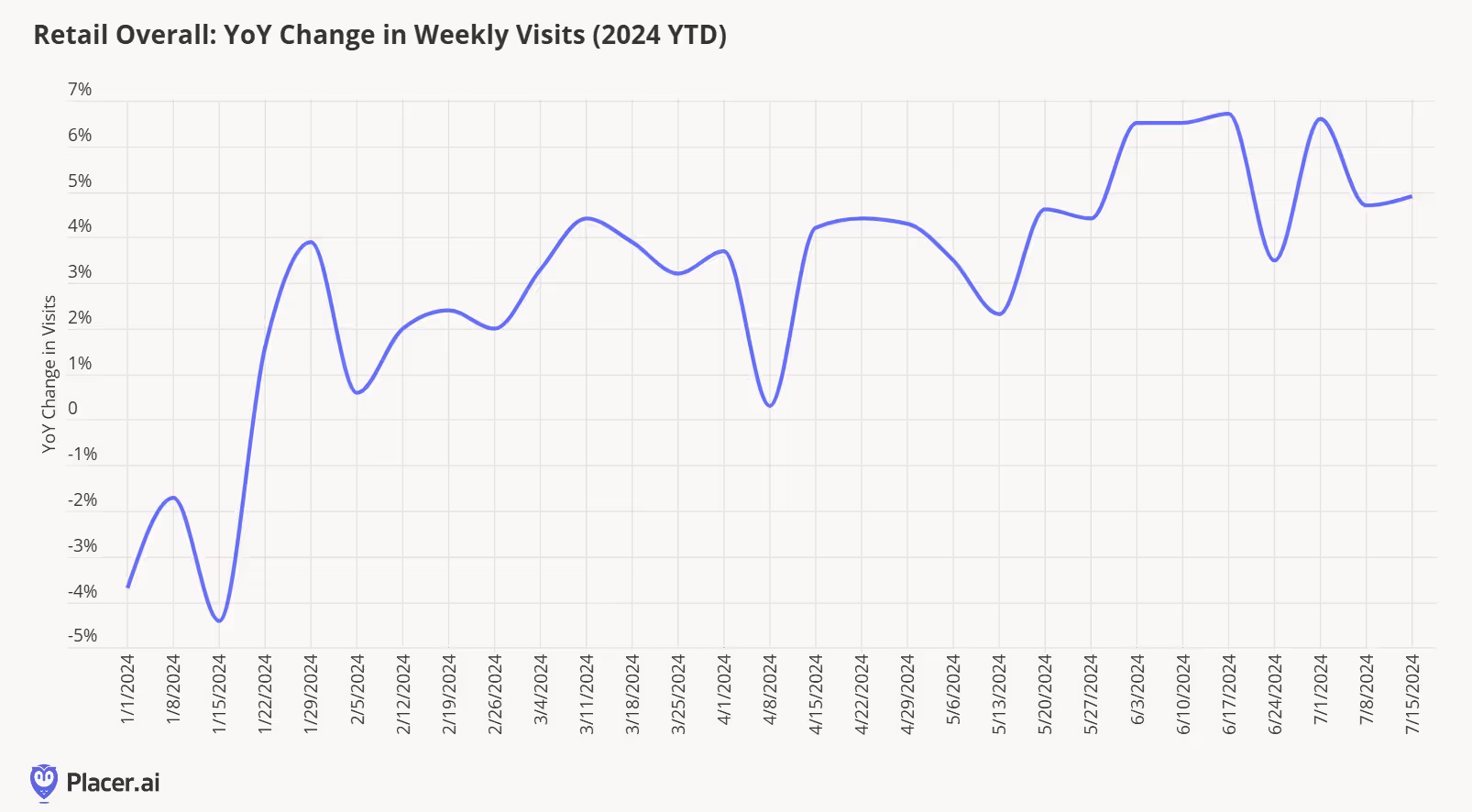
A powerful Arctic blast gripped a large portion of the continental U.S. in January 2024. And along with other disastrous consequences, the chill caused many consumers to stay indoors – resulting in a decline in overall retail visits.
Although retail foot traffic the week of January 8th, 2024 was almost in line with 2023 levels – likely due to a flux of consumers stocking up on essentials – the week of January 15th saw the overall retail visits gap widen to 2.9% year-over-year (YoY) as the storm expanded its grip on the country.
The worst of the cold abated in late January 2024, and consumers appeared to be out and about again – catching up on errands and making up for time spent cooped up at home. Overall retail visits picked up steam the week of January 22nd, 2024 and sustained positive YoY growth through February.
.png)
Zooming in on retail foot traffic by state revealed the scope of the storm’s impact on visits nationwide. Generally, states that bore the brunt of the cold blast saw the widest YoY retail visits gaps. And although perennial cold weather regions were not spared from the unusual cold spell, consumers in the often frigid Upper Midwest and Northeast may have been more acclimated to the cold and therefore able to maintain somewhat normal shopping routines.
In January 2024, Montana, Wyoming, the Dakotas, and Minnesota – along with Maine, Vermont, and New Hampshire – all experienced YoY retail visit growth, despite the extreme weather. Meanwhile, foot traffic in much of the Midwest and South buckled under the abnormal conditions.
The resilience of the Upper Midwest and the Northeast was evident again as temperatures thawed. While winter weather was still prevalent in these parts, North Dakota, Minnesota, Wisconsin, Maine, and Vermont all cozied up to over 8.0% YoY retail visit growth in February 2024.

As was the case for retail foot traffic patterns as a whole, the cold snap took a toll on visits to the dining space early on in 2024. The data suggests that many consumers stayed home and cut back on dining out during the extreme storm. But as temperatures more or less normalized, restaurant-goers were eager to get back to their favorite dining hot spots.
Analysis of weekly foot traffic to the various dining categories in January and February 2024 once again showcased the industry’s resilience and the strength of discretionary spending as a whole.
.png)
Diving into dining foot traffic on the state level provided further evidence that freezing conditions likely influenced the eating-out behavior of consumers.
Location analytics revealed that as storms raged in January 2024, southern and midwestern states – where consumers may have been caught off guard by the extreme weather – experienced the widest YoY dining visit gaps. Meanwhile, upper midwestern and northeastern states – where consumers are generally accustomed to harsher winters – produced dining traffic growth.
In February 2024 – as temperatures warmed – several states in the Upper Midwest and Northeast mustered exceptional increases in YoY dining visits. But notably, all of the continental U.S. saw YoY dining traffic growth during that month – further indication of the dining space’s ability to bounce back from adversity and the sustained demand for going out.

Which retail trends will prevail as 2024 progresses? Visit Placer.ai to find out.
This blog includes data from Placer.ai Data Version 2.0, which implements improvements to our extrapolation capabilities, adds short visit monitoring, and enhances visit detection.

With the first round of earning announcements in 2024 coming to a close, we dove into the foot traffic data to find out which companies are likely to surpass their 2023 performance in the coming year.
Following a challenging period and shifts in apparel consumer preferences hampering traffic, Gap’s performance is on the upswing. The company, which operates four iconic brands – Gap, Old Navy, Athleta, and Banana Republic – recently announced stronger-than-expected Q4 2023 results, driven by strong performances of the Gap and Old Navy brands.
Foot traffic data also points to a comeback. The Old Navy and Gap managed to maintain minimal year-over-year (YoY) visit gaps in 2023 despite the challenging retail environment, with Q4 visits – during the critical holiday season – down just 2.3% and 1.7% for the two brands, respectively.
Gap’s turnaround is likely helped by several C-suite personnel changes at the company. Last year, Gap Inc. brought in C.E.O. Richard Dickson from Mattel to revitalize the legacy brands, and Chris Blakeslee – previously at Alo Yoga – was chosen to lead the Athleta chain. And the company is continuing its series of high-profile hirings in 2024 with the appointment of designer Zac Posen as Creative Director of the company and Chief Creative Officer of the Old Navy banner. Should Gap continue on its current track, the company is well-positioned for a strong 2024.
.png)
Monthly visits to The Cheesecake Factory fell YoY for much of last year, with the chain’s foot traffic regularly lagging behind the wider Restaurant category. But the gaps between the wider industry performance and visits to the brand began to narrow towards the end of the year, with The Cheesecake Factory beating out the overall Restaurant industry in terms of YoY traffic in December 2023. And although January 2024’s cold spell brought visits back down, foot traffic rose again in February 2024.
The chain has announced plans to expand its store count this year and intends to implement moderate price hikes to offset rising costs. And if the positive foot traffic trends continue alongside the company’s new unit openings and price increases, The Cheesecake Factory may well outpace its 2023 performance in 2024.
.png)
The pet care sector thrived over the pandemic, as the combination of shelter-in-place orders, stimulus checks, and reduced spending channels drove consumers to shower their pets with love in the form of increased spending at pet stores. But the economic headwinds of the past two years led some shoppers to reduce their discretionary spending. Some consumers have gone as far as surrendering their pets in an effort to cut costs, with the tighter consumer budgets impacting visits to leading pet care retailers, including Petco. And to add to an already challenging situation, the pet care landscape has recently become even more competitive, with Walmart recently making more aggressive inroads into the space.
But Petco is fighting to stay on top, with the company continuing to invest in its veterinary program and optimize its product assortment to keep up with the changing preferences of 2024 consumers. And recent foot traffic data indicates that Petco’s strategy may be bearing fruit. Visits to Petco grew 1.8% and 4.0% YoY in November and December 2023, respectively – indicating that many pet owners still splurged on holiday gifts for their beloved pets and turned to Petco for the perfect treat or toy. And although January 2024’s unusual cold spell drove a visit lag, foot traffic quickly stabilized in February – indicating that the company should not be written off quite yet.
.png)
For more retail and dining insights, visit our blog at placer.ai.
This blog includes data from Placer.ai Data Version 2.0, which implements improvements to our extrapolation capabilities, adds short visit monitoring, and enhances visit detection.

In February 2024 Placer.ai released two white papers: 10 Top Brands to Watch in 2024 and Q4 2023 Quarterly Index. Below is a taste of our findings. To read more data-driven consumer research, visit our library.
The Q4 2023 Quarterly Index white paper analyzed the foot traffic performance of the Fitness, Beauty & Self Care, Discount & Dollar Stores, Superstores, Grocery Stores, and Dining categories in 2023 and during last year’s all-important holiday shopping season.
Last year ended on a high note for many retailers, with cooling inflation and rebounding consumer confidence contributing to a robust holiday season. Still, 2023 was a year of headwinds for the sector, as consumers traded down and cut back on unnecessary indulgences.
In the midst of these challenges, some segments thrived. Continued prioritization of health and wellness by consumers drove strong visit growth for the Fitness and Beauty & Self Care segments – which emerged as 2023 winners and enjoyed positive foot traffic growth in Q4. At the same time, price consciousness drove foot traffic to Discount & Dollar Stores and Superstores, both of which made inroads into the affordable grocery space during the year.
The Grocery category, too, saw a 4.3% jump in visits last year compared to 2022, as well as a slight uptick in Q4 visits. And even the discretionary Dining sector held its own, with a 2.1% year-over-year (YoY) annual increase in foot traffic, and a Q4 quarterly visit gap of just 1.8%.
For a deeper dive into the Q4 2023 performance of these sectors, read the full report.
.png)
The 10 Top Brands to Watch in 2024 white paper leveraged up-to-date location intelligence and consumer demographic insights to identify ten brands gearing up for growth in 2024 – one of which was Foxtrot Market.
Convenience stores have evolved into bona-fide dining destinations. And Foxtrot, a Chicago-based chain with 29 stores across Texas, Illinois, Washington, Maryland, and Virginia, is one of the brands redefining what a convenience store can be. The chain offers an upscale convenience store experience and is particularly known for including local brands in its product assortment as well as its excellent wine curation and dining options.
And location intelligence data indicates that Foxtrot knows its audience – visitors to the chain were significantly more likely to fall into AGS: Behavior & Attitudes dataset’s “Wine Drinker” or “Nutritionally Aware” segments than visitors to nearby convenience stores. The company plans to ramp up store openings, particularly in the suburbs, where convenience and a good bottle of wine might just find the perfect home as a welcome distraction from the daily grind.
To find out the other brands on the list, read the full report.
.avif)
For more data-driven consumer research, visit our library.
This blog includes data from Placer.ai Data Version 2.0, which implements improvements to our extrapolation capabilities, adds short visit monitoring, and enhances visit detection.

Discount and dollar stores flourished in 2022 and 2023, as rising prices led many shoppers to trade down and tighten their purse strings. Consumers flocked to dollar stores for everything from essential goods to discretionary items like toys and party supplies. And while some chains – including category leader Dollar General – were buoyed by their growing positioning as low-cost grocery venues, others found success by leaning into the affordable luxury space. Brands like Five Below, Ollie’s Bargain Outlet, and pOpshelf (owned by Dollar General) grew their audiences by offering price-conscious consumers easy access to inexpensive non-necessities.
But how did these specialty discount retailers fare in the all-important fourth quarter of 2023 – and what does their early 2024 performance portend for the rest of the new year?
We dove into the data to find out.
Five Below, the bargain chain specializing in low-cost, recreational merchandise, wrapped up 2023 with a bang. Between September and December 2023, the brand saw year-over-year (YoY) monthly visit increases ranging from 14.6% to 22.1%. And while Five Below’s expanding store count has likely helped fuel this surge, the indulgence-oriented retailer is also attracting shoppers with a growing selection of “Five Beyond” products, priced above the chain’s traditional $5.00 ceiling. Last year, Five Below further cemented its status as a key holiday shopping destination – another factor driving its impressive Q4 2023 performance. And the discounter continued its winning streak into the new year, with strong performance in January and February 2024.
Ollie’s Bargain Outlet operates according to a somewhat different strategy – enticing shoppers with a broad selection of highly discounted name-brand merchandise. Ollie’s offerings include lower-ticket items like food and books, but also a wide range of premium products like electronics and home furnishings. And Ollie’s closeout buying model means that shoppers never know exactly what they’re going to find – turning each trip into something of a treasure hunt. Like Five Below, Ollie’s Bargain Outlet has expanded its physical presence in recent years – and the chain’s consistent positive YoY foot traffic growth highlights its continued appeal to today’s consumers.
.avif)
Dollar General’s pOpshelf concept – launched in late 2020 with a discretionary-focused product mix aimed at higher income shoppers than the company’s flagship brand – now boasts some 240 locations across 20 states. And as the chain has expanded its footprint, it has also grown its audience. Like other affordable luxury venues, pOpshelf experiences large visit spikes during the fourth quarter of the year, as shoppers seek out inexpensive gifts and other holiday fare.
As of February 2024, visits to the chain were up 190.1% compared to a March 2022 baseline. Though Dollar General has reined in the pace of pOpshelf’s expansion to account for what remains a challenging retail environment, the company still plans to open more stores this year. And if pOpshelf’s strong visit trajectory is any indication, investing in the concept’s long-term strength may well bear fruit in the months and years ahead.
.png)
Each of these discount chains has found success by appealing to a different audience. Ollie’s Bargain Outlet, with its constantly-shifting closeout inventory, attracts shoppers from areas with higher shares of singles and fewer families with children. Five Below’s and pOpshelf, on the other hand, feature captured markets with larger shares of parental households than of singles – though pOpshelf’s share of the latter has risen over the past year, as the chain expanded into new markets.
For all three chains, however, the extent of the gap between the two demographic groups varies throughout the year – with the share of singles increasing during the summer and the share of parental households seeing an uptick during the December holiday shopping season. (For pOpshelf, this pattern began to emerge in 2023). Five Below experienced a particularly pronounced version of this trend – with the share of singles frequenting the chain actually outpacing the share of families with children each August. This uptick in the share of singles visiting discount chains – especially Five Below – may be due in part to back-to-school shopping by college students, many of whom load up on dorm supplies towards the end of summer.
%20(1).png)
Specialty discount chains offer price-conscious shoppers affordable outlets for retail therapy. And in 2023 and early 2024, Five Below, Ollie’s Bargain Outlet, and pOpshelf grew their audiences by appealing to the perennial quest for inexpensive, fun shopping experiences. How will these retailers continue to fare as 2024 wears on? Will cooling inflation put a dent in their gains – or will a revitalized discretionary retail environment propel them forward?
Follow Placer.ai’s data-driven retail analyses to find out.
This blog includes data from Placer.ai Data Version 2.0, which implements improvements to our extrapolation capabilities, adds short visit monitoring, and enhances visit detection.

Everybody loves coffee. And with some 75% of American adults indulging in a cup of joe at least once a week, it’s no wonder the industry is constantly on an upswing.
In early 2024, year-over-year (YoY) visits to coffee chains increased nationwide – with every state in the continental U.S. experiencing year-over-year (YoY) coffee visit growth.
The most substantial foot traffic boosts were seen in smaller markets like Oklahoma (19.4%), Wyoming (19.3%), and Arkansas (16.9%), where expansions may have a more substantial impact on statewide industry growth. But the nation’s largest coffee markets, including Texas (10.9%), California (4.2%), Florida (4.2%), and New York (3.5%), also experienced significant YoY upticks.
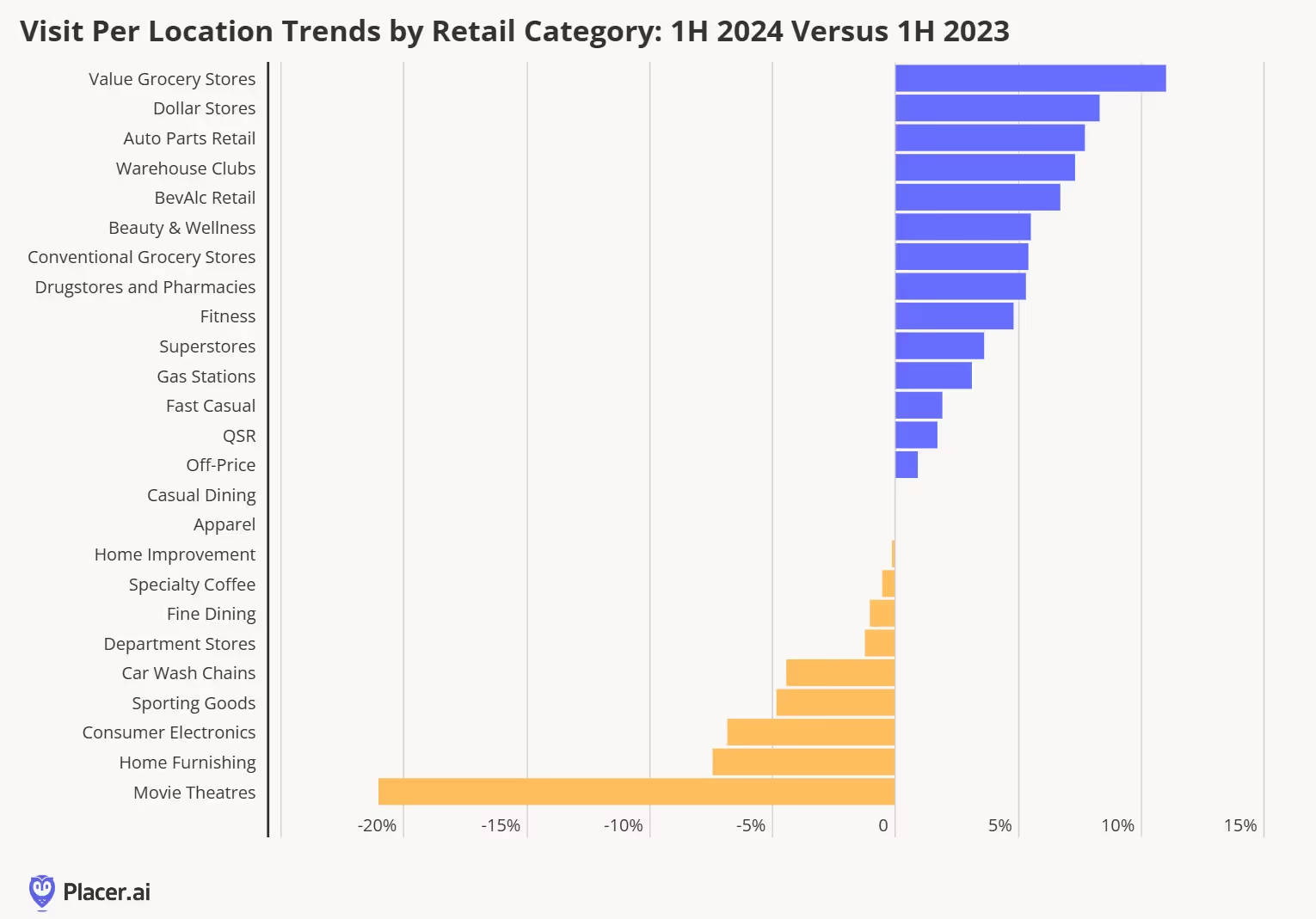
The nation’s coffee visit growth is being fueled, in large part, by chain expansions: Major coffee players are leaning into growing demand by steadily increasing their footprints. And a look at per-location foot traffic trends shows that by and large, they are doing so without significantly diluting visitation to existing stores.
On an industry-wide level, visits to coffee chains increased 5.1% YoY during the first five months of 2024. And over the same period, the average number of visits to each individual coffee location declined just slightly by 0.6% – meaning that individual stores drew just about the same amount of foot traffic as they did in 2023.
Drilling down into chain-level data shows some variation between brands. Dutch Bros., BIGGBY COFFEE and Dunkin’ all saw significant chain-wide visit boosts, accompanied by minor increases in their average number of visits per location.
Starbucks, for its part, which reported a YoY decline in U.S. sales for Q2 2024, maintained a small lag in visits per location. But given the coffee leader’s massive footprint – some 16,600 stores nationwide – its ability to expand while avoiding more significant dilution of individual store performance shows that Starbucks’ growth is meeting robust demand.
What is driving the coffee industry’s remarkable category-wide growth? And who are the customers behind it? This white paper dives into the data to explore key factors driving foot traffic to leading coffee chains in early 2024. The report explores the demographic and psychographic characteristics of visitors to major players in the coffee space and examines strategies brands can use to make the most of the opportunity presented by a thriving industry.
One factor shaping the surge in coffee visit growth is the slow-but-sure return-to-office (RTO). Hybrid work may be the post-COVID new normal – but RTO mandates and WFH fatigue have led to steady increases in office foot traffic over the past year. And in some major hubs – including New York and Miami – office visits are back to more than 80.0% of what they were pre-pandemic.
A look at shifting Starbucks visitation patterns shows that customer journeys and behavior increasingly reflect those of office-goers. In April and May 2022, for example, 18.6% of Starbucks visitors proceeded to their workplace immediately following their coffee stop – but by 2024, this share shot up to 21.0%.
Over the same period, the percentage of early morning (7:00 to 10:00 AM) Starbucks visits lasting less than 10 minutes also increased significantly – from 64.3% in 2022 to 68.7% in 2024. More customers are picking up their coffee on the go – many of them on the way to work – rather than settling down to enjoy it on-site.
Dunkin’ is another chain that is benefiting from consumers on the go. Examining the coffee giant’s performance across major regional markets – those where the chain maintains a significant presence – reveals a strong correlation between the share of Dunkin’ visits in each state lasting less than five minutes and the chain’s local YoY trajectory.
In Wisconsin, for example, 50.9% of visits to Dunkin’ between January and May 2024 lasted less than five minutes. And Wisconsin also saw the most impressive YoY visit growth (5.9%). Illinois, Ohio, Maine, and Connecticut followed similar patterns, with high shares of very short visits and strong YoY showings.
On the other end of the spectrum lay Tennessee, Alabama, and Florida, where very short visits accounted for a low share of the chain’s statewide total – under 40.% – and where visits declined YoY.
Dunkin’s success with very short visits may be driven in part by its popular app, which makes it easy for harried customers to place their order online and save time in-store. And this is good news indeed for the coffee leader – since customers using the app also tend to generate bigger tickets.
Dutch Bros.’ meteoric rise has been fueled, in part, by its appeal to younger audiences. Recently ranked as Gen Z’s favorite quick-service restaurant, the rapidly-expanding coffee chain sets itself apart with a strong brand identity built on cultivating a positive, friendly customer experience.
And Dutch Bros.’ people-centered approach is resonating especially well with singles – including young adults living alone – who may particularly appreciate the chain’s community atmosphere.
Analyzing the relative performance of Dutch Bros.’ locations across metro areas – focusing on regions where the chain has a strong local presence – shows that it performs best in areas with plenty of singles. Indeed, the share of one-person households in Dutch Bros.’ local captured markets is very strongly correlated with the coffee brand’s CBSA-level YoY per-location visit performance. Areas with higher concentrations of one-person households saw significantly more YoY visit growth in the first part of 2024. (A chain’s captured market is obtained by weighting each Census Block Group (CBG) in its trade area according to the CBG’s share of visits to the chain – and so reflects the population that actually visits the chain in practice).
The share of one-person households in Dutch Bros.’ Tucson, AZ captured market, for example, stands at 33.4% – well above the nationwide baseline of 27.5%. And between January and May 2024, Tucson-area Dutch Bros. saw a 6.0% increase in the average number of visits per location. Tulsa, OK, Medford, OR, and Oklahoma City, OK – which also feature high shares of one-person households (over 30.0%) – similarly saw per-location visit increases ranging from 3.6% - 7.0%. On the flip side, Fresno, CA, Las Vegas-Henderson-Paradise, NV, and San Antonio-New Braunfels, TX, which feature lower-than-average shares of single-person households, saw YoY per-location visit declines ranging from 1.5%-9.5%.
As Dutch Bros. forges ahead with its planned expansions, it may benefit from doubling down on this trends and focusing its development efforts on markets with higher-than-average shares of one-person households – such as university towns or urban areas with lots of young professionals.
Michigan-based BIGGBY COFFEE is another java winner in expansion mode. With a growth strategy focused on emerging markets with less brand saturation, BIGGBY has been setting its sights on small towns and rural areas throughout the Midwest and South. Though the chain does have locations in bigger cities like Detroit and Cincinnati, some of its most significant markets are in smaller population centers.
And a look at the captured markets of BIGGBY’s 20 top-performing locations in early 2024 shows that they are significantly over-indexed for suburban consumers – both compared to BIGGBY as a whole and compared to nationwide baselines. (Top-performing locations are defined as those that experienced the greatest YoY visit growth between January and May 2024).
“Suburban Boomers”, for example – a Spatial.ai: PersonaLive segment encompassing middle-class empty-nesters living in suburbs – comprised 10.6% of BIGGBY’s top captured markets in early 2024, compared to just 6.6% for BIGGBY’s overall. (The nationwide baseline for Suburban Boomers is even lower – 4.4%.) And Upper Diverse Suburban Families – a segment made up of upper-middle-class suburbanites – accounted for 9.6% of the captured markets of BIGGBY’s 20 top locations, compared to just 7.2% for BIGGBY’s as a whole, and 8.3% nationwide.
Coffee has long been one of America’s favorite beverages. And java chains that offer consumers an enjoyable, affordable way to splurge are expanding both their footprints and their audiences. By leaning into shifting work routines and catering to customers’ varying habits and preferences, major coffee players like Starbucks, Dunkin’, Dutch Bros., and BIGGBY COFFEE are continuing to thrive.
Note: This report is based on an analysis of visitation patterns for regional and nationwide grocery chains and does not include single-location stores.
Grocery stores, superstores, and dollar stores all carry food products – and American consumers buy groceries at all three. But even in today’s crowded food retail environment, traditional grocery chains have a special role to play. With their primary focus on stocking a wide variety of fresh foods, these chains serve a critical function in offering consumers access to healthy options.
But visualizing the footprints of major grocery chains across the continental U.S. – alongside those of discount & dollar stores – shows that the geographical distribution of grocery chains remains uneven.
In some areas, including parts of the Northeast, Midwest, South Atlantic, and Pacific regions, grocery chains are plentiful. But in others – some with population centers large enough to feature a robust dollar store presence – they remain in short supply.
And though many superstore locations also provide a full array of grocery offerings, they, too, are often sparsely represented in areas with low concentrations of grocery chains.
For grocery chain operators seeking to expand, these underserved grocery markets can present a significant opportunity. And for civic stakeholders looking to broaden access to healthy food across communities, these areas highlight a policy challenge. For both groups, identifying underserved markets with significant untapped demand can be a critical first step in deciding where to focus grocery development initiatives.
This white paper dives into the location analytics to examine grocery store availability across the United States – and harnesses these insights to explore potential demand in some underserved markets. The report focuses on locations belonging to regional or nationwide grocery chains, rather than single-location stores.
Last year, grocery chains accounted for 43.4% of nationwide visits to food retailers – including grocery chains, superstores, and discount & dollar stores. But drilling down into the data for different areas of the country reveals striking regional variation – offering a glimpse into the variability of grocery store access throughout the U.S. In some states, grocery stores attract the majority of visit share to food retailers, while in others, dollar stores or superstores dominate the scene.
The ten states where residents were most likely to visit grocery chains in early 2024 – Oregon, Vermont, Washington, Massachusetts, California, Maryland, New Hampshire, Connecticut, New Jersey, and Rhode Island – were all on the East or West Coasts. In these states, as well as in Nevada and New York, grocery chain visits accounted for 50.0% or more of food retail visits between January and April 2024.
Meanwhile, residents of many West North Central and South Central states were much less likely to do their food shopping at grocery chains. In North Dakota, for example, grocery chain visits accounted for just 11.7% of visits to food retailers over the analyzed period. And in Mississippi, Oklahoma, and Arkansas, too, grocery stores drew less than 20.0% of the overall food retail foot traffic.
But low grocery store visit share does not necessarily indicate a lack of consumer interest or ability to support such stores. And in some of these underserved regions, existing grocery chains are seeing outsize visit growth – indicating growing demand for their offerings.
North Dakota, the state with the smallest share of visits going to grocery chains in early 2024, experienced a 9.1% year-over-year (YoY) increase in grocery visits during the same period – nearly double the nationwide baseline of 5.7%. Other states with low grocery visit share, including Nebraska, Arkansas, Alabama, Mississippi, and New Mexico, also experienced higher-than-average YoY grocery chain visit growth. This suggests significant untapped potential for grocery stores and a market that is hungry for more.
Alabama is one state where grocery chains accounted for a relatively small share of overall food retail foot traffic in early 2024 (just 28.9%) – but where YoY visit growth outperformed the nationwide average. And digging down even further into local grocery store visitation trends provides further evidence that at least in some places, low grocery visit share may be due to inadequate supply, rather than insufficient demand.
In Central Alabama, for example, many residents drive at least 10 miles to reach a local grocery chain. And several parts of the state, both rural and urban, feature clusters of grocery stores that draw customers from relatively far away.
But zooming in on YoY visitation data for local grocery chain locations shows that at least some of these areas likely harbor untapped demand. Take for example the Camden, Butler, Thomasville, and Gilbertown areas (circled in the map above). The Piggly Wiggly location in Butler, AL, drew 40.1% of visits from 10 or more miles away. The same store experienced a 23.3% YoY increase in visits in early 2024 – far above the statewide baseline of 6.6%. Meanwhile, the Super Foods location in Thomasville, AL, which drew 52.8% of visits from at least 10 miles away – experienced YoY visit growth of 12.3%. The Piggly Wiggly locations in Camden, AL and Gilbertown, AL saw similar trends.
At the same time, trade area analysis of the four locations reveals that the grocery stores had little to no trade area overlap during the analyzed period. Each store served specific areas, with minimal cannibalization among customer bases.
These metrics appear to highlight robust demand for grocery stores in the region – grocery visits are growing at a stronger rate than those in the overall state, people are willing to make the drive to these stores, and each one has little to no competition from the others.
While significant opportunity exists across the country, many communities still face considerable challenges in supporting large grocery stores. Though South Carolina has a significant number of grocery chain locations, for example, certain areas within the state have low access to food shopping opportunities. And one local government – Greenville County – is considering offering tax breaks to grocery stores that set up shop in the area, to improve local fresh food accessibility.
Placer.ai migration and visitation data shows that Greenville County is ripe for such initiatives: the county’s population grew by 4.8% over the past four years – with much of that increase a result of positive net migration. And YoY visits to Greenville County Grocery Stores have consistently outperformed state averages: In April 2024, grocery visits in the county grew by 6.1% YoY, while overall visits to grocery stores in South Carolina grew by 4.2%. This growth – both in terms of grocery visits and population – points to rising demand for grocery stores in Greenville County.
Analyzing the Greenville County grocery store trade areas with Spatial.ai’s FollowGraph dataset – which looks at the social media activity of a given audience – offers further insight into local grocery shoppers’ particular demand and preferences.
Consumers in Greenville-area grocery store trade areas, for example, are more likely to be interested in “Mid-Range Grocery Stores” (including brands like Aldi, Kroger, and Lidl) than residents of grocery store trade areas in the state as a whole. This metric provides further evidence of local demand for grocery chains – and offers a glimpse into the kinds of specific grocery offerings likely to succeed in the area.
Grocery stores remain essential services for many consumers, providing a place to pick up fresh produce, meat, and other healthy food options. And many areas in the country are ripe for expansion, with eager customer bases and growing demand. Identifying such areas with location analytics can help both grocery store operators and municipal stakeholders provide their communities and customer bases with an enhanced grocery shopping experience that caters to local preferences.
Following COVID-era highs, domestic migration levels have begun to taper off – with the number of Americans moving within the U.S. hitting an all-time low, according to some sources, in 2023.
To be sure, some popular COVID-era destinations – including Idaho, the Carolinas, and Utah – saw their net domestic migration continue to rise, albeit at a slower pace. But other states which had been relocation hotspots between February 2020 and February 2023, such as Wyoming and Texas, experienced negative net migration between February 2023 and February 2024.
Analyzing CBSA-level migration data reveals differences and similarities between last year’s migration patterns and COVID-era trends.
Between February 2020 and February 2023, seven out of the ten CBSAs posting the largest population increases due to inbound domestic migration were located in Florida. But between February 2023 and February 2024, the top 10 CBSAs with the largest net migrated percent of the population were significantly more diverse. Only four out of the ten CBSAs were located in Florida, and several new metro areas – including Provo-Orem, UT, Kingsport-Bristol, TN-VA, and Boulder, CO – joined the list.
This white paper leverages a variety of location intelligence tools – including Placer.ai’s Migration Report, Niche Neighborhood Grades, and ACS Census Data location intelligence – to analyze two migration hotspots. Specifically, the report focuses on Daytona Beach, FL, which already appeared on the February 2020 to February 2023 list and has continued to see steady growth, and Boulder, CO, which has emerged as a new top destination. The data highlights the potential of CBSAs with unique value propositions to continue to attract newcomers despite ongoing housing headwinds.
The Boulder, CO CBSA has emerged as a domestic migration hotspot: The net influx of population between February 2023 and February 2024 (i.e. the total number of people that moved to Boulder from elsewhere in the U.S., minus those that left) constituted 3.1% of the CBSA’s February 2024 population.
The strong migration is partially due to the University of Colorado, Boulder’s growing popularity. But the metro area has also emerged as a flourishing tech hub, with Google, Apple, and Amazon all setting up shop in town, along with a wealth of smaller start ups.
Most domestic relocators tend to remain within state lines – so unsurprisingly, many of the recent newcomers to Boulder moved from other CBSAs in Colorado. But perhaps due to Boulder’s robust tech ecosystem, many of the new residents also came from Los Angeles, CA (6.6%) and San Francisco, CA (3.4%) – other CBSAs known for their thriving tech scenes.
At the same time, looking at the other CBSAs feeding migration to the area indicates that tech is likely not the only draw attracting people to Boulder: A significant share of relocators came from the CBSAs of Chicago, IL (6.1%), Dallas , TX (4.9%), and New York, NY (3.9%). The move from these relatively urbanized CBSAs to scenic Boulder indicates that some of the domestic migration to the area is likely driven by people looking for better access to nature or a general lifestyle change.
According to the U.S. News & World Report, Boulder ranked in second place in terms of U.S. cities with the best quality of life. Using Niche Neighborhood Grades to compare quality of life attributes in the Boulder CBSA and in the areas of origin dataset highlights some of the draw factors attracting newcomers to Boulder beyond the thriving tech scene.
The Boulder CBSA ranked higher than the metro areas of origin for “Public Schools,” “Health & Fitness,” “Fit for Families,” and “Access to Outdoor Activities.” These migration draw factors are likely helping Boulder attract more senior executives alongside younger tech workers – and can also explain why relocators from more urban metro areas may be choosing to make Boulder their home.
Boulder’s strong inbound migration numbers over the past year – likely driven by its flourishing tech scene and beautiful natural surroundings – reveal the growth potential of certain CBSAs regardless of wider housing market headwinds.
Florida experienced a population boom during the pandemic, and several CBSAs in the state – including the Deltona-Daytona Beach-Ormond Beach, FL CBSA – have continued to welcome domestic relocators in high numbers. The CBSA’s anchor city, Daytona Beach – known for its Bike Week and NASCAR’s Daytona 500 – has also seen positive net migration between February 2023 and February 2024.
Americans planning for retirement or retirees operating on a fixed income are likely particularly interested in optimizing their living expenses. And given Daytona’s relative affordability, it’s no surprise that the median age in the areas of origin feeding migration to Daytona Beach tends to be on the older side.
According to the 2021 Census ACS 5-Year Projection data, the median age in Daytona Beach was 39.0. Meanwhile, the weighted median age in the areas of migration origin was 42.6, indicating that those moving to Daytona Beach may be older than the current residents of the city.
Zooming into the migration data on a zip code level also highlights Daytona Beach’s appeal to older Americans: The zip code welcoming the highest rates of domestic migration was 32124, home to both Jimmy Buffet’s Latitude Margaritaville’s 55+ community and the LPGA International Golf Club, host of the LPGA Tour. The median age in this zip code is also older than in Daytona Beach as a whole, and the weighted age in the zip codes of origin was even higher – suggesting that older Americans and retirees may be driving much of the migration to the area.
Looking at the migration draw factors for Daytona Beach also suggests that the city is particularly appealing to retirees, with the city scoring an A grade for its “Fit for Retirees.” But the city of Daytona Beach is also an attractive destination for anyone looking to elevate their leisure time, with the city scoring higher than Daytona Beach’s cities of migration origin for “Weather,” “Access to Restaurants,” or “Access to Nightlife.”
Like Boulder, Daytona’s scenery – including its famous beaches – is likely attracting newcomers looking to spend more time outdoors and improve their work-life balance. And like Boulder and its tech scene, Daytona Beach also has an extra pull factor – its affordability and fit for older Americans – that is likely helping the area continue to attract new residents, even as domestic migration slows down nationwide.
Although the overall pace of domestic migration has slowed, analyzing location intelligence data reveals several migration hotspots amidst the overall cooldown. Boulder and Daytona Beach each have a set of unique draw factors that seem to attract different populations – and the success of these regions highlights the many paths to migration growth in 2024.