.png)
.png)

.png)
.png)

Family Dollar’s parent company Dollar Tree recently announced plans to dramatically rightsize the discount chain’s store fleet, with 600 stores slated for closure in 2024 and more to follow in upcoming years for a total of almost 1000 closures. We dove into the location intelligence for Family Dollar and three other leading value-forward retailers to understand which chain stands to benefit most from Family Dollar’s contraction.
Dollar Tree’s plans to close almost 1000 Family Dollar stores did not surprise retail analysts. Discount & Dollar Stores have been on the rise in recent years, driven in part by significant expansions – visits to the industry up 25.4% in Q1 2023 and up 55.8% in Q4 2023 relative to pre-pandemic Q1 2019. But this growth seems to have bypassed Family Dollar. Q1 2023 visits to the brand were up just 0.8% and traffic during the critical holiday-driven Q4 2023 was up just 9.8% since Q1 2019.
Meanwhile, the eponymous banner of Family Dollar’s parent company Dollar Tree outperformed the wider industry during the same period, with a 28.4% increase in Q1 2023 visits and a 72.1% increase in Q4 2023 visits relative to a Q1 2019 baseline.
.avif)
The Discount & Dollar Store space includes major players like Dollar General and the Dollar Tree banner that can fill the voids left by shuttering Family Dollar Venues. Walmart also may step into some of the newly created gaps. Analyzing the demographic and psychographic composition of the trade areas of these four chains – Family Dollar, Dollar General, Dollar Tree, and Walmart – may reveal the chain(s) best positioned to cater to Family Dollar’s current visitor base.
Most people have set daily shopping habits, and chains will likely have more success vying for Family Dollar’s visitor base if they can accommodate the current visitation patterns of Family Dollar shoppers.
Family Dollar and Dollar General respectively receive 37.0% and 37.9% of their daily visits between the hours of 5:00 PM and 8:59 PM. Meanwhile, only 31.2% of Dollar Tree’s visitors and 34.3% of Walmart visitors visited those chains in the late afternoon and evening. The similarities between Dollar General and Family Dollar’s visitation patterns may mean that Dollar General’s staffing and opening schedule is suited to handle the influx of former Family Dollar visitors without making these visitors modify their current shopping behavior.
.png)
Analyzing the four chains by trade area median household income (HHI) also shows that Family Dollar is closer to Dollar General than to Walmart or Dollar Tree – but the data also reveals that Family Dollar serves a distinct demographic base. The chain has a potential market median HHI of $62.1K and a captured market median HHI of $48.3K – in both cases, the lowest trade area median HHI of the four chains analyzed.
Potential market analysis weighs the Census Block Groups (CBG) making up a trade area according to the number of residents in each CBG. The low median HHI in Family Dollar’s potential market means that the chain’s venues tend to be located in lower-income areas compared to the other chains’ store fleets.
Captured market median HHI reflects the median HHI in the CBGs making up a trade area weighted according to the number of visits to the chain from each CBG. And comparing the four chains indicates that the gap between Family Dollar and the other three chains is even larger when looking at the captured market median HHI, with Family Dollar serving the lowest income households within its potential market.
Still, Dollar General’s trade area median HHI is closest to that of Family Dollar – although Family Dollar’s trade area median HHI is still significantly lower than that of Dollar General – which could mean that Dollar General will be most attractive to Family Dollar’s former visitors.
.png)
But looking at other metrics suggests differences in household composition between Family Dollar and Dollar General. Although the potential market share of households with children is similar for the two chains, Family Dollar’s captured market share is higher while Dollar General’s captured market share of households with children is lower.
Family Dollar’s popularity among lower-income households with children may explain why the chain has been struggling in recent years, as this demographic has been particularly hard-hit by the recent economic headwinds. And this distinct demographic base may also mean that Dollar General might want to make some merchandising, pricing, or marketing adjustments to best serve Family Dollar’s former visitors.
.png)
Although the demographic composition of Family Dollar’s trade areas sets the chain’s visitor base apart, diving into the psychographic segmentation of the chain’s captured and potential market highlights similarities with other value-forward retailers.
All four chains analyzed seem particularly popular with rural audiences – specifically with the Rural Average Income and Rural Low Income segments as defined by the Spatial.ai: PersonaLive dataset. (Dollar General and Walmart also see a disproportionate number of visits from the Rural High Income segment within their potential markets.) So some of Family Dollar’s rural shoppers may already be visiting Walmart or Discount & Dollar Stores – and these other retailers may choose to open in areas where Family Dollar is closing and where no other discounter currently operates.
.avif)
The massive rightsizing of Family Dollar’s store fleet creates major opportunities for other value-driven retailers to expand their reach. Who will end up benefiting most from these shifts?
Check in with placer.ai to find out.
This blog includes data from Placer.ai Data Version 2.0, which implements improvements to our extrapolation capabilities, adds short visit monitoring, and enhances visit detection.

Last year’s retail vibe was nothing if not experiential. Inflation led consumers to trade down and cut back on discretionary spending – but people still sought out fun, affordable venues to meet up with friends and let off some steam.
So with 2023 firmly in the rearview mirror, we dove into the data to check in with Dave & Buster’s Entertainment Inc., owner of eatertainment chain Dave & Buster's, and – since 2022 – Main Event Entertainment. How did the company’s two brands fare in the final months of 2023 and at the start of 2024? And what lies in store for them in the months ahead?
Dave & Buster’s, the sports bar arcade that invites harried grown-ups to cast aside their worries and “unlearn adulthood”, is thriving. With some 160 venues across 42 states, Dave and Buster’s offers the most tightly-wound consumers an inexpensive escape from real life – someplace they can unwind with friends over a beer, some mouthwatering shareables, and a bit of friendly skee-ball.
Over the past several years, Dave & Buster’s has grown its store count, and in 2022 broadened its portfolio with Main Event Entertainment – the family-oriented eatertainment concept that pairs arcade games with larger format activities such as laser tag and bowling. And since November 2023, both brands have sustained mainly positive year-over-year (YoY) visit growth, disrupted only by January 2024’s inclement weather.
.png)
Main Event Entertainment’s purchase by Dave & Buster’s appears to have been a natural move on the company’s part. Overlaying foot traffic data with demographics from STI’s PopStats reveals that the two chains’ comparable offerings attract customers with similar income profiles: In 2023, Dave & Buster’s’ and Main Event’s captured markets featured median household incomes (HHIs) of $67.3K and $67.6K, respectively – just under the nationwide baseline of $69.5K.
But the acquisition of Main Event has also allowed Dave & Buster’s Entertainment, Inc. to broaden its visitor base. Both of the company’s brands attract plenty of singles and families with children. But while Dave & Buster’s young-adult-oriented vibe holds special appeal for people living on their own, Main Event’s child-friendly activities make it a particularly attractive destination for parental households. Together, the two chains offer something for everyone – cementing the company’s role as an eatertainment leader.
.png)
Dave & Buster’s and Main Event also enjoy similar weekly visitation patterns. Unsurprisingly, the two chains are busiest on Saturdays, followed by Sundays and Fridays, and quieter during the rest of the week. But both brands have also found creative ways to boost weekday visits. On Wednesdays, Dave & Buster’s offers a 50%-off deal, letting customers play their favorite games at half the price – and fueling a significant midweek foot traffic spike. Main Event Entertainment, for its part, draws weekday crowds on Mondays with an afternoon all–you-can-play special.
.png)
Everybody needs to let their hair down sometimes – and with Spring Break right around the corner, both Dave & Buster’s and Main Event are building momentum with seasonal specials aimed at making their offerings even more affordable.
For both chains, March is an important milestone – in 2023, Dave & Buster’s and Main Event drew 41.0% and 82.9% more traffic during the week of March 13th, respectively, than they did, on average, throughout the rest of year. And if recent visit trends are any indication, the two brands appear poised to enjoy a healthy Spring Break and a strong rest of 2024.
For more data-driven retail and dining insights, follow Placer.ai.
This blog includes data from Placer.ai Data Version 2.0, which implements improvements to our extrapolation capabilities, adds short visit monitoring, and enhances visit detection.

Despite the individual restaurant success stories in 2023, last year was also a period of economic headwinds in the dining industry. But Darden Restaurants – and its largest chains Olive Garden, LongHorn Steakhouse, and Cheddar’s Scratch Kitchen – continued to drive foot traffic. We dove into the location analytics for these three Darden brands and took a closer look at the shifts in consumer behavior impacting the dining space.
Foot traffic in 2023 was largely positive for Olive Garden, LongHorn Steakhouse, and Cheddar’s Scratch Kitchen, with the strong visit trends likely helping drive Darden’s recent sales growth.
All three brands posted impressive YoY visit growth in Q1 2023, perhaps aided by the comparison to an Omicron-impacted, muted Q1 2022. LongHorn Steakhouse then pulled ahead of the pack in Q2 and Q3 with YoY foot traffic up 3.7% and 4.8%, respectively, before finishing the year off strong with a 3.8% YoY visit increase in Q4. But the real Darden star in Q4 was Olive Garden. The Italian-focused chain’s success was likely bolstered by the return of the Never Ending Pasta Bowl – offered from late September 2023 through mid-November – which appears to have attracted even more hungry diners than it did the previous year.
Meanwhile, YoY visits to Cheddar’s Scratch Kitchen increased during the first three quarters of 2023 and held relatively steady in Q4 – YoY visits during the last quarter of the year were down just 0.7% – highlighting the overall strength of Darden’s portfolio.
.avif)
Though 2023 was a particularly successful year for Darden foot traffic, Olive Garden, LongHorn, and Cheddar’s were not immune to this year’s arctic blast. The extreme weather in January 2024 impacted dining visits and put a damper on traffic to these chains. But once the weather warmed up in February 2024, YoY visits to Olive Garden, LongHorn, and Cheddar’s began to heat up as well – outpacing even the strong early 2023 traffic – indicating that Darden brands are likely in for another year of robust visits.
.avif)
Diving deeper into the analytics for Darden’s brands indicated that shifts in consumer behavior may be a factor in the restaurants’ recent foot traffic gains. Analysis of hourly visits to Olive Garden, LongHorn, and Cheddar’s since 2019 revealed that a greater share of visitors are now engaging with their favorite restaurants during non-traditional dayparts in the mid and late afternoon.
The share of daily Olive Garden, LongHorn, and Cheddar’s visitors visiting between 2 PM and 5:59 PM was higher in 2023 than in 2019 for all three brands. Olive Garden had the largest share of mid and late afternoon visits in 2022 at 32.6% and maintained its share of 2:00 PM to 5:59 PM visitation in 2023. Meanwhile, LongHorn and Cheddar’s share of visits during the 2:00 PM to 5:59 PM daypart continued increasing in 2023 relative to the previous year, which suggests that this trend of late afternoon and early dinner visits is becoming the new normal.
As eating out early is becoming more prevalent in the casual dining space – as well as in fine dining and steakhouse restaurants – Darden might capitalize on this trend by adding more happy hours and other late-afternoon specials to its restaurants’ menus.
.png)
Darden’s biggest chains succeeded in driving foot traffic growth in 2023 and early 2024. Location analytics indicated that while demand for the brands is consistent, consumer behavior is always changing. How will these restaurants navigate the rest of 2024? Visit Placer.ai to find out.
This blog includes data from Placer.ai Data Version 2.0, which implements improvements to our extrapolation capabilities, adds short visit monitoring, and enhances visit detection.

Athleisure and sportswear are a go-to for consumers looking to move seamlessly between activities – from a workout to work-from-home. That functionality has kept the category running hot in recent years even while more consumers are getting back to the office and socializing. And since athleisure and sportswear are now bonafide wardrobe staples, more consumers are investing in high-end items. We dove into the data for two of the category’s biggest upscale players – Nike and lululemon – in order to take a closer look at the consumer behavior driving visit growth.
During all four quarters of 2023, Nike and lululemon saw year-over-year (YoY) foot traffic growth that surpassed the visit increases in the wider Athleisure & Sportswear space. Part of Nike’s sizable 2023 YoY visit gains were likely due to the addition of a large number of stores relative to its somewhat modest footprint. Nike is continuing to invest in own-brand stores to boost DTC business including the first U.S. Michael Jordan "World of Flight" store coming to Philadelphia, PA. Lululemon also expanded its store count – albeit more modestly – which likely also helped the company stay ahead of the competition.
.png)
Fueled by significant store growth, Nike managed to keep YoY foot traffic positive in the first two months of 2024 despite the arctic blast that plagued overall retail visits in January.
Lululemon and the wider Athleisure & Sportswear space were less insulated from the effects of the storm, and the comparison to a strong 2023 made for mild YoY visit gaps in January 2024. But by the end of February 2024, both lululemon and the Athleisure & Sportswear space had narrowed their visit gaps and appeared to be on an upward trajectory.
.png)
Diving deeper into the demographic data for Nike’s trade area indicated that the aggressive expansion is not the only factor driving the brand’s recent foot traffic gains. Analysis using the AGS: Demographic Dimensions dataset revealed that since the 2021 retail reopening – and specifically Q3 2021 – the median household income (HHI) of Nike’s captured market has been higher than that of its potential market*. And the gap between the median HHI in the brand’s captured and potential markets seems to have widened even further in 2022-2023.
Driving traffic from affluent consumers appears to be an intentional strategy by the brand. Nike CEO John Donahoe recently noted that the brand is expanding in products across price points and now offers more expensive womenswear than ever before – and location intelligence indicates that this strategy is working. By Q4 2023, the median HHI of Nike’s captured market had climbed to $95.6K – the highest in nearly five years. This suggests that despite the adverse impact of inflation on some aspirational shoppers, Nike is succeeding in driving high-value foot traffic.
*A chain’s potential market refers to the population residing in a given trade area, where the Census Block Groups (CBGs) making up the trade area are weighted to reflect the number of households in each CBG. A chain’s captured market weighs each CBG according to the actual number of visits originating to the chain from that CBG.
.png)
Will the success of upscale athleisure and sportswear continue in 2024? Visit Placer.ai to find out.
This blog includes data from Placer.ai Data Version 2.0, which implements improvements to our extrapolation capabilities, adds short visit monitoring, and enhances visit detection.

The big news coming out of Dollar Tree’s Q4 2023 update was that the company plans to close 1,000 stores following a comprehensive portfolio review (which we first discussed in December). Management plans to close approximately 600 Family Dollar stores in the first half of fiscal 2024, with another 370 Family Dollar and 30 Dollar Tree stores expected to close over the next several years as store lease terms expire. The 970 anticipated Family Dollar store closures represent 11.6% of the banner’s 8,359 stores opened as of the end of February. Dollar stores were one of the strongest performing categories from a visitation (new stores and perspective during 2023 (below), so it may seem surprising that Dollar Tree plans to close so many Family Dollar stores during 2024.
Dollar Tree’s decision to close Family Dollar stores echoes a lot of what we’ve heard from other retailers closing stores in recent years, including Macy’s, CVS/Walgreens, and others. For the most part, retailers’ decisions to close stores comes down to a combination of factors: (1) population migration has changed the supply/demand balance in a given market; (2) consumer behavior has changed post-COVID; (3) the retailer is facing new sources of competition and eroding consumer loyalty; and (4) retailers are replacing underperforming stores with a modernized store layout.
Management cited changing demographics and market saturation as key considerations driving its consolidation efforts for Family Dollar. While the company has not announced which locations it plans to close, we’ve plotted Family Dollar’s 1,000 lowest performing locations over the trailing twelve months on a visit per square foot basis below.
If we compare this to a map of changes in Origin/Destination Household Income Ratio over the past four years (using Placer’s Migration Trends report), the changing demographics that Dollar Tree cited becomes evident. Many underperforming Family Dollar locations are in the Mid-Atlantic and Southeast markets, several of which have seen an increase in higher household income population due to migration (represented by the green dots below). As populations in these markets have shifted, it’s not surprising that the company is reevaluating its store portfolio in these markets.
The other factor at play behind these store closures is increasing competition. We’ve discussed disruption from Temu and other online marketplaces in the past, but dollar stores are also fighting for visitor share with value grocery chains, superstores, and convenience stores. And it’s not just lower-income consumers that these chains are fighting over–we’re seeing increasing evidence that dollar stores are seeing visits from middle income consumers. In fact, Dollar Tree CEO Rick Dreiling noted that Dollar Tree added 3.4 million new customers in 2023, mostly from households earning over $125,000 a year. We’ve previously noted how Walmart has been successful attracting more middle-income consumers but if we look at captured trade area demographics for the Dollar Tree banner (and not including Family Dollar) from Q3 2023 to Q4 2023, we do see an increase in the trade areas between $50-$150K in household income (below).
Admittedly, some of the increase in higher-income consumers can be explained by the aforementioned migration trends, but management also attributes the pick up in middle-income consumers to its multi-price point strategy called “More Choices” (which we’ve discussed in the past). In particular, we believe the company has seen success driving visits to Dollar Tree stores with its $3, $4, and $5 frozen and refrigerated assortment, which have been rolled out to more than 6,500 locations today (almost 80% of the banner’s store base as of February). The company has also discussed adding cooler capacity at Family Dollar stores; 17,000 cooler doors were added at Family Dollar last year, which brought the average to 26 coolers per store (versus a long-term goal of 30 coolers per store). We suspect that many of the closed Family Dollar stores will be replaced with new stores featuring expanded cooler offerings to better compete for customers across all demographic groups.
There are also more practical reasons for the store closures, including improved execution. Dreiling pointed out that underperforming stores can “take the bulk of a district manager's time”. By closing them, the company can better focus on service and execution at existing stores. Also, management believes that the closings will be accretive from a cash perspective (i.e., it’s cheaper to run these underperforming stores dark than it is to operate them at a loss).
When closing stores, there is always the risk that customers will churn to competing retail brands and categories. In fact, we’ve seen a meaningful number of visitors to CVS and Walgreens locations that closed the past two years migrate to nearby grocery and superstore chains. However, by replicating many of Dollar Tree’s successful strategies–including expanded cooler assortments–at future Family Dollar store openings, it gives the chain an opportunity to offset potential visitors lost to this round of closures.

While many retailers have embraced smaller format stores, one chain bucking this trend is Dick’s Sporting Goods through its large-format House of Sport concept. This format offers shoppers an “elevated assortment and service model, premium experiences and enhanced visual expressions”. We discussed the early success of the House of Sport last summer, and with a few months of additional data to look at, we can now better assess the longer-term potential of this concept sporting goods retail category.
Below, we’ve presented visit per location data for the 12 Dick’s House of Sport locations currently open versus Dick’s chainwide average since the beginning of 2023. The strong visits per location trends that we identified last July continued into the back half of 2023 and early 2024, with House of Sport locations now seeing 5-6 times the number of visits per location compared to the rest of the chain. For reference, the average Dick’s Sporting Goods store is roughly 50K square feet square feet compared to 100K-120K square feet for House of Sport, indicating that House of Sport is also outperforming on a visit per square foot basis.
Given the strong visitation trends, it’s not surprising that Dick’s plans to invest more in the House of Sport concept in the years ahead. In 2024, the company plans to open eight new locations, with seven being planned relocations/conversions of existing Dick’s stores and one new store at Prudential Center in Boston. The company also plans to begin construction this year on approximately 15 House of Sport locations that will open throughout 2025, bringing the total number of House of Sport locations to 35 by the end of 2025. Longer-term, management sees an opportunity for 75-100 House of Sport locations by 2027.
Interestingly, Dick’s plans to incorporate experiential elements similar to House of Sport across the rest of its store portfolio. During its Q4 2023 update this past week, management also announced plans to open 16 next-generation 50K square foot Dick’s Sporting Goods stores in 2024, including the relocation/remodeling of 12 existing stores (on top of the 11 next-generation stores already opened). These next generation stores were inspired by the House of Sport format and incorporate expanded product assortments for certain categories, emphasis on services, and improved visuals. The company also plans to open 10 Golf Galaxy Performance Center locations in 2024 (aligning well with golf’s post-COVID comeback).
In total, Dick’s Sporting Goods plans to increase square footage by approximately 2% in 2024, marking the retailer's largest annual square footage increase since 2017. Importantly, the economics behind Dick’s nascent store formats are compelling. The House of Sport formats generate approximately $35 million in omnichannel sales per store, approximately 20% EBITDA margins, and cash-on-cash returns of 35% on an initial investment of $18.5M ($11.5M capex, $3.5M inventory, and $3.5M pre-opening costs). The next-generation Dick’s stores are expected to generate $14M in omnichannel sales per store, 20% EBITDA margins, and cash-on-cash returns of 65% on an initial investment of $4.5M ($2.5M capex, $1.5M inventory, and $0.5M in pre-opening costs).
New York City is one of the world’s leading commercial centers – and Manhattan, home to some of the nation's most prominent corporations, is at its epicenter. Manhattan’s substantial in-office workforce has helped make New York a post-pandemic office recovery leader, outpacing most other major U.S. hubs. And the plethora of healthcare, service, and other on-site workers that keep the island humming along also contribute to its thriving employment landscape.
Using the latest location analytics, this report examines the shifting dynamics of the many on-site workers employed in Manhattan and the up-and-coming Hudson Yards neighborhood. Where does today’s Manhattan workforce come from? How often do on-site employees visit Hudson Yards? And how has the share of young professionals across Manhattan’s different districts shifted since the pandemic?
Read on to find out.
The rise in work-from-home (WFH) trends during the pandemic and the persistence of hybrid work have changed the face of commuting in Manhattan.
In Q2 2019, nearly 60% of employee visits to Manhattan originated off the island. But in Q2 2021, that share fell to just 43.9% – likely due to many commuters avoiding public transportation and practicing social distancing during COVID.
Since Q2 2022, however, the share of employee visits to Manhattan from outside the borough has rebounded – steadily approaching, but not yet reaching, pre-pandemic levels. By Q2 2024, 54.7% of employee visits to Manhattan originated from elsewhere – likely a reflection of the Big Apple’s accelerated RTO that is drawing in-office workers back into the city.
Unsurprisingly, some nearby boroughs – including Queens and the Bronx – have seen their share of Manhattan worker visits bounce back to what they were in 2019, while further-away areas of New York and New Jersey continue to lag behind. But Q2 2024 also saw an increase in the share of Manhattan workers commuting from other states – both compared to 2023 and compared to 2019 – perhaps reflecting the rise of super commuting.
Commuting into Manhattan is on the rise – but how often are employees making the trip? Diving into the data for employees based in Hudson Yards – Manhattan’s newest retail, office, and residential hub, which was officially opened to the public in March 2019 – reveals that the local workforce favors fewer in-person work days than in the past.
In August 2019, before the pandemic, 60.2% of Hudson Yards-based employees visited the neighborhood at least fifteen times. But by August 2021, the neighborhood’s share of near-full-time on-site workers had begun to drop – and it has declined ever since. In August 2024, only 22.6% of local workers visited the neighborhood 15+ times throughout the month. Meanwhile, the share of Hudson Yards-based employees making an appearance between five and nine times during the month emerged as the most common visit frequency by August 2022 – and has continued to increase since. In August 2024, 25.0% of employees visited the neighborhood less than five times a month, 32.5% visited between five and nine times, and 19.2% visited between 10 and 14 times.
Like other workers throughout Manhattan, Hudson Yards employees seem to have fully embraced the new hybrid normal – coming into the office between one and four times a week.
But not all employment centers in the Hudson Yards neighborhood see the same patterns of on-site work. Some of the newest office buildings in the area appear to attract employees more frequently and from further away than other properties.
Of the Hudson Yards properties analyzed, Two Manhattan West, which was completed this year, attracted the largest share of frequent, long-distance commuters in August 2024 (15.3%) – defined as employees visiting 10+ times per month from at least 30 miles away. And The Spiral, which opened last year, drew the second-largest share of such on-site workers (12.3%).
Employees in these skyscrapers may prioritize in-person work – or have been encouraged by their employers to return to the office – more than their counterparts in other Hudson Yards buildings. Employees may also choose to come in more frequently to enjoy these properties’ newer and more advanced amenities. And service and shift workers at these properties may also be coming in more frequently to support the buildings’ elevated occupancy.
Diving deeper into the segmentation of on-site employees in the Hudson Yards district provides further insight into this unique on-site workforce.
Analysis of POIs corresponding to several commercial and office hubs in the borough reveals that between August 2019 and August 2024, Hudson Yards’ captured market had the fastest-growing share of employees belonging to STI: Landscape's “Apprentices” segment, which encompasses young, highly-paid professionals in urban settings.
Companies looking to attract young talent have already noticed that these young professionals are receptive to Hudson Yards’ vibrant atmosphere and collaborative spaces, and describe this as a key factor in their choice to lease local offices.
Manhattan is a bastion of commerce, and its strong on-site workforce has helped lead the nation’s post-pandemic office recovery. But the dynamics of the many Manhattan-based workers continues to shift. And as new commercial and residential hubs emerge on the island, workplace trends and the characteristics of employees are almost certain to evolve with them.
The restaurant space has experienced its fair share of challenges in recent years – from pandemic-related closures to rising labor and ingredient costs. Despite these hurdles, the category is holding its own, with total 2024 spending projected to reach $1.1 trillion by the end of the year.
And an analysis of year-over-year (YoY) visitation trends to restaurants nationwide shows that consumers are frequenting dining establishments in growing numbers – despite food-away-from-home prices that remain stubbornly high.
Overall, monthly visits to restaurants were up nearly every month this year compared to the equivalent periods of 2023. Only in January, when inclement weather kept many consumers at home, did restaurants see a significant YoY drop. Throughout the rest of the analyzed period, YoY visits either held steady or grew – showing that Americans are finding room in their budgets to treat themselves to tasty, hassle-free meals.
Still, costs remain elevated and dining preferences have shifted, with consumers prioritizing value and convenience – and restaurants across segments are looking for ways to meet these changing needs. This white paper dives into the data to explore the trends impacting quick-service restaurants (QSR), full-service restaurants (FSR), and fast-casual dining venues – and strategies all three categories are using to stay ahead of the pack.
Overall, the dining sector has performed well in 2024, but a closer look at specific segments within the industry shows that fast-casual restaurants are outperforming both QSR and FSR chains.
Between January and August 2024, visits to fast-casual establishments were up 3.3% YoY, while QSR visits grew by just 0.7%, and FSR visits fell by 0.3% YoY. As eating out becomes more expensive, consumers are gravitating toward dining options that offer better perceived value without compromising on quality. Fast-casual chains, which balance affordability with higher-quality ingredients and experiences, have increasingly become the go-to choice for value-conscious diners.
Fast-casual restaurants also tend to attract a higher-income demographic. Between January and August 2024, fast-casual restaurants drew visitors from Census Block Groups (CBGs) with a weighted median household income of $78.2K – higher than the nationwide median of $76.1K. (The CBGs feeding visits to these restaurants, weighted to reflect the share of visits from each CBG, are collectively referred to as their captured market).
Perhaps unsurprisingly, quick-service restaurants drew visitors from much less affluent areas. But interestingly, despite their pricier offerings, full-service restaurants also drew visitors from CBGs with a median HHI below the nationwide baseline. While fast-casual restaurants likely attract office-goers and other routine diners that can afford to eat out on a more regular basis, FSR chains may serve as special occasion destinations for those with more moderate means.
Though QSR, FSR, and fast-casual spots all seek to provide strong value propositions, dining chains across segments have been forced to raise prices over the past year to offset rising food and labor costs. This next section takes a look at several chains that have succeeded in raising prices without sacrificing visit growth – to explore some of the strategies that have enabled them to thrive.
The fast-casual restaurant space attracts diners that are on the wealthier side – but some establishments cater to even higher earners. One chain of note is NYC-based burger chain Shake Shack, which features a captured market median HHI of $94.3K. In comparison, the typical fast-casual diner comes from areas with a median HHI of $78.2K.
Shake Shack emphasizes high-quality ingredients and prices its offerings accordingly. The chain, which has been expanding its footprint, strategically places its locations in affluent, upscale, and high-traffic neighborhoods – driving foot traffic that consistently surpasses other fast-casual chains. And this elevated foot traffic has continued to impress, even as Shake Shack has raised its prices by 2.5% over the past year.
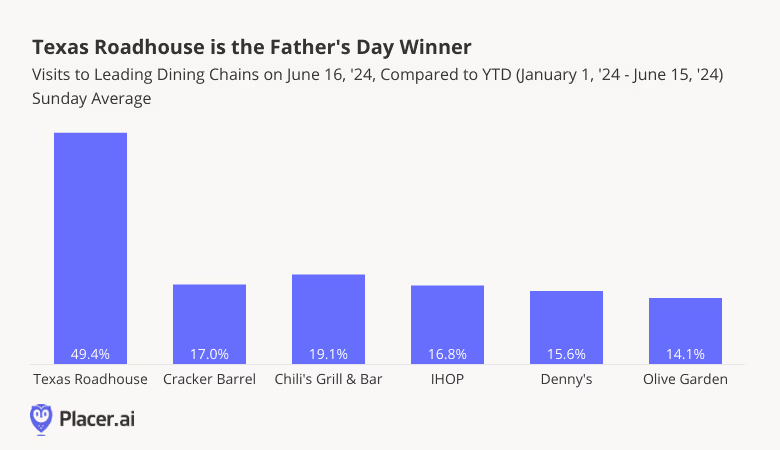
Steakhouse chain Texas Roadhouse has enjoyed a positive few years, weathering the pandemic with aplomb before moving into an expansion phase. And this year, the chain ranked in the top five for service, food quality, and overall experience by the 2024 Datassential Top 500 Restaurant Chain.
Like Shake Shack, Texas Roadhouse has raised its prices over the past year – three times – while maintaining impressive visit metrics. Between January and August 2024, foot traffic to the steakhouse grew by 9.7% YoY, outpacing visits to the overall FSR segment by wide margins.
This foot traffic growth is fueled not only by expansion but also by the chain's ability to draw traffic during quieter dayparts like weekday afternoons, while at the same time capitalizing on high-traffic times like weekends. Some 27.7% of weekday visits to Texas Roadhouse take place between 3:00 PM and 6:00 PM – compared to just 18.9% for the broader FSR segment – thanks to the chain’s happy hour offerings early dining specials. And 43.3% of visits to the popular steakhouse take place on Saturdays and Sundays, when many diners are increasingly choosing to splurge on restaurant meals, compared to 38.4% for the wider category.
Though rising costs have been on everybody’s minds, summer 2024 may be best remembered as the summer of value – with many quick-service restaurants seeking to counter higher prices by embracing Limited-Time Offers (LTOs). These LTOs offered diners the opportunity to save at the register and get more bang for their buck – while boosting visits at QSR chains across the country.
Limited time offers such as discounted meals and combo offers can encourage frequent visits, and Hardee’s $5.99 "Original Bag" combo, launched in August 2024, did just that. The combo allowed diners to mix and match popular items like the Double Cheeseburger and Hand-Breaded Chicken Tender Wraps, offering both variety and affordability. And visits to the chain during the month of August 2024 were 4.9% higher than Hardee’s year-to-date (YTD) monthly visit average.
August’s LTO also drove up Hardee’s already-impressive loyalty rates. Between May and July 2024, 40.1% to 43.4% of visits came from customers who visited Hardee’s at least three times during the month, likely encouraged by Hardee’s top-ranking loyalty program. But in August, Hardee’s share of loyal visits jumped to 51.5%, highlighting just how receptive many diners are to eating out – as long as they feel they are getting their money’s worth.
McDonald’s launched its own limited-time offer in late June 2024, aimed at providing value to budget-conscious consumers. And the LTO – McDonald’s foray into this summer’s QSR value wars – was such a resounding success that the fast-food leader decided to extend the deal into December.
McDonald’s LTO drove foot traffic to restaurants nationwide. But a closer look at the chain’s regional captured markets shows that the offer resonated particularly well with “Young Urban Singles” – a segment group defined by Spatial.ai's PersonaLive dataset as young singles beginning their careers in trade jobs. McDonald's locations in states where the captured market shares of this demographic surpassed statewide averages by wider margins saw bigger visit boosts in July 2024 – and the correlation was a strong one.
For example, the share of “Young Urban Singles” in McDonald’s Massachusetts captured market was 56.0% higher than the Massachusetts statewide baseline – and the chain saw a 10.6% visit boost in July 2024, compared to the chain's statewide H1 2024 monthly average. But in Florida, where McDonald’s captured markets were over-indexed for “Young Urban Singles” by just 13% compared to the statewide average, foot traffic jumped in July 2024 by a relatively modest 7.3%.
These young, price-conscious consumers, who are receptive to spending their discretionary income on dining out, are not the sole driver of McDonald’s LTO foot traffic success. Still, the promotion’s outsize performance in areas where McDonald’s attracts higher-than-average shares of Young Urban Singles shows that the offering was well-tailored to meet the particular needs and preferences of this key demographic.
While QSR, fast-casual, and FSR chains have largely boosted foot traffic through deals and specials, reputation is another powerful way to attract diners. Restaurants that earn a coveted Michelin Star often see a surge in visits, as was the case for Causa – a Peruvian dining destination in Washington, D.C. The restaurant received its first Michelin Star in November 2023, a major milestone for Chef Carlos Delgado.
The Michelin Star elevated the restaurant's profile, drawing in affluent diners who prioritize exclusivity and are less sensitive to price increases. Since the award, Causa saw its share of the "Power Elite" segment group in its captured market increase from 24.7% to 26.6%. Diners were also more willing to travel for the opportunity to partake in the Causa experience: In the six months following the award, some 40.3% of visitors to the restaurant came from more than ten miles away, compared to just 30.3% in the six months prior.
These data points highlight the power of a Michelin Star to increase a restaurant’s draw and attract more affluent audiences – allowing it to raise prices without losing its core clientele. Wealthier diners often seek unique culinary experiences, where price is less of a concern, making these establishments more resilient to inflation than more venues that serve more price-sensitive customers.
Dining preferences continue to evolve as restaurants adapt to a rapidly changing culinary landscape. From the rise in fast-casual dining to the benefits of limited-time offers, the analyzed restaurant categories are determining how to best reach their target audiences. By staying up-to-date with what people are eating, these restaurant categories can hope to continue bringing customers through the door.

The COVID-19 pandemic – and the subsequent shift to remote work – has fundamentally redefined where and how people live and work, creating new opportunities for smaller cities to thrive.
But where are relocators going in 2024 – and what are they looking for? This post dives into the data for several CBSAs with populations ranging from 500K to 2.5 million that have seen positive net domestic migration over the past several years – where population inflow outpaces outflow. Who is moving to these hubs, and what is drawing them?
The past few years have seen a shift in where people are moving. While major metropolitan areas like New York still attract newcomers, smaller cities, which offer a balance of affordability, livability, and career opportunities, are becoming attractive alternatives for those looking to relocate.
Between July 2020 and July 2024, for example, the Austin-Round Rock-Georgetown, TX CBSA, saw net domestic migration of 3.6% – not surprising, given the city of Austin’s ranking among U.S. News and World Report’s top places to live in 2024-5. Raleigh-Cary, NC, which also made the list, experienced net population inflow of 2.6%. And other metro areas, including Fayetteville-Springdale-Rogers, AR (3.3%), Des Moines-West Des Moines, IA (1.4%), Oklahoma City, OK (1.1%), and Madison, WI (0.6%) have seen more domestic relocators moving in than out over the past four years.
All of these CBSAs have also continued to see positive net migration over the past 12 months – highlighting their continued appeal into 2024.
What is driving domestic migration to these hubs? While these metropolitan areas span various regions of the country, they share a common characteristic: They all attract residents coming, on average, from CBSAs with younger and less affluent populations.
Between July 2020 and July 2024, for example, relocators to high-income Raleigh, NC – where the median household income (HHI) stands at $84K – tended to hail from CBSAs with a significantly lower weighted median HHI ($66.9K). Similarly, those moving to Austin, TX – where the median HHI is $85.4K – tended to come from regions with a median HHI of $69.9K. This pattern suggests that these cities offer newcomers an aspirational leap in both career and financial prospects.
Moreover, most of these CBSAs are drawing residents with a younger weighted median age than that of their existing residents, reinforcing their appeal as destinations for those still establishing and growing their careers. Des Moines and Oklahoma City, in particular, saw the largest gaps between the median age of newcomers and that of the existing population.
Career opportunities and affordable housing are major drivers of migration, and data from Niche’s Neighborhood Grades suggests that these CBSAs attract newcomers due to their strong performance in both areas. All of the analyzed CBSAs had better "Jobs" and "Housing" grades compared to the regions from which people migrated. For example, Austin, Texas received the highest "Jobs" rating with an A-, while most new arrivals came from areas where the "Jobs" grade was a B.
While the other analyzed CBSAs showed smaller improvements in job ratings, the combination of improvements in both “Jobs” and “Housing” make them appealing destinations for those seeking better economic opportunities and affordability.
Young professionals may be more open than ever to living in smaller metro areas, offering opportunities for cities like Austin and Raleigh to thrive. And the demographic analysis of newcomers to these CBSAs underscores their appeal to individuals seeking job opportunities and upward mobility.
Will these CBSAs continue to attract newcomers and cement their status as vibrant, opportunity-rich hubs for young professionals? And how will this new mix of population impact these growing markets?
Visit Placer.ai to keep up with the latest data-driven civic news.